 Endophytic colonization of Eucalyptus by Beauveria bassiana and Metarhizium anisopliae and their effects on plant growth
Abstract
Entomopathogenic fungi are effective biological control agents for pest management, also demonstrating several benefits to host plants when acting as endophytes. These fungi benefit from the host’s nutrition and protection, while plants gain greater resistance to herbivores, pathogens, and other biotic stresses. This study evaluated one isolate each of Beauveria bassiana (Balsamo) Vuillemin and Metarhizium anisopliae (Metschnikoff) Sorokin for their endophytic colonization ability and growth-promotion effects in Eucalyptus L’Hér plants. Two methods of artificial inoculation, stem injection and foliar spraying, were used for both fungal species and performed at 0, 15, 30, and 45 days after inoculation. Both fungal isolates successfully colonized Eucalyptus tissues during all evaluated periods. The colonized Eucalyptus plants showed increased number of leaves and branches after endophytic colonization by B. bassiana. M. anisopliae had a higher colonization rate when inoculated by both methods (stem injection and foliar spraying). The positive effects of endophytic colonization on plant growth are associated with the production of bioactive metabolites by the species, via mechanisms that are not yet fully understood. Endophytic isolates offer strategies that may contribute to pest management in Eucalyptus plantations.
Keywords:
entomopathogenic fungi; foliar spraying; stem injection; growth promotion; biological control
Resumo
Fungos entomopatogênicos são agentes de controle biológico eficazes para o manejo de pragas, demonstrando também diversos benefícios para as plantas hospedeiras quando atuam como endófitos. Esses fungos se beneficiam da nutrição e proteção do hospedeiro, enquanto as plantas obtêm maior resistência a herbívoros, patógenos e outros estresses bióticos. Este estudo avaliou um isolado de cada um dos fungos Beauveria bassiana (Balsamo) Vuillemin e Metarhizium anisopliae (Metschnikoff) Sorokin quanto à sua capacidade de colonização endofítica e efeitos de promoção do crescimento em plantas de Eucalyptus L’Hér. Dois métodos de inoculação artificial, injeção no caule e pulverização foliar, foram utilizados para ambas as espécies de fungos e realizados em 0, 15, 30 e 45 dias após a inoculação. Ambos os isolados fúngicos colonizaram com sucesso os tecidos de Eucalyptus em todos os períodos avaliados. As plantas de Eucalyptus colonizadas apresentaram aumento no número de folhas e ramos após a colonização endofítica por B. bassiana. M. anisopliae apresentou maior taxa de colonização em ambos os métodos (injeção no caule e pulverização foliar). Os efeitos positivos da colonização endofítica no crescimento da planta estão relacionados à produção de metabólitos bioativos pela espécie por meio de mecanismos ainda não totalmente compreendidos. Isolados endofíticos oferecem estratégias que podem contribuir para o manejo de pragas em plantações de eucalipto.
Palavras-chave:
fungos entomopatogênicos; pulverização foliar; injeção no caule; promoção do crescimento; controle biológico
1. Introduction
In the forestry sector, pests are among the threats that cause the greatest productivity loss, thereby affecting the economic viability and sustainability of forestry (Gullino et al., 2022). Planting uniformity, reduced genetic diversity, and a shortage of natural pest enemies can hinder intensive forestry (Tomé et al., 2021). This can contribute to the proliferation and pathogenicity of insects (Dal Pogetto et al., 2024). Consequently, it becomes more difficult to implement control strategies, thereby increasing production costs (Bastit et al., 2023).
Eucalyptus L’Hér is the most commonly used genus for afforestation and reforestation worldwide (Qin and Yu, 2021) because of its rapid growth, high productivity, and adaptability. It is also widely used as a raw material in pulp and paper industries (Rocha et al., 2023). Eucalyptus is an efficient biomass producer and plays a significant role in mitigating climate change because it is fast-growing and can sequester more CO2 through photosynthesis (Bayle, 2019), thereby contributing to biodiversity conservation (Palmieri et al., 2020).
In recent years, the productivity of Eucalyptus plantations has been threatened by invasive pests. Pests affecting Eucalyptus plantations include the gall wasp, Leptocybe invasa (Hymenoptera: Eulophidae); the Eucalyptus psyllid (Glycaspis brimblecombei); the stem borer Zeuzera multistrigata Moore (Lepidoptera, Cossidae); aphids such as Cinara eucalypti and Eucalyptus aphids; the leafhopper Mahanarva fimbriate; and leaf-cutting ants Atta spp. and Acromyrmex spp. (Barbosa et al., 2023). Some of these pests are specific to certain regions and their effects on plantations vary. Knowledge of the main pests affecting Eucalyptus is crucial for developing management and quarantine strategies, advancing research, protecting plantations, and mitigating the global economic and ecological impacts that threaten the species financial viability (Choi and Park, 2019).
The search for alternatives that enable efficient and sustainable management is expanding the use of biocontrols, including entomopathogenic fungi that act endophytically on plant species. Endophytic fungi are effective biological control agents for pest management (Mantzoukas and Eliopoulos, 2020). These organisms act symbiotically, triggering local and/or systemic defense (Chen et al., 2021). The great versatility of entomopathogenic endophytic fungi (EEF) is precisely the ability of these organisms to infect plants at all stages of their development, since these fungi can penetrate plant tissues naturally or artificially (Mhoswa et al., 2020; Bandeira et al., 2023) and establish a mutualistic symbiotic relationship with their hosts, directly or indirectly promoting adaptability to hardships, including biological and abiotic stress (Liu et al., 2022; Mesquita et al., 2025; Joseph et al., 2025).
Several species of entomopathogenic fungi transgress the insect cuticle through a combination of degrading enzymes and mechanical pressure (Bali et al., 2022), thereby perforating the insect hemocoel and multiplying throughout the host insect (Francis et al., 2022). The EEF infection pathway in host insects is ensured through a series of subsequent cuticle transgression phases: infection, presented by the attachment of conidia, germination, production of infection structures, and penetration into the host; growth, described by the proliferation of the fungus through hyphal bodies and blastospores, as well as the production of secondary metabolites in the hemocoel; and reproduction, presented by fungal excrescence, where asexual conidia are passively released and a new infection cycle is initiated (Chen et al., 2021; Mhoswa et al., 2020).
The community structure and distribution patterns of endophytes in host plants are influenced by various factors including agricultural practices, host plant genetics, geography, season, and vegetation structure (Saqib et al., 2022). The pattern of fungal colonization and spatial distribution can vary among the host plant’s roots, stems, and leaves (Mhoswa et al., 2020).
The genera Metarhizium and Beauveria have been successfully inoculated, either naturally or artificially, into various plant species using different techniques (Saqib et al., 2022; Santoyo et al., 2016). This colonization has resulted in increased growth and reduced pest infestation in economically important crops (Klieber and Reineke, 2016). Endophytic fungi have antagonistic effects on various insect pests and microbial pathogens and modify the bioavailability of nutrients to host plants, thereby improving host plant growth and controlling insect pests (Liao et al., 2017; Pourtaghi et al., 2020).
Although entomopathogenic fungi are widely studied as endophytes, there is still a clear research gap regarding comparative performance between species under different inoculation methods in forest species such as Eucalyptus. Therefore, this study was conducted to evaluate the endophytic colonization capacity of Eucalyptus by two entomopathogenic fungi, Beauveria bassiana (Bals.) Vuill (Ascomycota: Hypocreales) (1992) and Metarhizium anisopliae Sorokin (Metschnikoff) (Ascomycota: Hypocreales) (1976), using two artificial inoculation methods, stem injection and foliar spraying, at three different periods, and to verify the effects of such inoculation on plant growth. Such insights are essential for optimizing the use of endophytic fungi in forestry systems.
2. Materials and Methods
2.1. Study area
The experiment was conducted in the municipality of Gurupi, in the state of Tocantins, Brazil (11°44’45.41’’S and 49°03’10.60’’W, 284 m of altitude). The region’s climate is type Aw, defined as tropical savanna with two well-defined seasons, one rainy and one dry, according to the Köppen-Geiger classification (Beck et al., 2018). Environmental conditions varied naturally, with an average daily temperature of 25.96 °C and an average daily precipitation of 5.66 mm (Sparks, 2018; Figure S1, Supplementary Material).
2.2. Plant material
Plant material was obtained from a hybrid clone of Eucalyptus tereticornis Sm. × Eucalyptus camaldulensis Dehnh (VS058). Cuttings of this material were produced and cultivated until they reached 120 days of age and a height of approximately 90 cm. They were then transplanted into 2.6 L plastic pots containing commercial Bioplant® substrate (Bioplant Plus, Nova Ponte, Minas Gerais, Brazil), which had previously been autoclaved. The cuttings were fertilized every 2 weeks with 5 g of granulated fertilizer (10-10-10 NPK and Yoorin Master 1S, Poços de Caldas, Minas Gerais, Brazil). Before inoculation, the plants were acclimatized for 30 days. The plants were watered twice daily throughout the experiment.
2.3. Fungal isolates and preparation of conidia
Two entomopathogenic fungi, B. bassiana and M. anisopliae, were used in this study. B. bassiana was isolated from the commercial product Boveril® (Koppert do Brasil, Piracicaba, São Paulo, Brazil) and M. anisopliae was obtained from a Tenebrio molitor larva (Coleoptera: Tenebrionidae) kept in contact with forest soil using the bait technique (deposited in the UNESP Microbial Collection under the code CRM 1397) (Saqib et al., 2020).
The fungal isolates were subcultured in Petri dishes containing potato dextrose agar (PDA) culture medium plus amoxicillin (500 mg/L) and kept in a climate chamber at 26 ± 2 °C, with a 12-hour photoperiod for approximately 7 to 10 days to obtain conidia on the entire dish. After this period, 10 mL of distilled water and 0.02% (v/v) Tween 80 were added to each plate to collect conidia, which were then suspended using a sterilized spatula. The suspension was shaken vigorously for 5 min to homogenize the mixture and then filtered through a double layer of sterile gauze. An aliquot of this suspension was placed in a Neubauer chamber to determine conidial concentration. The inoculum was adjusted 1 × 10⁸ spores/mL/L. The suspension was adjusted to 1 ×10⁸ conidia/mL/L, following Gurulingappa et al. (2010).
A sample of this fungal suspension at a concentration of 1 × 10⁸ conidia/mL/L was used to determine the viability of conidia before inoculation. The process consisted of spreading 150 μL of the suspension on plates containing PDA supplemented with amoxicillin (500 mg/L) with a millimeter face. The plates were incubated a B.O.D incubator at 26 ± 2 °C with a 12-hour photoperiod for 3 days.
Germination was determined by counting the viable conidia on a plate using an optical microscope (Leica DM500) (Lacey, 2012). Germination was considered positive when the length of the germ tube was twice the diameter of the conidia. Four plates were used for each isolate to assess viability. Conidial viability exceeded 80% for both B. bassiana and M. anisopliae.
2.4. Experimental design
The experimental design was entirely randomized, in a 3 × 2 × 4 factorial scheme, with the first factor corresponding to B. bassiana, M. anisopliae, and the control, and the second factor corresponding to the inoculation methods: stem injection and foliar spraying. The third factor was evaluation time, with 0, 15, 30, and 45 days after inoculation (d.a.i.). Each treatment had six repetitions, and each plant was considered a repetition.
2.5. Inoculation by stem injection and foliar spraying
To conduct inoculation via stem injection, each plant was pierced through the stem up to the cortical parenchyma using a 0.45 mm thick pin below the antepenultimate fully expanded leaf. After removing the pin, 0.5 mL of the conidia suspension was introduced using an injection syringe (Figure S2 Supplementary Material). The injection site was sealed with a short piece of micropore tape (Batista et al., 2021).
To guarantee the entry of fungal spores in the inoculation method via foliar spraying, swabs were made on the adaxial surfaces of the fourth, fifth, and sixth fully expanded leaves with the aid of a soft sponge so that the lesion did not pass through the tissue of interest. Thirty milliliters of the conidial suspension was sprayed onto each plant using a plastic handheld sprinkler and applied directly to the leaf tissue (Figure S2 Supplementary Material). The intervals between the leaves and smears were delimited using colored ribbons.
For the control treatments, inoculations were performed using a solution of autoclaved distilled water with 0.02% (v/v) Tween 80. After inoculation, all plants were covered with sterile, transparent plastic bags for 48 h to maintain a moist, favourable environment for fungal growth.
2.6. Endophytic colonization assessment
Two leaves were collected from each plant, one above the inoculation site, referred to as the upper leaf, and the other below the inoculation site, referred to as the lower leaf. To verify endophytic colonization, repetitions were counted if at least one disc from the three discs isolated from the leaf showed the fungus of interest in the study. Therefore, the value three is the maximum for counting endophytic colonies considering each sampling position. This collection was carried out 15 days after inoculation (d.a.i.) and repeated 30 and 45 d.a.i. In the last collection (45 d.a.i.), in addition to these leaves, a leaf primordium and three root segments were collected: one from the main root and two from the secondary root. Due to the collection of material at 15 days after inoculation (d.a.i.), some plants did not develop and did not generate material to be collected at 30 d.a.i. (22 plants) or 45 d.a.i. (6 plants) assessments. For these plants, a value of zero was assigned because, although they were alive, the absence of new leaves made collection impossible. This absence of new leaves occurred for both fungi (B. bassiana and M. anisopliae).
The collected leaves were subjected to a superficial decontamination process using running water and a soft sponge after their mesophyll was sealed with melted paraffin. The tissue was then cleaned by immersing it in 70% ethyl alcohol for 2 min, then in and 3% sodium hypochlorite for 1 min, followed by washing in sterile distilled water (Agboyi et al., 2020). The plant material was then dried on sterile filter paper in a laminar-flow chamber.
After decontamination, leaves were cut into three circular fragments with diameter of 8–13 mm. Fully expanded leaves and leaf primordia were cut into the same dimensions 45 d.a.i. They were then transferred to Petri dishes containing PDA medium supplemented with amoxicillin (500 μg/m). Two Petri dishes were prepared for each plant and the plant tissues were separated based on their inoculation sites.
The plates were incubated at 26 °C and monitored daily to track fungal growth. Colonization was characterized only when the FEE colonies grew from the inner tissue to the edge of the isolated plant material. To confirm that the growing fungi were inoculated, slides were prepared based on the macroscopic morphology using the microcultivation technique (Humber, 2012). Slides of the original fungi were prepared for comparison and morphological identification, following the keys provided by Humber (Humber, 2012).
2.7. Evaluation of plant morphology
To determine the effects of fungal inoculation on plant growth, the following parameters were evaluated: plant height (from the base to the top leaf, in cm), stem diameter (in mm), number of fully expanded leaves per plant, and number of branches per plant collected 15, 30, and 45 d.a.i, as well as the biomass of the aerial parts and roots collected at 45 days of age. The plant materials were placed in an oven at 75 ± 2 °C to determine the dry biomass. For both fresh and dry biomass, the total biomass values were determined by summing the biomass of the aboveground portion with that of the roots (Oliveira-Neto et al., 2003)
2.8. Statistical analysis
The data obtained, when they met the assumptions, were subjected to analysis of variance, and the means were subjected to the Skott-Knott multiple comparison test (Scott and Knott, 1974). The statistical model used in the analysis of variance was (Equation 1):
in which represents the response trait, represents the effect of the overall average, represents the effect of the i-th fungus (i = 1 and 2), represents the effect of the j-th method (j = 1 and 2), represents the effect of the k-th time (k = 1, 2, 3, e 4), represents the dual interaction between fungus and method, represents the dual interaction between fungus and time, represents the dual interaction between method and time, represents the triple interaction between the factors and represents the random error.
To model the endophytic colony count in the aerial part and root, the Poisson regression model was used. To model the count of colonization in the aerial part, model (1) was used, supplemented by the effect of position (above or below) in relation to inoculation. McFadden's pseudo-R2 was calculated to assess the quality of the Poisson regression model (McFadden, 1973). The count of colonizations in the root part occurred at the end of the experiment (d.a.i. = 45), therefore the Poisson regression model considered for the root was model (1) removing the effects involving the time effect. All analyses were performed using the R software (R Development Core Team, 2026).
3. Results
Analysis of variance was not used to model endophytic colonization counts because both assumptions were violated. In this scenario, the Poisson regression model is the most commonly used for modeling count data (Coxe et al., 2009). The effect of position, whether above or below the inoculation site, did not show a significant effect in the deviance analysis for colony counts in shoot fragments (p-value = 0.2937) and was discarded to generate a more parsimonious model. In the deviance analysis of the complete Poisson regression model, the three-way interaction (p-value = 0.0646), and the two-way interactions between fungus and time (p-value = 0.6383), fungus and method (p-value = 0.8277), and time and method (p-value = 0.7823) were not significant and were also discarded from the model (Table S1 Supplementary Material). Therefore, the final model for colony counting in shoot fragments included only the main effects of fungus, method, and time. Considering the colony count in the root, the effect of position (p-value = 0.1300) and the double interaction between fungus and method was also not significant (p-value = 0.9667), and both effects were discarded from the model. The next model for the root considered only the effects of fungus (p-value = 0.3650) and method (p-value = 0.7630), although neither was significant. Thus, the final model for counting colonies at the root included only the intercept, since the other effects were not statistically significant (Table S1 Supplementary Material).
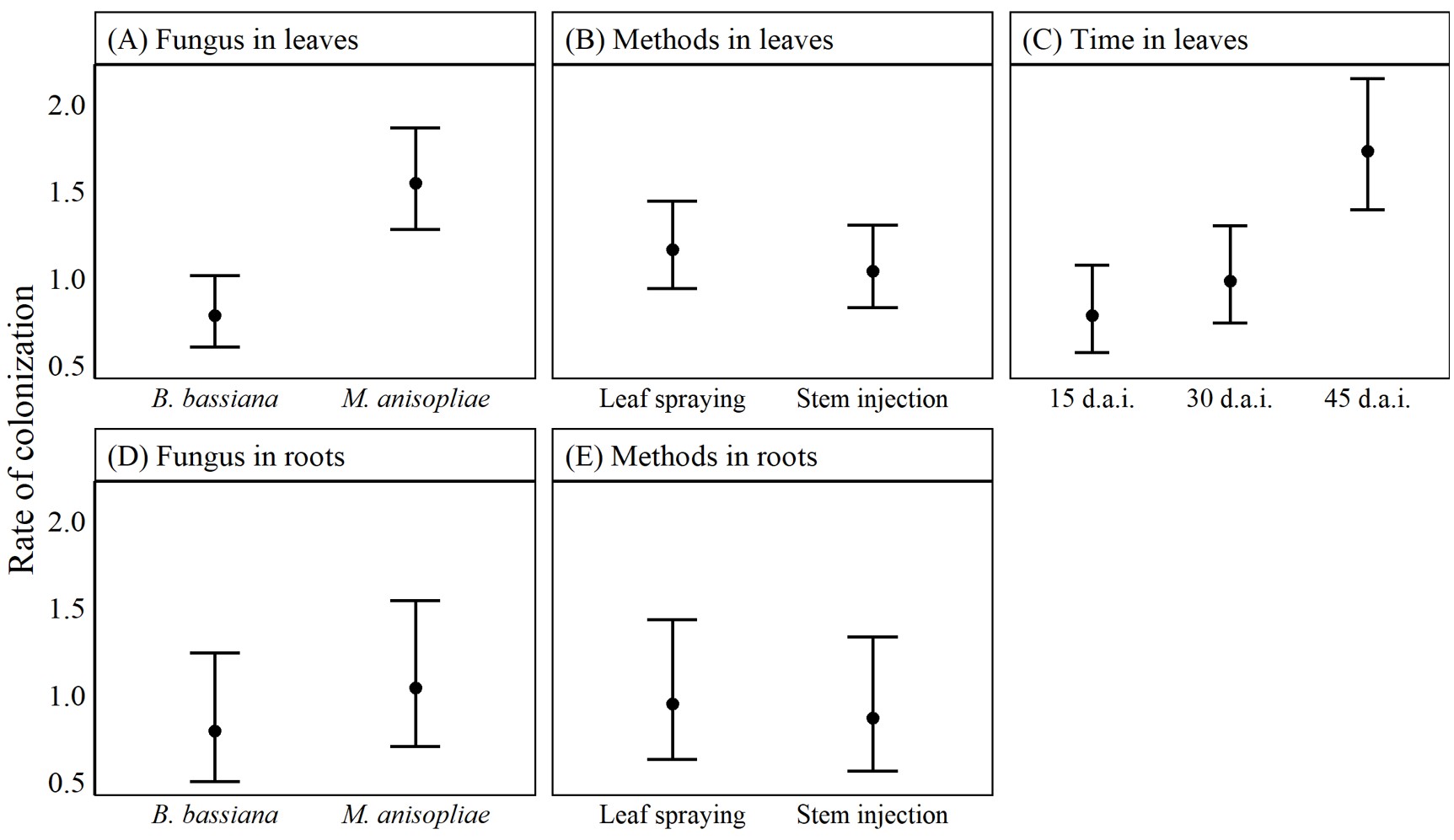
The maximum value of the average rate modeled in the Poisson regression is three, as this was the number of fragments collected at each position and on each plant in the experiment. Considering the fungal effect, M. anisopliae presented an average rate (r = 1.54, CI = [1.28, 1.86]) statistically superior to the estimated value for B. bassiana (r = 0.78, CI = [0.60, 1.01]) for counting endophytic colonies (Figure 1A). Considering the effect of the methods on colony counting, the average rates between stem injection (r = 1.04, CI = [0.83, 1.30]) and leaf spraying (r = 1.16, CI = [0.94, 1.44]) were statistically equal (Figure 1B). In the comparison of average time rates, the highest value was observed at 45 d.a.i. (r = 1.73, CI = [1.39, 2.14]), while 15 d.a.i. (r = 0.78, CI = [0.57, 1.07]) and 30 d.a.i. (r = 0.98, CI = [0.74, 1.30]) were statistically equal (Figure 1C). When counting colonies on roots, there were no significant differences between methods or between the fungi (Figure 1).
Rate of endophytic colonization by B. bassiana and M. anisopliae 15, 30, and 45 days after inoculation (d.a.i.) by the methods of leaf spraying and stem injection estimated by the Poisson regression model. Error bars indicate the 95% confidence intervals. Graph A shows the comparison of colonization rates among fungal species in the leaves, graph B shows the comparison between methods, and graph C shows the comparison between evaluation times. Graph D shows the comparison of colonization rates among fungal species in the roots, and graph E shows the comparison between methods.
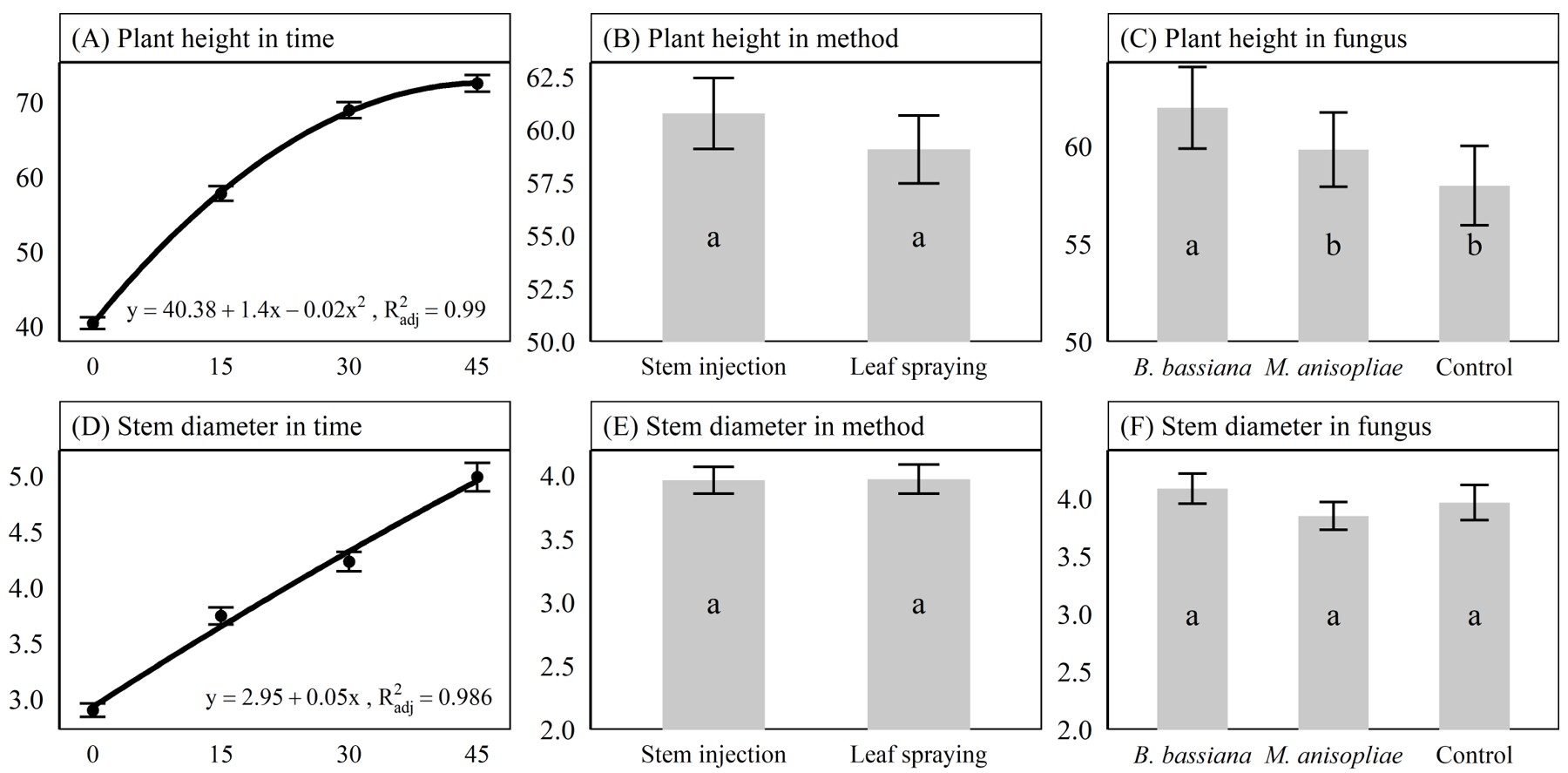
The analysis of variance showed a significant effect for time only (p-value < 0.0001) on stem diameter (Table S2 Supplementary Material, Figure 2). Considering plant height, time (p-value < 0.0001) and fungus (p-value = 0.0066) showed a significant effect (Figures 22C). B. bassiana (61.97 cm) showed the highest average plant height, while M. anisopliae (59.82 cm) showed an average statistically equal to the control (57.98 cm) (Figure 2C).
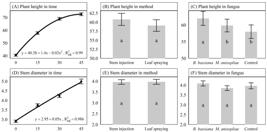
Height (cm) and stem diameter (mm) of Eucalyptus plants endophytically colonized by B. bassiana and M. anisopliae 15, 30, and 45 days after inoculation via foliar spraying and stem injection. Different letters indicate differences in the averages within each graph (p-value < 0.05). Graphs A, B, and C present the results for the plant height regarding the effects of time, method, and fungus, respectively. Graphs D, E, and F present the results for the stem diameter regarding the effects of time, method, and fungus, respectively.
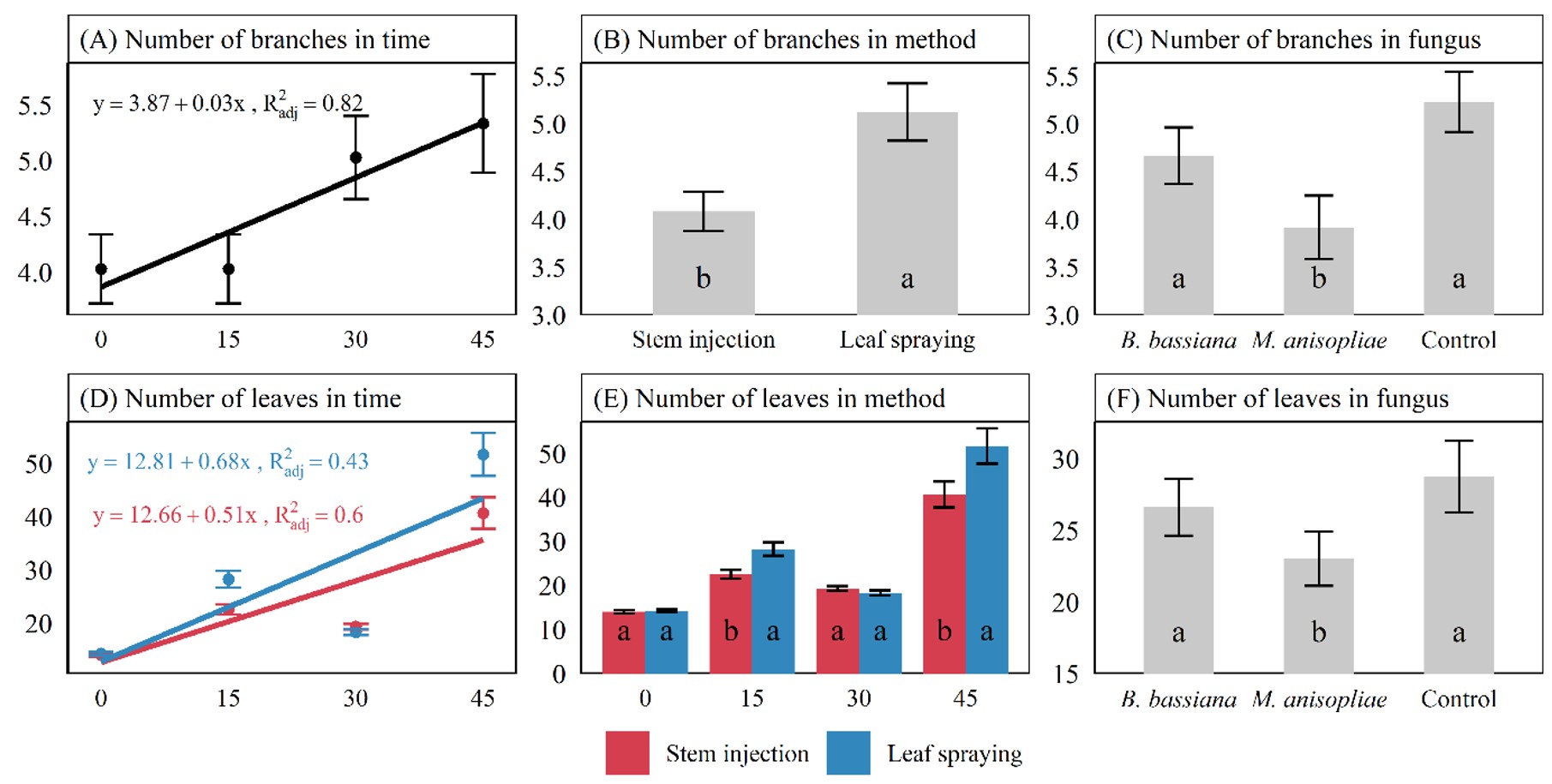
Considering the number of branches, time (p-value = 0.0168), method (p-value = 0.0045), and fungus (p-value = 0.0135) showed significant effects (Table S2 Supplementary Material). Since no interaction was significant, the main effects were studied separately (Figures 3A, 3B, 3C). The number of branches showed a linear relationship with time (Figure 3A). Regarding the method, leaf spraying (5.13) had a higher average than stem injection (4.08) (Figure 3B). In the comparison between fungi, B. bassiana and the control showed the highest average number of branches (Figure 3C).
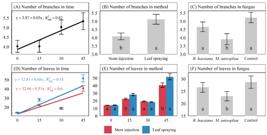
Number of leaves and branches of Eucalyptus plants endophytically colonized by B. bassiana and M. anisopliae 15, 30, and 45 days after inoculation via foliar spraying and stem injection. Different letters indicate differences in the averages within each graph (p-value < 0.05). Graphs A, B, and C present the results for the number of branches regarding the effects of time, method, and fungus, respectively. Graphs D, E, and F present the results for the number of leaves regarding the effects of time, method, and fungus, respectively.
Regarding the number of leaves, the two-way interaction between time and method was significant (p-value = 0.0061), and the main effect of fungus was also significant (p-value = 0.0023; Table S2 Supplementary Material). For this trait, a time comparison was made for each method, and a comparison between methods within each time was conducted due to the significant interaction (Figures 33E). Considering time, the increase in the number of leaves was faster ( for leaf spraying, for stem injection) when using the leaf spraying method (Figure 3D). In comparisons between methods within each time period, leaf spraying showed the highest averages at 15 and 45 d.a.i., while both methods were equal at 0 and 30 d.a.i. (Figure 3E). Regarding the fungi, B. bassiana and the control showed the highest averages for the number of leaves, exceeding the average of M. anisopliae (Figure 3F).
There were no significant differences between the treatments evaluated, indicating that there was no interference from the time, fungi, or inoculation methods on the production of fresh and dry biomass of the plants (Table S3 Supplementary Material).
4. Discussion
The results of this study showed that both M. anisopliae and B. bassiana can endophytically colonize different parts of eucalyptus plants. The higher rate of endophytic colonization observed in the upper leaves at 45 days of age for both fungi and inoculation methods could be explained by the systemic spread of these microorganisms, which affects various aspects of plant morphology and physiology, compromising natural physiological processes. Endophytic fungi act symbiotically, triggering both local and systemic defences (Bacon, 1994; Bandeira et al., 2023). The model presented a low pseudo-R2 (0.09; Table S1 Supplementary Material), indicating that the variability explained by the predictors is limited.
The contrasting responses observed in this study despite higher colonization by Metarhizium anisopliae and greater plant growth promotion by Beauveria bassiana, likely reflect functional differences in ecological strategies and plant–fungus interactions. Species of Metarhizium are recognized for their strong rhizosphere competence and ability to efficiently colonize plant tissues, particularly roots, facilitated by adaptations for soil persistence and nutrient acquisition, including the transfer of insect-derived nitrogen to plants (Behie et al., 2015; Barelli et al., 2019). This ecological specialization may explain the higher colonization rates observed for M. anisopliae. In contrast, although B. bassiana showed lower colonization frequency, its more pronounced effects on plant growth may be associated with its capacity to modulate plant physiology through the production of phytohormones, such as indole-3-acetic acid, and other bioactive metabolites that enhance nutrient uptake and stimulate shoot development (Liao et al., 2017; Baron and Rigobelo, 2021; Sui et al., 2023). Additionally, B. bassiana has been reported to establish a more systemic distribution within plant tissues, potentially leading to broader effects on plant metabolism and morphology (Behie et al., 2015; Tall and Meyling, 2018). Thus, while M. anisopliae appears to be more efficient in colonization per se, B. bassiana may exert stronger functional impacts on host growth, highlighting that colonization intensity is not necessarily directly correlated with plant growth promotion, but rather with the specific metabolic and signaling interactions established between the endophyte and the host plant.
The pathogenicity of B. bassiana depends on the concentration of the conidial suspension, host specificity, and abiotic factors (Paiva-Guimarães et al., 2020). The cuticle is the main physical and chemical barrier that fungal entomopathogens must overcome to infect the host (Ramirez et al., 2018). Based on the lower colonization rate of B. bassiana, we assumed that its lower performance in the process of adhesion or passage through the insect cuticle may be associated with the adhesion kinetics of the conidia, which are influenced by electrostatic charges and low relative humidity, as well as factors that contribute to the properties of the cuticle, such as nutrient levels, endogenous microbial flora, and cross-linked proteins (Agboyi et al., 2020).
The effects of endophytic microorganisms on their hosts are diverse, and they can be found in various parts of plants, including endophytic fungi, at different stages of their life cycle, causing no obvious damage to the host (Xia et al., 2019). Studies on the interactions between plants and endophytic fungi have indicated that this relationship can offer various benefits to host plants (Jia et al., 2016). Some of these effects include increased host nutrient content and phytohormone modulation to accelerate plant growth, increase root development, and improve crop yield and quality (Cheng et al., 2022). Increased mineral absorption and improved water use efficiency may be the active factors that promote plant growth, in addition to potential contributions through biological nitrogen fixation (Baron and Rigobelo, 2021).
The increase in the morphological characteristics of the Eucalyptus plants in this study showed a beneficial association between the entomopathogenic fungi and the plants via mycelium-root connections in a positive tritrophic association between the host insect, fungus, and plant in the rhizosphere (Behie et al., 2015), resulting in increased plant height, number of leaves and number of branches. The influence of inoculation with the two fungi on plant growth in this study was divergent for some of the characteristics evaluated, as fungal genera often exhibit different locations in plant tissues, with the endophytic Metarhizium restricted almost exclusively to the root system, whereas B. bassiana established itself as an endophyte in all plant tissues, indicating direct responses to the effect of inoculation in different parts of the plant (Cheng et al., 2022).
The increase in leaf and branch number following B. bassiana inoculation may be explained by the nutrient-exchange interactions established during endophytic colonization, whereby the fungus contributes nitrogen in exchange for carbon from the plant (Tall and Meyling, 2018). The pattern of gain and loss of carbohydrate-active enzymes is characteristic of the Metarhizium clade and reflects the extent of its continuous interaction with plants, manifesting physiological compensation (Amobonye et al., 2023).
Endophytic colonization by Metarhizium and Beauveria promotes the growth of many plant species (Liao et al., 2017; Tall and Meyling, 2018; Sui et al., 2023). The most direct growth-promoting effects of these species include indole-3-acetic acid (IAA) production, root development stimulation (Baron and Rigobelo, 2021), solubilisation of phosphorus from soil rocks, making it more accessible to plants, and facilitation of the transfer of nitrogen by hyphae connecting insect exoskeletons to plant roots (Barelli et al., 2019). A common effect on plant development is increased root growth (Liao et al., 2017; Batista et al., 2021), which was no observed in this study using B. bassiana and M. anisopliae fungi.
The absence of significant differences in fresh and dry biomass, despite observed increases in plant height, number of leaves, and branches, may be explained by a decoupling between morphological changes and biomass accumulation during early plant development. In young plants, increases in height and organ number often reflect alterations in growth patterns driven by hormonal modulation—such as auxin-mediated elongation and branching—rather than actual biomass gain (Taiz et al., 2017; Baron and Rigobelo, 2021). Endophytic fungi like Beauveria bassiana and Metarhizium anisopliae are known to influence plant architecture through phytohormone production and signaling, promoting shoot elongation and leaf initiation without necessarily increasing carbon assimilation or biomass allocation in the short term (Liao et al., 2017; Tall and Meyling, 2018). Additionally, biomass accumulation depends on longer-term carbon balance and resource-use efficiency, which may not yet be fully expressed within the 45-day evaluation period (Poorter et al., 2012). It is also possible that changes in biomass partitioning—such as allocation between shoots and roots—masked treatment effects on total biomass, resulting in non-significant differences even when morphological traits were affected (Poorter et al., 2012; Baron and Rigobelo, 2021).
Although the mechanism underlying this increase in plant growth has not been fully elucidated, entomopathogenic fungi have been observed to produce siderophores and organic acids, which can alter the bioavailability of various nutrients (Liao et al., 2017). In addition, studies on endophytic fungus-plant interactions have revealed that the positive effects may result from nutrient fixation from the soil, the production of bioactive metabolites, or the regulation of hormones such as auxin and ethylene, which can trigger eucalyptus defense mechanisms against various biotic stresses.
5. Conclusions
The cuticular characteristics of Eucalyptus plants were a potential explanation for the success of fungal inoculation, with a lower colonization rate observed for B. bassiana. The positive tritrophic association resulted in increased morphological characteristics, such as plant height, number of branches and number of leaves in the Eucalyptus plants studied. In view of this, we believe that future work should seek to understand which metabolites are being produced or not, and how the dynamics between them are favoring the growth of eucalyptus plants. Another interesting path to follow is to evaluate the performance of these colonized plants against insect pests, since endophytic isolates of B. bassiana and M. anisopliae have potential as biocontrol agents, promoting plant growth and preventing pathogen infestation in Eucalyptus forest crops. Moreover, the increased plant vigor resulting from the observed morphological changes suggests a promising avenue for utilizing endophytic isolates of B. bassiana and M. anisopliae to enhance Eycalyptus forest producitivity, while simultaneously reducing pathogen pressure.
Supplementary Material
Supplementary material accompanies this paper.
Table S1
Table S2
Table S3
Figure S1
Figure S2
This material is available as part of the online article from https://doi.org/10.1590/1519-6984.306757
Acknowledgements
The authors thank the National Council for Scientific and Technological Development (CNPq, Brazil) for financial support through the project (Grant No. 405279/2023-0 and 445388/2024-2), the Coordination for the Improvement of Higher Education Personnel (CAPES, Brazil), and Tocantins State Research Support Foundation (FAPT) for providing fellowships. We are also grateful to the Federal University of Tocantins (UFT) and all members of the Laboratory of Applied and Functional Ecology for their valuable contributions to this work.
Data Availability Statement
The dataset analyzed or produced in this study can be requested from the corresponding author.
References
-
AGBOYI, L.K., KETOH, G.K., KPINDOU, O.K.D., MARTIN, T., GLITHO, I.A. and TAMÓ, M., 2020. Improving the efficiency of Beauveria bassiana applications for sustainable management of Plutella xylostella. Biological Control, vol. 144, pp. 1-9. https://doi.org/10.1016/j.biocontrol.2020.104233
» https://doi.org/10.1016/j.biocontrol.2020.104233 -
AMOBONYE, A., BHAGWAT, P., MTHETHWA, N., KWENDA, S., ISMAIL, A., KUMARI, S., SINGH, S. and PILLAI, S., 2023. Transcriptomic profiling of Beauveria bassiana SAN01, an endophytic fungal entomopathogen, for the production of lignocellulosic enzymes. Biocatalysis and Agricultural Biotechnology, vol. 54, pp. 1-13. https://doi.org/10.1016/j.bcab.2023.102918
» https://doi.org/10.1016/j.bcab.2023.102918 - BACON, C.W., 1994. Biotechnology of endophytic fungi of grasses Boca Raton: CRC Press, 226 p.
-
BALI, G.K., SINGH, S.K., CHAUHAN, V.K., JOSHI, N., BHAT, F.A., MALLA, W.A., RAMANUJAM, B., VARSHNEY, R., KOUR, M. and PANDIT, R.S., 2022. An insight in proteome profiling of Tuta absoluta larvae after entomopathogenic fungal infection. Scientific Data, vol. 9, no. 1, pp. 507. https://doi.org/10.1038/s41597-022-01593-y PMid:35986033.
» https://doi.org/10.1038/s41597-022-01593-y -
BANDEIRA, J.B., RODRIGUES, J.N., OLIVEIRA, R.S., PINTO, I.O., CHAGAS-JÚNIOR, A.F., NASCIMENTO, V.L., SARMENTO, M.I., MORAES, C.B. and SARMENTO, R.A., 2023. Endophytic colonization of five Trichoderma species and their effects on growth of a Eucalyptus hybrid. Brazilian Journal of Microbiology : Publication of the Brazilian Society for Microbiology, vol. 54, no. 4, pp. 3113-3125. https://doi.org/10.1007/s42770-023-01112-0 PMid:37661212.
» https://doi.org/10.1007/s42770-023-01112-0 -
BARBOSA, L.R., DOMINGUES, M.M., WILCKEN, C.F. and ZANUNCIO, J.C., 2023. Eucalyptus pests. In: F.O. ASIEGBU and A. KOVALCHUK, ed. Forest microbiology: tree diseases and pests New York: Academic Press, pp 227-249. https://doi.org/10.1016/B978-0-443-18694-3.00020-1
» https://doi.org/10.1016/B978-0-443-18694-3.00020-1 -
BARELLI, L., BEHIE, S.W. and BIDOCHKA, M.J., 2019. Availability of carbon and nitrogen in soil affects Metarhizium robertsii root colonization and transfer of insect-derived nitrogen. FEMS Microbiology Ecology, vol. 95, no. 10, pp. 1-9. https://doi.org/10.1093/femsec/fiz144 PMid:31504453.
» https://doi.org/10.1093/femsec/fiz144 -
BARON, N.C. and RIGOBELO, E.C., 2021. Endophytic fungi: a tool for plant growth promotion and sustainable agriculture. Mycology, vol. 13, no. 1, pp. 39-55. https://doi.org/10.1080/21501203.2021.1945699 PMid:35186412.
» https://doi.org/10.1080/21501203.2021.1945699 -
BASTIT, F., BRUNETTE, M. and MONTAGNÉ-HUCK, C., 2023. Pests, wind and fire: a multi-hazard risk review for natural disturbances in forests. Ecological Economics, vol. 205, pp. 1-15. https://doi.org/10.1016/j.ecolecon.2022.107702
» https://doi.org/10.1016/j.ecolecon.2022.107702 -
BATISTA, K.O.M., SILVA, D.V., NASCIMENTO, V.L. and SOUZA, D.J., 2021. Effects of Trichoderma strigosellum in Eucalyptus urophylla development and leaf-cutting ant behavior. Journal of Fungi (Basel, Switzerland), vol. 8, no. 1, pp. 15. https://doi.org/10.3390/jof8010015 PMid:35049955.
» https://doi.org/10.3390/jof8010015 -
BAYLE, G.K., 2019. Ecological and social impacts of eucalyptus tree plantation on the environment. Journal of Biodiversity Conservation and Bioresource Management, vol. 5, no. 1, pp. 93-104. https://doi.org/10.3329/jbcbm.v5i1.42189
» https://doi.org/10.3329/jbcbm.v5i1.42189 -
BECK, H.E., ZIMMERMANN, N.E., MCVICAR, T.R., VERGOPOLAN, N., BERG, A. and WOOD, E.F., 2018. Present and future Köppen-Geiger climate classification maps at 1-km resolution. Scientific Data, vol. 5, no. 1, pp. 180214. https://doi.org/10.1038/sdata.2018.214 PMid:30375988.
» https://doi.org/10.1038/sdata.2018.214 -
BEHIE, S.W., JONES, S.J. and BIDOCHKA, M.J., 2015. Plant tissue localization of the endophytic insect pathogenic fungi Metarhizium and Beauveria. Fungal Ecology, vol. 13, pp. 112-119. https://doi.org/10.1016/j.funeco.2014.08.001
» https://doi.org/10.1016/j.funeco.2014.08.001 -
CHEN, H.Y., YAO, J.M., HUANG, S.B. and PANG, H., 2021. Ophelimus bipolaris sp. (Hymenoptera, Eulophidae), a new invasive Eucalyptus pest and its host plants in China. Insects, vol. 12, no. 9, pp. 778. https://doi.org/10.3390/insects12090778 PMid:34564218.
» https://doi.org/10.3390/insects12090778 -
CHENG, X.F., XIE, M.M., LI, Y., LIU, B.Y., LIU, C.Y., WU, Q.S. and KUCA, K., 2022. Effects of field inoculation with arbuscular mycorrhizal fungi and endophytic fungi on fruit quality and soil properties of Newhall navel oranges. Applied Soil Ecology, vol. 170, pp. 1-9. https://doi.org/10.1016/j.apsoil.2021.104308
» https://doi.org/10.1016/j.apsoil.2021.104308 -
CHOI, W.I. and PARK, Y.S., 2019. Monitoring, assessment and management of forest insect pests and diseases. Forests, vol. 10, no. 865, pp. 1-6. https://doi.org/10.3390/f10100865
» https://doi.org/10.3390/f10100865 -
COXE, S., WEST, S.G. and AIKEN, L.S., 2009. The analysis of count data: a gentle introduction to poisson regression and its alternatives. Journal of Personality Assessment, vol. 91, no. 2, pp. 121-136. https://doi.org/10.1080/00223890802634175 PMid:19205933.
» https://doi.org/10.1080/00223890802634175 -
DAL POGETTO, M.H.F.A., TAVARES, W.S., ZANUNCIO, J.C., SILVA, W.M., MASSON, M.V., FERREIRA-FILHO, P.J., BARBOSA, L.R. and WILCKEN, C.F., 2024. High population levels lead Glycaspis brimblecombei (Hemiptera: Aphalaridae) to unrecorded feeding and oviposition behaviors on Eucalyptus urograndis plants. Brazilian Journal of Biology, vol. 84, pp. e250931. https://doi.org/10.1590/1519-6984.250931 PMid:35137846.
» https://doi.org/10.1590/1519-6984.250931 -
FRANCIS, F., FINGU-MABOLA, J.C. and BEN FEKIH, I., 2022. Direct and endophytic effects of fungal entomopathogens for sustainable aphid control: a review. Agriculture, vol. 2, no. 2081, pp. 1-14. https://doi.org/10.3390/agriculture12122081
» https://doi.org/10.3390/agriculture12122081 -
GULLINO, M.L., ALBAJES, R., AL-JBOORY, I., ANGELOTTI, F., CHAKRABORTY, S., GARRET, K.A., HURLEY, B.P., JUROSZEK, P., LOPIAN, R., MAKKOUK, K., PAN, X., PUGLIESE, M. and STEPHENSON, T., 2022. Climate change and pathways used by pests as challenges to plant health in agriculture and forestry. Sustainability (Basel), vol. 14, no. 19, pp. 1-22. https://doi.org/10.3390/su141912421 PMid:36406588.
» https://doi.org/10.3390/su141912421 -
GURULINGAPPA, P., SWORD, G.A., MURDOCH, G. and MCGEE, P.A., 2010. Colonization of crop plants by fungal entomopathogens and their effects on two insect pests when in planta. Biological Control, vol. 55, no. 1, pp. 34-41. https://doi.org/10.1016/j.biocontrol.2010.06.011
» https://doi.org/10.1016/j.biocontrol.2010.06.011 -
HUMBER, R.A., 2012. Identification of entomopathogenic fungi. In: L.A. LACEY, ed. Manual of techniques in invertebrate pathology New York: Academic Press, pp 151-187.. https://doi.org/10.1016/B978-0-12-386899-2.00006-3
» https://doi.org/10.1016/B978-0-12-386899-2.00006-3 -
JIA, M., CHEN, L., XIN, H.L., ZHENG, C.J., RAHMAN, K., HAN, T. and QING, L.P., 2016. A friendly relationship between endophytic fungi and medicinal plants: a systematic review. Frontiers in Microbiology, vol. 7, pp. 906. https://doi.org/10.3389/fmicb.2016.00906 PMid:27375610.
» https://doi.org/10.3389/fmicb.2016.00906 -
JOSEPH, L.A., LIMA, N.M.P., ROCHA, P.A.L., CHAGAS JÚNIOR, A.F., ROCHA, J.P.L., PEREIRA, J.S., MARTINS, A.O., MORAES, C.B., OLIVEIRA, M.L.R., ARAÚJO, W.L., SARMENTO, M.I. and SARMENTO, R.A., 2025. Morphological responses of Eucalyptus demonstrate the potential of Trichoderma harzianum to promote resistance against Leptocybe invasa. Brazilian Journal of Microbiology : Publication of the Brazilian Society for Microbiology, vol. 56, no. 3, pp. 1555-1566. https://doi.org/10.1007/s42770-025-01704-y PMid:40465172.
» https://doi.org/10.1007/s42770-025-01704-y -
KLIEBER, J. and REINEKE, A., 2016. The entomopathogen Beauveria bassiana has epiphytic and endophytic activity against the tomato leaf miner Tuta absoluta. Journal of Applied Entomology, vol. 140, no. 8, pp. 580-589. https://doi.org/10.1111/jen.12287
» https://doi.org/10.1111/jen.12287 - LACEY, L.A., 2012. Manual of techniques in invertebrate pathology. 2nd ed. Oxford: Academic Press, 484 p.
-
LIAO, X., LOVETT, B., FANG, W. and LEGER, R.J.S., 2017. Metarhizium robertsii produces indole-3-acetic acid, which promotes root growth in Arabidopsis and enhances virulence to insects. Microbiology (Reading, England), vol. 163, no. 7, pp. 980-991. https://doi.org/10.1099/mic.0.000494 PMid:28708056.
» https://doi.org/10.1099/mic.0.000494 -
LIU, Y., YANG, Y. and WANG, B., 2022. Entomopathogenic fungi Beauveria bassiana and Metarhizium anisopliae play roles of maize (Zea mays) growth promoter. Scientific Reports, vol. 12, no. 1, pp. 15706. https://doi.org/10.1038/s41598-022-19899-7 PMid:36127502.
» https://doi.org/10.1038/s41598-022-19899-7 -
MANTZOUKAS, S. and ELIOPOULOS, P.A., 2020. Endophytic entomopathogenic fungi: a valuable biological control tool against plant pests. Applied Sciences (Basel, Switzerland), vol. 10, no. 360, pp. 1-13. https://doi.org/10.3390/app10010360
» https://doi.org/10.3390/app10010360 - MCFADDEN, D., 1973. Conditional logit analysis of qualitative choice behavior. In: P. ZAREMBKA, ed. Frontiers in econometrics New York: Wiley, pp. 105-142.
-
MESQUITA, N.L.S., NOVAES, Q.S., SOARES, P.P.S., BONFIM, R.A.A., SILVA, E.M., BRITO, N.D., SÃO JOSÉ, A.R. and COQUEIRO, D.S.O., 2025. Role of Trichoderma spp. in mitigating water deficiency and promoting Eucalyptus urophylla growth. Brazilian Journal of Biology, vol. 85, pp. e291287. https://doi.org/10.1590/1519-6984.291287 PMid:40435077.
» https://doi.org/10.1590/1519-6984.291287 -
MHOSWA, L., O’NEILL, M.M., MPHAHLELE, M.M., OATES, C.N., PAYN, K.G., SLIPPERS, B., MYBURG, A.A. and NAIDOO, S., 2020. A genome-wide association study for resistance to the insect pest Leptocybe invasa in Eucalyptus grandis reveals genomic regions and positional candidate defense genes. Plant & Cell Physiology, vol. 61, no. 7, pp. 1285-1296. https://doi.org/10.1093/pcp/pcaa057 PMid:32379870.
» https://doi.org/10.1093/pcp/pcaa057 -
OLIVEIRA-NETO, S.N.D., REIS, G.G.D., REIS, M.D.G.F. and NEVES, J.C.L., 2003. Produção e distribuição de biomassa em Eucalyptus camaldulensis Dehn. em resposta à adubação e ao espaçamento. Revista Árvore, vol. 27, no. 1, pp. 15-23. https://doi.org/10.1590/S0100-67622003000100003
» https://doi.org/10.1590/S0100-67622003000100003 -
PAIVA-GUIMARÃES, A.G.L., FREIRE, K.R.L., SANTOS, S.F.M., ALMEIDA, A.F. and SOUSA, A.C.B., 2020. Alternative substrates for conidiogenesis of the entomopathogenic fungus Beauveria bassiana (Bals) Vuillemin (Deuteromycotina: hyphomycetes). Brazilian Journal of Biology, vol. 80, no. 1, pp. 133-141. https://doi.org/10.1590/1519-6984.195711 PMid:31017241.
» https://doi.org/10.1590/1519-6984.195711 -
PALMIERI, N., SUARDI, A. and PARI, L., 2020. Italian consumers’ willingness to pay for Eucalyptus firewood. Sustainability (Basel), vol. 12, no. 2629, pp. 2629. https://doi.org/10.3390/su12072629
» https://doi.org/10.3390/su12072629 -
POORTER, H., NIKLAS, K.J., REICH, P.B., OLEKSYN, J., POOT, P. and MOMMER, L., 2012. Biomass allocation to leaves, stems and roots: meta-analyses of interspecific variation and environmental control. The New Phytologist, vol. 193, no. 1, pp. 30-50. https://doi.org/10.1111/j.1469-8137.2011.03952.x PMid:22085245.
» https://doi.org/10.1111/j.1469-8137.2011.03952.x -
POURTAGHI, E., TALAEI-HASSANLOUI, R., NASIBI, F. and FOTOUHIFAR, K.-B., 2020. Endophytic colonization of tomato by Beauveria bassiana for control of the greenhouse whitefly, Trialeurodes vaporariorum (Hemiptera: aleyrodidae). Acta Biologica, vol. 12, no. 27, pp. 149-160. https://doi.org/10.18276/ab.2020.27-14
» https://doi.org/10.18276/ab.2020.27-14 -
QIN, F. and YU, S., 2021. Compatible mycorrhizal types contribute to a better design for mixed Eucalyptus plantations. Frontiers in Plant Science, vol. 12, pp. 616726. https://doi.org/10.3389/fpls.2021.616726 PMid:33643349.
» https://doi.org/10.3389/fpls.2021.616726 - R DEVELOPMENT CORE TEAM, 2026. R: a language and environment for statistical computing Vienna: R Foundation for Statistical Computing.
-
RAMIREZ, J.L., MUTURI, E.J., DUNLAP, C. and ROONEY, A.P., 2018. Strain-specific pathogenicity and subversion of phenoloxidase activity in the mosquito Aedes aegypti by members of the fungal entomopathogenic genus Isaria. Scientific Reports, vol. 8, no. 1, pp. 9896. https://doi.org/10.1038/s41598-018-28210-6 PMid:29967469.
» https://doi.org/10.1038/s41598-018-28210-6 -
ROCHA, J.P.L., NUNES, T.V., RODRIGUES, J.N., LIMA, N.M.P., ROCHA, P.A.L., PINTO, I.O., SARMENTO, M.I., ARAÚJO, W.L., MORAES, C.B. and SARMENTO, R.A., 2023. Morphophysiological responses in Eucalyptus demonstrate the potential of the entomopathogenic fungus Beauveria bassiana to promote resistance against the galling wasp Leptocybe invasa. Forests, vol. 14, no. 1349, pp. 1-11. https://doi.org/10.3390/f14071349
» https://doi.org/10.3390/f14071349 -
SANTOYO, G., MORENO-HAGELSIEB, G., OROZCO-MOSQUEDA, M.D. and GLICK, B.R., 2016. Plant growth-promoting bacterial endophytes. Microbiological Research, vol. 183, pp. 92-99. https://doi.org/10.1016/j.micres.2015.11.008 PMid:26805622.
» https://doi.org/10.1016/j.micres.2015.11.008 -
SAQIB, S., NAZEER, A., ALI, M., ZAMAN, W., YOUNAS, M., SHAHZAD, A., SUNERA, X. and NISAR, M., 2022. Catalytic potential of endophytes facilitates synthesis of biometallic zinc oxide nanoparticles for agricultural application. Biometals : An International Journal on the Role of Metal Ions in Biology, Biochemistry, and Medicine, vol. 35, no. 5, pp. 967-985. https://doi.org/10.1007/s10534-022-00417-1
» https://doi.org/10.1007/s10534-022-00417-1 -
SAQIB, S., ZAMAN, W., AYAZ, A., HABIB, S., BAHADUR, S., HUSSAIN, S., MUHAMMAD, S. and ULLAH, F., 2020. Postharvest disease inhibition in fruit by synthesis and characterization of chitosan iron oxide nanoparticles. Biocatalysis and Agricultural Biotechnology, vol. 28, pp. 1-10. https://doi.org/10.1016/j.bcab.2020.101729
» https://doi.org/10.1016/j.bcab.2020.101729 -
SCOTT, A.J. and KNOTT, M., 1974. A cluster analysis method for grouping means in the analysis of variance. Biometrics, vol. 30, no. 3, pp. 507-512. https://doi.org/10.2307/2529204
» https://doi.org/10.2307/2529204 -
SPARKS, A., 2018. Nasapower: a NASA POWER Global meteorology, surface solar energy and climatology data client for R. Journal of Open Source Software, vol. 3, no. 30, pp. 1035. https://doi.org/10.21105/joss.01035
» https://doi.org/10.21105/joss.01035 -
SUI, L., LU, Y., ZHOU, L., LI, N., LI, Q. and ZHANG, Z., 2023. Endophytic Beauveria bassiana promotes plant biomass growth and suppresses pathogen damage by directional recruitment. Frontiers in Microbiology, vol. 14, pp. 1227269. https://doi.org/10.3389/fmicb.2023.1227269 PMid:37664126.
» https://doi.org/10.3389/fmicb.2023.1227269 - TAIZ, L., ZEIGER, E., MOLLER, I.M. and MURPHY, A., 2017. Plant physiology and development 6th ed. New York: Sinauer Associates; Oxford University Press.
-
TALL, S. and MEYLING, N.V., 2018. Probiotics for plants? Growth promotion by the entomopathogenic fungus beauveria bassiana depends on nutrient availability. Microbial Ecology, vol. 76, no. 4, pp. 1002-1008. https://doi.org/10.1007/s00248-018-1180-6 PMid:29594431.
» https://doi.org/10.1007/s00248-018-1180-6 -
TOMÉ, M., ALMEIDA, M.H., BARREIRO, S., BRANCO, M.R., DEUS, E., PINTO, G., SILVA, J.S., SOARES, P. and RODRÍGUEZ-SOALLEIRO, R., 2021. Opportunities and challenges of Eucalyptus plantations in Europe: the Iberian Peninsula experience. European Journal of Forest Research, vol. 140, no. 3, pp. 489-510. https://doi.org/10.1007/s10342-021-01358-z
» https://doi.org/10.1007/s10342-021-01358-z -
XIA, Y., SAHIB, M.R., AMNA, A., OPIYO, S.O., ZHAO, Z. and GAO, Y.G., 2019. Culturable endophytic fungal communities associated with plants in organic and conventional farming systems and their effects on plant growth. Scientific Reports, vol. 9, no. 1, pp. 1669. https://doi.org/10.1038/s41598-018-38230-x
» https://doi.org/10.1038/s41598-018-38230-x
Edited by
-
Editor:
Takako Matsumura Tundisi