 Pre-dispersal seed predation by insects and fire: limiting agents of Plathymenia reticulata (Fabaceae) seed production in Brazilian Cerrado
Abstract
The Brazilian Cerrado is considered one of the world's biodiversity hotspots due to both its levels of endemism and threat. The biotic and abiotic limitations on the production of non-cultivated forest seeds in this environment are poorly studied; Plathymenia reticulata, popularly known as “vinhático” is a typical forest species of the Brazilian Cerrado. This study aimed to identify insect predators of seeds of this plant before their dispersal, quantify injuries caused by these boring insects and, after dispersal, evaluate the impact of controlled burning of vegetation on seed germination. Dry seed of P. reticulata, collected pre-dispersal, contained only the boring insect Acanthoscelides clitellarius (Fahraeus) (Chrysomelidae: Bruchinae). In general, a larva of this insect consumes around 37.7% of the dry mass of a seed. This, as a rule, makes the attacked seed unviable. Insect larvae destroyed 17.4% of the seed lots sampled. In addition to insects, post-dispersal, seed germination of this plant is significantly compromised by the action of controlled fire. Considering that this forest species is widely distributed in the Brazilian Cerrado landscape, identifying biotic and abiotic agents that compromise its seeds is of fundamental importance for conservation and recovery programs of this landscape.
Keywords:
Acanthoscelides clitellarius; Bruchinae; controlled burning; Chrysomelidae; seed germination
Resumo
O Cerrado brasileiro é considerado um dos hotspots de biodiversidade do mundo devido aos seus níveis de endemismo e ameaça. As limitações bióticas e abióticas na produção de sementes florestais não cultivadas neste ambiente são pouco estudadas; Plathymenia reticulata, popularmente conhecida como “vinhático”, é uma espécie florestal típica do Cerrado brasileiro. Este estudo teve como objetivo identificar insetos predadores de sementes desta planta antes de sua dispersão, quantificar os danos causados por esses insetos perfuradores e, após a dispersão, avaliar o impacto da queima controlada da vegetação na germinação das sementes. Sementes secas de P. reticulata, coletadas antes da dispersão, continham apenas o inseto perfurador Acanthoscelides clitellarius (Fahraeus) (Chrysomelidae: Bruchinae). Em geral, uma larva deste inseto consome cerca de 37,7% da massa seca de uma semente. Isso, em regra, torna a semente atacada inviável. As larvas do inseto destruíram 17,4% dos lotes de sementes amostrados. Além dos insetos, a germinação das sementes desta planta, após a dispersão, é significativamente comprometida pela ação do fogo controlado. Considerando que esta espécie florestal possui ampla d istribuição na paisagem do Cerrado brasileiro, a identificação de agentes bióticos e abióticos que comprometem suas sementes é de fundamental importância para programas de conservação e recuperação desta paisagem.
Palavras-chave:
Acanthoscelides clitellarius; Bruchinae; queima controlada; Chrysomelidae; germinação de sementes
1. Introdution
Few studies have addressed the impact of seed-boring insects and fire on the germination of wild forest species in the Brazilian Cerrado. Among these species is Plathymenia reticulata (Fabaceae). The pre-dispersal seed loss imposed by insect herbivores is common and occurs in many ecosystems and species (Ragusa-Netto, 2019; Fleck et al., 2021; Szentesi, 2024). Particularly for Fabaceae, the most relevant pre-dispersal seed-boring insects are the Bruchinae (Santos et al., 1997; Fleck et al., 2021). As forest seeds have high nutrient content, they favor the development of larvae from several seed-feeding insect species in their interior (Janzen, 1969; Fleck et al., 2021).
Among other challenges for the development of plants in the Cerrado biome is the occurrence of fire. For many ecosystems, fire is a critical and unsettling agent (Abreu et al., 2017). Post-dispersal, seeds that experience direct damage due to fire action on the soil surface, have suffered significantly for their very survival, viability, and germination (Daibes et al., 2017). The environment of our study is characterized as Cerrado stricto sensu; here, the fires pass on the soil surface, across vegetation that is primarily grass, causing no significant escalation in the soil temperature (Miranda et al., 2002).
Hence, the seeds covered even with a thin layer of soil are safe from the damaging influence of the rapidly moving fire (Daibes et al., 2017). Besides, in their study, Ooi et al. (2014) reported the presence of an impervious skin coat in several Fabaceae species, thus physical dormancy, which can be destroyed through low-intensity, fire-related thermal shock. But Daibes et al. (2017) reported contrary findings, citing that most of the Fabaceae seeds studied in their experiments failed to survive the direct effects of fire.
This study aimed to identify insect predators of seeds of P. reticulata before their dispersal, quantify injuries caused by these boring insects and, post-dispersal, evaluate the impact of controlled burning of vegetation on seed germination.
2. Material and Methods
2.1. Collection area
For that, fruits were collected from the P. reticulata trees in fragments of the Cerrado stricto sensu, in the Brazilian municipalities, Caldas Novas, GO (Lat. 17°44’S; Long. 48°37’S) and Ipameri, GO (Lat. 17°39’S; Long 48°10’W). The fruit collections were carried out in the second half of September 2023, considered the species' peak fruiting period, with abundant fruit on the trees in the region, demonstrating that fruiting is regular for the species. Since fruit production is abundant on the trees, free-range collections were carried out to gather as many viable seeds as possible.
At Ipameri and Caldas Novas the fruits were collected from 40 randomly selected plants, 20 plants in each location. The fruits collected directly from the trees were all ripe, closed and dry. These fruits were temporarily stored in transparent plastic containers, 30 x 30 x 30 cm in dimension, whose lids were replaced with sheer fabric, which facilitated freer air circulation. This ensured complete drying of the fruits/seeds, as well as prevented the insects from escaping. Biological material was kept in the entomology laboratory in a climatized room, at a mean temperature of 25 °C ± 2 °C, mean relative humidity of 70% ± 10%, and 12-hour photoperiod.
2.2. Germination test
The fruits were opened after the insects emerged. The seeds were then processed, and quantification of the possible injuries was done. A random selection was made, and a set of 100 fruits was studied to understand the fruit metric-insect infestation relationship. From the rest of the fruits, the seeds benefited, and one batch of seeds was studied and quantification of the damage inflicted by the predatory insects was done. The seeds were categorized as given: undamaged, attacked by a predatory insect and anomalous (small with empty husk). The percentage of the seed substrate devoured by the insect was calculated by the difference in the weight between the healthy and insect-damaged seeds, using 10 samples containing 10 seeds of each class, based on the procedure proposed by Lourenço et al. (2017).
2.3. Fire experiment
The direct impact exerted by the fire on seed viability was investigated using a batch of randomly distributed 25 P. reticulata seeds from the soil surface, covered by varying quantities of combustible material (mostly dry grass and leaves). Burning was done in a controlled way, to simulate the type of burning these seeds would experience if normally exposed to fire, once the mother plant naturally released them. This burning was limited to an open field, where the experimental material alone was burned, avoiding any risk of spreading the fire. To replicate natural conditions, the controlled burning was performed during a time span when the area had no report of recent rainfall. During the controlled burning, the combustible material used was gathered from the soil surface, beneath the tree canopy. In earlier studies, the quantity of combustible material in the soil in the areas was estimated to be anywhere from 50 to 1000 g of dry mass per square meter. The quantity of naturally, sun-dried combustible material during controlled burning was enough to be distributed in the burnt plots, as listed: 50, 150, 250, 450, 750, and 1000 g, distributed on the soil surface in the 1 m2 demarcated areas (with three repetitions), as well as the control, without using any fire.
The frontal flame produced by the controlled burn showed erratic behavior, with very discrepant temperature records; thus, in our study, we present the amount of dry fuel material present in the experimental plots, which, according to Byram (1959), is directly proportional to the burning intensity (KJ.kg-1). To estimate the temperatures reached by burning plant biomass, we used the values found by Dionizio (2025). Temperature of the fire reached approximately 621°C and approximate plant biomass values are: 50g, 150g, 250g, 450g, 750g (all <695 °C), and 1000g (<700 °C). The use of biomass as a variable to control the effect of fire is due to this variable can jointly influence the temperature, time, and intensity of the fire, reflecting what happens in the natural environment.
After the passage of the fire during controlled burning, the seeds were gathered and transported to the laboratory for germination tests, using radicle emergence as the germinative trait. No other treatment was performed to either break the dormancy or disinfect the seeds. Different 25-seed lots, with three repetitions, were put into gerbox-type plastic boxes, using germitex paper, placed on moistened paper, using distilled water equivalent to 2.5 times the weight of the paper, maintained in BOD incubator, under conditions of 30 °C temperature and constant light. Daily counts of the germinated seeds were done for 45 days.
The variables of germination, seed size, and fruit damage were tested using the Wilcoxon and Spearman correlation tests. The distribution of the data residuals was verified, indicating that the data were not normally distributed. This justifies the use of non-parametric statistics. Data on the germination of the seedless used in the different treatments were studied using the analysis of variance and Tukey's test (95% significance level). To evaluate seed germination (with box-cox transformation) in relation to the amount of biomass in combustion, a polynomial regression analysis was performed to test the different relationships at a 95% significance level, choosing a linear model and generating a useful model for the study.
3. Results and Discussion
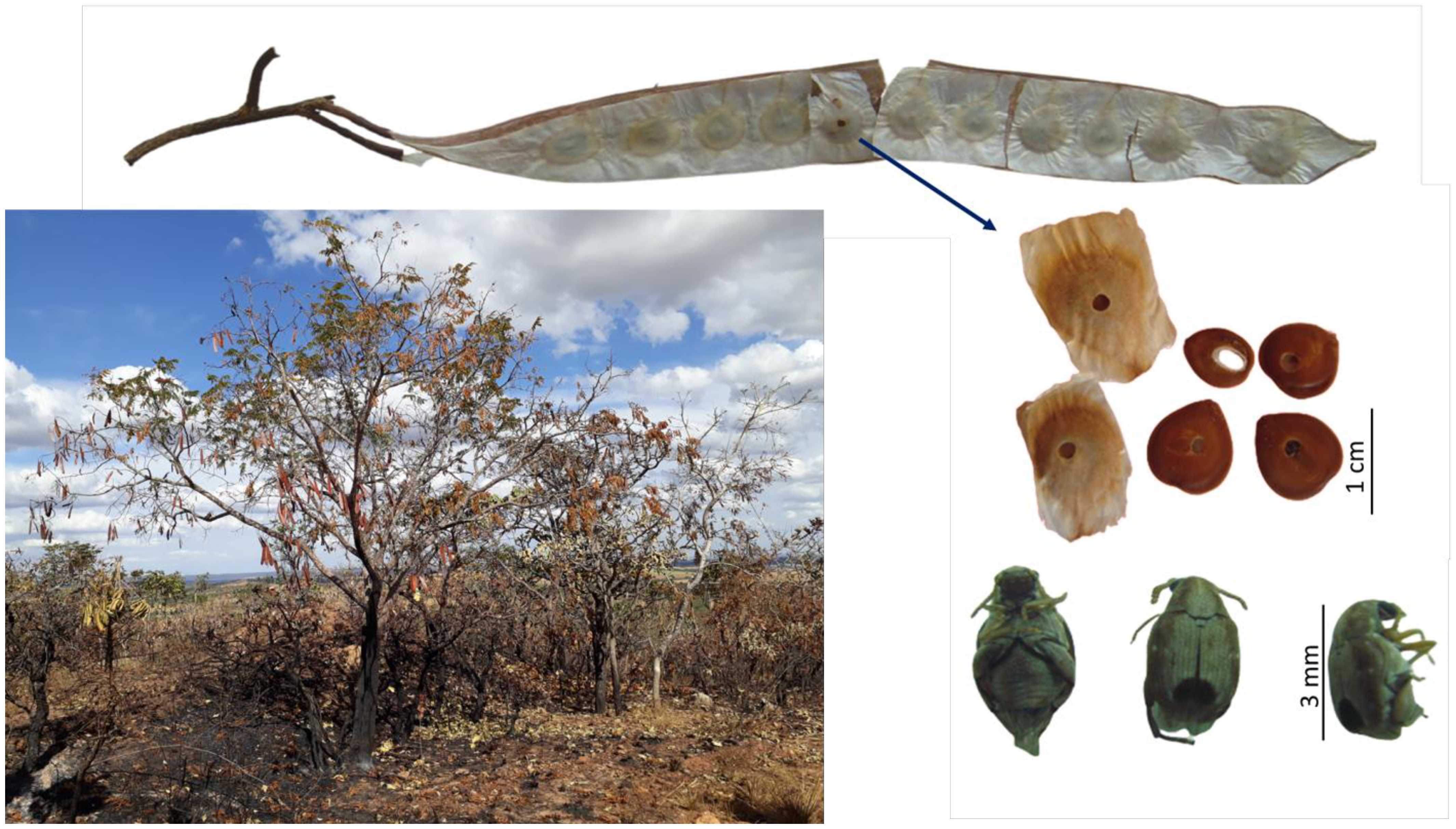
From all the P. reticulata seed samples assessed, Acanthoscelides clitellarius (Fahraeus) (Chrysomelidae: Bruchinae) was the only species found. The fruit, while attached to the mother plant, seeds that the predators had damaged, with and protective wing film present and absent, and the predatory adult insect are shown in Figure 1. The P. reticulata fruits sampled (n = 100) (mean ± standard deviation ) were characterised as listed: 12.03 ± 1.63 cm (length); 2.15 ± 0.21 cm (width); 8 ± 1.41 (total number of seeds per fruit); 6.56 ± 1.41 (unaffected seeds per fruit); 0.82 ± 0.71 (anomalous seeds per fruit); 82.02% (total number of unaffected seeds); 10.26% (total anomalous seeds) and 7.72% (total number of seeds damaged by A. clitellarius larvae). Also, 0.4541 ± 0.0209 [dry weight (g) of 10 unaffected seeds] and 0.2851 ± 0.00150 [dry weight (g) of 10 seeds attacked by the insect].
After collecting ripe fruits, record of one of the fruit collection areas that suffered the action of fire, highlighting the Plathymenia reticulata plant; also, detailed view of the seeds preyed upon, with and without the typical distinctive protective external structure and the adult predatory insect of the Acanthoscelides clitellarius.
The estimates showed that the insect had destroyed about 37.7% of the dry weight of the seeds. No significant correlation was identified between the fruit size (length x width) with the percentage of seeds damaged per fruit (Wilcoxon rank sum test: w = 2343.5; P > 0.05); also, no significant correlation was found between seed size (longest x widest) and seeds damaged by larvae of the insect (Spearman rank order correlation: c = -0.429; P > 0.05). The total of 4,818 seeds sampled (Caldas Novas, GO), 60.8% were undamaged, 17.4% showed damage by A. clitellarius and 21.8% were anomalous; of the total seeds evaluated, 8,120 seeds (Ipameri, GO), 56.5% were undamaged, 9.3% showed damage by A. clitellarius and 34.2% were anomalous.
As a rule, the larvae of bruchids are known to have the ability to feed on a single seed within the fruit, during their entire larval development (Southgate, 1979), very unlike, for instance, from the lepidopterans and dipterans and a few other coleopterans, which normally ingest more than one seed of the same fruit (Lourenço et al., 2017). In our study, all seeds visibly attacked by beetle larvae (as shown in Figure 1) were completely unviable for germination. Contrary to our results, Fonseca et al. (2020) and Fagundes et al. (2021) reported the likelihood of the germination of a few Fabaceae seeds, even post the Bruchinae induced damage. It is also noteworthy that the eventuality of minimal injury to the seed by the predatory insects may be positive in disrupting the physical dormancy confirmed in Fabaceae. Such a probability was possible, for instance, if the initial colonisation failed or if the larva suffered premature death. In fact, Han et al. (2018) confirmed this hypothesis in their work on the Astragalus lehmanniaus seeds, as well as in Fabaceae, in the desert areas of the Xinjiang province, China.
According to Campbell (2002), in general, the predatory insect adults show a tendency to select the larger seeds for egg laying, which is the reason for the eggs being laid under or close to the larger seeds in the fruit. In this last condition, the larva quickly reaches the seed. Further, it will partly, ensure that their offspring will enjoy better food conditions and feed exclusively on this seed. Although seed predation results in Fabaceae species from the Cerrado biome are quite variable, the values found for P. reticulata are within the range found for other species in the literature. Fagundes et al. (2013), in a study with Copaifera langsdorffii seeds, highlight that the species can present up to 30% seed damage caused by Rhinochenus brevicollis Chevrolat (Coleoptera: Curculionidae). In other Copaifera species, Santos et al. (2015) showed that other species of the genus presented higher seed predation percentages (C. depilis, 52.88% and C. luetzelburgii, 46.33%). Freitas et al. (2018) highlight that in Cassia fistula L. (Fabaceae), the damage caused by Pygiopachymerus lineola (Chevrolat, 1871) (Coleoptera: Chrysomelidae: Bruchinae) was 14.8%. Also, Lourenço et al. (2017) showed that adult borer beetles (Buprestidae) prefer to oviposit in larger fruits of a Vochysiaceae species in the Cerrado. In our study, we did not find significant correlations between fruit and seed size and insect predation, suggesting that they are not able to make this choice.
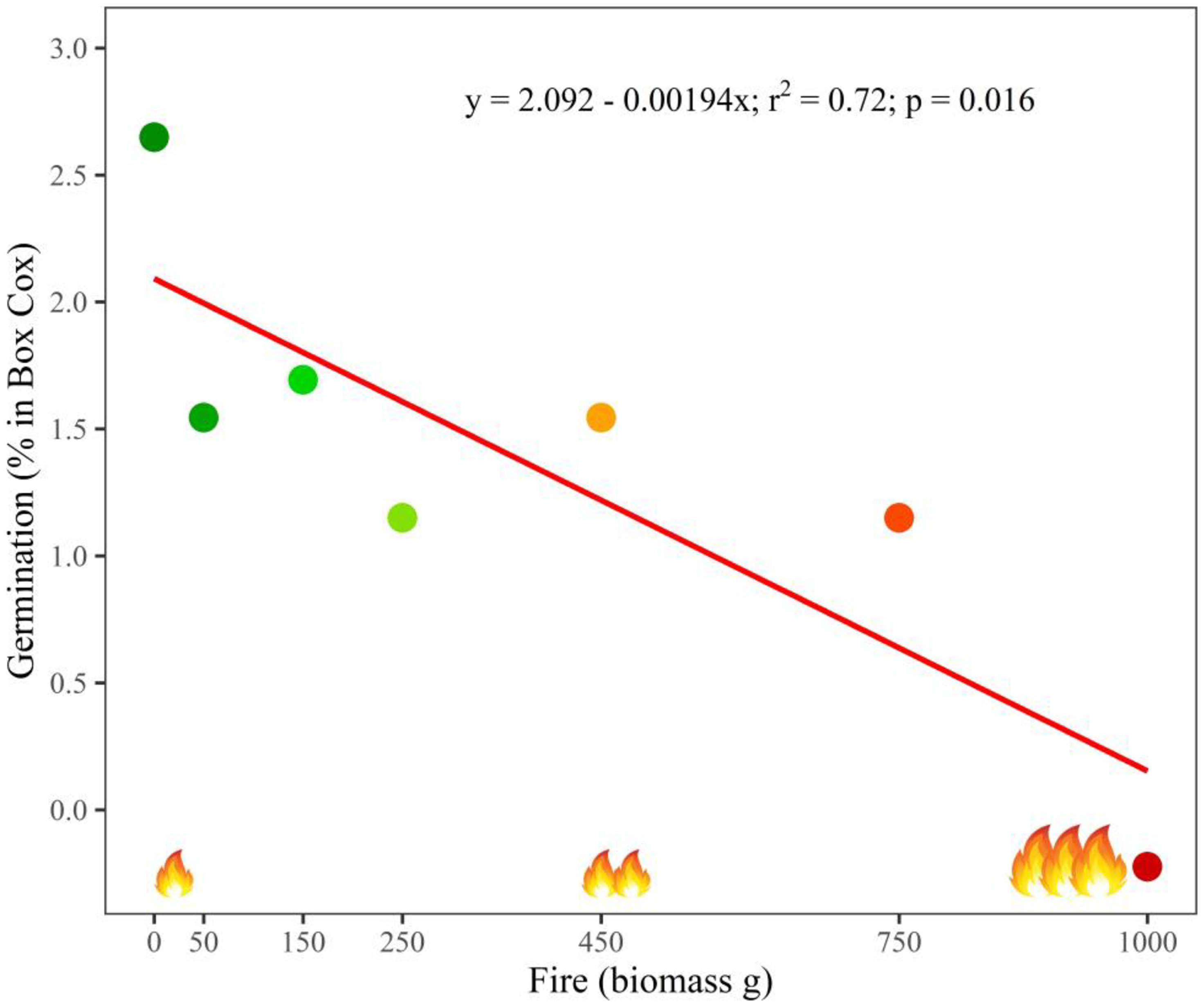
After the passage of controlled fire, seed germination showed significant differences (ANOVA, F = 15.511; P < 0.001). Tukey's test at the 1% level revealed that all treatments with controlled fire were similar to each other, but all differed significantly from the control (without fire). Normally, the seed germination confirmed with the control treatment revealed a value of 15.20 ± 5.21% (Mean ± standard deviation). The mean percentage of seed germination under different fire intensities, inferred by different amounts (g) of combustible plant material, was as follows (Mean ± SD): 4.8 ± 1.79% (50 g); 5.6 ± 2.19% (150 g); 3.2 ± 1.79% (250 g); 4.8 ± 1.80% (450 g); 3.2 ± 1.79% (750 g); 0.8 ± 1.77% (1000 g) (y=2.092-0.00194x, r2=0.72, p=0.016) (Figure 2). According to Bouchardet et al. (2015), evaluating the same species of P. reticulata, they found that exposure to 80 °C for 2 and 5 minutes and to 100 °C for 2 minutes did not alter germination (71%). However, above 150 °C, no seeds germinated. This result, as well as that obtained in our work, highlights that the species is not benefited by the passage of fire in relation to seed germination.
Germination of Plathymenia reticulata seeds under different amounts of biomass combustion (Model: y=2.092-0.00194x, r2=0.72, p=0.016).
This characteristic may be associated with the type of seed, which is dispersed by the event, has a smaller size and mass (anemochorous species). In the natural environment, the passage of fire can benefit the seed by reducing competition with grass and protecting it from high temperatures in the irregularities of the terrain (Gonçalves et al., 2016). According to what was discussed above, any quantity above 150g to 200g of biomass would cause temperatures higher than 150 °C and could directly affect seed germination.
The differences in the intensities of controlled burning inferred by the various quantities of combustible material used in the present work had no significant effect on the rates of seed germination. As the fuel material used usually involved very dry grasses, normally distributed homogeneously for controlled burning beneath the seeds, we concluded that the intensities produced by greater amounts of fuel would be higher. In the natural environments, the climatic conditions, relief, quality, and material arrangement also, affected the intensity (Silva et al., 2016).
This study highlights the fact that the seed distribution occurred below the dry, compacted and flat soil, and the burned vegetation distribution was performed evenly beneath the seeds, facilitating the direct action of fire upon them, and exposing them with no type of soil protection when the fire passed. It is also crucial to emphasise that in the present work, no treatment was performed to break seed dormancy. Second Carvalho (2009), when the seeds of this species experienced suitable treatment to break the dormancy, the germination rate hovered between 40 and 70%.
Considering that P. reticulata is widely distributed in the Brazilian Cerrado landscape, identifying biotic and abiotic agents that compromise its seeds is of fundamental importance for conservation and recovery programs of this landscape.
Acknowledgements
We thank State University of Goiás for financial support (In Portuguese: recurso financeiro proveniente do Edital/Convocatória PrP/UEG nº 01/2023 Pró-Programas, Termo de Fomento nº 75593594, Processo SEI nº 202300020011690). The authors CMSN and ECR thank CNPq and FAPEG for the research productivity grant.
-
Data Availability Statement
The entire data set that supports the results of this study was published in the article itself.
References
-
ABREU, R.C.R., HOFFMANN, W.A., VASCONCELOS, H.L., PILON, N.A., ROSSATTO, D.R. and DURIGAN, G., 2017. The biodiversity cost of carbon sequestration in tropical savanna. Science Advances, vol. 3, no. 8, e1701284. https://doi.org/10.1126/sciadv.1701284 PMid:28875172.
» https://doi.org/10.1126/sciadv.1701284 - BYRAM, G.M., 1959. Combustion of forest fuels. In: K.P. DAVIS, ed. Forest fire: control and use New York: McGraw Hill, pp. 61-89.
-
BOUCHARDET, D.D.A., RIBEIRO, I.M., SOUSA, N.D.A.D., AIRES, S.S. and MIRANDA, H.S., 2015. Efeito de altas temperaturas na germinação de sementes de Plathymenia reticulata Benth. e Dalbergia miscolobium Benth. Revista Árvore, vol. 39, no. 4, pp. 697-705. https://doi.org/10.1590/0100-67622015000400012
» https://doi.org/10.1590/0100-67622015000400012 -
CAMPBELL, J.F., 2002. Influence of seed size on exploitation by the rice weevil, Sithophilus oryzae. Journal of Insect Behavior, vol. 15, no. 3, pp. 429-445. https://doi.org/10.1023/A:1016225427886
» https://doi.org/10.1023/A:1016225427886 -
CARVALHO, P.E.R., 2009 [viewed 11 October 2025]. Vinhático Plathymenia reticulata [online]. Colombo: Embrapa Florestas. Circular Técnica, no. 231. Available from: https://www.infoteca.cnptia.embrapa.br/bitstream/doc/578666/1/CT231.pdf
» https://www.infoteca.cnptia.embrapa.br/bitstream/doc/578666/1/CT231.pdf -
DAIBES, L.F., ZUPO, T.M., SILVEIRA, F.A.O. and FIDELIS, A., 2017. A field perspective on effects of fire and temperature fluctuation on Cerrado legume seeds. Seed Science Research, vol. 27, no. 2, pp. 74-83. https://doi.org/10.1017/S096025851700006X
» https://doi.org/10.1017/S096025851700006X - DIONIZIO, L.M., 2025. O fogo em culturas agrícolas e florestais no Cerrado: efeitos na biomassa, no solo e métodos de controle. Ipameri: Universidade Estadual de Goiás. Dissertação de Mestrado em Produção Vegetal.
-
FAGUNDES, M., SANTOS, T.H., CUEVAS-REYES, P. and CORNELISSEN, T., 2021. Biotic and abiotic interactions shape seed germination of a fire-prone species. Seeds, vol. 1, no. 1, pp. 16-27. https://doi.org/10.3390/seeds1010003
» https://doi.org/10.3390/seeds1010003 -
FAGUNDES, M., MAIA, M.L., QUEIROZ, A., FERNANDES, G.W. and COSTA, F.V., 2013. Seed Predation of Copaifera langsdorffi Desf. (Fabaceae: Caesalpinioideae) by Rhinochenus brevicollis Chevrolat (Coleoptera: Curculionidae) in a Brazilian Cerrado Fragment. Ecología Austral, vol. 23, no. 3, pp. 218-221. https://doi.org/10.25260/EA.13.23.3.0.1174
» https://doi.org/10.25260/EA.13.23.3.0.1174 -
FLECK, M.D., COSTA, E.C., BOSCARDIN, J. and SILVA, J.M., 2021. Damage caused by seed-feeding insects in Senna corymbosa: a new host plant for the subfamily Bruchinae. Floresta e Ambiente, vol. 28, no. 1, pp. e20200008. https://doi.org/10.1590/2179-8087-floram-2020-0008
» https://doi.org/10.1590/2179-8087-floram-2020-0008 -
FONSECA, A.G., ASSIS JÚNIOR, S.L., TITON, M., LEMES, P.G. and MACHADO, E.L.M., 2020. Seeds of Senegalia polyphylla attacked by bruchid beetles may be viable? Pesquisa Florestal Brasileira, vol. 40, pp. 1-5. https://doi.org/10.4336/2020.pfb.40e201801731
» https://doi.org/10.4336/2020.pfb.40e201801731 -
FREITAS, F., TIESEN, C.M.A., BATTIROLA, L.D. and CORASSA, J.N., 2018. Predação de sementes de Cassia fistula L. (Fabaceae) por Bruchinae. Scientific Electronic Archives, vol. 11, no. 1, pp. 6. https://doi.org/10.36560/1112018448
» https://doi.org/10.36560/1112018448 - GONÇALVES, B.B., CARNEIRO, V.A., DE MELO, C.N., BERNARDO, P.V.D.S. and DE PAULA, V.R., 2016. Aula biogeográfica sobre rochas enfermeiras: facilitação no (re) estabelecimento de plantas em cerrado rupestre no Parque Estadual da Serra de Caldas Novas-GO. Revista Presença Geográfica, vol. 3, no. 2, pp. 45-53.
-
HAN, Y.J., BASKIN, J.M., TAN, D.Y., BASKIN, C.C. and WU, M.Y., 2018. Effects of predispersal insect seed predation on the early life history stages of a rare cold sand-desert legume. Scientific Reports, vol. 8, no. 1, pp. 3240. https://doi.org/10.1038/s41598-018-21487-7 PMid:29459622.
» https://doi.org/10.1038/s41598-018-21487-7 -
JANZEN, D.H., 1969. Seed-eaters versus seed size, number, toxicity and dispersal. Evolution; International Journal of Organic Evolution, vol. 23, no. 1, pp. 1-27. https://doi.org/10.2307/2406478 PMid:28562964.
» https://doi.org/10.2307/2406478 -
LOURENÇO, S.L.O., LUIZ, M.F., JESUS, F.G., CARVALHO, D.D.C., HORNBURG, M. and ARAÚJO, M.S., 2017. Predispersal infestation of Vochysia haenkeana seeds by Lius conicus. Ciência Rural, vol. 47, no. 9, pp. e20160953. https://doi.org/10.1590/0103-8478cr20160953
» https://doi.org/10.1590/0103-8478cr20160953 -
MIRANDA, H.S., BUSTAMENTE, M.M.C. and MIRANDA, A.C., 2002 [viewed 11 October 2025]. The fire fator. In: O.S. OLIVEIRA and R.J. MARQUIS, eds. The Cerrados of Brazil: ecology and natural history of a neotropical savanna [online]. New York: Columbia University, pp. 51-68. Available from: http://www.lerf.eco.br/img/publicacoes/2002_12%20The%20Cerrados%20of%20Brazil.pdf
» http://www.lerf.eco.br/img/publicacoes/2002_12%20The%20Cerrados%20of%20Brazil.pdf -
OOI, M.K.J., DENHAM, A.J., SANTANA, V.M. and AULD, T.D., 2014. Temperature thresholds of physically dormant seeds and plant functional response to fire: variation among species and relative impact of climate change. Ecology and Evolution, vol. 4, no. 5, pp. 656-671. https://doi.org/10.1002/ece3.973 PMid:25035805.
» https://doi.org/10.1002/ece3.973 -
RAGUSA-NETTO, J., 2019. Density-dependent seed predation in Attalea geraensis Barb. Rodr.(Arecaceae) caused by bruchid beetles in the Brazilian Cerrado. Brazilian Journal of Biology = Revista Brasileira de Biologia, vol. 79, no. 4, pp. 577-583. https://doi.org/10.1590/1519-6984.183318 PMid:30365636.
» https://doi.org/10.1590/1519-6984.183318 -
SANTOS, G.P.N., ZANUNCIO, T.V., ASSIS JUNIOR, S.L. and ZANUNCIO, J.C., 1997 [viewed 11 October 2025]. Daños por Sennius amazonicus, Sennius sp. y Amblycerus sp. (Coleoptera: Bruchidae) en semillas de Sclerobium sp. (Leguminosae). Revista de Biología Tropical [online], vol. 45, pp. 883-886. Available from: https://tropicalstudies.org/rbt/attachments/volumes/vol45-2/16_Porto_Sclerolobium.pdf
» https://tropicalstudies.org/rbt/attachments/volumes/vol45-2/16_Porto_Sclerolobium.pdf -
SANTOS, I.D., COSTA, J.A.S., COSTA, C.B.N. and CALADO, D., 2015. Seed predation by insects in three sympatric species of Copaifera L. (Fabaceae). Biotemas, vol. 28, no. 2, pp. 87-95. https://doi.org/10.5007/2175-7925.2015v28n2p87
» https://doi.org/10.5007/2175-7925.2015v28n2p87 -
SILVA, D.A., LUIZ, M.F., JESUS, F.G., ROCHA, E.C., OLIVEIRA, M.A. and ARAÚJO, M.S., 2016. Post-fire effect of savannah vegetation on the establishment of new colonies of Atta sexdens rubropilosa (Hymenoptera: formicidae). The Florida Entomologist, vol. 99, no. 4, pp. 744-749. https://doi.org/10.1653/024.099.0427
» https://doi.org/10.1653/024.099.0427 -
SOUTHGATE, B.J., 1979. Biology of the Bruchidae. Annual Review of Entomology, vol. 24, no. 1, pp. 449-473. https://doi.org/10.1146/annurev.en.24.010179.002313
» https://doi.org/10.1146/annurev.en.24.010179.002313 -
SZENTESI, A., 2024. Legume (Fabaceae) and seed beetle (Coleoptera, Chrysomelidae, Bruchinae) species of Europe: distribution and host specialization. Arthropod-Plant Interactions, vol. 18, no. 3, pp. 579-598. https://doi.org/10.1007/s11829-024-10041-0
» https://doi.org/10.1007/s11829-024-10041-0
Edited by
-
Editor:
Takako Matsumura Tundisi
The entire data set that supports the results of this study was published in the article itself.