 Temperature effects on the virulence of entomopathogenic fungi to manage the bronze bug Thaumastocoris peregrinus (Hemiptera: Thaumastocoridae)
Abstract
Thaumastocoris peregrinus Carpintero & Dellapé (Hemiptera: Thaumastocoridae), a sap-sucking pest native to Australia, has severely impacted eucalyptus plantations in Brazil since 2008. Due to environmental concerns and resistance risks, chemical control is restricted in forest systems, prompting the search for sustainable alternatives. Entomopathogenic fungi (EPF) offer promising potential for integrated pest management (IPM) strategies. This study evaluated the virulence and thermal tolerance of EPF isolates against T. peregrinus through a multi-phase bioassay. Initially, eleven fungal isolates were screened for pathogenicity against adults. Based on mortality rates, three isolates Beauveria bassiana (IBCB227), Metarhizium anisopliae (IBCB425), and Cordyceps farinosa (IBCB220) were selected for further testing at constant temperatures (20, 25, and 30 °C). Subsequently, lethal concentration (LC50) and lethal time (LT50) were determined for the two most virulent isolates (IBCB227 and IBCB425) in both nymphs and adults. IBCB425 demonstrated high efficacy across all temperatures, while IBCB227 and IBCB220 were less effective at 20 °C. LC50 values were 1.10 × 10⁷ and 2.10 × 10⁶ conidia/mL for IBCB227 and IBCB425, respectively, based on mortality recorded six days post-application. LT50 was calculated using the highest concentration (1.0 × 10⁸ conidia/mL), with IBCB425 inducing faster mortality (3.75 days) than IBCB227 (4.43 days). Post-mortem sporulation confirmed fungal infection in >90% of cadavers. These findings highlight the virulence and temperature resilience of M. anisopliae IBCB425 and B. bassiana IBCB227, supporting their potential as effective biological control agents for T. peregrinus in eucalyptus plantations under variable environmental conditions.
Keywords:
bronze bug; entomopathogenic fungus; isolate selection; microbial control; sustainable forest
Resumo
Thaumastocoris peregrinus Carpintero & Dellapé (Hemiptera: Thaumastocoridae), um inseto sugador de seiva nativo da Austrália, tem causado severos impactos em plantações de eucalipto no Brasil desde 2008. Devido a preocupações ambientais e ao risco de desenvolvimento de resistência, o controle químico é restrito em sistemas florestais, o que impulsiona a busca por alternativas sustentáveis. Fungos entomopatogênicos (FEP) apresentam potencial promissor para estratégias de manejo integrado de pragas (MIP). Este estudo avaliou a virulência e a tolerância térmica de isolados de FEP contra T. peregrinus por meio de um bioensaio em múltiplas fases. Inicialmente, onze isolados fúngicos foram avaliados quanto à patogenicidade em adultos. Com base nas taxas de mortalidade, três isolados — Beauveria bassiana (IBCB227), Metarhizium anisopliae (IBCB425) e Cordyceps farinosa (IBCB220) — foram selecionados para testes adicionais em temperaturas constantes (20, 25 e 30 °C). Posteriormente, foram determinadas a concentração letal (CL50) e o tempo letal (TL50) para os dois isolados mais virulentos (IBCB227 e IBCB425), tanto em ninfas quanto em adultos. O isolado IBCB425 apresentou alta eficácia em todas as temperaturas, enquanto IBCB227 e IBCB220 foram menos eficientes a 20 °C. Os valores de CL50 foram de 1,10 × 10⁷ e 2,10 × 10⁶ conídios/mL para IBCB227 e IBCB425, respectivamente, com base na mortalidade registrada seis dias após a aplicação. O TL50 foi calculado utilizando a maior concentração (1,0 × 10⁸ conídios/mL), sendo que IBCB425 induziu mortalidade mais rápida (3,75 dias) em comparação com IBCB227 (4,43 dias). A esporulação pós-morte confirmou a infecção fúngica em mais de 90% dos cadáveres. Esses resultados destacam a virulência e a resiliência térmica de M. anisopliae IBCB425 e B. bassiana IBCB227, reforçando seu potencial como agentes eficazes de controle biológico de T. peregrinus em plantações de eucalipto sob condições ambientais variáveis.
Palavras-chave:
percevejo-bronzeado; fungos entomopatogênicos; seleção de isolados; controle microbiano; floresta sustentável
1. Introduction
The bronze bug, Thaumastocoris peregrinus Carpintero & Dellapé, 2006 (Hemiptera: Thaumastocoridae), is a sap-sucking insect native to Australia that has been a serious pest in commercial eucalyptus plantations in Brazil since 2008 (Dias et al., 2014; Salibá et al., 2019). Its feeding causes the destruction of leaf tissues, leading to chlorosis, reduced photosynthesis, and premature leaf abscission, which significantly compromises tree growth and the productivity of planted forests (Oumar et al., 2013).
Thaumastocoris peregrinus has also been reported in other eucalyptus-growing countries, such as Argentina, Chile, South Africa, Italy, and Portugal, underscoring its invasive potential and the need for coordinated international control strategies (Jacobs and Neser, 2005). In Brazil, where eucalyptus is a cornerstone of the forestry economy, planted forests contribute to pulp and paper production, bioenergy, and carbon sequestration, reinforcing the importance of pest management in these ecosystems (ABRAF, 2023). Several studies have investigated the use of entomopathogenic fungi to manage T. peregrinus in Brazil (Santos et al., 2018; Tedesco et al., 2020; Velozo et al., 2023), but few have evaluated the combined effects of temperature, virulence, and developmental stage on fungal performance.
Infestation by Thaumastocoris peregrinus presents a challenge to the sustainable management of eucalyptus plantations, particularly because chemical insecticide use is restricted due to environmental concerns and the risk of selecting resistant insect populations (Wilcken et al., 2019; Bamisile et al., 2021). In this context, alternative strategies such as biological control using entomopathogenic fungi (EFs) have emerged as promising, sustainable approaches to reduce pest-related damage. In addition to laboratory selection, isolating EPF strains directly from naturally infected T. peregrinus or from the eucalyptus ecosystem (soil, leaves) is widely recognized as a strategy to enhance ecological fitness (Corallo et al., 2019; Mascarin et al., 2012; Lorencetti et al., 2017). However, the present study focused on pre-selected strains with established cultivation potential, aiming to assess virulence under ecologically relevant thermal conditions typical of Brazilian eucalyptus regions (Zimmermann, 2008; Fargues et al., 1997).
Entomopathogenic fungi (EPFs) effectively control sap-sucking pests such as hemipterans and coleopterans, offering several advantages over chemical pesticides, including specificity, safety to nontarget organisms, and environmental compatibility (Zimmermann, 2007; Dal Pogetto et al., 2011; Lorencetti et al., 2018; Mascarin Moura et al., 2018; Velozo et al., 2023). EPFs act mainly through conidial adhesion, cuticle penetration, and the release of toxic metabolites, leading to host mortality, while reducing the need for synthetic insecticide molecules in cultivated areas (Islam et al., 2021). Moreover, EPFs can be mass produced in vitro, formulated, stored, and applied as bioinsecticides in forest and agricultural environments (Velozo et al., 2023).
Although the egg parasitoid Cleruchoides noackae Lin & Huber (Hymenoptera: Mymaridae) was introduced from South Africa for the biological control of T. peregrinus in Brazil (Barbosa et al., 2017), its production is limited by the absence of alternative hosts, making it necessary to rear T. peregrinus, which increases production costs (Martínez et al., 2018). This highlights the importance of developing and optimizing additional biological control strategies, such as the use of entomopathogenic fungi or native predators such as Supputius cincticeps Stål (Hemiptera: Pentatomidae) (Souza et al., 2012), for effective and integrated management of this pest.
Temperature and humidity are crucial abiotic factors that directly influence the infection dynamics and performance of entomopathogenic fungi (EPF). These factors affect key stages of the fungal life cycle, including spore germination, hyphal growth, host cuticle penetration, and sporulation, ultimately determining the efficacy of fungal-based pest control in the field (Fargues et al., 1997; Inglis et al., 2001). High temperatures can accelerate fungal growth within the host but may reduce viability if exceeding optimal thresholds, while low temperatures may suppress or delay fungal germination and infection (Zimmermann, 2008).
Similarly, relative humidity plays a pivotal role in conidial adhesion and cuticle penetration, with low humidity conditions negatively impacting EPF infection success. Given the environmental variability in eucalyptus plantations across Brazil particularly fluctuations in temperature and moisture identifying isolates that are both virulent and thermotolerant is fundamental for achieving reliable biological control. In this context, T. peregrinus has emerged as a major pest, and various studies have demonstrated its susceptibility to different EPF species (Lorencetti et al., 2018; Santos et al., 2018; Velozo et al., 2023).
This study builds upon previous field evaluations (Wilcken et al., 2019) by conducting a detailed laboratory-based assessment of virulence and thermal tolerance of eleven entomopathogenic fungal isolates. These controlled assays allow us to identify promising isolates with superior performance across temperature ranges and insect developmental stages, thereby supporting formulation and application strategies under diverse climatic conditions.
This study aimed to evaluate the pathogenicity of different isolates of entomopathogenic fungi against T. peregrinus at constant temperatures and to determine the median lethal concentrations (LC50) of the most effective isolates. By identifying isolates that combine high virulence and temperature resilience, this research contributes to the development of sustainable biopesticide and integrated pest management (IPM) strategies for eucalyptus plantations.
2. Materials and Methods
2.1. Location
The experiments were conducted at the Laboratory of Biological Control of Forest Pests (LCBPF) and at the Application Technology Laboratory of the Department of Plant Protection (DPV) of the Faculty of Agronomic Sciences (FCA) at São Paulo State University (UNESP) in Botucatu, São Paulo state, Brazil.
2.2. Insect rearing
The colony of T. peregrinus was established using eggs from the stock culture at the entomology laboratory of Embrapa Florestas in Colombo, Paraná state, Brazil. Insects were maintained in a climate-controlled room at 24 ± 2°C, a relative humidity of 60 ± 10%, and a 12-hour photoperiod (Barbosa et al., 2017). Nymphs hatched from these eggs were kept on branches of Eucalyptus urophylla var. platyphylla, clone 433 (Myrtaceae), in 500 mL Erlenmeyer flasks with water and placed in rectangular plastic trays (40 cm long × 35 cm wide × 8 cm high). Adults and nymphs from the laboratory rearing system were used in the pathogenic bioassays.
2.3. Selection of entomopathogenic fungus isolates
Isolates of the entomopathogenic fungi Beauveria bassiana (Bals. Criv.) Vuill. (Hypocreales: Cordycipitaceae), Metarhizium anisopliae (Metschn.) Sorokin (Hypocreales: Clavicipitaceae), Cordyceps farinosa (Holmsk.) Fr. (Hypocreales: Cordycipitaceae), Cordyceps fumosorosea Wize (Hypocreales: Cordycipitaceae), and Sporothrix insectorum Hoog & H.C. Evans (Ophiostomatales: Ophiostomataceae) (Table 1) were obtained from the "Odemar Cardim Abreu" Collection of Entomopathogenic Microorganisms at the Biological Institute of Campinas, São Paulo state, Brazil, which were all collected within this state.
Isolate codes (Code), species, source and host orders (Ord.) of the entomopathogenic fungi Beauveria bassiana, Metarhizium anisopliae, Cordyceps sp., Cordyceps farinosa, Cordyceps fumosorosea, and Sporothrix insectorum used.
The initial inoculum of each isolate was obtained through propagation in Petri dishes with potato dextrose agar (PDA) (42 g/L [Kasvi, Italy]) at 25 ± 1°C in the dark.
The bioassay was initiated with infective structures of the fungi (conidia) collected by gently scraping the surface with a Drigalski loop and growing for 14 days on PDA medium. The material obtained was suspended in Tween 80® [Sigma, Germany] (0.1%). Prior to the bioassays, conidial viability was assessed by germination tests. A 100-µL aliquot of each conidial suspension was spread onto PDA medium and incubated at 25 ± 1°C for 24 h. Germination was evaluated under a light microscope by counting at least 100 conidia, and isolates presenting viability greater than 90% were used in the experiments.
The concentration of the conidial suspension was adjusted to 1.0 × 10⁸ conidia/mL using a hemocytometer, and conidia were counted under an optical microscope [Carl Zeiss Microscopy GmbH, Germany]. Ten adult individuals of T. peregrinus were used per replicate in the bioassay to screen fungal isolates for pathogenicity from the laboratory were placed in modified Petri dishes (60 × 20 mm) with lids 20 mm in diameter and covered with voile fabric for gas exchange. Hydroretentive gel® [Hydroplan-EB, Empresa de Base & Distribuidora Ltda, Brazil] (1 g/400 mL) was applied underneath the E. urophylla var. platyphylla, clone 433, leaf with an approximate area of 6 cm2 used per Petri dish. This gel reduces water loss from the leaf and prevents insects from escaping. Two milliliters of conidial suspension were sprayed onto each group of 10 adult T. peregrinus per Petri dish via a Potter Tower, whereas the control group received only Tween 80® (0.1%). These Petri dishes were kept in Biochemical Oxygen Demand (B.O.D.) incubators at 25.0 ± 1.0°C, a relative humidity of 83.0 ± 2.0%, and a 12-hour photoperiod. The experiment was conducted in triplicate, each repetition performed on a different day with freshly prepared suspensions and new insect cohorts. For each isolate–temperature combination, five replicates (Petri dishes) were used per repetition, totaling 15 replicates and 150 insects per treatment. Each replication (Petri dish) was observed daily, and the dead insects were counted, removed, and transferred to humid chambers (insects were placed in sterile Petri dishes sealed with lids). Sterilized absorbent paper was placed at the bottom of the Petri dishes, which were previously moistened with autoclaved distilled water to stimulate fungal growth and confirm insect mortality. Bioassays were conducted until mortality stabilized, allowing the determination of LT50 (lethal time for 50% of the population) and the efficacy of fungal isolates.
All assays were independently repeated three times on separate dates, using freshly prepared suspensions for each replicate and new groups of T. peregrinus adults. Each replicate consisted of five Petri dishes with ten insects each (n = 50 insects per treatment per repetition), totaling 150 insects per treatment. Mortality was recorded daily for seven days, and cadavers were transferred to humid chambers to confirm fungal infection through sporulation.
2.4. Pathogenicity of Beauveria bassiana, Cordyceps farinosa, and Metarhizium anisopliae to bronze bugs at different temperatures
The preselected isolates of the entomopathogenic fungi B. bassiana (IBCB227), Cordyceps farinosa (IBCB220), and M. anisopliae (IBCB425) were used. Conidial suspensions were prepared and applied as previously described in the subsection “Selection of Entomopathogenic Fungus Isolates” at a concentration of 1.0 × 10⁸ conidia/mL. Ten insects (replicates) were prepared in the same manner per modified Petri dish. Both nymphs and adults were tested separately under each temperature condition, using ten individuals per stage per replicate. Following inoculation, the replicates were maintained in B.O.D. incubators at temperatures of 20, 25, or 30°C with a relative humidity of 81.0 ± 2.0% and a 12-hour photoperiod. Three temperatures (20, 25, and 30°C) were selected because they represent the range commonly observed in Brazilian eucalyptus-growing regions where T. peregrinus occurs and where entomopathogenic fungi are applied under field conditions (Fargues et al., 1997; Zimmermann, 2008). Each replicate (Petri dish) was observed daily, and the dead insects were counted, removed, and transferred to humid chambers to stimulate fungal growth and confirm the cause of insect mortality. The inoculation experiment was conducted in a factorial arrangement consisting of three fungal isolates (B. bassiana IBCB227, C. farinosa IBCB220, and M. anisopliae IBCB425) and three temperatures (20, 25, and 30°C), with five replicates per treatment. Each replicate consisted of 10 insects, totaling 50 insects per treatment. The experiment was repeated three as independent blocks.
2.5. Lethal concentration (LC50) and lethal time (LT50) of selected isolates to Thaumastocoris peregrinus
The LC50 and LT50 values of Metarhizium anisopliae (IBCB425) and Beauveria bassiana (IBCB227) were determined using conidial suspensions prepared and applied as previously described. Separate bioassays were conducted for nymphs and adults of Thaumastocoris peregrinus, with ten individuals per stage per replicate in modified Petri dishes. The treatments included isolates applied at concentrations of 1.0 × 10⁴, 105, 106, 107, and 108 conidia/mL, with the replications kept in B.O.D. incubators at 25°C, a relative humidity of 83.0 ± 2.0% and a 12-hour photoperiod. Each replication (Petri dish) was observed daily, and the dead insects were counted, removed, and transferred to humid chambers to stimulate fungal growth and to confirm the cause of insect mortality. Isolates with viability above 90% were used. The treatments involved two fungal species (level 1) and five concentrations (level 2) with five replications, totaling 50 insects per treatment/level, and the experiments were conducted in two independent blocks. Isolates from different fungal species were selected on the basis of the total number of insects that died and the mortality period.
2.6. Statistical analysis
Statistical analyses were performed to estimate lethal concentration (LC50) and lethal time (LT50) values with 95% confidence intervals using Probit regression models, appropriate for binomial response data (Nelder and Wedderburn, 1972). Each model was fitted separately for each fungal isolate and insect developmental stage combination. LC50 estimates were based on cumulative mortality recorded at day 6 post-inoculation, the point at which mortality plateaued. LT50 estimates were derived from data collected using the highest concentration tested (1.0 × 10⁸ conidia/mL), ensuring robust time-based comparisons.
Mortality data were additionally analyzed using the GENMOD procedure in SAS University Edition (SAS Institute Inc., Cary, NC), with treatment as a fixed effect and replication and trial date as random factors. A generalized linear model (GLM) with binomial distribution and logit link function was applied to assess treatment effects. Means were compared using the Tukey–Kramer adjustment for multiple comparisons at a 5% significance level (Westfall et al., 1999).
We acknowledge that cumulative mortality data may present correlated errors over time. While Probit analysis is widely used for such data, we highlight the importance of more robust time-to-event methods in future work, such as Kaplan–Meier survival curves, which better account for censoring and time dependency (Throne et al., 1995).
3. Results
All isolates caused significantly higher mortality than the control, and fungal infection was confirmed in over 90% of cadavers through sporulation in moist chambers. Statistical analysis revealed significant differences among isolates in terms of mortality rates (p < 0.05), as indicated by non-overlapping group letters in Figure 1. Isolates IBCB425, IBCB227, and IBCB220 were selected based on their consistently higher performance compared to others (Tukey–Kramer test, p < 0.05). Among the eleven isolates tested, IBCB425 (Metarhizium anisopliae), IBCB227 (Beauveria bassiana), and IBCB220 (Cordyceps farinosa) were selected for further evaluation based on a combination of high cumulative mortality, early onset of visible symptoms, consistent performance across replicates, and confirmed fungal sporulation in over 90% of cadavers (Figure 1). Additionally, IBCB425 and IBCB227 are known for their viability and production potential, making them strong candidates for bioinsecticide development. These criteria ensured the selection of isolates that are not only pathogenic but also practical for future formulation and field use.
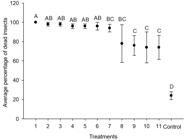
Mortality (%) of Thaumastocoris peregrinus (Hemiptera: Thaumastocoridae) adults caused by different isolates of entomopathogenic fungi. The isolates tested include Metarhizium anisopliae (IBCB425 and IBCB348), Beauveria bassiana (IBCB227, IBCB226, IBCB532, IBCB66, IBCB617), Cordyceps spp. (IBCB220, IBCB375, IBCB638), and Sporothrix insectorum (IBCB79). Control insects were treated with 0.1% Tween 80 only. Mortality was recorded daily and is presented as the cumulative percentage at the end of the bioassay period. Bars represent mean values with standard error (n = 5 replicates; 10 insects per replicate).
In the temperature assay, the three most virulent isolates B. bassiana (IBCB227), M. anisopliae (IBCB425), and C. farinosa (IBCB220) were evaluated at 20, 25, and 30 °C. Mortality rates varied by isolate and temperature (Table 2). According to the Tukey–Kramer test (p < 0.05), mortality at 20 °C was significantly lower for C. farinosa (IBCB220) compared to its efficacy at 25 and 30 °C. For M. anisopliae (IBCB425), mortality remained statistically similar across temperatures (p > 0.05), confirming its thermal resilience. Statistically significant differences (p < 0.05) between isolates were also observed within each temperature group, as indicated by different capital letters in Table 2. At 25 °C, all isolates caused ≥90% mortality, but at 20 °C, the efficacy of C. farinosa (IBCB220) dropped to 66%, while M. anisopliae (IBCB425) remained highly effective across all tested temperatures. Fungal infection was confirmed in more than 90% of cadavers through post-mortem sporulation, reinforcing the pathogenic origin of mortality.
Mortality (%) of adult Thaumastocoris peregrinus (Hemiptera: Thaumastocoridae) by the isolates IBCB227 (B. bassiana), IBCB425 (M. anisopliae), and IBCB220 (C. farinosa), and in control under different temperatures.
Subsequent bioassays determined the lethal concentrations (LC50) and lethal times (LT50) of IBCB227 and IBCB425 for nymphs and adults. The LC50 values were 1.10 × 10⁷ conidia/mL for IBCB227 and 2.10 × 10⁶ conidia/mL for IBCB425 (Table 3). LC50 values were calculated based on cumulative mortality recorded on the sixth day post-inoculation, which corresponded to the point at which mortality plateaued. LT50 values were estimated using mortality data from the highest concentration tested (1.0 × 10⁸ conidia/mL), as this dose yielded the most consistent and complete mortality curves for time-based analysis. The LT50 values were 4.43 and 3.75 days for IBCB227 and IBCB425, respectively, indicating slightly faster efficacy for IBCB425. Probit analysis indicated that LC50 and LT50 values differed significantly between isolates, although the 95% confidence intervals overlapped slightly. IBCB425 exhibited a significantly lower LC50 than IBCB227 (p < 0.05), confirming its higher virulence at lower doses. LT50 values also showed a statistically faster lethal action for IBCB425 compared to IBCB227 (p < 0.05), further supporting its superior efficacy.
Lethal concentration (LC50) and lethal time (LT50) values for Beauveria bassiana (IBCB227) and Metarhizium anisopliae (IBCB425) against T. peregrinus adults. LC50 was estimated based on cumulative mortality at day 6 post-inoculation. LT50 was based on data from the highest concentration (1.0 × 10⁸ conidia/mL).
Mortality varied between developmental stages and concentrations (Table 4). For example, IBCB227 at 1.0 × 10⁵ conidia/mL caused 80% mortality in nymphs and 44% in adults, whereas IBCB425 at the same concentration resulted in 54% and 84% mortality, respectively. These results highlight a statistically significant dose-dependent response (p < 0.05), as well as differences in susceptibility between developmental stages, confirmed by pairwise comparisons. For example, IBCB227 at 1.0 × 10⁵ conidia/mL caused significantly higher mortality in nymphs than in adults (Tukey–Kramer test, p < 0.05), whereas the reverse was observed for IBCB425.
Cumulative mortality of nymphs and adults of Thaumastocoris peregrinus (Hemiptera: Thaumastocoridae) with different conidia/mL concentrations (Conc.) of Beauveria bassiana (IBCB227) and Metarhizium anisopliae (IBCB425) six days after their application.
Together, these findings support the high virulence and temperature resilience of IBCB425 and IBCB227, confirming their potential as biological control agents for T. peregrinus.
4. Discussion
The potential of M. anisopliae, B. bassiana, Cordyceps spp., and S. insectorum, with their conidia applied in suspension, to manage T. peregrinus was demonstrated. Different isolates of M. anisopliae, including IBCB425 and IBCB348, caused mortality of up to 100% to other pests, such as the spittlebug Mahanarva fimbriolata Stål (Hemiptera: Cercopidae) (Loureiro et al., 2015), the cotton aphid Aphis gossypii Glover (Hemiptera: Aphididae), Aulacaspis tubercularis (Hemiptera: Diaspididae) (Nawaz et al., 2022), and Icerya seychellarum (Hemiptera: Monophlebidae) (Sayed et al., 2019). Metarhizium anisopliae caused 100% mortality in laboratory-reared adults of Diaphorina citri Kuwayama (Hemiptera: Liviidae) (Orduño-Cruz et al., 2015). The specificity of this fungus for Hemiptera is high but lower than that of B. bassiana, as its hosts also include 204 species of the Coleoptera, Dermaptera, Diptera, Hemiptera, Hymenoptera, Lepidoptera, and Orthoptera orders (Veen, 1968). The specificity of isolates to species of certain insect orders varies with characteristics such as the place of origin and virulence genes (Zimmermann, 2007). The pathogenicity of B. bassiana and Cordyceps spp. isolates to T. peregrinus is consistent with reports of mortality ranging from 37% to 80.1% for this insect with B. bassiana isolates and 87% with Cordyceps sp. at a concentration of 1.0 × 10⁸ conidia/mL (Lorencetti et al., 2018), with the same concentration used in this study. Native entomopathogenic fungi can increase the sustainability of forest pest management, as reported for B. bassiana, Cordyceps sp., and Zoophtora radicans (Wilcken and Oliveira, 2015; Jordan et al., 2021; Domingues et al., 2022a, b). The fungus S. insectorum has been used to manage the rubber lace bug Leptopharsa hevea Drake & Poor (Hemiptera: Tingidae) (Li et al., 2010), but these are the first reports of its pathogenicity to T. peregrinus.
The susceptibility of T. peregrinus to entomopathogenic fungi, specifically M. anisopliae, confirms reports for this insect (Soliman et al., 2019). The faster mortality of T. peregrinus by M. anisopliae isolates than by S. insectorum is related to the high virulence of the former fungus to Hemiptera, with reports of this isolate being produced and used in the management of other insects and registered against M. fimbriolata in Brazil (Loureiro et al., 2005; Lima et al., 2014; AGROFIT, 2018). The potential of the fungus S. insectorum against Leptopharsa heveae Drake and Poor (Hemiptera: Tingidae) in 1986 in the Amazonas was demonstrated, with 93% mortality of nymphs and 76% mortality of adults of this insect (Celestino Filho and Magalhães, 1986), values similar to those reported for T. peregrinus.
Variations in the pathogenicity of M. anisopliae, B. bassiana, and C. farinosa to T. peregrinus with temperature, with values greater than 30°C, have also been observed for the first fungus, which is present between 25 and 30°C, with Maruca vitrata Fabricius (Lepidoptera: Crambidae) (Tumuhaise et al., 2018). The pathogenicity of B. bassiana to Triatoma infestans Klug (Hemiptera: Reduviidae) was greater at 34°C (Lecuona et al., 2005), confirming the reduction in germination, growth, viability, and pathogenicity of fungi at inadequate temperatures. High temperatures can inactivate microorganisms before they contact the host or accelerate their growth within the insect. In contrast, low temperatures can reduce or stop the germination and growth of the fungus, hindering or prolonging infection (Zimmermann, 2008). The fungi M. anisopliae, B. bassiana, and C. farinosa are mesophiles, with optimal temperatures of 15 to 35°C, 23 to 28°C, and 20 to 30°C, respectively, but with variations among their isolates (Zimmermann, 2007, 2008; Lecuona et al., 2005). This increases the possibility of using entomopathogenic fungi to manage T. peregrinus in different regions of Brazil, most of which have warmer climates, including the states of Espirito Santo, Mato Grosso do Sul, Minas Gerais, Rio Grande do Sul, Rio de Janeiro, São Paulo, Bahia (Lima et al., 2010), Paraná (Barbosa et al., 2010), Santa Catarina (Savaris et al., 2011), Goiás (Pereira et al., 2013), and Pará (Saliba et al., 2019). Differences between isolates facilitate the regionalization of fungal use in biological control in countries such as Brazil, with varying temperatures between its states. Therefore, understanding the phenotypic plasticity of each isolate is important for better use of biological products.
The LC50 values of 2.1 × 10⁶ and 1.1 × 10⁷ conidia/mL for the isolates IBCB425 and IBCB227, respectively, for T. peregrinus are lower than those of three commercial products based on M. anisopliae for this insect, which are 3.2, 3.3, and 3.6 × 10⁷ conidia/mL (Soliman et al., 2019). The LC50 of a commercial product based on the isolate IBCB425 for Glycaspis brimblecombei Moore (Hemiptera: Psyllidae) was 3.8 × 10⁵ conidia/mL, which was lower than that reported in the present study, but this isolate has not been registered to manage T. peregrinus (Dal Pogetto et al., 2011). The LC50 values of M. anisopliae and B. bassiana in the management of Aphis craccivora Koch (Hemiptera: Aphididae) were 2.3 × 10⁶ and 1.3 × 10⁸ conidia/mL, respectively (Mweke et al., 2018), with the concentration of the first fungus similar to that used in this study for T. peregrinus. However, the LC50 values can differ between entomopathogenic fungi and host insects, as reported for Myzus persicae Sulzer (Aphidomorpha: Aphididae); Jacobiasca formosana Paoli (Hemiptera: Cicadellidae); Bemisia tabaci Gennadius (Hemiptera: Aleyrodoidea); and Stephanitis nashi Esaki & Takeya (Hemiptera: Tingidae), with LC50 values of 6.7 × 10⁴, 1.33 × 10⁶, 3.6 × 10⁶, and 1.2 × 10⁷, respectively, for the fungus B. bassiana (Bb-202) (Bugti et al., 2018).
The LT50 values of IBCB425 and IBCB227 were lower than those of commercial products against G. brimblecombei, suggesting that the virulence of the fungi M. anisopliae and B. bassiana may be greater, as 50% of the insects died between 1.4 and 2.3 days (Dal Pogetto et al., 2011). The lower LT50 of the isolate IBCB425 for T. peregrinus than for G. brimblecombei reinforces the report that this isolate is less virulent to Mahanarva fimbriolata Stål (Hemiptera: Cercopidae), with a LT50 of 4.26 at a concentration of 1.0 × 10⁸ (Freitas et al., 2012). The LT50 values of 3.75 and 4.43 days observed for M. anisopliae (IBCB425) and B. bassiana (IBCB227), respectively, are within the expected range for entomopathogenic fungi acting against hemipterans (Zimmermann, 2007). These values reflect a biologically plausible infection cycle, involving spore adhesion, germination, cuticle penetration, and host colonization. Any previous implication of mortality within 1–2 days has been clarified, and non-standard metrics such as the "mortality speed index" have been removed from the manuscript to avoid misinterpretation.
While LT50 values in this study were calculated using Probit analysis based on cumulative mortality data, we recognize that this approach does not fully account for the correlated nature of time-series mortality observations. The statistical approach described by Throne et al. (1995) provides a more appropriate framework for analyzing time-to-event mortality data. The relatively high mortality of T. peregrinus nymphs and adults at relatively high concentrations, as well as the mortality of nymphs at the three lower concentrations of IBCB425, may be due to the relatively high susceptibility of adults to fungal infections, highlighting the variation in susceptibility to fungi across insect developmental stages, which is important for effective fungal application (Sedighi et al., 2013). The LT50 values observed for M. anisopliae IBCB425 (3.75 days) and B. bassiana IBCB227 (4.43 days) are consistent with those reported in studies involving T. peregrinus and other hemipteran pests under laboratory conditions. For instance, reported LT50 values ranging from 3.8 to 5.2 days for various Metarhizium isolates tested against T. peregrinus, reinforcing the virulence potential observed in our trials (Soliman et al. 2019). These values are biologically relevant and reflect realistic infection dynamics, including adhesion, penetration, and internal colonization of the host cuticle. The mortality of M. fimbriolata was greater at the highest concentration of M. anisopliae (IBCB348), at 1.2 × 10⁷ conidia/mL (Loureiro et al., 2005), and that of G. brimblecombei increased with the concentration of conidia of the fungi B. bassiana, M. anisopliae and Lecanicillium lecanii (Dal Pogetto et al., 2011). Successful infection occurs when the fungus completes its cycle and penetrates the insect cuticle, which is composed of polysaccharide polymers incorporated into a protein matrix (Vega et al., 2012). However, the rupture of the insect cuticle during molting can stop the infection if the fungus has not penetrated and reproduced in the host hemocoel. Entomopathogenic fungi have developed mechanisms to adhere to and penetrate the host cuticle, which has evolved to resist pathogens through various means, including immune responses (Ortiz-Urquiza and Keyhani, 2013). Rapid molting reduces the mortality of aphids and Plutella xylostella Linnaeus (Lepidoptera: Plutellidae) caused by entomopathogenic fungi (Vandenberg et al., 1998; Kim and Roberts, 2012), indicating that this process reduces or prevents infection by quickly removing conidia.
The potential of the entomopathogenic fungi Beauveria bassiana, Cordyceps spp., Metarhizium anisopliae, and Sporothrix insectorum to manage T. peregrinus is high, with a particular emphasis on M. anisopliae. The pathogenicity of the isolates Beauveria bassiana (IBCB227), M. anisopliae (IBCB425), and Cordyceps farinosa (IBCB220) to T. peregrinus was greater at temperatures of 25 and 30°C, with B. bassiana (IBCB227) and M. anisopliae (IBCB425) at concentrations of 1.0 × 10⁷ conidia/mL and 2.10 × 10⁶ conidia/mL, respectively, causing 50% mortality in nymphs and adults of T. peregrinus. The feasibility of integrated management of T. peregrinus in eucalyptus plantations with these isolates of entomopathogenic fungi is high, providing a sustainable biological control approach for insects and reducing their dependence on toxic molecules.
Although our study did not include the isolation of fungi from naturally infected insects, natural occurrences of fungal infections in T. peregrinus have been documented in Uruguay (Corallo et al., 2019) and Brazil (Mascarin et al., 2012; Lorencetti et al., 2017). Future studies integrating environmental sampling and native strain characterization will be critical for improving the selection of environmentally competent bioagents.
Our findings align with previous studies reporting effective control of T. peregrinus using EPF (Lorencetti et al., 2018; Santos et al., 2018; Velozo et al., 2023; Wilcken et al., 2019) and confirm the importance of selecting isolates with both high virulence and temperature resilience. The superior performance of M. anisopliae IBCB425, particularly under both moderate and high temperatures, reinforces its candidacy for biological control programs. Considering the increasing restrictions on chemical control in forest systems, these results contribute to advancing sustainable pest management strategies against this invasive pest. Future field studies will be crucial to validate the performance of these isolates under fluctuating environmental conditions and large-scale application scenarios.
The results demonstrated that M. anisopliae IBCB425 and B. bassiana IBCB227 are effective entomopathogenic fungi against Thaumastocoris peregrinus under different temperature conditions. The consistent virulence of IBCB425 across all tested temperatures and its lower LC50 and LT50 values highlight its potential as a thermotolerant bioagent. These findings support the selection of fungal isolates not only for pathogenicity but also for performance under ecologically relevant thermal ranges. This approach aligns with the development of robust, sustainable biological control strategies for eucalyptus plantations, where temperature variation is a critical factor. Future studies should focus on field validation and formulation development to advance these candidates into operational pest management tools.
Acknowledgements
Dr. José Eduardo Marcondes de Almeida (Biological Institute) for providing the strains used in this study. Funding was provided by the following Brazilian institutions: “Conselho Nacional de Desenvolvimento Científico e Tecnológico (CNPq)”, Coordenação de Aperfeiçoamento de Pessoal de Nível Superior – Brazil (CAPES) granted the scholarship in Germany (Financing Code 88881.134760/2016-01) and in Brazil (Financing Code 001) to S.G.M.V. and “Programa Cooperativo sobre Proteção Florestal/PROTEF” do “Instituto de Pesquisas e Estudos Florestais/IPEF”. The founders had no role in the study design, data collection and analysis, decision to publish, or preparation of the manuscript.
Data Availability Statement
All data generated or analyzed during this study are included in this published article.
References
-
AGROFIT, 2018 [viewed 12 April 2018]. Sistema de agrotóxicos fitossanitários: controle de insetos pragas [online]. Brasília: Agrofit. Available from: http://agrofit.agricultura.gov.br/agrofit_cons/principal_ agrofit_ cons
» http://agrofit.agricultura.gov.br/agrofit_cons/principal_ - ASSOCIAÇÃO BRASILEIRA DE PRODUTORES DE FLORESTAS PLANTADAS – ABRAF, 2023. Dados sobre a importância econômica e ambiental do eucalipto no Brasil ABRAF.
-
BAMISILE, B.S., AKUTSE, K.S., SIDDIQUI, J.A. and XU, Y., 2021. Model application of entomopathogenic fungi as alternatives to chemical pesticides: prospects, challenges, and insights for next-generation sustainable agriculture. Frontiers in Plant Science, vol. 12, pp. 741804. https://doi.org/10.3389/fpls.2021.741804 PMid:34659310.
» https://doi.org/10.3389/fpls.2021.741804 -
BARBOSA, L.R., RODRIGUES, A.P., SOLER, L.S., FERNANDES, B.V., CASTRO, B.M.C.C., WILCKEN, C.F. and ZANUNCIO, J.C., 2017. Establishment in the field of Cleruchoides noackae (Hymenoptera: Mymaridae), an exotic egg parasitoid of Thaumastocoris peregrinus (Hemiptera: Thaumastocoridae). Florestal Brasileira, vol. 100, pp. 372-374. https://doi.org/10.1653/024.100.0237
» https://doi.org/10.1653/024.100.0237 -
BARBOSA, L.R., SANTOS, F., WILCKEN, C.F. and SOLIMAN, E.P., 2010. Registro de Thaumastocoris peregrinus Hemiptera: Thaumastocoridae) no estado do Paraná. Pesquisa Florestal Brasileira, vol. 30, no. 61, pp. 75-77. https://doi.org/10.4336/2010.pfb.30.61.75
» https://doi.org/10.4336/2010.pfb.30.61.75 -
BUGTI, G.A., BIN, W., NA, C. and FENG, L.H., 2018. Pathogenicity of Beauveria bassiana Strain 202 against sap-sucking insect pests. Plant Protection Science, vol. 54, no. 2, pp. 111-117. https://doi.org/10.17221/45/2017-PPS
» https://doi.org/10.17221/45/2017-PPS -
CELESTINO FILHO, P. and MAGALHÃES, F.E.L., 1986 [viewed 12 April 2018]. Ocorrência do fungo Sporothrix insectorum Hoog & Evans, parasitando a mosca-de-renda (Leptopharsa hevea Drake & Poor) em seringais de cultivo. Pesquisa em Andamento [online], vol. 42, pp. 1-2. Available from: https://www.infoteca.cnptia.embrapa.br/infoteca/handle/doc/665104?mode=full
» https://www.infoteca.cnptia.embrapa.br/infoteca/handle/doc/665104?mode=full -
CORALLO, P.G., SANTIAGO, I.G., MARTÍNEZ, G. and CARRILLO, R., 2019. Naturally occurring entomopathogenic fungi infecting the bronze bug Thaumastocoris peregrinus (Heteroptera: Thaumastocoridae) in Uruguay. Journal of Applied Entomology, vol. 143, no. 5, pp. 542-555. https://doi.org/10.1111/jen.12624
» https://doi.org/10.1111/jen.12624 -
DAL POGETTO, M.H.F.A., WILCKEN, C.F., CHRISTOVAM, R.S., PRADO, E.P. and GIMENES, M.J., 2011. Effect of formulated entomopathogenic fungi on red gum lerp psyllid Glycaspis brimblecombei. Journal of Forest Research, vol. 5, no. 2, pp. 99-106. https://doi.org/10.3923/rjf.2011.99.106
» https://doi.org/10.3923/rjf.2011.99.106 - DIAS, T., WILCKEN, C., SOLIMAN, E., BARBOSA, L., SERRÃO, J. and ZANUNCIO, J., 2014. Predation of Thaumastocoris peregrinus (Hemiptera: Thaumastocoridae) by Atopozelus opsimus (Hemiptera: Reduviidae) in Brazil. ISJ-. Invertebrate Survival Journal : ISJ, vol. 11, no. 1, pp. 224-227.
-
DOMINGUES, M.M., SANTOS, P.L., GÊA, B.C., CARVALHO, V.R., OLIVEIRA, F.N., SOLIMAN, E.P. and WILCKEN, C.F., 2022a. Cordyceps cateniannulata and Cordyceps javanica: first report of pathogenicity to Glycaspis brimblecombei (Hemiptera: Aphalaridae). Anais da Academia Brasileira de Ciências, vol. 94, suppl. 3, pp. e20211566. https://doi.org/10.1590/0001-3765202220211566 PMid:36417614.
» https://doi.org/10.1590/0001-3765202220211566 -
DOMINGUES, M.M., SANTOS, P.L., GÊA, B.C.C., CARVALHO, V.R., OLIVEIRA, F.N., SOLIMAN, E.P. and WILCKEN, C.F., 2022b. Isolation and molecular characterization of Cordyceps sp. from Bemisia tabaci (Hemiptera: Aleyrodidae) and pathogenic to Glycaspis brimblecombei (Hemiptera: Aphalaridae). Brazilian Journal of Biology, vol. 84, pp. e253028. https://doi.org/10.1590/1519-6984.253028 PMid:35507961.
» https://doi.org/10.1590/1519-6984.253028 -
FARGUES, J., GOETTEL, M.S., SMITS, N., OUEDRAOGO, A. and ROUGIER, M., 1997. Effect of temperature on vegetative growth of Beauveria bassiana isolates from different origins. Mycologia, vol. 89, no. 3, pp. 383-392. https://doi.org/10.1080/00275514.1997.12026797
» https://doi.org/10.1080/00275514.1997.12026797 -
FREITAS, A.F., LOUREIRO, E.S., ALMEIDA, M.E.B. and PESSOA, L.G.A., 2012. Seleção de isolados de Metarhizium anisopliae (Metsch.) Sorok. (Deuteromycotina: Hyphomycetes) para o controle de Mahanarva fimbriolata (Stal, 1854) (Hemiptera: Cercopidae) em cana-de-açúcar. Arquivos do Instituto Biológico, vol. 79, no. 2, pp. 247-254. https://doi.org/10.1590/S1808-16572012000200013
» https://doi.org/10.1590/S1808-16572012000200013 -
INGLIS, G.D., GOETTEL, M.S., BUTT, T.M. and STRASSER, H., 2001. Use of hyphomycetous fungi for managing insect pests. In: T.M. BUTT, C. JACKSON and N. MAGAN. Fungi as biocontrol agents: progress, problems and potential Wallingford: CABI publishing, pp. 23-69. https://doi.org/10.1079/9780851993560.0023
» https://doi.org/10.1079/9780851993560.0023 -
ISLAM, W., ADNAN, M., SHABBIR, A., NAVEED, H., ABUBAKAR, Y., QASIM, M., TAYYAB, M., NOMAN, A., NISAR, M., KHAN, K. and ALI, H., 2021. Insect-fungal-interactions: a detailed review on entomopathogenic fungi pathogenicity to combat insect pests. Microbial Pathogenesis, vol. 159, pp. 105122. https://doi.org/10.1016/j.micpath.2021.105122 PMid:34352375.
» https://doi.org/10.1016/j.micpath.2021.105122 - JACOBS, D.H. and NESER, S., 2005. Thaumastocoris australicus Kirkaldy (Heteroptera: Thaumastocoridae): a new insect arrival in South Africa, damaging to Eucalyptus trees: research in action. South African Journal of Science, vol. 101, no. 5, pp. 233-236.
-
JORDAN, C., DOS SANTOS, P.L., OLIVEIRA, L.R.D.S., DOMINGUES, M.M., GÊA, B.C.C., RIBEIRO, M.F. and WILCKEN, C.F., 2021. Entomopathogenic fungi as the microbial frontline against the alien eucalyptus pest Gonipterus platensis in Brazil. Scientific Reports, vol. 11, no. 1, pp. 7233. https://doi.org/10.1038/s41598-021-86638-9 PMid:33790337.
» https://doi.org/10.1038/s41598-021-86638-9 -
KIM, J.J. and ROBERTS, D.W., 2012. The relationship between conidial dose, moulting and insect developmental stage on the susceptibility of cotton aphid, Aphis gossypii, to conidia of Lecanicillium attenuatum, an entomopathogenic fungus. Biocontrol Science and Technology, vol. 22, no. 3, pp. 319-331. https://doi.org/10.1080/09583157.2012.656580
» https://doi.org/10.1080/09583157.2012.656580 -
LECUONA, R.E., RODRIGUEZ, J. and LA ROSSA, F.R., 2005. Effect of constant and cyclical temperatures on the mortality of Triatoma infestans (Klug) (Hemiptera: Reduviidae) treated with Beauvaria bassiana (Bals.) Vuill. (Hyphomycetes). Neotropical Entomology, vol. 34, no. 4, pp. 675-679. https://doi.org/10.1590/S1519-566X2005000400019
» https://doi.org/10.1590/S1519-566X2005000400019 -
LI, Z., ALVES, S.B., ROBERTS, D.W., FAN, M., DELALIBERA JUNIOR, I., TANG, J., LOPES, R.B., FARIA, M. and RANGEL, D.E.N., 2010. Biological control of insects in Brazil and China: history, current programs and reasons for their successes using entomopathogenic fungi. Biocontrol Science and Technology, vol. 20, no. 2, pp. 117-136. https://doi.org/10.1080/09583150903431665
» https://doi.org/10.1080/09583150903431665 - LIMA, A.C.V., DIAS, T.K.R., BARBOSA, L.R., SOLIMAN, E.P., SA, L.A.N., MASSON, M.V., NEVES, D.A. and WILCKEN, C.F., 2010. Primeira ocorrência do percevejo-bronzeado Thaumastocoris peregrinus (Hemiptera: Thaumastocoridae) no estado da Bahia. In: Congresso Brasileiro de Entomologia, 2010, Natal, RN. Natal: Sociedade Entomológica do Brasil (SEB).
-
LIMA, E.L.O., BATISTA-FILHO, A., ALMEIDA, J.E.M., GASSEN, M.H., WENZEL, I.M., ALMEIDA, A.M.B. and ZAPELLINI, L.O., 2014. Liquid production of entomopathogenic fungi and ultraviolet radiation and temperature effects on produced propagules. Arquivos do Instituto Biológico, vol. 81, no. 4, pp. 342-350. https://doi.org/10.1590/1808-1657001352012
» https://doi.org/10.1590/1808-1657001352012 -
LORENCETTI, G.A.T., POTRICH, M., MAZARO, S.M. and BARBOSA, L.R., 2017. Ocorrência espontânea de Beauveria bassiana Vuill. 1912 (Ascomycetes: Clavicipitaceae) em Thaumastocoris peregrinus (Hemiptera: Thaumastocoridae). Ciência Florestal, vol. 27, no. 4, pp. 1403-1407. https://doi.org/10.5902/1980509830222
» https://doi.org/10.5902/1980509830222 -
LORENCETTI, G.A.T., POTRICH, M., MAZARO, S.M., LOZANO, E.R., BARBOSA, L.R., MENEZES, M.J.S. and GONÇALVEZ, T.E., 2018. Eficiência de Beauveria bassiana Vuill. e Isaria sp. para o controle de Thaumastocoris peregrinus Carpintero & Dellapé (Hemiptera: thaumastocoridae). Ciência Florestal, vol. 28, no. 1, pp. 403-411. https://doi.org/10.5902/1980509831612
» https://doi.org/10.5902/1980509831612 -
LOUREIRO, E.S., BATISTA FILHO, A., ALMEIDA, J.E.M. and PESSOA, L.G.A., 2005. Seleção de isolados de Metarhizium anisopliae (Metsch.) Sorok. contra a cigarrinha da raiz da cana-de-açúcar Mahanarva fimbriolata (Stål) (Hemiptera: Cercopidae) em laboratório. Neotropical Entomology, vol. 34, no. 5, pp. 791-798. https://doi.org/10.1590/S1519-566X2005000500011
» https://doi.org/10.1590/S1519-566X2005000500011 -
MARTÍNEZ, G., GONZÁLEZ, A. and DICKE, M., 2018. Rearing and releasing the egg parasitoid Cleruchoides noackae, a biological control agent for the Eucalyptus bronze bug. Biological Control, vol. 123, pp. 97-104. https://doi.org/10.1016/j.biocontrol.2018.05.008
» https://doi.org/10.1016/j.biocontrol.2018.05.008 - MASCARIN MOURA, G., BIAGGIONI LOPES, R., DELALIBERA JUNIOR, I., KORT KAMP, E.F., LUZ, C. and FARIA, M., 2018. Current status and perspectives of fungal entomopathogens used for microbial control of arthropod pests in Brazil. Journal of Invertebrate Pathology, vol. 165, pp. 46-53. https://doi.org/10.1016/j.jip.2018.01.001.
-
MASCARIN, G.M., DUARTE, V.S., BRANDÃO, M.M. and DELALIBERA JUNIOR, Í., 2012. Natural occurrence of Zoophthora radicans (Entomophthorales: Entomophthoraceae) infecting Thaumastocoris peregrinus (Heteroptera: Thaumastocoridae), a recently introduced invasive pest in Brazil. Journal of Invertebrate Pathology, vol. 110, no. 3, pp. 401-404. https://doi.org/10.1016/j.jip.2012.03.025 PMid:22490879.
» https://doi.org/10.1016/j.jip.2012.03.025 -
MWEKE, A., ULRICHS, C., NANA, P., AKUTSE, K.S., FIABOE, K.K.M., MANIANIA, N.K. and EKESI, S., 2018. Evaluation of the entomopathogenic fungi Metarhizium anisopliae, Beauveria bassiana and Isaria sp. for the management of Aphis craccivora (Hemiptera: aphididdae). Journal of Economic Entomology, vol. 111, no. 4, pp. 1587-1594. https://doi.org/10.1093/jee/toy135 PMid:29788178.
» https://doi.org/10.1093/jee/toy135 -
NAWAZ, A., RAZZAQ, F., RAZZAQ, A., GOGI, M.D., FERNÁNDEZ-GRANDON, G.M., TAYIB, M. and ARIF, M.J., 2022. Compatibility and synergistic interactions of fungi, Metarhizium anisopliae, and insecticide combinations against the cotton aphid, Aphis gossypii Glover (Hemiptera: aphididae). Scientific Reports, vol. 12, no. 1, pp. 4843. https://doi.org/10.1038/s41598-022-08841-6 PMid:35318374.
» https://doi.org/10.1038/s41598-022-08841-6 -
NELDER, J.A. and WEDDERBURN, R.W., 1972. Generalized linear models. Journal of the Royal Statistical Society. Series A (General), vol. 135, no. 3, pp. 370-384. https://doi.org/10.2307/2344614
» https://doi.org/10.2307/2344614 -
ORDUÑO-CRUZ, N., GUZMÁN-FRANCO, A.W., RODRÍGUEZ-LEYVA, E., ALATORRE-ROSAS, R., GONZÁLEZ-HERNÁNDEZ, H. and MORA-AGUILERA, G., 2015. In vivo selection of entomopathogenic fungal isolates for control of Diaphorina citri (Hemiptera: liviidae). Biological Control, vol. 90, pp. 1-5. https://doi.org/10.1016/j.biocontrol.2015.05.011
» https://doi.org/10.1016/j.biocontrol.2015.05.011 -
ORTIZ-URQUIZA, A. and KEYHANI, N.O., 2013. Action on the surface: entomopathogenic fungi versus the insect cuticle. Insects, vol. 4, no. 3, pp. 357-374. https://doi.org/10.3390/insects4030357 PMid:26462424.
» https://doi.org/10.3390/insects4030357 -
OUMAR, Z., MUTANGA, O. and ISMAIL, R., 2013. Predicting Thaumastocoris peregrinus damage using narrow band normalized indices and hyperspectral indices using field spectra resampled to the Hyperion sensor International. International Journal of Applied Earth Observation and Geoinformation, vol. 21, pp. 113-121. https://doi.org/10.1016/j.jag.2012.08.006
» https://doi.org/10.1016/j.jag.2012.08.006 -
PEREIRA, J.M., MELO, A.P.C., FERNANDES, P.M. and SOLIMAN, E.P., 2013. Ocorrência de Thaumastocoris peregrinus Carpintero & Dellapé (Hemiptera: Thaumastocoridae) no Estado de Goiás. Ciência Rural, vol. 43, no. 2, pp. 254-257. https://doi.org/10.1590/S0103-84782013000200010
» https://doi.org/10.1590/S0103-84782013000200010 -
SALIBA, I.L., LUNZ, A.M., BATISTA, T.F. and SCHWARTZ, G., 2019. First record of Thaumastocoris peregrinus (Hemiptera, Thaumastocoridae) in Pará state, Brazil. Acta Amazonica, vol. 49, no. 3, pp. 179-182. https://doi.org/10.1590/1809-4392201803161
» https://doi.org/10.1590/1809-4392201803161 -
SANTOS, T.S., DE FREITAS, A.C., PODEROSO, J.C.M., HERNANDEZ-MACEDO, M.L., RIBEIRO, G.T., DA COSTA, L.P. and DA COSTA MENDONÇA, M., 2018. Evaluation of isolates of entomopathogenic fungi in the genera Metarhizium, Beauveria, and Isaria, and their virulence to Thaumastocoris peregrinus (Hemiptera: thaumastocoridae). The Florida Entomologist, vol. 101, no. 4, pp. 597-602. https://doi.org/10.1653/024.101.0421
» https://doi.org/10.1653/024.101.0421 -
SAVARIS, M., LAMPERT, S., PEREIRA, P.R.V.S. and SALVADORI, J.R., 2011. Primeiro registro de Thaumastocoris peregrinus para o estado de Santa Catarina, e novas áreas de ocorrência para o Rio Grande do Sul, Brasil. Ciência Rural, vol. 41, no. 11, pp. 1874-1876. https://doi.org/10.1590/S0103-84782011001100004
» https://doi.org/10.1590/S0103-84782011001100004 -
SEDIGHI, N., ABBASIPOUR, H., ASKARY, H., GORJAN, A.S. and KARIMI, J., 2013. Pathogenicity of the entomopathogenic fungus Metarhizium anisopliae var. major on different stages of the sunn pest, Eurygaster integriceps. Journal of Insect Science, vol. 13, pp. 150. https://doi.org/10.1673/031.013.15001 PMid:24766585.
» https://doi.org/10.1673/031.013.15001 -
SOLIMAN, E.P., WILCKEN, C.F., FIRMINO, A.C., POGETTO, M.H.F.A.D., BARBOSA, L.R. and ZANUNCIO, J.C., 2019. Susceptibility of Thaumastocoris peregrinus (Hemiptera: Thaumastocoridae), a Eucalyptus pest, to entomopathogenic fungi. Scientia Agrícola, vol. 76, no. 3, pp. 255-260. https://doi.org/10.1590/1678-992x-2017-0043
» https://doi.org/10.1590/1678-992x-2017-0043 -
SOUZA, G.K., PIKART, T.G., PIKART, F.C., SERRÃO, J.E., WILCKEN, C.F. and ZANUNCIO, J.C., 2012. First record of a native heteropteran preying on the introduced eucalyptus pest, Thaumastocoris peregrinus (Hemiptera: Thaumastocoridae), in Brazil. The Florida Entomologist, vol. 95, no. 2, pp. 517-520. https://doi.org/10.1653/024.095.0245
» https://doi.org/10.1653/024.095.0245 -
TEDESCO, F.G., LOZANO, E.R., MAZARO, S.M., ABATI, R. and POTRICH, M., 2020. Potential of Beauveria bassiana formulations to control Thaumastocoris peregrinus (Hemiptera: Thaumastocoridae).Research, Social Development, vol. 9, no. 10, pp. e969108097. https://doi.org/10.33448/rsd-v9i10.8097
» https://doi.org/10.33448/rsd-v9i10.8097 -
THRONE, J.E., WEAVER, D.K., CHEW, V. and BAKER, J.E., 1995. Probit analysis of correlated data: multiple observations over time at one concentration. Journal of Economic Entomology, vol. 88, no. 5, pp. 1510-1512. https://doi.org/10.1093/jee/88.5.1510
» https://doi.org/10.1093/jee/88.5.1510 -
TUMUHAISE, V., EKESI, S., MANIANIA, N.K., TONNANG, H.E.Z., TANGA, C.M., NDEGWA, P.N., IRUNGU, L.W., SRINIVASAN, R. and MOHAMED, S.A., 2018. Temperature-dependent growth and virulence, and mass production potential of two candidate isolates of Metarhizium anisopliae (Metschnikoff) Sorokin for managing Maruca vitrata Fabricius (Lepidoptera: Crambidae) on cowpea. African Entomology, vol. 26, no. 1, pp. 73-83. https://doi.org/10.4001/003.026.0073
» https://doi.org/10.4001/003.026.0073 -
VANDENBERG, J.D., RAMOS, M. and ALTRE, J.A., 1998. Dose-response and age- and temperature-related susceptibility of the diamondback moth (Lepidoptera: Plutellidae) to two isolates of Beauveria bassiana (Hyphomycetes: Moniliaceae). Environmental Entomology, vol. 27, no. 4, pp. 1017-1021. https://doi.org/10.1093/ee/27.4.1017
» https://doi.org/10.1093/ee/27.4.1017 - VEEN, K.H., 1968. Recherches sur la maladie due a` Metarrhizium anisopliae chez le criquet pe’lerin. Mededelingen Landbouwhogeschool Wageningen, vol. 68, no. 5, pp. 1-77.
-
VEGA, F.E., MEYLING, N.V., LUANGSA-ARD, J.J. and BLACKWELL, M., 2012. Fungal Entomopathogens. In: F. VEGA and H.K. KAYA, editors. Insect Pathology 2nd ed. San Diego: Academic Press, pp. 171-220. https://doi.org/10.1016/B978-0-12-384984-7.00006-3
» https://doi.org/10.1016/B978-0-12-384984-7.00006-3 -
VELOZO, S.M.G., VELOZO, M.R., DOMINGUES, M.M., BECCHI, L.K., CARVALHO, V.R., PASSOS, J.R.S., ZANUNCIO, J.C., SERRÃO, J.E., STEPHAN, D. and WILCKEN, C.F., 2023. From the dual cyclone harvest performance of single conidium powder to the effect of Metarhizium anisopliae on the management of Thaumastocoris peregrinus (Hemiptera: thaumastocoridae). PLoS One, vol. 18, no. 3, pp. e0283543. https://doi.org/10.1371/journal.pone.0283543 PMid:36972276.
» https://doi.org/10.1371/journal.pone.0283543 - WESTFALL, P. H., TOBIAS, R. D., ROM, D., WOLFINGER, R. D. and HOCHBERG, Y., 1999. Multiple comparisons and multiple tests using the SAS System Carolina do Norte, EUA: SAS Institute Inc.
- WILCKEN, C.F. and OLIVEIRA, N.C., 2015. Gorgulho-do-eucalipto Gonipterus platensis Marelli. In: E.F. VILLELA and R.A. ZUCCHI, editors. Pragas Introduzidas no Brasil: Insetos e Ácaros Piracicaba: Fealq, pp. 779-91.
-
WILCKEN, C.F., DAL POGETTO, M.H.F.D.A., LIMA, A.C.V., SOLIMAN, E.P., FERNANDES, B.V., DA SILVA, I.M., ZANUNCIO, J.C., BARBOSA, L.R. and ZANUNCIO, J.C., 2019. Chemical vs entomopathogenic control ofThaumastocoris peregrinus(Hemiptera: Thaumastocoridae) via aerial application in eucalyptus plantations. Scientific Reports, vol. 9, no. 1, pp. 9416. https://doi.org/10.1038/s41598-019-45802-y PMid:31263121.
» https://doi.org/10.1038/s41598-019-45802-y -
ZIMMERMANN, G., 2007. Review on safety of the entomopathogenic fungus Metarhizium anisopliae. Biocontrol Science and Technology, vol. 17, no. 9, pp. 879-920. https://doi.org/10.1080/09583150701593963
» https://doi.org/10.1080/09583150701593963 -
ZIMMERMANN, G., 2008. The entomopathogenic fungi Isaria farinosa (formerly Paecilomyces farinosus) and the Isaria fumosorosea species complex (formerly known as Paecilomyces fumosoroseus): biology, ecology and its use in biological control. Biocontrol Science and Technology, vol. 18, no. 9, pp. 865-901. https://doi.org/10.1080/09583150802471812
» https://doi.org/10.1080/09583150802471812
Edited by
-
Editor:
Takako Matsumura Tundisi