 Comprehensive assessment of productivity and forage value of promising sainfoin (Onobrychis spp.) genotypes in the foothill-steppe zone of Eastern Kazakhstan
Abstract
Sainfoin (Onobrychis spp.) is a valuable perennial legume forage crop for continental and semi-arid regions, providing high-quality fodder and offering significant agroecological benefits. The aim of this study was to identify high-yielding sainfoin genotypes adapted to the foothill-steppe zone of Eastern Kazakhstan, with dry matter and seed yields exceeding the regional standard by 10-15% while maintaining high forage quality. Field experiments were conducted in 2024-2025 using a four-stage nursery system (collection, breeding, control, and competitive variety trials) on ordinary heavy loamy chernozem soil (pH ≈ 7.0; humus content 3.0-3.4%). The following traits were evaluated: phenological stages, plant density, plant height, leafiness, dry matter yield, seed yield, and crude protein content, in accordance with the methodologies of the State Variety Testing system and the guidelines of the Williams All-Russian Research Institute of Forage Crops. Statistical analysis was performed using analysis of variance (ANOVA) with calculation of the least significant difference (LSD0.05) at p = 0.05. In the competitive variety trial nursery, genotype No. 2122 demonstrated the highest performance, achieving maximum dry matter yield (6.48 t/ha) and seed yield (1.19t/ha), exceeding the standard by 17.8% and 19.0%, respectively. This genotype was also characterized by the highest crude protein content (17.7%) and high leafiness (46.6%). Economic assessment of seed production revealed an additional profit of 114 000 KZT/ha compared with the standard under equal production costs. Overall, genotype No. 2122 can be recommended for further state variety testing and subsequent introduction into agricultural production under the conditions of Eastern Kazakhstan.
Keywords:
sainfoin (Onobrychis spp.); breeding; synthetic breeding; competitive variety trial; dry matter yield; seed productivity; crude protein
Resumo
A esparceta (Onobrychis spp.) é uma leguminosa forrageira perene valiosa para regiões continentais e semiáridas, capaz de produzir forragem de alta qualidade e oferecer benefícios agroecológicos significativos. O objetivo deste estudo foi identificar genótipos de esparceta de alto rendimento, adaptados à zona de sopé de estepe do Cazaquistão Oriental, com produtividade de matéria seca e de sementes superiores ao padrão regional em 10-15%, mantendo a alta qualidade da forragem. Experimentos de campo foram conduzidos em 2024-2025 utilizando um sistema de viveiros em quatro estágios (coleta, melhoramento, controle e ensaios de variedades competitivas) em solo chernozem argiloso pesado comum (pH ≈ 7,0; teor de húmus 3,0-3,4%). As seguintes características foram avaliadas: estádios fenológicos, densidade de plantas, altura das plantas, folhosidade, rendimento de matéria seca, rendimento de sementes e teor de proteína bruta, de acordo com as metodologias do Sistema Estatal de Teste de Variedades e as diretrizes do Instituto Russo de Pesquisa de Culturas Forrageiras Williams. A análise estatística foi realizada utilizando análise de variância (ANOVA) com cálculo da diferença mínima significativa (DMS0,05) a p = 0,05. No viveiro de ensaio de variedades competitivas, o genótipo nº 2122 apresentou o melhor desempenho, atingindo o rendimento máximo de matéria seca (6,48 t/ha) e produtividade de sementes (1,19 t/ha), superando o padrão em 17,8% e 19,0%, respectivamente. Este genótipo também foi caracterizado pelo maior teor de proteína bruta (17,7%) e alta folhosidade (46,6%). A avaliação econômica da produção de sementes revelou um lucro adicional de 114.000 KZT/ha em comparação com o padrão, sob custos de produção equivalentes. No geral, o genótipo nº 2122 pode ser recomendado para testes adicionais de variedades estaduais e posterior introdução na produção agrícola nas condições do Cazaquistão Oriental.
Palavras-chave:
esparceta (Onobrychis spp.); melhoramento; melhoramento sintético; ensaio de variedades competitivas; rendimento de matéria seca; produtividade de sementes; proteína bruta
1. Introduction
Under conditions of global climate change and the increasing frequency of extreme weather events, including droughts and temperature stress, the stability of the forage base for livestock production is becoming critically important, particularly in regions with continental and semi-arid climates (Bhattarai et al., 2016; Mora-Ortiz and Smith, 2018; Poudel et al., 2023; Sakhraoui et al., 2024). In this context, perennial legume crops that combine high productivity, superior forage quality, and agroecosystem sustainability are attracting growing scientific and practical interest (Bhattarai et al., 2016; Mora-Ortiz and Smith, 2018).
Sainfoin (Onobrychis spp., primarily Onobrychis viciifolia Scop.) is considered one of the most promising forage legumes for arid and foothill-steppe zones due to its high drought and winter tolerance, ability to fix atmospheric nitrogen symbiotically, and good adaptability to low-fertility soils (Bhattarai et al., 2016; Poudel et al., 2023; Sakhraoui et al., 2024; 5. Irani et al., 2015). Numerous studies indicate that sainfoin is capable of producing stable dry matter and seed yields under water-limited conditions, often outperforming traditional legume crops in resistance to abiotic stresses (Sakhraoui et al., 2024; Irani et al., 2015; Zarrabian et al., 2013; Bhattarai et al., 2017).
An important advantage of sainfoin is its high forage value, which is associated with elevated crude protein content and the presence of condensed tannins. These compounds improve nitrogen utilization in ruminants, reduce the risk of bloat, and contribute to lower methane emissions (Wang et al., 2015; Regos et al., 2009; Malisch et al., 2015, 2016; Hatew et al., 2016; Rufino-Moya et al., 2019; Aufrère et al., 2008, 2013; Theodoridou et al., 2010; Guglielmelli et al., 2011; McMahon et al., 1999). It has been demonstrated that the inclusion of sainfoin in ruminant diets enhances protein-use efficiency, improves digestive parameters, and positively affects the environmental sustainability of livestock production systems (Rufino-Moya et al., 2019; Aufrère et al., 2008, 2013; Acharya et al., 2013; Huyen et al., 2016, 2020; Kapp-Bitter et al., 2021; Legendre et al., 2017; Petrič et al., 2022).
Despite these advantages, sainfoin breeding remains less intensively developed than alfalfa breeding, largely due to the biological characteristics of the crop and the limited availability of well-adapted, high-yielding cultivars (Poudel et al., 2023; Zarrabian et al., 2013; Zarrabian & Majidi, 2015). Studies on genetic diversity reveal substantial intra- and interspecific variability within the genus Onobrychis, creating favorable prerequisites for improving breeding efficiency through the use of broad germplasm resources and synthetic populations (Zarrabian et al., 2013; Bhattarai et al., 2017; Zarrabian and Majidi, 2015).
Modern breeding strategies involve multi-stage evaluation of initial material using a system of specialized nurseries, which enables the consistent identification of genotypes combining high dry matter yield, seed productivity, and improved forage quality traits (Poudel et al., 2023; Irani et al., 2015; Stevović et al., 2012; Cicek et al., 2020). However, data on the comprehensive assessment of sainfoin breeding lines that simultaneously consider productivity, forage value, and economic efficiency under the continental climatic conditions of Eastern Kazakhstan remain limited.
Therefore, the objective of this study was to conduct a comprehensive evaluation of promising sainfoin (Onobrychis spp.) genotypes within a multi-stage nursery selection system and to identify a candidate cultivar exceeding the regional standard in dry matter and seed yields by 10-15% while maintaining high forage quality and economic efficiency.
The scientific novelty of this study lies in the integrated multi-stage assessment of promising sainfoin (Onobrychis spp.) genotypes under the environmental conditions of Eastern Kazakhstan in terms of productivity, forage value, and economic efficiency. For the first time in the region, breeding line No. 2122 was identified as a candidate cultivar exhibiting a stable combination of high productivity, increased crude protein content, and economic advantages in seed production.
2. Materials and Methods
The study was conducted in 2024-2025 in the foothill-steppe zone of Eastern Kazakhstan. The soil of the experimental site was ordinary heavy loamy chernozem with a neutral reaction (pH ≈ 7.0) and a humus content of 3.0-3.4%. The breeding material included cultivars, breeding lines, and populations of domestic and foreign origin. In total, 540 sainfoin genotypes were evaluated across four types of nurseries: collection (60), breeding (400), control (56), and competitive variety trial (24). The primary method for developing the initial breeding material was synthetic breeding followed by multi-stage selection. Phenological observations included recording the main developmental stages (regrowth, stem elongation, budding, flowering, and seed maturation). Dry matter yield was determined by accounting harvests with conversion to a per-hectare basis; dry matter content was assessed using a 500 g sample dried to constant weight at 105°C. Seed yield was measured using a total harvest method and recalculated to 100% purity and a standard moisture content of 12%. Leafiness was determined as the proportion of leaves and inflorescences in the total aboveground biomass. Crude protein content was determined using the Kjeldahl method. Statistical analysis was performed using analysis of variance (ANOVA) with calculation of the least significant difference (LSD0.05).
3. Results and Discussion
In accordance with the objectives of the study, sainfoin breeding research was carried out in 2024 using four types of nurseries: collection, breeding, control, and competitive variety trial nurseries. Each nursery played a specific role in the breeding process, ensuring the formation of initial material, its preliminary and advanced evaluation, and the selection of superior genotypes for further use.
All observations and measurements were conducted in compliance with the methodologies of the State Commission for Variety Testing of Agricultural Crops (1989), the methodological guidelines of the Williams All-Russian Research Institute of Forage Crops (Novoselova et al., 2002), and recommendations of leading domestic and international researchers in the field of perennial forage crop breeding.
3.1. Role of nurseries in the breeding process
The sainfoin breeding process was organized using a system of specialized nurseries, each performing a specific function at the corresponding stage of selection. The collection nursery was intended for the accumulation, maintenance, and primary evaluation of initial material, including domestic and foreign cultivars, breeding lines, and wild populations, thereby providing a broad genetic base for further breeding work. The breeding nursery served as the main platform for selecting promising biotypes based on a complex of economically valuable traits, such as yield potential, winter hardiness, drought tolerance, and disease resistance, as well as for conducting cross-pollination and forming breeding populations. The control nursery was used for comparative evaluation of selected forms in comparison with zoned cultivars, allowing an objective assessment of their productivity and forage value. The competitive variety trial nursery ensured comprehensive testing of the most promising breeding lines under conditions close to commercial production and enabled the identification of genotypes with high trait stability and adaptive potential. Thus, the functional differentiation of tasks among the nurseries ensured the integrity and continuity of the breeding process, allowing the simultaneous formation, evaluation, and selection of breeding material at different stages.
3.2. Structure of the studied material
In 2023, a set of initial material comprising 550 sainfoin accessions was established, which became the object of research in 2024. Their distribution among the nurseries was as follows:
-
collection nursery - 60 samples;
-
breeding nursery - 400 samples;
-
control nursery - 56 samples;
-
competitive variety trial nursery - 24 samples.
Thus, the coverage of the initial material was sufficiently broad, allowing a comprehensive evaluation of diverse forms and enabling the identification of the most promising genotypes for the development of a new synthetic cultivar.
3.2.1. Collection nursery
In the collection nursery, 35 sainfoin accessions of diverse origin were evaluated in 2025. Table 1 presents eight of the most promising accessions that distinguished themselves by a combination of economically valuable traits.
Plant height ranged from 98 to 113 cm, compared with 103 cm for the standard cultivar. The tallest plants were observed in accessions 2015 (113 cm) and 2022 (111 cm), indicating a high potential for aboveground biomass formation.
Leafiness is an important indicator of forage quality, as leaves contain the highest proportion of crude protein. In terms of this trait, accessions 2013, 2019, and 2025 were superior, exceeding the standard by 0.6-1.2%.
Dry matter yield ranged from 54.8 to 61.1 dt/ha, whereas the standard yielded 55.2 dt/ha. A statistically significant advantage was observed for accessions 2004, 2015, and 2022, with yield increases of 7.1-10.7% over the standard (LSD0.05 = 2.4). The maximum dry matter yield (61.1 dt/ha) was recorded for accession 2015.
Seed yield varied from 9.9 to 11.9 dt/ha, compared with 9.8 dt/ha for the standard. The highest seed productivity was observed in accessions 2015 (11.9 dt/ha) and 2019 (11.3 dt/ha), exceeding the standard by 15.3-21.4%.
Overall, based on the combination of economically valuable traits, accessions 2015, 2022, 2019, and 2004 were identified as superior in the collection nursery, exceeding the standard in both dry matter and seed yields. These accessions are of particular interest for further use in the breeding process, especially for the development of synthetic cultivars.
3.2.2. Breeding nursery
In the breeding nursery, 40 sainfoin accessions were evaluated in 2025, of which seven of the most promising lines were selected for detailed analysis (Table 2).
Plant height ranged from 89 to 112 cm, compared with 105 cm for the standard. The tallest plants were observed in lines 04 (108 cm), 11 (110 cm), and 32 (111 cm), indicating a high potential for biomass formation.
Leafiness varied from 43.6 to 54.2%, whereas the standard showed a value of 46.9%. The highest leafiness was recorded for lines 11 (51.9%), 13 (53.1%), and 32 (52.0%). This trait is of particular importance, as increased leafiness is directly associated with higher protein content and improved dry matter digestibility.
On a per-plant basis, dry matter yield ranged from 190.0 to 315.7 g, compared with 259.7 g for the standard. A significant advantage over the standard was demonstrated by lines 04 (310.3 g), 30 (311.4 g), and 32 (314.6 g), corresponding to yield increases of 19.5-21.1%.
Seed productivity ranged from 27.7 to 64.1 g/plant, compared with 48.3 g/plant for the standard. The highest values were obtained for lines 04 (63.0 g), 30 (61.9 g), and 32 (59.8 g), exceeding the standard by 23.9-30.4%.
Thus, based on the combination of economically valuable traits, lines 04, 30, and 32 were identified as the most promising in the breeding nursery, characterized by high dry matter and seed yields as well as increased leafiness. These genotypes show considerable potential for use as initial material in the development of synthetic sainfoin cultivars.
3.2.3. Control nursery
In the control nursery, 16 sainfoin breeding lines were evaluated in 2025. The zoned cultivar “Shygys” (2061St) was used as the standard. Table 3 presents data on dry matter and seed yields, leafiness, and crude protein content for seven of the most promising accessions.
3.2.3.1. Dry matter yield
In 2025, dry matter yield of the promising accessions ranged from 59.4 to 64.1 dt/ha, whereas the standard produced 55.3 dt/ha. The yield advantage over the standard reached 4.1-8.8 dt/ha, corresponding to 7.4-15.9%. The highest values were recorded for lines 2070 (64.1 dt/ha) and 2067 (63.9 dt/ha).
Seed productivity of the promising lines ranged from 10.5 to 11.8 dt/ha, compared with 10.0 dt/ha for the standard. The highest seed yields were observed for lines 2063 and 2068 (11.8 dt/ha), exceeding the standard by 18.0% (LSD0.05 = 0.4).
Leafiness of the new lines ranged from 45.8 to 46.9%, compared with 45.6% for the standard. The highest values were recorded for lines 2065 (46.6%) and 2068 (46.9%).
Crude protein content in the control nursery lines varied from 16.1 to 17.4%. The highest values were recorded for lines 2065 (17.4%) and 2068 (17.3%), significantly exceeding the standard (16.5%).
Overall, based on the combination of economically valuable traits, lines 2065 and 2068 were identified as superior, combining high seed yield, increased leafiness, and maximum crude protein content. Line 2070 exhibited the highest dry matter yield. These accessions are of considerable interest for further evaluation in the competitive variety trial.
3.2.4. Competitive variety trial nursery
In the sainfoin competitive variety trial nursery, six breeding lines were evaluated in 2025. The cultivar “Shygys” (2118St) was used as the standard. Table 4 summarizes data on dry matter and seed yields, leafiness, crude protein content, and plant height.
In 2025, dry matter yield ranged from 61.5 to 64.8 dt/ha, which was 6.2-9.5 dt/ha higher than that of the standard (55.3 dt/ha), corresponding to an increase of 11.2-17.8%. The highest yields were recorded for lines 2120 (64.3 dt/ha) and 2122 (64.8 dt/ha).
Seed productivity varied from 10.8 to 11.9 dt/ha, compared with 10.1 dt/ha for the standard. All tested lines significantly outperformed the standard (LSD0.05 = 0.3). The highest seed yield was observed for line 2122 (11.9 dt/ha), exceeding the standard by 1.8 dt/ha (19.0%).
Leafiness in the competitive variety trial nursery ranged from 45.4 to 46.6%, compared with 45.5% for the standard. The highest values were recorded for lines 2122 (46.6%) and 2121 (46.1%).
Crude protein content varied from 16.6 to 17.7%, whereas the standard contained 16.5%. The maximum values were recorded for lines 2122 (17.7%) and 2121 (17.2%).
Plant height at the flowering stage ranged from 94 to 113 cm. The tallest plants were observed for lines 2120 and 2122, reflecting their high adaptive potential.
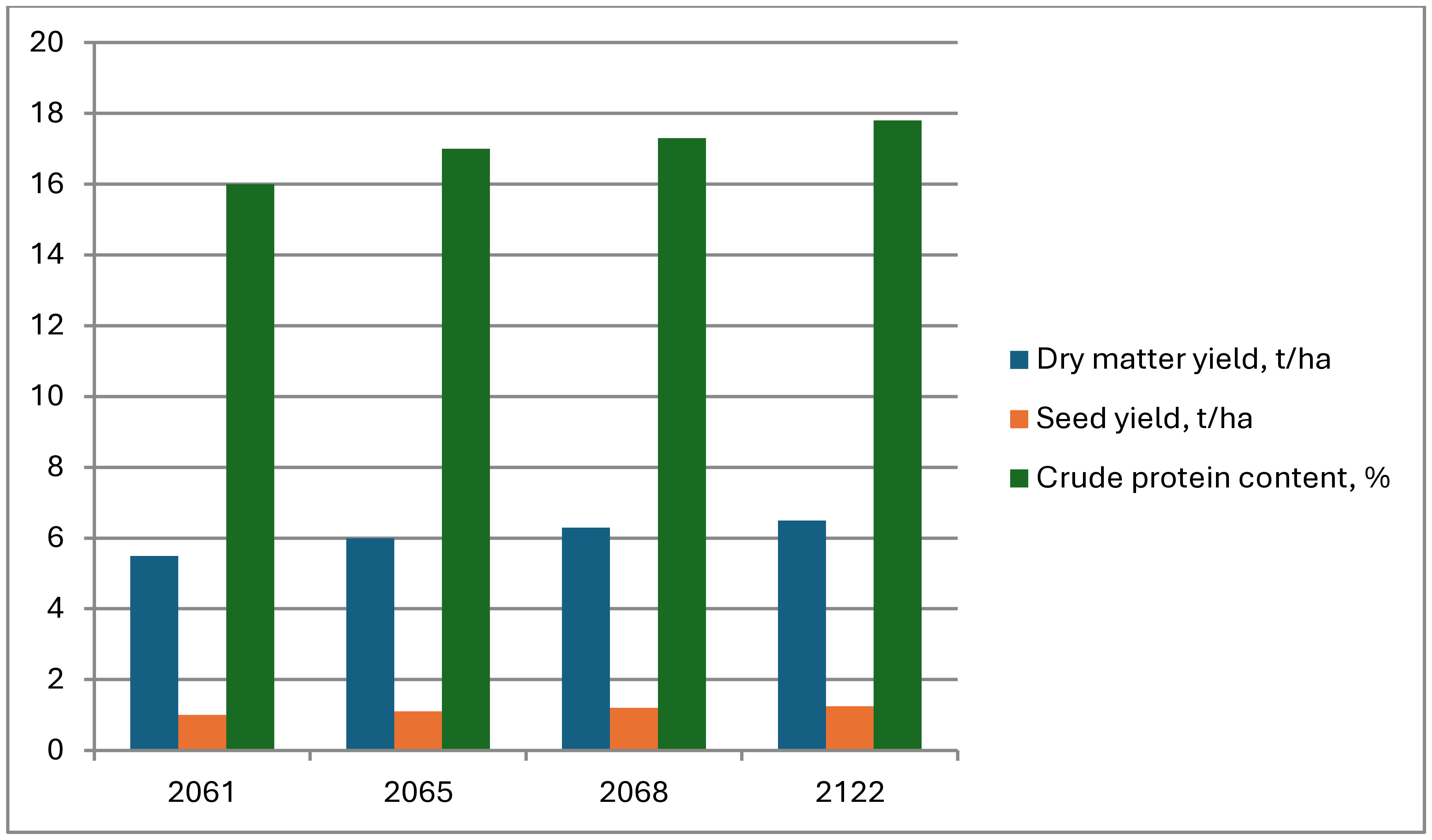
Based on the combination of economically valuable traits, breeding line 2122 demonstrated the greatest overall value, characterized by the highest dry matter yield (64.8 dt/ha), high seed productivity (11.9 dt/ha), the greatest leafiness (46.6%), and elevated crude protein content (17.7%). Line 2120 also exhibited high productivity and favorable forage quality traits and can therefore be considered promising for further evaluation.
3.2.5. Comparative analysis of variety trial results across different nurseries
An analysis of data obtained from the collection, breeding, control, and competitive variety trial nurseries made it possible to identify a number of sainfoin accessions characterized by high productivity and improved forage quality traits.
Across all types of nurseries, dry matter yield of the studied accessions exceeded that of the standard cultivar. In the collection nursery, the highest dry matter yield was recorded for accession 2015 (61.1 dt/ha), which was 10.7% higher than the standard. In the breeding nursery, individual plant productivity was highest for lines 04, 30, and 32, which produced 310-315 g of dry matter per plant compared with 259.7 g in the standard. In the control nursery, the maximum dry matter yields were observed for lines 2067 and 2070 (63.9-64.1 dt/ha), exceeding the standard by 15.6-15.9%. In the competitive variety trial nursery, the highest dry matter yields were achieved by lines 2120 and 2122 (64.3-64.8 dt/ha), surpassing the standard by 16.3-17.8%.
Thus, line 2122, which produced the maximum dry matter yield (64.8 dt/ha), can be recommended as the primary candidate for further state variety testing and subsequent introduction into agricultural production. At the same time, lines 2015, 04, 30, 32, 2067, and 2070 are advisable for use as donors of high productivity traits in sainfoin breeding programs.
In terms of seed productivity, accessions 2015 and 2019 stood out in the collection nursery, producing yields of 11.3-11.9 dt/ha, which exceeded the standard by 15-21%. In the breeding nursery, the highest individual seed productivity was observed for lines 04, 30, and 32, reaching up to 64.1 g of seeds per plant compared with 48.3 g in the standard. In the control nursery, high seed yields were recorded for lines 2063 and 2068 (11.8 dt/ha), representing an 18% increase over the standard cultivar. In the competitive variety trial nursery, the absolute leader in seed productivity was line 2122, which produced a seed yield of 11.9 dt/ha, exceeding the standard by 19%.
Accordingly, line 2122 is recommended as a priority candidate for further state testing and for use in breeding programs as a source of high seed productivity, while lines 2015, 2019, 04, 30, 32, 2063, and 2068 are advisable as donors of this trait for the development of new synthetic sainfoin cultivars.
Seed productivity analysis further confirmed the high yield potential of line 2122. Evaluation of forage quality traits showed that, in terms of leafiness, the most promising accessions were 2013, 2019, and 2025 (46.6-46.8%) in the collection nursery; lines 13 and 32 (52.0-53.1%) in the breeding nursery; lines 2065 and 2068 (46.6-46.9%) in the control nursery; and lines 2122 and 2121 (46.6% and 46.1%, respectively) in the competitive variety trial nursery. Regarding crude protein content, the highest values were recorded for line 2065 in the control nursery (17.4%) and for line 2122 in the competitive variety trial nursery (17.7%). Thus, lines 13 and 32 made the greatest contribution to increasing leafiness as a key indicator of forage quality, whereas lines 2122 and 2065 should be considered the primary donors of elevated crude protein content and overall forage quality improvement in sainfoin breeding.
Figure 1 presents a comparative analysis of the key productivity and quality indicators of the best-performing sainfoin lines, including dry matter yield, seed yield, and crude protein content under the environmental conditions of Eastern Kazakhstan.
The comparative analysis of variety trial results demonstrated that, at the collection nursery stage, initial material characterized by high yield and leafiness (lines 2015 and 2019) was identified; in the breeding nursery, promising biotypes (04, 30, and 32) with increased individual productivity were selected; and in the control nursery, the breeding value of lines 2065, 2067, and 2070 was confirmed, as they combined high productivity with improved forage quality traits. The competitive variety trial allowed the identification of an absolute leader – line 2122 – which demonstrated the highest dry matter and seed yields, high leafiness, and the greatest crude protein content. Overall, considering the combination of economically valuable traits (dry matter yield, seed productivity, leafiness, and crude protein content), line 2122 occupies a leading position and is recommended for further state variety testing as a promising candidate cultivar. Lines 2065, 2015, and 32 should be regarded as valuable breeding material for subsequent selection work.
Based on the obtained results, it is recommended to include the most promising accessions from the collection nursery (2015, 2004, 2022), breeding nursery (04, 30, 32), control nursery (2065, 2070), and competitive variety trial nursery (2120, 2122) in the breeding program aimed at developing a new synthetic sainfoin cultivar. Further breeding work should combine individual and family selection methods with elements of synthetic breeding to ensure more effective fixation of economically valuable traits. During selection, priority should be given to genotypes with leafiness exceeding 46% and crude protein content of at least 17%. Considering their high adaptation to the climatic conditions of Eastern Kazakhstan, expanded competitive trials under commercial field conditions are recommended, followed by regionalization of the best forms and the use of the obtained results in the development of regional programs to strengthen the forage base of livestock production in foothill-steppe zones with unstable moisture supply.
4. Conclusions
The conducted studies confirmed the high breeding and production value of sainfoin (Onobrychis spp.) as a forage crop for the foothill-steppe zone of Eastern Kazakhstan and demonstrated the effectiveness of a multistage nursery selection system in developing adapted, high-yielding genotypes. A comprehensive evaluation of 540 sainfoin genotypes across the collection, breeding, control, and competitive variety trial nurseries enabled the consistent identification of forms exceeding the regional standard in dry matter yield, seed productivity, and forage quality traits.
It was established that at the early stages of selection (collection and breeding nurseries), accessions 2015, 2019, 04, 30, and 32 served as promising sources of economically valuable traits, being characterized by enhanced biomass accumulation capacity, high individual seed productivity, and increased leafiness. At the control nursery stage, the stability of productivity and quality traits was confirmed for accessions 2065, 2067, and 2070, indicating their high adaptability to the soil and climatic conditions of the region.
According to the results of the competitive variety trial, breeding line 2122 was identified as the absolute leader in terms of the combined trait complex. This line achieved the maximum dry matter yield (6.48t/ha) and seed yield (1.19t/ha), exceeding the standard cultivar by 17.8% and 19.0%, respectively, and was also distinguished by increased leafiness (46.6%) and the highest crude protein content (17.7%). These results indicate a stable combination of high productivity and improved forage quality, which is a key requirement for the development of forage legume cultivars for regions with unstable moisture conditions.
Overall, the findings of this study support the recommendation of breeding line 2122 for submission to state variety testing, followed by its introduction into agricultural production under the conditions of Eastern Kazakhstan. Genotypes identified at the preceding selection stages (2015, 04, 30, 32, 2065, and 2070) are advisable for use as donors of high productivity, leafiness, and elevated crude protein content in the development of new synthetic sainfoin cultivars. Further research should focus on assessing the ecological plasticity and persistence of the most promising forms under multi-cut management systems and across diverse agroecological conditions of the region.
Acknowledgements
The materials presented in this article were obtained within the framework of the scientific and technical program IRN BR22884393 “Development of competitive cultivars and hybrids of forage crops for various agroclimatic zones of Kazakhstan and the elaboration of varietal cultivation technologies”, under the project “Development of high-yielding sainfoin cultivars under the conditions of Eastern Kazakhstan and the optimization of sainfoin cultivation technology.”
Data Availability Statement
The entire data set that supports the results of this study will be published in the article itself.
References
-
ACHARYA, S.N., SOTTIE, E.T., COULMAN, B.E., IWAASA, A.D., MCALLISTER, T.A., WANG, Y. and LIU, J.-H., 2013. New sainfoin populations for bloat-free alfalfa pasture mixtures in Western Canada. Crop Science, vol. 53, no. 5, pp. 2283-2293. https://doi.org/10.2135/cropsci2012.10.0591
» https://doi.org/10.2135/cropsci2012.10.0591 -
AUFRÈRE, J., DUDILIEU, M. and PONCET, C., 2008. In vivo and in situ measurements of the digestive characteristics of sainfoin in comparison with lucerne fed to sheep as fresh forages at two growth stages and as hay. Animal, vol. 2, no. 9, pp. 1331-1339. https://doi.org/10.1017/S1751731108002450 PMid:22443822.
» https://doi.org/10.1017/S1751731108002450 -
AUFRÈRE, J., DUDILIEU, M. and PONCET, C., 2013. Mixing sainfoin and lucerne to improve the feed value of legumes fed to sheep by the effect of condensed tannins. Animal, vol. 2, no. 9, pp. 1331-1339. https://doi.org/10.1017/S1751731112001097 PMid:22443822.
» https://doi.org/10.1017/S1751731112001097 -
BHATTARAI, S., COULMAN, B. and BILIGETU, B., 2016. Sainfoin (Onobrychis viciifolia Scop.): renewed interest as a forage legume for Western Canada. Canadian Journal of Plant Science, vol. 96, no. 5, pp. 748-756. https://doi.org/10.1139/cjps-2015-0378
» https://doi.org/10.1139/cjps-2015-0378 -
BHATTARAI, S., COULMAN, B., FU, Y.-B., BEATTIE, A.D. and BILIGETU, B., 2017. Genetic diversity and relationship of sainfoin (Onobrychis viciifolia Scop.) germplasm as revealed by amplified fragment length polymorphism markers. Canadian Journal of Plant Science, vol. 98, no. 3, pp. 543-551. https://doi.org/10.1139/cjps-2017-0094
» https://doi.org/10.1139/cjps-2017-0094 -
CICEK, H., ATES, S., OZCAN, G., TEZEL, M., KLING, J.G., LOUHAICHI, M. and KELES, G., 2020. Effect of nurse crops and seeding rate on the persistence, productivity and nutritive value of sainfoin in a cereal-based production system. Grass and Forage Science, vol. 75, no. 1, pp. 86-95. https://doi.org/10.1111/gfs.12467
» https://doi.org/10.1111/gfs.12467 -
GUGLIELMELLI, A., MELE, M., TRABALZA, M. and CUTRIGNELLI, M.I., 2011. In vitro fermentation patterns and methane production of sainfoin hay with different condensed tannin contents. Grass and Forage Science, vol. 66, no. 4, pp. 488-500. https://doi.org/10.1111/j.1365-2494.2011.00805.x
» https://doi.org/10.1111/j.1365-2494.2011.00805.x -
HATEW, B., STRINGANO, E., MUELLER-HARVEY, I., HENDRIKS, W.H., CARBONERO, C.H., SMITH, L.M.J. and PELLIKAAN, W.F., 2016. Impact of variation in structure of condensed tannins from sainfoin on in vitro ruminal methane production and fermentation characteristics. Journal of Animal Physiology and Animal Nutrition, vol. 100, no. 2, pp. 348-360. https://doi.org/10.1111/jpn.12336 PMid:25960083.
» https://doi.org/10.1111/jpn.12336 -
HUYEN, N.T., DESRUES, O., ALFERINK, S.J.J., ZANDSTRA, T., VERSTEGEN, M.W.A., HENDRIKS, W.H. and PELLIKAAN, W.F., 2016. Inclusion of sainfoin (Onobrychis viciifolia) silage in dairy cow rations affects nutrient digestibility, nitrogen utilization, energy balance, and methane emissions. Journal of Dairy Science, vol. 99, no. 5, pp. 3566-3577. https://doi.org/10.3168/jds.2015-10583 PMid:26898288.
» https://doi.org/10.3168/jds.2015-10583 -
HUYEN, N.T., VERSTEGEN, M.W.A., HENDRIKS, W.H. and PELLIKAAN, W.F., 2020. Sainfoin (Onobrychis viciifolia) silage in dairy cow rations reduces ruminal biohydrogenation and increases transfer efficiencies of unsaturated fatty acids from feed to milk. Animal Nutrition, vol. 6, no. 3, pp. 333-341. https://doi.org/10.1016/j.aninu.2020.05.001 PMid:33005767.
» https://doi.org/10.1016/j.aninu.2020.05.001 -
IRANI, S., MAJIDI, M.M., MIRLOHI, A., ZARGAR, M. and KARAMI, M., 2015. Assessment of drought tolerance in sainfoin. Agronomy Journal, vol. 107, no. 5, pp. 1771-1781. https://doi.org/10.2134/agronj15.0131
» https://doi.org/10.2134/agronj15.0131 -
KAPP-BITTER, A.N., DICKHOEFER, U., KAPTIJN, G., PEDAN, V., PERLER, E., KREUZER, M. and LEIBER, F., 2021. On-farm examination of sainfoin supplementation effects in dairy cows in a roughage-based feeding system: indicators of protein utilisation. Livestock Science, vol. 258, pp. 104509. https://doi.org/10.1016/j.livsci.2021.104509
» https://doi.org/10.1016/j.livsci.2021.104509 -
LEGENDRE, H., HOSTE, H. and GIDENNE, T., 2017. Nutritive value and anthelmintic effect of sainfoin pellets fed to experimentally infected growing rabbits. Animal, vol. 11, no. 9, pp. 1464-1471. https://doi.org/10.1017/S1751731117000209 PMid:28215185.
» https://doi.org/10.1017/S1751731117000209 -
MALISCH, C.S., LÜSCHER, A., BAERT, N., ENGSTRÖM, M.T., STUDER, B., FRYGANAS, C., SUTER, D., MUELLER-HARVEY, I. and SALMINEN, J.-P., 2015. Large variability of proanthocyanidin content and composition in sainfoin (Onobrychis viciifolia). Journal of Agricultural and Food Chemistry, vol. 63, no. 47, pp. 10234-10242. https://doi.org/10.1021/acs.jafc.5b04946 PMid:26551032.
» https://doi.org/10.1021/acs.jafc.5b04946 -
MALISCH, C.S., SALMINEN, J.-P., KÖLLIKER, R., ENGSTRÖM, M.T., SUTER, D., STUDER, B. and LÜSCHER, A., 2016. Drought effects on proanthocyanidins in sainfoin (Onobrychis viciifolia). Journal of Agricultural and Food Chemistry, vol. 64, no. 49, pp. 9307-9316. https://doi.org/10.1021/acs.jafc.6b02342 PMid:27960281.
» https://doi.org/10.1021/acs.jafc.6b02342 -
MCMAHON, L.R., MAJAK, W., MCALLISTER, T.A., HALL, J.W., JONES, G.A., POPP, J.D. and CHENG, K.-J., 1999. Effect of sainfoin on in vitro digestion of fresh alfalfa and bloat in steers. Canadian Journal of Animal Science, vol. 79, no. 2, pp. 203-212. https://doi.org/10.4141/A98-074
» https://doi.org/10.4141/A98-074 -
MORA-ORTIZ, M. and SMITH, L.M.J., 2018. Onobrychis viciifolia: a comprehensive literature review of its agronomy and genetic resources. Plant Genetic Resources, vol. 16, no. 5, pp. 403-418. https://doi.org/10.1017/S1479262118000230
» https://doi.org/10.1017/S1479262118000230 -
NOVOSELOVA, A.S., KONSTANTINOVA, A.M. and MIKHAILICHENKO, B.P., 2002 [viewed 26 Feb 2026]. Guidelines for breeding perennial legume forage crops [online]. Moscow: V.R. Williams All-Russian Research Institute of Forage Crops. Available from: https://agris.fao.org/search/en/providers/122613/records/6473a3b813d110e4e7a78371 [in Russian].
» https://agris.fao.org/search/en/providers/122613/records/6473a3b813d110e4e7a78371 -
PETRIČ, D., KOMÁROMYOVÁ, M., BATŤÁNYI, D., KOZŁOWSKA, M., FILIPIAK, W., ŁUKOMSKA, A., ŚLUSARCZYK, S., SZUMACHER-STRABEL, M., CIEŚLAK, A., VÁRADY, M., KIŠIDAYOVÁ, S. and VÁRADYOVÁ, Z., 2022. Rumen methanogens: effect of sainfoin (Onobrychis viciifolia) pellets on rumen microbiome and histopathology in lambs exposed to gastrointestinal nematodes. Agriculture, vol. 12, no. 2, pp. 301. https://doi.org/10.3390/agriculture12020301
» https://doi.org/10.3390/agriculture12020301 -
POUDEL, H.P., BHATTARAI, S., SINGER, S.D., BILIGETU, B. and ACHARYA, S., 2023. An insight into sainfoin (Onobrychis viciifolia Scop.) breeding: achievements and prospects. Agronomy Journal, vol. 115, pp. 2843-2858. https://doi.org/10.1002/agj2.21439
» https://doi.org/10.1002/agj2.21439 -
REGOS, I., URBANELLA, A. and TREUTTER, D., 2009. Identification and quantification of phenolic compounds from the forage legume sainfoin (Onobrychis viciifolia). Journal of Agricultural and Food Chemistry, vol. 57, no. 13, pp. 5843-5852. https://doi.org/10.1021/jf900625r PMid:19456170.
» https://doi.org/10.1021/jf900625r -
RUFINO-MOYA, P.J., BLANCO, M., BERTOLÍN, J.R. and JOY, M., 2019. Methane production of fresh sainfoin, with or without PEG, and fresh alfalfa at different stages of maturity is similar but the fermentation end products vary. Animals (Basel), vol. 9, no. 5, pp. 197. https://doi.org/10.3390/ani9050197 PMid:31027381.
» https://doi.org/10.3390/ani9050197 -
SAKHRAOUI, A., LTAEIF, H.B., SAKHRAOUI, A.S., VILLALBA, J.J., CASTILLO, J.M. and ROUZ, S., 2024. Sainfoin (Onobrychis viciifolia): a legume with great ecological and agronomical potential under climate change. Journal of Agricultural Science, vol. 162, no. 4, pp. 307-331. https://doi.org/10.1017/S0021859624000327
» https://doi.org/10.1017/S0021859624000327 -
STATE COMMISSION FOR VARIETY TESTING OF AGRICULTURAL CROPS, 1989 [viewed 26 Feb 2026]. Methods of state variety testing of agricultural crops. Vol. 2. Cereals, grain legumes, maize and forage crops [online]. Moscow: Kolos. Available from: https://rusneb.ru/catalog/000200_000018_rc_839699/ [in Russian]
» https://rusneb.ru/catalog/000200_000018_rc_839699/ -
STEVOVIĆ, V., STANISAVLJEVIĆ, R., ĐUKIĆ, D. and ĐUROVIĆ, D., 2012. Effect of row spacing on seed and forage yield in sainfoin (Onobrychis viciifolia Scop.). Turkish Journal of Agriculture and Forestry, vol. 36, no. 1, pp. 35-44. https://doi.org/10.3906/tar-1006-1018
» https://doi.org/10.3906/tar-1006-1018 -
THEODORIDOU, K., AUFRÈRE, J., ANDUEZA, D., POURRAT, J., LE MORVAN, A., STRINGANO, E., MUELLER-HARVEY, I. and BAUMONT, R., 2010. The effect of condensed tannins in fresh sainfoin (Onobrychis viciifolia) on in vivo and in situ digestion in sheep. Animal Feed Science and Technology, vol. 160, no. 1–2, pp. 23-38. https://doi.org/10.1016/j.anifeedsci.2010.06.007
» https://doi.org/10.1016/j.anifeedsci.2010.06.007 -
WANG, Y., MCALLISTER, T.A. and ACHARYA, S., 2015. Condensed tannins in sainfoin: Composition, concentration, and effects on nutritive and feeding value of sainfoin forage. Crop Science, vol. 55, no. 1, pp. 13-22. https://doi.org/10.2135/cropsci2014.07.0489
» https://doi.org/10.2135/cropsci2014.07.0489 -
ZARRABIAN, M. and MAJIDI, M.M., 2015. Genetic diversity and relationships within and among Onobrychis species. Turkish Journal of Botany, vol. 39, no. 4, pp. 681-692. https://doi.org/10.3906/bot-1406-47
» https://doi.org/10.3906/bot-1406-47 -
ZARRABIAN, M., MAJIDI, M.M. and EHTEMAM, M.H., 2013. Genetic diversity in a worldwide collection of sainfoin using morphological, anatomical, and molecular markers. Crop Science, vol. 53, no. 6, pp. 2483-2496. https://doi.org/10.2135/cropsci2013.03.0130
» https://doi.org/10.2135/cropsci2013.03.0130
Edited by
-
Editor:
Takako Matsumura Tundisi