 Combined methods for detecting phytopathogens and protecting crops: a comparative study
Abstract
This study evaluated the agronomic and economic performance of chemical, biological, agrotechnical and integrated crop protection strategies in field conditions in southern Kazakhstan between 2023 and 2024. A randomised field experiment was conducted across five farms with a total area of 50 hectares, including wheat, maize and barley. Each crop was subdivided into replicated treatment plots (chemical, biological, agrotechnical, integrated protection and untreated control), with the treatments being assigned at random within each field. Phytopathogens were identified through visual assessments of disease incidence and severity, followed by laboratory confirmation via PCR diagnostics, microscopy, spectrophotometry, and chromatographic analysis. Fungal pathogens predominated, accounting for 88.4% of pathogens detected in wheat, 71.1% in maize and 70.2% in barley in 2023. The integrated approach significantly increased yields compared to the individual strategies and the control plots (wheat: F(3, 16) = 25.12, p < 0.001; maize: F(3, 16) = 25.12, p < 0.001; barley: F(3, 16) = 18.93, p < 0.001). An economic evaluation demonstrated that the integrated protection strategy yielded the highest net returns, with additional revenue of 12,300-12,750 KZT/ha for wheat and 15,400-16,200 KZT/ha for maize compared to the control. The return on investment was 1.35-1.42 for the integrated strategy compared to 1.12-1.18 for chemical-only treatments. The findings show that combining chemical, biological and agrotechnical measures improves the stability of crop yields and financial performance under local agroecological conditions. This supports the economic viability of integrated crop protection.
Keywords:
combined approach; organic agriculture; phytopathogens; plant protection; product quality; South Kazakhstan Region; yield
Resumo
Este estudo avaliou o desempenho agronômico e econômico de estratégias de proteção de culturas químicas, biológicas, agrotécnicas e integradas em condições de campo no sul do Cazaquistão entre 2023 e 2024. Um experimento de campo randomizado foi conduzido em cinco fazendas, com uma área total de 50 hectares, incluindo trigo, milho e cevada. Cada cultura foi subdividida em parcelas de tratamento replicadas (química, biológica, agrotécnica, proteção integrada e controle não tratado), com os tratamentos sendo atribuídos aleatoriamente dentro de cada parcela. Os fitopatógenos foram identificados por meio de avaliações visuais da incidência e severidade da doença, seguidas de confirmação laboratorial via diagnóstico por PCR, microscopia, espectrofotometria e análise cromatográfica. Os patógenos fúngicos predominaram, representando 88,4% dos patógenos detectados no trigo, 71,1% no milho e 70,2% na cevada em 2023. A abordagem integrada aumentou significativamente a produtividade em comparação com as estratégias individuais e as parcelas de controle (trigo: F(3, 16) = 25,12, p < 0,001; milho: F(3, 16) = 25,12, p < 0,001; cevada: F(3, 16) = 18,93, p < 0,001). Uma avaliação econômica demonstrou que a estratégia de proteção integrada gerou os maiores retornos líquidos, com receita adicional de 12.300-12.750 KZT/ha para o trigo e 15.400-16.200 KZT/ha para o milho, em comparação com o controle. O retorno do investimento foi de 1,35-1,42 para a estratégia integrada, em comparação com 1,12-1,18 para tratamentos apenas químicos. As conclusões mostram que a combinação de medidas químicas, biológicas e agrotécnicas melhora a estabilidade dos rendimentos das culturas e o desempenho financeiro sob condições agroecológicas locais. Isto apoia a viabilidade econômica da protecção integrada das culturas.
Palavras-chave:
abordagem combinada; agricultura orgânica; fitopatógenos; proteção de plantas; qualidade do produto; Região do Cazaquistão do Sul; produtividade
1. Introduction
Protecting crops against phytopathogenic organisms is one of the most critical challenges for sustainable agricultural production. Plant diseases account for 15-30% yield losses of major crops globally, with severe epidemic events causing substantially higher reductions (Oerke, 2006; Oerke and Dehne, 2004; Savary et al., 2019). The annual global economic burden of plant pathogens exceeds USD 200 billion, impacting both productivity and product quality (Savary et al., 2019; Tang, 2024). Climate change, increasing pathogen adaptability and the emergence of fungicide-resistant strains further intensify these risks (Hillocks, 2012; Savary et al., 2019).
Fungal pathogens are the primary biotic constraint in cereal systems, including wheat, maize, and barley. Species of Fusarium, Puccinia and Phytophthora can cause severe reductions in yield and deterioration in quality, including mycotoxin contamination (Alberts et al., 2016; Haverkort et al., 2009; Ivanov et al., 2021; Mengesha, 2020; Tang, 2024). Bacterial and viral pathogens also contribute to productivity losses, albeit typically at lower incidence levels in temperate cereal systems (Cai et al., 2019; Jagadeesan et al., 2025; Jain et al., 2020).
Three principal categories of plant protection measure are employed to mitigate phytopathogen pressure: chemical, biological and agrotechnical (Ermachenkov et al., 2024; Kazakova et al., 2025; Sergunova and Ilina, 2025). Chemical fungicides provide rapid and often highly effective disease suppression. However, long-term reliance on synthetic pesticides can lead to the development of resistance, environmental contamination and regulatory restrictions (Hillocks, 2012; Ons et al., 2020; Schut et al., 2014). Increasing societal and legislative pressure in many regions has stimulated the search for alternative or complementary approaches (Claß-Mahler et al., 2023; Zimmermann et al., 2021).
Biological control agents, including Bacillus, Trichoderma and other plant growth-promoting microorganisms, have emerged as promising tools for sustainable disease management (El-Saadony et al., 2022; Koskey et al., 2021; Kubicek et al., 2001; Sheoran et al., 2025). However, their efficacy in the field can be inconsistent and is often context-dependent, influenced by soil properties, microclimate, and pathogen pressure (Awan and Shoaib, 2019; Collinge et al., 2022; Fenta and Mekonnen, 2024). Agrotechnical measures, such as crop rotation, residue management, irrigation control and resistant cultivars, are fundamental to integrated pest management, but they require long-term system planning and may not provide rapid suppression under high infection intensity (Bonanomi et al., 2015; Richard et al., 2022).
Consequently, integrated crop protection systems that combine chemical, biological and agronomic measures are increasingly being promoted as the most balanced strategy (Ons et al., 2020; Richard et al., 2022). Evidence from European mineral-ecological systems and IPM frameworks suggests that integrated approaches can reduce chemical inputs while maintaining stable yields (Claß-Mahler et al., 2023; Zimmermann et al., 2021). Studies from Asia show that combining microbial biopreparations with adaptive management practices is more effective at suppressing disease than single-component interventions (Jain et al., 2020; Solomin et al., 2003; Wei et al., 2021).
Despite growing global evidence supporting integration, several important gaps remain. Firstly, many studies focus on single crops or controlled experimental stations, which limits the ability to extrapolate to commercial farm conditions (Richard et al., 2022; Schut et al., 2014). Secondly, quantitative economic evaluations of multi-component protection systems are less frequently reported than agronomic outcomes, even though economic feasibility is crucial for farmer adoption. Thirdly, validation in temperate continental agroecosystems of Central Asia remains limited. Monitoring studies in South-East Kazakhstan highlight environmental variability and pathogen risks in local agroecosystems (Suleimenova et al., 2021), yet there is a lack of comprehensive comparative evaluations of protection strategies under production-scale conditions.
In light of the growing pathogen pressure linked to climate variability (Savary et al., 2019; Tang, 2024), it is both scientifically and practically relevant to evaluate integrated protection strategies under region-specific agroecological conditions.
The present study therefore aimed to conduct a multi-year comparative field assessment of chemical, biological and agrotechnical crop protection strategies, applied both individually and in combination, in cereal-based systems in southern Kazakhstan. The study objective to:
-
quantify the effects of the strategies on yield, crop losses, and product quality;
-
assess the statistical relationship between infection intensity and productivity; and
-
evaluate the economic performance and stability of each protection strategy under commercial farming conditions.
1.1. Research hypothesis
Under the agroecological conditions of South Kazakhstan, the integration of chemical, biological and agrotechnical measures provides significantly higher yields, lower phytopathogen incidence, reduced crop losses and improved economic returns compared to single-method protection strategies and untreated control.
2. Materials and Methods
2.1. Study area and climatic conditions
The field experiment was carried out in the South Kazakhstan Region, one of the country’s most important agricultural zones. This area is characterized by a temperate continental climate with hot, dry summers and relatively mild winters. The average annual temperature is approximately 13 °C, while mean annual precipitation reaches about 645 mm, most of which falls in spring and early summer. These conditions, combined with long periods of sunshine, create favorable circumstances for cereal production. The soils of the study area are fertile chernozems with a humus content ranging from 5 to 7%, providing an excellent nutrient base for crop cultivation and ensuring high productivity when coupled with appropriate crop protection practices.
The global relevance of crop protection research is well established. Recent expert-based assessments have demonstrated that pathogens and pests account for substantial yield losses worldwide. For instance, average global losses are estimated at 21.5% for wheat, 22.5% for maize, and more than 30% for rice, with particularly severe effects in food-deficient regions with fast-growing populations (Savary et al., 2019). These findings underscore the need for locally adapted studies that quantify the impact of pathogens under specific agro-climatic conditions. The present research contributes to this body of knowledge by focusing on pathogen incidence and management strategies in South Kazakhstan, a region where cereals form the backbone of both local and national food security.
2.2. Experimental design and layout
The total research area covered 50 hectares, which were divided into five experimental plots of 10 hectares each. To minimize the confounding effects of environmental heterogeneity, all farms were located within the same agro-climatic zone. Each plot was further subdivided into crop-specific subplots: four hectares were allocated to wheat, three hectares to maize, and three hectares to barley. The experiment was conducted across two consecutive agricultural cycles, 2023 and 2024, allowing for the evaluation of inter-annual variability in pathogen pressure and crop performance. To ensure statistical robustness, each of the five experimental plots on the farm was subdivided into five subplots, each measuring 0.8-1.0 ha, for each crop (wheat, maize and barley). Treatments were randomly assigned within each crop block using a randomised complete block design to minimise the effect of field heterogeneity. This experimental layout was maintained throughout the two-year study, with careful crop rotation according to the maize-wheat-barley scheme to avoid carryover effects. Within each subplot, guard rows measuring 2 m were left untreated to reduce edge effects.
2.3. Crop varieties
The cultivars used were chosen for their proven adaptation to local growing conditions and their partial resistance to key regional pathogens. For wheat, the cultivar Astana 2 was used, which displays moderate resistance to Puccinia triticina (leaf rust) and Fusarium graminearum (Fusarium head blight). Maize was represented by the hybrid KAZCORN 501, known for its partial tolerance to Ustilago maydis (corn smut). Barley was sown with the cultivar Bereke 70, which has been bred for resistance to powdery mildew caused by Blumeria graminis f. sp. hordei. These choices reflect the ongoing national strategy of deploying resistant varieties as the first line of defense against crop diseases.
2.4. Agronomic practices
Sowing was carried out under conditions typical for the region. Wheat and barley were sown from late April to early May, while maize was planted in mid-May. Seeding rates followed regional agronomic recommendations: 200-220 kg/ha for wheat, 180-200 kg/ha for barley, and 22-25 kg/ha for maize. Harvesting dates corresponded to physiological maturity: late July for barley, mid-August to early September for wheat, and late September to October for maize.
The rotation scheme was structured as maize-wheat-barley, supplemented with green manure crops such as a vetch-oat mixture to improve soil fertility. Post-harvest, fields underwent deep ploughing to a depth of 25 cm, followed by spring harrowing and mulching to conserve soil moisture. Irrigation was provided through drip systems, with application rates of 3500-4000 m3/ha for wheat and barley and 4500-5000 m3/ha for maize. These rates correspond to the crop-specific evapotranspiration needs in the semi-arid environment of South Kazakhstan.
2.5. Crop protection strategies
Five different protection regimes were compared. The chemical protection group received treatments with tebuconazole (Folicur®, Bayer; 0.5 l/ha), azoxystrobin (Amistar®, Syngenta; 1.0 l/ha), thiophanate-methyl (Topsin-M®, Nippon Soda; 1.5 kg/ha), and lambda-cyhalothrin (Karate Zeon®, Syngenta; 0.15 l/ha). Applications were performed twice: during tillering and heading for cereals, and at the V6 and VT stages for maize.
The biological protection group was treated with microbial preparations: Bactofit® (Bacillus subtilis strain 26D; 2 l/ha, 108 CFU/mL) and Trichodermin® (Trichoderma harzianum strain VIZR-18; 1.5 l/ha), applied at seedling emergence and flowering, following the protocols developed by the All-Russian Institute of Plant Protection (VIZR, St. Petersburg, Russia).
The agrotechnical group relied exclusively on preventive agronomic measures, including rotation, soil fertility management, resistant cultivars, mulching, and optimized irrigation. The combined group integrated chemical, biological, and agrotechnical approaches, representing an intensive protection system. The control group received no interventions, thereby allowing for the evaluation of natural pathogen incidence and spread.
All chemical and biological treatments were applied using a calibrated tractor-mounted boom sprayer, delivering 300-400 litres per hectare (L/ha) of spray solution for cereals and 400-500 L/ha for maize to ensure uniform coverage. Applications were carried out in the morning under wind speeds of less than 5 m/s to minimise drift. Each treatment was applied twice per season: at the tillering and heading stages for wheat and barley, and at the V6 and VT stages for maize. The combined protection plots received both chemical and biological treatments on the same schedule, integrated with agronomic measures such as mulching and irrigation management. Yield reductions and pathogen incidence were calculated based on weekly observations of 50 plants per subplot using a visual severity scale of 0-5, supplemented by molecular analyses of collected plant tissue.
2.6. Monitoring and laboratory analyses
Plant health was assessed weekly through visual inspection for typical disease symptoms, including leaf spots, stem discoloration, and growth retardation. At each major developmental stage, samples of soil, roots, leaves, and grains were collected. DNA was extracted using the DNeasy Plant Mini Kit (Qiagen, Germany), and PCR amplification was carried out targeting the fungal ITS1-ITS4 region and the bacterial tufA gene. Sequencing was performed on an ABI 3130xl Genetic Analyzer (Applied Biosystems, USA). Quantitative PCR (qPCR) assays using SYBR Green chemistry on a Bio-Rad CFX96 Touch platform enabled the estimation of infection intensity.
Multiplex PCR was employed to detect mixed infections, which frequently occurred, such as Fusarium spp. in combination with Alternaria spp. in wheat and barley, and co-infections of Ustilago maydis with Fusarium verticillioides in maize. Complementary analyses included spectrophotometry (Thermo Fisher Scientific, USA) to evaluate potential contamination of soil and irrigation water, light and fluorescence microscopy (Leica, Germany) to study tissue colonization, and chromatographic assays to quantify pesticide residues in soil and plant samples.
DNA was extracted from 100 mg of homogenised plant tissue samples and from 10 g of soil collected from the rhizosphere. PCR and qPCR assays were performed in triplicate to quantify the pathogen load, while spectrophotometry and chromatography were conducted on pooled soil and plant extracts to estimate potential environmental contamination and chemical residues. These procedures followed standardised protocols, enabling the results to be replicated in future studies.
2.7. Statistical analysis
All data were processed using IBM SPSS Statistics v.25. Descriptive statistics were first applied to summarize the data. Comparative analyses included ANOVA and MANOVA to assess treatment effects, correlation and regression analyses to explore associations among variables, and cluster analysis to classify pathogens by infection profiles. Mixed-effects models were used to account for repeated measurements across the two years of the experiment. For year-to-year yield comparisons within the same plots, paired t-tests and mixed-effects models were applied rather than independent-sample t-tests, ensuring a statistically sound approach. A significance threshold of p < 0.05 was used throughout.
2.8. Economic analysis
An economic assessment was undertaken to evaluate the cost-effectiveness of different crop protection strategies. The calculation included direct expenses on chemical pesticides, biological agents, irrigation, and labor, set against the financial gains from yield improvements. Market price data were obtained from national sources: approximately 100,000 KZT per ton of wheat (equivalent to USD 210-220) and 61,400 KZT per ton of barley. The profitability of each treatment was calculated as the difference between the additional market value of grain produced and the incurred costs of protection. This provided an applied framework for assessing whether integrated approaches not only reduced pathogen incidence but also offered tangible financial benefits for farmers in South Kazakhstan. The ROI calculations considered total costs (chemical, biological, labour, irrigation and machinery) in relation to incremental yield gains. Additional sensitivity analyses were performed to explore the contribution of each component, considering hypothetical variations such as doubling chemical application rates and varying biocontrol efficacy from 50-100%. These analyses provided an understanding of the relative economic importance of each treatment component, thereby justifying the superiority of the integrated approach over chemical-only or biological-only regimes. All statistical analyses accounted for the randomised block design and replication across the five farms, ensuring a robust assessment of the effects of the treatments.
3. Results
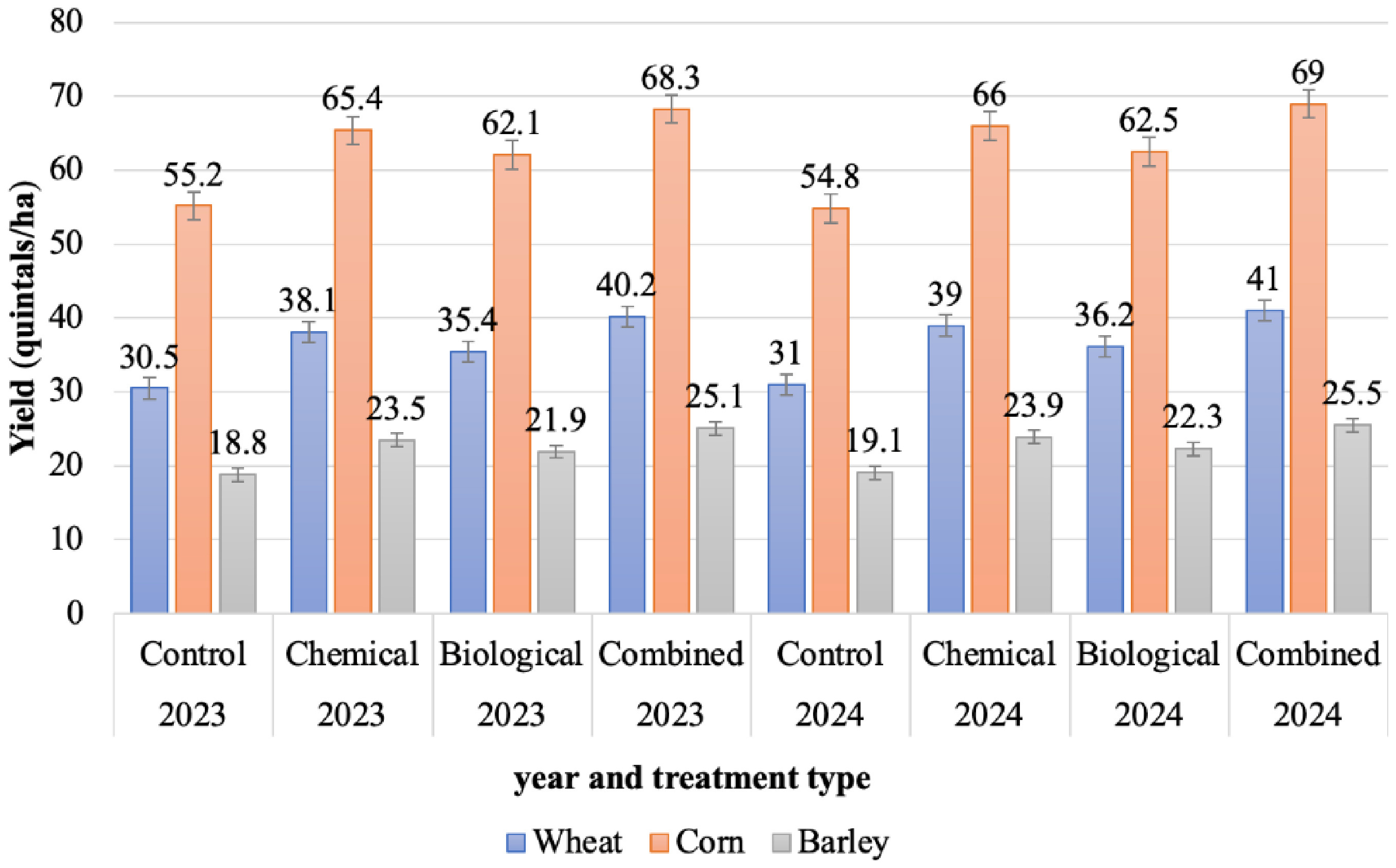
Statistical analysis revealed that the use of different plant protection methods substantially affected yield (ANOVA: F(3, 16) = 21.45, p < 0.001 for wheat in 2023; F(3, 16) = 25.12, p < 0.001 for corn; F(3, 16) = 18.93, p < 0.001 for barley), as shown in Figure 1. A similar trend was observed in 2024: F(3, 16) = 22.78, p < 0.001 for wheat; F(3, 16) = 24.31, p < 0.001) for corn; F(3, 16) = 20.41, p < 0.001 for barley. Post-hoc analysis (Tukey’s HSD) revealed that the combined protective measure considerably increased yield compared to the control group (p < 0.001), as well as the biological method (p < 0.01). The pathogen incidence reported below was determined using a combination of weekly visual inspections, molecular analyses (PCR and qPCR) and microscopic examination of collected leaf, root and grain samples, as detailed in the 'Materials and Methods' section.
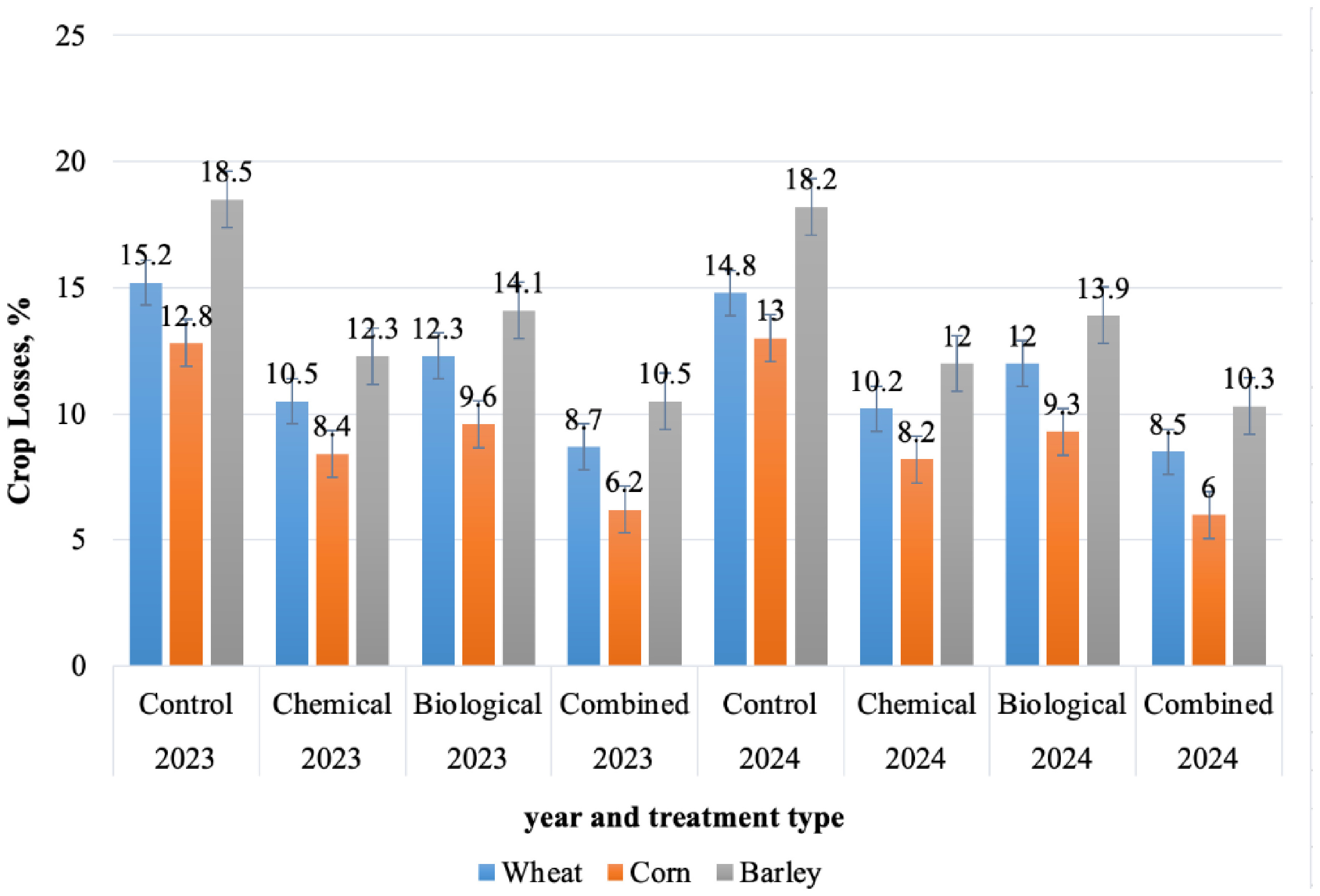
The analysis of crop yield losses also revealed statistically significant differences between groups in 2023: F(3, 16) = 19.62, p < 0.001 for wheat; F(3, 16) = 22.41, p < 0.001 for corn; F(3, 16) = 16.84, p < 0.001) for barley (Figure 2). In 2024, similar results were observed for all three crops (wheat: F(3, 16) = 20.17, p < 0.001; corn: F(3, 16) = 21.93, p < 0.001; barley: F(3, 16) = 17.56, p < 0.001. The combined protection method more substantially reduced crop yield losses compared to the control group (p < 0.001) and the biological method (p < 0.01). A t-test comparison of yield and crop loss data from 2023 and 2024 revealed no statistically significant difference (p > 0.05), confirming the stability of the results. Correlation analysis showed a strong inverse relationship between yield and crop loss, indicating that a decrease in loss was accompanied by an increase in yield (wheat: r = -0.82, p < 0.001; corn: r = -0.85, p < 0.001; barley: r = -0.79, p < 0.001). Regression analysis demonstrated a high level of predictability of the yield model based on the crop protection method (wheat: R2 = 0.76, p < 0.001; corn: R2 = 0.81, p < 0.001; barley: R2 = 0.73, p < 0.001). Thus, the combined approach to plant protection was found to be the most effective, providing a steady increase in yield and reduction in crop losses, as well as exhibiting a high level of consistency in the results across years.
The analysis of variance revealed statistically significant differences in the occurrence of various pathogen groups among crops (F(2, 18) = 12.45, p < 0.001) (Table 1). Fungi had the most profound impact on plant damage, particularly in barley cultivation (p < 0.01, η2 = 0.42), whereas the effects of bacterial and viral infections were moderate (p = 0.06, η2 = 0.23), although there was a marked tendency for their incidence to increase in corn and barley.
ANOVA revealed a statistically significant decrease in crop yield under the influence of fungal pathogens (F(3, 16) = 9.83, p < 0.001). This effect was particularly pronounced in barley (p < 0.01, η2 = 0.38) (Table 2). Control plots, which received no protective interventions, serve as the reference group in Tables 2 and 3. While bacterial and viral infections also led to decreased yields, the differences between these groups were not statistically significant (p = 0.12). Subsequent post-hoc tests (Tukey’s HSD) indicated that the control group exhibited considerably higher yields than the fungal-affected group (p < 0.001).
Fungal pathogens were the main cause of decreased product quality (F(3, 16) = 10.72, p < 0.001), which was particularly evident in barley samples (p < 0.01, η2 = 0.35) (Table 3). The differences between the effects exerted by bacterial and viral infections did not reach statistical significance (p = 0.14). The control group exhibited better product quality indicators than the fungal-affected groups (p < 0.01).
Multivariate analysis of variance (MANOVA) revealed statistically significant differences between plant protection groups in a set of variables, including yield, level of infection, and product quality (Wilks’ Lambda = 0.324, F(9, 30) = 6.78, p < 0.001). The fungal pathogens had the most pronounced impact on crop productivity, particularly in the control plots, where the average reduction in yield reached 20.5%, compared to the combined treatment group (p < 0.001, η2 = 0.42). Although viruses and bacteria also decreased productivity, the differences between these pathogens were not statistically significant (p = 0.08).
Cluster analysis was employed to divide the plots into three groups based on the level of infection and effectiveness of protection measures. Cluster 1 included areas with a high level of infection, mostly fungal infections (an average area of damage of 36.8% and an average yield of 31.1 quintals/ha). Cluster 2 consisted of areas with an average infection level (predominantly bacterial infections, 19.3%) and a yield of 34.9 quintals/ha. Cluster 3 represented plots with minimal crop loss, mainly treated using a combined protection method. In these plots, the percentage of infection was less than 8.5%, and yield remained at 41.0 quintals/ha. Structural analysis revealed that the main difference between the groups was the level of fungal infections (F(2, 18) = 12.45, p < 0.001). Bacterial and viral infections, on the other hand, were more evenly distributed among the clusters (p = 0.12).
Mixed-effect models pointed to a decisive influence of protection methods on crop yield and quality over a two-year period (χ2(3) = 17.62, p < 0.001). Combined protection led to a steady increase in crop yield in 2024 compared to 2023 (β = 1.45, SE = 0.28, p < 0.01), whereas control plots exhibited a large decrease (β = -2.18, SE = 0.35, p < 0.001). Analysis of random effects showed that differences in soil conditions and microclimatic factors heavily influenced crop yields (τ = 4.27, p < 0.05), confirming the need to consider these factors in future studies.
A detailed study of wheat, corn, and barley identified the major phytopathogenic organisms that pose a risk to yields (see Table 4). In the case of wheat, the most common disease was wheat leaf rust (Puccinia triticina), with an area of damage reaching 35.2% in 2023 and decreasing to 31.5% in 2024. A substantial portion of the plants were affected by Fusarium head blight (Fusarium graminearum), with 22.4% of plants infected in 2023 and an increase to 26.7% in 2024. These results suggest a trend towards increased incidence. The prevalence of WSMV (wheat streak mosaic virus) was lower, but it increased from 4.9% in 2023 to 7.4% in 2024.
For corn, the two most common diseases were corn smut (Ustilago maydis) and Fusarium wilt in corncobs (Fusarium verticillioides). Corn smut affected 28.7% of the crop in 2023 and 24.9% in 2024. Fusarium wilt showed an increase from 23.5% to 27.1%. The incidence of bacterial white spot (Pantoea ananatis) remained stable at 12.1% (2023) and 10.8% (2024).
For barley, brown rust of barley (Puccinia hordei) was the greatest threat, infecting 34.2% and 31.7%, respectively, in 2023 and 2024. Fusarium stalk rot (Fusarium culmorum) showed steady dynamics, with 20.7% in 2023 and 22.9% in 2024. Among viral diseases, BYDV (barley yellow dwarf virus) affected 8.9% of the plants in 2023 and 9.1% in 2024.
Data analysis found that the incidence of phytopathogens varied between years, which may be attributed to differences in meteorological conditions, agricultural practices, and the use of protective measures. Fungal infections dominated among phytopathogens, while bacterial and viral diseases were less prevalent, although they could still have a profound effect on crop yields.
3.1. Economic evaluation of crop protection strategies
The economic assessment of the different crop protection methods revealed clear differences in cost-effectiveness across treatments. The combined protection approach, which integrated chemical, biological, and agrotechnical measures, consistently generated the highest net returns. For wheat, the additional yield obtained under the combined approach translated into an average revenue increase of approximately 12,300 KZT/ha in 2023 and 12,750 KZT/ha in 2024 compared to the control. Maize benefited even more, with incremental revenue reaching 15,400 KZT/ha in 2023 and 16,200 KZT/ha in 2024, while barley showed a moderate gain of 7,800-8,200 KZT/ha over the same period.
When considering the direct costs of protection—chemical and biological agents, irrigation, and labor—the combined approach remained the most profitable, yielding a positive return on investment (ROI) of 1.35-1.42 for the two-year period. Chemical-only treatments produced moderate economic benefits (ROI ~1.12-1.18), while the biological and agrotechnical methods alone were less cost-effective, though still superior to the untreated control plots. Differences in ROI between the combined and chemical-only treatments were statistically significant (p < 0.05). The higher ROI observed in the combined protection approach compared to chemical-only treatments is likely due to the synergistic effect of biological agents enhancing the efficacy of chemical protection in real-world conditions, despite biocontrol alone demonstrating limited effectiveness. The control group, which did not implement protective measures, suffered the greatest yield losses and consistently showed the lowest profitability.
In contrast, the integrated management approach minimized crop losses and boosted financial returns, offering clear economic benefits for farmers in South Kazakhstan. The superiority of the combined approach was consistent across all five farms and in both study years. The analysis highlights that the incremental investment in combined protection is justified by the corresponding increase in net revenue, confirming the economic viability of integrated crop protection under local agronomic and climatic conditions. Future studies could examine the dose-response relationships of chemical and biological agents, both individually and in combination, in order to optimise protection strategies in local field conditions.
4. Discussion
The present study provides evidence from multiple crops and over several years that integrated crop protection strategies outperform single-component approaches under the phytopathological and climatic conditions of South Kazakhstan. Fungal pathogens constituted the dominant infection group across wheat, maize and barley (70-88% of total disease incidence), confirming that they remain the principal yield-limiting factor in cereal systems. This pattern is consistent with global quantitative assessments showing that fungal pathogens cause the greatest proportion of crop losses worldwide (Oerke, 2006; Oerke and Dehne, 2004; Savary et al., 2019).
The mean yield reduction of 20.5% observed in untreated plots under high infection pressure is consistent with the 15-30% loss range reported for intensive cereal systems (Oerke and Dehne, 2004), thus supporting the external validity of the findings. The similar dominance of fungal pathogens in regional agroecosystems documented in Kazakhstan (Abdrassulova et al., 2015; Salybekova et al., 2019) indicates that the phytopathological structure observed in the present study reflects broader regional and global trends rather than local anomalies.
Unlike controlled station experiments, this research was conducted across five commercial farms over two consecutive seasons to capture inter-annual climatic variability and production-level heterogeneity. Validation on a field scale is particularly important in integrated crop management studies, where the outcomes are strongly influenced by interactions between agronomic practices and environmental conditions (Richard et al., 2022; Schut et al., 2014). The consistency of treatment effects across years suggests that the superiority of the combined protection strategy is robust.
4.1. Mechanisms underlying the superiority of the combined approach
A central question is why the combined approach (chemical, biological and agrotechnical measures) outperformed chemical-only treatments, particularly given that biological methods applied alone yielded only moderate economic returns. The data suggest that the advantage of the integrated system is likely to be synergistic rather than merely additive.
Chemical fungicides rapidly suppress active infections during critical phenological stages, as demonstrated in studies on the management of cereal rust and root rot (Mengesha, 2020; Wei et al., 2021). However, relying exclusively on chemical inputs does not enhance systemic plant resistance or improve the balance of soil microbes. By contrast, biological control agents and plant growth-promoting microorganisms enhance induced resistance, the competitive exclusion of pathogens and rhizosphere stabilisation (El-Saadony et al., 2022; Koskey et al., 2021; Kubicek et al., 2001; Sheoran et al., 2025). Reviews of biological disease control consistently emphasise that it is most effective within integrated systems rather than as a standalone intervention (Collinge et al., 2022; Fenta and Mekonnen, 2024).
The synergistic interaction between biological and chemical agents has specifically been highlighted in integrated fungal disease management frameworks (Ons et al., 2020; Richard et al., 2022). For instance, the combination of biocontrol organisms and reduced fungicide doses has been demonstrated to enhance suppression whilst reducing environmental impact (Awan and Shoaib, 2019; Jain et al., 2020). This likely explains why biological treatments alone delivered limited economic gains in the present study, yet their inclusion in a multi-component system increased the overall ROI beyond that of chemical-only treatments.
Agrotechnical practices also contribute to this synergy by reducing inoculum carryover, improving soil health and limiting microclimatic conditions that favour fungal proliferation (Claß-Mahler et al., 2023; Zimmermann et al., 2021). Thus, the superiority of the combined approach observed in this study is consistent with a systems-based model of crop protection rather than an input-maximisation model.
4.2. Economic interpretation and practical significance
The economic evaluation showed that the combined strategy produced the greatest net returns for all crops, with ROI values consistently surpassing those of chemical-only treatments. Although the absolute difference in ROI (0.2-0.25 units) appears modest, economic analyses of crop protection suggest that even slight percentage improvements can significantly impact farm profitability on a large scale (Oerke, 2006; Richard et al., 2022).
The control plots exhibited the lowest profitability, confirming that, under high fungal pressure, non-intervention is economically disadvantageous. This is consistent with global loss assessments showing that preventive crop protection is economically justified in systems where pathogen incidence exceeds threshold levels (Oerke and Dehne, 2004; Savary et al., 2019).
Beyond mean profitability, the stability of economic returns across two years suggests that integrated protection could mitigate the financial volatility associated with disease outbreaks. Systems-based crop protection approaches have been proposed as a means of increasing resilience in the face of climatic uncertainty (Richard et al., 2022; Schut et al., 2014), particularly in temperate continental agroecosystems characterised by significant inter-annual variability.
4.3. Dose-response question
A pertinent issue is whether intensified chemical application alone could yield comparable results. Although dose-response gradients were not tested, an extensive body of literature demonstrates that increasing fungicide input can lead to diminishing marginal returns and accelerate the development of resistance (Hillocks, 2012). Furthermore, over-reliance on synthetic pesticides has been linked to ecological and regulatory issues (Claß-Mahler et al., 2023; Zimmermann et al., 2021).
Recent reviews emphasise the necessity of reducing chemical dependence by integrating biological and ecological strategies (Aremu et al., 2024; Collinge et al., 2022; Omran and Baek, 2022). Therefore, the superiority of the combined system observed here is consistent with contemporary recommendations that advocate balanced integration rather than dose escalation. Future studies should incorporate factorial dose-response designs to determine the most effective combinations of reduced chemical rates and biological agents, as recommended in integrated frameworks (Ons et al., 2020; Richard et al., 2022).
4.4. Contribution to the regional and global context
Although integrated crop protection has been widely promoted in Europe and other regions (Richard et al., 2022; Zimmermann et al., 2021), empirical, field-based validation in Central Asian temperate continental systems remains limited. Studies on environmental monitoring in South-East Kazakhstan emphasise the vulnerability of regional agroecosystems to climatic stress and pathogen pressure (Suleimenova et al., 2021), highlighting the importance of adaptive management strategies.
This study extends the applicability of integrated protection principles to South Kazakhstan by providing quantitative agronomic and economic evidence under real production conditions across multiple crops and years. The findings confirm that multi-component strategies can be transferred beyond high-input European systems and deliver measurable benefits under continental dryland conditions.
In light of the projected climate variability and growing prevalence of pathogens in cereal systems (Savary et al., 2019), integrated protection strategies could be crucial for achieving sustainable intensification.
4.5. Limitations
Several limitations should be acknowledged. Firstly, pathogen identification relied on field diagnostics rather than molecular characterisation, which may result in latent or mixed infections being underestimated. Secondly, the absence of dose-gradient treatments limits the ability to draw conclusions regarding the optimal chemical-biological ratio. Thirdly, environmental externalities, such as the impact on soil microbiota or non-target organisms, were not directly measured despite their recognised importance in sustainable crop protection frameworks (Collinge et al., 2022; Omran and Baek, 2022).
Future research that integrates molecular diagnostics, ecological indicators and factorial treatment designs would provide a deeper understanding of the mechanisms underlying synergistic interactions and enable the development of more refined region-specific integrated management protocols.
5. Conclusions
This study demonstrated that plant protection measures significantly impacted crop yield, yield losses and product quality in South Kazakhstan’s agroecological conditions. Of the strategies evaluated, the integrated protection approach, which combines chemical, biological and agrotechnical measures, proved to be the most effective. It significantly increased yields and reduced crop losses compared to single-component treatments and untreated controls (p < 0.001).
Correlation analysis revealed a strong negative relationship between yield and disease-induced losses (r = −0.82 to −0.85, p < 0.001), while regression models demonstrated high explanatory power (R2 = 0.73-0.81, p < 0.001), confirming the robustness and reproducibility of the observed patterns. Fungal pathogens had the greatest negative impact on productivity (p < 0.01), with barley experiencing yield reductions of up to 20.5% in untreated plots. Bacterial and viral infections had comparatively weaker effects, although an increasing incidence trend was observed in maize and barley. Mixed-effects modelling further confirmed the significant influence of the protection strategy over the two-year study period, as well as the measurable contributions of soil and microclimatic factors (p < 0.05).
From an economic perspective, the integrated approach generated the highest return on investment (ROI: 1.35-1.42), which exceeded that of chemical-only treatments (ROI: 1.12-1.18). This confirms that multi-component protection is financially justified under prevailing pathogen pressure. The stability of the agronomic and economic effects observed over two seasons suggests that the proposed system increases productivity and farm-level profitability while mitigating disease-related risk.
This study’s scientific contribution lies in providing multi-year, field-scale, quantitative evidence in support of integrated crop protection in temperate continental production systems. In practice, the findings support the broader adoption of combined chemical, biological and agronomic measures in cereal-based farming systems that are under significant fungal pressure.
Future research should refine dose-response relationships, incorporate molecular pathogen diagnostics and evaluate the long-term ecological impact in order to optimise the balance of inputs and assess performance in the context of projected climate variability.
Acknowledgements
This research has been funded by the Committee of Science of the Ministry of Science and Higher Education of the Republic of Kazakhstan (Grant No. BR24992814).
Data Availability Statement
All data generated or analysed during this study are included in this published article.
References
- ABDRASSULOVA, Zh.T., KUZHANTAEVA, Zh., NEWSOME, A.S., SALYBEKOVA, N.N. and TURMETOVA, G.Zh., 2015. Biological and ecological characteristics of fungi affecting seeds of grain crops. Journal of Pure & Applied Microbiology, vol. 9, no. 1, pp. 593-600.
-
ALBERTS, J.F., VAN ZYL, W.H. and GELDERBLOM, W.C., 2016. Biologically based methods for control of fumonisin-producing Fusarium species and reduction of the fumonisins. Frontiers in Microbiology, vol. 7, pp. 548. https://doi.org/10.3389/fmicb.2016.00548 PMid:27199904.
» https://doi.org/10.3389/fmicb.2016.00548 -
AREMU, A.O., OMOGBENE, T.O., FADIJI, T., LAWAL, I.O., OPARA, U.L. and FAWOLE, O.A., 2024. Plants as an alternative to the use of chemicals for crop protection against biotic threats: trends and future perspectives. European Journal of Plant Pathology, vol. 170, no. 4, pp. 711-766. https://doi.org/10.1007/s10658-024-02924-y
» https://doi.org/10.1007/s10658-024-02924-y -
AWAN, Z.A. and SHOAIB, A., 2019. Combating early blight infection by employing Bacillus subtilis in combination with plant fertilizers. Current Plant Biology, vol. 20, pp. 100125. https://doi.org/10.1016/j.cpb.2019.100125
» https://doi.org/10.1016/j.cpb.2019.100125 - BONANOMI, G., IPPOLITO, F. and SCALA, F., 2015. A “black” future for plant pathology? Biochar as a new soil amendment for controlling plant diseases. Journal of Plant Pathology, vol. 97, no. 2, pp. 223-234.
-
CAI, L., LIU, C., FAN, G., LIU, C. and SUN, X., 2019. Preventing viral disease by ZnONPs through directly deactivating TMV and activating plant immunity in Nicotiana benthamiana. Environmental Science. Nano, vol. 6, no. 12, pp. 3653-3669. https://doi.org/10.1039/C9EN00850K
» https://doi.org/10.1039/C9EN00850K -
CLAß-MAHLER, I., ZIMMERMANN, B., HERMANN, W., SCHWARZ, J., PIEPHO, H.P., LEWANDOWSKI, I., KEHLENBECK, H. and BAHRS, E., 2023. Yield potential of cropping systems without chemical synthetic plant protection products in NOcsPS field trials in Germany. Landbauforschung, vol. 72, no. 1, pp. 1-24. https://doi.org/10.5073/LBF.2023.01.05
» https://doi.org/10.5073/LBF.2023.01.05 -
COLLINGE, D.B., JENSEN, D.F., RABIEY, M., SARROCCO, S., SHAW, M.W. and SHAW, R.H., 2022. Biological control of plant diseases: what has been achieved and what is the direction? Plant Pathology, vol. 71, no. 5, pp. 1024-1047. https://doi.org/10.1111/ppa.13555
» https://doi.org/10.1111/ppa.13555 -
EL-SAADONY, M.T., SAAD, A.M., SOLIMAN, S.M., SALEM, H.M., AHMED, A.I., MAHMOOD, M., EL-TAHAN, A.M., EBRAHIM, A.A.M., EL-MAGEED, T.A.A., NEGM, S.H., SELIM, S., BABALGHITH, A.O., ELRYS, A.S., EL-TARABILY, K.A. and ABUQAMAR, S.F., 2022. Plant growth-promoting microorganisms as biocontrol agents of plant diseases: mechanisms, challenges and future perspectives. Frontiers in Plant Science, vol. 13, pp. 923880. https://doi.org/10.3389/fpls.2022.923880 PMid:36275556.
» https://doi.org/10.3389/fpls.2022.923880 -
ERMACHENKOV, R.E., MARKOV, A.L., AGAEV, M.M., BURTSEVA, E.V. and TERNINKO, I.I., 2024. Study of component features of essential oils of Rosmarinus officinalis and Salvia sclarea of Crimean origin. Drug Development & Registration, vol. 13, no. 4, pp. 161-179. https://doi.org/10.33380/2305-2066-2024-13-4-1832
» https://doi.org/10.33380/2305-2066-2024-13-4-1832 -
FENTA, L. and MEKONNEN, H., 2024. Microbial biofungicides as a substitute for chemical fungicides in the control of phytopathogens: current perspectives and research directions. Scientifica, vol. 5322696, pp. 5322696. https://doi.org/10.1155/2024/5322696 PMid:38449800.
» https://doi.org/10.1155/2024/5322696 -
HAVERKORT, A.J., STRUIK, P.C., VISSER, R.G.F. and JACOBSEN, E.J.P.R., 2009. Applied biotechnology to combat late blight in potato caused by Phytophthora infestans. Potato Research, vol. 52, no. 3, pp. 249-264. https://doi.org/10.1007/s11540-009-9136-3
» https://doi.org/10.1007/s11540-009-9136-3 -
HILLOCKS, R.J., 2012. Farming with fewer pesticides: EU pesticide review and resulting challenges for UK agriculture. Crop Protection, vol. 31, no. 1, pp. 85-93. https://doi.org/10.1016/j.cropro.2011.08.008
» https://doi.org/10.1016/j.cropro.2011.08.008 -
IVANOV, A.A., UKLADOV, E.O. and GOLUBEVA, T.S., 2021. Phytophthora infestans: an overview of methods and attempts to combat late blight. Journal of Fungi, vol. 7, no. 12, pp. 1071. https://doi.org/10.3390/jof7121071 PMid:34947053.
» https://doi.org/10.3390/jof7121071 -
JAGADEESAN, K., KRISHNAN, N., SIRARI, A., MOHINDRU, B. and DHKAL, M., 2025. Variable infection mechanisms of mungbean yellow mosaic India virus in diverse Vigna species: new insights from differential gene expression. Physiology and Molecular Biology of Plants: an International Journal of Functional Plant Biology, vol. 31, no. 1, pp. 153-162. https://doi.org/10.1007/s12298-025-01547-9 PMid:39901952.
» https://doi.org/10.1007/s12298-025-01547-9 -
JAIN, A., CHATTERJEE, A. and DAS, S., 2020. Synergistic consortium of beneficial microorganisms in rice rhizosphere promotes host defense to blight-causing Xanthomonas oryzae pv. oryzae. Planta, vol. 252, no. 6, pp. 106. https://doi.org/10.1007/s00425-020-03515-x PMid:33205288.
» https://doi.org/10.1007/s00425-020-03515-x -
KAZAKOVA, M.A., KURKIN, V.A., RYZHOV, V.M., LYAMIN, A.V. and KOZLOV, A.V., 2025. Comparative microbiological and phytochemical study of extracts from leaves of varietal forms of the genus Mentha L. Drug Development & Registration, vol. 14, no. 1, pp. 265-273. https://doi.org/10.33380/2305-2066-2025-14-1-1932
» https://doi.org/10.33380/2305-2066-2025-14-1-1932 -
KOSKEY, G., MBURU, S.W., AWINO, R., NJERU, E.M. and MAINGI, J.M., 2021. Potential use of beneficial microorganisms for soil amelioration, phytopathogen biocontrol, and sustainable crop production in smallholder agroecosystems. Frontiers in Sustainable Food Systems, vol. 5, pp. 606308. https://doi.org/10.3389/fsufs.2021.606308
» https://doi.org/10.3389/fsufs.2021.606308 - KUBICEK, C.P., MACH, R.L., PETERBAUER, C.K. and LORITO, M., 2001. Trichoderma: from genes to biocontrol. Journal of Plant Pathology, vol. 83, no. 2, pp. 11-23.
-
MENGESHA, G.G., 2020. Management of yellow rust (Puccinia striiformis f. sp. tritici) and stem rust (Puccinia graminis f. sp. tritici) of bread wheat through host resistance and fungicide application in Southern Ethiopia. Cogent Food & Agriculture, vol. 6, no. 1, pp. 1739493. https://doi.org/10.1080/23311932.2020.1739493
» https://doi.org/10.1080/23311932.2020.1739493 -
OERKE, E.C. and DEHNE, H.W., 2004. Safeguarding production: losses in major crops and the role of crop protection. Crop Protection, vol. 23, no. 4, pp. 275-285. https://doi.org/10.1016/j.cropro.2003.10.001
» https://doi.org/10.1016/j.cropro.2003.10.001 -
OERKE, E.C., 2006. Crop losses to pests. Journal of Agricultural Science, vol. 144, no. 1, pp. 31-43. https://doi.org/10.1017/S0021859605005708
» https://doi.org/10.1017/S0021859605005708 -
OMRAN, B.A. and BAEK, K.H., 2022. Control of phytopathogens using sustainable biogenic nanomaterials: recent perspectives, ecological safety, and challenging gaps. Journal of Cleaner Production, vol. 372, pp. 133729. https://doi.org/10.1016/j.jclepro.2022.133729
» https://doi.org/10.1016/j.jclepro.2022.133729 -
ONS, L., BYLEMANS, D., THEVISSEN, K. and CAMMUE, B.P., 2020. Combining biocontrol agents with chemical fungicides for integrated plant fungal disease control. Microorganisms, vol. 8, no. 12, pp. 1930. https://doi.org/10.3390/microorganisms8121930 PMid:33291811.
» https://doi.org/10.3390/microorganisms8121930 -
RICHARD, B., QI, A. and FITT, B.D., 2022. Control of crop diseases through Integrated Crop Management to deliver climate-smart farming systems for low- and high-input crop production. Plant Pathology, vol. 71, no. 1, pp. 187-206. https://doi.org/10.1111/ppa.13493
» https://doi.org/10.1111/ppa.13493 -
SALYBEKOVA, N.N., BASIM, E., BASIM, H. and TURMETOVA, G.Z., 2019. Characterization of Alternaria brassicae causing black leaf spot disease of cabbage (Brassica oleracea var. capitata) in the southern part of Kazakhstan. Acta Scientiarum Polonorum. Hortorum Cultus, vol. 18, no. 4, pp. 3-13. https://doi.org/10.24326/asphc.2019.4.1
» https://doi.org/10.24326/asphc.2019.4.1 -
SAVARY, S., WILLOCQUET, L., PETHYBRIDGE, S.J., ESKER, P., MCROBERTS, N. and NELSON, A., 2019. The global burden of pathogens and pests on major food crops. Nature Ecology & Evolution, vol. 3, no. 3, pp. 430-439. https://doi.org/10.1038/s41559-018-0793-y PMid:30718852.
» https://doi.org/10.1038/s41559-018-0793-y -
SCHUT, M., RODENBURG, J., KLERKX, L., VAN AST, A. and BASTIAANS, L., 2014. Systems approaches to innovation in crop protection: a systematic literature review. Crop Protection, vol. 56, pp. 98-108. https://doi.org/10.1016/j.cropro.2013.11.017
» https://doi.org/10.1016/j.cropro.2013.11.017 -
SERGUNOVA, E.V. and ILINA, M.B., 2025. Chemical composition of bird cherry bark (Padus avium Mill.). Herbarium, vol. 2, no. 2, pp. 41-46. https://doi.org/10.33380/3034-3925-2025-2-2-19
» https://doi.org/10.33380/3034-3925-2025-2-2-19 -
SHEORAN, A.R., LAKRA, N., SAHARAN, B.S., LUHACH, A., KUMAR, R., SETH, C.S. and DUHAN, J.S., 2025. Enhancing plant disease resistance: insights from biocontrol agent strategies. Journal of Plant Growth Regulation, vol. 44, no. 2, pp. 436-459. https://doi.org/10.1007/s00344-024-11480-y
» https://doi.org/10.1007/s00344-024-11480-y -
SOLOMIN, V.A., BISHIMBAEVA, G.K., LYAPUNOV, V.V., ZHUMABEKOVA, S.O., DZHUSIPBEKOV, U.Z., UMBETOVA, S.M. and DZHAKHMETOV, E.A., 2003. Molecular composition of sulfur-containing waste from desulfurization of Tengiz crude oil. Russian Journal of Applied Chemistry, vol. 76, no. 10, pp. 1683-1685. https://doi.org/10.1023/B:RJAC.0000015738.86443.86
» https://doi.org/10.1023/B:RJAC.0000015738.86443.86 -
SULEIMENOVA, N., ORYNBASAROVA, G., SULEIMENOVA, M., BOZHBANOV, A. and YEREKEYEVA, S., 2021. Environmental monitoring of the sustainability and productivity of the agroecosystem of oilseeds in South-East Kazakhstan. Journal of Ecological Engineering, vol. 22, no. 7, pp. 89-99. https://doi.org/10.12911/22998993/139114
» https://doi.org/10.12911/22998993/139114 -
TANG, X., 2024. Integrated approaches to managing Fusarium and other fungal pathogens in maize. Molecular Pathogens, vol. 15, no. 2, pp. 93-105. https://doi.org/10.5376/mp.2024.15.0010
» https://doi.org/10.5376/mp.2024.15.0010 -
WEI, X., XU, Z., ZHANG, N., YANG, W., LIU, D. and MA, L., 2021. Synergistic action of commercially available fungicides for protecting wheat from common root rot caused by Bipolaris sorokiniana in China. Plant Disease, vol. 105, no. 3, pp. 667-674. https://doi.org/10.1094/PDIS-03-20-0627-RE PMid:32729809.
» https://doi.org/10.1094/PDIS-03-20-0627-RE -
ZIMMERMANN, B., CLAß-MAHLER, I., VON COSSEL, M., LEWANDOWSKI, I., WEIK, J., SPILLER, A., NITZKO, S., LIPPERT, C., KRIMLY, T., PERGNER, I., ZÖRB, C., WIMMER, M.A., DIER, M., SCHURR, F.M., PAGEL, J., RIEMENSCHNEIDER, A., KEHLENBECK, H., FEIKE, T., KLOCKE, B., LIEB, R., KÜHNE, S., KRENGEL-HORNEY, S., GITZEL, J., EL-HASAN, A., THOMAS, S., RIEKER, M., SCHMID, K., STRECK, T., INGWERSEN, J., LUDEWIG, U., NEUMANN, G., MAYWALD, N., MÜLLER, T., BRADÁČOVÁ, K., GÖBEL, M., KANDELER, E., MARHAN, S., SCHUSTER, R., GRIEPENTROG, H.-W., REISER, D., STANA, A., GRAEFF-HÖNNINGER, S., MUNZ, S., OTTO, D., GERHARDS, R., SAILE, M., HERMANN, W., SCHWARZ, J., FRANK, M., KRUSE, M., PIEPHO, H.-P., ROSENKRANZ, P., WALLNER, K., ZIKELI, S., PETSCHENKA, G., SCHÖNLEBER, N., VÖGELE, R.T. and BAHRS, E., 2021. Mineral-ecological cropping systems: a new approach to improve ecosystem services by farming without chemical synthetic plant protection. Agronomy, vol. 11, no. 9, pp. 1710. https://doi.org/10.3390/agronomy11091710
» https://doi.org/10.3390/agronomy11091710
Edited by
-
Editor:
Takako Matsumura Tundisi