 Effect of sodium chloride on physiological parameters of juvenile Brycon amazonicus (matrinxã)
Abstract
The use of common salt or sodium chloride (NaCl) has been recommended to reduce stress caused in freshwater fish due to fish farming management. The argument is that NaCl tends to decrease the osmotic gradient between the water and the animal, reallocating energy for growth and reproduction and reestablishing homeostasis. However, it is necessary to understand the effect of salt concentrations on the physiology and welfare of freshwater fish. Thus, the aim of this study was to evaluate the physiological parameters at different concentrations of NaCl in water used for rearing juvenile Brycon amazonicus (matrinxã). Five experimental treatments were performed: 0, 6, 10, 14 and 15 g/L of NaCl. The fish weighed 678.28 ± 53.15 g, measured 29.91 ± 1.13 cm in length and were maintained in tanks for 96 h. In the first 6 h, only fish in the 15 g/L concentration died. At the end of the 96 h of exposure to different concentrations of NaCl, blood was collected to analyze the blood parameters of the rest of the animals. The 14 g/L of NaCl treatment showed lower values of hemoglobin, hematocrit and total protein, and higher values of plasma triglycerides, sodium, potassium, chloride and cortisol ions, suggesting a reduction in oxygen transport, plasma electrolyte imbalance and physiological stress. Although no apparent signs of physiological stress were observed, in the treatment using 10 g/L of NaCl, the fish also showed low oxygen transport capacity, hypercholesterolemia and electrolyte disturbances. Therefore, this study indicates that 6 g/L of NaCl may be used for juvenile matrinxã for 96 h, as it does not alter the hematological parameters investigated.
Keywords:
salinity; osmoregulation; stress; cortisol; fish
Resumo
O uso de sal comum ou cloreto de sódio (NaCl) tem sido recomendado para reduzir o estresse causado em peixes devido ao manejo da piscicultura. O argumento é que o NaCl tende a diminuir o gradiente osmótico entre a água e o animal, realocando energia para o crescimento e reprodução e restabelecendo a homeostase. No entanto, é necessário entender o efeito das concentrações de sal na fisiologia e no bem-estar dos peixes. Assim, o objetivo deste estudo foi avaliar os parâmetros fisiológicos em diferentes concentrações de NaCl na água utilizada para a criação de juvenis de Brycon amazonicus (matrinxã). Foram utilizados cinco tratamentos experimentais: 0, 6, 10, 14 e 15 g/L de NaCl. Os peixes pesavam 678,28 ± 53,15 g e mediam 29,91 ± 1,13 cm de comprimento e foram mantidos em tanques por 96 horas. Nas primeiras 6 horas, apenas os peixes na concentração de 15 g/L de NaCl morreram. Ao final das 96 h de exposição as diferentes concentrações de NaCl, foi coletado sangue para análises de parâmetros sanguíneos dos peixes sobreviventes. O tratamento com 14 g/L de NaCl apresentou menores valores de hemoglobina, hematócrito e proteína total, e maiores valores de triglicerídeos plasmáticos, íons sódio, potássio, cloreto e cortisol, sugerindo redução do transporte de oxigênio, desequilíbrio eletrolítico plasmático e estresse fisiológico. Embora não tenham sido observados sinais aparentes de estresse fisiológico, no tratamento com 10 g/L de NaCl, os peixes também apresentaram baixa capacidade de transporte de oxigênio, hipercolesterolemia e distúrbios eletrolíticos. Portanto, este estudo indica que 6 g/L of NaCl pode ser usada para juvenis de matrinxã por 96 horas, pois não altera os parâmetros hematológicos investigados.
Palavras-chave:
salinidade; osmorregulação; estresse; cortisol; peixes
1. Introduction
In fish, osmoregulation relies on mechanisms that maintain plasma ion levels, and these processes require energy (Miraji et al., 2025). An example of this mechanism occurs with freshwater fish, which are hyperosmotic, i.e., they maintain a higher concentration of ions in the plasma compared to the amount of ions in the environment in which they live, and therefore require the activation of structures such as gills, kidneys, the intestine and body surface to maintain osmotic balance (Altinok and Grizzle, 2004).
According to Wendelaar-Bonga (1997), cortisol also acts on both ion balance and energy metabolism. Increases in the levels of this hormone are associated with the availability of energy substrates, such as an increase in plasma glucose, thus making energy available for the production of erythrocytes and a consequent increase in oxygen uptake (Jerez-Cepa and Ruiz-Jarabo, 2021). In addition, cortisol acts to increase the activity of ion exchangers, such as Na+/K+ ATPase, which are responsible for the hydromineral balance in fish (Wendelaar-Bonga, 1997).
Given this, osmoregulatory processes and metabolism can be influenced by water salinity, which at appropriate levels can favor zootechnical performance (Jomori et al., 2013; Mardones et al., 2020). In this context, salt or sodium chloride (NaCl) is one of the compounds that is widely used in fish farming as an attenuator of the stressor effect in fish (Gomes et al., 2006; García-Magaña et al., 2019) since it approximates the ionic concentration between water and plasma, making the external medium less hypoosmotic and, in turn, reduces the loss of ions by diffusion to the external medium (Altinok and Grizzle, 2004). The addition of the salt in the water in which fish are reared increases the levels of sodium (Na+) (Sepulchro et al., 2016) and chloride (Cl-) in the water may avoid the reduction of these ions in stressful situations (Mohamed et al., 2021).
A number of species of fish have shown positive effects with the addition of salt in the water at different stages of life. In yellow perch (Perca flavescens, Mitchill 1814), an increase of 0.5 g/L of salt produced higher hatching rates and increased survival in the larval stage (Abd El-Gawad et al., 2016). In matrinxã (Brycon amazonicus) larvae, an increase in salinity of up to 4 g/L of salt showed no change in levels of plasma cortisol (Oliveira et al., 2020). However, it is important to emphasize that the use of salt in the water can also negatively affect the physiological condition of fish (Rosa et al., 2019).
Both cortisol and hematological parameters are used to evaluate the effect of salt on fish. For example, high levels of water salinity cause the breakdown of osmotic balance, forcing the animal to expend more energy on osmoregulation, with this energy need being reflected in high glucose levels (Abdelrhman et al., 2020). In addition, the use of 10 and 15 g/L of salt in the rearing of tambaqui (Colossoma macropomum, Cuvier 1816) increased hemoglobin and hematocrit, with an increase in erythrocytes for oxygen mobilization (Fiúza et al., 2015). Therefore, salinity levels close to those of osmotic equilibrium of the animal can reduce stress, as was observed in B. amazonicus, using 6 g/L of salt, without altering plasma glucose levels during 4 h of transport (Urbinati and Carneiro, 2006).
The target species of this study is B. amazonicus, which is native to the Amazon basin and is produced and marketed in South America (Zaniboni-Filho et al., 2006). In Brazil, the production of B. amazonicus is concentrated in the northern region, this being the second most produced fish species (IBGE, 2021). Its zootechnical characteristics, such as good acceptance of commercial feed and rapid growth in intensive and semi-intensive systems, favor the rearing of this species (Brandão et al., 2005). Thus, the aim of this study was to evaluate the physiological parameters at different concentrations of NaCl in the water of juvenile matrinxã (B. amazonicus) over 96 h.
2. Materials and Methods
2.1. Study site and ethical note
The experiment was carried out at the Experimental Farm of the Federal University of Amazonas (UFAM/FAEXP), located at highway marker km 38 on the BR-174 highway. This study was carried out in accordance with the Ethical Principles in Animal Experimentation established by the National Council for Animal Experimentation Control (CONCEA) and was approved by the Commission for the Ethical Use of Animals (CEUA) of the Federal University of Amazonas, Manaus, AM, under approval No. 019/2021.
2.2. Experimental design
For the evaluation of the salinity levels, 30 juvenile matrinxã (678.28 ± 53.15 g and 29.91 ± 1.13 cm) of either sex were used, which were isolated in tanks of 300 L (useful volume of 100 L). The fish were exposed to different concentrations of common salt (NaCl): 0 g/L (0.02 ± 0.01), 6 g/L (6.15 ± 0.09), 10 g/L (10.21 ± 0.17), 14 g/L (14.02 ± 0.33) and 15 g/L (15.21 ± 0.08) for 96 h, with six replicates per treatment. Agricultural salt (BRAND: CiaSal) was selected for this experiment due to its greater accessibility to producers, and the salinity levels were established based on a pilot experiment, in which the concentration of 15 g/L of NaCL resulted in 100% mortality.
The tests were conducted in completely randomized block experiments in semi-static conditions, where 1/4 of the water was renewed daily, ensuring the maintenance of salt concentrations in the water with the use of a multiparameter probe (AK88v2, AKSO). Mortality rates were recorded at 24, 48, 72 and 96 h after the start of the experiment. After 96 h, the fish were anesthetized with 64 µL/L of eugenol (Vidal et al., 2007) for the collection of blood samples, in order to observe whether the salinity of the water acts as a stressor for matrinxã. The fish were not fed during the 96 h of the experiment since high levels of salt can interfere with feeding.
2.3. Blood parameters
Blood samples were collected via puncture of the caudal vessel in with the aid of heparinized 3-mL syringes. After collection, the samples were packed and refrigerated for the following blood tests:
-
Erythrocyte count (RBC; 106/µL): performed in a Neubauer chamber, with blood samples fixed in formalin-citrate, according to the method of Collier (1944);
-
Hematocrit (Htc; %): using the microhematocrit method, according to the methodology proposed by Goldenfarb et al. (1971);
-
Hemoglobin concentration (Hb; g/dL): using the cyanometahemoglobin method and readings in a spectrophotometer (Kampen and Zijlstra, 1964).
With the determination of hematological parameters, we calculated the hematometric indices (Wintrobe, 1934):
-
Mean corpuscular volume: (MCV; fL) = ;
-
Mean corpuscular hemoglobin concentration: (MCHC; g/dL) = .
For plasma analysis, blood aliquots were centrifuged at 452.79 g per 15 min for plasma separation. The analysis of blood glucose concentration (mg/dL), triglycerides (mg/dL), cholesterol (mg/dL) and total proteins (g/dL) was performed using a specific enzymatic-colorimetric kit (GOD-PAP/In Vitro Diagnóstica). For the analysis of the chloride ions (Cl-; mEq/L) and calcium (Ca2+; mEq/L), the samples were diluted (10 µL of the sample to 1,000 µL of colored reagent) and specific colorimetric kits (In Vitro and Labtest, respectively) were used. The concentrations of sodium (Na+; mEq/L) and potassium (K+; mEq/L) in the plasma were analyzed using flame photometry (Brand: DIGIMED / Model: DM-62). The plasma cortisol concentration (ng/mL) was measured via the enzyme-linked immunosorbent assay (Cortisol ELISA kit, DRG Diagnostic), and the intra-assay variation was 5.62%. All procedures were performed according to the protocols suggested by the manufacturers.
2.4. Physical and chemical characteristics of the water
The physical and chemical characteristics of the water of the tank, such as dissolved oxygen (6.94 ± 0.26 mg/L), pH (7.16 ± 0.24) and temperature (26.36 ± 0.47 °C) were monitored daily throughout the experiment and were within those recommended for B. amazonicus (Gomes and Urbinati, 2005). As expected, an increase in water conductivity (mS/cm) was observed in the different treatments (0 g/L: 0.039 ± 0.01; 6 g/L: 10.54 ± 0.14; 10 g/L: 16.85 ± 0.26; 14 g/L: 22.53 ± 0.50; 15 g/L: 24.27 ± 0.11) as a result of the increase in salinity (ppt) (0 g/L: 0.02 ± 0.01; 6 g/L: 6.15 ± 0.09; 10 g/L: 10.21 ± 0.17; 14 g/L: 14.02 ± 0.33; 15 g/L: 15.21 ± 0.08).
2.5. Data analysis
The results are presented as mean ± standard error. The Shapiro-Wilk and Levene tests were used to check the normality of the data and homogeneity of the variances, respectively. After these tests, the data were submitted to parametric or nonparametric statistical tests depending on the previous assumptions. The parameters erythrocytes, cortisol and plasma chloride and calcium levels were compared between the experimental treatments using one-way ANOVA, followed by Fisher’s LSD test for multiple comparisons. Kruskal-Wallis was used for the parameters mean corpuscular hemoglobin, glucose and sodium, which was followed by Dunn’s test. α ≤ 0.05 was considered for statistical significance. All analyses were performed using Sigma Plot software version 14.0.
3. Results
No mortality occurred in the concentrations 0 g/L of NaCl (control group) up to 14 g/L during the 96 h; however, the fish in the 15 g/L of NaCl experiment survived for only 6 h, which made it unfeasible to use this treatment for physiological analyses.
There was no significant difference in the red blood cell count (RBC) in relation to salinity. Hemoglobin (Hb) was lower in the fish of the experiments with 10 and 14 g/L of NaCl. The highest hematocrit (Htc) and mean corpuscular volume (MCV) was observed in the fish exposed to 6 g/L of NaCl and the lowest Htc in those exposed to 14 g/L of NaCl (Table 1). The lowest values of mean corpuscular hemoglobin concentration (MCHC) were observed in the fish of the 6, 10 and 14 g/L exposure (Table 1).
Mean (± standard deviation) of the hematological parameters for Brycon amazonicus exposed to different concentration of NaCl.
In regard to plasma ions, higher plasma chloride and sodium levels were observed at 10 and 14 g/L of NaCl; calcium presented higher values in all treatments in the presence of salt and potassium only showed a difference at 14 g/L in relation to 6 and 10 g/L, but did not differ at 0 g/L (Table 2).
Mean (± standard deviation) plasma ion levels for Brycon amazonicus exposed to different concentration of NaCl.
For blood glucose, there was no significant difference between the experiments. Triglyceride levels were higher at 14 g/L of NaCl and cholesterol levels were higher at the concentrations 6 g/L and 10 g/L of NaCl. The lowest concentration of plasma protein was observed in fish in the 14 g/L of treatment (Table 3).
Mean (± standard deviation) of biochemical parameters for of Brycon amazonicus exposure to different concentration of NaCl.
For plasma cortisol levels, 14 g/L of NaCl caused higher values than the other treatments tested (Fisher LSD, p=0.011) (Figure 1).
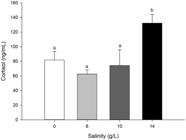
Mean (± standard error) of the plasma cortisol for Brycon amazonicus exposure to different concentration of NaCl. One-way ANOVA, different lowercase letters indicate statistically significant difference between treatments (Fisher LSD, p<0.05).
4. Discussion
Hematology has been widely used to evaluate the effect of salt in water used in fish farming (O’Neal et al., 2006) and is able to indicate changes in the physiological status of the animal (Erhunmwunse and Ainerua, 2013). The number of RBC was not affected by the increase in salinity; however, at 6 g/L of NaCl, higher percentages of Htc were observed, indicating that the erythrocytes were more turgid in this experimental treatment. In fact, Al-Hilali and Al-Khshali (2016) suggest that increasing the concentration of salt in water stimulates the entry of ions by diffusion into erythrocytes and, consequently, the entry of water by osmosis into the intracellular medium. Thus, it is possible to suggest that, at a concentration of 6 g/L of NaCl, the cells became more turgid as a result of the greater osmoregulatory activity.
On the other hand, cell dehydration was observed in the treatment with the highest salinity, since at 14 g/L the fish presented lower values for Htc, with no difference in RBC, evidencing smaller cells. In fact, a higher concentration of Na+ and Cl- was observed in the higher salinities, demonstrating ionic imbalance, with values higher than those found by Urbinati et al. (2004). Imbalance in Na+ and Cl- ions causes disturbances in respiratory regulation and acid-base balance, thus impairing oxygen uptake (Perry and Gilmour, 2006). Therefore, the reduction in Hb and MCHC presents a reflex of this disorder, with a reduction in oxygen intake.
In fish, ions are incorporated by several organs, mainly by the gills, which have specialized cells known as chloride cells/CCs (Sterzelecki et al., 2013). In CCs, the Na+ channels (ENaC) and the Na/H exchanger are responsible for absorbing the Na+ from the water, and Na/K-ATPase (NKA) is responsible for transferring the Na+ to the plasma (Lin and Randall, 1991; Hirata et al., 2003; Reid et al., 2003), while the CL−/HCO3− exchanger absorbs Cl- from water, transporting it to the plasma (Perry, 1997). The baseline values of Cl- and Na+ at 0 g/L were close to those found by Urbinati et al. (2004) and Ferreira et al. (2010), respectively. At 6 g/L, a higher MCV value was observed; however, 10 and 14 g/L presented higher plasma chloride concentrations, accompanied by a higher sodium value at 14 g/L, thereby explaining the reduction in MCV.
According to Hwang et al. (2011), potassium (K+) enters the cell via K channels present in the basolateral membrane and exits through the exchange of Na+ via the activity of NKA. However, in B. amazonicus, the increase in salinity causes a reduction in CCs (Oliveira, 2019), and consequently reduces the activity of the NKA that is present in CCs, thus decreasing the output of K+ in plasma, a visible result at 14 g/L, which returned similar values at 0 g/L. Finally, Ca2+ is absorbed by the calcium channel (ECaC) in the apical membrane and Ca2+-ATPase by the basolateral membrane, which reflected in the highest value of Ca2+ at 14 g/L (Hwang et al., 2011).
The increase in salinity in all the treatments (6, 10 and 14 g of salt/L) for 96 h showed no significant difference in plasma glucose level. According to Urbinati and Carneiro (2006), glycemia is also unchanged for B. amazonicus during transport when kept in an environment with 6 g/L of NaCl. Stressful situations, such as handling and transportation, cause the fish to lose ions to the environment, requiring more energy to replace the amount lost, which brings about the need for an energy substrate, in this case glucose, to replace these ions, so the increase in water salinity causes there to be ion gain by diffusion, reducing the energy expenditure of the fish (Wendelaar-Bonga, 1997; Abreu et al., 2009).
The higher plasma triglyceride concentrations observed at 14 g/L may also be due to the increase in catecholamines and plasma cortisol, whereby, through lipase activation, triglyceride utilization is facilitated, thus an increase in free fatty acids occurs, which can be used as an energy source (Vijayan et al., 1997). Similarly, cholesterol is used in the synthesis of steroid hormones, and proteins have the role of carriers of these hormones, such as cortisol (Mattioli et al., 2017), which can be observed at 14 g/L of NaCl, with lower values of both cholesterol and protein, accompanied by an increase in cortisol.
Water salinization was stressful for the species studied, especially at 14 g/L of NaCl, because the cortisol level was higher at this concentration. High concentrations of Na+ and Cl- in water facilitate the infusion of these ions into the plasma, causing osmoregulatory imbalance, breaking homeostasis and causing stress, which explains the increase in the cortisol level (Wendelaar-Bonga, 1997; Tavares-Dias and Mariano, 2015). Adequate levels of salinity corroborate the reduction of stress by decreasing the osmotic gradient between the animal and the environment in which it lives, thus reducing energy expenditure with osmoregulation, which directly influences metabolism (Tian et al., 2020).
For B. amazonicus, 15 g/L of NaCl caused mortality of all the fish in less than 6 h of exposure. The fish in the treatments 0, 6, 10 and 14 g/L of NaCl showed no mortality during the 96 h of exposure. Thus, it is suggested that the limit for salt concentration resistance for juveniles of the species can be determined between the salinities of 14.36 g/L (value of the mean ± standard deviation of the treatment of 14 g/L) and 15.13 g/L (value of the mean ± standard deviation of the treatment of 15 g/L). According to Mattioli et al. (2017), acute salinity stress in Lophiosilurus alexandri (Steindachner, 1876) for 96 h caused a reduction in Htc levels, indicating hemoconcentration due to osmoregulatory disorders. This is possibly the main cause of mortality at 15 g/L since a lower Htc value was observed at 14 g/L, which is lower than the 42.8 ± 2.3% found by Nascimento et al. (2020).
Overall, the results of this study indicate that salt affected the erythrocyte osmoregulatory mechanism when fish were exposed to higher salinity, creating a potentially stressful situation. The concentration of 6 g/L did not alter the erythrocytes number, metabolic and ionic indices above what was expected for the species and did not generate an increase in cortisol levels and can thus be used for B. amazonicus, helping to maintain homeostasis.
Acknowledgements
The authors would like to thank the coordination of the Experimental Farm at UFAM (FAEXP), all the outsourced employees of the same, and especially Agnaldo, Lincon and Ulisses. We also thank the Magnetic Resonance Laboratory of the Federal University of Amazonas (NMRLAB), for making the liquid nitrogen available, and the Amazonas State Research Support Foundation (FAPEAM) for funding this work. This study was funded by National Council for Scientific and Technological Development (CNPq), approved in the MCTIC/CNPq call No. 28/2018 – Universal and by Postgraduate Development Program (PDPG-CONSOLIDATION), process No. 88887.707238/2022-00. The author Eike Nascimento de Oliveira received research support from Amazonas State Research Support Foundation (FAPEAM) under the call: RESOLUTION No. 008/2021 - POSGRAD 2021/2022 - UFAM.
-
Data Availability Statement
The dataset analyzed or generated during this study is available from the corresponding author upon request.
References
-
ABD EL-GAWAD, E.A., SHEN, Z.G. and WANG, H.P., 2016. Efficacy of formalin, iodine and sodium chloride in improvement of egg hatching rate and fry survival prior to the onset of exogenous feeding in yellow perch. Aquaculture Research, vol. 47, no. 8, pp. 2461-2469. https://doi.org/10.1111/are.12694
» https://doi.org/10.1111/are.12694 -
ABDELRHMAN, A.M., SHARAWY, Z.Z., GOWDA, A.M.A.S. and SLATER, M.J., 2020. Adaptability of the Nile tilapia, Oreochromis niloticus juveniles to water salinity by controlling dietary sodium chloride levels. Egyptian Journal of Aquatic Biology and Fisheries, vol. 24, no. 2, pp. 225-237. https://doi.org/10.21608/ejabf.2020.86056
» https://doi.org/10.21608/ejabf.2020.86056 -
ABREU, J.S., TAKAHASHI, L.S., HOSHIBA, M.A. and URBINATI, E.C., 2009. Biological indicators of stress in pacu (Piaractus mesopotamicus) after capture. Brazilian Journal of Biology = Revista Brasileira de Biologia, vol. 69, no. 2, pp. 415-421. https://doi.org/10.1590/S1519-69842009000200026 PMid:19675947.
» https://doi.org/10.1590/S1519-69842009000200026 -
AL-HILALI, H.A. and AL-KHSHALI, M.S., 2016. Effect of water salinity on some blood parameters of common carp (Cyprinus carpio). International Journal of Applied Agricultural Sciences, vol. 2, no. 1, pp. 17-20. https://doi.org/10.11648/j.ijaas.20160201.13
» https://doi.org/10.11648/j.ijaas.20160201.13 -
ALTINOK, I. and GRIZZLE, J.M., 2004. Excretion of ammonia and urea by phylogenetically diverse fish species in low salinities. Aquaculture, vol. 238, no. 1-4, pp. 499-507. https://doi.org/10.1016/j.aquaculture.2004.06.020
» https://doi.org/10.1016/j.aquaculture.2004.06.020 -
BRANDÃO, F.R., GOMES, L.D.C., CHAGAS, E.C., ARAÚJO, L.D.D. and SILVA, A.L.F.D., 2005. Stocking density of matrinxã (Brycon amazonicus) in rearing in net cages. Brazilian Agricultural Research, vol. 40, pp. 299-303. https://doi.org/10.1590/S0100-204X2005000300014
» https://doi.org/10.1590/S0100-204X2005000300014 - COLLIER, H.B., 1944. Standardization of blood haemoglobin determinations. Canadian Medical Association Journal, vol. 50, no. 6, pp. 550-552. PMid:20323122.
- ERHUNMWUNSE, N. and AINERUA, M., 2013. Characterization of some blood parameters of African Catfish (Clarias gariepinus). American-Eurasian Journal of Toxicological Sciences, vol. 5, no. 3, pp. 72-76.
-
FERREIRA, M.S., OLIVEIRA, A.M.D. and VAL, A.L., 2010. Velocidade crítica de natação (Ucrit) de matrinxã (Brycon amazonicus) após exposição à hipoxia. Acta Amazonica, vol. 40, no. 4, pp. 699-704. https://doi.org/10.1590/S0044-59672010000400009
» https://doi.org/10.1590/S0044-59672010000400009 -
FIÚZA, L.S., ARAGÃO, N.M., RIBEIRO-JUNIOR, H.P., MORAES, M.G., ROCHA, Í.R.C.B., LUSTOSA-NETO, A.D. and COSTA, F.H.F., 2015. Effects of salinity on the growth, survival, haematological parameters and osmoregulation of tambaqui Colossoma macropomum juveniles. Aquaculture Research, vol. 46, pp. 1-9. https://doi.org/10.1111/are.12224
» https://doi.org/10.1111/are.12224 -
GARCÍA-MAGAÑA, L., JIMENEZ VASCONCELOS, L., RODRÍGUEZ-SANTIAGO, M.A., GRANO-MALDONADO, M.I. and LAFFON LEAL, S., 2019. The effectiveness of sodium chloride and formalin in trichodiniasis of farmed freshwater tilapia Oreochromis niloticus (Linnaeus, 1758) in southeastern Mexico. Latin American Journal of Aquatic Research, vol. 47, no. 1, pp. 164-174. https://doi.org/10.3856/vol47-issue1-fulltext-18
» https://doi.org/10.3856/vol47-issue1-fulltext-18 -
GOLDENFARB, P.B., BOWYER, F.P., HALL, E. and BROSIOUS, E., 1971. Reproducibility in the hematology laboratory: the microhematocrit determination. American Journal of Clinical Pathology, vol. 56, no. 1, pp. 35-39. https://doi.org/10.1093/ajcp/56.1.35 PMid:5556212.
» https://doi.org/10.1093/ajcp/56.1.35 - GOMES, L.C. and URBINATI, E.C., 2005. Matrinxã (Brycon amazonicus). In: B. BALDISSEROTTO and L.C. GOMES, eds. Native species for fish farming in Brazil. Santa Maria: UFSM, pp. 149-174.
-
GOMES, L.D.C., ARAÚJO-LIMA, C.A.R.M., CHIPPARI-GOMES, A.R. and ROUBACH, R., 2006. Transportation of juvenile tambaqui (Colossoma macropomum) in a closed system. Brazilian Journal of Biology = Revista Brasileira de Biologia, vol. 66, no. 2a, pp. 493-502. https://doi.org/10.1590/S1519-69842006000300015
» https://doi.org/10.1590/S1519-69842006000300015 -
HIRATA, T., KANEKO, T., ONO, T., NAKAZATO, T., FURUKAWA, N., HASEGAWA, S., WAKABAYASHI, S., SHIGEKAWA, M., CHANG, M.-H., ROMERO, M.F. and HIROSE, S., 2003. Mechanism of acid adaptation of a fish living in a pH 3.5 lake. American Journal of Physiology. Regulatory, Integrative and Comparative Physiology, vol. 284, no. 5, pp. R1199-R1212. https://doi.org/10.1152/ajpregu.00267.2002 PMid:12531781.
» https://doi.org/10.1152/ajpregu.00267.2002 -
HWANG, P.P., LEE, T.H. and LIN, L.Y., 2011. Ion regulation in fish gills: recent progress in the cellular and molecular mechanisms. American Journal of Physiology. Regulatory, Integrative and Comparative Physiology, vol. 301, no. 1, pp. R28-R47. https://doi.org/10.1152/ajpregu.00047.2011 PMid:21451143.
» https://doi.org/10.1152/ajpregu.00047.2011 - INSTITUTO BRASILEIRO DE GEOGRAFIA E ESTATÍSTICA – IBGE, 2021. Pesquisa da pecuária municipal. Rio de Janeiro.
-
JEREZ-CEPA, I. and RUIZ-JARABO, I., 2021. Physiology: an important tool to assess the welfare of aquatic animals. Biology, vol. 10, no. 1, pp. 61. https://doi.org/10.3390/biology10010061 PMid:33467525.
» https://doi.org/10.3390/biology10010061 -
JOMORI, R.K., LUZ, R.K., TAKATA, R., FABREGAT, T.E.H.P. and PORTELLA, M.C., 2013. Slightly salinized water increases the efficiency of neotropical fish larval culture. Brazilian Agricultural Research, vol. 48, pp. 809-815. https://doi.org/10.1590/S0100-204X2013000800001
» https://doi.org/10.1590/S0100-204X2013000800001 - KAMPEN, E.J. and ZIJLSTRA, W.G., 1964. Erythrocytometric methods and their standardization. Clinica Chimica Acta; International Journal of Clinical Chemistry, vol. 6, pp. 538-542.
-
LIN, H. and RANDALL, D., 1991. Evidence for the presence of an electrogenic proton pump on the trout gill epithelium. The Journal of Experimental Biology, vol. 161, no. 1, pp. 119-134. https://doi.org/10.1242/jeb.161.1.119
» https://doi.org/10.1242/jeb.161.1.119 -
MARDONES, A., VEGA, R., ENCINA, F., PICHARA, C., GONZÁLEZ, K., DE LOS RIOS, P. and PEÑA, B., 2020. Assessing the growth of Arctic charr (Salvelinus alpinus) (Linnaeus, 1758) in four salinities, under experimental conditions. Brazilian Journal of Biology = Revista Brasileira de Biologia, vol. 80, no. 4, pp. 907-913. https://doi.org/10.1590/1519-6984.226331 PMid:31800771.
» https://doi.org/10.1590/1519-6984.226331 -
MATTIOLI, C.C., TAKATA, R., LEME, F.D.O.P., COSTA, D.C., MELILLO-FILHO, R., SILVA, W.D.S. and LUZ, R.K., 2017. The effects of acute and chronic exposure to water salinity on juveniles of the carnivorous freshwater catfish Lophiosilurus alexandri. Aquaculture, vol. 481, pp. 255-266. https://doi.org/10.1016/j.aquaculture.2017.08.016
» https://doi.org/10.1016/j.aquaculture.2017.08.016 -
MIRAJI, S.M., CHEN, W., WEN, H., WANG, L., JIN, W., MA, X., XU, P. and CHENG, H., 2025. Rearing time-salinity synergy in osmoregulation: ionic homeostasis and textural enhancement in adult freshwater drums (Aplodinotus grunniens). Fishes, vol. 10, no. 9, pp. 437. https://doi.org/10.3390/fishes10090437
» https://doi.org/10.3390/fishes10090437 -
MOHAMED, N.A., SAAD, M.F., SHUKRY, M., EL-KEREDY, A.M.S., NASIF, O., VAN DOAN, H. and DAWOOD, M.A.O., 2021. Physiological and ion changes of Nile tilapia (Oreochromis niloticus) under the effect of salinity stress. Aquaculture Reports, vol. 19, pp. 100567. https://doi.org/10.1016/j.aqrep.2020.100567
» https://doi.org/10.1016/j.aqrep.2020.100567 -
NASCIMENTO, G.B., VALE AMARAL, L., RAMOS, N.C., LITAIFF, N.R., RIBEIRO, M.W.S., LADISLAU, D.S. and OLIVEIRA, A.T., 2020. Parâmetros hematológicos do matrinxã Brycon amazonicus (Characidae: Bryconinae) criados em cativeiro na região Amazônica. Brazilian Journal of Development, vol. 6, no. 1, pp. 3303-3315. https://doi.org/10.34117/bjdv6n1-238
» https://doi.org/10.34117/bjdv6n1-238 -
O’NEAL, C.C., HAWKE, J.P. and WEIRICH, C.R., 2006. Evaluation of low levels of salinity on hematological parameters and health status of channel catfish reared in multiple-crop ponds. Journal of Aquatic Animal Health, vol. 18, no. 1, pp. 1-10. https://doi.org/10.1577/H05-005.1
» https://doi.org/10.1577/H05-005.1 - OLIVEIRA, E.N., 2019. Efeito do uso de sal comum em indicadores fisiológicos de estresse social na matrinxã, Brycon amazonicus (Spix & Agassiz, 1829). Manaus: Universidade Nilton Lins. Dissertação de Mestrado em Aquicultura.
-
OLIVEIRA, E.N., DUNCAN, W.P. and CARVALHO, T.B., 2020. Use of common salt affects aggressiveness in matrinxã larvae (Brycon amazonicus). Aquaculture Research, vol. 51, no. 9, pp. 3822-3828. https://doi.org/10.1111/are.14730
» https://doi.org/10.1111/are.14730 -
PERRY, S.F., 1997. The chloride cell: structure and function in the gills of freshwater fishes. Annual Review of Physiology, vol. 59, no. 1, pp. 325-347. https://doi.org/10.1146/annurev.physiol.59.1.325 PMid:9074767.
» https://doi.org/10.1146/annurev.physiol.59.1.325 -
PERRY, S.F. and GILMOUR, K.M., 2006. Acid-base balance and CO2 excretion in fish: unanswered questions and emerging models. Respiratory Physiology & Neurobiology, vol. 154, no. 1-2, pp. 199-215. https://doi.org/10.1016/j.resp.2006.04.010 PMid:16777496.
» https://doi.org/10.1016/j.resp.2006.04.010 -
REID, S.D., HAWKINGS, G.S., GALVEZ, F. and GOSS, G.G., 2003. Localization and characterization of phenamil-sensitive Na+ influx in isolated rainbow trout gill epithelial cells. The Journal of Experimental Biology, vol. 206, no. 3, pp. 551-559. https://doi.org/10.1242/jeb.00109 PMid:12502776.
» https://doi.org/10.1242/jeb.00109 -
ROSA, S.S., BALDAN, A.P., BENDHACK, F., PASCHOAL, A.F.L., CORDEIRO, A.L.A., KIRSCHNIK, P.G., BORGES, T.D. and MACEDO, R.E.F., 2019. Transporting live silver catfish (Rhamdia quelen) with salt addition does not mitigate fish stress and negatively affects meat quality. Food Science and Technology, vol. 39, no. 2, suppl. 2, pp. 482-490. https://doi.org/10.1590/fst.23318
» https://doi.org/10.1590/fst.23318 -
SEPULCHRO, L.R., CARVALHO, M.A.G. and GOMES, L.C., 2016. Salinity does not alter the effectiveness of menthol as an anesthetic and sedative during the handling and transport of juvenile fat snook (Centropomus parallelus). Brazilian Journal of Biology = Revista Brasileira de Biologia, vol. 76, no. 3, pp. 757-763. https://doi.org/10.1590/1519-6984.04115 PMid:27097096.
» https://doi.org/10.1590/1519-6984.04115 -
STERZELECKI, F.C., RODRIGUES, E., FANTA, E. and RIBEIRO, C.A.O., 2013. The effect of salinity on osmoregulation and development of the juvenile fat snook, Centropomus parallelus (POEY). Brazilian Journal of Biology = Revista Brasileira de Biologia, vol. 73, no. 3, pp. 609-615. https://doi.org/10.1590/S1519-69842013000300019 PMid:24212702.
» https://doi.org/10.1590/S1519-69842013000300019 - TAVARES-DIAS, M. and MARIANO, W.D.S., 2015. Aquicultura no Brasil: novas perspectivas. Aspectos biológicos, fisiológicos e sanitários de organismos aquáticos. São Carlos: Pedro & João Editores, vol. 1.
-
TIAN, L., TAN, P., YANG, L., ZHU, W. and XU, D., 2020. Effects of salinity on the growth, plasma ion concentrations, osmoregulation, non-specific immunity, and intestinal microbiota of the yellow drum (Nibea albiflora). Aquaculture, vol. 528, pp. 735470. https://doi.org/10.1016/j.aquaculture.2020.735470
» https://doi.org/10.1016/j.aquaculture.2020.735470 -
URBINATI, E.C. and CARNEIRO, P.C.F., 2006. Sodium chloride added to transport water and physiological responses of matrinxã Brycon amazonicus (Teleost: characidae). Acta Amazonica, vol. 36, no. 4, pp. 569-572. https://doi.org/10.1590/S0044-59672006000400020
» https://doi.org/10.1590/S0044-59672006000400020 -
URBINATI, E.C., ABREU, J.S., CAMARGO, A.C.S. and PARRA, M.A.L., 2004. Loading and transport stress of juvenile matrinxã (Brycon cephalus, Characidae) at various densities. Aquaculture, vol. 229, no. 1-4, pp. 389-400. https://doi.org/10.1016/S0044-8486(03)00350-8
» https://doi.org/10.1016/S0044-8486(03)00350-8 - VIDAL, L.V.O., FURUYA, W.M.M., GRACIANO, T.S., SCHAMBER, C.R., SILVA, L.C.R., SANTOS, L.D. and SOUZA, S.R., 2007. Eugenol como anestésico para juvenis de matrinxã (Brycon cephalus). Revista Brasileira de Saúde e Produção Animal, vol. 8, no. 4, pp. 335-342.
-
VIJAYAN, M.M., PEREIRA, C., GRAU, E.G. and IWAMA, G.K., 1997. Metabolic responses associated with confinement stress in tilapia: the role of cortisol. Comparative Biochemistry and Physiology. Part C, Pharmacology, Toxicology & Endocrinology, vol. 116, no. 1, pp. 89-95. https://doi.org/10.1016/S0742-8413(96)00124-7 PMid:9185331.
» https://doi.org/10.1016/S0742-8413(96)00124-7 -
WENDELAAR BONGA, S.E., 1997. The stress response in fish. Physiological Reviews, vol. 77, no. 3, pp. 591-625. https://doi.org/10.1152/physrev.1997.77.3.591 PMid:9234959.
» https://doi.org/10.1152/physrev.1997.77.3.591 - WINTROBE, M.M., 1934. Variations in the size and hemoglobin content of erythrocytes in the blood of various vertebrates. Folia Haematologica, vol. 51, no. 32, pp. 32-49.
- ZANIBONI-FILHO, E., REYNALTE-TATAJE, D. and WEINGARTNER, M., 2006. Potencialidad del género Brycon en la piscicultura brasileña. Revista Colombiana de Ciencias Pecuarias, vol. 19, no. 2, pp. 233-240.
Edited by
-
Editor: Elisabeth Henschel
The dataset analyzed or generated during this study is available from the corresponding author upon request.