 Grapevine rootstock responses to soil and stem wound inoculation with fungal pathogens in the presence of grape phylloxera
Abstract
Among the factors associated with the decline and death of grapevine plants are insect that occur in the roots, such as grape Grapevine phylloxera Daktulosphaira vitifoliae (Hemiptera: Phylloxeridae). During the feeding process, grape D. vitifoliae causes wounds in the cortex of the plant, which can result in a gateway for fungal pathogens. The aim of this study was evaluated the interaction between the root-galling form of phylloxera, phytopathogenic fungi and the rootstock 'Paulsen 1103' (Vitis berlandieri x Vitis rupestris) and the genotype '1111-21' (hybrid of V. labrusca × Magnolia (V. rotundifolia). The study was carried out in a greenhouse using micropropagated seedlings, planted in 3L plastic pots and inoculated via soil with the fungus Ilyonectria liriodendri and via injury with Dactylonectria macrodidyma, I. liriodendri,Neofusiccocum parvum, Phaeomoniella chlamydospora. In the treatments with phylloxera, 200 eggs were inoculated per pot. Assessments were conducted at 90 and 180 days after inoculation. After this period, the number of eggs, nymphs and adults present in the roots was assessed. The inoculated phytopathogens were re-isolated by evaluating the percentage of re-isolation. Based on the experiments conducted, an interaction was observed between D. vitifoliae, N. parvum and P. chlamydospora in the resistant genotype '1111-21'. In contrast, the fungi D. macrodidyma, I. liriodendri, N. parvum and P. chlamydospora alone were found to have a high infection rate, especially on the 'Paulsen 1103' rootstock. The results show that soil insects such as phylloxera and phytopathogenic fungi can act in isolation or together depending on the genotype.
Keywords:
grapevine phylloxera; grapevine; fungal pathogens; rootstocks; plant-pathogen interaction
Resumo
Entre os fatores associados ao declínio e à morte de plantas de videira estão os insetos que ocorrem nas raízes, como a filoxera da videira, Daktulosphaira vitifoliae (Hemiptera: Phylloxeridae). Durante o processo de alimentação, D. vitifoliae causa ferimentos no córtex da planta, o que pode resultar em uma porta de entrada para patógenos fúngicos. O objetivo deste estudo foi avaliar a interação entre a forma formadora de galhas radiculares da filoxera, fungos fitopatogênicos e o porta-enxerto 'Paulsen 1103' (Vitis berlandieri × Vitis rupestris) e o genótipo '1111-21' (híbrido de V. labrusca × Magnolia (V. rotundifolia)). O estudo foi realizado em casa de vegetação utilizando mudas micropropagadas, plantadas em vasos plásticos de 3 litros e inoculadas via solo com o fungo Ilyonectria liriodendri e via injúria mecânica com Dactylonectria macrodidyma, I. liriodendri, Neofusiccocum parvum e Phaeomoniella chlamydospora. Nos tratamentos com filoxera, foram inoculados 200 ovos por vaso. As avaliações foram realizadas aos 90 e 180 dias após a inoculação. Após esse período, foi avaliado o número de ovos, ninfas e adultos presentes nas raízes. Assim como, os fitopatógenos foram reisolados avaliando-se a porcentagem de reisolamento. Com base nos experimentos realizados, observou-se uma interação entre D. vitifoliae, N. parvum e P. chlamydospora no genótipo resistente '1111-21'. Em contraste, os fungos D. macrodidyma, I. liriodendri, N. parvum e P. chlamydospora, isoladamente, apresentaram alta taxa de infecção, especialmente no porta-enxerto 'Paulsen 1103'. Os resultados demonstram que insetos do solo, como a filoxera, e fungos fitopatogênicos podem agir isoladamente ou em conjunto, dependendo do genótipo.
Palavras-chave:
filoxera da videira; videira; patógenos fúngicos; porta-enxertos; interação planta-patógeno
1. Introduction
Among the factors associated with grapevine decline and death (GDD) are soil-dwelling insect pests that feed on the root system, notably grape phylloxera, Daktulosphaira vitifoliae (Fitch) (Hemiptera: Phylloxeridae). This insect is considered one of the most destructive grapevine pests worldwide and occurs in most grape-producing regions (Powell et al., 2013; Ji et al., 2021; Andzeiewski et al., 2022b). The use of resistant rootstocks remains one of the most effective and sustainable strategies to mitigate phylloxera-related damage and associated decline (Andzeiewski et al., 2022b).
To reduce reliance on the widespread use of the rootstock ‘Paulsen 1103’ in southern Brazil, grapevine breeding programs conducted by Embrapa Uva e Vinho (Bento Gonçalves, RS), the Universidade Federal do Paraná (Curitiba, PR), and the Empresa de Pesquisa Agropecuária e Extensão Rural de Santa Catarina (Videira, SC) have developed new rootstock candidates derived from interspecific crosses involving Vitis spp. and Vitis rotundifolia. This species is recognized as an important source of resistance to insects, nematodes, and phytopathogens (Botton and Colleta, 2010). Among the materials developed by Embrapa, the genotype ‘1111-21’ (Seyval-Villard 18315; hybrid of V. labrusca × Magnolia [=V. rotundifolia]) has shown reduced infestation and survival of D. vitifoliae nymphs in roots (Andzeiewski et al., 2022b), as well as resistance to plant-parasitic nematodes and soilborne fungi (Silva, 2022).
Although ‘Paulsen 1103’ is considered resistant to grape phylloxera, nodosities induced by insect feeding are frequently observed on its roots. These feeding sites may facilitate infection by soilborne pathogens and contribute to vine decline (Andzeiewski et al., 2022b). Previous studies have reported associations between phylloxera infestation and fungal pathogens such as Fusarium spp., Cylindrocarpon destructans, Pythium ultimum, and Phaeoacremonium spp., which were linked to increased root damage and biomass reductions of 24–29% in grapevines (Omer et al., 1995; Omer and Granett, 2000; Granett et al., 2001; Edwards et al., 2007). Similar associations have been documented in declining Vitis labrusca vineyards in southern Brazil (Botton and Walker, 2009). Despite these observations, grapevine responses to combined insect and fungal challenges remain insufficiently characterized under controlled conditions.
In addition to soilborne fungi, trunk pathogens such as Neofusicoccum parvum, Phaeomoniella chlamydospora, and species of Dactylonectria and Ilyonectria are widely associated with vascular dysfunction, wood necrosis, and reduced vine longevity. Although these pathogens primarily infect aerial tissues, vascular colonization may alter plant physiological status and potentially influence belowground processes. However, the effects of stem wound–initiated infections on the establishment or performance of root-feeding insects such as D. vitifoliae remain largely unexplored.
Given the coexistence of soilborne and trunk pathogens in commercial vineyards, understanding rootstock responses to single and combined inoculations of insects and fungi is essential for clarifying factors associated with vine decline. We hypothesized that grapevine rootstock responses to D. vitifoliae and selected fungal pathogens differ according to genotype and pathogen inoculation pathway. Therefore, the objective of this study was to evaluate the responses of the rootstocks ‘Paulsen 1103’ and ‘1111-21’ to single and combined inoculations of grape phylloxera and Dactylonectria macrodidyma, Ilyonectria liriodendri, Neofusicoccum parvum, and Phaeomoniella chlamydospora using soil and stem wound inoculation approaches.
2. Material and Methods
2.1. Experimental site and plant material
The experiments were conducted in the Entomology Laboratory and greenhouse facilities of the Brazilian Agricultural Research Corporation (Embrapa), at the National Research Center for Grape and Wine (Embrapa Uva e Vinho), and in the Phytopathology Laboratory of the Federal Institute of Rio Grande do Sul (IFRS), Bento Gonçalves, RS, Brazil. One-year-old micropropagated seedlings of the rootstock ‘Paulsen 1103’ and the experimental genotype ‘1111-21’ were used in all assays.
2.2. Plant material and cultivation conditions
Micropropagated grapevine seedlings were produced from mother plants maintained at Embrapa Uva e Vinho, following established protocols to obtain pest- and pathogen-free material (Teixeira et al., 2008). Explants were collected from healthy mother plants and subjected to fungicide and bactericide treatments prior to surface disinfection. Subsequently, explants were excised and transferred to a specific nutrient culture medium under aseptic conditions. Cultures were maintained in a growth chamber at 25 ± 2 °C, with a 16-h photoperiod and a light intensity of 72 µmol m−2 s−1, and were subcultured at regular intervals. After the multiplication phase, explants were transferred to a rooting medium and later acclimatized under controlled conditions. Each rooted seedling was transplanted individually into 3-L plastic pots containing an organo-mineral substrate composed of two parts soil (corrected to pH 5.6–5.8), one part peat-based commercial substrate, and 0.5 parts vermiculite. The substrate was sterilized in an autoclave at 145 °C for 45 min. After transplanting, seedlings were maintained in a greenhouse for approximately one year prior to the beginning of the experiments.
2.3. Rearing and maintenance of Daktulosphaira vitifoliae
Phylloxera individuals used in the experiments originated from a laboratory colony established from specimens collected in 2018 in a commercial vineyard planted with the 12-year-old cultivar ‘Isabel’ (Vitis labrusca) in Nova Roma do Sul, RS, Brazil (28°58′09″ S, 51°24′25″ W). Insects were continuously maintained in the laboratory on excised grapevine roots (Vitis vinifera L.) approximately 10 cm in length. Moist absorbent cotton was placed at one end of each root segment to maintain humidity. Colonies were kept in darkness at 25 ± 1 °C and 70 ± 10% relative humidity in BOD-type climate chambers. To provide fresh roots for colony maintenance, cuttings of ‘Cabernet Sauvignon’ (V. vinifera) obtained from mother plants at Embrapa Uva e Vinho were planted in 3-L containers and grown under greenhouse conditions. Using this rearing methodology, egg viability of D. vitifoliae reached 100% (Andzeiewski et al., 2022a).
2.4. Bioassays and phytopathogen inoculation
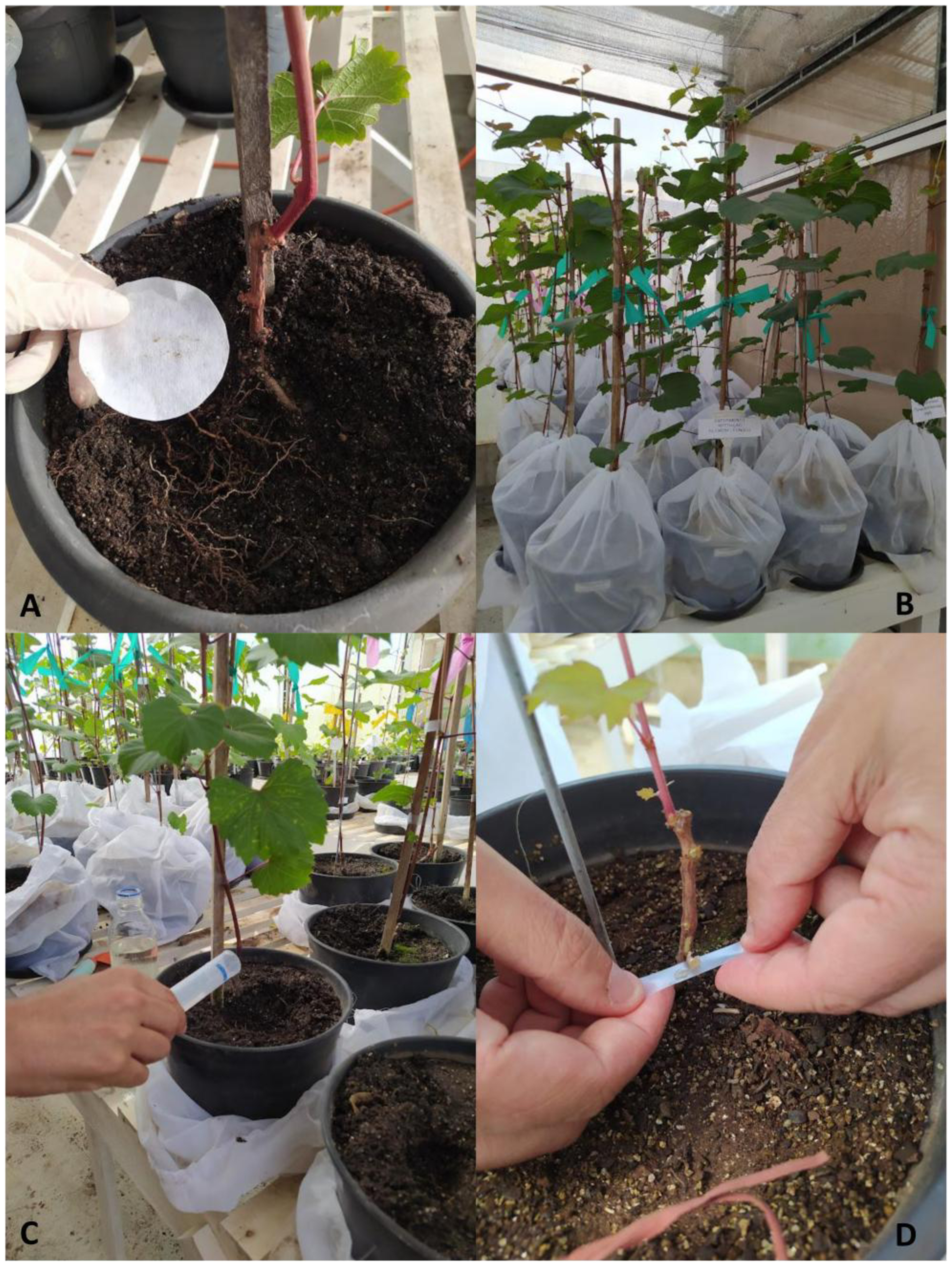
For interaction assays, grapevine roots were gently exposed in each pot, and phylloxera eggs (200 eggs per pot, aged 1–3 days) were inoculated directly onto the root system using filter paper, following the methodology described by Herbert et al. (2008) and Andzeiewski et al. (2023) (Figure 1A). After inoculation, pots were enclosed in double-layer voile fabric bags to prevent cross-contamination among treatments (Figure 1B).

Inoculation of phylloxera and phytopathogenic fungi in micropropagated seedlings of '1111-21' and 'Paulsen 1103'. A) Inoculation of Daktulosphaira vitifoliae eggs in roots; B) Isolation of pots using double Voile fabric bags to avoid contamination; C) Inoculation of Ilyonectria liriodendri via soil; D) Inoculation of Dactylonectria macrodidyma, Ilyonectria liriodendri, Neofusiccocum parvum, Phaeomoniella chlamydospora via wounding.
2.4.1. Experiment 1 – Soil inoculation
Experiment 1 followed a completely randomized design with five replicate seedlings per treatment. Ilyonectria liriodendri isolate TD 1117 (GenBank accession MK421588.1) was inoculated via soil using 30 mL of a spore suspension adjusted to a concentration of 1.8 × 10⁶ spores mL−1. All fungal isolates used in this study were obtained from the culture collection of the Federal Institute of Rio Grande do Sul, Campus Bento Gonçalves (Figure 1C; Table 1).
Treatments evaluated in greenhouse bioassays assessing the interaction between Daktulosphaira vitifoliae and fungal pathogens, in which Ilyonectria liriodendri was inoculated via soil and stem wounding, whereas Dactylonectria macrodidyma, Neofusiccocum parvum and Phaeomoniella chlamydospora were inoculated exclusively via wounding.
2.4.2. Experiment 2 – Wound inoculation
In Experiment 2, pathogen inoculation was performed via stem wounding to simulate entry routes associated with grapevine management practices (Cavalcanti et al., 2013; Probst et al., 2019). Longitudinal wounds approximately 0.5 cm in length were made on the stem using a sterile scalpel. Agar plugs from potato dextrose agar (PDA) cultures containing the following fungi were placed onto the wounds: Dactylonectria macrodidyma TD 1110 (GenBank MK421587), I. liriodendri TD 1117 (GenBank MK421588.1), Neofusiccocum parvum TD 316 (GenBank MT823469.1), and Phaeomoniella chlamydospora TD 157 (GenBank KY984071.1) (Figure 1D; Table 1). Each treatment consisted of six replicate seedlings arranged in a completely randomized design. After phylloxera infestation and fungal inoculation, plants were maintained for 90 days (Experiment 1) or 180 days (Experiment 2) to allow insect establishment and pathogen development.
2.5. Assessment of phylloxera infestation and fungal re-isolation
At the end of each experimental period, phylloxera infestation was quantified by counting eggs, nymphs, and adults present in the roots, following the protocol of Andzeiewski et al. (2023). Two root samples (3 g each) were collected per pot, placed in labeled 50-mL Falcon® tubes, and stored at −15 °C to kill the insects. Roots were then washed with 35 mL of hot water, shaken vigorously to detach insects, and the resulting suspension was filtered three times through a single-layer folded voile cloth and filter paper. Insects were counted under a stereomicroscope at 5× magnification.
Fungal re-isolation was performed to determine the percentage of successful pathogen recovery, following the methodology of Almança et al. (2013). Root samples were surface-disinfected in 70% ethanol for 30 s, 2.5% sodium hypochlorite for 2 min, and again in 70% ethanol for 30 s. Five internal tissue fragments per replicate were excised and plated onto potato dextrose agar (PDA) in 90-mm Petri dishes. Plates were incubated at 25 ± 1 °C and 70 ± 10% relative humidity for 30 days. Fungal identification was based on morphological characteristics observed under optical microscopy and confirmed by comparison with reference isolates previously characterized by genetic sequencing.
2.6. Statistical analysis
Data were analyzed using generalized linear models (GLMs) with a quasi-binomial distribution to account for overdispersion (Hinde and Demétrio, 1998). When significant treatment effects were detected, multiple comparisons were performed using Tukey’s test (p < 0.05) with the glht function from the multcomp package. All analyses were conducted in R version 4.0.2 (R Development Core Team, 2020). The percentage of infection reduction (IR) was calculated using Abbott’s formula (Abbott, 1925).
3. Results
3.1. Experiment 1 – Soil inoculation with Ilyonectria liriodendri
No infestation of Daktulosphaira vitifoliae was detected in the non-inoculated control plants of either genotype (Table 2). In the genotype ‘1111-21’, phylloxera populations were significantly lower in plants coinoculated with Ilyonectria liriodendri than in plants inoculated with the insect alone, indicating reduced insect establishment in the presence of the fungus. In ‘1111-21’, fungal re-isolation of I. liriodendri occurred when the pathogen was inoculated alone or in combination with phylloxera, with re-isolation frequencies ranging from 19.0 to 26.0%, whereas no re-isolation was detected in the control treatment (F = 7.11; df = 3, 22; p < 0.0001; Table 2). The presence of phylloxera did not significantly alter fungal re-isolation levels in this genotype.
Interaction between Daktulosphaira vitifoliae and Ilyonectria liriodendri with inoculation of the pathogen via soil on '1111-21' and 'Paulsen 1103' rootstocks.
In the rootstock ‘Paulsen 1103’, high phylloxera populations were observed in treatments receiving artificial insect infestation, whereas no insects were detected in the control treatment (Table 2). Phylloxera population levels differed among treatments (F = 14.12; df = 3, 22; p < 0.0001), with the highest densities recorded in plants inoculated only with I. liriodendri. Although no artificial infestation was performed in this treatment, phylloxera individuals were detected. Fungal re-isolation rates in ‘Paulsen 1103’ were consistently high when I. liriodendri was present, either alone or in combination with phylloxera, and did not differ significantly between these treatments (F = 7.11; df = 3, 22; p < 0.0001; Table 2). Overall, coinoculation of phylloxera and I. liriodendri did not consistently increase fungal re-isolation or phylloxera population levels compared with single inoculations in either genotype.
3.2. Experiment 2 – Stem Wound Inoculation with Fungal Pathogens
No phylloxera infestation was recorded in the non-inoculated control plants of either genotype, confirming that insect establishment occurred exclusively in treatments subjected to artificial infestation (Table 3). In the genotype ‘1111-21’, phylloxera infestation was absent in treatments inoculated with Dactylonectria macrodidyma or Ilyonectria liriodendri, regardless of fungal inoculation (Table 3). In contrast, phylloxera infestation was observed only in treatments inoculated with Neofusiccocum parvum or Phaeomoniella chlamydospora in combination with the insect (F = 10.34; df = 8, 35; p < 0.0001). In this genotype, fungal re-isolation was generally low and occurred primarily in treatments where phylloxera infestation was detected (F = 9.14; df = 8, 35; p < 0.0001).
Interaction between Daktulosphaira vitifoliae and fungal pathogen species (Dactylonectria macrodidyma, Ilyonectria liriodendri, Neofusiccocum parvum, Phaeomoniella chlamydospora with wound inoculation on '1111-21' and 'Paulsen 1103' rootstocks.
In the rootstock ‘Paulsen 1103’, phylloxera infestation was detected in all inoculated treatments, with the exception of the control (Table 3). Fungal re-isolation rates for D. macrodidyma, I. liriodendri, N. parvum and P. chlamydospora were consistently high (>60%) and did not differ significantly between treatments with and without phylloxera. Re-isolation rates were significantly higher in ‘Paulsen 1103’ compared with ‘1111-21’. Regarding internal lesion development, no interaction with phylloxera was observed for treatments inoculated with D. macrodidyma, I. liriodendri or P. chlamydospora. However, lesions caused by Neofusiccocum parvum were significantly greater in the absence of phylloxera (F = 19.83; df = 8, 35; p < 0.0001; Table 3).
4. Discussion
The genotype ‘1111-21’ (Seyval-Villard 18315; hybrid Vitis labrusca × Magnolia (V. rotundifolia)) consistently showed lower levels of root infestation by Daktulosphaira vitifoliae than the reference rootstock ‘Paulsen 1103’, confirming its resistance to grapevine phylloxera (Andzeiewski et al., 2022b). Resistance traits associated with V. rotundifolia ancestry have been widely documented for multiple biotic stresses, including insects and soilborne pathogens, supporting its use in breeding programs aimed at resilience under complex soil environments (Firoozabady and Olmo, 1982; Grzegorczyk and Walker, 1998). From a physiological perspective, phylloxera feeding induces marked metabolic and structural changes in grapevine roots, including the formation of metabolically active nodosities that alter assimilate allocation and root exudation (Powell et al., 2013). The reduced infestation and survival of phylloxera nymphs in ‘1111-21’ therefore suggest a limitation of these insect-induced physiological alterations.
The relevance of ‘1111-21’ is further supported by evidence from soilborne disease complexes. Silva (2022) demonstrated that ‘1111-21’ is immune to the root-lesion nematode Pratylenchus brachyurus, whereas ‘Paulsen 1103’ was classified as susceptible, with nematode–fungus interactions intensifying vascular damage and accelerating grapevine decline in susceptible genotypes. Together, these findings indicate that ‘1111-21’ expresses multi-pest resistance, limiting the establishment of belowground organisms that predispose grapevine roots to fungal infection.
Despite its reduced susceptibility to phylloxera, infestation of D. vitifoliae was recorded in ‘1111-21’ when plants were coinoculated with Neofusicoccum parvum or Phaeomoniella chlamydospora following stem wound inoculation. This pattern highlights the importance of the inoculation pathway, as mechanical injuries can bypass structural and biochemical resistance barriers, facilitating pathogen establishment and altering host physiology. Comparable indirect effects have been described in other plant–herbivore–pathogen systems, where fungal infection modifies plant nutritional quality and secondary metabolism, influencing herbivore performance (Johnson et al., 2003; Powell et al., 2013).
In the present study, re-isolation of N. parvum and P. chlamydospora in ‘1111-21’ was detected only in coinoculated treatments, whereas no colonization occurred when these pathogens were inoculated alone. Similar processes have been described for nematode–fungus interactions, in which parasitism increases root exudation and microbial activity in the rhizosphere (Back et al., 2002).
In contrast, all fungal pathogens colonized the roots of ‘Paulsen 1103’, resulting in high re-isolation frequencies and greater internal lesion lengths. Phylloxera was consistently detected in treatments subjected to artificial infestation. Although ‘Paulsen 1103’ is considered resistant to grape phylloxera, nodosity formation associated with insect feeding is common and may compromise root integrity (Andzeiewski et al., 2022b). As noted by Powell et al. (2013), nodosities function as metabolically active tissues that alter carbon and nitrogen fluxes and increase root exudation, potentially favoring soilborne pathogens. Similar breakdowns of resistance have been reported in other studies, where phylloxera populations developed on rootstocks previously classified as resistant (Benedictis et al., 1996; Granett et al., 2007; Granett and Walker, 2009).
Previous studies have shown that the combined occurrence of phylloxera and soilborne fungal pathogens results in greater root damage and reduced vine vigor compared with single infections (Omer et al., 1995; Omer and Granett, 2000; Edwards et al., 2007; Idris and Arabi, 2014). The present results extend this knowledge by demonstrating that these interactions are strongly genotype-dependent and influenced by the pathogen entry pathway.
Overall, D. vitifoliae and phytopathogenic fungi may act independently or synergistically depending on grapevine genotype and inoculation pathway. The genotype ‘1111-21’ emerges as a suitable rootstock option for vineyard replanting in areas affected by grapevine decline, as it combines resistance to grape phylloxera and immunity to key plant-parasitic nematodes while restricting fungal establishment under non-wounded conditions. In contrast, continued reliance on ‘Paulsen 1103’ may increase vineyard vulnerability under complex soilborne pest and pathogen pressure, as this rootstock showed consistently high levels of fungal colonization, greater internal lesion development, and sustained phylloxera establishment across treatments. The absence of reductions in fungal re-isolation or insect populations under coinoculation conditions suggests that this genotype may be more permissive to simultaneous biotic challenges.
Further greenhouse and field studies are required to clarify the mechanisms underlying these responses and to support integrated management strategies for grapevine decline. The genotype ‘1111-21’ has demonstrated promising responses under multiple biotic stress conditions, including reduced establishment of Daktulosphaira vitifoliae, previously reported resistance to plant-parasitic nematodes, and limited colonization by selected fungal pathogens associated with grapevine decline. These combined traits suggest that this lineage may represent a potential rootstock candidate for environments with complex soilborne pest and pathogen pressure. However, before it can be considered for commercial release, further studies are required to evaluate graft compatibility with scion cultivars, long-term field performance, yield stability, vigor modulation, and additional agronomic characteristics relevant to vineyard sustainability.
Acknowledgements
This study was funded in part by the Coordination for the Improvement of Higher Education Personnel - Brazil (CAPES) - Finance Code 001. DCO and SA were funded by the Coordination for the Improvement of Higher Education Personnel" (CAPES), Brazil - Financial Code 001. MA funded by the project "Prospecting and technological adjustments of grapevine rootstocks to overcome stresses typical of replanting areas in southern Brazil - Embrapa (22.16.04.035.00.00). DB and MB by the "Conselho Nacional de Desenvolvimento Científico e Tecnológico" (CNPq), Brazil through the granting of productivity scholarships (306460/2022-0 and 313428/2021-2).
Data Availability Statement
Not applicable.
References
-
ABBOTT, W.S., 1925. A method of computing the effectiveness of an insecticide. Journal of Economic Entomology, vol. 18, no. 2, pp. 265-267. http://doi.org/10.1093/jee/18.2.265a
» http://doi.org/10.1093/jee/18.2.265a -
ALMANÇA, M.A.K., ABREU, C.M.D., SCOPEL, F.B., BENEDETTI, M., HALLEEN, F. and CAVALCANTI, F.R., 2013 [viewed 21 October 2025]. Evidências morfológicas da ocorrência de Phaeomoniella chlamydospora em videiras no Estado do Rio Grande do Sul [online]. Bento Gonçalves: Embrapa Uva e Vinho. Comunicado Técnico, no. 134. Available from: http://www.infoteca.cnptia.embrapa.br/infoteca/handle/doc/856487
» http://www.infoteca.cnptia.embrapa.br/infoteca/handle/doc/856487 -
ANDZEIEWSKI, S., OLIVEIRA, D.C., BERNARDI, D. and BOTTON, M., 2022a. Occurrence of sexual reproduction of Daktulosphaira vitifoliae (Fitch, 1856) (Hemiptera: Phylloxeridae) in southern Brazil and biology and fertility life table in grapevine cultivars. Environmental Entomology, vol. 51, no. 1, pp. 210-215. http://doi.org/10.1093/ee/nvab126 PMid:34788395.
» http://doi.org/10.1093/ee/nvab126 -
ANDZEIEWSKI, S., OLIVEIRA, D.C., BERNARDI, D. and BOTTON, M., 2022b. Resistance of grapevine genotypes (Vitis spp.) to Daktulosphaira vitifoliae (Hemiptera: Phylloxeridae) in Brazil: implications for pest management. Environmental Entomology, vol. 51, pp. 1166-1171. http://doi.org/10.1093/ee/nvac074 PMid:36178318.
» http://doi.org/10.1093/ee/nvac074 -
ANDZEIEWSKI, S., OLIVEIRA, D.C., BERNARDI, D. and BOTTON, M., 2023. Population suppression of phylloxera gallicolae and radicicolae forms on grapevines with the use of synthetic insecticides. Ciência Rural, vol. 53, no. 11, pp. e20220112. http://doi.org/10.1590/0103-8478cr20220112
» http://doi.org/10.1590/0103-8478cr20220112 -
BACK, M.A., HAYDOCK, P.P.J. and JENKINSON, P., 2002. Disease complexes involving plant parasitic nematodes and soilborne pathogens: nematodes and soilborne pathogens. Plant Pathology, vol. 51, no. 6, pp. 683-697. http://doi.org/10.1046/j.1365-3059.2002.00785.x
» http://doi.org/10.1046/j.1365-3059.2002.00785.x -
BENEDICTIS, J.A., GRANETT, J. and TAORMINO, S.P., 1996. Differences in host utilization by California strains of grape phylloxera. American Journal of Enology and Viticulture, vol. 47, no. 4, pp. 373-379. http://doi.org/10.5344/ajev.1996.47.4.373
» http://doi.org/10.5344/ajev.1996.47.4.373 - BOTTON, M. and WALKER, M.A., 2009. Grape phylloxera in Brazil. Acta Horticulturae, no. 816, pp. 30-40.
-
BOTTON, M. and COLLETA, V.D., 2010. Avaliação da resistência de cultivares de Vitis rotundifolia à pérola-da-terra (Hemiptera: Margarodidae) na região sul do Brasil. Acta Scientiarum. Agronomy, vol. 32, no. 2, pp. 1-7. http://doi.org/10.4025/actasciagron.v32i2.3151
» http://doi.org/10.4025/actasciagron.v32i2.3151 -
CAVALCANTI, F.R., BUENO, C.J. and ALMANÇA, M.A.K., 2013 [viewed 21 October 2025]. Declínio e morte de plantas de videira [online]. Bento Gonçalves: Embrapa Uva e Vinho. Documentos, no. 82. Available: http://www.infoteca.cnptia.embrapa.br/infoteca/handle/doc/859270
» http://www.infoteca.cnptia.embrapa.br/infoteca/handle/doc/859270 -
EDWARDS, J., NORNG, S., GRANETT, J. and POWELL, K.S., 2007. Relationships between grape phylloxera abundance, fungal interactions and grapevine decline. Acta Horticulturae, no. 733, pp. 151-158. http://doi.org/10.17660/ActaHortic.2007.733.16
» http://doi.org/10.17660/ActaHortic.2007.733.16 - FIROOZABADY, E. and OLMO, H.P., 1982. Resistance to grape phylloxera in Vitis vinifera x V. rotundifolia grape hybrids. Vitis, vol. 21, pp. 1-4.
-
GRANETT, J., WALKER, M.A., KOCSIS, L. and OMER, A.D., 2001. Biology and management of grape phylloxera. Annual Review of Entomology, vol. 46, no. 1, pp. 387-412. http://doi.org/10.1146/annurev.ento.46.1.387 PMid:11112174.
» http://doi.org/10.1146/annurev.ento.46.1.387 -
GRANETT, J., WALKER, M.A. and FOSSEN, M.A., 2007. Association between grape phylloxera and strongly resistant rootstocks in California: bioassays. Acta Horticulturae, no. 733, pp. 25-31. http://doi.org/10.17660/ActaHortic.2007.733.2
» http://doi.org/10.17660/ActaHortic.2007.733.2 -
GRANETT, J. and WALKER, M.A., 2009. Nodosity populations on rootstocks are not a current threat to Californian vineyards bioassays. Acta Horticulturae, no. 32, pp. 1-9. http://doi.org/10.17660/ActaHortic.2009.816.3
» http://doi.org/10.17660/ActaHortic.2009.816.3 -
GRZEGORCZYK, W. and WALKER, M.A., 1998. Evaluating resistance to grape phylloxera in Vitis species with an in vitro dual culture assay. American Journal of Enology and Viticulture, vol. 49, no. 1, pp. 1-7. http://doi.org/10.5344/ajev.1998.49.1.17
» http://doi.org/10.5344/ajev.1998.49.1.17 -
HERBERT, K.S., POWELL, K.S., MCKAY, A., HARTLEY, D., HERDINA, OPHELKELLER, K., SCHIFFER, M. and HOFFMANN, A.A., 2008. Developing and testing a diagnostic probe for grape phylloxera applicable to soil samples. Journal of Economic Entomology, vol. 101, no. 6, pp. 1934-1943. http://doi.org/10.1603/0022-0493-101.6.1934 PMid:19133477.
» http://doi.org/10.1603/0022-0493-101.6.1934 -
HINDE, J. and DEMÉTRIO, C.G., 1998. Overdispersion: models and estimation. Computational Statistics & Data Analysis, vol. 3, no. 2, pp. 151-170. http://doi.org/10.1016/S0167-9473(98)00007-3
» http://doi.org/10.1016/S0167-9473(98)00007-3 -
IDRIS, I. and ARABI, M.I.E., 2014. The relationship between grape phylloxera and Fusarium root infection. Advances in Horticultural Science, vol. 28, pp. 14-19. http://doi.org/10.13128/ahs-22750
» http://doi.org/10.13128/ahs-22750 -
JI, W., GAO, G. and WEI, J., 2021. Potential global distribution of Daktulosphaira vitifoliae under climate change based on MaxEnt. Insects, vol. 12, no. 4, pp. 1-17. http://doi.org/10.3390/insects12040347 PMid:33924706.
» http://doi.org/10.3390/insects12040347 -
JOHNSON, S.N., DOUGLAS, A.E., WOODWARD, S. and HARTLEY, S.E., 2003. Microbial impacts on plant-herbivore interactions: the indirect effects of a birch pathogen on a birch aphid. Oecologia, vol. 134, no. 3, pp. 388-396. http://doi.org/10.1007/s00442-002-1139-6 PMid:12647147.
» http://doi.org/10.1007/s00442-002-1139-6 -
OMER, A.D., GRANETT, J., DE BENEDICTUS, J.A. and WALKER, M.A., 1995. Effects of fungal root infections on the vigour of grapevines infested by root feeding grape phylloxera. Vitis, vol. 34, pp. 1-7. http://doi.org/10.5073/vitis.1995.34.165-170
» http://doi.org/10.5073/vitis.1995.34.165-170 - OMER, A.D. and GRANETT, J., 2000. Relationship between grape phylloxera and fungal infections in grapevine roots. Journal of Plant Diseases and Protection, vol. 107, pp. 285-294.
-
POWELL, K.S., COOPER, P.D. and FORNECK, A., 2013. The biology, physiology and host–plant interactions of grape phylloxera Daktulosphaira vitifoliae. Advances in Insect Physiology, vol. 45, pp. 159-218. http://doi.org/10.1016/B978-0-12-417165-7.00004-0
» http://doi.org/10.1016/B978-0-12-417165-7.00004-0 -
PROBST, C.M., RIDGWAY, H.J., JASPER, M.V. and JONES, E.E., 2019. Pathogenicity of Ilyonectria liriodendri and Dactylonectria macrodidyma propagules in grapevines. European Journal of Plant Pathology, vol. 154, no. 2, pp. 405-421. http://doi.org/10.1007/s10658-018-01664-0
» http://doi.org/10.1007/s10658-018-01664-0 -
R DEVELOPMENT CORE TEAM, 2020 [viewed 1 October 2020]. R: a language and environment for statistical computing. Version 3.6.2 [software]. Vienna: R Foundation for Statistical Computing. Available from: http://r-project.org
» http://r-project.org - SILVA, W.R., 2022. Nematofauna, reação de genótipos de Vitis spp. a fitonematoides e interação com Ilyonectria macrodydima associados ao declínio de morte da videira e primeiro relato de Meloidogyne morocciensis em pessegueiro no Brasil Pelotas: Universidade Federal de Pelotas, 185 p. Tese.
-
TEIXEIRA, S.L., RIBEIRO, J.M. and TEIXEIRA, M.T., 2008. Utilização de hipoclorito de sódio na esterilização de meio de cultura para multiplização in vitro de Eucalyptus pellita L. Ciência Florestal, vol. 18, no. 2, pp. 185-191. http://doi.org/10.5902/19805098456
» http://doi.org/10.5902/19805098456
Edited by
-
Editor:
Takako Matsumura Tundisi