 Strategies to improve the quality of wheat flour in baking: a review
Abstract
The different bakery products consumed worldwide require wheat flour with specific viscoelastic characteristics, which are not always available on the market. To meet these particular demands, wheat flour mills and baking industries turn to ingredients, additives, and processing aids. These improving agents act on the gluten network and other flour components, adapting them to produce various products with the desired technological and sensory properties. Many studies relate increases in the parameters obtained in flour quality analyses, such as farinographic, extensographic, alveographic, and others, with the flour-strengthening effect of various ingredients, additives, and processing aids used; however, this is not a direct relationship. In this review, we evaluated each strategy for improving wheat flour, considering key studies in the field of baking, and examining how these strategies work. Focusing on gluten, which is crucial for the technological quality of the flour, we explored strategies involving additives (oxidizing agents, emulsifiers, and hydrocolloids), processing aids (enzymes), and the ingredient vital wheat gluten. We also evaluated the regulatory aspects governing the use of these enhancers in various countries.
Keywords:
Ingredients; Additives; Processing aids; Gluten; Baking technology; Dough; Bread
HIGHLIGHTS
Oxidants strengthen the dough, making it more elastic and producing bread with greater volume
Enzymes, as processing aids, offer a natural alternative to chemical additives, supporting 'clean label' formulations
The combined use of additives and processing aids balances dough elasticity and extensibility
1 Introduction
Wheat (Triticum aestivum L.) serves as a crucial raw material in a variety of food products. This cereal is distinguished by its gluten content, which forms a viscoelastic network capable of retaining gases produced during dough fermentation. This characteristic significantly influences the shape and structure of fermented bread (Cauvain, 2012). Consequently, wheat flour, derived from this cereal, is the base of numerous bakery products.
Wheat flour for making bread must provide specific characteristics according to the type of bread. Flours with high gluten quality are the most commonly used in breadmaking, as they can retain the gases produced during the bread fermentation stage (Ortolan et al., 2017). The quality of wheat flour is evaluated by specific analyses, i.e., wet gluten content, dry gluten content, gluten index, and empirical rheological tests such as those carried out in the farinograph, extensograph, and alveograph.
The variation in the quality of wheat flour used in the industrial bread-making process is due to the inherent variation in the quality of the wheat grains from which the flour is derived. Therefore, the industry uses wheat flour improving agents to make a product closer to what consumers expect. As the gluten-forming proteins are responsible for the viscoelastic characteristics of the dough, agents that act on this fraction play a significant role and govern its properties. These agents can affect gluten proteins and starch present in the flour. They can be classified into four main groups: (i) additives, such as oxidants, emulsifiers, and hydrocolloids; (ii) processing aids, such as enzymes; and (iii) ingredients, such as vital gluten. Among the main additives, processing aids and ingredients used in baking processes are ascorbic acid (AA), azodicarbonamide (ADA), calcium stearoyl lactylate (CSL), sodium stearoyl lactylate (SSL), diacetyl tartaric acid esters of mono and diglycerides (DATEM), polysorbate 80 (PS 80), carboxymethylcellulose (CMC), xanthan gum (XG), transglutaminase (TG), glucose oxidase (GOX), and vital gluten (VG) (Gioia et al., 2017).
The primary function of these additives, processing aids, and ingredients is to standardize the quality of wheat flour and improve its technological characteristics for specific applications. Considering that the wheat industry is keen on finding solutions that ensure the appropriate viscoelastic properties of wheat flour for various applications, mills, the food industry, and bakeries can add the cited improvers to wheat flour to regulate its rheological properties. In this context, this review will address the main strategies used in baking to strengthen the dough and provide bread with the quality expected by the industry and consumers.
2 Methodology
This review focuses on innovative studies from the past ten years, with particular emphasis on those from the past five years, that investigated strategies to strengthen wheat flour for baking. A narrative literature review was conducted due to the diversity of the research found on different baked products and the effects of various flour-enhancing agents. We surveyed scientific articles published from 2014 to 2023 to help readers understand the state of the art for each flour enhancer. Six articles from before 2014 were cited, as they were references to the subject. The search was carried out from June 2021 to October 2023 using databases such as Scopus, Web of Science, Elsevier, Google Scholar, Periódicos Capes, and Science Direct. The following keywords were used in the search: gluten, gluten strengthening, enhancing agents, processing aids fortifiers, oxidants, enzymes, emulsifiers, hydrocolloids, and vital gluten.
In total, twenty-five publications were selected for the elaboration of Tables 1, 2 and 3, providing relevant information about the effects of each enhancer on the process of strengthening wheat flour to produce baked goods.
3 The importance of gluten formation
When wheat flour and water are mixed, a dough is obtained that exhibits cohesion, extensibility, and elasticity. This dough primarily consists of water, starch, and proteins. Upon adding water to the flour, the proteins hydrate, facilitating the formation of a protein network. Mixing provides the energy and movement necessary for the protein chains to interact and form chemical bonds, contributing to the structure of the gluten network (MacRitchie, 2014). The gluten network, comprised of the proteins gliadin and glutenin, plays a crucial and unique role in determining the quality of bakery products. Furthermore, this network contributes to the dough's viscoelasticity, which includes the flour's capacity to absorb water and its properties of elasticity and extensibility (Wieser, 2007).
Gliadins and glutenins are distinguished by their unique composition including the amino acids proline and glutamine, along with a low prevalence of polar amino acids (such as serine, threonine, and tyrosine) in their polypeptide chains. This composition renders both proteins insoluble in water. When hydrated, gliadin enhances viscosity and extensibility, which reduces the elasticity and cohesiveness of wheat flour dough compared to glutenin. In contrast, glutenin contributes strength, cohesion, and elasticity to the dough (MacRitchie, 2014; Wieser, 2007).
Gliadin, a prolamine protein, is a monomer that can be categorized into different fractions based on its mobility in polyacrylamide gel electrophoresis. These fractions, in ascending order of molecular weight, are α-, β-, γ-, and ω-gliadins. In contrast, glutenin belongs to the glutelin class and is divided into high and low-molecular weight fractions (HMW-GS and LMW-GS, respectively). These glutenin fractions are linked via intra and inter-chain disulfide bonds within the dough. All gliadin fractions, except for ω-gliadin, can form intermolecular disulfide bonds with HMW-GS. They can also aggregate into macropolymers with LMW-GS, thereby enhancing the viscoelastic properties of the dough and, consequently, improving bread-making performance (Schmid et al., 2017).
Both intramolecular and intermolecular covalent bonds play a crucial role in maintaining the structure of the gluten network through disulfide bonds. Additionally, non-covalent bonds such as hydrogen bonds, along with ionic and van der Waals interactions, also contribute to the stability of the network formed (Schmid et al., 2017). Covalent bonds are determinant for dough stability, followed by hydrogen bonds and electrostatic interactions that, in conjunction, govern the structure and properties of the network (Geisslitz et al., 2018). Various agents can be added to the dough to improve the formation of these bonds or to create a more stable system, significantly influencing dough's viscoelastic properties.
4 Wheat flour improving agents
In the production of bakery products, each type of product requires a specific type of wheat flour, and therefore, the selection of the wheat - or even its blends - in the mill is crucial for influencing the quality characteristics of the resulting wheat flour. Strong flours, which are usually high in protein content, are typically produced by milling hard wheat. These flours are commonly used to produce bread and pasta. Conversely, milling soft wheat yields “weaker” and more extensible flours, which are usually low in protein content and better suited for producing cookies and cakes (Cauvain, 2012). In milling operations, different types of wheat are blended to merge their distinct characteristics, such as grain hardness and the origin of each variety, to meet specific product specifications.
The composition of the wheat flour blend is specific for each product and is determined by the availability and cost of the raw material and the characteristics required for a given product. Moreover, several agents can act on wheat flour and modify its rheological properties such as those measured through farinographic, extensographic, and alveographic analyses. The main agents used in bakery flours are chemical oxidants, emulsifiers, hydrocolloids, enzymes, and vital gluten. The concentration of each type of agent used in the formulation of bread may vary according to the manufacturer and regulations of the different countries.
Thus, this work reviews the published literature on the use of the main improving agents for wheat flour, describing how they, directly and indirectly, affect the formation of the gluten network and the main quality characteristics in breadmaking. The work is divided into the following parts: (i) chemical oxidants; (ii) emulsifiers; (iii) hydrocolloids; (iv) enzymes; (v) vital gluten; and (vi) regulatory aspects.
5 Chemical oxidants
The addition of chemical agents such as oxidants significantly impacts gluten functionality (Tozatti et al., 2020). These agents, also known as oxidizing agents, function by oxidizing free sulfhydryl groups (-SH) to form disulfide bonds (-S-S-) between protein chains, thereby strengthening the gluten network. This transformation influences the dough's rheology, enhancing its elasticity and reducing extensibility (Ortolan & Steel, 2017; Tozatti et al., 2020). The oxidation by these agents increases the dough’s capacity to retain CO2, leading to bread with a larger volume and better-distributed air cells within the crumb. Additionally, oxidizing agents also increase “oven-rise”, known as the rapid increase in volume that occurs in the first minutes after the dough enters the oven (Gioia et al., 2017; Tozatti et al., 2020). Studies on the main effects of chemical oxidants in baking are presented in Table 1.
5.1 Ascorbic acid
Ascorbic acid (AA) is a widely used oxidizing agent in baking. Although initially acting as an antioxidant, it is transformed during the dough mixing stage into dehydroascorbic acid, which then oxidizes the gluten proteins. This conversion allows it to serve as an intermediate reactive agent, influencing both the mixing and fermentation stages of dough preparation. Its addition enhances the dough’s cohesiveness and the bread's volume (Pereira et al., 2009).
Studies indicate that AA not only increases dough stability but also reduces its extensibility, thereby improving gas retention and the specific volume of the bread (Lopes et al., 2007; Saraiva et al., 2010; Baratto et al., 2016; Iqbal et al., 2023). Additionally, AA is often used in conjunction with other oxidizing agents to optimize baking outcomes. For instance, Saraiva et al. (2010) demonstrated that combining tannic acid (TA) with AA increases dough stability, while Baratto et al. (2016) reported that its combination with enzymes such as xylanase and amylase can shorten development time and increase dough stability.
5.2 Azodicarbonamide (ADA)
Azodicarbonamide (ADA) (C2H4N4O2) is recognized as a fast-acting oxidant that primarily strengthens the dough during the mixing stage. This chemical agent quickly degrades, making it suitable for rapid mixing processes. In baking, both fast and slow oxidizers are strategically employed together so that, as the fast-acting ADA exhausts, the slower oxidizers subsequently activate to continue the process (Wieser, 2012; Lopes et al., 2007).
Beyond ADA and AA, potassium bromate is another oxidizing agent; however, its use is banned in several countries, including Brazil, due to its toxicity (Joye et al., 2009). ADA is known to enhance the resistance of doughs to extension and increase the specific volume of bread (Lopes et al., 2007; Pereira et al., 2009). It also reduces the dough's extensibility (Pereira et al., 2009) and improves its gas retention capacity and machinability (Lopes et al., 2007; Joye et al., 2009). Similar to AA, ADA improves the appearance of bread crumbs, yielding a more homogeneous texture (La et al., 2006).
Considering that bread formulation is a complex system involving numerous interactions and reactions among ingredients, the use of various improvers is commonly employed in the industry to optimize bread quality (Dai & Tyl, 2021). Therefore, each flour improver exhibits a highly specific mechanism of action that depends on its chemical, structural, and functional properties (Iqbal et al., 2023). For example, the combination of AA with other oxidizers or enzymes can optimize dough development time and enhance stability (Saraiva et al., 2010; Baratto et al., 2016). Similarly, the strategic use of both fast and slow oxidizers, such as ADA and AA, respectively, ensures continuous and effective oxidation during the mixing and fermentation processes (Wieser, 2012). Therefore, the choice and combination of flour improvers must be carefully considered to achieve the desired properties in the dough and the final product (Tozatti et al., 2020).
6 Emulsifiers
Emulsifiers contribute significantly to baking, facilitating dough handling and enhancing the volume and shelf-life of baked goods (Pareyt et al., 2011). These surfactant compounds interact with starch and/or stabilize the protein-lipid interface around gas cells, acting as crumb softeners and/or dough fortifiers, respectively.
Emulsifiers are categorized by their charges into four types: (i) anionic emulsifiers, such as SSL, CSL, DATEM, and PS 80, which serve as dough strengthening agents; (ii) cationic emulsifiers, which are considered toxic and are no longer used as food additives; (iii) non-ionic emulsifiers, including mono and diglycerides, primarily used as crumb softeners; and (iv) amphoteric emulsifiers like lecithin, known for their versatility (Miller, 2015).
Regarding baking, emulsifiers can also be classified into two groups: (i) emulsifiers that form complexes with starch and can improve crumb softness and prevent bread staling, such as monoglycerides; and (ii) emulsifiers that interact with proteins and can strengthen the dough, increasing the capacity of gluten to form a network that retains the gases produced by yeasts. This group includes the anionic emulsifiers, SSL, CSL, DATEM, and PS 80, which act during the stages of mixing, shaping, and fermentation, and in the early stages of baking. Their application results in greater volume and improved crumb structure of bread (Gómez et al., 2013; Parenti et al., 2020). In addition to their primary functions, SSL and CSL exhibit a dual role, as they not only interact with proteins to strengthen the dough but also form complexes with starch, contributing to crumb softness and delaying bread staling. The survey of studies on the effects of emulsifiers on wheat flour is presented in Table 1.
Surfactants such as CSL, SSL, DATEM, and PS 80 significantly impact the structure of the gluten network (Pareyt et al., 2011; Miller, 2015). SSL has a notable strengthening effect on dough due to its interactions with gluten proteins during mixing. This interaction promotes the aggregation of gluten and enhances its strength, especially when SSL is added in small concentrations (0.3% to 1.0%) (Pareyt et al., 2011). During fermentation and the initial baking stages - periods characterized by high tensions in the gas cells - CSL, SSL, DATEM, and PS 80 help stabilize the dough. Their application is associated with bread that exhibits greater volume, a uniform crumb structure, and a delicate texture (Ajibade & Ijabadeniyi, 2019).
Further research reveals that the benefits of emulsifiers extend beyond simply reducing the surface tension of the medium. Whether used individually or in combination, SSL and DATEM at low concentrations (0.5% - 1.0%) can alter the secondary structure of gluten proteins. For instance, Gómez et al. (2013) found that adding just 0.25% SSL increased the α-helix conformation and decreased β-sheet, β-turn, and random coils in gluten proteins, leading to bread of superior quality. This reorganization of the gluten conformation likely facilitates the formation of disulfide bonds, enhancing the stability and functionality of the gluten network. Conversely, a higher concentration of 1.0% SSL disrupts the gluten structure, resulting in bread of lower quality.
Ajibade & Ijabadeniyi (2019) explored the effects of emulsifiers such as SSL, PS 80, and DATEM on bread production. They observed that the incorporation of these emulsifiers not only increased dough development time and stability but also enhanced bread specific volume and softness. Importantly, the use of emulsifiers is commonly paired with other improving agents, such as chemical and enzymatic oxidants. This combination is beneficial because oxidants tend to increase dough cohesion, which can complicate its machinability. Emulsifiers, therefore, play a dual role by improving the viscoelastic properties of the dough, facilitating easier handling and machinability, and mitigating the tension typically introduced by oxidants.
Consequently, the use of emulsifiers leads to improvements in dough consistency and, ultimately, in bread quality - characterized by greater volume and softer crumb. This makes emulsifiers such as CSL, SSL, DATEM, and PS 80 indispensable additives in breadmaking, particularly for their role in strengthening the gluten network.
7 Hydrocolloids
Most hydrocolloids are polysaccharides derived from natural or synthetic sources, with a few important proteins recognized for their technological functionality in the food industry. The use of hydrocolloids is based on their hydrophilic capacity to reduce water mobility and, therefore, increase the viscosity of the medium (Iqbal et al., 2023). The survey of studies on the effects of hydrocolloids on wheat flour is presented in Table 1.
Hydrocolloids are particularly valued in the production of gluten-free products (Tebben & Li, 2019), where they are used to mimic the functional properties of wheat flour doughs by simulating the gluten network. They are also beneficial in baked products enriched with fibers (Zannini et al., 2014). While it is uncommon to associate hydrocolloids with gluten strengthening - typically linked to the formation of disulfide bonds and other interactions within the dough - evidence suggests that hydrocolloids can enhance dough properties, notably improving its machinability (Rosell et al., 2001).
Dough formation is a crucial phase in the production of baked goods, with its development being fundamental to the quality of the final products. The viscoelastic properties of dough result from a series of transformations occurring in gluten proteins, involving hydration, unfolding, orientation, and the exchange between free sulfhydryls (-SH) and disulfide (-S-S-) bonds (Schmid et al., 2017). Additionally, the abundance of hydroxyl groups (-OH) in the structure of hydrocolloids markedly increases their water affinity, which significantly modifies the structural organization of the dough.
Recent studies highlight hydroxypropylmethylcellulose (HPMC), CMC, XG, GG, and λ-carrageenan (CGN) as significant enhancers of the rheological properties of wheat flour dough (Li et al., 2019; Ashraf et al., 2020; Zhao et al., 2020; Arp et al., 2021; Iqbal et al., 2023). These hydrocolloids vary in their impact depending on their structural characteristics; for example, GG and locust bean gum (0.2% - 1%) strengthen the dough, whereas pectin and konjac gum weaken it. Hydrocolloids with linear, high-viscosity structures like XG and GG positively affect the dough, unlike those with branched, lower-viscosity structures such as gum arabic.
Further research by León et al. (2000) found that CGN (lambda carrageenan), enhanced bread volume through better hydration and interaction with gluten's low molecular weight fractions, altering the protein network's physicochemical properties. Similarly, Zannini et al. (2014) observed that HPMC, XG, and dextran improved water absorption in whole-wheat flour, with HPMC showing superior water-binding capacity, leading to longer dough development times and reduced wet gluten content.
Hydrocolloids like CMC, GG, and XG also enhanced the structure of bread enriched with dietary fibers or other flour types. These hydrocolloids helped create a smoother texture and better heat stability, improving bread porosity and microstructure (Ashraf et al., 2020). Notably, CMC at 0.5% concentration can strengthen the gluten network by forming hydrocolloid-gluten aggregates during baking, enhancing bread structure (Zhao et al., 2020). However, higher concentrations (1%) have been shown to weaken the gluten network.
Although primarily used in gluten-free products to mimic the gluten network, the inclusion of hydrocolloids like HPMC, CMC, XG, GG, and CGN in wheat flour doughs must be carefully managed. Their effectiveness is concentration-dependent, and excessive amounts can compete with proteins and starch for water, potentially disrupting gluten formation.
Also, despite the apparent improvements in rheological properties observed in various studies with the addition of hydrocolloids, it is essential to recognize that, when using empirical rheological methods (e.g. farinographic, extensographic, and alveographic analyses) the increase in parameters may not necessarily indicate the strengthening of the gluten network. Instead, these changes may be related to the interaction of hydrocolloids with water, which delays dough hydration and subsequently increases development time (Lazaridou et al., 2007). This delay should not be misinterpreted as a genuine increase in dough strength. Additionally, the equipment used for these analyses is designed for refined wheat flour (Rosell et al., 2001), and the addition of hydrocolloids may increase dough resistance during testing, leading to elevated rheological parameters that may not accurately reflect the actual strengthening of the flour. Therefore, while hydrocolloids contribute to certain desirable dough characteristics, their impact on empirical rheological parameters should be carefully interpreted to avoid overestimating their strengthening effect on the dough.
When hydrocolloids are used in combination with emulsifiers and chemical oxidants, their synergistic effects can further enhance dough and bread quality. Emulsifiers, such as SSL and DATEM work by stabilizing the gas cells in the dough, which, combined with the water retention properties of hydrocolloids, can lead to a more uniform and stable dough structure (Pareyt et al., 2011; Miller, 2015). This interaction helps achieve a balance between dough elasticity and extensibility, crucial for high-quality bread. Additionally, hydrocolloids can mitigate the additional toughness introduced by chemical oxidants by improving dough machinability and hydration, thereby enhancing overall dough handling (Ajibade & Ijabadeniyi, 2019).
Hydrocolloid-emulsifier-oxidant interactions also contribute to the stabilization of the gluten network, ensuring that the dough retains gases effectively during fermentation and baking. This integrated approach not only improves bread volume and crumb structure but also prolongs shelf-life by retaining moisture and delaying staling (Rosell et al., 2001; Gómez et al., 2013). Consequently, the strategic use of these additives allows for the optimization of both dough and bread properties, meeting the diverse needs of the baking industry.
8 Enzymes
The use of enzymes that strengthen the gluten network is an attractive alternative because of regulatory restrictions on chemical agents and the market trend towards more natural ingredients and “clean label” products. Key enzymes that enhance gluten properties include glucose oxidase (GOx), TG, and pyranose oxidase (POx), with GOx being the most commonly utilized (Dai & Tyl, 2021). The survey of studies on the effects of enzymes on wheat flour is presented in Table 2.
8.1 Glucose oxidase (GOx)
Glucose oxidase (GOx) is increasingly used in the place of chemical oxidants such as AA and ADA in the baking industry, favored by its rapid action that enhances dough hydration and creates a non-stick surface. GOx catalyzes the oxidation of β-D-glucopyranose in the presence of oxygen, producing hydrogen peroxide (H2O2) and D-glucose-δ-lactone. The latter spontaneously hydrolyzes into D-glycolic acid in the presence of water. The beneficial effects of GOx on dough properties primarily arise from the hydrogen peroxide produced, which oxidizes the free sulfhydryl (-SH) groups in gluten proteins to form disulfide bonds (-S-S-), thereby strengthening the gluten network (Renzetti & Rosell, 2016; Tang et al., 2014).
Studies have demonstrated that GOx application reduces dough extensibility (Aja et al., 2007; Amiri et al., 2016), enhances elasticity (Meerts et al., 2017), and improves stability and handling properties during bread processing (Liu et al., 2018). These improvements are attributed to an increase in glutenin macropolymers, which leads to reduced free sulfhydryl content and increased dough strength. Consequently, bread made with GOx exhibits higher volume and reduced hardness (Tang et al., 2014).
8.2 Transglutaminase (TG)
Transglutaminase (TG) is a key enzyme used to improve gluten quality alongside glucose oxidase (GOx). TG facilitates the formation of covalent cross-links by catalyzing reactions between the ε-amino groups of lysine residues and the γ-carboxyamide groups of glutamine residues in gluten proteins (Aja et al., 2007; Renzetti & Rosell, 2016). This enzyme predominantly targets HMW-GS, altering the protein network structure and thereby enhancing dough properties (Dai & Tyl, 2021).
The impact of TG on dough is influenced by its concentration and the quality of the wheat flour used. Studies have shown that doughs with added TG exhibit reduced extensibility (Bardini et al., 2018) and increased development times, stability, and resistance (Meerts et al., 2017; Niu et al., 2018). Furthermore, bread formulated with TG demonstrates greater water retention, alongside improvements in loaf volume, structure, and texture (Boukid et al., 2018).
8.3 Pyranose oxidase (POx)
Pyranose oxidase (POx) has recently been introduced in baking, functioning similarly to GOx by fostering disulfide bond formation in gluten proteins (Joye et al., 2013).
Despite its recent use, the specific actions of POx on gluten in wheat flour are not fully understood. Current research indicates that POx exhibits superior thermostability and catalytic efficiency compared to GOx (Li et al., 2018; Abrera et al., 2020). Additionally, the enzyme's ability to form cross-links between gluten proteins may enhance their hydration capacity.
Studies by Li et al. (2018) have shown that adding POx to flour can increase both wet and dry gluten weights, with optimal results observed at a concentration of 0.5 nkat/g of flour - resulting in increases of 4.27% and 10.53% in wet and dry gluten weights, respectively. However, higher concentrations of POx (above 0.75 nkat/g of flour) have been found to adversely affect gluten weights by reducing both wet and dry gluten content.
Therefore, GOx and POx enhance the formation of disulfide bonds in gluten proteins, strengthening the gluten network and improving dough elasticity and stability (Renzetti & Rosell, 2016; Tang et al., 2014). This is similar to the role of chemical oxidants but often with fewer adverse effects. The combination of enzymes and chemical oxidants can promote an uncontrolled oxidation process, increasing the risk of over-oxidation, which may lead to excessive dough stress (Bonet et al., 2006). When used alongside hydrocolloids like HPMC and xanthan gum, these enzymes improve water retention and dough hydration, resulting in better dough handling properties and bread volume (Zannini et al., 2014; Ashraf et al., 2020). Furthermore, the addition of emulsifiers can mitigate the toughness introduced by TG, balancing dough elasticity and extensibility (Gómez et al., 2013; Parenti et al., 2020).
9 Vital gluten
Vital gluten (VG), a coproduct of wheat starch production, is composed of approximately 80% proteins and has a grayish white color. It quickly rehydrates and exhibits viscoelastic properties, significantly enhancing the technological quality of wheat flour (Ortolan & Steel, 2017). The survey of studies on the effects of VG on wheat flour is presented in Table 3.
Indeed, VG improves the viscoelastic properties of dough, increasing resistance, mixing tolerance, handling properties, gas retention, and controlled expansion during fermentation. It also enhances the uniformity and texture of bread (Tebben et al., 2018). Widely used throughout the bakery chain, from milling to flour fortification in bakeries, VG allows bakers to strengthen flour to achieve desired dough performance. It is particularly essential in products requiring strong flours, such as traditional and whole wheat bread, and in products like panettone, which demands a long fermentation process and significant dough volume (Rahman & Simsek, 2020).
The quality of vital wheat gluten critically determines its effectiveness (Ortolan & Steel, 2017). Its capability to reinforce the existing gluten network makes doughs more elastic and stable (Ortolan et al., 2017). When used alongside TG, VG can enhance dough resistance to extension and produce bread with higher specific volume and reduced hardness (Bardini et al., 2018; Pizzigalli et al., 2018).
There are also highlights of the benefits of adding vital gluten to whole wheat flour, which naturally has a more diluted and fragile gluten network due to the presence of insoluble fibers and other compounds. For instance, Boz et al. (2010) found that adding 2.5% VG increased water absorption by 3.09%, extensibility by 5.56%, and resistance to extension by 1.27%, resulting in dough with superior machinability compared to doughs without added VG. The studies by Iqbal et al. (2023) reported that VG increased water absorption and improved dough stability.
When used strategically, the combination of VG with the enzymes TG and GOx can ensure optimal dough performance (Pareyt et al., 2011). On the other hand, the use of emulsifiers and hydrocolloids may help mitigate undesirable effects, as discussed earlier (Gómez et al., 2013; Li et al., 2019).
To further illustrate the impact of vital gluten and other dough improvers on the dough's structure and properties, Figure 1 provides a visual representation of the mixing process and the roles played by oxidants, hydrocolloids, emulsifiers, and VG.
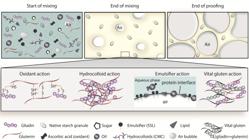
The action of oxidants, hydrocolloids, emulsifiers, and vital gluten in wheat dough. Figure made from the works of Arp et al. (2021); Pareyt et al. (2011); Pereira et al. (2009). SSL: sodium stearoyl lactylate; CMC: carboxymethylcellulose.
Figure 1 illustrates the breadmaking process from the mixing phase to the end of fermentation, highlighting the action of different agents (oxidants, hydrocolloids, emulsifiers, and vital gluten) on the structure and properties of the dough. At the top of the figure, three stages are shown: the beginning of mixing, the end of mixing, and the end of fermentation. At the beginning of mixing, the dough components, including gliadin, gluten, native starch granules, sugar, emulsifier (SSL), lipids, oil, hydrocolloids (CMC), and air bubbles, are dispersed in the aqueous phase. At the end of mixing, the components begin to interact, forming a more cohesive network, and the air bubbles become better integrated into the dough matrix. At the end of fermentation, the gluten network is well formed, encapsulating larger gas bubbles and providing the necessary structure for the bread to expand.
At the bottom of the figure, the specific modes of action of each improving agent are illustrated. Oxidants, such as AA, promote the formation of disulfide bonds (-S-S-) between gluten protein chains (gliadin and glutenin). Hydrocolloids (such as CMC) interact with the gluten network and other dough components. Emulsifiers (such as SSL) stabilize the water-protein interface around air bubbles. VG reinforces the existing gluten network.
Continuing from the detailed visual representation provided, Table 4, developed based on the studies referenced in this article and the conclusions drawn from the subsequent discussion, offers a comprehensive breakdown of the effects of various improving agents—oxidants, emulsifiers, hydrocolloids, enzymes, and vital gluten—on the properties of wheat dough and bread. The table outlines the influence of each agent across several critical parameters, including elasticity, extensibility, dough strengthening, machinability, water absorption, bread volume, and crumb texture. This data not only demonstrates how each additive contributes to the final product but also provides insights into the specific functional roles these agents play in enhancing bread-making processes.
10 Regulatory aspects
Several regulatory agencies define the regulation of the additives described in this review, based on scientific evidence. These agencies are responsible for declaring which agents are allowed in specific product categories and their maximum concentrations, guaranteeing safety to consumers. It is worth noting that each agency can set the maximum concentration of a given additive, which provides different conditions for an additive depending on the country.
Among the agents mentioned in this review, the oxidants undergo more restrictive regulation. For example, ADA is an oxidizing agent allowed by the FDA (Food and Drug Administration) of the United States of America (USA). However, it cannot exceed 45 ppm of the total weight of flour for bread production (Food and Drug Administration, 2020). In Europe, this same additive had its use suspended by a decree of the European Food Safety Authority (European Food Safety Authority, 2005). Potassium bromate is allowed by the FDA in concentrations up to 75 ppm for whole wheat flour and 50 ppm for white flour (Food and Drug Administration, 2020). In Brazil, the National Health Surveillance Agency (Agência Nacional de Vigilância Sanitária - ANVISA) prohibited its use in 2001, Law No. 10,273 (Brasil, 2001). Polysorbate is the most critical among emulsifiers due to the risk of impurities. According to the FDA, the emulsifier PS 80 cannot exceed 0.5% of the weight of the flour (Food and Drug Administration, 2019), while in Brazil, the maximum concentration is 0.3%, based on the finished product (Brasil, 1999, 2010).
Lately, the term “clean label” has been highlighted in the market and industry, accounting for producing food products with a more natural appeal, which includes not adding chemical agents in their formulations (Nascimento et al., 2018). In this context, enzymes gain significant visibility and play an important role owing to their effects on wheat flour and bread, similar to chemical additives, being inactivated after the thermal process (Dai & Tyl, 2021). In Brazil, enzymes are not considered additives by the current legislation. Instead, they act as processing aids that act during the breadmaking process but are inactivated during baking, and their declaration on the labels of processed bread is not mandatory (Brasil, 2014).
On the other hand, VG is an ingredient generally recognized as safe (GRAS) and can be used in foods with no limitations beyond GMP (Good Manufacturing Practices) (Food and Drug Administration, 2020).
Therefore, the various flour improvers discussed in this study demonstrate different degrees of efficacy in strengthening the dough and improving bread quality. The strategic use of these improvers, whether combined or not, is crucial for optimizing dough properties and ensuring the desired processing and quality of bread.
11 Conclusion
The studies presented in this review have shown alternatives to improve the rheological properties of wheat flour doughs and the quality of bread for industry and consumers. The use of additives and processing aids is the easiest and fastest way to achieve this goal. They can be added directly to the flour in the wheat flour mill or to the other ingredients in the mixing stage in industries or bakeries.
The strengthening of the dough is the determining action of chemical oxidants that provide a more significant number of covalent disulfide bonds in the gluten network, which is reflected in more elastic, less extensible doughs and bread of greater volume. Dough handling properties and bread texture are easily improved features with the use of emulsifiers and VG. Hydrocolloids have a limited effect on the strengthening of the dough; however, it is possible to observe that these agents positively impact the machinability and water absorption of the dough. Moreover, changes in dough rheology and performance in baking may be achieved by selecting which wheat flour should be enriched.
Enzymes, hydrocolloids, and VG stand out as ingredients that refer to the “clean label” concept. These agents may often be associated with other enhancers, be it gluten strengthening agents or agents that act on starch. Each agent has its specific mechanism of action, established based on its chemical, structural, and functional properties, which, in short, converges at the single objective of increasing the quality of the flour directed to the bakery and of bakery products produced by the industry.
-
Cite as:
Ferreira, M. P. K., Ribeiro, V. A. G., Barros, J. H. T., & Steel, C. J. (2025). Strategies to improve the quality of wheat flour in baking: a review. Brazilian Journal of Food Technology, 28, e2024046. https://doi.org/10.1590/1981-6723.04624
-
Funding:
National Council for Scientific and Technological Development (CNPq) [grant numbers 165803/2018-5 and 140893/2020-2] and the Coordination for the Improvement of Higher Education Personnel (CAPES) [funding code 001].
References
-
Abrera, A. T., Sützl, L., & Haltrich, D. (2020). Pyranose oxidase: A versatile sugar oxidoreductase for bioelectrochemical applications. Bioelectrochemistry, 132, 107409. PMid:31821902. http://doi.org/10.1016/j.bioelechem.2019.107409
» http://doi.org/10.1016/j.bioelechem.2019.107409 -
Aja, S., Rosell, C. M., Wang, J., Bean, S., Lookhart, G., Aja, S., Bean, S., & Lookhart, G. (2007). Wheat flour proteins as affected by transglutaminase and glucose oxidase. Cereal Chemistry, 80(C), 52-55. http://doi.org/10.1094/CCHEM.2003.80.1.52
» http://doi.org/10.1094/CCHEM.2003.80.1.52 -
Ajibade, B. O., & Ijabadeniyi, O. A. (2019). Effects of pectin and emulsifiers on the physical and nutritional qualities and consumer acceptability of wheat composite dough and bread. Journal of Food Science and Technology, 56(1), 83-92. PMid:30728549. http://doi.org/10.1007/s13197-018-3457-7
» http://doi.org/10.1007/s13197-018-3457-7 -
Altuna, L., Ribotta, P. D., & Tadini, C. C. (2015). Effect of a combination of enzymes on dough rheology and physical and sensory properties of bread enriched with resistant starch. Lebensmittel-Wissenschaft + Technologie, 64(2), 867-873. http://doi.org/10.1016/j.lwt.2015.06.024
» http://doi.org/10.1016/j.lwt.2015.06.024 -
Amiri, A., Shahedi, M., & Kadivar, M. (2016). Evaluation of physicochemical properties of gluten modified by Glucose oxidase and Xylanase. Journal of Cereal Science, 71, 37-42. http://doi.org/10.1016/j.jcs.2016.07.013
» http://doi.org/10.1016/j.jcs.2016.07.013 -
Arp, C. G., Correa, M. J., & Ferrero, C. (2021). Improving quality: Modified celluloses applied to bread dough with high level of resistant starch. Food Hydrocolloids, 112, 106302. http://doi.org/10.1016/j.foodhyd.2020.106302
» http://doi.org/10.1016/j.foodhyd.2020.106302 -
Ashraf, W., Shehzad, A., Sharif, H. R., Aadil, R. M., Rafiq Khan, M., & Zhang, L. (2020). Influence of selected hydrocolloids on the rheological, functional, and textural properties of wheat-pumpkin flour bread. Journal of Food Processing and Preservation, 44(June), 1-11. http://doi.org/10.1111/jfpp.14777
» http://doi.org/10.1111/jfpp.14777 -
Baratto, C. M., Becker, N. B., Gelinski, J. M. L. N., & Silveira, S. M. (2016). Influence of enzymes and ascorbic acid on dough rheology and wheat bread quality. African Journal of Biotechnology, 15(3), 55-61. http://doi.org/10.5897/AJB2015.14931
» http://doi.org/10.5897/AJB2015.14931 -
Bardini, G., Boukid, F., Carini, E., Curti, E., Pizzigalli, E., & Vittadini, E. (2018). Enhancing dough-making rheological performance of wheat flour by transglutaminase and vital gluten supplementation. Lebensmittel-Wissenschaft + Technologie, 91, 467-476. http://doi.org/10.1016/j.lwt.2018.01.077
» http://doi.org/10.1016/j.lwt.2018.01.077 -
Bonet, A., Rosell, C., Caballero, P., Gómez, M., Pérez-Munuera, I., & Lluch, M. (2006). Glucose oxidase effect on dough rheology and bread quality: A study from macroscopic to molecular level. Food Chemistry, 99(3), 408-415. http://doi.org/10.1016/j.foodchem.2005.07.043
» http://doi.org/10.1016/j.foodchem.2005.07.043 -
Boukid, F., Carini, E., Curti, E., Bardini, G., Pizzigalli, E., & Vittadini, E. (2018). Effectiveness of vital gluten and transglutaminase in the improvement of physico-chemical properties of fresh bread. Lebensmittel-Wissenschaft + Technologie, 92, 465-470. http://doi.org/10.1016/j.lwt.2018.02.059
» http://doi.org/10.1016/j.lwt.2018.02.059 -
Boz, H., Murat Karaoǧlu, M., Gürbüz Kotancilar, H., & Emre Gerçekaslan, K. (2010). The effects of different materials as dough improvers for organic whole wheat bread. International Journal of Food Science & Technology, 45(7), 1472-1477. http://doi.org/10.1111/j.1365-2621.2010.02289.x
» http://doi.org/10.1111/j.1365-2621.2010.02289.x -
Brasil, (2001). Dispõe sobre o uso do bromato de potássio na farinha e nos produtos de panificação (Lei nº 10.273, de 5.8.2001). Diário Oficial [da] República Federativa do Brasil, Brasília. Retrieved in 2024, May 5, from http://www.planalto.gov.br/ccivil_03/LEIS/LEIS_2001/L10273.htm
» http://www.planalto.gov.br/ccivil_03/LEIS/LEIS_2001/L10273.htm -
Brasil. (1999). Aprova o uso de aditivos alimentares, estabelecendo suas funções e seus limites máximos para a categoria de alimentos 7 - produtos de panificação e biscoitos (Regulamento técnico que Resolução nº 383, de 5 de Agosto de 1999). Diário Oficial [da] República Federativa do Brasil, Brasília. Retrieved in 2024, May 5, from http://bvsms.saude.gov.br/bvs/saudelegis/anvisa/1999/res0383_05_08_1999.html
» http://bvsms.saude.gov.br/bvs/saudelegis/anvisa/1999/res0383_05_08_1999.html -
Brasil. (2010). Dispõe sobre aditivos alimentares autorizados para uso segundo as Boas Práticas de Fabricação (BPF) (Resolução RDC nº 45, de 3 de novembro de 2010). Diário Oficial [da] República Federativa do Brasil, Brasília. Retrieved in 2024, May 5, from https://bvsms.saude.gov.br/bvs/saudelegis/anvisa/2010/rdc0045_03_11_2010.html
» https://bvsms.saude.gov.br/bvs/saudelegis/anvisa/2010/rdc0045_03_11_2010.html -
Brasil. (2014). Dispõe sobre o Regulamento Técnico sobre enzimas e preparações enzimáticas para uso na produção de alimentos em geral (Resolução nº 54, de 07 de outubro de 2014). Diário Oficial [da] República Federativa do Brasil, Brasília. Retrieved in 2024, May 5, from https://www.legisweb.com.br/legislacao/?id=275613
» https://www.legisweb.com.br/legislacao/?id=275613 - Cauvain, S. P. (2012). Breadmaking: Improving quality (2nd ed.). Oxford: Woodhead Publishing Limited.
-
Dai, Y., & Tyl, C. (2021). A review on mechanistic aspects of individual versus combined uses of enzymes as clean label-friendly dough conditioners in breads. Journal of Food Science, 86(5), 1583-1598. PMid:33890293. http://doi.org/10.1111/1750-3841.15713
» http://doi.org/10.1111/1750-3841.15713 - European Food Safety Authority – EFSA. (2005). Opinion of the Scientific Panel on food additives, flavorings, processing aids, and materials in contact with food (AFC) on a request from the Commission related to tertiary-butylhydroquinone (TBHQ). EFSA Journal, 2(10), 1-36.
-
Food and Drug Administration – FDA. (2019). Food additive status list. Retrieved in 2024, May 5, from https://www.hfpappexternal.fda.gov/scripts/fdcc/index.cfm?set=FoodSubstances#ftnA
» https://www.hfpappexternal.fda.gov/scripts/fdcc/index.cfm?set=FoodSubstances#ftnA -
Food and Drug Administration – FDA. (2020). Food additives permitted for direct addition to food for human consumption. Retrieved in 2024, May 5, from https://www.accessdata.fda.gov/scripts/cdrh/cfdocs/cfCFR/CFRSearch.cfm?fr=172.806
» https://www.accessdata.fda.gov/scripts/cdrh/cfdocs/cfCFR/CFRSearch.cfm?fr=172.806 -
Geisslitz, S., Wieser, H., Scherf, K. A., & Koehler, P. (2018). Gluten protein composition and aggregation properties as predictors for bread volume of common wheat, spelt, durum wheat, emmer, and einkorn. Journal of Cereal Science, 83, 204-212. http://doi.org/10.1016/j.jcs.2018.08.012
» http://doi.org/10.1016/j.jcs.2018.08.012 -
Giannou, V., & Tzia, C. (2016). Addition of vital wheat gluten to enhance the quality characteristics of frozen dough products. Foods, 5(4), 6. http://doi.org/10.3390/foods5010006
» http://doi.org/10.3390/foods5010006 -
Gioia, L. C., Ganancio, J. R., & Steel, C. J. (2017). Food additives and processing aids used in breadmaking. In D. N. Karunaratne & G. Pamunuwa (Eds.), Food additives (pp. 147-166). London: IntechOpen Limited. http://doi.org/10.5772/intechopen.70087
» http://doi.org/10.5772/intechopen.70087 -
Gómez, A. V., Ferrer, E. G., Añón, M. C., & Puppo, M. C. (2013). Changes in secondary structure of gluten proteins due to emulsifiers. Journal of Molecular Structure, 1033, 51-58. http://doi.org/10.1016/j.molstruc.2012.08.031
» http://doi.org/10.1016/j.molstruc.2012.08.031 -
Iqbal, S., Arif, S., Khurshid, S., Iqbal, H. M., Akbar, Q., Ali, T. M., & Mohiuddin, S. (2023). A combined use of different functional additives for improvement of wheat flour quality for bread making. Journal of the Science of Food and Agriculture, 103(7), 3261-3271. PMid:36799259. http://doi.org/10.1002/jsfa.12508
» http://doi.org/10.1002/jsfa.12508 -
Joye, I. J., Courtin, C. M., Nicolas, J., Decamps, K., Rakotozafy, L., Delcour, J. A., Joye, I. J., Rakotozafy, L., Nicolas, J., Courtin, C. M., & Delcour, J. A. (2013). The bread dough stability improving effect of pyranose oxidase from teammates multicolor and glucose oxidase from Aspergillus niger: Unraveling the molecular mechanism. Journal of Agricultural and Food Chemistry, 61(32), 7848-7854. PMid:23875828. http://doi.org/10.1021/jf4021416
» http://doi.org/10.1021/jf4021416 -
Joye, I. J., Lagrain, B., & Delcour, J. A. (2009). Use of chemical redox agents and exogenous enzymes to modify the protein network during Breadmaking - A review. Journal of Cereal Science, 50(1), 11-21. http://doi.org/10.1016/j.jcs.2009.04.001
» http://doi.org/10.1016/j.jcs.2009.04.001 -
La, I., Lee, M., & Kim, K. (2006). Effects of azodicarbonamide on the rheology of wheat flour dough and the quality characteristics of bread. Journal of the Korean Society of Food Science and Nutrition, 33(9), 1566-1572. http://doi.org/10.3746/jkfn.2004.33.9.1566
» http://doi.org/10.3746/jkfn.2004.33.9.1566 -
Lazaridou, A., Duță, D., Papageorgiou, M., Belc, N., & Biliaderis, C. G. (2007). Effects of hydrocolloids on dough rheology and bread quality parameters in gluten-free formulations. Journal of Food Engineering, 79(3), 1033-1047. http://doi.org/10.1016/j.jfoodeng.2006.03.032
» http://doi.org/10.1016/j.jfoodeng.2006.03.032 -
León, A. E., Ribotta, P. D., Ausar, S. F., Fernández, C., Landa, C. A., & Beltramo, D. M. (2000). Interactions of different carrageenan isoforms and flour components in breadmaking. Journal of Agricultural and Food Chemistry, 48(7), 2634-2638. http://doi.org/10.1021/jf991340a
» http://doi.org/10.1021/jf991340a -
Li, J., Hou, G. G., Chen, Z., & Gehring, K. (2013). Effects of endoxylanases, vital wheat gluten, and gum Arabic on the rheological properties, water mobility, and baking quality of whole-wheat saltine cracker dough. Journal of Cereal Science, 58(3), 437-445. http://doi.org/10.1016/j.jcs.2013.09.006
» http://doi.org/10.1016/j.jcs.2013.09.006 -
Li, M., Deng, H., Ma, R., Luo, H., Yao, B., & Su, X. (2018). Biochemical and mutational analyses of a Trametes pyranose oxidase and comparison of its mutants in breadmaking. AMB Express, 8(1), 38. PMid:29536215. http://doi.org/10.1186/s13568-018-0570-y
» http://doi.org/10.1186/s13568-018-0570-y -
Li, J., Zhu, Y., Yadav, M. P., & Li, J. (2019). Effect of various hydrocolloids on the physical and fermentation properties of dough. Food Chemistry, 271, 165-173. PMid:30236662. http://doi.org/10.1016/j.foodchem.2018.07.192
» http://doi.org/10.1016/j.foodchem.2018.07.192 -
Liu, L., Yang, W., Cui, S. W., Jiang, Z., Chen, Q., Qian, H., Wang, L., & Zhou, S. (2018). Effects of pentosanase and glucose oxidase on the composition, rheology and microstructure of whole wheat dough. Food Hydrocolloids, 84, 545-551. http://doi.org/10.1016/j.foodhyd.2018.06.034
» http://doi.org/10.1016/j.foodhyd.2018.06.034 -
Lopes, A. S., Ormenese, R. D. C. S. C., Montenegro, F. M., & Ferreira, P. G. (2007). Influência do uso simultâneo de ácido ascórbico e azodicarbonamida na qualidade do pão francês. Food Science and Technology, 27(2), 307-312. http://doi.org/10.1590/S0101-20612007000200017
» http://doi.org/10.1590/S0101-20612007000200017 -
MacRitchie, F. (2014). Theories of glutenin/dough systems. Journal of Cereal Science, 60(1), 4-6. http://doi.org/10.1016/j.jcs.2014.02.010
» http://doi.org/10.1016/j.jcs.2014.02.010 -
Marchetti, L., Cardós, M., Campaña, L., & Ferrero, C. (2012). Effect of glutens of different quality on dough characteristics and breadmaking performance. Lebensmittel-Wissenschaft + Technologie, 46(1), 224-231. http://doi.org/10.1016/j.lwt.2011.10.002
» http://doi.org/10.1016/j.lwt.2011.10.002 -
Meerts, M., Van Ammel, H., Meeus, Y., Van Engeland, S., Cardinaels, R., Oosterlinck, F., Courtin, C. M., & Moldenaers, P. (2017). Enhancing the rheological performance of wheat flour dough with glucose oxidase, transglutaminase or supplementary gluten. Food and Bioprocess Technology, 10(12), 2188-2198. http://doi.org/10.1007/s11947-017-1986-0
» http://doi.org/10.1007/s11947-017-1986-0 - Miller, R. (2015). Emulsifiers: Types and uses. In B. Caballero, P. M. Finglas & F. Toldrá (Eds.), Encyclopedia of food and health Oxford: Academic Press.
-
Nascimento, K. de O., do, & Paes, S. (2018). A review “clean labeling”: Applications of natural ingredients in bakery products. Journal of Food and Nutrition Research (Newark, Del.), 6(5), 285-294. http://doi.org/10.12691/jfnr-6-5-2
» http://doi.org/10.12691/jfnr-6-5-2 -
Niu, M., Xiong, L., Zhang, B., Jia, C., & Zhao, S. (2018). Comparative study on protein polymerization in whole-wheat dough modified by transglutaminase and glucose oxidase. Lebensmittel-Wissenschaft + Technologie, 90, 323-330. http://doi.org/10.1016/j.lwt.2017.12.046
» http://doi.org/10.1016/j.lwt.2017.12.046 -
Ortolan, F., & Steel, C. J. (2017). Protein characteristics that affect the quality of vital wheat gluten to be used in baking: A review. Comprehensive Reviews in Food Science and Food Safety, 16(3), 369-381. PMid:33371555. http://doi.org/10.1111/1541-4337.12259
» http://doi.org/10.1111/1541-4337.12259 -
Ortolan, F., Corrêa, G. P., da Cunha, R. L., Steel, C. J., Lopes, R., Ortolan, F., Paiva, G., & Joy, C. (2017). Rheological properties of vital wheat glutens with water or sodium chloride. Lebensmittel-Wissenschaft + Technologie, 79, 647-654. http://doi.org/10.1016/j.lwt.2017.01.059
» http://doi.org/10.1016/j.lwt.2017.01.059 -
Parenti, O., Guerrini, L., Cavallini, B., Baldi, F., & Zanoni, B. (2020). Breadmaking with an old wholewheat flour: Optimization of ingredients to improve bread quality. Lebensmittel-Wissenschaft + Technologie, 121, 108980. http://doi.org/10.1016/j.lwt.2019.108980
» http://doi.org/10.1016/j.lwt.2019.108980 -
Pareyt, B., Finnie, S. M., Putseys, J. A., & Delcour, J. A. (2011). Lipids in bread making: Sources, interactions, and impact on bread quality. Journal of Cereal Science, 54(3), 266-279. http://doi.org/10.1016/j.jcs.2011.08.011
» http://doi.org/10.1016/j.jcs.2011.08.011 -
Pereira, E. P. R., Amorim, E. O. C., Ambiel, L., Chang, Y. K., & Steel, C. J. (2009). Influência de agentes oxidantes sobre as propriedades reológicas de massas de farinha de trigo branca e de grão inteiro e sobre o volume específico de pão francês. Brazilian Journal of Food Technology, 12(03), 161-171. http://doi.org/10.4260/BJFT2009800900009
» http://doi.org/10.4260/BJFT2009800900009 -
Pizzigalli, E., Curti, E., Vittadini, E., Boukid, F., Carini, E., Bardini, G., Curti, E., Bardini, G., Pizzigalli, E., & Vittadini, E. (2018). Effectiveness of vital gluten and transglutaminase in the improvement of physico-chemical properties of fresh bread. Lebensmittel-Wissenschaft + Technologie, 92, 465-470. http://doi.org/10.1016/j.lwt.2018.02.059
» http://doi.org/10.1016/j.lwt.2018.02.059 -
Rahman, M. M., & Simsek, S. (2020). Go clean label: Replacement of commercial dough strengtheners with hard red spring wheat flour in bread formulations. Journal of Food Science and Technology, 57(10), 3581. PMid:32903984. http://doi.org/10.1007/s13197-020-04390-w
» http://doi.org/10.1007/s13197-020-04390-w -
Renzetti, S., & Rosell, C. M. (2016). Role of enzymes in improving the functionality of proteins in non-wheat dough systems. Journal of Cereal Science, 67, 35-45. http://doi.org/10.1016/j.jcs.2015.09.008
» http://doi.org/10.1016/j.jcs.2015.09.008 -
Rosell, C., Rojas, J. A., & Barber, C. B. (2001). Influence of hydrocolloids on dough rheology and bread quality. Food Hydrocolloids, 15(1), 75-81. http://doi.org/10.1016/S0268-005X(00)00054-0
» http://doi.org/10.1016/S0268-005X(00)00054-0 -
Saraiva, A. L. G., Da Silva, C. E. M., & Clemente, E. (2010). Efeito do ácido ascórbico em massa de pão na presença do ácido tânico. Acta Scientiarum. Technology, 32(2), 207-211. http://doi.org/10.4025/actascitechnol.v32i2.5290
» http://doi.org/10.4025/actascitechnol.v32i2.5290 -
Schmid, M., Wieser, H., & Koehler, P. (2017). Disulfide structure of high-molecular-weight (HMW-) gliadins as affected by terminators. Journal of Cereal Science, 78, 66-74. http://doi.org/10.1016/j.jcs.2016.12.007
» http://doi.org/10.1016/j.jcs.2016.12.007 -
Tang, L., Yang, R., Hua, X., Yu, C., Zhang, W., & Zhao, W. (2014). Preparation of immobilized glucose oxidase and its application in improving breadmaking quality of commercial wheat flour. Food Chemistry, 161, 1-7. PMid:24837914. http://doi.org/10.1016/j.foodchem.2014.03.104
» http://doi.org/10.1016/j.foodchem.2014.03.104 -
Tebben, L., & Li, Y. (2019). Effect of xanthan gum on dough properties and bread qualities made from whole wheat flour. Cereal Chemistry, 96(2), 263-272. http://doi.org/10.1002/cche.10118
» http://doi.org/10.1002/cche.10118 -
Tebben, L., Shen, Y., & Li, Y. (2018). Improvers and functional ingredients in whole wheat bread: A review of their effects on dough properties and bread quality. Trends in Food Science & Technology, 81, 10-24. http://doi.org/10.1016/j.tifs.2018.08.015
» http://doi.org/10.1016/j.tifs.2018.08.015 -
Tozatti, P., Hopkins, E. J., Briggs, C., Hucl, P., & Nickerson, M. (2020). Effect of chemical oxidizers and enzymatic treatments on the baking quality of doughs formulated with five Canadian spring wheat cultivars. Food Science & Technology International, 26(7), 614-628. PMid:32279537. http://doi.org/10.1177/1082013220915363
» http://doi.org/10.1177/1082013220915363 -
Wieser, H. (2007). Chemistry of gluten proteins. Food Microbiology, 24(2), 115-119. PMid:17008153. http://doi.org/10.1016/j.fm.2006.07.004
» http://doi.org/10.1016/j.fm.2006.07.004 -
Wieser, H. (2012). The use of redox agents in breadmaking. In S. P. Cauvain (Ed.), Breadmaking: Improving quality (2nd ed., pp. 447-469). Oxford: Woodhead Publishing. http://doi.org/10.1533/9780857095695.2.447
» http://doi.org/10.1533/9780857095695.2.447 -
Zannini, E., Waters, D. M., & Arendt, E. K. (2014). The application of dextran compared to other hydrocolloids as a novel food ingredient to compensate for low protein in biscuit and wholemeal wheat flour. European Food Research and Technology, 238(5), 763-771. http://doi.org/10.1007/s00217-014-2161-8
» http://doi.org/10.1007/s00217-014-2161-8 -
Zhao, L., Wang, K., Zhu, J., Guo, J., & Hu, Z. (2020). Temperature-induced interaction with carboxymethyl cellulose affected the rheological properties and structure of wheat gluten. Lebensmittel-Wissenschaft + Technologie, 133, 10999. http://doi.org/10.1016/j.lwt.2020.109993
» http://doi.org/10.1016/j.lwt.2020.109993
Edited by
-
Associate Editor:
Fernanda Ortolan.