 How sexual behavior in male rats is inhibited by repeated maternal separation during early postnatal development
Abstract
Perinatal stress can have lasting effects on hormone regulation and behavior. An association between maternal separation and depressive illness is well established. The present study was undertaken to investigate the effects of maternal separation on both motivational and consummatory measures and on the temporal patterning of sexual behavior in male rats. Litters were separated from their mothers for 180 min per day from P1 to P21 (birth=P0) and placed in an isolated box. Control litters remained with their mothers and were not disturbed. At 90 days of age, the sexual behavior of the male rats was assessed using both standard behavioral parameters and mount bout analysis. The forced swim test, open field test, and elevated plus maze test were used to assess anxious and depressive behavior. Each rat was subjected to a single type of behavioral protocol. The inhibitory effect of maternal separation on the sexual behavior of male rats was shown by an increase in mount, intromission, and ejaculation latencies, mount and intromission frequency, and interintromission interval, and a decrease in intromission ratio. Maternally separated rats showed a delayed temporal patterning of sexual behavior. In addition, there was an increase in depressive and anxiety-like behavior in maternally separated rats. The present results suggest that perinatal stress induced by maternal separation leads to changes in sexual behavior and depressive and anxiety-like behavior in male rats. In this sense, early postnatal stress may cause behavioral changes that persist into adulthood.
Key words:
Maternal separation; Sexual behavior; Early postnatal stress; Mount bout analysis; Depressive-like behavior; Anxiety-like behavior
Introduction
It has been proposed that perinatal stress may lead to increased susceptibility to the development of affective and anxiety disorders in adulthood (1- 3). In this context, it is generally accepted that early postnatal stress such as repeated maternal separation (MS) could have high construct validity for animal models of affective disorders, because these animal models evoke behavioral, neurochemical, and physiological abnormalities like those found in depressed human patients (4,5). It has also been proposed that MS may lead to changes in the hypothalamic-pituitary-adrenal (HPA) response to stress and brain development, leading to behavioral, neurochemical, and immunological modifications as well as other permanent brain functional abnormalities (6- 8).
Several studies have shown that MS produces behavioral changes in rats that persist into adulthood (9- 14). Depressive-like behavior, but not anxiety-like behavior, was increased after MS in male and female rats (10). It has been proposed that MS increases vulnerability of male rats to adult stress re-exposure (10- 13). In general, MS sensitizes the effect of other perinatal stressors such as prenatal hypoxia (12), limited bedding and nesting (13,14), and drugs (9). Yano et al. (14) showed that MS accelerated sexual maturation in males, but not in females, as the onset of preputial separation occurred significantly earlier in the MS group. However, no changes in sexual behavior were observed in the study.
It is well established that different protocols of MS produce different results in the sexual response of rats. Models vary in the length of each daily separation (generally short or long), the number of days of separation (15 to 21 days in most studies), and the period of neonatal life (starting on the first, fifth, or another day of life). Long-term MS (≥180 min) impairs male copulatory behavior, increasing latency, inter-intromission interval, and intromission ratio (7,13- 16). In contrast, short-term MS may enhance sexual behavior, reducing both latency and post-ejaculatory intervals (17). However, none of these studies used mount bout analysis, which provides more information about the temporal patterning of male rat sexual behavior. A mount bout consists of one or more mounts and/or intromissions that occur in succession without interruption by any non-sexual behavior (except genital - autogrooming) directed away from the female (18). Specifically, examining mount bouts in rats provides valuable additional information regarding the temporal organization, copulatory efficiency, and sexual motivation of the animals, thereby complementing traditional behavioral metrics. This analysis also helps determine whether the animal performs coordinated or disorganized copulatory sequences (18- 20). Furthermore, studies have shown that the duration of mount bouts is correlated with sexual motivation (19). In addition, the analysis of successive copulatory series makes it possible to investigate the consistency of behavior, as well as the behavioral response to sexual experience. Therefore, the relevance of the present study is that it examined the effects of long-term MS on motivational and consummatory measures and the temporal patterning of male rat sexual behavior to clarify the effects of MS on each component of male rat sexual behavior. We also investigated the effects of MS on depressive and anxiety-like behaviors in rats.
Material and Methods
Subjects
All procedures were approved by the Ethics Committee on Animal Use (protocol number: CEUA/050/2022) of the Universidade do Estado do Rio de Janeiro, Brazil. All experiments were conducted in accordance with the Declaration of Helsinki, the Guide for the Care and Use of Laboratory Animals as adopted by the National Institutes of Health (USA), and the Brazilian guidelines established by CONCEA-MCTI (Conselho Nacional de Controle de Experimentação Animal, Ministério da Ciência, Tecnologia e Inovação). Adult male and female Wistar naive rats from our own colony were used. Experimental animals were produced through controlled mating. The estrous cycle was monitored via vaginal smears. For mating, 3-month-old virgin female Wistar rats in the estrus phase were paired with males in a 1:1 ratio for 12 h. The first day of pregnancy was confirmed by the presence of spermatozoa in vaginal smears (11). Animals were maintained in maternity cages in temperature-controlled colony rooms (23±1°C) under 12-h light/dark cycles, with lights on at 18:00. Twenty-four pregnant Wistar rats were randomly designated to the control (twelve litters) or maternal separation (MS, twelve litters) groups. MS litters were removed from their mothers for 180 minutes per day from P1 to P21 (birth=P0) and placed individually in a transparent polycarbonate cage (5-cm height; 5-cm radius) in a room with controlled conditions of the nest temperature (35±1°C) under a 12-h photoperiod (11). After that, the pups remained with their mothers until weaning (P25). Control animals continued in their cages and were not handled. MS was conducted according to the protocol established by Rhees et al. (7): the pups from each litter were placed in a separate box located outside the colony room. MS was conducted at 08:00 each day in the dark lighting cycle, and the pups were then returned to the same dam. The maternal behavior of each dam was recorded on video during and immediately after the separation procedures to allow subsequent analysis of material behavior (7). Food and water were provided ad libitum, and room temperature was kept at 23±1°C.
Experimental design
At three months of age (P90), MS and control male rats were submitted to five mating tests separated by 4-day intervals using a bilevel chamber analogous to those defined by Mendelson and Pfaus (21) and Pfaus and Phillips (22). Only one randomly selected male per litter was used in the mating tests. Two rats from each remaining group were randomly selected and tested for either depressive-like (sucrose preference and forced swim tests) or anxious-like (open field and elevated plus maze (EPM) tests) behaviors. The light-dark lighting cycle was inverted 20 days prior to the start of the experimental tests to ensure full acclimation. All behavioral tests were performed during the dark phase of the circadian cycle (14:00-18:00) under red light illumination (>600 nm). This wavelength was selected because rodents exhibit minimal photopic sensitivity to long-wavelength light (23), preserving their natural behavior. Before and between all the tests, the equipment was cleaned with 70% alcohol and 3% hydrogen peroxide and dried off. All behavioral tests were video-recorded and analyzed independently by two blinded observers. To resolve any scoring discrepancies, a third blinded observer conducted additional analyses.
Mating test
Females were brought into estrus through subcutaneous injections of 100 μg/kg of estradiol benzoate in corn oil administered 72 and 48 h before testing, followed by a 500 μg/kg injection of medroxyprogesterone acetate 5 h prior to the test, in accordance with our previous studies (24). All the females were tested for sexual proceptivity and receptivity with non-experimental male rats, immediately before the experiment, using a 4-point scale (11). Only the rats that presented a grade equal to or greater than 3 were used in the experiment. After 10 min of adaptation in a bilevel chamber, a stimulus female rat was introduced into the upper level of the cage and the copulatory behavior test started (21). To evaluate the motivational aspect of sexual behavior, we measured several parameters based on our earlier work. These included: level searching (number of level changes in the five minutes before introducing the female), mount latency (time from the start of the test to the first mount, with or without penetration), intromission latency (time from introducing the female to the first intromission), and postejaculatory interval (time from ejaculation to the first intromission in the next mating round) (22). To assess the consummatory (performance) aspect, we recorded: ejaculatory latency (time from the first intromission to ejaculation), mount frequency (number of mounts without penetration before ejaculation), intromission frequency (number of penetrative mounts before ejaculation), interintromission interval (average time between intromissions, calculated as ejaculation latency divided by [intromission frequency + 1]), intromission ratio ([intromission frequency + 1] divided by [total mounts + 1]), and copulatory rate (percentage of rats per group that ejaculated) (25). Tests were terminated if the intromission latency exceeded 15 min or ejaculation latency exceeded 30 min. In the initial test, sixteen male rats were used per group. However, only twelve MS rats achieved ejaculation, whereas all control rats did. To maintain consistency, we randomly selected twelve control rats, resulting in twelve rats per group for the study.
Sexual behavior temporal patterning analysis
Data of temporal patterning of sexual behavior (SBTP) are reported as mount bout frequency (the sequence of mounts, with or without intromission, undisrupted by any behavior that is not aligned toward the female prior to ejaculation), genital grooming time (the average time spent in genital autogrooming preceding the ejaculation), intermount bout interval (the average time from the start of one mount bout to the onset of the next mount bout), time-out (the average interval from the end of one mount bout to the start of the next mount bout), intromissions per mount bout (calculated as intromission frequency divided by mount bout frequency), and total mounts per mount bout (calculated as the sum of mounts with and without intromissions divided by the mount bout frequency) (18).
Open field test
Locomotor activity and anxiety-like behavior were assessed in the open field for 5 min. The apparatus was a white square acrylic box (40×40 cm, wall height: 35 cm) divided into 16 equal quadrants (10×10 cm each), comprising 4 central and 12 peripheral squares. To assess motor activity, we recorded the total number of squares crossed, along with separate counts for central and peripheral squares. Anxiety-like behavior was evaluated using two metrics: 1) the percentage of central square entries (calculated as central entries divided by total entries) and 2) the percentage of time spent in central squares (calculated as central time divided by total time). A square crossing was only counted when all four paws entered a new square (26).
Elevated plus maze test (EPM)
The EPM test was performed as a measure of anxiety-like behavior. The EPM equipment has two open and two closed arms (30-cm wall height), each arm running 50-cm in length and 10-cm wide, and it is elevated 80.0 cm above the floor. The following measures were recorded: time spent in the open and closed arms and number of entries into the open and closed arms. A rat was considered entering an arm when all four paws were placed in that arm (27).
Forced swimming test
MS and control rats were subjected to three trials in which each rat was forced to swim in an acrylic cylinder (40-cm high, 18-cm diameter) filled with water (25°C) to a height of 26 cm. Each test was separated by 24 h. The first trial lasted 15 min and corresponded to the training phase. The second and third trials lasted 5 min (25).
Sucrose preference test
Prior to the formal test, rats were given two bottles of 1% sucrose solution for 24 h, then one bottle was replaced with pure water and allowed to acclimate for a further 24 h, and after 12 h, the position of the two bottles was reversed. Rats were deprived of food and water for 24 h prior to the test and given a pre-weighed bottle of 1% sucrose solution and a bottle of pure water for a 2-h formal test. The residual weights of the two bottles of solution were recorded. Sucrose preference was calculated as percent = sucrose intake / (sucrose intake + water intake) × 100% (28).
Statistics
GraphPad Prism 8.0 software (GraphPad Software, USA) was used for the statistical analyses. The data from the four groups were submitted to the Kolmogorov-Smirnov test to assess normality. The data are reported as means±SD. Statistical analyses were performed using two-way repeated measures ANOVA, with “GROUP” (control vs MS) as the between-subjects factor and “TESTING” (multiple sessions) as the within-subject factor. Significant results were subsequently analyzed using the post hoc Sidak's test. In all cases, we considered P<0.05 to be statistically significant.
Results
Standard sexual behavior measures
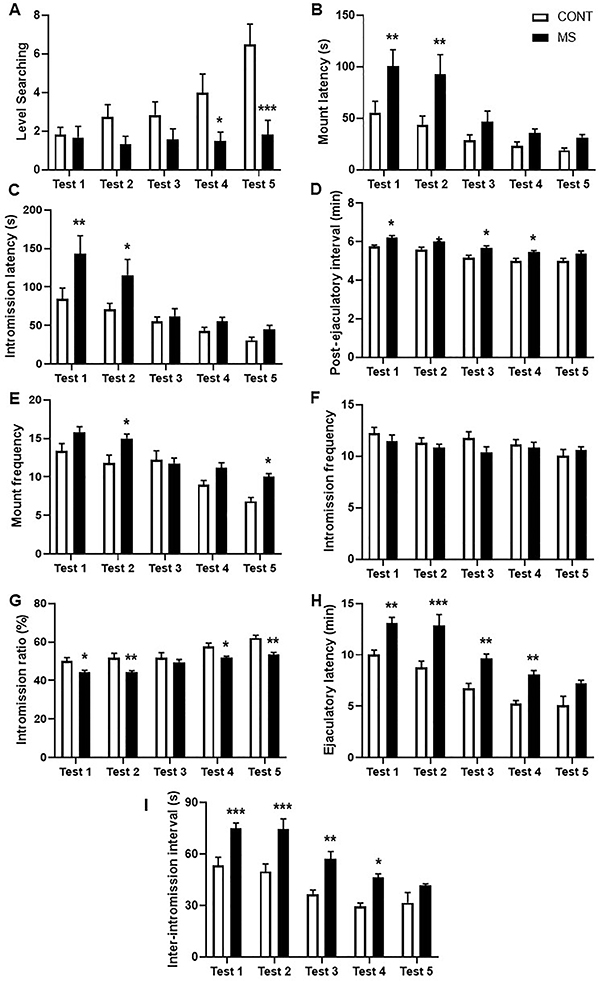
MS rats showed reduction in sexual behavior compared with the control rats (Figures 1 and 2). Two-way ANOVA indicated group-dependent effects (GROUP: F(1,22)=9.79, P<0.01) and trial-dependent effects (TESTING effect: F(4, 88)=5.93, P<0.001) on level searching (Figure 1A) compared with the controls. Control rats displayed a progressive increase in level-searching behavior - measured by the number of level changes - from the first to the fifth test (P<0.05). In contrast, the MS group exhibited a non-significant change in this measure. Furthermore, MS rats presented a significant decrease in level searching behavior in tests 4 (P<0.05) and 5 (P<0.001) compared to Control. Post hoc Sidak's tests showed statistically significant differences between MS and control groups during the fourth (mean difference=2.5, 95%CI: [0.017, 4.98], P=0.047) and fifth tests (mean difference=4.667, 95%CI: [2.184, 7.15], P<0.0001). Two-way ANOVA registered group-dependent effects (GROUP: F(1,22)=9.45, P<0.01) and trial-dependent effects (TESTING effect: F(4, 88)=19.47, P<0.001) on mount latency (Figure 1B), which was related to a reduction in mount latency across the serial tests. Post hoc Sidak's tests revealed statistically significant differences between MS and control groups during the first test (mean difference=-45.33, 95%CI: [-81.97, -8.694], P=0.008) and second test (mean difference=-48.83, 95%CI: [-85.47, -12.19], P=0.0035). Two-way ANOVA registered group-dependent effects (GROUP: F(1,22)=7.69, P<0.05) and trial-dependent effects (TESTING effect: F(4,88)=18.55, P<0.001) on intromission latency (Figure 1C), which was related to a reduction in intromission latency across the serial tests. Post hoc Sidak's tests showed statistically significant differences between MS and control groups during the first (mean difference=-58.83, 95%CI: [-102.4, -15.22], P=0.0031) and second tests (mean difference=-44.67, 95%CI: [-88.28, -1.05], P=0.042). Two-way ANOVA registered group-dependent effects (GROUP: F(1,22)=12.73, P<0.01) or trial-dependent effects (TESTING effect: F(4, 88)=31.75, P<0.001) on post-ejaculatory interval (Figure 1D). Post hoc Sidak's tests revealed statistically significant differences between MS and control groups during the first test (mean difference=-0.45, 95%CI: [-0.895, -0.02], P=0.035), third test (mean difference=-0.5, 95%CI: [-0.94, -0.062], P=0.017), and fourth test (mean difference=-0.45, 95%CI: [-0.887, 0.012], P=0.047). Together, the results from the level searching, mount latency, intromission latency, and post-ejaculatory interval parameters suggest that MS decreases the motivational component of male rat sexual behavior. Two-way ANOVA registered group-dependent effects (GROUP: F(1,22)=9.63, P<0.01) and trial-dependent effects (TESTING effect: F(4, 88)=29.44, P<0.001) on mount frequency (Figure 1E). Post hoc Sidak's tests revealed statistically significant differences between MS and control groups during the first (mean difference=-3.167, 95%CI: [-5.945, -0.388], P=0.018) and fourth tests (mean difference=-3.167, 95%CI: [-5.945, 0.388], P=0.018). Two-way ANOVA indicated no group-dependent effect (GROUP: F(1,22)=1.89, P=0.182), but there was trial-dependent effect (TESTING effect: F(4,88)=2.48, P<0.05) on intromission frequency (Figure 1F). Post hoc analysis revealed no significant differences in intromission frequency between MS and control groups across all test sessions (all P>0.05). Two-way ANOVA registered group-dependent effects (GROUP: F(1,22)=17.63, P<0.001) and trial-dependent effects (TESTING effect: F(4,88)=21.35, P<0.001) on intromission ratio (Figure 1G) compared with controls. Post hoc Sidak's tests revealed statistically significant differences between MS and control groups during the first test (mean difference=6.142, 95%CI: [0.2, 12.08], P=0.039), second test (mean difference=7.5, 95%CI: [1.56, 13.44], P=0.006), fourth test (mean difference=5.95, 95%CI: [0.009, 11.89], P=0.049), and fifth test (mean difference=8.31, 95%CI: [2.368, 14.25], P=0.002). Together, the results from the mount and intromission frequencies and intromission ratio parameters suggest that MS decreases the consummatory component of sexual behavior in male rats. Two-way ANOVA registered group-dependent effects (GROUP: F(1,22)=37.28, P<0.01) and trial-dependent effects (TESTING effect: F(4, 88)=40.28, P<0.001) on ejaculation latency (Figure 1H) compared with controls. Post hoc Sidak's tests revealed statistically significant differences between MS and control groups during the first test (mean difference=-3.067, 95%CI: [-5.242, -0.89], P=0.002), second test (mean difference=-4.04, 95%CI: [-6.22, -1.87], P<0.0001), third test (mean difference=-2.84, 95%CI: [-5.017, -0.67], P=0.004), and fourth test (mean difference=-2.78, 95%CI: [-4.96, -0.61], P=0.006). Two-way ANOVA indicated group-dependent effects (GROUP: F(1,22)=42.22, P<0.0001) and trial-dependent effects (TESTING effect: F(4,88)=24.48, P<0.001) on inter-intromission interval (Figure 1I) compared with controls. Post hoc Sidak's tests revealed statistically significant differences between MS and control groups during the first test (mean difference=-21.73, 95%CI: [-36.13, -7.32], P=0.0007), second test (mean difference=-24.61, 95%CI: [-39.01, -10.2], P<0.0001), third test (mean difference=-20.58, 95%CI: [-34.99, -6.18], P=0.0015), and fourth test (mean difference=-16.08, 95%CI: [-30.49, -1.68], P=0.021). Together, the results from ejaculation latency and inter-intromission interval parameters indicated that MS increased the ejaculatory threshold while further confirming the impairment of consummatory aspects in male rat sexual behavior.
Sexual behavior of adult male rats submitted to maternal separation (MS). MS reduced level searching (A), and increased mount latency (B), intromission latency (C), post-ejaculatory interval (D), mount frequency (E), intromission frequency (F), intromission ratio (G), ejaculatory latency (H), and inter-intromission interval (I). The data are reported as means±SD (n=12 rats/group). *P<0.05, **P<0.01, ***P<0.001 compared to the control group (two-way analysis of variance).

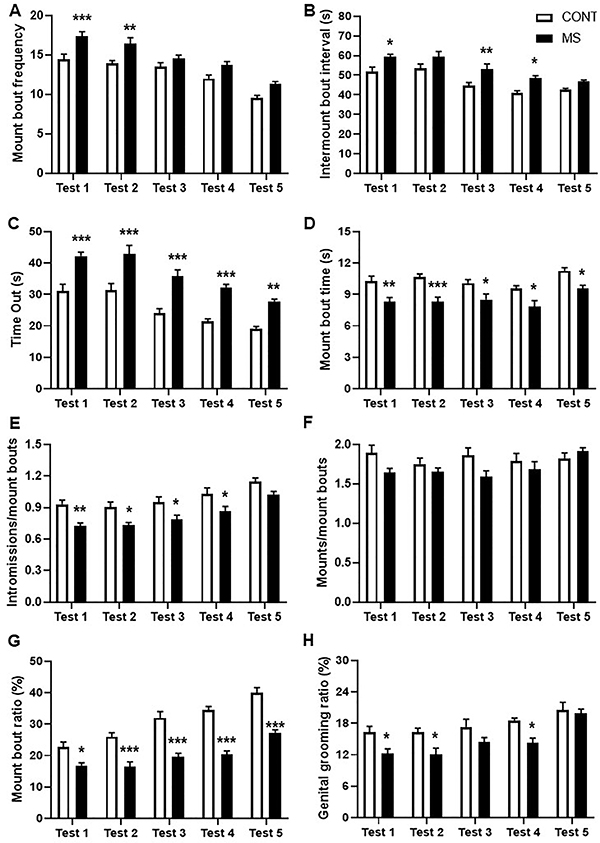
Temporal patterning of sexual behavior of adult male rats submitted to maternal separation (MS). MS increased mount bout frequency (A), intermount bout interval (B), and time out (C), and decreased mount bout time (D), intromissions/mount bout (E), mounts/mount bouts (F), mount bout ratio (G), and genital grooming ratio (H). The data are reported as means±SD (n=12 rats/group). *P<0.05, **P<0.01, ***P<0.001 compared to the control group (two-way analysis of variance).
Sexual behavior temporal patterning
The effects of MS on sexual behavior temporal patterning are shown in Figure 2. Two-way ANOVA registered group-dependent effects (GROUP: F(1,22)=19.08, P<0.001) and trial-dependent effects (TESTING effect: F(4, 88)=46.43, P<0.001) on mount bout frequency (Figure 2A) compared with controls. Post hoc Sidak's tests showed statistically significant differences between MS and control groups during the first (mean difference=-2.92, 95%CI: [-4.81, -1.03], P=0.0005) and second tests (mean difference=-2.5, 95%CI: [-4.39, -0.61], P=0.0039). Two-way ANOVA registered group-dependent effects (GROUP: F(1,22)=30.80, P<0.001) and trial-dependent effects (TESTING effect: F(4, 88)=21.43, P<0.001) on intermount bout interval (Figure 2B). Post hoc Sidak's tests revealed statistically significant differences between MS and control groups during the first test (mean difference=-7.33, 95%CI: [-13.89, -0.78], P=0.021), third test (mean difference=-8.58, 95%CI: [-15.14, -2.03], P=0.004), and fourth test (mean difference=-7.25, 95%CI: [-13.8, -0.69], P=0.023). Two-way ANOVA indicated group-dependent effects (GROUP: F(1,22)=82.85, P<0.001) and trial-dependent effects (TESTING effect: F(4, 88)=30.31, P<0.001) on time out (Figure 2C). Post hoc Sidak's tests revealed statistically significant differences between MS and control groups during the first test (mean difference=-11.0, 95%CI: [-17.01, -4.99], P<0.0001), second test (mean difference=-11.42, 95%CI: [-17.43, -5.41], P<0.0001), third test (mean difference=-11.92, 95%CI: [-17.93, -5.91], P<0.0001), fourth test (mean difference=-10.75, 95%CI: [-16.76, -4.74], P<0.0001), and fifth test (mean difference=-8.17, 95%CI: [-14.18, -2.16], P=0.0028). Two-way ANOVA registered group-dependent effects (GROUP: F(1,22)=61.86, P<0.001), but not trial-dependent effects (TESTING effect: F(4, 88)=4.574, P=0.002) on mount bout time (Figure 2D). Post hoc Sidak's tests revealed statistically significant differences between MS and control groups during the first test (mean difference=1.97, 95%CI: [0.43, 3.41], P=0.005), second test (mean difference=2.33, 95%CI: [0.84, 3.82], P=0.0004), third test (mean difference=1.58, 95%CI: [0.09, 3.07], P=0.031), fourth test (mean difference=1.75, 95%CI: [0.26, 3.24], P=0.013), and fifth test (mean difference=1.67, 95%CI: [0.178, 3.15], P=0.021). Two-way ANOVA registered group-dependent effects (GROUP: F(1,22)=33.05, P<0.0001) and trial-dependent effects (TESTING effect: F(4, 88)=16.12, P<0.01) on intromissions per mount bout (Figure 2E). Post hoc Sidak's tests revealed statistically significant differences between MS and control groups during the first test (mean difference=0.21, 95%CI: [0.06, 0.36], P=0.0025), second test (mean difference=0.17, 95%CI: [0.02, 0.32], P=0.019), third test (mean difference=0.17, 95%CI: [0.01, 0.31], P=0.024), and fourth test (mean difference=0.16, 95%CI: [0.13, 0.31], P=0.026). Two-way ANOVA registered group-dependent effects (GROUP: F(1,22)=5.424, P=0.029) but not trial-dependent effects (TESTING effect: F(4, 88)=1.527, P=0.201) on mounts per mount bout (Figure 2F). Post hoc analyses revealed no significant differences in mounts per mount bout between MS and control groups across all test sessions (all P>0.05). Two-way ANOVA registered group-dependent effects (GROUP: F(1,22)=86.32, P<0.001) and trial-dependent effects (TESTING effect: F(4, 88)=43,57, P<0.001) on mount bout ratio (Figure 2G). Post hoc Sidak's tests revealed statistically significant differences between MS and control groups during the first test (mean difference=5.84, 95%CI: [0.87, 10.81], P=0.013), second test (mean difference=9.53, 95%CI: [4.56, 14.5], P<0.0001), third test (mean difference=12.37, 95%CI: [7.39, 17.34], P<0.0001), fourth test (mean difference=14.17, 95%CI: [9.19, 19.14], P<0.0001), and fifth test (mean difference=12.71, 95%CI: [7.74, 17.68], P<0.0001). Two-way ANOVA registered group-dependent effects (GROUP: F(1,22)=18.41, P<0.001) and trial-dependent effects (TESTING effect: F(4, 88)=11.78, P<0.001) on genital autogrooming ratio (Figure 2H). Post hoc Sidak's tests revealed statistically significant differences between MS and control groups during the first test (mean difference=4.07, 95%CI: [0.21, 7.93], P=0.033), second test (mean difference=4.28, 95%CI: [0.42, 8.14], P=0.022), and fourth test (mean difference=4.35, 95%CI: [0.49, 8.21], P=0.019). Together, the mount bout analysis revealed that MS altered the pattern of copulatory series in male rats. These findings not only confirmed the reduction in both sexual motivation and copulatory efficiency, but also corroborated the results obtained through conventional behavioral measures.
Figure 3 illustrates a delineative representation of the MS and control male rat sexual behavior temporal patterning.
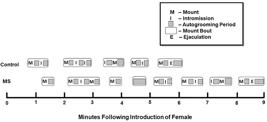
Schematic representation of the temporal patterning of copulatory behavior in male rats during the first ejaculatory cycle.
Effects of maternal separation on anxiety-like and depressive-like behaviors
There were no significant differences in the percent of entry into open arms (t=1.519, df=22, P=0.143) in the EPM between the control and MS rats (Figure 4A). MS showed a significant decrease in the percent of time in open arms (t=2.296, df=22, P<0.05) in the EPM compared with control groups (Figure 4B). Abnormalities in posture and gait were not observed in MS males during the open field test. MS rats showed a significant decrease in the percent of entry into the central squares (t=2.135, df=22, P<0.05) in relation to the control (Figure 4C). There were no significant differences in the total lines crossed between the control and MS rats (t=1.184, df=22, P=0.249; Figure 4D). Together, the results from the open field and EPM tests suggest that MS does lead to anxiety-like behavior in male rats. Significantly longer immobility was observed in MS rats (t=3.19, df=22, P<0.01; Figure 4E). Longer immobility in the forced swim test is an indicator of depression-like behavior. MS rats showed a significant decrease in sucrose preference (t=3.045, df=22, P<0.01) in relation to control (Figure 4F). Together, the results from the forced swim test and sucrose preference test suggest that MS does lead to depression-like behavior in male rats.
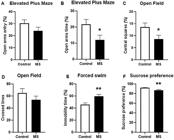
Influence of maternal separation (MS) on anxiety-like and depressive-like behaviors. MS reduced the number of entries (A) and the time spent in the open arms in the elevated plus maze test (B), reduced entry into the central squares (C) and the number of crossed lines (D) in the open field test, increased immobility time in the forced swim test (E), and reduced sucrose preference (F). The data are reported as means±SD (n=12 rats/group). *P<0.05, **P<0.01 compared to the control group (two-way analysis of variance).
Discussion
This study demonstrated that perinatal MS caused multifaceted sexual behavior impairments in male rats, confirming and extending prior findings (6,11- 15). Early-life stress disrupted the complete behavioral sequence from motivation to recovery, including: 1) reduced appetitive behaviors: decreased searching level behavior, delayed mounting/intromission latencies, and prolonged post-ejaculatory intervals, indicating motivational/arousal deficits; 2) impaired copulatory efficiency: elevated mounts but reduced intromission ratio, suggesting motor/sensory dysfunction; and 3) altered ejaculatory control: prolonged latency and interintromission intervals, implying central nervous system-mediated threshold modifications. Notably, our study provides the first evidence that MS fundamentally reorganizes the temporal architecture of sexual behavior, with striking alterations in intromission distribution patterns that distinguish MS animals from controls. This discovery reveals previously unrecognized chronobiological dimensions of early stress effects on reproductive behavior. Crucially, these sexual dysfunction phenotypes emerged in tandem with robust anxiety-like and depressive-like symptomatology, suggesting shared neurobiological substrates. Collectively, our findings established that perinatal stress simultaneously dysregulated motivational, consummatory, and temporal organizational domains of sexual behavior, while precipitating comorbid affective pathology - revealing a pleiotropic impact of early-life adversity on brain and behavior.
The analysis of SBTP offers insights into sexual drive and social-sexual behavior and provides a more accurate representation of sexual behavior patterns than the standard analysis (18- 22). Yells et al. (18) provide an illustrative example to elucidate the significance of SBTP analysis. The same example is employed here: in this study, the intromission frequency was found to be almost identical between MS and control rats. However, an analysis of SBTP data indicates that the disposal of each intromission differed between the groups. The control rats usually initiated a mount and/or an intromission for each mounting session, while the rats with MS showed a variety of mounting sessions without intromissions. These observations could suggest that the rats were behaving in a similar way, but the SBTP analysis indicated that they were behaving in the opposite way. In the present study, SBTP data revealed that MS rats displayed significantly reduced interaction with females compared to controls, a pattern that persisted consistently from initial testing through the final trial. Moreover, MS rats exhibited shorter and less frequent mount bouts, suggesting potential deficits in sexual motivation, attentional focus, or motor coordination during mounting behavior.
On the other hand, rats exposed to MS exhibited a decreased intromission ratio from the first to the fifth test, likely due to impaired penile erection during copulation. In a previous study, we demonstrated that treatment with N-ω-nitro-L-arginine methyl ester (L-NAME) reduced intromission ratio (copulatory efficiency) and that this effect was reversed by co-treatment with vasodilators (24) and the phosphodiesterase 5 inhibitor sildenafil (29), suggesting the involvement of peripheral mechanisms associated with penile erection. It has been described that the female plays a relevant role in regulating copulation through proceptive behavior (30). In the present study, the mount bout analysis suggests that the effects of MS on intromission ratio may be related to a reduction in the interaction between the male and the female. Although the females had been previously tested and showed a high degree of sexual proceptivity and receptivity, it appeared that the MS males were less responsive to the sexual stimulation produced by the female's behavior.
In a previous work, we have shown that male rats subjected to prenatal hypoxia-ischemia (HI) showed an increase of both motivational and consummatory aspects of sexual behavior. Furthermore, HI rats showed hypersexual behavior, characterized by homosexual mounting behavior and an increase in persisting to mount an unreceptive female (31). Prenatal stress likely disrupted the development of neural pathways underlying sexual behavior (32- 34). In contrast, rats exposed to postnatal stress showed persistent sexual inhibition, consistent with prior findings (6,10). Strikingly, the long-term behavioral effects were diametrically opposed, indicating that the timing of stress exposure critically determines its impact on sexual function in adulthood. In this study, we adapted an established testing protocol to examine the effects of MS on sexual behavior. The paradigm consisted of successive 30-min mating tests, allowing 2-4 copulatory series (rats can typically perform more than 15 complete copulatory sets in each session of sexual behavior), repeated every four days. While this approach has been used in other contexts, applying it to study the effects of MS represents a novel implementation. The abbreviated testing prevented sexual satiety, enabling us to track progressive changes in sexual motivation and performance. Our results showed that MS-exposed rats exhibited significantly less improvement across tests compared to the control group.
Copulation is a complex behavior consisting of both motivational and performance aspects. The present data showed that both motivational and ejaculatory mechanisms are affected by postnatal stress. Rats subjected to MS from P1 to P21 showed a consistent decrease in the motivational component compared to the control, as mount and intromission latencies were significantly higher than the control. In addition, unlike the control, MS rats did not show level changing behavior. Mendelson and Pfaus (21) noticed that male rats kept in a bilevel chamber to study copulatory behavior showed searching for the female during the adaptation period. They have proposed that this behavior serves as a reliable indicator of sexual motivation in male rats (20- 22), a conclusion supported by our group's findings. In our study, control rats demonstrated significant level-seeking behavior by test 5. Ferraro and Kiefer (35) attributed such progressive increases in searching behavior across test days to a conditioned response, where male rats anticipate encountering a receptive female. Our results align with this interpretation, suggesting that enhanced level-shifting behavior reflects heightened sexual motivation. Importantly, the absence of this behavior in MS rats corresponds with reduced motivational drive, further supporting this behavioral measure as a valid index of sexual motivation.
The consummatory measures were also decreased in MS rats. Although MS rats did not show statistical differences in intromission frequency, the intromission ratio was significantly lower. Beach (36) proposed that ejaculation requires sensory feedback from the penis that accumulates with multiple intromissions. In a previous study, and according to Beach, we proposed that a certain number of intromissions is needed for the rat to achieve ejaculation and it does not depend on either total time spent in copulation or interval between each intromission (24,29). Mount and intromission frequencies and intromission ratio (formerly known as intromission ratio efficiency) are employed to evaluate the arousal mechanism, which is associated with penile erection and resulting vasodilatation (19- 22). In our previous work, we proposed that the increased mount frequency and reduced intromission ratio reflect both enhanced sexual motivation and impaired erectile function during copulation (24). This pattern suggests that MS rats compensate by mounting more frequently to achieve successful intromission and ejaculation. While these behavioral findings are clear, the neurobiological mechanisms underlying this arousal dysfunction remain to be elucidated, warranting further investigation. The ejaculatory component was also reduced by postnatal stress. In addition, the inhibition of the arousal component may indicate that more reflexogenic stimulation is required to achieve ejaculation, and the increase in the interintromission interval is consistent with this hypothesis. However, the effects on the ejaculatory component were dramatically greater than the arousal measures, suggesting that MS produced a direct inhibition of the ejaculatory component. The analysis of temporal patterning of sexual behavior suggests that MS may increase ejaculation latency by altering mount bout patterning, potentially due to reduced male-female interaction decreasing stimulation below the ejaculatory threshold.
Our previous studies indicate that the sexual response of male rats can be markedly enhanced through training. This is evidenced by a reduction in mount latencies, intromission and ejaculation latencies, and mount and mount bout frequencies, which decline progressively and reach a plateau at approximately the fifth test. These findings are supported by previous studies (16,36). The results obtained are in accordance with the hypothesis proposed, as evidenced by the improvement in the sexual response of the control rats across the successive tests. MS rats demonstrated enhanced motivational measures across the course of the experiment. However, no enhancement was observed in the consummatory measures of sexual response of MS rats from the first to the fifth test. The consistency of the behavioral effects was more pronounced in the case of ejaculatory measurements than in the measurement of arousal. Our data suggest that behavioral training appears to be less effective in MS-exposed rats.
Decreased motivation represents a core symptom of major depressive disorder (MDD), characterized by anhedonia, appetite/sleep disturbances, and sexual dysfunction (2,5,37- 39). Given the established association between sexual dysfunction and depressive symptoms, this study investigated anxiety-like and depressive behaviors in MS rats. Using the forced swim test, we observed significantly prolonged immobility times in MS rats vs controls (P<0.05), indicating increased depressive-like behavior. Additionally, MS rats showed reduced sucrose preference in the sucrose preference test (P<0.05), further supporting the development of anhedonia following MS. These behavioral changes parallel clinical manifestations of MDD and suggest that early-life stress may induce persistent depressive phenotypes. MS rats also demonstrated significant anxiety-like phenotypes. The EPM test revealed that MS rats spent significantly less time in the open arms compared to controls (P<0.05), despite showing comparable numbers of open-arm entries. This dissociation between time spent and entries suggests increased risk assessment behavior rather than general locomotor impairment. Supporting these findings, the open field test showed that MS animals made fewer entries into (P<0.05) and spent less time in (P<0.01) the central zone, while total locomotor activity remained unchanged between groups. Together, these results demonstrated that maternal separation induced robust anxiety-like behaviors independent of motor dysfunction.
Kaiser and Sachser (4) proposed that the behavioral consequences of prenatal social stress cannot be explained by a single neuroendocrine pathway and that a variety of components appear to occur. The authors also proposed that maternal care plays a critical role in fetal brain development and interferes with the influence of the social environment during pregnancy on offspring behavior. Throughout this study, we continuously video-monitored dams during and following separation procedures. In MS rats, the concurrent inhibition of motivational and consummatory sexual behaviors might reflect either developmental disruptions in sexual neural circuitry that persist in adulthood or could emerge secondarily to the broader motivational and motor deficits associated with affective disorders (40).
Conclusion
In summary, our results support the hypothesis that early environmental factors play a critical role in the development of affective disorders. Although our results do not assess the underlying neurobiological mechanisms, MS in male rats produces neural changes comparable to those associated with increased vulnerability to affective disorders. Newer studies are necessary to elucidate the mechanism involved with these inhibitory effects.
Data Availability Statement
All data generated or analyzed during this study are included in this published article.
References
-
1 Kendler KS, Karkowski LM, Prescott CA. Causal relationship between stressful life events and the onset of major depression. Am J Psychiatry. 1999;156:837-41, doi: 10.1176/ajp.156.6.837.
» https://doi.org/10.1176/ajp.156.6.837 -
2 Kessler RC, Merikangas KR, Wang PS. Prevalence, comorbidity, and service utilization for mood disorders in the United States at the beginning of the twenty-first century. Annu Rev Clin Psychol. 2007;3:137-58, doi: 10.1146/annurev.clinpsy.3.022806.091444.
» https://doi.org/10.1146/annurev.clinpsy.3.022806.091444 -
3 Saavedra K, Molina-Márquez AM, Saavedra N, Zambrano T, Salazar LA. Epigenetic modifications of major depressive disorder. Int J Mol Sci. 2016;17(8):1279, doi: 10.3390/ijms17081279.
» https://doi.org/10.3390/ijms17081279 -
4 Kaiser S, Sachser N. The effects of prenatal social stress on behaviour: mechanisms and function. Neurosci Biobehav Rev. 2005;29(2):283-94, doi: 10.1016/j.neubiorev.2004.09.015.
» https://doi.org/10.1016/j.neubiorev.2004.09.015 -
5 Barros MBA, Lima MG, Azevedo RCS, Medina LBP, Lopes CS, Menezes PR, et al. Depression and health behaviours in Brazilian adults - PNS 2013. Rev Saude Publica. 2017;51(suppl 1):8s, doi: 10.11606/S1518-8787.2017051007138.
» https://doi.org/10.11606/S1518-8787.2017051007138 -
6 Mathews K, Wilkinson LS, Robbins TW. Repeated maternal separation of preweanling rats attenuates behavioural responses to primary and conditioned incentives in adulthood. Physiol Behav. 1996;59(1):99-107, doi: 10.1016/0031-9384(95)02069-1.
» https://doi.org/10.1016/0031-9384(95)02069-1 -
7 Rhees RW, Lephart ED, Eliason D. Effects of maternal separation during early postnatal development on male sexual behaviour and female reproductive function. Behav Brain Res. 2001;123(1):1-10, doi: 10.1016/S0166-4328(00)00381-8.
» https://doi.org/10.1016/S0166-4328(00)00381-8 -
8 Venzala E, García-García AL, Elizalde N, Tordera RM. Social vs Environmental stress models of depression from a behavioural and neurochemical approach. Eur Neuropsychopharmacol. 2013;23(7):697-708, doi: 10.1016/j.euroneuro.2012.05.010.
» https://doi.org/10.1016/j.euroneuro.2012.05.010 -
9 Houwing DJ, Esquivel-Franco DC, Ramsteijn AS, Schuttel K, Struik EL, Arling C, et al. Perinatal fluoxetine treatment and dams' early life stress history have opposite effects on aggressive behaviour while having little impact on sexual behaviour of male rat offspring. Psychopharmacology (Berl). 2020;237(9):2589-600, doi: 10.1007/s00213-020-05535-7.
» https://doi.org/10.1007/s00213-020-05535-7 -
10 Wei Y, Wang G, Wang H, He J, Zhang N, Wu Z, et al. Sex-dependent impact of different degrees of maternal separation experience on OFT behavioural performances after adult chronic unpredictable mild stress exposure in rats. Physiol Behav. 2018;194:153-61, doi: 10.1016/j.physbeh.2018.04.034.
» https://doi.org/10.1016/j.physbeh.2018.04.034 -
11 Ferraz MR, Cavalheira MA, de Santana AOM, Barboza VN, Nântua MS, Santos LN, et al. Double perinatal stress reduces the sexual response of adult female Wistar rats. J Sex Med. 2023;20(6):742-8, doi: 10.1093/jsxmed/qdad036.
» https://doi.org/10.1093/jsxmed/qdad036 -
12 Ferraz MR, Guimarães JS, Monteiro VU, Santos LN, Casimiro e Silva JS, Barbosa ES, et al. Effects of double neonatal stress on female rat sexual behaviour. Physiol Behav. 2024;287:114692, doi: 10.1016/j.physbeh.2024.114692.
» https://doi.org/10.1016/j.physbeh.2024.114692 -
13 Davis LK, Bolton JL, Hanson H, Guarraci FA. Modified limited bedding and nesting is a model of early-life stress that affects reproductive physiology and behaviour in female and male Long-Evans rats. Physiol Behav. 2020;224:113037, doi: 10.1016/j.physbeh.2020.113037.
» https://doi.org/10.1016/j.physbeh.2020.113037 -
14 Yano K, Matsuzaki T, Iwasa T, Mayila Y, Yanagihara R, Tungalagsuvd A, et al. The influence of psychological stress in early life on sexual maturation and sexual behaviour in male and female rats. Reprod Med Biol. 2019;19(2):135-41, doi: 10.1002/rmb2.12313.
» https://doi.org/10.1002/rmb2.12313 -
15 Bodensteiner KJ, Christianson N, Siltumens A, Krzykowski J. Effects of early maternal separation on subsequent reproductive and behavioural outcomes in male rats. J Gen Psychol. 2014;141(3):228-46, doi: 10.1080/00221309.2014.897215.
» https://doi.org/10.1080/00221309.2014.897215 -
16 Neill D, Vogel G, Hagler M, Kors D, Hennessey A. Diminished sexual activity in a new animal model of endogenous depression. Neurosci Biobehav Rev. 1990;4(1):73-6, doi: 10.1016/S0149-7634(05)80162-9.
» https://doi.org/10.1016/S0149-7634(05)80162-9 -
17 Greisen MH, Bolwig TG, Husum H, Nedergaard P, Wörtwein G. Maternal separation affects male rat copulatory behaviour and hypothalamic corticotropin releasing factor in concert. Behav Brain Res. 2005;158(2):367-75, doi: 10.1016/j.bbr.2004.09.018.
» https://doi.org/10.1016/j.bbr.2004.09.018 -
18 Yells DP, Prendergast MA, Hendricks SE, Miller ME. Monoaminergic influences on temporal patterning of sexual behaviour in male rats. Physiol. Behav. 1995;58(5):847-52, doi: 10.1016/0031-9384(95)00130-B.
» https://doi.org/10.1016/0031-9384(95)00130-B -
19 Hull EM, Dominguez JM. Sexual behavior in male rodents. Horm Behav. 2007;52(1):45-55, doi: 10.1016/j.yhbeh.2007.03.030.
» https://doi.org/10.1016/j.yhbeh.2007.03.030 -
20 Pfaus JG, Damsma G, Nomikos GG, Wenkstern DG, Blaha CD, Phillips AG, et al. Sexual behavior enhances central dopamine transmission in the male rat. Brain Res. 1990;530(2):345-8, doi: 10.1016/0006-8993(90)91309-5.
» https://doi.org/10.1016/0006-8993(90)91309-5 -
21 Mendelson SD, Pfaus JG. Level searching: a new assay of sexual motivation in the male rat. Physiol Behav. 1989;45:337-41, doi: 10.1016/0031-9384(89)90136-4.
» https://doi.org/10.1016/0031-9384(89)90136-4 -
22 Pfaus JG, Phillips AG. Role of dopamine in anticipatory and consummatory aspects of sexual behaviour in the male rat. Behav Biosci. 1991;105(5):727-43, doi: 10.1037//0735-7044.105.5.727.
» https://doi.org/10.1037//0735-7044.105.5.727 -
23 Jacobs GH, Fenwick JA, Williams GA. Cone-based vision of rats for ultraviolet and visible lights. J Exp Biol. 2001;204(Pt 14):2439-46, doi: 10.1242/jeb.204.14.2439.
» https://doi.org/10.1242/jeb.204.14.2439 -
24 Ferraz MR, Ferraz MMD, Santos R, de Moura RS. Preventing LNAME inhibitory effects on rat sexual behaviour with hydralazine, isradipine or captopril co-treatment. Pharmacol Biochem Behav. 2003;75(2):265-72, doi: 10.1016/S0091-3057(03)00077-7.
» https://doi.org/10.1016/S0091-3057(03)00077-7 -
25 Porsolt RD, Anton G, Blavet N, Jalfre M. Behavioural despair in rats: a new model sensitive to antidepressant treatments. Eur J Pharmacol. 1978;47(4):379-91, doi: 10.1016/0014-2999(78)90118-8.
» https://doi.org/10.1016/0014-2999(78)90118-8 -
26 Prut L, Belzung C. The open field as a paradigm to measure the effects of drugs on anxiety-like behaviors: a review. Eur J Pharmacol. 2003;463(1-3):3-33, doi: 10.1016/S0014-2999(03)01272-X.
» https://doi.org/10.1016/S0014-2999(03)01272-X -
27 Carobrez AP, Bertoglio LJ. Ethological and temporal analyses of anxiety-like behavior: the elevated plus-maze model 20 years on. Neurosci Biobehav Rev. 2005;29(8):1193-205, doi: 10.1016/j.neubiorev.2005.04.017.
» https://doi.org/10.1016/j.neubiorev.2005.04.017 -
28 Liu MY, Yin CY, Zhu LJ, Zhu XH, Xu C, Luo CX, et al. Sucrose preference test for measurement of stress-induced anhedonia in mice. Nat Protoc. 2018;13(7):1686-98, doi: 10.1038/s41596-018-0011-z.
» https://doi.org/10.1038/s41596-018-0011-z -
29 Ferraz MM, Quintella SL, Parcial AL, Ferraz MR. The effects of sildenafil after chronic L-NAME administration in male rat sexual behaviour. Pharmacol Biochem Behav. 2016;146-147:13-20, doi: 10.1016/j.pbb.2016.04.004.
» https://doi.org/10.1016/j.pbb.2016.04.004 -
30 Bergheim D, Chu X, Ågmo A. The function and meaning of female rat paracopulatory (proceptive) behaviours. Behav Processes. 2015;118:34-41, doi: 10.1016/j.beproc.2015.05.011.
» https://doi.org/10.1016/j.beproc.2015.05.011 -
31 Ferraz MMD, Sab IM, Silva MA, Santos DAS, Ferraz MR. Prenatal hypoxia ischemia increases male rat sexual behaviour. J Sex Med. 2015;12(10):2013-21, doi: 10.1111/jsm.13006.
» https://doi.org/10.1111/jsm.13006 -
32 Huijgens PT, Heijkoop R, Snoeren EMS. Silencing and stimulating the medial amygdala impairs ejaculation but not sexual incentive motivation in male rats. Behav Brain Res. 2021;405:113206, doi: 10.1016/j.bbr.2021.113206.
» https://doi.org/10.1016/j.bbr.2021.113206 -
33 Schellino R, Trova S, Cimino I, Farinetti A, Jongbloets BC, Pasterkamp RJ, et al. Opposite-sex attraction in male mice requires testosterone-dependent regulation of adult olfactory bulb neurogenesis. Sci Rep. 2016;6:36063, doi: 10.1038/srep36063.
» https://doi.org/10.1038/srep36063 -
34 Robison CL, McHenry JA, Hull EM. Increased expression of carbon monoxide producing enzymes in the MPOA after sexual experience in male rats. Physiol Behav. 2017;171:149-57, doi: 10.1016/j.physbeh.2017.01.016.
» https://doi.org/10.1016/j.physbeh.2017.01.016 -
35 Ferraro FM, Kiefer SW. Behavioural analysis of male rat sexual motivation and performance following acute ethanol treatment. Pharmacol Biochem Behav. 2004;78(3):427-33, doi: 10.1016/j.pbb.2004.03.020.
» https://doi.org/10.1016/j.pbb.2004.03.020 - 36 Beach FA. Characteristics of masculine “sex drive”. In: M.R. Jones (Ed.), The Nebraska Symposium on Motivation. Univ. of Nebraska Press, Linconln, Nebr.; 1956. p 1-32.
-
37 Cirino G, Fusco F, Imbimbo C, Mirone V. Pharmacology of erectile dysfunction in man. Pharmacol Ther. 2006;111(2):400-23, doi: 10.1016/j.pharmthera.2005.10.011.
» https://doi.org/10.1016/j.pharmthera.2005.10.011 -
38 Shabsigh R, Zakaria L, Anastasiadis AG, Seidman AS. Sexual dysfunction and depression: etiology, prevalence, and treatment. Curr Urol Rep. 2001;2:463-7, doi: 10.1007/s11934-001-0040-x.
» https://doi.org/10.1007/s11934-001-0040-x -
39 Lopez AD, Mathers CD, Ezzati M, Jamison DT, Murray CJL. Global and regional burden of disease and risk factors, 2001: systemic analysis of population health data. Lancet. 2006;367(9524):1747-57, doi: 10.1016/S0140-6736(06)68770-9.
» https://doi.org/10.1016/S0140-6736(06)68770-9 -
40 Boku S, Nakagawa S, Toda H, Hishimoto A. Neural basis of major depressive disorder: Beyond monoamine hypothesis. Psychiatry Clin Neurosci. 2018;72(1):3-12, doi: 10.1111/pcn.12604.
» https://doi.org/10.1111/pcn.12604
Edited by
-
Editor
Rafael N. Ruggierohttps://orcid.org/0000-0002-4712-6853