 Association between hepatitis B and C viruses and head and neck lymphoma: A case-control study
Abstract
Objective This study aims to assess the relationship between Hepatitis B Virus (HBV) and Hepatitis C Virus (HCV) infections and Head and Neck (H&N) lymphoma in a region where HBV and HCV are highly prevalent.
Methods Patients diagnosed with H&N lymphoma between 2013 and 2022 at our institution were eligible for the study, with exclusion criteria applied to patients with a history of recurrence, other cancers, HIV infections, organ transplantation, and those below 18-years of age. The first and the second control group comprised outpatients and patients diagnosed with Head and Neck Squamous Cell Carcinoma (HNSCC) who were gender and age-matched at the same hospital. Logistic regression analysis, which was adjusted for sex, age, smoking, alcohol consumption, Rheumatoid Arthritis (RA), and Systemic Lupus Erythematosus (SLE), was utilized to estimate the Odds Ratio (OR) and 95% Confidence Interval (95% CI) for HBV and HCV infection status.
Results From 2013 to 2022, 304 patients with H&N lymphoma were identified. After excluding those with a history of other cancers or recurrences, 262 patients remained. The first control group included 1048 matched outpatients. Additionally, 262 patients diagnosed with HNSCC during the same period were selected as the second control group. Of the 242 Non-Hodgkin Lymphoma (NHL) patients, 102 had Extranodal Lymphoma (ENL). Of these ENL patients, 49 tested positive for HBV and 17 for HCV. After controlling for the confounding factors, NHL patients with HBsAg positivity had a significantly higher prevalence rate than healthy controls, particularly among B-cell Lymphoma and Diffuse Large B-Cell Lymphoma (DLBCL) patients. Furthermore, there were no significant differences in HCV infections between the three groups.
Conclusions In conclusion, the study found a significant link between HBV infection and H&N NHL, particularly DLBCL in Taiwan. However, no significant link was discovered between HCV infection and H&N lymphoma. These findings suggest a potential role for HBV in the development of H&N NHL and DLBCL. Level of evidence: 4.
Keywords
Head and neck lymphoma; Non-Hodgkin Lymphoma; Diffuse large B cell lymphoma; Hepatitis B virus; Hepatitis C virus
Highlights
-
A potential role for HBV in the development of H&N NHL and DLBC.
-
No significant link between HCV infection and H&N lymphoma.
-
Extranodal lymphomas are more commonly found in Waldeyer’s ring.
Introduction
HBV and HCV infections pose significant public health challenges worldwide. Taiwan has been found to have relatively high prevalence rates of both HBV and HCV. The estimated prevalence of HCV infection ranges from 1.8% to 5.5% with geographic variation, while chronic HBV infection ranges from 13% to 25% with geographical disparities, both exceeding global averages.1,2 To combat HBV infection, Taiwan launched a universal HBV vaccination campaign in 1984. Subsequent surveillance studies revealed a considerable decrease in the anti-HBV Surface Antigen (HBsAg) carrier rate among children in Taipei, from 11% to 0.5% between 1984 and 2014. Another surveillance study found an estimated age-adjusted HCV seroprevalence rate of approximately 3.28% in Taiwan.3,4
The etiology of Non-Hodgkin Lymphoma (NHL) remains unknown. Several studies have proposed links between NHL and viral or bacterial infections, as well as impaired immune function.5,6 Moreover, chronic liver disease has been identified as a possible risk factor for NHL development.7–10 A recent large-scale database research conducted in Taiwan using the National Health Insurance Research Database found a link between viral hepatitis and NHL, indicating the need for increased awareness and targeted prevention strategies for NHL among people with HBV and HCV infections.11 However, compelling clinical evidence supporting these associations is currently lacking.
This retrospective case-control study sought to determine the differences in the risk of developing H&N lymphoma among patients with HBV and HCV infections. The study used a clinical database from a single center to elucidate these relationships.
Methods
Study design
We conducted a retrospective case-control study with electronic medical records obtained from the database of our institution, which included records from the Outpatient Department (OPD), emergency department, and admitted patients. H&N lymphoma and HNSCC were defined as lymphoma and SCC found through biopsy in the head and neck regions, respectively.
Positive HBV infection was defined as HBsAg positivity or detection of HBV viral load (>10 IU/mL), whereas positive HCV infection was defined as anti-HCV antibody reactivity (Signal-to-Cutoff ratio [S/CO >5.00]). Screening for HBV and HCV infection was performed on all patients diagnosed with H&N lymphoma and SCC before starting treatment.
The first control group comprised outpatients, or general population, who were matched by gender and age, had undergone HBV and HCV testing, and had no history of cancer. The second control group consisted of patients with HNSCC, representing another type of malignancy arising in the head and neck region.
Study population and eligibilities
We obtained outpatient and inpatient data from the database of our institution from January 1, 2013 to December 31, 2022. The analysis excluded patients under the age of 18 and those with a history of HIV infection or organ transplantation. As for cases of H&N lymphoma (ICD-10: C81-C88) and SCC (Coding of the International Classification of Diseases for Oncology, Third Edition (ICD-O-3) from Taiwan Cancer Registry: 8052, 807X, 8085, and 8086), recurrent cases were also removed. This study received authorization from the Institutional Review Board which waived the requirement for informed consent. We obtained the approval of the ethics committee in our institution to perform this study.
Statistical analysis
All statistical operations were conducted using Stata version 17.0 (StataCorp, College Station, Texas 77845 USA). Logistic regression analysis, adjusted for sex, age, smoking, alcohol consumption, RA, and SLE, was used to estimate the Odds Ratio (OR) and 95% Confidence Interval (95% CI) for HBsAg-positive and anti-HCV-positive status.
Results
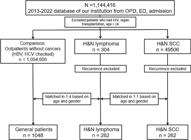
Three hundred and four patients were diagnosed with H&N lymphoma between 2013 and 2022. After removing patients with recurrent lymphoma, 262 cases remained. Additionally, 1048 outpatients who had blood tests for HBV and HCV were matched in a 1:4 ratio by age and gender. In contrast, there were 49,506 patients with H&N SCC. After excluding recurrence cases, 262 patients were matched in a 1:1 ratio for age and gender (Fig. 1, Table 1).
Among patients diagnosed with H&N lymphoma, 242 cases were classified as NHL and 20 cases as HL. Generally, NHL patients tended to be older, and male patients constituted a sizable proportion of HL cases. Of the total H&N lymphoma cases, 52 patients were diagnosed with HBV infection, 49 with NHL, and 3 with HL. Regarding HCV infection, all 17 patients with a history of HCV infection were classified as NHL. Among the cases of H&N lymphoma, 102 were identified as ENLs, with all of them being NHL. ENL cases were more commonly found in Waldeyer’s ring, specifically the palatine tonsils (34 cases), nasopharynx (18 cases), and tongue base (7 cases). Sixteen ENL cases were located in the sinonasal region and 14 in the parotid gland (Table 2).
Most cases of NHL were classified as B-cell lymphoma, with 131 cases (more than half) being diagnosed as DLBCL. Additionally, there were 29 cases of Follicular Lymphoma (FL), 13 cases of mucosa-associated lymphoid tissue lymphoma, and 15 cases of Small Lymphocytic Lymphoma/Chronic Lymphocytic Leukemia (SLL/CLL). T-cell lymphoma accounted for 37 cases or roughly 15.3% of NHL cases. NHL incidence rates were significantly higher, particularly in B-cell lymphoma and DLBCL. Forty-nine cases of NHL were associated with HBV infection, resulting in an adjusted Odds Ratio (aOR) of 2.07 (95% CI 1.42–3.00) compared to the general population (119 cases out of 1048). Of these, 43 cases were B-cell lymphoma and 31 cases were DLBCL, with aORs of 2.17 (95% CI 1.47–3.21) and 2.76 (95% CI 1.74–4.36), respectively. Among NHL patients, 22 ENL patients (21.6%) and 27 NL patients (19.3%) had HBV infections, and there was a significant difference between the H&N lymphoma group and the general population group (Table 3).
Univariate and multivariate analysis of the impact of HBV and HCV infection status on the risk of lymphoma in the general population group and the H&N lymphoma group.
Similar findings were found when comparing H&N lymphoma to HNSCC, with HBV and HCV infection rates of 6.1% and 6.6%, respectively. Notably, H&N lymphoma had significantly higher incidence rates of HBV infection, particularly in NHL with an aOR of 3.83 (95% CI 2.07–7.09), B-cell lymphoma with an aOR of 4.01 (95% CI 2.15–7.50), and DLBCL with an aOR of 5.09 (95% CI 2.59–10.00) (Table 4). We also compared the studies on the association between HBV, HCV, and lymphoma. (Table 5).
Univariate and multivariate analysis of the impact of HBV and HCV infection status on the risk of lymphoma in the HNSCC group and the H&N lymphoma group.
Discussion
The purpose of this study was to assess the relationship between HBV and HCV infections and H&N lymphoma in Taiwan. Our findings revealed that patients with NHL, B-cell lymphoma, and DLBCL had significantly higher HBV infection rates than patients in the OPD, the general population, and patients with HNSCC. However, the prevalence rate of HCV infection among patients with H&N lymphoma was comparable with that of the general population and patients with HNSCC. Furthermore, all ENLs found in this study were NHL and primarily located in Waldeyer’s ring.
There is mounting evidence of a link between HBV infection and NHL.7–12 In Taiwan, Lai et al. conducted a retrospective cohort study using data from Taiwan’s National Health Insurance Research Database. They discovered a higher incidence of NHL among patients with HBV or HCV infections. However, note that the database does not include information on patients’ habits, such as tobacco and alcohol use, or NHL histology. These factors have the potential to influence the relationship between viral infections and NHL development.11 Indeed, HBV is commonly known as a hepatotropic virus because it replicates primarily in hepatocytes in the liver. However, studies have shown that HBV nucleic acids can also be found in various extrahepatic tissues, including lymph nodes, spleen, gonads, thyroid gland, and others, especially during acute HBV infection.13 Given HBV’s potential etiological role in lymphoma development, understanding whether it can infect and replicate in hematopoietic and lymphoid cells is critical. Studies have indeed shown HBV infection of Peripheral Blood Mononuclear Cells (PBMCs) and integration of HBV DNA into PBMCs,14–17 even in the absence of concomitant liver infection.18 PBMCs have been demonstrated to harbor HBV DNA for extended periods.19 These findings suggest that HBV may be able to infect and persist within cells of the immune system, potentially contributing to the pathogenesis of HBV-related lymphoproliferative disorders.20 However, the exact mechanisms by which HBV infection causes NHL are not fully understood. One hypothesis is that HBV can directly infect lymphocytes and integrate into the host genome, resulting in oncogene overexpression or downregulation of tumor suppressor genes. Furthermore, HBV replication and viral antigens may cause the release of hematopoietic tumor growth factors, which promotes the proliferation of cloned lymphocytes.12
Although increasing evidence suggests a link between HCV infection and NHL,21–23 however, in this study, the incidence of HCV infection was similar among the three groups: patients with H&N lymphoma, H&N SCC, and outpatients. Though the incidence of HCV infection in outpatients may be overestimated, patients with H&N SCC still had an incidence as high as H&N lymphoma. The small number of cases of HCV infection in H&N lymphoma, H&N SCC, and outpatients may explain the insignificant difference observed between the three groups. The subsites of the H&N lymphoma were also recorded in this study. ENLs were detected in 102 cases, all of which were NHLs. ENLs were more commonly found in Waldeyer’s ring, which includes the palatine tonsils, nasopharynx, and tongue base. These results are consistent with previous research by Chi et al. and Kuo et al. conducted in Taiwan.24,25
There were also some limitations to this study. First, information about the patient’s dietary habits, stress levels, living environments, family disease history, laboratory parameters (e.g., HCV RNA and genotypes of HBV and HCV), and history of antiviral therapy or HBV vaccination was unavailable or incomplete in the database, but it may have an impact on lymphoma development.21,23,26,27 However, the study attempted to reduce confounding factors by controlling for personal habits (e.g., smoking and alcohol) and comorbidities (e.g., RA and SLE) that have been linked to lymphoma development. Second, the inclusion of cases from a single center may have resulted in a relatively small sample size, which could have reduced the statistical power to detect significant differences between the three groups. This could explain the lack of significant differences found in the incidence of HCV infection rates between patients with H&N lymphoma, HNSCC, and outpatients. Third, we chose patients from the OPD as the first control group and patients with HNSCC as the second control group. Our findings did not demonstrate a significant association between HCV infection and lymphoma when compared to either control group. A possible explanation is the potential overestimation of HBV and HCV prevalence within the outpatient population. Although we choose this outpatient group represents the general population, we have explicitly addressed the selection bias as a limitation in our study. Nonetheless, HBV infection remained significantly associated with lymphoma compared to both control groups.
Conclusions
Herein, our case-control study uses a clinical database to investigate the link between HBV/HCV infection and H&N lymphoma in Taiwan. HBV infection raises the risks of NHL, B-cell lymphoma, and DLBCL at H&N in a Taiwanese population. HCV infection did not play a significant role in the development of NHL or HL in this study.
-
Funding
The author(s) received no financial support for the research, authorship, and/or publication of this article.
Acknowledgment
The authors thank personnel at the Health Examination Center and Department of Medical Education and Research of Kaohsiung Veterans General Hospital for providing information in response to inquiries and assistance in data processing.
Data availability statement
The authors declare that all data are available in repository.
References
- 1 Bennett H, Waser N, Johnston K, Kao J-H, Lim Y-S, Duan Z-P, et al. A review of the burden of hepatitis C virus infection in China, Japan, South Korea and Taiwan. Hepatol Int. 2015;9:378-90.
- 2 Chen C-H, Yang P-M, Huang G-T, Lee H-S, Sung J-L, Sheu J-C. Estimation of seroprevalence of hepatitis B virus and hepatitis C virus in Taiwan from a large-scale survey of free hepatitis screening participants. J Formos Med Assoc. 2007;106:148-55.
- 3 Yu M-L, Yeh M-L, Tsai P-C, Huang C-I, Huang J-F, Huang C-F, et al. Huge gap between clinical efficacy and community effectiveness in the treatment of chronic hepatitis C: a nationwide survey in Taiwan. Medicine (Baltimore). 2015;94:e690.
- 4 Liu C-J, Chen P-J. Elimination of hepatitis B in highly endemic settings: lessons learned in Taiwan and challenges ahead. Viruses. 2020;12:815.
- 5 Armitage JO, Gascoyne RD, Lunning MA, Cavalli F. Non-hodgkin lymphoma. Lancet. 2017;390:298-310.
- 6 Zhang Y, Dai Y, Zheng T, Ma S. Risk factors of non-Hodgkin's lymphoma. Expert Opinion Medical Diagnostics. 2011;5:539-50.
- 7 Ulcickas Yood M, Quesenberry Jr CP, Guo D, Caldwell C, Wells K, Shan J, et al. Incidence of non‐Hodgkin's lymphoma among individuals with chronic hepatitis B virus infection. Hepatology. 2007;46:107-12.
- 8 Park SC, Jeong S-H, Kim J, Han CJ, Kim YC, Choi KS, et al. High prevalence of hepatitis B virus infection in patients with B‐cell non‐Hodgkin's lymphoma in Korea. J Med Virol. 2008;80:960-6.
- 9 Wang C, Xia B, Ning Q, Zhao H, Yang H, Zhao Z, et al. High prevalence of hepatitis B virus infection in patients with aggressive B cell non-Hodgkin’s lymphoma in China. Ann Hematol. 2018;97:453-7.
- 10 Kim M, Lee YK, Park B, Oh DJ, Choi HG. Hepatitis virus B and C infections are associated with an increased risk of non‐Hodgkin lymphoma: a nested case‐control study using a national sample cohort. J Med Virol. 2020;92:1214-20.
- 11 Lai Y-R, Chang Y-L, Lee C-H, Tsai T-H, Huang K-H, Lee C-Y. Risk of Non-Hodgkin Lymphoma among patients with hepatitis B virus and hepatitis C virus in Taiwan: a nationwide cohort study. Cancers. 2022;14:583.
- 12 Marcucci F, Spada E, Mele A, Caserta CA, Pulsoni A. The association of hepatitis B virus infection with B-cell non-Hodgkin lymphoma–a review. Am J Blood Res. 2012;2:18.
- 13 Yoffe B, Burns DK, Bhatt HS, Combes B. Extrahepatic hepatitis B virus DNA sequences in patients with acute hepatitis B infection. Hepatology. 1990;12:187-92.
- 14 Neurath A, Strick N, Sproul P, Ralph H, Valinsky J. Detection of receptors for hepatitis B virus on cells of extrahepatic origin. Virology. 1990;176:448-57.
- 15 Pontisso P, Poon M, Tiollais P, Brechot C. Detection of hepatitis B virus DNA in mononuclear blood cells. Br Med J (Clin Res Ed). 1984;288:1563-6.
- 16 Murakami Y, Minami M, Daimon Y, Okanoue T. Hepatitis B virus DNA in liver, serum, and peripheral blood mononuclear cells after the clearance of serum hepatitis B virus surface antigen. J Med Virol. 2004;72:203-14.
- 17 Umeda M, Marusawa H, Seno H, Katsurada A, Nabeshima M, Egawa H, et al. Hepatitis B virus infection in lymphatic tissues in inactive hepatitis B carriers. J Hepatol. 2005;42:806-12.
- 18 Feray C, Zignego A, Samuel D, Bismuth A, Reynes M, Tiollais P, et al. Persistent hepatitis B virus infection of mononuclear blood cells without concomitant liver infection: the liver transplantation model. Transplantation. 1990;49:1155-7.
- 19 Mason A, Yoffe B, Noonan C, Mearns M, Campbell C, Kelley A, et al. Hepatitis B virus DNA in peripheral‐blood mononuclear cells in chronic hepatitis B after HBsAg clearance. Hepatology. 1992;16:36-41.
- 20 Pontisso P, Vidalino L, Quarta S, Gatta A. Biological and clinical implications of HBV infection in peripheral blood mononuclear cells. Autoimmun Rev. 2008;8:13-7.
- 21 Tasleem S, Sood GK. Hepatitis C associated B-cell non-Hodgkin lymphoma: clinical features and the role of antiviral therapy. J Clin Transl Hepatol. 2015;3:134.
- 22 Khaled H, Abu-Taleb F, Haggag R. Hepatitis C virus and non-Hodgkin’s lymphomas: A minireview. J Adv Res. 2017;8:131-7.
- 23 Couronné L, Bachy E, Roulland S, Nadel B, Davi F, Armand M, et al. From hepatitis C virus infection to B-cell lymphoma. Ann Oncol. 2018;29:92-100.
- 24 Chi H-S, Lee K-W, Chiang F-Y, Tai C-F, Wang L-F, Yang S-F, et al. Head and neck extranodal lymphoma in a single institute: a 17-year retrospective analysis. Kaohsiung J Med Sci. 2012;28:435-41.
- 25 Kuo C-Y, Shih C-P, Cheng L-H, Liu S-C, Chiu F-H, Lin Y-Y, et al. Head and neck lymphomas: review of 151 cases. J Med Sci. 2020;40:215-23.
- 26 Huang C-E, Yang Y-H, Chen Y-Y, Chang J-J, Chen K-J, Lu C-H, et al. The impact of hepatitis B virus infection and vaccination on the development of non‐Hodgkin lymphoma. J Viral Hepat. 2017;24:885-94.
- 27 Lia L, Grima D, Amici F, Manzi L, Monaci A, La Torre G. The possible protective effect of hepatitis B vaccine against lymphomas: a systematic review. Curr Pharm Biotechnol. 2022;23:1864-72.
Edited by
-
Edited by
Dr C Chone