 Knowledge of health professionals regarding dental trauma
Abstract
Aim This study aims to assess the level of knowledge of healthcare professionals about first aid procedures in cases of dental trauma.
Methods A questionnaire was administered to students enrolled in the first aid course at the Catholic University of Brasília. This questionnaire covered a variety of topics, including the students’ profile, hypothetical scenarios that required first aid approaches and the degree of knowledge in preventive methods.
Results The survey findings highlighted a worrying trend. The results obtained from the students’ responses indicated that their knowledge about dental trauma is, in general, limited. Data revealed that most students had a level of knowledge below what was desirable, with a considerably low average number of correct answers on items related to the topic. This finding raises significant concerns, suggesting that students may not be fully prepared to effectively deal with emergencies related to dental injuries. The questionnaires were processed and analyzed using Microsoft Office Excel 2007 software. Data were presented as percentages, offering a simplified way to understand the distribution and trend of results.
Conclusion The results indicated that students demonstrated that they were aware of the importance of acquiring more knowledge and skills in this specific area. Furthermore, it is notable to highlight the importance of using mouthguards as a preventive measure in sporting environments. This conclusion highlights the need for proactive measures to prevent dental injuries, reinforcing the importance of raising awareness about preventive practices in risk situations.
Keywords
Tooth injuries; Health personnel; Dental care; First aid
Introduction
Dental trauma is a common occurrence that affects millions of people worldwide and constitutes one of the primary causes of oral injures. It is characterized by physical injury to the teeth, surrounding tissues, and oral structures, resulting from events such as accidents, falls, contact sports, and unforeseen situations1. The impact of dental trauma is substantial, affecting oral health, aesthetics, functionality, and often individuals’ emotional well-being2. Traumatic dental injuries can cover range of situations, from crown fractures to complete tooth loss (avulsion). First-aid procedures are critical for post-trauma tooth prognosis. In the case of dental avulsion, factors such as time elapsed with the tooth outside the socket, storage conditions, and transportation of the extracted tooth, as well as the location of the trauma, are pivotal in the assessment and treatment outcome3.
The correct approach to dental trauma situations requires training and knowledge from health professionals4. However, the extent of knowledge surrounding first aid related to dental trauma varies significantly among healthcare professionals, depending on their training, experience, and access to continuing education5. This work explores the significance of healthcare professionals’ knowledge in dental trauma, emphasizing the need for ongoing skill updates and the dissemination of accurate information. Additionally, it addresses the challenges associated with diagnosing and treating traumatic dental injures and presents strategies to enhance awareness and competence among healthcare professionals in this critical domain of dentistry. It is imperative to recognize that dental trauma is not solely a clinical concern but also a public health issue that necessitates the collaboration of various healthcare professionals to enhance the quality of life and well-being of affected individuals5.
Dental trauma constitutes an emergency that necessitates immediate attention6. Insufficient and, at times, nonexistent actions, often owing to the lack of knowledge among parents, guardians, educators, or even health professionals, can negatively impact the clinical prognosis1. The significance of this matter is so deep that numerous studies have lent supported to this observation. Therefore, the aim of this study is to evaluate the level of knowledge and practices among students enrolled in the first-aid course regarding the management of dental trauma. Collaboration between different health professionals is an important differential in promoting and updating first-aid procedures in dental trauma.
Well-trained health professionals to provide first aid are decisive for preserving teeth and adjacent structures in the case of dental trauma. The clinical relevance of first-aid knowledge in cases of dental trauma lies in the ability to preserve the patient’s oral health and minimize long-term damage. This paper seeks to assess the level of knowledge of healthcare professionals regarding first aid procedures and preventative measures, resulting in benefits for both professionals and patients.
Materials and Methods
A comprehensive quantitative cross-sectional study was carried out to assess the students’ level of knowledge regarding first-aid procedures in cases of dental trauma. This study aimed to analyze quantitative data to quantify and identify patterns and trends within the phenomenon studied. This may involve structured questionnaires. The sample was composed of experimental participants, students enrolled in the 5th semester in physical education, physiotherapy, nursing and nutrition courses in the first semester of 2012 in the first aid discipline at the Catholic University of Brasília (UCB). The research focused only on the first semester of 2012 because it was an optional subject that was not renewed for the second semester. A pilot study was carried out with five students from different background to assess their understanding of the terminology used in the questionnaire. A questionnaire applied as an assessment instrument aimed to measure not only the participants’ theoretical knowledge, but also their practical understanding and their ability to apply this knowledge in hypothetical scenarios. The questionnaire included a variety of items that covered different aspects of premature trauma, such as causes, types of injuries, appropriate first aid procedures, preventive methods, and long-term consequences. Additionally, questions were included about identifying signs and symptoms of dental injuries, emergency treatment approaches, and follow-up recommendations. The objective was to deliver comprehensive material that allowed a complete assessment of participants’ knowledge about overt trauma, thus enabling a detailed analysis of the study results and information. Each student received printed material so that each question could be answered individually.
The questionnaire was administered by only 1 research and subsequently, 2 researches provided instructions in the form of training on first aid in cases of dental trauma were provided to these students. Training students in knowledge of dental trauma aimed to enable them to recognize and respond appropriately to dental emergency situations, thereby promoting the provision of effective care and minimization of harm to patients.
The questionnaire was in Portuguese to ensure the understanding of all local students. Questionnaires answered by students enrolled in the course who voluntarily agreed to participate in the research after signing the informed consent form (TCLE) were considered. Students who did not agree to participate or did not sign the informed consent form were excluded from the study. This study received approval from the UCB Human Research Ethics Committee (Nº 263/2011) and was conducted in accordance with applicable legislation. The questionnaire was divided into four distinct parts and all responses were kept anonymous. The first part of the questionnaire had 7 questions about the students’ profile, such as gender, age, course, semester and experience or previous knowledge about first aid. The second part consisted of 4 questions about the evaluation of two fictitious clinical cases (fracture and tooth avulsion). The third part had 10 questions about conduct in the case of an avulsed tooth. The fourth part consisted of 2 questions to assess knowledge about mouthguards and when they should be used.
The instructions were carried out after applying the questionnaire with emergency simulation exercises in which students were exposed to dental trauma scenarios and there were group discussions with analyzes of real cases of dental trauma, where students were able to apply the knowledge obtained in solving practical problems and in clinical decision making.
Results
Part I – Population profile
A total of 153 individuals participated in the research by answering the questionnaires. Among the participants, 81 students (53%) were male, while 72 students (47%) were female. Most of the students belonged to the group of 20 to 39 years of age, representing 58% of the interviewees, while the group aged below 20 years constituted only 30% of the analyzed sample. Among the participants, 126 students (82%) were enrolled in the undergraduate course in physical education; 18 students (12%) were enrolled in the undergraduate course in nursing; 7 students (5%) were enrolled in the undergraduate course in physiotherapy, and 2 students (1%) were enrolled in the undergraduate course in nutrition. Out of these matriculated students, 128 students (84%) had completed less than half of the undergraduate degree and 25 students (16%) had completed more than half of the undergraduate degree. Regarding the first-aid knowledge, 142 undergraduates (93%) received this content during their undergraduate course and 11 students (7%) did not receive this content during their undergraduate course. Additionally, 43 respondents (27%) also participated in extracurricular first-aid courses and 110 students (73%) did not. However, only one student (1%) reported receiving specific content on dental trauma.
Part II - Analysis of imaginary clinical cases
In the first case, a clinical situation was presented in which a front tooth of an 8-year-old child was broken, raising doubts about the dentition involved (permanent or deciduous). A total of 61 students (40%) considered the tooth as permanent, while 63 students (41%) considered it as part of the deciduous dentition. Furthermore, 29 respondents (19%) were unsure, indicating a good level of knowledge about dentition. The second question also reported the same clinical situation as the first case but asked about the appropriate conduct in this scenario. The correct answer was to look for the fractured fragments, locate the parents and instruct them to take the child to the dentist immediately. Only 21 respondents (14%) marked the correct alternative, while 89 (58%) chose the option of taking the child immediately to the school infirmary, and 31 (20%) chose to locate the parents and guide them to go immediately to the dentist.
In the second clinical case, the analyzed situation involved a tooth that had been avulsed. The correct alternative included actions such as looking for the tooth, locating the parents and instructing them to take the child to the dentist immediately. Only 21 respondents (14%) pointed this out as the correct answer, while 76 (50%) considered as correct the alternative of taking the injured child to bite a handkerchief and control the bleeding. In addition, 146 students interviewed (95%) believed that they need better training in first aid in cases of dental trauma.
Part III - Imaginary cases of tooth avulsion
Among the interviewed students, 142 (93%) reported not having witnessed a case of dental avulsion, while 11 (7%) students mentioned having witnessed such an incident. In relation to seeking urgent care, 116 students (76%) stated they would seek dental treatment, 11 (8%) would go to the hospital and 12 (7%) would visit a general medical. When asked about the timeframe for seeking emergency care, 122 students (80%) chose to seek attention immediately, demonstrating correct knowledge. However, when questioned about their ability to reimplant an avulsed tooth, most of these students (104 occurrences, totaling 68% of the population) did not feel competent to perform this procedure, although most of them (129 occurrences, totaling 84% of the population) indicated that deciduous teeth should not be reimplanted.
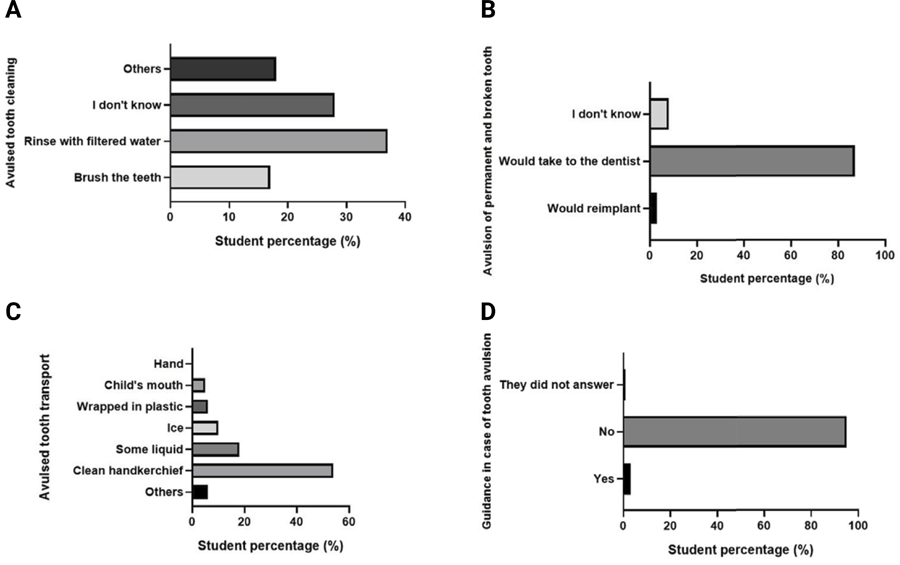
In cases where the avulsed tooth had impurities on its surface, the two most selected options were to rinse the tooth with filtered water (57 occurrences - 37% of the population) and “I don’t know” (43 occurrences - 28% of the population). In clinical situations where the avulsed tooth also had a fracture, only 5 (3%) students chose to reimplant the tooth and seek a dentist’s assistance. Regarding the non-replantation of an avulsed tooth, 82 students (54%) believed that transportation should be done using a clean handkerchief, which is an incorrect alternative as it can cause loss of periodontal structures and dry out the tooth (Figure 1). When asked about the means of transportation and cleaning of the avulsed tooth, the most prevalent cleaning was filtered water (72%), which was also the most prevalent transportation medium (36%). As the second most prevalent cleaning method, an antiseptic solution was mentioned (39%), and for transportation, cold water (24%) was highlighted (Table 1).
Questions involving cleaning behavior of the avulsed tooth. A Conduct in case of fractured tooth avulsion. B Means of transportation the avulsed tooth. C Guidance in case of tooth avulsion.
Part IV- Knowledge about mouthguards and recommendations for usage
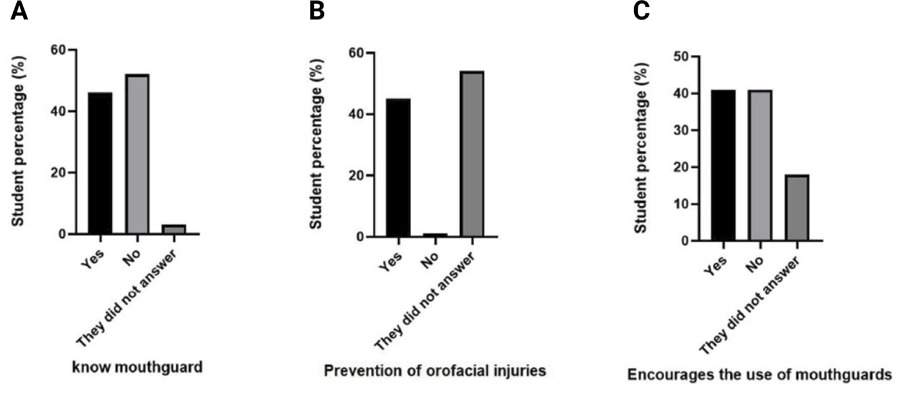
According to the interviewees, 79 (52%) reported not having knowledge about mouthguards. Among the 46% of the interviewed population who had some knowledge about mouthguards (Figure 2A), 69 (45%) believed that the use of these devices can prevent injures in the orofacial region (Figure 2B). However, only 63 students (41%) encouraged the use of mouthguards for sports activities (Figure 2C).
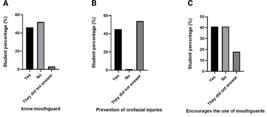
Respondent’s level of knowledge regarding mouthguards. A. Know mouthguard. B Prevention of orofacial injuries. C Encourages the use of mouthguards.
Discussion
Dental trauma is a common injury that can occur due to various circumstances. Proper diagnosis and treatment are essential to preserve the health and function of teeth, especially in cases involving a permanent tooth during its formation7. Knowledge of how to handle dental trauma situations is of utmost importance for healthcare professionals and the public. The lack of immediate effective care, often due to a lack of knowledge among parents or caregivers, teachers, or even healthcare professionals, can compromise the prognosis of the clinical case7. Therefore, the present work aimed to analyze the knowledge of undergraduate health students in relation to first-aid cases of dental trauma and hypothetical situations of dental trauma through a questionnaire adapted from Chan et al.8 (2001).
The first hypothetical situation involved a fracture in the upper anterior tooth of an 8-year-old girl. Almost half of the respondents (41%) believed that the affected tooth belonged to the deciduous dentition, indicating a need for more knowledge about the eruption chronology of permanent teeth among students. A similar survey conducted with physical education teachers in Hong Kong also showed that 46.8% of the interviewees demonstrated a lack of knowledge in this area. Regarding the correct course of action in the case of the fractured tooth, 58% of the students chose to take the child to the school infirmary, which is an acceptable choice. However, only 14% of the students selected the most appropriate alternative, which includes searching for fragments, locating parents, and immediately taking the child to the dentist. Recovering broken tooth fragments and seeking immediate dental care are vital to preserving oral health, minimizing discomfort and pain, and maintaining the aesthetics and function of the teeth. Furthermore, locating parents or guardians when dealing with dental fractures in children is crucial to ensuring safety, informed consent, and the well-being of the child during dental treatment7. In contrast, a study by Chan et al.8 (2001) found that 71.1% of physical education teachers provided an appropriate response to the management of dental fracture cases.
Dental avulsion represents the most severe case of dental injures, with an incidence rate ranging from 0.5% to 16%. The prognosis for this type of accident is directly influenced by the first-aid action taken immediately after avulsion3. The second hypothetical situation involves a clinical scenario of tooth avulsion. Among the respondents, 51% chose the option of having the injured boy bite on a tissue to control bleeding, while only 21% chose the correct alternative, which includes carefully placing the tooth back in the mouth and referring the child to a dentist. This procedure increases the chances of periodontal ligament regeneration and minimizes root resorption3. Similar results were observed in a study with physical education teachers conducted by Chan et al.8 (2001). In a study conducted in New Zealand, Stokes et al.9 (1992) investigated the level of knowledge among the general population and healthcare professionals regarding tooth avulsion. The results showed that sports coaches had a higher level of knowledge on the subject, while nurses and receptionists had the lowest level of knowledge.
Al-Asfour et al.10 (2008), in Kuwait, assessed the knowledge of high school teachers regarding first aid for an avulsed tooth using a questionnaire. In a second phase, educational lectures were given, and then the teachers were re-tested using the same method. The results demonstrated low performance in the first phase of the study, and the lecture was effective in improving the results11. The ideal treatment for avulsed teeth is immediate replantation, as this environment tends to better preserve the cells of the periodontal ligament11. As a reflection of their own responses, 95% of the students concluded this case by indicating that they need more training in dental trauma management procedures.
Part III of the questionnaire used addressed the students’ knowledge of tooth avulsion, a clinical situation never encountered by 93% of the students who responded. Faced with this occurrence, it is initially necessary to calm parents and the patient, and to perform a quick physical examination during a brief local anamnesis to establish a rapid emergency diagnosis12,13. To aid in the diagnosis process, information such as the trauma history, including how, when, and where it happened, is of utmost importance14. This information allows the dentist to assess important aspects such as the possible degree of contamination by microorganisms and the need for tetanus prophylaxis15. Depending on where the avulsed tooth falls, it can become contaminated with environmental bacteria. Then, adequate prophylaxis helps to prevent Clostridium tetani infection and its complications16. In this study, 80% of the respondents would seek immediate care in a dental trauma emergency.
First aid in cases of dental avulsion should involve the immediate reimplantation or immediate storage of the avulsed tooth in milk, which promotes better preservation of the periodontal ligament fibers. This option is the one most recommended for storing an avulsed tooth because it presents a chemical composition that is compatible with dental tissues17. It keeps the tooth in an environment that helps preserve the viability of the tooth’s tissues. Saline solution and saliva can also be used as transport media3,11. Furthermore, milk and saline solution are useful for maintaining the dental pulp in a viable state16,17. Regarding the transportation of the avulsed tooth, a significant number of students (54%) opted to use a clean tissue, which represents a procedural error as it can lead to drying the surface of the tooth surface and loss of periodontal ligament cells11.
Slightly more complex situations were also addressed in the questionnaire. In the first scenario, there was a question about an avulsed tooth that was also fractured. Eighty-seven percent of the respondents would take the tooth to the dentist; however, most of them did not indicate immediate replantation before referral to the dentist. In cases of dual injury to a tooth, the prognosis tends to be unfavorable11. Nevertheless, it is often only by means of thorough physical, and radiographic examinations that a correct diagnosis is reached, with the treatment and prognosis being determined by the dentist and not at the accident site18. Another special situation concerns the management of traumatic injuries to deciduous dentition. Due to the close relationship between the root apex of a deciduous tooth and the permanent tooth germ, some changes in the eruption process and tooth formation must be considered. Despite the low level of knowledge about dental chronology among the interviewed students, 129 (84%) would not replant a deciduous tooth12.
According to the National Youth Sport Safety Foundation, an American foundation for the prevention of sports-related injuries, each contact sport athlete has about a 10% chance of experiencing orofacial injuries during a sports session, or 33% to 56% over their lifetime. In this survey, only 46% of the interviewed students reported knowledge about mouthguards, and of these, only 45% believe that their use can prevent orofacial injuries. Thus, an equal percentage of students were observed to either encourage or discourage their use. These results agree with prior literature, with 60% of athletes not using mouthguards compared to only 40% who use them during competitions. Athletes who report difficulty in using mouthguards cite reasons such as difficulty in breathing, gagging, speech impediments, discomfort, and pain19.
It is important to recognize the need for regular updates and ongoing training in first aid for dental trauma among healthcare professionals. This is due to the evolution of practices and technologies. Therefore, healthcare professionals must keep up with the latest practices and approaches in managing dental trauma. Furthermore, it is important to remember that knowledge of first aid for dental trauma can be critical in emergencies, where a quick and appropriate response can be directly related to tooth preservation and the patient’s overall health. Therefore, after detecting gaps in knowledge about first aid in the care of dental trauma, this study provided a training program and face-to-face updates for responders, to guarantee correct knowledge for health professionals about dental trauma.
Acknowledgements
We would like to thank the support of the Conselho Nacional de Desenvolvimento Científico e Tecnológico (CNPq) (305242/2022), Coordenação de Aperfeiçoamento de Pessoal de Nível Superior (CAPES) (88887.724415/2022-00), Fundação de Apoio à Pesquisa do Distrito Federal (FAPDF) (00193-00000782/2021-63 and 00193-00001118/2021-31).
References
-
1 Levin L, Day PF, Hicks L, O'Connell A, Fouad AF, Bourguignon C, et al. International Association of Dental Traumatology guidelines for the management of traumatic dental injuries: General introduction. Dent Traumatol. 2020 Aug;36(4):309-13. doi: 10.1111/edt.12574.
» https://doi.org/10.1111/edt.12574 -
2 Cortes MI, Marcenes W, Sheiham A. Prevalence and correlates of traumatic injuries to the permanent teeth of schoolchildren aged 9-14 years in Belo Horizonte, Brazil. Dent Traumatol. 2001 Feb;17(1):22-6. doi: 10.1034/j.1600-9657.2001.170105.x.
» https://doi.org/10.1034/j.1600-9657.2001.170105.x -
3 Fouad AF, Abbott PV, Tsilingaridis G, Cohenca N, Lauridsen E, Bourguignon C, et al. International Association of Dental Traumatology guidelines for the management of traumatic dental injuries: 2. Avulsion of permanent teeth. Dent Traumatol. 2020 Aug;36(4):331-42. doi: 10.1111/edt.12573.
» https://doi.org/10.1111/edt.12573 -
4 Chauhan R, Rasaratnam L, Alani A, Djemal S. Adult dental trauma: what should the dental practitioner know? Prim Dent J. 2016 Aug;5(3):70-81. doi: 10.1177/205016841600500308.
» https://doi.org/10.1177/205016841600500308 -
5 Assadi T, Moosazadeh M, Akbari P, Omidi S. Knowledge of emergency physicians about the management of traumatic dental injuries: a cross-sectional study in Northern Iran. Ethiop J Health Sci. 2022 Mar;32(2):351-358. doi: 10.4314/ejhs.v32i2.16.
» https://doi.org/10.4314/ejhs.v32i2.16 - 6 Andreasen JO, Andreasen FM, Andersson L, editors. Textbook and color atlas of traumatic injuries to the teeth. John Wiley & Sons; 2018.
-
7 Bourguignon C, Cohenca N, Lauridsen E, Flores MT, O'Connell AC, Day PF, et al. International Association of Dental Traumatology guidelines for the management of traumatic dental injuries: 1. Fractures and luxations. Dent Traumatol. 2020 Aug;36(4):314-30. doi: 10.1111/edt.12578.
» https://doi.org/10.1111/edt.12578 -
8 Chan AW, Wong TK, Cheung GS. Lay knowledge of physical education teachers about the emergency management of dental trauma in Hong Kong. Dent Traumatol. 2001 Apr;17(2):77-85. doi: 10.1034/j.1600-9657.2001.017002077.x.
» https://doi.org/10.1034/j.1600-9657.2001.017002077.x -
9 Stokes AN, Anderson HK, Cowan TM. Lay and professional knowledge of methods for emergency management of avulsed teeth. Endod Dent Traumatol. 1992 Aug;8(4):160-2. doi: 10.1111/j.1600-9657.1992.tb00236.x.
» https://doi.org/10.1111/j.1600-9657.1992.tb00236.x -
10 Al-Asfour A, Andersson L, Al-Jame Q. School teachers' knowledge of tooth avulsion and dental first aid before and after receiving information about avulsed teeth and replantation. Dent Traumatol. 2008 Feb;24(1):43-9. doi: 10.1111/j.1600-9657.2006.00476.x.
» https://doi.org/10.1111/j.1600-9657.2006.00476.x -
11 Levin L, Day PF, Hicks L, O'Connell A, Fouad AF, Bourguignon C, et al. International Association of Dental Traumatology guidelines for the management of traumatic dental injuries: general introduction. Dent Traumatol. 2020 Aug;36(4):309-13. doi: 10.1111/edt.12574.
» https://doi.org/10.1111/edt.12574 -
12 Day PF, Flores MT, O'Connell AC, Abbott PV, Tsilingaridis G, Fouad AF, et al. International Association of Dental Traumatology guidelines for the management of traumatic dental injuries in the primary dentition. Dent Traumatol. 2020 Aug;36(4):343-59. doi: 10.1111/edt.12576.
» https://doi.org/10.1111/edt.12576 -
13 Malmgren B, Andreasen JO, Flores MT, Robertson A, DiAngelis AJ, Andersson L, et al. International Association of Dental Traumatology guidelines for the management of traumatic dental injuries: 3. Injuries in the primary dentition. Dent Traumatol. 2012 Jun;28(3):174-82. doi: 10.1111/j.1600-9657.2012.01146.x.
» https://doi.org/10.1111/j.1600-9657.2012.01146.x -
14 Moule A, Cohenca N. Emergency assessment and treatment planning for traumatic dental injuries. Aust Dent J. 2016 Mar;61 Suppl 1:21-38. doi: 10.1111/adj.12396.
» https://doi.org/10.1111/adj.12396 -
15 Cho J, Sachs A, Cunningham Jr LL. Dental trauma and alveolar fractures. Facial Plast Surg Clin North Am. 2022 Feb;30(1):117-24. doi: 10.1016/j.fsc.2021.08.010.
» https://doi.org/10.1016/j.fsc.2021.08.010 -
16 Baviskar PS, Ahuja SA, Natarajan S, Bagchi PR. Tetanus of suspected dental causality. J Stomatol Oral Maxillofac Surg. 2021 Feb;122(1):115-8. doi: 10.1016/j.jormas.2020.05.004. Epub 2020 May 13.
» https://doi.org/10.1016/j.jormas.2020.05.004 -
17 Adnan S, Lone MM, Khan FR, Hussain SM, Nagi SE. Which is the most recommended medium for the storage and transport of avulsed teeth? A systematic review. Dent Traumatol. 2018 Apr;34(2):59-70. doi: 10.1111/edt.12382.
» https://doi.org/10.1111/edt.12382 -
18 Jadav NM, Abbott PV. Dentists' knowledge of dental trauma based on the International Association of Dental Traumatology guidelines: An Australian survey. Dent Traumatol. 2022 Oct;38(5):374-80. doi: 10.1111/edt.12761.
» https://doi.org/10.1111/edt.12761 -
19 Stanbouly D, Stanbouly R, Lee KC, Chuang SK. Prevalence of dentofacial injuries and concussions among college athletes and their perceptions of mouthguards. J Craniofac Surg. 2021 Jun;32(4):1600-3. doi: 10.1097/SCS.0000000000007615.
» https://doi.org/10.1097/SCS.0000000000007615
-
Data Availability:
Datasets related to this article will be available to the corresponding author upon request.
Edited by
-
Editor:
Dr. Altair A. Del Bel Cury
Datasets related to this article will be available to the corresponding author upon request.