 Relation of the WNT5A gene and non-syndromic orofacial clefts
Abstract
Orofacial clefts are anomalies arising from defects during the fusion of the craniofacial processes. Non-syndromic orofacial cleft (NSOC) is the most frequent malformation in the craniofacial region. Understanding their etiology is a challenge requiring a multidisciplinary approach and deep understanding of environmental and genetic factors. Polymorphic variants in genes linked to craniofacial development emerge as key pieces in this puzzle.
Aim This research aimed to deepen the understanding of the genetic mechanisms of the WNT5A gene in the development of NSOC.
Methods To this end, a broad, comprehensive and updated synthesis of existing literature was carried out, through a narrative literature review.
Results The WNT5A gene plays a crucial role in regulating cellular functions, significantly contributing to the formation and development of labial and palatal structures. It interacts with multiple gene signaling pathways also strongly linked to craniofacial development. Specifically, the SNP rs566926 has been associated with the occurrence of NSOC in various populations.
Conclusions This study reinforces the importance of the WNT5A gene and its polymorphic variant in craniofacial development. Understanding these genetic mechanisms may pave the way for new diagnostic strategies, treatment, and improvement in the quality of life of affected individuals and their families.
Keywords
Cleft lip; Cleft palate; Polymorphism, genetic; Wnt-5a protein
Introduction
Orofacial cleft (OC) is the major congenital craniofacial malformation globally1. This condition it is the result of failure in the fusion of the maxillary, medial nasal and palatal processes between the nasal and oral cavities during embryogenesis1,2. This malformation can present itself independently, without any other cognitive or craniofacial structural abnormalities, or it can be part of a broad spectrum of chromosomal, Mendelian, or teratogenic syndromes3. Approximately 70% of individuals with cleft lip with or without palate involvement (CL±P), and 50% of cases of isolated cleft palate (CP) manifest in the non-syndromic form of non-syndromic oral cleft (NSOC)4.
The origin of NSOC is complex, given the multifactorial interaction between genetic elements and environmental exposures3-5. As a result, the condition has a variable global prevalence, between 2:1,000 and 0.4:1,000 live births3,6. This variability is directly influenced by geographic origin, racial and ethnic groups, environmental conditions and socioeconomic status4. It is crucial to understand the combination of genetic and environmental causes in order to develop effective strategies for preventing NSOC2,3.
The most important environmental factors are an advanced age of both parents, consanguinity, as well as maternal active and passive smoking, use of medication, and alcohol consumption2,3,7. The genetic contribution to the development of NSOC is attributed to variations in candidate genes that act during craniofacial development. However, the exact mechanism by which this relationship influences the development of the malformation is not yet well established1.
To understand the genetic etiology related to the development of congenital malformations, it is crucial to consider the familial aggregation of the characteristic in question. This involves acknowledging the presence of one or more genes within families8. When it comes to understanding the origin of NSOC, different strategies are employed9. These include linkage studies, whole-genome association analyses, gene expression surveys, targeted genetic sequencing, investigations of genetic interactions between polymorphisms in candidate genes for the development of OC, and direct DNA sequencing8,9. Utilizing these strategies, several genes and genetic loci have been identified7,8. These participate in signaling pathways associated with the development of the lip and palate and, therefore, may be implicated in the etiology of NSOC8.
Among these genes, WNT5A stands out for its role in cell migration and polarity, in addition to regulating developmental pathways during embryogenesis, such as the migration of mesenchymal cells in palatogenesis5,10. Mutations in this gene have been associated with the occurrence of NSOC5,6,11. Among the several single nucleotide polymorphisms (SNP) located in WNT5A, the rs566926 SNP is notable for its association with the occurrence of NSOC in populations of Europeans, Americans of European descent, and Brazilians5,6,11,12. Considering that polymorphic variants in genes associated with craniofacial development may have a significant role in the etiology of NSOC, the present study aims to consolidate current knowledge about the role of the WNT5A gene in the development of NSOC, providing a comprehensive and updated view of the existing literature.
Materials and Methods
A literature search in the PubMed, Web of Science and Google Scholar databases for articles published in English from 1980 to 2024 was performed.
The research strategy included the MeSH terms “Wnt-5a Protein”, “cleft lip” and “cleft palate”. Additional terms commonly used in studies, “wnt5a cleft”, “wnt5a palate” and “wnt5a signaling” were also used in the searches.
Duplicate articles, those investigating syndromic OC, those offering perspectives and opinions, commentary pieces, and book reviews were excluded from the selection.
Results
NSOC are among the congenital craniofacial malformations that occur most frequently in humans3. They result from failed fusion of facial processes during embryogenesis1. The incidence of NSOC is highly variable, with the highest rates found among Asian and Native American populations (2:1000), followed by individuals of European (1:1000) and African descent (0.4:1000)3,6.
NSOCs are etiologically heterogeneous, which means they have multiple and complex causes that depend on the interaction between inherited genetic patterns and environmental factors8. In terms of genetic involvement, it is currently impossible to determine exactly how many genes are related to the etiology of NSOC7. However, it is estimated that many genes and gene loci participate in signaling pathways associated with the correct embryonic development of the lip and palate and, therefore, could be related to the etiology of malformations5,13.
Certain gene families are responsible for controlling early embryonic development, as well as the formation and diversification of the facial skeleton in vertebrates14. The Wingless (WNT) family is included in this group. WNT family genes were discovered in 1980, and since then, have proven to be significant in signaling for the normal development of polarity in vertebrate limbs15. In 1992, Nusse and Varmus published the most classic study on these genes, indicating evidence that they are evolutionarily conserved. This theory is widely accepted today, as they can be identified in all metazoan organisms, and the 19 genes identified in the human genome are conserved in the genomes of mammals15,16.WNT genes are structurally related but have distinct functions17. The proteins translated by the WNT are secreted glycoproteins, rich in cysteines, modified by lipids that act as ligands for various membrane-bound receptors18.
The WNT play roles in cellular communication at different stages19, regulate cell growth, motility and differentiation during the embryonic phase17,19and tissue homeostasis in the post-embryonic phase18,19. These genes are active in almost all tissues during craniofacial development, allowing proliferation and cell polarity to occur simultaneously and in the same cells5,15,18. Therefore, alterations in these genes may contribute to a variety of developmental defects, such the OCs5,6,11-13,20.
The WNT5A gene, was isolated for the first time in 1990, in mouse fetal tissue, and in human cells the first isolation occurred in 1993. This gene is member 5 of the WNT family, located in chromosome 3p14.3 in the human genome. Like other WNTs, WNT5A is highly conserved among species. The human WNT5A gene has 98.7% of similar amino acids to the rodent Wnt5a gene21. This gene encodes the WNT5A-specific protein that regulates a variety of cellular functions such as proliferation, differentiation, migration, adhesion and polarity22. It is fundamental in the migration of mesenchymal cells during palatogenesis10, in addition to regulating postnatal tissue and bone homeostasis23. Mutations in mouse Wnt5a are linked to limb morphogenesis defects with shortened and/or malformed skeletal elements24, as well as reduced skull bone formation25. The deletion of this gene is associated with defective growth of the tail and snout, cleft palate, jaw malformation, tongue malformation, other skeletal defects, and perinatal lethality10,24,26. In humans, mutations in the WNT5A gene have been associated with poor heart development22, the occurrence of NSOC5,6,11, and autosomal dominant Robinow syndrome, which frequently includes cleft palate26. These mutations have also been linked to a variety of malignant tumors10.
The WNT5A protein is a key regulator of ß-catenin-independent WNT signaling, also known as non-canonical pathway. However, it can also influence the ß-catenin-dependent pathway, also known as canonical or classical, in two ways25. The number of expressed receptors, coreceptors and endogenous inhibitors present are responsible for this variation16,17.
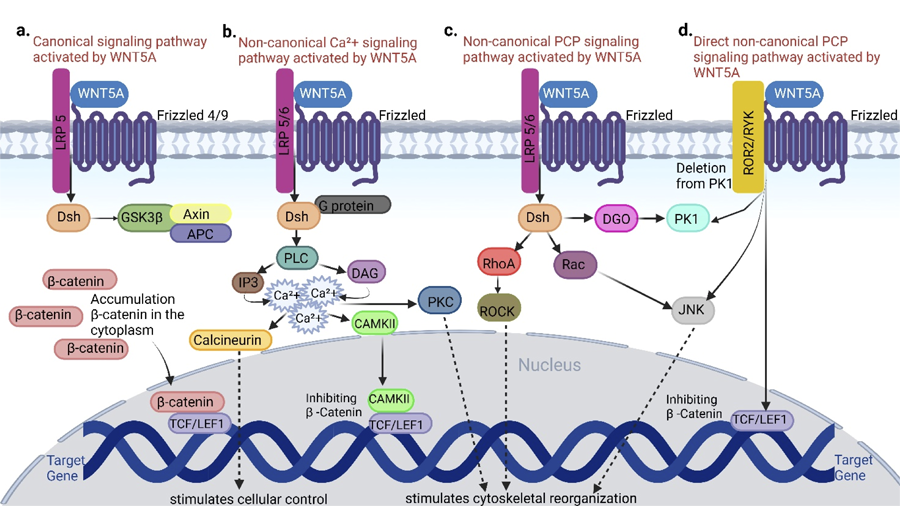
The main function of the canonical pathway is to encode proteins responsible for regulating vascular, fibroblast and antigen endothelial proliferation; matrix metalloproteinases and some components of the extracellular matrix; cadherins; lineage-specific proteins, particularly those linked to the skin and eyes27; the proliferation, differentiation and maintenance of stem cells28; and the formation, differentiation and maintenance of bone mineral density29. The initiation of signaling occurs after the extracellular WNT protein docks with its receptor Frizzled (FzD) 4 or 930 juxtaposed with a lipoprotein receptor-related protein (LRP) 5 receptor molecule on the cell surface31,32. It forms a heterotrimeric complex responsible for intracellular signaling, it binds to Dishevelled (Dsh) and in the cytoplasmic tail to Axin, glycogen synthase kinase-3β (GSK-3β) and Adenomatous Polyposis Coli (APC)18,19,31. The migration of the Axin/GSK-3β/APC complex from the cytoplasm to the plasma membrane inactivates the activity of degrading β- catenin33. Consequently, β-catenin accumulated in the cytoplasm migrates to the nucleus. Once in the nucleus, β-catenin can interact with several proteins and activate the main transcription factors of the canonical, T-cell-specific pathway. transcription factor/lymphoid enhancer-binding factor 1 (TCF/LEF1), to promote the expression of effector genes18,19,33. Mutations in TCF/LEF1 have been correlated with changes in facial formation34.
The non-canonical Ca2+ pathway is involved in changes in the arrangement of the cytoskeleton, regulation of cell motility, migration and cell connections. It also inhibits the transcriptional activity of canonical WNT signaling35. This pathway is activated when the extracellular WNT5A protein binds to its receptor FzD 2, 3, 4, 5, 6, or 716,30, juxtaposed with LRP 5 or 6, which is binded to heterotrimeric Dsh and G protein. These proteins then stimulate the Phospholipase C enzyme (PLC). Consequently, the messengers Inositol Triphosphate (IP3) and Diacylglycerol (DAG) induce the release of calcium from intracellular stores16,32. This release activates calcium-sensitive enzymes, such as Protein Kinase C (PKC), Calmodulin-dependent Protein Kinase II (CaMKII), and Calcineurin16,35. PKC stimulates the reorganization of the cytoskeleton through effector genes, thus it can alter the cell migration process in gastrulation. CaMKII binds to TCF/LEF1 that would bind to β-catenin, thus inhibiting the action of the canonical pathway32,35,36. Calcineurin, stimulates cellular control through effector genes. Thus, the WNT5A Ca2+ pathway can promote or inhibit chondrogenesis16.
The non-canonical planar cell polarity (PCP) pathway is involved in regulating the modification of actin cytoskeleton structures and cell motility37. Although the PCP pathway may share the use of the FzD and Dsh receptors with other signaling pathways, this pathway offers numerous organizational possibilities, varying according to the tissue in which the cell is located, and may oppose each other’s functions of other pathways or influence neighboring cells to regulate cellular polarity32,38. WNT5A can activate the PCP pathway by binding to FzD, LRP5/6 and Dsh, which binds to kinases: RhoA or Rac. Both induce the activation of other kinase molecules: Rho kinase (ROCK) and Jun N-terminal kinase (JNK), respectively. Thus, they stimulate effector genes to reorganize the cytoskeleton, which can promote or inhibit chondral tissue formation16. Another form of organization is WNT5A being directly bound by molecules such as related orphan receptor 2 (ROR2) and receptor tyrosine kinase-like (RYK), with or without the presence of FzD. ROR2 can activate the JNK molecule to stimulate target genes to reorganize the cytoskeleton or stimulate β-catenin degradation through binding with TCF/LEF137-39. ROR2, is expressed in the mesenchyme of the secondary palate10. WNT5A mediated by ROR2 regulates cell proliferation and directional cell movement40, so lower WNT5A cell proliferation in dental mesenchyme and/or epithelium is associated with delayed tooth growth41. The gene mutation mediated by the ROR2 receptor is associated with smaller and incorrectly patterned teeth, while the absence of WNT5A can cause defective tooth development40,41. ROR2 knockout mice showed craniofacial defects, including cleft palate26. Mutations in RYK are also associated with cleft palate in mice42and non-syndromic cleft lip and palate (NSCLP) in Vietnamese and Japanese individuals43. Furthermore, deletion of PK1, through WNT5A binding to ROR2/RYK, causes CP and limb defects in mice44.
Simplified scheme of the WNT5A signaling pathways. a. Canonical signaling pathway activated by WNT5A: WNT5A binds to FzD4 or 9 and LRP5. These, in turn, bind to Dsh on the plasma membrane. Dsh attracts: Axin, GSK-3β and APC, thus inhibiting the activity of the β-degrading complex-catenin. The β-catenin accumulated in the cytoplasm migrates to the nucleus where it interacts with TCF/LEF1 to promote the expression of effector genes. b. Non-canonical Ca2+ signaling pathway activated by WNT5A: WNT5A binds to FzD 2, 3, 4, 5, 6 or 7 and LRP5/6, which bind to Dsh and G protein. They stimulate PLC, which activates IP3 and DAG, inducing the release of calcium from intracellular stores. Thus, calcium-sensitive enzymes act: calcineurin stimulates cellular control through effector genes, CaMKII binds to TCF/LEF1, inhibiting β- catenin and PKC stimulates cytoskeletal reorganization through effector genes. c. Non-canonical PCP signaling pathway activated by WNT5A: One of the ways this pathway signals is with WNT5A binding to FzD and LRP5/6, which bind to Dsh. The other bindings stimulate effector genes to reorganize the cytoskeleton. d. Direct non-canonical PCP signaling pathway activated by WNT5A: Another way of signaling this pathway is with WNT5A binding to ROR2 or RYK, with or without the presence of FzD. This activates the JNK molecule to stimulate target genes to reorganize the cytoskeleton or stimulate degradation of β-catenin through binding with TCF/LEF1.
Discussion
The WNT5A gene has been associated with the occurrence of NSOC. It is widely linked to several pathways and interacts with many genes16. This feature makes WNT5A a promising candidate to participate in epistatic interactions, which influence the occurrence of OC10,45. The WNT5A gene was initially proposed as a possible influencer of the risk of NSOC occurrence in multiplex families in the population of the United States12. The study noted that regions D3S3666 and D3S1547 provided strong evidence for a non-syndromically manifested CL±P-linked locus (NSCL±P) in this region, with WNT5A as a leading candidate12. Later, the regions D3S3719, D3S2408 and the SNP rs566926 in WNT5A were analyzed11. Associations between the rs566926 variant and the occurrence of NSCL±P in the sample of Americans of European descent were identified11. Gene-gene interactions between the SNPs rs566926-WNT5A and rs1745420-WNT3A in the sample of Americans of Hispanic descent were also observed, but these demonstrated an insufficient p-value to confirm an association with NSOC11. A study conducted in two centers in the Southeast region of Brazil also investigated the SNP rs566926 of the WNT5A gene. Initially, a significant association was found in individuals with unilateral left NSCL±P. However, the significance was lost in both groups after the Bonferroni correction20.
Other variants have also been analyzed in WNT5A. A study using data from an international consortium of parent-child trios from European and Asian European populations found significant epistatic interactions between rs358817 and rs3856709 in WNT5A and s3790604 in WNT2B, among individuals of European ancestry. The rs7640326 (WNT5A) variant as well as the rs2013162 (C1orf107) and rs126280 (IRF6) variants demonstrated associations in Asian trios46. Another study also using data from two international consortia and parent-child trios in Denmark, Norway, the United States, Singapore, Taiwan, Philippines, Korea and China identified signs associated with WNT5A. However, the specific SNPs were not mentioned47. A study with both parent-child trios and isolated patients investigated the rs1499890-WNT5A variant in the development of NSOC in the Japanese population. However, the methods and limited sample power did not enable either confirming or ruling out the association48. A large survey with individuals from different regions of China investigated seven genes of the WNT pathway, with 45 SNPs for NSCL±P and 46 for non-syndromic cleft palate (NSCP) in WNT5A. Three SNPs in WNT5A were found to be associated with epistatic interactions for NSCL±P: rs7618735 (WNT5A) and rs10848543 (WNT5B); rs556874 (WNT5A) and rs631948 (WNT11); rs472631 (WNT5A) and rs631948 (WNT11). Two SNPs were related for NSCP: rs358792 (WNT5A) and rs1402704 (WNT11); rs358793 (WNT5A) and rs1402704 (WNT11)49. The SNP rs769829279 in the WNT5A gene was investigated in the Polish population, but it was not possible either to confirm or rule out its association with the development of NSOC. This may have occurred due to the limited sample size and/or the method employed50.
Recently, two studies focused on the rs566926 variant. The relationship between NSCLP and the rs566926 (WNT5A) and rs1530364 (WNT9B) SNPs were analyzed in a population of 50 individuals from southern India. However, the limited sample size may not have enabled the determination of existing associations51. A study with 1,955 Brazilians confirmed the relationship between the SNP rs566926- WNT5A and NSCL±P, particularly in individuals with non-syndromic cleft lip (NSCL) and high European ancestry. This study also identified epistatic interactions involving rs566926-WNT5A and the BMP4 SNPs rs2071047 and rs2761887; rs566926- WNT5A and the SNPs rs16969681 and rs16969862 of GREM1 and the association with NSCL±P; and interaction between rs566926- WNT5A and the FGFR1 SNP rs7829058 which revealed a protective association for NSCLP5. A meta-analysis that evaluated case-control studies in populations of European descent confirmed rs566926- WNT5A as strongly associated with NSOC6.
Thus, the only SNP in the WNT5A gene associated with the occurrence of NSOC in different populations is rs5669265,6. It is located in a transcription factor binding site that has an intronic enhancer function. These sites are involved in regulating embryonic development and determining cell fate20. Factors common to the studies may explain the discrepancies in the results found for the rs566926-WNT5A variant. First, genetic heterogeneity is intensified by epistatic and gene-environment interactions, affecting different populations differently52. Ethnic diversity should also be considered53, as the prevalence of the different types of NSOC can vary significantly among populations5,54. This diversity significantly influences genetic susceptibility in cases of NSOC53. However, in the assessment of the rs566926-WNT5A variant, only one study performed genetic ancestry analyses for each individual5, although some studies separated individuals by self-reported ancestry11,20, or only included studies that investigated the association between genetic factors and NSOC in populations of European descent6. Second, the frequently observed variability in penetrance makes it difficult to gain a full understanding of the phenotype52. Third, there are difficulties in analyzing and comparing studies, which can compromise the accuracy of the results. One example of this is the difference in the way orofacial cleft subtypes are classified. While some studies adopt a detailed division, such as NSCL, NSCLP and NSCP51, some combine the NSCL and NSCLP categories into a single group: NSCL±P11 and others use both classifications5-6,20. This lack of standardization in the classification makes it difficult to compare and interpret data, in addition to limiting the power of specific subgroups. Fourth, all the studies analyzed had a small sample size5,11,20,51, which raises concerns that the results may not adequately reflect reality.
This demonstrates the importance of future studies analyzing the rs566926-WNT5A variant among individuals from all regions of the planet. Additionally, these studies should strive to incorporate ancestry analyses. Furthermore, including a robust sample will allow exploration of interactions between genes and environment, making possible a more detailed investigation of genetic associations with the occurrence of NSOC in humans.
The present review has limitations, as it included studies with different designs, such as case-control5,20,51, multiplex family studies11,12, parent-child family trio screening11,46,48,49, GWAS47,48,50 and meta-analysis6. Differences in methodological quality among the studies and the difficulty in fully exploring interactions between genetic and environmental factors may affect the reliability of our conclusions.
It is also essential to consider that genetic modulation through epigenetic changes is influenced by environmental stimuli, affecting gene expression and the inheritance of phenotypic characteristics55. Therefore, the diagnosis of NSOC should include a clinical assessment and genetic testing to identify specific abnormalities and improve the understanding of the malformation52,56. Identifying such abnormalities can benefit treatment, enabling more effective personalized interventions57. Therefore, a multidisciplinary approach, involving clinical treatment and genetic counseling, is important58. Counseling can predict recurrences in future pregnancies and enable access to procedures that prevent the birth of an affected child57.
In conclusion, WNT5A gene emerges as a potential influencer in occurrence of NSOC among world populations. It plays a crucial role in regulating cellular functions, contributing significantly to the formation and development of lip and palate structures. Furthermore, WNT5A is widely connected to several signaling pathways and interacts with a series of genes associated with craniofacial development. Notably, the rs566926 SNP has been consistently associated with the occurrence of NSOC in several populations.
References
-
1 Hammond NL, Dixon MJ. Revisiting the embryogenesis of lip and palate development. Oral Dis. 2022 Jul;28(5):1306-26. doi: 10.1111/odi.14174.
» https://doi.org/10.1111/odi.14174 -
2 Stanier P, Moore GE. Genetics of cleft lip and palate: syndromic genes contribute to the incidence of non-syndromic clefts. Hum Mol Genet. 2004 Apr;13 Spec No 1:R73-81. doi: 10.1093/hmg/ddh052.
» https://doi.org/10.1093/hmg/ddh052 -
3 Dixon MJ, Marazita ML, Beaty TH, Murray JC. Cleft lip and palate: understanding genetic and environmental influences. Nat Rev Genet. 2011 Mar;12(3):167-78. doi: 10.1038/nrg2933.
» https://doi.org/10.1038/nrg2933 -
4 Coletta RD, Sunavala-Dossabhoy G. Orofacial clefts: A compendium on non-syndromic cleft lip-cleft palate. Oral Dis. 2022 Jul;28(5):1301-4. doi: 10.1111/odi.14238.
» https://doi.org/10.1111/odi.14238 -
5 Lara LDS, Coletta RD, Assis Machado R, Querino Rocha de Oliveira L, Martelli Júnior H, de Almeida Reis SR, et al. Exploring the role of the WNT5A rs566926 polymorphism and its interactions in non-syndromic orofacial cleft: a multicenter study in Brazil. J Appl Oral Sci. 2024 Feb;32:e20230353. doi: 10.1590/1678-7757-2023-0353.
» https://doi.org/10.1590/1678-7757-2023-0353 -
6 Slavec L, Karas Kuželicki N, Locatelli I, Geršak K. Genetic markers for non-syndromic orofacial clefts in populations of European ancestry: a meta-analysis. Sci Rep. 2022 Jan 24;12(1):1214. doi: 10.1038/s41598-021-02159-5.
» https://doi.org/10.1038/s41598-021-02159-5 -
7 Beaty TH, Marazita ML, Leslie EJ. Genetic factors influencing risk to orofacial clefts: today's challenges and tomorrow's opportunities. F1000Res. 2016 Nov;5:2800. doi: 10.12688/f1000research.9503.1.
» https://doi.org/10.12688/f1000research.9503.1 -
8 Leslie EJ. Genetic models and approaches to study orofacial clefts. Oral Dis. 2022 Jul;28(5):1327-38. doi: 10.1111/odi.14109.
» https://doi.org/10.1111/odi.14109 -
9 Alade A, Awotoye W, Butali A. Genetic and epigenetic studies in non-syndromic oral clefts. Oral Dis. 2022 Jul;28(5):1339-50. doi: 10.1111/odi.14146.
» https://doi.org/10.1111/odi.14146 -
10 He F, Xiong W, Yu X, Espinoza-Lewis R, Liu C, Gu S, et al. Wnt5a regulates directional cell migration and cell proliferation via Ror2-mediated noncanonical pathway in mammalian palate development. Development. 2008 Dec;135(23):3871-9. doi: 10.1242/dev.025767.
» https://doi.org/10.1242/dev.025767 -
11 Chiquet BT, Blanton SH, Burt A, Ma D, Stal S, Mulliken JB, et al. Variation in WNT genes is associated with non-syndromic cleft lip with or without cleft palate. Hum Mol Genet. 2008 Jul;17(14):2212-8. doi: 10.1093/hmg/ddn121.
» https://doi.org/10.1093/hmg/ddn121 -
12 Blanton SH, Bertin T, Serna ME, Stal S, Mulliken JB, Hecht JT. Association of chromosomal regions 3p21.2, 10p13, and 16p13.3 with nonsyndromic cleft lip and palate. Am J Med Genet A. 2004 Feb;125A(1):23-7. doi: 10.1002/ajmg.a.20426.
» https://doi.org/10.1002/ajmg.a.20426 -
13 Juriloff DM, Harris MJ. Mouse genetic models of cleft lip with or without cleft palate. Birth Defects Res A Clin Mol Teratol. 2008 Feb;82(2):63-77. doi: 10.1002/bdra.20430.
» https://doi.org/10.1002/bdra.20430 -
14 Marazita ML, Mooney MP. Current concepts in the embryology and genetics of cleft lip and cleft palate. Clin Plast Surg. 2004 Apr;31(2):125-40. doi: 10.1016/S0094-1298(03)00138-X.
» https://doi.org/10.1016/S0094-1298(03)00138-X -
15 Willert K, Nusse R. Wnt proteins. Cold Spring Harb Perspect Biol. 2012 Sep;4(9):a007864. doi: 10.1101/cshperspect.a007864.
» https://doi.org/10.1101/cshperspect.a007864 -
16 Lojk J, Marc J. Roles of Non-Canonical Wnt Signalling Pathways in Bone Biology. Int J Mol Sci. 2021 Oct;22(19):10840. doi: 10.3390/ijms221910840.
» https://doi.org/10.3390/ijms221910840 -
17 Mikels AJ, Nusse R. Purified Wnt5a protein activates or inhibits beta-catenin-TCF signaling depending on receptor context. PLoS Biol. 2006 Apr;4(4):e115. doi: 10.1371/journal.pbio.0040115.
» https://doi.org/10.1371/journal.pbio.0040115 -
18 Logan CY, Nusse R. The Wnt signaling pathway in development and disease. Annu Rev Cell Dev Biol. 2004;20:781-810. doi: 10.1146/annurev.cellbio.20.010403.113126.
» https://doi.org/10.1146/annurev.cellbio.20.010403.113126 -
19 Clevers H. Wnt/beta-catenin signaling in development and disease. Cell. 2006 Nov;127(3):469-80. doi: 10.1016/j.cell.2006.10.018.
» https://doi.org/10.1016/j.cell.2006.10.018 -
20 Menezes R, Letra A, Kim AH, Küchler EC, Day A, Tannure PN, et al. Studies with Wnt genes and nonsyndromic cleft lip and palate. Birth Defects Res A Clin Mol Teratol. 2010 Nov;88(11):995-1000. doi: 10.1002/bdra.20720.
» https://doi.org/10.1002/bdra.20720 - 21 Katoh M, Katoh M. Comparative genomics on Wnt5a and Wnt5b genes. Int J Mol Med. 2005 Apr;15(4):749-53.
-
22 Li P, Li H, Zheng Y, Qiao B, Duan W, Huang L, et al. Variants in the regulatory region of wnt5a reduced risk of cardiac conotruncal malformations in the chinese population. Sci Rep. 2015 Aug;5:13120. doi: 10.1038/srep13120.
» https://doi.org/10.1038/srep13120 -
23 Kumawat K, Gosens R. WNT-5A: signaling and functions in health and disease. Cell Mol Life Sci. 2016 Feb;73(3):567-87. doi: 10.1007/s00018-015-2076-y. Epub 2015 Oct 29.
» https://doi.org/10.1007/s00018-015-2076-y -
24 Yamaguchi TP, Bradley A, McMahon AP, Jones S. A Wnt5a pathway underlies outgrowth of multiple structures in the vertebrate embryo. Development. 1999 Mar;126(6):1211-23. doi: 10.1242/dev.126.6.1211.
» https://doi.org/10.1242/dev.126.6.1211 -
25 van Amerongen R, Fuerer C, Mizutani M, Nusse R. Wnt5a can both activate and repress Wnt/ß-catenin signaling during mouse embryonic development. Dev Biol. 2012 Sep 1;369(1):101-14. doi: 10.1016/j.ydbio.2012.06.020.
» https://doi.org/10.1016/j.ydbio.2012.06.020 -
26 Schwabe GC, Trepczik B, Süring K, Brieske N, Tucker AS, Sharpe PT, et al. Ror2 knockout mouse as a model for the developmental pathology of autosomal recessive Robinow syndrome. Dev Dyn. 2004 Feb;229(2):400-10. doi: 10.1002/dvdy.10466.
» https://doi.org/10.1002/dvdy.10466 -
27 Widlund HR, Horstmann MA, Price ER, Cui J, Lessnick SL, Wu M, et al. Beta-catenin-induced melanoma growth requires the downstream target Microphthalmia-associated transcription factor. J Cell Biol. 2002 Sep;158(6):1079-87. doi: 10.1083/jcb.200202049.
» https://doi.org/10.1083/jcb.200202049 -
28 van Amerongen R, Nusse R. Towards an integrated view of Wnt signaling in development. Development. 2009 Oct;136(19):3205-14. doi: 10.1242/dev.033910.
» https://doi.org/10.1242/dev.033910 -
29 Holmen SL, Zylstra CR, Mukherjee A, Sigler RE, Faugere MC, Bouxsein ML, et al. Essential role of beta-catenin in postnatal bone acquisition. J Biol Chem. 2005 Jun;280(22):21162-8. doi: 10.1074/jbc.M501900200.
» https://doi.org/10.1074/jbc.M501900200 -
30 Sato A, Yamamoto H, Sakane H, Koyama H, Kikuchi A. Wnt5a regulates distinct signalling pathways by binding to Frizzled2. EMBO J. 2010 Jan;29(1):41-54. doi: 10.1038/emboj.2009.322. Epub 2009 Nov 12.
» https://doi.org/10.1038/emboj.2009.322 -
31 Nusse R. Wnt signaling. Cold Spring Harb Perspect Biol. 2012 May;4(5):a011163. doi: 10.1101/cshperspect.a011163.
» https://doi.org/10.1101/cshperspect.a011163 -
32 Mastelaro de Rezende M, Zenker Justo G, Julian Paredes-Gamero E, Gosens R. Wnt-5A/B Signaling in Hematopoiesis throughout Life. Cells. 2020 Jul;9(8):1801. doi: 10.3390/cells9081801.
» https://doi.org/10.3390/cells9081801 -
33 Kikuchi A. Regulation of beta-catenin signaling in the Wnt pathway. Biochem Biophys Res Commun. 2000 Feb;268(2):243-8. doi: 10.1006/bbrc.1999.1860.
» https://doi.org/10.1006/bbrc.1999.1860 - 34 Brugmann SA, Goodnough LH, Gregorieff A, Leucht P, ten Berge D, Fuerer C, et al. Wnt signaling mediates regional specification in the vertebrate face. Development. 2007 Sep;134(18):3283-95. doi: 10.1242/dev.005132.
-
35 Veeman MT, Axelrod JD, Moon RT. A second canon. Functions and mechanisms of beta-catenin-independent Wnt signaling. Dev Cell. 2003 Sep;5(3):367-77. doi: 10.1016/s1534-5807(03)00266-1.
» https://doi.org/10.1016/s1534-5807(03)00266-1 -
36 Sheldahl LC, Slusarski DC, Pandur P, Miller JR, Kühl M, Moon RT. Dishevelled activates Ca2+ flux, PKC, and CamKII in vertebrate embryos. J Cell Biol. 2003 May;161(4):769-77. doi: 10.1083/jcb.200211094.
» https://doi.org/10.1083/jcb.200211094 -
37 Qian D, Jones C, Rzadzinska A, Mark S, Zhang X, Steel KP, et al. Wnt5a functions in planar cell polarity regulation in mice. Dev Biol. 2007 Jun;306(1):121-33. doi: 10.1016/j.ydbio.2007.03.011.
» https://doi.org/10.1016/j.ydbio.2007.03.011 -
38 Seifert JR, Mlodzik M. Frizzled/PCP signalling: a conserved mechanism regulating cell polarity and directed motility. Nat Rev Genet. 2007 Feb;8(2):126-38. doi: 10.1038/nrg2042.
» https://doi.org/10.1038/nrg2042 -
39 Shi F, Mendrola JM, Sheetz JB, Wu N, Sommer A, Speer KF, et al. ROR and RYK extracellular region structures suggest that receptor tyrosine kinases have distinct WNT-recognition modes. Cell Rep. 2021 Oct;37(3):109834. doi: 10.1016/j.celrep.2021.109834.
» https://doi.org/10.1016/j.celrep.2021.109834 -
40 Yin W, Bian Z. The Gene Network Underlying Hypodontia. J Dent Res. 2015 Jul;94(7):878-85. doi: 10.1177/0022034515583999.
» https://doi.org/10.1177/0022034515583999 -
41 Lin M, Li L, Liu C, Liu H, He F, Yan F, et al. Wnt5a regulates growth, patterning, and odontoblast differentiation of developing mouse tooth. Dev Dyn. 2011 Feb;240(2):432-40. doi: 10.1002/dvdy.22550.
» https://doi.org/10.1002/dvdy.22550 -
42 Halford MM, Armes J, Buchert M, Meskenaite V, Grail D, Hibbs ML, et al. Ryk-deficient mice exhibit craniofacial defects associated with perturbed Eph receptor crosstalk. Nat Genet. 2000 Aug;25(4):414-8. doi: 10.1038/78099.
» https://doi.org/10.1038/78099 -
43 Watanabe A, Akita S, Tin NT, Natsume N, Nakano Y, Niikawa N, et al. A mutation in RYK is a genetic factor for nonsyndromic cleft lip and palate. Cleft Palate Craniofac J. 2006 May;43(3):310-6. doi: 10.1597/04-145.1.
» https://doi.org/10.1597/04-145.1 -
44 Yang T, Jia Z, Bryant-Pike W, Chandrasekhar A, Murray JC, Fritzsch B, et al. Analysis of PRICKLE1 in human cleft palate and mouse development demonstrates rare and common variants involved in human malformations. Mol Genet Genomic Med. 2014 Mar;2(2):138-51. doi: 10.1002/mgg3.53. Epub 2013 Dec 17.
» https://doi.org/10.1002/mgg3.53 -
45 Smith TM, Lozanoff S, Iyyanar PP, Nazarali AJ. Molecular signaling along the anterior-posterior axis of early palate development. Front Physiol. 2013 Jan;3:488. doi: 10.3389/fphys.2012.00488.
» https://doi.org/10.3389/fphys.2012.00488 -
46 Li Q, Kim Y, Suktitipat B, Hetmanski JB, Marazita ML, Duggal P, et al. Gene-Gene Interaction Among WNT Genes for Oral Cleft in Trios. Genet Epidemiol. 2015 Jul;39(5):385-94. doi: 10.1002/gepi.21888.
» https://doi.org/10.1002/gepi.21888 -
47 Carlson JC, Anand D, Butali A, Buxo CJ, Christensen K, Deleyiannis F, et al. A systematic genetic analysis and visualization of phenotypic heterogeneity among orofacial cleft GWAS signals. Genet Epidemiol. 2019 Sep;43(6):704-16. doi: 10.1002/gepi.22214.
» https://doi.org/10.1002/gepi.22214 -
48 Shibano M, Watanabe A, Takano N, Mishima H, Kinoshita A, Yoshiura KI, et al. Target capture/next-generation sequencing for nonsyndromic cleft lip and palate in the japanese population. Cleft Palate Craniofac J. 2020 Jan;57(1):80-7. doi: 10.1177/1055665619857650. Epub 2019 Jul 23.
» https://doi.org/10.1177/1055665619857650 -
49 Wang MY, Li WY, Zhou R, Wang SY, Liu DJ, Zheng HC, et al. [Evaluating the effect of WNT pathway genes considering interactions on the risk of non-syndromic oral clefts among Chinese populations]. Beijing Da Xue Xue Bao Yi Xue Ban. 2020 Oct;52(5):815-20. Chinese. doi: 10.19723/j.issn.1671-167X.2020.05.004.
» https://doi.org/10.19723/j.issn.1671-167X.2020.05.004 -
50 Dabrowska J, Biedziak B, Szponar-Zurowska A, Budner M, Jagodzinski PP, Ploski R, et al. Identification of novel susceptibility genes for non-syndromic cleft lip with or without cleft palate using NGS-based multigene panel testing. Mol Genet Genomics. 2022 Sep;297(5):1315-27. doi: 10.1007/s00438-022-01919-w.
» https://doi.org/10.1007/s00438-022-01919-w -
51 Jain R, Dharma RM, Dinesh MR, Amarnath BC, Hegde M, Pramod KM. Association of Wnt9B rs1530364 and Wnt5A rs566926 Gene Polymorphisms with Nonsyndromic Cleft lip and Palate in South Indian Population using Deoxyribonucleic Acid Sequencing. Contemp Clin Dent. 2020 Jan-Mar;11(1):60-6. doi: 10.4103/ccd.ccd_90_19.
» https://doi.org/10.4103/ccd.ccd_90_19 -
52 Saleem K, Zaib T, Sun W, Fu S. Assessment of candidate genes and genetic heterogeneity in human non syndromic orofacial clefts specifically non syndromic cleft lip with or without palate. Heliyon. 2019 Dec;5(12):e03019. doi: 10.1016/j.heliyon.2019.e03019.
» https://doi.org/10.1016/j.heliyon.2019.e03019 -
53 do Rego Borges A, Sá J, Hoshi R, Viena CS, Mariano LC, de Castro Veiga P, et al. Genetic risk factors for nonsyndromic cleft lip with or without cleft palate in a Brazilian population with high African ancestry. Am J Med Genet A. 2015 Oct;167A(10):2344-9. doi: 10.1002/ajmg.a.37181.
» https://doi.org/10.1002/ajmg.a.37181 -
54 Mossey PA, Little J, Munger RG, Dixon MJ, Shaw WC. Cleft lip and palate. Lancet. 2009 Nov;374(9703):1773-85. doi: 10.1016/S0140-6736(09)60695-4.
» https://doi.org/10.1016/S0140-6736(09)60695-4 -
55 Alvizi L, Nani D, Brito LA, Kobayashi GS, Passos-Bueno MR, Mayor R. Neural crest E-cadherin loss drives cleft lip/palate by epigenetic modulation via pro-inflammatory gene-environment interaction. Nat Commun. 2023 May;14(1):2868. doi: 10.1038/s41467-023-38526-1.
» https://doi.org/10.1038/s41467-023-38526-1 -
56 Silva IMW, Tacla MA, Ribeiro EM, Lustosa-Mendes E, Fett-Conte AC, Félix TM, et al. Access to genetic evaluation of 1463 individuals with orofacial cleft in Brazil. J Pediatr (Rio J). 2024 Nov-Dec;100(6):604-8. doi: 10.1016/j.jped.2024.07.002.
» https://doi.org/10.1016/j.jped.2024.07.002 -
57 Kini U. Genetics and orofacial clefts: a clinical perspective. Br Dent J. 2023 Jun;234(12):947-52. doi: 10.1038/s41415-023-5994-3.
» https://doi.org/10.1038/s41415-023-5994-3 -
58 Nasreddine G, El Hajj J, Ghassibe-Sabbagh M. Orofacial clefts embryology, classification, epidemiology, and genetics. Mutat Res Rev Mutat Res. 2021 Jan-Jun;787:108373. doi: 10.1016/j.mrrev.2021.108373.
» https://doi.org/10.1016/j.mrrev.2021.108373
-
Data availability:
Datasets related to this article will be available to the corresponding author upon request.
Edited by
-
Editor:
Dr. Altair A. Del Bel Cury
Datasets related to this article will be available to the corresponding author upon request.