
 Validation of an instrument that assesses the quality of care in dental services from the perspective of adolescents
Abstract
Aim To characterize the quality of dental care services and validate the Quality of Care in Dental Services from the Perspective of Adolescents (QASO-A - Qualidade da Assistência nos Serviços Odontológicos na perspectiva de Adolescentes) instrument.
Methods A quantitative cross-sectional epidemiological study, part of an epidemiological survey on oral health conditions among schoolchildren. The tested sample consisted of 350 subjects. Trained academics used software developed for data collection and database construction. Data were descriptively analyzed using JASP 1.8.2.
Results The quality of dental care was positively evaluated among schoolchildren aged 12 and 15 years. However, there was limited access to information about oral cancer and diet, along with dissatisfaction related to the physical structure of the clinic, the comfort of the dental chair, and waiting time. The QASO-A instrument provided evidence of validity and reliability.
Conclusion The quality of dental care among adolescents aged 12 and 15 years was well evaluated in terms of service satisfaction, indicating that good-quality services were offered. The QASO-A instrument was considered valid and reliable for application to individuals with similar characteristics to those evaluated in this study.
Keywords
Health services research; Dentistry; Dental care; Oral health
Introduction
Donabedian, an Armenian pediatrician who later settled in the USA, was the first to assess healthcare quality using theories originally applied in the industrial sector. He introduced the classic triad of quality indicators (structure, process, and outcome), adapting them to hospital care. Structure encompasses the physical, material, human, and financial resources essential for healthcare delivery. Process refers to the interaction between professionals and users during care, evaluated from both technical and administrative perspectives. Outcome reflects the impact of care on individuals and the population, considering health improvements, satisfaction with services, and the fulfillment of user expectations. This dimension of quality can be assessed through user satisfaction with the care provided1.
In Brazil, access to healthcare is constitutionally guaranteed2. The 1988 Federal Constitution established health as a fundamental right, assigning the Unified Health System (Sistema Único de Saúde – SUS) the responsibility of ensuring this right for all citizens. Reinforcing this mandate, the Child and Adolescent Statute (Article 11) guarantees comprehensive healthcare for children and adolescents, to be provided through SUS, which oversees access to health promotion, protection, and recovery services3,4. Additionally, the Organic Health Law upholds universal and comprehensive access to healthcare as a fundamental principles, ensuring these rights for all Brazilian citizens5,6.
Beyond benefiting individual health, access to and use of healthcare services also play a key role in evaluating service quality. By incorporating users’ subjective perspectives alongside technical assessments, healthcare providers can refine management strategies and improve service delivery7. Studies on user satisfaction with dental services are integral to the development of SUS and the expansion of public dental care, fostering greater community involvement in designing and evaluating healthcare initiatives7.
National surveys highlight a positive trend in user perception of public dental services7-9. In 2003, most users rated dental care as “good” or “very good,” and this favorable evaluation was reaffirmed in 2010. The growing number of studies on this topic reflects an increasing awareness of the importance of assessing dental services from the users’ perspective. Unlike purely technical evaluations, user-centered assessments enable the development of targeted actions that address real population health needs9,10. User satisfaction is a critical measure of healthcare quality and is directly linked to overall well-being, quality of life, and oral health. Consequently, assessing the quality of care in both medical and dental fields must be an ongoing effort7,9. Engaging adolescents and young people in their therapeutic planning fosters greater commitment to their health and enhances the effectiveness of healthcare teams.
A significant policy advancement in this regard is Ordinance GM/MS Nº. 960, issued on July 17, 2023, which introduced Performance-Based Payment for Oral Health in Primary Healthcare under SUS11. By monitoring key performance indicators, healthcare professionals and managers can evaluate service accessibility and quality, optimize oral health strategies, and enhance transparency in health investments. Among these indicators, user satisfaction with oral health services is particularly emphasized11.
Ensuring high-quality dental services is fundamental for health evaluation and strategic planning. Previous studies have examined user satisfaction with dental care among Brazilian adults, identifying greater dissatisfaction in areas with lower dentist-to-resident ratios10. However, no studies to date have explored the quality of these services from the perspective of adolescents. Therefore, the present study aims to assess the quality of dental care and validate the Quality of Care in Dental Services from the Perspective of Adolescents (QASO-A) instrument through Confirmatory Factor Analysis (CFA). By providing a validated tool to evaluate dental service quality from an adolescent perspective, this research contributes to evidence-based improvements in oral healthcare, ultimately enhancing service delivery for this population.
Methods
The study is an excerpt from the Epidemiological Survey on Oral Health Conditions Among Schoolchildren in Montes Claros, Minas Gerais, Brazil (SB Moc Project) and follows a quantitative cross-sectional epidemiological design. The population comprised schoolchildren from public schools in the urban area of Montes Claros, a medium-sized city with an estimated population of 413,487 inhabitants12. The study adhered to the 2013 methodological proposal of the World Health Organization (WHO)13, which established standardized methodologies for epidemiological investigations on oral health conditions. The WHO has published five editions of methodological manuals, widely adopted in global research on oral health. The fifth edition, released in 2013, recommends assessing adolescents at two index ages (12 and 15 years) to represent this age group. Specifically, it defines the 12-year index age as including individuals aged 11 years and 6 months to 12 years and 6 months, and the 15-year index age as including those aged 14 years and 6 months to 15 years and 6 months13.
Initially, a probabilistic cluster sampling method was designed to include all students aged 12 and 15 years enrolled in 2019 in private and public schools, covering municipal and state institutions in both urban and rural areas. The sample was stratified by age, ensuring representation of all adolescents in the municipality, as per WHO recommendations13. The sampling plan considered the following parameters: an eligible population of 5,539 students aged 12 and 5,228 students aged 15, an assumed prevalence of 50%, a 95% confidence level (Z = 1.96), a 5% sampling error, a 10% non-response rate, and a design effect (deff) of 1.414,15. These criteria determined that a sample of 540 (3601.4 + 10%) and 537 (3581.4 + 10%) would be necessary. However, with the emergence of Severe Acute Respiratory Syndrome Coronavirus 2 (SARS-CoV-2), first identified in Wuhan, China, in December 201916, the resulting COVID-19 pandemic led to the suspension of data collection in public and private schools in rural areas and private schools in urban areas. As a result, a reevaluation of the sample calculation was necessary, restricting the study to municipal and state public schools in urban areas. The revised eligible population included 4,036 students aged 12 and 4,118 students aged 15, reducing the estimated sample size to 527 and 528 students, respectively. All students who met the recommended index ages and were enrolled in the selected schools were invited to participate, with cognitive impairments preventing participation as an exclusion criterion.
The study was conducted using Research Management System software, developed by a specialized company to create two digital platforms: one for data collection and database construction, including interfaces for oral exams and interviews, and another for intra- and inter-examiner calibration estimation. The field research in this segment of the SB Moc Project relied on the interview interface for data collection, which was carried out by Dentistry students from partner institutions, who evaluated aspects related to dental care quality in public health services. The study received approval from the National Research Ethics Committee of the State University of Montes Claros (Unimontes - Opinion No. 2,483,638).
Statistical Analysis
The descriptive statistical analysis aimed to organize, summarize, and present the data through text and tables, characterizing the QASO-A. Response frequencies for each category of the items in the satisfaction and evaluation dimensions were estimated. The instrument’s validation was performed using Confirmatory Factor Analysis (CFA) to assess whether it appropriately reflected two latent dimensions, Evaluation and Satisfaction, which together comprised the latent construct QASO-A. The estimation method employed was Robust Diagonally Weighted Least Squares (RDWLS), suitable for categorical data17,18.
To evaluate the model fit, several indices were considered: χ2, χ2/gl, Comparative Fit Index (CFI), Tucker-Lewis Index (TLI), Standardized Root Mean Square Residual (SRMR), and Root Mean Square Error of Approximation (RMSEA). For model validity, χ2 values should ideally not be statistically significant, the χ2/gl ratio should be below 5 (preferably under 3) while CFI and TLI should exceed 0.90, ideally surpassing 0.95. Additionally, RMSEA values should be below 0.08 or, preferably, under 0.06, with an upper confidence interval limit below 0.1019. The modification index was examined to check for cross-loadings among items. Furthermore, floor and ceiling effects were analyzed by determining the proportion of individuals who selected the lowest or highest possible scores, with good-quality samples recommended not to exceed 40% of responses in extreme categories, as supported by multiple authors20,21. The overall data quality assessment considered response frequency distributions, missing data, and descriptive statistics.
Following the factorial model evaluation, reliability analysis of the dimensions was conducted using internal consistency reliability, measured through composite reliability based on standardized factor loadings from the CFA. A composite reliability above 0.70 was deemed desirable22,23. After validation, the scores for the two QASO-A dimensions were computed using the weighted additive method, which involved summing the products of item scores and their respective factor loadings from the CFA. The total instrument score was obtained by summing the products of dimension scores and their factor loadings20.
Subsequently, Welch’s t-tests were used to compare scores across biological sexes, age groups (12 and 15 years), and school types (municipal and state). Analysis of variance (ANOVA) was applied to assess differences in self-reported race or color. To further analyze significant differences in ANOVA, the Sidak post-hoc test was performed. Both tests used bootstrap resampling with 1,000 iterations to mitigate the potential effects of non-normal data distribution24. Subgroups were categorized according to sociodemographic characteristics such as age and education level, and effect size measures were calculated to determine the magnitude of significant differences.
For Welch’s t-test, Cohen’s d was applied, with values classified as insignificant (<0.20), small (0.21–0.39), moderate (0.40–0.79), and large (≥0.80)25,26. In ANOVA, η2 (eta-squared) was used as an effect size measure, where values below 0.01 were insignificant, between 0.01 and 0.04 were small, from 0.05 to 0.11 were medium, and above 0.14 were large26,27. All statistical analyses were conducted using JASP 1.8.2, an open-source statistical software28. A significance level of p < 0.05 was adopted throughout the study.
Results
A total of 708 subjects were initially selected for the study. However, to ensure validation without the need for imputation techniques for missing responses, individuals who answered “I have never been to the dental office” and those who did not fully complete the QASO-A were excluded. As a result, 358 subjects were removed, leaving a final sample of 350 participants. The majority were female (54.86%), self-identified as mixed-race (59.71%), attended state schools (63.14%), and were 15 years old. The response frequencies for each category of the items in the satisfaction and evaluation dimensions are detailed in Tables 1 and 2.
The descriptive statistics of the QASO-A scores are presented in Table 3.
The structural analysis of the QASO-A instrument revealed insufficient fit indices. As detailed in Table 4, the chi-square values were significant, and the chi-square to degrees of freedom ratio slightly exceeded the recommended threshold (4.83). Moreover, the CFI, TLI, SRMR, and RMSEA indices did not support the model’s fit. To address this, modification indices were examined to identify the impact of cross-loadings and residual correlations on the model. Residual covariances were found between items 21 and 22 (0.47), 23 and 24 (0.53), 24 and 25 (0.70), 23 and 25 (0.47), and 5 and 10 (0.38). To enhance the model fit, these residual covariances were incorporated, resulting in an improved analysis. The factor loadings and their respective residuals are presented in Figure 1.
Factorial Structure, with factor loadings and measurement errors of the instrument that aims to estimate the Quality of Care in Dental Services from the perspective of Adolescents, QASO-A, applied among students aged 12 to 15, from Montes Claros - MG, 2019/2020.
Analysis of the presence of floor effect (evaluation = 4.32; satisfaction = 7.28) and ceiling effect (evaluation = 25.92; satisfaction = 43.69) showed no evidence of either in both scales. The reliability of internal consistency, measured by the composite reliability coefficient, was 0.73 for the Evaluation scale (9 items) and 0.83 for the Satisfaction scale (16 items). Considering that the instrument provided evidence of validity and reliability, the scores for the dimensions and the instrument were calculated, as shown in Table 3. In the comparisons between the scores of the scales and the QASO-A with dichotomous variables, no significant differences were observed for age (assessment p = 0.65, Welch’s t = −0.45; satisfaction p = 0.18, Welch’s t = −1.34; QASO-A p = 0.25, Welch’s t = −1.16) or biological sex (assessment p = 0.23, Welch’s t = −1.21; satisfaction p = 0.14, Welch’s t = −1.48; QASO-A p = 0.12, Welch’s t = −1.55). However, a significant difference was found for age in the Evaluation scale (p = 0.02, Welch’s t = −2.43, Cohen’s d = 0.11) and the QASO-A (p = 0.06, Welch’s t = −2.01), whereas no difference was detected for the satisfaction scale (p = 0.14, Welch’s t = −1.49). When comparing with polytomous variables, no significant differences were found for self-reported race/color (assessment p = 0.31, F = 1.19; satisfaction p = 0.92, F = 0.17; QASO-A p = 0.79, Welch’s t = 0.34).
Discussion
When analyzing the results related to the satisfaction with dental care dimension, nine questions were evaluated (Table 1). The first question assessed satisfaction with the care provided, revealing that most respondents were either very satisfied or somewhat satisfied, with dissatisfaction reported only in extreme cases. This low level of dissatisfaction may be attributed to the “gratitude bias,” where individuals, often out of fear of losing access or due to their dependency on health professionals, tend to avoid criticizing the services provided7. The second question, concerning the freedom to choose a dentist, showed that the majority were very satisfied with this freedom. This is likely linked to the progress in oral health programs targeting children and adolescents, although the prevalence of dental issues remains high, particularly among economically disadvantaged groups8.
Response frequencies in each category of the satisfaction dimension items among adolescents aged 12 to 15 years, from Montes Claros - MG, 2019/2020.
The third question focused on travel time to the dental office, which is crucial as access influences care quality. The results indicated that 80.85% rated access as excellent or good. In the fourth question, respondents were asked about accessibility, and a high level of satisfaction was observed. Accessibility is a key factor, encompassing physical barriers that may hinder patients’ ability to reach healthcare facilities, such as non-adapted corridors, bathrooms, doors, and stairs29. According to the National Primary Care Policy, ensuring the accessibility of healthcare services, with proximity, welcoming, and problem-solving capacity, is essential for effective primary care30,31.
The fifth question asked about satisfaction with the physical structure of the dental office, with more than half of the respondents indicating dissatisfaction. The sixth question, addressing the adequacy of the waiting room space, received positive feedback, with the majority rating it as very adequate or adequate. Creating welcoming and healthy spaces in healthcare settings can enhance care relationships, making them more humanized and effective32,33. In the seventh question, the comfort of the dental office chair was assessed, and more than half reported it as “very uncomfortable” or “uncomfortable.” The eighth question regarding the adequacy of materials and equipment was rated as very adequate by the majority, reinforcing the importance of quality supplies and equipment for a humanized service34.
Question nine, related to satisfaction with the dental appointment scheduling process, also showed high satisfaction, as most respondents expressed being very satisfied. This aligns with the fact that dental emergencies are often the first point of access to oral health services, but long waiting times can discourage people from seeking care35. Shifting to the dental care evaluation dimension, sixteen questions were assessed (Table 2). Question ten concerned satisfaction with waiting time before entering the dental office, with the majority expressing dissatisfaction. The waiting time is critical, as it serves as an opportunity for the patient to build trust with the professional and feel more comfortable during the appointment36. Questions eleven and twelve focused on cleanliness in the office and the availability of a toothbrushing station. Most respondents were satisfied with cleanliness, while 54.29% rated the toothbrushing station as excellent, though 21.71% of offices lacked this facility. This aligns with findings by Nóbrega et al.7, confirming that satisfaction levels are an ongoing indicator of service quality.
Frequency of responses in each category of the items in the evaluation dimension among adolescents aged 12 to 15, from Montes Claros - MG, 2019/2020.
Question thirteen, concerning respect during treatment, was rated very positively, with most respondents considering it very adequate. Respectful care contributes to patients’ satisfaction and their perception that they received the treatment they deserved37. Question fourteen evaluated the dentist’s manual dexterity and technical competence, with the majority rating it as very adequate or adequate. Professional experience and ongoing education play a crucial role in shaping patients’ perceptions of care38. Question fifteen assessed the patient’s involvement in decision-making, with most respondents feeling they had autonomy in their care. Question sixteen, focusing on professional-patient communication, also received positive responses, particularly regarding the clarity of explanations during procedures, which is essential for encouraging proper oral health care in adolescents39.
Question seventeen, regarding the sufficiency of time for asking questions, showed that most adolescents felt they had enough time to clarify doubts, a positive outcome that emphasizes the importance of effective communication in healthcare. Questions eighteen and nineteen, concerning privacy during exams and treatments, also received “excellent” ratings for most respondents. Maintaining ethical conduct and ensuring privacy are vital for fostering trust and improving care interactions40.
Question twenty, which evaluated the learning gained during care, received high marks, with most respondents rating it as “excellent” or “good.” Similarly, questions twenty-one and twenty-two, addressing information on preventing dental problems and oral hygiene, showed positive results, reinforcing the importance of early preventive dental programs in promoting oral health41. Question twenty-three, related to diet and nutrition information, found that just over half of respondents rated the information as adequate. Given the significant role diet plays in dental caries, this is an essential area for improvement42.
However, when it came to information about preventing oral cancer and performing oral self-exams (questions twenty-four and twenty-five), the majority of respondents reported not receiving adequate information. This highlights the need for increased awareness of oral cancer risks at all levels, including community, family, and individual education. Incorporating these topics into school programs, with the support of dental professionals, could help internalize this knowledge and empower adolescents to apply it at home7,30.
As outlined by the “SB Brazil 2010” report, the “Brasil Sorridente” program emphasizes the importance of using epidemiological data to inform oral health policies. This is vital for improving the accessibility and quality of care through initiatives like the National Oral Health Policy, which aims to centralize practices that assess and monitor health risks and outcomes30. This study supports these efforts, as it found high satisfaction levels regarding the clarity of information provided during dental visits, which has a direct impact on health outcomes.
Donabedian1 originally proposed three dimensions for evaluating healthcare quality: technical-scientific knowledge, process quality, and structural quality. These dimensions are now expanded into pillars: effectiveness, efficiency, optimization, acceptability, equity, and legitimacy. Each of these pillars contributes to a comprehensive definition of healthcare quality, and their application can significantly enhance patient outcomes when considered in conjunction with other factors like patient satisfaction and service accessibility.
Regular surveys, like the one conducted in this study, are essential for identifying strengths and areas for improvement in dental care. They also provide a foundation for creating policies that can further enhance service quality and accessibility, particularly within Brazil’s Unified Health System (SUS)30. The data analysis in this study, using Confirmatory Factor Analysis (CFA), confirms the validity of the instrument and evaluates how well the theoretical model fits the data. CFA is a powerful statistical tool for assessing the factorial structure of instruments and helps to confirm that the items of a measurement tool align with the intended constructs43,44. It allows researchers to verify the appropriateness of item distribution and the interrelationships between factors, contributing to the overall flexibility and robustness of the analysis45.
While this study provides valuable insights, some limitations must be acknowledged. Response bias could have influenced the results, particularly the gratitude bias that may have affected adolescents’ assessments of service quality. Additionally, relying on self-reported data introduces the potential for recall bias. Future research should aim for a more diverse sample, longitudinal approaches to track changes in perceptions, and a deeper exploration of adolescents’ experiences with dental services. Expanding the validation of the QASO-A instrument to different demographic groups would further improve its applicability and reliability. Moreover, to obtain fully representative data across all contexts, including private schools, future research should incorporate diverse sociodemographic profiles. To gain a deeper understanding of the quantitative data presented in this study, incorporating qualitative methods, such as interviews or open-ended questions, could provide valuable insights. Future studies exploring this adolescent context should consider this approach to enrich the interpretation of the findings.
The quality of dental care among adolescents aged 12 to 15 in this sample was generally rated positively. However, additional research on the topic is recommended, as new evidence could further strengthen and refine the development of public health policies aimed at improving the oral health of this population. The QASO-A instrument demonstrated validity and reliability for use with individuals sharing similar characteristics to those in this study. Nevertheless, it is crucial to highlight that the validation and reliability of such an instrument should be an ongoing process, not limited to a single study, to ensure its continued applicability and accuracy.
References
- 1 Donabediam A. An introduction to quality assurance in health care. New York: Oxford University Press; 2003.
- 2 [Constitution of the Federative Republic of Brazil]. Brasília: Federal Senate; 1988. Portuguese.
- 3 Brazilian Ministry of Health. Secretariat of Health Care. Department of Strategic Programmatic Actions. [Guidelines for comprehensive health care for adolescents and young people in health promotion, protection, and recovery]. Brasília: Ministry of Health; 2010. Portuguese.
- 4 Brazilian Institute of Geography and Statistics. [Family budget survey. National school health survey, 2015]. Rio de Janeiro: IBGE; 2016. Portuguese.
-
5 Barros AJD, Bertoldi AD. [Inequalities in utilization and access to dental services: a nationwide assessment]. Cienc Saude Colet. 2022;7(4):709-17. Portuguese. doi: 10.1590/S1413-81232002000400008.
» https://doi.org/10.1590/S1413-81232002000400008 -
6 Noro LR, Roncalli AG, Mendes Júnior FI, Lima KC. [Use of dental care by children and associated factors in Sobral, Ceará State, Brazil]. Cad Saude Publica. 2008 Jul;24(7):1509-16. Portuguese. doi: 10.1590/s0102-311x2008000700005.
» https://doi.org/10.1590/s0102-311x2008000700005 -
7 Nóbrega DF, Souza JGS, Assis ACBM, Martins AMEBL, Bulgareli JV. [The association between normative and subjective oral health conditions and dissatisfaction with dental services among adult Brazilians]. Cien Saude Colet. 2018 Nov;23(11):3881-90. Portuguese. doi: 10.1590/1413-812320182311.28892016.
» https://doi.org/10.1590/1413-812320182311.28892016 -
8 Crevelim MA, Peduzzi M. [Community participation in the family health team: is it possible to establish a common project involving health workers and clientele?] Cien Saude Colet. 2005;10(2):323-31. Portuguese. doi: 10.1590/S1413-81232005000200010.
» https://doi.org/10.1590/S1413-81232005000200010 - 9 Viana IB, Moreira RS, Martelli PJL, Oliveira ALS, Monteiro IS. Evaluation of the quality of oral health care in Primary Health Care in Pernambuco, Brazil, 2014. Epidemiol. Serv. Saúde. 2019;28(2):1-12. doi: 10.5123/S1679-49742019000200015.
-
10 Carreiro DL, Oliveira RFR, Coutinho WLM, Martins AMEBL, Haikal DS. [Evaluation of satisfaction with dental care from the standpoint of adult Brazilian users: a multilevel analysis]. Cien Saude Colet. 2018 Dec;23(12):4339-49. Portuguese. doi: 10.1590/1413-812320182312.32792016.
» https://doi.org/10.1590/1413-812320182312.32792016 - 11 Brazilian Ministry of Health. [GM/MS Ordinance No. 960, dated July 17, 2023]. Brasília; 2023. Portuguese.
- 12 Brazilian Institute of Geography and Statistics. [Panorama Montes Claros]. Brasília: IBGE; 2017. Portuguese.
- 13 World Health Organization. Oral health surveys: basic methods. Geneva: WHO; 2013.
- 14 Triola MF. [Introduction to statistics]. 7.ed. Rio de Janeiro: LTC; 1999. Portuguese.
-
15 Martins AMEBL, Ferreira AC, Nicolau LCS, Lima PXV, Maia MN, Silva LF, et al. [Sampling of oral conditions survey during COVID-19 pandemic: methodologic study]. Res Soc Develop. 2022;11(1): e9611124896. Portuguese. doi: 10.33448/rsd-v11i1.24896.
» https://doi.org/10.33448/rsd-v11i1.24896 -
16 Yee J, Unger L, Zadravecz F, Cariello P, Seibert A, Johnson MA, Fuller MJ. Novel coronavirus 2019 (COVID-19): Emergence and implications for emergency care. J Am Coll Emerg Physicians Open. 2020 Feb 22;1(2):63-69. doi: 10.1002/emp2.12034.
» https://doi.org/10.1002/emp2.12034 -
17 DiStefano C, Morgan GB. A comparison of diagonal weighted least squares robust estimation techniques for ordinal data. Struct Equat Mod: Multidisc J. 2014;21(3):425-38. doi: 10.1080/10705511.2014.915373.
» https://doi.org/10.1080/10705511.2014.915373 -
18 Li CH. Statistical estimation of structural equation models with a mixture of continuous and categorical observed variables. Behav Res Methods. 2021 Oct;53(5):2191-213. doi: 10.3758/s13428-021-01547-z.
» https://doi.org/10.3758/s13428-021-01547-z -
19 Cheung GW, Rensvold RB. Evaluating goodness-of-fit indexes for testing measurement invariance. Struct Equat Model Multidisc J. 2002;9(2):233-55. doi: 10.1207/S15328007SEM0902_5
» https://doi.org/10.1207/S15328007SEM0902_5 -
20 Pasquali L. Psychometrics. Rev Esc Enferm USP. 2009;43(Special):992-9. doi: 10.1590/S0080-62342009000500002.
» https://doi.org/10.1590/S0080-62342009000500002 -
21 Petrillo J, Cano SJ, McLeod LD, Coon CD. Using classical test theory, item response theory, and Rasch measurement theory to evaluate patient-reported outcome measures: a comparison of worked examples. Value Health. 2015 Jan;18(1):25-34. doi: 10.1016/j.jval.2014.10.005. Erratum in: Value Health. 2015 Jun;18(4):547.
» https://doi.org/10.1016/j.jval.2014.10.005 -
22 Raykov T. Estimation of composite reliability for congeneric measures. Appl Psychol Meas. 1997;21(2):173-84. doi: 10.1177/01466216970212006.
» https://doi.org/10.1177/01466216970212006 -
23 Peterson RA, Kim Y. On the relationship between coefficient alpha and composite reliability. J Appl Psychol. 2013 Jan;98(1):194-8. doi: 10.1037/a0030767. Epub 2012 Nov 5.
» https://doi.org/10.1037/a0030767 -
24 Delacre M, Lakens D, Leys C. Why psychologists should by default use Welch's t-test instead of student's t-test. International Review of Social Psychology, United Kingdom. 2017;30(1):92-101. doi: 10.5334/irsp.82.
» https://doi.org/10.5334/irsp.82 - 25 Cohen J. Statistical power analysis for the behavioral sciences. Academic Press; 1977.
-
26 Lenhard W, Lenhard A. Computation of effect sizes. 2017. doi: 10.13140/RG.2.2.17823.92329.
» https://doi.org/10.13140/RG.2.2.17823.92329 -
27 Richardson JTE. Eta squared and partial eta squared as measures of effect size in educational research. Educ Res Rev. 2011;6(2):135-47. doi: 10.1016/j.edurev.2010.12.001.
» https://doi.org/10.1016/j.edurev.2010.12.001 -
28 Jasp Team. JASP, version 0.17.2.1. 2023. Available from: https://jasp-stats.org
» https://jasp-stats.org - 29 Gonçalves AJG, Pereira PHS, Monteiro V, Silva Júnior MF, Baldani MH. [Structure of oral health services offered in Primary Care in Brazil: regional differences]. Saude Debate. 2020;44(126):725-38. Portuguese.
- 30 Brazilian Ministry of Health. Secretariat of Health Care. Health Surveillance Secretariat. [SB Brazil 2010: National Oral Health Survey: main results]. Brasília: Ministry of Health; 2012. p.116. Portuguese.
- 31 Brazilian Ministry of Health. [Ordinance No. 2,436, dated September 21, 2017]. Brasília; 2017. Portuguese.
- 32 Brazilian Ministry of Health [HumanizaSUS. National Humanization Policy]. Brasília: Ministry of Health; 2003. Portuguese.
-
33 Cardoso LMDS, Moreira JC, Cabral MCB, Amaral RCD. [Dental waiting room ambience and psychosocial aspects users' of basic health units]. Interf Cientif. 2020;8(2):389-404. Portuguese. doi: 10.17564/2316-3798.2020v8n2.
» https://doi.org/10.17564/2316-3798.2020v8n2 - 34 Cunha ATR, Vilar RLA, Melo RHV, Silva AB, Rodrigues MP. [Perceptions of users about humanization in family health strategy: astudy based on the theory of gift]. Rev Cienc Plural. 2017;3(3):16-31. Portuguese.
-
35 Dumont AF, Salla JT, Vilela MB, Morais PC, Lucas SD. [Rate of dental treatment needs: the case of the Xakriaba Indians]. Cien Saude Colet. 2008 May-Jun;13(3):1017-22. Portuguese. doi: 10.1590/s1413-81232008000300024.
» https://doi.org/10.1590/s1413-81232008000300024 - 36 Garcia PPNS, Serra MC, Dotta EAV. [First consultation: strategies adopted by dental surgeons to win over patients]. Rev Odontol UNESP. 2005;34(1):43-8. Portuguese.
-
37 Toledo BAS, Campos AA, Leite RA. [Analysis of patient satisfaction with dental care at the University of Franca Dental Clinic]. Rev ABENO. 2013;10(2):72-8. Portuguese. doi: 10.30979/rev.abeno.v10i2.24.
» https://doi.org/10.30979/rev.abeno.v10i2.24 - 38 Lopes MGK, Koch Filho HR, Ferreira IRC, Bueno RE, Moysés ST. [Focus groups: a strategy for health research]. RSBO. 2010;7(2):166-72. Portuguese.
-
39 Muller IB, Castilhos ED, Camargo MBJ, Gonçalves H. [Dental caries experience and use of public dental services by school children: a descriptive study in Arroio do Padre, Rio Grande do Sul State, Brazil, 2013]. Epidemiol Serv Saude. 2015;24(4):759-70. Portuguese. doi: 10.5123/S1679-49742015000400018.
» https://doi.org/10.5123/S1679-49742015000400018 - 40 Felter M, Rodrigues LG, Martorell LB, Prado MM. [Ethycal and legal aspects violation of a professional dental social media]. Rev Bras Odontol Leg RBOL. 2017;4(3):34-47. Portuguese.
-
41 Zuanon ACC, Azevedo ER, Coldebella CR. [Effectiveness of an educational dental program implemented in rural areas of Araraquara (SP)]. Rev Cienc Extens. 2008;4(1):113-21. Portuguese. doi: 10.23901.
» https://doi.org/10.23901 - 42 Santos SP, Vieira GO, Scavuzzi AIF, Gomes Filho IS. [Feeding practices and dental caries - approach on early childhood]. Rev Assoc Paul Cir Dent. 2016;70(1):12-8. Portuguese.
- 43 Long JS. Confirmatory factor analysis. A preface to LISREL. Beverly Hills: John Willey & Sons; 1983.
- 44 Fayers PM; Machin D. Quality of life: assessment, analysis and interpretation. Chichester: John Wiley & Sons; 2000. p.393.
-
45 Fernandes HM; Vasconcelos-Raposo JJB. [Confirmatory factorial analysis of TEOSQp]. Psicol Reflex Crit. 2010;23(1):92-101. Portuguese. doi: 10.1590/S0102-79722010000100012.
» https://doi.org/10.1590/S0102-79722010000100012
-
Data Availability:
The entire dataset supporting the results of this study is available upon request from the corresponding author.
Edited by
-
Editor:
Dr. Altair A. Del Bel Cury
The entire dataset supporting the results of this study is available upon request from the corresponding author.

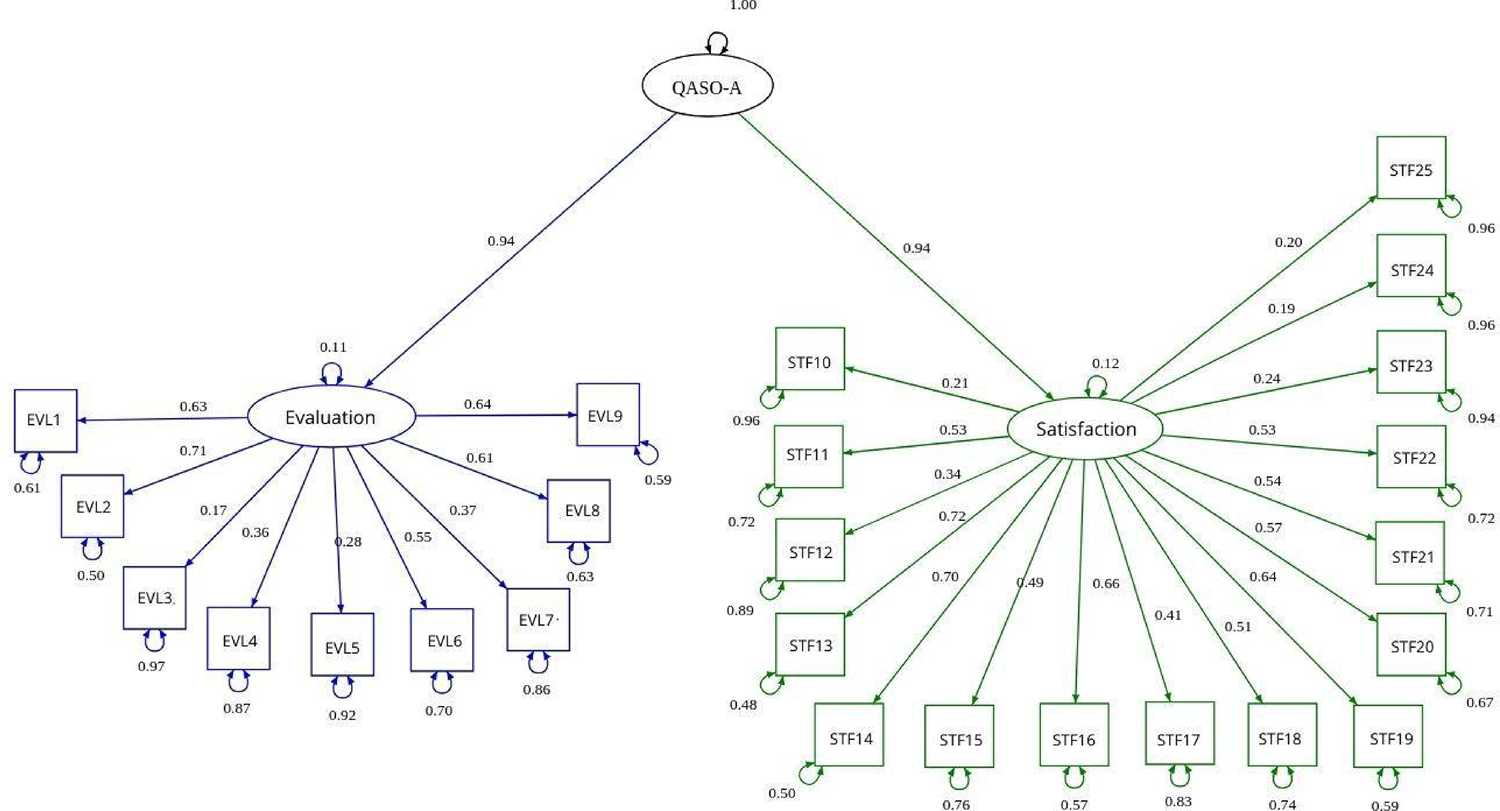 Legend: EVL – Items of the evaluation dimension; STF – Items of the satisfaction dimension.