 Development of a new methodology for dissolving tablets containing diltiazem hydrochloride marketed in Brazil using design of experiment
Abstract
Diltiazem hydrochloride (DH) is a calcium channel blocker used to modify or restore normal heart rhythm in cardiovascular diseases. The aim of this study was to develop and validate a new innovative method using UV molecular absorption spectrophotometry to evaluate the in vitro dissolution of DH using a factorial design of experiments. Physical and physicochemical tests were performed. The dissolution profiles of DH tablets (30 and 60 mg) available as the reference, generic and similar drugs were compared. The dissolution test was used to obtain and compare dissolution profiles and to determine the similarity of pharmaceutical formulations (USP type 2 apparatus at 75 rpm, with 750 mL of water at 37.0 ± 0.5 oC for 120 minutes). Only samples G30 and G60 showed compliance with the parameters established by the Brazilian Pharmacopoeia in all tests. Drug dissolution percentages are in accordance with the Brazilian and American Pharmacopoeias (>75% dissolution in 180 minutes). Using the proposed new method, it was observed that > 80% of DH was released in approximately 60 minutes. The proposed method was found to be sensitive, rapid and efficient for the quality control of DH tablets.
Keywords:
Diltiazem hydrochloride; Tablets; Dissolution test; Factorial design of experiments; Quality control.
INTRODUCTION
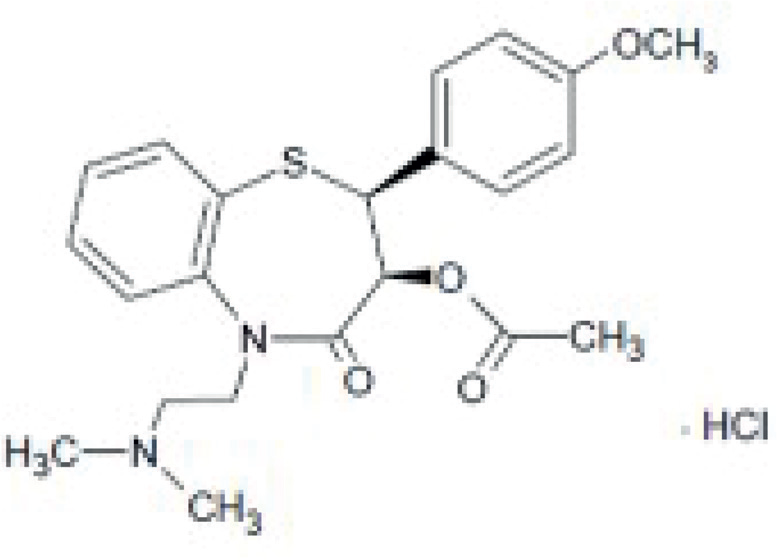
Diltiazem is a calcium channel blocker used to treat mild to moderate hypertension, angina pectoris andanginaconditionssuchaspost-myocardial infarction(Malachiasetal.,2016).Diltiazem hydrochloridehasthechemicalname(2S,3S)-3-acetyloxy-5-[2-(dimethylamino)ethyl]-2,3-dihydro-2-(4-methoxyphenyl)-1,5-benzothiazepin-4(5H)-one hydrochloride (Figure 1) and is classified in Class 1 (high solubility and permeability) of the Biopharmaceutical Classification System-SCB (Mendonça et al., 2011; Brasil,2024a;Costaetal.,2021).Althoughthe reference product will be discontinued in Brazil in 2022 for commercial reasons, 30 mg and 60 mg immediate-release tablets (reference, similar, and generic) are still on the market (Brasil, 2021). Brazilian regulatory authorities require comparative studies of pharmaceutical equivalence for these specialties, and it is therefore necessary to assess the quality of the medicines still available in the country (Brasil, 2010).
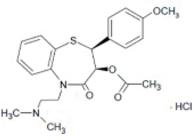
A generic drug is a medicine that contains the same active ingredient, in the same dosage and pharmaceutical form, administered by the same route, with the same dosage and therapeutic indication as the reference drug (innovative product registered by the registration agency and marketed in the country), has efficacy and safety equivalent to the reference drug, and is interchangeable with it. A similar drug: one that contains the same active ingredients, which has the same concentration, pharmaceutical form, route of administration, dosage and therapeutic indication, and which is equivalent to the drug registered with the National Health Surveillance Agency, of the Brazilian Ministry of Health. These pharmaceutical specialties (reference, similar and generic) differ in characteristics such as size and formulation, with a variety of excipients, and may therefore affect the dissolution kinetics of solid oral dosage forms (Brasil, 2024b).
To establish quality parameters for pharmaceuticals, the Brazilian Pharmacopoeia (BP) (Brasil, 2024c) defines quality control as a set of measures designed to ensure the production of batches of pharmaceuticals and other products that at all times meet the standards of identity, activity, content, purity, potency and safety. The dissolution test determines the percentage of the active pharmaceutical ingredient (API) released into the dissolution medium as a function of time in relation to the quantity declared on the label (Brasil, 2024c). It also demonstrates whether the product meets the criteria defined in the drug monograph, described in the pharmacopoeias and studied by an in vitro bioavailability prediction ratio (Grangeia et al., 2020; Van Der Merwe et al., 2020). In this test, collections are made at a single predetermined time; or at multiple times to determine the dissolution profiles of the drugs tested. To assess pharmaceutical equivalence, it is analyzed whether the dissolution profiles are statistically comparable. Therefore, to assess the quality of the tested drugs (generic and similar), their dissolution profiles are compared with the reference drug (Brasil, 2010; Anand et al., 2011; Bhakta, Lin, Grover, 2020; Ferreira et al., 2020).
There are few studies in the scientific literature on the dissolution profile of Diltiazem Hydrochloride (DH) in solid pharmaceutical forms, such as capsules (Mendonça et al., 2011; Souza et al., 2017) and tablets (Alkhalidi, Alkhatib, Khdair, 2010). Studies using ultraviolet (UV) molecular absorption spectrophotometry only replicate the methods already described in pharmacopoeias, with a dissolution test time of 30 minutes to 3 hours. However, this long test time influences the low analytical frequency of the industry to perform the test during the quality control of the produced batch (Bezerra, Rodrigues, 2017).
The use of Experimental Design or Design of Experiment (DoE) of Quality by Design (QbD) aims to monitor quality through a systematic control of the variables involved in the process (Bezerra, Rodrigues, 2017). QbD is an approach applied to the development of pharmaceutical products that uses risk analysis and experimental design methods with the goal of carefully understanding the product being developed and its manufacturing process in order to confidently control them and avoid failures (ICH, 2009; Kovács et al., 2021).
The objective of this study was to evaluate the quality of tablets containing DH (30 and 60 mg) marketed in Brazil using a new innovative method of molecular absorption spectrophotometry in the UV range to evaluate the in vitro dissolution of DH tablets, using multivariate analysis with a 24-1 factorial design and Doehlert matrix as a response surface methodology.
MATERIAL AND METHODS
Material, reagents and samples
All chemical reagents used in the experiments were of analytical grade (QuimexTM, MerckTM, Brazil). The distilled water used in the experiments was obtained by distillation (SPLabor, São Paulo). Ultrapure water (with a resistivity of 18 MΩ cm-1), obtained from a Purist purification system (RephiLe Bioscience Ltd, Argentina), was used for the preparation of standards, solutions and analyses. All glassware was washed in HNO3 solution for 24 hours, rinsed with ultrapure water and dried at room temperature.
The reference chemical substance (RCS) of DH was purchased from the National Institute for Quality Control in Health, Oswaldo Cruz Foundation (FIOCRUZ, Brazil). The DH samples (tablets) of 30 mg (reference and generic) and 60 mg (reference, similar and generic) were obtained from commercial pharmacies and drugstores in the city of Salvador, Bahia, Brazil, and were designated as R30 and G30; R60, S60 and G60, respectively. All tests were performed on products within the expiration date. The tablets were subjected to average weight, disintegration and dissolution tests according to the official compendia BP (2024a) and The United States Pharmacopeia (USP 43) (2020). The excipients of the four products described on the labels were: reference samples (R30 and R60): lactose monohydrate, macrogol, hydrogenated vegetable oil and magnesium stearate; generic samples (G30 and G60): lactose monohydrate, macrogol, hydrogenated vegetable oil and magnesium stearate and silicon dioxide; and, similar samples (S60): lactose monohydrate, magnesium stearate, silicon dioxide, microcrystalline cellulose and povidone.
Instruments
The average weight was determined with an analytical balance (M164-AI MarkTM, Piracicaba, SP, Brazil); friability was tested in a friabilometer (HX 300-2 EthikTM, Vargem Grande Paulista, SP, Brazil) and the disintegration test was performed in a disintegrator (301/AC 01 Nova Ética, Vargem Grande Paulista, SP, Brazil). Dissolution was analyzed in a dissolver (299 EthikTM, Vargem Grande Paulista, SP, Brazil), with tests (n=6). Spectrophotometric analyses were performed using a molecular absorption spectrophotometer in the UV-visible range (λ= 190-1100 nm) Cary 60 (Agilent TechnologiesTM, USA) and Femto (700 Plus), equipped with a diode array detector (DAD). The detector was set at λ= 240 nm. The absorbances of the solutions were read in triplicate, in 1 cm3 quartz cuvettes.
Calibration standards
A DH reference stock solution (15 mg L-1) was prepared using the RCS. Calibration standards with concentrations ranging from 0 to 15 mg L-1 were prepared daily from the standard stock solution with appropriate dilution, stored and analyzed in triplicate by molecular absorption spectrophotometry in the UV-visible range at λ = 240 nm.
General Tests (Weight Variation, Friability and Disintegration Tests)
All physical tests (weight uniformity and average weight, friability and disintegration) were performed according to the BP (Brasil, 2024a). For the weight uniformity test, 20 tablets from each sample (reference, similar, and generic) were randomly selected and individually weighed. The average weight, standard deviation, and individual deviations were calculated. According to the BP, the maximum allowable variation is ± 10.0%, with no more than two units outside the limits and no unit deviating more than twice the specified percentage. For the friability test, 20 tablets were weighed and placed in the friabilometer at 100 rpm. The tablets were then reweighed and weight loss was calculated as the percentage friability. The BP (Brasil, 2024a) and USP (2020) accept a loss of 1.5% or less and no tablets should be broken or damaged at the end of the test. In the disintegration test, six tablets from each sample were placed in the apparatus with distilled water at 37 ± 1°C for 30 minutes. After the specified time, the tablets should be completely disintegrated.
Experimental design and optimization of dissolution test conditions
The dissolution test is used to determine the amount of active ingredient dissolved in the dissolution medium. For the test, the dissolution medium specified in the monograph was used in the dissolution container at 37 ± 0.5°C. To use apparatus 2 (paddle), the sample was placed in the dissolution container after stabilization of rotation and start time. An aliquot was removed and filtered at predetermined time intervals prior to analysis. Replacement with the same medium heated to 37°C was used. The sample was quantified according to the technique described in the product monograph (Brasil, 2024a; USP, 2020).
The BP (Brasil, 2024c) and USP 43 (2020) recommend the UV-visible molecular absorption spectrophotometry method for dissolution testing of tablets containing DH with the following conditions: 900 mL of water, apparatus 2 (paddle), rotation at 75 rpm, and time from 30 minutes to 3 hours. A very long dissolution time is observed for the immediate release formulation. Therefore, for quality control in industry, dissolution would require a long time to evaluate the samples produced and, consequently, the method has a low analytical frequency. Therefore, the use of QbD tools, such as factorial design of experiments, is necessary to improve several test conditions.
To evaluate the influence of the variables in the dissolution test, a 4-variable factorial design (24-1) with triplication of the center point was used to reduce the testing time. This resulted in 11 experiments (Table I). The variables analyzed were: pH, volume (mL), rotation (rpm) and time (minutes). The variables maintained were: temperature (37 ± 0.5°C) and apparatus 2 (paddle), for all dissolutions, according to the BP (Brasil, 2024c) and USP 43 (2020).
For all experiments, 10-mL aliquots were taken, filtered through 0.45-μm membranes, and the volume of reaction medium was replaced. DH concentrations were determined by the proposed spectrophotometric method. The absorbances were subjected to analysis of variance (ANOVA) and the Pareto chart was plotted using Statistica 7.0 software. It was then possible to study the effects and interactions of the variables in the dissolution test.
As a response surface method, the Doehlert Matrix (MD) was used, since it has the following advantages: it requires few experiments; it allows the construction of sequential designs towards the region of maximum or minimum response; the number of levels related to each factor can be selected to obtain more information about the most important or problematic factors (Novaes et al., 2017; Deidda et al., 2019).
Dissolution studies
Dissolution was tested in a dissolver with 6 media tanks at 37 ± 0.5°C and apparatus 2 (paddle). The other conditions were defined after optimization based on a factorial design, Pareto chart analysis and application of the Doehlert matrix. For the dissolution profiles, 10-mL samples were taken at predetermined time intervals (0, 10, 20, 30, 40, 50, 60, 70, 80, 90, 100, 110 and 120 min), with the same volume of medium being replaced to keep the total volume constant. The collected aliquots were filtered (0.45-μm membrane filter) for spectrophotometric reading in the UV range (λ = 240 nm). Absorbances were converted to concentrations using the analytical curve equation. Calculations were performed taking into account the amount of drug removed in each aliquot and the results were expressed as percentage as a function of time.
Dissolution efficiency (DE), a parameter used to assess pharmaceutical equivalence between drugs, was calculated using the trapezoidal rule to obtain dissolution profiles. This parameter was obtained from the area under the drug dissolution curve versus time (t) in minutes (AUC0-t), corresponding to 100% of the label value (AUCTR). DE was expressed as a percentage and can be defined by the following equation AUC0-t/ AUCTR × 100, where “t” is the time (min) and TR is the label value of the product.
The profiles were compared by the method based on the difference factor (f1) and similarity factor (f2), dependent models (definition of zero-order and first-order models) with the construction of time (minutes) versus the amount of undissolved DH. Correlation coefficient (r), dissolution rate constant (k), dissolution half-life (t50%) and dissolved amount of DH were calculated after 50 minutes of dissolution test (Q50).
Validation of the analytical method
Validation of the dissolution method followed the criteria of Brazilian Resolution n° 166 (2017) and the International Conference on Harmonization (ICH) (2018), evaluating selectivity, linearity, precision (repeatability and intermediate precision), accuracy, limit of detection (LOD), and limit of quantitation (LOQ).
Linearity was determined from the correlation coefficient by linear regression analysis with 14 different concentrations ranging from 0 to 15 mg L-1. The relative standard deviation (RSD, %) was used to calculate the quantification accuracy of 3 known concentrations (1; 5 and 10 mg L-1) on the same day and on alternate days. Accuracy tests were performed from addition and recovery tests of the analyte (DH) from 3 concentration levels (1; 5 and 10 mg L-1), expressed as a percentage recovery of the analyte added to the sample. The limits of detection and quantification were calculated using the following equations LOD=3.3 x DPb/a and LOQ=10 x DPb/a, respectively, where DPb is the standard deviation at the intercept and a is the slope of the regression line.
Statistical analysis
Student’s t-test for comparison of means and one-way ANOVA with Tukey’s multiple comparison test for p-value <0.05 were used to compare the dissolution capacity of DH, in addition to the 24-1 factorial design. Pareto charts were plotted to analyze the variables and their interactions. DE values were statistically analyzed using Student’s t-test with a significance level of p ≤ 0.05.
RESULTS AND DISCUSSION
Validation of the analytical method
The proposed method, using spectrophotometry in the UV region, was validated for analytical applications and rapid quality control analyses. The results showed that the method met the validation requirements, as defined by RDC 166/2017 and ICH Q2(R1) (Table II). Therefore, it is proposed to use this method for the quantification of DH as an active pharmaceutical ingredient and finished product.
General Tests (Weight Variation, Friability and Disintegration Tests)
Only samples G30 and G60 met the parameters set by the BP in all tests. The other samples exceeded the limit time (30 minutes) specified for the disintegration test. Souza et al., 2017 showed the same problem with the disintegration time of the reference and generic drugs containing DH. This long disintegration time can be assigned to manufacturing processes, either in the choice of excipients that make up the tablet or in the pressure used to compact the powders. High pressure can cause the particles that make up the tablet to deform and reduce their porosity and, as a consequence, the reduction in porosity leads to a reduction in the surface area and water permeability of the tablet, making disintegration more difficult (Sheskey, Cook, Cable, 2017; Manzoor et al., 2024; Ghourichay et al., 2021). It is suggested that the presence of the excipient (silicon dioxide) in the generic sample, due to its adsorbent, anti-caking and disintegrant function, favored this pharmaceutical specialty during the disintegration test (Sheskey, Cook, Cable, 2017).
Quality by Design and dissolution test conditions
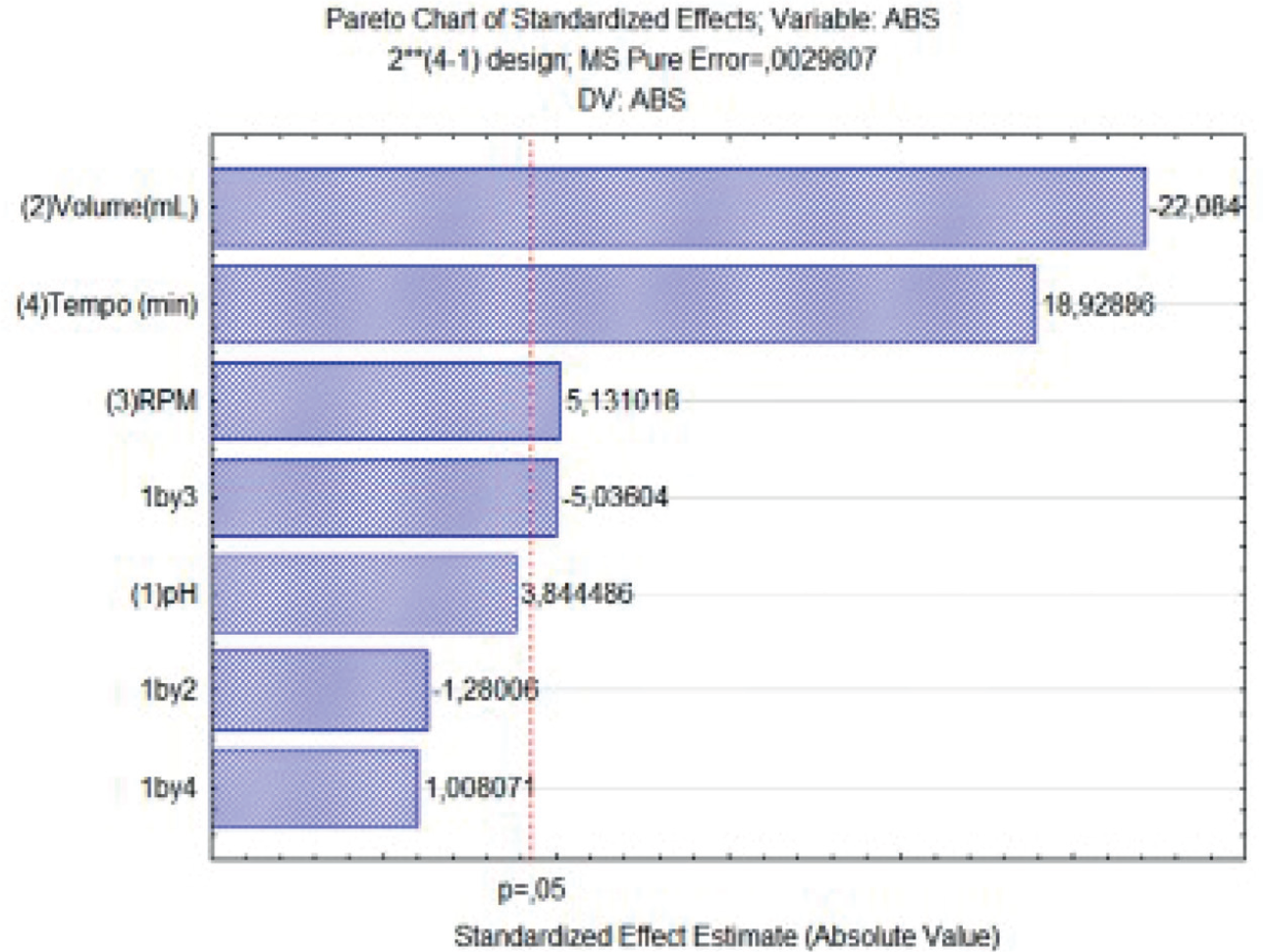
Based on the results of the dissolution tests, a Pareto chart (Figure 2) was plotted to analyze the variables and their interactions using a 24-1 factorial design with triplicate central points. Of the 4 variables, 3 were statistically significant (p > 0.05) for the systems tested.
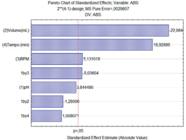
Volume, time, rotation and the interaction between pH and rotation were significant in the system studied. Based on these results, a new experimental design was proposed using Response Surface Methodology (RSM) for optimization. The Doehlert matrix design requires few experiments with high power values and has proven to be suitable and advantageous, as it is easily applied to experimental variables (Grangeia et al., 2020; Deidda et al., 2019). It also allows the construction of sequential designs towards the region where the maximum response is expected; furthermore, the number of levels associated with each factor can be related in such a way as to obtain more information about significant or problematic factors (Deidda et al., 2019). Therefore, a Doehlert design was analyzed for 4 variables. Although pH was not significant in isolation, it was significant when interacted with rotation (rpm). Therefore, the 4 variables were retained for the new design (Table III). The results of the analysis of variance (ANOVA) for the variables studied are presented in Table IV.
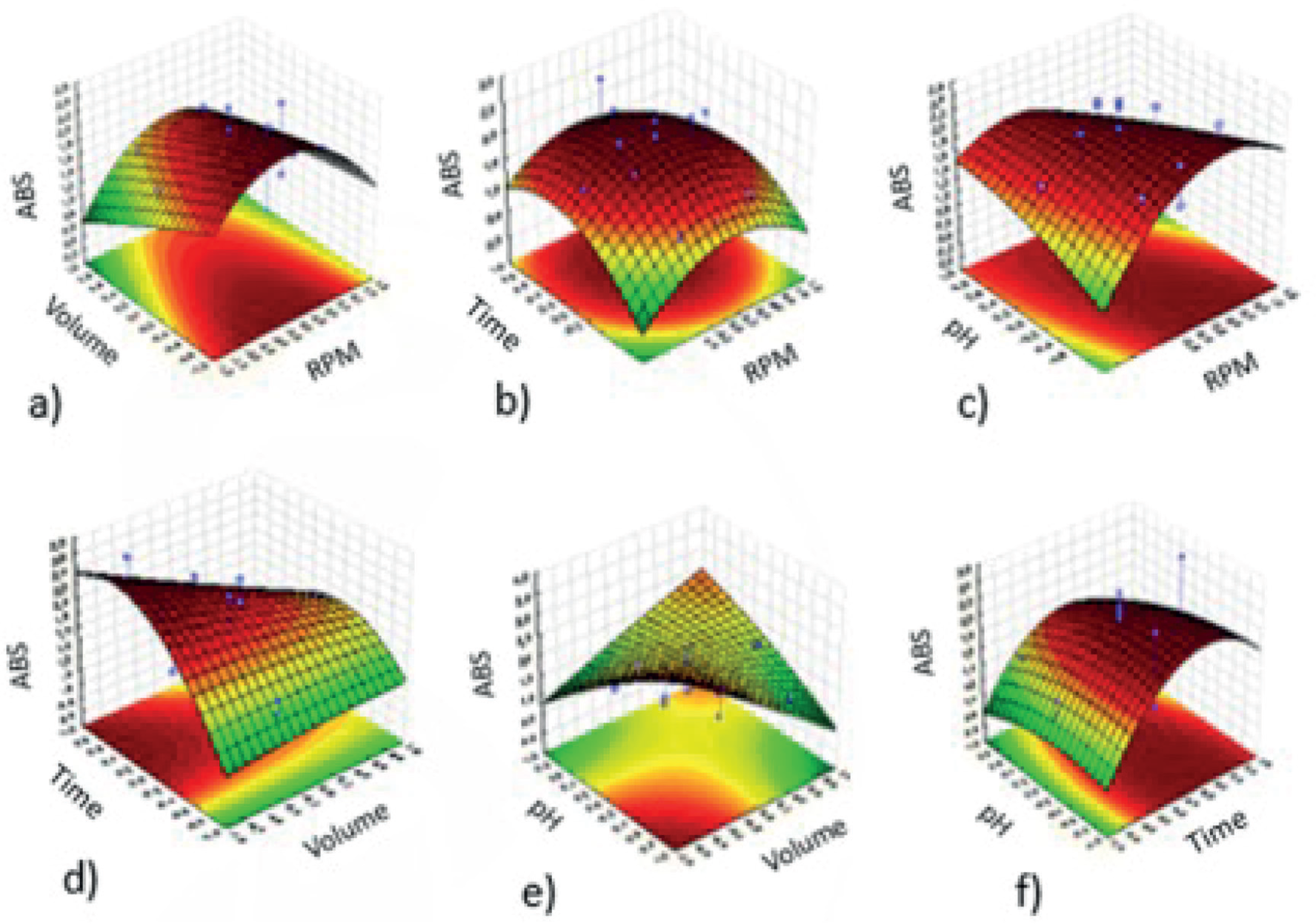
The variable time in the quadratic model (Q) and the interaction of volume and pH in the linear model, coded “2L by 4L”, showed significance (p<0.05) and are therefore highlighted in red in Table 5. According to Deidda et al. (2019), a model fit to experimental data should show a significant regression and a non-significant lack of fit. It was observed that the lack of fit (p = 0.4412105 > 0.05) is not significant, or even a regression value of 0.83017. Thus, these results indicate that there is good agreement between the predicted absorbance values and the experiments studied for each variable. The response surfaces (Figure 3) showed that the conditions used in the design were significant and the surface designs were fitted with optimal points.
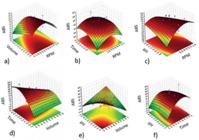
Response Surface Plots for: (a) Volume x rpm, (b) Time x rpm, (c) pH x rpm, (d) Time x Volume, (e) pH x Volume, and (f) pH x Time, and the mutual effects on absorbance (ABS).
All graphs showed maximum points, except graph (e), which showed a saddle point. Based on the results of the Doehlert matrix, the optimized conditions for the dissolution test were determined: 750 mL of water, 75 rpm and 120 minutes of testing. As a result, the total test time and the volume of medium used could be reduced. The reduction in time increases the frequency of analysis for quality control tests in industry and laboratories. In addition, reducing the volume of medium has an environmental impact by reducing the cost and waste disposal into the environment.
No studies were found in the literature using QbD to develop a method for dissolving DH, and only a few studies involved the dissolution of DH tablets and capsules. In Brazil, Mendonça et al. (2011) developed a spectrophotometric dissolution method for DH, with a test time of 1 hour, using hard capsules, apparatus 2 (paddle), 50 rpm and 900 mL of phosphate buffer dissolution medium at pH = 6.8. In another Brazilian study, Souza et al. (2017) conducted a comparative study of DH capsules and tablets using the USP dissolution method, 900 mL of water, apparatus 2 (paddle), 75 rpm and 210 min of testing. In Jordan, Alkhalidi, Alkhatib and Khdair (2010) proposed the use of a new apparatus (crescent spindle) using USP apparatus 2 (paddle) and applied the method described by USP for immediate-release drugs. The test time was 3 hours and 75 rpm; however, for the proposed new apparatus, the rotation was 25 rpm.
When comparing dissolution test conditions for oral solid dosage forms containing DH in the literature, the studies used the same volume conditions (900 mL). After optimization, this study used 750 mL, a reduced volume that favors less waste generation. The use of water as the reaction medium is in agreement with Souza et al. (2017). The rotation speed was the same as that described by Souza et al. (2017), Alkhalidi, Alkhatib and Khdair (2010) and Mendonça et al. (2011). The main difference between the studies is test duration, which was previously described to be between 180 and 210 minutes. This study proposes a reduction to 120 minutes, thus increasing the analytical frequency of the method.
Dissolution Studies
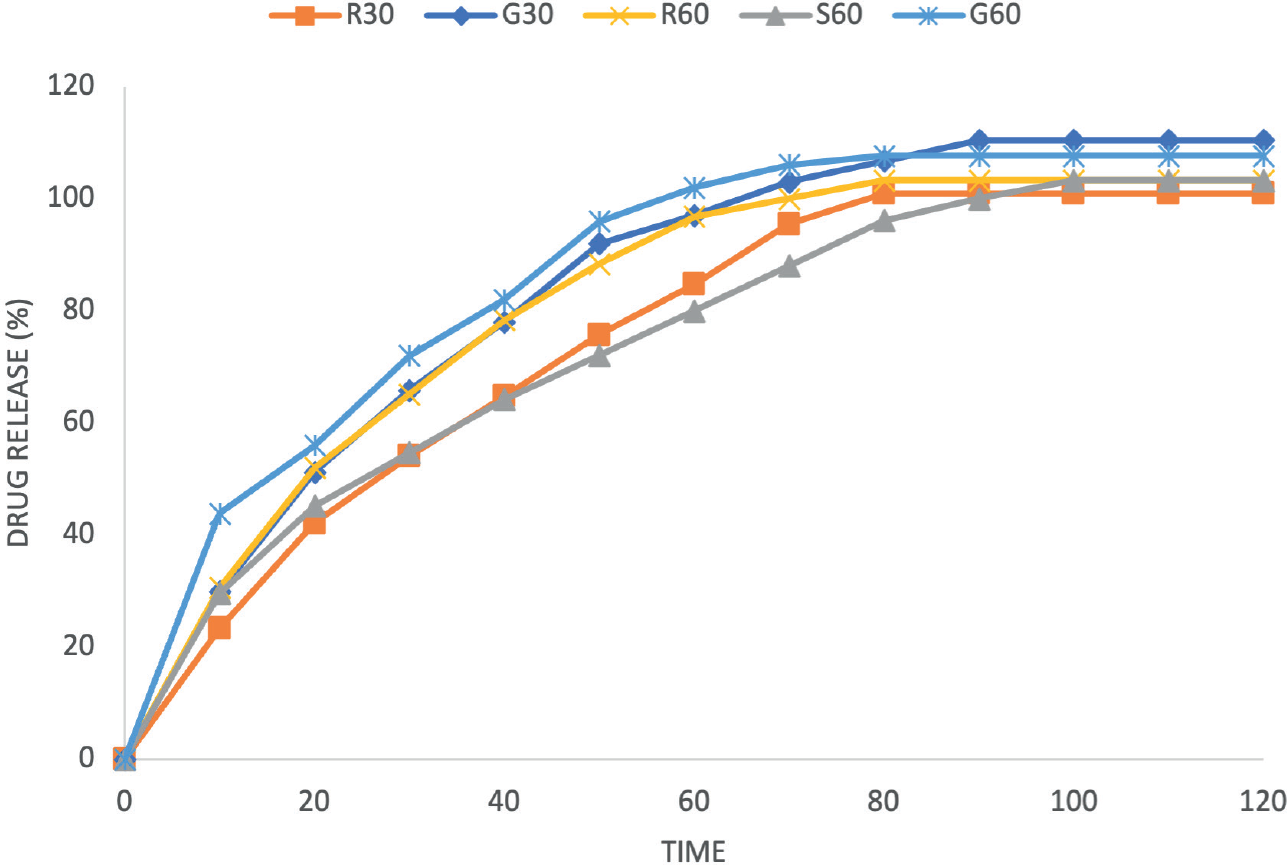
The BP (Brasil, 2024c) and USP 43 (2020) recommend that ≤ 60% of the drug be released in 30 minutes and ≥ 75% in 180 minutes. By applying the new methodology proposed in this study, it was observed that > 60% of DH was released in 30 minutes and > 80% of the drug was released in approximately 60 minutes, as observed in Figure 4, from the dissolution profiles obtained for the pharmaceutical specialties studied. Thus, after 60 minutes, the amount of drug available in the body (pharmaceutical availability) for the pharmacological effect to occur is higher than that specified in the pharmacopoeias.
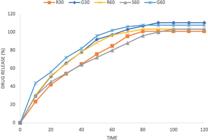
Comparison of dissolution profiles of Diltiazem Hydrochloride (reference, similar and generic) after optimization.
The samples released comparable amounts of DH in 100 minutes. All samples were dissolved according to the BP (Brasil, 2024c) and USP 43 (2020). The percentage of drug dissolved for the reference and generic drugs (30 mg) ranged from 100.9 to 110.5%; for the reference, similar and generic drugs (60 mg), 103.24% for the first two, and 107.7% for the last. Mendonça et al. (2010) obtained a dissolution percentage between 80 and 90% in the capsules of three samples (60 mg) in 60 minutes. Alkhalidi, Alkhatib and Khdair (2010) obtained 100% release in the sample (30 mg), while in the sample (60 mg), the percentage ranged from 80 to 100% in the 6 samples analyzed, after 180 minutes of testing. According to Souza et al. (2017), the reference and generic products released more than 80% of the diltiazem in 3 hours. The method developed in this study proved to achieve a higher percentage of DH release in a shorter test time.
The dissolution efficiencies (DE%) of reference and generic (30 mg) and reference, similar and generic (60 mg) products were 42.94, 48.55, 46.94, 42.56% and 50.41%, respectively. Although they seem low, the DE percentages obtained by (2), for the DH sample (30 mg) using apparatus 2 was 24.36%, and among the samples containing 60 mg, they were 21.3% to 27%. Mendonça et al. (2011) and Souza et al. (2017) did not present results on dissolution efficiency.
The choice of the kinetic model was evaluated considering the correlation coefficient (r) that is closest to 1 (Table V), as it is the one that best fits the dissolution profile of the evaluated drugs (Rosa, 2015).
Statistical parameters of regression studies, applying zero-order and first-order models, derived from dissolution profiles
The correlation coefficients showed better results for the first-order model in all 5 samples studied, in which the amount of drug released as a function of time depends on the amount of drug remaining in the formulation, which is characteristic of immediate-release drugs (Usman et al., 2024). The kinetic parameters obtained from the equations were determined by the first-order model: dissolution rate constant (k); dissolution half-life (t50%); amount of DH dissolved in 50 minutes (Q50) (Table VI). The values of t50%, Q50 and k indicated the best performance of sample G60, followed by G30 and R60, thus confirming the DE and release results during the dissolution profile previously presented.
Kinetic parameters from the first-order kinetic model, derived from the dissolution profiles of the studied products
To compare the dissolution profiles, the difference (f1) and similarity (f2) factors were calculated in pairs, according to the equations:
Where, n = time number; Rt = reference value of time group dissolution t; Tt = group dissolution test value at time t.
According to Brazilian Resolution RDC 31/2010, the similarity or equivalence of two profiles is observed when f1 values are between 0 and 15 and f2 values are between 50 and 100. Table VII presents the difference (f1) and similarity (f2) factors obtained for the drugs studied. All samples presented difference (f1) and similarity (f2) values within the values described in the Brazilian legislation (Brasil, 2010). Thus, the evaluated drugs are shown to be pharmaceutical equivalents in their respective dosages. Souza et al. (2017) obtained a value of f2 = 56.60 for the generic product when compared to the reference product. Mendonça et al. (2011) indicated that only products B and C showed similar profiles (f2 = 69.36) and the comparisons between A and B (38.03) and A and C (33.61) did not reflect the similarity of these products, probably due to the differences between the excipients of these products.
The Biopharmaceutical Classification System (BCS) was proposed by Amidon et al. (1995) to classify drugs according to their physiological solubility (high or low) and intestinal permeability (high or low). This classification has become an important tool for predicting the “in vivo” behavior of a formulated drug, taking into account its “in vitro” dissolution test, and is also critical in the development of dissolution test methodologies (Costa et al., 2021). Some studies have indicated that DH belongs to class 1 of the BCS (Kasi et al., 2004; Infinity Pharma, 2020), which consists of drugs with high solubility and permeability that dissolve rapidly when administered in immediate release pharmaceutical forms and are also rapidly transported across the intestinal wall (Manzoor et al., 2024). Furthermore, according to RDC 31/2010 and 749/2022, for a drug to be considered fast-dissolving, at least 85% of the active ingredient must be dissolved within 30 minutes (Brasil, 2010; Brasil, 2022). These data are not consistent with the BP monograph, which requires at least 60% of the drug to dissolve in 30 minutes and a maximum of 75% of the drug to dissolve in 3 hours and, therefore, Biowaiver cannot be applied to the drug under study as it does not exhibit the characteristics of fast or very fast dissolution.
There is a gap in the literature with respect to biopharmaceutical studies, particularly with respect to dissolution testing of solid dosage forms containing DH. New systems containing this drug have been the subject of research. Prasad et al. (2013) developed controlled-release DH pellets with ethyl cellulose and hydroxylpropyl methylcellulose phthalate as release retarding polymers by fluidized bed coating. The compatibility between drug and polymers in the drug loaded pellets was confirmed by scanning electron microscopy (SEM) and differential scanning calorimetry (DSC), and stability studies indicated that the pellets were stable. The authors used 900 mL of distilled water as a medium, a paddle apparatus at 100 rpm at 37 ± 1°C, with aliquots taken at regular intervals up to 24 hours of testing; the amount of drug released was estimated by spectrophotometry at 238 nm (Prasad et al., 2013). Arafat et al. (2021) showed that poloxamer-188 combined with hydroxypropyl methylcellulose and stearyl alcohol was an effective matrix system for controlling DH release using an in vivo model (rabbits) and the results were compared with a commercially available reference product. The authors also used 900 mL of distilled water as a medium, a paddle apparatus at 100 rpm at 37 ± 1°C, and samples were collected using a at the following time intervals: 0, 15, 30, 60, 90, 120, 180, 240, 300, 360, 390, 420, 480, 540, and 600 minutes. Therefore, there are still several challenges in the release of this drug from solid forms, which reinforces the importance of this study.
CONCLUSION
DH is an antihypertensive drug whose main indications are mild and moderate hypertension, angina pectoris, heart disease and angina state such as post-myocardial infarction. According to the pharmacopoeia physical tests for quality control, of the 4 samples tested, only two (G30 and G60) met the requirements in all tests.
A rapid method was developed and validated, in combination with chemometric tools, to determine and obtain the dissolution profiles of diltiazem hydrochloride tablets. The method was validated according to guidelines (ICH and IUPAC) and applied to assays with DH tablets. The dissolution test conditions were optimized to obtain better conditions by reducing the volume of reaction medium and time (750 mL water and 120 minutes), maintaining apparatus 2 (paddle) and 75 rpm. Dissolved drug release percentages are in accordance with the BP (2024) and USP 43 (2010), so that not less than 75% is dissolved in 180 minutes. In this study, not less than 80% of the drug was dissolved in 60 minutes.
The drugs studied (reference, similar, and generic) exhibited first-order kinetics based on the determination of the dissolution rate constant, dissolution half-life, and amount of DH dissolved per minute. The dissolution efficiency showed superior results (from 42.56 to 50.41%) when compared to other studies described in the literature. The independent models (f1 and f2) indicated the pharmaceutical equivalence of the drugs and, consequently, the possibility of interchangeability of the similar drug with the reference drug.
ACKNOWLEDGEMENTS
The authors are grateful for the financial support received from “Fundação de Amparo a Pesquisa do Estado da Bahia (FAPESB)”, “Conselho Nacional de Desenvolvimento Científico e Tecnológico (CNPq) and “Coordenação de Aperfeiçoamento de Pessoal de Nível Superior (CAPES)”. Also, to the Research Group: “Biopharmaceutics and Drugs”, State University of Bahia (UNEB).
DATA AVAILABILITY STATEMENT
Data available from the corresponding author upon reasonable request.
REFERENCES
-
Alkhalidi BA, Alkhatib HS, Khdair AA. Comparative Dissolution of Diltiazem Immediate and Extended Release Products Using Conventional USP and Innovative Dissolution Paddles. The Open Drug Deliv J. 2010;4(2):48-54. DOI: 10.2174/1874126601004020048.
» https://doi.org/10.2174/1874126601004020048. -
Amidon GL, Lennerñas H, Shah VP, Crison JR. A Theoretical Basis for a Biopharmaceutic Drug Classification: The Correlation of in Vitro Drug Product Dissolution and in Vivo Bioavailability. Pharm Res. 1995;12(3):413-420. DOI:10.1023/a:1016212804288.
» https://doi.org/10.1023/a:1016212804288. -
Anand O, Yu LX, Conner DP, Davit BM. Dissolution testing for generic drugs: An FDA Perspective. AAPS J. 2011;13(3):328. DOI: 10.1208/s12248-011-9272-y.
» https://doi.org/10.1208/s12248-011-9272-y -
Arafat M, Sarfraz M, Bostanudin MF, Esmaeil A, Salam A, AbuRuz S. In vitro and in vivo evaluation of oral controlled release formulation of bcs class i drug using polymer matrix system. Pharmaceuticals. 2021;14(9):929. DOI: 10.3390/ph14090929.
» https://doi.org/10.3390/ph14090929 -
Bezerra MP, Rodrigues LNC. Quality by Design (QbD) as a tool for optimization of pharmaceutical processes. Infarma. 2017;29(1):5-12. DOI: 10.14450/2318-9312.
» https://doi.org/10.14450/2318-9312. -
Bhakta HC, Lin JM, Grover WH. Measuring dissolution profiles of single controlled-release drug pellets. Sci Rep. 2020;10(19734): DOI: 10.1038/s41598-020-76089-z.
» https://doi.org/10.1038/s41598-020-76089-z. - Brasil. ANVISA. National Health Surveillance Agency. Brazilian Pharmacopoeia 7ª edition. Volume 2 - Monographs. Brasília: National Health Surveillance Agency. 2024a.
-
Brasil. ANVISA. National Health Surveillance Agency. Concepts and definitions. 2024b. Available at: https://www.gov.br/anvisa/pt-br/acessoainformacao/perguntasfrequentes/medicamentos/conceitos-e-definicoes (accessed jun 02, 2024).
» https://www.gov.br/anvisa/pt-br/acessoainformacao/perguntasfrequentes/medicamentos/conceitos-e-definicoes - Brasil. ANVISA. National Health Surveillance Agency. Brazilian Pharmacopoeia 7ª edition. Volume 1. Brasília: National Health Surveillance Agency. 2024c.
-
Brasil. ANVISA. National Health Surveillance Agency. Notificação de Descontinuação e Reativação de Fabricação e Importação de Medicamentos. 2021. Available from: https://sad.anvisa.gov.br/MicroStrategy/servlet/mstrWeb (accessed feb 11, 2023).
» https://sad.anvisa.gov.br/MicroStrategy/servlet/mstrWeb -
Brasil. ANVISA. National Health Surveillance Agency. Resolução RDC n° 166, de 24 de Julho de 2017. Dispõe sobre a validação de métodos analíticos e dá outras providências. Available from: https://www20.anvisa.gov.br/coifa/pdf/rdc166.pdf (accessed jan 10, 2022).
» https://www20.anvisa.gov.br/coifa/pdf/rdc166.pdf - Brasil. Ministry of Health. National Health Surveillance Agency. Resolution RDC n° 749 de 5 de setembro de 2022. Dispõe sobre isenção de estudos de bioequivalência/biodisponibilidade relativa. Diário Oficial da União. 2022;171(1):67.
-
Brasil. ANVISA. National Health Surveillance Agency. Resolution Nº 31, Dispõe sobre a realização dos Estudos de Equivalência Farmacêutica e de Perfil de Dissolução Comparativo. 2010. Available from: https://portal.anvisa.gov.br/documents/10181/2718376/RDC_31_2010_COMP.pdf/85adb5d2-94f7-4b31-8b59-754ecd1ccd52 (accessed Feb 26, 2022).
» https://portal.anvisa.gov.br/documents/10181/2718376/RDC_31_2010_COMP.pdf/85adb5d2-94f7-4b31-8b59-754ecd1ccd52 -
Costa AS, Silva DDM, Jesus LC, Luiz LC, Batista RT, Bell MJV, Anjos VC. The importance of the choice of excipients in drug manipulation. Braz J Hea Rev 2021;4(4):16659-70. DOI:10.34119/bjhrv4n4-180
» https://doi.org/10.34119/bjhrv4n4-180 -
Deidda R, Avohou HT, Baronti R, Davolio P, Pasquini B, Del Bubba M, Hubert C, Hubert P, Orlandini S, Furlanetto S. Analytical quality by design: development and control strategy for a LC method to evaluate the cannabinoids content in cannabis olive oil extracts. J Pharm Biomed Anal. 2019;166:326-335. DOI: 10.1016/j.jpba.2019.01.032
» https://doi.org/10.1016/j.jpba.2019.01.032 -
Ferreira MS, Teles Júnior GAC, Carvalho Júnior CMR, Dias FS, Santos Júnior WSD, Souza MOG, Santos Júnior AF. Evaluation of physicochemical properties and dissolution studies on quality control of low water solubility drugs (raw materials and pharmaceutical formulations). Rev Colomb Cienc Quim Farm. 2020;49(2):329-354. DOI: 10.15446/rcciquifa.v49n2.89486.
» https://doi.org/10.15446/rcciquifa.v49n2.89486 -
Ghourichay M, Kiaie S, Nokhodchi A, Javadzadeh Y. Formulation and Quality Control of Orally Disintegrating Tablets (ODTs): Recent Advances and Perspectives. Biomed Res Int. 2021;6618934. DOI: 10.1155/2021/6618934.
» https://doi.org/10.1155/2021/6618934. -
Grangeia HB, Silva C, Simões SP, Reis MS. Quality by design in pharmaceutical manufacturing: A systematic review of current status, challenges and future perspectives. Eur J Pharm Biopharm. 2020;147:19-37. DOI: 10.1016/j.ejpb.2019.12.007.
» https://doi.org/10.1016/j.ejpb.2019.12.007. -
Infinity Pharma. Guia de Formulações: Excipientes. 2020. Available from: https://infinitypharma.com.br/wp-content/uploads/2020/04/GUIA-DE-FORMULA%C3%87%C3%95ES-2020-Excipientes.pdf (accessed on: feb 11, 2022).
» https://infinitypharma.com.br/wp-content/uploads/2020/04/GUIA-DE-FORMULA%C3%87%C3%95ES-2020-Excipientes.pdf -
International Conference on Harmonization of Technical Requirements for Registration of Pharmaceuticals for Human Use, ICH Harmonized Tripartite Guideline, Pharmaceutical Development, Q8(R2), Current Step 5 version, August 2009. Available from: https://www.ema.europa.eu/en/documents/scientific-guideline/international-conference-harmonisation-technical-requirements-registration-pharmaceuticals-human-use_en-11.pdf (accessed jun 02, 2024).
» https://www.ema.europa.eu/en/documents/scientific-guideline/international-conference-harmonisation-technical-requirements-registration-pharmaceuticals-human-use_en-11.pdf -
International Conference on Harmonization (ICH). International Council for Harmonization of Technical Requirements for Pharmaceuticals for Human Use. ICH Q14: Analytical Procedure Development and Revision of Q2(R10). Analytical Validation: ICH Harmonized Tripartite Guideline: Geneva, Switzerland, 2018. Available from: https://database.ich.org/sites/default/files/Q2R2-Q14_EWG_Concept_Paper.pdf (accessed jan 10, 2022).
» https://database.ich.org/sites/default/files/Q2R2-Q14_EWG_Concept_Paper.pdf -
Kasim NA, Whitehouse M, Ramachandran C, Bermejo M, Lennernäs H, Hussain AS, Junginger HE, Stavchansky SA, Midha KK, Shah VP, Amidon GL. Molecular properties of WHO essential drugs and provisional biopharmaceutical classification. Mol Pharm. 2004;1(1):85-96. DOI: 10.1021/mp034006h.
» https://doi.org/10.1021/mp034006h. -
Kovács B, Péterfi O, Kovács-Deák B, Székely-Szentmiklósi I, Fülöp I, Bába LI, Boda F. Quality-by-design in pharmaceutical development: From current perspectives to practical applications. Acta Pharm. 2021;71(4):497-526. DOI: 10.2478/acph-2021-0039
» https://doi.org/10.2478/acph-2021-0039 - Malachias MV, Souza WK, Plavnik FL, Rodrigues CI, Brandão AA, Neves MF, et al. Brazilian Society of Cardiology. 7th Brazilian Guideline for Arterial Hypertension. Arq Bras Cardiol. 2016;107(3):21.
- Manzoor MF, Riaz S, Verma DK, Waseem M, Goksen G, Ali A, Zeng X. Nutraceutical tablets: Manufacturing processes, quality assurance, and effects on human health. Food Res Int. 2024;115197.
-
Mendonça TF, Barros EG, Pereira GR, Araújo MB, Bonfilio R. Development and validation of a dissolution test for diltiazem hydrochloride in immediate release capsules. Quím Nova. 2011;34(3):520-6. DOI: 10.1590/ S0100-40422011000300027
» https://doi.org/10.1590/S0100-40422011000300027 - Novaes CG, Yamaki RT, De Paula VF, Do Nascimento Júnior BB, Barreto JA, Valasques GS, Bezerra MA. Otimização de métodos analíticos usando metodologia de superfícies de resposta-Parte I: variáveis de processo. Rev Virtual Quim. 2017;9(3):1284-1215.
-
Prasad MB, Vidyadhara S, Sasidhar RLC, Balakrishna T, Trilochani P. Development and evaluation of diltiazem hydrochloride controlled-release pellets by fluid bed coating process. J Adv Pharm Technol Res. 2013;4(2):101-107. DOI: 10.4103/2231-4040.111526.
» https://doi.org/10.4103/2231-4040.111526. -
Rosa TA. Desenvolvimento farmacotécnico e estudos de dissolução de diferentes comprimidos de liberação prolongada de benzonidazol para o tratamento da Doença de Chagas [Dissertation]. Pernambuco: Centro de Ciências da Saúde, Universidade Federal De Pernambuco, 2015. 90p. Available from: https://repositorio.ufpe.br/handle/123456789/15376
» https://repositorio.ufpe.br/handle/123456789/15376 - Sheskey PJ, Cook WG, Cable CG, organizators. Handbook of Pharmaceutical Excipients. 8th ed. London: Pharmaceutical Press; 2017. 1216 p.
-
Souza MAC, Pereira CEO, Nogueira FHA, Pianetti, GA. In Vitro Dissolution Profiles of Two Diltiazem Tablet Formulations and a Compounded Capsule Formulation: a comparative study. Dissolution Technol. 2017;24(2):38-42. DOI: http://dx.doi.org/10.14227/dt240217p38
» http://dx.doi.org/10.14227/dt240217p38 -
Usman S, Akram M, Usman A, Fatima S, Islam Q. Development and assessment of immediate-release tablets containing clopidogrel bisulphate & aspirin-strategy for optimizing the combination formulation. PLoS One. 2024;19(5):e0303705. DOI: 10.1371/journal.pone.0303705.
» https://doi.org/10.1371/journal.pone.0303705. - USP. Monograph: Diltiazem Hydrochloride Tablets, United States Pharmacopeia 43; The United States Pharmacopeial Convention, Inc.: Rockville, MD., 2020.
-
Van Der Merwe J, Steenekamp J, Steyn D, Hamman J. The role of functional excipients in solid oral dosage forms to overcome poor drug dissolution and bioavailability. Pharmaceutics. 2020;12(5):393. DOI: 10.3390/pharmaceutics12050393.
» https://doi.org/10.3390/pharmaceutics12050393.
Edited by
-
Associate Editor:
Gabriel Araújo