 Evaluation of Hair Fiber and Sensory Properties following the Application of Conditioners containing Jojoba and Coconut Oils
Abstract
The use of natural ingredients, such as vegetable oils, in hair care products has gained significant attention due to their conditioning and protective properties. This study evaluates the impact of chemical treatments on hair fiber integrity and assesses the effectiveness of conditioners containing jojoba and coconut oils. The investigation employed advanced analytical techniques, including the Dia-stron® MTT175, SAMBA® Hair System, Attension® tensiometer, and Olympus transmitted light microscopy. Sensory analysis was conducted using descriptive and discriminative ranking methods. Results indicated that bleaching followed by dyeing increased combing resistance and friction while reducing shine and hydrophobicity. Conditioners mitigated these effects, except for the jojoba oil formulation, which did not significantly reduce combing resistance. Shine remained unaffected by all conditioners, though formulations with vegetable oils enhanced the water contact angle of hair fibers, indicating improved hydrophobicity. Optical microscopy confirmed that conditioners smoothed the hair cuticles. Sensory evaluation revealed that participants preferred conditioners containing vegetable oils over the base formulation. These findings suggest that incorporating vegetable oils into hair conditioners can enhance hair fiber properties and consumer preference.
Keywords:
Coconut oil; Conditioner; Hair; Damage; Jojoba oil.
INTRODUCTION
The incorporation of plant-based ingredients into cosmetic formulations has increased due to their natural antioxidant properties and reduced adverse effects on human health and the environment (Samet et al., 2019). The beauty and personal care market has witnessed a shift toward organic and plant-derived ingredients, reflecting growing consumer awareness of the potential risks associated with synthetic chemicals (Mordor Intelligence, 2019). This trend has driven manufacturers to formulate hair care products, including shampoos, conditioners, dyes, and styling products, with natural and vegan ingredients (Mordor Intelligence, 2024).
Hair plays a significant role in modern society and throughout history, serving both aesthetic and functional purposes. Hair damage primarily affects the cuticles, the outermost protective layer, which is particularly susceptible to external aggressors. The cortex, located beneath the cuticle, is essential for determining the mechanical properties of hair fibers, including their strength and elasticity. Chemical treatments, such as bleaching and dyeing, can compromise the structural integrity of hair fibers, leading to increased fragility and deterioration (Halal, 2016; Oliveira et al., 2014; Ribeiro, Souza, Antunes Jr., 2021; Velasco et al., 2009).
Consumers are becoming increasingly aware of the sensory changes in their hair, prompting a growing preference for vegetable oils as treatments for damaged hair. These oils offer numerous benefits, including reducing dryness, providing nourishment, strengthening the hair shaft, balancing sebum production, offering pre-wash protection, controlling frizz, and preventing split ends (Abelan et al., 2022; Gabarra Almeida Leite, Campos, 2018). Jojoba oil is unique among vegetable oils, as it consists of long-chain esters derived from monounsaturated acids and alcohols, making it highly resistant to oxidation and degradation (Ghannam et al., 2023; Sanches, 2019). Similarly, coconut oil is notable for its composition, which is rich in medium-chain saturated fatty acids, particularly lauric acid. This composition contributes to its emollient and antioxidant properties (Santana, Silva, Mulder, 2020).
This study aimed to assess the extent of damage caused by bleaching and dyeing on Caucasian hair fibers and to evaluate the effects of conditioners formulated with and without vegetable oils (coconut and jojoba), through physicochemical analyses and descriptive sensory evaluations using a hedonic scale and discriminative ranking.
MATERIAL AND METHODS
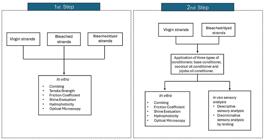
Figure 1 presents a flowchart outlining the study's stages, which includes hair strand preparation, formulation of conditioners containing vegetable oils (coconut and jojoba), physicochemical and morphological analyses before and after conditioner application, and in vitro sensory evaluation.
Sample preparation
A total of 27 strands of virgin light brown hair, each weighing approximately 4 g and measuring 20 cm in length, were prepared. The strands were washed for 60 s with a 10% (w/v) sodium lauryl ether sulfate (S.L.E.S.) solution. After air drying, the strands were divided into three groups: virgin, bleached, and bleached/dyed.
The bleaching process involved mixing 60 g of bleaching powder with 90 g of 20 volume hydrogen peroxide. A total of 10 mL of the bleaching mixture was applied to each strand for 45 min. The bleached strands were then divided into two subgroups of nine strands each. The dyeing process was conducted using COR & TON® 10.0 hair dye, prepared by mixing 50 g of dye with 75 g of 30 volume hydrogen peroxide. A total of 10 mL of the dye mixture was applied to each strand.
Conditioner formulations
The compositions of the conditioner formulations, both with and without vegetable oils, are detailed in Table I. Approximately 200 g of each formulation was prepared using the sub-phase inversion temperature.
A preliminary stability evaluation was conducted after 48 h using a centrifugation test at 3,000 rpm for 30 min at room temperature. Formulations were classified as either unmodified (UM) or normal (N) based on phase separation. Additionally, visual appearance, color, and odor were assessed to ensure sensory stability. The final pH was measured using a calibrated pH meter (buffer solutions: pH 4.0 and 7.0).
Conditioning of the hair strands
A total of 4 g of conditioner was applied to each hair strand, massaged for 1 min, and left for 2 min. The strands were then rinsed with running water (flow rate: 3 L/min; temperature: 36ºC) for 1 min.
Physicochemical characterization of hair strands
The physicochemical properties of virgin, dyed, and bleached hair strands were evaluated before and after conditioner application.
Combing
Combing resistance was assessed using the Dia-stron® MTT175 system. Hair strands of 20 cm, 4 g) were analyzed under controlled conditions (23.0 C± 2.0°C). Five trials per strand were conducted to determine the average total work. Dry strands were tested. Statistical analysis was performed using analysis of variance (ANOVA) and Tukey’s test for wet combing, and the Kruskal-Wallis test for dry combing (α = 0.05).
Tensile strength and diameter
Stress-strain curves were obtained using the Dia-stron® MTT175 at 22.0°C±2.0°C. Fiber diameters were measured using a Mitutoyo® micrometer. Statistical analysis was performed using ANOVA followed by Tukey’s test (α = 0.05).
Friction coefficient
The friction coefficient was measured using the Dia-stron® MTT175 with a rubber probe to simulate skin contact. Hair strands were analyzed at 22,0±2,0ºC and 65% relative humidity (RH), at a speed of 200 mm/min. The response was recorded in gram-force (gf). Statistical analysis was conducted using ANOVA followed by Tukey’s test (α = 0.05).
Shine
Shine was evaluated using the SAMBA® Hair System from Bossa Nova Technologies. A metal cylinder was attached to a polarization camera to analyze groups of three strands. Statistical analysis was performed using a t test for two means (α =0.05) with Minitab® 21 software.
Hydrophobicity
Hydrophobicity was assessed using an Attension® tensiometer on a polymethyl methacrylate) plate. A water droplet was deposited at a central point on the strand using a syringe (0.5-mm needle). Images were captured at 20 frames per 12 s, and the instantaneous contact angle was calculated with the equipment software. Statistical analysis was conducted using the Kruskal-Wallis test (α = 0.05).
Optical microscopy
Optical microscopy was employed to examine hair fiber surfaces using an Olympus® Transmitted Light Microscope (TLM). Images were captured with a 5 × 50-mm lens set in Extended Focal Imaging (EFI) mode, enabling image overlay along the focal height range. Software quantified strand characteristics before and after chemical damage.
In vivo sensory analysis
This study was approved by the Ethics Committee for Research CEP/UNIFESP (No. 1081/2022). A total of 42 volunteers (both sexes, aged 20 and 60 years) were recruited. The sensory evaluation followed ABNT NBR 12806 (1993) guidelines and included two methods: (a) descriptive analysis using a 9-point hedonic scale (assessing shine, combability, and softness) and (b) discriminative ranking analysis.
Statistical tests
A paired t test was applied to shine evaluation, comparing preand post-chemical treatment samples (p < 0.05). ANOVA was used for friction, wet combability, and tensile strength tests to compare control and treated samples. When significant differences were found, Tukey’s test identified which samples differed. For the hydrophobicity test, where normality was not ensured, the Kruskal-Wallis test was applied as a non-parametric alternative to ANOVA.
RESULTS AND DISCUSSION
Step 1: Physicochemical analysis of three hair types (virgin, bleached, and bleached/dyed) without conditioning
Combing
Combing refers to the subjective perception of how easily hair can be combed, which correlates with the force required to pass a comb through the strands. It serves as a crucial parameter for evaluating hair conditioning, as improved combability reflects a well-conditioned hair state from a consumer perspective (Velasco et al., 2015).
In the combing test, the force required to comb through the strands, measured in Joules, showed an increasing trend for bleached strands (17.2 J) and bleached/dyed strands (15.3 J) compared with virgin strands (11.5 J). However, statistical analysis did not reveal a significant difference among the three hair types (ANOVA followed by Tukey, α= 0.05), suggesting that a single application of bleaching or bleaching followed by dyeing does not substantially impact the combing force. Additionally, the test was conducted on dry strands. Previous studies have emphasized that hair damage is more evident under wet conditions, as swelling of the hair fibers increases their susceptibility to breakage and cuticle wear (Tate et al., 1993).
Tensile strength
The tensile behavior of human hair is primarily by the cortex, which determines mechanical properties such as tensile strength and elasticity (Sureka et al., 2022). Oxidative reactions induced by bleaching weaken cystine disulfide bonds, thereby compromising hair malleability and load-bearing capacity, increasing the likelihood of breakage. Consequently, chemically treated strands exhibit increased dryness and stiffness (Kim, 2011; Tang et al., 2016).
Tensile strength values (gmf.mm2).10⁻7 for virgin hair (3.2 ± 0.7), bleached hair (2.8 ± 0.6), and bleached dyed hair (2.7 ± 0.7) indicated reductions of 12.5% and 16.6% for bleached and bleached/dyed strands, respectively, compared with virgin hair. However, despite these reductions, statistical analysis (ANOVA followed by Tukey’s test) did not identify significant differences between the groups (p value 0.259), suggesting that a single application of bleaching and dyeing does not significantly affect the mechanical strength of hair fibers. As a result, conditioner treatments were not included in this analysis.
Friction coefficient
Friction is a key parameter in hair care science, closely linked to consumer-perceived by consumers, such as “softness,” “smoothness,” and “surface. The friction should be low to allow the comb to slide easily, and adhesion between fibers should be minimal to reduce tangling (LaTorre, Bhushan, 2006).
The friction coefficient significantly increased for bleached and bleached/dyed strands relative to virgin strands, with percentage increases of 62.3% and 72.0%, respectively. These findings indicate that chemical treatments increase resistance to frictional movement, leading to higher frictional forces. The friction test results showed a significant difference between virgin hair and chemically treated strands (bleached and bleached/dyed hair). However, no significant difference was observed between bleached and bleached/dyed strands, suggesting that the addition of dyeing after bleaching does not further increase frictional resistance with a single application.
Shine
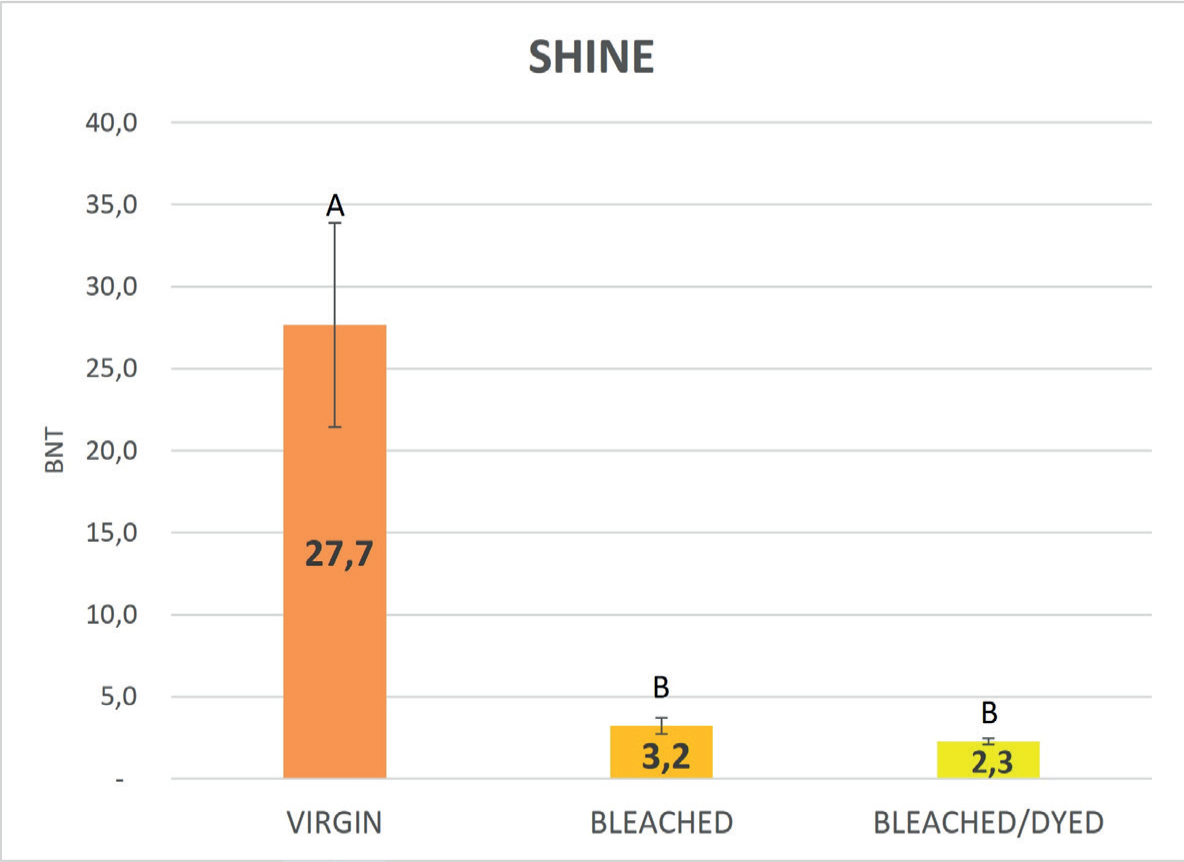
Shine is a measure of light reflection. The evaluation of shine on the studied hair strands was evaluated using the SAMBA® Hair System from Bossa Nova Technologies (Lefaudeux et al., 2010). The results are presented in Figure 2.
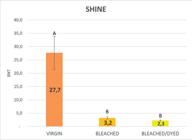
Luster analysis values obtained from the SAMBA® for virgin, bleached, and bleached/dyed hair strands. Caption: Values that share a letter do not differ significantly according to statistical analysis (ANOVA followed by Tukey’s test, α = 0.05). Source: Author (2024).
The shine intensity was significantly higher in virgin hair strands (27.74 BNT, Bossa Nova Technologies units) than in bleached and bleached/dyed strands (3.22 BNT), representing an 88.5% reduction in shine. This decline can be attributed to the intact cortex and cuticles in virgin strands, which enhance light reflection (Halal, 2016). No significant difference in shine was found between bleached and bleached/dyed strands.
Hydrophobicity
The contact angle measurement was used to assess hydrophobicity, which reflects the compatibility of water with the hair surface and its lipid content (Coderch et al., 2017). In this way, it is possible to assess the effectiveness of the interaction between water and the hair surface and thus observe its lipid content, using the Attension® tensiometer.
The results revealed a statistically significant decrease in the contact angle for chemically treated hair. Compared with virgin strands, the contact angle decreased by 51.4% in bleached strands and 78.3% in bleached/dyed strands. This progressive loss of hydrophobicity suggests that chemical treatments reduce the lipid content on the hair surface. Statistical analysis using the Kruskal-Wallis test (α = 0.05, p value < 0.05) confirmed that these variations were significant, showing that chemical treatments have a relevant impact on the interaction of water with the hair surface making it more hydrophilic and less resistant to moisture penetration.
Optical microscopy
Optical microscopy was used to examine surface alterations in the hair fibers (Colenci, 2007). Images obtained at 693x magnification revealed structural differences between virgin, bleached, and bleached/dyed strands.
In virgin strands, the cuticles appeared tightly overlapped, forming a smooth, uniform surface with enhanced shine. Conversely, bleached and bleached/ dyed strands exhibited cuticle degradation, including loss of definition, contrast, and uniformity. The raised and irregular scales in these strands contribute to increased friction and reduced shine, giving the hair a dull appearance.
Step 2: Physicochemical analyses of hair strands (virgin and bleached/dyed), treated with three types of conditioners: base conditioner, jojoba oil conditioner, and coconut oil conditioner.
Physicochemical analyses were conducted on virgin and bleached/ dyed strands treated with three types of conditioners: base conditioner, jojoba oil conditioner, and coconut oil conditioner. Bleached strands were excluded from this phase since no significant differences were observed between bleached and bleached/dyed strands in the initial physicochemical tests.
Combing
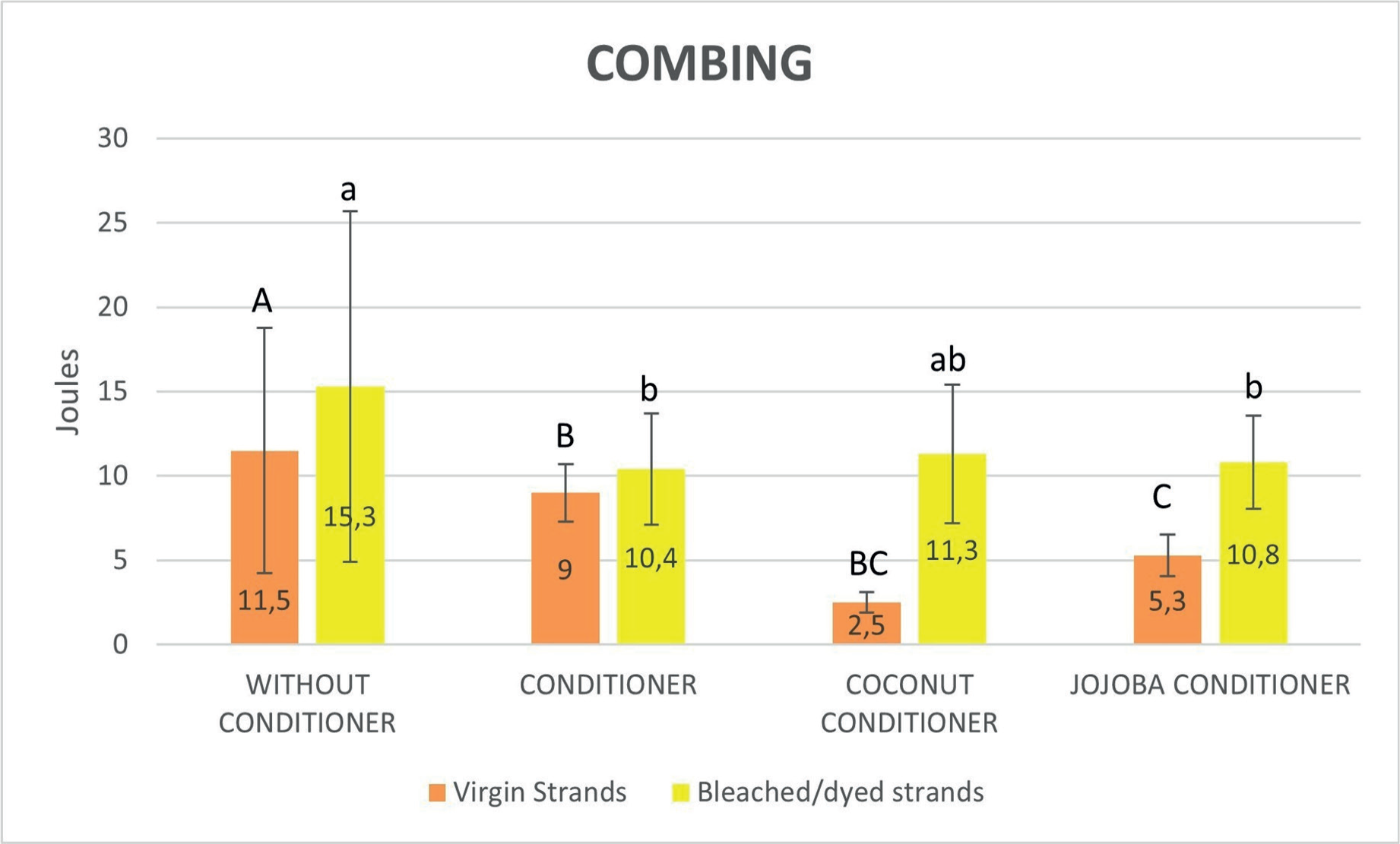
Figure 3 illustrates the total work (J) required for the combing test on virgin and bleached/dyed hair strands under different conditions: without conditioner, with base conditioner, with coconut oil conditioner, and with jojoba oil conditioner.
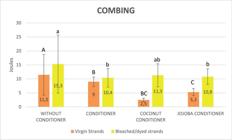
Total work (J) required for combing virgin and bleached/dyed hair strands before and after treatment with different conditioners. Caption: Values that share a letter do not differ significantly according to statistical analysis (ANOVA followed by Tukey’s test, α = 0.05).
A significant difference was observed in virgin hair strands between those without conditioner and those treated with any conditioner, demonstrating that conditioners influenced the force required for combing. However, no significant difference was found between strands treated with coconut oil and those treated with jojoba oil conditioner. In bleached/dyed strands, a reduction in total combing effort was also observed following treatment with any of the studied conditioners. Chemical hair treatments such as dyeing, bleaching, perming, and straightening/relaxing can cause substantial damage, sometimes leading to complete cuticle removal (Sá Dias, 2015). Additionally, the friction coefficient of the cuticle surface is notably high due to the structural arrangement and orientation of the cuticles. However, regardless of the extent of hair damage, both the base conditioner and those containing vegetable oils improved strand combability (Wortmann et al., 2006).
Friction coefficient
Friction tests conducted before and after conditioner treatment revealed that the base and coconut oil conditioners reduced the friction coefficient compared with untreated strands, in both virgin and damaged hair. In contrast, the jojoba oil conditioner increased the friction coefficient in virgin strands compared to untreated but reduced it in bleached/dyed strands. Statistical analysis indicated significant differences across all groups (ANOVA followed by Tukey’s test, p< 0.05), except between bleached/dyed strands treated with the base conditioner and those treated with jojoba oil.
Conditioners can significantly alter the surface properties of hair, both in quantitative terms, such as reducing friction coefficient) and in human perception of smoothness (LaTorre, Bhushan, 2006).
Shine
Luster analysis using the SAMBA® system on virgin and chemically treated hair, both before and after conditioner application, revealed that for virgin strand, there was no statistical difference between the untreated strands and those treated with the different conditioners, suggesting that the use of conditioners did not influence the shine of virgin strands (p> 0.05). However, in bleached/dyed hair, the jojoba oil conditioner provided greater shine than the coconut oil conditioner. Notably, when comparing virgin strands with bleached/ dyed strands, a reduction of approximately 90% in shine was observed, both before and after treatment with the different conditioners.
Hydrophobicity
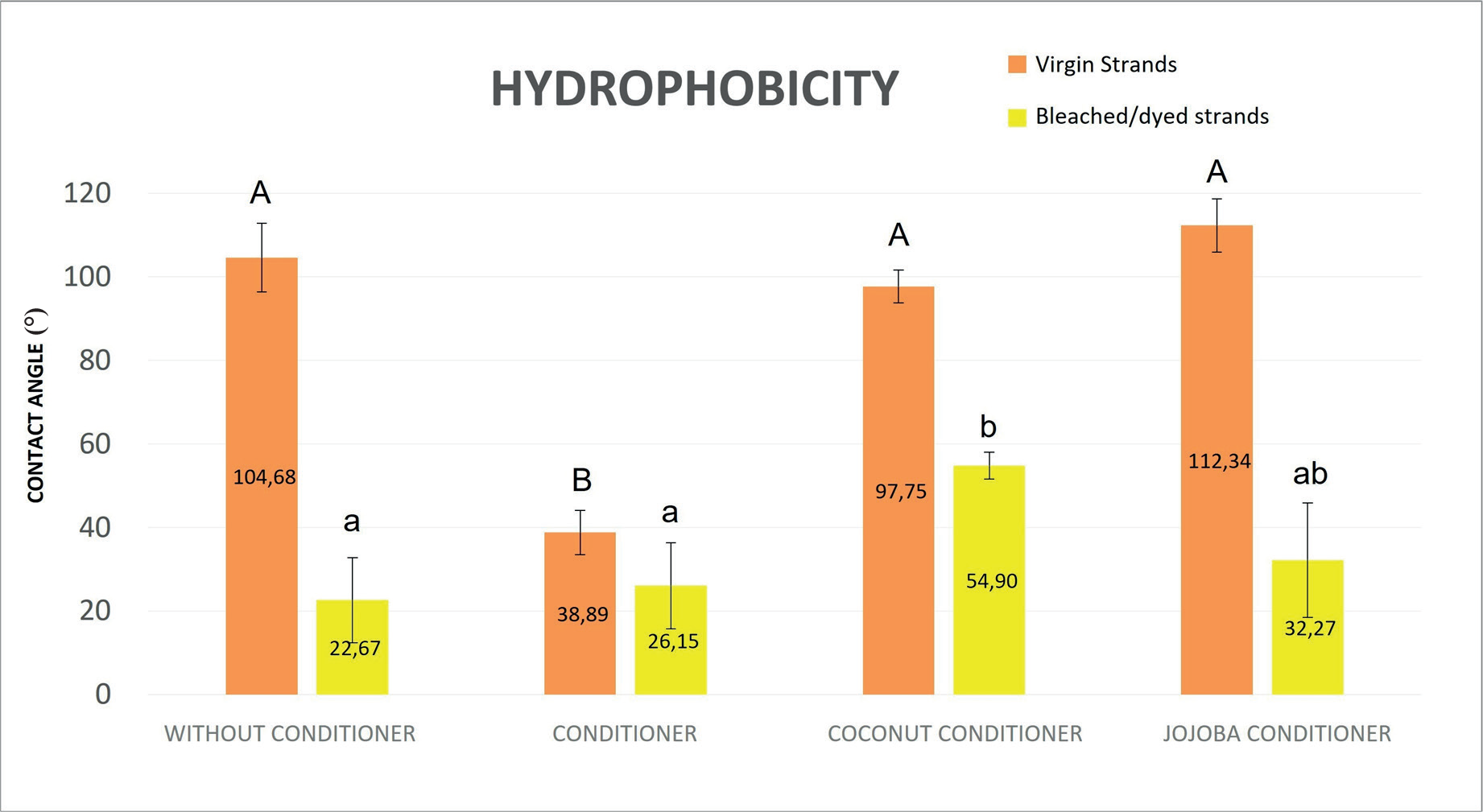
Tensiometry analysis results for contact angle measurements in virgin and bleached/dyed hair, before and after conditioner application, are presented in Figure 4.
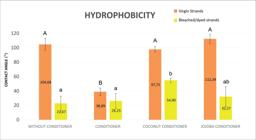
Contact angle values from tensiometry analysis. Caption: Values that share a letter do not show a significant difference according to statistical analysis (ANOVA followed by Tukey’s test, α = 0.05). Source: Author (2024).
No statistically significant difference was found between untreated virgin strands without and those treated with coconut oil or jojoba oil conditioners, except in comparison to the base. This suggests that vegetable oils promote greater hydrophobicity, whereas the base conditioner increases water affinity.
In bleached/dyed strands, both jojoba oil and coconut oil conditioners increased the contact angle, indicating enhanced hydrophobicity. This suggests that these oils contribute to lipid restoration in damaged hair.
Optical microscopy
Optical microscopy images (693× magnification) of virgin and bleached/dyed hair, both before and after treatment with different conditioners, it was found that in both virgin and bleached/dyed hair fibers, the use of conditioner, especially those containing coconut oil and jojoba oil, altered the structural changes in the cuticle. In both hair types, conditioner applications - especially those containing coconut or jojoba oil - smoothed the cuticles, leading to increased shine (Gao, Pereira, Zhu, 2009).
In vivo sensory analysis
Sensory tests serve as a crucial quality assessment tool due to their ability to evaluate multiple dimensions. These tests offer several advantages, including assessing user preferences, identifying sensory differences, defining important product characteristics, and detecting subtle variations that may not be measurable through analytical methods (Muñoz, 2002).
This study employed sensory analysis in two stages. In the first stage, descriptive tests were conducted to evaluate hair attributes such as shine, softness, and combability. In the second stage, a discriminative ranking test was used to classify the tested products based on participants overall preferences.
Descriptive sensory analysis using a hedonic scale
Conditioners were assessed based on three parameters: combability, shine, and softness - using a nine-point hedonic scale, where higher scores indicated superior performance. In the hedonic scale sensory analysis tests, participants did not perceive significant differences in shine and softness in either virgin or damaged hair strands. However, for the combability of damaged hair, participants noted an improvement with the base conditioner. This effect can be attributed to the conditioner’s ability to smooth the hair by neutralizing the negatively charged sites, which are more prevalent in damaged strands.
Although the in vivo tests did not indicate noticeable improvements in the combability or softness of hair treated with vegetable oils, physicochemical analyses demonstrated superior performance in terms of combability and reduced friction in both virgin and damaged strands.
Discriminative sensory analysis by ranking
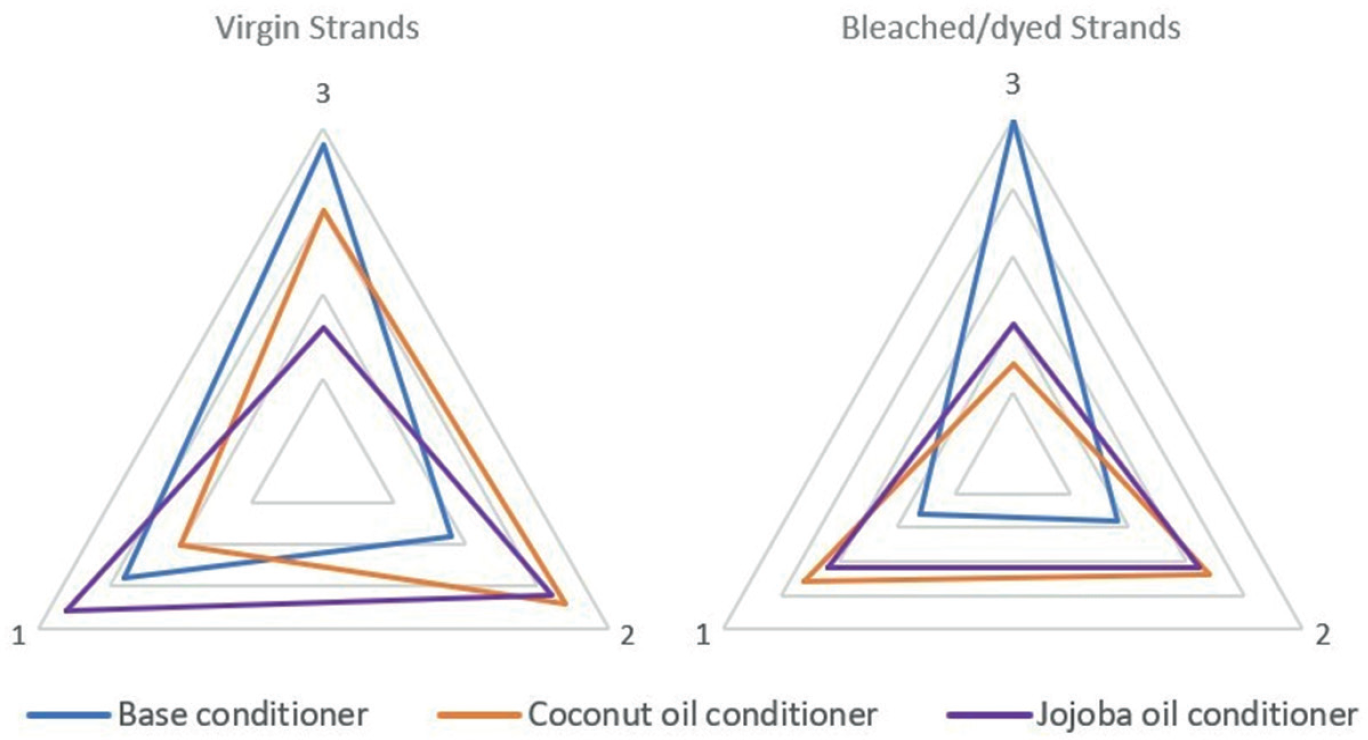
Participants ranked the tested formulations based on their overall sensory preference rather than specific attributes. Figure 5 presents a radar chart depicting sensory preference rankings for the base conditioner, coconut oil conditioner, and jojoba oil conditioner applied to both virgin and damaged hair. The chart categorizes responses into three levels: (1) “Liked the most,” (2) “Neutral,” and (3) “Liked the least" - representing the proportion of participant's responses for each conditioner.
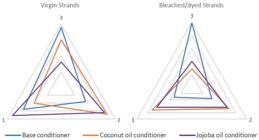
Ranking analysis of sensory preferences for conditioners on virgin and chemically treated hair strands. Caption: 1=“Liked the most,” 2="Neutral,” 3=“Liked the least”. Source: Author (2024).
For both virgin and chemically treated hair strands, the base conditioner (without oils) received the lowest preference ratings. Jojoba oil was the most preferred formulation for virgin hair, while coconut oil was favored for damaged hair. Although participants did not perceive significant differences in shine, softness, and combability in the discriminative sensory analysis, the ranking results suggest that overall sensory perception was enhanced in conditioners containing vegetable oils.
CONCLUSIONS
The findings indicate that bleaching and dyeing significantly damage hair structure, leading to increased combing resistance, higher friction, reduced shine, and decreased hydrophobicity compared with virgin hair.
Physicochemical analyses demonstrated that conditioners containing coconut and jojoba oil significantly improved combability and hydrophobicity relative to the base conditioner. Coconut oil was particularly effective in reducing friction, especially in chemically treated hair, while jojoba oil was superior in enhancing shine.
Although sensory evaluations did not reveal significant differences in shine and combability during descriptive sensory analysis, the discriminative ranking test suggested a clear preference for formulations containing vegetable oils. These results highlight the potential benefits of incorporating coconut and jojoba oils in conditioners demonstrated to be an effective and promising approach to minimize damage in both virgin and chemically treated hair.
ACKNOWLEDGMENTS
This study was financed in part by the Coordenação de Aperfeiçoamento de Pessoal de Nível Superior - Brasil (CAPES) - Finance Code 001. Professor Vania R Leite-Silva is highly thankful to the Brazilian National Council for Scientific and Technological Development (CNPq), for the Productivity Scholarship in technological development and innovative extension (CNPq, Process 302153/2023-3). We are grateful to the study participants who, with their best efforts, made it possible to obtain the results reported here. We extend our gratitude to Aqia®, Clariant®, and Wacker® as well as the Brazilian Society of Cosmetology (ABC), the Faculty of Pharmaceutical Sciences at the University of São Paulo, for providing laboratory facilities.
DATA AVAILABILITY STATEMENT
All data is available within the article or its supplementary materials.
REFERENCES
- Abelan US, Oliveira de AC, Cacoci ESP, Martins TEA, Giacon VM, Velasco MVR, Lima CRRC. Potential use of essential oils in cosmetic and dermatological hair products: A review. J Cosmet Dermatol. 2022;21(4):1407-18.
- Coderch L, Oliver MA, Martínez V, Manich AM, Rubio L, Martí M. Exogenous and endogenous lipids of human hair. Skin Res Technol. 2017;23(4):479-85.
-
Colenci AVP. Efeito de uma formulação contendo o biopolímero quitosana sobre a fibra capilar caucasiana [Internet] [text]. Universidade de São Paulo; 2007 [citado 11 de setembro de 2024]; Disponível em: http://www.teses.usp.br/teses/disponiveis/82/82131/tde-14022008-090538/
» http://www.teses.usp.br/teses/disponiveis/82/82131/tde-14022008-090538/ - Gabarra Almeida Leite M, Campos P. Development and efficacy evaluation of hair care formulations containing vegetable oils and silicone. Int J Phytocosmetics Nat Ingred. 2018;5:0-9.
- Gao T, Pereira A, Zhu S. Study of hair shine and hair surface smoothness. J Cosmet Sci. 2009;60(2):187-97.
- Ghannam MT, Selim MYE, Ansari AT, Binamro A, Almansoori M, Abdallah S. Flow characteristics of jojoba and other oil blends for skin treatment fluids. Int J Thermofluids. 1o de abril de 2023. 2023;18:100362.
- Halal J. Milady - Tricologia: química cosmética capilar. 2a edição. Cengage Learning; 2016.
- Kim MM. Skin Research and Technology. Eff Procyandin Oligomers Oxidative Hair Damage. 2011;17(1):108-18.
- LaTorre C, Bhushan B. Investigation of scale effects and directionality dependence on friction and adhesion of human hair using AFM and macroscale friction test apparatus. Ultramicroscopy. 2006;106(8-9):720-34.
- Lefaudeux N, Lechocinski N, Clemenceau P, Breugnot S. New luster formula for the characterization of hair tresses using polarization imaging. Int J Cosmet Sci. 2010;32(2):153-69.
-
Mordor Intelligence. Análise de tamanho e participação do mercado emoliente - Tendências e previsões de crescimento; 2024-2029 [Internet]. Mordor Intelligence; 2019 Disponível em: https://www.mordorintelligence.com/pt/industry-reports/emollientmarket
» https://www.mordorintelligence.com/pt/industry-reports/emollientmarket -
Mordor Intelligence. Cuidado capilar Tamanho do mercado | Mordor Intelligence [Internet]; 2024 Disponível em: https://www.mordorintelligence.com/pt/industry-reports/hair-caremarket-industry
» https://www.mordorintelligence.com/pt/industry-reports/hair-caremarket-industry -
Muñoz AM. Sensory evaluation in quality control: An overview, new developments and future opportunities. Food Qual Prefer [Internet]. 2002 [citado 11 de setembro de 2024]; Disponível em: https://www.academia.edu/11176044/Sensory_evaluation_in_quality_control_an_overview_new_developments_and_future_opportunities;13(6):329-39
» https://www.academia.edu/11176044/Sensory_evaluation_in_quality_control_an_overview_new_developments_and_future_opportunities;13(6):329-39 - Oliveira de RAG, Zanoni TB, Bessegato GG, Oliveira DP, Umbuzeiro GA, Zanoni MVB. The chemistry and toxicity of hair dyes. Quim Nova. 2014;37:1037-46.
- Ribeiro AC, Souza VM, Antunes Jr D. Tricologia e cosmética capilar: Das alterações aos tratamentos. 1a ed. Editora Cia Farmacêutica; 2021.
-
Sá Dias, TC de. Avaliação in vitro do efeito de diferentes processos de Alisamento químico/térmico na fibra capilar [Internet] [text]. Universidade de São Paulo; 2015 [citado 11 de setembro de 2024]. Disponível em: http://www.teses.usp.br/teses/disponiveis/9/9139/tde-07122016-111738/
» http://www.teses.usp.br/teses/disponiveis/9/9139/tde-07122016-111738/ - Samet AV, Shevchenko OG, Rusak VV, Chartov EM, Myshlyavtsev AB, Rusanov DA, et al. Antioxidant activity of natural Allylpolyalkoxybenzene plant essential oil constituents. J Nat Prod. 2019;82(6):1451-8.
-
Sanches P de S. Desenvolvimento de formulações cosméticas contendo pigmento natural obtido de Arthrospira platensis e avaliação do efeito na fibra capilar antes e após irradiação ultravioleta. 2019 [citado 12 de setembro de 2024]; Disponível em: https://app.uff.br/riuff/handle/1/10905
» https://app.uff.br/riuff/handle/1/10905 -
Santana I, Silva da TT, Mulder AP. Coqueiro (Cocos nucifera L.) e produtos alimentícios derivados: Uma revisão sobre aspectos de produção, tecnológicos e nutricionais. Em editora Científica Digital; 2020 [citado 12 de setembro de 2024] p. 80-101 Disponível em: https://www.editoracientifica.com.br/artigos/coqueiro-cocos-nucifera-l-e-produtos-alimenticios-derivados-uma-revisao-sobre-aspectos-de-producao-tecnologicos-enutricionais
» https://www.editoracientifica.com.br/artigos/coqueiro-cocos-nucifera-l-e-produtos-alimenticios-derivados-uma-revisao-sobre-aspectos-de-producao-tecnologicos-enutricionais - Sureka P, Agrawal T, Majumder S, Ritambhara K. A method to measure oil penetration into hair and correlation to tensile strength. Int J Trichology. 2022;14(4):128-34.
- Tang W, Zhang SG, Zhang JK, Chen S, Zhu H, Ge SR. Ageing effects on the diameter, nanomechanical properties and tactile perception of human hair. Int J Cosmet Sci. 2016;38(2):155-63.
-
Tate M, Kamath Y, Ruetsch S, Weigmann H. Quantification and prevention of hair damage. J Soc Cosmet Chem [Internet]; 1993 [citado 12 de setembro de 2024]; Disponível em: https://www.semanticscholar.org/paper/Quantification-and-prevention-of-hair-damage-Tate-Kamath/b0a1694651ff1f5e00cd32d26ee8d5d00a9dec9
» https://www.semanticscholar.org/paper/Quantification-and-prevention-of-hair-damage-Tate-Kamath/b0a1694651ff1f5e00cd32d26ee8d5d00a9dec9 - Velasco MVR, Balogh TS, Kagiyama EJW, Dario MF, Gama da RM, Bedin V, et al. Influence of Brazilian vegetable oils on mechanical resistence of hair fiber. Biomed Biopharm Res. 2015;12(1):99-106.
- Velasco MVR, Dias TCS, Freitas AZD, Júnior NDV, Pinto CASO, Kaneko TM, Baby, A. R. Hair fiber characteristics and methods to evaluate hair physical and mechanical properties. Braz J Pharm Sci. 2009;45(1):153-62.
- Wortmann FJ, Schwan-Jonczyk A, In cooperation with the working group Hair Care Products of the DGK (Deutsche Gesellschaft fuer Wissenschaftliche und Angewandte Kosmetik e.V.: German Association for Scientific and Applied Cosmetics). Investigating hair properties relevant for hair ‘handle’. Part I: Hair diameter, bending and frictional properties. Int J Cosmet Sci. 2006;28(1):61-8.
Edited by
-
Associate Editor:
Taís Gratieri


 Source: Author (2024).