 Development of dextran based nanomicelles in a dry powder formulation for pulmonary administration of niclosamide
Inhalable dry powders containing dextran-behenic acid polymeric micelles (PM) were developed for the local delivery of niclosamide (NCL) to combat bacterial infections in the lungs of patients with cystic fi brosis. NCL loaded PM were prepared using dialysis method. Inhalable nanocomposites loaded with NCL were effectively prepared by co-spray drying the PM with inert carriers like mannitol and lactose. The physicochemical properties and in vitro deposition of the aerosolized nanocomposites were then evaluated. Additionally, the in vitro effi cacy of the prepared formulations against staphylococcus aureus was assessed using the agar well diffusion method. The optimized formulation exhibited a particle size of 333.67 ± 22.36 nm, a polydispersity index of 0.53 ± 0.08, a zeta potential of -2.90 ± 0.18 mV, an encapsulation effi ciency of 52.07 ± 3.88%, a drug loading of 19.94 ± 1.49%, and a release effi ciency of 54.04 ± 3.11%. Scanning electron microscopy also revealed that the nanomicelles were nearly spherical in shape. Both the NCL-loaded nanocomposite and PM demonstrated superior antibacterial effi cacy at higher concentrations, as compared to free NCL and drug-free PM. It can be, therefore, concluded that dry powders embedding NCL-PM may serve as a viable alternative therapy for treating lung infections in patients with cystic fi brosis.
Keywords:
Cystic fi brosis; Niclosamide; Polymeric micelle; Dextran-behenic acid conjugate; Dry powder inhaler.
INTRODUCTION
Cystic fibrosis (CF) is an inherited disorder caused by a mutation in the gene encoding the cystic fibrosis transmembrane conductance regulator (CFTR) protein. The functional deficiency of the CFTR protein results in the accumulation of chloride ions and associated water molecules within epithelial cells, leading to the production of thick and sticky mucus in various organs. In the lungs, this alteration in ion composition and the increased viscosity of secretions diminish mucociliary clearance. As a consequence, the airway environment becomes prone to inflammation and colonization by pathogenic bacteria such as Staphylococcus aureus (S. aureus), Haemophilus influenza, Pseudomonas aeruginosa, etc. (Klinger-Strobel et al., 2015). Various studies have highlighted the potential use of the anthelmintic drug niclosamide (NCL) in treating CF. NCL, a potent inhibitor of TMEM16A, reduces excessive mucus and cytokine release, alleviates inflammation and relaxes bronchoconstriction commonly observed in CF. In addition, it displays strong antibacterial activity against gram-positive bacteria such as S. aureus; it also inhibits quorum sensing and biofilm development in Pseudomonas aeruginosa (Cabrita et al., 2019; Rajamuthiah et al., 2015). While orally administered NCL is effective in treating intestinal parasites, its limited solubility in water impedes oral absorption, hindering its potential for the efficacious systemic treatment of CF (Ye et al., 2015). Pulmonary drug delivery offers significant advantages over systemic administration for patients with pulmonary diseases. By providing higher drug concentrations at the site of action, minimizing off-target drug distribution, and reducing systemic side effects, pulmonary drug delivery represents a promising approach to improving treatment outcomes in this patient population (Chan et al., 2023). Moreover, when the advantages of pulmonary delivery are integrated with the sustained release potential of innovative drug delivery systems, the therapeutic advantage of a medication can be significantly enhanced. Sustained delivery of drugs in the lungs prolong the drug action at the target site, reducing the dosing frequency and decreasing the incidence of side effects (Gill, Nazzal, Kaddoumi, 2011). To achieve sustained release formulations for lung delivery, drugs must be encapsulated within micro or nano carrier systems. Nanocarrier systems are a particularly promising approach for sustained delivery in the lung, as particles below 1 µm can effectively evade uptake by macrophages, thereby increasing the residence time in the lung; meanwhile, particles ranging between 1 and 5 µm exhibit maximal phagocytosis (Patel, Gupta, Ahsan, 2015; Liu et al., 2020).
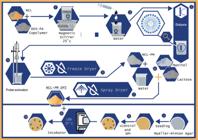
Polymeric micelles (PM) are core-shell nano-sized structures with high loading capacity for hydrophobic drugs. They are prepared through the self-assembly of amphiphilic block copolymers in solution. PM are considered promising nanocarriers for the pulmonary delivery of small molecules drugs and macromolecules due to several advantageous properties. These include high solubilization efficiency and the ability to extend pulmonary drug release. Additionally, PM can evade alveolar macrophage uptake due to their nanosize and reduce the clearance by the mucocillary escalator, facilitating drug diffusion through human airway mucus thanks to their hydrophilic shell (Hu et al., 2014; Triolo et al., 2017; Andrade et al., 2015). However, the mass median aerodynamic diameter (MMAD) of nano-sized delivery systems is not suitable for inhalation delivery. As a result, a large fraction of the inhaled dose is easily exhaled from the respiratory tract. Additionally, these nano-sized carriers tend to aggregate due to their small size and consequently high free surface energy. Therefore, nano-carriers can be embedded into a microparticulate matrix using various additives such as lactose, mannitol and L-leucine through different techniques, including freeze drying, spray drying, spray-freeze drying, or supercritical fluid technologies (Topal et al., 2018). Since the matrix of microparticles is water soluble, it will be dissolved upon deposition on the wet mucosa in the lungs, releasing the embedded nanoparticulate carriers that are small enough to avoid phagocytic uptake until they deliver their therapeutic agent (Scherließ, Janke, 2021). According to the aforementioned points, a dry powder particulate system containing NCL-PM was developed. PM was fabricated from a dextran-behenic acid (DEXBA) conjugate synthesized in our previous study and used for the delivery of itraconazole to treat cutaneous leishmaniasis (Shahriyar et al., 2021). The critical micelle concentration of this co-polymer was about 12.16 µg/ ml, significantly lower than that of low molecular weight surfactants such as 2.3 mg/ml for sodium lauryl sulfate (SLS) in water. NCL-PM were prepared using the dialysis method, and the factors influencing the physicochemical features of the PM were optimized. The optimized formulation was converted into dry powders through spray drying and then evaluated for its physical and aerodynamic properties. Finally, the in vitro antimicrobial activity of the optimized formulation against S. aureus was investigated.
MATERIAL AND METHODS
Material
NCL was provided by Pars Darou Pharmaceutical Company (Tehran-Iran). Lactose, Mannitol and leucine were from Fluka (Buchs, Switzerland). Dextran (molecular weight of 10,000 Da), behenic acid, dialysis bags with Molecular weight cutoffs (MWCO) of 12-14 kDa and 3 kDa, dimethyl sulfoxide (DMSO), Mueller-Hinton agar were all purchased from Sigma-Aldrich Company (St. Louis, MO).
Preparation of NCL-PM
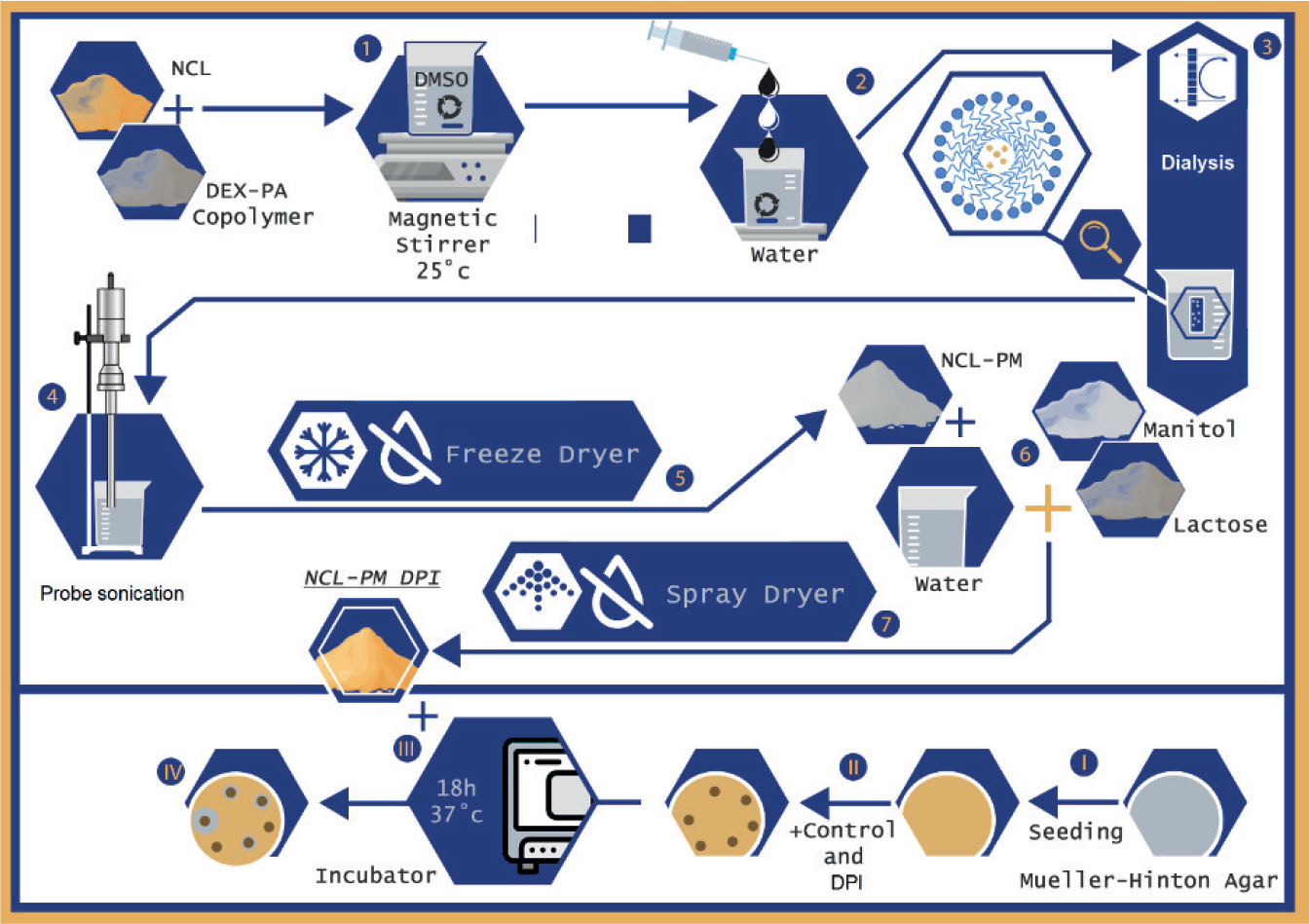
NCL-PM were prepared using the dialysis method. To achieve this, varying quantities of NCL (5-20 mg) and copolymer (40-80 mg) were dissolved in 5 ml of DMSO and stirred for 30 minutes at room temperature with a magnetic stirrer. To form PMs, the resulting mixture was slowly introduced in a dropwise manner into 15 ml of deionized water. To remove the organic solvent and free NCL, the solutions were dialyzed (Cut off 3 kDa) against 1 L of deionized water at various temperatures (25 and 50o C) for 24 hours. To assess the effect of sonication on the properties of the PMs, some of the obtained micelle dispersions were sonicated by Bandelin probe sonicator (Berlin, Germany) at 50 Watts of power (2-second pulses of on and off) for 10 minutes. Finally, the product was frozen at -20 o C in a freezer for 24 hours. The frozen samples were then lyophilized for 48 h in a freeze-dryer (Martin Christ, Germany) at the temperature of -70 o C and pressure of 0.001 mbar. The resulting powder was then kept in a desiccator for further analysis.
Experimental design
The Design Expert Software (version 11, Minneapolis, MN), which employs an irregular fractional factorial design, suggested 12 runs to optimize NCLPM. The independent parameters considered were drug content, polymer concentration, dialysis temperature, and sonication time, each examined at two levels (Table I). On the other hand, particle size (PS), encapsulation efficiency (EE)%, polydispersity index (PdI), zeta potential (ZP), Drug loading (DL) % and release efficiency during 12 hours (RE12h)% were taken as dependent (response) variables.
Characterization of NCL-PM
PS, ZP and PdI
The mean PS, PdI, and ZP of NCL-PM were evaluated using the Malvern nanosizer (ZEN3600, Malvern Instruments Ltd, UK) after dispersing 1 mg of the lyophilized powder in 10 ml of distilled water.
Determination of EE% and DL% of NCL-PM
1 mg of NCL-PM was dissolved in 5 ml of DMSO and diluted 5 times. NCL concentration was then measured using UV spectrophotometry (Shimadzu, Kyoto, Japan) at 339 nm. EE% and DL% were determined using Equations 1 and 2.
In vitro release of NCL
The dialysis method was used to assess the release of NCL from PM. For this, an appropriate amount of each freeze-dried sample (equivalent to 330-580 µg NCL) was dispersed in 1 ml of phosphate buffer solution (PBS, pH 7.4). The sample was then put in a dialysis bag (cutoff 1214 kDa) and immersed in an appropriate amount of solution of PBS: methanol (50:50, v/v) containing 1% w/v Tween 80 to provide the sink condition. At set intervals, 1 ml of the medium was withdrawn and replaced with the fresh medium. The amount of released NCL was determined using UV spectrophotometry at 339 nm. RE12h% was calculated using equation 3 to compare release profiles:
where Y.dt represents the area below the release curve up until the time, t, and y100.t indicates the rectangle area defined at the same time by 100% release.
X-Ray diffraction (XRD) analysis
The crystalline nature of NCL, DEX-BA polymer, and NCL-PM was examined using an X-ray powder diffractometer (Bruker, Hamburg, Germany) at a 2θ diffraction angle in the range of 5 to 80°.
Preparation and size analysis of nanocomposite microparticles
40 mg of the optimal NCL-PM was dispersed in 20 ml aqueous solutions of mannitol, lactose, mixture of mannitol: lactose and mixture of mannitol: lactose: leucine to obtain the final concentration of 2%. Each sample was then spray-dried using a Buchi mini spray drier B-290 at the temperature of 150 ºC and pump rate of 8% (2.4 ml/h), with the aspirator set at 90% (35 m3/h). The spray-dried powders were collected in sealed containers and stored in a desiccator for further analysis. 1 mg of each sample was dispersed in 10 ml of chloroform and subsequently evaluated for particle size using a Malvern nanosizer.
In vitro aerosolization of nanocomposite microparticles
Andersen cascade impactor (ACI, Copley Scientific, UK) was used to evaluate the aerosol performance of each formulation. To accomplish this, 20 mg of each powder sample was loaded into a size 3 hard gelatin capsule and then aerosolized into ACI using a cyclohaler at a flow rate of 60 L/min for 6 sec. After that, the mouthpiece adaptor, throat and each collecting plate were rinsed with an appropriate amount of DMSO and the concentration of the NCL was later determined using UV spectrophotometry at 339 nm. This process was repeated 3 times for every formulation. From drug deposition data, emitted dose (ED)%, fine particle fraction (FPF)%, MMAD and geometric standard deviation (GSD) were determined.
Solid state characterization
The flow characteristics of the dry powder inhaler (DPI) were assessed by calculating Carr’s index and Hausner's ratio, according to equations 4 and 5. Bulk density (ρB) was determined by measuring the volume of a specified weight of powder in a 10 mL measuring cylinder, while tapped density (ρT) was determined by measuring the density after subjecting the powder to 1250 taps according to USP 44-NF 39 (USP, 2021a).
Scanning electron microscopy
The shape and surface morphology of the optimized NCL-PM and DPI formulation were studied using a scanning electron microscope (SEM, Philips SEM XL30, Best, Netherlands). A small amount of each of the two sample powders was coated with gold under a vacuum before evaluation under the SEM.
Evaluation of antimicrobial activity in vitro
The antimicrobial effect of NCL, NCL-PM and NCL-embedded DPI. against S. aureus was evaluated using the agar well diffusion method. The samples were dispersed in sterile water and the concentration of NCL was set at 20 µg/ml, 40µg/ml, and 60 µg/ml. The impact of both drug-free PM and drug-free DPI formulations was also assessed using the same concentration of materials present in their respective formulations, but without the inclusion of NCL. To accomplish this, a fresh colony of S. aureus was inoculated in sterile saline solution up to a turbidity of 0.5 McFarland and then diluted and seeded on a plate of Mueller-Hinton agar to reach a final concentration of 1.5×10⁴ cfu/ml. Wells with the diameter of 6 mm were made by punching the agar plate with a sterilized pasteur pipette. Aliquots of 30 µl from each sample were placed in the wells, and the plates were incubated at 36 ºC for 18 hours to allow S.aureus growth. The zone inhibition diameter for different samples was measured and then compared using ANOVA.
RESULTS
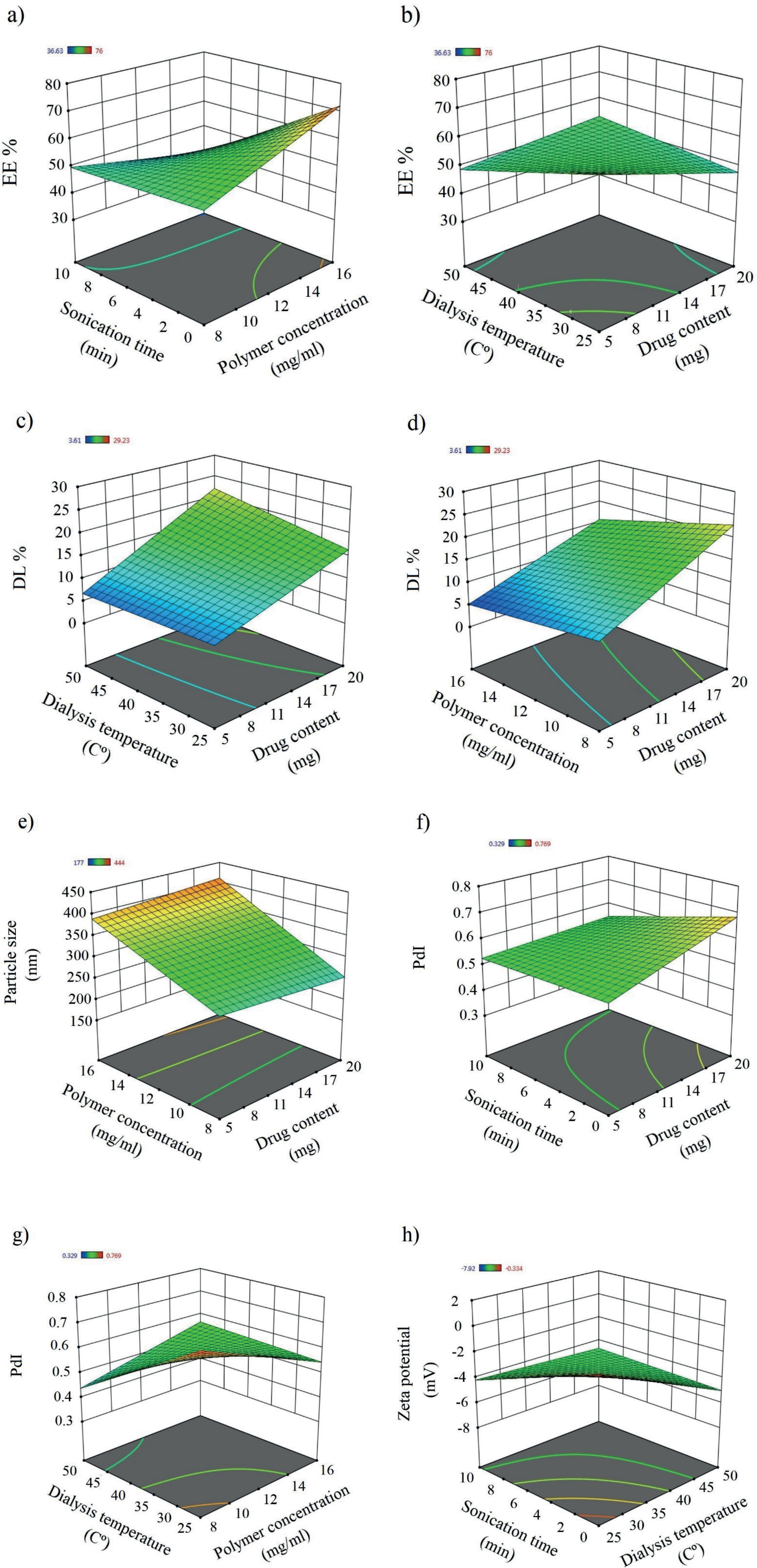
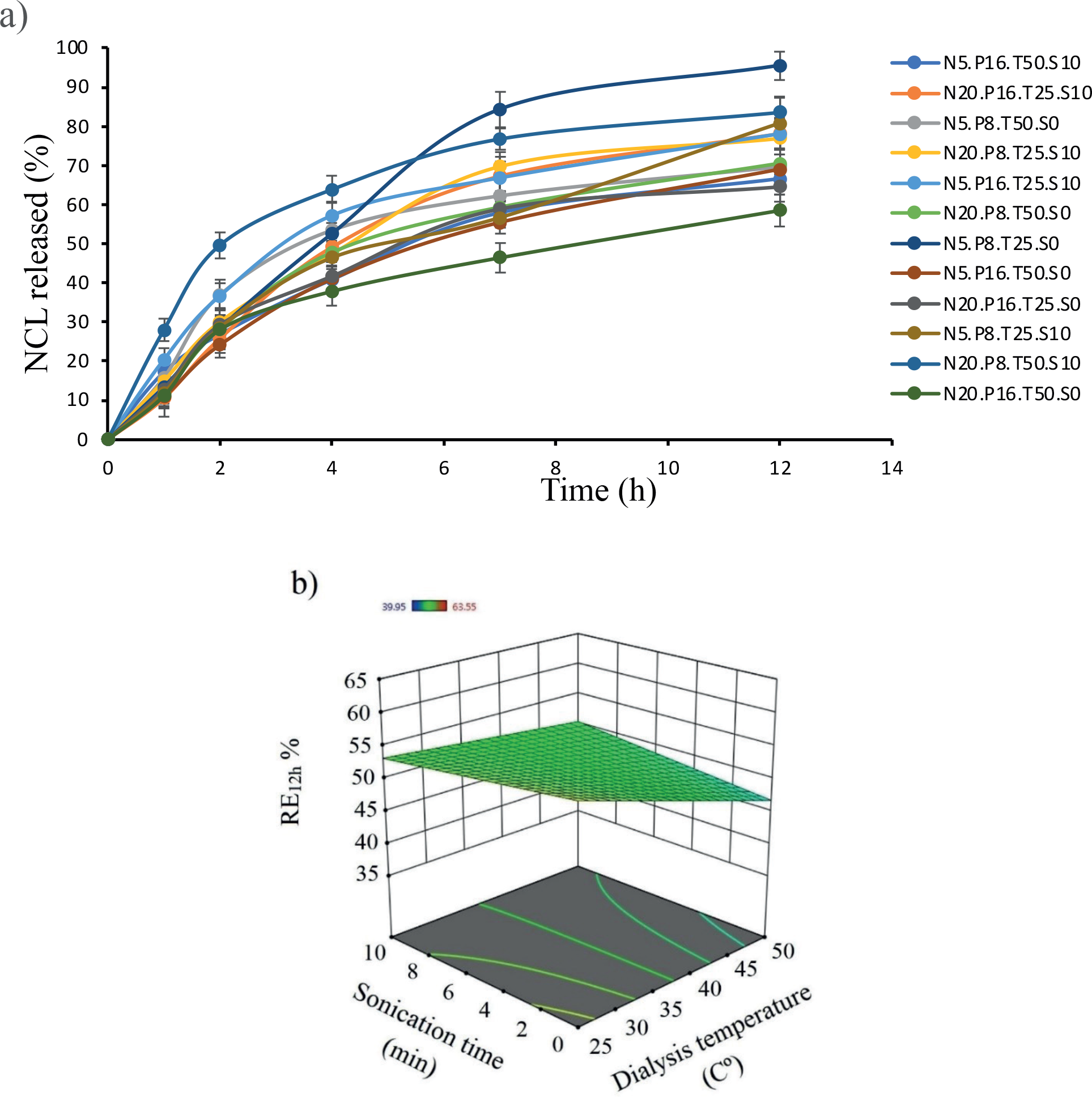
NCL-PM were prepared using the dialysis method. Table II displays the observed responses for the formulations. The effect of independent variables on the studied responses is shown in Figure 1, as generated by the Design Expert software. As indicated in Table II, the average particle size ranged from 177 to 444 nm and PdI varied from 0.33 to 0.77. The results showed that polymer concentration had a significant positive effect on PS. The ZP of PM, which ranged from -0.94 to -7.92 mv (Table II), was significantly influenced by dialysis temperature and sonication time. EE% for the prepared formulations ranged from 36.63 to 74.48 %, while DL% varied from 3.61% to 27.25%. For EE%, sonication time had the most significant effect, followed by drug content, polymer concentration, and dialysis temperature (p-value < 0.05). DL% was mostly influenced by drug content followed by polymer concentration, and dialysis temperature (p-value < 0.05). The in vitro release profiles of NCL from different formulations are displayed in Figure 2a. As shown in Table II, RE12h% varied from 39.95 and 64.86%, and it was significantly affected by dialysis temperature.
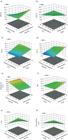
Response surface plots showing the effect of different variables on EE%, DL%, particle size, PdI, zeta potential, and RE12h % of NCL.
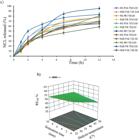
a) Release profiles of NCL from different studied formulations b) Effect of dialysis temperature on RE12h %
Optimization
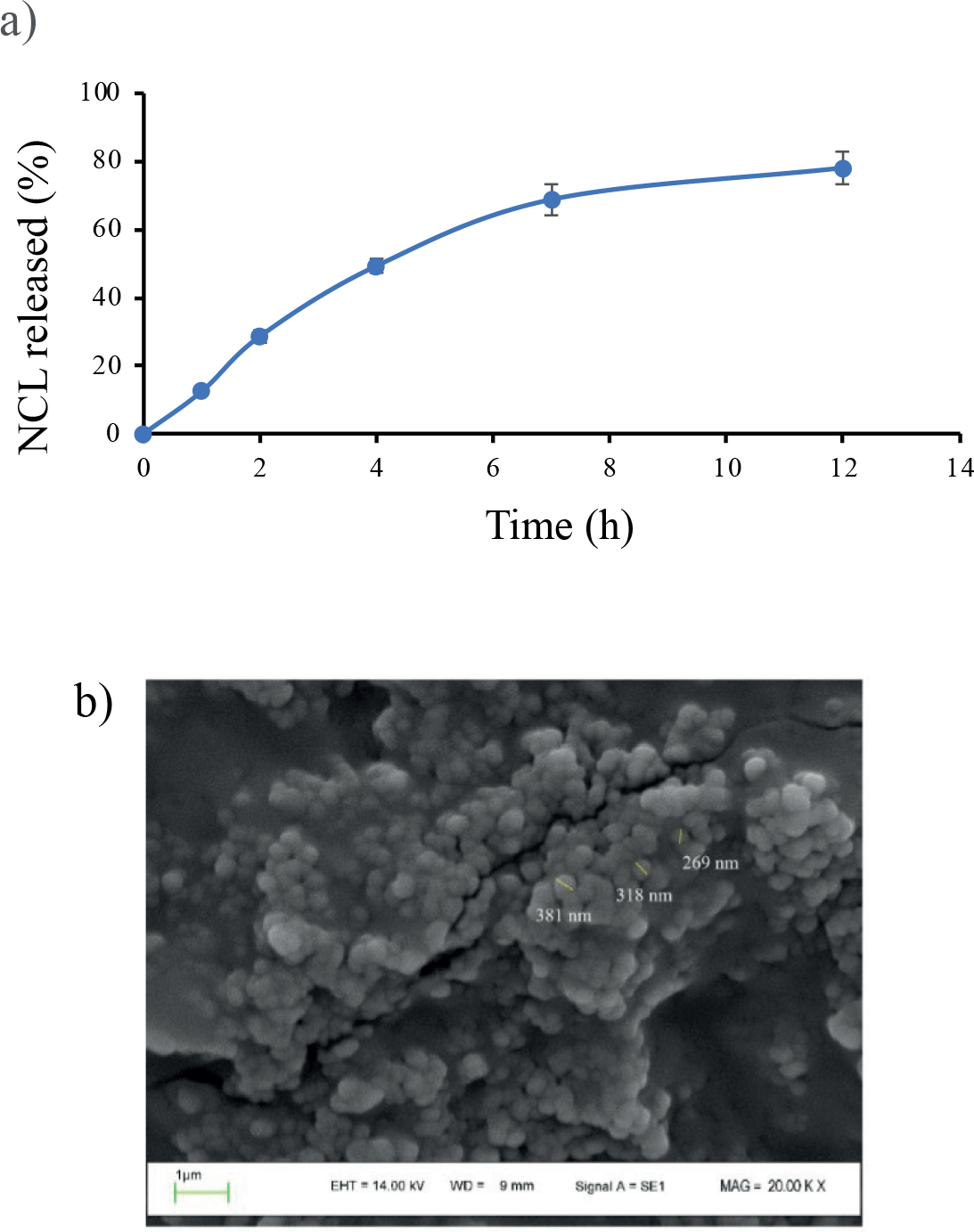
The Design Expert software was used to determine the optimal conditions for formulation preparation based on several measures; these included minimizing PdI and particle size and maximizing the absolute value of ZP, DL%, RE%, and EE%. The optimum levels for the NCL content, DEX-BA concentration, dialysis temperature, and sonication time were determined to be 18 mg, 8 mg/ml, 50°C, and 10 minutes, respectively. Table III summarizes both the observed physicochemical properties and the values predicted by the software, along with the corresponding error %. A low error % implied that the actual values of evaluated responses were in a good agreement with the predicted ones. This close agreement between predicted and actual values assured the validity of the optimization process. Figure 3a illustrates the release profile of NCL from the optimized PM. The release data from this formulation were evaluated using different kinetic models. The results are presented in Table IV. Based on the highest correlation coefficient observed, it was determined that the drug release behavior of the optimized formulation aligned with the Baker-Lonsdale kinetic model (R2 = 0.97). To interpret the drug release mechanism, the release data of the optimized nanomicelles were fitted to the Korsemeyer-Peppas model. According to this model, when n < 0.43, it indicates quasi-Fickian diffusion; when n = 0.43, it denotes Fickian diffusion. Finally, when 0.43 < n < 0.85, it signifies non-Fickian diffusion, characterized by a combination of diffusion and swelling control (Viswanadha, et al, 2024). Based on the Korsmeyer-Peppas model fitting, the obtained n value was about 0.75. This suggests that both polymer relaxation and diffusion significantly contribute to the drug transport from the nanomicelles. SEM images (Figure 3b) showed that the optimized PM were predominantly spherical, and their particle size closely matched those obtained from the zeta-sizer.
Correlation coefficient (R2) obtained from curve fitting of NCL release data from the optimized formulation
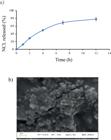
a) Release profile of NCL from the optimized PM b) SEM image of the optimized NCL-loaded PM.
XRD analysis
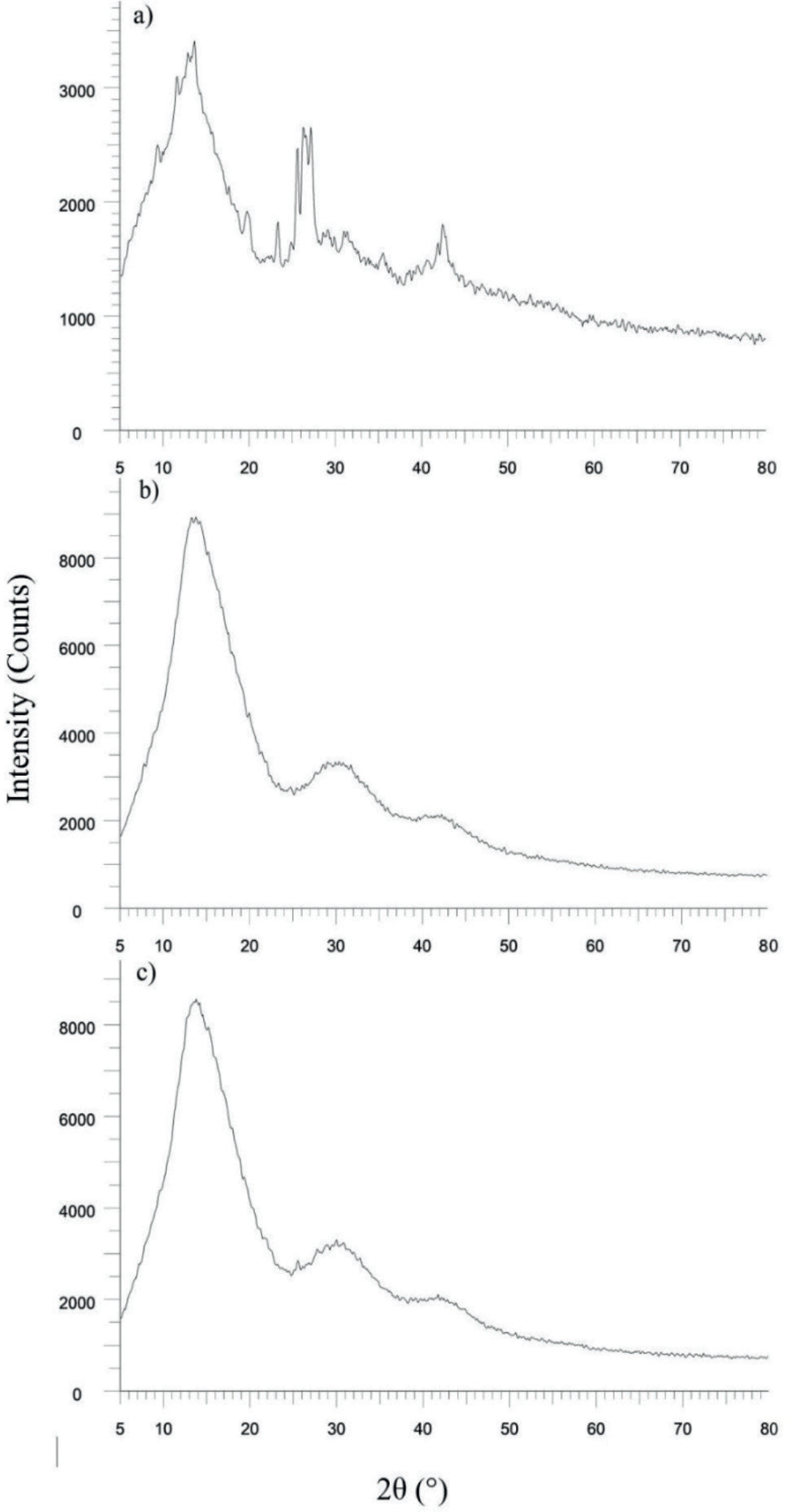
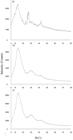
XRD analysis was conducted to determine the physical state of NCL in the nanomicelles. As depicted in Figure 4, NCL displayed sharp and distinct peaks at 2θ values of 13.5o and 19.7o, along with several weak diffraction peaks at 2θ values of 27.1o and 42.5o, thus signifying its crystalline nature in the solid state. The XRD pattern of DEX-BA nanomicelles revealed broad peaks, thus indicating an irregular and amorphous arrangement. Notably, the sharp peaks characteristic of NCL were not detected in the XRD pattern of NCL-PM. These results, therefore, suggest that NCL exists in a solid solution or amorphous state within the nanomicelles. A similar outcome was observed when itraconazole was loaded in DEX-BA nanomicelles (Shahriyar et al., 2021).
Aerosolization and flow properties of different NCL-loaded DPIs
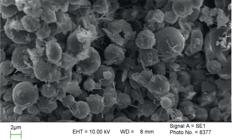
Table V lists the in vitro aerosol performance and physical properties of the DPI formulations. The Carr's index and Hausner ratio obtained ranged from 20.33 to 40.66 and 1.25 to 1.65, respectively. According to the flowability scale provided by the USP (USP, 2021b), powders with Hausner ratios between 1.26 to 1.34 and Carr's index values from 21 and 25 exhibit passable flow properties. Notably, the S2 formulation showed superior flowability, as compared to the other samples. The particle size measured by DLS ranged from 2.06 µm to 3.50 µm. ED% for nanocomposites was between 87.94 % to 95.12%, showing that substantial amounts of the powders were emitted from the device. As shown in Table V, the calculated FPF and MMAD for various DPI formulations ranged from 10.53 to 31.83% and from 2.61 µm to 3.93 µm, respectively. The lowest FPF and the highest MMAD were observed when mannitol was used as the sole carrier (p-value <0.05), whereas the mannitol and lactose mixture produced the highest FPF and the lowest MMAD (p-value <0.05). Based on the data shown in Table V, leucine did not significantly affect the aerosolization performance of co-spray dried NCL/lactose/mannitol particles (p-value>0.05). The S2 formulation, which utilized mannitol and lactose in a 1:1 ratio, was selected as the best-performing formulation for inhalation because of the best flow properties, the highest FPF and acceptable MMAD values (1-5 µm). The SEM image of co-spray dried NCL/lactose/mannitol particles is illustrated in Figure 5. The spray-dried particles exhibited microspherical shapes with a rough surface that could enhance their aerosolization properties (Pourshahab et al., 2011)
In vitro evaluation of antimicrobial activity
Table VI illustrates the diameter of the inhibition zone. As can be seen, when S. aureus was treated with different samples, both blank PM and DPIs containing blank PM showed no inhibitory effect on the growth of S. aureus, indicating their lack of activity against the bacteria. The antibacterial activity of all formulations containing NCL increased in a dose-dependent manner. At the higher concentration (60 µg/ml), the diameter of the inhibition zone in the NCL-PM group was signifi cantly larger, as compared to that of free NCL (p-value < 0.05). The size of the inhibition zone for NCL-PM DPI remained relatively unchanged (p-value > 0.05) following spray drying, thus indicating that the spray drying process does not adversely affect the properties of NCL-PM.
DISCUSSION
EE% in nanomicelles is affected by multiple factors, including the compatibility of the drug with the micelle core segment, the molecular volume of the drug, the composition and length of the core and shell-forming blocks, the concentration and physicochemical properties of the drug, the polymer concentration, and the physical state of the micellar core (Lavasanifar, Samuel, Kwon, 2002). In this study, it was observed that the higher concentrations of polymer led to an increase in EE% (Figure 1a). This observation is linked to the higher quantities of copolymer that can trap more drug with increased efficiency (Saadat et al., 2014). Conversely, as the amount of drug was increased, there was a downward trend in EE% (Figure 1b). This decline could be attributed to the capacity limit of the hydrophobic inner core for drug incorporation, with the amount of drug exceeding the capacity of the nanomicelle core. Similarly, Yamamoto et al. (2007) documented a decrease in the incorporation efficiency for camptothecin as its quantity was increased in micelles formed from partially benzyl-esterified poly(ethylene glycol)-b-poly(aspartic acid) copolymer. As depicted in Figure 1b, EE% exhibited a decline as the dialysis temperature was increased. This may be attributed to the enhanced diffusion rate of the drug into the aqueous media at higher temperatures (Yin, Bae, 2009). Additionally, sonication time negatively affected EE%, as shown in Figure 1a. This effect may be due to the excessive energy input causing the leakage of some encapsulated NCL from PM (Ding et al., 2009).
The samples exhibited DL ranging from 3.61 to 29.23%. As both drug amount and dialysis temperature were increased, DL% was also increased (Figure 1c). However, DL% was decreased when polymer concentration was increased (Figure 1d). This finding is consistent with equation 2, which shows an inverse correlation between DL% and polymer content.
PS is indeed a crucial factor influencing the intrapulmonary fate of drug carrier systems. An increase in particle size is associated with greater uptake by macrophages, with the highest uptake occurring in particles sizes between 1 to 5 µm. In contrast, particles smaller than 200 nm are not recognized by macrophages due to their small volume (Jin, et al, 2023)
The statistical analysis of size measurement showed a correlation between the increase in polymer concentration (DEX-BA) and the increase in PS, as illustrated in Figure 1e. This finding is well aligned with previous research, suggesting that the expansion of the micellar core occurs as more drug molecules are entrapped at higher polymer concentrations (Saadat et al., 2014). Moreover, the rise in the viscosity of the polymer solution hindered the mixing process due to a decrease in the diffusion coefficient. Consequently, the aggregation of unimers persisted for a longer duration, leading to the formation of larger PM (Capretto et al., 2012). This finding is consistent with the results obtained from the study by Capretto et al. ( 2012) .
PdI serves as a parameter indicating the degree of uniformity in particle size within a colloidal system. It ranges from 0 and 1, where a PdI value exceeding 0.7 suggests a very broad size distribution within the sample (Danaei et al., 2018). In our study, PdI ranged from 0.33 to 0.77. Statistical analysis also revealed that the NCL content positively influenced PdI, with higher values promoting the formation of more heterogeneous samples (Figure 1f). Conversely, increasing the dialysis temperature, sonication time, and polymer concentration resulted in smaller PdI values, leading to the formation of more homogenously distributed nanomicelles (Figure 1f and 1g). ZP, which serves as an indicator of the surface charge of particles, is crucial for assessing colloidal system stability. Beyond its influence on particle stability during storage, surface charge can affect their uptake by macrophages and mucociliary clearance in lungs. Increases in the uptake of negatively or positively charged particles have been reported alongside a corresponding rise in the magnitude of charge in either direction. It was observed that less negatively or positively particles were taken up less efficiently, as compared to those exhibiting a high negative or positive ZP. Furthermore, positively charged NPs tend to immobilize within the negatively charged mucus network due to electrostatic interaction. In contrast, neutral particles and those with lower negative charge are considered to penetrate the mucus more easily (Patel, Gupta, Ahsan, 2015; Liu, et al, 2020).
In our study, the mean ZP values ranged from -0.94 to -7.92 mV. The negative surface potential observed can be attributed to the presence of unreacted hydroxyl groups of dextran on the surface of the resulting nanomicelles (Sharma et al., 2014). Although ZP values greater than ± 30 mV are typically indicative of good stability against aggregation during storage, the low ZP observed in our study may not be considered a limitation. This is since the optimized nanomicelles were ultimately co-spray-dried with a sugar-based carrier and stored in a dry state, which could potentially mitigate any concerns related to stability (Emami et al., 2015). The results showed that increasing sonication time and dialysis temperature resulted in more negative ZP (Figure 1h). These changes paralleled those in EE%. As EE% in the micelles was increased, ZP was decreased, presumably due to the polymer's negative charge being neutralized by amine functional groups of NCL. Similar results were also demonstrated by Varshosaz et al. (2019). The release rate from the PMs depends on various factors, including the degradation rate and molecular weight of the polymer, crystallinity, micelle stability, rate of drug diffusion from the micelle core, and the affinity of the drug for the micelle core (Sunoqrot et al., 2020). As shown in Figure 2a, the NCL release pattern from PMs exhibited an initial burst release of the drug followed by a slower release. The initial burst release was related to the fraction of drug trapped in the hydrophilic outer shell and at the interface between the micelle core and the outer shell. The subsequent gradual release stemmed from the diffusion of the drug trapped within the core of the nanomicelles (Nasehi et al., 2019). Paclitaxel also showed a biphasic release pattern from folate-conjugated amphiphilic block copolymeric micelles (Park et al., 2005). To compare the release patterns of the different formulations, RE12h% was determined. The release rate from nanomicelles is directly correlated with RE. A greater value indicates a faster NCL release. As illustrated in Figure 2b, temperature had a negative effect on RE.
NCL-loaded nanocomposites were prepared using a spray drying technique to resolve the limitation of NPs for pulmonary delivery. The aerodynamic diameter of particle is a well-known factor affecting both the deposition site and amount of inhaled drug that settles in the lungs. The optimal aerodynamic diameter for achieving a desirable distribution in the lungs typically ranges from 1 to 5 µn. Particles with an aerodynamic diameter smaller than 0.5 µm are more likely to be exhaled, while those larger than 5 µn are more prone to deposition in the mouth/ nose, pharynx, and larynx ((Lin et al, 2015; Ezzati Nazhad Dolatabadi, Hamishehkar, Valizadeh, 2015). The impact of the carrier (mannitol, lactose and their combination) on the deposition profile of spray-dried powder containing NCL-PM was evaluated using the Andersen cascade impactor. It was observed that the powder containing mannitol showed the least amount of deposition in the lower stages of the Anderson cascade impactor and exhibited the highest MMAD, likely due to the increased cohesiveness of the spray-dried powder (Andya et al. 1999). Conversely, MMAD and FPF values of the formulation achieved through a combination of lactose and mannitol showed improvement, as compared to those of either mannitol or lactose alone. This indicates that spray drying lactose and mannitol together in a single solution can enhance the deposition of NCL in the lower airways of the lungs.
Assuming the successful delivery of the inhaled formulation to the lungs and penetration across extracellular barriers, the next challenge is inhibiting the growth of S. aureus. Our findings indicate that the NCL-PM group showed statistically significant bacterial growth inhibition compared with the free NCL group in high concentrations (60 µg/ml). This effect may be attributed to the enhanced diffusion and dispersion of NCL within the solid growth medium, as well as improved penetration of PM into the bacterial cell membrane due to the good mobility and small diameter of NCL-PM. This characteristic may facilitate its action despite the sustained-release behavior of NCL-PM (Wen et al., 2022). Similarly, in a study conducted by Morteza et al. (1 2019), the incorporation of piperacillin/tazobactam into PLGAPEG micelles resulted in a significant reduction in MIC.
CONCLUSIONS
NCL-loaded DEX-BA PM were successfully prepared using the dialysis method. It was observed that EE% and particle size increased with higher polymer concentrations. The in-vitro drug release profile of NCLPM also showed an initial burst release followed by a slow release. Our data, thus, suggested that temperature had negative effects on RE. The optimized formulation, which was created using 18 mg of NCL, 8 mg/ml of copolymer, sonication time of 10 min, and dialysis temperature of 50o C, was transformed into a dry powder through spray drying. The highest FPF% and acceptable MMAD were obtained when mannitol and lactose were utilized as a carrier in a 1:1 ratio. Subsequently, an in vitro study against S. aureus was conducted, revealing the efficacy of our DPI formulation in inhibiting S. aureus growth in vitro. However, further investigations are required to evaluate formulation stability and explore the potential for therapeutic applications in vivo.
DATA AVAILABILITY STATEMENT
All data is available within the article.
REFERENCES
- Andya JD, Maa YF, Costantino HR, Nguyen PA, Dasovich N, Sweeney TD, et al. The effect of formulation excipients on protein stability and aerosol performance of spray-dried powders of a recombinant humanized anti-IgE monoclonal antibody. Pharm Res. 1999;16(3):350-8.
- Andrade F, das Neves J, Gener P, Schwartz Jr S, Ferreira D, Oliva M, Sarmento B. Biological assessment of self-assembled polymeric micelles for pulmonary administration of insulin. Nanomedicine. 2015;11(7):1621-31.
- Ezzati Nazhad Dolatabadi J, Hamishehkar H, Valizadeh H. Development of dry powder inhaler formulation loaded with alendronate solid lipid nanoparticles: solid-state characterization and aerosol dispersion performance. Drug Dev Ind Pharm. 2015;41(9):1431- 1437
- Cabrita I, Benedetto R, Schreiber R, Kunzelmann K. Niclosamide repurposed for the treatment of inflammatory airway disease. JCI Insight. 2019;4(15).
- Capretto L, Mazzitelli S, Brognara E, Lampronti I, Carugo D, Hill M, et al. Mithramycin encapsulated in polymeric micelles by microfluidic technology as novel therapeutic protocol for beta-thalassemia. Int J Nanomedicine. 2012;7:307-24.
- Chan HW, Chow S, Zhang X, Zhao Y, Tong HHY, Chow SF. Inhalable Nanoparticle-based Dry Powder Formulations for Respiratory Diseases: Challenges and Strategies for Translational Research. AAPS PharmSciTech. 2023;24(4):98.
- Danaei M, Dehghankhold M, Ataei S, Hasanzadeh Davarani F, Javanmard R, Dokhani A, et al. Impact of Particle Size and Polydispersity Index on the Clinical Applications of Lipidic Nanocarrier Systems. Pharmaceutics. 2018;10(2).
- Ding B, Xia S, Hayat K, Zhang X. Preparation and pH Stability of Ferrous Glycinate Liposomes. J Agric Food Chem. 2009;57(7):2938-44.
- Emami J, Pourmashhadi A, Sadeghi H, Varshosaz J, Hamishehkar H. Formulation and optimization of celecoxib-loaded PLGA nanoparticles by the Taguchi design and their in vitro cytotoxicity for lung cancer therapy. Pharm Dev Technol. 2015;20(7):791-800.
- Gill KK, Nazzal S, Kaddoumi A. Paclitaxel loaded PEG5000-DSPE micelles as pulmonary delivery platform: formulation characterization, tissue distribution, plasma pharmacokinetics, and toxicological evaluation. Eur J Pharm Biopharm. 2011; 79(2) : 276-284.
- Hu X, Yang FF, Quan LH, Liu CY, Liu XM, Ehrhardt C, Liao YH. Pulmonary delivered polymeric micelles- pharmacokinetic evaluation and biodistribution studies. Eur J Pharm Biopharm.2014;88(3):1064-75
- Jin Z, Gao Q, Wu K, Ouyang J, Guo W, Liang XJ. Harnessing inhaled nanoparticles to overcome the pulmonary barrier for respiratory disease therapy. Adv Drug Deliv Rev. 2023:115111
- Klinger-Strobel M, Lautenschläger C, Fischer D, Pletz M, Mainz J, Bruns T, et al. Aspects of pulmonary drug delivery strategies for infections in cystic fibrosis - where do we stand? Expert Opin Drug Deliv. 2015;12(8):1351-74.
- Liu Q, Guan J, Qin L, Zhang X, Mao S. Physicochemical properties affecting the fate of nanoparticles in pulmonary drug delivery. Drug Discov. Today. 2020;25(1):150-9
- Lavasanifar A, Samuel J, Kwon GS. Poly(ethylene oxide)-block-poly(L-amino acid) micelles for drug delivery. Adv Drug Deliv Rev. 2002;54(2):169-90.
- Lin YW, Wong J, Qu L, Chan HK, Zhou Q. Powder production and particle engineering for dry powder inhaler formulations. Curr Pharm Des. 2015;21(27):3902-16.
- Morteza M, Roya S, Hamed H, Amir Z, Abolfazl A. Synthesis and evaluation of polymeric micelle containing piperacillin/tazobactam for enhanced antibacterial activity. Drug Deliv. 2019;26(1):1292-9.
- Nasehi N, Varshosaz J, Taymouri S, Rostami M, Akbari V, Firoozpour L. Sorafenib loaded pluronic F127lithocholic acid micelles for prostate cancer therapy: formulation, optimization, and in vitro evaluation against LNCaP cells. Int J Polym Mater. 2019;69(3): 158-172
- Patel B, Gupta N, Ahsan F. Particle engineering to enhance or lessen particle uptake by alveolar macrophages and to influence the therapeutic outcome. Eur J Pharm Biopharm. 2015; 89:163-74.
- Park EK, Kim SY, Lee SB, Lee YM. Folate-conjugated methoxy poly(ethylene glycol)/poly(epsiloncaprolactone) amphiphilic block copolymeric micelles for tumor-targeted drug delivery. J Control Release. 2005;109(1-3):158-68.
- Pourshahab PS, Gilani K, Moazeni E, Eslahi H, Fazeli MR, Jamalifar H. Preparation and characterization of spray dried inhalable powders containing chitosan nanoparticles for pulmonary delivery of isoniazid. J Microencapsul. 2011;28(7):605-13.
- Rajamuthiah R, Fuchs BB, Conery AL, Kim W, Jayamani E, Kwon B, et al. Repurposing Salicylanilide Anthelmintic Drugs to Combat Drug Resistant Staphylococcus aureus. PLOS ONE. 2015;10(4):e0124595.
- Saadat E, Amini M, Khoshayand MR, Dinarvand R, Dorkoosh FA. Synthesis and optimization of a novel polymeric micelle based on hyaluronic acid and phospholipids for delivery of paclitaxel, in vitro and invivo evaluation. Int J Pharm. 2014;475(1):163-73.
- Scherließ R, Janke J. Preparation of Poly-LacticCo-Glycolic Acid Nanoparticles in a Dry Powder Formulation for Pulmonary Antigen Delivery. Pharmaceutics. 2021;13(8).
- Shahriyar S, Taymouri S, Saberi S, Asadi P, Tabbakhian M. Preparation and characterization of itraconazole loaded nanomicelles based on dextran-behenic acid for cutaneous leishmaniasis treatment. Drug Dev Ind Pharm. 2021;47(3):416-28.
- Sharma D, Maheshwari D, Philip G, Rana R, Bhatia S, Singh M, et al. Formulation and optimization of polymeric nanoparticles for intranasal delivery of lorazepam using Box-Behnken design: in vitro and in vivo evaluation. Biomed Res Int. 2014;2014:156010.
- Sunoqrot S, Alfaraj M, Hammad AM, Kasabri V, Shalabi D, Deeb AA, et al. Development of a Thymoquinone Polymeric Anticancer Nanomedicine through Optimization of Polymer Molecular Weight and Nanoparticle Architecture. Pharmaceutics. 2020;12(9).
- Triolo D, Craparo EF, Porsio B, Fiorica C, Giammona G, Cavallaro G. Polymeric drug delivery micellelike nanocarriers for pulmonary administration of beclomethasone dipropionate. Colloids Surf B Biointerfaces. 2017;151:206-14.
- Topal GR, Devrim B, Eryilmaz M, Bozkir A. Design of ciprofloxacin-loaded nano-and microcomposite particles for dry powder inhaler formulations: preparation, in vitro characterisation, and antimicrobial efficacy. J Microencapsul. 2018;35(6):533-47.
- USP. Bulk density and tapped density of powders. Rockville, MD: United States Pharmacopeial Convention; 2021a.
- USP. Powder Flow. Rockville, MD: United States Pharmacopeial Convention; 2021b.
- Viswanadha LS, Arcot Y, Lin YT, Akbulut ME. A comparative investigation of release kinetics of paclitaxel from natural protein and macromolecular nanocarriers in nanoscale drug delivery systems. JCIS Open. 2024;15:100120.
- Varshosaz J, Sadri F, Rostami M, Mirian M, Taymouri S. Synthesis of pectin-deoxycholic acid conjugate for targeted delivery of anticancer drugs in hepatocellular carcinoma. Int J Biol Macromol. 2019;139:665-77.
- Wen Y, Song Z, Xu H, Feng S, Zhu L, Teng F, Feng R. Azithromycin-loaded linolenic acid-modified methoxy poly(ethylene glycol) micelles for bacterial infection treatment. Drug Deliv Transl Res. 2022;12(3):550-61.
- Yamamoto T, Yokoyama M, Opanasopit P, Hayama A, Kawano K, Maitani Y. What are determining factors for stable drug incorporation into polymeric micelle carriers? Consideration on physical and chemical characters of the micelle inner core. J Control Release. 2007;123(1):11-8.
- Ye Y, Zhang X, Zhang T, Wang H, Wu B. Design and evaluation of injectable niclosamide nanocrystals prepared by wet media milling technique. Drug Dev Ind Pharm. 2015;41(9):1416-24.
- Yin H, Bae YH. Physicochemical aspects of doxorubicinloaded pH-sensitive polymeric micelle formulations from a mixture of poly(L-histidine)-b-poly(ethylene glycol)/ poly(L-lactide)-b-poly(ethylene glycol) [corrected]. Eur J Pharm Biopharm. 2009;71(2):223-30.
Edited by
-
Associate Editor:
Carlota Rangel-Yagui de Oliveira