 DIGITAL MEDIA AND GENDER EQUALITY IN SPORT: an approach to polarization through the media coverage of Rafael Nadal’s interview on the El Objetivo show
ABSTRACT
This case study analyzes the 17 news items published in the Spanish digital press following the interview with Rafael Nadal on the El Objetivo show on 14 February 2024. The aim is to determine whether the ideology of the media and the gender of the authors of the news items influence the treatment of the news items published, even in cases involving well-known figures. The study suggests that there is indeed a bias based on ideological (media) and gender (author) issues when addressing topics related to gender equality or feminism, which may lead to other issues being overlooked and generate a distortion of the public image of even a figure of global relevance. The case study has allowed for a more in-depth analysis of the protagonist’s statements and how they have been interpreted through the news published in the five most widely circulated general newspapers and the four sports newspapers.
Keywords
Sports journalism; Equal pay; Polarization; Feminism; Sport
RESUMO
Este estudo de caso analisa as 17 notícias publicadas na imprensa digital espanhola após a entrevista de Rafael Nadal no programa El Objetivo, em 14 de fevereiro de 2024. O objetivo é determinar se a ideologia dos meios de comunicação e o gênero dos autores das notícias influenciam o tratamento informativo das matérias publicadas, mesmo em casos envolvendo figuras de reconhecida reputação. O estudo sugere que há, de fato, um viés tanto ideológico (do meio de comunicação) quanto de gênero (do autor) quando se abordam temas relacionados à igualdade de gênero ou ao feminismo, podendo ignorar outras questões e gerar uma distorção da imagem pública, mesmo de uma personalidade de relevância mundial no esporte, como Rafael Nadal. O estudo de caso permitiu uma análise mais profunda das declarações do protagonista e de como foram interpretadas através das notícias publicadas nos cinco principais jornais generalistas e nos quatro jornais esportivos.
Palavras-chave
Jornalismo esportivo; Igualdade salarial; Polarização; Feminismo; Esporte
RESUMEN
Este caso de estudio analiza las 17 noticias publicadas en la prensa digital española tras la entrevista a Rafael Nadal en el programa El Objetivo el 14 de febrero de 2024. El objetivo es determinar si la ideología de los medios y el género de los firmantes de las noticias influyen en el tratamiento informativo de las noticias publicadas, incluso en casos de personajes de reconocida reputación. El estudio sugiere que sí se produce un sesgo por cuestiones ideológicas (medio) y de género (autor) cuando se abordan temas relacionados con la igualdad de género o el feminismo, pudiendo obviarse otras cuestiones y generando una distorsión de la imagen pública incluso de una figura de relevancia mundial. El estudio de caso ha permitido un análisis más profundo de las declaraciones del protagonista y cómo han sido interpretadas a través de las noticias publicadas en los cinco diarios generalistas de mayor tirada y de los cuatro diarios deportivos.
Palabras clave
Periodismo deportivo; Igualdad salarial; Polarización; Feminismo; Deporte
1 Introduction
This research aims to analyze how Spain’s major newspapers covered Rafael Nadal’s interview on one of the country’s most prominent television channels. Many of the most significant sporting milestones in Spanish history cannot be understood without reference to the figure of the former tennis player. With more than two decades of professional experience, Nadal has been recognised as one of the leading figures in Spanish sport and one of the best tennis players in the world (Calvo, 2024; Mayone, 2024). He has won more than a hundred titles, ninety-two of which are individual titles, including 22 Grand Slams divided as follows: two Australian Opens, 14 Roland Garros, two Wimbledons and four US Opens. This places the Spanish athlete second in the ranking for most Grand Slams, behind only Novak Djokovic, who holds 24. Rafael Nadal’s career is not only successful at the individual level; he has also represented Spain in three Olympic Games and has distinguished himself in two of them, winning gold medals at the 2008 Beijing and 2016 Rio de Janeiro Olympics (Olympics, 2024).
Having received numerous accolades and positive recognition for his achievements both on and off the court over the past two decades, the former professional tennis player gave an interview to the Spanish television channel La Sexta on the show El Objetivo in February 2024. Among the various topics discussed during the interview, feminism and equal pay for men and women in sport were the issues that generated the greatest public response. In particular, the following excerpt from the interview was the one that provoked the strongest reactions in the media and on social networks: “What I don’t like is being hypocritical and saying things that are easy to say, but I don’t really mean, Ana. Investment in women’s tennis? For me, it should be the same as for men. Opportunities? The same. As for salaries, should they be the same? No. That’s not unfair. What’s unfair is the lack of equal opportunities”. Due to these statements, it is necessary to investigate whether the news articles published by different newspapers about the Spanish athlete’s statements were critical and polarising or merely informative. It is also pertinent to analyze whether the coverage varies according to each newspaper’s ideological orientation, particularly in relation to tone, framing and headlines.
2 Theoretical background
Over the last few decades, numerous case studies have examined media coverage of socially significant events, including political or war-related issues. However, the areas of research are highly diverse, one of the most recent being the global health crisis caused by covid-19. This topic has been the subject of extensive research, particularly through analyzes of front pages and coverage in Spain’s most widely read newspapers, excluding sports media, during the months before and after the state of alarm (Cuéllar & Martín-Pena, 2020; Núñez et al., 2020; Sánchez et al., 2020). Other studies focused on quantifying headlines in the months following the declaration of the state of emergency with covid-19 as the main theme, as in the case of Merola Teixidó and Percastre-Mendizábal (2024). Content analysis is one of the techniques used by various authors with the aim of “obtaining a summary of the characteristics of a set of messages” (Igartua, 2006, p. 184). Some of the elements on which this analysis focused were the infographics published in the press and their use to report on the covid-19 crisis, in which the factor of proximity prevailed, as did the sources consulted, which were mostly public bodies (Salvat Martinrey & Aranda Martínez, 2020).
Issues of a military nature continue to be the focus of numerous academic studies. The recent conflict between Ukraine and Russia has attracted considerable media interest, capturing the attention of newspapers, radio stations and television channels, which have expanded their coverage of this issue at the expense of other current affairs. A study carried out by Valencia (2024) provides an exhaustive analysis of the content offered by two prominent Spanish media outlets, ElPais.com and ElDiario.es, both of which are characterised by a similar ideology.
The analysis focuses on the coverage provided by these media outlets of two conflicts of international relevance and similar duration: the war in Ukraine and the war in Yemen. This approach is particularly relevant because both humanitarian crises coincided in time, thus allowing for a comparison of the media treatment they received from these outlets. The results of the study revealed significant similarities in the way ElPais.com and ElDiario.es approached and presented information on both conflicts (Valencia, 2024).
The same is true at the international level. Arcangeletti and Zunino (2023) also conducted a study on the coverage of the conflict between Ukraine and Russia by the four most widely consumed digital media outlets in Argentina. Their research focused on the dominant frames in this coverage. Chernov (2023) also opted for a study using the framing technique, taking as reference cases the American media outlet CNN and the Russian news source Gazeta.ru in order to determine the differences between the two news media.
Political issues at the national and international level have not gone unnoticed by the research community either. In Spain, a large percentage of news coverage has consisted of analyzes, carried out by the major newspapers with the largest readerships, according to the General Media Study for the year in question. One of the most politically tense moments, the wounds of which have still not healed, was in 2015 and the process of independence in Catalonia. Moragas-Fernández and Capdevila Gómez (2017) conducted a study of the news coverage of newspapers such as LaVanguardia.com, ElPais.com and ElMundo.es, intending to discover the use of metaphor in the various news and opinion articles published by these media outlets. This approach allowed them to investigate the discursive strategies used by the media to address and represent the complex political framework surrounding the Catalan independence process (Moragas-Fernández & Capdevila, 2017).
Other researchers, such as Barbeito Veloso et al. (2020), examined another variable within the news coverage in the Spanish print and digital press during the 2019 election campaign, namely the reputation of these media outlets and the public’s perception of them. In this research, as in previous studies, audience ratings provided by the Estudio General de Medios (General Media Study) were used as the criterion for selecting the newspapers to be studied.
In the case of international politics, the US presidential elections tend to dominate the headlines and front pages of the media worldwide. Cartes-Barroso (2022) analyzed the coverage of the 2020 US elections in the front pages of various Spanish general news media in order to determine how the information was presented in those front pages.
Focusing now on the topic underpinning this research on news coverage, sport has also been the subject of numerous studies. With a wide variety of case studies, the trend in recent years, in which great effort and attention have been placed, has been the role of women in sport and its relevance in different news coverage.
The 2012 Olympic Games were a major turning point for women in sport, thanks to the great achievements of several Spanish athletes who surpassed the successes of their male counterparts. Sanz-Garrido (2020) initiated a study with the aim of examining the media coverage given to female athletes during the 2012 and 2016 Olympic Games, as well as the level of interest generated by the sporting successes of these athletes. This research was based on an analysis of the headlines published in the newspaper Marca. com, providing a detailed overview of the media coverage of Spanish female athletes at these two key Olympic events.
The 2016 Olympic Games in Rio de Janeiro were also the focus of new research, as in the case of Barbero González (2017), who conducted a quantitative and qualitative study on the news items about women published during those Olympic Games and the impact that the athletes had in the daily newspaper ABC.es, which was chosen for the case study. The results showed that the interest of the ABC.es newspaper in the achievements of Spanish female athletes increased considerably, although without highlighting the number of medals won by the athletes.
In the case of Sainz-De-Baranda Andújar et al. (2019), research was conducted on sports such as canoeing and badminton, both considered minority sports. In this qualitative and quantitative study, the content of news items appearing in the newspaper Marca.com, which mainly covers sports, and the newspaper ElPais.com, which covers general news, was analyzed between the 2012 and 2016 Olympic Games. The case of golf was also the focus of a study by Fernández Fernández and Martínez Pastor (2016), whose objective was to identify the different digital newspaper headlines related to golf and to create a classification of the topics covered by those headlines.
In the field of tennis, the sport covered by this study, it is necessary to focus on television rather than the press, given the limited number of studies carried out by the written press. Calvo Ortega and Gutiérrez San Miguel (2017) conducted a study focusing on the framing used in news broadcasts by the main Spanish television channels regarding Garbiñe Muguruza’s victory at Roland Garros, where the results showed limited success in their choice of frames, many of which adopted a condescending tone.
As evidenced by the existing scientific literature, most analyzes and research have traditionally focused on the written press and digital newspapers, examining the treatment of a variety of current affairs topics by these media. However, television has emerged as a prominent area of interest for the research community, as highlighted by Sotelo (2024), given its continuing impact on society.
When analyzing television news coverage, research tends to focus on several key aspects, such as comparisons between channels in terms of framing, agenda-setting and editorial stance. In the case of Sotelo (2024), he took the above as a reference based on the election results of 28 March 2023 and the announcement of early elections. The representation of women in sports has also been the subject of interest in the study of television news coverage, especially with regard to the achievements of female athletes. Ortega and San Miguel (2016) examined how women’s sporting successes are reported on television and compared media coverage of both genders to determine the prevalence of male and female presence in the television media. On the other hand, Gallardo Parrón and Montes Vozmediano (2015) carried out an analysis of how different media outlets report on sporting events depending on whether or not they owned the broadcasting rights.
As a result of efforts by public institutions and sports organisations to raise the profile and the professionalism of women’s sport in Spain and elsewhere, numerous studies examined how the media cover women’s sport (Azurmendi & Murua, 2020). Abajo et al. (2020) point out that, despite this drive, the agendas of many media outlets still tend to give more visibility to men’s sports than women’s, especially when it comes to one of the most popular sports, football. The analysis carried out by Navarro and Roca (2020) confirms this trend by showing that the appearance of female athletes on the front pages of two of Spain’s leading sports newspapers, Marca.com and AS.com, is practically negligible, with only five appearances compared to thirty for men over the course of a month.
Focusing on another important aspect of this study, namely polarization, this concept has become widespread and popular in recent years. It has gone from being a term used only in the field of science to being part of the everyday vocabulary of many politicians and journalists today. Such is the level of use that, according to the Fundación del Español Urgente, the word polarization was the most used in Spain in 2023 (FundéuRAE, 2023). Referring to its use in the social sciences, it refers to the division that exists between individuals and groups on cultural, political or religious issues, among many others (Barreda, 2021). Authors such as Teruel outline the current level of polarization in Spain, focusing on how prominent political figures and the media align themselves to construct a framework for dialogue that, far from encouraging the exchange of ideas, promotes confrontation and tension between the different entities involved (Teruel, 2016).
Polarization is a concept that has been intrinsic to democratic societies for years, and concern and relevance have increased recently, linked to global issues such as the environment (Suárez-Álvarez et al., 2025). Thus, the tensions and confrontations generated by polarization are not only found among citizens but are also used as a political tool to create division with the intention of discrediting the moral legitimacy of opponents, making the vision of one group the only valid one – “us against them” – (McCoy, 2022). Such is the significance of polarization that studies suggest, in some cases, a relationship between fake news and polarization (Colussi et al., 2025; Subiela Hernández et al., 2023; Vicario et al., 2019).
The phenomenon of polarization tends to manifest itself in different ways, and its impact on society can be observed through the following subcategories:
-
Polarization among elites, where political leaders adopt increasingly extreme positions (Hetherington, 2001).
-
Popular polarization, characterised by citizens who align themselves with radically opposing ideological positions (Abramowitz & Saunders, 2008).
-
Emotional polarization, in which disagreement transcends the ideological sphere and turns into animosity towards those who represent the opposing side (Iyengar et al., 2018).
One of the key aspects to highlight in this section is media polarization, a phenomenon that has been widely studied by the research community in recent years. Its relevance lies in the impact that the media has on public opinion, whose rise in the 20th century transformed the public sphere. This type of polarization shares similarities with the forms described above, as the media, in many cases, adopt extreme and biased positions in their reporting and in the dissemination of their own opinions. This dynamic can significantly influence public perception, generating changes in the way events and public debate are interpreted (Berrocal-Gonzalo et al., 2023).
It is also essential to focus attention on the public. Sunstein (2017) points out that polarised media act as magnets for audiences who share similar views. This leads to greater consumption of biased news by these groups, which, in turn, increases their exposure to information and opinions that reinforce their pre-existing beliefs, thus contributing to the phenomenon of polarization.
3 Objectives and hypotheses
Based on a content analysis of publications in the Spanish digital press of an interview with Rafael Nadal (La Sexta, El Objetivo, 14 February 2024), the main objective of this study is to determine whether there are patterns associated with the polarization surrounding this topic.
The specific objectives are to:
-
Determine the tone of the texts published by each of the selected media outlets.
-
Examine the framing of the articles in order to determine whether it is related to their tone.
-
Assess whether gender is a determining factor in the stance (for or against) related to polarization.
-
Verify whether the ideological orientation of the media is a determining factor in the perception of polarization.
In line with these objectives, the following hypotheses are proposed:
-
H1: The ideological stance of newspapers prevails over rhetorical aspects such as appeals to authority.
-
H2: The political spectrum in which a news item is positioned acts as a conditioning factor in polarization.
-
H3: The author’s gender may influence the tone of the article and function as a polarising element of the audience.
4 Methodology
This study focuses on content analysis applied to news coverage of statements made by tennis player Rafael Nadal on El Objetivo, broadcast on the Spanish television channel La Sexta. According to Igartua (2006), content analysis is key “to understanding its genesis or formation process, obtaining accurate descriptions of its structure, analyzing its flow of exchange, tracing its evolution and inferring its impact” (Igartua, 2006, p. 180).
The study focused on the five leading generalist newspapers with the highest circulation at the national level in Spain during 2023 (ElPais.com, ElMundo.es, LaVanguardia.com, ABC.es and LaRazon.es) and the four most relevant sports newspapers (Marca. com, AS.com, MundoDeportivo.com and Sport.es), according to data from Asociación para la Investigación de Medios de Comunicación (AIMC) (2024) in its digital version, including the entire population of relevant articles.
The period analyzed was between 14 February and 15 March 2024 through the My News tool. This tool allows users to search for news in the print and digital versions of the selected newspapers. The choice of this time interval is justified because it covers the period from the date of the interview’s broadcast to the four weeks following it, during which the event significantly influenced the newspapers’ coverage.
4.1 Coding manual
To carry out this analysis, a coding manual was developed, consisting of four dimensions, which together comprise 19 variables, each with its respective categories. Dimensions are defined as conceptual domains guiding the structure of the research (Bardin, 2011). Lafuente-Ibáñez and Marín-Egoscozábal (2008) describe variables as “observable qualities, properties or features of the elements of scientific study” (Lafuente-Ibáñez & Marín-Egoscozábal, 2008, p. 8). Finally, categories allow the descriptive analysis to be organized (Rivas Tovar, 2016).
5 Results
The results obtained after using qualitative and quantitative techniques supported by the coding manual are shown below.
5.1 Dimension I: identification
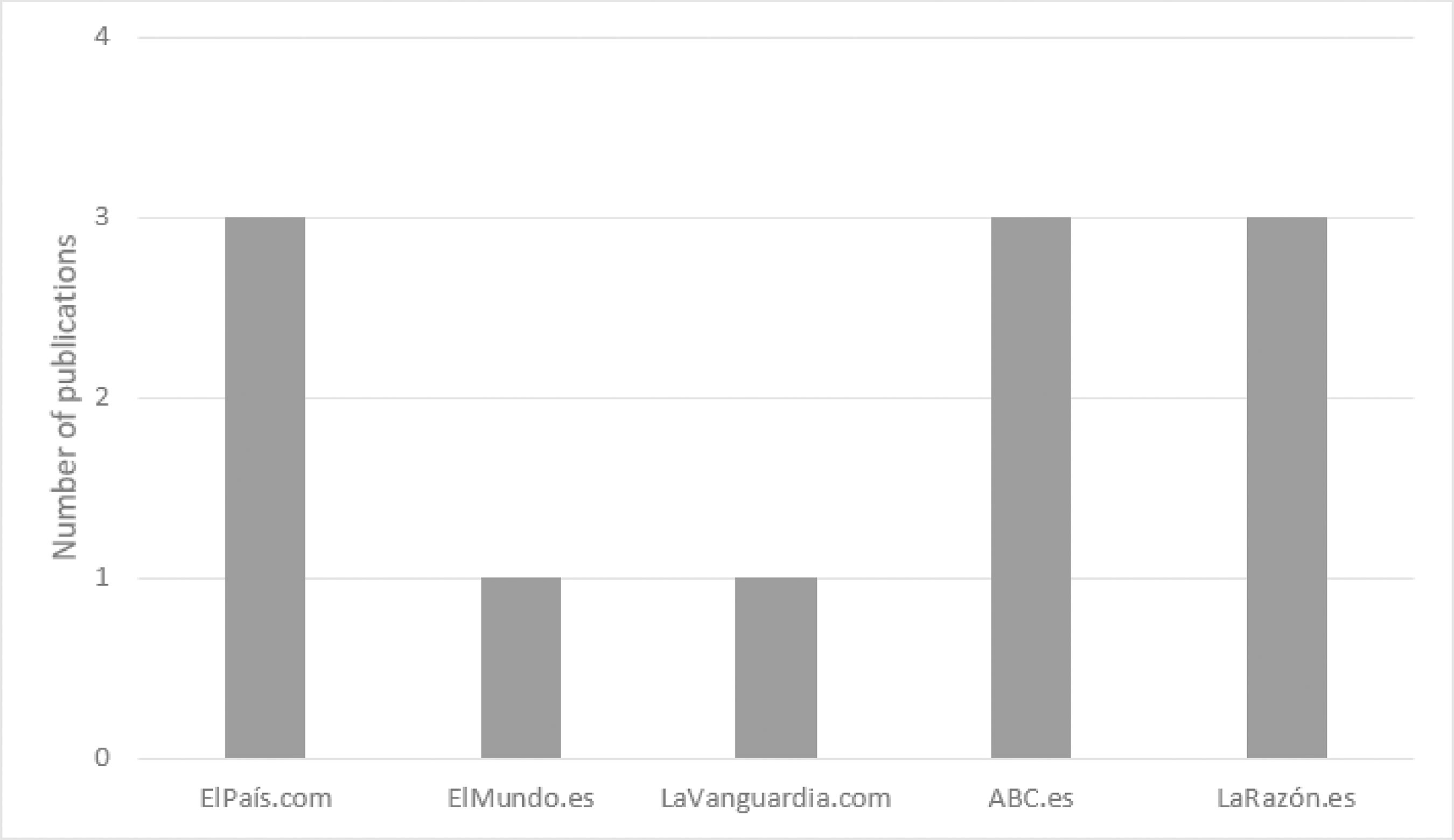
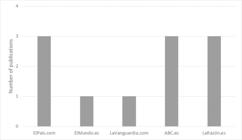
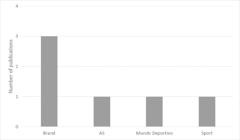
Regarding the identification dimension, which encompasses the variables type of newspaper, newspaper and newspaper’s ideology, it is noteworthy that the number of news items published in the press related to Rafael Nadal’s statements on feminism and equal pay in sport was concentrated mainly on the day after the interview was broadcast. As can be seen in figure 1, among the generalist newspapers, ElPaís.es, LaRazón.es and ABC.es published a total of three news items on the former tennis player’s statements. In the cases of ElMundo.es and LaVanguardia.com, only one article was produced on the subject of this study.
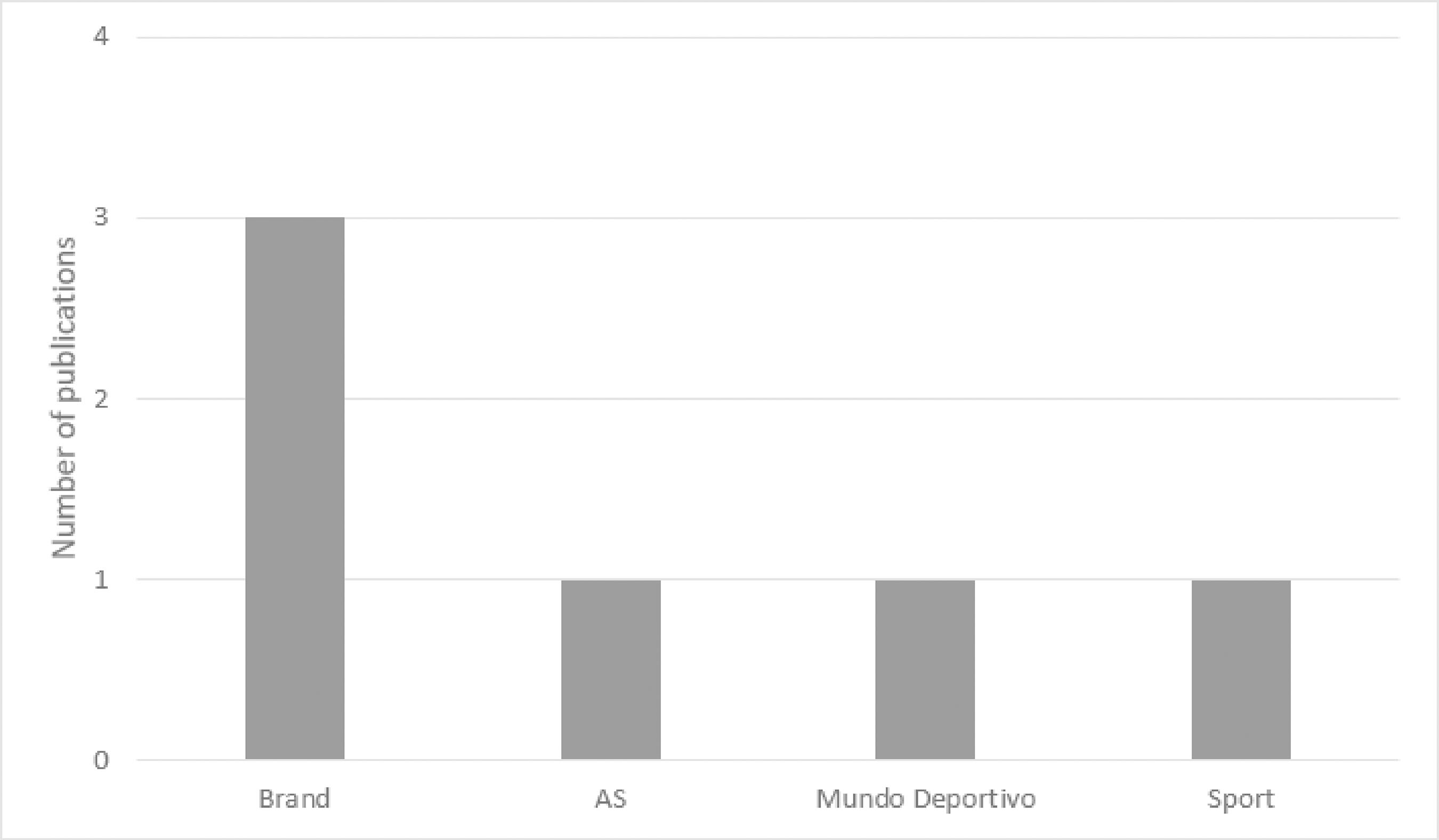
Sports newspapers showed similar patterns. Marca.com published the highest number of articles with three, while AS.com, MundoDeportivo.com and Sport.es published one article each (figure 2).
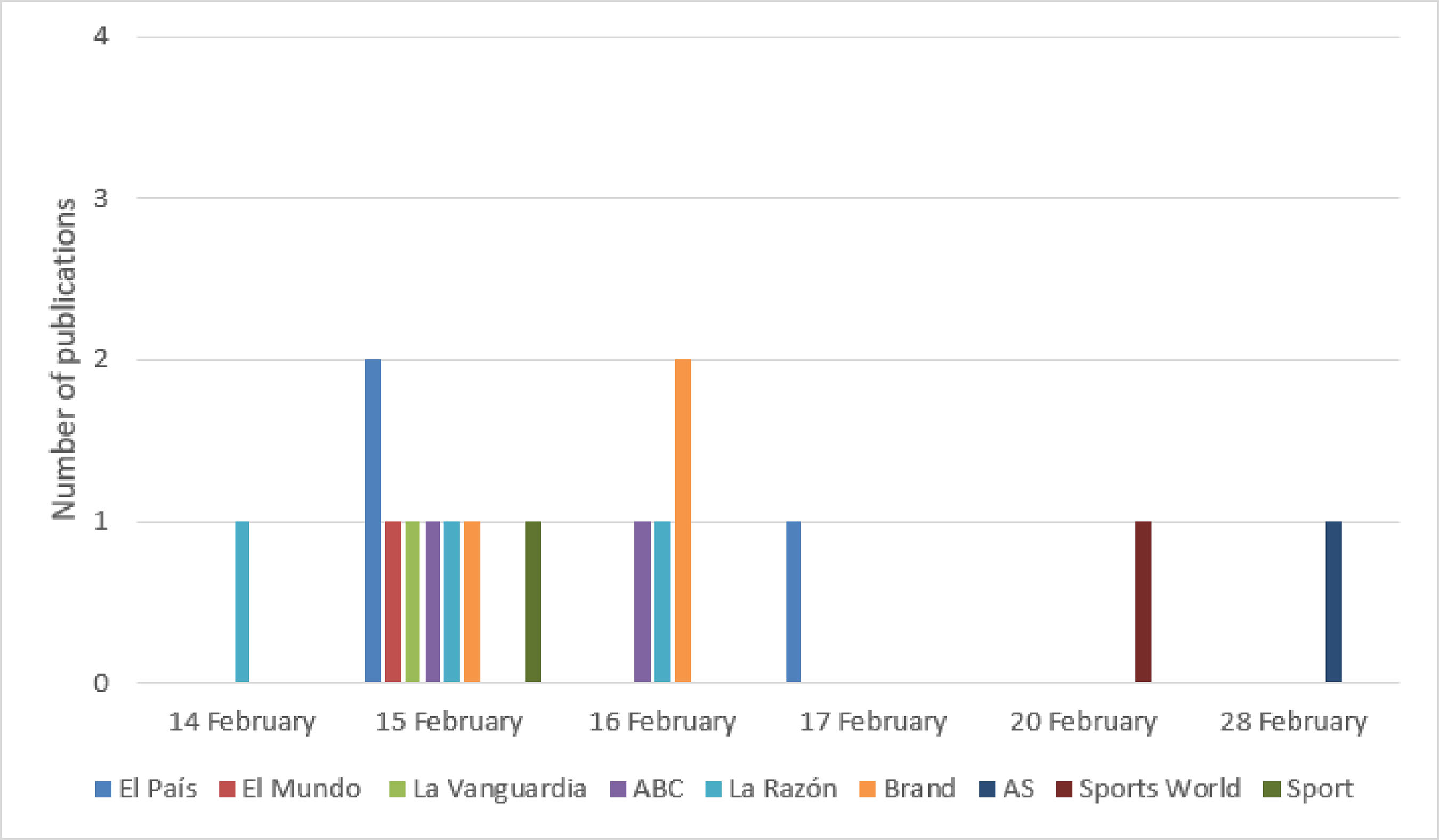
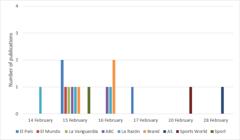
Taking the full sample (100%) as a reference, 54.5% of the news articles were published on 15 February 2024 (figure 3). Among the generalist newspapers, ElPaís.com published the most articles on that day, with two items, while the other four newspapers published only one article each. A notable case is that of the newspaper LaRazon. es, which published a first article immediately after the broadcast of the interview on 14 February 2024, highlighting several of the topics relevant to the present case study. Regarding the sports newspapers, the case of AS.com is particularly notable. This newspaper did not publish a specific piece related to the Spanish tennis player’s statements on the two main topics of this research until two weeks after the broadcast of the interview.
The ideology variable has been classified into four categories: right, center-right, center-left, and left, following the study by Masip et al. (2020). Due to the relevance of this variable in the study, the selection of newspapers was based on those with the highest circulation in Spain, according to data from AIMC (2024). Newspapers categorized as right-wing represent 5.8% of the total sample. Center-right media constitute 35.3%, representing the group with the highest number of publications on the subject. In contrast, center-left newspapers represent 23.5% of the total, while there is no representation in the left-wing category. It should be noted that sports newspapers were excluded from the analysis as they do not display any ideological alignment. This decision is based on the fact that, although the four Spanish sports media outlets may occasionally include political news (Rojas-Torrijos and Guerrero-Caballero, 2021) or belong to different publishing groups, there is no academic evidence or official statements to support their affiliation with any political spectrum.
5.2 Dimension II: objectivity
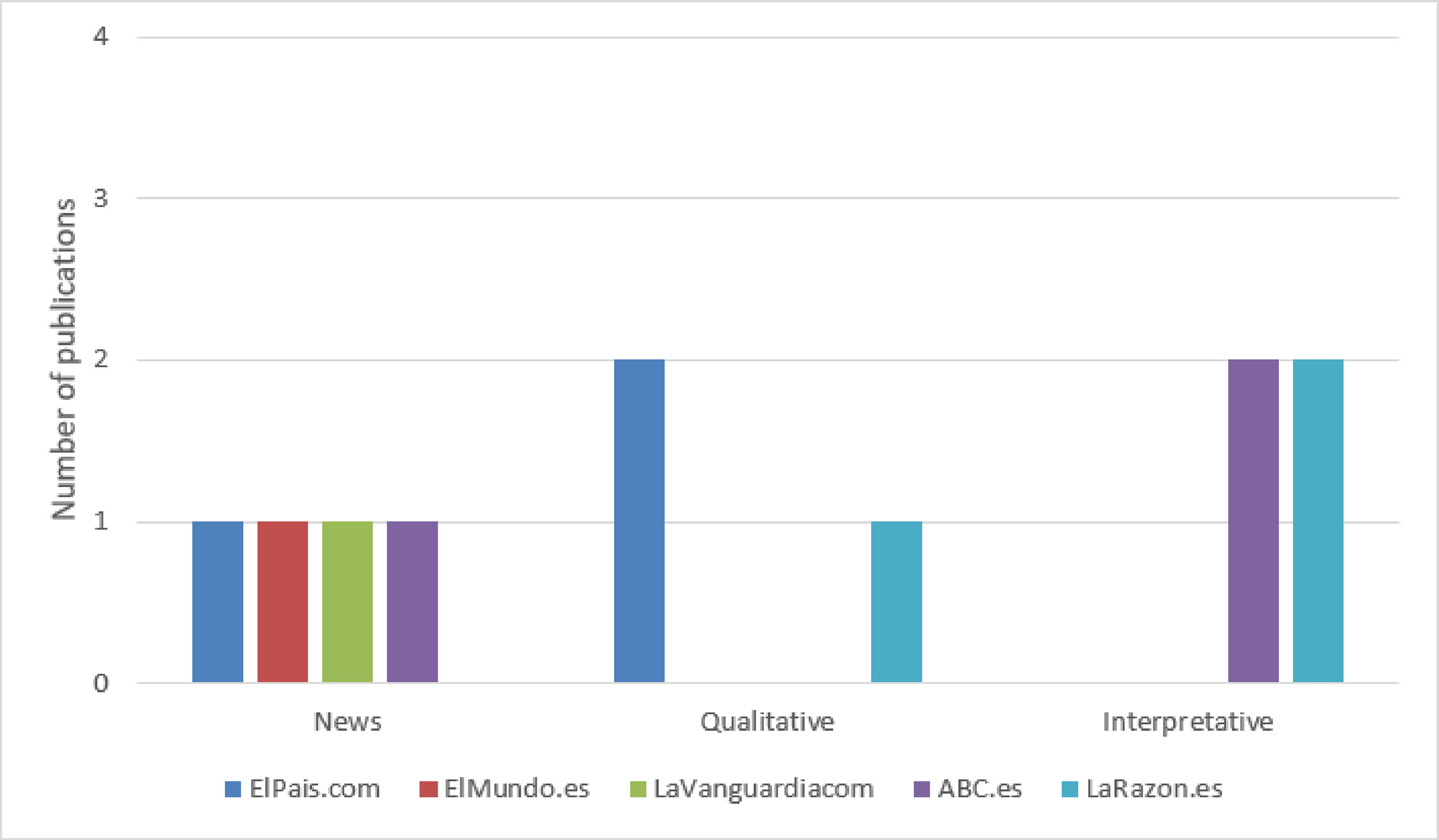
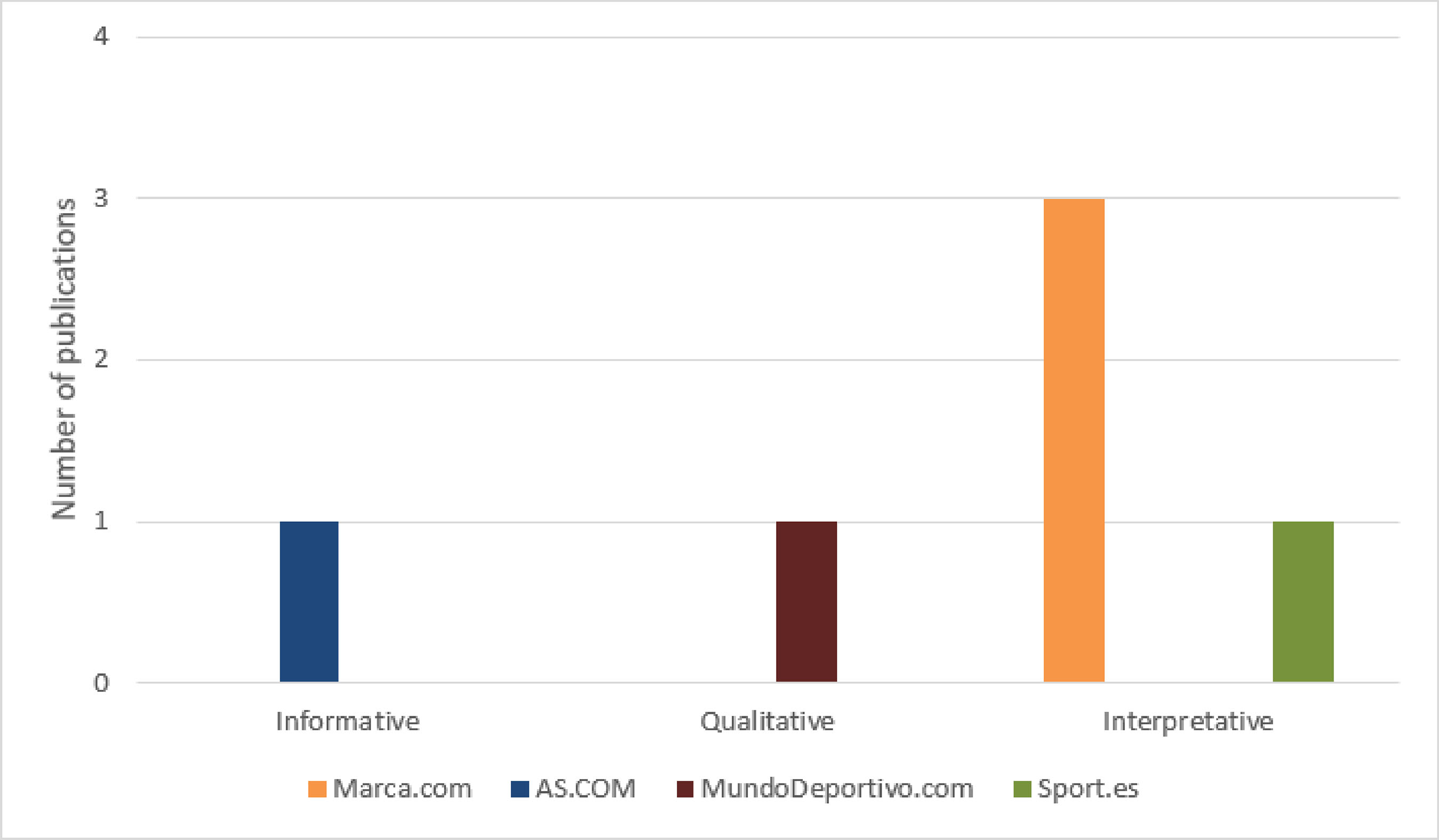
The dimension known as objectivity, defined as the journalistic practice of separating news from opinion (Muñoz-Torres, 2012), is composed of the variables headline type, source, focus, tone of language and elaboration. It is important to focus the analysis on some of these. Regarding the headline type variable, the predominance of interpretative headlines is evident in comparison with informative or descriptive headlines. The newspaper Marca. com stands out as the media outlet using the highest number of interpretative headlines (figure 5), surpassing ABC.es and LaRazon. es, each with two (figure 4). In newspapers such as ElMundo.es, LaVanguardia.com and LaRazon, the headlines are clearly informative. On the other hand, ElPais.com is the newspaper that published the most descriptive headlines.
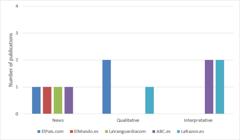
Type of headline assigned to publications referring to the Nadal case in generalist digital newspapers
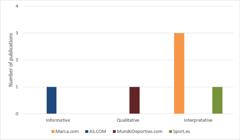
Type of headline assigned to publications referring to the Nadal case in digital sports newspapers
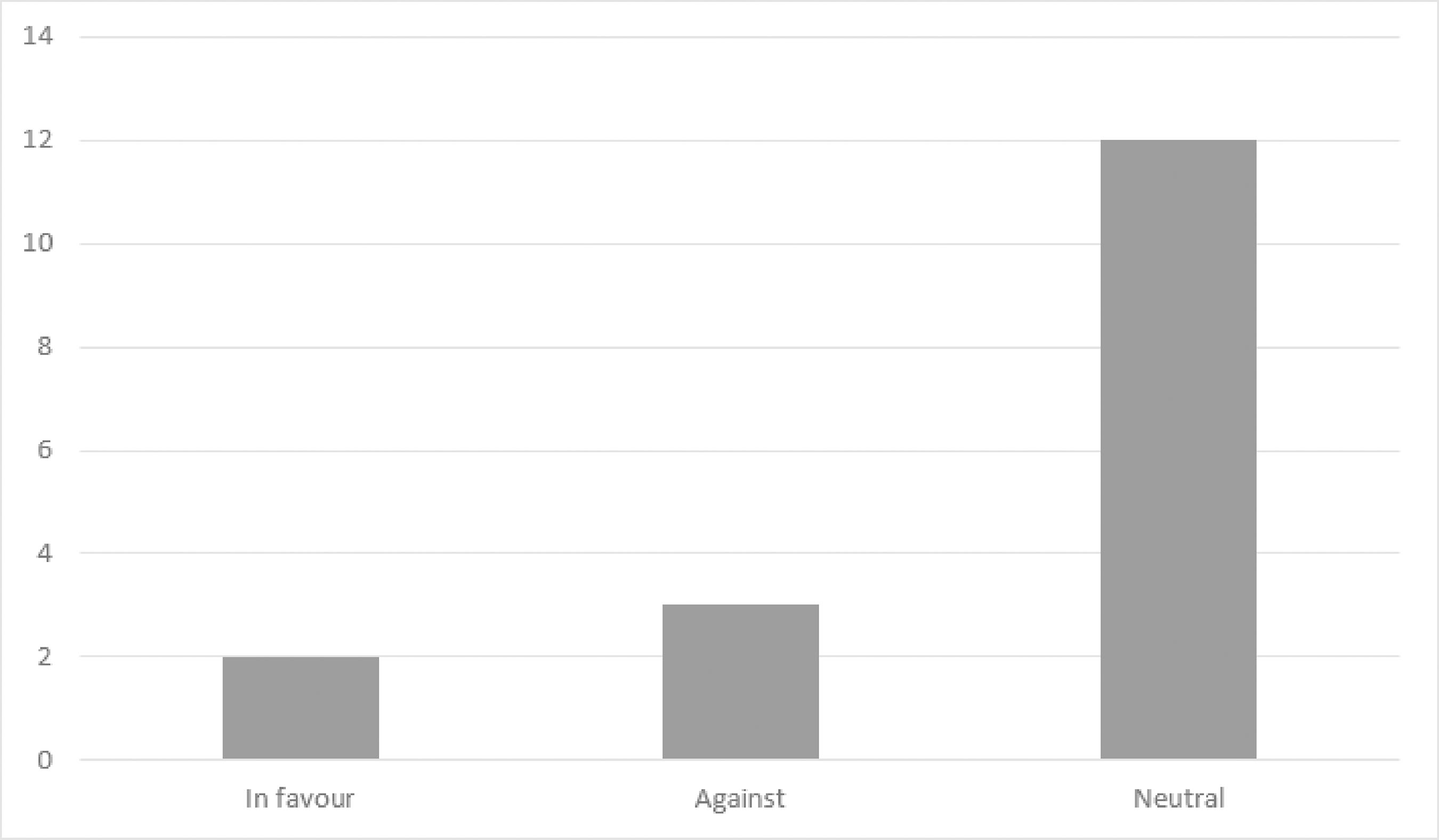
It is pertinent to analyze the variable of focus, defined as the angle from which the article is presented. It is composed of the categories “pro”, “anti” and “neutral” with regard to Rafael Nadal. “Pro” includes those journalistic pieces that support or reinforce the statements of an authority figure. The “against” category contains elements that are critical or negative towards the tennis player. Finally, “neutral” articles are defined as those that do not provide any assessment or exhibit partiality.
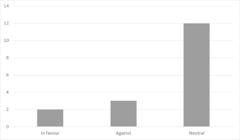
As shown in figure 6, 17.6% of the total sample adopts an against focus. A representative example is the headline “Rafa Nadal: tus lecciones mejor de tenis” from the digital newspaper ElPais.com, which shows a polarised discourse in line with the terminology developed by Van Dijk through the polarization approach. This headline would be classified as a ‘dichotomous’ discourse: one side against the other (Van Dijk, 1980).
A similar phenomenon occurs in another headline from the same digital newspaper entitled “Rafael Nadal: extraterrestre en la pista, españolazo medio fuera de ella”. In this case, the headline employs qualifying lexicon with negative connotations directed at the authority.The last of the three headlines classified under the negative focus variable was published in the digital sports newspaper MundoDeportivo.com under the title: “Rafa Nadal, al resto”. Unlike the previous two examples, this headline makes minimal use of explicitly evaluative language, instead relying on a play on words typical of tennis jargon to question the athlete’s statements.
In contrast, the neutral focus is predominant in the analysis sample, comprising 12 articles (70.5%). Finally, the pro focus accounts for only 11.7% of the total.
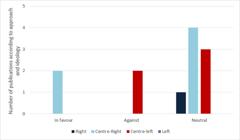
Total number of articles by focus and media ideology
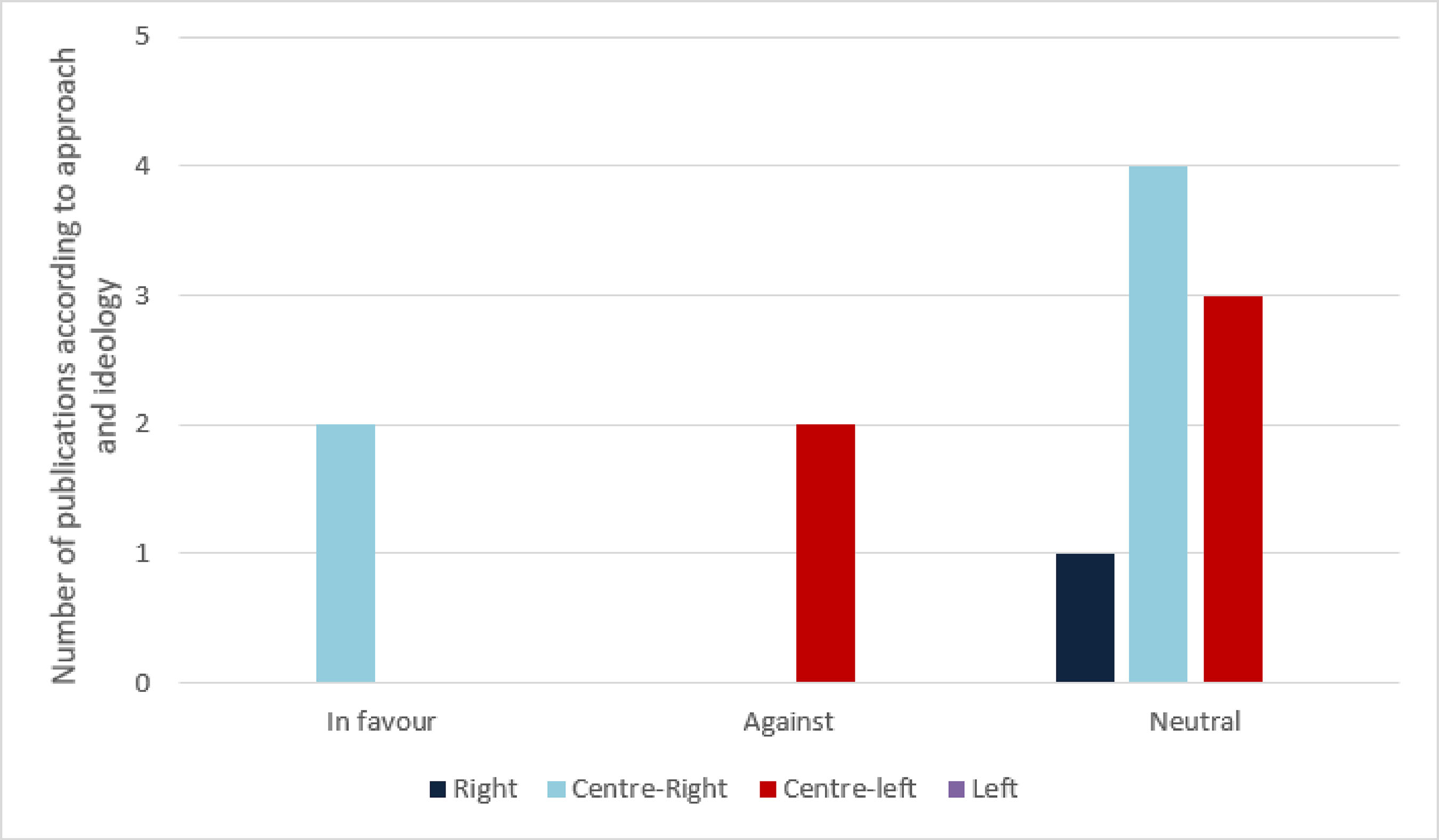
It is relevant for this research to examine the approaches taken in the articles from an ideological perspective. Figure 7 illustrates the distribution of the approaches used by generalist newspapers according to their political alignment. Of the twelve news items published by the generalist media, two took a favourable approach and came from center-right newspapers. The same number of publications took an unfavourable stance towards the tennis player, in this case, in the center-left media. As for neutral approaches, one news item was identified as having been published by a right-wing media outlet, three by center-left newspapers and four by center-right newspapers. Overall, the neutral approach was the most frequent among generalist newspapers, accounting for 66.6% of the total. The variables source, production or author type were not considered in this analysis, as they do not affect the study’s final results and lack the relevance of the previously examined variables.
Dimension III: conditioning factors
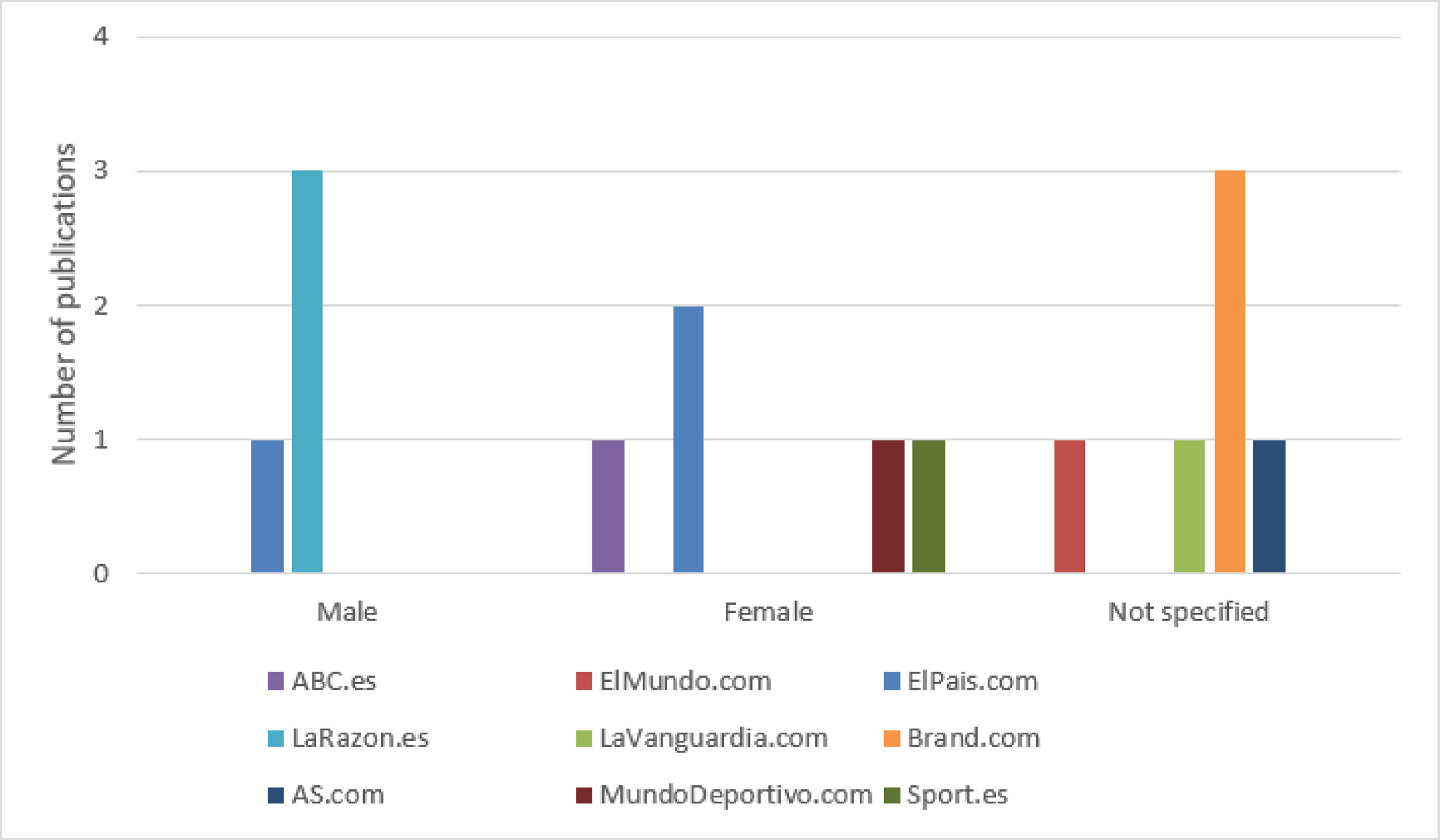
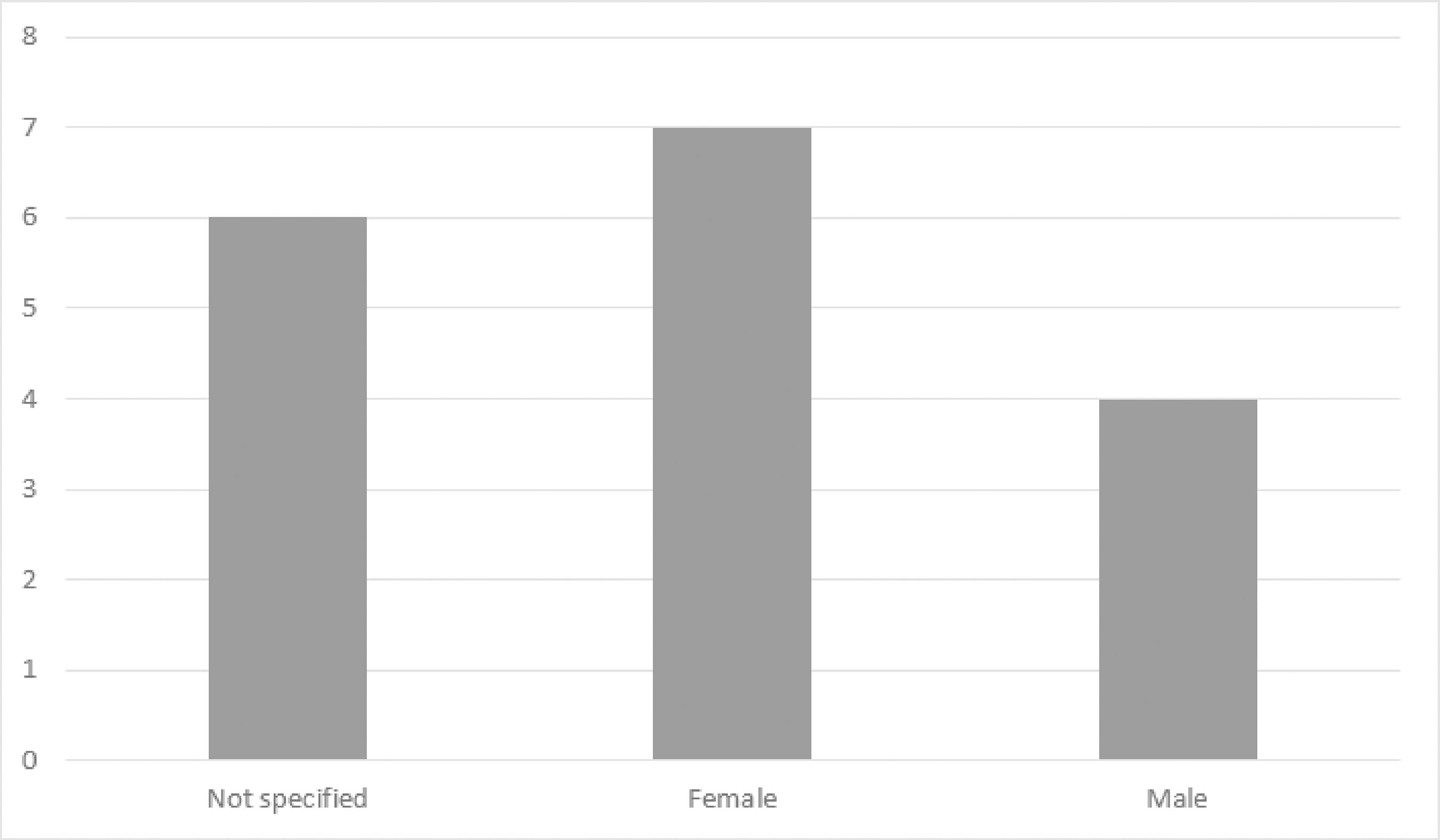
The conditioning factors dimension, composed of the variables author’s gender and journalistic gender, highlights the importance of both factors. It is crucial to analyze the variable gender (figures 8 and 9) of the authors of the publications to determine whether it constitutes a relevant factor in the orientation of the view taken by (for or against) the authority figure and in the context of polarization. Of the total sample, 41.2% of the articles were written by women, 23.5% by men, and 35.3% belong to the unspecified category, which includes texts produced by the media or news agencies themselves.
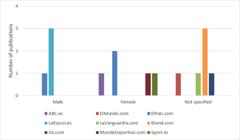
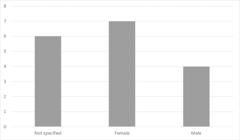
Regarding female authors, of a total of five, three adopted an anti-Rafael Nadal approach with a critical tone, representing 60% of the articles written by women. The other two female authors opted for a neutral approach and tone. In contrast, only two men authored articles, representing 11.7% of the total sample. In both cases, they opted for a neutral approach and a tone favourable to the athlete.
5.4 Dimension IV: relevance
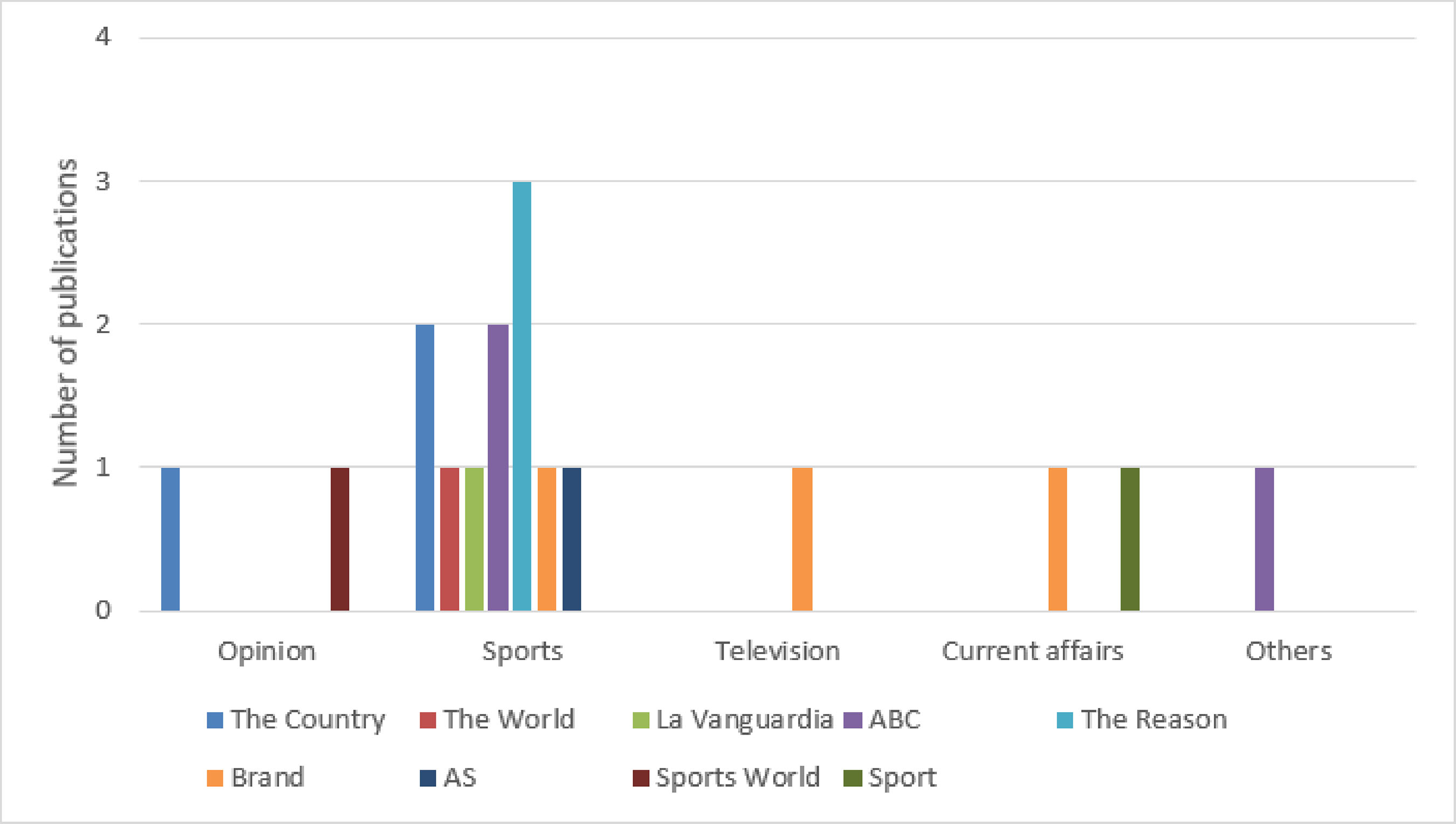
The relevance dimension encompasses the variables topic coverage, section, resources, use of audiovisual resources and article length. It is particularly relevant to analyze the section variable (figure 10), which indicates where the texts were published. Among generalist newspapers, 63.6% of the articles appeared in the sports section, reflecting the activity of the interview. LaRazon. es published all of its articles in this section, whereas ElPais.com published one in the opinion section and the other two in sports. The newspaper ABC.es demonstrated greater diversity, with one article in the sports section, one in the television section and one in the category labelled “other”.
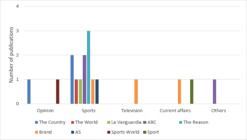
Regarding sports newspapers, Marca.com published three articles on the topic, distributed across the Sports, Current Affairs and Television sections. The newspaper AS.com published a single article in the Sports section. MundoDeportivo.com and Sport.es placed their articles in the opinion and Current Affairs sections, respectively. It is noteworthy that the number of articles published in the Current Affairs section is equal to that of the sports section, despite all four being sports newspapers.
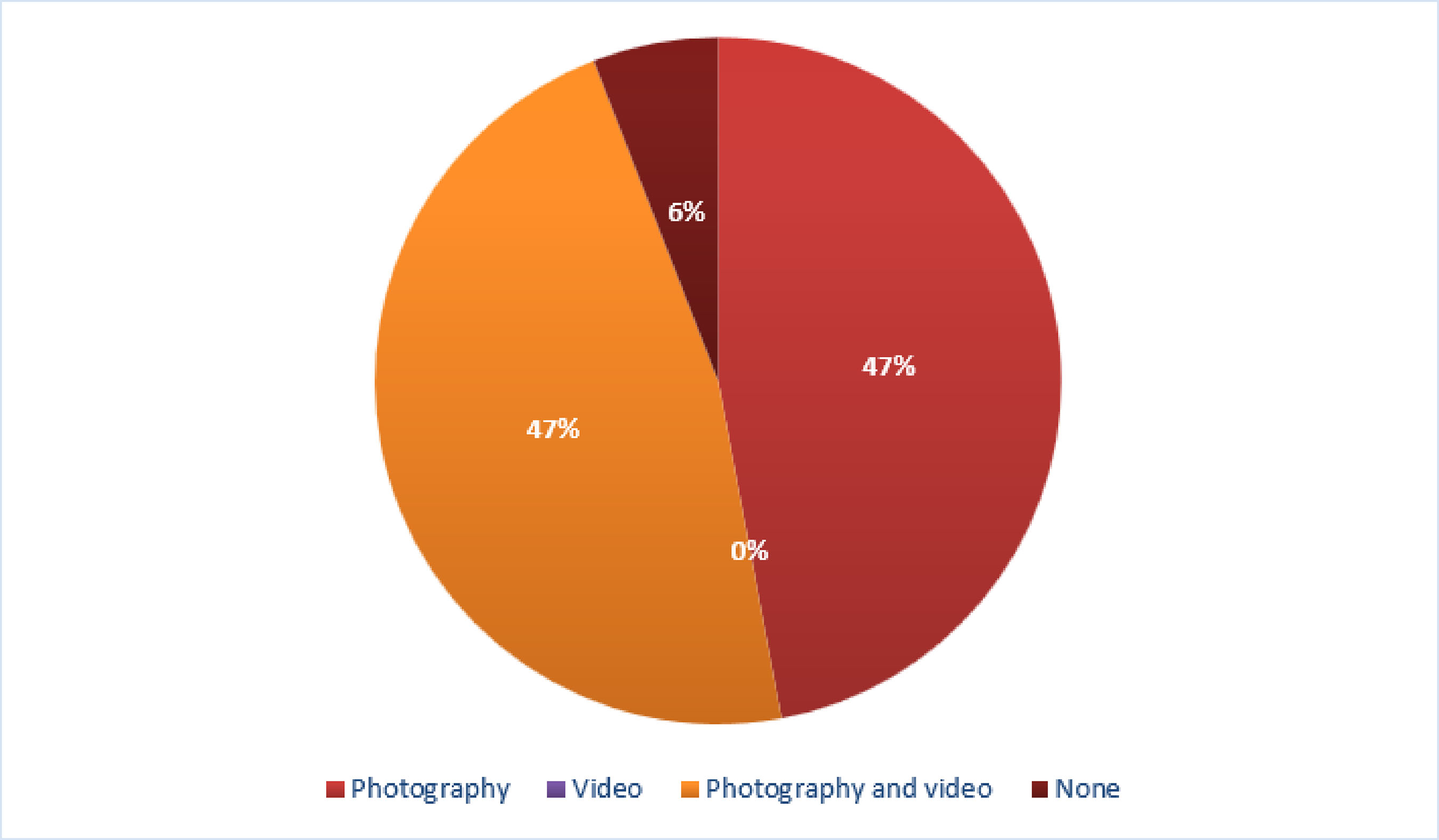
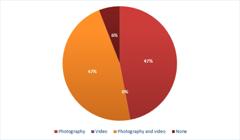
The use of visual resources (figure 11) within journalistic pieces is crucial as it enriches and reinforces the articles for the reader, making this variable highly relevant. Of the total sample, 94.1% of the articles included at least one visual resource. A notable parity is observed, with 47% of articles containing only photographs and 47% combining photographs and videos. None of the publications relied exclusively on videos.
The variables of topic coverage and article length were not considered, as they provide only supplementary information and do not contribute significantly to the present case study.
Conclusions
After analyzing the coverage in Spain’s most widely circulated generalist and sports newspapers regarding Rafael Nadal’s interview on El Objetivo and his statements on feminism and equal pay in sport, it can be argued that newspapers’ ideology is not a decisive factor in the polarization of the topic. The digital newspaper ElPais.com, identified as center-left, was the most critical of Nadal in two of its three articles, both in terms of tone and approach (against). In contrast, its third article adopted a neutral approach and tone. Among the newspapers classified as right-wing and center-right, five of the seven articles analyzed took a neutral approach, with all texts exhibiting a neutral tone. These results suggest that media ideology does not determine the perception of polarization.
Regarding media ideology, the results indicate that it does not constitute a determining factor in the perception of polarization, thereby refuting hypotheses H1 and H2. Conversely, the author’s gender emerges as a relevant variable: all the articles adopting a stance against Rafael Nadal – characterized by a critical tone and evaluative headlines – were written by women. In contrast, the news articles authored by men displayed a neutral or favorable tone towards the athlete. These findings support H3 by confirming that the author’s gender influences the tone of the coverage and may act as a polarising factor.
Analysis of the journalistic genre indicates that the informative genre is predominant in the study. This finding aligns partially with the favourable and neutral approaches, consistent with informative reporting and reinforcing Nadal’s statements. Notably, newspapers that adopted an approach either in favour of or against the authority figure employed judgmental headlines. These headlines contribute to shaping the audience’s perception of the figure, either positively or negatively. This pattern highlights the significant influence of media on public opinion through language choice and presentation of facts. The use of evaluative headlines not only reflects editorial bias but can also contribute to polarization and the development of audience prejudice.
Finally, this study opens up avenues for further research. Future studies should consider audience reception and assess whether reactions across digital newspapers and other media platforms (e.g., social media) align with the results observed here and whether any differences are attributable to the age of the target audience. Additionally, it would be valuable to compare the effects of statements from other athletes or lesser-known figures on polarization, as this phenomenon has been extensively studied in political contexts but remains underexplored in sports journalism.
-
How to cite this article:
Álvarez-Álvarez, A. (2026). DIGITAL MEDIA AND GENDER EQUALITY IN SPORT: an approach to polarization through the media coverage of Rafael Nadal’s interview on the El Objetivo show. Brazilian Journalism Research, 22(1), e1815. DOI: 10.25200/BJR.v22n1.2026.1815
DATA AVAILABILITY
The data supporting the findings of this study are available within the article.
REFERENCES
-
Abajo, J. M., Leonet, G. L., Gomez, R. G., & Morales, M. T. V. (2020). La programación deportiva ¿qué lugar ocupan las mujeres? Revista Estudos Feministas, 28(2), 1–15. DOI: 10.1590/1806-95842020v28n260585
» https://doi.org/10.1590/1806-95842020v28n260585 -
Abramowitz, A. I., & Saunders, K. L. (2008). Is Polarization a Myth? The Journal of Politics, 70(2), 542-555. DOI: 10.1017/s0022381608080493
» https://doi.org/10.1017/s0022381608080493 -
AIMC. (2024). Marco general de los medios en España. Asociación para la investigación de medios de comunicación. Retrieved from www.aimc.es/a1mc-c0nt3nt/uploads/2024/01/Marco_General_Medios_2024.pdf
» www.aimc.es/a1mc-c0nt3nt/uploads/2024/01/Marco_General_Medios_2024.pdf -
Arcangeletti, A., & Zunino, E. (2023). Los encuadres de la guerra en Ucrania: un estudio sobre los medios digitales argentinos. Comunicación y medios, 32(48), 24–36. DOI: 10.5354/0719-1529.2023.70992
» https://doi.org/10.5354/0719-1529.2023.70992 -
Azurmendi, A., & Murua, J. (2020). Estudio desde la perspectiva de género sobre la situación de las deportistas de sobre la situación de las deportistas de alto nivel de la capv alto nivel de la capv. Servicio Central de Publicaciones del Gobierno Vasco. Retrieved from www.euskadi.eus/contenidos/documentacion/deportistas_alto_nivel/es_ altoniv/adjuntos/informe_20101103.pdf
» www.euskadi.eus/contenidos/documentacion/deportistas_alto_nivel/es_ altoniv/adjuntos/informe_20101103.pdf -
Barbeito Veloso, M. L., Perona Páez, J. J., Rodríguez Prieto, V., & Hernández Ruiz, A. (2020). El tratamiento de los contenidos periodísticos y su influencia en la reputación de la prensa española: la campaña electoral de noviembre de 2019 como estudio de caso. Estudios sobre el Mensaje Periodístico, 26(4), 1.305–1.324 DOI: 10.5209/esmp.69925
» https://doi.org/10.5209/esmp.69925 -
Barbero González, M. Á. (2017). Los Juegos Olímpicos de Río 2016: La explosión del deporte femenino español en El Diario ABC. Citius, Altius, Fortius, 10(1), 39–50. DOI: 10.15366/citius2017.10.1.003
» https://doi.org/10.15366/citius2017.10.1.003 - Bardin, L. (2011). Content Analysis Edições 70.
-
Barreda, M. (2021). La polarización política en las democracias actuales: expresiones y consecuencias. Cuadernos Manuel Giménez Abad, (21), 190–202. DOI: 10.47919/fmga.cm21.0109
» https://doi.org/10.47919/fmga.cm21.0109 -
Berrocal-Gonzalo, S., Waisbord, S., & Gómez-García, S. (2023). Polarización política y medios de comunicación, su impacto en la democracia y en la sociedad. Profesional De La información, 32(6), 1–9. DOI: 10.3145/epi.2023.nov.22
» https://doi.org/10.3145/epi.2023.nov.22 -
Calvo Ortega, E. & Gutiérrez, S. M. B. (2017). El deporte femenino en los informativos deportivos de televisión. Un estudio de caso sobre la noticia de la victoria de Garbiñe Muguruza en Roland Garros. Estudios sobre el Mensaje Periodístico, 23(2), 747–758. DOI: 10.5209/ESMP.58013
» https://doi.org/10.5209/ESMP.58013 -
Calvo, B. (2024, September 2). Los mejores deportistas españoles de la historia – descubre a los iconos deportivos españoles Mundo Deportivo – Uncomo. Retrieved from www.mundodeportivo.com/uncomo/deporte/articulo/los-mejores-deportistas-espanoles-de-lahistoria-53733.html
» www.mundodeportivo.com/uncomo/deporte/articulo/los-mejores-deportistas-espanoles-de-lahistoria-53733.html -
Cartes-Barroso, M. J. (2022). Las elecciones presidenciales de EE. UU. (2020) en las portadas de la prensa española. Observatorio (OBS*), 16(3), 182–201. DOI: 10.15847/obsOBS16320222091
» https://doi.org/10.15847/obsOBS16320222091 -
Chernov, G. (Ed.). (2023). The Russian-Ukrainian War: Persistence of Frames and the Media Issue-Cycles. Athens Journal of Mass Media and Communications, 9(4), 307–320. DOI: 10.30958/ajmmc/v9i4
» https://doi.org/10.30958/ajmmc/v9i4 -
Colussi, J., Zaharía, A. M., & de la Garza Montemayor, D. J. (2025). Desinformación y polarización en las elecciones de España 2023: un estudio de Vox en Instagram. Comunicación y Medios, 34(51), 190– 202. DOI: 10.5354/0719-1529.2025.76482
» https://doi.org/10.5354/0719-1529.2025.76482 -
Fernández Fernández, J. G., & Martínez Pastor, E. (2016). El tratamiento informativo y publicitario de los diarios digitales especializados en golf en España. Cuadernos de Turismo, (37), 157–174. DOI: 10.6018/turismo.37.256191
» https://doi.org/10.6018/turismo.37.256191 -
FundéuRAE. (2023, December 27). Polarización, palabra del año 2023 para la FundéuRAE FundéuRAE. Retrieved from www.fundeu. es/recomendacion/polarizacion-palabra-del-ano-2023-para-lafundeurae/
» www.fundeu. es/recomendacion/polarizacion-palabra-del-ano-2023-para-lafundeurae/ -
Gallardo Parrón, R., & Montes Vozmediano, M. (2015). La propiedad de los derechos de emisión de los eventos deportivos y su repercusión en los informativos: el caso de Antena 3, la 1 y Telecinco. Fonseca, Journal of Communication, 10(10), 9–28. Retrieved from https://revistas.usal.es/cuatro/index.php/21729077/article/view/12909
» https://revistas.usal.es/cuatro/index.php/21729077/article/view/12909 -
Hetherington, M. J. (2001). Resurgent Mass Partisanship: The Role of Elite Polarization. American Political Science Review, 95(3), 619–631. DOI: 10.1017/s0003055401003045
» https://doi.org/10.1017/s0003055401003045 - Igartua, J. J. (2006). Métodos cuantitativos de investigación en comunicación Bosch.
-
Iyengar, S., Lelkes, Y., Levendusky, M., Malhotra, N., & Westwood, S. J. (2018). The Origins and Consequences of Affective Polarization in the United States. Annual Review of Political Science, 22, 299-326. DOI: 10.1146/annurev-polisci-051117-073034
» https://doi.org/10.1146/annurev-polisci-051117-073034 -
Lafuente Ibáñez, C., & Marín Egoscozábal, A. (2008). Metodologías de la investigación en las ciencias sociales: Fases, fuentes y selección de técnicas. Revista EAN, (64), 5–18. DOI: 10.21158/01208160.n64.2008.450
» https://doi.org/10.21158/01208160.n64.2008.450 -
López-Rabadán, P., & Casero-Ripollés, A. (2012). La evolución de la agenda mediática española (1980-2010). un análisis longitudinal de la portada de la prensa de referencia. Revista Latina De Comunicación Social, (67), 470–493. DOI: 10.4185/RLCS-2012-964
» https://doi.org/10.4185/RLCS-2012-964 -
Masip, P., Suau, J., & Ruiz-Caballero, C. (2020). Percepciones sobre medios de comunicación y desinformación: Ideología y polarización en el sistema mediático español. Ediciones Profesionales de la Informacion, 29(5), 1–13. DOI: 10.3145/epi.2020.sep.27
» https://doi.org/10.3145/epi.2020.sep.27 -
Mayone, J. (2024, January 25). ¿Cuántos títulos de grand slam tiene rafa nadal? DAZN news ES. Retrieved from www.dazn. com/es-ES/news/tenis/cuantos-titulos-de-grand-slam-tiene-rafanadal/1x7vcxxfypuco1p3vipdlw0h1r
» www.dazn. com/es-ES/news/tenis/cuantos-titulos-de-grand-slam-tiene-rafanadal/1x7vcxxfypuco1p3vipdlw0h1r -
McCoy, J. (2022). Reflexiones sobre el populismo y la polarización en américa latina y sus consecuencias para la democracia. Desafíos, 34(2), 1–19. DOI: 10.12804/revistas.urosario.edu.co/desafios/a.11307
» https://doi.org/10.12804/revistas.urosario.edu.co/desafios/a.11307 -
Merola Teixidó, C., & Percastre-Mendizábal, S. (2024). Covid-19 in the Spanish Press Before the Pandemic: El País and El Mundo. Anagramas Rumbos Y Sentidos De La Comunicación, 22(44), 1–23. DOI: 10.22395/angr.v22n44a05
» https://doi.org/10.22395/angr.v22n44a05 -
Moragas-Fernández, C., & Capdevila, A. (2017). La mediatización del proceso independentista de Cataluña: el rol de la metáfora en el tratamiento informativo de El Mundo, El País y La Vanguardia. DÍGITOS: Revista de Comunicación Digital, 2(3), 11–35. Retrieved from https://turia.uv.es/index.php/digitos/issue/view/1915
» https://turia.uv.es/index.php/digitos/issue/view/1915 -
Muñoz-Torres, J. R. (2012). Truth and objectivity in journalism: Anatomy of an endless misunderstanding. Journalism Studies, 13(4), 566–582. DOI: 10.1080/1461670X.2012.662401
» https://doi.org/10.1080/1461670X.2012.662401 -
Navarro García, E. M., & Roca Marín, D. (2022). Visibility of Women’s Sport in the Press Spanish Digital Sports. Multidisciplinary Journal of Gender Studies, 11(3), 297–321. DOI: 10.17583/generos.7772
» https://doi.org/10.17583/generos.7772 -
Núñez-Gómez, P., Abuín-Vences, N., Sierra-Sánchez, J., & MañasViniegra, L. (2020). El enfoque de la prensa española durante la crisis del covid-19. Un análisis del framing a través de las portadas de los principales diarios de tirada nacional. Revista Latina De Comunicación Social, (78), 41–63. DOI: 10.4185/RLCS-2020-1468
» https://doi.org/10.4185/RLCS-2020-1468 -
Olympics. (2024. n.d.). Rafael Nadal Olympics.com. Retrieved from https://olympics.com/es/atletas/rafael-nadal
» https://olympics.com/es/atletas/rafael-nadal -
Parejo Cuéllar, M., & Martín-Pena, D. (2020). Tratamiento informativo de la prensa española sobre el covid-19 antes del estado de alarma. Revista Española De Comunicación En Salud, 1, 218-225. DOI: 10.20318/recs.2020.5418
» https://doi.org/10.20318/recs.2020.5418 -
Rivas Tovar, L. A. (2016). La definición de variables o categorías de análisis. In L. A. R. Tovar (Ed.), ¿Còmo hacer una tesis? (pp. 107–118). IPNEditors. DOI: 10.13140/RG.2.1.3446.6644
» https://doi.org/10.13140/RG.2.1.3446.6644 -
Rojas Torrijos, J. L., & Guerrero Caballero, M. (2021). ¿Un periodismo deportivo apolítico?: Estudio de las referencias al ‘procés’ catalán en la prensa deportiva digital en España. Estudios sobre el Mensaje Periodístico, 27(3), 947–960. DOI: 10.5209/esmp.72554
» https://doi.org/10.5209/esmp.72554 -
Sainz-De-Baranda Andújar, C., Barbero González, M., & Fernández Fernández, J. (2019). Tratamiento informativo del bádminton y el piragüismo en Marca y El País (2012-2016). Universidad Complutense de Madrid (UCM) DOI: 10.5209/esmp.67007
» https://doi.org/10.5209/esmp.67007 -
Salvat Martinrey, G., & Aranda Martínez, S. (2020). Análisis de contenido de la prensa diaria española sobre el uso de la infografía para informar de la crisis sanitaria de la COVID-19. Revista De Comunicación Y Salud, 10(2), 185–210. DOI: 10.35669/rcys.2020.10(2).185-210
» https://doi.org/10.35669/rcys.2020.10(2).185-210 -
Sánchez, L. P., de Frutos Torres, B., & Gutiérrez Martín, A. (2020). La covid-19 en la prensa española. Encuadres de alarma y tranquilidad en las portadas de El País, El Mundo y La Vanguardia. Revista De Comunicación Y Salud, 10(2), 355–384. DOI: 10.35669/rcys.2020.10(2).355-384
» https://doi.org/10.35669/rcys.2020.10(2).355-384 -
Sanz Garrido, B. (2020). Influencia del éxito deportivo en la cobertura del deporte femenino español: los Juegos Olímpicos de Londres 2012 y Río 2016. Doxa Comunicación. Revista Interdisciplinar De Estudios De Comunicación Y Ciencias Sociales, 31, 131-151. DOI: 10.31921/doxacom.n31a6
» https://doi.org/10.31921/doxacom.n31a6 -
Sotelo, J. (2024). Agenda, Framing and Editorial Bias in State-Run Television News in Spain: Results of the Regional and Municipal Elections of 28-M 2023 Versus the Announcement of Early General Elections. VISUAL REVIEW. International Visual Culture Review Revista Internacional De Cultura Visual, 16(1), 31–43. DOI: 10.62161/revvisual.v16.5173
» https://doi.org/10.62161/revvisual.v16.5173 -
Suárez-Álvarez, R., Catalina-García, B., & García-Jiménez, A. (2025). Dicotomía del discurso de odio en X. polarización de tuits y comentarios sobre el cambio climático y los jóvenes. Estudios Sobre El Mensaje Periodístico, 31(2), 299–311. DOI: 10.5209/emp.100597
» https://doi.org/10.5209/emp.100597 -
Subiela-Hernández, B., Gómez-Company, A., & Vizcaíno-Laorga, R. (2023). Retos y oportunidades en la lucha contra la desinformación y los derechos de autor en periodismo: MediaVerse (IA, blockchain y smart contracts). Estudios Sobre El Mensaje Periodístico, 29(4), 869–880. DOI: 10.5209/esmp.88081
» https://doi.org/10.5209/esmp.88081 -
Sunstein, C. R. (2017). #Republic: Divided Democracy in the Age of Social Media (NED-New edition) Princeton University Press. DOI: 10.2307/j.ctv8xnhtd
» https://doi.org/10.2307/j.ctv8xnhtd -
Teruel, L. (2016). El impacto de la crisis política y económica sobre la polarización de los medios españoles. Historia Y Comunicación Social, 21(1), 203–220. DOI: 10.5209/rev_HICS.2016.v21.n1.52692
» https://doi.org/10.5209/rev_HICS.2016.v21.n1.52692 -
Valencia, E. (2024). Ucrania y Yemen: Análisis comparativo del tratamiento mediático. Corporación Minuto de Dios University – UNIMINUTO, 20(32), 66–77. DOI: 10.26620/uniminuto.mediaciones.20.32.2024.66-77
» https://doi.org/10.26620/uniminuto.mediaciones.20.32.2024.66-77 - Van Dijk, T. (1980). Ideología y discurso Ariel Lingüística.
-
Vicario, M. D., Quattrociocchi, W., Scala, A. & Zollo, F. (2018). Polarization and fake news: Early warning of potential misinformation targets. arXiv, online first, 1 – 18. DOI: 10.48550/arXiv.1802.01400
» https://doi.org/10.48550/arXiv.1802.01400
-
Desk review editor:
Lia Seixas