 THE GUARDIAN’S DEPARTURE FROM X: an analysis of the tone and emotions of journalistic audiences’ comments on four platforms
ABSTRACT
The Guardian newspaper announced it would stop sharing its news on X (formerly Twitter). When Elon Musk bought Twitter, he reduced moderation mechanisms in the name of freedom of expression. However, these changes have accentuated the challenge for newspapers to manage audience participation. Against the backdrop of the ethical and deontological duty of media companies to dynamize and moderate participatory spaces, this study analyzes the tone and its relationship with the emotional expressions that characterized people’s reactions in comment boxes to the announcement on Facebook, Instagram, TikTok, and X (n = 41.320). LIWC-22 software was used to analyze the tone of the comments. To conduct an emotion recognition analysis, Ekman’s works were used. The news comments showed higher scores for positive tone on Instagram and negative tone on X. This study shows how emotional categories affect the tone of comments over time.
Keywords
Journalism; Media; The Guardian; Tone; Emotions; Facebook; Instagram; TikTok; X
RESUMO
O jornal The Guardian anunciou que deixará de partilhar notícias no X (antigo Twitter). Desde a aquisição da plataforma por Elon Musk, os mecanismos de moderação foram reduzidos em nome da liberdade de expressão, o que acentuou os desafios enfrentados pelos jornais na gestão da participação pública. Tendo como enquadramento o dever ético e deontológico dos media em dinamizar e moderar espaços participativos, este estudo analisa o tom e as expressões emocionais que caracterizaram as reações ao anúncio nas caixas de comentários do Facebook, Instagram, TikTok e X (n = 41.320). Recorreu-se ao software LIWC-22 para a análise do tom e aos modelos de emoções de Ekman para a análise emocional. Os comentários no Instagram apresentaram um tom mais positivo, enquanto no X se destacou o tom negativo. O estudo evidencia como as categorias emocionais moldam o tom dos comentários ao longo do tempo.
Palavras-chave
Jornalismo; Media; The Guardian; Tom; Emoções; Facebook; Instagram; TikTok; X
RESUMEN
The Guardian anunció que dejará de compartir noticias en X (antes Twitter). Tras la compra de la plataforma por Elon Musk, se redujeron los mecanismos de moderación en nombre de la libertad de expresión, lo que intensificó los retos para los medios en la gestión de la participación pública. Este estudio, enmarcado en el deber ético y deontológico de dinamizar y moderar los espacios participativos, analiza el tono y las emociones presentes en los comentarios al anuncio en Facebook, Instagram, TikTok y X (n = 41.320). Se utilizó el software LIWC-22 para el análisis del tono y los modelos de Ekman para identificar emociones. Los comentarios en Instagram presentaron un tono más positivo; en X predominó el tono negativo. El estudio muestra cómo las categorías emocionales influyen en la evolución del tono de los comentarios en distintas plataformas.
Palabras clave
Periodismo; Medios; The Guardian; Tono; Emociones; Facebook; Instagram; TikTok; X
1 Introduction
Since Elon Musk’s acquisition of the former Twitter, now X, the platform has become the epicenter of a global debate over weakened moderation norms, algorithmic manipulation, the spread of disinformation, and intensified hate speech (Bustos Díaz et al., 2025; Noguera Vivo, 2024). On 13 November 2024, The Guardian, a British newspaper, made an unprecedented decision in the journalism industry. The newspaper announced that from that moment on, it would no longer share its news on X. The decision was publicized in the same way on all the newspapers’ social platforms with the following description: “The US presidential election campaign served only to underline what we have considered for a long time. X is a toxic media platform, and its owner, Elon Musk, has been able to use its influence to shape political discourse” (The Guardian, 2024a).
The news, published in the form of a press release, states that “the benefits of being on X are now outweighed by the negative effects [...], given the often-disturbing content promoted or found on the platform, including far-right conspiracy theories and racism” (The Guardian, 2024b). This move occurred amid broader industry-wide dissatisfaction, which started with the #GoodbyeTwitter campaign in November 2022, when journalists and news organizations publicly considered leaving the platform. Claesson (2024) found that, in a content analysis of 118 French press articles published between October 25, 2022, and April 25, 2023, 13.6% directly addressed the possible departure of journalists, indicating a growing conflict between professional ethics and the platform’s new direction under Elon Musk. The Spanish newspaper La Vanguardia, the Swedish newspaper Dagens Nyheter, the European Federation of Journalists, more than 60 German universities and research institutions, and several companies from all sectors listed the same concerns about security on X, the decline in content moderation, and the increasingly polarizing environment to justify their departure from the platform (Jones, 2025; Shah, 2024).
This episode, however, is not an isolated case; it is, in fact, a deeper structural conflict in the digital media ecosystem: the gradual loss of journalism’s symbolic authority within the spheres where platform logic is progressively mediating visibility, legitimacy, and engagement (Martin & Murrell, 2021; Moe, 2024). The Guardian’s departure from X can thus be considered a reaction to the environment, where the role of journalism as the mediator of discourse is challenged not only by the algorithmic processes but also by the increasingly emotional, fragmented, and polarized audiences (Humprecht et al., 2024; Humprecht et al., 2020). This shift challenges long-held assumptions of the connection between news institutions and their audiences and poses a question about media companies in a platform-controlled environment where the balance of power has shifted (Moe, 2024).
X distinguishes itself from other platforms by allowing the immediate dissemination of posts with a character limit and in an informal manner (Maireder & Ausserhofer, 2014). The rapid virality potential of posts makes X an attractive platform for political discussion (Dawson, 2020), online radicalization (Bastug et al., 2020), civil mobilization (Tufekci & Wilson, 2012), and attacks against journalists (Costa, 2023). In 2022, Musk bought Twitter, renamed the social platform X, and reduced security mechanisms in the name of freedom of expression (Spring, 2024). In the journalistic field, these changes have heightened the challenge of managing audience participation in information production and online interactions (Chen & Pain, 2017; Loke, 2012). Since 2022, these shifts have also rendered the logic of visibility and the governance of informational discourse more unstable, exacerbating the tension between algorithmic visibility and the journalistic principles of autonomy and public service (Claesson, 2024). Taken together, these developments highlight an unresolved empirical and theoretical question: how do journalistic audiences emotionally and discursively react to such institutional exits from platforms? Understanding these reactions is important for two reasons: first, to comprehend the impact of such exits on public perceptions of journalism, particularly in contexts where trust in media and direct access to news sites shape audience response (Moe, 2024), and second, to aid media outlets in making informed decisions regarding similar dilemmas in the future, as journalists often fail to consider their audience’s opinions (Peña-Fernández et al., 2021).
Many authors have identified the democratic value of online debate and argued that media companies have an ethical and deontological duty to act as facilitators and moderators of non-native participatory spaces on platforms such as X (Castells, 2015; Coe et al., 2014; DeNardis, 2015; Edström et al., 2016). Journalism’s growing distance from the ideal of deliberation and its audiences, and the media’s lack of interest in new models of accountability regulation adjusted to the digital age, open a gap for initiatives of hetero-regulation of social platforms by public regulatory institutions (Bergström & Wadbring, 2015; Costa, 2024; Hermida & Thurman, 2008). In this contemporary media ecosystem, algorithms have become structuring elements of visibility and informational authority (Winques & Longhi, 2022). Therefore, the refusal to be present on X, despite its ethical justification, creates strategic weaknesses: it reduces the presence of journalists in fields of concentrated attention among the population and puts the dissemination of verified information under the control of those who are less concerned with epistemic rigor (Noguera Vivo, 2024). This tension between institutional regulation and editorial freedom raises fresh questions about platforms’ roles in mediating public trust and preserving journalism’s integrity.
Based on the potential of the X platform as a central site for journalistic visibility, audience engagement, and algorithmic contestation, this study aims to analyze the tone and its relationship with the emotional expressions that characterized the reactions of journalistic audiences in comment boxes to the news of The Guardian’s departure on the British journal’s official Facebook, Instagram, TikTok, and X accounts. In this sense, this research is guided by the following research questions:
-
RQ1: What differences exist in the tone scores across platforms?
-
RQ2: What patterns of tone and emotional expression develop over time?
-
RQ3: How do emotional categories affect tone?
-
RQ4: Which emotional categories are significant predictors of tone?
2 News media and audiences
The study of audience interaction with news media is not new (Berger, 2014; Landert, 2014). Traditionally, audience participation has been considered a strategy to increase institutional legitimacy and develop new sources of revenue (Enli, 2008; Lüders, 2008). One of the most frequent ways to monetize online news in the age of the attention economy is by encouraging audiences to interact directly with news products on social platforms and media company websites (Costa & Mateus, 2024; Martin & Dwyer, 2019). Audiences have a variety of interaction options available in these communication flows, from emojis, shares, and comments to the creation of user-generated content (Bruns, 2018).
Researchers have combined their efforts to examine how people use social networks to interact with others. They have investigated the different ways people consume news (Newman et al., 2024), the structure of political communication networks, the prevalence and impact of toxic language (Falkenberg et al., 2024), the role of journalists in online defamation and gender campaigns (Iranzo-Cabrera et al., 2024), the tone of publications (Loughran & McDonald, 2011), and how people express their emotions and feelings (Colneric & Demsar, 2020; D’Ambrosio, 2022; Dworakowski et al., 2023; Giuntini et al., 2019; Inuduka et al., 2024). Building on Ekman and Friesen’s (2003) identification of six basic emotions (anger, disgust, fear, joy, sadness, and surprise), studies employ lexicon-based resources and deep-learning–based sentiment analysis (Colneric & Demsar, 2020; Inuduka et al., 2024; Loughran & McDonald, 2011), map reaction types to basic emotions (Giuntini et al., 2019), and combine natural language processing (NLP) tools with qualitative content analysis (Iranzo-Cabrera et al., 2024).
Audience interaction with information flows on social platforms occurs primarily through reactions, shares, and comments (Schmidt et al., 2018; Wisniewski et al., 2020). Reactions capture the emotional response a post elicits; shares extend its visibility; comments provide feedback – positive, neutral, or negative – and constitute the main arena for collective debate (Schmidt et al., 2018; Wisniewski et al., 2020). These mechanisms not only illustrate how audiences engage with content but also shape its visibility and influence how people perceive news. Social platforms base their operations on user interaction. This results in certain narratives gaining prominence and influencing how news circulates in the digital sphere.
Studies indicate that user interest in topics increases gradually, reaching a saturation point within the first 72 hours. According to Etta et al. (2023, p. 7), “topics that have reached a plateau in the evolution of their engagement shortly after their initial appearance are more likely to collect negative/controversial reactions”. Milioni et al. (2012) found that users tend to take a homogeneous stance in comment boxes, and most do not address the reported journalistic issues.
Giuntini et al. (2019) discovered that emotionally joyful news stories receive more positive reactions, while sad news stories receive mostly sad reactions. There appear to be no significant differences in positive emotions in news comments between platforms (Aldous et al., 2021). In polarized information environments, politicians, populist parties, and alternative and highly partisan media outlets often use anti-elitist and exclusionary language. Such behavior provokes higher levels of anger than traditional media outlets and less polarized environments (Humprecht et al., 2024, 2020). The evidence suggests that the level of emotional involvement determines how much people participate in online debates about polarizing topics.
An experiment indicated that a possible user interface (UI) intervention mechanism can trigger the unconscious process of emotion recognition and control (Syrjämäki et al., 2022). The results of this study are promising for the journalism industry, as they can help develop emotional profiles, predict online attitudes, reduce uncivil comments, and enhance the quality of public deliberation (Nip & Berthelier, 2023).
3 Audiences and disinformation
While the mechanisms that increase engagement with journalistic content enhance the dynamics of the media space, they also promote the propagation of disinformation (Benkler et al., 2018; Lewandowsky, 2011). On social media, whether the content is factual or not, in most cases, it is user engagement that determines which content obtains visibility (Bu et al., 2013; Ecker et al., 2015). Disinformation spreads mainly because social media algorithms prioritize user engagement over news accuracy (Vosoughi et al., 2018). This is particularly the case on X, where content visibility was altered after the platform’s takeover by Elon Musk. In the 2024 U.S. presidential election, conspiracy theories and other forms of disinformation were propagated under loose moderation rules and algorithmic amplification of viral content (Alonso-Muñoz, 2024). Empirical evidence demonstrates that these shifts in governance resulted in a quantifiable reduction in information quality, with lower-credibility sources gaining disproportionate traction over time (Özturan et al., 2025).
Bakir and McStay (2018) and Pennycook et al. (2020) found that false news spreads more quickly than confirmed news. It does so particularly because it provokes emotions such as anger, fear, or surprise. These emotions put users in a heightened state of arousal, which makes them more likely to share, as they want to validate their emotional responses through social validation (Berger & Milkman, 2012). Additionally, social platforms reinforce information bubbles and echo chambers (Cinelli et al., 2021). The more frequently a user scrolls through content corresponding to their prior beliefs, the more polarized they become, and fact-checking becomes less likely (Cinelli et al., 2021; Tandoc et al., 2018). Algorithmic personalization further intensifies this cycle by prioritizing content that aligns with users’ existing views, reinforcing ideological divides (Pariser, 2012).
Disinformation is spread through friends’ and family members’ sharing behavior and comment activities. Weeks et al. (2015) show that people are more likely to trust and spread inaccurate information from their close social ties, believing them to be more truthful. Because users engage with both false information believers and debunkers, such content is more visible. Even corrective interactions, such as fact-checking or debunking (Vraga & Bode, 2020), may unwittingly propagate the reach of the false information, making it especially problematic. The increased attention to disinformation through platform discussions heightens its visibility (Guess & Lyons, 2020). This epidemic is worsened by bots and trolls, who artificially promote their narratives and influence user interactions (Ferrara, 2020). Bradshaw and Howard (2019) documented how state-sponsored actors, together with other groups, amplify disinformation during electoral campaigns and crisis events.
Pennycook et al. (2020) claim that these audiences continue to spread disinformation that matches what they believe in or might arouse strong feelings in them, even after they are informed about the falsehood. Cognitive biases, like confirmation bias and motivated reasoning, induce the tendency to prefer information that agrees with already held views (Nyhan & Reifler, 2010). The “illusory truth effect” (Pennycook et al., 2018, p. 4) also explains this idea. It means that repeated exposure to information increases belief in its accuracy, thereby reinforcing false beliefs and making it more difficult for audiences to accept corrections. Interventions such as pre-bunking (inoculating users against disinformation before exposure) and nudging users to consider accuracy have shown promise in reducing the spread of false information, but their long-term effectiveness remains an area of active research (Pennycook et al., 2021; Roozenbeek & van der Linden, 2019).
The Guardian’s decision to leave X offers a chance to study how audiences react when a major news organization makes a significant editorial change in the digital age. No prior research has explored how audiences position themselves in relation to editorial decisions within the digital information space. This study addresses that gap by providing empirical evidence on the emotional and tonal dynamics of online engagement in this context.
4 Method
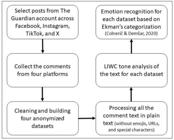
The analysis comprises four moments: creating a database of published content across four platforms, processing text with emojis into plain text, conducting a tone analysis, and performing emotion recognition on data. Figure 1 illustrates the workflow of the proposed data collection and analysis plan. This research design has been chosen because it has been shown to have the ability to study large corpora with accuracy. The integration of the tone and emotion detection methods allows a more nuanced interpretation of discourse patterns and audience responses. Although the current framework has strengths, it has limitations. First, lexicon-based models and simplified categorical taxonomies may fail to capture all the nuances, particularly in irony-rich environments such as social media (Chutia & Baruah, 2024). Second, the use of English-language lexicons may reduce sensitivity to different linguistic idioms, as well as slang and platform-specific memes (Chutia & Baruah, 2024). Third, although LIWC and Orange Ekman-based models offer interpretability, they do not account for contextual interaction among users that follows from preceding comments (Sharma & Sirts, 2024). These limitations do not undermine the validity of the results; however, they should be considered when interpreting the findings.
4.1 Data collection procedures
Since each of the platforms is unique, different tools and collected comments from Facebook, Instagram, X, and TikTok were used. The collection for Facebook was performed on December 7, 2024, using a Python script based on the Facepager application (Jünger & Keyling, 2019), which allowed the extraction of targeted data from the comments section and resulted in 1.084 comments (table 1). For Instagram, the Instascraper (Santos, 2024), a Chrome browser extension, was employed on December 2, 2024. This tool enabled the collection of 9.393 comments. For X (formerly Twitter), data collection was conducted on December 31, 2024, using an advanced tool called Communalytic (Gruzd & Mai, 2020), which enabled integration with the Twitter API to retrieve 23.005 replies to the tweet. Finally, the process concluded on January 2, 2025, with TikTok. Using a web scraper known as TikTok API (GitHub, 2022), 7.838 comments were retrieved.
4.2 Data cleaning
Given that each dataset could contain personal data (nicknames and avatars) and the focus is solely on comment content, it was decided to clean all columns containing possible identifiers of the comment authors. This was followed by a process using the Emoji Data, version 16.0, from Unicode (Unicode CLDR Project, 2024), to turn emojis into plain text. Each emoji symbol was replaced with its short name. During the review of the comments, it was noted that some contained special characters and URLs, which necessitated an additional cleaning step for these elements.
4.3 Tone analysis
After the data was cleaned, the LIWC-22 software and its dictionary (Boyd et al., 2022) were used to analyze the four different datasets from the platforms and the tone of the conversations. The positive tone (tone_pos) and negative tone (tone_neg) dictionaries are designed to reflect sentiment rather than emotion per se (Boyd et al., 2022). The sentiment classifier analyzes the words in the text to predict sentiment, generating scores on a scale from 0 to 100. Both positive and negative sentiments potentially coexist at varying intensities.
4.4 Emotion recognition analysis
To conduct an emotion recognition analysis, we began with tokenization, which splits texts into smaller components such as words, sentences, and bigrams (e.g., “This example.” becomes “This,” “example,” “.”). Next, a WordNet lemmatizer was employed to standardize the words (Li et al., 2021). This step uses a network of cognitive synonyms for tokens (words) derived from the extensive English language lexicon (dictionary) information base of the Natural Language Toolkit (Demšar et al., 2013). In the filtering stage, HTML tags and accents were removed, and a file with a list of English stop words was adjusted to match the characteristics of the text.
In this research, the content was analyzed by attributes using Ekman’s (1999) set of basic emotions (anger, disgust, fear, joy, sadness, and surprise), a process refined afterward by Ekman and Friesen (2003), with multi-class options (Colneric & Demsar, 2020), focusing on the grouped emotion variables identified through Orange data mining (Demšar et al., 2013). The widespread use of the categorical model in computational linguistics research justifies the decision to use Ekman’s classification of emotions, which is based on distinct categories. Psychology research recognizes two main approaches to emotions: categorical and dimensional. The categorical model is preferred in computational contexts because it organizes emotions into defined groups, making the analysis more straightforward (Aman & Szpakowicz, 2007).
4.5 Statistical analysis
Using descriptive statistics, the distribution of positive tone (tone_pos) and negative tone (tone_neg) scores was assessed across platforms. To determine whether tone score differences between platforms existed, a Kruskal-Wallis test was applied due to data asymmetry and the unsuitability of parametric assumptions.
A temporal analysis was conducted to examine how tones and emotions were distributed across platforms during the first four days (November 13, 2024, to November 17, 2024). Daily averages were calculated for each platform, and proportions for positive, negative, and neutral tones were computed relative to their total per day and platform to ensure comparability. Cross-tabulation was used to analyze emotional data and determine the frequency of each emotion across platforms and dates. The raw emotion counts were then normalized to reflect their proportional representation across days and platforms, ensuring that their total percentages sum to 100%.
A linear regression analysis examined the relationship between emotional categories and tone and assessed how each emotional category predicted tone. The tone was the dependent variable, while the emotional categories (Joy, Surprise, Anger, Sadness, and Disgust) were included as independent variables. Using one-hot encoding, these emotions were encoded as binary variables (0 = absence, 1 = presence).
5 Results
Our findings indicate different patterns in communication across platforms regarding the use of positive, negative, and neutral tones. Table 2 provides descriptive statistics for these tone variables and presents an overview of the dataset.
The first research question – What differences exist in tone scores across platforms? – was addressed using the Kruskal-Wallis test, applied to tone scores across platforms based on the descriptive analysis. Subsequently, median values were estimated using 10.000 bootstrap samples to provide robust confidence intervals for tone scores across platforms. The Kruskal-Wallis test revealed statistically significant differences in positive tone across the four platforms (χ² (3, N = 13.841) = 248.297, p < .001). Posts on the Instagram platform showed the highest positive tone scores (Mdn = 11.76, 95% CI (11.11, 12.50)) compared to the other platforms: TikTok (Mdn = 9.52, 95% CI (9.09, 10.00)), X (Mdn = 9.09, 95% CI (9.09, 9.09)), and Facebook (Mdn = 6.67, 95% CI (6.25, 7.14)).
Similarly, the analysis of negative tone scores identified statistically significant differences across platforms (χ² (3, N = 9.657) = 123.619, p < .001). Negative tone scores were highest on X (Mdn = 8.33, 95% CI (8.33, 8.33)), followed by TikTok (Mdn = 7.41, 95% CI (7.14, 7.69)), Instagram (Mdn = 6.67, 95% CI (6.25, 7.14)), and Facebook, which recorded the lowest score (Mdn = 5.56, 95% CI (5.26, 6.25)).
In addition to positive and negative tones, neutral tone scores, defined as posts without either classification, accounted for 53.5% of all posts. A chi-square test revealed statistically significant differences in the distribution of neutral tone across platforms (χ²(3, N = 41.312) = 241.36, p < .001). Instagram and X had the highest proportions of neutral posts (56.5% and 54.9%, respectively), followed by TikTok (47.6%), while Facebook had the lowest (39.9%). The analysis indicates that Instagram and X users mainly communicate in neutral tones, yet both TikTok and Facebook users display more expressiveness with emotionally charged content.
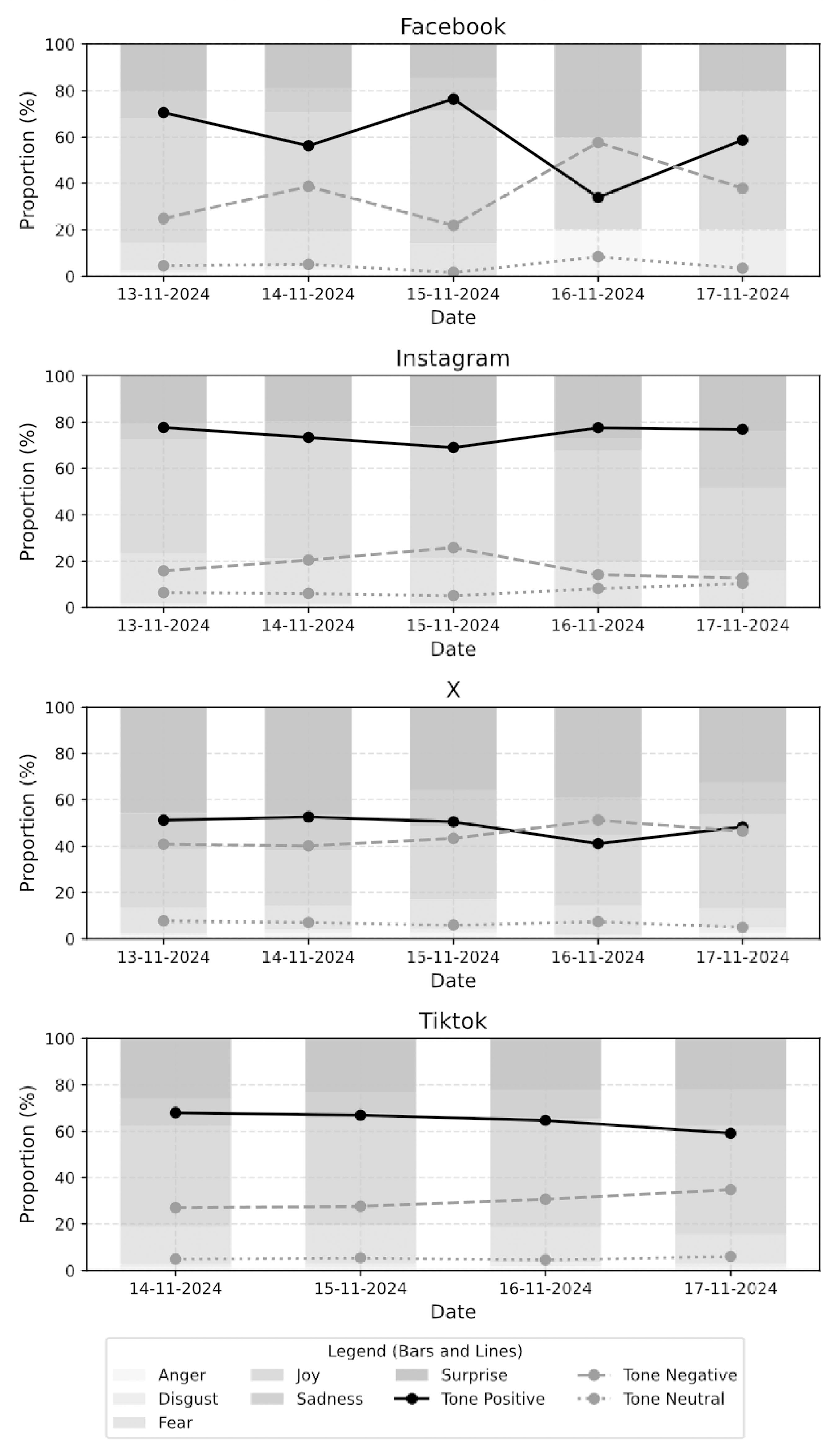
The second research question examined how tone and emotional expression changed across platforms. This analysis was essential for understanding variations in communication dynamics. Figure 2 shows Facebook, Instagram, X, and TikTok emotional expression and tone changes from November 13 to 17, 2024. The time-based distribution of emotional proportions – such as anger, joy, and surprise – and positive, negative, and neutral tones illustrates audience reactions to The Guardian’s departure across these platforms. Regarding emotions, fear and anger are more prevalent on X than on other platforms, while joy is Instagram’s dominant emotion.
Distribution of tone and emotions across the four platforms between November 13 and 17, 2024
The third research question explores the relationship between emotional categories and tone by analyzing the six emotions and positive, negative, and neutral tone scores. Descriptive statistics for the emotional categories are provided in Table 3, which presents an overview of the dataset.
First, statistically significant differences in positive tone were identified between comments with and without specific emotions using the Kruskal-Wallis test. Data not classified as “Joy” (χ²(1), N = 13.821) = 1611.63, p < .001) (Mean RankHigh = 8290.50), “Surprise” (χ²(1, N = 13.821) = 1398.30, p < .001) (Mean RankHigh = 9069.76), and “Disgust” (χ²(1, N = 13.693) = 3.92, p = .048) (Mean RankHigh = 6917.49) exhibited higher positive tone scores than those classified as these emotions (Mean RankLow = 5566.78, 6165.71, and 6216.51, respectively). Conversely, data classified as “Sadness” (χ²(1, N = 13.821) = 101.60, p < .001) (Mean RankHigh = 7927.40) and “Anger” (χ²(1, N = 13,821) = 7.04, p = .008) (Mean RankHigh = 7657.34) showed higher positive tone scores compared to those without these emotions (Mean RankLow = 6795.98 and 6900.15, respectively). No statistically significant findings were observed for comments classified as “Fear” (p = .072), despite their high positive tone scores (Mean RankHigh= 7083.09).
Subsequently, differences were also identified with a negative tone. Data not classified as “Joy” (χ²(1, N = 9657) = 2943.10, p < .001) (Mean RankHigh= 6210.87) exhibited significantly higher negative tone scores compared to those classified as “Joy” (Mean RankLow = 3116.08). Meanwhile, comments classified as “Sadness” (χ²(1, N = 9657) = 585.82, p < .001) (Mean RankHigh= 4554.91), “Surprise” (χ²(1, N = 9657) = 915.56, p < .001) (Mean RankHigh= 6501.71), “Disgust” (χ²(1, N = 9657) = 7.28, p = .007) (Mean RankHigh= 5355.11), “Anger” (χ²(1, N = 9657) = 124.40, p < .001) (Mean RankHigh = 6586.45), and “Fear” (χ²(1, N = 9657) = 122.84, p < .001) (Mean RankHigh = 5561.39) displayed higher negative tone scores than those without these emotions (Mean RankLow = 4554.91, 4388.78, 4817.87, 4772.07, and 4694.11, respectively).
The inquiry into how neutral tone corresponds to emotional categories employed a chi-square statistical evaluation. The analysis revealed several statistically significant associations. Among the emotions, “Surprise” was the most prevalent, expressed in 43.7% of neutral messages (χ²(1, N = 41.312) = 1581.59, p < .001), followed by “Joy” which appeared in 26.4% of neutral messages (χ²(1, N = 41.312) = 1727.40, p < .001).
Notably, the emotion “Fear” showed up in 14.9% of messages that were labeled as neutral, which suggests it plays an important role and fits with patterns seen in other tones (χ²(1, N = 41.312) = 22.91, p < .001). Similarly, “Sadness” was found in 13.2% of neutral messages, with a statistically significant association (χ²(1, N = 41.312) = 11.04, p = .001).
Additionally, neutral messages showed extremely low levels of “Anger”, which appeared in only 1.0% of cases (χ²(1, N = 41.312) = 83.05, p < .001), and an even lower prevalence of “Disgust” appearing in just 0.7% of messages (χ²(1, N = 41.312) = 51.22, p < .001).
The data show that neutral tone communications trigger emotional responses like surprise, alongside joy and sadness. While emotional patterns partially aligned with positive and negative tone results, emotions such as surprise and sadness also demonstrated significant associations, albeit with varying intensity and prevalence across tones.
The fourth research question – Which emotional categories are significant predictors of tone? – was addressed by applying a multiple linear regression analysis and employing the enter method to determine the extent to which five emotional categories – Surprise, Sadness, Disgust, Anger, and Fear – predict positive, negative, and neutral tone. The model was significant for positive tone, (F(5,13815) = 200.096, p < .001), explaining 6.8% (R² = .068) of the variance in the outcome variable. The emotions “Surprise” (B = 9.93, t = 31.0, p < .001), “Sadness” (B = 2.86, t = 6.29, p < .001), and “Disgust” (B = 5.54, t = 3.99, p < .001) were significant predictors of positive tone. “Fear” (B = .836, t = 1.91, p = .056) and “Anger” (B = 1.93, t = 1.72, p = .085) were not significant predictors. Of these, “Surprise” was most strongly associated.
Similarly, multiple linear regression analysis of negative tone (tone_neg) yielded a significant model (F(5, 9651) = 300.969, p < .001), explaining 13.5% (R² = .135) of the variance. All five emotional categories – “Surprise” (B = 9.01, t = 31.51, p < .001), “Sadness” (B = 9.16, t = 27.55, p < .001), “Disgust” (B = 4.32, t = 5.64, p < .001), “Anger” (B = 10.83, t = 17.20, p < .001), and “Fear” (B = 4.64, t = 14.61, p < .001) – were found to be significant predictors of negative tone. Notably, “Anger” and “Sadness” had strong associations with the negative tone.
Lastly, a significant model was found for the neutral tone (neutral_tone) in the multiple linear regression analysis (F(5, 41306) = 487.927, p <.001), explaining 5.6% (R² =.056) of the variance. The emotional categories, “Surprise” (B = .270, t = 47.61, p < .001), “Sadness” (B = .159, t = 20.38, p < .001), “Fear” (B = .166, t = 22.20, p < .001), and “Anger” (B = -.040, t = -2.07, p = .039) were significant predictors of neutral tone. Conversely, “Disgust” (B = -.034, t = -1.45, p = .148) was not a significant predictor. Of note, “Surprise” yielded the strongest positive association with this outcome. Note that the “Joy” variable was excluded from all models due to high collinearity with other predictors, as indicated by extremely low tolerance values (tolerance < 0.10) and a high Variance Inflation Factor (Field, 2017).
6 Discussion
This study enhances understanding of public reactions in online participatory environments, and The Guardian’s absence from X stands out as a media event and an unprecedented act in institutional journalism. It fills a gap by empirically examining how audiences react emotionally and discursively to editorial decisions in digital contexts, using The Guardian’s departure from X as a case study. Building on prior work on emotional responses to news (Aldous et al., 2021), it treats editorial decisions as emotional stimuli and extends analysis across platforms. Rather than making a strong novelty claim, it models the relationship between major emotional categories and the tone of audience responses. Surprise, sadness, and anger emerge as predictors of response tone (positive, neutral, or negative).
These results address both guiding questions. First, by identifying tone and emotional patterns in audience reactions, they clarify how The Guardian’s withdrawal shaped public perceptions of journalism. Neutral tone tends to prevail in online participatory spaces, followed by positive and, lastly, negative (Aldous et al., 2021). In this case, the withdrawal from X elicited predominantly “joy” and “surprise” among journalistic audiences. Two implications follow. One, the announcement was often perceived as emotionally satisfying, given the balance of reactions (Giuntini et al., 2019). Yet this “joy” is semantically ambivalent: it can signal relief or support for a credible outlet leaving a deteriorating space, but it can also reflect satisfaction among groups that view critical journalism as a threat. Right-wing political elites and extremist movements have increasingly challenged the media’s democratic legitimacy, and journalists have been targeted for critical reporting (Riedl & Eberl, 2022). The suspension of U.S. journalists who criticized Elon Musk illustrates this tendency (Bustos Díaz et al., 2025). The absence of an outlet with The Guardian’s stature weakens resistance to disinformation, benefiting populist and conspiratorial forces that, since the covid-19 pandemic, have instrumentalized platforms to spread xenophobic and denialist narratives (White, 2020).
Two, “joy” may also mark genuine support for withdrawal as a protest against X’s trajectory, often associated with normalized disinformation, hostile discourse, and a fragmented public sphere (Bustos Díaz et al., 2025; Noguera Vivo, 2024). This supportive stance coexists with minority “sadness” and “disgust”, suggesting that some audiences saw the exit as a symbolic loss for democratic deliberation. This reading is tempered by journalistic positions advocating continued presence in hostile environments as a form of resistance and monitoring, precisely to observe how disinformation actors operate and coordinate (Noguera Vivo, 2024).
Cross-platform variation makes this ambivalence clearer. Platform environments elicited different emotional reactions to the same event, with architecture structuring user behavior. Instagram comments scored highest in positive tone, whereas X registered the most negative. Text-centric, trend-driven dynamics on X intensify affect and polarization, producing echo chambers (Cinelli et al., 2021). Instagram’s visual, curated feeds foster homophily by exposing users to content aligned with prior interests (Pariser, 2012). TikTok prioritizes short-form, viral video; Facebook’s engagement patterns reflect a broad, aging demographic. These dynamics yield distinct interaction patterns; “anger” and “fear” are more frequent on X, consistent with evidence that it disproportionately disseminates disinformation (Guess & Lyons, 2020). X also exhibits higher levels of incivility and hostile exchanges compared to other platforms (Bastug et al., 2020; Costa, 2023; Falkenberg et al., 2024). Facebook’s consistently lower tone scores align with its diminishing role in news consumption (Newman et al., 2024).
Overall, platform architecture and audience composition shape both content and modes of communication. Each platform’s emotional expression arises from the interplay of interface design, recommendation systems, community norms, and circulating content (Gillespie, 2018; van Dijck et al., 2018). Algorithmic governance mediates public deliberation by reinforcing some emotional patterns and constraining others (Napoli, 2019). Consistent with recent work, user interest in a topic typically saturates within two to three days (Etta et al., 2023). Topics that emerge and saturate quickly tend to trigger more negative or controversial responses. This helps explain the relatively low number of negative reactions observed here, since the peak fell on the third day after The Guardian’s announcement. The pattern matches research showing predictable cycles of escalation and decline in emotional engagement (Vosoughi et al., 2018).
Building on these dynamics, the analysis offers practical guidance for editorial strategy and audience engagement. Decisions that disregard audiences often fail to secure public legitimacy, even when well-intentioned (Peña-Fernández et al., 2021). Although reactions were largely positive or neutral, the semantic ambiguity of claims of “support” calls for a more profound understanding of affective and discursive processes to inform decisions about leaving or remaining on platforms. This interpretive gap signals a deeper structural issue in journalistic practice. Martin and Murrell (2021) add that professional journalists are not adequately trained to decode or respond to the emotional tone of digital publics. The contemporary journalism curriculum lacks a focus on active listening, particularly in hostile environments, and therefore fails to equip practitioners with the skills needed to defuse tensions in participatory public spaces (Costa, 2022). This structural disconnect between journalistic institutions and their audiences helps explain why strategic choices often fail to resonate with the public.
Moreover, as social platforms can be viewed as algorithmic intermediaries (Winques & Longhi, 2022), audience behavior is increasingly shaped by computational processes that traditional editorial reasoning struggles to grasp. This illustrates the importance of analytical skills in decoding interactions between publics and journalism in algorithmically designed spaces. As Moe (2024) argues, decisions such as leaving a platform cannot rest solely on institutional beliefs or normative frameworks; they must also consider audience perceptions. The empirical evidence presented here can support more informed and context-sensitive editorial policies.
Among the ways audiences engage with information on social platforms, comments are central, as they enable direct interaction with information flows, provide feedback, and facilitate collective debate (Schmidt et al., 2018; Wisniewski et al., 2020). Journalism’s growing distance from its audiences jeopardizes revenue streams, traffic, and institutional legitimacy (Newman et al., 2024). At the same time, limited investment in accountability and regulatory models suited to the digital age has opened space for external regulation of platforms by public authorities (Bergström & Wadbring, 2015; Costa, 2024; Enli, 2008; Lüders, 2008). Recent developments necessitate closer scrutiny of platforms and their institutional impacts. The Guardian’s departure drew mixed reactions, showing that users – via algorithmic mediation and affect-laden engagement – are increasingly critical of editorial authority. In such environments, journalists must actively assert legitimacy; it is no longer granted by default. The sector is undergoing structural transformation, shifting from institutional power to systems of visibility governed by platform rules. News organizations now struggle to preserve editorial independence and sustain trust while ceding control over circulation. The Guardian’s stance against misinformation entails financial and reputational risks and highlights a structural contradiction in contemporary journalism: an ever-greater dependence on platform-mediated visibility.
7 Conclusion
This study contributes to debates on how audiences react emotionally and discursively to media organizations’ withdrawals from digital platforms, taking The Guardian’s departure from Platform X as a focal point. Most respondents supported the move, expressing both approval and acceptance of the reasons provided. Approval was evident on Instagram, and the decision was echoed across other platforms; however, anger, sadness, and even disgust also appeared, indicating the existence of a latent ambivalence. Such a mix of reactions suggests that the editorial decision can be read as both a protest and a disruptive move. Nonetheless, it is unlikely to alter the structural dynamics of disinformation and polarization that underlie these platforms.
The decision aligns with the tendency among news organizations to reassess the role of major platforms within the media ecosystem. It is not an isolated event but rather part of a larger movement to reevaluate the role of social platforms within the media ecosystem, informed by dissatisfaction with the management of X and by a climate of hostility towards the press, including recent incidents of violence (Costa, 2021). Beneath the decision lies a broader debate on press freedom and digital safety. Yet withdrawing from these spaces also entails relinquishing a degree of real-time moderation – the work of journalists as curators and verifiers of information. Without that presence, platforms are left more exposed to unverified claims, conspiracy theories, and coordinated disinformation, deepening the risks of fragmentation and radicalization in public discourse.
While this episode may prompt other outlets to reconsider their presence on X, any such decision must weigh symbolic and ethical motives against the operational expenses: loss of audience reach, reduced subscriptions, and diminished advertising income. At the same time, disengagement can open space to reallocate resources toward alternative channels – proprietary platforms, newsletters, podcasts, or decentralized networks – with the potential to fortify the direct connection with the public. To ensure a reliable and legitimate media presence moving forward, future studies are necessary to determine whether reducing media presence on social platforms will increase the trust and legitimacy of the media or, on the contrary, create a vacuum that will favor misinformation. This reflection necessitates an examination of diverse segments of the audience, acknowledging that the role of journalists encompasses not only the dissemination of information but also the moderation and contextualization of public discourse. Their absence may result in a deterioration of the debate, which is already vulnerable to distortions. This deterioration may manifest as increased noise, polarization, and a weakened factual basis (Costa, 2024).
NOTES
-
1
Data extraction is limited to public profiles. This ethical issue results in a lower value of comments collected than the original (93.9%).
-
2
The total number of likes and shares is summed from the data made available by the platforms on 9 January 2025.
-
3
Negative and positive tones are not mutually exclusive.
-
How to cite this article:
Santos, R. B., & Costa, B. F. (2026). THE GUARDIAN’S DEPARTURE FROM X: an analysis of the tone and emotions of journalistic audiences’ comments on four platforms. Brazilian Journalism Research, 22(1), e1821. DOI: 10.25200/BJR.v22n1.2026.1821
-
FUNDING
The research, writing, and editing of this study were supported by the Portuguese Foundation for Science and Technology (FCT – Fundação para a Ciência e a Tecnologia) under grant 2023.04877.BD (website https://aversion2agony.com/; DOI: 10.54499/2023.04877.BD) – and through the funding of the R&D Unit UIDB/03126/2020.
DATA AVAILABILITY
The data supporting the findings of this study are available within the article.
REFERENCES
-
Aldous, K. K., An, J., & Jansen, B. J. (2021). Measuring 9 Emotions of News Posts from 8 News Organizations Across 4 Social Media Platforms for 8 Months. ACM Transactions on Social Computing, 4(4), 1–31. DOI: 10.1145/3516491
» https://doi.org/10.1145/3516491 -
Alonso-Muñoz, L. (2024). X/Twitter: ¿espacio para la deliberación o para la desinformación?. Anuario ThinkEPI, 18, 1–5. DOI: 10.3145/thinkepi.2024.e18a39
» https://doi.org/10.3145/thinkepi.2024.e18a39 - Aman, S., & Szpakowicz, S. (2007). Identifying Expressions of Emotion in Text. In V. Matoušek & P. Mautner (Eds), Text, Speech and Dialogue (pp. 196–205). Springer.
-
Bakir, V., & McStay, A. (2018). Fake News and the Economy of Emotions. Digital Journalism, 6(2), 154–175. DOI: 10.1080/21670811.2017.1345645
» https://doi.org/10.1080/21670811.2017.1345645 -
Bastug, M. F., Douai, A., & Akca, D. (2020). Exploring the “Demand Side” of Online Radicalization: Evidence from the Canadian Context. Studies in Conflict & Terrorism, 43(7), 616–637. DOI: 10.1080/1057610X.2018.1494409
» https://doi.org/10.1080/1057610X.2018.1494409 - Benkler, Y., Faris, R., & Roberts, H. (2018). Network Propaganda Oxford University Press.
- Berger, A. A. (2014). Media and Communication Research Methods: An Introduction to Qualitative and Quantitative . Sage.
-
Berger, J., & Milkman, K. L. (2012). What Makes Online Content Viral? Journal of Marketing Research, 49(2), 192–205. DOI: 10.1509/jmr.10.0353
» https://doi.org/10.1509/jmr.10.0353 -
Bergström, A., & Wadbring, I. (2015). Beneficial yet crappy: Journalists and Audiences on Obstacles and Opportunities in Reader Comments. European Journal of Communication, 30(2), 137–151. DOI: 10.1177/0267323114559378
» https://doi.org/10.1177/0267323114559378 -
Boyd, R. L., Ashokkumar, A., Seraj, S., & Pennebaker, J. W. (2022). The Development and Psychometric Properties of LIWC-22 University of Texas at Austin. Retrieved from https://www.liwc.app
» https://www.liwc.app -
Bradshaw, S., & Howard, P. N. (2019). The Global Disinformation Order: 2019 Global Inventory of Organised Social Media Manipulation University of Oxford. Retrieved from https://demtech.oii.ox.ac.uk/wp-content/uploads/sites/12/2019/09/CyberTroop-Report19.pdf
» https://demtech.oii.ox.ac.uk/wp-content/uploads/sites/12/2019/09/CyberTroop-Report19.pdf - Bruns, A. (2018). Gatewatching and News Curation Peter Lang US.
-
Bu, Z., Xia, Z., & Wang, J. (2013). A Sock Puppet Detection Algorithm on Virtual Spaces. Knowledge-Based Systems, 37, 366–377. DOI: 10.1016/j.knosys.2012.08.016
» https://doi.org/10.1016/j.knosys.2012.08.016 -
Bustos Díaz, J., Martin Vicario, L., & Perelló Sobrepere, M. (2025). De Twitter a X: orígenes, desinformación y el éxodo de medios tradicionales. Estudio de caso de los medios The Guardian y La Vanguardia. Hipertext.Net, (30), 89–100. DOI: 10.31009/hipertext.net.2025.i30.07
» https://doi.org/10.31009/hipertext.net.2025.i30.07 - Castells, M. (2015). Networks of Outrage and Hope: Social Movements in the Internet Age (2nd ed.). Polity Press.
-
Chen, G. M., & Pain, P. (2017). Normalizing Online Comments. Journalism Practice, 11(7), 876–892. DOI: 10.1080/17512786.2016.1205954
» https://doi.org/10.1080/17512786.2016.1205954 -
Chutia, T., & Baruah, N. (2024). A Review on Emotion Detection by Using Deep Learning Techniques. Artificial Intelligence Review, 57(8), 203. DOI : 10.1007/s10462-024-10831-1
» https://doi.org/10.1007/s10462-024-10831-1 -
Cinelli, M., De Francisci Morales, G., Galeazzi, A., Quattrociocchi, W., & Starnini, M. (2021). The Echo Chamber Effect on Social Media. Proceedings of the National Academy of Sciences, 118(9), 1–7. DOI: 10.1073/pnas.2023301118
» https://doi.org/10.1073/pnas.2023301118 -
Claesson, A. (2024). Twitter: A Necessary Evil? Journalistic Responses to Elon Musk and the Denormalization of Social Media. Journalism, 25(12), 2604–2621. DOI: 10.1177/14648849231221616
» https://doi.org/10.1177/14648849231221616 -
Coe, K., Kenski, K., & Rains, S. A. (2014). Online and Uncivil? Patterns and Determinants of Incivility in Newspaper Website Comments. Journal of Communication, 64(4), 658–679. DOI: 10.1111/jcom.12104
» https://doi.org/10.1111/jcom.12104 -
Colneric, N., & Demsar, J. (2020). Emotion Recognition on Twitter: Comparative Study and Training a Unison Model. IEEE Transactions on Affective Computing, 11(3), 433–446. DOI: 10.1109/TAFFC.2018.2807817
» https://doi.org/10.1109/TAFFC.2018.2807817 - Costa, B. F. (2021). Liberdade de expressão e discurso de ódio: Consequências para o campo jornalístico Media XXI.
- Costa, B. F. (2022). Refletir o jornalismo português perante as novas situações de vulnerabilidade. In C. Camponez, M. Oliveira, F. Proença & A. F. Oliveira (Eds.), Jornalismo, Cidadania e Democracias Sustentáveis nos Países de Língua Portuguesa (pp. 8-19). ACEP/Ceis20/CECS.
- Costa, B. F. (2023). The Rhetoric of Digital Hate Speech Against Women Journalists: Drawing from Experiences of Harassment in Portugal. In J. Valdizán Ayala (Eds.), La ética y el derecho a la información: Nuevas audiencias activas en la era poscovid (pp. 98-118). Universidad San Ignacio de Loyola.
- Costa, B. F. (2024). Return to Censorship: Portuguese Perceptions of Digital Disinformation Regulation. In T. Filibeli & M. Ö. Özbek (Eds.), Mapping lies in the global media sphere (pp. 148–164). Routledge.
- Costa, B. F., & Mateus, B. C. (2024). Innovating in Journalism with Newsgames: An Exploratory Study in Portugal. In L. Bojić, S. Žikić, J. Matthes, & D. Trilling (Eds.), Navigating the Digital Age: An In-Depth Exploration into the Intersection of Modern Technologies and Societal Transformation (pp. 43-82). Institute for Philosophy and Social Theory.
-
D’Ambrosio, M. (2022). Emotions in Political Discourse and Social Narratives: Sociological Reflections on Traditional and New Media. Society Register, 6(4), 101–116. DOI: 10.14746/sr.2022.6.4.06
» https://doi.org/10.14746/sr.2022.6.4.06 -
Dawson, P. (2020). Hashtag Narrative: Emergent Storytelling and Affective Publics in the Digital Age. International Journal of Cultural Studies, 23(6), 968–983. DOI: 10.1177/1367877920921417
» https://doi.org/10.1177/1367877920921417 -
Demšar, J., Curk, T., Erjavec, A., Gorup, Č., Hočevar, T., Milutinovič, M., Možina, M., Polajnar, M., Toplak, M., Starič, A., Štajdohar, M., Umek, L., Žagar, L., Žbontar, J., Žitnik, M., & Zupan, B.. (2013). Orange: Data Mining Toolbox in Python. Journal of Machine Learning Research, 14, 2.349–2.353. Retrieved from http://jmlr.org/papers/v14/demsar13a.html
» http://jmlr.org/papers/v14/demsar13a.html - DeNardis, L. (2015). The Global War for Internet Governance Yale University Press.
-
Dworakowski, O., Boyd, R. L., Meier, T., Kuppens, P., Mehl, M. R., Nussbeck, F. W., & Horn, A. B. (2023). Twitter Language Samples Reflect Collective Emotional Responses Following Political Leaders’ Rhetoric during the Pandemic Across Four Countries. Psychology of Language and Communication, 27(1), 350–383. DOI: 10.58734/plc-2023-0017
» https://doi.org/10.58734/plc-2023-0017 -
Ecker, U. K. H., Lewandowsky, S., Cheung, C. S. C., & Maybery, M. T. (2015). He Did It! She Did It! No, She Did Not! Multiple Causal Explanations and the Continued Influence of Misinformation. Journal of Memory and Language, 85, 101–115. DOI: 10.1016/j.jml.2015.09.002
» https://doi.org/10.1016/j.jml.2015.09.002 - Edström, M., Kenyon, A. T., & Svensson, E. (Eds.). (2016). Blurring the Lines: Market-Driven and Democracy-Driven Freedom of Expression Nordicom.
- Ekman, P. (1999). Basic Emotions. In T. Dalgleish & M. Power (Eds.), Handbook of Cognition and Emotion (pp. 45–60). John Wiley & Sons.
- Ekman, P., & Friesen, W. V. (2003). Unmasking the Face Malor Books.
-
Enli, G. S. (2008). Redefining Public Service Broadcasting. Convergence: The International Journal of Research into New Media Technologies, 14(1), 105–120. DOI: 10.1177/1354856507084422
» https://doi.org/10.1177/1354856507084422 -
Etta, G., Sangiorgio, E., Di Marco, N., Avalle, M., Scala, A., Cinelli, M., & Quattrociocchi, W. (2023). Characterizing Engagement Dynamics across Topics on Facebook. PLOS ONE, 18(6), e0286150. DOI: 10.1371/journal.pone.0286150
» https://doi.org/10.1371/journal.pone.0286150 -
Falkenberg, M., Zollo, F., Quattrociocchi, W., Pfeffer, J., & Baronchelli, A. (2024). Patterns of Partisan Toxicity and Engagement Reveal the Common Structure of Online Political Communication Across Countries. Nature Communications, 15(1), 1–13. DOI: 10.1038/s41467-024-53868-0
» https://doi.org/10.1038/s41467-024-53868-0 -
Ferrara, E. (2020). What Types of COVID-19 Conspiracies Are Populated by Twitter Bots? First Monday, 25(6). DOI: 10.5210/fm.v25i6.10633
» https://doi.org/10.5210/fm.v25i6.10633 - Field, A. (2017). Discovering Statistics Using IBM SPSS Statistics (5th ed.). Sage.
- Gillespie, T. (2018). Custodians of the Internet: Platforms, Content Moderation, and the Hidden Decisions that Shape Social Media Yale University Press.
-
GitHub. (2022, n.d.). Evil0ctal/Douyin_TikTok [Douyin_TikTok_Download_API」. Retrieved from https://github.com/Evil0ctal/Douyin_TikTok_Download_API
» https://github.com/Evil0ctal/Douyin_TikTok_Download_API -
Giuntini, F. T., Ruiz, L. P., Kirchner, L. D. F., Passarelli, D. A., Dos Reis, M. D. J. D., Campbell, A. T., & Ueyama, J. (2019). How Do I Feel? Identifying Emotional Expressions on Facebook Reactions Using Clustering Mechanism. IEEE Access, 7, 53.909–53.921. DOI: 10.1109/ACCESS.2019.2913136
» https://doi.org/10.1109/ACCESS.2019.2913136 -
Gruzd, A., & Mai, P. (2020). Communalytic: A Computational Social Science Research Tool for Studying Online Communities and Discourse Communalytic. Retrieved from https://communalytic.org/
» https://communalytic.org/ - Guess, A. M., & Lyons, B. A. (2020). Misinformation, Disinformation, and Online Propaganda. In N. Persily & J. A. Tucker (Eds.), Social Media and Democracy (pp. 10–33). Cambridge University Press.
-
Hermida, A., & Thurman, N. (2008). A Clash of Cultures. Journalism Practice, 2(3), 343–356. DOI: 10.1080/17512780802054538
» https://doi.org/10.1080/17512780802054538 -
Humprecht, E., Hellmueller, L., & Lischka, J. A. (2020). Hostile Emotions in News Comments: A Cross-National Analysis of Facebook Discussions. Social Media + Society, 6(1), 1–12. DOI: 10.1177/2056305120912481
» https://doi.org/10.1177/2056305120912481 -
Humprecht, E., Amsler, M., Esser, F., & Van Aelst, P. (2024). Emotionalized Social Media Environments: How Alternative News Media and Populist Actors Drive Angry Reactions. Political Communication, 41(4), 559–587. DOI : 10.1080/10584609.2024.2350416
» https://doi.org/10.1080/10584609.2024.2350416 -
Inuduka, T., Yokose, A., & Managi, S. (2024). Noise Trader Impact: Bitcoin Market Evidence from Telegram and X. Social Network Analysis and Mining, 14(1), 189. DOI: 10.1007/s13278-024-01350-6
» https://doi.org/10.1007/s13278-024-01350-6 -
Iranzo-Cabrera, M., Castro-Bleda, M. J., Simón-Astudillo, I., & Hurtado, L.-F. (2024). Journalists’ Ethical Responsibility: Tackling Hate Speech Against Women Politicians in Social Media Through Natural Language Processing Techniques. Social Science Computer Review, 43(3), 475–502. DOI: 10.1177/08944393241269417
» https://doi.org/10.1177/08944393241269417 -
Jones, F. (2025, January 10). More than 60 German Universities and Research Institutions Leave X - Research Professional News Clarivate. Retrieved from www.researchprofessionalnews.com/rr-news-europe-germany-2025-1-more-than-60-german-universities-and-research-institutions-leave-x/
» www.researchprofessionalnews.com/rr-news-europe-germany-2025-1-more-than-60-german-universities-and-research-institutions-leave-x/ -
Jünger, J., & Keyling, T. (2019, n.d.). Facepager. An Application for Automated Data Retrieval on the Web. Strohne/Facepager. Retrieved from https://github.com/strohne/Facepager/
» https://github.com/strohne/Facepager/ - Landert, D. (2014). Personalisation in Mass Media Communication (Vol. 240). John Benjamins Publishing Company.
-
Lewandowsky, S. (2011, March 27). Bitten by a Sock Puppet, but the Climate Is Still Changing ABC News. Retrieved from www.abc.net.au/news/2011-03-28/lewandowsky/45638
» www.abc.net.au/news/2011-03-28/lewandowsky/45638 -
Li, X., You, S., & Chen, W. (2021). Enhancing Accuracy of Semantic Relatedness Measurement by Word Single-Meaning Embeddings. IEEE Access, 9, 117.424–117.433. DOI: 10.1109/ACCESS.2021.3107445
» https://doi.org/10.1109/ACCESS.2021.3107445 -
Loke, J. (2012). Old Turf, New Neighbors. Journalism Practice, 6(2), 233–249. DOI: 10.1080/17512786.2011.616649
» https://doi.org/10.1080/17512786.2011.616649 -
Loughran, T., & McDonald, B. (2011). When is a Liability not a Liability? Textual Analysis, Dictionaries, and 10‐Ks. The Journal of Finance, 66(1), 35–65. DOI: 10.1111/j.1540-6261.2010.01625.x
» https://doi.org/10.1111/j.1540-6261.2010.01625.x -
Lüders, M. (2008). Conceptualizing Personal Media. New Media & Society, 10(5), 683–702. DOI: 10.1177/1461444808094352
» https://doi.org/10.1177/1461444808094352 - Maireder, A., & Ausserhofer, J. (2014). Political Discourses on Twitter: Networking Topics, Objects, and People. In K. Weller, A. Bruns, J. Burgess, M. Mahrt & C. Puschmann (Eds.), Twitter and Society (pp. 305–318). Peter Lang US.
- Martin, F., & Dwyer, T. (2019). Sharing News Online Springer.
-
Martin, F., & Murrell, C. (2021). Negotiating the Conversation: How Journalists Learn to Interact with Audiences Online. Journalism Practice, 15(6), 839–859. DOI: 10.1080/17512786.2021.1907211
» https://doi.org/10.1080/17512786.2021.1907211 -
Milioni, D. L., Vadratsikas, K., & Papa, V. (2012). ‘Their Two Cents Worth’: Exploring User Agency in Readers’ Comments in Online News Media. Observatorio (OBS*), 6(3), 21–47. DOI: 10.15847/obsOBS632012591
» https://doi.org/10.15847/obsOBS632012591 -
Moe, H. (2024). Embrace or Leave Social Media? On the Viability of Public Service Media Organizations’ Strategies Facing Platform Power. European Journal of Communication, 39(6), 595–607. DOI: 10.1177/02673231241290097
» https://doi.org/10.1177/02673231241290097 - Napoli, P. M. (2019). Social Media and the Public Interest: Media Regulation in the Disinformation Age Columbia University Press.
- Newman, N., Fletcher, R., Robertson, C. T., Ross Arguedas, A., & Nielsen, R. K. (2024). Reuters Institute Digital News Report 2024 Reuters Institute for the Study of Journalism.
-
Nip, J. Y. M., & Berthelier, B. (2023). Emotional Profiles of Facebook Pages: Audience Response to Political News in Hong Kong. Journalism and Media, 4(4), 1021–1038. DOI: 10.3390/journalmedia4040065
» https://doi.org/10.3390/journalmedia4040065 -
Noguera Vivo, J. M. (2024, December 26). Por qué abandonar X (Twitter) no lleva a ninguna parte Telos. Retrieved from https://repositorio.ucam.edu/handle/10952/8691
» https://repositorio.ucam.edu/handle/10952/8691 -
Nyhan, B., & Reifler, J. (2010). When Corrections Fail: The Persistence of Political Misperceptions. Political Behavior, 32(2), 303–330. DOI: 10.1007/s11109-010-9112-2
» https://doi.org/10.1007/s11109-010-9112-2 -
Özturan, B., Quintana-Mathé, A., Grinberg, N., Ognyanova, K., & Lazer, D. (2025, July 11). Declining Information Quality Under New Platform Governance Harvard Kennedy School Misinformation Review. DOI: 10.37016/mr-2020-176
» https://doi.org/10.37016/mr-2020-176 - Pariser, E. (2012). The Filter Bubble: What the Internet is Hiding from You Penguin Books.
-
Peña-Fernández, S., Pérez-Dasilva, J. Á., Meso-Ayerdi, K., & Larrondo-Ureta, A. (2021). Social Participation in the Media: The Dialogue of Digital Journalists with Audiences. European Public & Social Innovation Review, 6(1), 16–28. DOI: 10.31637/epsir.21-1.2
» https://doi.org/10.31637/epsir.21-1.2 -
Pennycook, G., Bear, A., Collins, E. T., & Rand, D. G. (2020). The Implied Truth Effect: Attaching Warnings to a Subset of Fake News Headlines Increases Perceived Accuracy of Headlines Without Warnings. Management Science, 66(11), 4944–4957. DOI : 10.1287/mnsc.2019.3478
» https://doi.org/10.1287/mnsc.2019.3478 -
Pennycook, G., Cannon, T. D., & Rand, D. G. (2018). Prior Exposure Increases Perceived Accuracy of fake News. Journal of Experimental Psychology: General, 147(12), 1865–1880. DOI: 10.1037/xge0000465
» https://doi.org/10.1037/xge0000465 -
Pennycook, G., Epstein, Z., Mosleh, M., Arechar, A. A., Eckles, D., & Rand, D. G. (2021). Shifting Attention to Accuracy Can Reduce Misinformation Online. Nature, 592(7855), 590–595. DOI: 10.1038/s41586-021-03344-2
» https://doi.org/10.1038/s41586-021-03344-2 -
Riedl, A., & Eberl, J.-M. (2022). Audience Expectations of Journalism: What’s Politics Got to Do with it? Journalism, 23(8), 1.682–1.699. DOI: 10.1177/1464884920976422
» https://doi.org/10.1177/1464884920976422 -
Roozenbeek, J., & van der Linden, S. (2019). The Fake News Game: Actively Inoculating Against the Risk of Misinformation. Journal of Risk Research, 22(5), 570–580. DOI: 10.1080/13669877.2018.1443491
» https://doi.org/10.1080/13669877.2018.1443491 -
Santos, B. R. (2024, January 7). Instagram Extract Comment. An Application for Automated Data Extraction from Instagram GitHub. Retrieved from https://github.com/RuiBrunoSantos/Instascraper
» https://github.com/RuiBrunoSantos/Instascraper -
Schmidt, A. L., Zollo, F., Scala, A., & Quattrociocchi, W. (2018). Polarization Rank: A Study on European News Consumption on Facebook, 0(0), 1–30. DOI: 10.48550/arXiv.1805.08030
» https://doi.org/10.48550/arXiv.1805.08030 -
Shah, S. (2024, December 5). Which Brands have Quit X/Twitter? More Journalist Organisations Ditch Social Media Platform The Standard. Retrieved from www.standard.co.uk/news/tech/which-brands-quit-x-twitter-elon-musk-guardian-npr-balenciaga-b1193886.html
» www.standard.co.uk/news/tech/which-brands-quit-x-twitter-elon-musk-guardian-npr-balenciaga-b1193886.html - Sharma, N., & Sirts, K. (2024). Context is Important in Depressive Language: A Study of the Interaction between the Sentiments and Linguistic Markers in Reddit Discussions. In O. De Clercq, V. Barriere, J. Barnes, R. Klinger, J. Sedoc & S. Tafreshi (Eds.), Proceedings of the 14th Workshop on Computational Approaches to Subjectivity, Sentiment, & Social Media Analysis (pp. 344–361). Association for Computational Linguistics.
-
Spring, M. (2024, December 27). The Evolution of X: How Musk Transformed the Social Media Giant in 2024 BBC. Retrieved from www.bbc.com/news/articles/c1elddq34p7o
» www.bbc.com/news/articles/c1elddq34p7o -
Syrjämäki, A. H., Ilves, M., Kiskola, J., Rantasila, A., Isokoski, P., Olsson, T., & Surakka, V. (2022). Facilitating Implicit Emotion Regulation in Online News Commenting – An Experimental Vignette Study. Interacting with Computers, 34(5), 129–136. DOI: 10.1093/iwc/iwad010
» https://doi.org/10.1093/iwc/iwad010 -
Tandoc, E. C., Lim, Z. W., & Ling, R. (2018). Defining “Fake News”. Digital Journalism, 6(2), 137–153. DOI: 10.1080/21670811.2017.1360143
» https://doi.org/10.1080/21670811.2017.1360143 -
The Guardian [@guardian]. (2024a, November 13). Why we will no longer share our work on X [post]. Instagram. Retrieved from www.instagram.com/p/DCUieM0PnoB/?utm_source=ig_web_copy_link
» www.instagram.com/p/DCUieM0PnoB/?utm_source=ig_web_copy_link -
The Guardian. (2024b, November 13). Why the Guardian is No Longer Posting on X The Guardian. Retrieved from www.theguardian.com/media/2024/nov/13/why-the-guardian-is-no-longer-posting-on-x
» www.theguardian.com/media/2024/nov/13/why-the-guardian-is-no-longer-posting-on-x -
Tufekci, Z., & Wilson, C. (2012). Social Media and the Decision to Participate in Political Protest: Observations from Tahrir Square. Journal of Communication, 62(2), 363–379. DOI: 10.1111/j.1460-2466.2012.01629.x
» https://doi.org/10.1111/j.1460-2466.2012.01629.x -
Unicode CLDR Project. (2024, October 24). CLDR 46 Release Note Retrieved from https://cldr.unicode.org/downloads/cldr-46
» https://cldr.unicode.org/downloads/cldr-46 - van Dijck, J., Poell, T., & de Waal, M. (2018). The Platform Society Oxford University Press.
-
Vosoughi, S., Roy, D., & Aral, S. (2018). The Spread of True and False News Online. Science, 359(6.380), 1.146–1.151. DOI: 10.1126/science.aap9559
» https://doi.org/10.1126/science.aap9559 -
Vraga, E. K., & Bode, L. (2020). Correction as a Solution for Health Misinformation on Social Media. American Journal of Public Health, 110(S3), S278–S280. DOI: 10.2105/AJPH.2020.305916
» https://doi.org/10.2105/AJPH.2020.305916 -
Weeks, B. E., Ardèvol-Abreu, A., & Gil de Zúñiga, H. (2015). Online Influence? Social Media Use, Opinion Leadership, and Political Persuasion. International Journal of Public Opinion Research, 29(2), 214–239. DOI: 10.1093/ijpor/edv050
» https://doi.org/10.1093/ijpor/edv050 -
White, A. I. R. (2020). Historical Linkages: Epidemic Threat, Economic Risk, and Xenophobia. The Lancet, 395(10.232), 1.250–1.251. DOI: 10.1016/S0140-6736(20)30737-6
» https://doi.org/10.1016/S0140-6736(20)30737-6 -
Winques, K., & Longhi, R. R. (2022). Dos meios às mediações (algorítmicas): Mediação, recepção e consumo em plataformas digitais. MATRIZes, 16(2), 151–172. DOI: 10.11606/issn.1982-8160.v16i2p151-172
» https://doi.org/10.11606/issn.1982-8160.v16i2p151-172 -
Wisniewski, P., Badillo-Urquiola, K., Ashtorab, Z., & Vitak, J. (2020). Happiness and Fear. ACM Transactions on Social Computing, 3(4), 1–25. DOI: 10.1145/3414825
» https://doi.org/10.1145/3414825
-
Desk review editor:
Fred Tavares