 Leaf-scale phenotypic plasticity of Coffea arabica progenies under seasonal variation in water availability
ABSTRACT
Climate variability poses major challenges to coffee production, particularly due to the increasing frequency and intensity of drought events. Understanding the physiological acclimation capacity of Coffea arabica genotypes to water deficit is critical for developing resilient cultivars. We hypothesized that progenies with higher multivariate phenotypic plasticity index (MVPi) values would exhibit coordinated morphophysiological traits associated with greater acclimation capacity to seasonal water availability. This study aimed to quantify leaf-scale phenotypic plasticity in 16 C. arabica progenies derived from a plant selected for its large leaves and fruits, which originated from a natural mutation of the Acaiá cultivar. Physiological, anatomical, and biochemical traits were assessed during the dry and rainy seasons, and plasticity was quantified using the MVPi. Principal component analysis revealed substantial variation in plastic responses among genotypes, with M11, L30, and L16 exhibiting the highest MVPi values. These genotypes showed coordinated adjustments in water use efficiency, chlorophyll content, and leaf tissue structure. Although MVPi proved effective in integrating multidimensional trait variation, its interpretation requires caution, as higher plasticity does not necessarily indicate an adaptive advantage. These findings support the integration of multivariate plasticity analysis into breeding programs as a strategy to identify genotypes with superior acclimation potential under water-limited conditions.
Key words
acclimation capacity; drought; leaf anatomy; multivariate analysis; multivariate phenotypic plasticity index
INTRODUCTION
Climate variability, particularly the increasing frequency and severity of droughts, poses significant challenges to the sustainability of Coffea arabica production. As a perennial crop with a long developmental cycle and narrow climatic adaptation range, coffee is especially vulnerable to shifts in temperature and rainfall patterns (Thioune et al. 2020). These environmental constraints threaten not only productivity but also the long-term viability of coffee farming systems.
To mitigate these effects, breeding programs have increasingly focused on identifying genotypes capable of maintaining physiological function under stress. A central concept in this context is the phenotypic plasticity, defined as the ability of a genotype to modify its phenotype in response to environmental variation (Matesanz et al. 2021). In coffee, such plastic responses may include adjustments in leaf anatomy, stomatal behavior, and metabolic activity, which together contribute to enhanced water-use efficiency and photosynthetic stability during drought (Hassan et al. 2021).
Understanding phenotypic plasticity requires an integrated perspective that considers the interaction between genotype (G), environment (E), and their interaction (G×E), expressed in the conceptual framework P = G × E × GE. Recent advances in plant phenomics have enabled the quantification of multivariate phenotypic responses across environmental gradients, offering new tools for assessing plant acclimation capacity. In this context, Pennacchi et al. (2021) proposed the multivariate phenotypic plasticity index (MVPi), which integrates multiple traits into a single metric based on trait variance and Euclidean distances in multivariate space. The MVPi has shown promise in identifying genotypes with high plasticity under abiotic stress, with potential applications in selection and breeding (Santos et al. 2023).
In parallel, the genetic exploration of natural mutations in traditional cultivars has yielded promising materials with distinct morphophysiological traits. One such example is a mutant plant of the Acaiá cultivar, selected in Brazil for its unusually large leaves and fruits. Although not formally registered as a cultivar, this genotype has been used in breeding programs aimed at combining large bean size with improved physiological performance and enhanced stress resilience (Silva et al. 2016).
Against this background, the present study evaluated the leaf-scale phenotypic plasticity of 16 C. arabica progenies derived from this mutant line under contrasting water availability scenarios. We assessed physiological, anatomical, and biochemical traits during the dry and rainy seasons and quantified phenotypic plasticity using the MVPi. We hypothesized that progenies with higher MVPi values would exhibit coordinated morphophysiological traits associated with greater acclimation capacity, thereby enabling their identification as promising candidates for drought-resilient cultivar development.
MATERIAL AND METHODS
Vegetative material
A coffee plant (C. arabica L.) exhibiting unusually large leaves and fruits—presumably originating from a spontaneous mutation in the cultivar Acaiá—was identified in 1989 in Capitólio, Minas Gerais, Brazil. Seeds collected from its progenies were cultivated in Piumhi, MG, and selected based on morphological segregation. Plants were classified into three categories—large (L), medium (M), and small (S)—, according to leaf and fruit size (Table 1). In 2011, a breeding program targeting large-bean genotypes was initiated at the Universidade Federal de Lavras (UFLA), and in 2012, an experimental trial was established at the Coffee Research Sector (21°14’06”S, 45°00’00”W; 910 m altitude). Plants were spaced 3.5 × 0.9 m and managed according to standard agronomic practices.
Identification of Coffea arabica progenies evaluated, categorized into groups small, medium, and large, according to the size characteristics of leaves and fruits.
In 2017, 16 genetically distinct progenies were selected for detailed analysis. The experiment followed a randomized block design with three replicates, each consisting of three central plants per plot. Evaluations were conducted during two seasonal periods: the dry season (July 2017) and the rainy season (January 2018).
Climatic characterization
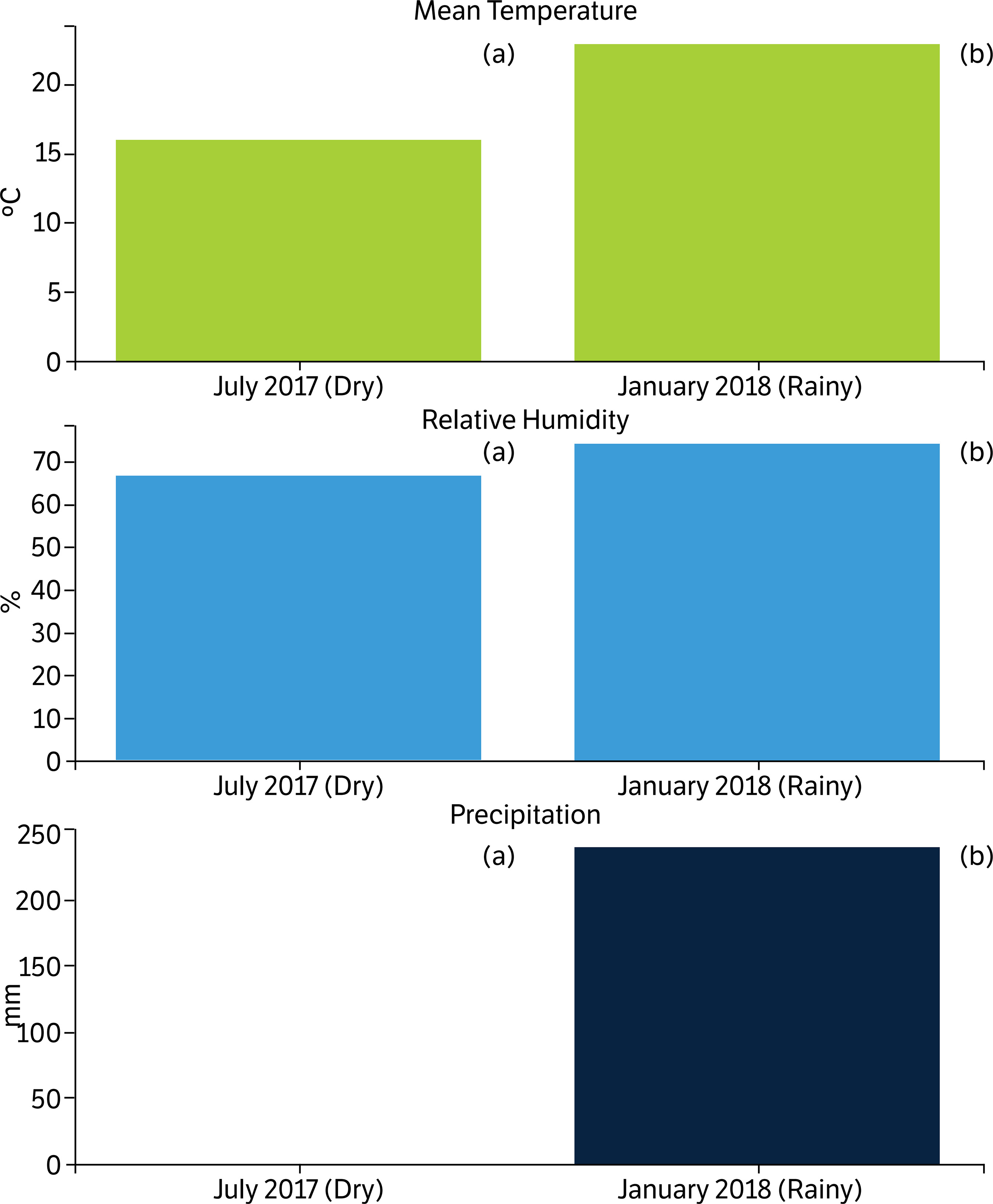
According to the Köppen-Geiger classification, the region is characterized by a Cwb climate (humid subtropical with dry winters and rainy summers) (Alvares et al. 2013). Meteorological data were obtained from the UFLA/Instituto Nacional de Meteorologia weather station and are summarized in Fig. 1, which depicts the contrasting conditions between the dry (July 2017) and wet (January 2018) seasons. In July 2017, the average temperature was 16.1°C, with 67% relative humidity and no recorded precipitation (Fig. 1a). In January 2018, the average temperature was 23°C, with 74% relative humidity and 240 mm of rainfall (Fig. 1b).

Although soil moisture and solar radiation were not directly measured, these two sampling periods are widely recognized as representative hydric extremes in the region. They correspond to the lowest and highest levels of rainfall and humidity, respectively, based on long-term climatic records. Thus, Fig. 1 provides a concise visual validation of these ecophysiological contrasts, supporting their selection as distinct environmental contexts for assessing phenotypic plasticity under field conditions.
Leaf anatomical analysis
Two fully expanded leaves were collected from the third node of plagiotropic branches in the middle third of each plant. Samples were fixed in formaldehyde–acetic acid–alcohol fixative, prepared with 70% ethanol for 72 h, preserved in 70% ethanol, and sectioned following standard protocols (Kraus and Arduin 1997). Paradermal sections were obtained manually using a steel blade, bleached with 1.25% sodium hypochlorite, stained with 1% safranin, and mounted in 50% glycerol.
Cross-sections from the median leaf region were embedded in methacrylate resin (Leica, Germany), sectioned at 8 µm using a rotary microtome (Lupetec MRP 2015, Brazil), and stained with toluidine blue (O’Brien et al. 1964). Observations were performed using a Kasvi RED 200 optical microscope (Brazil) connected to a Moticam 5.0 MP camera (Motic, Hong Kong). Eighteen images per sample were captured and analyzed using UTHSCSA ImageTool (v3.0).
The following anatomical traits were measured: stomatal density (Density), ratio between polar and equatorial stomatal diameter (RatioPE), and stomatal index (SI). Tissue thickness was recorded for the adaxial epidermis (EpiAd), abaxial epidermis (EpiAb), palisade parenchyma (PalisPar), spongy parenchyma (LacPar), total mesophyll (Mesophyll), and leaf blade (Blade). Additionally, phloem (Phloem) and xylem (Xylem) areas were quantified, as well as the number of xylem vessels (NXV).
Gas exchange measurements were taken between 8 and 10:30 a.m. using a portable photosynthesis system (LI-6400XT, LI-COR Inc., Lincoln, NE, United States of America) under a constant photon flux density of 1,000 µmol m-2·s-1. The following parameters were recorded: net CO2 assimilation (A), stomatal conductance (gs), transpiration (E), internal CO2 concentration (Ci), leaf temperature (Tleaf), vapor pressure deficit (VPD), and the ratio of intercellular to atmospheric CO2 concentration (Ci/Ca). Water use efficiency (WUE = A/E) and carboxylation efficiency (A/Ci) were also calculated.
Chlorophyll indices were measured using a ClorofiLOG CFL 1,030 meter (Falker, Porto Alegre, RS, Brazil), including chlorophyll a (ChlorA), chlorophyll b (ChlorB), and total chlorophyll (ChlorT).
Vegetative vigor (Vigour) was visually assessed by three independent evaluators using a 1–10 scale (Carvalho et al. 1979), in which 1 indicated low vigor and 10 indicated highly vigorous plants.
Antioxidant metabolism and oxidative stress
Leaf tissue (100 mg) was macerated in liquid nitrogen with 50% PVPP and homogenized in 3.5 mL of 100 mM phosphate buffer (pH 7.8) containing 0.1 mM EDTA and 10 mM ascorbic acid. After centrifugation (13,000×g, 10 min, 4°C), supernatants were stored at -20 °C. The enzymes superoxide dismutase (SOD) activity was measured by its ability to inhibit NBT photoreduction at 560 nm (Giannopolitis and Ries 1977); catalase (CAT) activity was assessed by monitoring H2O2 decomposition at 240 nm (Mengutay et al. 2013).
Hydrogen peroxide (H2O2) content was determined using potassium iodide-based colorimetry (Velikova et al. 2000), while lipid peroxidation was estimated by the thiobarbituric acid reactive substances (TBARS) method (Buege and Aust 1978), with absorbance readings at 535 and 600 nm. Malondialdehyde (MDA) concentration was calculated by Eq. 1:
where: ξ (extinction coefficient): 1.56 × 105 cm-1 M-1; b (path length): 1 cm.
Statistical analysis
All variables were standardized using z-score normalization to eliminate scale effects prior to multivariate analysis. The MVPi was calculated as described by Pennacchi et al. (2021), based on the Euclidean distance between phenotypic states in the dry and rainy seasons across a multidimensional trait space (Eq. 2):
where: Zij: the standardized value of trait j for genotype i in each season.
Principal component analysis (PCA) was conducted using the FactoMineR and factoextra packages in R (version 4.3.1) (R Core Team 2023) to visualize multivariate patterns and identify traits most strongly associated with phenotypic plasticity. Genotype grouping based on MVPi values was determined by the Scott-Knott clustering test (ScottKnott package), following residual diagnostics for normality (Shapiro–Wilk test) and homoscedasticity (Levene’s test via the car package).
RESULTS
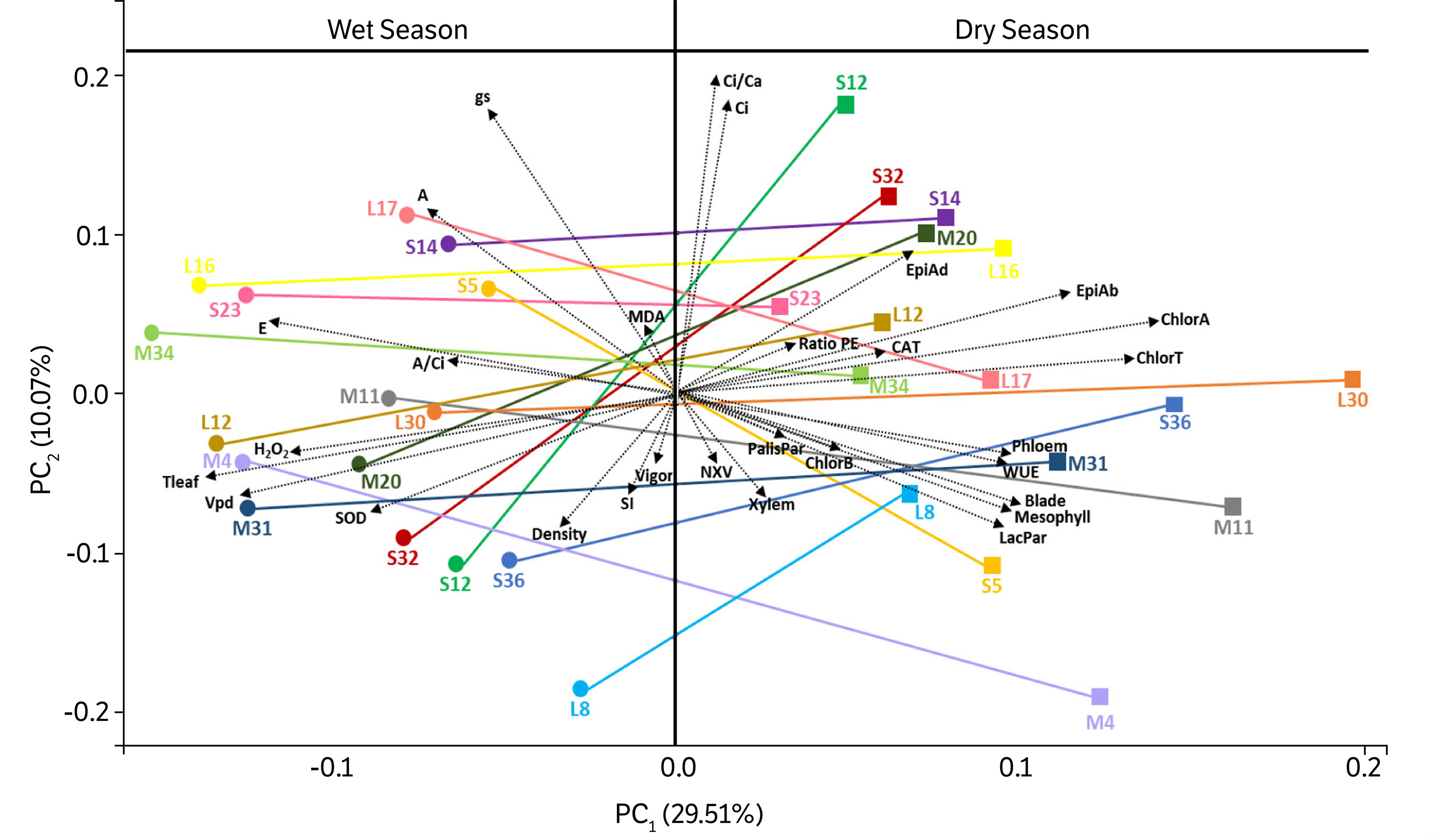
The multivariate evaluation of physiological, anatomical, biochemical, and morphological traits revealed significant phenotypic shifts across seasonal conditions, allowing for the discrimination of C. arabica progenies based on their integrated responses to water availability. Phenotypic plasticity was quantified using the MVPi, derived from standardized trait values and calculated as the Euclidean distance between each progeny’s phenotypic states during the dry (July 2017) and rainy (January 2018) seasons. Although only the first two principal components (PC1 and PC2) are graphically represented—together explaining 40% of the total variance (Fig. 2)—, the MVPi calculations accounted for the full dimensionality of the dataset, thereby preserving the entire multivariate variability.

Principal component biplot (PC1 × PC2) showing the average multivariate profiles of 16 Coffea arabica progenies evaluated across seasons. Circles represent measurements during the rainy season (WS), and squares represent the dry season (DS). Lines connecting symbols indicate the multivariate phenotypic plasticity index (MVPi), calculated as the Euclidean distance between seasonal states. Trait legend: Agronomic: vegetative vigor (Vigour); Physiological: net photosynthetic rate (A), stomatal conductance (gs), transpiration rate (E), carboxylation efficiency (A/Ci), leaf temperature (Tleaf), vapor pressure deficit (VPD), internal CO2 concentration (Ci), Ci/Ca ratio, water use efficiency (WUE), chlorophyll a (ChlorA), b (ChlorB), and total chlorophyll (ChlorT); Biochemical: hydrogen peroxide (H2O2), malondialdehyde (MDA), catalase (CAT), superoxide dismutase (SOD); Anatomical: adaxial (EpiAd) and abaxial (EpiAb) epidermis thickness, palisade (PalisPar) and spongy (LacPar) parenchyma, mesophyll (Mesophyll), leaf blade (Blade), stomatal density (Density), stomatal diameter ratio (RatioPE), stomatal index (SI), phloem area (Phloem), xylem area (Xylem), and number of xylem vessels (NXV).
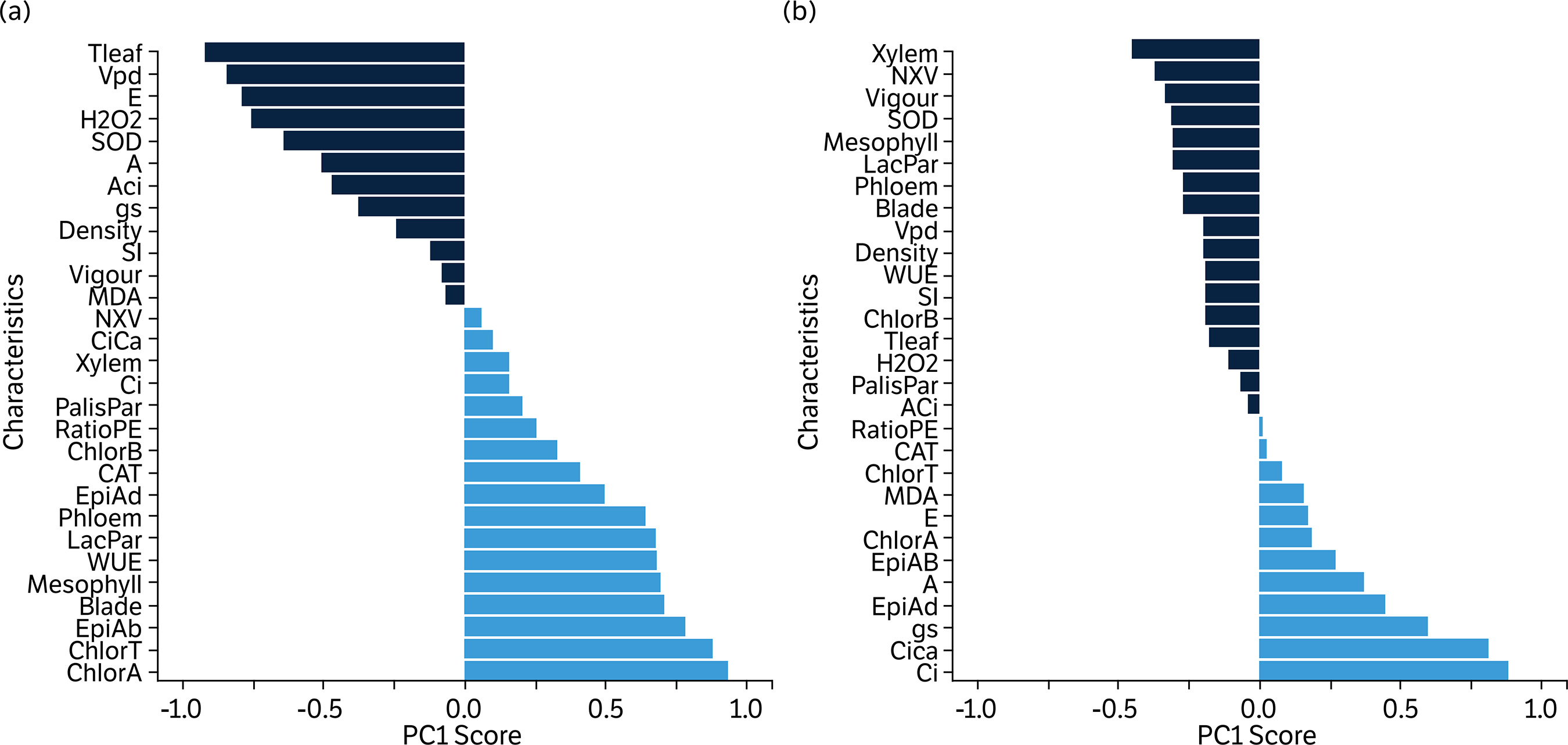
The PCA ordination revealed a consistent and directional seasonal shift in genotype positioning, primarily along PC1, reflecting coordinated changes in key traits under drought stress. During the rainy season, all progenies clustered on the left side of the PCA biplot associated with higher values of chlorophyll a (ChlA), total chlorophyll content (ChlT), abaxial epidermis thickness (EpAb), mesophyll, lacunose parenchyma, water use efficiency (WUE), and phloem area. In contrast, during the dry season, genotypes shifted toward the right side of the plot, characterized by increased leaf temperature (Tleaf), vapor pressure deficit (VPD), transpiration rate (E), H2O2 concentration, and SOD activity (Fig. 3a). These traits—negatively correlated with PC1—emerged as prominent indicators of physiological stress, reinforcing their value in detecting drought-induced responses.
Contribution of individual traits to the (a) first and (b) second principal components of the multivariate analysis. Trait abbreviations as listed in Fig. 2.
PC2 captured additional orthogonal variation and was positively associated with internal CO2 concentration (Ci), Ci/Ca ratio, stomatal conductance (gs), adaxial epidermis thickness (EpAd), and net photosynthetic rate (A), while negatively associated with xylem vessel number and area, vegetative vigor, and SOD activity (Fig. 3b). This axis reflects potential trade-offs between photosynthetic capacity and vascular adaptation under variable environmental conditions.
Genotypic differences in phenotypic plasticity were evident in the MVPi results (Fig. 4). According to the Scott-Knott clustering, the progenies were grouped into six statistically distinct clusters. Progenies M11, L30, and L16 exhibited the highest plasticity, followed by intermediate responses from M31, S32, M34, L17, S12, and S36. In contrast, progeny L8 showed the lowest MVPi value, indicating a limited multivariate response to water stress. This contrast between high- and low-plasticity genotypes is particularly relevant for breeding programs targeting physiological resilience.

Mean values of the multivariate phenotypic plasticity index (MVPi) for 16 Coffea arabica progenies. Different colors represent statistically distinct groups according to the Scott-Knott test at the 5% significance level.
Additional information into the nature of the phenotypic responses were gained by examining genotype-specific trajectories in PCA space. Genotype S5, for instance, exhibited high photosynthetic activity and stomatal conductance under well-watered conditions, with pronounced reductions under drought. This behavior suggests an isohydric strategy characterized by early stomatal closure to reduce water loss, evidenced by increased WUE during the dry period. Conversely, genotype S14 maintained similar A and gs levels across both seasons, indicating limited physiological flexibility and correspondingly low plasticity. Genotype S12 followed an atypical pattern, with low photosynthetic performance during the rainy season and increased gas exchange under drought, accompanied by elevated Ci and Ci/Ca ratios but reduced WUE, suggesting a delayed stomatal response or inefficient carbon fixation.
Interestingly, some genotypes exhibited similar phenotypic trajectories but differed in the magnitude of their plastic responses. For example, both L8 and S36 showed reduced photosynthesis and vigor under drought, yet L8 exhibited minimal phenotypic change between seasons (low MVPi), whereas S36 demonstrated one of the largest multivariate shifts. This finding underscores that the direction of response is not necessarily proportional to its amplitude, further highlighting MVPi as a discriminative index.
Further contrasts were observed between genotypes with divergent MVPi values. Genotype L12, categorized as low plasticity, displayed thinner epidermal layers, lower chlorophyll content, and higher transpiration rates—traits suggestive of impaired water regulation and reduced photosynthetic efficiency under stress. In contrast, high-plasticity genotype L30 exhibited thicker epidermal tissues, lower E, elevated ChlT, and improved WUE, supporting a more efficient water management strategy during drought. These contrasting phenotypic profiles emphasize the utility of MVPi in integrating multiscale traits to reveal functionally relevant patterns of environmental responsiveness.
DISCUSSION
Climate change poses an increasingly severe threat to the stability and productivity of perennial crops, including C. arabica, which is particularly vulnerable to climatic extremes due to its long-life cycle and narrow ecological niche. Projected increases in global temperature and shifts in precipitation patterns, particularly the growing frequency and intensity of droughts, are expected to reshape coffee-growing regions and challenge traditional breeding strategies (Thioune et al. 2020). Consequently, identifying and selecting genotypes with improved physiological acclimation to water deficit has become a key objective in coffee breeding programs.
In this study, we examined the phenotypic plasticity of C. arabica progenies derived from a genotype selected for its unusually large leaves and fruits. Our main goal was to evaluate their multivariate responses to seasonal changes in water availability and to quantify their phenotypic plasticity using the MVPi. This approach, aligned with the conceptual model P = G × E × GE, provides a systemic perspective on genotype-by-environment interactions by integrating physiological, anatomical, and biochemical traits into a composite index. Similar studies in Coffea canephora have underscored the relevance of characterizing G × E interactions to ensure stable genetic performance across environments (Montagnon et al. 2000, Partelli et al. 2022), reinforcing the value of multivariate approaches such as the MVPi in capturing adaptive trait dynamics.
PCA revealed clear phenotypic differentiation between the wet and dry seasons, primarily along the first principal component, which explained a significant proportion of total variance. Traits that contributed positively to PC1, such as chlorophyll a, ChlT, mesophyll and epidermal thickness, WUE, and phloem area, were strongly associated with higher plasticity. These traits represent coordinated photosynthetic and structural adjustments conducive to drought acclimation. Conversely, traits negatively associated with PC1, including leaf temperature (Tleaf), vapor pressure deficit (VPD), transpiration rate (E), and H2O2, are well-known markers of abiotic stress. Their attenuation under drought likely indicates effective physiological regulation.
Notably, these progenies had previously demonstrated favorable agronomic traits, including high yield potential and vegetative vigor (Silva et al. 2016), reinforcing the notion that multivariate plasticity may serve as a proxy for adaptive performance under climatic stress. In particular, yield data collected during the second harvest in 2015 revealed significant productivity variation among these same progenies, with M11, L30, and L16 exhibiting superior performance in field conditions, further supporting their agronomic relevance for drought-resilient cultivar development (Silva et al. 2016).
The functional interpretation of trait correlations reinforces the utility of MVPi in genotype selection. Elevated chlorophyll levels observed in highly plastic progenies during drought likely enhance post-stress recovery by sustaining photosynthetic capacity (Pérez-Llorca et al. 2021). Simultaneously, thicker leaf tissues, including the epidermis and mesophyll, appear to improve light interception, water retention, and CO2 diffusion, contributing to drought resilience. These anatomical traits, in conjunction with improved WUE, were consistently found in genotypes such as L30 and M11, supporting the hypothesis that coordinated structural and physiological plasticity underpins acclimation success.
Additionally, greater phloem thickness in highly plastic genotypes during drought may enhance photoassimilate transport and sink maintenance, which are critical for plant growth under limited water supply (Queiroz-Voltan et al. 2014). This finding aligns with previous research showing that drought-tolerant genotypes can sustain carbohydrate transport under stress conditions. In perennial crops such as coffee, other authors have highlighted the predictive value of structural and architectural traits in explaining yield potential (Cilas et al. 2006). Architectural ideotypes characterized by efficient canopy structure, balanced leaf-to-branch ratios, and optimized light distribution have been associated with superior productivity in C. canephora, reinforcing the role of morphological integration in adaptive performance.
Notably, some genotypes with similar drought response patterns displayed contrasting plasticity magnitudes. For instance, although L8 and S36 showed comparable reductions in photosynthesis and vigor, S36 exhibited significantly greater phenotypic distance across seasons. This highlights the importance of distinguishing between response direction and response magnitude—an analytical strength of the MVPi.
The diversity of phenotypic strategies observed among progenies suggests the existence of multiple acclimation pathways within the population. For example, genotype S12 displayed compensatory increases in gas exchange under drought, whereas L30 combined morphological reinforcement with physiological stability. This variability is valuable for breeding, as it offers a broader selection of candidates adapted to different climatic scenarios and levels of water limitation.
Traditional drought tolerance screening often relies on isolated traits, such as stomatal conductance or antioxidant activity, which may yield inconsistent results due to complex trade-offs (Dalal et al. 2017, Silva et al. 2022). Moreover, traits associated with stress tolerance, like reduced stomatal conductance, can sometimes limit productivity. The MVPi offers a robust alternative by capturing plasticity as an emergent property of the whole phenotype. Unlike univariate indices, it does not rely on predefined assumptions of trait desirability and enables the evaluation of complex trait interactions.
While the evaluation was conducted in only two distinct seasonal periods, the experimental design mitigates the risk of pseudoreplication. The measurements were obtained from biologically independent plants across three randomized blocks, with each progeny represented by separate individuals per replicate. Furthermore, the dry and rainy seasons sampled (July 2017 and January 2018) were not randomly selected but represented ecologically and agronomically contrasting conditions, as evidenced by climatic data (Fig. 1). These temporal points captured the extremes of water availability in the study region and were treated as independent environmental contexts, allowing the assessment of genotype-specific responses to well-characterized environmental variation. This approach aligns with established practices for evaluating phenotypic plasticity under field conditions, in which environmental heterogeneity is inherent and seasonality is ecophysiologically meaningful.
While the present study provides valuable insights into the multivariate nature of phenotypic plasticity, certain environmental and agronomic aspects were beyond its scope. Direct measurements of soil moisture and light intensity, for instance, were not incorporated, which might have refined the environmental characterization underlying the observed phenotypic responses. Similarly, concurrent evaluation of agronomic traits such as yield and fruit quality was not undertaken, and as a result, direct associations between plasticity patterns and field productivity could not be fully explored. Future studies that integrate physiological, anatomical, and agronomic assessments under carefully monitored environmental conditions are expected to further strengthen the interpretability and practical relevance of MVPi-based analyses.
Although the benefits of higher plasticity remain debated (Arnold et al. 2019), our results suggested that, in C. arabica, multivariate plasticity expressed through coordinated anatomical and physiological responses is associated with traits beneficial under drought. Nevertheless, the MVPi should be considered an exploratory tool at this stage, serving primarily to identify promising acclimation profiles. Its predictive value for breeding must still be validated through multi-year, multi-site trials that test the stability of plasticity-based rankings under variable field conditions. Such validations will be essential to confirm its robustness as a decision-support tool for breeding programs.
Ultimately, the use of MVPi in this study allowed for the identification of highly plastic and potentially resilient genotypes, particularly M11, L30, and L16. These progenies exhibited consistent adjustments in response to water availability and combined structural and biochemical traits conducive to stress adaptation. Moreover, integrating MVPi with productivity and cup quality data could validate its practical utility in breeding pipelines. By correlating multivariate plasticity patterns with agronomic performance, breeders could identify genotypes that not only adjust physiologically to drought but also sustain yield and beverage quality under variable climates. As climate instability increases, incorporating multivariate plasticity metrics into breeding pipelines may prove essential for the development of climate-resilient coffee cultivars.
Finally, future research should aim to decompose the MVPi into functional components—physiological, anatomical, and biochemical—, to determine which dimensions are most predictive of adaptive performance. This partitioning would provide deeper mechanistic insights and help refine the index for targeted applications in coffee breeding.
CONCLUSION
The MVPi offered a comprehensive framework for evaluating the adaptive responses of C. arabica progenies to contrasting water regimes. By integrating physiological, anatomical, and biochemical dimensions, the index effectively captured coordinated trait adjustments associated with drought acclimation, particularly in genotypes M11, L30, and L16.
While the MVPi shows promise as an integrative measure of phenotypic responsiveness, it should be regarded as exploratory. Broader validation through multi-year and multi-site evaluations, ideally encompassing environmental monitoring and key agronomic indicators such as yield and cup quality, will be essential to confirm its breeding relevance.
Continued refinement of the index, including its decomposition into functional components and its integration with productivity and quality datasets, may further enhance its predictive capacity and practical utility. Collectively, these advances could support the selection of coffee cultivars with improved adaptive stability and resilience under increasingly variable climatic conditions.
ACKNOWLEDGMENTS
Not applicable.
-
How to cite:
Silva, E. A., Santos, C. S., Matos, N. M. S., Pennacchi, J. P., Abrahão, J. C. R., Carvalho, M. A. F., Tavares, M. C. S., Carvalho, S. P. and Guimarães, R. J. (2025). Leaf-scale phenotypic plasticity of Coffea arabica progenies under seasonal variation in water availability. Bragantia, 85, e20250157. https://doi.org/10.1590/1678-4499.20250157
-
FUNDING
Fundação de Amparo à Pesquisa do Estado de Minas GeraisGrant No.: CAG APQ 03605-17Conselho Nacional de Desenvolvimento Científico e TecnológicoGrant No.: 465580/2014-9Coffee Research ConsortiumGrant No.: 10200.13/0199-2
-
DECLARATION OF USE OF ARTIFICIAL INTELLIGENCE TOOLS
The authors declare that artificial intelligence tools (ChatGPT, OpenAI) were used exclusively to support language revision. All scientific content, analyses, interpretations, and conclusions presented in this manuscript are the sole responsibility of the authors.
DATA AVAILABILITY STATEMENT
All data generated or analysed during this study are included in this article.
REFERENCES
-
Alvares, C. A., Stape, J. L., Sentelhas, P. C., Gonçalves, J. D. M. and Sparovek, G. (2013). Köppen’s climate classification map for Brazil. Meteorologische Zeitschrift, 22, 711-728. https://doi.org/10.1127/0941-2948/2013/0507
» https://doi.org/10.1127/0941-2948/2013/0507 -
Arnold, P. A., Kruuk, L. E. B. and Nicotra, A. B. (2019). How to analyse plant phenotypic plasticity in response to a changing climate. New Phytologist, 222, 1235-1241. https://doi.org/10.1111/nph.15656
» https://doi.org/10.1111/nph.15656 -
Buege, J. A. and Aust, S. D. (1978). Microsomal lipid peroxidation methods. Methods in Enzymology, 52, 302-310. https://doi.org/10.1016/s0076-6879(78)52032-6
» https://doi.org/10.1016/s0076-6879(78)52032-6 -
Carvalho, A., Monaco, L. C. and Fazuoli, L. C. (1979). Melhoramento do cafeeiro XL: estudos de progênies e híbridos de café Catuaí. Bragantia, 38, 202-216. https://doi.org/10.1590/S0006-87051979000100022
» https://doi.org/10.1590/S0006-87051979000100022 -
Cilas, C., Bar-Hen, A., Montagnon, C. and Godin, C. (2006). Definition of architectural ideotypes for good yield capacity in Coffea canephora Annals of Botany, 97, 405-411. https://doi.org/10.1093/aob/mcj053
» https://doi.org/10.1093/aob/mcj053 -
Dalal, A., Attia, Z. and Moshelion, M. (2017). To produce or to survive: How plastic is your crop stress physiology? Frontiers in Plant Science, 8, 2067. https://doi.org/10.3389/fpls.2017.02067
» https://doi.org/10.3389/fpls.2017.02067 -
Giannopolitis, C. N. and Ries, S. K. (1977). Superoxide dismutases: I. occurrence in higher plants. Plant Physiology, 59, 309-314. https://doi.org/10.1104/pp.59.2.309
» https://doi.org/10.1104/pp.59.2.309 -
Hassan, M. A. E., Santhoshkumar, A. V., Hrideek, T. K., Jijeesh, C. M. and Joseph, J. (2021). Variability in drought response among the plus tree accessions of Tectona grandis (Linn f.) from the provenances of Kerala, South India. Acta Physiologiae Plantarum, 43, 47. https://doi.org/10.1007/s11738-021-03215-3
» https://doi.org/10.1007/s11738-021-03215-3 - Kraus, J. E. and Arduin, M. (1997). Manual básico de métodos em morfologia vegetal. Rio de Janeiro: EDUR.
-
Matesanz, S., Blanco-Sánchez, M., Ramos-Muñoz, M., de la Cruz M., Benavides, R. and Escudero, A. (2021). Phenotypic integration does not constrain phenotypic plasticity. New Phytologist, 231, 2359-2370. https://doi.org/10.1111/nph.17536
» https://doi.org/10.1111/nph.17536 -
Mengutay, M., Ceylan, Y., Kutman, U. B. and Cakmak, I. (2013). Adequate magnesium nutrition mitigates adverse effects of heat stress on maize and wheat. Plant and Soil, 368, 57-72. https://doi.org/10.1007/s11104-013-1761-6
» https://doi.org/10.1007/s11104-013-1761-6 -
Montagnon, C., Cilas, C., Leroy, T., Yapo, A. and Charmetant, P. (2000). Genotype–location interactions for Coffea canephora yield in the Ivory Coast. Agronomie, 20, 101-109. https://doi.org/10.1051/agro:2000110
» https://doi.org/10.1051/agro:2000110 -
O’Brien, T. P., Feder, N. and McCully, M. E. (1964). Polychromatic staining of plant cell walls by toluidine blue O. Protoplasma, 59, 368-373. https://doi.org/10.1007/BF01248568
» https://doi.org/10.1007/BF01248568 -
Partelli, F. L., Silva, F. A., Covre, A. M., Oliosi, G., Correa, C. C. G. and Viana, A. P. (2022). Adaptability and stability of Coffea canephora to dynamic environments using the Bayesian approach. Scientific Reports, 12, 11608. https://doi.org/10.1038/s41598-022-15190-x
» https://doi.org/10.1038/s41598-022-15190-x -
Pennacchi, J. P., Lira, J. M. S., Rodrigues, M., Garcia, F. H. S., Mendonça, A. M. D. C. and Barbosa, J. P. R. A. D. (2021). A systemic approach to the quantification of the phenotypic plasticity. Journal of Experimental Botany, 72, 1864-1878. https://doi.org/10.1093/jxb/eraa545
» https://doi.org/10.1093/jxb/eraa545 -
Pérez-Llorca, M., Caselles, V., Müller, M. and Munné-Bosch, S. (2021). The threshold between life and death in Cistus albidus seedlings. Tree Physiology, 41, 1861-1876. https://doi.org/10.1093/treephys/tpab047
» https://doi.org/10.1093/treephys/tpab047 -
Queiroz-Voltan, R. B., Nardin, C. F., Fazuoli, L. C. and Braghini, M. T. (2014). Caracterização da anatomia foliar de cafeeiros arábica em diferentes períodos sazonais. Revista Biotemas, 27, 1-10. https://doi.org/10.5007/2175-7925.2014v27n4p1
» https://doi.org/10.5007/2175-7925.2014v27n4p1 -
R Core Team (2023). R: A language and environment for statistical computing. Vienna: R Foundation for Statistical Computing. Available at: http://www.R-project.org/ Accessed on: Mar 10, 2024.
» http://www.R-project.org/ -
Santos, C. S., Freitas, A. F., Silva, G. H. B., Pennacchi, J. P., Figueiredo de Carvalho, M. A., Santos, M. D. O., Junqueira de Moraes, T. S., Rezende Abrahão, J. C., Pereira, A. A., Carvalho, G. R., Botelho, C. E. and Silva, V. A. (2023). Phenotypic plasticity index as a strategy for selecting water-stress-adapted coffee genotypes. Plants, 12, 4029. https://doi.org/10.3390/plants12234029
» https://doi.org/10.3390/plants12234029 -
Silva, J. A., Carvalho, S. P., Bruzi, A. T., Guimarães, R. J. and Simões, L. C. (2016). Genetic diversity among coffee tree progenies Big Coffee VL based on growth traits and production. Genetics and Molecular Research, 15, 1-8. https://doi.org/10.4238/gmr15049066
» https://doi.org/10.4238/gmr15049066 -
Silva, V. A., Abrahão, J. C. R., Reis, A. M., A. M., Santos, M. D. O., Pereira, A. A., Botelho, C. E., Carvalho, G. R., Castro, E. M., Barbosa, J. P. R. A. D., Botega, G. P. and Oliveira, A. C. B. D. (2022). Strategy for selection of drought-tolerant arabica coffee genotypes in Brazil. Agronomy, 12, 2167. https://doi.org/10.3390/agronomy12092167
» https://doi.org/10.3390/agronomy12092167 -
Thioune, E. H., Strickler, S., Gallagher, T., Charpagne, A., Decombes, P., Osborne, B., and McCarthy, J. (2020). Temperature impacts the response of Coffea canephora to decreasing soil water availability. Tropical Plant Biology, 13, 236-250. https://doi.org/10.1007/s12042-020-09254-3
» https://doi.org/10.1007/s12042-020-09254-3 -
Velikova, V., Yordanov, I. and Edreva, A. (2000). Oxidative stress and some antioxidant systems in acid rain-treated bean plants: protective role of exogenous polyamines. Plant Science, 151, 59-66. https://doi.org/10.1016/S0168-9452(99)00197-1
» https://doi.org/10.1016/S0168-9452(99)00197-1
Edited by
-
Section Editor:
Christian Cilas https://orcid.org/0000-0001-7658-1866

 Source: Universidade Federal de Lavras/Instituto Nacional de Meteorologia Weather Station (83687).