 Corn bacterial leaf streak: alternative hosts of Xanthomonas vasicola pv. vasculorum
 ABSTRACT
Corn bacterial leaf streak is an emerging disease, and there are few studies related to its management. Therefore, it is necessary to know alternative hosts of this pathogen that may interfere with its survival during the off-season. The aim of this work was to evaluate different genotypes of oats, barley, and wheat as secondary hosts to the pathogen Xanthomonas vasicola pv. vasculorum. The experiments were carried out in Guarapuava, PR, Brazil, in the 2019 and 2022 seasons, in a greenhouse, with completely randomized design and five replications. Eight different cultivars of winter cereals widespread in the region were inoculated, and susceptible corn hybrid was used as a control. Disease incidence evaluations were performed to calculate the area under the disease progress curve (AUDPC). In the 2019 season, relative humidity averages at ten days after inoculation were between 54 and 68%, and only TBIO Audaz wheat cultivar, in addition to the control, showed symptoms related to the disease. In the 2022 season, when relative humidity remained around 70% throughout the experiment, all genotypes tested showed symptoms. However, cultivars Danielle (barley), TBIO Audaz, and ORS Vintecinco (wheat) did not differ from the susceptible corn control, with the highest AUDPC values. These results indicated that winter cereals are hosts of X. vasicola pv. vasculorum, and that relative humidity affects the expression of disease symptoms.
Key words
Avena strigosa
;
Hordeum vulgare
;
Triticum aestivum
; winter cereals;
Zea mays
INTRODUCTION
The presence of an emerging disease in corn (Zea mays L.) crops, called bacterial leaf streak, has been reported in the United States of America, Argentina, and Brazil (Korus et al. 2017, Leite Junior et al. 2018, Plazas et al. 2018). Its incidence can reach 90% in commercial crops, especially if they are irrigated by central pivot, whose conditions may favor the spread of the pathogen (Ortiz-Castro et al. 2020).
Studies regarding the etiology, genomics, and behavior of the bacterium Xanthomonas vasicola pv. vasculorum (Xvv) (Vauterin et al. 1995), the etiological agent of corn bacterial leaf streak, have been conducted since the first disease report, in 2016 (Lang et al. 2017, Studholme et al. 2020). However, information regarding dissemination, alternative hosts, management, and potential for loss related to the pathogen and disease is still scarce.
In the disease management system, it is important to know and study the possible hosts that can be infected by the pathogen, as they can be a place for their survival. In addition to weeds, pathogens can infect other economically important crops, directly affecting cultural management and interfering with the producer’s choice of species in crop rotation (Reis et al. 2011).
It is already known that the Xvv bacteria can survive in corn straw remains, infect sugarcane crops, causing the disease known as “gumming disease.” It can also cause foliar injuries in some species of palm and bamboo (Ricaud and Autrey 1989) and weeds such as Andropogon gerardii and Setaria verticillata (North 1935, Hartman et al. 2020b, Ortiz-Castro et al. 2020). According to Longhi et al. (2023), in addition to the pathogen being able to colonize weeds, it also colonizes rice, a species of high economic importance in Brazil, while for sorghum and millet, there is currently only evidence of epiphytic colonization by the pathogen.
In Brazil, especially in the South region, the cultivation of winter cereals is widely spread, whether for commercial purposes or just green manure. Among the cultivated species, wheat (Triticum aestivum) has the greatest commercial value, followed by oats (Avena spp.) (Gomes Junior et al. 2023). Besides these species, barley (Hordeum vulgare) also plays an important role as a winter cereal in the South part of the country (Furtado et al. 2025) and could be an important source of inoculum. So, it is vital to know whether these grasses are possible hosts of the pathogen, such as white oat (Avena sativa), identified by Hartman et al. (2020b).
Therefore, the aim of this research was to evaluate the reaction of different cultivars of oats, barley, and wheat as alternative hosts to the pathogen X. vasicola pv. vasculorum, etiological agent of bacterial streak in corn.
MATERIAL AND METHODS
The study was carried out in Guarapuava, PR, Brazil, in the experimental field of Agronomy Department of the Universidade Estadual do Centro Oeste do Paraná (UNICENTRO), CEDETEG Campus. The campus is located at coordinates 25°23’00”S and 51°29’38.50”W, 1,024 m altitude. The local climate is classified as mesothermal humid subtropical (Cfb), with moderate summers and winters with frequent and severe frosts according to the Köppen classification (Aparecido et al. 2016).
The Xvv isolate was obtained from symptomatic leaves from commercial corn crops in the Guarapuava region. The leaves were superficially disinfected with alcohol (70%) and sodium hypochlorite (1%) for 30 seconds, and subsequently triple washed with sterilized distilled water (Fernandez 1993). Then, fragments of the transition area between the typical symptoms and the healthy area of the leaf were placed in a nutrient agar culture medium, and after 48 hours, the presence of typical colonies, yellowish and with a mucoid appearance, was observed.
Afterwards, subculture was carried out to obtain a pure culture. After this initial process, maintenance and subculture of the isolate were carried out periodically in the laboratory, to keep the pathogen viable. In addition to morphological (colony color, shape and GRAM test) (Mariano et al. 2016) and physiological tests like esculin hydrolysis (Mariano et al. 2016) and xanthomonadin pigment extraction (Schaad et al. 2001), the isolate was sent to a specialized laboratory (GMT Lab, Molecular Markers Laboratory) in Palmas Research Center (TO) and identified by a genetic sequencing of the 16S rRNA. The pathogen was preserved in nutrient agar culture medium, and subcultures were periodically performed.
The experiment was carried out in a greenhouse covered with a 150-micron transparent plastic film, with open ventilation in two seasons, with sowings on October 1, 2019, and June 10, 2022. The design used was entirely randomized, consisting of nine treatments and five replications.
The treatments were composed of eight different cultivars of winter cereals and one cultivar of corn (as a control) widespread and widely cultivated in the region (Table 1). The corn cultivar was included as a positive control due to its known susceptibility to Xvv; there was no prior knowledge about the susceptibility of the other cultivars tested.
Species and cultivars evaluated as potential alternative hosts of <i>Xanthomonas vasicola</i> pv. <i>vasculorum</i>. Universidade Estadual do Centro Oeste do Paraná, Guarapuava, PR, Brazil, 2023.
Each plot was composed of two plants per 18-L polypropylene pot, in a mixture of soil and sand. At the time of sowing, the pots were fertilized following the recommendations for each crop. Drip irrigation was used, and all treatments related to top dressing and insect management were carried out in accordance with technical recommendations.
The preparation of the suspension containing the bacteria inoculum was carried out from young colonies (48 h of growth), and the inoculum concentration was adjusted to 1 × 10⁸ CFU/mL, in a spectrophotometer (OD580 nm, BEL Photonics, model UV-M51). When winter cereals reached the tillering stage (Zadoks et al. 1974) and corn reached the V8 stage (eighth expanded leaf), all the plants, including the susceptible control (corn), were inoculated with a manual sprayer, in the adaxial face of the leaves (Lautenchleger et al. 2023). Relative humidity (RH) and temperature data were collected for the two seasons.
Assessments of the disease incidence in plants began from the appearance of the first symptoms (seven days after the inoculation), characterized by cellular extravasation, at an interval of seven days after inoculation. All green leaves were evaluated, until the number of symptomatic leaves remained constant, which happened at the sixth week after inoculation. The incidence values were submitted to the area under the disease progress curve (AUDPC), calculated by trapezoidal integration (Campbell and Madden 1990), using Eq. 1:
in which: Yi: disease proportion in the i-th observation; Ti: time in days in the i-th observation; n: total number of observations.
In plants that showed symptoms of lesions and yellow spots, the bacteria were reisolated, so that Koch’s postulates could be fulfilled (Rezende et al. 2018). After that, the presence of the pathogen was confirmed in the hosts, by identifying the typical colony (color, form and physiological characteristics), as described previously.
For the statistical analysis of the experiment, the SISVAR program (Ferreira 2019) version 4.0 was used. The experiments were analyzed separately. The analysis of variance was carried out, and the means of variables that were significant in the F test were grouped using the Scott-Knott’s test.
RESULTS AND DISCUSSION
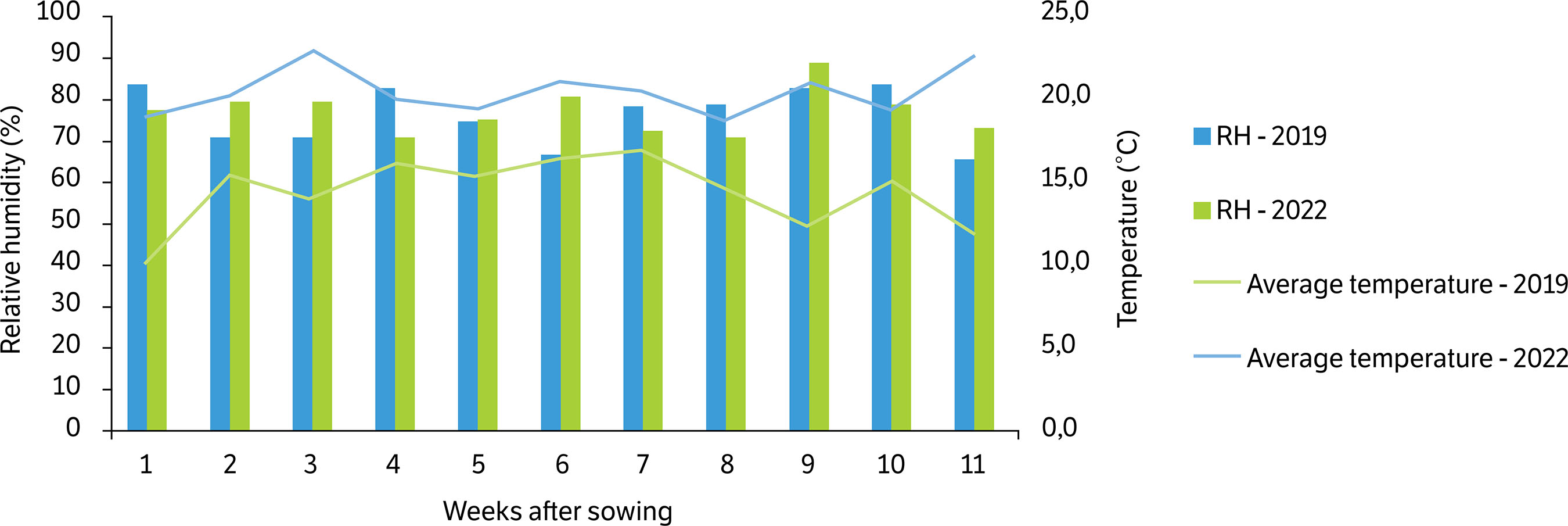
The climatic data (Fig. 1) showed differences between seasons, especially regarding temperature. In the 2019 season, temperatures were averaging 20.5°C throughout the experiment. In the 2022 season, the average was 14.4°C.
Weekly average temperature (°C) and relative humidity (RH; %) data from the meteorological station in Guarapuava, PR, Brazil, during the 2019 and 2022 seasons. Universidade Estadual do Centro Oeste do Paraná, 2023.
In the 2019 season, only the control (corn) and the wheat cultivar TBIO Audaz showed disease symptoms. In 2022, two distinct groups for AUDPC values were formed. However, in all evaluated genotypes there was a manifestation of the disease, unlike the 2019 season (Table 2).
Incidence means of bacterial leaf streak (<i>Xanthomonas vasicola</i> pv. <i>vasculorum</i>) expressed through the area under the disease progress curve (AUDPC), evaluated in alternative hosts in the 2019 and 2022 seasons. Guarapuava, PR, Brazil, Universidade Estadual do Centro Oeste do Paraná, 2023<tfn href="tfn02">*</tfn>.
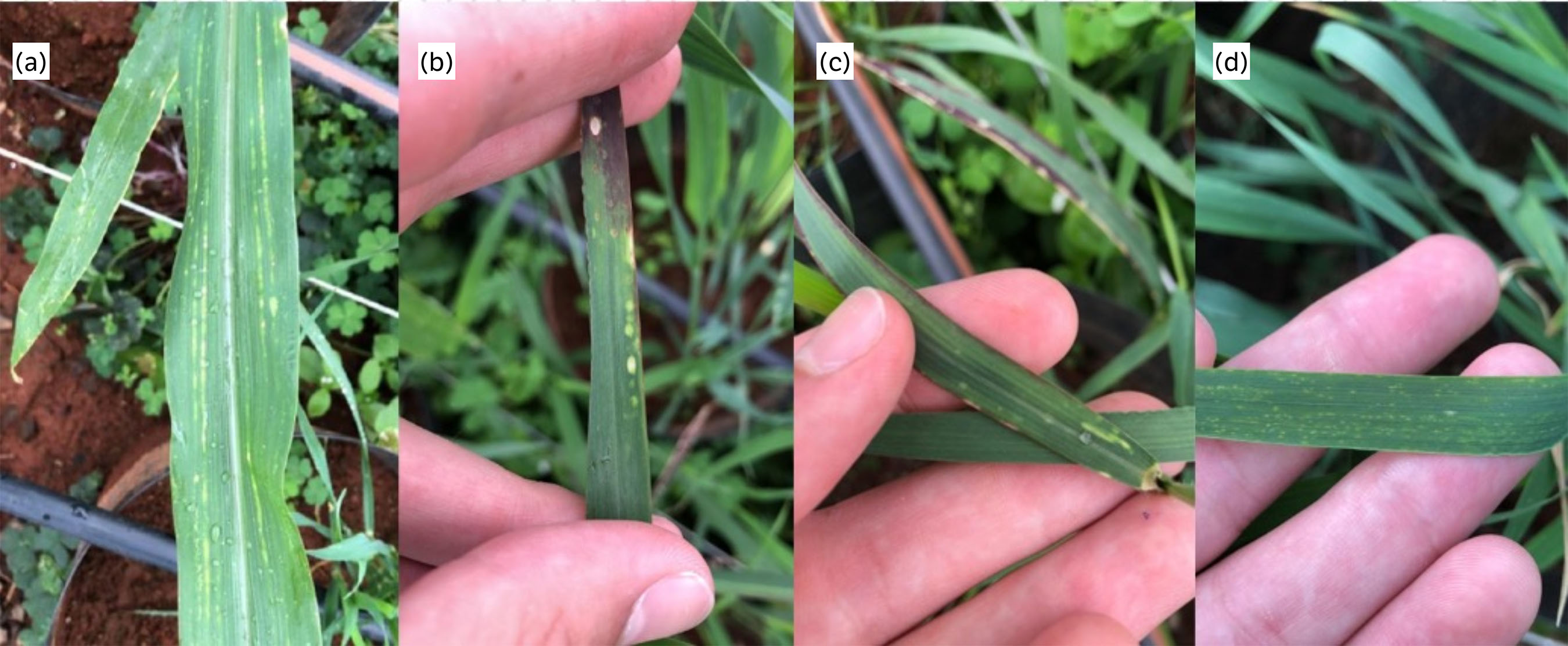
The corn hybrid showed typical symptoms in both seasons, which demonstrated that the pathogen was virulent in both periods. In 2019, the initial symptoms were observed in white oat, URS Altiva cultivar, and in wheat, TBIO Audaz cultivar. For oats (Figs. 2a and 2b), lesions with rounded edges and a yellowish halo were observed. In wheat, smaller punctures than the lesions in oats, with discoloration, however, in greater quantity along the leaf blade, were observed (Fig. 2c).
Initial symptoms (punctures and discoloration) observed in leaves of (a) corn, (b and c) white oat and (d) wheat, seven days after inoculation with <i>Xanthomonas vasicola</i> pv. <i>vasculorum</i>, in the 2019 season. Guarapuava, PR, Brazil, Universidade Estadual do Centro Oeste do Paraná, 2023.
In the second season (2022), all genotypes showed incidence of the disease. The AUDPC values for the only two genotypes that had symptoms in the previous season (TBIO Audaz and control) were higher. This may be related to climatic factors of the period (Fig. 1).
Despite having similar relative humidity averages, the 2019 season presented particularities not seen in the 2022 season. In 2019, relative humidity presented an average of 62% for a period of seven days after inoculation (Fig. 1). In the 2022 season, relative humidity values below 70% occurred throughout the experiment, although these were no longer than three days and happened only three weeks after inoculation, a different scenario from the previous season.
This result demonstrated that, even with discrepant temperatures, high relative humidity is a determining factor for the development of the disease, especially in the days following inoculation or infection. It is known that the pathogen infects leaves via stomata in corn (Korus et al. 2017) and that high relative humidity allows longer stomatal opening time (Lange et al. 1971).
Drip irrigation, used in this experiment, cannot influence the relative humidity, unlike sprinkler systems, which are similar to the effect of rain, a factor that most influenced the maintenance of relative humidity (Liu et al. 2021). In corn, it is known that central pivot irrigation systems favor the occurrence of bacterial leaf streak compared to systems with localized irrigation (Hartman et al. 2020a). Therefore, based on the results, it can be inferred that for the incidence of bacterial streak in winter cereals, the favorable climatic conditions are similar to those necessary for its development in corn.
Regarding the reaction of the evaluated genotypes to Xvv, all showed susceptibility to the pathogen in the 2022 season (Table 2). The AUDPCs of the wheat cultivars and corn were similar for white oat. There was a difference in susceptibility among cultivars, with the Danielle cultivar being more susceptible in relation to ANAG 02 cultivar. Barley ANAG 02 cultivar showed lower incidence compared to the control.
Studies regarding alternative hosts of Xvv are contrasting. According to Hartman et al. (2020b), white oats were symptomatic, while barley and wheat were not hosts of the pathogen. For Longhi et al. (2023), in addition to white oats, black oats and barley were symptomatic, and wheat was asymptomatic, however, with epiphytic colonization of Xvv. This type of colonization of phytopathogenic bacteria is important for disease management, as it is a way for pathogen survival and can be a source of inoculum even without symptoms on the plants (Osdaghi et al. 2018).
Bacteria of the Xanthomonas genus are known to have an epiphytic phase (Ceseti et al. 2019, Mielnichuk et al. 2021), do not infect the host and only carry out the infection when conditions are favorable (Alvarez-Martinez et al. 2021, He et al. 2020). Therefore, in this work, in the 2019 season, the pathogen may have only formed a biofilm characteristic of the epiphytic phase in the genotypes that did not present symptoms, since the climatic conditions (Fig. 1) were not favorable for infection, especially the relative humidity, which was unstable (An et al. 2020).
Differently from the literature, the results of this study showed that wheat is a viable host for Xvv, showing all the symptoms of the disease, and not only the epiphytic colonization. In addition to the persistence of Xvv throughout the winter on the leaf surface or straw, there are still concerns regarding its dissemination via seeds of alternative hosts, being that the dissemination of Xvv via corn seeds has already been confirmed (Tebaldi et al. 2022).
The evidence that wheat can be a source of inoculum for Xvv highlights the need to further investigate this pathosystem (Clavijo et al. 2022). This information is crucial for the detection of the bacteria during the winter harvest, in one of the main species cultivated during this season in the southern region of Brazil.
The results indicated that the management of bacterial leaf streak in the field may be difficult, due to the persistence of the pathogen during the winter (Shah et al. 2021), in other cereals such as oats, wheat, and barley. Therefore, it is suggested that studies on the economic impact of bacterial streak in alternative hosts be carried out.
CONCLUSION
Wheat, white oat, black oat, and barley cultivars are hosts for Xvv.
ACKNOWLEDGMENTS
Not applicable.
-
How to cite:
Lautenchleger, F., Morais, A. F., Moccellin, R., Denardi, L. O. P., Faria, C. M. D. R. and Faria, M. V. (2026). Corn bacterial leaf streak: alternative hosts of Xanthomonas vasicola pv. vasculorum. Bragantia, 85, e20250105. https://doi.org/10.1590/1678-4499.20250105
-
FUNDING
Coordenação de Aperfeiçoamento de Pessoal de Nível SuperiorGrant No.: Finance Code 001Conselho Nacional de Desenvolvimento Científico e TecnológicoGrant No.: 313873/2021-6
-
DECLARATION OF USE OF ARTIFICIAL INTELLIGENCE TOOLS
We declare that no artificial intelligence tools were used in the preparation of this manuscript.
DATA AVAILABILITY STATEMENT
The datasets generated during the current study are available from the corresponding author on reasonable request.
REFERENCES
-
Alvarez-Martinez, C. E., Sgro, G. G., Araujo, G. G., Paiva, M. R. N., Matsuyama, B. Y., Guzzo, C. R. and Andrade, M. O. (2021). Secrete or perish:The role of secretion systems in Xanthomonas biology. Computational and Structural Biotechnology Journal, 19, 279-302. https://doi.org/10.1016/j.csbj.2020.12.020
» https://doi.org/10.1016/j.csbj.2020.12.020 -
An, S., Potnis, N., Dow, M., Vorhölter, F. J., He, Y. Q., Becker, A., Teper, D., Li, Y., Wang, N., Bleris, L. and Tang., J. L. (2020). Mechanistic insights into host adaptation, virulence and epidemiology of the phytopathogen Xanthomonas FEMS Microbiology Reviews, 44, 1-32. https://doi.org/10.1093/femsre/fuz024
» https://doi.org/10.1093/femsre/fuz024 -
Aparecido, L. E. D. O., Rolim, G. D. S., Richetti, J., Souza, P. S. D. and Johann, J. A. (2016). Köppen, Thornthwaite and Camargo climate classifications for climatic zoning in the State of Paraná Brazil. Ciência e Agrotecnologia, 40, 405-417. https://doi.org/10.1590/1413-70542016404003916
» https://doi.org/10.1590/1413-70542016404003916 - Campbell, C. L. and Madden, L. V. (1990). Introduction to plant disease epidemiology. New York: John Wiley & Sons.
-
Ceseti, L. M., Santana, E. S., Ratagami, C. Y., Barreiros, Y., Lima, L. P., Dunger, G., Farah, C. S. and Alvarez-Martinez, C. E. (2019). The Xanthomonas citri pv. citri type VI secretion system is induced during epiphytic colonization of citrus. Current Microbiology, 76, 1105-1111. https://doi.org/10.1007/s00284-019-01735-3
» https://doi.org/10.1007/s00284-019-01735-3 -
Clavijo, F., Curland, R. D., Croce, V., Lapaz, M. I., Dill-Macky, R., Pereyra, S. and Siri, M. (2022). Genetic and Phenotypic characterization of Xanthomonas Species Pathogenic in wheat in Uruguay. Phytopathology, 112, 511-520. https://doi.org/10.1094/PHYTO-06-21-0231-R
» https://doi.org/10.1094/PHYTO-06-21-0231-R - Fernandez, M. R. (1993). Manual para laboratório de fitopatologia. Passo Fundo: Embrapa.
-
Ferreira, D. F. (2019). Sisvar: a computer statistical analysis system to fixed effects split plot type designs: Sisvar. Brazilian Journal of Biometrics, 37, 529-535. https://doi.org/10.28951/rbb.v37i4.450
» https://doi.org/10.28951/rbb.v37i4.450 -
Furtado, E. B., Guatimosim, E., Barros, D. R., Mallmann, C. A., Araujo Filho, J. V., Martins, S. D. O., Tessmann, D. J., Rombaldi, C. V., Schlösser, L. M. L., Favaretto, A. and Dallagnol, L. J. (2025). Fusarium head blight in barley from subtropical Southern Brazil: associated Fusarium species and grain contamination levels of deoxynivalenol and nivalenol. Plants, 14, 2327. https://doi.org/10.3390/plants14152327
» https://doi.org/10.3390/plants14152327 -
Gomes Junior, W. L., Barbosa, F. T. and Melo, H. F. (2023). Root and shoot development in winter crops in soils of different textures and degrees of compaction. Revista Ciência Agronômica, 54, e20218314. https://doi.org/10.5935/1806-6690.20230020
» https://doi.org/10.5935/1806-6690.20230020 -
Hartman, T., Harbour, J., Tharnish, B., Van Meter, J. and Jackson-Ziems, T. A. (2020a). Agronomic factors associated with bacterial leaf streak development caused by Xanthomonas vasicola pv. vasculorum in corn. Phytopathology, 110, 1132-1138. https://doi.org/10.1094/PHYTO-02-20-0043-R
» https://doi.org/10.1094/PHYTO-02-20-0043-R -
Hartman, T., Harbour, J., Tharnish, B., Van Meter, J. and Jackson-Ziems, T.A. (2020b). Alternative hosts in the families Poaceae and Cyperaceae for Xanthomonas vasicola pv. vasculorum, causal agent of bacterial leaf streak of corn. Phytopathology, 110, 1147-1152. https://doi.org/10.1094/PHYTO-04-19-0132-R
» https://doi.org/10.1094/PHYTO-04-19-0132-R -
He, Y., Cao, X. Q. and Poplawsky, A. (2020). Chemical structure, biological roles, biosynthesis and regulation of the yellow xanthomonadin pigments in the phytopathogenic genus Xanthomonas Molecular Plant-Microbe Interactions, 33, 705-714. https://doi.org/10.1094/mpmi-11-19-0326-cr
» https://doi.org/10.1094/mpmi-11-19-0326-cr -
Korus, K., Lang, M., Adesemoye, A. O., Block, C. C., Pal, N., Leach, L. E. and Jackson-Ziems, T. A. (2017). First report of Xanthomonas vasicola causing bacterial leaf streak on corn in the United States. Plant Disease, 101, 1030. https://doi.org/10.1094/PDIS-10-16-1426-PDN
» https://doi.org/10.1094/PDIS-10-16-1426-PDN -
Lang, J. M., DuCharme, E., Caballero, J. I., Luna, E., Hartman, T., Ortiz-Castro, M., Korus, K., Rascoe, J., Jackson-Ziems, T. A., Broders, K. and Leach, J. E. (2017). Detection and characterization of Xanthomonas vasicola pv. vasculorum (Cobb 1894) comb. nov. causing bacterial leaf streak of corn in the United States. Phytopathology, 107, 1312-1321. https://doi.org/10.1094/PHYTO-05-17-0168-R
» https://doi.org/10.1094/PHYTO-05-17-0168-R -
Lange, O. L., Lösch, R., Schulze, E. D. and Kappen, L. (1971). Responses of stomata to changes in humidity. Planta, 100, 76-86. https://doi.org/10.1007/BF00386887
» https://doi.org/10.1007/BF00386887 -
Lautenchleger, F., Faria, M. V., Faria, C. M. D. R., Santos, L. A., Gasperotto, L. M., Andreoli, P. H. W., Gava, E. and Müller, E. M. (2023). Bacterial leaf streak: inoculation methodology determination. Tropical Plant Pathology, 48, 720-727. https://doi.org/10.1007/s40858-023-00611-7
» https://doi.org/10.1007/s40858-023-00611-7 -
Leite Junior, R. P., Custódio, A. A. P., Madalosso, T., Robaina, R. R., Duin, I. M. and Sugahara, V. H. (2018). First report of the occurence of bacterial leaf streak of corn caused by Xanthomonas vasicola pv. vasculorum in Brazil. Plant Disease, 103, 14. https://doi.org/10.1094/PDIS-06-18-1100-PDN
» https://doi.org/10.1094/PDIS-06-18-1100-PDN -
Liu, Z., Jiao, X., Zhu, C., Katul, G. G., Ma, J. and Guo, W. (2021). Micro-climatic and crop responses to micro-sprinkler irrigation, Agricultural Water Management, 243, 106498. https://doi.org/10.1016/j.agwat.2020.106498
» https://doi.org/10.1016/j.agwat.2020.106498 -
Longhi, T. V., Robaina, R. R., Carvalho, D. U., Oliveira, A. G., Leite Junior, R. P. and Balbi-Peña, M. I. (2023). New insights on alternative hosts of Xanthomonas vasicola pv. vasculorum, the causal agent of bacterial leaf streak of maize. Agronomy, 13, 1073. https://doi.org/10.3390/agronomy13041073
» https://doi.org/10.3390/agronomy13041073 - Mariano, R. L. R., Souza, E. B., Assis, S. M. P., Gomes, A. M. A. and Guerra, M. L. (2016). Testes fisiológicos, nutricionais e bioquímicos para identificação e caracterização de bactérias fitopatogênicas. In R. L. R. Mariano and E. B. Souza (Eds.). Manual de práticas em fitobacteriologia (p. 79-127). Recife: UDUFRPE.
-
Mielnichuk, N., Bianco, M. I., Yaryura, P. M., Bertani, R. P., Toum, L., Daglio, Y., Colonnella, M. A., Lizarraga, L., Castagnaro, A. P. and Vojnov, A. A. (2021). Virulence factors analysis of native isolates of Xanthomonas albilineans and Xanthomonas sacchari from Tucumán, Argentina, reveals differences in pathogenic strategies. Plant Pathology, 70, 1072-1084. https://doi.org/10.1111/ppa.13367
» https://doi.org/10.1111/ppa.13367 - North, D. S. (1935). The gumming disease of sugarcane, its dissemination and control. Sydney: Colonial Sugar Refining Company.
-
Ortiz-Castro, M., Hartman, T., Coutinho, T., Lang, L. M., Korus, K., Leach, J. E., Jackson-Ziemns, T. and Broders, K. (2020). Current understanding of the history, global spread, ecology, evolution, and management of the corn bacterial leaf streak pathogen, Xanthomonas vasicola pv. vasculorum Phytopathology, 110, 1124-1131. https://doi.org/10.1094/PHYTO-01-20-0018-PER
» https://doi.org/10.1094/PHYTO-01-20-0018-PER -
Osdaghi, E., Taghavi, S. M., Hamzehzarghani, H., Fazliarab, A., Harveson, R. M., Tegli, S. and Lamichhane, J. R. (2018). Epiphytic Curtobacterium flaccumfaciens strains isolated from symptomless solanaceous vegetables are pathogenic on leguminous but not on solanaceous plants. Plant Pathology, 67, 388-398. https://doi.org/10.1111/ppa.12730
» https://doi.org/10.1111/ppa.12730 -
Plazas, M. C., De Rossi, R. L., Brücher, E., Guerra, F. A., Vilaró, M., Guerra, G. D., Wu, G., Ortiz-Castro, M. C. and Broders, K. (2018). First report of Xanthomonas vasicola pv. vasculorum causing bacteria leaf streak of maize (Zea mays) in Argentina. Plant Disease, 102, 1026. https://doi.org/10.1094/PDIS-10-17-1578-PDN
» https://doi.org/10.1094/PDIS-10-17-1578-PDN -
Reis, E. M., Casa, T. R. and Bianch, V. (2011). Controle de doenças de plantas pela rotação de culturas. Summa Phytopathologica, 37, 85-91. https://doi.org/10.1590/S0100-54052011000300001
» https://doi.org/10.1590/S0100-54052011000300001 - Rezende, J. A. M. (2018). Conceito de doença, sintomatologia e diagnose. In L. Amorim, J. A. M. Rezende and A. Bergamin Filho (Eds.). Manual de fitopatologia: princípios e conceitos (p. 27-43). Ouro Fino: Agronômica Ceres.
- Ricaud, C. and Autrey, L. J. (1989). Gumming disease. In D. Ricaud, B. T. Egan, A. G. Gillaspie Junior and C. G. Hugues (Eds.). Diseases of sugarcane: major diseases (p. 21-38). Amsterdam: Elsevier.
-
Schaad, N. W., Jones, J. B. and Chun, W. (2001). Laboratory guide for identification of plant pathogenic bacteria (3. ed.). St. Paul: American Phytopathology Society. https://doi.org/10.1023/A:1013748332579
» https://doi.org/10.1023/A:1013748332579 -
Shah, K. K., Modi, B., Pandey, H. P., Subedi, A., Aryal, G., Pandey, M. and Shrestha, J. (2021). Diversified crop rotation: an approach for sustainable agriculture production. Advances in Agriculture, 2021, 1-9. https://doi.org/10.1155/2021/8924087
» https://doi.org/10.1155/2021/8924087 -
Studholme, D. J., Wicker, E., Abrare, S. M., Aspin, A., Bogdanove, A., Broders, K., Dubrow, Z., Grant, M., Jones, J. B., Karamura, G., Lang, J., Leach, J., Mahuku, G., Nakato, G. V., Coutinho, T., Smith, J. and Bull, C. T. (2020). Transfer of Xanthomonas campestris pv. arecae and. X. campestris pv. musacearum to X. vasicola (Vauterin) as X. vasicola pv. arecae comb. nov. and X. vasicola pv. musacearum comb. nov. and description of X. vasicola pv. vasculorum pv. nov. Phytopathology, 110, 1153-1160. https://doi.org/10.1094/PHYTO-03-19-0098-LE
» https://doi.org/10.1094/PHYTO-03-19-0098-LE -
Tebaldi, N. D., Pereira, J. N. P., Sagata, E., Mota, C. B. M., Hora-Junior, B. T., Piazzoli, D. and Klosowski, A. C. (2022). Occurrence and detection of Xanthomonas vasicola pv. vasculorum in naturally contaminated maize seeds in Brazil. Tropical Plant Pathology, 47, 698-702. https://doi.org/10.1007/s40858-022-00514-z
» https://doi.org/10.1007/s40858-022-00514-z -
Vauterin, L., Hoste, B., Kersters, K. and Swings, J. (1995). Reclassification of Xanthomonas International Journal of Systematic Bacteriology, 45, 472-489. https://doi.org/10.1099/00207713-45-3-472
» https://doi.org/10.1099/00207713-45-3-472 -
Zadoks, J. C. and Chang, T. T. and Konzak, C. F. (1974). A decimal code for the growth stages of ce-reals. Weed Research, 14, 415-421. https://doi.org/10.1111/j.1365-3180.1974.tb01084.x
» https://doi.org/10.1111/j.1365-3180.1974.tb01084.x
Edited by
-
Section Editor:
Fabrício de Ávila Rodrigues https://orcid.org/0000-0003-0301-2720