 Analysis of greenhouse gas emissions and carbon footprint of carrot production in two cropping systems
ABSTRACT
Carrot is among the main vegetables produced in Brazil, and evaluating the impact of its production systems is essential for decision making aimed at the sustainable development of agriculture and combating global warming. Thus, the objective of this study was to estimate the greenhouse gas emissions and carbon footprint of carrot production in conventional system, in two seasons, and in an organic system. The life cycle analysis methodology was employed, and two functional units were defined: 1 ha of cultivation and 1 kg of carrot produced. The limits of the systems contemplated the agricultural phase of production and the manufacture of inputs, materials and fuels used. In the conventional system, the emissions were 3,850.1 and 5,412.5 kg CO2eq.ha-1 in summer and winter, respectively. The lowest emissions occured in the organic production system, 2287.6 kg CO2eq.ha-1. The use of fertilizers and diesel were the largest contributors in both systems. Although the emissions associated with the use of fertilizer in the organic system represented more than 40% of the total emitted, the origin of these fertilizers was organic. Carbon footprint for carrot production in an organic system was 1 to 8% lower than that of the conventional system, mainly due to the difference in yield between the two systems, indicating the need to combine the more sustainable practices of the organic system with higher yields.
Key words
crop systems; Daucus carota L.; life cycle analysis; sustainability
INTRODUCTION
With the increase in population over the last decades, the great challenge of the agricultural sector has been to ensure food security and meet the growing demand for food (Zarei et al. 2019, Martin-Gorriz et al. 2020). Compared to 2018, it is estimated that it is necessary to increase food production by 50% in 2050 (FAO 2018). However, to meet this expectation, the sector has made transformations, generating an agriculture based on the intensive use of natural resources (soil and water) and fertilizers, pesticides, and fuel inputs. Currently, due to such characteristics, there has been considerable concern about the impact of this agricultural model on climate change/global warming (Tasca et al. 2017, Avadí 2020).
The harvested area and the production of vegetables increased by more than 30% between 2001 and 2021 (FAO 2021). This sector reflects the significant growth of agriculture in recent years, arousing the same concern about the impacts on climate change/global warming. Thus, the characterization of the vegetable production system makes it possible to reassess and plan actions to minimize these impacts.
To achieve sustainability in this sector, studies using life cycle analysis (LCA) are fundamental, as they consider the compatibility between economic, environmental, and social aspects (Zarei et al. 2019, Winans et al. 2020, Martin-Gorriz et al. 2020, Pishgar-Komleh et al. 2020). In vegetable production, LCA studies have been carried out in several countries and allow quantifying the impact of vegetable production in a region (Cellura et al. 2012, Antón et al. 2014, Martin-Gorriz et al. 2020, Winans et al. 2020) and comparing the impact between cropping systems (within the farm) (Bartzas et al. 2015, Foteinis and Chatzisymeon 2016, Zarei et al. 2019) and between imported and locally produced products (Payen et al. 2015, Tua et al. 2017).
Brazil is one of the main producers of vegetables in the world (FAO 2021), but studies using LCA to assess the carbon footprint of the products that make up this sector, specifically in carrot production, are incipient. Carrots are among the main vegetables produced in Brazil, occupying more than 22,000 ha of cultivation, with production of 752,196 tons (ABCSEM 2017). Determining the carbon footprint by the LCA methodology is an important attribute in evaluating the impact of production systems on the environment (Wiedmann and Minx 2008) and can contribute to achieving goals proposed by the United Nations (2015) that aim at sustainable development, which particularly include the sustainable development of agriculture, environmentally responsible consumption and production, and the fight against climate change. Therefore, the hypothesis of this study was that LCA allows identifying in detail the intensity of the impacts caused, and the sources of greenhouse gas emissions associated with carrot production in a conventional system, in two production seasons, and in an organic system.
The objective of this study was to estimate the greenhouse gas emissions and carbon emissions of carrot production in conventional and organic systems, using the LCA methodology.
MATERIALS AND METHODS
Characterization of carrot production systems
Minas Gerais is the main Brazilian carrot producing state, with more than 5,000 ha in the summer harvest and more than 2,000 ha in the winter harvest (Anuário HF, 2023), while in the state of São Paulo, the second largest producer, planting occupies approximately 2,465 ha (IEA 2022). Carrot production in the conventional system is carried out intensively and with mechanization, while in the organic system it is predominantly carried out by family farming, partially mechanized, on properties smaller than 50 ha.
According to Köppen’s classification, the climate of the area is classified as Aw (megathermal: tropical with rainy summers and dry winters), with average temperatures between 14 and 31°C. The rainy season is between October and April, and the dry season is between May and September.
Life cycle analysis inventory: functional units and system boundaries
To assess greenhouse gas (GHG) emissions and carbon footprint in conventional and organic carrot cultivation systems in the states of Minas Gerais and São Paulo, Brazil, the LCA methodology, described in ISO 14040 and 14044 (ISO 2006a, 2006b), was used. To standardize the input data of the systems, allowing comparison between different products and services (ISO 2006b), two functional units were chosen to represent the impact of GHG emissions: 1 ha of cultivation and 1 kg of carrots produced.
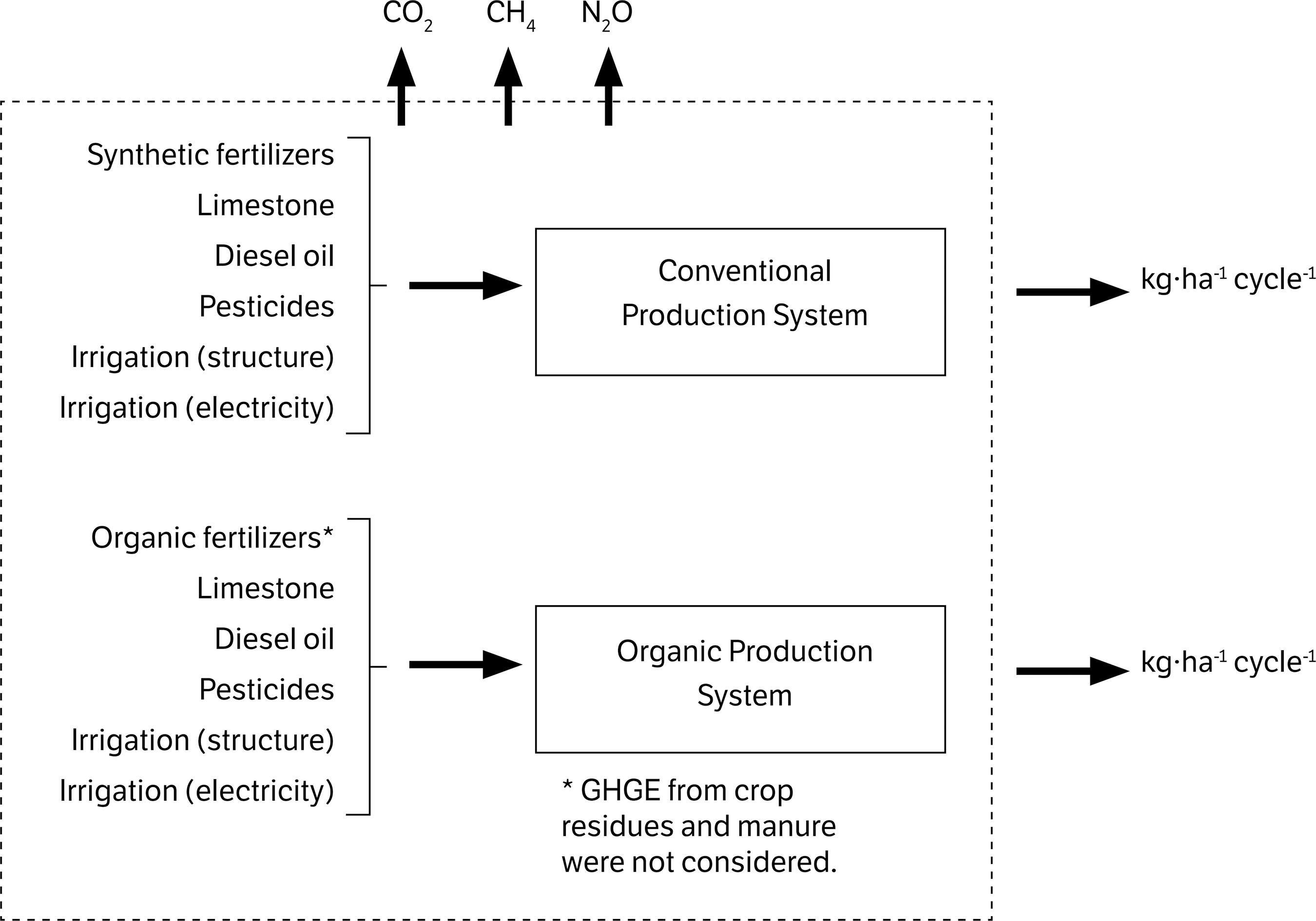
The agricultural phase of carrot production and the manufacturing of inputs (Fig. 1) were the boundaries established for the study and were characterized by:

Flowchart for the evaluation of greenhouse gas emissions (GHGE) and carbon footprint of carrot production in conventional and organic systems.
-
Phase 1: agricultural production. In this phase, direct GHG emissions caused by the application of fertilizers (N fertilizer and liming) and the use of fuel (diesel) in operations carried out during the cultivation of vegetables were quantified;
-
Phase 2: production of raw materials. In this phase, GHG emissions originated by the manufacturing (off-farm) of fertilizer inputs (N, P, K, limestone), pesticides (insecticides, herbicides and fungicides), fuels (diesel), material for the structure of the irrigation system and generation of energy consumed in the system, and machinery were quantified.
Life cycle analysis inventory: data collection
Information on relevant inputs and outputs of the evaluated cultivation systems (inputs used, operations carried out during the production cycle, and yield) were collected through a questionnaire and interviews with producers and technicians responsible for production on rural properties in the states of Minas Gerais and São Paulo. Carrot production was evaluated in a conventional production system, in two seasons of the year (summer and winter), on a property of 6,688 ha, of which 923 ha were destined to produce this vegetable. For the organic production system, data were obtained from three properties, covering a total area of 12 ha of carrot production. The data correspond to the 2020/2021 agricultural year, and there was no distinction for the cultural management method between the growing seasons (Table 1).
In the conventional system, crop rotation is carried out with planting of millet and Brachiaria sp. prior to the planting of carrots. Soil preparation is carried out in a conventional way, with subsoiling, harrowing, leveling, and bedding operations. Cultural practices are carried out using chemical pesticides (herbicides, fungicides, and insecticides), and crop fertilization is performed using synthetic fertilizers, with liming for soil correction (Table 1). Sowing, cultural practices and harvesting operations are carried out with mechanization. The irrigation system used is the center pivot.
In the organic system, crop rotation is also carried out, but using millet, sunn hemp, and other vegetables (lettuce, zucchini, beets, green beans etc.). Soil preparation is carried out with plowing and bedding operations. Organic fertilizers (cattle manure, Yorim Master and Ekosil) and crop residues are used for crop fertilization as sources of NPK, and limestone is used for soil correction. Cultural practices and harvesting operations are carried out manually. The same fertilization is applied at different times. In addition, the sprinkler system is used for crop irrigation (Table 1).
The average yield of the systems used in the calculations was 50,000 and 65,000 kg.ha-1 of carrot in the conventional system, in the summer and winter seasons, respectively, and 30,000 kg.ha-1 in the organic system.
Average values of inputs and materials used in carrot production in conventional cultivation systems (CS) in summer (S), in winter (W) and organic cultivation systems (O) in summer and winter.
Life cycle impact assessment
GHG emissions were calculated using factors associated with the inputs, materials, and energy used in each phase of the production process, according to the limits established in this study (Tables 2 and 3). The methodology of the Intergovernmental Panel on Climate Change (IPCC 2006) and, in some cases, specific local factors (Tier 2) were used. The total GHG emitted was calculated in terms of carbon equivalent (CO2eq), using the global warming potential of CO2eq, CH4 and N2O equal to 1, 27 and 273, respectively, over a determined period of 100 years (IPCC 2023), according to Eq. 1. The carbon footprint to produce 1 kg of carrots was calculated by Eq. 2.
where: GHGtotal = total GHG emission in the system (kg CO2eq.ha-1); j = input described in Table 1 (unit.ha-1 or kg-1); EF(j) = emission factor (kg CO2eq.unit-1); AC = amortization coefficient based on the years of input life (dimensionless), when applicable; CF = carbon footprint (kg CO2eq.kg-1 carrot); TY = total yield of carrots (kg.ha-1).
Greenhouse gas emission factors (E.F.) used to calculate greenhouse gas emissions in phase 1 of carrot cultivation defined in this study.
Greenhouse gas emission factors used to calculate greenhouse gas emissions in phase 2 of carrot cultivation defined in this study.
Amortization
In the calculations of amortization of the irrigation system used in conventional production, the weight of a center pivot system sufficient to irrigate an area of 91 ha was calculated based on information from manufacturers. The life cycles were 20 years for the steel structure, 10 years for the gearmotor and motor pump, five years for the polyvinyl chloride (PVC) pipes used in the mainline, and 10 years for the polystyrene rubbers used in the electrical coatings (Table 1). For the organic production system, a sprinkler irrigation system was designed, using PVC for the manufacture of pipes and sprinklers. The system’s useful life was five years.
RESULTS
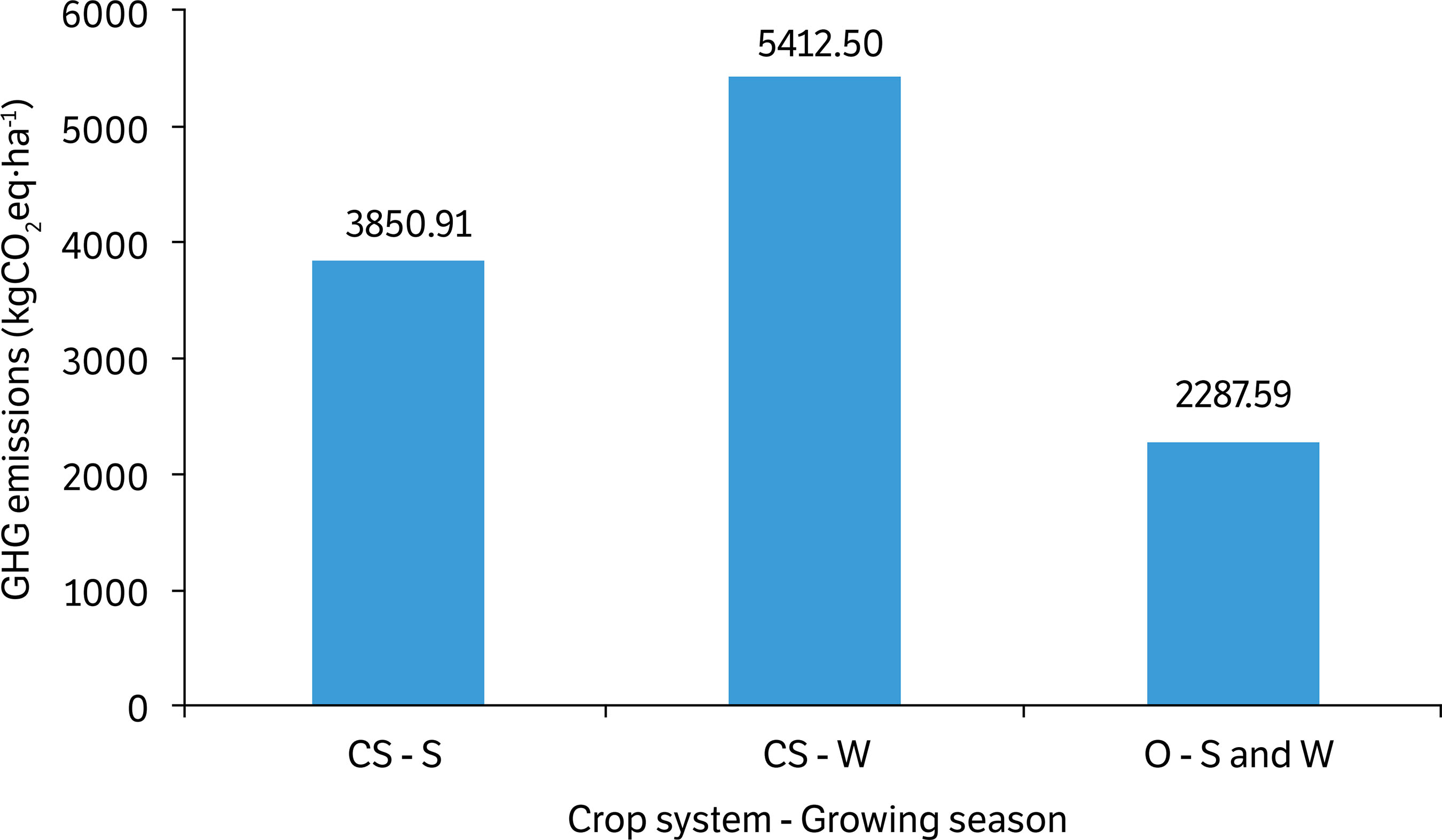
According to the limits established in this study, GHG emissions for carrot production in an intensive conventional system varied according to the production season. The highest emissions occurred in the winter season, 5,412.5 kg CO2eq.ha-1, while in the summer season the emissions were of 3,850.9 kgCO2eq.ha-1 (Fig. 2). The lowest emissions occurred in the organic production system, 2,287.6 kg CO2eq.ha-1 (Fig. 2). The difference in the estimates of GHG emissions in the conventional system, in the different seasons, was associated with the quantity of fertilizers applied, especially N, because greater amounts of this input were applied in winter (Table 1). By analyzing the contribution of each input to GHG emissions in the systems evaluated, it was possible to observe that N fertilizers were the main contributors in the conventional system in winter, 37.1% of the total, and in the organic system, 37.5% of the total (Fig. 3).

Greenhouse gas (GHG) emissions for carrot production in conventional cultivation system (CS) in the summer (S) and in the winter (W), and organic cultivation system (O) in the summer and the winter.

Percentage contribution of each input, material, and fuel to total greenhouse gas emissions for carrot production in conventional cultivation system (CS) in the summer (S) and in the winter (W), and organic cultivation system (O) in the summer and winter.
In the conventional system in summer, diesel consumption by machinery was the main contributor, 36.9% of the total, while the contribution of N fertilizers was only 13% of the total. Diesel consumption was the second input that contributed the most in the conventional system in winter, with 26.7%, and the third in the organic system, with 20.3%. The use of correctives corresponded to 28.6% of the emissions in the organic system, being the second largest contributor (Fig. 3). P and K fertilizers contributed with 20.5 and 27.8% in the conventional winter and summer systems, respectively, while in the organic system the contribution was 5.6% of the total. Pesticides and irrigation (electricity consumption in the system and structure) contributed the least in the conventional winter and summer systems. In the organic system, irrigation (electricity consumption in the system and structure) contributed with 8% of the total (Fig. 3).
The carbon footprint for carrot production was higher in the conventional production system in the winter season, corresponding to 0.0833 kg CO2eq.kg-1 of carrot, while in the summer harvest the values were 0.0770 kg CO2eq.kg-1 of carrot (Fig. 4).

Carbon footprint for carrot production in conventional cultivation system (CS) in the summer (S) and in the winter (W), and organic cultivation system (O) in the summer and winter.
The organic cropping system had the lowest carbon footprint for carrot production, emitting 0.0763 kg CO2eq.kg-1 of carrot, 8% lower than the conventional system in the winter season (Fig. 4).
DISCUSSION
No studies were found evaluating the impact of carrot production in conventional and organic systems on GHG emissions in Brazil. However, when evaluating the impact of the production of other vegetables in a conventional system (cabbage, spinach, and chicory), Pereira et al. (2022) found that GHG emissions in a conventional cropping system of these vegetables ranged from 1,700 to 3,348 t CO2eq.ha-1 cycle-1. The authors found that the use of fertilizers was the main contributing source to GHG emissions, as observed in the results presented here (Fig. 3).
It is important to consider that, although in the organic production system the emissions associated with the use of fertilizers represented more than 40% of the total emitted, the origin of these fertilizers was organic (crop residues and manure), unlike the conventional system, in which synthetic fertilizers were mostly used. In addition, the contribution of a production cycle in the organic system was about 40 and 57% less intensive in terms of emissions compared to the conventional production system in the summer and winter seasons, respectively (Fig. 2).
These results showed that replacing synthetic sources of fertilizers with organic sources can be a strategy to mitigate GHG emissions in carrot production in a conventional intensive system. Another strategy to be considered is the more efficient use of N fertilizers, because in carrot production in the summer season, when the application of N fertilizers was lower compared to the winter season, the contribution of N fertilizer to the total GHG emitted decreased by approximately 25% (Fig. 4).
Although diesel consumption in the organic system was 67.5% lower than in the conventional system, due to the non-use of tractors in pesticide application (Table 1) and topdressing fertilization, in both systems evaluated, the replacement of diesel by renewable fuel sources, such as biodiesel or the use of electric tractors, should also be included in measures to reduce GHG emissions associated with carrot production. According to Lagnelöv et al. (2021), the use of electric tractors has the potential to reduce GHG emissions by 65% compared to internal combustion tractors, which would contribute to a reduction of 913 to 940 kg CO2eq.ha-1 in GHG emissions associated with the use of diesel in the conventional production system, in the summer and winter, respectively, and 308 kg CO2eq.ha-1 in the organic system. Additionally, Canabarro et al. (2023) found that replacing diesel with biodiesel in Brazil would reduce GHG emissions by 66.8%, which would promote reductions similar to those cited for electric tractors.
In addition to the impact on GHG emissions, reduction and mitigation strategies need to contemplate the economic aspects of the production system. When analyzing the carbon footprint, it was possible to observe that in the organic system the values were 1 and 8% lower than those of the conventional system, in the summer and winter seasons, respectively (Fig. 4). Such differences were directly related to carrot yield, which was 66 and 116% higher in the conventional system, in the summer and winter seasons, respectively, compared to the organic system (Fig. 3). Thus, despite the lower GHG emissions and carbon footprint in the organic production system, there was also a decrease in yield, so it is necessary to conduct more research and develop technologies for this system to meet both aspects, that is, higher yield and lower emissions. As demonstrated by Pereira et al. (2021), Cecílio Filho et al. (2022) and Pereira et al. (2022), the use of intercropping systems promotes better use of the production area, being a viable alternative to reduce the carbon footprint of vegetable production, without compromising crop yield.
When using the LCA methodology to evaluate the impact of irrigated carrot production in the semi-arid region of Brazil, Lopes et al. (2018) found that the carbon footprint for the production of 1 kg of carrot in conventional system was 0.12 kg CO2eq.kg-1, with the use of fertilizers and diesel consumption being the main contributing sources, as observed in the results obtained in the present study. In a literature review, Clune et al. (2017) observed that the carbon footprint for carrot production ranged from 0.08 to 0.036 kg CO2eq.kg-1. The variations in the carbon footprint compared to the values obtained in the present study can be attributed to different LCA approaches, including limits established for the study, geographic location, and yield of crops. In addition, uncertainties associated with the emission factors and approach used are common in LCA studies (Adewale et al. 2018) and should be considered in the present study.
CONCLUSION
The use of fertilizers, especially N fertilizers, and the consumption of diesel in tractor operations are the main sources contributing to GHG emissions associated with carrot production in the conventional system, in the summer and winter seasons, as well as in the organic system. Strategies to mitigate GHG emissions associated with the production of this vegetable include replacing synthetic fertilizer inputs with organic sources or improving the efficiency of use of this input, in addition to replacing diesel with electric or biofuel-powered tractors in the near future. Carbon footprint for carrot production in an organic system is 1 to 8% lower than that of the conventional system, mainly due to the difference in yield between the two systems, indicating the need to combine the more sustainable practices of the organic system with yield gains.
ACKNOWLEDGMENTS
To Universidade Estadual Paulista “Júlio de Mesquita Filho” for support during the research.
-
How to cite:
Cecílio Filho, A. B., Pereira, B. J. and La Scala Junior, N. (2026). Analysis of greenhouse gas emissions and carbon footprint of carrot production in two cropping systems. Bragantia, 85, e20250173. https://doi.org/10.1590/1678-4499.20250173
-
FUNDING
Coordenação de Aperfeiçoamento de Pessoal de Nível SuperiorFinance Code 001Conselho Nacional de Desenvolvimento Científico e TecnológicoGrant No.: 313398/2021-6
-
DECLARATION OF USE OF ARTIFICIAL INTELLIGENCE TOOLS
The authors declare that artificial intelligence tools were not used in the design and conduct of the study, nor in the writing of the scientific paper.
DATA AVAILABILITY STATEMENT
The data that support the findings of this study are available on request from the corresponding author.
REFERENCES
- [ABCSEM] Associação Brasileira de Comércio de Sementes e Mudas. (2017). Mapeamento e quantificação da cadeira produtiva das hortaliças. Campinas: ABCSEM.
-
Adewale, C., Reganold, J. P., Higgins, S., Evans, R. D. and Carpenter-Boggs, L. (2018). Improving carbon footprinting of agricultural systems: Boundaries, tiers, and organic farming. Environmental Impact Assessment Review, 71, 41-48. https://doi.org/10.1016/j.eiar.2018.04.004
» https://doi.org/10.1016/j.eiar.2018.04.004 -
Antón, A., Torrellas, M., Núñez, M., Sevigné, E., Amores, M. J., Muñoz, P. and Montero, J. I. (2014). Improvement of agricultural life cycle assessment studies through spatial differentiation and new impact categories: Case study on greenhouse tomato production. Environmental Science and Technology, 48, 9454-9462. https://doi.org/10.1021/es501474y
» https://doi.org/10.1021/es501474y -
Anuário HF (2023). In M. M. Moreira (Ed.). HF Brasil. Available at: http://www.hfbrasil.org.br Accessed on: Apr. 10, 2023.
» http://www.hfbrasil.org.br - Audsley, E., Stacey, K., Parsons, D. J. and Willians, A. G. (2009). Estimation of the greenhouse gas emissions from agricultural pesticide manufacture and use. Cranfield: Cranfield University.
-
Avadí, A. (2020). Screening LCA of French organic amendments and fertilisers. International Journal of Life Cycle Assessment, 25, 698-718. https://doi.org/10.1007/s11367-020-01732-w
» https://doi.org/10.1007/s11367-020-01732-w -
Bartzas, G., Zaharaki, D. and Komnitsas, K. (2015). Life cycle assessment of open field and greenhouse cultivation of lettuce and barley. Information Processing in Agriculture, 2, 191-207. https://doi.org/10.1016/j.inpa.2015.10.001
» https://doi.org/10.1016/j.inpa.2015.10.001 -
Canabarro, N. I., Silva-Ortiz, P., Nogueira, L. A. H., Cantarella, H., Maciel-Filho, R. and Souza, G. M. (2023). Sustainability assessment of ethanol and biodiesel production in Argentina, Brazil, Colombia, and Guatemala. Renewable and Sustainable Energy Reviews, 171, 113019. https://doi.org/10.1016/j.rser.2022.113019
» https://doi.org/10.1016/j.rser.2022.113019 -
Cecílio Filho, A. B., Nascimento, C. S., Pereira, B. J. and Nascimento, C. S. (2022). Nitrogen fertilisation impacts greenhouse gas emissions, carbon footprint, and agronomic responses of beet intercropped with arugula. Journal of Environmental Management, 307, 114568. https://doi.org/10.1016/j.jenvman.2022.114568
» https://doi.org/10.1016/j.jenvman.2022.114568 -
Cellura, M., Longo, S. and Mistretta, M. (2012). Life Cycle Assessment (LCA) of protected crops: An Italian case study. Journal of Cleaner Production, 28, 56-62. https://doi.org/10.1016/j.jclepro.2011.10.021
» https://doi.org/10.1016/j.jclepro.2011.10.021 -
[CETESB] Companhia Ambiental do Estado de São Paulo (2018). Relatório Emissões Veiculares. CETESB. Available at: https://cetesb.sp.gov.br/veicular/relatorios-e-publicacoes/ Accessed on: June 10, 2022.
» https://cetesb.sp.gov.br/veicular/relatorios-e-publicacoes/ -
Clune, S., Crossin, E. and Verghese, K. (2017). Systematic review of greenhouse gas emissions for different fresh food categories. Journal of Cleaner Production, 140, 766-783. https://doi.org/10.1016/j.jclepro.2016.04.082
» https://doi.org/10.1016/j.jclepro.2016.04.082 -
[FAO] Food and Agriculture Organization (2018). Faostat crops database. FAO. Available at: http://www.fao.org/faostat/en/#data/QC Accessed on: April 10, 2023.
» http://www.fao.org/faostat/en/#data/QC -
[FAO] Food and Agriculture Organization (2021). Faostat crops database. FAO. Available at: http://www.fao.org/faostat/en/#data/QC Accessed on: December 1, 2023.
» http://www.fao.org/faostat/en/#data/QC -
Foteinis, S. and Chatzisymeon, E. (2016). Life cycle assessment of organic versus conventional agriculture. A case study of lettuce cultivation in Greece. Journal of Cleaner Production, 112, 2462-2471. https://doi.org/10.1016/j.jclepro.2015.09.075
» https://doi.org/10.1016/j.jclepro.2015.09.075 -
[IEA] Instituto de Economia Agrícola (2022). Estatísticas da produção paulista. IEA. Available at: http://www.iea.agricultura.sp.gov.br/out/index.php Accessed on: July 16, 2023.
» http://www.iea.agricultura.sp.gov.br/out/index.php - [IPCC] Intergovernmental Panel on Climate Change (2006). Guidelines for National Greenhouse Gas Inventories. Hayama: Institute for Global Environmental Strategies.
- [IPCC] Intergovernmental Panel on Climate Change (2019). Refinement to the 2006 IPCC guidelines for national greenhouse gas inventories. Switzerland: IPCC.
-
[IPCC] Intergovernmental Panel on Climate Change (2023). The Earth’s energy budget, climate feedbacks, and climate sensitivity. In: IPCC (Ed.). Climate Change 2021: The physical science basis. Contribution of working group I to the sixth assessment report of the intergovernmental panel on climate change (p. 923-1054). Cambridge: Cambridge University Press. https://doi.org/10.1017/9781009157896.009
» https://doi.org/10.1017/9781009157896.009 - [ISO] International Organization for Standardization (2006a). Environmental management – Life cycle assessment – Principles and framework. Geneva: ISO.
- [ISO] International Organization for Standardization (2006b). Environmental management – Life cycle assessment – Requirements and guidelines. Geneva: ISO.
-
Lagnelöv, O., Larsson, G., Larsolle, A. and Hansson, P. A. (2021). Life cycle assessment of autonomous electric field tractors. Swedish Agriculture Sustainability, 13, 11285. https://doi.org/10.3390/su132011285
» https://doi.org/10.3390/su132011285 -
Lopes, J., Medeiros, D. L. and Kiperstok, A. (2018). Combining cleaner production and life cycle assessment for reducing the environmental impacts of irrigated carrot production in Brazilian semi-arid region. Journal of Cleaner Production, 170, 924-939. https://doi.org/10.1016/j.jclepro.2017.08.198
» https://doi.org/10.1016/j.jclepro.2017.08.198 -
Macedo, I. C., Seabra, J. E. A. and Silva, J. E. A. R. (2008). Greenhouse gases emissions in the production and use of ethanol from sugarcane in Brazil: The 2005/2006 averages and a prediction for 2020. Biomass and Bioenergy, 32, 582-595. https://doi.org/10.1016/j.biombioe.2007.12.006
» https://doi.org/10.1016/j.biombioe.2007.12.006 -
Martin-Gorriz, B., Gallego-Elvira, B., Martínez-Alvarez, V. and Maestre-Valero, J. F. (2020). Life cycle assessment of fruit and vegetable production in the Region of Murcia (south-east Spain) and evaluation of impact mitigation practices. Journal of Cleaner Production, 265, 121656. https://doi.org/10.1016/j.jclepro.2020.121656
» https://doi.org/10.1016/j.jclepro.2020.121656 -
[MCTI] Ministério da Ciência, Tecnologia e Inovação (2022). Arquivos dos fatores médios de emissão de CO2 grid mês/ano. Brazil: MCTI. Available at: http://www.mctic.gov.br/mctic/opencms/index.html Accessed on: June 28, 2023.
» http://www.mctic.gov.br/mctic/opencms/index.html -
Payen, S., Basset-Mens, C. and Perret, S. (2015). LCA of local and imported tomato: An energy and water trade-off. Journal of Cleaner Production, 87, 139-148. https://doi.org/10.1016/j.jclepro.2014.10.007
» https://doi.org/10.1016/j.jclepro.2014.10.007 -
Pereira, B. J., Cecílio Filho, A. B. and La Scala Junior, N. (2021). Greenhouse gas emissions and carbon footprint of cucumber, tomato and lettuce production using two cropping systems. Journal of Cleaner Production, 282, 124517. https://doi.org/10.1016/j.jclepro.2020.124517
» https://doi.org/10.1016/j.jclepro.2020.124517 -
Pereira, B. J., Cecílio Filho, A. B., La Scala Junior, N. and Figueiredo, E. B. (2022). Greenhouse gas emissions and carbon footprint of collard greens, spinach and chicory production systems in Southeast of Brazil. Frontiers in Plant Science, 13, 1015307. https://doi.org/10.3389/fpls.2022.1015307
» https://doi.org/10.3389/fpls.2022.1015307 -
Pishgar-Komleh, S. H., Akram, A., Keyhani, A., Sefeedpari, P., Shine, P. and Brandão, M. (2020). Integration of life cycle assessment, artificial neural networks, and metaheuristic optimization algorithms for optimization of tomato-based cropping systems in Iran. International Journal of Life Cycle Assessment, 25, 620-632. https://doi.org/10.1007/s11367-019-01707-6
» https://doi.org/10.1007/s11367-019-01707-6 -
Posen, I. D., Jaramillo, P., Landis, A. M. and Griffin, W. M. (2017). Greenhouse gas mitigation for U.S. plastics production: energy first, feedstocks later. Environmental Research Letters, 12, 034024. https://doi.org/10.1088/1748-9326/aa60a7
» https://doi.org/10.1088/1748-9326/aa60a7 -
Tasca, A. L., Nessi, S. and Rigamonti, L. (2017). Environmental sustainability of agri-food supply chains: An LCA comparison between two alternative forms of production and distribution of endive in northern Italy. Journal of Cleaner Production, 140, 725-741. https://doi.org/10.1016/j.jclepro.2016.06.170
» https://doi.org/10.1016/j.jclepro.2016.06.170 -
Tua, C., Nessi, S., Rigamonti, L., Dolci, G. and Grosso, M. (2017). Packaging waste prevention in the distribution of fruit and vegetables: An assessment based on the life cycle perspective. Waste Management and Research, 35, 400-415. https://doi.org/10.1177/0734242X16688259
» https://doi.org/10.1177/0734242X16688259 -
[UN] United Nations (2015). Sustainable Development Goals. UN. Available at: https://www.un.org/sustainabledevelopment/ Accessed on: April 10, 2023.
» https://www.un.org/sustainabledevelopment/ - Wiedmann, T. and Minx, J. (2008). A definition of carbon footprint. In C. C. Pertsova (Ed.). Ecological Economics Research Trends. Hauppauge: Nova Science.
-
Winans, K., Brodt, S. and Kendall, A. (2020). Life cycle assessment of California processing tomato: an evaluation of the effects of evolving practices and technologies over a 10-year (2005–2015) timeframe. International Journal of Life Cycle Assessment, 25, 538-547. https://doi.org/10.1007/s11367-019-01688-6
» https://doi.org/10.1007/s11367-019-01688-6 -
Zarei, M. J., Kazemi, N. and Marzban, A. (2019). Life cycle environmental impacts of cucumber and tomato production in open-field and greenhouse. Journal of the Saudi Society of Agricultural Science, 18, 249-255. https://doi.org/10.1016/j.jssas.2017.07.001
» https://doi.org/10.1016/j.jssas.2017.07.001
Edited by
-
Section Editor:
Fernando Cesar Bachiega Zambrosi https://orcid.org/0000-0001-9376-3346