 Selection of sources of aluminum tolerance in wheat germplasm using minimum solution
ABSTRACT
Wheat (Triticum aestivum L.) is highly sensitive to aluminum (Al), an abiotic factor that limits productivity in acidic soils. In this way, the use of Al-tolerant cultivars associated with liming could increase the productive potential in these unfavorable growing environments. The objectives of this study were to determine the effective concentration of Al in a minimum solution and to identify sources of Al tolerance. Initially, an experiment was conducted in a randomized block design with three replicates, evaluating five concentrations of Al in minimum solution (calcium + Al) on eight wheat genotypes. The experiment had a split-plot design, analyzing the effect of Al concentrations in plots and the effect of genotypes in subplots. To select sources of tolerance, a second experiment was conducted in a randomized block design with three replicates, evaluating 88 inbred lines, six commercial cultivars, and the Anahuac and BH 1146 controls (sensitive and tolerant, respectively). Al tolerance was assessed through the root growth difference of the main root. Results showed that a concentration of 4 mg.L-1 of Al was effective for discriminating between sensitive and tolerant genotypes. The wheat germplasm demonstrated wide genetic variability for tolerance to Al, with the L34 and L72 inbred lines standing out as excellent sources of tolerance. These lines could be used in future crosses in breeding programs to obtain progeny with greater tolerance to Al, improving wheat productivity under acid soil conditions.
Key words
Triticum aestivum L.; aluminum toxicity; root growth difference; relative tolerance index
INTRODUCTION
Aluminum (Al) is the third most abundant metal in Earth’s crust, is generally found bound to soil minerals, such as aluminosilicates, and is not easily available to plants. In acidic soil conditions (pH < 5.5), aluminosilicates dissociate, leading to the release of Al ions, which become soluble in the soil, with the Al(H2O)63+ form prevailing. Al3+ is easily absorbed by plants and potentially toxic at micromolar levels (Chandra and Keshavkant 2021). The primary site of action of Al3+ is the root apex, interfering with cell division and elongation. The most rapid and evident effect of Al3+ toxicity is the inhibition of root growth, followed by the thickening and reduction of its ramifications, significantly reducing the volume of soil explored by the roots, limiting the absorption of water and nutrients (Kochian 1995, Matsumoto 2000). Al also reduces photosynthesis and plant growth, results in the accumulation of reactive oxygen species, and causes damage to cellular and biochemical components (Ofoe et al. 2023).
Toxicity caused by Al3+ is considered to be the second most important abiotic stress factor in reducing agricultural production worldwide, because acidic soils account for approximately 50% of the world’s potentially arable areas (Von Uexküll and Mutert 1995). In Brazil, it is estimated that 70% of areas with potential for agricultural activity have soil acidity problems, with a pH between 3.8 and 5.5 (Quaggio 2000). The intensification of human activities, lixiviation of basic cations from soils and occurrence of acid rain have considerably accelerated soil acidification in recent years (Hajiboland et al. 2023).
Wheat (Triticum aestivum L.) is one of the most sensitive agricultural crops to toxicity caused by Al3+ and is considered the second most produced and consumed cereal in the world, with global production of 799.71 million tons (2024/2025 harvest) (USDA 2025). In Brazil, the crop occupied 3.058 million ha in the 2024 harvest, with a production of 7.889 million tons and average productivity of 2.57 tons.ha-1. National demand for wheat grains is approximately 12.64 million tons, making it necessary to import this cereal, with 6.2 million tons imported in 2024 (CONAB 2025).
Liming is one of the main alternatives to increase soil pH and, consequently, reduce the solubilization of Al3+. In areas under a long-term no-till system, pH correction is generally restricted to the subsurface layers, since lime is applied to the soil surface without mechanical incorporation and has low solubility (Caires and Guimarães 2018, Fontoura et al. 2019). Below 0.20 m, low levels of calcium (Ca) and magnesium (Mg) are observed, which limits root growth. Additionally, high levels of available Al in deeper soil layers can impair root growth further, reducing the crop’s ability to access water and nutrients. This increases its sensitivity to drought and decreases its productive potential (Caires and Guimarães 2018, Lollato et al. 2019).
Al-tolerant wheat cultivars have been cultivated in soils with high levels of this toxic element because they can endure the negative effects of toxicity better (Aguilera et al. 2016, Boff et al. 2019). However, Al-tolerant genotypes are also affected by high levels of available Al in the soil. When aluminum saturation exceeds 30% of the cation exchange capacity, sensitive cultivars suffer total crop loss, whereas tolerant cultivars exhibit a 12–52% reduction in grain yield compared to soil conditions with Al saturation below 30% (Kariuki et al. 2007). Therefore, using Al-tolerant cultivars combined with correcting the soil pH through liming are important strategies in regions with predominantly acidic soils. This benefits the agricultural system and improves the soil’s chemical quality (Foloni et al. 2023).
Selection of tolerant genotypes using a complete nutrient solution containing Al facilitates the assessment of damage caused by the toxic element in the root system of seedlings, permitting a non-destructive assessment during the early stages of development, by controlling both the pH and Al concentrations in solution (Crestani et al. 2009). In recent years, the minimum nutrient solution technique has been widely used to reduce the number of reagents, facilitate the preparation of solution and reduce the interaction of Al3+ with other ions in solution, which significantly reduces the chemical activity of this toxic element.
The minimum solution is composed only of Al and Ca and has been used to characterize Al tolerance in maize (Mazzocato et al. 2002, Coelho et al. 2015), oats (Crestani et al. 2011, Silveira et al. 2013), and wheat (Ferraz et al. 2020), with variations in concentrations of Al and Ca depending on the plant species and the period of exposure to the toxic element. In this work, the objectives were to determine the effective concentration of Al in minimum solution and to select sources of Al tolerance in wheat germplasm.
MATERIAL AND METHODS
Aluminum concentration in minimum solution
Six wheat inbred lines from the genetic breeding program at the Universidade Estadual de Ponta Grossa were evaluated, as well as the cultivars BH 1146 and Anahuac (Instituto Agronômico de Campinas), used as experimental Al-tolerant and Al-sensitive controls, respectively.
The experiment was carried out in a randomized block design with three replicates. Treatments were arranged in a split-plot design, analyzing the effect of Al concentrations (0, 2, 4, 6, and 8 mg.L-1) in the plots and the effect of wheat genotypes (L24, L34, L59, L62, L72, L77, BH 1146, and Anahuac) in the sub-plots, evaluating 12 seedlings.replicate-1.
Seeds were germinated on sterilized Germitest paper and kept in a germination chamber at an average temperature of 23°C and relative humidity of 100% for a period of 60 hours to allow for the main root of the seedlings to achieve a minimum length of 2 to 3 cm.
After the germination period, secondary roots were removed, seedlings with uniform main root length were selected, and the initial length of the main root in cm was determined (first evaluation). Subsequently, seedlings were transferred to expanded polystyrene trays, which were placed on top of the minimum solution, and maintained in a plastic tray with capacity of 8 L.
Minimum solutions were prepared with deionized water, pH 7 and conductivity of 1.8 µS.cm-1. Solutions were composed of 40 mg.L-1 of Ca (CaCl2) and Al (AlCl3.6H2O) at concentrations of 0, 2, 4, 6 and 8 mg.L-1.
Roots of the seedlings remained in contact with the minimum solution for 48 hours. Solutions were maintained under constant aeration and light, and pH was adjusted daily, maintaining it in the 4 to 4.5 range. After the seedling roots had been exposed to the treatment solution, length of the main root in cm (second evaluation) was evaluated again. The difference between the first and the second values was denominated root growth difference (RGD) (Mazzocato et al. 2002).
The normality of the residuals and homoscedasticity of the data for the RGD variable were tested. Then, the RGD data were submitted to an analysis of variance. In the presence of a significant effect (p < 0.05) for Al concentrations × wheat genotypes interaction, the Al concentrations were analyzed within each genotype by polynomial regression analysis using the quadratic regression model in the Genes program (Cruz 2016).
SELECTION OF SOURCES OF ALUMINUM TOLERANCE
We evaluated 88 inbred wheat lines from the genetic breeding program at the Universidade Estadual de Ponta Grossa, derived from artificial biparental crosses between eight obsolete wheat cultivars (Alcover, BH 1146, BR 18 - Terena, BRS 208, BRS 210, BRS 220, Ônix, and OR 1). In addition, six commercial cultivars (TBIO Audaz, TBIO Ponteiro, OR Quartzo, OR Safira, TBIO Sinuelo, and TBIO Toruk) recommended for cultivation in southern Brazil and in the states of São Paulo and Mato Grosso do Sul were evaluated. The cultivars Anahuac (Al-sensitive) and BH 1146 (Al-tolerant) (Instituto Agronômico de Campinas) were used as experimental controls.
The experiment was carried out in a randomized block design with three replicates, evaluating eight seedlings.replicate-1. The minimum solution was prepared with 40 mg.L-1 of Ca (CaCl2) and 4 mg.L-1 of Al (AlCl3.6H2O), and maintained in a fiberglass tank with capacity of 280 L.
The procedures adopted for germinating the seeds, preparing seedlings and assessing the length of the main root of each seedling, before and after exposure to the minimum solution, were carried out as described above.
The data relating to the RGD variable were submitted to analysis of variance and the genotype averages to Scott-Knott cluster analysis (p < 0.05). Based on the results of the analysis of variance, genetic parameters were estimated using the Genes program (Cruz 2016). In addition, the Al relative tolerance index (RTIAl) was calculated using Eq. 1, adapted from Camargo et al. (1991):
where: RGDx: RGD obtained for each genotype; RGDs: RGD obtained for the sensitive experimental control; RGDt: RGD obtained for the tolerant experimental control.
The sensitive and tolerant experimental controls assumed RTIAl values equal to 1 and 5, respectively.
RESULTS AND DISCUSSION
Aluminum concentration in minimum solution
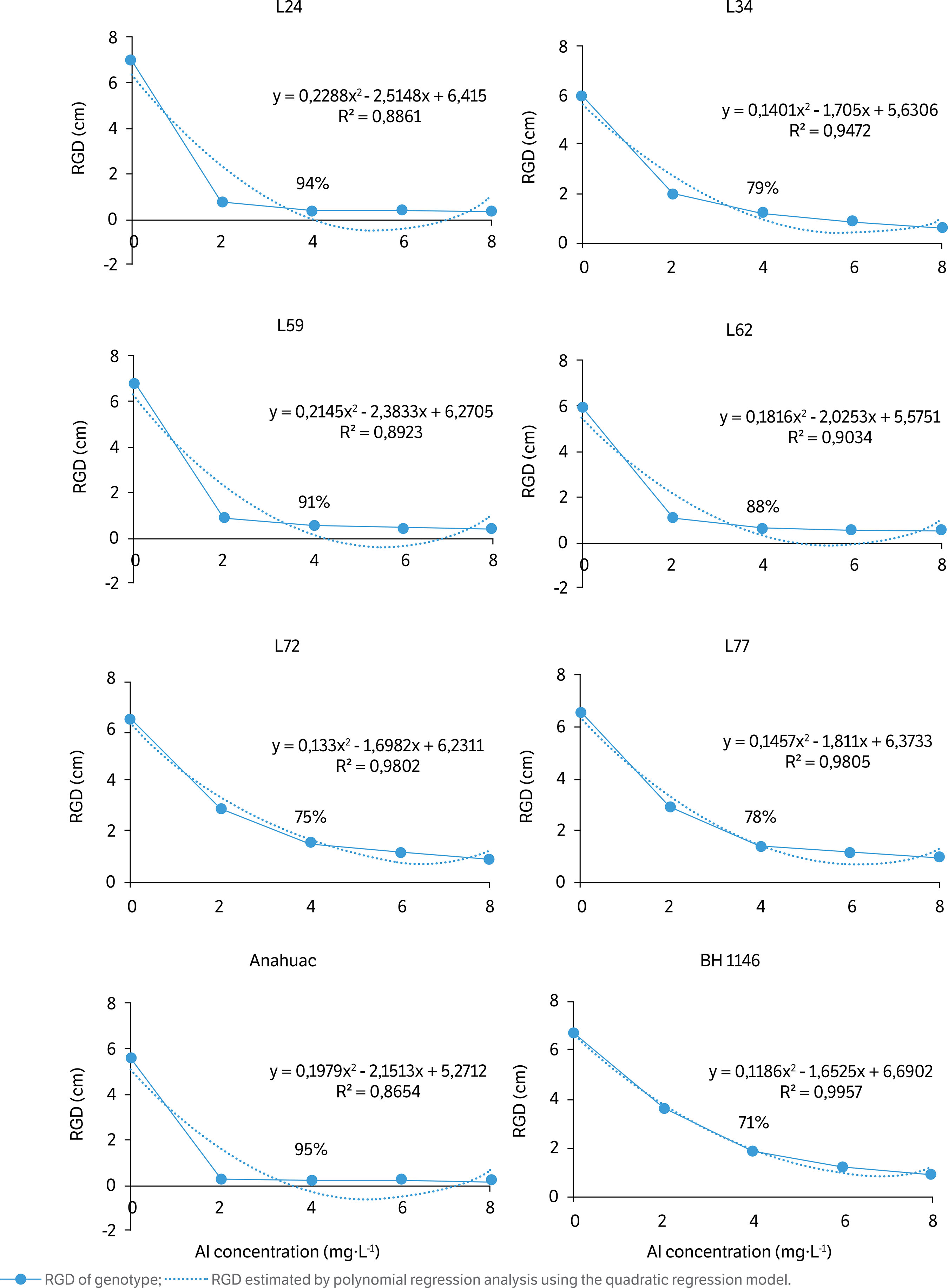
Results of the analysis of variance for the RGD variable showed a highly significant effect by the F test (p < 0.01) for the concentrations × genotypes interaction (Table 1). Analysis of Al concentrations within each genotype showed that at a concentration of 2 mg.L-1 of Al, there was a drastic reduction in the root growth of all the wheat genotypes (Fig. 1)

Effect of aluminum (Al) concentrations (0, 2, 4, 6, and 8 mg·L<sup>-1</sup>) in minimum solution on the root growth difference (RGD) variable in lines L24, L34, L59, L62, L72, and L77, and in cultivars Anahuac (Al-sensitive control), and BH 1146 (Al-tolerant control). Percentage values indicate the reduction in RGD with 4 mg·L<sup>-1</sup> of Al.
Summary of the analysis of variance for root growth difference (RGD) in the experiment to determine the effective concentration of aluminum in a minimum solution and in the experiment to select sources of aluminum tolerance.
L24, L59, L62, and the cultivar Anahuac, used as an Al-sensitive control, showed a very evident reduction in root growth after the roots were exposed to 2 mg.L-1 of Al, while they maintained relatively stable root growth at concentrations of 4, 6, and 8 mg.L-1. On the other hand, L34, L72, L77, and cultivar BH 1146, used as an Al-tolerant control, showed a significant reduction in root growth at a concentration of 4 mg.L-1 of Al, while maintaining constant root growth at concentrations of 6 and 8 mg.L-1. According to Silveira et al. (2013), to observe RGD under Al stress conditions, the percentage reduction of this variable must be evaluated, as this data can reflect how much the toxic element affected the plant’s metabolism. Thus, the results showed that at a concentration of 2 mg.L-11 of Al, the genotypes presented an average reduction in RGD of 71%, compared to the RGD observed in the absence of Al in the minimum solution. At a concentration of 4 mg.L-1, there was an average reduction of 84% (Fig. 1), while at concentrations of 6 and 8 mg.L-1, the average reduction was 88 and 90%, respectively. Thus, it can be observed that, starting at a concentration of 4 mg.L-1 of Al, the genotypes did not show a significant average reduction in RGD, evidencing that this concentration was effective in discriminating between Al-tolerant and Al-sensitive genotypes.
Results of this study indicated that, in Al-sensitive genotypes, low concentrations of the element cause root growth to stop, due to inhibition of cell division and elongation. However, in Al-tolerant genotypes, root growth is paralyzed only after the roots are exposed to higher concentrations of Al (Kochian 1995). Root apices are the most sensitive part of the root system and respond to micromolar concentrations of Al. Thus, rapid inhibition of root growth is one of the main symptoms of Al toxicity (Huang et al. 2014) and is widely used as a marker in the evaluation of Al sensitivity/tolerance (Awasthi et al. 2017). Al-induced root growth inhibition occurs because Al initially targets the epidermis and cortex of the roots and instantly binds to the root cell walls through negatively charged phosphate and carboxyl groups, constituents of pectin, cellulose, and hemicellulose, which are compounds of root cell walls that serve as a protective barrier against abiotic stress. The binding of Al to root cell walls compromises cell wall integrity and functions, including cell expansion and whole root growth (Geng et al. 2017, Silva et al. 2020, Wu et al. 2022).
A recent study has shown that in wheat roots, Al stress triggers excessive accumulation of short-chain aldehydes derived from Al-induced lipid peroxidation. Aldehydes exacerbate Al toxicity in wheat seedlings, considerably increasing Al retention in root cell walls. This occurs due to an increase in the polysaccharide content of the cell wall and in the levels of pectin demethylation, resulting in an increase in the number of potential Al-binding sites and, consequently, in a high accumulation of Al in wheat roots (Liang et al. 2022).
Results showed that, in the absence of Al in minimum solution, L24 had an RGD of 7.08 cm, while Anahuac cultivar had an RGD of 5.89 cm (Fig. 1). This difference in root growth between the genotypes in the absence of Al can be attributed to the quantity of reserve tissue in the seeds, which includes endosperm and the aleurone layer in wheat. Reserve tissue is directly related to the mass of the seed, a characteristic that is intrinsically related to the genotype and directly affects the initial growth of the seedlings (Peterson et al. 1989).
Adapting the minimum solution methodology to evaluate Al tolerance in maize genotypes, Mazzocato et al. (2002) observed that a concentration of 6 mg.L-1 of Al (Al2(SO4)3.18H2O) and 40 mg.L-1 of Ca (CaCl2.2H2O), during the 48-hour exposure period, was efficient for characterizing Al tolerance by assessing RGD. In contrast, Coelho et al. (2015) observed that there was a significant decrease in the RGD variable as the concentration of Al increased in a minimum solution containing 40 mg.L-1 of Ca (CaCl2.2H2O). The authors noted that exposing the roots to 4 mg.L-1 of Al (AlCl3.6H2O) for 48 hours was effective in selecting Al-tolerant maize hybrids.
Evaluating the response of oat genotypes subjected to Al stress using minimum solution, Silveira et al. (2013) observed that exposing the roots to a concentration of 6 mg.L-1 of Al (Al2(SO4)3.14-18H2O) and 5 mg.L-1 of Ca (CaCl2.2H2O) for a period of 72 hours, followed by exposure of the roots to a solution containing 50 mg.L-1 of Ca (CaCl2.2H2O) for a period of 96 hours, was suitable for differentiating between Al-sensitive and Al-tolerant oat genotypes, by assessing the regrowth of the roots.
Studies on the evaluation of Al tolerance in wheat, using the minimum solution methodology, showed that a concentration of 4 mg.L-1 of Al (AlCl3.6H2O) and 40 mg.L-1 of Ca (CaCl2.2H2O), and exposure for 48 hours, was effective in screening wheat inbred lines for Al tolerance and/or sensitivity (Ferraz et al. 2020).
The use of the minimum solution methodology to assess Al tolerance reduces the quantity of reagents compared to complete nutrient solutions, as well as offering agility in the production of solutions (Crestani et al. 2011). Results of this study with cultivars BH 1146 and Anahuac, tolerant and sensitive controls to Al, respectively, confirmed the efficiency of using the minimum solution methodology (4 mg.L-1 of Al + 40 mg.L-1 of Ca) to characterize tolerance and/or sensitivity to Al in wheat seedlings.
Selection of sources of aluminum tolerance
Results of the analysis of variance for RGD showed a highly significant effect (p < 0.01) for wheat genotypes (Table 1), demonstrating the existence of wide genetic variability for Al tolerance in the germplasm studied.
Cluster analysis of the genotypes for the RGD variable revealed the formation of nine statistical groups (Table 2). The highest RGD was observed for cultivar BH 1146 (1.90 cm), an Al-tolerant control, while the lowest value was found for cultivar Anahuac (0.31 cm), a sensitive control. L34 and L72 stand out positively, with RGD of 1.59 and 1.53 cm, respectively, demonstrating that they are excellent sources of Al tolerance. These lines can be recommended for cross-block composition in wheat breeding programs to produce more Al-tolerant progeny. Further studies should be conducted with these lines under acidic soil conditions with high Al saturation to validate their tolerance to this toxic element. The results also showed that 60 inbred lines from the evaluated wheat germplasm have higher RGD than the commercial cultivars, indicating the germplasm’s high potential for Al tolerance.
The Anahuac cultivar originated in Mexico and is recognized worldwide for its high sensitivity to Al, as it has undergone low selection pressure for tolerance, since many Mexican soils do not have acidity problems and, consequently, toxic Al (Sousa 1998). Due to this high sensitivity to Al, Anahuac is widely used in studies as a sensitive experimental control.
Camargo et al. (2006) observed high sensitivity to Al in Anahuac cultivar, evidenced by the absence of root growth after exposure to complete nutrient solutions containing 2, 4, 6, 8 and 10 mg.L-1 of Al (Al2(SO4)3.18H2O) for 48 hours. On the other hand, cultivar BH 1146, from the cross between cultivars Alfredo Chaves and Polyssu, is recognized as a source of Al tolerance (Garcia-Oliveira et al. 2015). Camargo et al. (2006) reported high tolerance to Al in BH 1146 cultivar, with the highest root growth among ten commercial cultivars, after exposure for 48 hours to a complete nutrient solution containing 2, 4, 6, 8, and 10 mg.L-1 of Al (Al2(SO4)3.18H2O). Subsequently, Camargo et al. (2008) found that the genotypes that showed the highest root growth in complete nutrient solutions containing 2, 4, 6, 8, and 10 mg.L-1 of Al (Al2(SO4)3.18H2O) for a period of 48-hour were the genotypes that showed the greatest productivity under acid soil conditions and rainfed cultivation.
Root growth difference (RGD) of wheat genotypes subjected to Al stress in minimum solution<tfn>*</tfn>.
Wide genetic variability for Al tolerance was also observed by Bertan et al. (2006), when they evaluated 23 wheat cultivars exposed to a treatment solution containing 1 μM of Al for 48 hours, and then to a complete nutrient solution for 72 hours, assessing root regrowth. According to the authors, 11 genotypes stood out positively and could be used in crossbreeding programs to obtain higher progeny for Al tolerance.
Portaluppi et al. (2010) classified 14 wheat genotypes regarding their tolerance to Al after exposure for 96 hours to a nutrient solution containing 2 mg.L-1 of Al (AlCl3). Based on the evaluation of growth of the main and major secondary roots, using cultivars IAC 5-Maringa and Anahuac 75 as an Al-tolerant and Al-sensitive control, respectively, the authors classified the genotypes BRS Guamirim, BRS 194, IPR 85, BRS Buriti, BRS Angico, BRS Guabiju, and IAC 5-Maringa as Al-tolerant. Genotypes Jesuíta, PF 844005, IPR 87, and BRS 229 were classified as moderately tolerant, BRS 209 as moderately sensitive, and the cultivars Anahuac 75 and CD 104 as sensitive to Al.
Evaluating the Al tolerance of 20 wheat cultivars grown in pots containing acidic soil and high levels of exchangeable Al, in a short-term experiment, Pereira (2018) observed that there was a clear separation between genotypes widely recognized as sensitive to Al or tolerant, since the lowest relative root length was observed for genotypes Tiacena 1, Embrapa 10, and Anahuac 75, previously characterized under field conditions as sensitive to Al, and the highest lengths for genotypes BH 1146 and C33 classified as tolerant (Aguilera et al. 2016).
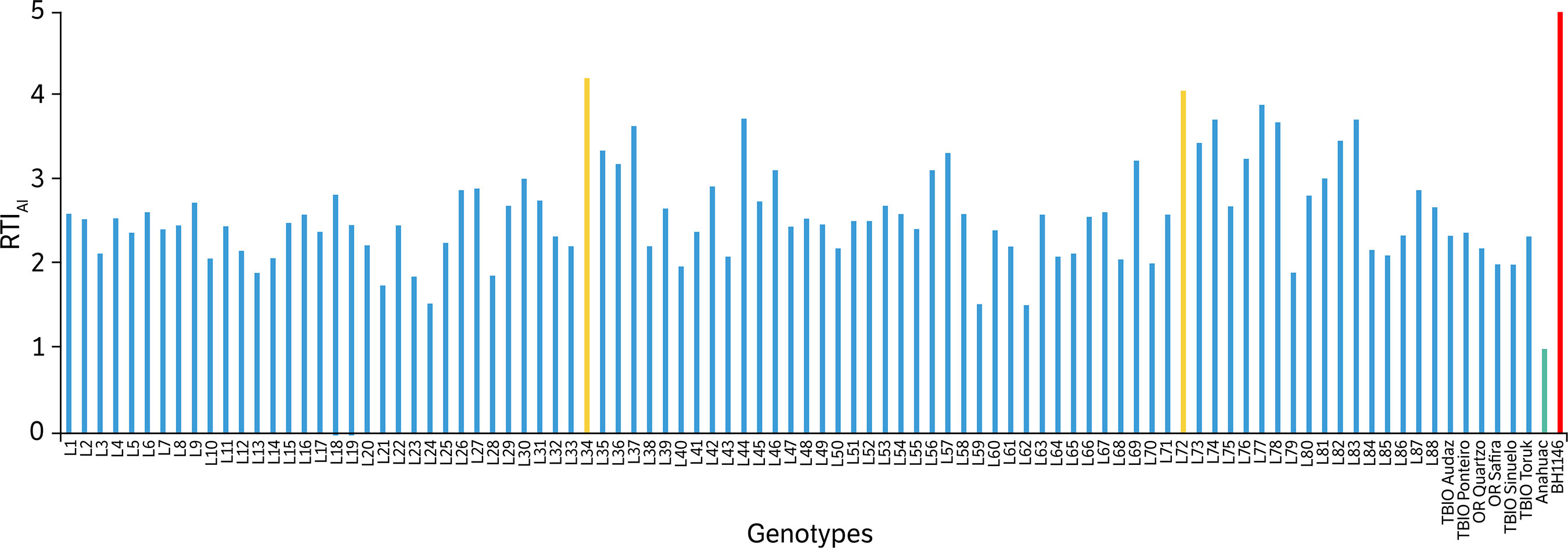
Screening of Al tolerance and/or sensitivity of different genotypes based on the RTIAl showed that the lines had RTIAl values varying from 1.43 to 4.21, while the sensitive (Anahuac) and tolerant (BH 1146) controls had values of 1 and 5, respectively. L34 and L72 stood out positively, with RTIAl of 4.21 and 4.07, respectively, and were considered the most tolerant to Al. Of all the inbred lines analyzed, 74 exhibited RTIAl values between 2.1 to 3.9, and only 12 with RTIAl values below 2 were considered the most sensitive to Al (Fig. 2).
Al relative tolerance index (RTI<sub>Al</sub>) of wheat genotypes. Cultivars Anahuac (Al-sensitive control) and BH 1146 (Al-tolerant control).
Assessing the root growth of wheat genotypes subjected to Al stress in a complete nutrient solution containing 10 mg.L-1 of Al (Al2(SO4)3.18H2O) for 48 hours, Camargo et al. (2006) reported that the genotypes BH 1146, IAC-364, IAC-377, IAC-24, IAC-373, and IAC-378 showed RTIAl ranging from 4 to 5.4, demonstrating high tolerance to Al. In contrast, Anahuac, IAC-289, IAC-350, and IAC-370 showed RTIAl between 1 and 1.7, indicating high sensitivity to the toxic element.
Ferraz et al. (2020), evaluating 45 wheat genotypes exposed to a minimum solution containing 4 mg.L-1 of Al for 48 hours, showed that the inbred lines L01, L03, and L38 had RTIAl higher than 4, demonstrating high tolerance to Al among the genotypes studied.
Estimates of the genetic parameters showed a greater contribution of the genetic component in relation to environmental component in formation of the phenotypic variance (σˆp2) of the RGD, indicating that the growth of the main root is a reliable phenotypic characteristic for identification and prospecting of wheat genotypes tolerant to Al, using minimum solution methodology (Ca + Al). The genotypic variance (σˆg2) was 0.0603 and the environmental variance (σˆe2) only 0.0026 (Table 1). This high value for genotypic variance indicated the presence of genetic variability for Al tolerance, enabling success with artificial selection. On the other hand, the low value for the estimated environmental variance indicated good uniformity of the experimental condition, i.e., the minimum solution used to expose the roots of the seedlings to Al.
The broad-sense heritability (hˆ b s2 ) was 95.94% (Table 1), indicating that the genetic component contributed more to the phenotypic variance than the environmental component. This result was higher than that found by Ferraz et al. (2020) when assessing Al tolerance in 45 wheat genotypes exposed to a minimum solution containing 4 mg.L-1 of Al for 48 hours, with an estimate of 83.6%. The results of this study indicated that artificial selection is very easy and that genetic gain can be achieved by selecting for Al tolerance, since most of the phenotypic variation in tolerance and/or sensitivity was explained by genetic effects.
The coefficient of genetic variation (CVg) was 25.97%, much higher than the coefficient of environmental variation (CVe) (Table 1), indicating the existence of wide genetic variability for Al tolerance in this germplasm. The b quotient expresses the relationship between CVg and CVe and is considered a genetic parameter of great importance in breeding programs, as it estimates the proportion of phenotypic variation that is attributed to genetic differences between individuals (Vencovsky and Barriga 1992). In this work, the b quotient was 2.81, indicating a very favorable condition for artificial selection, by selecting genotypes with higher phenotypic performance for the RGD variable.
Estimates of the genetic parameters indicated a large contribution from genetic variance, a small effect from the environmental component and high broad-sense heritability for the RGD variable, suggesting that the inheritance of Al tolerance is probably based on the action of a few genes with a large phenotypic effect. In addition, the high b quotient demonstrated a very favorable situation for selecting Al tolerance in segregating populations of wheat, based on the evaluation of the root growth of the main root in minimum solution.
CONCLUSION
A concentration of 4 mg.L-1 of Al was effective for discriminating sensitive genotypes from those tolerant to Al using the minimum solution methodology.
The inbred lines from the evaluated wheat germplasm showed wide genetic variability for Al tolerance.
L34 and L72 stood out as excellent sources of Al tolerance within the germplasm, based on the minimum solution methodology, and could be used in future crosses to obtain superior progeny for Al tolerance.
ACKNOWLEDGMENTS
Not applicable.
-
How to cite:
Finger, A. C., Caires, E. F., Ohse, S. and Matiello, R. R. (2026). Selection of sources of aluminum tolerance in wheat germplasm using minimum solution. Bragantia, 85, e20250174. https://doi.org/10.1590/1678-4499.20250174
-
FUNDING
Fundação Araucária de Apoio ao Desenvolvimento Científico e Tecnológico do ParanáGrant No.: CP 23/2024 – PBA2025201000488Coordenação de Aperfeiçoamento de Pessoal de Nível SuperiorFinance code 001
-
DECLARATION OF USE OF ARTIFICIAL INTELLIGENCE TOOLS
The authors declare that artificial intelligence tools (ChatGPT, GeminiAI) were used exclusively to support language revision. All scientific content, analyses, interpretations, and conclusions presented in this manuscript are the sole responsibility of the authors.
DATA AVAILABILITY STATEMENT
The data will be available upon request.
REFERENCES
-
Aguilera, J. G., Minozzo, J. A., Barichello, D., Fogaça, C. M., Silva Júnior, J. P., Consoli, L. and Pereira, J. F. (2016). Alleles of organic acid transporter genes are highly correlated with wheat resistance to acidic soil in field conditions. Theoretical and Applied Genetics, 129, 1317-1331. https://doi.org/10.1007/s00122-016-2705-3
» https://doi.org/10.1007/s00122-016-2705-3 -
Awasthi, J. P., Saha, B., Regon, P., Sahoo, S., Chowra, U., Pradhan, A., Roy, A. and Panda, S. K. (2017). Morpho-physiological analysis of tolerance to aluminum toxicity in rice varieties of North East India. PLoS One, 12, e0176357. https://doi.org/10.1371/journal.pone.0176357
» https://doi.org/10.1371/journal.pone.0176357 -
Bertan, I., Carvalho, F. I. F., Oliveira, A. C., Silva, J. A. G., Benin, G., Vieira, E. A., Silva, G. O., Hartwig, I., Valério, I. P. and Finatto, T. (2006). Dissimilaridade genética entre genótipos de trigo avaliados em cultivo hidropônico sob estresse por alumínio. Bragantia, 65, 55-63. https://doi.org/10.1590/S0006-87052006000100008
» https://doi.org/10.1590/S0006-87052006000100008 -
Boff, T., Espindula, L. F., Bücker-Neto, L., Minella, E., Milach, S. C. K. and Da-Silva, P. R. (2019). Inheritance of aluminum tolerance in the wheat cultivar Toropi and new findings about the introduction of this trait into the Brazilian wheat germplasm. Environmental and Experimental Botany, 157, 91-99. https://doi.org/10.1016/j.envexpbot.2018.10.007
» https://doi.org/10.1016/j.envexpbot.2018.10.007 -
Caires, E. F. and Guimarães, A. M. (2018). A novel phosphogypsum application recommendation method under continuous no-till management in Brazil. Agronomy Journal, 110, 1987-1995. https://doi.org/10.2134/agronj2017.11.0642
» https://doi.org/10.2134/agronj2017.11.0642 -
Camargo, C. E. O., Felicio, J. C. and Ferreira Filho, A. W. P. (1991). Triticale: tolerância ao alumínio em solução nutritiva. Bragantia, 50, 323-330. https://doi.org/10.1590/S0006-87051991000200011
» https://doi.org/10.1590/S0006-87051991000200011 -
Camargo, C. E. O., Felicio, J. C., Ferreira Filho, A. W. P. and Lobato, M. T. V. (2006). Tolerância de genótipos de trigo comum, trigo duro e triticale à toxicidade de alumínio em soluções nutritivas. Bragantia, 65, 43-53. https://doi.org/10.1590/S0006-87052006000100007
» https://doi.org/10.1590/S0006-87052006000100007 -
Camargo, C. E. O., Ferreira Filho, A. W. P., Felicio, J. C., Gallo, P. B., Lobato, M. T. V. and Biudes, G. B. (2008). Desempenho de linhagens de trigo, oriundas de hibridações, em duas condições de cultivo do Estado de São Paulo e tolerância à toxicidade de alumínio em laboratório. Bragantia, 67, 613-625. https://doi.org/10.1590/S0006-87052008000300009
» https://doi.org/10.1590/S0006-87052008000300009 -
Chandra, J. and Keshavkant, S. (2021). Mechanisms underlying the phytotoxicity and genotoxicity of aluminum and their alleviation strategies: A review. Chemosphere, 278, 130384. https://doi.org/10.1016/j.chemosphere.2021.130384
» https://doi.org/10.1016/j.chemosphere.2021.130384 -
Coelho, C. J., Molin, D., Wood Joris, H. A., Caires, E. F., Gardingo, J. R. and Matiello, R. R. (2015). Selection of maize hybrids for tolerance to aluminum in minimal solution. Genetics and Molecular Research, 14, 134-144. https://doi.org/10.4238/2015.January.15.16
» https://doi.org/10.4238/2015.January.15.16 - [CONAB] Companhia Nacional de Abastecimento (2025). Acompanhamento da safra brasileira de grãos. Safra 2024/25. CONAB.
-
Crestani, M., Carvalho, F. I. F., Oliveira, A. C., Silva, J. A G., Souza, V. Q., Parachu, E. A. M., Silveira, G., Ribeiro, G. and Luche, H. S. (2009). Estresse por alumínio em genótipos de aveia preta em condição hidropônica. Bragantia, 68, 639-649. https://doi.org/10.1590/S0006-87052009000300010
» https://doi.org/10.1590/S0006-87052009000300010 - Crestani, M., Silva, J. A. G., Tessmann, E. W., Silveira, S. F. S., Nornberg, R., Ribeiro, G., Carvalho, F. I. F. and Oliveira, A. C. (2011). Protocolos para seleção quanto à tolerância ao alumínio em aveia sob cultivo hidropônico. Revista Brasileira de Agrociência, 17, 311-320.
-
Cruz, C. D. (2016). Genes Software – extended and integrated with the R, Matlab and Selegen. Acta Scientiarum, 38, 547-552. https://doi.org/10.4025/actasciagron.v38i4.32629
» https://doi.org/10.4025/actasciagron.v38i4.32629 -
Ferraz, F. S., Coelho, C. J. and Matiello, R. R. (2020). Caracterização fenotípica de linhagens de trigo quanto à tolerância ao alumínio em solução mínima. Brazilian Journal of Development, 6, 78996-79008. https://doi.org/10.34117/bjdv6n10-362
» https://doi.org/10.34117/bjdv6n10-362 -
Foloni, J. S. S., Silva, S. R., Abati, J., Oliveira Junior, A., Castro, C., Oliveira, F. A., Nogueira, M. A. and Bassoi, M. C. (2023). Yield of soybean-wheat succession in no-tillage system and soil chemical properties affected by liming, aluminum tolerance of wheat cultivars, and nitrogen fertilization. Soil and Tillage Research, 226, 105576. https://doi.org/10.1016/j.still.2022.105576
» https://doi.org/10.1016/j.still.2022.105576 -
Fontoura, S. M. V., Pias, O. H. C., Tiecher, T., Cherubin, M. R., Moraes, R. P. and Bayer, C. (2019). Effect of gypsum rates and lime with different reactivity on soil acidity and crop grain yields in a subtropical Oxisol under no-tillage. Soil and Tillage Research, 193, 27-41. https://doi.org/10.1016/j.still.2019.05.005
» https://doi.org/10.1016/j.still.2019.05.005 - Garcia-Oliveira, A. L., Poschenrieder, C., Barcelo, J. and Martins-Lopes, P. (2015). Breeding for Al tolerance by unravelling genetic diversity in bread wheat. In S. K. Panda, and F. Baluska (Eds.). Aluminum stress adaptation in plants (p. 125-153). Switzerland: Signaling and Communication in Plants.
-
Geng, X., Horst, W. J., Golz, J. F., Lee, J. E., Ding, Z. and Yang, Z. (2017). LEUNIG _HOMOLOG transcriptional co-repressor mediates aluminum sensitivity through PECTIN METHYLESTERASE46-modulated root cell wall pectin methylesterification in Arabidopsis. The Plant Journal, 90, 491-504. https://doi.org/10.1111/tpj.13506
» https://doi.org/10.1111/tpj.13506 -
Hajiboland, R., Panda, C. K., Lastochkina, O., Gavassi, M. A., Habermann, G. and Pereira, J. F. (2023). Aluminum toxicity in plants: Present and future. Journal of Plant Growth Regulation, 42, 3967-3999. https://doi.org/10.1007/s00344-022-10866-0
» https://doi.org/10.1007/s00344-022-10866-0 -
Huang, W., Lwin Oo, T., He, H., Wang, A., Zhan, J., Li, C., Wei, S. and He, L. (2014). Aluminum induces rapidly mitochondria-dependent programmed cell death in Al-sensitive peanut root tips. Botanical Studies, 55, e67. https://doi.org/10.1186/s40529-014-0067-1
» https://doi.org/10.1186/s40529-014-0067-1 -
Kariuki, S. K., Zhang, H., Schroder, J. L., Edwards, J., Payton, M., Carver, B. F., Raun, W. R. and Krenzer, E. G. (2007). Hard red winter wheat cultivar responses to a pH and aluminum concentration gradient. Agronomy Journal, 99, 88-98. https://doi.org/10.2134/agronj2006.0128
» https://doi.org/10.2134/agronj2006.0128 -
Kochian, L. V. (1995). Cellular mechanisms of aluminum toxicity and resistance in plants. Annual Review of Plant Physiology and Plant Molecular Biology, 46, 237-260. https://doi.org/10.1146/annurev.pp.46.060195.001321
» https://doi.org/10.1146/annurev.pp.46.060195.001321 -
Liang, X., Ou, Y., Zhao, H., Qian, R., Sun, C. and Lin, X. (2022). Short-chain aldehydes increase aluminum retention and sensitivity by enhancing cell wall polysaccharide contents and pectin demethylation in wheat seedlings. Journal of Hazardous Materials, 433, 128743. https://doi.org/10.1016/j.jhazmat.2022.128743
» https://doi.org/10.1016/j.jhazmat.2022.128743 -
Lollato, R. P., Ochsner, T. E., Arnall, D. B., Griffin, T. W. and Edwards, J. T. (2019). From field experiments to regional forecasts: upscaling wheat grain and forage yield response to acidic soils. Agronomy Journal, 111, 287-302. https://doi.org/10.2134/agronj2018.03.0206
» https://doi.org/10.2134/agronj2018.03.0206 -
Matsumoto, H. (2000). Cell biology of aluminum toxicity and tolerance in higher plants. International Review Cytology, 200, 1-46. https://doi.org/10.1016/S0074-7696(00)00001-2
» https://doi.org/10.1016/S0074-7696(00)00001-2 -
Mazzocato, A. C., Rocha, P. S. G., Sereno, M. J. C. M., Bohnen, H., Grongo, V. and Barbosa Neto, J. F. (2002). Tolerância ao alumínio em plântulas de milho. Ciência Rural, 32, 19-24. https://doi.org/10.1590/S0103-84782002000100004
» https://doi.org/10.1590/S0103-84782002000100004 -
Ofoe, R., Thomas, R. H., Asiedu, S. K., Wang-Pruski, G., Fofana, B. and Abbey, L. (2023). Aluminum in plant: Benefits, toxicity and tolerance mechanisms. Frontiers in Plant Science, 13, 1085998. https://doi.org/10.3389/fpls.2022.1085998
» https://doi.org/10.3389/fpls.2022.1085998 -
Pereira, J. F. (2018). Initial root length in wheat is highly correlated with acid soil tolerance in the field. Scientia Agricola, 75, 79-83. https://doi.org/10.1590/1678-992X-2016-0422
» https://doi.org/10.1590/1678-992X-2016-0422 -
Peterson, C. M., Klepper, B. and Rickman, R. W. (1989). Seed reserves and seedling development in winter wheat. Agronomy Journal, 81, 245-251. https://doi.org/10.2134/agronj1989.00021962008100020022x
» https://doi.org/10.2134/agronj1989.00021962008100020022x -
Portaluppi, R., Brammer, S. P., Magalhães, J. V., Costa, C. T., Caierão, E., Nascimento Junior, A. and Silva Junior, J. P. (2010). Tolerância de genótipos de cereais de inverno ao alumínio em cultivo hidropônico e em campo. Pesquisa Agropecuária Brasileira, 45, 178-185. https://doi.org/10.1590/S0100-204X2010000200009
» https://doi.org/10.1590/S0100-204X2010000200009 - Quaggio, J. A. (2000). Acidez e calagem em solos tropicais. Campinas: Instituto Agronômico.
-
Silva, T. F., Ferreira, B. G., Isaias, R. M. S., Alexandre, S. S. and França, M. G. C. (2020). Immunocytochemistry and density functional theory evidence the competition of aluminum and calcium for pectin binding in Urochloa decumbens roots. Plant Physiology and Biochemistry, 153, 64-71. https://doi.org/10.1016/j.plaphy.2020.05.015
» https://doi.org/10.1016/j.plaphy.2020.05.015 -
Silveira, S. F. S., Hawerroth, M. C., Luche, H. S., Oliveira, D. C., Sousa, R. O., Maia, L. C. and Oliveira, A. C. (2013). Desempenho de genótipos de aveia branca em resposta ao estresse por alumínio. Bragantia, 72, 319-325. https://doi.org/10.1590/brag.2013.055
» https://doi.org/10.1590/brag.2013.055 - Sousa, C. N. A. (1998). A utilização de germoplasma mexicano no melhoramento de trigo no Brasil. Pesquisa Agropecuária Brasileira, 33, 543-551.
- [USDA] United States Department of Agriculture (2025). World Agricultural Production, Circular Series, WAP 05-25. United States: USDA.
- Vencovsky, R. and Barriga, P. (1992). Genética biométrica no fitomelhoramento. Ribeirão Preto: Sociedade Brasileira de Genética.
-
Von Uexküll, H. R. and Mutert, E. (1995). Global extend, development and economic: impact of acid soils. Plant and Soil, 171, 1-15. https://doi.org/10.1007/BF00009558
» https://doi.org/10.1007/BF00009558 -
Wu, Q., Tao, Y., Huang, J., Liu, Y. S., Yang, X. Z., Jing, H. K., Shen, R. F. and Zhu, X. F. (2022). The MYB transcription factor MYB103 acts upstream of TRICHOME BIREFRINGENCE-LIKE27 in regulating aluminum sensitivity by modulating the O-acetylation level of cell wall xyloglucan in Arabidopsis thaliana. The Plant Journal, 111, 529-545. https://doi.org/10.1111/tpj.15837
» https://doi.org/10.1111/tpj.15837
Edited by
-
Section Editor:
Hector Valenzuela https://orcid.org/0000-0001-8415-5453