 Assessment of anthracnose resistance and agromorphological traits in fifth-generation lima bean populations
ABSTRACT
Lima bean (Phaseolus lunatus L.) is an important socioeconomic legume in northeastern Brazil, particularly among small- and medium-scale farmers. Despite its nutritional value and role in food security, crop yield is often compromised by diseases such as anthracnose. This study aimed to evaluate six groups of lima bean populations at the fifth generation (F5), derived from crosses between genotypes conserved in the P. lunatus Active Germplasm Bank at the Universidade Federal do Piauí, which differed in morphological traits and levels of anthracnose resistance. Populations were grown under field conditions and evaluated for agromorphological and phytopathological traits, including yield, seed morphology, and disease resistance. Statistical analyses were performed using restricted maximum likelihood/best linear unbiased prediction and likelihood ratio test methods with the aid of SELEGEN, R, and Genes software. Among the populations, significant phenotypic variability was observed. Population P6 was notable for its earliness, a desirable trait that contributes to disease escape; P2 and P4 showed white seed coats and commercially attractive seeds, whereas P4, P5, and P6 exhibited superior performance in pod, seed, and anthracnose resistance traits. The presence of BGP-UFPI 832 genotype in the most promising crosses suggests its potential to transmit favorable alleles. These results indicate that populations P4, P5, and P6 are potential candidates for breeding programs focused on developing higher-yielding, locally adapted, and anthracnose-resistant cultivars.
Key words
Phaseolus lunatus
;
Colletotrichum truncatum
; genotypic variance; plant breeding; restricted maximum likelihood/best linear unbiased prediction
Introduction
Lima bean (Phaseolus lunatus L.) is an important socioeconomic crop, particularly in northeastern Brazil, where it is widely cultivated by small- and medium-scale farmers (Lustosa-Silva et al. 2022). In addition to its nutritional value, this legume supports family subsistence, fosters the local economy, and contributes significantly to food security and agricultural diversification (Adebo 2023).
Lima bean yield and seed quality are often severely affected by diseases (Carmo et al. 2015, Cavalcante et al. 2018). Anthracnose, caused by the fungus Colletotrichum truncatum (Schw.), is considered one of the most damaging diseases to this crop (Brito et al. 2022, Gomes et al. 2022). It affects all parts of the plant, causing significant yield losses and reduced commercial seed quality, which directly impacts farmers’ income (Carvalho et al. 2015, Soares et al. 2025).
Plant breeding has emerged as a key strategy for developing resistant cultivars that combine high-yield potential, disease resistance, and desirable agronomic traits (Martínez-Castillo et al. 2023). Parameters such as yield, seed weight, number of pods per plant, and disease resistance have been widely used in legume breeding programs, enabling the selection of promising genotypes based on their agromorphological traits (Carvalho et al. 2022).
To support these efforts, germplasm banks play a crucial role by conserving and evaluating promising genetic resources for lima bean breeding (Almeida et al. 2025). The P. lunatus Active Germplasm Bank at the Universidade Federal do Piauí maintains populations derived from crosses between genotypes previously identified as resistant to C. truncatum (Brito, Torres et al. 2025).
The advancement of these generations is essential for identifying superior genotypes that combine resistance to anthracnose with desirable agronomic characteristics, such as high yield and good adaptability to local conditions (Santos Siqueira Gomes et al. 2023). To date, no breeding program has been specifically aimed at developing lima bean cultivars combining anthracnose resistance with superior phenotypic traits (Brito, Diniz et al. 2025).
The selection of genotypes with resistance to diseases, such as anthracnose, combined with strong agronomic performance, represents an important strategy for improving crop management. This approach contributes to more sustainable and economically viable agriculture, while also strengthening food security and the competitiveness of the production chain (Martínez-Nieto et al. 2020, Sousa et al. 2023).
In this context, this study was based on the hypothesis that F5 populations of P. lunatus exhibit sufficient genetic variability to enable the identification of superior genotypes combining anthracnose resistance and high agronomic performance. Thus, this study aimed to evaluate six fifth-generation (F5) lima bean populations and identify those with desirable agronomic traits, with the goal of selecting promising materials to develop high-yielding, locally adapted cultivars with robust agronomic performance.
Materials and methods
Plant material
The genetic material used in this study was obtained from hybridizations between accessions of P. lunatus, maintained in the Active Germplasm Bank of the Universidade Federal do Piauí. The parental lines used in the crosses (BGP-UFPI 220, BGP-UFPI 251, BGP-UFPI 798, BGP-UFPI 832, and BGP-UFPI 1000) exhibited contrasting characteristics in anthracnose reaction (resistant versus susceptible), growth habit (determinate versus indeterminate), and seed size (small versus medium) (Table 1).
List of lima bean genotypes from the Active Germplasm Bank of the Universidade Federal do Piauí, used as parents in the crosses for the development of F5 lima bean populations.
Artificial hybridization was conducted without emasculation, following the methodology described by Sousa et al. (2022). Hybridization was confirmed by assessing morphological traits, such as growth habit and leaflet shape, according to the P. lunatus descriptor catalog from Bioversity International (IPGRI 2001). These genetically controlled traits, which differ among parental lines, permitted the identification of hybrid plants through the combination of parental features.
The populations were advanced from the F1 to the F5 generation using the bulk method, with the F5 generation used for agromorphological characterization and anthracnose resistance evaluation. The analyzed populations were:
-
Population 1 (P1): BGP-UFPI 1000 × BGP-UFPI 251;
-
Population 2 (P2): BGP-UFPI 798 × BGP-UFPI 220;
-
Population 3 (P3): BGP-UFPI 1000 × BGP-UFPI 251;
-
Population 4 (P4): BGP-UFPI 1002 × BGP-UFPI 220;
-
Population 5 (P5): BGP-UFPI 798 × BGP-UFPI 832;
-
Population 6 (P6): BGP-UFPI 1000 × BGP-UFPI 220.
Populations P1 and P3, originating from the same parental cross, are described as independent progeny groups. Nevertheless, the evaluation of these populations is justified by genetic and phenotypic factors. Lima bean (P. lunatus L.) exhibits a mixed reproductive system (Penha et al. 2017), which favors the maintenance and generation of genetic variability even among descendants from identical crosses, potentially resulting in differentiation across generations. Additionally, evident phenotypic differences were observed between P1 and P3, especially regarding seed coat color, indicating underlying genetic divergence. Therefore, the management and evaluation of these populations allowed for better exploration of existing variability and a more precise comparison of their agronomic and phytopathological responses.
Agromorphological assessment
Six F5 lima bean populations (Table 2) were evaluated under field conditions at the Department of Crop Science, Center for Agricultural Sciences, Universidade Federal de Piauí, located in Teresina, Piauí, Brazil (05°02’45”S, 42°46’57”W; 74.4 m a.s.l.). According to Köppen’s climate classification, the region has a tropical climate, with a mean annual temperature of 27.5°C, maximum of 32.7°C, and minimum of 21.9°C, relative air humidity of 74%, average monthly precipitation of 25.4 mm, and atmospheric pressure of 100.2 kPa (Bastos and Andrade Júnior 2024).
The experiment was conducted in an area with a history of lima bean cultivation and occurrence of anthracnose. A randomized complete block design was used, consisting of six populations and five replications under field conditions. Each population was grown in a plot containing five rows with 16 plants each, totaling 80 plants per population, and the analyses were performed using plot means. The plots measured 10.5 m × 5 m, except for P6, which measured 9.1 m × 5 m due to the limited number of seeds, with five rows containing 11 plants each. To minimize possible effects of this difference on experimental variability and ensure comparability among populations, the data were subjected to statistical adjustment, considering plot size in the analysis and using adjusted means. Thus, the experiment totaled 455 experimental units.
Each plot consisted of five rows, spaced 1 m apart, with 0.7 m between planting holes. Each hole received two lima bean seeds and three maize seeds. Maize served as a support for plants with an indeterminate growth habit.
A spacing of 2 m was maintained between plots to facilitate movement and prevent interference among populations. Seeds were treated with fungicides to control soil-borne pathogens. Basal fertilization was performed according to the soil analysis, following the recommendations of Lopes et al. (2010), with 1 L of manure applied per planting hole. Weed control was performed manually, and irrigation was applied using a sprinkler system.
The following agromorphological traits were evaluated based on the International Plant Genetic Resources Institute (IPGRI 2001) descriptors for P. lunatus: days to flowering (number of days from sowing to the appearance of the first flowers); days to pod initiation (number of days from sowing to the appearance of the first pods); days to pod maturation (period from emergence to the stage when 50% of the pods were mature); pod width (measured in millimeters using 10 mature pods randomly selected); pod length (measured in millimeters using 10 mature pods randomly selected); pod thickness (measured in millimeters using 10 mature pods randomly selected); number of locules per pod (total number of locules present in each pod within the plot), number of seeds per pod (determined from 10 mature pods randomly selected); seed width (measured in millimeters using 10 dry seeds randomly selected); seed length (measured in millimeters using 10 dry seeds randomly selected); seed thickness (measured in millimeters using 10 dry seeds randomly selected); and 100-seed weight (weight of 100 randomly sampled seeds, expressed in grams); grain yield (amount of grains produced in a given area (kg.ha-1); and seed coat color. The number days to anthracnose symptom appearance (number of days from sowing to the onset of anthracnose symptoms) was also evaluated.
Statistical analysis was performed using Model 81 of the SELEGEN software (Resende, 2016), which is appropriate for a randomized complete block design. The following statistical model was used (Eq. 1):
where: y: the vector of observed data; u: the overall mean effect (fixed); g: the vector of genotypic effects (random); p: the vector of plot effects; e: the vector of residual errors (random); The uppercase letters represent the incidence matrices corresponding to each effect.
Deviance analysis was performed using the likelihood ratio test, according to Resende and Duarte (2007). Significance was determined at probability levels of 1 and 5% based on the χ2 test. Genetic parameters were estimated using the restricted maximum likelihood (REML) method, and genotypic means were predicted using the best linear unbiased prediction (BLUP) procedure. The assumptions of the linear mixed model were evaluated through residual analysis, including the assessment of normality and homogeneity of variances, and no violations affecting model adequacy were detected.
The following parameters were estimated: genotypic variance (σ g²), variance among plots (σ²plot), residual variance (σ e²), individual phenotypic variance (σ f²), broad-sense heritability (h g²), adjusted heritability (h²adj), plot effect determination coefficient (c2), genotypic coefficient of variation (CV g%), environmental coefficient of variation (CV e%), and overall experimental mean (μ).
Genetic gains were estimated using the BLUP values for each population. Genotypic values were obtained by summing the predicted genotypic effects and overall mean. Genetic gain was calculated as the average genetic effect of the selected populations. The new average genotype was derived by adding the genetic gain to the overall mean.
Phytopathological assessment
Phytopathological evaluation was conducted in six F5 lima bean populations, cultivated in 5-L plastic pots under screenhouse conditions favorable for C. truncatum development, which ensured greater accuracy in treatment comparisons. The experimental design was completely randomized, with four replications per progeny, each replication consisting of an independent experimental unit represented by a single plant grown in a polyethylene pot and individually subjected to the inoculation process. For each population, multiple progenies were evaluated, totaling a set of independent plants. The progenies evaluated within the same plant were used to estimate the mean response of that experimental unit.
The evaluation was conducted at the progeny level, as this approach is particularly relevant in advanced generations such as F5, considering the objective was to identify superior progenies with greater stability of response to the pathogen.
For the inoculation procedure, C. truncatum isolate CT4 was used. This isolate was obtained from the Laboratory of the Interuniversity Network for the Development of the Sugar-Energy Sector, located at the Center for Agricultural Sciences of the Universidade Federal do Piauí, Teresina, Piauí, Brazil. The fungus was cultured on bean-dextrose-agar (BDA) medium, previously sterilized and poured into 10-cm diameter Petri dishes. A sample of the C. truncatum isolate was transferred to the medium, and the plates were incubated at 28 ± 1°C under a 12-hour photoperiod for 15 days.
For inoculum preparation, fungal spores were scraped from the culture surface and suspended in sterile distilled water. The suspension was filtered and adjusted to a concentration of 106 conidia mL-1 using a Neubauer chamber. Inoculation of the plants was carried out 40 days after sowing, in the afternoon, using a manual sprayer. The suspension was applied to both the upper and lower surfaces of the leaves. For the control treatment, sterile distilled water was used instead of the conidia suspension. Control plants were kept at a distance from the inoculated plants to prevent contamination. After inoculation, the plants were covered with plastic bags (100 × 70 cm) to maintain a humid chamber for 24 hours, creating favorable conditions for fungal colonization. Following this period, the plastic bags were removed.
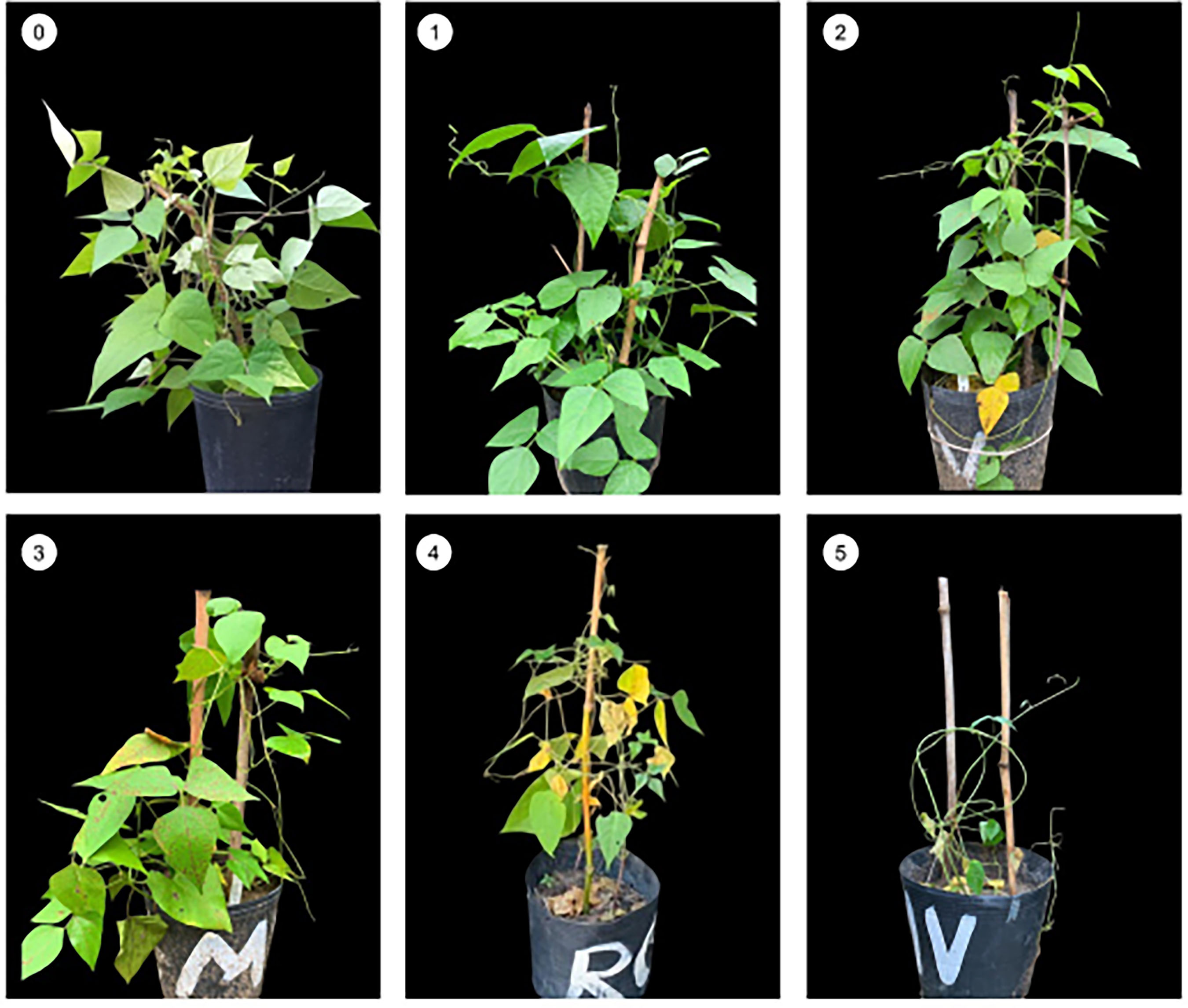
Anthracnose severity was assessed five and seven days after inoculation (DAI) (Fig. 1). Only these two periods were considered because some leaves from certain accessions detached completely from the plants after seven days. For severity assessment, ten trifoliate leaves were selected from the middle third of each plant, digitized, and analyzed using ASSESS 2.0 software, which calculated the percentage of leaf area affected. The mean scores assigned to each population were used to group them according to the classification criteria of Carmo et al. (2015):
Anthracnose severity in lima beans, according to the percentage of the plant affected: 0 = no symptoms; 1 = 1–10%; 2 = 11–25%; 3 = 26–50%; 4 = 51–75%; 5 = 76–100%.
-
Figure 1
-
Immune (IM), with a score of 0;
-
Highly resistant (HR), with scores ranging from 0.1 to 1.4;
-
Moderately resistant (MR), from 1.5 to 2.4;
-
Moderately susceptible (MS), from 2.5 to 3;
-
Highly susceptible (HS), with scores >3.
Plants that died due to the pathogen were classified as HS to infection.
Severity data were transformed using the square root transformation √(x+1) to meet the assumptions of normality and homoscedasticity. Analysis of variance was performed, followed by the Scott–Knott’s grouping test at a 5% significance level. All analyses were conducted using R software (R Core Team 2018) and Genes software (Cruz 2013).
Results and discussion
Agromorphological assessment
Deviance analysis (Table 3) indicated significant population effects for the following traits: pod width, pod length, pod thickness, number of locules per pod, number of seeds per pod, 100-seed weight, grain yield, seed width, seed length, seed thickness, days to flowering, days to pod formation, days to pod maturity, and days to anthracnose symptom appearance.
Deviance analysis for the evaluated traits in lima bean populations at the F5 generation<tfn>*</tfn>.
These results indicated the presence of genetic variability among the evaluated populations and confirmed that the proposed model fits the data. This variability is essential for the success of breeding programs, as it enables the selection of superior genotypes based on agronomically desirable traits (Assunção-Filho et al. 2022, Jesús Pires et al. 2022). For the traits days to flowering, pod formation, pod maturity, onset of anthracnose symptoms, seed length, and 100-seed weight, genetic variance (σ g²) exceeded residual variance ( σ e²) (Table 4).
The predominance of genetic variance over residual variance suggests that environmental influences on these traits were limited, supporting the conclusion that the differences observed among the populations are mainly attributed to their distinct genetic constitutions (Damas et al. 2023). This pattern indicates that genetic effects contributed substantially to the phenotypic variation observed under the tested conditions. This scenario is highly desirable in lima bean breeding programs, as it improves the selection efficiency and predictability of genetic gains.
Heritability expresses the proportion of genetic variance relative to the total phenotypic variance of a trait and is influenced by environmental effects on trait expression. In this study, estimated heritability coefficients (h2) ranged from 0.91 for the number of days to anthracnose symptom appearance to 0 for pod thickness. The number of days to flowering, pod formation, pod maturity, and onset of anthracnose symptoms revealed high heritability values (Table 4), indicating a predominance of genetic variance in determining these traits. These results suggested a high potential for the successful selection and advancement of superior lines.
Estimates of genetic parameters for the traits evaluated in lima bean populations in the F5 generation, via REML/BLUP methodology.
Traits such as pod width and length, seed width, length, and thickness, 100-seed weight, and grain yield exhibited intermediate heritability values (Table 4). Conversely, the number of locules per pod showed low heritability, while pod thickness and the number of seeds per pod displayed very low heritability estimates (Table 4).
The low heritability observed for some traits indicated a higher environmental influence on their expression, making it difficult to distinguish between genetic and environmental effects (Langat et al. 2019). In such cases, implementing additional selection cycles is recommended to accumulate genetic gains over successive generations. The genotypic coefficient of variation (CV g%) expresses the magnitude of genetic variance relative to the trait mean, indicating the potential for response to selection. High CV g values are desirable in breeding programs as they reflect greater genetic variability (Asfaw et al. 2017). In this study, the CV g values ranged from 1.71 for pod thickness to 20.21% for the number of days to the onset of anthracnose symptoms (Table 4).
The environmental coefficient of variation (CV e%) is widely used to assess the precision of agronomic experiments (Storck et al. 2010). Since there are no specific reference values for lima bean, the classification proposed by Gomes (2009) was adopted: low (CV e < 10%), medium (10% ≤ CV e < 20%), high (20% ≤ CV e < 30%), and very high (CV e > 30%).
In this study, the CV e values ranged from 3.15 for seed thickness to 48.59% for grain yield. CV e was considered high for 100-seed weight and grain yield, medium for the number of days to flowering and pod thickness (Table 4), and low for the remaining traits. These results indicated favorable experimental conditions for selection, except for traits that were more strongly influenced by environmental factors.
The high heritability estimates suggest a favorable outlook for selection success, further supported by the CV g/CV e ratios that were close to or higher than 1 for most traits. This ratio is commonly used as an indicator of the predominance of genetic over environmental variance in trait determination and reflects better conditions for selecting superior genotypes (Santos et al. 2022). All evaluated traits, except pod thickness, number of locules per pod, number of seeds per pod, and grain yield, had CV g/CV e ratios ≥ 1, indicating higher selective efficiency (Table 4).
In plant breeding programs, it is essential to adopt methodologies that enable accurate estimation of genotypic values, particularly for species with mixed reproductive systems such as lima beans. In this context, the REML/BLUP approach has proven effective in predicting additive genetic effects and guiding the selection of superior genotypes (Capistrano et al. 2021, Carvalho et al. 2022, Gonçalves Jr. et al. 2025).
Based on the individual genotypic values predicted by BLUP, the expected genetic gains were estimated, and new predicted means were obtained for each evaluated trait, considering additive effects only. These estimates enabled the ranking of populations according to their genetic performance (Table 5), providing objective support for selecting promising genotypes. For days to flowering, pod formation, pod maturity, and, days to anthracnose symptom appearance, population P6 exhibited the shortest developmental cycle, followed by P1 and P3 (Table 5).
Ranking, selection gains, and new averages for the traits evaluated in lima bean populations in the F5 generation, using SELEGEN model 81.
Earliness is a desirable trait, particularly in regions affected by climatic stress, limited water availability, and short cropping seasons. Under such conditions, early genotypes can avoid adverse environmental factors, increasing the likelihood of successful cultivation (Buratto et al. 2007). For lima beans, adopting early genotypes represents a sustainable and profitable strategy, enabling faster and more efficient harvests (Lustosa-Silva et al. 2023).
Moreover, earliness reduces the duration of plant exposure to the anthracnose pathogen. Thus, using early genotypes can serve as an effective control strategy aligning with the principle of disease escape, by avoiding pathogen contact during environmental conditions favorable for its development (Amorim et al. 2018).
Early genotypes tend to be less susceptible to pests and diseases and reduce production costs, making them promising candidates for breeding programs (De Melo et al. 2023). Populations P1, P2, and P5 demonstrated consistent performance for pod and seed traits. However, populations P3, P4, and P6 achieved the highest results for the number of locules and seeds per pod (Table 5). The highest grain yields were obtained with P3, P4, and P1.
Populations P1 and P2 predominantly exhibited white seed coats, an attribute highly valued by consumers (Soares et al. 2022). This color is considered the most desirable commercial standard, particularly in northeastern Brazil, where there is a preference for large, light-colored (particularly white) seeds (Lustosa-Silva et al. 2023). Market acceptance is directly influenced by this trait, making it a relevant criterion for breeding programs.
Traits related to pods, such as the number of locules and seeds per pod, correlate positively with grain yield and are essential for selecting superior genotypes. In addition to yield, improvements in these traits are desirable, as they facilitate manual harvesting, a practice still common in many production regions (Sousa et al. 2020). For example, pods with more seeds make the harvesting process more efficient and economically viable.
Seed coat color was also evaluated because of its commercial relevance. Seed colors strongly influence consumer preferences and, consequently, marketability. In this study, 64% of the progenies within the population exhibited white seed coats, followed by orange (16%), pink (7.3%), and reddish-purple (6.3%). The predominance of white seed coats reinforces the commercial suitability of the analyzed populations.
Regarding the seed coat pattern, 82.3% of the seeds exhibited a uniform color, whereas 17.7% displayed a bicolor pattern. The most frequent bicolor patterns were light brown (10.3%), reddish-purple (4.0%), and dark brown (3.4%.) Regarding secondary seed coat color, 83.6% of the populations lacked this trait, and among the 16.4% that had it, colors included dark red, reddish-purple, black, and dark brown. These data highlight the phenotypic diversity among the evaluated populations and underscore the importance of visual seed characterization as a complementary criterion for selecting genotypes with greater commercial appeal.
Phytopathological assessment
In the phytopathological evaluation of the F5 generation, 15 of the 16 selected lima bean progenies developed foliar vein lesions approximately 1 cm in size, three days after inoculation with the fungus. At five DAI, most progenies exhibited reddish lesions on the petioles and veins. The only exception was the progeny derived from the BGP-UFPI 832 parent, which exhibited less severe symptoms.
At five DAI, 15 progenies were classified as MR and only one as HR. Statistical analysis identified two distinct groups (Table 6): group A, consisting of all MR progenies, and group B, comprising only the HR progeny.
Rating scale for lima bean (F5 generation) populations inoculated with Colletotrichum truncatum, assessed at five and seven DAI<tfn>*</tfn>.
At seven DAI, symptom progression was observed in the leaves, although severe leaf abscission did not occur. Remarkably, progeny with BGP-UFPI 832 as the male parent continued to exhibit low symptom severity, suggesting a possible genetic resistance mechanism. At this stage, the overall classification of progenies remained stable: of the 15 initially classified as MR, only one was reclassified as MS.
These results suggested the presence of anthracnose resistance in some F5 progenies, particularly those with BGP-UFPI 832 as a parent, as indicated by the reduced progression of symptoms over time. The formation of two statistically distinct groups reflects the genetic variability among progenies in response to the pathogen, a feature highly desirable for breeding programs.
Furthermore, the consistency of classification between the five and seven DAI assessments demonstrates the reliability of the data, reinforcing the potential of both MR and HR progenies for future use in developing cultivars adapted and resistant to anthracnose.
Conclusion
Based on the analyses, significant phenotypic variability was observed among the F5-generation lima bean populations, demonstrating their potential for use in genetic improvement programs for this species. Population P6 was notable for its early developmental cycle, an agronomically desirable trait associated with disease escape such as anthracnose, and enhanced sustainability under adverse conditions.
Populations P2 and P4 excelled in seed size and white seed coat traits, features preferred by the consumer market, favoring acceptance and commercialization. Additionally, populations P4, P5, and P6 exhibited superior performance in pod and seed traits, as well as anthracnose resistance. Particularly interesting was the progeny derived from the BGP-UFPI 832 parent, which exhibited low symptom severity, suggesting the presence of favorable alleles for resistance to C. truncatum.
Thus, populations P4, P5, and P6 can be considered for ongoing breeding efforts, either through recurrent selection or the development of superior cultivars, as they combine desirable traits such as earliness, yield, commercial quality, and anthracnose resistance.
ACKNOWLEDGMENTS
Nothing to declare.
-
How to cite:
Torres, K. K. B., Brito, M. V., Sousa, J. V. M., França, G. B., Costa, M. F., Matos Filho, C. H. A., Silva, V. B., Lopes, A. C. A., Melo, M. P. and Gomes, R. L. F. (2026). Assessment of anthracnose resistance and agromorphological traits in fifth-generation lima bean populations. Bragantia, 85, e20250137. https://doi.org/10.1590/1678-4499.20250137
-
FUNDING
Coordenação de Aperfeiçoamento de Pessoal de Nível SuperiorFinance code 001Conselho Nacional de Desenvolvimento Científico e TecnológicoGrant No: 314207/2021-0
-
DECLARATION OF USE OF ARTIFICIAL INTELLIGENCE TOOLS
The authors declare that artificial intelligence tools (ChatGPT, OpenAI) were used exclusively to support language revision. All scientific content, analyses, interpretations, and conclusions presented in this manuscript are the sole responsibility of the authors.
DATA AVAILABILITY STATEMENT
The data from this study are available upon request from the corresponding author.
REFERENCES
-
Adebo, J. A. (2023). A review on the potential food application of lima beans (Phaseolus lunatus L.), an underutilized crop. Applied Sciences, 13, 1996. https://doi.org/10.3390/app13031996
» https://doi.org/10.3390/app13031996 -
Almeida, R. C., Carvalho, L. C. B., Alves-Pereira, A., Penha, J. S., Silva, V. B., Zucchi, M. I., Pinheiro, J. B., Martínez-Castillo, J., Lopes, A. C. A. and Gomes, R. L. F. (2025). Establishment and Molecular Validation of a Lima Bean (Phaseolus lunatus) Core Collection in Brazil. Plant Molecular Biology Reporter, 43, 286-294. https://doi.org/10.1007/s11105-024-01486-x
» https://doi.org/10.1007/s11105-024-01486-x - Amorim, L., Rezende, J. A. M. and Bergamin Filho, A. (2018). Manual de fitopatologia. 5th ed. Piracicaba: Agronômica Ceres.
-
Asfaw, A., Ambachew, D., Shah, T. and Blair, M. W. (2017). Trait associations in diversity panels of the two common bean (Phaseolus vulgaris L.) gene pools grown under well-watered and water-stress conditions. Frontiers in Plant Science, 8, 733. https://doi.org/10.3389/fpls.2017.00733
» https://doi.org/10.3389/fpls.2017.00733 -
Assunção-Filho, J. R. D., Costa, M. F., Pinheiro, J. B., Carvalho, L. C. B., Ferreira-Gomes, R. L. and Lopes, A. C. D. A. (2022). Selection of superior genotypes of lima bean landraces by multivariate approach. Revista Caatinga, 35, 87-95. https://doi.org/10.1590/1983-21252022v35n109rc
» https://doi.org/10.1590/1983-21252022v35n109rc - Bastos, E. A. and Andrade Júnior, A. S. (2024). Boletim agrometeorológico de 2023 do município de Teresina. Teresina: Embrapa Meio-Norte. Documentos 297.
-
Brito, M. V., Diniz, Y. B., Brito, K. A. D. S., Matos Filho, C. H., Silva, V. B. D., Lopes, A. C. A., Melo, M. P. and Ferreira-Gomes, R. L. (2025). Anthracnose severity in F2 lima bean progenies obtained by hybridization without emasculation. Revista Caatinga, 38, e12707. https://doi.org/10.1590/1983-21252025v3812707rc
» https://doi.org/10.1590/1983-21252025v3812707rc -
Brito, M. V., Lopes, A. C. A., Gomes, R. L. F., Melo, M. P. D., Silva, V. B. D. and Matos Filho, C. H. A. (2022). Associação entre resistência de Phaseolus lunatus a Colletotrichum truncatum e caracteres morfoagronômicos. Summa Phytopathologica, 48, 69-77. https://doi.org/10.1590/0100-5405/206544
» https://doi.org/10.1590/0100-5405/206544 -
Brito, M. V., Torres, K. K. B., Sousa, J. V. M., França, G. B., Costa, M. F., Costa, G. A. L., Ferreira, G. N. C., Silva, V. B., Sá, G. H., Melo, M. P. and Gomes, R. L. F. (2025). Inheritance of genetic resistance to anthracnose in lima beans: analysis and implications for breeding. Journal of Phytopathology, 173, e70036. https://doi.org/10.1111/jph.70036
» https://doi.org/10.1111/jph.70036 -
Buratto, J. S., Moda-Cirino, V., Fonseca Júnior, N. D. S., Prete, C. E. C. and Faria, R. T. (2007). Adaptabilidade e estabilidade produtiva em genótipos precoces de feijão no estado do Paraná. Semina: Ciências Agrárias, 28, 373-380. https://doi.org/10.5433/1679-0359.2007v28n3p373
» https://doi.org/10.5433/1679-0359.2007v28n3p373 -
Capistrano, M. D. C., Andrade Neto, R. D. C., Santos, V. B. D., Lessa, L. S., Resende, M. D. V. D., Mesquita, A. G. G. and Gurgel, F. D. L. (2021). Use of the REML/BLUP methodology for the selection of sweet orange genotypes. Pesquisa Agropecuária Brasileira, 56, e02032. https://doi.org/10.1590/S1678-3921.pab2021.v56.02032
» https://doi.org/10.1590/S1678-3921.pab2021.v56.02032 -
Carmo, M. D. S., Carvalho, E. M. S., Gomes, R. L. F., Lopes, A. C. A. and Cavalcante, G. R. S. (2015). Avaliação de acessos de feijão-fava para resistência a Colletotrichum truncatum, em condições de folhas destacadas e campo. Summa Phytopathologica, 41, 292-297. https://doi.org/10.1590/0100-5405/2079
» https://doi.org/10.1590/0100-5405/2079 - Carvalho, E. M. S., Beserra Jr., J. E. A. and Barguil, B. M. (2015). Lima bean diseases. In A. S. A. Ferreira, A. C. A. Lopes and R. L. F. Gomes (Eds.). Phaseolus lunatus: diversity, growth and production (p. 113-133). New York: Nova Science Publishers.
-
Carvalho, J. L. R. D., Vieira, M. D. F. B., Albuquerque, T. M. D., Costa, G. A. L. D., Gomes, R. L. F. and Lopes, A. C. A. (2022). Lima bean populations assessments via REML/BLUP methodology. Revista Caatinga, 35, 783-790. https://doi.org/10.1590/1983-21252022v35n405rc
» https://doi.org/10.1590/1983-21252022v35n405rc -
Cavalcante, G. R. S., Vieira, W. A. S., Michereff, S. J., Barguil, B. M., Doyle, V. P. and Câmara, M. P. S. (2018). First report of anthracnose caused by Colletotrichum sichuanensis on Phaseolus lunatus in Brazil. Plant Disease, 102, 680-680. https://doi.org/10.1094/PDIS-07-17-0963-PDN
» https://doi.org/10.1094/PDIS-07-17-0963-PDN -
Cruz, C. D. (2013). Genes: a software package for analysis in experimental statistics and quantitative genetics. Acta Scientiarum. Agronomy, 35, 271-276. https://doi.org/10.4025/actasciagron.v35i3.21251
» https://doi.org/10.4025/actasciagron.v35i3.21251 -
Damas, L. R., Barroso, P. A., Assunção, W. V. D., Lopes, A. C. D. A., Silva, J. V. D., Gomes, R. L. and Medeiros, A. M. (2023). Selection of lima bean accessions for fresh and dry production. Revista Brasileira de Engenharia Agrícola e Ambiental, 27, 625-631. https://doi.org/10.1590/1807-1929/agriambi.v27n8p625-631
» https://doi.org/10.1590/1807-1929/agriambi.v27n8p625-631 -
De Melo, L. F., Silva, S. C. C. C., Nascimento Costa, G., Silva, V. B., Pinheiro, J. B., Zucchi, M. I., Costa, M. F., Gomes, R. L. F. and Lopes, A. C. A. (2023). Assessment of genetic diversity in Phaseolus lunatus landrace germplasm for use in breeding programs. Plant Molecular Biology Reporter, 41, 292-303. https://doi.org/10.1007/s11105-022-01367-1
» https://doi.org/10.1007/s11105-022-01367-1 - Gomes, F. P. (2009). Curso de estatística experimental. 15. ed. Piracicaba: ESALQ.
-
Gomes, R. S. S., Martins, J. V. S., Silva, E. C., Silva, H. A. O. and Nascimento, L. C. (2022). Reactions of lima bean (Phaseolus lunatus L.) accessions to Colletotrichum truncatum Revista Caatinga, 35, 809-817. https://doi.org/10.1590/1983-21252022v35n408rc
» https://doi.org/10.1590/1983-21252022v35n408rc -
Gomes, S. S. R., Nunes, M. C., Silva, E. C., Silva Martins, J. V. and Nascimento, L. C. (2023). Epidemiological aspects of lima beans anthracnose in different varieties. European Journal of Plant Pathology, 165, 701-713. https://doi.org/10.1007/s10658-022-02630-7
» https://doi.org/10.1007/s10658-022-02630-7 -
Gonçalves Jr., D. H., Pereira Jr., J. D., Oliveira, L. M. C., Nunes, N. X., Bender, L., Souza Carneiro, J. E., Dias, K. O. G. and Carneiro, P. C. S. (2025). Application of linear mixed models to overcome challenges of unbalanced data in common bean breeding. Agronomy Journal, 117, e70042. https://doi.org/10.1002/agj2.70042
» https://doi.org/10.1002/agj2.70042 - [IPGRI] International Plant Genetic Resources Institute (2001). Descritores para Phaseolus lunatus IPGRI.
-
Jesús Pires, C., Costa, M. F., Zucchi, M. I., Ferreira-Gomes, R. L., Pinheiro, J. B., Viana, J. P. G., Bajay, M. M., Assunção-Filho, J. R. and Lopes, A. C. A. (2022). Genetic diversity in accessions of lima bean (Phaseolus lunatus L.) determined from agro-morphological descriptors and SSR markers for use in breeding programs in Brazil. Genetic Resources and Crop Evolution, 69, 973-986. https://doi.org/10.1007/s10722-021-01272-8
» https://doi.org/10.1007/s10722-021-01272-8 -
Langat, C., Ombori, O., Leley, P., Karanja, D., Cheruiyot, R., Gathaara, M. and Masila, B. (2019). Genetic variability of agronomic traits as potential indicators of drought tolerance in common beans (Phaseolus vulgaris L.). International Journal of Agronomy, 2019, 2360848. https://doi.org/10.1155/2019/2360848
» https://doi.org/10.1155/2019/2360848 - Lopes, A. C. A., Gomes, R. L. F. and Araújo, A. S. F. (2010). A cultura do feijão-fava no meio norte do Brasil. Teresina: EDUFPI.
-
Lustosa-Silva, J. D., Ferreira-Gomes, R. L., Martínez-Castillo, J., Carvalho, L. C. B., Oliveira, L. F., Ortiz-García, M. M., Sánchez-Sosa, A. G., Silva, G. R., Costa, M. F., Silva, V. B. and Lopes, A. C. A. (2022). Genetic diversity and erosion in lima bean (Phaseolus lunatus L.) in northeast Brazil. Genetic Resources and Crop Evolution, 69, 2819-2832. https://doi.org/10.1007/s10722-022-01402-w
» https://doi.org/10.1007/s10722-022-01402-w -
Lustosa-Silva, J. D., Oliveira, E. G., Costa Soares, L. A., Ferreira-Gomes, R. L., Costa, A. F., Barros, R. F. M., Almeida, R. C., Silva, V. B., Costa, M. F. and Lopes, A. C. A. (2023). Traditional varieties of lima beans (Phaseolus lunatus L.) in northeastern Brazilian farms: conservation and sustainability. Genetic Resources and Crop Evolution, 70, 2021-2032. https://doi.org/10.1007/s10722-023-01553-4
» https://doi.org/10.1007/s10722-023-01553-4 -
Martínez-Castillo, J., Araujo, A. S., Chacón-Sánchez, M. I., Santos, L. G., Lopes, A. C. A., Gibson, K., Gomes, R. L. F., Andueza-Noh, R. H., Bitochi, E., Ballina-Gomez, H. S., Peralta, E., Ormeno-Orrillo, E., Espinoza, L., Nieto, C., Murillo, A., Jadan-Verinas, E., García, T., Duitama, J., Aguirre-Liguori, J. A., Leon-Cadena, A., Castaneda-Alvarez, N. and Debouck, D. G. (2023). International lima bean network: from the origin of the species to modern plant breeding. Genetic Resources and Crop Evolution, 70, 1575-1583. https://doi.org/10.1007/s10722-023-01603-x
» https://doi.org/10.1007/s10722-023-01603-x -
Martínez-Nieto, M. I., Estrelles, E., Prieto-Mossi, J., Roselló, J. and Soriano, P. (2020). Resilience capacity assessment of the traditional lima bean (Phaseolus lunatus L.) landraces facing climate change. Agronomy, 10, 758. https://doi.org/10.3390/agronomy10060758
» https://doi.org/10.3390/agronomy10060758 -
Penha, J. S., Lopes, A. C. A., Gomes, R. L. F., Pinheiro, J. B., Assunção-Filho, J. R., Silvestres, E. A., Viana, J. P. G. and Castilho-Martinez, J. (2017). Estimation of natural outcrossing rate and genetic diversity in lima bean (Phaseolus lunatus L. var. lunatus) from Brazil using SSR markers: implications for conservation and breeding. Genetic Resources and Crop Evolution, 64, 1355-1364. https://doi.org/10.1007/s10722-016-0441-9
» https://doi.org/10.1007/s10722-016-0441-9 - R Core Team (2018). R: a language and environment for statistical computing. Vienna: R Foundation for Statistical Computing.
-
Resende, M. D. V. (2016). Software Selegen-REML/BLUP: a useful tool for plant breeding. Crop Breeding and Applied Biotechnology, 16, 330-339. https://doi.org/10.1590/1984-70332016v16n4a49
» https://doi.org/10.1590/1984-70332016v16n4a49 - Resende, M. D. V. and Duarte, J. B. (2007). Precisão e controle de qualidade em experimentos de avaliação de cultivares. Pesquisa Agropecuária Tropical, 37, 182-194.
-
Santos, G. G. D., Ribeiro, N. D., Maziero, S. M. and Santos, G. G. D. (2022). Genetic diversity among bean landraces and cultivars for agronomy traits and selection of superior parents. Revista Ciência Agronômica, 53, e20217873. https://doi.org/10.5935/1806-6690.20220031
» https://doi.org/10.5935/1806-6690.20220031 -
Soares, L. A. C., Lustosa da Silva, J. D., Brito da Silva, V., Silva Ferreira, C., Batista de Sousa, A. M. C., Costa, M. F., Lopes, A. C. A. and Ferreira-Gomes, R. L. (2022). On-farm conservation in Phaseolus lunatus L.: an alternative for agricultural biodiversity. Agroecology and Sustainable Food Systems, 46, 392-409. https://doi.org/10.1080/21683565.2021.2016545
» https://doi.org/10.1080/21683565.2021.2016545 -
Soares, V. F., Pereira, G. S., Oliveira Marques, A. and Leal Junior, G. A. (2025). Phaseolus lunatus landraces from northeast Brazil: genetic diversity and anthracnose resistance. Genetic Resources and Crop Evolution, 72, 2287-2306. https://doi.org/10.1007/s10722-024-02098-w
» https://doi.org/10.1007/s10722-024-02098-w -
Sousa, A. M. C. B., Silva, V. B., Lopes, A. C. A., Gomes, R. L. F. and Carvalho, L. C. B. (2020). Prediction of grain yield, adaptability, and stability in landrace varieties of lima bean (Phaseolus lunatus L.). Crop Breeding and Applied Biotechnology, 20, e295120115. https://doi.org/10.1590/1984-70332020v20n1a15
» https://doi.org/10.1590/1984-70332020v20n1a15 -
Sousa, A. M. C. B., Silva, V. B., Silvestre, E. A., Silva, R. N. O., Lopes, A. C. A. and Gomes, R. L. F. (2022). Artificial hybridization without emasculation in lima bean (Phaseolus lunatus L.). Revista Caatinga, 35, 223-230. https://doi.org/10.1590/1983-21252022v35n123rc
» https://doi.org/10.1590/1983-21252022v35n123rc -
Sousa, G. G., Viana, T. V. A., Sales, J. R. S., Freire, M. H. D. C. and Simplício, A. A. F. (2023). Influence of intercropping and monocropping systems on fava bean cultivation under saline stress. Pesquisa Agropecuária Tropical, 53, e76910. https://doi.org/10.1590/1983-40632023v5376910
» https://doi.org/10.1590/1983-40632023v5376910 -
Storck, L., Cargnelutti Filho, A., Lúcio, A. D. C., Missio, E. L. and Rubin, S. A. L. (2010). Avaliação da precisão experimental em ensaios de competição de cultivares de soja. Ciência e Agrotecnologia, 34, 572-578. https://doi.org/10.1590/S1413-70542010000300007
» https://doi.org/10.1590/S1413-70542010000300007
Edited by
-
Section Editor:
Fabrício de Ávila Rodrigues https://orcid.org/0000-0002-3091-0000