 Factors associated with pain medication use and physiotherapy consultation among older adults with chronic spinal conditions: results from ELSI-Brazil
ABSTRACT
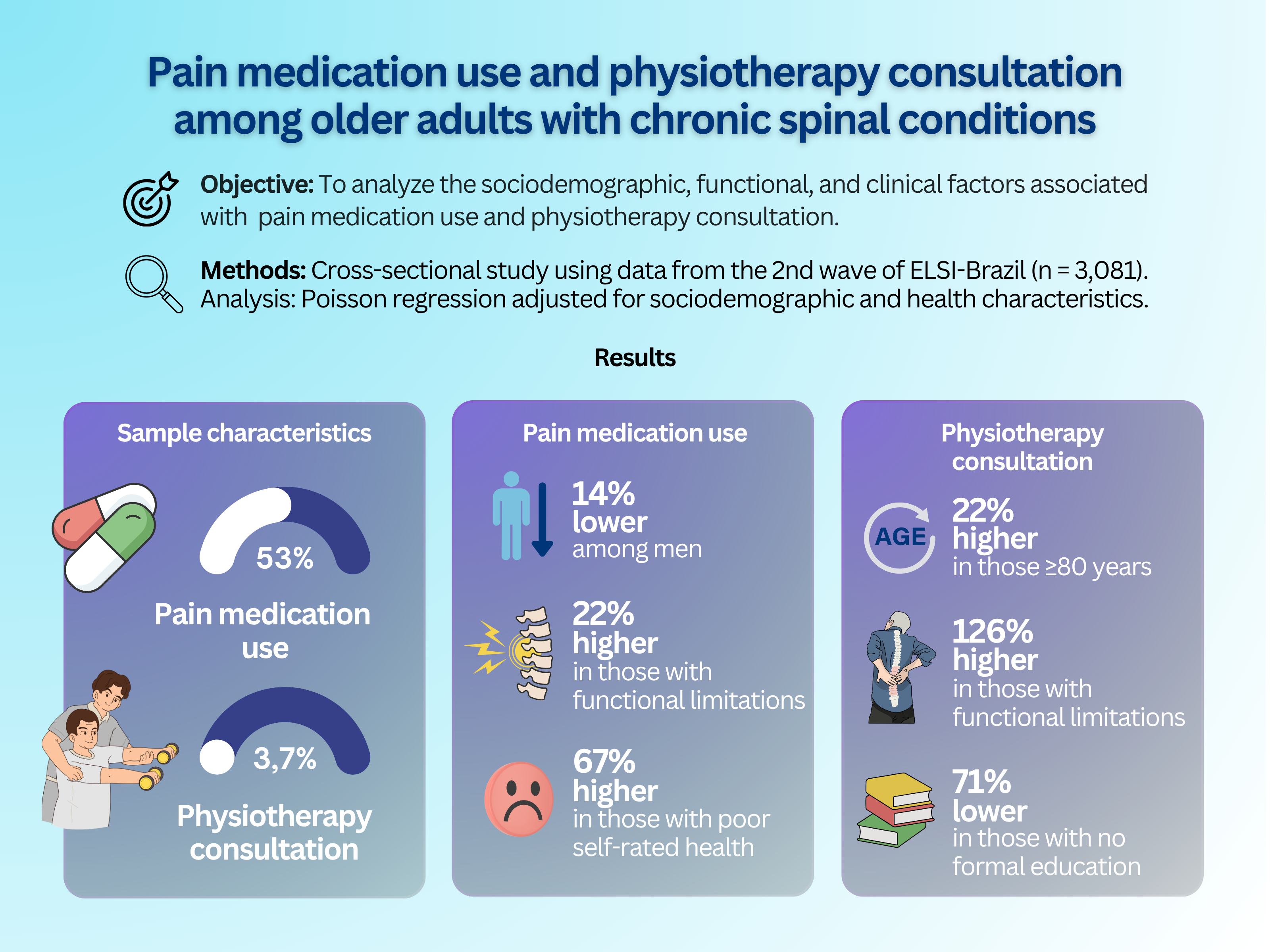
BACKGROUND AND OBJECTIVES Chronic spinal conditions are highly prevalent among older adults and are associated with persistent pain, functional limitations, and health care utilization. This study aimed to analyze sociodemographic, functional, and clinical factors associated with pain medication use and physiotherapy consultation among older adults with chronic spinal conditions in Brazil.
METHODS Cross-sectional study including 3,081 individuals (≥50 years) from the second wave of ELSI-Brazil who reported a chronic spinal condition. Outcomes were pain medication use and physiotherapy consultation in the previous three months. Poisson regression with robust variance was used, adjusted for sociodemographic and health characteristics.
RESULTS Pain medication use occurred in 53.00% (95%CI: 48.64–57.31) and physiotherapy consultation in 3.70% (95%CI: 3.03–4.52). Pain medication use was lower among men (PR = 0.86; 95%CI: 0.79–0.94) and higher in the presence of functional limitations (PR = 1.22; 95%CI: 1.10–1.35), fair self-perceived health (PR = 1.41; 95%CI: 1.20–1.65), and poor self-perceived health (PR = 1.66; 95%CI: 1.42–1.95). Physiotherapy consultation was associated with age ≥80 years (PR = 2.12; 95%CI: 1.10–4.08), functional limitations (PR = 2.27; 95%CI: 1.30–3.95), and no formal education (PR = 0.28; 95%CI: 0.10–0.79).
CONCLUSION Findings suggest the influence of health needs on pain medication use and potential inequalities in access to physiotherapy consultation, indicating the importance of care strategies aimed at improving equity in health care.
Keywords:
Aged; Chronic pain; Cross-sectional studies; Drug therapy; Physical therapy services
HIGHLIGHTS
Pain medication use was frequent, whereas physiotherapy consultations were uncommon among older adults with chronic spinal conditions.
Pain medication use was less prevalent among men and more prevalent among individuals with functional limitations and poorer self-perceived health.
Physiotherapy consultations were more frequent among older adults with functional limitations and less frequent among those with lower educational levels.
RESUMO
JUSTIFICATIVA E OBJETIVOS Problemas crônicos de coluna são altamente prevalentes entre adultos mais velhos e associados à dor persistente, limitações funcionais e cuidados em saúde. O objetivo deste estudo foi analisar os fatores sociodemográficos, funcionais e clínicos associados ao uso de fármacos para dor e a realização de consulta fisioterapêutica em adultos mais velhos com problema crônico de coluna no Brasil.
MÉTODOS Estudo transversal com 3.081 indivíduos (≥50 anos) da segunda onda do ELSI-Brasil que autorrelataram problema crônico de coluna. Os desfechos foram o uso de fármacos para dor e a realização de consulta fisioterapêutica (últimos três meses). Utilizou-se regressão de Poisson ajustada por características sociodemográficas e de saúde.
RESULTADOS O uso de fármacos para dor ocorreu em 53,00% (IC95%:48,64-57,31), e a consulta fisioterapêutica em 3,70% (IC95%:3,03-4,52). O uso de fármacos para dor foi menor entre homens (RP=0,86; IC95%:0,79-0,94) e maior na presença de limitação funcional (RP=1,22; IC95%:1,10-1,35), autopercepção de saúde regular (RP=1,41; IC95%:1,20-1,65) e ruim (RP=1,66; IC95%:1,42-1,95). A consulta fisioterapêutica foi associada à idade, ≥80 anos (RP=2,12; IC95%:1,10-4,08), limitação funcional (RP=2,27; IC95%:1,30-3,95) e ausência de escolaridade formal (RP=0,28; IC95%:0,10-0,79).
CONCLUSÃO Os achados sugerem influência de necessidades em saúde no uso de fármacos para dor e possíveis desigualdades no acesso à consulta fisioterapêutica, indicando a importância de estratégias assistenciais que ampliem a equidade no cuidado.
Descritores:
Dor crônica; Estudos transversais; Idoso; Serviços de Fisioterapia; Tratamento farmacológico
INTRODUCTION
Chronic spinal conditions affect a significant portion of the adult and older adult population and are associated with functional limitations, reduced quality of life, and increased demand for health care1. Among its main clinical manifestations, persistent pain is particularly prominent, frequently affecting the low back, neck, or chest, and it can last for months or years and compromise individuals’ autonomy2,3.
In this context, pain plays a central role in the experience of individuals with chronic spinal conditions. According to the International Association for the Study of Pain (IASP), pain is an unpleasant sensory and emotional experience associated with, or resembling that associated with, actual or potential tissue damage4. It is influenced at multiple levels by biological, psychological, and social factors and may also affect functionality, social well-being, and psychological well-being4.
When pain persists beyond the expected period of complete recovery from an injury, even after the healing process has been completed, it is classified as chronic pain (CP), generally defined as lasting longer than 3 months5. In these cases, it ceases to be merely a symptom and becomes an independent clinical condition, characterized by central sensitization and alterations in pain modulation6,7. Based on the fear-avoidance model, fear of pain and avoidance behaviors can contribute to chronicity by perpetuating protective responses even in the absence of actual threats, thereby exacerbating the pain condition8.
CP is among the most prevalent conditions worldwide, and it is expected that, with the aging of the population, its social and economic impact will increase significantly9. According to the Global Burden of Disease Study, low back pain is the leading cause of years lived with disability worldwide, while neck pain has a high global burden, affecting approximately 203 million people in 202010,11.
Given the complexity of the condition, therapeutic management must be comprehensive and individualized, focusing on symptom relief, improved functionality, and quality of life1. Interventions are often multimodal, combining pharmacological and non-pharmacological strategies12. Pharmacological treatment includes the use of drugs such as analgesics, anti-inflammatories, and, in some cases, opioids, and can provide symptomatic relief, although it is associated with potential adverse effects, especially if used long-term12. In addition, physiotherapy consultations are an important component of non-pharmacological care for muscle strengthening, improved mobility, maintenance of functionality, as well as pain reduction through techniques tailored to the patient’s individual needs13.
Although international guidelines, such as those from the American College of Physicians and the World Health Organization, recommend comprehensive therapeutic approaches to care that may include the rational use of drugs14,15, pharmacological treatment is often seen in clinical practice as one of the primary methods for managing chronic spinal conditions1. Beyond clinical recommendations, this pattern of care may reflect the need for symptomatic relief in the face of persistent pain, as well as factors related to individual, social, and healthcare system characteristics.
Despite the relevance of chronic back pain, population-based studies addressing the use of care strategies for this condition in daily life remain scarce. Most available evidence focuses on the prevalence of pain or the clinical effectiveness of interventions, while analyses of service use and of pharmacological treatment are typically limited to local contexts or specific samples. To inform public policies and care strategies better suited to the older adult population, it is essential to understand how sociodemographic, clinical, functional, and health care context characteristics relate to the management of chronic back pain.
To address this gap, the present study conducted a cross-sectional analysis using nationally representative data. The objective was to analyze the sociodemographic, functional, and clinical factors associated with pain medication use and physiotherapy consultations among older adults with chronic spinal conditions in Brazil.
METHODS
This population-based cross-sectional study used data from the second wave of the Brazilian Longitudinal Study of Aging – ELSI-Brazil (ELSI-Brasil - Estudo Longitudinal da Saúde dos Idosos Brasileiros), conducted between 2019 and 2021. The sample consisted of 3,081 individuals aged 50 years or older living in 70 municipalities and was nationally representative of the five geographic regions of Brazil (North, Northeast, Central-West, Southeast, and South). Sampling was multistage cluster probability sampling, with the municipality as the primary unit, followed by census tract and household. The complete methodological description is available elsewhere16. ELSI-Brasil was approved by the Research Ethics Committee of the René Rachou Institute, Oswaldo Cruz Foundation, Minas Gerais (CAAE 34649814.3.0000.5091). Participants provided written informed consent. This study was conducted in accordance with Resolution No. 466/2012 of the National Health Council of the Brazilian Ministry of Health and the principles of the Declaration of Helsinki (1964). The sample consisted of individuals who self-reported having received a medical diagnosis of a chronic spinal condition, based on the question: “Has a doctor ever told you that you have a chronic spinal condition, such as back pain, neck pain, low back pain, sciatica, or problems with your vertebrae or discs?”.
The outcome variables were pain medication use and physiotherapy consultations, which were analysed separately. Pain medication use was assessed by self-report based on an affirmative response to at least one of two questions regarding the previous three months: (1) use of over-the-counter drugs, such as acetaminophen (Tylenol without codeine), aspirin, dipyrone, or similar; and (2) use of prescription drugs, including analgesics containing codeine or morphine (Fiorinal, Tylex, Duramorf, Demerol, Durogesic, OxyContin, Percodan, Dimorf, Tramadol, Codex) or other opioid analgesics. Physiotherapy consultations were assessed by self-report through the following question: “Have you had any consultation/treatment with a physiotherapist in the past 90 days?”. It should be noted that the variable measured the occurrence of physiotherapy for any reason, without restriction to back pain. Both outcome variables were dichotomized (yes/no) for the analyses, with the categories “not applicable” and “don’t know/did not answer” excluded.
The independent variables were selected based on the literature and theoretical plausibility, including sociodemographic characteristics: gender, age group in 10-year categories (50-59, 60-69, 70-79, and ≥80 years), self-reported skin color (white/non-white), and educational level (no formal education, 1-4, 5-8, 9-11, and ≥12 years); and health characteristics: physical activity level assessed by the short version of the International Physical Activity Questionnaire17, presence of functional limitations in Basic Activities of Daily Living (BADLs)18, comorbidities, and self-perceived health.
For the analysis, a complete-case approach was adopted, excluding individuals with missing data for the outcome or independent variables included in the models. Physical activity level was classified according to the recommendations of the World Health Organization19. Participants who accumulated between 150-300 minutes per week of moderate-intensity physical activity, 75-150 minutes of vigorous-intensity activity, or an equivalent combination were considered sufficiently active; all others were classified as insufficiently active. Comorbidities were assessed according to previous reference study20, based on the number of self-reported morbidities identified through prior medical diagnosis. The presence of a chronic spinal condition was not included in the count, as it constituted an inclusion criterion for the study population. For the analysis, the number of comorbidities was categorized as none, one to two, and three or more. Self-perceived health, originally collected by the questionnaire in six categories, was grouped into three: good (excellent/very good/good), regular, and poor (poor/very poor). Functional limitations were classified as present when difficulty was reported in at least one BADL.
Statistical analysis
The statistical analyses accounted for the complex sampling design of ELSI-Brazil by applying the sample weights provided by the database and using the svy command set to obtain population-representative estimates adjusted for the design effect. Initially, a descriptive analysis was performed by calculating relative frequencies and their respective 95% confidence intervals (95% CI). Next, bivariate analyses were conducted between the outcomes and the independent variables using Pearson’s chi-square test. Finally, Poisson regression with robust variance was applied to estimate prevalence ratios (PR) and 95% CI, in crude models and adjusted models for sociodemographic and health variables. All independent variables were included simultaneously in the adjusted models, based on theoretical plausibility and prior evidence. Analyses were performed using the Stata SE 14 software, with a significance level of 5%.
The manuscript was prepared in accordance with the Strengthening the Reporting of Observational Studies in Epidemiology (STROBE) Statement.
RESULTS
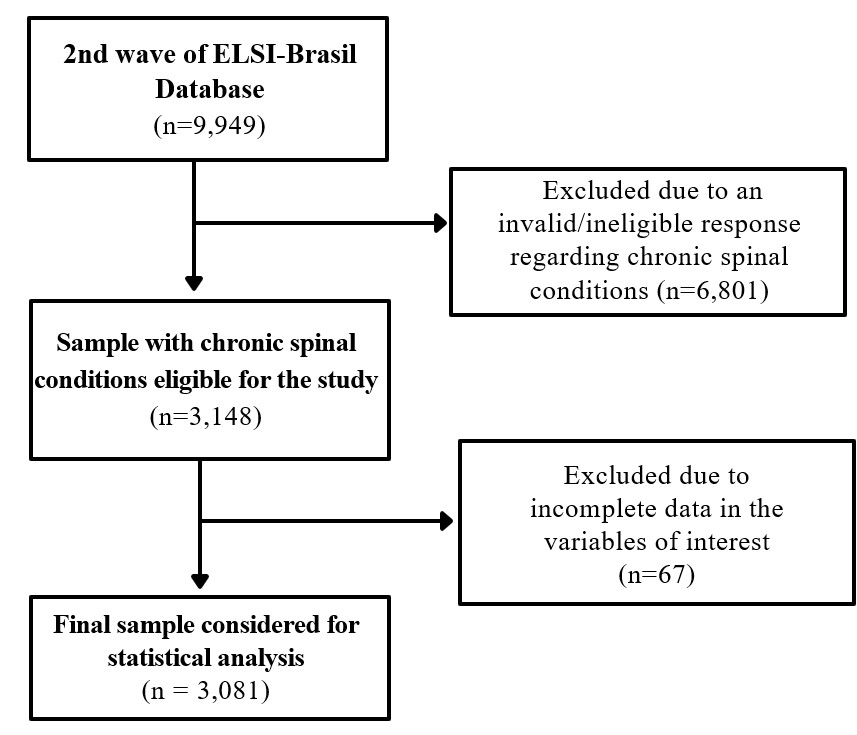
In the total ELSI-Brazil sample, the prevalence of chronic spinal conditions was 32.68% (95% CI: 28.74–36.89). The sample selection process, presented in Figure 1, resulted in 3,081 individuals with complete data for the analyses. The sociodemographic and health characteristics of the study population are described in Table 1.
Regarding the sample profile, the majority were female (60.32%; 95% CI: 57.13–63.42) and were in the 50-59 age group (44.84%; 95% CI: 40.88–48.86). Regarding skin color, self-identified non-white participants were predominant (56.10%; 95% CI: 49.03–62.94). As for educational level, the majority had between 1 and 4 years (43.01%; 95% CI: 39.89–46.19).
Regarding health status, most participants were classified as insufficiently active (73.52%; 95% CI: 66.32–79.65), and 44.49% (95% CI: 41.44–47.57) rated their health as regular. It was also observed that 15.22% (95% CI: 12.16–18.89) had functional limitations in BADLs and 46.18% (95% CI: 42.58–49.82) reported three or more comorbidities. Regarding health care, only 3.70% (95% CI: 3.03–4.52) had attended a physiotherapy consultation in the past 90 days, while 53.00% (95% CI: 48.64–57.31) reported pain medication use during the same period.
Table 2 describes the factors associated with pain medication use. In the bivariate analysis, a higher prevalence of the outcome was observed among women (p<0.001), individuals aged 50 to 59 years (p=0.020), and those who had attended a physiotherapy consultation in the past 90 days (p=0.003). Additionally, the pain medication use was significantly higher among participants with functional limitations in BADLs (p<0.001), with three or more comorbidities (p<0.001), and poor self-perception of health (p<0.001). No significant associations were observed with skin color, educational level, and physical activity level in the bivariate analysis.
Factors associated with pain medication use among individuals with chronic spinal conditions (n=3,081).
In the adjusted analysis, pain medication use remained associated with sociodemographic and health factors. The prevalence of the outcome was lower among men compared to women (PR: 0.86; 95% CI: 0.79–0.94) and decreased progressively with increasing age, being significantly lower in the 60-69 years (PR: 0.86; 95% CI: 0.79–0.93), 70-79 years (PR: 0.77; 95% CI: 0.71 - 0.84), and 80 years or older (PR: 0.71; 95% CI: 0.60–0.85), compared with those aged 50-59 years.
As for the health status and service utilization, attending a physiotherapy consultation (PR: 1.20; 95% CI: 1.01–1.41) and functional limitations in BADLs (PR: 1.22; 95% CI: 1.10–1.35) remained associated with a higher prevalence of pain medication use. An association was also observed with self-perceived health, with a higher prevalence of the outcome among those who rated their health as regular (PR: 1.41; 95% CI: 1.20–1.65) and poor (PR: 1.66; 95% CI: 1.42–1.95), compared to those who reported good health. The presence of three or more comorbidities showed a positive association (PR: 1.18; 95% CI: 1.00–1.39), compared to those who reported no comorbidities. Variables such as skin color, educational level and physical activity level were not significantly associated with the outcome after adjustment.
Table 3 presents the factors associated with physiotherapy consultations in the past 90 days, highlighting determinants that differ from those observed in the previous outcome. In the bivariate analysis, a higher prevalence of physiotherapy consultations was observed among individuals who used pain drugs (p=0.003), had functional limitations in BADLs (p<0.001), and reported poor self-perceived health (p=0.045). No significant associations were observed between gender, age group, skin color, educational level, physical activity level or comorbidities in the bivariate analysis.
Factors associated with physiotherapy consultations among individuals with chronic spinal conditions (n=3,081).
In the adjusted multivariable analysis, the prevalence of the outcome was significantly higher among adults aged 80 years or older (PR: 2.12; 95% CI: 1.10–4.08) compared with those aged 50-59 years. Educational level was significantly associated with physiotherapy consultations, with lower prevalence among individuals with no formal education (PR: 0.28; 95% CI: 0.10–0.79) and 1 to 4 years of education (PR: 0.44; 95% CI: 0.20–0.98), when compared to the group with 12 or more years of education.
Regarding health conditions, functional limitations in BADLs remained associated with a higher prevalence of physiotherapy consultations (PR: 2.27; 95% CI: 1.30–3.95). Pain medication use showed a trend toward a positive association (PR: 1.69; 95% CI: 0.97–2.95; p = 0.062), although it did not reach statistical significance in the final model. Variables such as gender, skin color, physical activity level, number of comorbidities, and self-perceived health were not associated with the outcome after adjustment.
DISCUSSION
The findings revealed a significant prevalence of pain medication use among older adults with chronic spinal conditions in Brazil, a practice that is common and strongly associated with markers of greater health vulnerability. Higher use among women, individuals with functional limitations, and those with poorer self-perceived health suggests that pharmacological treatment is related to contexts of greater clinical and functional complexity, reflecting the search for symptomatic relief in the face of persistent pain and the limitations imposed by the chronic condition. At the same time, the use of physiotherapy consultations, although also motivated by functional needs, presents a different profile of users, characterized by higher prevalence among older adults and a significant reduction among individuals with lower educational levels.
The high prevalence of pharmacological treatment observed in this population is not unique to Brazil and has been widely described in the literature. People with CP tend to rely primarily on drugs as a strategy for symptom relief, which underscores that pharmacotherapy remains one of the main clinical management approaches for this condition21. Longitudinal data confirm this trend: between 2012 and 2022, there was an increase in the prescription of nonsteroidal anti-inflammatory drugs, acetaminophen, opioids, neuropathic agents, and muscle relaxants for CP22. The predominance of the pharmacological approach in the management of spinal CP suggests the persistence of a traditional biomedical model, centered on symptom relief, to the detriment of more comprehensive and integrative approaches23.
This reality is reflected in the prevalence of self-medication, identified as the primary strategy for managing pain compared to other therapeutic modalities in a reference study24. In Brazil, this trend is corroborated by data from the National Health Survey (PNS - Pesquisa Nacional de Saúde), which highlight the rise in pharmacotherapy, with an increase in the use of drugs for spinal pain from 31.6% in 20131 to 45.3% in 201925. Although pharmacotherapy offers greater accessibility and immediate application, its prolonged use, especially among older adults, can result in adverse events and increased long-term costs12, drug interactions, functional decline, poorer quality of life, and the presence of depression and dementia26. These risks are exacerbated by the polypharmacy characteristic of this population, a factor that should not be overlooked in this context.
The central role of pharmacological treatment is reinforced by barriers that limit adherence to long-term non-pharmacological therapies. On the one hand, professional skepticism regarding the efficacy of these interventions results in reduced encouragement and low clinical prescription rates27. On the other hand, obstacles such as the time commitment required and the fear of worsening pain contrast with the convenience of immediate pharmacotherapy27. To overcome this logic, the biopsychosocial model proposes a multifactorial comprehension of chronic pain, integrating biological, psychological, and social aspects into clinical management28. This paradigm shift favors the use of combined strategies, aiming to reduce exclusive reliance on drugs and their associated risks27. In this regard, professional support and a foundation in scientific evidence emerge as essential facilitators for adherence to non-pharmacological therapies27.
However, access to these modalities remains limited for part of the population, whether due to gaps in health care coverage, higher costs, or structural inequalities in the healthcare system28,29. This gap in care is reflected in the low prevalence of physiotherapy observed in the present study, despite the evidence supporting physical rehabilitation13,30,31. This result is consistent with national studies that point to a low frequency of use of physiotherapy services in Brazil, even among individuals with chronic conditions, and indicate that access to this type of care remains limited in the general population32,33.
In this scenario, the findings reveal that access to physiotherapy services was strongly influenced by educational level, with a marked reduction among individuals with lower levels of education. This pattern is consistent with Brazilian studies demonstrating an association between educational level and health service utilization, indicating lower utilization among individuals with lower schooling, possibly reflecting inequalities in access to and utilization of services32. This disparity suggests that, given a limited and unequal supply - with the availability of physiotherapists ranging from 0.002 to 0.34 per thousand inhabitants29 - the shortage of human resources acts as a barrier to access that predominantly penalizes the most vulnerable social strata.
Regarding gender, the higher prevalence of pain medication use among women observed in this study is consistent with the literature, which points to a higher incidence of chronic pain and greater use of health services in this group. A previous reference study1 identified a prevalence of pain medication use among women that was approximately 20% higher. This difference can be explained by biological and psychosocial factors that influence the experience and management of pain. Evidence indicates greater sensitivity and a lower pain threshold in women, in addition to the influence of hormonal factors, lower bone density, and reproductive events34. Added to this is the higher prevalence of depressive symptoms, which can intensify perception of pain35. In the social sphere, the burden of domestic and caregiving responsibilities may favor the adoption of pharmacotherapy as the most immediate and viable strategy for pain control35.
As for age group, a progressive decline in the prevalence of pain medication use was observed with advancing age, in contrast to the higher prevalence of physiotherapy consultations among the older adults aged 80 years or older. Global studies demonstrate that the prevalence of musculoskeletal disorders increases progressively, peaking around age 85 in a more disabling manner9,10, a fact that may explain the greater use of physiotherapy services to preserve autonomy among the older adults. This finding is consistent with Brazilian evidence indicating greater use of health services among older individuals, especially in the presence of functional limitations, reflecting the high demand for care in this age group36. Regarding the lower use of drugs at this stage of life, there is evidence that the pain threshold increases with aging37, reducing perception of pain and the search for immediate intervention. Furthermore, the presence of multiple comorbidities and the fear of polypharmacy in the older adults may lead to greater selectivity in the use of drugs.
As for health conditions, pain medication use is strongly influenced by the severity of the clinical condition and the accumulation of functional vulnerabilities. The association between limitations in BADLs and a higher prevalence of both medication use and physiotherapy consultations reinforces the notion that the adoption of therapeutic strategies is directly related to the impact of pain on functional autonomy13. Similar findings have been previously reported1, demonstrating a higher prevalence of pharmacological treatment among individuals with severe functional limitations, poorer self-perceived health, and multiple comorbidities. This same logic applies to the use of physiotherapy services, as observed in a national study that associated disability with greater use of rehabilitation services, reflecting a greater need for care among individuals with limitations38.
At the same time, a higher prevalence of physiotherapy consultations was observed among individuals who used pain medication, although this association was not statistically significant after adjustment. This finding may indicate greater use of different therapeutic modalities among individuals with pain, reflecting a greater need for care in this population. In this context, older adults with chronic spinal conditions are more likely to experience severe disability, with impaired mobility, independence, and the ability to perform self-care activities9. The tendency toward worse clinical outcomes and slower recovery in this age group9 underscores the importance of care strategies that go beyond pain management and effectively prioritize the preservation of autonomy13.
The present study had limitations inherent to its cross-sectional design, which precludes the establishment of causal relationships. The results may be influenced by referral bias, given that clinical severity is the primary driver of service utilization. The use of self-reported data may introduce recall and measurement bias, while the 90-day recall window may not capture the complete therapeutic trajectory of a long-term condition such as chronic back pain. Finally, it is important to consider that the physiotherapy consultation variable used does not allow for the specific identification of the reason for the visit. Thus, although some of these consultations may be related to chronic back pain, it is not possible to establish this relationship directly.
Despite its limitations, this study provides robust evidence on the sociodemographic and clinical factors associated with pain medication use and the utilization of physiotherapy consultation among older adults with chronic spinal conditions in Brazil. The use of a nationally representative sample lends statistical power to the findings, which reveal significant gaps in access to care. Therefore, the results point to paths for improving pain management in the context of an aging population. Longitudinal studies could clarify the temporal relationship between the severity of the condition and the adoption of different therapeutic strategies, while qualitative research could deepen the understanding of the determinants of care decisions in the management of chronic spinal conditions.
CONCLUSION
Pain medication use among older adults with chronic spinal conditions in Brazil is high and influenced by indicators of greater healthcare needs, being more prevalent among women, individuals with functional limitations, and those with poorer self-perceived health. Meanwhile, the use of physiotherapy services, although more frequent among older adults and people with physical disabilities, remains limited and is strongly restricted by educational barriers.
In this regard, the results underscore the need for care strategies that take into account the clinical and functional complexity of the older adult population, promoting practices aligned with the comprehensive and interdisciplinary care advocated by the biopsychosocial model of pain, in order to encourage the rational use of pharmacological treatment and integration with other evidence-based therapeutic approaches. Understanding the factors associated with pain medication use can inform the planning of public policies and the organization of health care, contributing to expanding access to more appropriate, equitable, and comprehensive care practices within the Brazilian Unified Health System (SUS - Sistema Único de Saúde).
ACKNOWLEDGEMENTS
The authors would like to thank CNPq (Conselho Nacional de Desenvolvimento Científico e Tecnológico) (Grant No. 305873/2025-3), as well as CAPES (Coordenação de Aperfeiçoamento de Pessoal de Nível Superior) (Funding Code 001).
-
Ethics statement:
ELSI-Brazil was approved by the Fundação Oswaldo Cruz (FIOCRUZ) ethics committee, Minas Gerais, Brazil (protocol number 34649814.3.0000.5091)
-
Sponsoring sources:
ELSI-Brasil was funded by the Ministry of Health: DECIT/SCTIE (Departamento de Ciência e Tecnologia da Secretaria de Ciência, Tecnologia e Insumos Estratégicos) – Department of Science and Technology of the Secretariat of Science, Technology, and Strategic Inputs (Grant Nos.: 404965/2012-1 and TED 28/2017); COPID/DECIV/SAPS (Coordenação de Saúde da Pessoa Idosa na Atenção Primária, Departamento dos Ciclos da Vida da Secretaria de Atenção Primária à Saúde) – Coordination of Health Care for Older Adults in Primary Care, Department of Life Cycles of the Secretariat of Primary Health Care (Grant Nos.: 20836, 22566, 23700, 25560, 25552, and 27510). This work was conducted with support from the Coordination for the Improvement of Higher Education Personnel - Brazil (CAPES - Coordenação de Aperfeiçoamento de Pessoal de Nível Superior) – Funding Code 001, and the National Council for Scientific and Technological Development – Brazil (CNPq - Conselho Nacional de Desenvolvimento Científico e Tecnológico) – Grant No. 305873/2025-3.
-
Data availability
Data from the Longitudinal Study of the Health of Brazilian Elderly (ELSI-Brazil) are made available based on a policy of quick and simplified access on the website: https://elsi.cpqrr.fiocruz.br/
-
The study was carried out at Federal University of Minas Gerais – UFMG and Oswaldo Cruz Foundation of Minas Gerais – Fiocruz Minas, Belo Horizonte, MG, Brazil.
References
-
1 Romero DE, Muzy J, Maia L, Marques AP, Souza PRB Jr, Castanheira D. Desigualdades e fatores associados ao tratamento do problema crônico de coluna no Brasil. Cien Saude Colet. 2019;24(11):4211-26. https://doi.org/10.1590/1413-812320182411.06352018 PMid:31664394.
» https://doi.org/10.1590/1413-812320182411.06352018 -
2 Oliveira CVA, Souza DE, Magalhães AG, Silva JPC, Correia GN. Prevalência e fatores associados a problema crônico de coluna em mulheres em idade fértil. Cien Saude Colet. 2020;25(3):1041-9. https://doi.org/10.1590/1413-81232020253.15522018 PMid:32159672.
» https://doi.org/10.1590/1413-81232020253.15522018 - 3 Malta DC, Oliveira MM, Andrade SSCA, Caiaffa WT, Souza MFM, Berna RTI. Fatores associados à dor crônica na coluna em adultos no Brasil. Rev Saude Publica. 2017;51:9s. PMid:28591350.
-
4 Raja SN, Carr DB, Cohen M, Finnerup NB, Flor H, Gibson S, Keefe FJ, Mogil JS, Ringkamp M, Sluka KA, Song XJ, Stevens B, Sullivan MD, Tutelman PR, Ushida T, Vader K. The revised International Association for the Study of Pain definition of pain: concepts, challenges, and compromises. Pain. 2020;161(9):1976-82. https://doi.org/10.1097/j.pain.0000000000001939 PMid:32694387.
» https://doi.org/10.1097/j.pain.0000000000001939 - 5 International Association for the Study of Pain. Classification of chronic pain. 2nd ed. Washington, D.C.: IASP; 1994.
-
6 Treede RD, Rief W, Barke A, Aziz Q, Bennett MI, Benoliel R, Cohen M, Evers S, Finnerup NB, First MB, Giamberardino MA, Kaasa S, Korwisi B, Kosek E, Lavand’homme P, Nicholas M, Perrot S, Scholz J, Schug S, Smith BH, Svensson P, Vlaeyen JWS, Wang SJ. Chronic pain as a symptom or a disease: the IASP Classification of Chronic Pain for the International Classification of Diseases (ICD-11). Pain. 2019;160(1):19-27. https://doi.org/10.1097/j.pain.0000000000001384 PMid:30586067.
» https://doi.org/10.1097/j.pain.0000000000001384 -
7 Cohen SP, Vase L, Hooten WM. Chronic pain: an update on burden, best practices, and new advances. Lancet. 2021;397(10289):2082-97. https://doi.org/10.1016/S0140-6736(21)00393-7 PMid:34062143.
» https://doi.org/10.1016/S0140-6736(21)00393-7 -
8 Vlaeyen JWS, Crombez G, Linton SJ. The fear-avoidance model of pain. Pain. 2016;157(8):1588-9. https://doi.org/10.1097/j.pain.0000000000000574 PMid:27428892.
» https://doi.org/10.1097/j.pain.0000000000000574 -
9 Ferreira ML, De Luca K, Haile LM, Steinmetz JD, Culbreth GT, Cross M, Kopec JA, Ferreira PH, Blyth FM, Buchbinder R, Hartvigsen J, Wu A-M, Safiri S, Woolf AD, Collins GS, Ong KL, Vollset SE, Smith AE, Cruz JA, Fukutaki KG, Abate SM, Abbasifard M, Abbasi-Kangevari M, Abbasi-Kangevari Z, Abdelalim A, Abedi A, Abidi H, Adnani QES, Ahmadi A, Akinyemi RO, Alamer AT, Alem AZ, Alimohamadi Y, Alshehri MA, Alshehri MM, Alzahrani H, Amini S, Amiri S, Amu H, Andrei CL, Andrei T, Antony B, Arabloo J, Arulappan J, Arumugam A, Ashraf T, Athari SS, Awoke N, Azadnajafabad S, Bärnighausen TW, Barrero LH, Barrow A, Barzegar A, Bearne LM, Bensenor IM, Berhie AY, Bhandari BB, Bhojaraja VS, Bijani A, Bodicha BBA, Bolla SR, Brazo-Sayavera J, Briggs AM, Cao C, Charalampous P, Chattu VK, Cicuttini FM, Clarsen B, Cuschieri S, Dadras O, Dai X, Dandona L, Dandona R, Dehghan A, Demie TGG, Denova-Gutiérrez E, Dewan SMR, Dharmaratne SD, Dhimal ML, Dhimal M, Diaz D, Didehdar M, Digesa LE, Diress M, Do HT, Doan LP, Ekholuenetale M, Elhadi M, Eskandarieh S, Faghani S, Fares J, Fatehizadeh A, Fetensa G, Filip I, Fischer F, Franklin RC, Ganesan B, Gemeda BNB, Getachew ME, Ghashghaee A, Gill TK, Golechha M, Goleij P, Gupta B, Hafezi-Nejad N, Haj-Mirzaian A, Hamal PK, Hanif A, Harlianto NI, Hasani H, Hay SI, Hebert JJ, Heidari G, Heidari M, Heidari-Soureshjani R, Hlongwa MM, Hosseini M-S, Hsiao AK, Iavicoli I, Ibitoye SE, Ilic IM, Ilic MD, Islam SMS, Janodia MD, Jha RP, Jindal HA, Jonas JB, Kabito GG, Kandel H, Kaur RJ, Keshri VR, Khader YS, Khan EA, Khan MJ, Khan MAB, Khayat Kashani HR, Khubchandani J, Kim YJ, Kisa A, Klugarová J, Kolahi A-A, Koohestani HR, Koyanagi A, Kumar GA, Kumar N, Lallukka T, Lasrado S, Lee W-C, Lee YH, Mahmoodpoor A, Malagón-Rojas JN, Malekpour M-R, Malekzadeh R, Malih N, Mehndiratta MM, Mehrabi Nasab E, Menezes RG, Mentis A-FA, Mesregah MK, Miller TR, Mirza-Aghazadeh-Attari M, Mobarakabadi M, Mohammad Y, Mohammadi E, Mohammed S, Mokdad AH, Momtazmanesh S, Monasta L, Moni MA, Mostafavi E, Murray CJL, Nair TS, Nazari J, Nejadghaderi SA, Neupane S, Neupane Kandel S, Nguyen CT, Nowroozi A, Okati-Aliabad H, Omer E, Oulhaj A, Owolabi MO, Panda-Jonas S, Pandey A, Park E-K, Pawar S, Pedersini P, Pereira J, Peres MFP, Petcu I-R, Pourahmadi M, Radfar A, Rahimi-Dehgolan S, Rahimi-Movaghar V, Rahman M, Rahmani AM, Rajai N, Rao CR, Rashedi V, Rashidi M-M, Ratan ZA, Rawaf DL, Rawaf S, Renzaho AMN, Rezaei N, Rezaei Z, Roever L, Ruela GA, Saddik B, Sahebkar A, Salehi S, Sanmarchi F, Sepanlou SG, Shahabi S, Shahrokhi S, Shaker E, Shamsi MB, Shannawaz M, Sharma S, Shaygan M, Sheikhi RA, Shetty JK, Shiri R, Shivalli S, Shobeiri P, Sibhat MM, Singh A, Singh JA, Slater H, Solmi M, Somayaji R, Tan K-K, Thapar R, Tohidast SA, Valadan Tahbaz S, Valizadeh R, Vasankari TJ, Venketasubramanian N, Vlassov V, Vo B, Wang Y-P, Wiangkham T, Yadav L, Yadollahpour A, Yahyazadeh Jabbari SH, Yang L, Yazdanpanah F, Yonemoto N, Younis MZ, Zare I, Zarrintan A, Zoladl M, Vos T, March LM. Global, regional, and national burden of low back pain, 1990–2020, its attributable risk factors, and projections to 2050: a systematic analysis of the Global Burden of Disease Study 2021. Lancet Rheumatol. 2023;5(6):e316-29. https://doi.org/10.1016/S2665-9913(23)00098-X PMid:37273833.
» https://doi.org/10.1016/S2665-9913(23)00098-X -
10 Wu AM, Cross M, Elliott JM, Culbreth GT, Haile LM, Steinmetz JD, Hagins H, Kopec JA, Brooks PM, Woolf AD, Kopansky-Giles DR, Walton DM, Treleaven JM, Dreinhoefer KE, Betteridge N, Abbasifard M, Abbasi-Kangevari Z, Addo IY, Adesina MA, Adnani QES, Aithala JP, Alhalaiqa FAN, Alimohamadi Y, Amiri S, Amu H, Antony B, Arabloo J, Aravkin AY, Asghari-Jafarabadi M, Atomsa GH, Azadnajafabad S, Azzam AY, Baghdadi S, Balogun SA, Balta AB, Banach M, Banakar M, Barrow A, Bashiri A, Bekele A, Bensenor IM, Bhardwaj P, Bhat AN, Bilchut AH, Briggs AM, Buchbinder R, Cao C, Chaurasia A, Chirinos-Caceres JL, Christensen SWMP, Coberly K, Cousin E, Dadras O, Dai X, de Luca K, Dehghan A, Dong H-J, Ekholuenetale M, Elhadi M, Eshetu HB, Eskandarieh S, Etaee F, Fagbamigbe AF, Fares J, Fatehizadeh A, Feizkhah A, Ferreira ML, Ferreira N, Fischer F, Franklin RC, Ganesan B, Gebremichael MA, Gerema U, Gholami A, Ghozy S, Gill TK, Golechha M, Goleij P, Golinelli D, Graham SM, Haj-Mirzaian A, Harlianto NI, Hartvigsen J, Hasanian M, Hassen MB, Hay SI, Hebert JJ, Heidari G, Hoveidaei AH, Hsiao AK, Ibitoye SE, Iwu CCD, Jacob L, Janodia MD, Jin Y, Jonas JB, Joshua CE, Kandel H, Khader YS, Khajuria H, Khan EA, Khan MAB, Khatatbeh MM, Khateri S, Khayat Kashani HR, Khonji MS, Khubchandani J, Kim YJ, Kisa A, Kolahi A-A, Koohestani HR, Krishan K, Kuddus M, Kuttikkattu A, Lasrado S, Lee YH, Legesse SM, Lim SS, Liu X, Lo J, Malih N, Manandhar SP, Mathews E, Mesregah MK, Mestrovic T, Miller TR, Mirghaderi SP, Misganaw A, Mohammadi E, Mohammed S, Mokdad AH, Momtazmanesh S, Moni MA, Mostafavi E, Murray CJL, Nair TS, Nejadghaderi SA, Nzoputam OJ, Oh I-H, Okonji OC, Owolabi MO, Pacheco-Barrios K, Pahlevan Fallahy MT, Park S, Patel J, Pawar S, Pedersini P, Peres MFP, Petcu I-R, Pourahmadi M, Qattea I, Ram P, Rashidi M-M, Rawaf S, Rezaei N, Rezaei N, Saeed U, Saheb Sharif-Askari F, Salahi S, Sawhney M, Schumacher AE, Shafie M, Shahabi S, Shahbandi A, Shamekh A, Sharma S, Shiri R, Shobeiri P, Sinaei E, Singh A, Singh JA, Singh P, Skryabina AA, Smith AE, Tabish M, Tan K-K, Tegegne MD, Tharwat S, Vahabi SM, Valadan Tahbaz S, Vasankari TJ, Venketasubramanian N, Vollset SE, Wang Y-P, Wiangkham T, Yonemoto N, Zangiabadian M, Zare I, Zemedikun DT, Zheng P, Ong KL, Vos T, March LM. Global, regional, and national burden of neck pain, 1990–2020, and projections to 2050: a systematic analysis of the Global Burden of Disease Study 2021. Lancet Rheumatol. 2024;6(3):e142-55. https://doi.org/10.1016/S2665-9913(23)00321-1 PMid:38383088.
» https://doi.org/10.1016/S2665-9913(23)00321-1 -
11 Ferrari AJ, Santomauro DF, Aali A, Abate YH, Abbafati C, Abbastabar H, Abd ElHafeez S, Abdelmasseh M, Abd-Elsalam S, Abdollahi A, Abdullahi A, Abegaz KH, Abeldaño Zuñiga RA, Aboagye RG, Abolhassani H, Abreu LG, Abualruz H, Abu-Gharbieh E, Abu-Rmeileh NME, Ackerman IN, Addo IY, Addolorato G, Adebiyi AO, Adepoju AV, Adewuyi HO, Afyouni S, Afzal S, Afzal S, Agodi A, Ahmad A, Ahmad D, Ahmad F, Ahmad S, Ahmed A, Ahmed LA, Ahmed MB, Ajami M, Akinosoglou K, Akkaif MA, Al Hasan SM, Alalalmeh SO, Al-Aly Z, Albashtawy M, Aldridge RW, Alemu MD, Alemu YM, Alene KA, Al-Gheethi AAS, Alharrasi M, Alhassan RK, Ali MU, Ali R, Ali SSS, Alif SM, Aljunid SM, Al-Marwani S, Almazan JU, Alomari MA, Al-Omari B, Altaany Z, Alvis-Guzman N, Alvis-Zakzuk NJ, Alwafi H, Al-Wardat MS, Al-Worafi YM, Aly S, Alzoubi KH, Amare AT, Amegbor PM, Ameyaw EK, Amin TT, Amindarolzarbi A, Amiri S, Amugsi DA, Ancuceanu R, Anderlini D, Anderson DB, Andrade PP, Andrei CL, Ansari H, Antony CM, Anwar S, Anwar SL, Anwer R, Anyanwu PE, Arab JP, Arabloo J, Arafat M, Araki DT, Aravkin AY, Arkew M, Armocida B, Arndt MB, Arooj M, Artamonov AA, Aruleba RT, Arumugam A, Ashbaugh C, Ashemo MY, Ashraf M, Asika MO, Askari E, Astell-Burt T, Athari SS, Atorkey P, Atout MMW, Atreya A, Aujayeb A, Ausloos M, Avan A, Awotidebe AW, Awuviry-Newton K, Ayala Quintanilla BP, Ayuso-Mateos JL, Azadnajafabad S, Azevedo RMS, Babu AS, Badar M, Badiye AD, Baghdadi S, Bagheri N, Bah S, Bai R, Baker JL, Bakkannavar SM, Bako AT, Balakrishnan S, Bam K, Banik PC, Barchitta M, Bardhan M, Bardideh E, Barker-Collo SL, Barqawi HJ, Barrow A, Barteit S, Barua L, Bashiri Aliabadi S, Basiru A, Basu S, Basu S, Bathini PP, Batra K, Baune BT, Bayileyegn NS, Behnam B, Behnoush AH, Beiranvand M, Bejarano Ramirez DF, Bell ML, Bello OO, Beloukas A, Bensenor IM, Berezvai Z, Bernabe E, Bernstein RS, Bettencourt PJG, Bhagavathula AS, Bhala N, Bhandari D, Bhargava A, Bhaskar S, Bhat V, Bhatti GK, Bhatti JS, Bhatti MS, Bhatti R, Bhutta ZA, Bikbov B, Bishai JD, Bisignano C, Bitra VR, Bjørge T, Bodolica V, Bodunrin AO, Bogale EK, Bonakdar Hashemi M, Bonny A, Bora Basara B, Borhany H, Boxe C, Brady OJ, Bragazzi NL, Braithwaite D, Brant LC, Brauer M, Breitner S, Brenner H, Brown J, Brugha T, Bulamu NB, Buonsenso D, Burkart K, Burns RA, Busse R, Bustanji Y, Butt ZA, Byun J, Caetano dos Santos FL, Calina D, Cámera LA, Campos-Nonato IR, Cao C, Capodici A, Carr S, Carreras G, Carugno A, Carvalho M, Castaldelli-Maia JM, Castañeda-Orjuela CA, Castelpietra G, Catapano AL, Cattaruzza MS, Caye A, Cegolon L, Cembranel F, Cenderadewi M, Cerin E, Chakraborty PA, Chan JSK, Chan RNC, Chandika RM, Chandrasekar EK, Charalampous P, Chattu VK, Chatzimavridou-Grigoriadou V, Chen AW, Chen A-T, Chen CS, Chen H, Chen NM, Cheng ETW, Chimed-Ochir O, Chimoriya R, Ching PR, Cho WCS, Choi S, Chong B, Chong YY, Choudhari SG, Chowdhury R, Christensen SWMP, Chu D-T, Chukwu IS, Chung E, Chung E, Chutiyami M, Claassens MM, Cogen RM, Columbus A, Conde J, Cortesi PA, Cousin E, Criqui MH, Cruz-Martins N, Dadras O, Dai S, Dai X, Dai Z, Dalaba MA, Damiani G, Das JK, Das S, Dashti M, Dávila-Cervantes CA, Davletov K, De Leo D, Debele AT, Debopadhaya S, DeCleene NK, Deeba F, Degenhardt L, Del Bo’ C, Delgado-Enciso I, Demetriades AK, Denova-Gutiérrez E, Dervenis N, Desai HD, Desai R, Deuba K, Dhama K, Dharmaratne SD, Dhingra S, Dias da Silva D, Diaz D, Diaz LA, Diaz MJ, Dima A, Ding DD, Dirac MA, Do THP, do Prado CB, Dohare S, Dominguez R-MV, Dong W, Dongarwar D, D’Oria M, Dorsey ER, Doshmangir L, Dowou RK, Driscoll TR, Dsouza HL, Dsouza V, Dube J, Dumith SC, Duncan BB, Duraes AR, Duraisamy S, Durojaiye OC, Dzianach PA, Dziedzic AM, Eboreime E, Ebrahimi A, Edinur HA, Edvardsson D, Eikemo TA, Eini E, Ekholuenetale M, Ekundayo TC, El Sayed I, El Tantawi M, Elbarazi I, Elemam NM, ElGohary GMT, Elhadi M, Elmeligy OAA, ELNahas G, Elshaer M, Elsohaby I, Engelbert Bain L, Erkhembayar R, Eshrati B, Estep K, Fabin N, Fagbamigbe AF, Falzone L, Fareed M, Farinha CSS, Faris MAIEM, Faro A, Farrokhi P, Fatehizadeh A, Fauk NK, Feigin VL, Feng X, Fereshtehnejad S-M, Feroze AH, Ferreira N, Ferreira PH, Fischer F, Flavel J, Flood D, Flor LS, Foigt NA, Folayan MO, Force LM, Fortuna D, Foschi M, Franklin RC, Freitas A, Fukumoto T, Furtado JM, Gaal PA, Gadanya MA, Gaidhane AM, Gaihre S, Galali Y, Ganbat M, Gandhi AP, Ganesan B, Ganie MA, Ganiyani MA, Gardner WM, Gebi TG, Gebregergis MW, Gebrehiwot M, Gebremariam TBB, Gebremeskel TG, Gela YY, Georgescu SR, Getachew Obsa A, Gething PW, Getie M, Ghadiri K, Ghadirian F, Ghailan KY, Ghajar A, Ghasemi MR, Ghasempour Dabaghi G, Ghasemzadeh A, Ghazy RM, Gholamrezanezhad A, Ghorbani M, Ghotbi E, Gibson RM, Gill TK, Ginindza TG, Girmay A, Glasbey JC, Göbölös L, Godinho MA, Goharinezhad S, Goldust M, Golechha M, Goleij P, Gona PN, Gorini G, Goulart AC, Grada A, Grivna M, Guan S-Y, Guarducci G, Gubari MIM, Gudeta MD, Guha A, Guicciardi S, Gulati S, Gulisashvili D, Gunawardane DA, Guo C, Gupta AK, Gupta B, Gupta I, Gupta M, Gupta R, Gupta VB, Gupta VK, Gupta VK, Gutiérrez RA, Habibzadeh F, Habibzadeh P, Haddadi R, Hadi NR, Haep N, Hafezi-Nejad N, Hafiz A, Hagins H, Halboub ES, Halimi A, Haller S, Halwani R, Hamilton EB, Hankey GJ, Hannan MA, Haque MN, Harapan H, Haro JM, Hartvigsen J, Hasaballah AI, Hasan I, Hasanian M, Hasnain MS, Hassan A, Haubold J, Havmoeller RJ, Hay SI, Hayat K, Hebert JJ, Hegazi OE, Heidari G, Helfer B, Hemmati M, Hendrie D, Henson CA, Hezam K, Hiraike Y, Hoan NQ, Holla R, Hon J, Hossain MM, Hosseinzadeh H, Hosseinzadeh M, Hostiuc M, Hostiuc S, Hsu JM, Huang J, Hugo FN, Hushmandi K, Hussain J, Hussein NR, Huynh CK, Huynh H-H, Hwang B-F, Iannucci VC, Ihler AL, Ikiroma AI, Ikuta KS, Ilesanmi OS, Ilic IM, Ilic MD, Imam MT, Immurana M, Irham LM, Islam MR, Islam SMS, Islami F, Ismail F, Ismail NE, Isola G, Iwagami M, Iwu CCD, Iyer M, Jaafari J, Jacobsen KH, Jadidi-Niaragh F, Jafarinia M, Jaggi K, Jahankhani K, Jahanmehr N, Jahrami H, Jain A, Jain N, Jairoun AA, Jaiswal A, Jakovljevic M, Jatau AI, Javadov S, Javaheri T, Jayapal SK, Jayaram S, Jee SH, Jeganathan J, Jeyakumar A, Jha AK, Jiang H, Jin Y, Jonas JB, Joo T, Joseph A, Joseph N, Joshua CE, Jozwiak JJ, Jürisson M, K V, Kaambwa B, Kabir A, Kabir Z, Kadashetti V, Kalani R, Kalankesh LR, Kaliyadan F, Kalra S, Kamenov K, Kamyari N, Kanagasabai T, Kandel H, Kanmanthareddy AR, Kanmodi KK, Kantar RS, Karaye IM, Karim A, Karimi SE, Karimi Y, Kasraei H, Kassel MB, Kauppila JH, Kawakami N, Kayode GA, Kazemi F, Kazemian S, Keikavoosi-Arani L, Keller C, Kempen JH, Kerr JA, Keshtkar K, Kesse-Guyot E, Keykhaei M, Khajuria H, Khalaji A, Khalid A, Khalid N, Khalilian A, Khamesipour F, Khan A, Khan I, Khan M, Khan MAB, Khanmohammadi S, Khatab K, Khatami F, Khatatbeh MM, Khater AM, Khayat Kashani HR, Khidri FF, Khodadoust E, Khormali M, Khorrami Z, Kifle ZD, Kim MS, Kimokoti RW, Kisa A, Kisa S, Knudsen AKS, Kocarnik JM, Kochhar S, Koh HY, Kolahi A-A, Kompani F, Koren G, Korzh O, Kosen S, Koulmane Laxminarayana SL, Krishan K, Krishna V, Krishnamoorthy V, Kuate Defo B, Kuddus MA, Kuddus M, Kuitunen I, Kulkarni V, Kumar M, Kumar N, Kumar R, Kurmi OP, Kusuma D, Kyu HH, La Vecchia C, Lacey B, Ladan MA, Laflamme L, Lafranconi A, Lahariya C, Lai DTC, Lal DK, Lalloo R, Lallukka T, Lám J, Lan Q, Lan T, Landires I, Lanfranchi F, Langguth B, Laplante-Lévesque A, Larijani B, Larsson AO, Lasrado S, Lauriola P, Le H-H, Le LKD, Le NHH, Le TDT, Leasher JL, Ledda C, Lee M, Lee PH, Lee S, Lee SW, Lee W-C, Lee YH, LeGrand KE, Lenzi J, Leong E, Leung J, Li M-C, Li W, Li X, Li Y, Li Y, Lim L-L, Lim SS, Lindstrom M, Linn S, Liu G, Liu R, Liu S, Liu W, Liu X, Liu X, Llanaj E, Lo C-H, López-Bueno R, Loreche AM, Lorenzovici L, Lozano R, Lubinda J, Lucchetti G, Lunevicius R, Lusk JB, lv, Ma ZF, Machairas N, Madureira-Carvalho ÁM, Magaña Gómez JA, Maghazachi AA, Maharjan P, Mahasha PW, Maheri M, Mahjoub S, Mahmoud MA, Mahmoudi E, Majeed A, Makris KC, Malakan Rad E, Malhotra K, Malik AA, Malik I, Malta DC, Manla Y, Mansour A, Mansouri P, Mansournia MA, Mantilla Herrera AM, Mantovani LG, Manu E, Marateb HR, Mardi P, Martinez G, Martinez-Piedra R, Martini D, Martins-Melo FR, Martorell M, Marx W, Maryam S, Marzo RR, Mathangasinghe Y, Mathieson S, Mathioudakis AG, Mattumpuram J, Maugeri A, Mayeli M, Mazidi M, Mazzotti A, McGrath JJ, McKee M, McKowen ALW, McPhail MA, Mehrabani-Zeinabad K, Mehrabi Nasab E, Mekene Meto T, Mendoza W, Menezes RG, Mensah GA, Mentis A-FA, Meo SA, Meresa HA, Meretoja A, Meretoja TJ, Mersha AM, Mestrovic T, Mettananda KCD, Mettananda S, Michalek IM, Miller PA, Miller TR, Mills EJ, Minh LHN, Mirijello A, Mirrakhimov EM, Mirutse MK, Mirza-Aghazadeh-Attari M, Mirzaei M, Mirzaei R, Misganaw A, Mishra AK, Mitchell PB, Mittal C, Moazen B, Moberg ME, Mohamed J, Mohamed MFH, Mohamed NS, Mohammadi E, Mohammadi S, Mohammed H, Mohammed S, Mohammed S, Mohr RM, Mokdad AH, Molinaro S, Momtazmanesh S, Monasta L, Mondello S, Moodi Ghalibaf AA, Moradi M, Moradi Y, Moradi-Lakeh M, Moraga P, Morawska L, Moreira RS, Morovatdar N, Morrison SD, Morze J, Mosapour A, Mosser JF, Mossialos E, Motappa R, Mougin V, Mouodi S, Mrejen M, Msherghi A, Mubarik S, Mueller UO, Mulita F, Munjal K, Murillo-Zamora E, Murlimanju BV, Mustafa G, Muthu S, Muzaffar M, Myung W, Nagarajan AJ, Naghavi P, Naik GR, Nainu F, Nair S, Najmuldeen HHR, Nangia V, Naqvi AA, Narayana AI, Nargus S, Nascimento GG, Nashwan AJ, Nasrollahizadeh A, Nasrollahizadeh A, Natto ZS, Nayak BP, Nayak VC, Nduaguba SO, Negash H, Negoi I, Negoi RI, Nejadghaderi SA, Nesbit OD, Netsere HB, Ng M, Nguefack-Tsague G, Ngunjiri JW, Nguyen DH, Nguyen HQ, Niazi RK, Nikolouzakis TK, Nikoobar A, Nikoomanesh F, Nikpoor AR, Nnaji CA, Nnyanzi LA, Noman EA, Nomura S, Norrving B, Nri-Ezedi CA, Ntaios G, Ntsekhe M, Nurrika D, Nzoputam CI, Nzoputam OJ, Oancea B, Odetokun IA, O’Donnell MJ, Oguntade AS, Oguta JO, Okati-Aliabad H, Okeke SR, Okekunle AP, Okonji OC, Olagunju AT, Olasupo OO, Olatubi MI, Oliveira GMM, Olufadewa II, Olusanya BO, Olusanya JO, Omar HA, Omer GL, Omonisi AEE, Onie S, Onwujekwe OE, Ordak M, Orish VN, Ortega-Altamirano DV, Ortiz A, Ortiz-Brizuela E, Osman WMS, Ostroff SM, Osuagwu UL, Otoiu A, Otstavnov N, Otstavnov SS, Ouyahia A, Ouyang G, Owolabi MO, P A MP, Padron-Monedero A, Padubidri JR, Palicz T, Palladino C, Pan F, Pandi-Perumal SR, Pangaribuan HU, Panos GD, Panos LD, Pantea Stoian AM, Pardhan S, Parikh RR, Pashaei A, Pasovic M, Passera R, Patel J, Patel SK, Patil S, Patoulias D, Patthipati VS, Pawar S, Pazoki Toroudi H, Pease SA, Peden AE, Pedersini P, Peng M, Pensato U, Pepito VCF, Peprah EK, Peprah P, Perdigão J, Pereira MO, Perianayagam A, Perico N, Pesudovs K, Petermann-Rocha FE, Petri WA, Pham HT, Philip AK, Phillips MR, Pigeolet M, Pigott DM, Pillay JD, Piracha ZZ, Pirouzpanah S, Plass D, Plotnikov E, Poddighe D, Polinder S, Postma MJ, Pourtaheri N, Prada SI, Pradhan PMS, Prakash V, Prasad M, Prates EJS, Priscilla T, Pritchett N, Puri P, Puvvula J, Qasim NH, Qattea I, Qazi AS, Qian G, Rabiee Rad M, Radhakrishnan RA, Radhakrishnan V, Raeisi Shahraki H, Rafferty Q, Raggi A, Raghav PR, Rahim MJ, Rahman MM, Rahman MHU, Rahman M, Rahman MA, Rahmani S, Rahmanian M, Rahmawaty S, Rajaa S, Ramadan MM, Ramasamy SK, Ramasubramani P, Ramazanu S, Rana K, Ranabhat CL, Rancic N, Rane A, Rao CR, Rao K, Rao M, Rao SJ, Rashidi M-M, Rathnaiah Babu G, Rauniyar SK, Rawaf DL, Rawaf S, Razo C, Reddy MMRK, Redwan EMM, Reifels L, Reiner RC Jr, Remuzzi G, Renzaho AMN, Reshmi B, Reyes LF, Rezaei N, Rezaei N, Rezaei N, Rezaei Hachesu P, Rezaeian M, Rickard J, Rodrigues CF, Rodriguez JAB, Roever L, Ronfani L, Roshandel G, Rotimi K, Rout HS, Roy B, Roy N, Roy P, Rubagotti E, S N C, Saad AMA, Saber-Ayad MM, Sabour S, Sacco S, Sachdev PS, Saddik B, Saddler A, Sadee BA, Sadeghi E, Sadeghi M, Saeb MR, Saeed U, Safi SZ, Sagar R, Sagoe D, Saif Z, Sajid MR, Sakshaug JW, Salam N, Salami AA, Salaroli LB, Saleh MA, Salem MR, Salem MZY, Sallam M, Samadzadeh S, Samargandy S, Samodra YL, Samy AM, Sanabria J, Sanna F, Santos IS, Santric-Milicevic MM, Sarasmita MA, Sarikhani Y, Sarmiento-Suárez R, Sarode GS, Sarode SC, Sarveazad A, Sathian B, Sathyanarayan A, Satpathy M, Sawhney M, Scarmeas N, Schaarschmidt BM, Schmidt MI, Schneider IJC, Schumacher AE, Schwebel DC, Schwendicke F, Sedighi M, Senapati S, Senthilkumaran S, Sepanlou SG, Sethi Y, Setoguchi S, Seylani A, Shadid J, Shafie M, Shah H, Shah NS, Shah PA, Shahbandi A, Shahid S, Shahid W, Shahwan MJ, Shaikh MA, Shakeri A, Shalash AS, Sham S, Shamim MA, Shamshirgaran MA, Shamsi MA, Shanawaz M, Shankar A, Shannawaz M, Sharath M, Sharifan A, Sharifi-Rad J, Sharma M, Sharma R, Sharma S, Sharma U, Sharma V, Shastry RP, Shavandi A, Shayan AM, Shayan M, Shehabeldine AME, Shetty PH, Shibuya K, Shifa JE, Shiferaw D, Shiferaw WS, Shigematsu M, Shiri R, Shitaye NA, Shittu A, Shivakumar KM, Shivarov V, Shokati Eshkiki Z, Shool S, Shrestha S, Shuval K, Sibhat MM, Siddig EE, Sigfusdottir ID, Silva DAS, Silva JP, Silva LMLR, Silva S, Simpson CR, Singal A, Singh A, Singh BB, Singh H, Singh JA, Singh M, Singh P, Skou ST, Sleet DA, Slepak ELN, Solanki R, Soliman SSM, Song S, Song Y, Sorensen RJD, Soriano JB, Soyiri IN, Spartalis M, Sreeramareddy CT, Stark BA, Starodubova AV, Stein C, Stein DJ, Steiner C, Steiner TJ, Steinmetz JD, Steiropoulos P, Stockfelt L, Stokes MA, Subedi NS, Subramaniyan V, Suemoto CK, Suleman M, Suliankatchi Abdulkader R, Sultana A, Sundström J, Swain CK, Szarpak L, Tabaee Damavandi P, Tabarés-Seisdedos R, Tabatabaei Malazy O, Tabatabaeizadeh S-A, Tabatabai S, Tabche C, Tabish M, Tadakamadla SK, Taheri Abkenar Y, Taheri Soodejani M, Taherkhani A, Taiba J, Talaat IM, Talukder A, Tampa M, Tamuzi JL, Tan K-K, Tandukar S, Tang H, Tavakoli Oliaee R, Tavangar SM, Teimoori M, Temsah M-H, Teramoto M, Thangaraju P, Thankappan KR, Thapar R, Thayakaran R, Thirunavukkarasu S, Thomas N, Thomas NK, Thum CCC, Tichopad A, Ticoalu JHV, Tillawi T, Tiruye TY, Tobe-Gai R, Tonelli M, Topor-Madry R, Torre AE, Touvier M, Tovani-Palone MR, Tran JT, Tran MTN, Tran NM, Tran N-H, Trico D, Tromans SJ, Truyen TTTT, Tsatsakis A, Tsegay GM, Tsermpini EE, Tumurkhuu M, Tyrovolas S, Udoh A, Umair M, Umakanthan S, Umar TP, Undurraga EA, Unim B, Unnikrishnan B, Unsworth CA, Upadhyay E, Urso D, Usman JS, Vahabi SM, Vaithinathan AG, Van den Eynde J, Varga O, Varma RP, Vart P, Vasankari TJ, Vasic M, Vaziri S, Vellingiri B, Venketasubramanian N, Veroux M, Verras G-I, Vervoort D, Villafañe JH, Violante FS, Vlassov V, Vollset SE, Volovat SR, Vongpradith A, Waheed Y, Wang C, Wang F, Wang N, Wang S, Wang Y, Wang Y-P, Ward P, Wassie EG, Weaver MR, Weerakoon KG, Weintraub RG, Weiss DJ, Weldemariam AH, Wells KM, Wen YF, Whisnant JL, Whiteford HA, Wiangkham T, Wickramasinghe DP, Wickramasinghe ND, Wilandika A, Wilkerson C, Willeit P, Wimo A, Woldegebreal DH, Wolf AW, Wong YJ, Woolf AD, Wu C, Wu F, Wu X, Wu Z, Wulf Hanson S, Xia Y, Xiao H, Xu X, Xu YY, Yadav L, Yadollahpour A, Yaghoubi S, Yamagishi K, Yang L, Yano Y, Yao Y, Yaribeygi H, Yazdanpanah MH, Ye P, Yehualashet SS, Yesuf SA, Yezli S, Yiğit A, Yiğit V, Yigzaw ZA, Yismaw Y, Yon DK, Yonemoto N, Younis MZ, Yu C, Yu Y, Yusuf H, Zahid MH, Zakham F, Zaki L, Zaki N, Zaman BA, Zamora N, Zand R, Zandieh GGZ, Zar HJ, Zarrintan A, Zastrozhin MS, Zhang H, Zhang N, Zhang Y, Zhao H, Zhong C, Zhong P, Zhou J, Zhu Z, Ziafati M, Zielińska M, Zimsen SRM, Zoladl M, Zumla A, Zyoud SH, Vos T, Murray CJL. Global incidence, prevalence, years lived with disability (YLDs), disability-adjusted life-years (DALYs), and healthy life expectancy (HALE) for 371 diseases and injuries in 204 countries and territories and 811 subnational locations, 1990–2021: a system…. Lancet. 2024;403(10440):2133-61. https://doi.org/10.1016/S0140-6736(24)00757-8 PMid:38642570.
» https://doi.org/10.1016/S0140-6736(24)00757-8 -
12 Takai Y, Yamamoto-Mitani N, Abe Y, Suzuki M. Literature review of pain management for people with chronic pain. Jpn J Nurs Sci. 2015;12(3):167-83. https://doi.org/10.1111/jjns.12065 PMid:25407249.
» https://doi.org/10.1111/jjns.12065 -
13 Schwan J, Sclafani J, Tawfik VL. Chronic pain management in the elderly. Anesthesiol Clin. 2019;37(3):547-60. https://doi.org/10.1016/j.anclin.2019.04.012 PMid:31337484.
» https://doi.org/10.1016/j.anclin.2019.04.012 -
14 Qaseem A, Wilt TJ, McLean RM, Forciea MA, Denberg TD, Barry MJ, Boyd C, Chow RD, Fitterman N, Harris RP, Humphrey LL, Vijan S. Noninvasive treatments for acute, subacute, and chronic low back pain: a clinical practice guideline from the American College of Physicians. Ann Intern Med. 2017;166(7):514-30. https://doi.org/10.7326/M16-2367 PMid:28192789.
» https://doi.org/10.7326/M16-2367 - 15 World Health Organization. WHO guideline for non-surgical management of chronic primary low back pain in adults in primary and community care settings. Geneva: WHO; 2023.
-
16 Lima-Costa MF, Mambrini JVDM, Andrade FB, Souza PRB, Vasconcellos MTL, Neri AL, Castro-Costa E, Macinko J, Oliveira C. Cohort profile: the Brazilian Longitudinal Study of Ageing (ELSI-Brazil). Int J Epidemiol. 2023;52(1):e57-65. https://doi.org/10.1093/ije/dyac132 PMid:35748356.
» https://doi.org/10.1093/ije/dyac132 - 17 Matsudo S, Araújo T, Matsudo V, Andrade D, Andrade E, Oliveira LC, Braggion G. Questinário internacional de atividade física (IPAQ): estudo de validade e reprodutibilidade no Brasil. Rev Bras Ativ Fís Saúde. 2001;6(2):5-18.
-
18 Katz S, Ford AB, Moskowitz RW, Jackson BA, Jaffe MW. Studies of illness in the aged the Index of ADL: A standardized measure of biological and psychosocial function. JAMA. 1963;185(12):914-9. https://doi.org/10.1001/jama.1963.03060120024016 PMid:14044222.
» https://doi.org/10.1001/jama.1963.03060120024016 - 19 Organização Mundial da Saúde. Diretrizes da OMS para atividade física e comportamento sedentário: num piscar de olhos. Brasília; 2020.
- 20 Nunes BP, Batista SRR, Andrade FB, Souza PRB Jr, Lima-Costa MF, Facchini LA. Multimorbidity: the Brazilian Longitudinal Study of Aging (ELSI-Brazil). Rev Saude Publica. 2018;52(52, Suppl 2):10s. PMid:30379288.
-
21 Hsu ES. Medication overuse in chronic pain. Curr Pain Headache Rep. 2017;21(1):2. https://doi.org/10.1007/s11916-017-0606-z PMid:28097532.
» https://doi.org/10.1007/s11916-017-0606-z -
22 Goudman L, Moens M, Pilitsis JG. Incidence and prevalence of pain medication prescriptions in pathologies with a potential for chronic pain. Anesthesiology. 2024;140(3):524-37. https://doi.org/10.1097/ALN.0000000000004863 PMid:38081041.
» https://doi.org/10.1097/ALN.0000000000004863 -
23 Cheatle MD. Biopsychosocial approach to assessing and managing patients with chronic pain. Med Clin North Am. 2016;100(1):43-53. https://doi.org/10.1016/j.mcna.2015.08.007 PMid:26614718.
» https://doi.org/10.1016/j.mcna.2015.08.007 -
24 Hamdan A, Mosleh R. How does the general population approach their pain? A cross-sectional study in Palestine. SAGE Open Med. 2024;12:1. https://doi.org/10.1177/20503121231223442 PMid:38268944.
» https://doi.org/10.1177/20503121231223442 -
25 Oliveira Saes M, Saes-Silva E, Duro SMS, Neves RG. Inequalities in the management of back pain care in Brazil - National Health Survey, 2019. Cien Saude Colet. 2023;28(2):437-46. https://doi.org/10.1590/1413-81232023282.11792022 PMid:36651398.
» https://doi.org/10.1590/1413-81232023282.11792022 -
26 Zahlan G, De Clifford-Faugère G, Nguena Nguefack HL, Guénette L, Pagé MG, Blais L, Lacasse A. Polypharmacy and excessive polypharmacy among persons living with chronic pain: a cross-sectional study on the prevalence and associated factors. J Pain Res. 2023;16:3085-100. https://doi.org/10.2147/JPR.S411451 PMid:37719270.
» https://doi.org/10.2147/JPR.S411451 -
27 Becker WC, Dorflinger L, Edmond SN, Islam L, Heapy AA, Fraenkel L. Barriers and facilitators to use of non-pharmacological treatments in chronic pain. BMC Fam Pract. 2017;18(1):41. https://doi.org/10.1186/s12875-017-0608-2 PMid:28320337.
» https://doi.org/10.1186/s12875-017-0608-2 -
28 Miaskowski C, Blyth F, Nicosia F, Haan M, Keefe F, Smith A, Ritchie C. A biopsychosocial model of chronic pain for older adults. Pain Med. 2020;21(9):1793-805. https://doi.org/10.1093/pm/pnz329 PMid:31846035.
» https://doi.org/10.1093/pm/pnz329 -
29 Rodes CH, Kurebayashi R, Kondo VE, Luft VD, Góes AB, Schmitt ACB. O acesso e o fazer da reabilitação na Atenção Primária à Saúde. Fisioter Pesqui. 2017;24(1):74-82. https://doi.org/10.1590/1809-2950/16786424012017
» https://doi.org/10.1590/1809-2950/16786424012017 -
30 Lima CSA, Dutra RA No, Gonzalez GLS, Aranha GO, Pereira CH, Leonel AJT, Passos MR, Barbosa JAC, Gonzaga AMS, Araujo JC, Suarez LE No, Oliveira BXR, Melegaro EAC, Silva MM, Oliveira MF. Terapêutica não medicamentosa para dor crônica: revisão integrativa. Braz J Health Rev. 2023;6(4):16729-39. https://doi.org/10.34119/bjhrv6n4-209
» https://doi.org/10.34119/bjhrv6n4-209 -
31 Kechichian A, Lafrance S, Matifat E, Dubé F, Lussier D, Benhaim P, Perreault K, Filiatrault J, Rainville P, Higgins J, Rousseau J, Masse J, Desmeules F. Multimodal interventions including rehabilitation exercise for older adults with chronic musculoskeletal pain: a systematic review and meta-analyses of randomized controlled trials. J Geriatr Phys Ther. 2022;45(1):34-49. https://doi.org/10.1519/JPT.0000000000000279 PMid:34928239.
» https://doi.org/10.1519/JPT.0000000000000279 -
32 Stopa SR, Malta DC, Monteiro CN, Szwarcwald CL, Goldbaum M, Cesar CLG. Use of and access to health services in Brazil, 2013 National Health Survey. Rev Saude Publica. 2017;51(Suppl 1):3s. https://doi.org/10.1590/s1518-8787.2017051000074 PMid:28591351.
» https://doi.org/10.1590/s1518-8787.2017051000074 -
33 Siqueira FV, Facchini LA, Hallal PC. Epidemiology of physiotherapy utilization among adults and elderly. Rev Saude Publica. 2005;39(4):663-8. https://doi.org/10.1590/S0034-89102005000400022 PMid:16113919.
» https://doi.org/10.1590/S0034-89102005000400022 -
34 Osborne NR, Davis KD. Sex and gender differences in pain. Int Rev Neurobiol. 2022;164:277-307. https://doi.org/10.1016/bs.irn.2022.06.013 PMid:36038207.
» https://doi.org/10.1016/bs.irn.2022.06.013 -
35 Xu S, Chen J, Wang C, Lin Y, Huang W, Zhou H, Ji W, Chen Y. Global, regional, and national burden of low back pain for adults aged 55 and older 1990-2021: an analysis for the global burden of disease study 2021. BMC Musculoskelet Disord. 2025;26(1):81. https://doi.org/10.1186/s12891-025-08326-3 PMid:39849415.
» https://doi.org/10.1186/s12891-025-08326-3 -
36 Silva AMM, Mambrini JVM, Peixoto SV, Malta DC, Lima-Costa MF. Use of health services by Brazilian older adults with and without functional limitation. Rev Saude Publica. 2017;51(Suppl 1):5s. https://doi.org/10.1590/s1518-8787.2017051000243 PMid:28591357.
» https://doi.org/10.1590/s1518-8787.2017051000243 -
37 Lautenbacher S, Peters JH, Heesen M, Scheel J, Kunz M. Age changes in pain perception: a systematic-review and meta-analysis of age effects on pain and tolerance thresholds. Neurosci Biobehav Rev. 2017;75:104-13. https://doi.org/10.1016/j.neubiorev.2017.01.039 PMid:28159611.
» https://doi.org/10.1016/j.neubiorev.2017.01.039 -
38 Medeiros AA, Galvão MHR, Barbosa IR, Oliveira AGRDC. Use of rehabilitation services by persons with disabilities in Brazil: a multivariate analysis from Andersen’s behavioral model. PLoS One. 2021;16(4):e0250615. https://doi.org/10.1371/journal.pone.0250615 PMid:33914791.
» https://doi.org/10.1371/journal.pone.0250615
Edited by
-
Associate editor in charge:
Marcelo Lourenço da Silva https://orcid.org/0000-0002-5523-5910
-
Editor in charge:
Juliana Barcellos de Souza https://orcid.org/0000-0003-4657-052X
Data from the Longitudinal Study of the Health of Brazilian Elderly (ELSI-Brazil) are made available based on a policy of quick and simplified access on the website: https://elsi.cpqrr.fiocruz.br/