 Productive performance and milk quality in cattle herds of the Amazon Savanna
Abstract
This study aimed to investigate phenotypic trends and the effects of environmental factors on milk yield and composition in herds located in the Amazon Savanna. Milk recording data and samples collected between 2022 and 2024 were analyzed from three cities in the state of Roraima, Brazil (Boa Vista, Cantá, and Iracema), including cows of different breed compositions, predominantly Gir and Girolando crossbreds. Phenotypic trends were estimated using linear regression, and the effects of location and season (dry and rainy) were evaluated by analysis of variance followed by Tukey’s test at a 5 % significance level. In the experimental herd, average milk yield was 2.66 kg/ cow/day, and mean contents of fat, protein, lactose, mineral salts, and solids-not-fat were 3.79 %, 3.43 %, 4.80 %, 0.81 %, and 9.04 %, respectively. The phenotypic trend indicated a slight reduction in daily milk yield (-0.0021 kg), whereas milk components remained phenotypically stable: fat (-0.0006 %), protein (0.0003 %), lactose (0.0004 %), and mineral salts (0.00006 %). In commercial herds, no significant interaction was observed between location and season. A significant effect of location was detected for all milk components, with Iracema presenting higher mean contents of protein (4.79 %), lactose (5.21 %), mineral salts (0.88 %), and solids-not-fat (9.89 %), whereas Boa Vista showed the highest fat content (3.81 %). The dry season presented higher values for protein (4.05 %), lactose (5.04 %), mineral salts (0.85 %), and solids-not-fat (9.54 %) compared to the rainy season. It is concluded that average milk yield in the experimental herd remains low under tropical conditions of the Amazon Savanna, although relevant phenotypic variability exists, and milk composition is influenced by geographic location and climatic seasonality, with greater concentration of solids during the dry season.
Keywords:
tropical climate; milk components; variability; seasonality.
Resumo
Objetivou-se investigar as tendências fenotípicas e os efeitos de fatores ambientais sobre a produção e a composição do leite em rebanhos da Savana Amazônica. Foram analisados registros de controle leiteiro e amostras coletadas entre 2022 e 2024 em três municípios do estado de Roraima (Boa Vista, Cantá e Iracema), incluindo vacas de diferentes padrões raciais, com predominância de mestiças Gir e Girolando. As tendências fenotípicas foram estimadas por regressão linear e os efeitos de localidade e estação do ano (seca e chuvosa) foram avaliados por análise de variância, seguida do teste de Tukey a 5 % de significância. No rebanho experimental, a produção média foi de 2,66 kg de leite/vaca/dia, e os teores médios de gordura, proteína, lactose, sais minerais e extrato seco desengordurado foram de 3,79 %, 3,43 %, 4,80 %, 0,81 % e 9,04 %, respectivamente. A tendência fenotípica indicou discreta redução na produção média diária de leite (-0,0021 kg), enquanto os componentes mantiveram estabilidade fenotípica: gordura (-0,0006 %), proteína (0,0003 %), lactose (0,0004 %) e sais minerais (0,00006 %). Nos rebanhos comerciais, não houve interação significativa entre localidade e estação do ano. Observou-se efeito significativo da região sobre todos os componentes do leite, com destaque para Iracema, que apresentou maiores teores médios de proteína (4,79 %), lactose (5,21 %), sais minerais (0,88 %) e extrato seco desengordurado (9,89 %), enquanto Boa Vista apresentou maior teor de gordura (3,81 %). A estação seca apresentou valores superiores para proteína (4,05 %), lactose (5,04 %), sais minerais (0,85 %) e extrato seco desengordurado (9,54 %) em relação à estação chuvosa. Conclui-se que a produção média do rebanho experimental é baixa sob condições tropicais da Savana Amazônica, porém, com variabilidade fenotípica relevante, e a composição do leite é influenciada pela localização geográfica e pela sazonalidade climática, com maior concentração de sólidos no período seco.
Palavras-chave:
clima tropical; componentes do leite; variabilidade; sazonalidade.
1. Introduction
Dairy farming is one of the primary agricultural activities in Brazil, practiced throughout the country, and exhibits considerable heterogeneity in production systems, herd composition, and producer profiles (1). In the state of Roraima, milk production reached approximately 21.82 million liters in 2024 (2), highlighting the sector’s importance for the rural economy and food security. By incorporating new technologies and management practices, the dairy production chain aims to overcome challenges and enhance its strategic role in the state, thereby contributing to local supply and job creation (3).
Milk is a biologically complex food with high nutritional value, mainly composed of water, fat, protein, lactose, vitamins, and mineral (4). The proportion of these components directly influences their nutritional, sensory, and technological properties, determining its suitability for both fresh consumption and industrial processing (5). Milk composition results from the interaction of genetic, physiological, environmental, and management factors, varying according to breed, feeding, stage of lactation, and climatic conditions (6,7). The selection of animals with high genetic merit for milk protein, fat, and total solids, combined with improvements in soil fertility and pasture management, contributes to increased milk yield and quality (8). Genetic differences among breeds directly affect both milk volume and composition (9,10). In northern Brazil, zebu (Bos taurus indicus) and crossbred cattle are predominantly used due to their greater adaptability, including resistance to parasites and better tolerance to hot and humid climates (11). Compared to Bos taurus taurus, Bos taurus indicus animals exhibit lower body temperatures and more efficient respiratory responses under similar heat stress conditions (6).
The expansion of dairy farming in the Amazonian savanna is a growing trend, primary based on extensive grazing systems over large areas of native pastures with low nutritional value. Additionally, the seasonal tropical climate of Roraima influences milk production and composition, as variations between the rainy and dry seasons directly influence pasture availability and quality, the primary feed source for herds in the region (10). During the dry season, reduced forage availability and declining nutritional value may impair animal performance and alter milk solids content (6). Higher milk solids are economically advantageous, as they are essential to produce various dairy products (8). These fluctuations reflect the close relationship between environmental conditions and animal metabolism, particularly in pasture-based systems (6). Therefore, understanding the effects of the Amazonian climate is essential for nutritional planning, reproductive management, and the selection of more adapted genotypes, aiming to sustain milk productivity and quality under tropical conditions.
The analysis of phenotypic trends in milk production and composition over time is an important tool for understanding population performance under different environmental and management conditions, as well as for identifying temporal patterns in dairy production (8,12). This approach allows the detection of changes in productive performance and potential adaptive responses of herds. However, studies integrating both milk yield and composition in tropical production systems of northern Brazil remain scarce. Thus, this study aimed to investigate phenotypic trends and evaluate the effects of environmental factors influencing milk production and its components in cattle herds raised in the Amazonian savanna.
2. Materials and methods
2.1 General design
The study was structured into two distinct analytical approaches due to differences in the availability of production data. Study 1 consisted of the evaluation of an experimental from the Department of Animal Science, Federal University of Roraima (UFRR), in which systematic milk recording was conducted, allowing regular monitoring of individual production over time. Study 2 evaluated dairy herds from commercial farms located in different municipalities of the state of Roraima, where no systematic milk recording was performed, and only periodic sampling for milk composition analysis was possible.
2.2 Data collection
The first study was conducted at the Cauamé Campus of the UFRR, located in Boa Vista, Roraima, Brazil. Data was collected from September 22, 2022, to November 30, 2024. Production records from 38 dairy cows of Gir and crossbred breeds belonging to the experimental herd of the Department of Animal Science were used. The animals were managed under a semi-intensive production system, with access to tropical pastures and mineral supplementation provided ad libitum. The number of animals evaluated varied throughout the experimental period due to production seasonality and the dynamics of entry and exit of lactating cows. Parity ranged from first to fifth lactation, although no systematic individual records of this variable were available in the analyzed data. Milk recording was performed manually during morning milking, with calves present, using a precision scale to measure individual production. Animals were identified with ear tags, and production records were entered into spreadsheets for subsequent data consolidation. For milk component determination, samples were collected monthly, properly identified, and stored under appropriate conditions until laboratory analysis.
The state of Roraima is characterized by a humid tropical climate with two well-defined seasons: rainy (April to August) and dry (September to March). Climatic data were also collected, including dry-bulb temperature (DBT, °C), dew point temperature (°C), and relative humidity (%), obtained from the NASA POWER platform (13) for the same period evaluated in the experimental herd. Based on these variables, the Black Globe Humidity Index (BGHI) was calculated to assess heat stress in cattle (14):
where black globe temperature (BGT, °C) can be estimated from DBT for external environments (15) as follows:
The second study included records from dairy farms located in the municipalities of Boa Vista (34 cows), Cantá (67 cows), and Iracema (61 cows), in the state of Roraima, Brazil. Two farms per municipality were evaluated, totaling six production units. Data collection ranged from January 2023 to November 2024, with monthly sampling throughout the experimental period. The number of samples collected varied monthly according to the number of lactating cows on each farm. The municipality of Boa Vista is located in the central-northern region of the state (02°49′ N, 60°40′ W), with an average altitude of 90 m, a mean annual temperature of 27-28 °C, and an annual rainfall of approximately 1,700 mm. Cantá is located approximately 35 km from Boa Vista (02°36′ N, 60°36′ W), with an average altitude of 95 m, a mean annual temperature of 27 °C, and an annual rainfall between 1,800 and 2,000 mm. Iracema is situated in the southeastern region of the state (02°11′ N, 61°03′ W), with an average altitude of 110 m, a mean annual temperature of 27 °C, and an average annual rainfall of 1,400 mm.
The evaluated farms were characterized by semi-intensive production systems, predominantly based on tropical pastures with concentrate supplementation mainly during the dry season, representing typical dairy production systems in Roraima. Limitations related to pasture management and nutritional adequacy of the herds were observed, reflecting the prevailing technological level in the region. Herds were predominantly composed of crossbred animals, with a higher proportion of Girolando and Gir crosses, a genetic pattern typical of dairy systems in northern Brazil. Herd size varied among farms and was mainly composed of smalland mediumscale producers. No systematic milk recording was performed on the farms evaluated, which precluded individual production measurements. However, for the regional context, the average milk yield per cow in the state of Roraima was approximately 2.8 kg/cow/day in 2023 (16), reflecting the generally low technological level of dairy farming in the region. In four of the six farms, milking was performed manually with calves present. In one farm in Cantá and one in Iracema, milking was performed using a mechanical system without calf presence.
Milk samples were collected individually during complete morning milking using a transparent plastic container with a capacity of 5 to 10 mL and transported under refrigeration to the Milk Analysis Laboratory of the Department of Animal Science at the Federal University of Roraima for processing. No preservatives were used in the samples. The following variables were determined using a Master Mini electronic analyzer: fat content (%), protein content (%), lactose content (%), mineral content (%), and solids-not-fat content (%).
The study was conducted in accordance with the guidelines of the National Council for the Control of Animal Experimentation (CONCEA) and was approved by the Animal Ethics Committee (CEUA) of the Federal University of Roraima under protocol number 009/2025.
2.3 Statistical analysis
An initial exploratory data analysis was performed to identify and remove potential outliers. The data were then subjected to descriptive statistics (mean, standard deviation, coefficient of variation, minimum, and maximum values) to characterize herd performance and assess variability within the studied population.
Phenotypic trends in milk production and its components in the experimental dairy herd of the Department of Animal Science were evaluated using simple linear regression (5 % significance level), considering the year of milk recording as the independent variable, according to the following model:
Yi = β0 + β1(Year) + εi where Yi is the observed value of the trait (milk production or component); β0 is the intercept; β1 is the linear regression coefficient (phenotypic trend); and εi is the random error, assumed to be normally distributed (0,σ2).
To evaluate the effects of location and season on milk components across different herds, analyses of variance (ANOVA) were performed using a two-factor model with interaction, according to the following statistical model:
Yijk = μ + Mi + Ej + (M × E)ij + εijk where Yijk is the observed value of the response variable; μ is the overall mean; Mi is the fixed effect of the i-th location (i = Boa Vista, Cantá, Iracema); Ej is the fixed effect of the j-th season (j = dry, rainy); (M × E)ij is the interaction between location and season; and εijk is the random error, assumed to be normally distributed (0,σ2).
When significant differences among factor levels were detected (p < 0.05), Tukey’s test at the 5 % significance level was applied for multiple comparisons of means. All analyses were performed using R software (17).
3. Results and discussion
3.1 Study 1 - Experimental herd
3.1.1 Descriptive statistics
Table 1 presents the descriptive statistics for milk yield and the main milk components of dairy cows from the experimental herd of the Department of Animal Science at the Federal University of Roraima.
Descriptive statistics of milk production and composition of the experimental herd in the Amazonian savanna.
The average milk yield observed was 2.66 kg per day, with a coefficient of variation of 39.85 % (Table 1), indicating high variability among animals. This wide range reflects individual differences in genetic potential, breed composition, stage of lactation, and nutritional management (6). Compared to the historical production context of the state, a slight increase in milk yield is evident, as approximately a decade ago, the average daily production was only 0.94 L per cow (3). Nevertheless, the productive level observed in Roraima remains low when compared to specialized herds of Bos taurus taurus or crossbred cattle managed under intensive systems (18). Gradual improvements in herd management, nutrition, and genetic selection are therefore required to enhance productivity. The observed variability also indicates that a subset of cows exhibits superior performance, suggesting exploitable phenotypic variation for breeding programs. The implementation of systematic milk recording as a routine practice, along with the identification of high genetic merit females to form a local selection nucleus, represents key strategies for improving productivity (19).
The average fat content was 3.79 %, with high variability (38.35 %) among cows (Table 1), which is expected in dairy herds raised under tropical conditions and reflects the influence of physiological and nutritional factors. Cows in late lactation tend to exhibit higher fat content due to increased concentration of milk solids. Variations in milk fat are associated with reproductive and feeding strategies (8). Compared to protein and lactose, milk fat is a highly variable component influenced by both nutritional and non-nutritional factors. Milk fat originates from two primary sources: fatty acids synthesized in the mammary gland from precursors such as acetate and β-hydroxybutyrate, and preformed fatty acids circulating in the blood derived from diet and body reserves (20). A total of 52 samples (22.81 %) from 20 cows (52.63%) showed average fat content below the minimum quality standard (3.0 %) required by the Ministry of Agriculture and Livestock (MAPA) (21), which may be associated with low forage quality (22). This variability highlights the role of lactation stage and nutritional heterogeneity among herd groups as key determinants of milk composition. The high variability in both milk yield and fat content may reflect challenges in nutritional standardization and herd management under tropical conditions, while also indicating potential for genetic selection and dietary adjustments, given the presence of higher-performing animals under the same environmental conditions.
Furthermore, the greater variation observed for fat content may also be related to the analytical methodology employed, as this fraction is directly measured by the Master Mini device, which operates using ultrasound-based technology and is therefore more sensitive to biological and management-related variations in the samples. In contrast, other milk components are estimated using internal calibration equations based on mathematical models that incorporate fat and other physicochemical parameters as reference.
The average protein content (3.43 %) showed low variability (4.44 %), indicating greater physiological stability of this component in bovine milk (Table 1). Higher values were reported by Silva et al. (23), who found an average protein content of 3.90 % in crossbred cows under humid tropical conditions. The mean lactose content was 4.80 %, with a coefficient of variation of 5.19 % (Table 1), confirming its lower sensitivity to dietary variations. Both protein and lactose contents were within the standards established by MAPA (21). In cattle, lactose is the main carbohydrate in milk and plays a key role in maintaining osmotic balance between blood and the alveolar lumen of the mammary gland (24). Although lactose content has historically been considered relatively uninformative due to its low variability, recent studies have demonstrated some variation both within and between lactations (25). Additionally, with the advancement of whey filtration technologies, powdered lactose has become a valuable food ingredient with increasing market demand (24).
The average contents of mineral (0.81 %) and solids-not-fat (9.04 %) were within the expected range for bovine milk (Table 1), with coefficients of variation below 6 %, indicating good uniformity and compliance with quality standards. Although mineral represent a small fraction of milk nutrients, they play essential roles in the organism, including structural functions and biochemical processes, and may occur as inorganic salts and ions or as components of organic molecules such as proteins (7). Beyond their nutritional importance, mineral are also critical for the technological quality of milk; calcium and phosphorus, for instance, are essential for the stability of casein micelles during cheese production (26).
3.1.2 Phenotypic trends
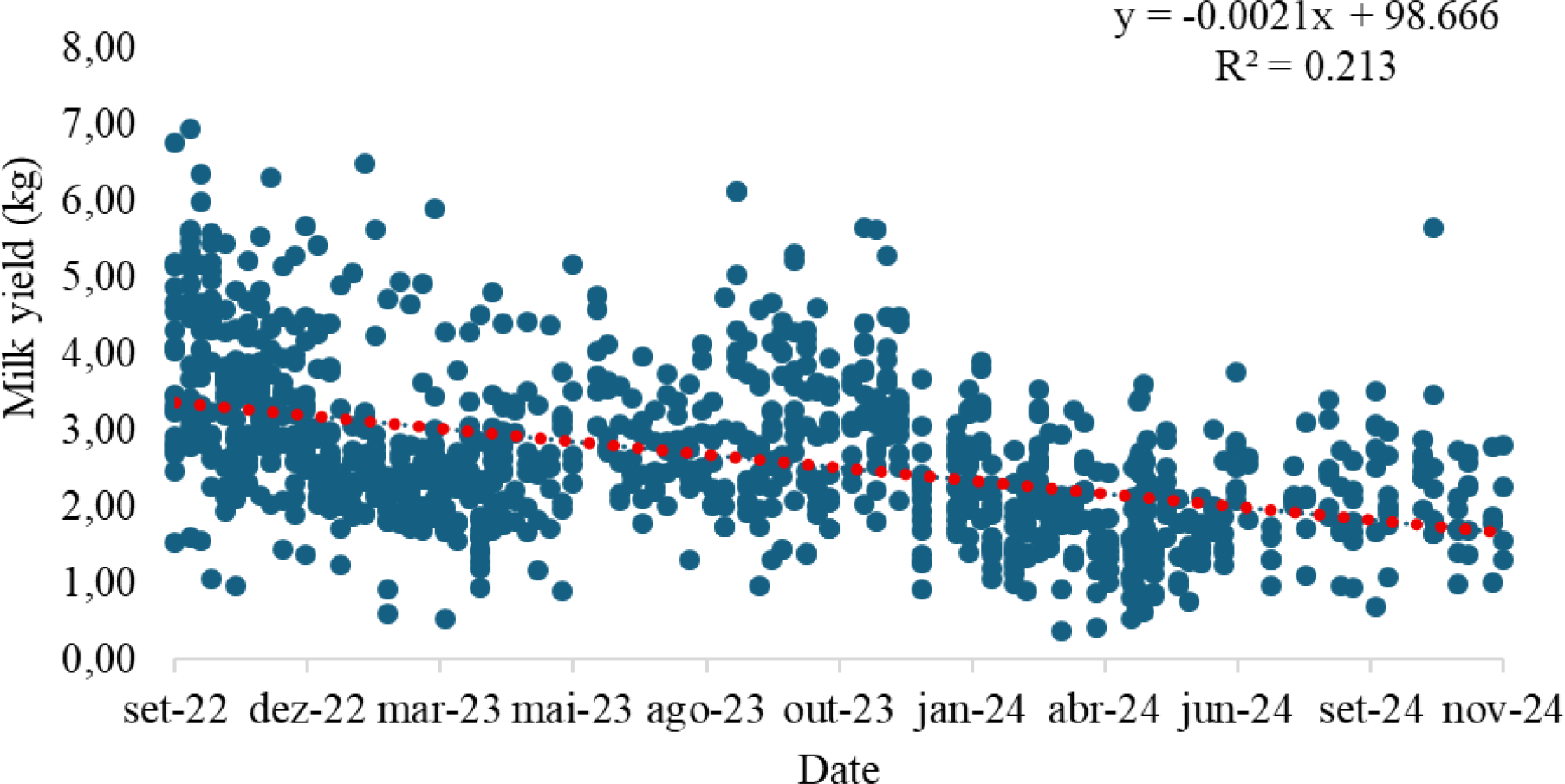
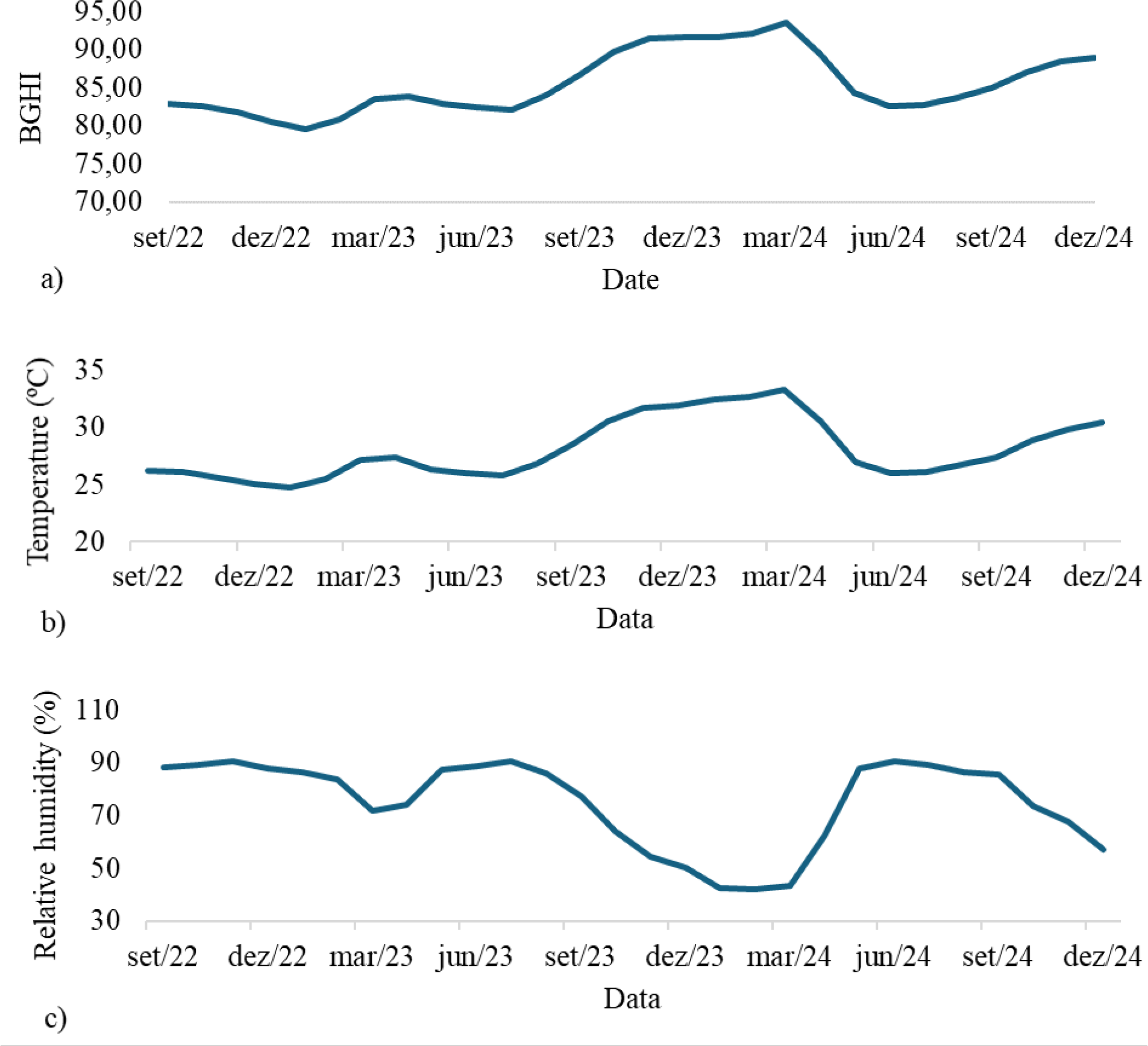
Figure 1 illustrates the phenotypic trend in milk production of lactating cows from the experimental herd in the Amazonian savanna, indicating a gradual average daily decline of 0.0021 kg. This negative trend appears to be mainly associated with the environmental conditions recorded during the evaluated period (Figure 2). From September 2022 onward, greater fluctuations in climatic indicators were observed, characterized by increased thermal load, higher average temperatures, and reduced relative humidity. These factors contribute to an increase in the Black Globe Humidity Index (BGHI), a condition commonly associated with heat stress in dairy cattle. Heat stress compromises animal comfort and reduces dry matter intake, affecting metabolic efficiency and lactation persistency, which may result in a progressive decline in milk production.
Phenotypic trend of milk yield (kg) in lactating cows from the experimental herd in the Amazonian savanna.
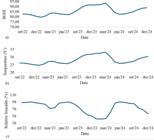
Temporal variation of the BGHI (globe temperature and humidity index) (a), temperature (b), and relative humidity (c) in the Amazon Savanna.
In addition to adverse thermal conditions, the period between October 2023 and April 2024 was marked by an extreme climatic event in northern Brazil, characterized by a prolonged drought considered one of the most severe in recent years. Reduced precipitation led to a significant decline in water availability and forage production in pastures. Consequently, animals experienced an extended period of nutritional deficit, accompanied by weight loss and reduced body condition score, contributing to the decline in milk production observed in the herd. Following the return of rainfall after the severe drought, intense pest infestations were reported in pasture areas, particularly caterpillars and phytophagous insects, which consumed a large portion of the available vegetation. Species such as the fall armyworm and grass-feeding caterpillars were reported to have destroyed extensive pasture areas in the region. This scenario further aggravated feed scarcity and prolonged the nutritional recovery period of the animals, extending the negative impact on herd productive performance.
Heat stress remains a limiting factor for the development of global dairy production, as it is associated with reduced dry matter intake and metabolic alterations that impair lactation persistency (27). According to Tao et al. (27), heat abatement strategies, such as shading and evaporative cooling, are currently the most effective approaches to mitigate the negative effects of heat stress and should be prioritized, particularly during warmer periods. Furthermore, advancing cow age is associated with reduced lactation persistency, as older animals exhibit greater regression of mammary alveolar cells, resulting in decreased milk production over time (28). Therefore, variability in milk production among cows may reflect differences in genetic merit, stage of lactation, and responses to environmental conditions, especially climatic factors, reinforcing the importance of individual milk recording and the identification of superior animals for selection purposes.
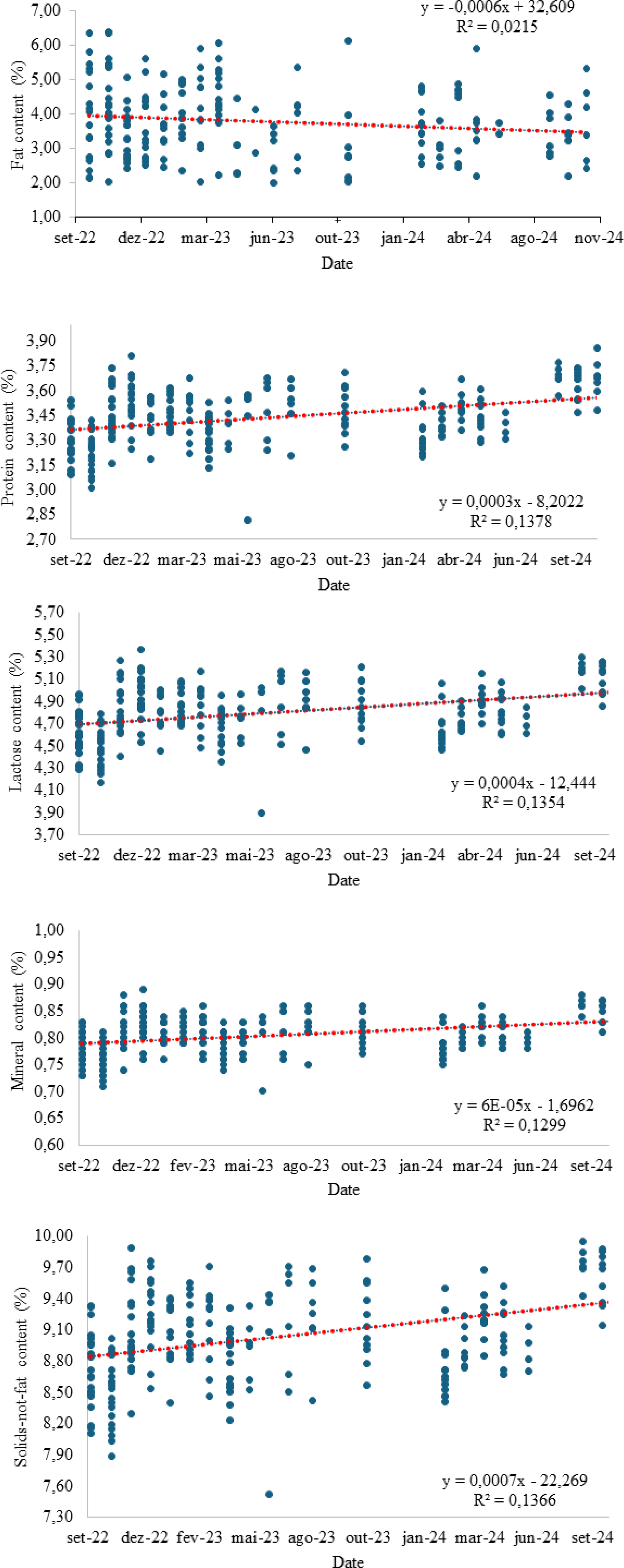
The phenotypic trend in milk fat content is presented in Figure 2a, indicating an average daily reduction of 0.0006 % between September 2022 and November 2024. This pattern suggests that the magnitude of the temporal effect was modest, not indicating a pronounced phenotypic change in milk fat content over the analyzed period. The dispersion of the data highlights variability among individual records, which may be associated with differences in lactation stage, body condition, nutritional management, and environmental conditions to which the animals were exposed.
In production systems with structured genetic improvement programs, increases in milk yield would be expected to result in a dilution effect on milk solids or, alternatively, in an increase in fat content while maintaining production levels. However, in the evaluated herd, there is no history of genetic selection directed toward milk yield or composition, and the herd is predominantly composed of crossbred animals managed under low technological input. Therefore, the observed variations appear to be more closely related to environmental and nutritional factors than to genetic changes within the population.
In addition, the evaluated period was marked by an extreme climatic event in the region, as previously described, characterized by a prolonged drought followed by intense pest outbreaks in pastures after the return of rainfall. This scenario resulted in forage scarcity and an extended period of negative energy balance in the animals, which may explain the simultaneous declining trend observed in both milk yield and fat content in the experimental herd. In general, greater fluctuations in milk fat content would be expected due to seasonal variations typical of tropical systems, particularly because of changes in forage quality and availability between dry and rainy seasons, factors that directly influence the energy balance of cows and fat synthesis in the mammary gland (29,30). Among the main factors affecting milk fat content, dietary composition stands out, especially fiber concentration and the forage-to-concentrate ratio (31). Diets with higher fiber content tend to increase the production of volatile fatty acids in the rumen, particularly acetate and butyrate, which act as important precursors for milk fat synthesis (32). Therefore, unlike what would be expected under genetic progress scenarios, where changes in production often lead to dilution or increases in milk components, the results of this study indicate that variations in fat content predominantly reflect temporary environmental effects on animal phenotypic performance. These findings highlight the importance of considering extreme climatic events and nutritional constraints when interpreting production trends in tropical livestock systems, particularly in herds managed under extensive conditions and low technological input.
A similarly stable pattern was observed for the phenotypic trends of protein (0.0003 %), lactose (0.0004 %), mineral (0.00006 %), and solids-not-fat (0.0007 %) content, with only minor fluctuations and no significant change in the overall mean pattern (Figure 3b-e). This suggests that, despite variations in milk yield, milk components exhibited relative phenotypic stability, which is desirable for the dairy industry, as it relies on consistent compositional standards to ensure processing efficiency. Continuous monitoring of these parameters enables the adoption of more effective nutritional, environmental, and genetic management strategies, contributing to the sustainability and profitability of dairy production in the Amazonian savanna region.
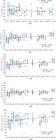
Phenotypic trends of milk fat (a), protein (b), lactose (c), mineral (d), and solids-no-fat (e) content in lactating cows from the experimental herd in the Amazonian savanna.
In dairy cows adapted to tropical systems, it is common for milk yield to vary with environmental and dietary conditions, while chemical composition remains more stable, as reported by Olawale et al. (33), who observed lower variability in protein, lactose, and solids-notfat. Protein content, for instance, showed a slight positive trend, suggesting adequate amino acid supply and energy balance in the cows. Milk protein tends to be more sensitive to protein nutrition and energy balance than to environmental temperature, which may explain its stability in the studied herd (34). Similarly, lactose content, being the primary regulator of milk volume, remained constant, indicating no substantial changes in milk osmolarity or significant metabolic impairment over time (24). Mineral content and solids-not-fat also exhibited minimal variation, with nearly null trends. These results indicate consistency in ionic composition and the non-fat solid fraction, demonstrating the absence of significant dilution effects. This finding also suggests no evidence of adulteration and preservation of the physicochemical integrity of milk, in accordance with standards established by MAPA (21).
3.2 Study 2: Commercial herd
3.2.1 Effect of Location and Season
Descriptive statistics and analysis of variance results for the milk components evaluated across different municipalities and seasons in the state of Roraima are presented in Table 2. No significant interaction was observed between location and season for the analyzed variables (p > 0.05). A significant effect of location (p < 0.001) on fat content (%) was observed, whereas season did not significantly influence this variable (p = 0.99). The highest mean fat content was observed in dairy cows raised in Boa Vista (3.81 %), followed by Iracema (3.18 %), and Cantá (2.70 %).
Descriptive statistics and analysis of variance (ANOVA) results for bovine milk components in the state of Roraima.
Variations in milk fat content may primarily reflect differences in feeding management and local environmental conditions. Although no significant effect of season was observed (p = 0.99), Ruiz-Ortega et al. (31) reported higher fat content during the rainy season compared to the dry season in cows raised under tropical conditions. Overall, the results suggest that milk fat content is more strongly influenced by regional characteristics than by rainfall patterns, highlighting the importance of location-specific management and supplementation strategies. This local heterogeneity reinforces the need for technical assistance aimed at nutritional standardization, particularly in areas with lower levels of productive development.
For the remaining milk components, a significant effect (p < 0.001) of both location and season was observed. Among locations, the highest mean protein content was recorded in dairy cows raised in Iracema (4.79 %), followed by Boa Vista (3.43 %), and Cantá (3.40 %). Regarding season, higher average values for milk components were observed during the dry period compared to the rainy period. This pattern may be associated with reduced milk yield during the dry months, leading to a concentration of total solids in milk. In addition, during the dry season, there may be increased use of supplementary feeding with concentrates and conserved forages (hay and silage), which contribute to improved metabolic efficiency and protein synthesis. Seasonal effects on milk composition in tropical regions may be related to feeding practices; lowquality milk requires corrective actions focused on meeting the nutritional demands of dairy herds, considering that tropical conditions are characterized by greater variability in forage availability and that nutrition is a key factor for improving production (27).
Lactose content also varied among locations, being higher in herds from Iracema (5.21 %), followed by Boa Vista (4.80 %), and Cantá (4.75 %). When analyzed by season, lactose content was slightly higher during the dry season (5.04 %) compared to the rainy season (4.95 %). Similarly, mineral content was higher in lactating cows from Iracema (0.88 %), followed by Boa Vista (0.80 %), and Cantá (0.79 %). A higher mineral content was also observed during the dry season (0.85 %) compared to the rainy (0.83 %). Solids-not-fat content followed the same pattern as the other components, being higher in herds from Iracema (9.89 %) compared to Boa Vista (9.03 %), and Cantá (8.96 %). Regarding seasonality, solids-not-fat content was slightly higher during the dry period (9.54 %) than during the rainy period (9.34 %). The continuity of milk recording programs, combined with the valorization of milk quality, represents a promising pathway for strengthening the dairy production chain in the state of Roraima. These results emphasize the importance of nutritional standardization and quality, as well as the genetic selection of more adapted and productive animals, to establish more efficient, sustainable production systems compatible with local edaphoclimatic conditions.
4. Conclusion
The experimental herd is characterized by low average productivity under the tropical conditions of the Amazonian savanna; however, it exhibits substantial phenotypic variability, indicating potential for improvement through enhanced management and selection practices. Milk composition is influenced by both geographic location and climatic seasonality, with no significant interaction between these factors. The Iracema region showed higher concentrations of milk solids, indicating greater potential for industrial processing, whereas Boa Vista stood out for its higher fat content. The dry season also demonstrated an influence on milk quality. These findings highlight the importance of adopting appropriate nutritional management, implementing systematic milk recording, and applying genetic selection strategies tailored to regional climatic conditions as key approaches to achieving consistent improvements in milk productivity and quality in the Amazonian savanna.
Generative AI use statement
The authors did not use generative Artificial Intelligence tools or technologies in the creation or editing of any part of this manuscript.
Acknowledgment
The Department of Animal Science, Centro de Ciências Agrárias, and Universidade Federal de Roraima.
Data availability statement
The data will be provided upon request to the corresponding author.
References
-
1 Ferrazza RA, Castellani E. Analysis of Brazilian livestock transformations: a focus on dairy farming. Ciência Animal Brasileira. 2021; 22:e-68940. https://doi.org/10.1590/1809-6891v22e-68940
» https://doi.org/10.1590/1809-6891v22e-68940 -
2 Brasil. Instituto Brasileiro de Geografia e Estatística (IBGE). Produção de Leite. Roraima; 2025. Disponível em: https://www.ibge.gov.br/explica/producao-agropecuaria/leite/rr
» https://www.ibge.gov.br/explica/producao-agropecuaria/leite/rr - 3 Braga RM, Bendahan AB. Perfil dos produtores e da produção de leite e derivados nos municípios de São Luiz e Rorainópolis em Roraima. Embrapa Roraima - Documentos, n.66, 86 p., 2020.
-
4 Haug A, Hostmark AT, Harstad OM. Bovine milk in human nutrition - a review. Lipids in Health and Disease. 2007; 6(25):1-16. https://doi.org/10.1186/1476-511X-6-25
» https://doi.org/10.1186/1476-511X-6-25 -
5 Gulati A, Galvin N, Hennessy D, McAuliffe S, O’Donovan M, McManus JJ, Fenelon MA, Guinee TP. Grazing of dairy cows on pasture versus indoor feeding on total mixed ration: effects on low-moisture part-skim Mozzarella cheese yield and quality characteristics in mid and late lactation. Journal of Dairy Science. 2018; 101(10):8737-8756. https://doi.org/10.3168/jds.2018-14566
» https://doi.org/10.3168/jds.2018-14566 -
6 Ramírez-Rivera EJ, Rodríguez-Miranda J, Huerta-Mora IR, Cárdenas-Cágal A, Juárez-Barrientos JM. Tropical milk production systems and milk quality: a review. Tropical Animal Health and Production. 2019; 51:1295-1305. https://doi.org/10.1007/s11250-019-01922-1
» https://doi.org/10.1007/s11250-019-01922-1 -
7 Amalfitano N, Patel N, Haddi M, Benabid H, Pazzola M, Vacca GM, Tagliapietra F, Schiavon S, Bittante G. Detailed mineral profile of milk, whey, and cheese from cows, buffaloes, goats, ewes, and dromedary camels, and efficiency of recovery of minerals in their cheese. Journal of Dairy Science. 2024; 107(11):8887-8907. https://doi.org/10.3168/jds.2023-24624
» https://doi.org/10.3168/jds.2023-24624 -
8 Hayes E, Wallace D, O’Donnell C, Greene D, Hennessy D, O’Shea N, Tobin JT, Fenelon MA. Trend analysis and prediction of seasonal changes in milk composition from a pasture-based dairy research herd. Journal of Dairy Science. 2023; 106(4):2326-2337. https://doi.org/10.3168/jds.2021-21483
» https://doi.org/10.3168/jds.2021-21483 -
9 Bekele R, Taye M, Abebe G, Meseret S. Genetic and non-genetic factors affecting test day milk yield and milk composition traits in crossbred dairy cattle in Ethiopia. Veterinary Integrative Sciences. 2023; 21(3):717-733. https://doi.org/10.12982/VIS.2023.052
» https://doi.org/10.12982/VIS.2023.052 -
10 Kaoian P, Buaban S, Mitsuwan W, Kitpipit W. First-lactation milk fat-to-protein ratio in tropically-raised dairy cows: environmental and genetic influences. Veterinary Integrative Sciences. 2023; 21(2):429-437. https://doi.org/10.12982/VIS.2023.030
» https://doi.org/10.12982/VIS.2023.030 -
11 Reis NS, Ferreira IC, Mazocoo LA, Souza ACB, Pinho GAS, Fonseca Neto AM, Malaquias JV, Macena FA, Muller AG, Martins CF, Balbino LC, McManus CM. Shade modifies behavioral and physiological responses of low to medium production dairy cows at pasture in an integrated crop-livestock-forest system. Animals. 2021; 11:2411. https://doi.org/10.3390/ani11082411
» https://doi.org/10.3390/ani11082411 -
12 O’Connell A, McParland S, Ruegg PL, O’Brien B, Gleeson D. Seasonal trends in milk quality in Ireland between 2007 and 2011. Journal of Dairy Science. 2015; 98(6):3778-3790. https://doi.org/10.3168/jds.2014-9001
» https://doi.org/10.3168/jds.2014-9001 -
13 NASA (National Aeronautics and Space Administration). Power Data Access Viewer. [Internet]. USA: NASA Langley Research Center; 2025. [cited 2025 abr 15]. Available from: https://power.larc.nasa.gov/data-access-viewer/
» https://power.larc.nasa.gov/data-access-viewer/ -
14 Buffington DE, Collazo-Arocho A, Caton GH, Pitt D, Thatcher WW, Collier RJ. Black globe-humidity index (BGHI) as comfort equation for dairy cows. Transactions of the Asae; 24(3):711-714. 1981. https://doi.org/10.13031/2013.34325
» https://doi.org/10.13031/2013.34325 -
15 Abreu PG, Abreu VMN, Francisco L, Coldebella A, Amaral AG. Estimativa da temperatura de globo negro a partir da temperatura de bulbo seco. Engenharia na Agricultura-REVENG. 2011; 19(6):557-563. https://doi.org/10.13083/reveng.v19i6.273
» https://doi.org/10.13083/reveng.v19i6.273 -
16 Instituto Brasileiro de Geografia e Estatística (IBGE). Pesquisa da pecuária Roraima 2023: Bovino. Roraima: IBGE, 2023. [citado 2025 abr 15]. Disponível em: https://cidades.ibge.gov.br/brasil/rr/pesquisa/18/164594?ano=2024
» https://cidades.ibge.gov.br/brasil/rr/pesquisa/18/164594?ano=2024 - 17 R Core Team. (2024). R: A language and environment for statistical computing. R Foundation for Statistical Computing, Vienna, Austria.
-
18 Alves AVNG, Monteschio JO, Fagundes GM, Paiva JT. Avaliação do controle leiteiro e agentes causadores de mastite em vacas Holandesas. Brazilian Journal of Animal and Environmental Research. 2024; 7(1):145-157. https://doi.org/10.34188/bjaerv7n1-012
» https://doi.org/10.34188/bjaerv7n1-012 -
19 Rauber LP, Coldebella F, Salvadego TA, Comunello L, Giacomin L. Projeto de extensão rural - leite forte: controle reprodutivo de pequenos rebanhos leiteiros. Revista de Extensão do Instituto Federal Catarinense. 2020; 2:47-52. https://publicacoes.ifc.edu.br/index.php/RevExt/article/view/72
» https://publicacoes.ifc.edu.br/index.php/RevExt/article/view/72 -
20 Gallardo WB, Teixeira IAMA. Associations between dietary fatty acid profile and milk fat production and fatty acid composition in dairy cows: a meta-analysis. Animals. 2023; 13(13):2063. https://doi.org/10.3390/ani13132063
» https://doi.org/10.3390/ani13132063 - 21 Brasil. Ministério da Agricultura, Pecuária e Abastecimento. Instrução Normativa nº 76, de 26 de novembro de 2018. Regulamentos técnicos que fixam a identidade e as características de qualidade que devem apresentar o leite cru refrigerado, o leite pasteurizado e o leite pasteurizado tipo A. Diário Oficial da União. 2018 Nov 26; Seção 1. Português.
-
22 Kalač P, Samková E. The effects of feeding various forages on fatty acid composition of bovine milk fat: a review. Czech Journal of Animal Science. 2010; 55(12):521-537. https://doi.org/10.17221/2485-CJAS
» https://doi.org/10.17221/2485-CJAS -
23 Silva BP, Deboni ACN, Fernandes CB, Carvalho GGM, Christino KC, Saltos LVRA, Santos LC, Pereira PV, Porn TA, Lemos MJ. Qualidade do leite produzido por vacas mestiças. Revista FT. 2023; 1(10). https://doi.org/10.5281/zenodo.10440466
» https://doi.org/10.5281/zenodo.10440466 -
24 Costa A, Lopez-Villalobos N, Sneddon NW, Shalloo L, Franzoi M, DeMarchi M, Penasa M. Invited review: Milk lactose-Current status and future challenges in dairy cattle. Journal of Dairy Science. 2019a; 102(7):5883-5898. https://doi.org/10.3168/jds.2018-15955
» https://doi.org/10.3168/jds.2018-15955 -
25 Costa A, Lopez-Villalobos N, Visentin G, DeMarchi M, Cassandro M, Penasa M. Heritability and repeatability of milk lactose and its relationships with traditional milk traits, somatic cell score and freezing point in Holstein cows. Animal. 2019b; 13(5):909-916. https://doi.org/10.1017/S1751731118002094
» https://doi.org/10.1017/S1751731118002094 -
26 Dalgleish D, Corredig M. The structure of the casein micelle of milk and its changes during processing. Annual Review of Food Science and Technology. 2012; 3:449-467. https://doi.org/10.1146/annurev-food-022811-101214
» https://doi.org/10.1146/annurev-food-022811-101214 -
27 Tao S, Rivas RMO, Marins TN, Chen Y, Gao J, Bernard JK. Impact of heat stress on lactational performance of dairy cows. Theriogenology. 2020; 150(1):437-444. https://doi.org/10.1016/j.theriogenology.2020.02.048
» https://doi.org/10.1016/j.theriogenology.2020.02.048 -
28 Jingar S, Mehla RK, Singh M, Roy AK. Lactation curve pattern and prediction of milk production performance in crossbred cows. Journal of Veterinary Medicine. 2014; 13:814768. https://doi.org/10.1155/2014/814768
» https://doi.org/10.1155/2014/814768 -
29 Pacheco-Pappenheim S, Yener S, Heck JML, Dijkstra J, VanValenberg HJF. Seasonal variation in fatty acid and triacylglycerol composition of bovine milk fat. Journal of Dairy Science. 2021; 104(8):8479-8492. https://doi.org/10.3168/jds.2020-19856
» https://doi.org/10.3168/jds.2020-19856 -
30 Bokharaeian M, Toghdory A, Ghoorchi T, Ghassemi N J, Esfahani IJ. Quantitative associations between season, month, and temperature-humidity index with milk yield, composition, somatic cell counts, and microbial load: a comprehensive study across ten dairy farms over an annual cycle. Animals. 2023; 13(20). https://doi.org/10.3390/ani13203205
» https://doi.org/10.3390/ani13203205 -
31 Ruiz-Ortega M, González ECG, Guevara-Arroyo AM, Chay-Canul AJ, Valencia-Franco E, Pérez-Sato M, VelázquezMorales JV, Rodríguez-Castillo JC, Robles-Robles JM, Vázquez-Diosdado JA, Ponce-Covarrubias JL. Physicochemical Characteristics of Dual-Purpose Cow’s Milk During the Dry and Rainy Seasons in a Tropical Environment. Veterinary Sciences. 2025; 12:269. https://doi.org/10.3390/vetsci12030269
» https://doi.org/10.3390/vetsci12030269 -
32 Beckett L, Gleason CB, Bedford A, Liebe D, Yohe TT, Hall MB, Daniels KM, White RR. Rumen volatile fatty acid molar proportions, rumen epithelial gene expression, and blood metabolite concentration responses to ruminally degradable starch and fiber supplies. Journal of Dairy Science. 2021; 104(8):8857-8869. https://doi.org/10.3168/jds.2020-19622
» https://doi.org/10.3168/jds.2020-19622 -
33 Olawale FO, Kaya I, Secka A. Assessment of composition and physical properties of the Gambian N’Dama cow milk. Journal of Food Composition and Analysis. 2023; 115:104961. https://doi.org/10.1016/j.jfca.2022.104961
» https://doi.org/10.1016/j.jfca.2022.104961 -
34 Kim JE, Lee HG. Amino acids supplementation for the milk and milk protein production of dairy cows. Animals. 2021; 11(7):2118. https://doi.org/10.3390/ani11072118
» https://doi.org/10.3390/ani11072118
Edited by
-
Editor:
Rondineli P. Barbero