 Longitudinal analysis of pre-slaughter factors influencing the incidence of injuries in beef carcasses
Abstract
The study aimed to analyze and quantify the potential factors contributing to carcass injuries in beef cattle. Data were obtained from 1,980 batches (117,241 carcasses) of animals slaughtered at a federally inspected (SIF) slaughterhouse located in the state of Pará, Brazil, representing the total annual slaughter volume of the facility. The data cover the period from May 2020 to May 2021 and were analyzed using binomial regression. The results indicated that sex was the most influential variable in model development, with batches of female animals exhibiting a 24 % higher likelihood of presenting carcass bruises compared to batches of males. The presence of horned animals increased the odds of carcass injuries by 120 % in mixed batches and by 473 % in batches composed exclusively of horned animals, relative to batches of polled cattle. A total of 9,653 injured carcasses were recorded, with an average of 4.87 injured carcasses per batch. The analysis further revealed that transport distances exceeding 800 km increased the probability of injuries by 188 %. In summary, transport conditions, travel distance, and loading densities were identified as the most significant factors associated with carcass injuries. The study highlights the importance of monitoring the conditions to which animals are exposed prior to slaughter, as these factors have a direct impact on production parameters and commercial value. The findings underscore the necessity of implementing practices that reduce stress and promote animal welfare throughout the production chain.
Keywords
pre-slaughter handling; animal welfar; beef cattle farming
Resumo
O estudo teve como objetivo analisar e quantificar os possíveis fatores que contribuem para lesões em carcaças de bovinos de corte. Foram utilizados dados de 1.980 lotes (117.241 carcaças) de animais abatidos em um frigorífico com SIF no estado do Pará (Brasil), correspondendo ao total de abate anual desse estabelecimento. Os dados são referentes ao período de maio de 2020 a maio de 2021 e foram analisados por regressão binomial. Os resultados demonstraram que a variável sexo foi a mais relevante para a formação do modelo, com lotes de fêmeas apresentando 24 % mais chances de desenvolver hematomas nas carcaças em comparação aos lotes de machos. A presença de animais aspados aumentou em 120 % e em 473 % as chances de haver carcaças lesionadas em lotes mistos e com aspados, respectivamente, em comparação com lotes de animais mochos. Foram registradas 9.653 carcaças lesionadas, com uma média de 4,87 carcaças por lote. A análise indicou que distâncias percorridas acima de 800 km aumentaram a probabilidade de lesões em 188 %. Em resumo, o transporte, a distância percorrida e as densidades de carga foram considerados os fatores mais relevantes para a ocorrência de lesões. O estudo enfatiza a necessidade de atenção às condições a que os animais são submetidos até o abate, pois essas condições impactam os parâmetros produtivos e o interesse comercial, ressaltando a importância de práticas que visem a minimizar o estresse e a garantir o bem-estar animal.
Palavras-chave
manejo pré-abate; bem-estar animal; bovinocultura de corte
1. Introduction
The livestock sector and products of animal origin are fundamental to sustainability, human food and nutrition, poverty reduction, the expansion of livelihoods, food security, and the promotion of health (1). In this context, animal welfare allows for inferences to be made about the conditions of animal husbandry and slaughter.
The beef production chain has sought to emphasize the importance of considering animal welfare at all stages of their operations to producers, transporters, operators, consumers, authorities, and organizations (2). During pre-slaughter handling, cattle face challenges that compromise this welfare and can lead to carcass lesions (3). Among the stressors, loading and transport deserve attention, as in addition to directly affecting the animals, they involve variables that are difficult to control (4).
Handling can be evaluated using subjective methods, such as visual analysis of the carcasses. Monitoring the prevalence of bruises and contusions in slaughterhouses is an effective strategy to assess the adopted handling practices (5). In the slaughterhouse, if the carcasses have any impairment, partial or total condemnations occur. Once imperfections are identified, it is necessary to discard marketable portions, which leads to economic losses as no resources are obtained from these products (6,7).
These losses could be minimized through investment in good handling practices during pre-shipment and transport (8). Thus, promoting research that identifies the factors associated with contusions in beef carcasses is essential for the implementation of strategies that reduce production losses.
It is assumed that inadequate handling and transport practices are directly related to the occurrence of lesions in beef cattle carcasses. In this sense, encouraging research aimed at identifying the factors that influence the formation of contusions becomes essential to support the adoption of more effective handling strategies, aiming to reduce economic losses in production. Therefore, this study aimed to analyze and quantify the possible factors associated with the occurrence of lesions in beef cattle carcasses.
2. Material and methods
The study was conducted with information from the database of the bovine slaughterhouse located in the Municipality of Castanhal – PA, in northern Brazil (1°11'10.8"S 47°56'42.6"W), covering one year of evaluation. The slaughterhouse operates in compliance with the regulations established by the Ministry of Agriculture and Livestock (MAPA) regarding sanitary, biosafety, and animal welfare requirements for slaughter, processing, storage, import, and export through the Federal Inspection Service (SIF 4554). tregion’s According to the Köppen-Geiger classification, the region’s climate is designated as “Am”, a humid tropical or equatorial climate (9).
A survey of climatic data was carried out from the National Institute of Meteorology (INMET) automatic weather station, located in the municipality of Castanhal – PA, to characterize the climate during the experimental period. The rainy season, also known as the wet season, occurs between the austral summer and autumn, from December to May, with an average monthly precipitation of 392.50 mm, a maximum temperature of 26.49 °C, and a minimum temperature of 25.62 °C. The dry season, with less rainfall, occurs between June and November, showing an average monthly precipitation of 144.43 mm, a maximum temperature of 27.7 °C, and a minimum temperature of 26.61 °C.
The data referring to animal weights and logistics were obtained based on the slaughter reports and the transport manifests, during the period from May 2020 to May 2021. A total of 1,980 lots were evaluated, 1,922 male lots and 58 female lots, with each lot considered to be an experimental unit. The average was 59 animals per lot, ranging from 3 to 380, and totaling 117,241 carcasses, of which 115,833 (98.80 %) were males and 1,408 (1.20 %) were females. The average slaughter weights were 536.64 kg for males and 457.43 kg for females, while the average hot carcass weights were 294.36 kg and 239.27 kg, respectively.
Regarding the presence of horns, the lots were categorized based on the percentage of animals in the lots’ composition. Lots with more than 90 % of animals with horns were designated as horned lots, lots with less than 90 % of animals with horns were classified as mixed lots, and lots with no animals with horns were categorized as polled lots. In relation to the average weight of the animals, the lots were categorized as light, with a weight up to 400.0 kg; medium, with weights between 400.1-590.0 kg; and heavy, above 590.1 kg.
The variable season was divided into the rainy period, between December and May, and the less rainy period (or dry period), between June and November, according to data provided byINMET (10). Coat humidity and the transport vehicle were assessed at the time of unloading by visual inspection of the animals’ coats and the vehicle’s floor. The lots were classified as dry, wet, or mixed, considering the homogeneity or heterogeneity of the surface condition of the animals and the inside of the vehicle.
The transport vehicles were divided into categories with distinct load capacities, considering an average weight of 450 kg per animal. Truck-type vehicles with up to two partitions can transport loads of 18 to 40 animals, while double-decker trailer-type vehicles have a capacity of up to 60 animals.
The lot’s stocking density was determined by the ratio between the total load weight in kg, and the truck's cargo area, in m-2, and was expressed in kg/m-2. The density classes were assigned as low (up to 200.0 kg/m-2), medium (from 200.1 to 599.9 kg/m-2), and high (above 600.0 kg/m-2). The distances covered were defined as the mileage traveled by the transport vehicle between the farm and the slaughterhouse, being categorized into five classes: < 200 km, 200.1-400.0 km, 400.1- 600.0 km, 600.1-800.0 km, and > 800.1 km.
The classification of bruises (hematomas) was carried out according to the criteria described by Hoffman et al. (11), who define a bruise as an injury to the muscle tissues resulting from an impact with sufficient intensity to cause crushing and rupture of blood vessels, leading to the extravasation and accumulation of blood and serum in the tissues.
The data were analyzed using R software, with the lots considered to be experimental units. The binomial logistic regression model was used to compare lots that presented at least one carcass with injury/bruising in relation to lots with carcasses without any injury/bruising. For the construction of the binomial logistic regression models, the stepwise method was used, which included the variables in stages considering forward selection. The choice of the best adjusted model was based on the Akaike information criterion (AIC), taking into account the odds ratio (OR) as a measure of the effect of the predictor variables in sets, along with the evaluation of the 95 % confidence intervals (CI) (11, 12). The general binomial logistic regression model was as follows (Equation 1):
In this model, Yijklmnop is the dependent variable for lots with or without bruised carcasses; α is the intercept of the model; Si is the effect of i in the category of animal sex (i = 1 male, i = 2 female); Cj is the effect of j in the category of horn presence (j = 1 horned, j = 2 hornless, j = 3 heterogeneous lots); CPk is the effect of k in the weight category (k = 1 light, k = 2 medium, and k = 3 heavy); El is the effect of l in the category of season (l = 1 rainy; l = 2 less rainy/dry); Plm is the effect of lm in the category of coat and transport vehicle humidity states (m = 1 wet, m = 2 dry, and m = 3 adverse humidity condition); Tn is the effect of n in the transport vehicle type category (n = 1 trailer, n = 2 truck); DPo is the effect of o in the load density category (o = 1 low, o = 2 medium, and o = 3 high); DCp is the effect of p in the distance traveled category (p = 1 if < 200 km, p = 2 from 200.1- 400.0 km, p = 3 from 400.1-600.0 km, p = 4 from 600.1-800.0 km, and p = 5 if > 800.0 km); and eijklmnop is the residual term.
3. Results and discussion
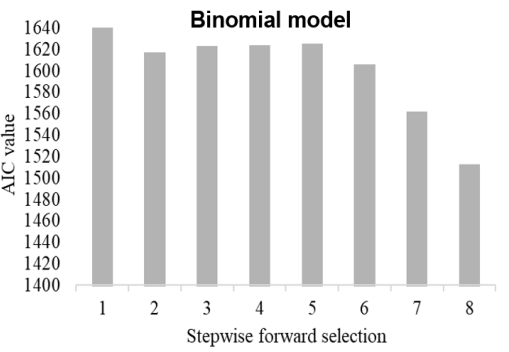
In the logistic regression analysis, the animal sex variable presented the highest AIC value, being incorporated as the first variable in the prediction model for the probability of bruise occurrence (Figure 1). The remaining variables were introduced following similar criteria, advancing until no further significant improvements in model fit were observed with the inclusion of additional variables. Thus, the order of variable inclusion in the model was as follows: "sex" category (Si), "horn presence" category (Cj), "weight" category (CPk), "climatic period" category (El), "coat and transport vehicle humidity states" category (Plm), "transport vehicle type" category (Tn), "load density" category (DPo), and "distance traveled" category (DCp). Among the variables related to the category with or without cranial appendages and transport, the following stood out as the most relevant for model fit: the effect of the transport vehicle type (Tn), the effect of the distance traveled (DPo), and the effect of the load density (DCp).
Logistic reg ression adjustments for model definition by the AIC selection methodology with cumulative effect at each step of adding a variable causing bruises to the model. Binomial model: Step 1. Added the effect of sex (Gi); Step 2. Added the effect of the category with or without cranial appendages (Cj); Step 3. Added the effect of the weight category (CPk); Step 4. Added the effect of the category of coat and transport vehicle humidity states (Pl); Step 5. Added the effect of the season category (Em); Step 6. Added the effect of the transport vehicle type category (Tn); Step 7. Added the effect of the distance traveled category (DPo); and Step 8. Added the effect of the load density category (DCp).
Once the model was adjusted, the interpretation regarding the significance of the estimated coefficients considered the odds ratios for dichotomous independent variables (the odds of injury occurrence or non-occurrence in the lots). The odds ratio is estimated by the quotient between the odds of the event of interest occurring (Y = 1) in individuals with x = 1, and the odds of this event occurring (Y = 1) in individuals with x = 0. The 95 % confidence interval for each estimated coefficient was considered.
Out of a total of 117,241 animals in 1,980 different lots, 9,653 carcasses with bruises were accounted for, amounting to 4.87 bruised carcasses per lot. The most influential variable in the model was the sex of the animals. Females showed a 24 % higher probability of developing carcass bruises compared to males; however, no difference was found between classes (Table 1).
Probability of occurrence of bruises in beef cattle carcass lots per causative variable, based on binomial logistic regression.
Welfare is crucial throughout the entire pre-slaughter handling period, which comprises everything from loading on the farm to the moment of stunning and slaughter. During this phase, animals are exposed to various new stimuli, making them more prone to stress and fatigue, a condition that can result in quantitative and qualitative losses in the carcasses (14). Consequently, these impacts affect several areas, from production to the commercial sector.
The higher prevalence of bruised carcasses in lots of females destined for slaughter must be related to the fact that culled females are not subjected to quality handling practices (15, 16). The higher probability of bruising in females in the present study may be associated with the capacity and memory of the females, which are subjected to non-ideal handling conditions for longer periods, and due to these adversities, are more reactive than males, which are usually better managed in production systems (17).
Furthermore, the higher prevalence of injuries in lots of adult females may be justified by the bony body structure of cows, which have a more protuberant posterior (pelvic) part of the body due to bone dilation for ease of calving. This factor allows for collisions with the truck structure, in addition to mounting behavior during estrus (18, 19).
The presence of horns in the lots revealed a higher prevalence of bruised carcasses. Lots with horns and mixed lots increased the odds of bruised carcasses by 473 % and 120 %, respectively, compared to lots of polled animals. The classifications regarding the weight category, climatic period, and coat humidity did not influence the probability of bruise occurrence in the carcasses (Table 1).
The presence of horns may contribute to the occurrence of bruises due to the aggressive behavior of the animals, including pushing and actions that can lead to injuries. Zebu animals or those with horns are more prone to exhibiting carcass injuries, resulting in potential economic losses (19). According to Grandin and Husson (20), cattle herds composed of 25 % to 50 % horned animals have an injury rate of 10.5 %, while lots of polled animals reduce this incidence to 2.0 % to 5.0 %. The results of this study regarding the presence of horns are consistent with the existing literature, which suggests that the presence of horns in cattle herds may be undesirable as they aggravate the incidence of injuries. Regardless of the degree of domestication, the presence of horns increases the risk of attacks among group members and plays a crucial role in defining the social hierarchy of herds, a condition that is a determining factor for injuries among animals (21). It should be noted that the presence of horns is a characteristic that can be targeted for selection, despite the difficulty of genetic selection and its still limited understanding, due to the existing phenotypic variation within cattle herds (22).
Although the average weight of the lots did not have a significant impact on the increased occurrence of injuries, separating the animals into lots based on weight category is crucial for preserving the integrity of the animals during transport and in the lairage pens, due to the disputes that normally occur. However, the load density showed a significant relationship with the occurrence of injuries in the bovine carcasses (23).
When comparing lots transported exclusively in truck-type vehicles with those transported in trailer-type vehicles, an increase of 308 % in the odds of injury occurrence was observed. Regarding lots transported in more than one type of vehicle, no differences in the probability of bruising were found (Table 1). Furthermore, analyzing the load density categories, it was observed that low densities reduce the odds of carcass bruising by 66 %, not differing significantly from medium density (Table 1).
For the distances traveled in the transport of animals, it is verified that lots transported up to 200 kilometers presented fewer carcass bruises. Although the increase in distance classes every 200 kilometers favors the probability of bruising occurrence, only the lots that traveled a distance greater than 800 km showed an 188 % higher probability of injured carcasses (Table 1).
Low densities, although increasing the risk of injuries by allowing animal movement inside the truck body, leading to collisions with compartment structures and other animals, were the densities with the lowest probability of bruising in the present study. On the other hand, high stocking rates are also aggravating factors for bruising, as they increase the probability of falls and injuries (such as horn wounds, fights, kicks, and trampling), and aggravate animal stress (24).
When evaluating data on the loading of animals for slaughter at a slaughterhouse in the interior of the state of São Paulo, Brazil, Brennecke et al. (25) concluded that a load density of 450 kg/m-2 is the one that provides bestoptimal welfare conditions, and consequently, a lower incidence of bruising. However, according to the authors, despite 87 % of the carcasses presenting injuries, medium density is still most recommended, since at both high densities (500 kg/m-2) and low densities (420 kg/m-2), 100 % of the carcasses exhibited injuries. According to the data, adjusting the load density is fundamental, as it not only decreases the probability of bruising, but also favors production costs and lower losses in the production chain.
The season of the year can influence road conditions and animal welfare. In an experiment carried out in Chile, Gallo et al. (26) reported that there were 143.3 % more bruises in cattle slaughtered during the autumn and winter, when compared to other times of the year. On the other hand, Minka and Ayo (27) observed a higher number of bruises in carcasses during the summer period, when evaluating 150 animals in West Africa belonging to Bos indicus breeds. Despite the differences in the periods identified, both studies agree that environmental conditions affect other variables related to transport and impact animal health.
However, it is important to point out that the national road network still has extensive unpaved areas, especially in the connections between large commercial centers and beef cattle production systems. This results in the transport of animals on unmaintained roads, which become dangerous, especially during the rainy season (28). Under adverse conditions, even over short distances, animals become more susceptible to injuries due to maneuvers to avoid potholes, sudden braking, the use of alternative routes, and other inherent problems, which lead to greater imbalance, and collisions among the animals and with the truck body structures (29, 30).
The largest number of bruises in lots transported in livestock trailers can be explained by the structural characteristics of the vehicles. Mendonça et al. (19) report that long trucks exhibit greater dynamics in the traction area, causing a pronounced centrifugal effect and increased vibration, which reduces animal stability and increases the probability of appendicular injuries. Furthermore, the poor overall condition of the vehicles contributes to this problem.
Regarding the different types of vehicles for animal transport, the analysis conducted by Ferreira et al. (31) addressed the incidence of bruises in cattle carcasses transported in straight trucks, cattle trailers, and undivided trucks with trailer configurations. According to the authors, in the three types of truck bodies evaluated, most of the analyzed carcasses presented between one and five bruises. There was no carcass completely free of trauma, or exhibiting more than 15 bruises.
The distance between slaughterhouses and rural properties is another factor that increases the probability of injuries. The largest number of injuries occurred due to the prolonged exposure of animals to adverse conditions inherent to transport, such as inclement weather, excessive fatigue, fear, hunger, and intense dehydration (32). The results obtained demonstrate that the probability of injuries increases as the distance traveled increases, especially on journeys exceeding 800 km (p < 0.05), compared to distances less than 200 km (Table 1). Furthermore, long journeys across properties are common in the state of Pará, the second largest Brazilian state, with a territorial extension of 1,247,955 km-2.
The long distances traveled by cattle can lead to "fatigued cattle" syndrome, characterized by a state of physical exhaustion due to excessive effort during transport. During this period, the animals are deprived of water and need to remain standing (33). There are still debates about the duration of journeys and the space available in the transport for cattle to lie down, stand up, and turn around without impediments, highlighting the need for a comfortable structure that allows the animals to lie down without the risk of transport-related injuries (34). It is worth noting that excessive vibrations, road conditions (whether poorly paved or unpaved), excessive acceleration, braking, curves, and inadequate driving techniques cause fatigue and displace the animals' center of gravity, leading many to be severely injured while attempting to balance themselves in the bodies of the transport trucks (35, 36, 37).
Bethancourt-Garcia et al. (37) reported a link between the distance traveled and road infrastructure on the occurrence of bruises in the carcasses. The authors observed that the greater the distance between the property and the slaughterhouse, the greater the number of bruised carcasses recorded. Another example is from Moreira et al. (38), who evaluated the carcasses of 624 male cattle, 30 to 36 months old, for the occurrence of hematomas when transported from cities with distances below or above 200 km, six from the state of Mato Grosso and two from the state of Pará, respectively. The authors highlighted that the number of hematomas in bovine carcasses was greater (n=323) when the animals were subjected to distances greater than 200 km. Furthermore, of the 272 animals in this group, 260 presented some type of injury, compared to the animals that traveled less than 200 km (n=269), of which 43.75 % of the carcasses were affected, among the 352 transported. This study also indicated that the hindquarters of the carcasses were the most affected region.
The results presented here reinforce the importance of adopting practices that promote animal welfare during transport, especially regarding the control of load density, separation by sex, and dehorning in animals destined for slaughter. Despite the robustness of the sample, it is important to highlight that the use of data obtained in a commercial environment may present limitations, such as the lack of information about the animals' previous management, fasting time, and environmental conditions during transport. These factors, although not controlled in this study, can influence the results and should be considered in future research.
4. Conclusion
The analysis of pre-slaughter factors revealed that the sex of the animals, the presence of horns, and the distance traveled during transport are determining factors for the occurrence of injuries in bovine carcasses. These results reinforce the need for improvements in pre-slaughter management, such as separating animals by sex, more careful handling of lots containing horned animals, and the adoption of measures that minimize stress during transport, especially on longer journeys. The implementation of these practices can contribute to reducing economic losses, improving carcass quality, and ensuring better animal welfare conditions.
Data availability statement
The complete set of data that supports the results of this study is available upon request from the corresponding author.
-
Generative AI use statement
The authors did not use generative artificial intelligence tools or technologies in creating or editing any part of this manuscript.
References
-
1 Adegbola TA, Arie HH, Sarah L.M, Marjatta E, Geoffrey ED. Animal source foods: Sustainability problem or malnutrition and sustainability solution? Perspective matters. Global Food Security.2020;25:100325. https://doi.org/10.1016/j.gfs.2019.100325
» https://doi.org/10.1016/j.gfs.2019.100325 -
2 Hultgren J, Segerkvist KA, Berg C, Karlsson AH, Algers B. Animal handling and stress-related behaviour at mobile slaughter of cattle. Preventive veterinary medicine.2020;177: 104959. https://doi.org/10.1016/j.prevetmed.2020.104959
» https://doi.org/10.1016/j.prevetmed.2020.104959 -
3 De La Cruz L, Gibson TJ, Guerrero-Legarreta I, Napolitano F, Mora-Medina P, Mota-Rojas D. The welfare of water buffaloes during the slaughter process: a review. Livestock Science.2018;212:22-33. https://doi.org/10.1016/j.livsci.2018.03.014
» https://doi.org/10.1016/j.livsci.2018.03.014 -
4 Zhao H, Tang X, Wu M, Li Q, Yi X, Liu S, Sun X. Transcriptome characterization of short distance transport stress in beef cattle blood. Frontiers in Genetics. 2021;12: 616388. https://doi.org/10.3389/fgene.2021.616388
» https://doi.org/10.3389/fgene.2021.616388 -
5 Ludtke CB, Costa OAD, Roça RO, Silveira ETF, Athayde NB, Araújo AP, Junior AM, Azambuja NC. Bem-estar animal no manejo pré-abate e a influência na qualidade da carne suína e nos parâmetros fisiológicos do estresse. Ciência Rural. 2012; 42: 532-537. https://doi.org/10.1590/S0103-84782012000300024
» https://doi.org/10.1590/S0103-84782012000300024 -
6 Silva VL, Groff AM, Bassani CA, Pianho CR. Total condemnation causes of cattle carcasses in slaughterhouse on the state of Paraná. 2016; 10(4):730-741. http://dx.doi.org/10.5935/1981-2965.20160060
» http://dx.doi.org/10.5935/1981-2965.20160060 -
7 Rodrigues RM, Martins TO, Procópio DP. Economic loss from the main causes of whole bovine carcass condemnation in slaughterhouses supervised by the Federal Inspection Service in São Paulo state from 2010 to 2019. Acta Scientiarum. Animal Sciences. 2022;44:e55220. https://doi.org/10.4025/actascianimsci.v44i1.55220
» https://doi.org/10.4025/actascianimsci.v44i1.55220 -
8 Webb EM, Weebb EC, Tlhapi PT. Cumulative incidence and causal risk factors of carcass condemnations in a South African high-throughput cattle abattoir. South African Journal of Animal Science. 2020;50(1):170-177. https://doi.org/10.4314/sajas.v50i1.18
» https://doi.org/10.4314/sajas.v50i1.18 - 9 Do Amaral FHF, Santos VC. Análise das ilhas de calor a partir do uso do sensoriamento remoto: o caso do município de Castanhal-PA/Amazônia. Revista Itacaiúnas.2021;1(1):42-66.
-
10 Instituto Nacional de Meteorologia (INMET). Dados meteorológicos anuais [Internet]. Brasília: Instituto Nacional de Meteorologia; 2022. Available from: https://bdmep.inmet.gov.br/
» https://bdmep.inmet.gov.br/ - 11 Hoffman, Donna L.; Novak, Thomas P. Bridging the Digital Divide: The Impact of Race on Computer Access and Internet Use. 1998.
- 12 Akaike, H. A new look at the statistical model identification. IEEE transactions on automatic control.1974;19(6):716-723.
-
13 Venables WN, RipleyBD, Venables WN, Ripley BD. Random and mixed effects. Modern applied statistics with S. 2002; 271-300. https://doi.org/10.1007/978-0-387-21706-2_10
» https://doi.org/10.1007/978-0-387-21706-2_10 -
14 Wigham EE, Butterworth A, Wotton S. Assessing cattle welfare at slaughter–Why is it important and what challenges are faced?. Meat Science. 2018;145:171-177. https://doi.org/10.1016/j.meatsci.2018.06.010
» https://doi.org/10.1016/j.meatsci.2018.06.010 -
15 Strappini AC, Frankena K, Metz JHM, Gallo B, Kemp B. Prevalence and risk factors for bruises in Chilean bovine carcasses. Meat Science. 2010;86(3):859-864. https://doi.org/10.1016/j.meatsci.2010.07.010
» https://doi.org/10.1016/j.meatsci.2010.07.010 -
16 Knock M.; Carroll GA. The potential of post-mortem carcass assessments in reflecting the welfare of beef and dairy cattle. Animals. 2019; 9 (11):959. https://doi.org/10.3390/ani9110959
» https://doi.org/10.3390/ani9110959 -
17 González LA, Tolkamp BJ, Coffey MP, Ferret A, Kyriazakis I. Changes in feeding behavior as possible indicators for the automatic monitoring of health disorders in dairy cows. Journal of dairy science. 2008; 91(3): 1017-1028. https://doi.org/10.3168/jds.2007-0530
» https://doi.org/10.3168/jds.2007-0530 - 18 Ghezzi MD et al. Evaluación de las prácticas relacionadas con el transporte terrestre de hacienda que causan perjuicios económicos en la cadena de ganados y carne. Sitio Argentino de Producción Animal. 2008;5:01-29
-
19 Mendonça FS, Vaz RZ, Leal WS, Restle J, Pascoal LL, Vaz MB, Farias GD. Genetic group and horns presence in bruises and economic losses in cattle carcasses. Semina: Ciências Agrárias. 2016;37(6):4265–4273. https://doi.org/10.5433/1679-0359.2016v37n6p4265
» https://doi.org/10.5433/1679-0359.2016v37n6p4265 -
20 Grandin JP, Husson X. Even-parity Rydberg and autoionising states in xenon. Journal of Physics B: Atomic and Molecular Physics. 1981;14(3), 433. https://doi.org/10.1088/0022-3700/14/3/020
» https://doi.org/10.1088/0022-3700/14/3/020 -
21 Bagnato S, Pedruzzi L, Goracci J, Palagi E. The interconnection of hierarchy, affiliative behaviours, and social play shapes social dynamics in Maremmana beef cattle. Applied Animal Behaviour Science.2023; 260: 105868. https://doi.org/10.1016/j.applanim.2023.105868
» https://doi.org/10.1016/j.applanim.2023.105868 -
22 Gehrke LJ, Capitan A, Scheper C, König S, Upadhyay M, Heidrich K, Russ I, Seichter D, Tetens J, Medugorac I, Thalle G. Are scurs in heterozygous polled (Pp) cattle a complex quantitative trait?. Genetics Selection Evolution. 2020;52:1-13. https://doi.org/10.1186/s12711-020-0525-z
» https://doi.org/10.1186/s12711-020-0525-z -
23 Tarrant PV, Kenni FJ, Harrington D, Murph M. Long distance transportation of steers to slaughter: effect of stocking density on physiology, behaviour and carcass quality. Livestock Production Science. 1992;30(3):223-238. https://doi.org/10.1016/S0301-6226(06)80012-6
» https://doi.org/10.1016/S0301-6226(06)80012-6 -
24 Braggion M, Silva R. Quantificação de lesões em carcaças de bovinos abatidos em frigoríficos no Pantanal Sul- Mato-Grossense. Embrapa Pantanal (Internet). 2004 (cited 2024 jul 10);(45):1-4. Available from: https://www.infoteca.cnptia.embrapa.br/infoteca/bitstream/doc/812037/1/COT45.pdf
» https://www.infoteca.cnptia.embrapa.br/infoteca/bitstream/doc/812037/1/COT45.pdf. -
25 Brennecke K, Zeferino CP, Soares VE, Orlandi CMB, Bertipagli LMA, Sgavioli S, Dian PHM, Amâncio WDC. Welfare during pre-slaughter handling and carcass lesions of beef cattle submitted to different loading densities. Pesquisa Veterinária Brasileira. 2021; 40: 985-991. https://doi.org/10.1590/1678-5150-PVB-5998
» https://doi.org/10.1590/1678-5150-PVB-5998 - 26 Gallo C, Peréz S, Sanhueza C, Gazic J. Efectos del tiempo de transporte de novillos previo al faenamiento sobre el comportamiento, las pérdidas de peso y algunas características de la canal. Archivos de medicina veterinaria. 2000; 32(2):157-170
-
27 MINKA NS, AYO JO. Effects of loading behaviour and road transport stress on traumatic injuries in cattle transported by road during the hot-dry season. Livestock Science. 2007;107(1):91-95. https://doi.org/10.1016/j.livsci.2006.10.013
» https://doi.org/10.1016/j.livsci.2006.10.013 - 28 Polastrini A, Bracarense LSFP, Pedroza Filho MX. Perdas econômicas decorrentes de lesões em carcaças bovinas durante o transporte pré-abate: o caso do estado do Tocantins. Revista Agri-Environmental Sciences. 2021; 7:e021001
-
29 Gregory NG, Benson T, Mason, CW. Cattle handling and welfare standards in livestock markets in the UK. The Journal of Agricultural Science.2009;147(3):345-354. https://doi.org/10.1017/S0021859609008508
» https://doi.org/10.1017/S0021859609008508 -
30 Al-Bdairi NSS, Behnood A, Hernandez S. Temporal stability of driver injury severities in animal-vehicle collisions: A random parameters with heterogeneity in means (and variances) approach. Analytic methods in accident research, 2020; 26:100120. https://doi.org/10.1016/j.amar.2020.100120
» https://doi.org/10.1016/j.amar.2020.100120 -
31 Ferreira KC, Furtado AC, Flores HP, Oliveira PRO, Gonçalves AG, Oliveira DM. Cattle loading rates in different truck models and their relationship with bruises on bovine carcasses. Ciência Rural. 2020; 50: e20190819. https://doi.org/10.1590/0103-8478cr20190819
» https://doi.org/10.1590/0103-8478cr20190819 -
32 Hultgren J, Segerkvist KA, Berg C, Karlsson AH, Öhgren C, Algers B. Preslaughter stress and beef quality in relation to slaughter transport of cattle. Livestock Science. 2022; 264: 105073. https://doi.org/10.1016/j.livsci.2022.105073
» https://doi.org/10.1016/j.livsci.2022.105073 - 33 Hogan JP, Petherick JC, Phillips CJ. The physiological and metabolic impacts on sheep and cattle of feed and water deprivation before and during transport. Nutrition research reviews.2007; 20(1):17-28
- 34 Broom DM. Causes of poor welfare and welfare assessment during handling and transport. In: Livestock handling and transport. Wallingford UK: CABI, 2007. p. 30-43
-
35 Miranda-De La Lama GC, Monge P, Villarroel M, Olleta JL, García-Belenguer S, María GA. Effects of road type during transport on lamb welfare and meat quality in dry hot climates. Tropical Animal Health and Production. 2011;43:915-922. https://doi.org/10.1007/s11250-011-9783-7
» https://doi.org/10.1007/s11250-011-9783-7 -
36 Ekiz B, Ekiz EE, Kocak O, Yalcintan H, Yilmaz A. Effect of pre-slaughter management regarding transportation and time in lairage on certain stress parameters, carcass and meat quality characteristics in Kivircik lambs. Meat Science. 2012;90(4):967-976. https://doi.org/10.1016/j.meatsci.2011.11.042
» https://doi.org/10.1016/j.meatsci.2011.11.042 -
37 Garcia JAB, Vaz RZ, Vaz FN, Restle J, Mendonça FS. Pre-slaughter factors associated with severe bruising in different primary commercial cuts of bovine carcasses. Revista Ciência Agronômica. 2019;50:681-690. https://doi.org/10.5935/1806-6690.20190080
» https://doi.org/10.5935/1806-6690.20190080 - 38 Moreira PSA, Neto AP, Martins LR, Lourenço FJ, Palhari C, Faria FF. Ocorrência de hematomas em carcaças de bovinos transportados por duas distâncias. Revista Brasileira de Saúde e Produção Animal. 2014;15:689-695
Edited by
-
Editor:
Rondineli P. Barbero