 Phosphate blends change the salami ripening process
Abstract
This study evaluated the effects of three phosphate blends on the ripening process of dry fermented sausages (salami) in comparison with a phosphate-free control by assessing physicochemical, microbiological, and sensory characteristics. The alkaline phosphate blends (BRS450 and BRS460) were more effective in accelerating ripening by three days compared with the control, as indicated by greater weight loss and lower moisture content and water activity; however, the reduction in pH occurred more slowly. These formulations also resulted in sausages with higher hardness due to the lower final moisture content, similar levels of lipid oxidation, and reduced mesophilic bacteria counts. The samples exhibited satisfactory sensory acceptance (scores > 7) for color, appearance, aroma, flavor, and texture. Overall, the results indicate that phosphate blends represent an effective technological strategy to accelerate salami ripening without impairing product quality, contributing to shorter processing times and potential economic benefits.
Keywords:
Dry fermented sausage; weight loss; moisture; sensory acceptance.
Resumo
Este estudo avaliou os efeitos de três misturas de fosfatos no processo de maturação de linguiças fermentadas secas (salame) em comparação com uma amostra controle sem fosfato, por meio da avaliação de características físico-químicas, microbiológicas e sensoriais. As misturas de fosfatos alcalinos (BRS450 e BRS460) foram mais eficazes em acelerar a maturação, em três dias, em relação à amostra controle, observado pela maior perda de peso e menores teores de umidade e atividade de água; entretanto, a redução do pH ocorreu de forma mais lenta. Essas formulações também resultaram em uma linguiça com maior dureza devido ao menor teor final de umidade, níveis semelhantes de oxidação lipídica e menores contagens de bactérias mesófilas. As amostras apresentaram aceitação sensorial satisfatória (escore > 7) para cor, aparência, aroma, sabor e textura. De modo geral, os resultados indicam que as misturas de fosfatos representam uma estratégia tecnológica eficaz para acelerar a maturação do salame sem comprometer a qualidade do produto, contribuindo para a redução do tempo de processamento e potenciais benefícios econômicos.
Palavras-chave:
linguiça fermentada seca; perda de massa; umidade; aceitação sensorial.
1. Introduction
Dry fermented sausage (salami) is a typical fermented dried meat, made with raw meat and fatty tissues, salts, curing agent, sugars, and spices. The ingredients are mixed and embedded in casings, which are subjected to ripening, which consists of the fermentation and drying steps, important for the development of the sensory properties of the product (1). However, to achieve desirable sensory properties and ensure food safety, this product requires a successful combination of several factors, including raw materials, such as salt and curing salts, as well as the reduction of pH, water activity (aw), and moisture contents (2,3).
One of the most important technological additives used in the efficient and safe production of salami includes curing agents, such as phosphates. Phosphates are recognized as suitable additives for use in the food industry. They are applied in many different molecular forms and selected according to the function desired in the food matrix (4). The mechanisms of action of phosphates in meat raw materials are complex and involve interactions of ions, water, and proteins, and their functions are influenced by the water content and pH values (4).
Food-grade phosphates are used in meat products due to their emulsifying and stabilizing capacities, by changing and/or stabilizing the pH value, increasing water holding capacity, decreasing weight loss during cooking, and improving texture and the sensory properties such as tenderness, juiciness, color, and flavor (4, 5).
Authors have studied the use of different phosphate levels in emulsified meat and processed meat products (6), combined or not with other compounds (7). However, research addressing the effects of phosphates, including different phosphate blends, on dry-cured meat products remains limited. Fonseca et al. (8) evaluated the addition of a commercial phosphate blend to dry-cured Spanish sausages, salchichón and chorizo. In salchichón, the addition of phosphate resulted in a significant increase in drying rate, hardness, and chewiness, with a tendency toward lower lipid oxidation. In chorizo, the addition of phosphates resulted in increased hardness, elasticity, chewiness, and less intensity of yellow color. Despite these findings, the available literature remains scarce and focuses mainly on the use of a single commercial blend, without addressing the comparative effects of different phosphate formulations during the ripening process.
Given the limited scientific evidence on the use of phosphates blends in dry-cured meat products and the practical relevance of accelerating ripening while maintaining product quality and safety, this study aimed to evaluate the effects of different phosphate blends on the physicochemical, technological, microbiological, and sensory characteristics of salami throughout the ripening process.
2. Material and methods
2.1 Material
The raw materials (pork shoulder, beef shoulder, pork back fat, salt, sugar, garlic, and nutmeg) were purchased from a local market in Pinhalzinho, Santa Catarina, Brazil. The commercial additives sodium erythorbate, sodium nitrite, and phosphate blends were purchased from a company specialized in meat additives. The phosphate blends used in the formulations presented the following compositions: BRS450 (35-45 % sodium polyphosphate, 35-45 % sodium tripolyphosphate, and 10-20 % sodium acid pyrophosphate - pH 7.5); BRS460 (30-40 % sodium hexametaphosphate, 25-35 % sodium tripolyphosphate, and 25-35 % sodium acid pyrophosphate - pH 6.5); and TRS78 (90-99 % sodium acid pyrophosphate and 1-10 % sodium polyphosphate - pH 5.0). All chemicals used for the analyses were of analytical grade.
2.2 Manufacture and sampling of salami
Four treatments were made, as follows: CONTROL (control formulation, without the addition of phosphates), BRS450 (0.10 g/100 g), BRS460 (0.10 g/100 g), and TRS78 (0.10 g/100 g), as indicated by the manufacturer. The following ingredients were used in all formulations: pork shoulder (57.95 g/100 g), beef shoulder (19.31 g/100 g), pork back fat (19.31 g/100 g), salt (2.12 g/100 g), sugar (0.48 g/100 g), garlic (0.48 g/100 g), nutmeg (0.02 g/100 g), sodium erythorbate (0.10 g/100 g), and a commercial mixture of sodium nitrite and sodium chloride (0.13 g/100 g). Firstly, beef shoulder and pork shoulder were ground in an industrial grinder (7000 Light, MSI10, BRA), using 5 mm discs, pork back fat in 8 mm discs, respectively, and placed in a plastic bowl. Sequentially, phosphate and commercial mixture (sodium chloride/ sodium nitrite) were added into meat/fat blend, and mixed manually for 20 minutes until complete solubilization. Then, the other ingredients were added and mixed, also manually, for another 5 minutes for complete homogenization.
The meat batter was filled into natural casings with a diameter of 45-50 mm and a length of 10 cm, producing individual salami units weighing 100 g of batter. For each treatment, three independent batches were produced, each batch consisting of approximately 2000 g of batter, yielding about 20 salami units per batch. The salami was refrigerated (max. 10 °C) for about 20 h and then taken to the company Embutidos Lamb (Pinhalzinho, Santa Catarina, Brazil) for natural smoking for 10 h. The average temperature and relative humidity of the smoking process were 26.3 °C and 89 %, respectively.
After natural smoking, the salami was stored in a BOD incubation chamber (SSBODu 342L, Solidsteel, BRA), under controlled relative humidity (RH) and temperature (ºC) according to the conditions proposed by de Lima Alves et al. (9), with adaptations. The relative humidity and the temperature were established as follows: 85 % RH and 23 ºC (days 1, 2, and 3); 85 % RH and 22 ºC (day 4); 83 % RH and 21 ºC (day 5); 80 % RH and 20 ºC (day 6); 80 % RH and 19 ºC (day 7); 75 % RH and 18 ºC (day 8 until the end of the ripening time).
The salami was evaluated over 16 days of ripening. Three independent batches were produced for each treatment. At each sampling time, three salami units per treatment were analyzed, with one unit taken from each batch. All analyses were performed in triplicate, resulting in a total of nine experimental units (n = 9) per treatment.
2.3 Proximate composition, physicochemical analysis, and texture profile
The proximate composition was determined (n=9) at the end of the ripening time (day 16 after manufacture) according to AOAC (10). The lipid contents were determined by the Soxhlet extraction method (method 920.39c); the protein contents were determined by the micro Kjeldahl method (method 920.152), using the conversion factor of 6.25; and the ash contents were determined by incineration in a muffle at 550 °C (method 940.26).
Physicochemical analysis of the salami was evaluated on days 1, 4, 7, 10, 13, and 16 of ripening for weight loss, pH, moisture content and water activity. The weight loss was determined by percentage, through the difference between the initial and final weight of the pieces, using a semi-analytical balance (BEL, BRA). The moisture contents were determined according to method 925.45b by AOAC (10), through the gravimetric method of direct drying in an oven at 105 °C (method 925.45b), until constant weight. The pH was determined in a suspension of sample and distilled water at a ratio of 1:10 (w/v) using a benchtop pH meter (MS Tecnopon, mPA210, BRA), previously calibrated with pH 4 and 7 buffer solutions. The water activity (aw) was measured at 25 °C in an Aqualab apparatus (Pre Water Activity Analyzer, Decagon, BRA).
The thiobarbituric acid reactive substances (TBARS) levels were determined on days 1, 7, and 16 of ripening, using the spectrophotometric method as described by Jo and Ahn (11), with modifications. For that, 5 g of sample was mixed with 30 mL of 7.5 % trichloroacetic acid (TCA). The mixture was filtered through qualitative filter paper (Qualy 12.5 cm, J. Prolab, BRA) and a 2 mL aliquot of the filtrate was transferred to a test tube, and 2 mL of 0.02 M thiobarbituric acid (TBA) solution was added. The tubes were heated in a thermostatic bath (SSD 5L, Solidsteel, BRA) for 20 minutes at 100 ºC, and cooled in a water bath to room temperature. The absorbance of the samples was measured in a spectrophotometer (80 SA, Femto, BRA) at 532 nm and the concentration was determined using a standard curve of 1,1,3,3-tetraethoxypropane (TEP) previously prepared. The results were expressed in mg of MDA/kg of sample.
At the end of the ripening time (day 16), the salami was evaluated, in six repetitions, for texture profile analysis (TPA) and shear stress as proposed by Matos et al. (12), using a CT3 texture analyzer (Brookfield, USA). The samples were cut 2 cm high and compressed with a 50.4 mm cylindrical acrylic probe, with a test speed of 5 mm/s, trigger load of 1.0 N, and deformation of 60 %, to determine the parameters hardness, cohesiveness, adhesiveness, and chewiness. The samples were submitted to transverse shear 2 cm from the extremities, using a straight WarnerBratzler blade, with a test speed of 3 mm/s and load trigger of 1.0 N.
2.4 Microbiological analysis
Two salami from each batch were used (n = 6). For that, 10 g of different portions were placed in a sterile Stomacher-type bag, and 90 mL of 0.1 % (w/v) peptone water was added to make the 10-1 dilution. The other dilutions were prepared by transferring 1 mL (10-1) to 9 mL of 0.1 % (w/v) BPW (10-2). On days 1 and 16 of ripening, mesophilic aerobic bacteria counts were performed using PCA agar (Kasvi, BRA) and incubation at 37 °C for 48 h. Before performing the sensory tests, the salami was evaluated for Salmonella spp. and Escherichia coli, and coagulasepositive staphylococci according to the methodologies presented in Normative Instruction 30 (13).
2.5 Sensory evaluation
The sensory evaluation of the salami was approved by the Ethics Committee on Research Involving Human Beings of the Santa Catarina State University (CAAE: 32229420.5.0000.0118). Sixty untrained assessors participated in the test at the sensory analysis laboratory of the Food Engineering and Chemical Engineering Department of UDESC. For the acceptance test, a 9-point hedonic scale was used, in which 9 = liked very much and 1 = disliked very much, to evaluate the attributes color, appearance, aroma, flavor, texture, and overall acceptance. After the period of ripening, when the samples showed moisture content less than 40 %, they were vacuum packaged and maintained in refrigeration temperature while awaiting the microbiological results and subsequent sensory evaluation. All treatments were submitted to sensory evaluations. The samples were cut approximately 10 mm thick, coded with three random digits, and served on white plastic plates, with a glass of water and a cracker biscuit to clean the palate between samples.
2.6 Statistical analysis
The physicochemical, texture, microbiological, and sensory parameters of the salami were analyzed by analysis of variance (ANOVA) using the trial software STATISTICA 14 (Statsoft), considering the treatments and time as fixed effects, and the repetitions as random effects. Significant differences were analyzed by Tukey's test at a 5 % significance level.
3. Results and discussion
3.1 Proximate composition
According to the Brazilian legislation (14), maximum fat content of 35 % and a minimum protein content of 20 % were allowed for salami, thus all salami produced in this study complied with the legislation (Table 1). Regarding the fat content, no significant difference was observed between the samples (P > 0.05).
Proximate composition (on a wet basis) of salami with the addition of phosphate blends, after 16 days of ripening.
Whereas similar amounts of protein sources were added to all formulations, the difference between treatments (P < 0.05) was probably due to the variation in moisture content of the samples (Table 2). Protein levels ranging from 24.92 % to 31.22 % (moisture contents of 45.09 % and 34.51 %, respectively) were also observed by Ozaki et al. (15), who investigated the use of plant powders as potential nitrite substitutes in fermented dry sausages and reported that the water loss affected the concentration of other components, such as protein, at the end of the ripening time. Concerning the ash content, a significant difference (P < 0.05) was observed between the CONTROL and the other treatments, with higher values observed for the treatments BRS450, BRS460, and TRS78, possibly due to the alteration of the mineral content by the addition of phosphates, which contain higher sodium and phosphorus levels in their composition.
Physicochemical properties (moisture, pH, and aw) of salami with the addition of phosphate blends during the 16 days of ripening.
3.2 Physicochemical properties and texture
The moisture content (Table 2) of all treatments decreased during the ripening time, due to the dehydration effect that occurs in fermented dry meat products (8). A more effective reduction was observed for the phosphate-containing samples (16.58, 13.57, and 13.10 % for BRS450, TRS78, and BRS460, respectively) when compared to the CONTROL (11.82 %) from day 1 to 4, showing that the incorporation of phosphates accelerated the water loss at the beginning of ripening. Similar behavior was observed for BRS450 and BRS460 from day 4, which showed similar moisture contents (P < 0.05) at the end of the ripening time (day 16). The treatment TRS78 showed a higher reduction in moisture content when compared to the CONTROL; however, such reduction was not expressive when compared to the treatments BRS450 and BRS460.
Fonseca et al. (8) reported that the addition of phosphates to salchichón formulations resulted in lower moisture contents, probably due to phosphate-protein interactions. Similar effects were observed by Huang et al. (16) and Lee et al. (17), who used phosphates in processed meat products subjected to low temperatures, such as those applied in the present study. Interactions among myofibrillar proteins are altered in the presence of phosphates, leading to a reduced ability of these proteins to bind water, which facilitates water migration and evaporation during the ripening process (18).
The differences in moisture reduction may be due to the distinct compositions of the phosphate blends, particularly their chain length. Phosphates with shorter chain lengths exhibit a higher affinity for proteins, thereby favoring water loss (19). Accordingly, the higher proportion of sodium tripolyphosphate in the BRS450 and BRS460 blends may explain the lower moisture contents observed in these treatments at the end of the ripening process (day 16).
Regarding the pH values (Table 2), a sharper decrease in pH was observed for all treatments between days 1 and 4 of ripening, which is typical of the fermentation process (20). This drop depends on the fermentation conditions and is related to the activity of lactic acid bacteria that produce lactic acid through the metabolism of carbohydrates (1).
No effect of phosphate addition was observed on the initial pH values (day 1) when compared to the CONTROL (P > 0.05). Throughout ripening, the control sample and the TRS78 treatment showed a faster decrease in pH (P < 0.05), whereas the BRS450 and BRS460 samples only reached pH values similar to the control after 10 days of ripening. This behavior observed for the latter two treatments may be attributed to the buffering effect of alkaline phosphates present in these blends, such as sodium tripolyphosphate (4). In contrast, the TRS78 treatment, which contains a higher proportion of sodium acid pyrophosphate, exhibited lower pH values, reflecting the acidic nature of this phosphate. It is also important to note that spontaneous fermentation occurred in this study, as no starter cultures were added, which may have contributed to a slower pH decline during the ripening process.
The fermentation process and consequent pH reduction in meat products are responsible for the formation of several compounds that play important roles in the sensory and technological characteristics of the final product, including the microbiological safety (1). During fermentation and ripening, intermediate salt contents and physicochemical changes may promote modifications in the protein matrix, influencing water retention and texture development (21,22).
A gradual reduction of water activity (Table 2) was observed for all treatments during the ripening time. Salt plays a key role in cured meat products by reducing water activity through diffusion and osmotic effects (21). The incorporation of phosphates reduced the aw values, with significant differences among the treatments BRS450, BRS460, and TRS78 when compared to the CONTROL (P < 0.05) at the end of the ripening time, which may be associated with the higher sodium content of these formulations (23). Differences in aw between the CONTROL and the phosphate-containing samples were evident from day 10 of ripening, and the lowest aw values were observed for the phosphate-containing treatments on day 16 (P < 0.05).
Considering the combined effects of pH reduction and water activity decrease during ripening, these physicochemical changes play a crucial role in the microbiological stability and sensory quality of dry fermented sausages. Lower pH values associated with reduced av inhibit the growth of undesirable microorganisms, thereby enhancing product safety (24). Beyond microbiological stability, variations in pH and av also influence technological and sensory attributes, particularly texture development and overall consumer acceptance, as water availability and acidification directly affect firmness and flavor perception throughout the ripening process (25).
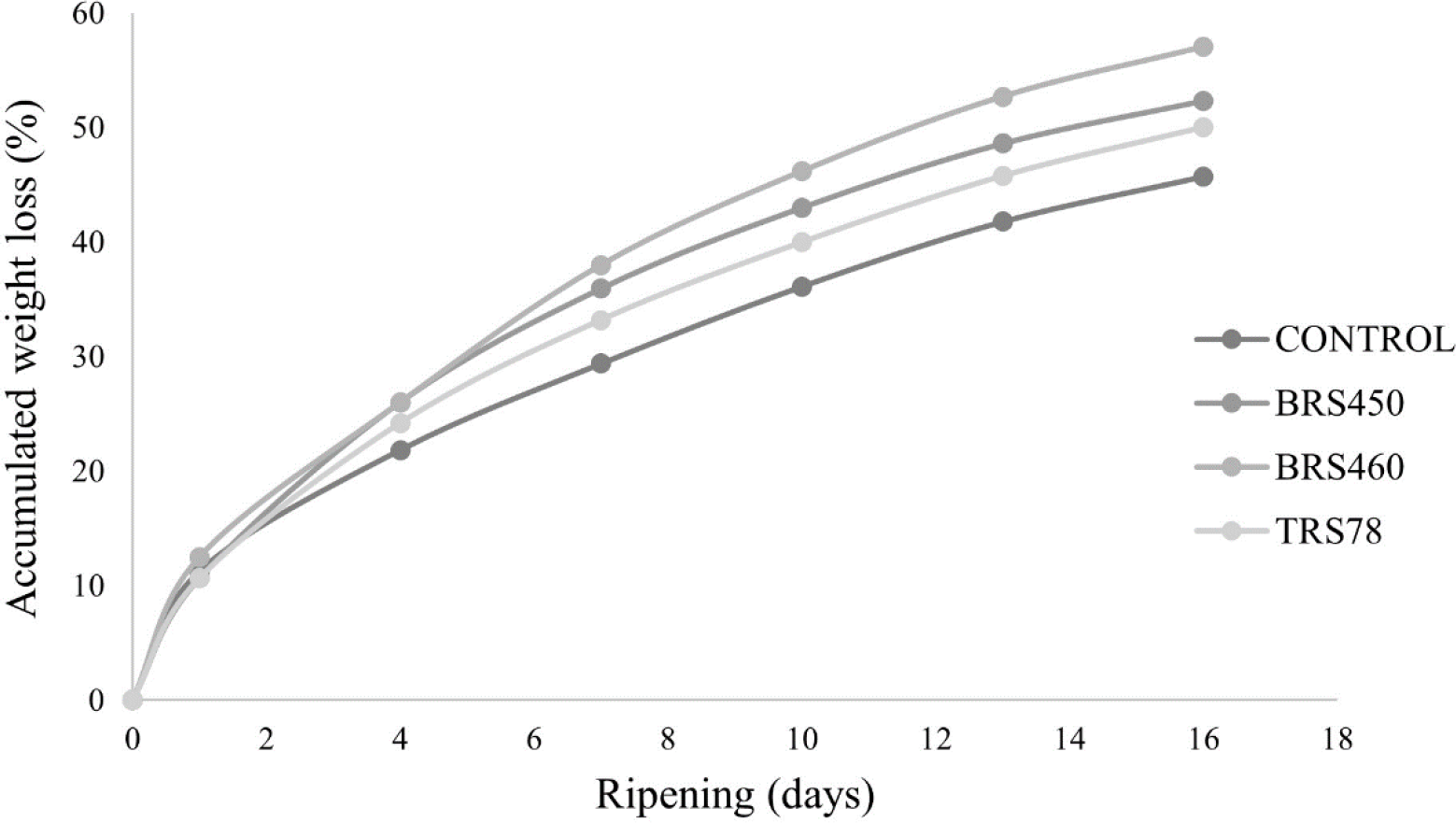
Weight loss (Figure 1) is expected during the ripening process due to water evaporation, with a gradual reduction in the moisture content of the samples. At the end of the ripening time, higher weight loss was observed for the treatments BRS460 and BRS450, with values of 57.04 and 52.35 %, respectively, when compared to the CONTROL (45.73 %). These results are due to the ease of water loss of the phosphate-containing formulations, as previously discussed in the moisture analysis.
Accumulated weight loss (%) of salami with the addition of phosphate blends during ripening. CONTROL: No phosphate; BRS450: 35-45 % sodium polyphosphate, 35-45 % sodium tripolyphosphate and 10-20 % sodium acid pyrophosphate; BRS460: 30-40 % sodium hexametaphosphate, 25-35 % sodium tripolyphosphate, and 25-35 % sodium acid pyrophosphate; and TRS78: 90-99 % sodium acid pyrophosphate and 1-10 % sodium polyphosphate.
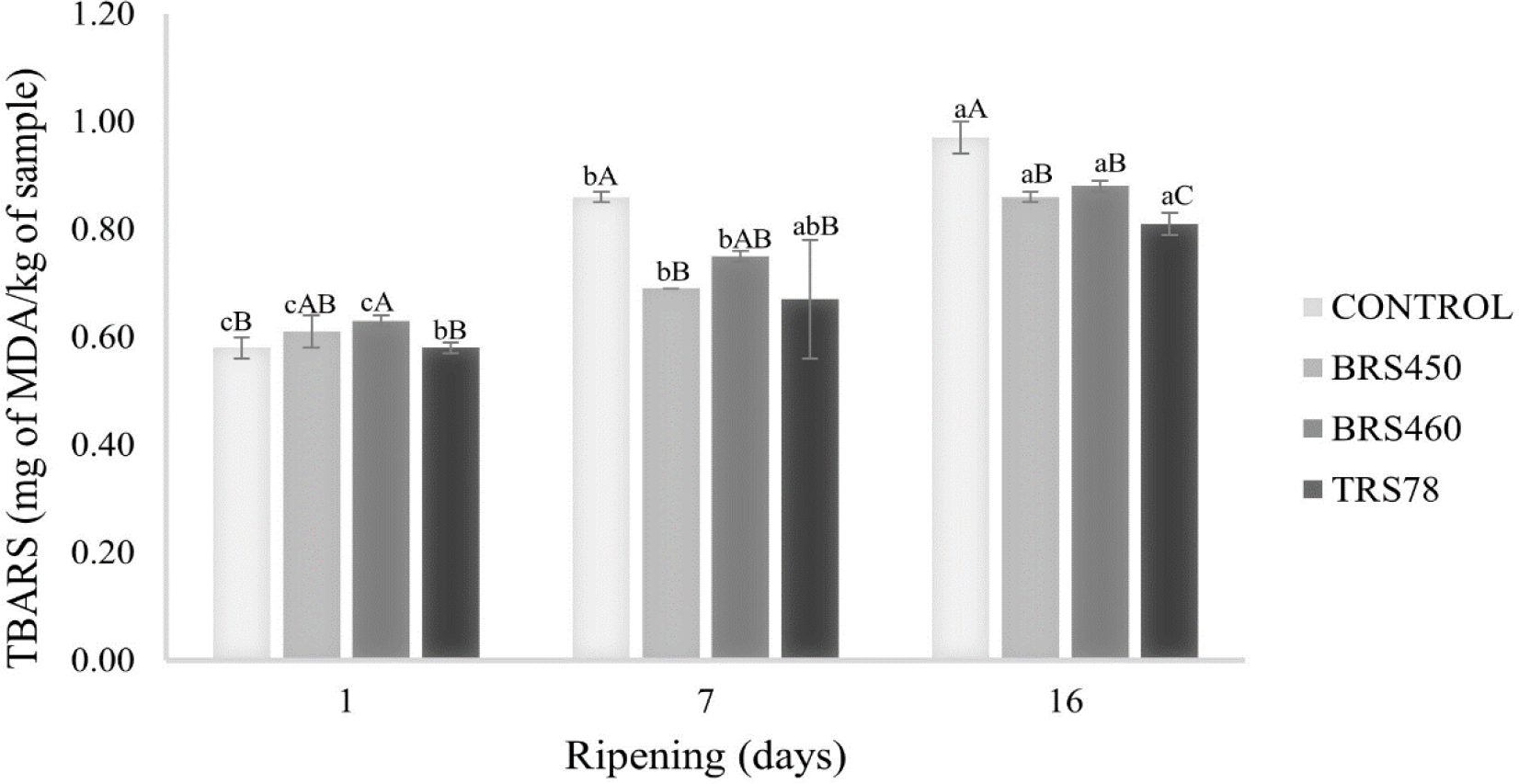
The results of the lipid oxidation analysis (Figure 2) showed a gradual increase of TBARS values, regardless of the phosphate blend used, although values were significantly lower (P < 0.05) for the phosphate-containing samples compared to the CONTROL, at the end of the ripening time (day 16). By the end of the ripening time, TRS78 showed the lowest TBARS values, followed by BRS450 and BRS460, corroborating the statement that shorter chain phosphates are less effective in controlling lipid oxidation (26, 27).
Lipid oxidation (TBARS) of salami with the addition of different phosphate blends on days 1, 7, and 16 of ripening. Averages (n = 9) followed by the same lowercase letter are not significantly different by Tukey's test (P > 0.05) for the same treatment at the different ripening times; Averages (n = 9) followed by the same uppercase letter are not significantly different by Tukey's test (P > 0.05) for the different treatments at the same ripening time; CONTROL: No phosphate; BRS450: 35-45 % sodium polyphosphate, 35-45 % sodium tripolyphosphate and 10-20 % sodium acid pyrophosphate; BRS460: 30-40 % sodium hexametaphosphate, 25-35 % sodium tripolyphosphate, and 25-35 % sodium acid pyrophosphate; and TRS78: 90-99 % sodium acid pyrophosphate and 1-10 % sodium polyphosphate.
The amount of malonaldehyde formed during the process resulted in TBARS values lower than 2.0 mg MDA/kg, for all treatments, which is accepted as a maximum level for no sensory detection of lipid oxidation (1). This finding is supported by the sensory evaluation of the attribute flavor (Table 5), which showed no significant difference between the treatments (P > 0.05).
Texture profile analysis (TPA) and shear stress of salami with the addition of phosphate blends on day 16 of ripening.
Mesophilic aerobic bacteria counts of salami (log CFU/g) with the addition of phosphate blends at days 1 and 16 of ripening.
The phosphate-containing treatments showed higher hardness and chewiness values (P < 0.05) (Table 3), probably due to the higher weight losses (water) during drying (Figure 1). The treatment BRS460 showed higher hardness when compared to the other samples, followed by BRS450, TRS78, and CONTROL. Consequently, the lower moisture values were also observed for these samples, in the same order (BRS460 < BRS450 < TRS78 < CONTROL), at the end of 16 days of ripening. Fonseca et al. (8) reported lower values than those observed in this study, with differences between the groups with phosphate addition, which presented higher hardness values when compared to CONTROL.
The lower adhesiveness was observed for BRS460 (P < 0.05) (Table 3). As reported by Herrero et al. (28), pH plays a significant role in adhesiveness, which may explain the results of the present study, as this treatment showed a higher pH value on day 16 of ripening (Table 2). In turn, the addition of phosphates increased the cohesiveness (P < 0.05). Similar results were also observed by other authors in salchichón and chorizo with the addition of phosphate blends (8).
The treatment BRS450 presented a higher shear stress, while a lower value was observed for the CONTROL (P < 0.05). During the drying of meat products, water loss leads to product shrinkage, which may promote protein aggregation and the formation of a more ordered protein network, contributing to increased firmness and sliceability (29). This phenomenon was evident in the BRS450 and BRS460 treatments, which exhibited greater water loss.
3.3 Microbiological counts of the salami
The fermentation of dry sausages, such as dry fermented sausages, confers firmness, color, and flavor to the product due to complex chemical and physical interactions associated with the multiplication of the microbiota of the batter (30).
Regarding the mesophilic aerobic bacteria counts (Table 4), there was an increase in the number of cells during the 16 days of ripening (P < 0.05) for all treatments, as also reported by Li et al. (31). The multiplication of mesophilic microorganisms is expected during the ripening of salami, mainly lactic acid bacteria, which are responsible for the fermentation of dry sausages (1).
Higher mesophilic aerobic bacteria counts were observed in the CONTROL (P < 0.05), throughout 16 days of ripening, thus phosphates were able to inhibit the multiplication of mesophilic microorganisms. suggesting that the presence of phosphates may be associated with a reduced proliferation of mesophilic microorganisms. However, fermentative bacteria do not appear to have been adversely affected, as comparable pH reductions were observed among treatments. The microbiological quality of salami is generally supported by intrinsic factors such as pH values below 5.3, reduced moisture content, and water activity below 0.92, which together contribute to limiting the growth of undesirable microorganisms, including pathogens (20).
Regarding the presence of Salmonella spp. and Escherichia coli, and coagulase-positive staphylococci counts, all salami met the standards of Normative Instruction 161 (32) which establishes the absence, less than 102 log CFU/g, and less than 10 log CFU/g, respectively. Therefore, all treatments were suitable for the sensory evaluation concerning the safety aspects.
3.4 Sensory evaluation
No significant differences were observed for the attributes color, appearance, aroma, and flavor of the treatments (P > 0.05) (Table 5), thus the addition of phosphate blends was not perceived by the assessors for these attributes.
Concerning the texture and overall acceptance, CONTROL presented the higher values, with no differences from TRS78 and BRS460. Similarly, no significant differences were observed for these two attributes among the phosphate-containing treatments (P > 0.05). The lower sensory scores observed for phosphate-containing samples may be associated with their higher hardness values, as shown in Table 3. This relationship suggests that increased hardness was negatively associated with texture perception and, consequently, with overall acceptance.
Nevertheless, all treatments presented high sensory scores (> 7), indicating that the inclusion of phosphate blends in salami formulations is feasible and does not negatively affect consumer acceptance or the overall sensory quality of the products.
4. Conclusion
The results of the present study indicate that phosphate blends can be used as a technological strategy to promote faster ripening of salami over 16 days. Phosphate addition appears to have influenced protein-water interactions, leading to enhanced moisture loss and reduced water activity, which contributed to an accelerated ripening process. Among the phosphate blends evaluated, BRS450 and BRS460 showed greater technological potential, as they promoted faster drying while maintaining lipid oxidation within acceptable limits and preserving satisfactory sensory acceptance. However, these treatments exhibited a less pronounced pH reduction, highlighting the importance of further evaluating the use of starter cultures and their interactions with phosphate blends to ensure adequate acidification. Ripening time plays a key role in determining salami quality. Therefore, the use of compounds capable of accelerating this process while maintaining product characteristics may contribute to reduced storage time, representing a potential economic advantage, given that ripening is associated with substantial time and energy costs in dry-cured meat production. For future studies, a deeper understanding of the chemical behavior of phosphates during salami ripening is recommended. This could be achieved through the application of analytical techniques such as spectroscopy and microscopy, as well as kinetic studies, to better elucidate phosphate interactions within the meat matrix.
Generative AI use statement
The authors did not use generative Artificial Intelligence tools or technologies in the creation or editing of any part of this manuscript.
Acknowledgment
The authors thank ICL Aditivos e Ingredientes LTDA and Embutidos Lamb.
Data availability statement
The complete dataset supporting the results of this study is available upon request from the corresponding author.
References
-
1 Bis-Souza CV, Penna ALB, da Silva Barretto AC. Applicability of potentially probiotic Lactobacillus casei in lowfat Italian type salami with added fructooligosaccharides: in vitro screening and technological evaluation. Meat Sci. 2020;168:108186. https://doi.org/10.1016/j.meatsci.2020.108186
» https://doi.org/10.1016/j.meatsci.2020.108186 -
2 Mohamed HMH, Burroughs S, Emch AW, Waite-Cusic J. Enhancing the reduction of Salmonella and Listeria monocytogenes during traditional salami processing by adding a finishing phase. Food Control. 2022;131:108432. https://doi.org/10.1016/j.foodcont.2021.108432
» https://doi.org/10.1016/j.foodcont.2021.108432 -
3 Tabanelli G, Barbieri F, Soglia F, Magnani R, Gardini G, Petracci M, et al. Safety and technological issues of dry fermented sausages produced without nitrate and nitrite. Food Res Int. 2022;160:111685. https://doi.org/10.1016/j.foodres.2022.111685
» https://doi.org/10.1016/j.foodres.2022.111685 -
4 Thangavelu KP, Kerry JP, Tiwari BK, McDonnell CK. Novel processing technologies and ingredient strategies for the reduction of phosphate additives in processed meat. Trends Food Sci. Technol. 2019; 94:43-53. https://doi.org/10.1016/j.tifs.2019.10.001
» https://doi.org/10.1016/j.tifs.2019.10.001 -
5 Long NHBS, Gál R, Buňka F. Use of phosphates in meat products. Afr. J. Biotechnol. 2011;10:19874-19882. https://doi.org/10.5897/AJBX11.023
» https://doi.org/10.5897/AJBX11.023 -
6 Pinton MB, Correa LP, Facchi MMX, Heck RT, Leães YSV, Cichoski AJ, et al. Ultrasound: A new approach to reduce phosphate content of meat emulsions. Meat Sci. 2019;152:88-95. https://doi.org/10.1016/j.meatsci.2019.02.010
» https://doi.org/10.1016/j.meatsci.2019.02.010 -
7 Cao C, Yuan D, Li X, Kong B, Chen Q, Sun F, et al. Reduction of phosphate content in frankfurters by up to 50 % using micronized cold-pressed sesame seed cake. Meat Sci. 2022;185:108708. https://doi.org/10.1016/j.meatsci.2021.108708
» https://doi.org/10.1016/j.meatsci.2021.108708 -
8 Fonseca B, Kuri V, Zumalacárregui JM, Fernández-Diez A, Salvá BK, Caro I, et al. Effect of the use of a commercial phosphate mixture on selected quality characteristics of 2 Spanish-style dry-ripened sausages. J Food Sci. 2011;76(5):S300-S305. https://doi.org/10.1111/j.1750-3841.2011.02199.x
» https://doi.org/10.1111/j.1750-3841.2011.02199.x -
9 de Lima Alves L, Stefanello da Silva M, Martins Flores DR, Rodrigues Athayde D, Roggia Ruviaro A, da Silva Brum D, et al. Effect of ultrasound on the physicochemical and microbiological characteristics of Italian salami. Food Res Int. 2018;106:363-373. https://doi.org/10.1016/j.foodres.2017.12.074
» https://doi.org/10.1016/j.foodres.2017.12.074 - 10 AOAC. Official methods of analysis of AOAC International. 20th ed. Washington, DC: Association of Official Analytical Chemists; 2016.
-
11 Jo C, Ahn DU. Fluorometric analysis of 2-thiobarbituric acid reactive substances in turkey. Poult Sci. 1998;77(3):475-480. https://doi.org/10.1093/ps/77.3.475
» https://doi.org/10.1093/ps/77.3.475 -
12 Matos RA, Menezes CM, Ramos EM, Ramos ADLS, Gomide LADM. Efeito do tipo de fermentação na qualidade final de embutidos fermentados cozidos elaborados à base de carne ovina. Bol Cent Pesqui Process Alim. 2007;25(2). https://doi.org/10.5380/cep.v25i2.10610
» https://doi.org/10.5380/cep.v25i2.10610 -
13 Brasil. Ministério da Agricultura, Pecuária e Abastecimento. Instrução Normativa nº 30, de 26 de junho de 2018. Estabelece como oficiais os métodos constantes do Manual de Métodos Oficiais para Análise de Alimentos de Origem Animal. [Internet]. Available at: https://sistemasweb.agricultura.gov.br/sislegis/action/detalhaAto.do?method=gravarAtoPDF&tipo=INM&numeroAto=00000030&seqAto=000&valorAno=2018&orgao=GM/MAPA&codTipo=&desItem=&desItemFim
» https://sistemasweb.agricultura.gov.br/sislegis/action/detalhaAto.do?method=gravarAtoPDF&tipo=INM&numeroAto=00000030&seqAto=000&valorAno=2018&orgao=GM/MAPA&codTipo=&desItem=&desItemFim -
14 Brasil. Ministério da Agricultura, Pecuária e Abastecimento. Instrução Normativa nº 22, de 31 de julho de 2000. Aprova os Regulamentos Técnicos de Identidade e Qualidade de Copa, de Presunto tipo Parma, de Presunto Cru, de Salame, de Salaminho, de Salame tipo Alemão, de Salame tipo Calabrês, de Salame tipo Friolano, de Salame tipo Napolitano, de Salame tipo Hamburguês, de Salame tipo Italiano, de Salame tipo Milano, de Linguiça Colonial e Pepperoni. [Internet]. Available at: https://sistemasweb.agricultura.gov.br/sislegis/action/detalhaAto.do?method=gravarAtoPDF&tipo=INM&numeroAto=00000022&seqAto=000&valorAno=2000&orgao=SDA/MAA&codTipo=&desItem=&desItemFim
» https://sistemasweb.agricultura.gov.br/sislegis/action/detalhaAto.do?method=gravarAtoPDF&tipo=INM&numeroAto=00000022&seqAto=000&valorAno=2000&orgao=SDA/MAA&codTipo=&desItem=&desItemFim -
15 Ozaki MM, Munekata PES, Jacinto-Valderrama RA, Efraim P, Pateiro M, Lorenzo JM, et al. Beetroot and radish powders as natural nitrite source for fermented dry sausages. Meat Sci. 2021;171:108275. https://doi.org/10.1016/j.meatsci.2020.108275
» https://doi.org/10.1016/j.meatsci.2020.108275 -
16 Huang J, Bakry AM, Zeng S, Xiong S, Yin T, You J, et al. Effect of phosphates on gelling characteristics and water mobility of myofibrillar protein from grass carp (Ctenopharyngodon idellus). Food Chem. 2019;272:84-92. https://doi.org/10.1016/j.foodchem.2018.08.028
» https://doi.org/10.1016/j.foodchem.2018.08.028 -
17 Lee J, Park HW, Jenkins R, Yoon WBB, Park JW. Image and chemical analyses of freezing-induced aggregates of fish natural actomyosin as affected by various phosphate compounds. Food Biosci. 2017;19:57-64. https://doi.org/10.1016/j.fbio.2017.06.007
» https://doi.org/10.1016/j.fbio.2017.06.007 -
18 Jia D, Huang Q, Xiong S. Chemical interactions and gel properties of black carp actomyosin affected by MTGase and their relationships. Food Chem. 2016;196:1180-1187. https://doi.org/10.1016/j.foodchem.2015.10.030
» https://doi.org/10.1016/j.foodchem.2015.10.030 -
19 Hu Y, Zhang L, Yi Y, Solangi I, Zan L, Zhu J. Effects of sodium hexametaphosphate, sodium tripolyphosphate and sodium pyrophosphate on the ultrastructure of beef myofibrillar proteins investigated with atomic force microscopy. Chem., 2021;338:128146. https://doi.org/10.1016/j.foodchem.2020.128146
» https://doi.org/10.1016/j.foodchem.2020.128146 -
20 Vedovatto E, Steffens C, Cansian RL, Backes GT, Verlindo R. Evaluation of different starters cultures in the obtention of Italian-type sausage. Cienc Anim Bras. 2019;20:e47777. https://doi.org/10.1590/1809-6891v20e-47777
» https://doi.org/10.1590/1809-6891v20e-47777 -
21 Delgado-Pando G, Fischer E, Allen P, Kerry JP, O’Sullivan MG, Hamill RM. Salt content and minimum acceptable levels in whole-muscle cured meat products. Meat Sci. 2018;139:179-186. https://doi.org/10.1016/j.meatsci.2018.01.025
» https://doi.org/10.1016/j.meatsci.2018.01.025 -
22 De Prados M, García-Pérez JV, Benedito J. Non-destructive salt content prediction in brined pork meat using ultrasound technology. J Food Eng. 2015;154:39-48. https://doi.org/10.1016/j.jfoodeng.2014.12.024
» https://doi.org/10.1016/j.jfoodeng.2014.12.024 -
23 Nguyen MV, Arason S, Thorarinsdottir KA, Thorkelsson G, Gudmundsdóttir A. Influence of salt concentration on the salting kinetics of cod loin (Gadus morhua) during brine salting. J Food Eng. 2010;100:225-231. https://doi.org/10.1016/j.jfoodeng.2010.04.003
» https://doi.org/10.1016/j.jfoodeng.2010.04.003 -
24 Martín-Miguélez JM, Olegario LS, González-Mohino A, Ventanas S, Delgado J. Physicochemical, sensory, and safety evaluation of dry-cured fermented sausages and their plant-based analogs. LWT-Food Sci. Technol. 2024;208:116704. https://doi.org/10.1016/j.lwt.2024.116704
» https://doi.org/10.1016/j.lwt.2024.116704 -
25 Susilo A, Widyastuti ES, Evanuarini H, Apriliyani MW. Comparison of the quality of fermented sausages with the use of yogurt starter and Lactobacillus plantarum (pH, aw, and proximate values). J. Penelit. Pendidik. IPA. 2023;9(5):2319- 2324. https://doi.org/10.29303/jppipa.v9i5.2463
» https://doi.org/10.29303/jppipa.v9i5.2463 -
26 Molina RE, Bohrer BM, Mejia SMV. Phosphate alternatives for meat processing and challenges for the industry: A critical review. Food Res Int. 2023;166:112624. https://doi.org/10.1016/j.foodres.2023.112624
» https://doi.org/10.1016/j.foodres.2023.112624 -
27 Kim YJ, Kim TK, Yun HJ, Kim J, Cha JY, Lee JH, et al. Effects of grafted myofibrillar protein as a phosphate replacer in brined pork loin. Meat Sci. 2023;199:109142. https://doi.org/10.1016/j.meatsci.2023.109142
» https://doi.org/10.1016/j.meatsci.2023.109142 -
28 Herrero AM, Ordóñez JA, de Avila R, Herranz B, de la Hoz L, Cambero MI. Breaking strength of dry fermented sausages and their correlation with texture profile analysis (TPA) and physico-chemical characteristics. Meat Sci. 2007;77:331-338. https://doi.org/10.1016/j.meatsci.2007.03.022
» https://doi.org/10.1016/j.meatsci.2007.03.022 -
29 González-Fernández C, Santos EM, Rovira J, Jaime I. The effect of sugar concentration and starter culture on instrumental and sensory textural properties of chorizo-Spanish dry-cured sausage. Meat Sci. 2006;74:46-475. https://doi.org/10.1016/j.meatsci.2006.04.019
» https://doi.org/10.1016/j.meatsci.2006.04.019 -
30 Zhang Y, Zheng S, Huang D, Xu B. Shaping microbial communities and flavor profiles: Effects of native Staphylococcus carnosus and Staphylococcus piscifermentans starter cultures in Chinese dry-fermented sausages. Food Res Int. 2026;226:118237. https://doi.org/10.1016/j.foodres.2025.118237
» https://doi.org/10.1016/j.foodres.2025.118237 -
31 Li D, Du Y, Su L, Lin Y, Zheng J, Toldrá F, Zhu C, Du M, Liu Y, Chen J. Evaluation of the lipolytic and antioxidant activities of different strains of coagulase-negative staphylococci in fermented sausages. Meat Sci. 2025;230:109932. https://doi.org/10.1016/j.meatsci.2025.109932
» https://doi.org/10.1016/j.meatsci.2025.109932 -
32 Brasil. Agência Nacional de Vigilância Sanitária. Instrução Normativa nº 161, de 1 de julho de 2022. Estabelece os padrões microbiológicos dos alimentos. [Internet]. Available at: https://anvisalegis.datalegis.net/action/ActionDatalegis.php?acao=abrirTextoAto&link=S&tipo=INM&numeroAto=00000161&seqAto=000&valorAno=2022&orgao=ANVISA/MS&codTipo=&desItem=&desItemFim=&cod_modulo=134&cod_menu=1696
» https://anvisalegis.datalegis.net/action/ActionDatalegis.php?acao=abrirTextoAto&link=S&tipo=INM&numeroAto=00000161&seqAto=000&valorAno=2022&orgao=ANVISA/MS&codTipo=&desItem=&desItemFim=&cod_modulo=134&cod_menu=1696
Edited by
-
Editor:
Luiz Augusto B. Brito