 Inclusion of soybeans in rehydrated corn grain silage
Abstract
The objective was to evaluate the bromatological and microbiological characteristics of adding raw and toasted soybeans to rehydrated corn grain silage. The experimental design used was a completely randomized design, in a 4 × 2 + 1 factorial design, with four levels of soybean inclusion (12.5, 25, 37.5, and 50 % of dry matter), two types of beans (raw and roasted), and a control treatment containing only rehydrated corn grain silage, totaling nine treatments, with five replicates each. To prepare the material, part of the soybeans was roasted, followed by grinding of all the beans and subsequent mixing with corn, according to the experimental treatments. Water was added until moisture reached 35 %. The material was ensiled in experimental silos made of polyvinyl chloride (PVC) tubes, with a capacity of 4 L, resulting in a final density of 1064 ± 83.8 kg/m3. After 60 days of fermentation, the silos were opened for pH, microbiological, and bromatological analyses. The inclusion of soybeans positively influenced the bromatological characteristics of the silage. Levels of up to 37.5 % resulted in improvements in nutritional composition, with increases in crude protein (7.1 %), extract (4 %), and mineral content (7 %), while maintaining good digestibility (84 %). Regarding the type of grain, raw soybeans provided better bromatological composition, while toasted soybeans resulted in lower concentrations of fungi and yeast.
Keywords:
digestibility; fermentation; raw grains; toasted grains.
Resumo
Objetivou-se avaliar as características bromatológicas e microbiológicas da inclusão de grãos de soja crus e tostados na silagem de grãos de milho reidratados. O delineamento experimental adotado foi o inteiramente casualizado, em esquema fatorial 4 × 2 + 1, com quatro níveis de inclusão de grãos de soja (12,5; 25; 37,5 e 50 % da matéria natural), dois tipos de grãos (crus e tostados) e um tratamento controle, contendo apenas silagem de grãos de milho reidratados, totalizando nove tratamentos, com cinco repetições cada. Para o preparo do material, parte dos grãos de soja foi submetida à tostagem, seguida da moagem de todos os grãos e posterior mistura ao milho, conforme os tratamentos experimentais. A água foi adicionada até que a umidade atingisse 35 %. O material foi ensilado em silos experimentais confeccionados com tubos de policloreto de vinila (PVC), com capacidade de 4 L, resultando em densidade final de 1064 ± 83,8 kg/m3. Após 60 dias de fermentação, os silos foram abertos para análises de pH, microbiológicas e bromatológicas. A inclusão de soja influenciou positivamente as características bromatológicas da silagem. Níveis de até 37,5 % resultaram em melhorias na composição nutricional, com aumento nos teores de proteína bruta (7,1 %), extrato etéreo (4 %) e matéria mineral (7 %), mantendo boa digestibilidade (84 %). Em relação ao tipo de grão, a soja crua proporcionou melhor composição bromatológica, enquanto a soja tostada resultou em menor concentração de fungos e leveduras. A inclusão de grãos de soja na silagem de milho reidratado melhora a composição nutricional, sendo recomendada até o nível de 37,5 %, pois garante maior teor proteico e boa digestibilidade, além de reduzir a presença de fungos e leveduras quando tostada.
Palavras-chave:
digestibilidade; fermentação; grãos crus; grãos tostados.
1. Introduction
Silage is a widely adopted strategy in livestock production for the preservation of forages and grains, allowing the continuous supply of high-quality feed throughout the year, particularly during periods of pasture shortage. Through anaerobic fermentation, this process preserves nutrients and ensures feed with good stability, palatability, and nutritional value for ruminants (1-3).
Among the various types of silage, rehydrated corn grain silage has gained prominence as an alternative ingredient in concentrate formulations.
High-moisture grain silage is a feedstuff with high energy value, characterized by elevated digestibility and high starch concentrations, which may range from 60 % to more than 70 % of the dry matter. Its composition depends on the moisture content at harvest (ideally between 30 and 40 %) and on the processing method, generally containing 60 to 70 % dry matter, 7 to 9 % crude protein, and 80 to 85 % total digestible nutrients. In addition, it has a low fiber content (neutral detergent fiber ranging from 10 to 15 %), which enhances energy utilization. This method basically consists of grinding dry corn, rehydrating it, and storing it under anaerobic conditions to promote the fermentative process. As an easily implemented practice, it may significantly contribute to grain utilization and to reducing field losses (1; 4).
However, although corn is an excellent energy source due to its high starch content, it contains low protein concentrations (7 to 9 %), making protein supplementation necessary in diets for production animals. In this context, the use of alternative ingredients during ensiling emerges as a viable strategy to improve the nutritional profile of the silage. Soybean grain, for example, has a high protein content and may be used as an alternative to soybean meal, while also presenting potentially lower costs. Depending on grain quality and climatic conditions during the soybean harvest period, raw soybean grains may lose commercial value, particularly for export purposes, thereby making their use in silage production feasible (5; 6).
The inclusion of soybean grain in rehydrated corn grain silage, either in raw or toasted form, has been investigated as a strategy to increase the nutritional value of the diet, particularly with regard to protein content. Toasting, in turn, is an effective technique for inactivating antinutritional factors present in raw soybean grains, which may impair nutrient digestibility and absorption in animals (7; 8).
In this context, the inclusion of soybean grains in rehydrated corn grain silage has the potential to improve the protein content of the ensiled material, thereby enhancing dietary quality. Therefore, the objective of this study was to evaluate the bromatological and microbiological characteristics of rehydrated corn grain silage containing raw and toasted soybean grains.
2. Material and methods
The experiment was conducted at the Teaching Farm of the Universidade Professor Edson Antônio Velano (UNIFENAS), with approval from the Ethics Committee under protocol number 8248200220.
Corn and soybean grains used in the experiment were acquired directly from producers in the region of Alfenas, Minas Gerais, Brazil. The grains were evaluated for moisture content, which was subsequently considered for the rehydration process, as well as for their bromatological composition and pH. Table 1 presents the bromatological composition and pH values of the grains.
Bromatological composition (g/kg) and pH of corn and soybean grains obtained from producers in the region of Alfenas, Minas Gerais, Brazil.
A completely randomized design (CRD) was adopted in a 4 × 2 + 1 factorial arrangement, consisting of four soybean inclusion levels (12.5, 25, 37.5, and 50 %) × two soybean grain forms (raw and toasted), plus one control treatment composed exclusively of rehydrated corn grain silage, with five replicates per treatment.
For grain preparation and ensiling, part of the soybean grains was initially subjected to a toasting process. The grains were placed in aluminum trays, homogenized, and toasted in an industrial electric oven (model PRP-004, Progas®, Caxias do Sul, RS, Brazil) at 160 °C for 10 minutes.
Subsequently, dry corn grains and raw and toasted soybean grains were ground using a Wiley-type mill (model TE-650, Tecnal®, Piracicaba, SP, Brazil) equipped with an electric motor and 500-W power output. Sieves with 4-mm mesh openings were used for corn grains and 8-mm mesh openings for soybean grains. Ground soybean grains were mixed with ground corn at inclusion levels of 12.5, 25, 37.5, and 50 % on a dry matter basis. Water was then added to the material until a final moisture content of 35 % was achieved, calculated according to the equation adapted from Ferreira (9), where:
∆H₂O = volume of water to be added; UM = product mass on a natural matter basis (kg); Uf = final moisture (%); Ui = initial moisture (%); and p = water density (kg/L).
The homogenized mass was ensiled in experimental silos made of polyvinyl chloride (PVC) tubes with a capacity of 4 L, reaching a final density of 1064 ± 83.8 kg/m3. Wooden pendulums were used to compact the silage until a density of approximately 1000 kg/m3 was achieved. After compaction, the silos were sealed with adhesive tape and weighed again. Each tube was fitted with a lid adapted with a Bunsen-type valve to allow gas release.
After 60 days of fermentation, the silos were weighed and opened, and the superficial layer of each silo was discarded. The central portion of the ensiled mass was transferred to plastic trays, homogenized, and sampled for subsequent analyses.
Microbiological analyses were performed to quantify lactic acid bacteria, filamentous fungi, and yeasts. For this purpose, 125-g samples (25 g from each replicate) were sent to the Soil Microbiology Laboratory (LMS) of UNIFENAS for serial dilution analysis, based on successive dilutions of the sample in sterile solution for viable microorganism quantification. For dilution preparation, 10 g of sample were homogenized in 90 mL of saline solution (0.55 % sodium chloride, NaCl) under orbital agitation at 120 rpm for 20 minutes. Subsequently, 1 mL of this solution was transferred into test tubes containing 9 mL of the same saline solution, and the procedure was repeated until reaching a 10⁻9 dilution. From each dilution, a 30-µL aliquot was inoculated onto Petri dishes containing the following culture media: de Man, Rogosa and Sharpe agar (MRS) for lactic acid bacteria counts, and potato dextrose agar (PDA) for filamentous fungi and yeast counts, using the surface spread plate technique. Plates were incubated in a controlled-temperature incubator at 30 °C for bacteria and 25 °C for filamentous fungi and yeasts for 48 hours. Plating was performed in triplicate, and colony counts were conducted after the incubation period.
Bromatological analyses were carried out at the Bromatology Laboratory (LB) of UNIFENAS. For this purpose, 200-g samples were pre-dried in a forced-air circulation oven at 55 °C for 72 hours. After pre-drying, samples were ground in a Wiley-type mill (model TE-650, Tecnal®, Piracicaba, SP, Brazil) using a 1-mm mesh sieve and stored in sealed plastic containers. Total dry matter (DM) was determined in a forced-air circulation oven (model TE 394/3, Tecnal®, Piracicaba, SP, Brazil) at 105 °C for 16 hours according to AOAC (10). Crude protein (CP) content was determined from nitrogen concentration measured using a micro-Kjeldahl steam nitrogen distiller (model TE-0364, Tecnal®, Piracicaba, SP, Brazil), with CP calculated by multiplying nitrogen concentration by the conversion factor of 6.25 (11). Ether extract (EE) content was determined using a fat analyzer (model TE-044, Tecnal®, Piracicaba, SP, Brazil) according to the Randall extraction method, consisting of direct extraction for four hours (11). Fiber fraction analysis included neutral detergent fiber (NDF) and acid detergent fiber (ADF), determined using a Tecnal® apparatus (model TE-149) according to the methodology described by Van Soest et al. (12). Mineral matter (MM) was determined by sample incineration at 550 °C for five hours (11).
For the in vitro digestibility analysis, one female bovine weighing approximately 500 kg and belonging to the Instituto Federal do Sul de Minas Gerais (IFMG), Machado Campus, was used. The animal was fed corn and soybean silage for a 15-day adaptation period. Ruminal fluid collection was performed in the morning before feeding using an esophageal probe coupled to a vacuum pump for rumen content aspiration. After collection, the ruminal fluid was transported to the Bromatology Laboratory of UNIFENAS, where it was homogenized, filtered, and subjected to pH measurement. Subsequently, the fluid was mixed with an artificial saliva buffer solution at a 4:1 ratio. The in vitro dry matter digestibility coefficient (IVDMD) was determined using the indirect method proposed by Tilley and Terry (13).
Data were subjected to analysis of variance (ANOVA) using the R statistical software (R Core Team, 2024). Soybean inclusion levels were analyzed by regression analysis, whereas soybean form was compared using Tukey’s test (p < 0.05). The studied variables were subjected to ANOVA according to the following statistical model:
where Yijk is the observed value of the response variable; μ is the overall mean; Ni is the effect of soybean inclusion levels (i = 1, 2, 3, 4); Sj is the effect of soybean form (raw or toasted); (N × S)ij is the interaction effect between soybean inclusion level and soybean form; C is the effect of the control treatment (rehydrated corn grain silage without soybean); and ɛijk is the random error associated with each observation, assuming normal distribution N(0,σ2).
3. Results and discussion
The inclusion of soybean grain in rehydrated corn grain silage improved the bromatological characteristics of the product. The pH values showed an interaction effect (P < 0.05; Table 2). The pH of silages containing both raw and toasted soybean grains increased linearly as soybean inclusion levels increased (Table 2). However, toasted soybean grains resulted in higher pH values than raw soybean grains at all inclusion levels, except at the 50 % inclusion level.
Bromatological composition of corn grain silage containing different inclusion levels of raw or toasted soybean grains in rehydrated grain silage.
The increase in pH as a function of higher soybean inclusion levels was expected due to the greater concentration of protein compounds present in soybean grains, which exert a buffering effect during fermentation and interfere with pH reduction (14). According to Kung et al. (15) , wellpreserved silages exhibit pH values below 4.2. Therefore, it can be inferred that corn grain silages containing soybean inclusion exhibited good fermentative capacity, since all silages evaluated in this study presented pH values below 4.2 at silo opening.
Regarding bromatological parameters, an interaction effect between soybean inclusion levels and soybean form added to the silage was observed for dry matter (DM) content (P < 0.05; Table 2). As raw soybean inclusion increased, DM content decreased linearly (P < 0.05; Table 2). In contrast, this effect was not observed when toasted soybean grains were used. Furthermore, differences between soybean forms were detected at the 37.5 and 50 % inclusion levels, with silages containing toasted soybean grains presenting higher DM contents than those containing raw soybean grains (P < 0.05; Table 2).
Regarding microbiological development in corn grain silage containing soybean inclusion, a linear increase in lactic acid bacteria concentration was observed, in addition to an interaction effect between soybean inclusion levels and soybean form for filamentous fungi and yeast concentrations (P < 0.05; Table 3).
Microbial growth of bacteria and fungi (Log CFU/g) in corn grain silage containing different inclusion levels of raw or toasted soybean grains in rehydrated grain silage.
The increase in lactic acid bacteria concentration with increasing soybean grain levels may be associated with the good fermentative quality of the material, as evidenced by the pH values, since well-preserved silages present pH values below 4.2 (P < 0.05; Table 2) (15). According to Macêdo et al. (16), lactic acid bacteria predominate in well-fermented silages, promoting mass preservation and ensuring improved nutritional quality. These bacteria are essential for an adequate fermentation process because they promote material acidification, resulting in pH reduction and consequently inhibiting the development of undesirable microorganisms (17).
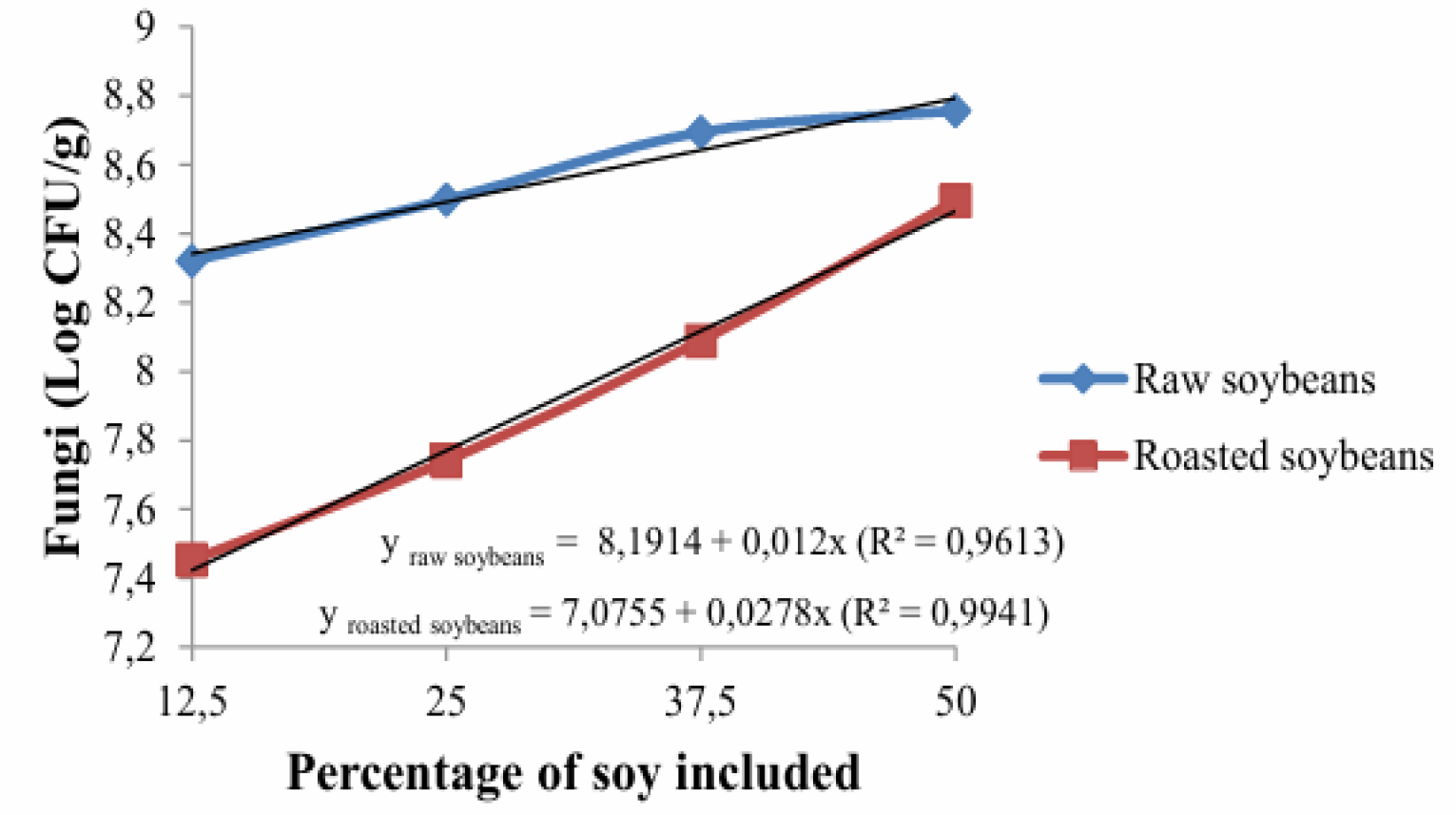
Regarding the development of filamentous fungi and yeasts, both raw and toasted soybean addition linearly increased the concentration of these microorganisms as soybean inclusion levels increased (Figure 1). However, toasted soybean grains showed lower concentrations of filamentous fungi and yeasts compared with raw soybean grains up to the 37.5 % inclusion level.
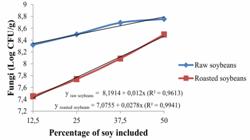
Development of filamentous fungi (Log CFU/g) at increasing inclusion levels of raw and toasted soybean grains in rehydrated corn grain silage.
The reduction in filamentous fungi and yeast concentrations with the addition of toasted soybean grains may be attributed to the adequate DM contents observed in this experiment, an important factor in preventing undesirable fermentations that degrade nutrients and favor toxin production. Furthermore, this reduction may also be associated with pH values, which directly influence silage acidity and, according to Santos et al. (18), contribute to decreased proteolytic activity, thereby controlling or inhibiting the development of undesirable microorganisms such as Clostridium.
Filamentous fungi are strictly aerobic microorganisms, whereas some yeast species are facultative anaerobes capable of metabolizing soluble sugars and lactic acid. The activity of these yeasts may promote pH elevation, creating favorable conditions for the development of filamentous fungi in the presence of oxygen, which may subsequently produce mycotoxins (19). Jobim et al. (19) and Muck (20) reported that appropriate management practices, avoiding prolonged exposure of silage to air during handling, combined with adequate dry matter content and proper moisture levels during silage preparation, positively contribute to product quality by reducing the proliferation of spoilage microorganisms.
According to Jobim et al. (21) and Benini et al. (22), rehydrated corn grain silage generally presents DM contents ranging from 64 to 70 %, corroborating the values observed in the present study. Similar results were also reported by Rezende et al. (4), who observed that rehydrated corn grain silages prepared with acid whey exhibited higher DM contents than those rehydrated with water (649.2 vs. 628.5 g/kg).
Regarding crude protein (CP), an effect of soybean inclusion level was observed, with a linear increase in CP content as soybean inclusion levels increased (P < 0.05; Table 2). This result was expected due to the high CP concentration naturally present in soybean grains. Conversely, no differences were observed between soybean forms added to the silage (P > 0.05; Table 2). The inclusion of soybean grains, as well as other additives in corn grain silage, may be advantageous because it increases the nutritional value of the material, particularly regarding CP and energy content. In this regard, Jobim et al. (23), evaluating high-moisture corn grain silage containing soybean grains, confirmed the feasibility of this practice and reported positive results, observing increased CP content without impairing the preservation of the ensiled material. Therefore, increasing soybean grain inclusion levels may improve the nutritional value of silage, which, when associated with forage, may meet the nutritional requirements of ruminants and consequently promote satisfactory productive performance (2).
Ether extract (EE) content showed an interaction effect, with a linear increase observed for both toasted and raw soybean addition as soybean inclusion levels increased (P < 0.05; Table 2). However, the inclusion of 37.5 and 50 % toasted soybean grains resulted in higher EE values than those observed for raw soybean grains. This finding may be explained by losses occurring during the toasting process, particularly moisture reduction, which consequently increases the concentration of the lipid fraction. In general, the linear increase in EE content is attributed to the high oil concentration naturally present in soybean grains. According to Bellaver et al. (24), soybean grains contain approximately 17 to 18 % oil, which is substantially higher than the levels recommended for ruminant diets, generally around 8 to 10 % EE. According to Valadares Filho and Pina (25), excessive lipid concentrations may interfere with ruminal fermentation in ruminants. Based on these findings, soybean grain inclusion levels up to 37.5 % in rehydrated corn grain silage may be considered acceptable, thereby ensuring adequate nutrient utilization by ruminants.
Neutral detergent fiber (NDF) content showed an interaction effect, with a linear increase observed as soybean inclusion levels increased, regardless of soybean form (raw or toasted) (P < 0.05; Table 2). Except for the 12.5 % soybean inclusion level, at which no differences were observed between soybean forms, toasted soybean addition resulted in higher NDF contents than raw soybean addition (P < 0.05; Table 2). This result may be related to the concentration of structural components present in the soybean outer layer, which may have been intensified during the toasting and ensiling processes. Rehydrated or high-moisture grain silages may undergo different processing methods. In addition to temperature, processing time, and inclusion level, moisture content during ensiling may also influence the bromatological composition of the final product.
A linear increase in acid detergent fiber (ADF) content was observed as soybean inclusion levels increased in corn grain silage (P < 0.05; Table 2). This increase may be attributed to the higher ADF concentration present in soybean grains, whose hulls contain elevated cellulose levels, thereby explaining the increased ADF content in the silage and its potential interference with feed digestibility. According to Van Soest (12), NDF and ADF contents are negatively correlated with feed intake and digestibility. Pinto et al. (26), evaluating the quality of high-moisture grain silages from different forage species, observed that sunflower silage exhibited higher ADF contents due to the greater fiber concentration present in this type of grain, similarly to soybean grains. Nussio et al. (27) reported that ADF contents around 40 % or higher may negatively affect silage digestibility and consequently impair animal diet quality.
Regarding IVDMD, no interaction effect was observed (P > 0.05; Table 2). However, a linear decrease in IVDMD was observed as soybean grain inclusion levels increased in corn grain silage (P < 0.05; Table 2), indicating that higher soybean inclusion levels resulted in lower digestibility. This result may be attributed to the linear increase in NDF and ADF contents associated with soybean addition, since higher fiber concentrations reduce digestibility. According to Van Soest (12), these variables negatively affect feed intake and digestibility. Another limiting factor may have been the increase in EE content. According to Valadares Filho and Pina (25), excessive lipid concentrations may interfere with ruminal fermentation and digestive enzyme activity.
In a study conducted by Vasconcelos et al. (8), evaluating intestinal digestibility through 16hour in situ incubation using the three-stage technique, effective DM degradability at a passage rate of 5 %/hour was 71.94 % for raw soybean grains and ranged from 52.23 to 68.78 % for toasted soybean grains. In the present study, in vitro digestibility was evaluated, which may explain the discrepancy between the results obtained.
Previous studies have reported increased dry matter digestibility in high-moisture or rehydrated corn grain silage. Jobim et al. (23) observed that high-moisture corn grain silage containing 20 % soybean grain reduced the effective degradability of dry matter and crude protein.
A linear increase in mineral matter (MM) content was observed as soybean grain inclusion levels increased in corn silage (P < 0.05; Table 2), a result expected due to the mineral concentration naturally present in soybean grains. Soybean addition during ensiling improved the nutritional quality of the final product, since soybean grains, compared with other legumes, present more favorable characteristics for silage production due to their richer nutritional composition (6).
Overall, when comparing rehydrated corn grain silage containing soybean grains with the control treatment (corn grain silage without soybean addition), soybean inclusion resulted in significant nutritional advantages, including higher CP, EE, and MM contents (P < 0.05; Table 4). This effect may be attributed to the nutritional composition of soybean grains, which increased the concentration of these nutrients in the silage. According to Tres et al. (28), increased nutrient concentrations in silage are of considerable interest to producers, particularly because they may reduce costs associated with concentrate supplementation.
Comparison between the mixture of rehydrated corn and soybean grains and rehydrated corn grain silage without soybean addition.
The addition of soybean grains to silage provides significant advantages regarding the nutritional quality of the final product, particularly in terms of CP and EE contents. This behavior is related to the nutritional composition of soybean grains, which contain high CP concentrations ranging from 35 to 37 % of high biological value, with a favorable essential amino acid profile, in addition to 17 to 18 % oil, thereby providing both protein and energy supply (24). According to Jobim et al. (23), rehydrated corn grain silage may exhibit improved nutritional value through the inclusion of oilseed grains, with soybean representing a viable alternative. In this context, the authors emphasized that efficient preservation of these feeds is essential to minimize nutritional losses and ensure satisfactory results.
Regarding pH, higher values were observed in corn grain silage containing soybean grains (4.02; P < 0.05; Table 4) compared with silage composed exclusively of corn grains (3.81). This increase may be attributed to the greater concentration of protein compounds present in soybean grains, which, according to Jobim et al. (5), hinder pH reduction and negatively influence this variable. Furthermore, Lempp et al. (14) reported that, depending on the concentration of soybean grains added to corn, reductions in water-soluble carbohydrate concentrations and increases in buffering capacity may occur, impairing lactic fermentation and interfering with silage acidification.
When digestibility was evaluated by comparing corn grain silage containing soybean grains with rehydrated corn grain silage without soybean addition, silage composed exclusively of corn grains exhibited higher digestibility percentages (P < 0.05; Table 4). This result is attributed to a more favorable fermentation pathway during the ensiling process. In rehydrated grain silage, greater breakdown of the protein matrix occurs, promoting increased availability of starch granules and favoring the fermentative process, resulting in higher-quality silage and consequently improved digestibility for animals (23; 4).
When comparing the mixture of rehydrated corn and soybean grains with silage composed exclusively of corn grains, higher growth of lactic acid bacteria was observed in the soybeancontaining mixture (P < 0.05; Table 4). This result was expected, since this combination presented superior bromatological composition, driven by the nutritional quality of soybean grains and by the good fermentative capacity during ensiling, as evidenced by the pH values. Ávila et al. (29) reported that the more adequate the pH values are for the fermentation process, the lower the negative impacts on silage characteristics and quality.
Regarding the growth of filamentous fungi and yeasts, no differences were observed between corn grain silage containing soybean grains and silage composed exclusively of corn grains (P > 0.05; Table 5). The type of ensiled material may or may not favor the development of undesirable microorganisms, whose activity is directly associated with fermentation conditions such as pH reduction, moisture content, and dry matter concentration (16).
4. Conclusion
The inclusion of soybean grains in rehydrated corn grain silage promoted improvements in the nutritional quality of the silage, with progressive increases in crude protein, ether extract, and mineral matter contents. Inclusion levels up to 37.5 % ensured adequate nutritional composition and digestibility, representing the recommended upper limit for practical application. The use of raw soybean grains resulted in a more favorable bromatological profile, whereas toasted soybean grains reduced the occurrence of filamentous fungi and yeasts, thereby improving the microbiological stability of the ensiled material. Overall, soybean addition to rehydrated corn grain silage represents an effective strategy to enhance nutritional value and ensure satisfactory fermentative quality.
Generative AI use statement
The authors did not use generative Artificial Intelligence tools or technologies in the creation or editing of any part of this manuscript.
Acknowledgements
The authors thank CAPES and FAPEMIG for providing master’s and doctoral scholarships.
Data availability statement
The complete dataset supporting the findings of this study is available from the corresponding author upon reasonable request.
References
-
1 Jobim, CC, Reis, RA, Rodrigues, LRD. Avaliação da silagem de grãos úmidos de milho. Pesquisa Agropecuaria Brasileira. 1997; 32(3):311-315. Available from: https://doi.org/10.1590/S1678-3921.pab1997.v32.4641
» https://doi.org/10.1590/S1678-3921.pab1997.v32.4641 -
2 Mombach MA, Pereira DH, Pina DS, Bolson DC, Pedreira BC. Silage of rehydrated corn grain. Arquivo Brasileiro de Medicina Veterinária e Zootecnia. 2019;71(3): 959-966. Available from: https://doi.org/10.1590/1678-4162-9676
» https://doi.org/10.1590/1678-4162-9676 -
3 Benini MC, Carvalho WTV, Pereira RVG, Tavares QG, Minighin DC, Nunes RFJ, Souza LPF, Ribeiro CHM, Silva LV. Avaliação química da silagem de grão de milho reidratado em diferentes níveis de água. Pubvet. 2020;14(7):1-6. Available from: https://doi.org/10.31533/pubvet.v14n7a612.1-6
» https://doi.org/10.31533/pubvet.v14n7a612.1-6 -
4 Rezende AV, Rabelo CHS, Veiga RM, Andrade LP, Harter CJ, Rabelo FHS, Basso FC, Nogueira DA, Reis RA. Rehydration of corn grain with acid whey improves the silage quality. Animal Feed Science and Technology. 2014;197:213221. Available from: https://doi.org/10.1016/j.anifeedsci.2014.07.009
» https://doi.org/10.1016/j.anifeedsci.2014.07.009 -
5 Jobim CC, Moyses CJ, Valter Harry BJ, Oliveira FL. Composição química e qualidade de conservação de silagens de grão de milho (Zea mays L.) com diferentes níveis de grãos de soja (Glycine max Merril). Semina Ciênc Agrár. 2010;31(3):773-781. Available from: https://doi.org/10.5433/1679-0359.2010v31n3p773
» https://doi.org/10.5433/1679-0359.2010v31n3p773 -
6 Gobetti STC, Neumann M, Oliveira M, Oliboni R. Produção e utilização da silagem de planta inteira de soja (Glycine max) para ruminantes. Ambiência. 2011;7(3):603-616. Available from: https://doi.org/10.5777/ambiencia.2011.03.02rb
» https://doi.org/10.5777/ambiencia.2011.03.02rb -
7 Lima CB, Guilherme FP, Costa JVL, Lima Júnior DM, Mariz TMA, Pereira AP, Silva GM, Almeida AAC. Fatores antinutricionais e processamento do grão de soja para alimentação animal. Agropecuária Científica no Semiárido. 2014;10(4):24-33. Available from: https://doi.org/10.30969/acsa.v10i4.452
» https://doi.org/10.30969/acsa.v10i4.452 -
8 Vasconcellos AM, Dias M, Nascimento VA, Rogério MCP, Façanha DAE. Degradabilidade ruminal e digestibilidade intestinal dos grãos de soja cru e tostado em bovinos leiteiros. Revista Brasileira de Saúde e Produção Animal. 2016;17(4):744-752. Available from: https://doi.org/10.1590/S1519-99402016000400017
» https://doi.org/10.1590/S1519-99402016000400017 - 9 Ferreira WA. Armazenamento de grãos de cereais. In: Cereda MP, Sanches L. Manual de armazenamento e embalagem de produtos agropecuários. Botucatu: Unesp; 1983. p.96-128. Português.
- 10 Association of Official Analytical Chemists (AOAC). Official methods of analysis. 16th ed. Arlington: AOAC International; 1995. 1141p. English.
- 11 Association of Official Analytical Chemists (AOAC). Official methods of analysis. 15th ed. Washington, DC: AOAC; 1990. 1094p. English.
- 12 Van Soest PJ. Nutritional ecology of the ruminant. 2nd ed. Ithaca: Cornell University Press; 1994. 476p. English.
- 13 Tilley JMA, Terry RA. A two stage technique for in vitro digestion of forages crops. J Br Grassl Soc. 1963;18:104-111.
-
14 Lempp B, Moraes MG, Souza LCF. Produção de milho em cultivo exclusivo ou consorciado com soja e qualidade de suas silagens. Arq Bras Med Vet Zootec. 2000;52(3):243-249. Available from: https://doi.org/10.1590/S010209352000000300013
» https://doi.org/10.1590/S010209352000000300013 - 15 Buxton DR, Muck RE, Harrison JH. Silage science and technology. Madison: ASA-CSSA-SSSA; 2003. 897p. English.
-
16 Macêdo AJS, Santos EM, Oliveira JS, Perazzo AF. Microbiologia de silagens: Revisão de Literatura. REDVET Rev Electr Vet. 2017;18(9):1-11. Available from: https://www.redalyc.org/pdf/636/63653009020.pdf
» https://www.redalyc.org/pdf/636/63653009020.pdf - 17 Pahlow G, Muck RE, Driehuis F, Oude Elferink SJWH, Spoelstra SF. Microbiology of ensiling. In: Buxton DR, Muck RE, Harrison JH. Silage science and technology. Madison: ASA-CSSA-SSSA; 2003. p.31-94. English.
-
18 Santos RD, Pereira LGR, Neves ALAL, Araújo GG, Voltolini TV, Brandão LGN, Aragão ASL, Dórea JRR. Características de fermentação da silagem de seis variedades de milho indicadas para a região semiárida brasileira. Arq Bras Med Vet Zootec. 2010;62(6):1423-1429. Available from: https://doi.org/10.1590/S0102-09352010000600019
» https://doi.org/10.1590/S0102-09352010000600019 -
19 Jobim CC, Nussio LG, Reis RA, Schmidt P. Methodological advances in evaluation of preserved forage quality. Rev Bras Zootec. 2007;36:101-119. Available from: https://doi.org/10.1590/S1516-35982007001000013
» https://doi.org/10.1590/S1516-35982007001000013 -
20 Muck RE. Silage microbiology and its control through additives. Rev Bras Zootec. 2010;39:183-191. Available from: https://doi.org/10.1590/S1516-35982010001300021
» https://doi.org/10.1590/S1516-35982010001300021 -
21 Jobim CC, Reis RA, Rodrigues LRA. Avaliação da silagem de grãos úmidos de milho. Pesq Agropec Bras. 1997;32(3):311-315. Available from: http://seer.sct.embrapa.br/index.php/pab/article/view/4641
» http://seer.sct.embrapa.br/index.php/pab/article/view/4641 -
22 Benini MDC, Carvalho WTV, Pereira RVG, Tavares QG, Minighin DC, de Jesus Nunes R F, Souza LPF, Ribeiro CHM, Silva LV. Avaliação química da silagem de grão de milho reidratado em diferentes níveis de adição de água. Pubvet, 2020; 14(7):1-6. Available from: https://doi.org/10.31533/pubvet.v14n7a606.1-7
» https://doi.org/10.31533/pubvet.v14n7a606.1-7 -
23 Jobim CC, Lombardi L, Macedo FAF, Branco AF. Silagens de grãos de milho puro e com adição de grãos de soja, de girassol ou ureia. Pesq Agropec Bras. 2008;43(5):649-656. Available from: https://doi.org/10.1590/S0100204X2008000500013
» https://doi.org/10.1590/S0100204X2008000500013 - 24 Bellaver C, Cotrefal G, Grecco M. Soja integral: processamento e uso. Aliment Anim. 2002;7:28-30.
- 25 Valadares Filho SC, Pina, DS. Fermentação Ruminal. In: Berchielli TT, PIRES AV, OLIVEIRA SG. Nutrição de Ruminantes. Jaboticabal: FUNEP; 2011. p.161-191. Português.
- 26 Pinto MS, Dias FJS, Costa KAP, Banys VL, Ribeiro MG. Qualidade da silagem de grãos úmidos de diferentes forrageiras. Gl Sci Technol. 2012;5(3):124-136.
- 27 Nussio LG, Simas JEC, Lima MLM. Determinação do ponto de maturidade ideal para colheita do milho para silagem. In: Nussio LG, Zopollato M, Moura JC. Milho para a silagem. Piracicaba: FEALQ; 2001. p.11-26. Português.
- 28 Tres TT, Jobim CC, Rossi RM, Silva MS, Poppi EC. Silagem de grãos de milho com adição de soja: estabilidade aeróbica e desempenho de vacas leiteiras. Rev Bras Saúde Prod Anim. 2014;15:248-260.
-
29 Avila NRB, Silva NCD, Leite RF, Florentino LA, Rezende AV. Utilização de silagem do grão de milho reidratado e de resíduo de tilápia na alimentação animal. Ciênc Anim. 2018;28(1):145-161. Available from: https://revistas.uece.br/index.php/cienciaanimal/article/view/11125
» https://revistas.uece.br/index.php/cienciaanimal/article/view/11125
Edited by
-
Editor: Rondineli P. Barbero