 Social inclusion and occupational engagement in disaster recovery: an analysis of community-driven action using the CORE Approach
Abstract
Introduction With disaster events disrupting occupational engagement and magnifying social exclusion, there is a need to focus on social inclusion in the context of occupation-focussed disaster recovery. The Capabilities, Opportunities, Resources and Environments (CORE) approach provides one means through which to do so. Using the CORE approach as an analytical tool, this study explores Australian community members’ experiences of disaster recovery, through analysis of narratives from the COVID-19 pandemic and bushfires that took place around Australia in the period 2019- 2022.
Objective To explore the capabilities, opportunities, resources and environments that support occupational engagement and social inclusion after a disaster event.
Method In this qualitative study, an analysis of extant data in the form of narratives from the publication Doing Our Best: Individual and Community Responses to Challenging Times was undertaken (Occupational Therapy Australia, 2022). A reflexive thematic analysis aligning with a constructionist and interpretive epistemology and ontology was utilised.
Results In adapting to challenges associated with disaster events, community members described participation in meaningful occupation-based solutions that: aligned with personal, family and community values and supported capabilities built through previous life experiences. They also described the opportunities, resources and environments that supported social inclusion.
Conclusion Narrative exploration using the CORE Approach has potential therapeutic benefit in disaster recovery, with the process supporting occupational therapists to engage in a truly collaborative pursuit of authentic occupational outcomes in disaster recovery work.
Keywords
Disaster Response; Occupational Therapy; Psychosocial Impact; Social Planning
Resumo
Introdução Com eventos de desastres interrompendo o engajamento ocupacional e ampliando a exclusão social, toma-se necessário focar na inclusão social dentro do contexto da recuperação pós-desastres, com destaque para a dimensão ocupacional. A abordagem conhecida como CORE (sigla em inglês para Capacidades, Oportunidades, Recursos e Ambientes) oferece um meio para isso. Utilizando a abordagem CORE como ferramenta analítica, este estudo explora as experiências de membros da comunidade australiana durante a recuperação pós-desastres, por meio da análise de narrativas relacionadas à pandemia de COVID-19 e aos incêndios florestais ocorridos na Austrália entre 2019 e 2022.
Objetivo Explorar as capacidades, oportunidades, recursos e ambientes que promovem o engajamento ocupacional e favorecem a inclusão social após eventos de desastre.
Método Neste estudo qualitativo, foi realizada uma análise de dados existentes, compostos por narrativas extraídas da publicação Doing Our Best: Individual and Community Responses to Challenging Times, lançada pela Occupational Therapy Australia em 2022. Empregou-se uma análise temática reflexiva, alinhada às perspectivas epistemológicas e ontológicas construcionistas e interpretativa.
Resultados Ao se adaptarem aos desafios decorrentes de eventos de desastre, os membros da comunidade relataram sua participação em soluções ocupacionais significativas, alinhadas a valores pessoais, familiares e comunitários, além de sustentadas pelas capacidades desenvolvidas ao longo de experiências de vida anteriores. Também ressaltaram as oportunidades, os recursos e os ambientes que promoveram a inclusão social.
Conclusão A exploração narrativa por meio da Abordagem CORE apresenta potencial terapêutico na recuperação pós-desastres, ao apoiar terapeutas ocupacionais no engajamento de uma busca genuinamente colaborativa por resultados ocupacionais autênticos no processo de recuperação.
Palavras-chave:
Respostas em Desastres; Terapia Ocupacional; Impacto Psicossocial; Planejamento Social
Introduction
In disaster events, the environments, resources and/or opportunities for engaging in necessary or meaningful occupation can be restricted (Carra et al., 2019; Rushford & Thomas, 2016; Rushford et al., 2015), with adversities experienced in such events having the potential to limit occupational engagement and amplify pre-disaster inequalities (Gardoni & Murphy, 2008; Hammell, 2021). Some subsections of the community are at higher risk of social exclusion, experiencing greater vulnerabilities to disasters as well as greater difficulties recovering from the losses due to a disaster, as has been shown for low-income households, ethnic minorities, people living with a disability, children (0-4 years) and the elderly (> 65 years) (Gardoni & Murphy, 2008; Ogie & Pradhan, 2019).
Given the potential for disaster events to disrupt occupational engagement and magnify social exclusion, there is a corresponding need to focus on social inclusion in the context of occupation-focussed disaster recovery. Various researchers have suggested a capabilities approach, which places emphasis on a person’s “capability to do things he or she has reason to value” (Sen, 2009), may be useful in the promotion of both social inclusion (Nussbaum, 2011; Sen, 1999) and occupational justice (Bailliard, 2016; Hammell, 2015; Hocking, 2017; Pereira, 2017). Whilst a small body of literature has suggested the capabilities approach may have specific relevance for post-disaster recovery (Bogati & Gautam, 2021; Gardoni & Murphy, 2008; Gardoni & Murphy, 2010; Hammell, 2021; Tiwari & Shukla, 2022), application to disaster recovery remains largely unexplored.
In this paper, we were interested in exploring Australian community members’ experiences of social inclusion and occupational engagement in disaster recovery, through analysis of narratives from the COVID-19 pandemic and bushfires that took place around Australia in the period 2019- 2022. Using the Capabilities, Opportunities, Resources and Environments (CORE) approach (Pereira, 2017; Pereira & Whiteford, 2025; Pereira et al., 2020; Pereira & Whiteford, 2022) as an analytical tool, we undertook a reflexive thematic analysis of publicly available narratives from the book Doing Our Best: Individual and Community Responses to Challenging Times, a project undertaken by Occupational Therapy Australia (2022). With the CORE approach initially developed to provide a mechanism for occupational therapists to view their practice through an inclusive lens (Pereira et al., 2020), we are utilising it as an analytical tool to better understand the capabilities, opportunities, resources and environments that support occupational engagement and social inclusion after a disaster event. Such learnings offer the potential to provide guidance on the operationalisation of occupational enablement and facilitation of social inclusion in disaster recovery.
Objectives
This paper aims to explore the following question: What are the capabilities, opportunities, resources and environments that support occupational engagement and social inclusion after a disaster event?
With the World Federation of Occupational Therapists calling for occupational therapists to consider their role in disaster recovery (World Federation of Occupational Therapists, 2026) and also highlighting the value of a capabilities approach in the pursuit of social inclusion (World Federation of Occupational Therapists, 2019), it is expected this research will provide some guidance to occupational therapists supporting disaster recovery.
Background to the CORE Approach
A comprehensive multidisciplinary literature synthesis on social inclusion was conducted as part of the second Author’s doctoral research (Pereira, 2013), which identified several key framings of social inclusion (Pereira, 2013; Whiteford & Pereira, 2012). While each framing is important to capture the political, moral and cultural essence of social inclusion, central elements selected for the CORE approach were capabilities and opportunities, resources to enable opportunities for capability realisation (Pereira, 2013, 2017; Sen, 1999), and environments, or contexts that support the process of achieving social inclusion (Hammell, 2015; 2020; Hocking, 2021; Hyett et al., 2019; Kantartzis, 2019; Law et al., 1996; Lopes & Malfitano, 2018). As such, the literature synthesis highlighted the centrality of a capabilities approach towards inclusion (Sen, 2005; Sen, 1999), and the resources and contexts necessary for capability enablement and social inclusion (Pereira, 2013; Whiteford & Pereira, 2012).
Put simply, capabilities “are those conditions, abilities, possibilities, and freedoms that enable a person or group to say, and do and believe that “I/we can” and that “I/we matter” in the world” (Pereira, 2025). Capabilities invite a discourse of hope. Capabilities capture what people are capable of doing and being, so that they can live lives that they have reason to value (Sen, 1999). Understanding capabilities to do, be, become, belong and connect (Pereira & Whiteford, 2025), help build a person or group’s story, so that others can authentically understand it, and the values imbued through each narrative. Learning about people’s values and occupational narratives can occur through listening to each story. In doing so, authentically listening to stories can become a launching pad for collaborative, relationship-focused work (Pereira & Brown, 2023; Restall & Egan, 2021). Occupational therapists can be capability vehicles – authentically doing occupational justice work through valuing what is important for people so that they can do and be, and live lives so that they “can”, and acknowledge their purpose and value in social and community life.
Through listening to stories, occupational therapists can better understand: the opportunities that might make it possible for a person/community to do or be; the personal, social, cultural, emotional,
material, physical, spiritual and/or assistive technology resources that may or may not be available to a person or community to support the realisation of their capabilities; as well as the complexities of the broader environment and how it might enable or restrict occupational performance.
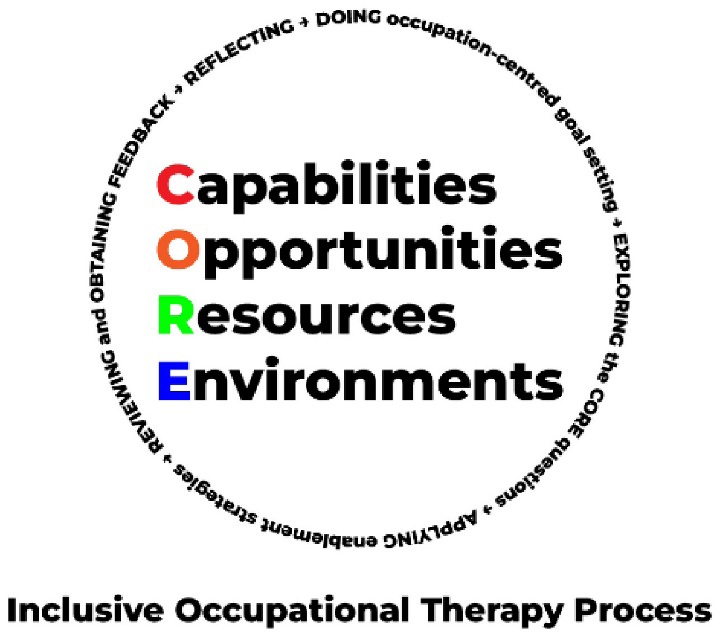
The CORE Approach was developed to provide occupational therapists with a guide for viewing practice through an inclusive lens, and doing inclusive occupational therapy through application of reflexive questions (Pereira, 2017). The approach guides occupational therapists through an iterative process of exploration of the four key CORE elements to guide emancipatory practice; encouraging application of enablement skills to facilitate opportunities for occupational fulfilment to be realised; promoting review alongside the person/community as an expert in their own lives; and ultimately leading the occupational therapist towards the doing of occupation-centred practice (see Figure 1) (Pereira et al., 2020). We contend, analysis using the CORE Approach provides a means through which to identify and explore the capabilities, opportunities, resources and environments that support emancipatory action in disaster recovery, with reflexive questions developed as part of the approach holding utility as an analytical tool.
Method
In this qualitative study, an analysis of extant data in the form of narratives from the publication Doing Our Best: Individual and Community Responses to Challenging Times was undertaken (Occupational Therapy Australia, 2022). As the data were publicly available, no ethics application was required, in line with previous research using the same dataset (Huppatz et al., 2025). To provide some transparency regarding the source of the narratives, a brief outline of the publication’s curation process has been provided in Table 1 (Bowen, 2009; Irwin, 2013).
An outline of the process behind the publication’s creation (Occupational Therapy Australia, 2022).
The Analytical Process
The lead researcher (EH) followed a six-phase approach to reflexive thematic analysis aligning with a constructionist and interpretive epistemology and ontology, giving consideration to both the meaning constructed and communicated by the community members as well as the interpretation of this meaning by the researcher (Braun & Clarke, 2006; 2019; 2021; Byrne, 2022). With the research team (EH, RB, GW & EG) holding an interest in strengths-based, occupational justice-oriented practice, this reflexive approach provided opportunity for deep interrogation of capabilities, opportunities, resources and environments that supported occupational engagement in disaster recovery. At each stage of data analysis, the lead researcher (EH) discussed findings with the broader research team (EG, RP & GW) to sense-check ideas and interrogate interpretations of the data. Whilst the six-phases have been outlined in a logical sequential order, analysis was recursive and iterative, with the researcher moving back and forth through the different stages as necessary (Byrne, 2022).
Phase one: familiarisation with the data
Familiarisation of the full dataset occurred through reading and re-reading of the narratives. Preliminary notes were made highlighting initial trends in the data and interesting passages contained within the narratives. Thoughts and feelings regarding the data and the analytical process were also documented. After several readthroughs, all eight narratives contained within the ‘Doing’ chapter of the publication were purposefully sampled for this research given their focus on emancipatory action enacted by community members to adapt to the challenges they themselves experienced in different disaster events. The CORE Approach was identified as holding explanatory potential to better understand how social inclusion was achieved within the context of the disaster events.
Phase two: generating initial codes
Working systematically through the entire dataset, the process of coding was then undertaken by the lead researcher EH to produce succinct interpretive labels for information that may have been relevant to the four key elements supporting social inclusion: capabilities, opportunities, resources and environments as outlined in the CORE Approach (Pereira, 2017). Once the data were reduced into these four broad categories, an inductive approach was then used to generate a greater number of more specific data-driven codes.
Phase three: generating themes
Once all relevant data items were coded, the coded data was reviewed and analysed to collapse different codes that held shared meanings to form themes (Braun & Clarke, 2006). The researcher then produced a thematic map of these ‘initial candidate themes’, exploring and interrogating the relationship and patterns between these themes.
Phase four: reviewing potential themes
Next, a review of the relationships among the data items and codes that informed each theme was undertaken (Braun & Clarke, 2006). Where the items/codes formed a coherent pattern, it was assumed that the candidate theme made a logical argument and thus contributed to the overall narrative of the data. The candidate themes were also reviewed in relation to a series of reflexive guiding questions (as shown in Table 2), adapted from Pereira & Whiteford (2022), that aid in exploring the 'capabilities, opportunities, resources and environments' that contribute to occupational fulfillment and social inclusion. Themes were assessed as to how well they provided the most apt interpretation of the data in relation to these guiding questions and the overarching research question(s).
Reflexive questions to explore the 'capabilities, opportunities, resources and environments' that contribute to social inclusion adapted from Pereira & Whiteford (2022).
Phase five: defining and naming themes
The researcher then presented a detailed analysis of the thematic framework, with each individual theme expressed in relation to the dataset and guiding reflexive questions (Braun & Clarke, 2006). A deep analysis of the underlying data items was undertaken to identify which data items would convey the diversity of expressions of meaning within each theme as well as the cohesion of each theme’s constituent data items. Data extracts were presented both illustratively and analytically.
Phase six: producing the report
The write-up of this piece of qualitative research was interwoven into the entire process of the analysis. As codes and themes evolved over the course of the analysis, so too did the write-up. Changes were documented through research memos organised in a research journal kept over the entire course of the analysis.
Results
Of the eight narratives analysed for this study, six were set in the context of the COVID-19 pandemic, one was set in the context of a bushfire event, and one was set across both the pandemic and a bushfire event. Narratives were written by community members across Australia: Australian Capital Territory (ACT) = 1, New South Wales (NSW) = 1, Victoria (Vic) = 5, Western Australia (WA) = 1.
Unpacking capability deprivation and the role of occupation in the context of disaster events
In both pandemic and bushfire, opportunities for occupational engagement were disrupted by the physical and social impacts of disaster events. This was evident in Shafiq’s narrative, who was living in the ACT when the threat of the COVID-19 pandemic first emerged. He described the challenges associated with restriction from opportunities to do the things meaningful to him after the Australian Government introduced social distancing and lockdown measures to minimise the spread of COVID-19:
Home confinement, social distancing and restrictions of movement meant an inability to see loved ones, and the end of plans to travel. These measures in addition to a diagnosis of Parkinson's disease plunged me into depression with a sense of hopelessness (Occupational Therapy Australia, 2022, p. 26).
For community members who may have been at greater risk of experiencing social exclusion in disaster events (e.g. those with a disability) (Ogie & Pradhan, 2019), challenges associated with pandemic and bushfire amplified feelings of isolation. One of the narratives which speaks powerfully to this lived experience is that of Ben, who was living in community housing during the pandemic and was supported by daily visits from carers when Victoria went into lockdown:
Two people in our flats got the COVID-19. Everybody was scared. The flats all had special cleans twice. We all had to stay in our rooms for four hours while they did the big noisy clean outside. The two people who have COVID-19 have to stay in their own rooms by themselves. The worst thing with COVID-19 for me is the places I was going are all closed. I can't stay home. There's all that time (Occupational Therapy Australia, 2022, p. 24).
With community members deprived of their occupational potential; that is, their ‘capacity to do what they are required and have opportunity to do, to become who they have the potential to be’, this could also be described as a form of ‘capability deprivation’ (Bailliard, 2016; Hocking, 2017; Pereira, 2017; Wicks, 2005).
Whilst community members described experiences of social exclusion and capability deprivation, they also described the essential role of occupations in mediating the adversity encountered in different disaster events. This ‘need to do’ was described by Gail, who lived through the lockdowns implemented in Victoria during the COVID-19 pandemic: ‘I had to think of something to keep myself occupied, otherwise I feared I might go crazy’ (Occupational Therapy Australia, 2022, p. 29). Rebecca was also living in Victoria when the COVID-19 pandemic hit, and described the multitude of benefits that came through engagement in gardening as a new occupation:
Probably the greatest benefit was enjoying a new hobby, meeting new people and focusing on something other than the pandemic. Over the lockdowns, we learnt to do things really differently, and to think outside the box. It's easy to get down and depressed during COVID-19 restrictions and we decided to think, "Well, what can we do? What needs to be done?" and we pushed through that way (Occupational Therapy Australia, 2022, p. 34).
Through the act of doing, community members such as Gail and Rebecca gained new focus, connected with others, and found new perspective, thus highlighting the transformative potential of occupational engagement in the context of adversities associated with bushfire and pandemic events. Such findings lead us to question: What are the capabilities, opportunities, resources and environments that support occupational engagement and social inclusion after a disaster event?
Capabilities
According to the CORE Approach, ‘capabilities’ are described as ‘the opportunities and freedoms to live a life that one has reason to value through being able to do and be’ (Pereira et al., 2020, p. 165; Sen, 1999). In this analysis, several significant themes related to 'capabilities' were revealed.
Values that guided occupational fulfilment or social inclusion
Community members’ occupational choices seemed to be guided by their own unique values. Vivienne’s narrative exemplifies the importance of living a life that one has reason to value through being able to do and be. Vivienne was living in NSW when her home was engulfed by smoke from a nearby bushfire. After months of staying inside to avoid the pollution, lockdowns to minimise the spread of COVID-19 were introduced, thus extending her isolation from society. Vivienne mediated this adversity by engaging in meaningful occupations that aligned with strong family values. These occupations involved: undertaking collaborative sewing and crocheting projects together with her family, connecting virtually with grandchildren, delivering home-made meals to her family and organising community mystery tours for her grandchildren. In her narrative, Vivienne touches on the importance of freedoms (capabilities) needed to participate in meaningful occupation, describing how she justified the balance between strict adherence to lockdown rules with the need to connect with family as an occupation meaningful to her. In Vivienne’s words:
There were many months in 2020 and 2021 of lockdown and stubbornly high case numbers. During those months of isolation we were unable to see our twin seven-year-old grandchildren. We were allowed outside the house only in the company of household members. We had to stay within our local government area or within 5km from home. This meant that my younger son and his family, including the seven-year olds, were out of bounds for us. They lived about a dozen houses outside our area and were in very strict lockdown in their area. So? What to do? Food… We did a furtive food drop to their house every Friday… We phoned my son as we arrived, dropped the Esky at his front door, picked up the empty from the previous week and waved at them as we drove away. No contact! Later we reasoned that it was OK for us to see the grandkids outdoors, though contact with adults in the strict lockdown area was still not allowed (Occupational Therapy Australia, 2022, p. 21).
Similarly, Sue, who was living in WA during successive bushfire events, appeared to be guided by her personal values, specifically a sense of community spirit or commitment to helping one’s community. In her narrative, Sue discussed the need to connect with neighbours to ensure mutual support was provided as part of bushfire safety plans. After her first experience of a bushfire, Sue was inspired to begin a new occupation where she could contribute more actively to the community, joining the local fire brigade as a volunteer. In describing the sense of comradery she had experienced since engaging in this occupation, Sue said:
It takes a certain type of person to voluntarily risk their lives to help others and their communities, and these are the types of people I want to spend time with (Occupational Therapy Australia, 2022, p. 13).
In these two examples, there was a clear interplay between values and occupational engagement. For Vivienne, family values were evidence in her repeated food drops to her son and grandchildren. For Sue, personal values drove her volunteer work in the local fire brigade. Moving beyond a ‘need to do’, community members described a need to be true to themselves, to their nature, to their essence and to what was distinctive about them to bring to others as part of their relationships and to what they did (Wilcock, 1999). For occupational therapists working with communities affected by disasters, this highlights a need to support community-driven design of meaningful occupation-based solutions to mediate the challenges associated with disaster events (that align with personal and community values).
Occupational narratives or life stories that guided occupational fulfilment or social inclusion
Some community members described how occupational repertoires built through a lifetime of experiences supported occupational engagement during challenges associated with disaster events. This was evident in Shafiq’s narrative as he described how the occupation of poetry writing had helped him weather adversities experienced earlier in life, including through the loneliness of migration. Shafiq described the important role poetry writing played in helping him to cope during the turmoil caused by the pandemic:
Soon I became the resident poet and thanks to our OT's encouragement I find myself out of the doldrums and starting to regain my confidence and desire to write and sketch. I started with a modern Japanese poem of five lines. I composed one based on the subject of the national flowers of the countries we visited. I challenged others in the group to do the same and these were proudly shared with one another. I was thrilled with the outcome (Occupational Therapy Australia, 2022, p. 26).
Similarly, Gail discussed how art, a previously meaningful occupation, helped her cope during the pandemic:
Creating my village has also rekindled my love of art, something I had let go during the tough times of my marriage separation (Occupational Therapy Australia, 2022, p. 30).
Other community members discussed how experience gained through vocational roles were applied to new occupational pursuits to mediate the challenges associated with disaster events. Val, who was living in Victoria during the COVID-19 lockdowns, reflected on her previous employment as an occupational therapist:
Being an occupational therapist from years ago, I was thinking how could I entertain my sick husband and provide some diversion for my golfing friends at Sandhurst Golf Club. NB: You can take the girl out of OT but you can't take the OT out of the girl, even if she is 80 plus (Occupational Therapy Australia, 2022, p. 18).
Similarly, Jackson (Vic) utilised skills learnt through a graphic design career to further his new occupational pursuit:
I taught myself how to make my own (cross stitch) patterns, which wasn't too hard as I'm familiar with graphics software due to my background in design and when you think about it, cross stitch is really just a grid of pixels. I have now completed more than 20 pieces (Occupational Therapy Australia, 2022, p. 16).
For Shafiq, Gail, Jackson, Val and other community members who drew on previous life experiences to meet the new challenges associated with disaster events, it appeared as though capabilities were built through a lifelong cumulative process. Community members clearly reflected on past occupational experience, thus drawing on an ‘adaptive repertoire’ (Spencer et al., 1996). As occupational therapists consider how best to support communities adapt to the challenges associated with disaster events, these findings suggest there is a need to explore the life stories or occupational narratives of community members with the intention of understanding how this knowledge can be used to support continuity and a coherent life story in times of adversity.
Opportunities
According to the CORE Approach, ‘opportunities’ arise when individuals are able to access equitable and dignified options and choices to engage in meaningful occupations (Wicks, as cited in Fisher, 2013). These ‘opportunities’ can be offered, accessed, discovered, or made available, enabling individuals to exercise their freedoms and empowering them with the ability to exert control and develop their capacities (Pereira et al., 2020). In this analysis, one major theme relating to ‘opportunities’ was identified.
Circumstances that made it possible for the person to do or be
Several community members discussed the role of health professionals in supporting or advocating for opportunities to engage in valued occupations. In Ben’s narrative, he described the value he placed on community outings as a pre-pandemic occupation meaningful to him. As Ben described his life mid-pandemic, we gain a sense of the important role his carers and other health care providers played in advocating for occupational opportunities to overcome some of the challenges associated with extended lockdowns:
The worst thing with COVID-19 for me is the places I was going are all closed. I can't stay home. There's all that time. I have to find new things to do. I'm going for longer drives with my carers, like to Rosebud. My carers have a letter from my doctor who knows me saying I'm allowed… Now we go to new places instead. At Essendon Fields I see the new cars in the showrooms through the big windows. We go to Edwards Lake instead to see the steam train. We go to the Maribyrnong instead and walk along the river. I am waiting for my old places to open again. Waiting and waiting (Occupational Therapy Australia, 2022, p. 24).
Shafiq also described the role of health professionals in supporting access to meaningful occupational opportunities:
During the last lockdown in Canberra, beginning in August 2021, I received a welcome invitation and ultimate circuit-breaker. Our PACT occupational therapist invited me to join a virtual travelling group flying to Fiji. My partner Margaret and I accepted the invitation and turned up on Zoom. Every passenger was made to feel relaxed and confident to contribute experiences and to compete during quiz time. The session was interesting and challenging… Our OT virtual travel guide invited passengers to recite poetry. I put my hand up and recited one I had composed on Fiji (Occupational Therapy Australia, 2022, p. 26).
For some community members who may have otherwise been at risk of experiencing social exclusion, health professionals played an important role in advocating for occupational opportunities. In the context of the occupational therapy role in disaster recovery, clinicians will need to ask themselves two important questions: Who is at risk of experiencing social exclusion? And: Is there a need to advocate for the opportunities through which occupational engagement can be achieved?
Resources
According to Pereira et al. (2020), ‘resources’ are required to enable capabilities to do and be. Resources involve having the things that are needed, wanted and/or perceived as necessary for equitable participation in occupations. In this analysis, community members described several different types of ‘resources’ that supported capabilities. These are presented below.
Physical or material resources that supported the person’s capabilities
Physical resources played a significant role in supporting occupational fulfillment and capabilities. In the context of the COVID-19 pandemic, physical resources within the home found new purpose and life as community members were confined to their home environments as a result of lockdowns. Gail described how she utilised household items to create a new art project:
Attempting to keep busy, I thought it best to clean up my small new apartment and make inroads into the storage room. Being alone, I tend to order everything online and found myself taking out an awful lot of cardboard boxes of different shapes and sizes. Cereal boxes, juice boxes, packing boxes, shoe boxes and, of course, medication boxes (after all, I am over 60!) So, it struck me that I was just adding to the world's junk, although mostly recyclable, and I was sure I could occupy myself by making something with the cardboard boxes. So, I chose to make a tiny village (Occupational Therapy Australia, 2022, p. 29).
Similarly, Val found new use for a doll that had been sitting unused:
While tidying up my laundry, I rediscovered a large knitted doll, the size of a two-year-old child. I had purchased it in a charity shop because it was dressed as a golfer, and just sat it in the laundry to amuse me when I was washing and ironing (Occupational Therapy Australia, 2022, p. 18).
By repurposing items or rediscovering forgotten possessions, community members such as Gail and Val tapped into their creativity and found meaningful activities to occupy their time. Their stories provide occupational therapists with examples of creative ways to think about the accessibility of physical resources in the promotion of social inclusion post disaster.
Technological resources that supported the person’s capabilities
In both pandemic and bushfire events, technology was a valuable resource for community members. In Sue’s narrative, she described how she used technology to monitor the bushfire as part of her survival plan:
I watched it on the EmergencyWA website, and the Bushfire.io app. I also listened to the scanner to hear what the brigades were doing, and then when the fire bombers arrived I watched from a different website (FlightRadar24.com) (Occupational Therapy Australia, 2022, p. 13).
Importantly, this technology supported Sue to keep herself safe. In the context of the COVID-19 pandemic, technology was a crucial resource for maintaining social connection with others. Whilst some community members already had access to technology, others, such as Vivienne were supported by family members to access advance video communication technology:
My son, who makes podcasts, enjoyed ensuring that each member of the household had the best home setup: new computer for me with large monitor (for my poor eyesight), good quality microphone and speaker, Wi-Fi charger for the headphones, lamps specially designed for lighting up the face with just the right luminescence for Zoom meetings and conferences, duo/Google hub for contacting grandchildren, and sub-woofers and speakers surrounding us as we watched telly of an evening (Occupational Therapy Australia, 2022, p. 21).
In this analysis, we saw how technology allowed Sue and Vivienne to mitigate risks associated disaster events –empowering adaption, communication, and participation in meaningful occupations. For occupational therapists, consideration of both the barriers and potential uses of technology to support occupational fulfillment will be important.
Social resources that supported the person’s capabilities
Social resources appeared to play a vital role in supporting capabilities and occupational engagement. Through connection with online communities, individuals connected with like-minded individuals who shared a common interest and thus bolstered capabilities. This was evident in Rebecca’s narrative as she described the support she received when learning a new occupation (establishing a vegetable garden):
I joined Instagram and Facebook groups dedicated to growing vegetables and found the people I met along the way to be lovely and helpful. I've met people from not only Melbourne and other Australian states but also many others from countries across the globe (Occupational Therapy Australia, 2022, p. 31).
Other community members described the role of family in supporting capabilities and occupational engagement. For instance, Jackson discussed how the occupation of cross-stitching was passed down from his grandmother:
Her eyesight is no longer sharp enough to do embroidery (she is 97), so she sent me all of her threads, aida cloth, and some pattern books, which spurred me on to continue creating embroidery works (Occupational Therapy Australia, 2022, p. 16).
Rebecca and Jackson’s narratives demonstrate how social resources supported occupational engagement. Of relevance for occupational therapists supporting disaster recovery, exploration of existing (e.g. familial) and new (e.g. online) social supports may provide a potentially crucial means of supporting connection during the hardships of disaster events.
Cultural resources that supported the person’s capabilities
In the context of both pandemic and bushfire events, community members described cultural resources as an important form of support. In the Australian context, a shared willingness to jump in to help one another was clearly evident in our analysis. Sue’s narrative epitomises the culture of community support and reliance, highlighting the interplay between cultural resources and capabilities in the context of emergency response and mutual assistance:
Now that I'm a trained and qualified firefighter, I know that I will likely be busy helping contain and control the fire. If it's a major incident I'll be busy with the incident control vehicle supporting the incident management team. I'm perfectly OK with that as I know my neighbours will do their best to get my pets out if need be (Occupational Therapy Australia, 2022, p. 13).
Sue’s story highlights how cultural resources facilitate the development and utilisation of capabilities, opening up new opportunities that may have otherwise been inaccessible – a timely reminder for occupational therapists to consider the wider cultural resources that may support occupational engagement in post disaster recovery.
Personal resources that supported the person’s capabilities
Community members who shared their narratives clearly described personal resources that supported disaster recovery. Although Vivienne did not explicitly mention goal setting as a personal skill or strength in her narrative, it was evident in her actions and accomplishments to plan a project through to complete and achieve her goal:
I produced several crocheted blankets for our household and for grandkids. I also made it my objective to crochet a woollen cardigan for myself and have it finished before the end of the winter lockdown. I succeeded at this, though the weather has taken a decidedly pleasant turn (Occupational Therapy Australia, 2022, p. 22).
Personal resources were wide and varied across different narratives. As another example, Jackson's social skills supported connection with others, maintenance of relationships, and navigation of online social environments in the context of the COVID-19 pandemic.
Generally, I'm quite a social person and like to keep myself busy catching up with friends, exercising and taking trips (Occupational Therapy Australia, 2022, p. 15).
In both cases, the utilisation of personal resources enhanced capabilities and occupational fulfillment, suggesting occupational therapists need to take the time to explore personal resources in post disaster recovery.
Environments
Under the CORE Approach, environments that foster and enable authentic occupational outcomes and social inclusion are essential for capability enablement (Pereira et al., 2020). In our analysis of narratives included in this study, there was limited discussion of the environmental factors influencing community member’s occupational engagement, with the exception of Ben’s narrative.
Contextual and/or environmental factors that impacted on a person’s ability to be able to do and be
Ben’s narrative provided a rich description of the environmental adaptations that could support occupational engagement and capability realisation within the challenging circumstances associated with disaster events. In his narrative, Ben discussed the important role both his family and carers played in supporting his occupational fulfilment. He also described the local assets (such as the museum, zoo and local businesses) that provided opportunity to connect with the wider community. He discussed the importance of visual cues set-up within his home environment to support adherence to COVID-19 infection control measures as well as the other important household items and toys that supported occupational fulfilment in the midst of lockdown events.
Ben’s narrative clearly illustrates the interplay between the environment and social inclusion. Occupational therapists’ recognition of the influence of the environment on occupational engagement will continue to be important in disaster recovery work.
Discussion
In this analysis of community-derived narratives, a clear description of capabilities, opportunities, resources and environments that supported post-disaster recovery emerged. Whilst there was limited discussion of the impact of macro-level drivers within the narratives analysed for this study, potential impact of opportunities and resources available at the population level on capability realisation need to be considered. With narratives situated in the context of Australia, authors acknowledge the quick policy responses from the Australian government to lockdown borders and mandate social distancing restrictions to minimise the spread of the COVID-19 pandemic. These policy decisions created an environment where Australians felt a perceived sense of physical safety albeit major restrictions to occupational participation. It must therefore be highlighted that results provide guidance for occupational therapists who are supporting post-disaster recovery in Australia and other similar settings, noting that these specific findings may not carry across different social, cultural, or geographical contexts.
Our analysis highlighted the need for occupational therapists to work in partnership with communities affected by disasters to support community-driven design of meaningful occupation-based solutions that: align with personal, family and community values and support capabilities built through previous life experiences. Results also illuminated the need for focussed attention on the opportunities, resources and environments that might support social inclusion, with recognition that intervention may be required to support opportunities that will enable individuals to exert control and develop their capacities. Where individuals were potentially at greater risk of experiencing social exclusion (for example due to disability or age), targeted assistance (in the form of advocacy or support) to access opportunities, resources and supportive environments will be beneficial. We propose, the CORE approach provides a useful springboard for collaborative, relationship-focused disaster recovery work.
A key strength of this study is the source of the dataset, with narratives written by community members themselves. Through narrative writing, community members had the opportunity to bring meaning to their experience of disaster events and to describe in detail the wider context that shaped their experiences (Ennals et al., 2022). This provided unique insight into people’s values and occupational narratives as well as the resources and environments that community members themselves considered as matters of importance in post-disaster recovery.
It has been suggested that storytelling and re-storying having the potential to facilitate healing and transformation (Ennals et al., 2022). In this analysis, it appears as though narrative exploration and amplification of community voice (at both the individual and community level through Occupational Therapy Australia’s ‘Doing Our Best’ publication) has potential therapeutic benefit in disaster recovery, with the process highlighting the capabilities, opportunities, resources and environments that might help both individuals and communities adapt to adversity. We propose, the CORE Approach holds salience as a tool to support narrative reasoning in disaster recovery work, allowing occupational therapists to act as capability vehicles, engaging in a truly collaborative pursuit of authentic occupational outcomes.
It is acknowledged that the research team (EH, RP, GW & EG) each hold a set of theoretical allegiances closely aligned with occupational justice focussed work, with health, social inclusion and rights all seen as an important part of the human condition. For this reason, researchers utilised a constructionist and interpretive epistemology and ontology, considering both the meaning constructed by the community members as well as the interpretation of this meaning by the researchers. Further research unpacking the potential role of epistemological underpinnings of research on occupational justice in disaster recovery may be warranted.
Conclusion
Whilst this paper sought to explore the capabilities, opportunities, resources and environments that support post-disaster recovery (and in fact did so), findings also highlighted the therapeutic benefits of narrative exploration in community driven disaster recovery. At the individual level, narrative exploration provided the opportunity to bring meaning to difficult experiences and to explore the wider context that shaped these experiences. At the community level, Occupational Therapy Australia’s narrative project amplified community voices, thus providing a tool to guide how occupational therapists might operationalise collaborative pursuit of authentic occupational engagement in post disaster recovery.
Interestingly, the CORE Approach has been proposed as a clinical reasoning tool that fosters narrative reasoning (Bailliard & Gallagher, 2025; Bailliard et al., 2020; Pereira & Whiteford, 2025; Pereira & Whiteford, 2022). Our findings support this. As occupational therapists are increasingly working with community members affected by disaster events, there will be a growing need to focus on addressing the root causes of inequity experienced by individuals, families and communities. Exploration of community narratives and the capabilities, opportunities, resources and environments affecting disaster recovery provides one means through which to do so.
Land acknowledgement
The authors acknowledge the original custodians of the land on which the first author (EH) lives and works, the Kaurna people, and pay our respects to Elders past, present, and emerging. We acknowledge the importance of ongoing connection to Country and culture.
Acknowledgements
The authors acknowledge the community members who generously shared their narratives as well as the work of Occupational Therapy Australia who brought these stories together.
-
How to cite:
Huppatz, E., Pereira, R., Whiteford, G., & George, E. (2026). Social inclusion and occupational engagement in disaster recovery: an analysis of community-driven action using the CORE Approach. Cadernos Brasileiros de Terapia Ocupacional, 34, e4179. https://doi.org/10.1590/2526-8910.cto422941792
-
Data Availability
The data that support the findings of this study are available from the corresponding author, upon reasonable request.
References
-
Bailliard, A. (2016). Justice, difference, and the capability to function. Journal of Occupational Science, 23(1), 3-16. https://doi.org/10.1080/14427591.2014.957886
» https://doi.org/10.1080/14427591.2014.957886 -
Bailliard, A., & Gallagher, M. (2025). The capabilities approach. In M. Ikiugu, S. Kantartzis, S. Taff & N. Pollard (Eds.), Routledge companion to occupational therapy: theories, concepts and models (pp. 458-470). Milton Park: Routledge. https://doi.org/10.4324/9781003526766-36
» https://doi.org/10.4324/9781003526766-36 -
Bailliard, A. L., Dallman, A. R., Carroll, A., Lee, B. D., & Szendrey, S. (2020). Doing occupational justice: a central dimension of everyday occupational therapy practice. Canadian Journal of Occupational Therapy. Revue Canadienne d’Ergothérapie, 87(2), 144-152. https://doi.org/10.1177/0008417419898930
» https://doi.org/10.1177/0008417419898930 -
Bogati, R., & Gautam, M. S. (2021). Disaster recovery toward attaining sustainable development goals. In W. Leal Filho, A. M. Azul, L. Brandli, A. Lange Salvia, P. G. Özuyar & T. Wall (Eds.), No poverty. Encyclopedia of the UN sustainable development goals. Cham: Springer. https://doi.org/10.1007/978-3-319-95714-2_56
» https://doi.org/10.1007/978-3-319-95714-2_56 -
Bowen, G. A. (2009). Document analysis as a qualitative research method. Qualitative Research Journal, 9(2), 27-40. https://doi.org/10.3316/QRJ0902027
» https://doi.org/10.3316/QRJ0902027 -
Braun, V., & Clarke, V. (2006). Using thematic analysis in psychology. Qualitative Research in Psychology, 3(2), 77-101. https://doi.org/10.1191/1478088706qp063oa
» https://doi.org/10.1191/1478088706qp063oa -
Braun, V., & Clarke, V. (2019). Reflecting on reflexive thematic analysis. Qualitative Research in Sport, Exercise and Health, 11(4), 589-597. https://doi.org/10.1080/2159676X.2019.1628806
» https://doi.org/10.1080/2159676X.2019.1628806 -
Braun, V., & Clarke, V. (2021). One size fits all? What counts as quality practice in (reflexive) thematic analysis? Qualitative Research in Psychology, 18(3), 328-352. https://doi.org/10.1080/14780887.2020.1769238
» https://doi.org/10.1080/14780887.2020.1769238 -
Byrne, D. (2022). A worked example of Braun and Clarke’s approach to reflexive thematic analysis. Quality & Quantity, 56(3), 1391-1412. https://doi.org/10.1007/s11135-021-01182-y
» https://doi.org/10.1007/s11135-021-01182-y -
Carra, K., Hyett, N., Kenny, A., & Curtin, M. (2019). Strengthening occupational therapy practice with communities after traumatic events. British Journal of Occupational Therapy, 82(5), 316-319. https://doi.org/10.1177/0308022618795594
» https://doi.org/10.1177/0308022618795594 - Ennals, P., D’Cruz, K., & Howie, L. (2022). Narrative Enquiry and Health Research. In P. Liamputtong (Ed.), Research methods and evidence-based practice (4th ed.). Oxford: Oxford University Press.
-
Fisher, A. G. (2013). Occupation-centred, occupation-based, occupation-focused: Same, same or different? Scandinavian Journal of Occupational Therapy, 20(3), 162-173. https://doi.org/10.3109/11038128.2012.754492
» https://doi.org/10.3109/11038128.2012.754492 -
Gardoni, P., & Murphy, C. (2008). Recovery from natural and man-made disasters as capabilities restoration and enhancement. International Journal of Sustainable Development and Planning, 3(4), 317-333. https://doi.org/10.2495/SDP-V3-N4-317-333
» https://doi.org/10.2495/SDP-V3-N4-317-333 -
Gardoni, P., & Murphy, C. (2010). Gauging the societal impacts of natural disasters using a capability approach. Disasters, 34(3), 619-636. https://doi.org/10.1111/j.1467-7717.2010.01160.x
» https://doi.org/10.1111/j.1467-7717.2010.01160.x -
Hammell, K. (2021). Building back better: imagining an occupational therapy for a post‐COVID‐19 world. Australian Occupational Therapy Journal, 68(5), 444-453. https://doi.org/10.1111/1440-1630.12760
» https://doi.org/10.1111/1440-1630.12760 -
Hammell, K. W. (2015). Quality of life, participation and occupational rights: A capabilities perspective. Australian Occupational Therapy Journal, 62(2), 78-85. https://doi.org/10.1111/1440-1630.12183
» https://doi.org/10.1111/1440-1630.12183 - Hammell, K. W. (2020). Engagement in living: Critical perspectives on occupation, rights and wellbeing Ottawa: Canadian Association of Occupational Therapists.
-
Hocking, C. (2017). Occupational justice as social justice: the moral claim for inclusion. Journal of Occupational Science, 24(1), 29-42. https://doi.org/10.1080/14427591.2017.1294016
» https://doi.org/10.1080/14427591.2017.1294016 -
Hocking, C. (2021). Occupation in context: A reflection on environmental influences on human doing. Journal of Occupational Science, 28(2), 221-234. https://doi.org/10.1080/14427591.2019.1708434
» https://doi.org/10.1080/14427591.2019.1708434 -
Huppatz, E., George, E., Wicks, A., & Whiteford, G. (2025). Exploring occupational participation and engagement during disaster through the lens of the Participatory Occupational Justice Framework. Journal of Occupational Science, 32(1), 71-83. https://doi.org/10.1080/14427591.2024.2394158
» https://doi.org/10.1080/14427591.2024.2394158 -
Hyett, N., Kenny, A., & Dickson-Swift, V. (2019). Re-imagining occupational therapy clients as communities: presenting the community-centred practice framework. Scandinavian Journal of Occupational Therapy, 26(4), 246-260. https://doi.org/10.1080/11038128.2017.1423374
» https://doi.org/10.1080/11038128.2017.1423374 -
Irwin, S. (2013). Qualitative secondary data analysis: ethics, epistemology and context. Progress in Development Studies, 13(4), 295-306. https://doi.org/10.1177/1464993413490479
» https://doi.org/10.1177/1464993413490479 -
Kantartzis, S. (2019). The Dr Elizabeth Casson Memorial Lecture 2019: shifting our focus. Fostering the potential of occupation and occupational therapy in a complex world. British Journal of Occupational Therapy, 82(9), 553-566. https://doi.org/10.1177/0308022619864893
» https://doi.org/10.1177/0308022619864893 -
Law, M., Cooper, B., Strong, S., Stewart, D., Rigby, P., & Letts, L. (1996). The person-environment-occupation model: a transactive approach to occupational performance. Canadian Journal of Occupational Therapy. Revue Canadienne d’Ergothérapie, 63(1), 9-23. https://doi.org/10.1177/000841749606300103
» https://doi.org/10.1177/000841749606300103 - Lopes, R. E., & Malfitano, A. P. S. (2018). Social occupational therapy: committing to social change. New Zealand Journal of Occupational Therapy, 65(1), 20-26.
-
Nussbaum, M. C. (2011). Creating capabilities the human development approach Cambridge, MA: Belknap Press of Harvard University Press. https://doi.org/10.4159/harvard.9780674061200
» https://doi.org/10.4159/harvard.9780674061200 - Occupational Therapy Australia – OTA. (2022). Doing our best: individual and community responses to challenging times. Melbourne: OTA.
-
Ogie, R. I., & Pradhan, B. (2019). Natural Hazards and Social Vulnerability of Place: The Strength-Based Approach Applied to Wollongong, Australia. International Journal of Disaster Risk Science, 10(3), 404-420. https://doi.org/10.1007/s13753-019-0224-y
» https://doi.org/10.1007/s13753-019-0224-y - Pereira, R. B. (2013). The politics of participation: a critical occupational science analysis of social inclusion policy and entrenched disadvantage (Doctoral thesis). Macquarie University, Macquarie.
-
Pereira, R. B. (2017). Towards inclusive occupational therapy: introducing the CORE approach for inclusive and occupation‐focused practice. Australian Occupational Therapy Journal, 64(6), 429-435. https://doi.org/10.1111/1440-1630.12394
» https://doi.org/10.1111/1440-1630.12394 - Pereira, R. B. (2025). Doing occupational justice work to amplify community voice, choice and action. Australian Occupational Therapy Journal, 72(S1), 1-45.
- Pereira, R. B., & Brown, T. L. (2023). Promoting an inclusive and values-based lens in mental health nursing through applying the CORE approach. International Journal of Mental Health Nursing, 32(1), 3-75.
-
Pereira, R. B., & Whiteford, G. (2025). The capabilities, opportunities, resources and environments (core) approach for inclusive and occupation-centred practice. In M. Ikiugu, S. Kantartzis, S. Taff & N. Pollard (Eds.), Routledge companion to occupational therapy: theories, concepts and models (pp. 156-169). Milton Park: Routledge. https://doi.org/10.4324/9781003526766-14
» https://doi.org/10.4324/9781003526766-14 -
Pereira, R. B., Whiteford, G., Hyett, N., Weekes, G., Di Tommaso, A., & Naismith, J. (2020). Capabilities, Opportunities, Resources and Environments (CORE): using the CORE approach for inclusive, occupation-centred practice. Australian Occupational Therapy Journal, 67(2), 162-171. https://doi.org/10.1111/1440-1630.12642
» https://doi.org/10.1111/1440-1630.12642 -
Pereira, R. B., & Whiteford, G. E. (2022). Enabling inclusive occupational therapy through the Capabilities, Opportunities, Resources, and Environments (CORE) Approach. In P. Liamputtong (Ed.), Handbook of social inclusion research and practices in health and social sciences (1st ed.). Cham: Springer International Publishing. https://doi.org/10.1007/978-3-030-89594-5_97
» https://doi.org/10.1007/978-3-030-89594-5_97 -
Restall, G. J., & Egan, M. Y. (2021). Collaborative relationship-focused occupational therapy: evolving lexicon and practice. Canadian Journal of Occupational Therapy. Revue Canadienne d’Ergothérapie, 88(3), 220-230. https://doi.org/10.1177/00084174211022889
» https://doi.org/10.1177/00084174211022889 -
Rushford, N., & Thomas, K. (2016). Occupational stewardship: advancing a vision of occupational justice and sustainability. Journal of Occupational Science, 23(3), 295-307. https://doi.org/10.1080/14427591.2016.1174954
» https://doi.org/10.1080/14427591.2016.1174954 - Rushford, N., Thomas, K., Scherrer, V., & Pattinson, M. (2015). Disaster and development: an occupational perspective China: Elsevier.
-
Sen, A. (2005). Human rights and capabilities. Journal of Human Development, 6(2), 151-166. https://doi.org/10.1080/14649880500120491
» https://doi.org/10.1080/14649880500120491 - Sen, A. K. (1999). Development as freedom (1st ed.). Oxford: Knopf.
- Sen, A. K. (2009). The idea of justice Massachusetts: Harvard University Press.
-
Spencer, J. C., Davidson, H. A., & White, V. K. (1996). Continuity and change: past experience as adaptive repertoire in occupational adaptation. The American Journal of Occupational Therapy, 50(7), 526-534. https://doi.org/10.5014/ajot.50.7.526
» https://doi.org/10.5014/ajot.50.7.526 -
Tiwari, P., & Shukla, J. (2022). Post-disaster reconstruction, well-being and sustainable development goals: a conceptual framework. Environment & Urbanization Asia, 13(2), 323-332. https://doi.org/10.1177/09754253221130405
» https://doi.org/10.1177/09754253221130405 -
Whiteford, G., & Pereira, R. B. (2012). Occupation, inclusion and participation. In G. Whiteford & C. Hocking (Eds.), Occupational science: Society, inclusion, participation (pp. 187-207). Noida: Blackwell Publishing Ltd.. https://doi.org/10.1002/9781118281581.ch13
» https://doi.org/10.1002/9781118281581.ch13 -
Wicks, A. (2005). Understanding occupational potential. Journal of Occupational Science, 12(3), 130-139. https://doi.org/10.1080/14427591.2005.9686556
» https://doi.org/10.1080/14427591.2005.9686556 -
Wilcock, A. A. (1999). Reflections on doing, being and becoming. Australian Occupational Therapy Journal, 46(1), 1-11. https://doi.org/10.1046/j.1440-1630.1999.00174.x
» https://doi.org/10.1046/j.1440-1630.1999.00174.x -
World Federation of Occupational Therapists – WFOT. (2019). Occupational Therapy and Human Rights. London: WFOT. Retrieved in 2025, July 18, from https://wfot.org/resources/occupational-therapy-and-human-rights
» https://wfot.org/resources/occupational-therapy-and-human-rights -
World Federation of Occupational Therapists – WFOT. (2026). Occupational Therapy and Humanitarian Response. London: WFOT. Retrieved in 2026, May 12, from https://wfot.org/our-work/professional-support/resource-listings/occupational-therapy-and-humanitarian-response
» https://wfot.org/our-work/professional-support/resource-listings/occupational-therapy-and-humanitarian-response
Edited by
-
Section editor
Profa. Dra. Ana Paula Serrata Malfitano
The data that support the findings of this study are available from the corresponding author, upon reasonable request.