 The prevalence of epistemology in occupational therapy education literature: a historical mapping review, 1917-2024
Abstract
Introduction The prevalence of epistemology throughout peer-reviewed occupational therapy education literature has not been systematically analyzed, but it is essential for determining the discipline’s scientific methodology. Analysis of epistemology is critical for the continued development of the profession.
Objective To inform occupational therapy educators and practitioners about the prevalence of epistemological thought within peer-reviewed occupational therapy education literature to support the continued development of occupational therapy educational practices.
Method A systematic mapping review approach was utilized to understand the extent to which epistemology has been evoked in English-written, peer-reviewed occupational therapy literature, which epistemological philosophies have shaped occupational therapy education, and how and when these epistemologies have been influential. These broad concepts were identified and researched on databases related to health sciences, yielding 4.033 articles published between 1917 and 2024.
Results Articles involving occupational therapy education and epistemology were extracted, resulting in 9 articles. Emergent themes included little mention of epistemology across peer-reviewed occupational therapy education literature, no mention of epistemology until 2006, and that the promotion epistemological inquiry within occupational therapy education could improve future learning and practice.
Conclusion When teaching the foundations of occupational therapy, educators can add further depth and context by addressing epistemology as the underlying base through which the priorities for the profession are identified. Developing epistemological continuity is imperative as a greater understanding of epistemological thought can reinforce professional values and create more reflexive practitioners.
Keywords:
Occupational Therapy; Education; Epistemology; Teaching
Resumo
Introdução A prevalência da epistemologia na literatura revisada por pares sobre formação em terapia ocupacional não tem sido analisada de forma sistemática, mas isso é essencial para determinar a metodologia científica da disciplina. A análise da epistemologia é fundamental para o desenvolvimento contínuo da profissão.
Objetivo Informar educadores e profissionais de terapia ocupacional sobre a prevalência do pensamento epistemológico na literatura revisada por pares sobre formação em terapia ocupacional para apoiar o desenvolvimento contínuo de práticas educativas em terapia ocupacional.
Método Revisão sistemática de mapeamento para compreender em que medida a epistemologia tem sido abordada na literatura de terapia ocupacional escrita em inglês e submetida a revisão por pares, quais as filosofias epistemológicas que moldaram a formação em terapia ocupacional e como e quando essas epistemologias têm exercido influência. Estes conceitos gerais foram identificados e pesquisados em bases de dados relacionadas com as ciências da saúde, resultando em 4.033 artigos publicados entre 1917 e 2024.
Resultados Foram extraídos artigos envolvendo formação em terapia ocupacional e epistemologia, resultando em nove artigos. Os temas emergentes incluíram pouca menção à epistemologia em terapia ocupacional, nenhuma menção até 2006 e que a promoção da investigação epistemológica na formação em terapia ocupacional poderia melhorar o aprendizado e a prática futuros.
Conclusão Ao ensinar os fundamentos da terapia ocupacional, os educadores podem adicionar mais profundidade e contexto, abordando a epistemologia como a base subjacente através da qual as prioridades para a profissão são identificadas. O desenvolvimento da continuidade epistemológica é imperativo, pois uma maior compreensão do pensamento epistemológico pode reforçar os valores profissionais e criar profissionais mais reflexivos.
Palavras-chave:
Terapia Ocupacional; Educação; Epistemologia; Ensino
Introduction
Emerging from the United States in 1917, occupational therapy drew knowledge and practices from a wide range of disciplines (e.g. psychology and biology) and social movements (e.g. Moral Treatment and educational progressivism) (Anderson & Reed, 2017; Quiroga, 1995; Schwartz, 1992). Occupational therapy’s multidisciplinary approach has been a source of both innovation and challenge throughout the history of the field (Taff & Babulal, 2021). One major challenge occupational therapy has faced, given its interdisciplinary and transnational nature, is adhering to consistent epistemologies. Epistemology, broadly speaking, is the division of philosophy focused on the study of knowledge. There are three primary questions that epistemology seeks to answer: what is knowledge, how it can be attained, and to what extent can things be known (Audi, 1999, p. 273). The epistemological influences of a field determine scope and scientific methodology, and thus, are critical for the continued development of any discipline. Epistemological direction (or a profession’s philosophical viewpoint on knowledge translation) is paramount for determining which knowledge is most relevant and how it should be taught and implemented for curricular development. For the purposes of this article, going forward, the term epistemological continuity will be utilized to encapsulate the need for occupational therapy education (as situated within Northern Anglophone contexts) to not only explore various epistemologies, but to apply them to curricula and teaching practices transnationally. Historically, within Northern Anglophone countries, epistemology has been seldom invoked in occupational therapy education and therefore has not been systematically utilized within Northern Anglophone occupational therapy curricular practices. Ensuring that epistemologies are utilized similarly within curricular practices transnationally can assist with establishing epistemological continuity across all global occupational therapy education settings. Educational instruction not informed by underlying epistemologies (or philosophy of knowledge and learning) could result in a profession lacking core values and a concrete direction.
The search for professional continuity and theoretical grounding has led to conflicts concerning which epistemological schools could best suit transnational occupational therapy education and practice; for example, the ongoing dialogue concerning pragmatism and structuralism (Hooper & Wood, 2002). Within Anglophone Northern contexts, Pragmatism has long been considered a foundational influence behind occupational therapy. An analysis conducted by Ikiugu & Schultz (2005) suggested that the assumptions, principles, and values of pragmatism were consistent with the themes of occupation, activity, and purposefulness expressed in early English-written, peer-reviewed occupational therapy literature. Pragmatism, as utilized within Northern Anglophone contexts, is marked by the assumption that knowledge is an attempt to organize experience; however, every individual experience interacts with a context and cannot be separated from its immediate, unique, and transient properties (Audi, 1999; James, 1907). Knowledge formed from past events serves primarily as a guidepost for future experiences and is often inconstant and fallible. Structuralism also seeks cogent connections but does so in a radically different way than pragmatism. According to structuralist thought, complex systems can be described as different variations of basic structures that remain the same from experience to experience (Audi, 1999). This epistemological paradigm is sometimes called positivism, reductionism, or realism (Hooper, 2006; Wilcock, 1998). Although there are nuances between all of these terms, here, we use structuralism not in its classic form originating in linguistics (De Sassure, 1959; Lévi-Strauss, 1963), but as framed by Serrett (1985) and discussed by Hooper & Wood (2002), referring to the broad epistemology that conceptualizes knowledge as systems of static structures used to inform the scientific method as a means to acquire new knowledge. The physical sciences, such as chemistry or physics, arrange their knowledge according to structuralist ideas.
Beginning in the 1940’s, within Anglophone Northern countries, the still-emerging profession of occupational therapy saw a radical shift from its pragmatist/ holistic roots toward structuralism/ reductionism as a means to gain legitimacy as a biomedical and health care profession (Hooper & Wood, 2002). Utilizing a structuralist paradigm, it was argued that methodologies supported by the pragmatic approach limited the scope of practice, as pragmatic thought was grounded in hands-on learning and thus not positioned to objectively measure individual improvement (West, 1984). Starting in the late 1980’s within Anglophone Northern countries (Breines, 1986), the profession began to move slowly back towards its pragmatist roots, adopting a client-centered model over a biomechanical paradigm. During this shift, the profession began to acknowledge the significant impact of systemic injustice and health inequities concerning individual health and well-being amongst marginalized populations (Hammell, 2021).
In response to this epistemological shift, the Social Occupational Therapy movement has moved to the forefront of this discussion. Now being vehiculated into English, social occupational therapy literature demonstrates how Latin-American contexts can significantly inform the social sphere of participation as part of the profession’s transnational educational identity. For social occupational therapy, marginalization extends beyond immediate temporal factors (disability, mood, environment, etc.) and includes the historical ramifications of power structures that can affect participation (e.g., capitalism, globalization, historical influences, etc.). Social occupational therapy recognizes that structures stemming from Westernized/ colonialist thought can significantly alter epistemological inquiry and global understanding of the profession. Taff & Putnam (2022) asserted the significant influence of neoliberalism/ Northern colonialist thought on the medical model which occupational therapy practitioners have been taught to navigate despite the professions founding theoretical schools (e.g. pragmatism, etc.). Given this, multi-cultural perspectives and interpretations must be a consideration when orienting future educational endeavors (Iwama, 2003). If occupational therapists are to acknowledge systematic injustice, they must also be familiar with the structures (whether they be political or historical) that could perpetuate oppression and inequality (Freire, 1971; Malfitano & Lopes, 2018). While not in exact correspondence to a pragmatist paradigm, the social occupational therapy movement provides educators and practitioners with a framework necessary for recognizing the influence of sociocultural issues on occupational engagement, community participation, and well-being (Malfitano & Lopes, 2018). This perspective aims to not only hold true to the historical intent of the profession, but to challenge structuralist/positivist practices as a means for liberation and occupational justice. While adopting pragmatism (as described within Northern Anglophone contexts) as the epistemological framework for occupational therapy is in line with the profession’s value of client-centeredness, doing so was complicated by the fact that occupational therapy still drew upon disciplines that were not supported by a this specific pragmatist framework (e.g., anatomy, neuroscience, and quantitative research) (Ikiugu & Schultz, 2005). This seeming contradiction unearths that while pragmatism has made important contributions to occupational therapy’s view on human participation, structuralist/ positivist epistemologies persist in the day-to-day fabric of occupational therapy practice, research, and education within Northern Anglophone contexts.
Discussion regarding epistemologies has been inconsistent since the inception of the profession in 1917 within Anglophone Northern countries, as even the founders never made mention of specific epistemologies to ground occupational therapy theory (Breines, 1987; Taff & Babulal, 2021). In this mapping review, we sought to discover explicit discussions of epistemology throughout the first century of English-available, peer-reviewed occupational therapy literature focused on education. The scope of the discussion was limited to education for a multitude of reasons, but primarily due to the importance of education in a society; which is to define the core values that unite a profession (Pitonyak et al., 2020). As Pitonyak et al. (2020) allude to, education is a broad and important endeavor that is the “foundation for professional reasoning” (p. 3). Not only are education and epistemology necessary for defining and establishing a profession, but also for guiding a profession’s practice and research. Occupation-centered education has been utilized to emphasize the importance of occupation for clinical practice as a means for promoting health and wellness (Hooper, 2006; Miller & Roberts, 2020). Although this may be the intent of a curriculum, occupational therapy students (within Northern Anglophone contexts) have traditionally had difficulty applying theory into practice (Hooper, 2006; Miller & Roberts, 2020; Murray et al., 2015). Murray et al.’s (2015) meta-synthesis of occupational therapists' challenges in professional practice revealed several themes, which included challenges in context, personal challenges, and social and cultural challenges. Newly established practitioners had difficulty with complex reasoning, applying their knowledge to practice, and were heavily influenced by the biomedical nature of the workplace (Murray et al., 2015). Hooper (2006) had alluded to this, describing the current profession of occupational therapy as a Fourth-Order Discipline (a profession that critically examines abstractions, promotes self-authorship, and promotes inquiry into the origin of current methodologies) with Third-Order Practices and Knowledge (practices that although reason abstractly, do not critically reflect on the meaning or truth of a claim). For these reasons illustrated, epistemological continuity within occupational therapy education will be paramount for establishing the profession’s direction as well as for preparing future occupational therapy practitioners transnationally.
According to Biesta & van Braak (2020), healthcare education (within Northern Anglophone contexts) has been traditionally structuralist/reductionistic (as influenced by the medical model), treating teaching “as an intervention that produces learning outcomes” (Biesta & van Braak, 2020, p. 450). Hooper (2006) also made this comparison pointing out that some educators are compelled to only cover content rather than “uncover content” (Hooper, 2006, p. 21). Without critical reflection into the profession's abstractions, occupational therapy education has been susceptible to minimizing fourth-order knowing, contributing to a structuralist-based education that may conflict with other educational epistemologies that may have influenced the development occupational therapy educational practices across varying contexts and countries (Lopes & Malfitano, 2021; Hooper, 2006). Battaglia (2016), had also noted similar pedagogical practices in his examination of Northern Anglophone occupational therapy education as it related to caring behaviors. It was noted that occupational therapy and other health care related education tend to focus on technical competence/ practice skill (structuralist methods) rather than a humanistic curriculum (caring) which encompasses ethical reasoning and proficiency when dealing with social justice concerns. Northern Anglophone occupational therapy education has been susceptible to implementing an education that focuses on structuralist principles over other epistemological theories, possibly leading to the discrepancies indicated by Murray et al. (2015), and as described by Battaglia (2016) and Hooper (2006). It would follow that education must espouse epistemological values in both approach and scope as a means for establishing epistemological continuity and the exploration necessary for creating reflexive future practitioners, across languages and contexts. This mapping review addresses the following related questions: To what extent is epistemology evoked in English-available, peer-reviewed occupational therapy literature focused on education? What epistemological approaches have shaped English-available, peer-reviewed occupational therapy educational literature throughout the full history of the profession? How and when have they done so? We chose to explore these questions via a historical mapping review as a means for “categorizing, classifying, characterizing patterns, trends or themes in evidence production or publication" (Booth, 2016, p. 14).
Method
A preliminary search of MEDLINE, the Cochrane Database of Systematic Reviews, and JBI Evidence Synthesis was conducted, and no current or underway systematic reviews or scoping reviews on the topic were identified. The methodological frameworks suggested by Levac et al. (2010) and Grant & Booth (2009) guided this mapping review. A mapping review methodological framework was utilized to investigate and deduce the current prevalence and usage of epistemological theories within occupational therapy education (Campbell et al., 2023). Given the aim of investigating a current body of knowledge, a mapping review was determined to be the best method of inquiry for synthesizing current data and identifying current gaps within the literature.
Identifying relevant studies
This study explored English-language peer-reviewed publications in the timeframe of the years 1917–2024. A research librarian assisted with developing and running the search strategy. A detailed systematic biomedical literature search was globally executed in the following databases: PubMed/MEDLINE (1946- ), Elsevier EMBASE (1947- ), SCOPUS (1823- ), Clarivate Web of Science Core Collection (WOS, 1900- ), Cumulative Index of Nursing and Allied Health Literature (CINAHL 1937- ), APA PsycINFO (1800s-) and ERIC.ed.gov (1966- ). The search strategy was conducted using both the controlled vocabulary of each database and plain language keywords for the terms: Occupational Therapy, occupational science, models educational, Teaching, Learning, Curriculum, instruction, assessment, Interdisciplinary Placement, collaborative learning, Problem-Based Learning, experiential learning, learning style, Self-Directed Learning as Topic, Self-Directed Learning, Social Learning, and professional knowledge. All results were exported to EndNote. The medical librarian used the duplicate finder in EndNote and 2485 duplicates were assumed to be accurately identified and removed for a total of 4,033 unique citations.
Selecting studies
The titles and abstracts of the 4,033 articles were entered into the Covidence® systematic review management system (Veritas Health Innovation, Melbourne, Australia). Both members of the review team completed an initial screening of the titles and abstracts using Covidence® search filters and the following inclusion criteria:
-
Must include occupational therapy or occupational science students/learners at some level (e.g., MS, OTD, PPOTD, Fieldwork, etc.). There can be other professions present, but occupational therapy must be one of those.
-
Must be a peer-reviewed journal article (no conference abstracts, dissertations, or professional magazines)
-
Must mention epistemology within the text in relation to occupational therapy education.
We excluded clinical trials, basic science research, theses/dissertations, book chapters, conference abstracts, interviews, and policy statements. Although book chapters undergo an editorial process that provides feedback, that process is not equivalent to the peer-review required for refereed journals. Clinical trials were excluded because they are not as relevant in education and rarely evoke epistemology in study design, measurement, implementation, or interpretation (Colquhoun et al., 2013).
Charting the data
The review team drafted a data extraction tool based upon the research questions, which was piloted using three randomly selected articles. Each member of the review team independently coded the articles using the draft extraction tool, followed by a discussion where intercoder agreement was established and minor revisions made to the tool for final extractions. The 9 included articles were divided up among the review team and coded using the extraction tool and a basic content analysis approach (Elo & Kyngäs, 2008; Hsieh & Shannon, 2005).
Collating, summarizing, and reporting the results
Data points extracted included: (1) year of publication, (2) geographic location, (3) orientation towards occupational therapy education (yes/no), (4) educational setting (didactic or clinical), (5) epistemology discussed (yes/no), and (6) type of epistemology evoked (pragmatism, phenomenology, postmodernism, critical theory, other, or not specified). Instances of each of the data points were summarized, and frequency was calculated.
Author positionality
The authors of this manuscript, while collectively quite diverse with respect to gender, ethnicity, and background, all reside within the United States and are primarily English speakers. Both cisgender white males, acknowledge their multiple privileged identities and the impact of neocolonialism on not only professional education, practice, and research, but also access to resources, healthcare, and education for the communities and populations we serve.
Results
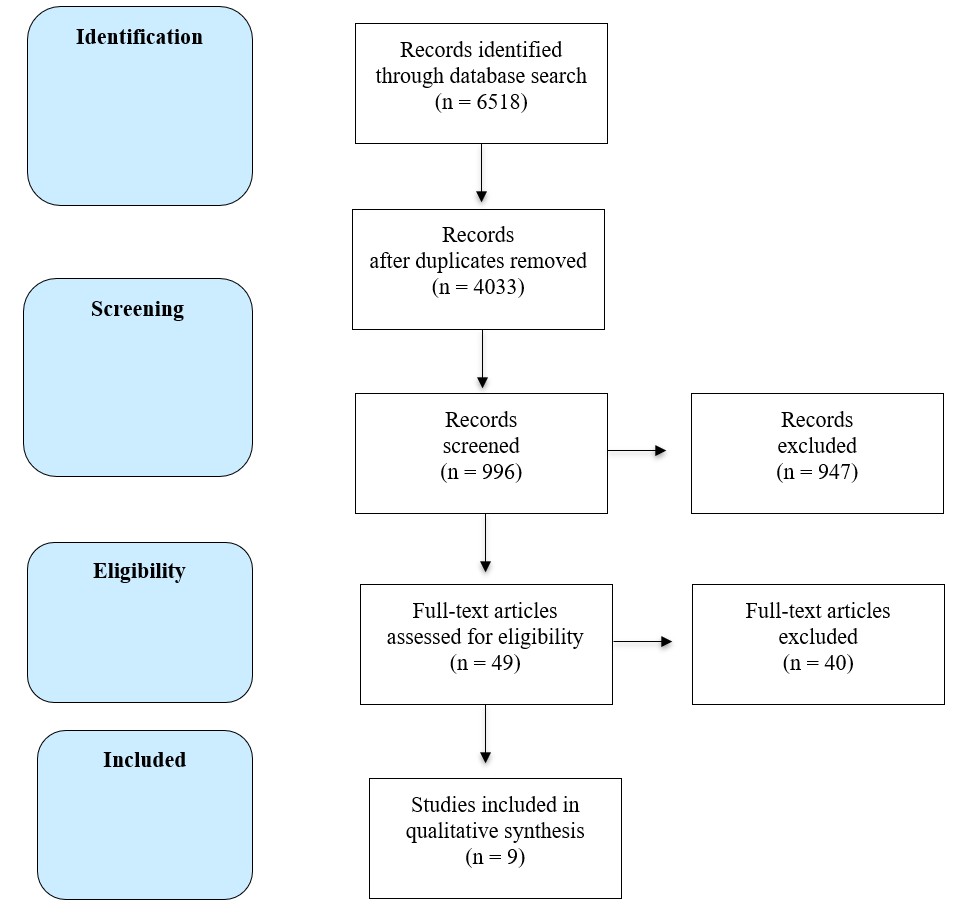
The initial screening resulted in 49 articles included for full text review. Each article was reviewed by both members of the review team, with any conflicts resolved through discussion and consensus. Full text review resulted in a total of 9 articles included for final data extraction. Please see Figure 1 for a Preferred Reporting Items for Systematic Reviews and Meta-Analyses (PRISMA) flow diagram that illustrates the publication selection steps.
PRISMA flowchart of included articles. Full-text coding of the 49 articles yielded 9 where epistemology was mentioned within the article.
Table 1 shows the results of coding for the prevalence of epistemology in English-available, peer-reviewed occupational therapy education literature. The earliest article concerning epistemology in occupational therapy education was published in 2006 (Hooper, 2006). Of the 9 articles extracted mentioning epistemology, only 4 revealed specific epistemological orientations (e.g. postmodernism, pragmatism, phenomenology, critical theory, etc.). The orientations mentioned were primarily postmodern-adjacent, alluding to postmodernism, social constructivism, and post-structuralist thought (as expressed in Northern Anglophone contexts). The fourth article by Taff & Putnam (2022) reviewed a wide variety of epistemological schools. The remaining 5 articles did not mention a specific theoretical epistemological orientation.
Discussion
Certain trends are immediately visible from the results. Throughout English-available peer-reviewed occupational therapy education literature, epistemology was rarely mentioned and seldom explored. Furthermore, English-available peer-reviewed occupational therapy education literature that did mention epistemology had not appeared until 2006, nearly a century since the profession’s inception (Hooper, 2006). Additionally, the few English-available peer-reviewed occupational therapy education articles that did include discourse concerning epistemology did so quite broadly, not mentioning specific epistemological orientations (e.g., critical theory, postmodernism, phenomenology, pragmatism, etc.). These findings have broad implications for the epistemological base of occupational therapy education, posing several challenges concerning course development and professional practice.
There are few discussions of epistemology in English-available peer-reviewed occupational therapy education literature
Findings
From the 4033 English-available peer-reviewed articles retrieved, 49 were deemed as relevant to occupational therapy education. Following a review of each article, only 9 articles mentioned epistemology and occupational therapy education explicitly. While there were other articles which could have been attributed to epistemological inquiry (e.g. asking questions concerning knowledge attainment within the profession) these were excluded as they did not deliberately aim to explore the use and implementation of epistemological schools of thought within occupational therapy education. While the reviewed articles were limited to those available in English, possible gaps are visible concerning the implementation of epistemology in to occupational therapy education.
Interpretations
This theme highlights a need for further epistemological inquiry and exploration concerning occupational therapy teaching and learning practices within Anglophone contexts. Given that only 9 out of 4033 articles were concerned with occupational therapy education and epistemology, alludes to a greater challenge for the profession which is to structure teaching and learning practices around theory. English available peer-reviewed occupational therapy education literature has seldom explored epistemologies, whether historically relevant to occupational therapy educational discourse (e.g., pragmatism, structuralism/ positivism, social occupational therapy) or broader epistemological and educational theories (e.g., phenomenology, critical theory, postmodernism, critical pedagogy, educational reconstructionism, etc.). This could call into question the grounding for occupational therapy education teaching practices insofar as that there is a lack of theoretical knowledge utilized to develop curricula. Given this, and as history has demonstrated, Northern Anglophone occupational therapy education has relied on structuralist/positivist structures, as informed by the medical model, to transnationally influence occupational therapy education rather than promote theoretical exploration and implementation (Boyer, 1990; Hooper, 2006; Miller & Roberts, 2020; Murray et al., 2015; Taff & Putnam, 2022).
The valuation of structuralist methodologies and constructs (e.g. the medical model, scholarship of discovery, etc.) continues to be an influential force guiding occupational therapy education research and literature within Northern Anglophone contexts (Boyer, 1990). As described by Boyer (1990), the scholarship of discovery posits that current educational research tends to value empirical studies over theoretical research, thus possibly influencing occupational therapy educators’ research aims and objectives. To explore this possible concern, Gupta & Bilics (2014) investigated occupational therapy faculty’s production of occupational therapy education research and scholarly practices. Their results acknowledge educational institutions’ adoption of Boyer’s (1990) scholarship of discovery, however occupational therapy programs are learning to adopt new educational perspectives. Results revealed that approximately half of the occupational therapy educators surveyed participated in some form of education related research (Gupta & Bilics, 2014). Although research in this area is steadily increasing, when participants (n= 450) were asked about their rate of publication over a seven-year period, 77% (n= 344) of respondents reported not publishing research in education. These results reveal that occupational therapy faculty do see the value in researching occupational therapy education, however research can often be limited due to institutional obligations, additional schooling, and workload. However, this result reveals a greater imperative which is a lack of educational research necessary to expand teaching/ learning practices grounded in epistemological theory (Gupta & Bilics, 2014).
Future implications
Deeper discussion concerning epistemological theories (e.g., pragmatism, structuralism/ positivism, critical theory, phenomenology, etc.) could help occupational therapy students build a better understanding of how and why occupational therapy practice and education ascribe to certain mediums of learning. Epistemologies, when integrated with occupational therapy practice and firsthand experiences, can create more reflexive practitioners. Galheigo et al. (2017) explored this when facilitating focus groups with acute pediatric occupational therapists. Through discussions on the demands of the hospital setting, assessment focus, and the client centered approach, new knowledge was generated through the firsthand experiences of the practitioners. Phenomenological in nature, reflexive dialogue was found to be a useful mechanism for contributing to the knowledge of occupational therapy and for creating more confident and thoughtful practitioners (Galheigo et al., 2017; Kinsella & Whiteford, 2009). This clinical example illustrates how occupational therapy education could greatly benefit from discussions concerning epistemological theories as well as their application to authentic practice.
Integrating epistemological theories into occupational therapy education, practice, and research would only serve to shed new light on new teaching/ learning practices in line with the foundational framework of occupational therapy (Anderson & Reed, 2017; Lopes & Malfitano, 2021). The primary aim of creating a curriculum imbued with epistemological theories is to provide students with opportunities to critically think about learning, to challenge epistemological narratives, and to develop a framework for occupation-centered practices (Galheigo et al., 2017; Kinsella & Whiteford, 2009). Through an education predicated on epistemological inquiry, students and educators could foster spaces for intellectual exploration into the ‘why’ of occupational therapy educational practices. Participation in occupational therapy education should be a lifelong endeavor, extending beyond higher education; teaching practitioners to ask important epistemological questions that could ultimately lead to epistemological continuity from education to practice.
Literature concerned with epistemology in occupational therapy education was not identified until 2006
Findings
Epistemology provides the basis for how a profession discovers and codifies new knowledge to advance and ensure the consistency of concepts. What was discovered and what is also concerning for the profession of occupational therapy was that explicit discussion concerning epistemology within English-available occupational therapy education peer-reviewed literature was not mentioned until 2006, approximately a century (nine decades) into the profession’s existence (Hooper, 2006). Given this observation, the structuring and focus of occupational therapy education could be called into question. Discussion within the Anglophone sphere concerning occupational therapy education seems to lack an epistemological basis for curricular valuation and direction, thus giving possible cause to the contraction seen between the existing structuralist curriculum informed by pragmatist foundations (Hooper & Wood, 2002; Taff & Babulal, 2021).
Interpretations
If epistemology is not actively discussed within a profession, confusion, miscommunication, and discord may arise given the contradicting principles of certain epistemologies concerning their interpretation and implementation. As informed by pragmatist principles and foundational influences (Moral Treatment and educational progressivism), occupational therapy was built on the belief that engagement in occupation is beneficial to health and recognizes that treatment methodology should be focused on one’s subjective understanding of meaning and purpose (Anderson & Reed, 2017; Kielhofner & Burke, 1977; Lazzaro & Lucas, 2021). While these principles remain fundamental to occupational therapy, they have often been abandoned given structuralist influences (Hooper & Wood, 2002; Mannion, 2014).
The medical model, which has influenced the way occupational therapists as well as other healthcare professionals assess, evaluate, and treat disease, often has resulted in reductionistic treatments rather than holistic/ narrative focused practices (Lazzaro & Lucas, 2021; Morrison, 2021). In tandem with the prevalence of the medical model, Boyer (1990) noted that the dominance of the scholarship of discovery had negated exploration concerning the development of new teaching and learning methods. Subsequently, Northern Anglophone academic institutions were called to prioritize empirical works (e.g. randomized control trials) in preference to research related to theory or educational practices. This practice in academia could also be a contributing explanation as to why English-available, peer-reviewed occupational therapy literature relating to epistemology and education was not prevalent. Given these forces, just as occupational therapy treatment and evaluation had been influenced by the medical model, so had the educational landscape.
Particularly within western society, in order to gain legitimacy as a health profession and be valued by corporate healthcare entities, occupational therapy’s orientation towards the biomedical sciences has often led to structuralist/reductionist approaches in education (Bagatell & Womack, 2016; Gupta & Taff, 2015; Taff & Babulal, 2021). Much of the occupational therapy curriculum continues to focus heavily on biomechanical approaches and topics such as anatomy, physiology, kinesiology, neuroscience, and standardized assessment (Bagatell & Womack, 2016; Hooper, 2006; Ikiugu & Schultz, 2005). While these subjects are necessary to facilitate a comprehensive understanding of individual performance, a heightened focus on biomedical factors could hinder the holistic approach the profession has been predicated on (Glenn & Gilbert-Hunt, 2012).
According to West (1984), the disconnect between theory and practice produced occupational therapists who exhibit “a lack of faith in what they are doing by using modalities that are neither occupational therapy nor effective treatment” (p. 16). Resolving this epistemological dissonance is necessary for the further development of occupational therapy. Within the answers to the three questions of epistemology – what is knowledge, how is it gained, and what can be known – lie answers about the fundamental identity of a field of study. The result of an active discussion concerning epistemology can lead to a stronger professional identity for occupational therapy education and practice within Northern Anglophone contexts. The clash identified in the findings between structuralism and pragmatism embodies the difficulty in creating a science that can be rigorous enough to produce truths and flexible enough to adapt those truths to every individual person. The search for truth and knowledge can be better aided through the establishment of epistemological continuity which could incorporate an overarching understanding of multiple epistemologies, establish the role of each epistemology, and align occupational therapy education with theory.
Future implications
For occupational therapy education, this theme underlines the importance of understanding occupational therapy’s theoretical framework in relation to what is taught and implemented. Without an established epistemological framework or way of knowing, what is taught in occupational therapy education could easily be influenced by outside power structures or entities, like that of the medical model or the corporatization of healthcare; causing occupational therapy educators to focus primarily on reductionistic approaches rather than holistic care, as observed in Northern Anglophone countries (Biesta & vanBraak, 2020; Gupta & Taff, 2015). It is possible that if education regarding epistemologies began at the profession’s inception, within Northern Anglophone contexts, and continued to the present day, the identity of occupational therapy could have greater continuity in theory and practice (Hooper, 2006).
Exploring epistemology is an opportunity for growth
Findings
Of the nine English-available articles identified as explicitly concerned with occupational therapy education and epistemology, only four mentioned a specific epistemological theory/ framework (e.g. pragmatism, structuralism/ positivism, postmodernism, phenomenology, etc.). This leads to a greater concern which is when epistemology is reviewed within Northern Anglophone contexts, it is done so superficially and broadly, neglecting the relevance of thorough epistemological analysis. When epistemological theories were reviewed within English-available, peer-reviewed occupational therapy literature, they focused primarily on postmodern theories (e.g. occupational justice, social reconstruction, etc.) aimed at deconstructing current neo-liberal practices while developing new learning methods (Carrasco Bassi & Oliver, 2024; Kaelin & Dancza, 2019; Taff & Putnam, 2022; van der Merwe et al., 2023).
Given that discussion concerning epistemological theories has been minimal across English-available literature, it will be imperative to establish epistemological continuity and exploration throughout occupational therapy education and curricula. Continuity can be established by teaching occupational therapy students about varying epistemologies, their historical/ theoretical nature, and how each can be translated into practice. The intentional use of multiple epistemological theories, whether historically influential (e.g., pragmatism, structuralism/ positivism) or relevant to curriculum development (e.g., critical theory, critical pedagogy, historical dialectic materialism (HDM), phenomenology, etc.), could improve learning outcomes through experiential opportunities and critical discourse (Ahmed-Landeryou, 2024; Glenn & Gilbert-Hunt, 2012; Pitonyak et al., 2020). To increase epistemological understanding and application, the discipline of occupational science, recognized that new methodologies are required to explore the multidimensional, complex construct of human occupation, and how these theories can reinforce an occupation-oriented education (Clark et al., 1991).
Interpretations
Educational approaches involving the implementation of theoretical frameworks into curricula as a means for grounding the profession can serve to strengthen student outcomes (Bagatell & Womack, 2016). While epistemological/ theoretical inquiry has been seldom explored within English available peer-reviewed occupational therapy education literature, the deconstruction of the structuralist lens abetted by the implementation of occupation centered (e.g. pragmatist) principles has been beneficial for teaching students about the complexities of human occupation within occupational science.
Bagatell & Womack (2016) identified courses and concepts based in structuralism/ reductionism (neuroscience, anatomy, etc.) as unsatisfactory for providing students with an occupation-centered education. Committed to an occupation centered curriculum, the faculty at the University of North Carolina at Chapel Hill reconceptualized structuralist based courses in 2014 (specifically kinesiology and neuroscience) with courses that utilize an occupation-based lens (Bagatell & Womack, 2016). In the Master of Science course, Human Capacity for Action I, students cover areas of occupation (e.g. eating, sleeping, driving, etc.) and how not only the body structures, body positions, and physiology related to the occupation, but also how the cultural, social, cognitive, and communicative influences apply (Bagatell & Womack, 2016). After completing the course, the authors reported that “students not only felt they had mastered knowledge about body structures and functions through occupation, but gained a deeper appreciation for the complexity of everyday occupations and the multiple factors that contribute to engagement” (Bagatell & Womack, 2016, p. 517). As demonstrated by Bagatell & Womack (2016), occupational science has and continues to provide students with a methodology for understanding phenomenon through an occupational lens rather than a lens that is strictly biomedical.
In the current century, the epistemological content of English-available, peer-reviewed occupational therapy education literature has minimally expanded, primarily focusing on occupational justice issues under the lens of postmodern thought. While occupational therapy education does not promote a singular way of knowing, increasing the prevalence of epistemological inquiry would only serve to refine and guide the profession’s scope (Guajardo et al., 2015). Just as no single point of view could hope to frame the scope of an individual’s life with complete accuracy, no single epistemology could hope to bring together the myriad frames of view existing within occupational therapy education. Given this, exploring epistemologies to ground occupational therapy educational practices is paramount for expanding the breadth and depth of the profession’s understanding of knowledge creation and attainment.
Future implications
Further epistemological exploration within Northern Anglophone educational contexts could reveal to educators and practitioners how these epistemologies relate to occupational therapy and each other. In the future, occupational therapy educators could create a framework that utilizes and connects varying epistemologies to expand curricular development. This would be imperative for grounding the profession in theory, promoting different ways of teaching and learning (as occupational therapists will always be teaching life skills) (Hooper et al., 2018; Pitonyak et al., 2020; Yerxa, 1967). In an effort to ensure this end, educators and researchers can use epistemological theories in-themselves to investigate how to best incorporate epistemology into educational practice.
Of these mediums, historical dialectic materialism (HDM) is an epistemological methodology, informed by critical theory and the works of Marx & Engels (1974), utilized to investigate the historical and dialectical nature of existing structures within society (e.g., education) (Godoy-Vieira et al., 2020). The HDM lens reflects how the social occupational therapy movement aims to reveal the subtle Northern/neoliberal power structures that impact curriculum development and implementation (Hammell, 2021; Malfitano & Lopes, 2018). In understanding the historical context of occupational therapy education as reviewed previously (e.g., the influence of the medical model on education via structuralism/ positivism, etc.), meaningful actions can be taken to ensure that educational practices not only promote critical discourse but inform students and educators about the epistemological grounding to invoke systematic change (Freire, 1971; Marx & Engels, 1974; Taff & Putnam, 2022). The HDM perspective provides occupational therapy educators with a framework for deconstructing biases within curricula and instruction as a means for providing occupational therapy students with the awareness necessary to invoke meaningful change as future practitioners (Godoy-Vieira et al., 2020). By inrporcoating discussions concerning different epistemologies, students and educators can use new and unrealized principles to create epistemological continuity that could be shared internationally. Further implementation of epistemological theories into occupational therapy education would only serve to increase curricular rigor and student competence.
Limitations and future research
A given aspect of historical research is difficulty in locating articles from occupational therapy education’s early years. These articles may not be listed in research databases and may be unavailable even when they are. The authors were also limited to researching only English language articles if a translated copy was unavailable. We acknowledge this as a primary limitation, as there is a growing body of literature, particularly in South America, Africa, and Asia, that is not available in English. It should further be noted that while these findings may not be generalizable across the globe, they speak to a greater critique of peer-reviewed works and their necessity in developing epistemological perspectives within occupational therapy education. In addition to this limitation, clinical trials, basic science research, theses/dissertations, book chapters, conference abstracts, interviews, and policy statements, were excluded from this inquiry as they are often not subject to the same rigor of peer-review as publishing journals. Furthermore, the use of epistemological descriptions (which match the opacity of professional use) within the included articles was inconsistent. Therefore, the authors decided to include a wide variety of similar epistemologies (positivism, reductionism, realism, structuralism) under the term structuralism to avoid overly focusing on the subtle differences between these terms. Epistemology is also strongly connected to ontology (the study of being) and axiology (the study of morals). A similar project concerning axiology or ontology would enhance the view of historical philosophical influences provided by this literature.
Implications for occupational therapy education
These findings have broad implications for the epistemological base of occupational therapy education, such as the way that occupational therapy constructs and organizes knowledge, as well as considerations for the future direction of the profession. Promoting epistemology would impact course curricula and instruction by offering multiple solutions for teaching and learning. This would include critical reflection and critical dialogue surrounding how and why occupational therapy students learn about certain areas of content. Having knowledge of pragmatism, structuralism/ positivism or other epistemological theories (e.g., critical theory, HDM, phenomenology, postmodernism, etc.), could facilitate such inquiry as it would endow students with the knowledge base and language for discussion (Guajardo et al., 2015). When teaching the foundations of occupational therapy, educators can add further depth and context by addressing epistemology as the underlying base through which the priorities for the profession are identified. A deeper understanding of epistemology and its application could help learners develop an all-encompassing perspective of occupational therapy and may aid them as future practitioners (Kielhofner & Burke, 1977; Teraoka & Kyougoku, 2015). Priorities for the profession would include identifying occupational therapy education’s mission and vision utilizing epistemological theories to provide a stronger foundation for teaching principles and methodologies (Hooper et al., 2018; Yerxa, 1967). The importance of having epistemological continuity of occupational therapy terms and theories is crucial if to facilitate adequate knowledge translation to sustain the profession. An understanding of epistemologies could also serve to inform students about emancipatory educational practices and therapeutic interventions which would better position future practitioners to liberate individuals and their communities (Malfitano & Lopes, 2018). Without epistemological continuity, the profession of occupational therapy could find itself disjointed and without curricular direction. With a clear understanding of epistemologies and teaching strategies, students and new occupational therapists can be better prepared to carry out the intentions and purpose of occupational therapy education and practice.
Conclusion
Epistemology, the study of knowledge, explores the following questions: what is knowledge, how is it attained, and what can be known. Occupational therapy draws from different disciplines and different epistemologies. In the past, a lack of research and discussion concerning epistemology coincided with a fracturing of the profession’s knowledge base and practice, a dichotomy between structuralist/positivist practices and pragmatists values, similarly presents specifically in Northern Anglophone contexts within occupational therapy education. Based upon the results of this review, peer-reviewed occupational therapy education literature has seldom explored epistemologies that inform knowledge construction and curriculum development. While the implementation of epistemological grounding is necessary for any profession, there have been barriers throughout the history of occupational therapy education that have hindered further epistemological development. These barriers have included time, training, professional obligations, and workload as influenced by neo-liberal systems and the misplaced valuation of structuralist/ positivist educational practices (Boyer, 1990; Freire, 1971; Gupta & Bilics, 2014; Malfitano & Lopes, 2018; Taff & Putnam, 2022). Given this, promoting epistemological inquiry and continuity will be imperative for upholding the values of occupational therapy as epistemologically driven curriculums can provide a way to study the concept of occupation while further establishing the unique and necessary presence of occupational therapy in health care. All practitioners, researchers, and educators can contribute to this development by taking a more critical and self-reflective view of their own knowledge and understanding of occupational therapy. The self-reflection must then be brought forth into discussions – in literature, workplaces, conferences and classrooms – about how we all search for and piece together the truths about occupational therapy education.
-
How to cite:
Lazzaro, C., Selvaratnam, A., Lipsey, K., Bachelani, S. H., & Taff, S. (2026). The prevalence of epistemology in occupational therapy education literature: a historical mapping review, 1917-2024. Cadernos Brasileiros de Terapia Ocupacional, 34, e4094. https://doi.org/10.1590/2526-8910.cto415940942
-
Data Availability
The data that support the findings of this study are available from the corresponding author, upon reasonable request.
References
- Ahmed-Landeryou, M. J. (2024). A critical reflection from inside, looking back and forward: theorising perspectives on decolonising occupational science theory and practice. Journal of Occupational Science, 31(1), 32-46.
- Anderson, L., & Reed, K. (2017). The history of occupational therapy: the first century New York: Slack
- Audi, R. (1999). Cambridge Dictionary of Philosophy (2nd ed). United Kingdom: Cambridge University Press.
- Bagatell, N., & Womack, J. L. (2016). Human capacity for action as core content in occupational science education. Journal of Occupational Science, 23(4), 514-518.
- Battaglia, J. (2016). Toward a caring curriculum: can occupational therapy be taught in a caring context? International Journal on Teaching and Learning in Higher Education, 28(2), 265-270.
- Biesta, G. J., & van Braak, M. (2020). Beyond the medical model: thinking differently about medical education and medical education research. Teaching and Learning in Medicine, 32(4), 449-456.
-
Booth, A. (2016). EVIDENT guidance for reviewing the evidence: a compendium of methodological literature and websites Retrieved in 2025, April 24, from https://www.researchgate.net/publication/292991575_EVIDENT_Guidance_for_Reviewing_the_Evidence_a_compendium_of_methodological_literature_and_websites?channel=doi&linkId=56b4ad2f08ae38193f6c9e5b&showFulltext=true
» https://www.researchgate.net/publication/292991575_EVIDENT_Guidance_for_Reviewing_the_Evidence_a_compendium_of_methodological_literature_and_websites?channel=doi&linkId=56b4ad2f08ae38193f6c9e5b&showFulltext=true - Boyer, E. L. (1990). Scholarship reconsidered: priorities of the professoriate. New Jersey: Princeton University Press.
- Breines, E. (1986). Origins and adaptations: a philosophy of practice. Lebanon: Geri-Rehab.
- Breines, E. (1987). Pragmatism as a foundation for occupational therapy curricula. The American Journal of Occupational Therapy, 41(8), 522-525.
- Campbell, F., Tricco, A. C., Munn, Z., Pollock, D., Saran, A., Sutton, A., White, H., & Khalil, H. (2023). Mapping reviews, scoping reviews, and evidence and gap maps (EGMs): the same but different— the “Big Picture” review family. Systematic Reviews, 12(45), 1-8.
- Carrasco Bassi, B. G., & Oliver, F. C. (2024). Systematic mapping of knowledge production in graduate training in occupational therapy in territorial and community contexts in Brazil. Cadernos Brasileiros de Terapia Ocupacional, 32, 1-17.
- Clark, F. A., Parham, D., Carlson, M. E., Frank, G., Jackson, J., Pierce, D., Wolfe, R. J., & Zemke, R. (1991). Occupational science: academic innovation in the service of occupational therapy’s future. The American Journal of Occupational Therapy, 45(4), 300-310.
-
Colquhoun, H. L., Brehaut, J. C., Sales, A., Ivers, N., Grimshaw, J., Michie, S., Carroll, K., Chalifoux, M., & Eva, K. W. (2013). A systematic review of the use of theory in randomized controlled trials of audit and feedback. Implementation Science : IS, 8(1), 66. http://dx.doi.org/10.1186/1748-5908-8-66
» http://dx.doi.org/10.1186/1748-5908-8-66 - De Sassure, F. (1959). Course in general linguistics New York: The Philosophical Library Inc.
- Elo, S., & Kyngäs, H. (2008). The qualitative content analysis process. Journal of Advanced Nursing, 62(1), 107-115.
- Freire, P. (1971). Pedagogy of the oppressed New York: Seabury.
- Galheigo, S. M., Braga, C., Mieto, F., Viotti, F., Sarmento, G., Motta, M., Silva, M., Santos, M., Spinola, P., Serpa, R., Mitre, R., Lagôa, T., Oliveira, T., Magalhães, W., & Kinsella, E. (2017). Exchanging knowledge within a community of practice: toward an epistemology of practice in Occupational Therapy paediatric hospital care. Cadernos Brasileiros de Terapia Ocupacional, 25(3), 449-459.
- Glenn, E. K., & Gilbert-Hunt, S. (2012). New graduate occupational therapists experience of showering assessments: A phenomenological study. Australian Occupational Therapy Journal, 59(3), 188-196.
- Godoy-Vieira, A., Soares, C. B., & Cordeiro, L. (2020). Occupation and labour: Towards emancipatory practices. In H. van Bruggen, S. Kantartzis & N. Pollard (Eds.), ‘And a seed was planted...’ Occupation-based approaches for social inclusion (pp. 307-317). London: Whiting and Birch.
- Grant, M. J., & Booth, A. (2009). A typology of reviews: an analysis of 14 review types and associated methodologies. Health Information and Libraries Journal, 26(2), 91-108.
- Guajardo, A., Kronenberg, F., & Ramugondo, E. L. (2015). Southern occupational therapies: emerging identities, epistemologies and practices. South African Journal of Occupational Therapy, 45(1), 1-8.
- Gupta, J., & Bilics, A. (2014). Brief Report: scholarship and research in occupational therapy education. The American Journal of Occupational Therapy, 68, S87-S92.
- Gupta, J., & Taff, S. D. (2015). The illusion of client-centered practice. Scandinavian Journal of Occupational Therapy, 22(4), 244-251.
- Hammell, K. W. (2021). Social and structural determinants of health: exploring occupational therapy’s structural (In) competence. Canadian Journal of Occupational Therapy. Revue Canadienne d’Ergothérapie, 88(4), 365-374.
- Hooper, B. (2006). Epistemological transformation in occupational therapy: educational implications and challenges. OTJR. Occupation, Participation, and Health, 26(1), 15-24.
- Hooper, B. (2010). On arriving at the destination of the centennial vision: navigational landmarks to guide occupational therapy education. Occupational Therapy in Health Care, 24(1), 97-106.
- Hooper, B., & Wood, W. (2002). Pragmatism and structuralism in occupational therapy: the long conversation. The American Journal of Occupational Therapy, 56(1), 40-50.
- Hooper, B., Gupta, J., Bilics, A., & Taff, S. (2018). Balancing efficacy and effectiveness with philosophy, history, and theory-building in occupational therapy education research. The Open Journal of Occupational Therapy, 6(1), 1-11.
- Hsieh, H., & Shannon, S. E. (2005). Three approaches to qualitative content analysis. Qualitative Health Research, 15(9), 1277-1288.
- Ikiugu, M. N., & Schultz, S. (2005). An argument for pragmatism as a foundational philosophy of occupational therapy. Canadian Journal of Occupational Therapy. Revue Canadienne d’Ergothérapie, 73(2), 86-97.
- Iwama, M. (2003). Toward culturally relevant epistemologies in occupational therapy. The American Journal of Occupational Therapy, 57(5), 582-588.
- James, W. (1907). Pragmatism, a new name for some old ways of thinking: popular lectures on philosophy New York: Longmans, Green, and Co.
- Kaelin, V. C., & Dancza, K. (2019). Perceptions of occupational therapy threshold concepts by students in role-emerging placements in schools: a qualitative investigation. Australian Occupational Therapy Journal, 66(6), 711-719.
- Kielhofner, G., & Burke, J. P. (1977). Occupational therapy after 60 years: an account of changing identity and knowledge. The American Journal of Occupational Therapy, 31(10), 657-689.
- Kinsella, E. A., & Whiteford, G. E. (2009). Knowledge generation and utilisation in occupational therapy: towards epistemic reflexivity. Australian Occupational Therapy Journal, 56(4), 249-258.
- Lazzaro, C. V. B., & Lucas, C. B. (2021). Occupational therapy’s role in understanding the subjectivity of spiritual suffering. Occupational Therapy in Mental Health, 38(2), 151-170.
- Levac, D., Colquhoun, H., & O’Brien, K. K. (2010). Scoping studies: advancing the methodology. Implementation Science : IS, 5(69), 1-9.
- Lévi-Strauss, C. (1963). Structural anthropology. New York: Basic Books.
- Lopes, R. E., & Malfitano, A. P. S. (2021). Social occupational therapy: theoretical and practical designs. Amsterdam: Elsevier
- Malfitano, A., & Lopes, R. (2018). Social occupational therapy: committing to social change. New Zealand Journal of Occupational Therapy, 65(1), 20-26.
- Mannion, R. (2014). Enabling compassionate healthcare: perils, prospects and perspectives. International Journal of Health Policy and Management, 2(3), 115-117.
- Marx, K., & Engels, F. (1974). The German ideology London: Lawrence & Wishart.
- Miller, M., & Roberts, M. J. (2020). Teaching and learning occupation in occupational therapy education: a qualitative evidence synthesis. Journal of Occupational Therapy Education, 4(3), 1-27.
- Mitchell, A. W. (2013a). Models of epistemic and ontological cognition: a new perspective of occupational therapy education. Occupational Therapy in Health Care, 27(1), 3-19.
- Mitchell, A. W. (2013b). Teaching Ill-structured problem solving using occupational therapy practice epistemology. Occupational Therapy in Health Care, 27(1), 20-34.
- Mitchell, A. W. (2014). Epistemic and Ontological cognition of entering and postdidactic occupational therapy students. The American Journal of Occupational Therapy, 68(Suppl.2), S3-S11.
- Morrison, R. (2021). Pragmatism in the initial history of occupational therapy. Cadernos Brasileiros de Terapia Ocupacional, 29, 1-12.
- Murray, C., Turpin, M., Edwards, I., & Jones, M. (2015). A qualitative meta-synthesis about challenges experienced in occupational therapy practice. British Journal of Occupational Therapy, 78(9), 534-546.
- Pitonyak, J. S., Nielsen, S., O’Brien, S. P., Corsilles-Sy, C., Lambert, D. O., & Jaffe, L. E. (2020). Critical thinking in occupational therapy education: A systematic mapping review. Journal of Occupational Therapy Education, 4(4), 1-30.
- Quiroga, V. A. M. (1995). Occupational therapy: the first 30 years 1900 to 1930 North Bethesda: The American Occupational Therapy Association
- Schwartz, K. B. (1992). Occupational therapy and education: a shared vision. The American Journal of Occupational Therapy, 46(1), 12-18.
- Serrett, K. D. (1985). Another look at occupational therapy’s history: paradigm or pair of-hands? Occupational Therapy in Mental Health, 5(3), 1-31.
- Taff, S. D., & Babulal, G. M. B. (2021). Reframing the narrative on the philosophies influencing the development of occupational therapy. In S.D. Taff (Ed.), Philosophy and occupational therapy: informing education, research, and practice (pp. 7-22). Abingdon: Routledge.
- Taff, S. D., & Putnam, L. (2022). Northern philosophies and professional neocolonialism in occupational therapy: a historical review and critique. Cadernos Brasileiros de Terapia Ocupacional, 30, 1-21.
- Teraoka, M., & Kyougoku, M. (2015). Development of the final version of the classification and assessment of occupational dysfunction scale. PLoS One, 10(8), 1-13.
- van der Merwe, T. R., Ramugondo, E. L., & Keet, A. (2023). Crafting a Foucauldian archaeology method: a critical analysis of occupational therapy curriculum-as-discourse, South Africa. Social Sciences, 12(7), 1-13.
- West, W. L. (1984). A reaffirmed philosophy and practice of occupational therapy for the 1980s. The American Journal of Occupational Therapy, 38(1), 15-23.
- Wilcock, A. A. (1998). An occupational perspective of health. New Jersey: Slack.
- Yerxa, E. J. (1967). Authentic occupational therapy. 1966 Eleanor Clarke Slagle lecture. The American Journal of Occupational Therapy, 21(1), 1-9.
Edited by
-
Section editor
Profa. Dra. Ana Paula Serrata Malfitano
The data that support the findings of this study are available from the corresponding author, upon reasonable request.