 Hypertriglyceridemic waist phenotype in older adults: prevalence and associated factors
Abstract
Background The hypertriglyceridemic waist (HW) phenotype is characterized by abdominal obesity and elevated blood triglycerides, indicating high cardiovascular risk in older adults.
Objective To identify the prevalence and factors associated with HW in older adults.
Method A cross-sectional epidemiological study was conducted with 223 older adults (mean age 71.80 ± 7.70 years) residing in Aiquara, Bahia, Brazil. HW was diagnosed by the presence of elevated waist circumference (women: ≥ 88 cm; men: ≥ 102 cm) in conjunction with hypertriglyceridemia (triglycerides ≥ 150 mg/dL). Poisson regression with robust variance was used for analysis, along with estimates of Prevalence Ratios (PR) and their respective 95% Confidence Intervals (CI).
Results The prevalence of HW was 23.30%. Female sex (PR: 2.50; 95% CI: 1.35–4.63), marital status (separated or divorced) (PR: 2.30; 95% CI: 1.33-3.96), elevated non-HDL cholesterol (PR: 2.15; 95% CI: 1.37–3.49), and low HDL cholesterol (PR: 2.35; 95% CI: 1.49–3.72) presented a greater probability of HW. Additionally, low weight presented a lower probability of HW (PR: 0.17; 95% CI: 0.04–0.60).
Conclusion A high prevalence of HW was identified, with positive associations with female sex, separated or divorced marital status, elevated non-HDL cholesterol, and low HDL cholesterol. Conversely, low weight showed an inverse association with HW.
Keywords:
aging; epidemiology; hypertriglyceridemia; abdominal obesity
Resumo
Introdução O fenótipo cintura hipertrigliceridêmica (CH) é caracterizado por obesidade abdominal e triglicerídeos elevados no sangue, indicando alto risco cardiovascular em pessoas idosas.
Objetivo Identificar a prevalência e os fatores associados à CH em pessoas idosas.
Método Estudo epidemiológico transversal realizado com 223 pessoas idosas (idade média de 71,80 ± 7,70 anos) residentes em Aiquara, Bahia, Brasil. A CH foi diagnosticada pela presença de circunferência da cintura elevada (mulheres: ≥ 88 cm; homens: ≥102 cm) em conjunto com hipertrigliceridemia (triglicerídeos ≥150 mg/dL). A regressão de Poisson com variância robusta foi utilizada para análise, com estimativas das Razões de Prevalência (RP) e seus respectivos Intervalos de Confiança (IC) de 95%.
Resultados A prevalência de CH foi de 23,30%. O sexo feminino (RP: 2,50; IC 95%: 1,35–4,63), estado civil (separado ou divorciado) (RP: 2.30; IC95%: 1.33-3.96), colesterol não-HDL elevado (RP: 2,15; IC95%: 1,37–3,49) e colesterol HDL baixo (RP: 2,35; IC95%: 1,49–3,72) apresentaram maior probabilidade para a CH. Além disso, o baixo peso apresentou menor probabilidade para a CH (RP: 0,17; IC95%: 0,04–0,60).
Conclusão Foi identificada uma alta prevalência de CH, com associações positivas com o sexo feminino, estado civil separado ou divorciado, colesterol não-HDL elevado e colesterol HDL baixo. Por outro lado, o baixo peso apresentou associação inversa com a CH.
Palavras-chave:
envelhecimento; epidemiologia; hipertrigliceridemia; obesidade abdominal
INTRODUCTION
During human aging, several physiological changes occur, leading to excessive fat accumulation in adipose tissue, particularly in the abdominal region1. Additionally, alterations in the lipid profile are often observed, such as elevated blood triglyceride levels2.
This combination defines the hypertriglyceridemic waist (HW) phenotype3, an adverse health condition in older adults that increases the likelihood of cardiovascular diseases and raises mortality risk4,5.
However, investigations into this outcome in older populations remain limited6,7, as most studies addressing this topic include a broad age range2,4,8-10. This gap highlights the need for health surveys to determine the prevalence of this condition and to identify the subgroups in which it is more common in later life stages, especially given that cardiovascular diseases account for 30.30% of morbidity in older adults and are a leading cause of illness and life-years lost in this population11.
Epidemiological surveys can thus aid in the early identification and screening of at-risk individuals, supporting targeted and more effective interventions in primary health care. With this purpose in mind,the presnt study aimed to identify the prevalence and factors associated with hypertriglyceridemic waist in older adults.
MATERIAL AND METHODS
Study design, setting, and population
This cross-sectional study was based on data from a census, population-based household survey titled “Health Conditions and Lifestyle of Older Adults in a Small Municipality,” conducted with older adults living in the urban community of Aiquara, a town in the Center-South region of the state of Bahia, Brazil12. The municipality covers approximately 167 km² and has an estimated population of 4,416 residents. It has a low Human Development Index (HDI = 0.583), ranking 4,562nd out of 5,565 Brazilian cities13.
Participants met the following inclusion criteria: being aged ≥ 60 years and not institutionalized. Exclusion criteria included residing in the rural area, cognitive impairment (determined by a score < 13 on the Mini Mental State Examination)14, and unavailability after three home visits on different days and times.
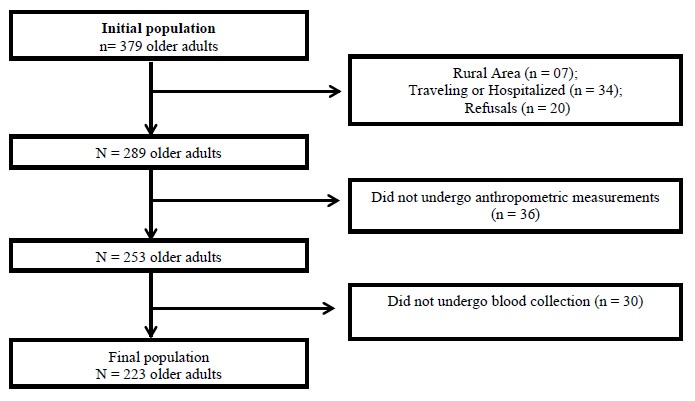
A census was initially conducted in Aiquara with the support of the Family Health Strategy (Estratégia Saúde da Família), covering 100% of the city’s population to identify older adults in the urban area. Consequently, all households were organized by territory and visited, identifying 379 older adults, of whom 223 participated in the study (see Figure 1).
Flowchart of the eligibility process for selecting older adult participants. Aiquara, state of Bahia, Brazil, 2015.
Data collection procedures
Data were collected between January and July 2015, involving three stages: questionnaire application, clinical and anthropometric assessments, and blood sample collection.
Household survey
The household survey, conducted in January 2015 through standardized interviews by a team of trained professionals and health science students, collected sociodemographic data, including age group (60–69, 70–79, ≥ 80 years), sex, self-reported skin color (white or non-white [Brown, Black, Indigenous]), education (educated or uneducated [defined as no schooling or only able to write one’s name]), marital status (married/stable union, divorced/separated, widowed), monthly income (≤ 1 minimum wage or > 1 minimum wage [2015 minimum wage: BRL 788.00]), and behavioral factors such as tobacco and alcohol consumption (yes or no). The frequency of health service use over the past year was recorded as two or more times, once, or none.
Physical activity was assessed using the long form of the International Physical Activity Questionnaire (IPAQ)15, validated for older Brazilian16,17. Insufficiently active individuals were classified as engaging in less than 150 minutes of moderate to vigorous activity18. Sedentary behavior was measured using the 5th domain of the IPAQ, which calculates sitting time on a typical weekday and weekend day. The weighted SB average was calculated as: (5 x min/weekday) + (2 x min/weekend day) / 7. High SB was defined as sitting time above the 75th percentile (430.00 min/day).
Clinical assessment and anthropometric measurements
Clinical and anthropometric measurements were conducted at the Municipal Health Department in Aiquara in March 2015. Blood pressure was measured per the Brazilian Guidelines on Arterial Hypertension19, using HEM 742 Omron® semi-automatic devices, with two measurements taken at 5-minute intervals. Older adults with a systolic blood pressure ≥ 140 mmHg and/or diastolic blood pressure ≥ 90 mmHg were considered to have high blood pressure19.
Height (m) was measured using a WiSO® stadiometer, with participants instructed to stand upright, heels together, with heels, buttocks, and shoulder blades against the wall, and eyes fixed on a horizontal plane20. Body mass (kg) was measured with a Plenna® digital scale, calibrated with a known-weight object prior to each use. Participants stood still, wearing light clothing and barefoot, with arms at their sides20. Based on that information, the body mass index in kg/m2 was calculated.
Waist circumference was measured using a flexible, non-elastic, anthropometric tape (Sanny®) at the narrowest point between the last floating rib and the iliac crest at the end of normal exhalation21.
Blood collection
Blood samples were collected from May to July 2015 at the Municipal Health Department of Aiquara in a clean, climate-controlled environment, following national biosafety guidelines22. A team of nursing and clinical laboratory technicians, equipped with personal protective equipment including latex gloves, goggles, caps, and waterproof coats, conducted the collection. Participants were instructed to fast for 12 hours before the procedure.
For the procedure, participants sat comfortably with their arms positioned horizontally for venipuncture. The median cubital vein was accessed using a tourniquet applied for no longer than 1.5 minutes, following aseptic site preparation with 70% alcohol. For participants unable to visit the facility, home blood collection was conducted following the same biosafety protocols22.
Blood was collected in vacuum tubes with an aspiration volume of 3–10 mL. Two tubes were taken per participant: a gray-stoppered tube containing fluoride and EDTA K3 for glucose analysis, and a red-stoppered tube for serum collection for other hormonal and biochemical assessments.
Samples were placed in coolers with reusable ice to maintain temperatures between +2 °C and +8 °C and were processed at the Public Health Laboratory, Pirajá da Silva Reference Center for Endemic Diseases, in Jequié, Bahia, Brazil.
Biochemical analyses included total cholesterol and its fractions (HDL-C, LDL-C, and non-HDL cholesterol), triglycerides, and fasting glucose, measured with SELLECTRA II® automated technology using the colorimetric enzymatic method. HDL-C was measured using direct precipitation, and LDL-C was calculated by the Friedewald equation. Hormonal assays (TSH and vitamin D [25-hydroxy]) were performed with ARCHTTECT® using chemiluminescence. Except for blood glucose, all samples were centrifuged to obtain serum. Variable cutoff points are shown in Chart 1.
Cutoff points for biochemical and hormonal profile categories among older adults participants. Aiquara, state of Bahia, Brazil, 2015.
Hypertriglyceridemic waist
Hypertriglyceridemic waist was defined as an elevated waist circumference (≥ 88 cm for women and ≥ 102 cm for men)21 combined with hypertriglyceridemia (triglycerides ≥ 150 mg/dL)24.
Statistical analysis
Descriptive analyses included absolute and relative frequencies, mean, and standard deviation. For inferential analysis, bivariate associations were examined using Pearson’s chi-squared test (χ²). Variables with a value of less than or equal to 20% (P ≤ 0.20) were included in the multivariate Poisson regression analysis with robust variance to estimate Prevalence Ratios (PR) and 95% Confidence Intervals (CI).
A hierarchical model was used, with sociodemographic factors as the most distal level (Level 1), behavioral aspects as the intermediate level (Level 2), and health conditions as the most proximal level (Level 3), as illustrated in Figure 2. The model construction began with the most distal variables, with successive levels added progressively. Each variable’s effect was adjusted for variables within the same and preceding levels, retaining only those with P ≤ 0.20 (Wald test for heterogeneity). The significance level for factors associated with the outcome in the final model was 5% (P ≤ 0.05). The statistical procedures were conducted in the Statistical Package for Social Sciences (SPSS® 21.0, 2013, Inc, Chicago, IL)
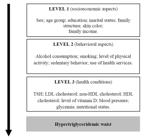
Hierarchical model for identifying factors associated with the hypertriglyceridemic waist in the study population. Aiquara, state of Bahia, Brazil, 2015
Ethical aspects
This study followed the World Medical Association’s Declaration of Helsinki and complied with Brazilian National Health Council Resolution No. 466/2012. The Research Ethics Committee of the State University of Southwest Bahia (UESB) approved the study (CAAE No: 10786212.3.0000.0055; Opinion No. 171.464).
RESULTS
A total of 223 older adults participated in the study, with a mean age of 71.80 ± 7.70 years (older women: 71.40 ± 7.10; older men: 72.50 ± 8.40). The prevalence of HW was 23.30%. Among the participants, 57% were women, 43% were insufficiently active, 47.40% had elevated non-HDL cholesterol, 51.80% presented insufficient vitamin D levels, 78% had high blood pressure, and 42.50% had hyperglycemia. Additional population characteristics are detailed in Table 1.
Descriptive analysis of the study population characteristics. Aiquara, state of Bahia, Brazil, 2015.
Table 2 presents the bivariate analyses between the independent variables and HW. Sex, marital status, skin color, alcohol consumption, physical activity level, health service use, nutritional status, non-HDL cholesterol, HDL cholesterol, vitamin D level, and glycemia (blood glucose) had a P-value of less than or equal to 20% (P ≤ 0.20) and were therefore included in the multivariate analysis.
Prevalence of hypertriglyceridemic waist among the older adults by independent variables. Aiquara, state of Bahia, Brazil, 2015.
After intra- and inter-level adjustments according to the hierarchical model, the variables alcohol consumption, health service use, vitamin D level, and glycemia did not meet the established statistical criteria (P ≤ 0.20) and were subsequently removed from the model.
In the final hierarchical Poisson regression model, it was found that being female (PR: 2.50; 95% CI: 1.35-4.63), being divorced or separated (PR: 2.30; 95% CI: 1.33-3.96), having elevated non-HDL cholesterol (PR: 2.15; 95% CI: 1.37-3.49) and low HDL cholesterol (PR: 2.35; 95% CI: 1.49-3.72) were positively associated with HW. In addition, older adults with low weight were less likely to present with the outcome compared to those with normal weight (PR: 0.17; 95% CI: 0.04-0.60) (see Table 3).
Final hierarchical model of the association between hypertriglyceridemic waist and independent variables in the study population. Aiquara, state of Bahia, Brazil, 2015.
DISCUSSION
This study found that 23.30% of older adults in Aiquara, Bahia, Brazil, had hypertriglyceridemic waist, with positive associations identified for female sex, marital status (separated or divorced), elevated non-HDL cholesterol, and low HDL cholesterol. An inverse association was observed between HW and low weight.
A population-based survey of 316 older adults in Lafaiete Coutinho, Bahia, Brazil, reported a similar HW prevalence of 27.10%6. In contrast, a study conducted with 2,102 older adults in Beijing, China, found a higher prevalence of 29.90%7. Variations in HW prevalence across studies may stem from differences in sociodemographic profiles and health conditions among participants. Nevertheless, the high frequency of HW in older populations signifies an important public health issue, as this phenotype is linked to the atherogenic metabolic triad (elevated apolipoprotein B, high LDL-c levels, and fasting hyperinsulinemia), which contributes to cardiometabolic diseases and worsens health outcomes for older adults3,27.
Our findings align with those of the Longitudinal Study on Adult Health (ELSA-Brazil), a multicenter study involving 12,811 adults and older adults (mean age: 51.10 ± 8.80 years) conducted in the Brazilian capitals of São Paulo, Belo Horizonte, Salvador, Rio de Janeiro, and Vitória. This study also observed associations between elevated non-HDL cholesterol (women: OR = 4.69, 95% CI: 3.94–5.58; men: OR = 2.94, 95% CI: 2.45–3.53), low HDL cholesterol (women: OR = 2.56, 95% CI: 2.19–2.99; men: OR = 3.06, 95% CI: 2.34–4.20), and HW10.
Similarly, research conducted in Spain with 6,732 older adults using data from the Prevención con Dieta Mediterránea (PREDIMED-Plus) study identified negative correlations between HDL cholesterol and both triglycerides (r = -0.208; P < 0.0001) and waist circumference ( r = -0.191; P<0.0001) in participants with HW2.
These associations may reflect the interplay between abdominal obesity and lipid profile changes, as excess visceral fat can lead to adipocyte dysfunction, resulting in increased production and release of pro-inflammatory adipokines. This process elevates LDL and very-low-density lipoprotein (VLDL) cholesterol levels, which contribute to non-HDL cholesterol. Additionally, obesity-related inflammation may reduce HDL cholesterol10,28.
Our results underscore an adverse epidemiological scenario in Aiquara, as abdominal obesity combined with dyslipidemia exacerbates comorbidities, raising the risk of hemodynamic and metabolic disorders like hypertension and diabetes mellitus, which can damage key organs (e.g., brain, kidneys, heart) and increase mortality risk4,5,19,29.
Another notable finding was the association between HW and female sex. Similarly, Fagundes et al.6 found that older women in Lafaiete Coutinho were 3.85 (95% CI: 2.16-6.87) times more likely to have HW than older men. The higher occurrence of HW in older women likely stems from a greater prevalence of abdominal obesity, driven by physiological changes following menopause29-31. Specifically, decreased estrogen levels during the climacteric period reduce resting energy expenditure and increase caloric intake, promoting fat accumulation. Moreover, fat redistribution from the hip to the abdominal region post-menopause contributes to both abdominal obesity and dyslipidemia32-34.
In Aiquara, Bahia, Brazil, marital status was positively associated with HW, with divorced or separated older adults more likely to present this outcome. Studies suggest that older adults without partners tend to have higher rates of abdominal obesity and an unfavorable lipid profile35-37. Conversely, those living with a spouse generally benefit from more balanced diets and fewer high-risk behaviors, such as poor nutrition and sedentary lifestyles10.
Conversely, underweight older adults were less likely to exhibit HW. This nutritional status, often marked by low muscle mass and low abdominal and overall fat levels, is frequently associated with malnutrition. Unintentional weight loss may result from various factors, including comorbidities, polypharmacy, and inadequate nutrient intake8,30,38.
This study has certain limitations, such as the indirect measurement of physical activity and sedentary behavior. However, a notable strength lies in the biochemical and hormonal assessment methods, as well as in the census-based approach, which allowed for the investigation of a large number of older adults in a municipality with low socioeconomic indicators. These findings may inform health surveillance strategies for older adults in Aiquara, Bahia, Brazil, and similar communities, facilitating early identification of individuals with a greater likelihood of HW and guiding targeted health interventions based on the factors identified in this study.
CONCLUSION
The findings indicate a high prevalence of hypertriglyceridemic waist, which was positively associated with female sex, elevated non-HDL cholesterol, marital status (separated or divorced), and low HDL cholesterol. Furthermore, an inverse association was observed between HW and low weight.
ACKNOWLEDGEMENTS
The authors are grateful to the Research Program for the Brazilian Unified Health System (PPSUS), the National Council for Scientific and Technological Development (CNPq), the State University of Southwest Bahia (UESB), the Foundation for Research Support of the State of Bahia (FAPESB), the Municipal Health Department of Aiquara, and the older adults who participated in this study.
-
How to cite:
Souza YS, Santos L, Silva DJ, Barbosa RS, Pinto LLT, Valença Neto PF, Casotti CA. Hypertriglyceridemic waist phenotype in older adults: prevalence and associated factors. Cad Saúde Colet, 2024;32(4):e32040610. https://doi.org/10.1590/1414-462X202432040610
-
Financial support:
The research was funded by the Brazilian Unified Health System Research Program, Call for Proposals 20/2013/SUS0055/2013, through the Bahia State Research Support Foundation.
REFERENCES
-
1 Jura M, Kozak LP. Obesity and related consequences to ageing. Age (Dordr). 2016;38(1):23. http://doi.org/10.1007/s11357-016-9884-3 PMid:26846415.
» http://doi.org/10.1007/s11357-016-9884-3 -
2 Fernández‐García JC, Muñoz‐Garach A, Martínez‐González MÁ, Salas‐Salvado J, Corella D, Hernáez Á, et al. Association Between Lifestyle and Hypertriglyceridemic Waist Phenotype in the PREDIMED‐Plus Study. Obesity (Silver Spring). 2020;28(3):537-43. http://doi.org/10.1002/oby.22728 PMid:32090511.
» http://doi.org/10.1002/oby.22728 -
3 Lemieux I, Pascot A, Couillard C, Lamarche B, Tchernof A, Alméras N, et al. Hypertriglyceridemic waist: a marker of the atherogenic metabolic triad (hyperinsulinemia; hyperapolipoprotein B; small, dense LDL) in men? Circulation. 2000;102(2):179-84. http://doi.org/10.1161/01.CIR.102.2.179 PMid:10889128.
» http://doi.org/10.1161/01.CIR.102.2.179 - 4 Rocha ALC, Pereira PF, Pessoa MC. Hypertriglyceridemic waist phenotype and cardiometabolic alterations in Brazilian adults. Nutr Hosp. 2015;32(3):1099-106. PMid:26319826.
-
5 Ely BR, Clayton ZS, McCurdy CE, Pfeiffer J, Minson CT. Meta-inflammation and cardiometabolic disease in obesity: Can heat therapy help? Temperature. 2017;5(1):9-21. http://doi.org/10.1080/23328940.2017.1384089 PMid:29687041.
» http://doi.org/10.1080/23328940.2017.1384089 -
6 Fagundes LC, Fernandes MH, Brito TA, Coqueiro RDS, Carneiro JAO. Prevalence and factors associated with hypertriglyceridemic waist in the elderly: a population-based study. Cien Saude Colet. 2018;23(2):607-16. http://doi.org/10.1590/1413-81232018232.02862016 PMid:29412418.
» http://doi.org/10.1590/1413-81232018232.02862016 -
7 Zeng J, Liu M, Wu L, Wang J, Yang S, Wang Y, et al. The association of hypertriglyceridemic waist phenotype with chronic kidney disease and its sex difference: a cross-sectional study in an urban Chinese elderly population. Int J Environ Res Public Health. 2016;13(12):1233. http://doi.org/10.3390/ijerph13121233 PMid:27983610.
» http://doi.org/10.3390/ijerph13121233 -
8 Andrade JR, Velasquez-Melendez G, Barreto SM, Pereira TSS, Mill JG, Molina MDCB. Fenótipo da cintura hipertrigliceridêmica e fatores nutricionais: um estudo com participantes do ELSA-Brasil. Rev Bras Epidemiol. 2017;20(3):382-93. http://doi.org/10.1590/1980-5497201700030003 PMid:29160432.
» http://doi.org/10.1590/1980-5497201700030003 -
9 Blackburn P, Lemieux I, Alméras N, Bergeron J, Côté M, Tremblay A, et al. The hypertriglyceridemic waist phenotype versus the National Cholesterol Education Program–Adult Treatment Panel III and International Diabetes Federation clinical criteria to identify high-risk men with an altered cardiometabolic risk profile. Metabolism. 2009;58(8):1123-30. http://doi.org/10.1016/j.metabol.2009.03.012 PMid:19481769.
» http://doi.org/10.1016/j.metabol.2009.03.012 -
10 Freitas RS, Fonseca MJMD, Schmidt MI, Molina MDCB, Almeida MDCC. Fenótipo cintura hipertrigliceridêmica: fatores associados e comparação com outros indicadores de risco cardiovascular e metabólico no ELSA-Brasil. Cad Saude Publica. 2018;34(4):e00067617. http://doi.org/10.1590/0102-311x00067617 PMid:29617485.
» http://doi.org/10.1590/0102-311x00067617 -
11 Prince MJ, Wu F, Guo Y, Gutierrez Robledo LM, O’Donnell M, Sullivan R, et al. The burden of disease in older people and implications for health policy and practice. Lancet. 2015;385(9967):549-62. http://doi.org/10.1016/S0140-6736(14)61347-7 PMid:25468153.
» http://doi.org/10.1016/S0140-6736(14)61347-7 - 12 Casotti CA, de Almeida CB, dos Santos L, Valença Neto PF, do Carmo TB. Condições de saúde e estilo de vida de idosos: métodos e desenvolvimento do estudo. PC-RESC. 2021;2:e12643.
-
13 Instituto Brasileiro de Geografia e Estatísica. Aiquara [Internet]. 2020 [cited 2021 Mar 14]. Available from: https://cidades.ibge.gov.br/brasil/ba/aiquara/panorama
» https://cidades.ibge.gov.br/brasil/ba/aiquara/panorama -
14 Melo DMD, Barbosa AJG. O uso do Mini-Exame do Estado Mental em pesquisas com idosos no Brasil: uma revisão sistemática. Cien Saude Colet. 2015;20(12):3865-76. http://doi.org/10.1590/1413-812320152012.06032015 PMid:26691810.
» http://doi.org/10.1590/1413-812320152012.06032015 -
15 Craig CL, Marshall AL, Sjöström M, Bauman AE, Booth ML, Ainsworth BE, et al. International physical activity questionnaire: 12-country reliability and validity. Med Sci Sports Exerc. 2003;35(8):1381-95. http://doi.org/10.1249/01.MSS.0000078924.61453.FB PMid:12900694.
» http://doi.org/10.1249/01.MSS.0000078924.61453.FB -
16 Benedetti TRB, Antunes PC, Rodriguez-Añez CR, Mazo GZ, Petroski ÉL. Reprodutibilidade e validade do Questionário Internacional de Atividade Física (IPAQ) em homens idosos. Rev Bras Med Esporte. 2007;13(1):11-6. http://doi.org/10.1590/S1517-86922007000100004
» http://doi.org/10.1590/S1517-86922007000100004 - 17 Benedetti T, Mazo G, Barros M. Aplicação do questionário internacional de atividades físicas para avaliação de mulheres idosas: validade concorrente e reprodutibilidade teste-reteste. Revista Brasileira de Ciência e Movimeto. 2004;12(1):25-34.
-
18 Bull FC, Al-Ansari SS, Biddle S, Borodulin K, Buman MP, Cardon G, et al. World Health Organization 2020 guidelines on physical activity and sedentary behaviour. Br J Sports Med. 2020;54(24):1451-62. http://doi.org/10.1136/bjsports-2020-102955 PMid:33239350.
» http://doi.org/10.1136/bjsports-2020-102955 -
19 Barroso WKS, Rodrigues CIS, Bortolotto LA, Mota-Gomes MA, Brandão AA, Feitosa ADM, et al. Diretrizes Brasileiras de Hipertensão Arterial–2020. Arq Bras Cardiol. 2021;116(3):516-658. http://doi.org/10.36660/abc.20201238 PMid:33909761.
» http://doi.org/10.36660/abc.20201238 -
20 Frisancho AR. New standards of weight and body composition by frame size and height for assessment of nutritional status of adults and the elderly. Am J Clin Nutr. 1984;40(4):808-19. http://doi.org/10.1093/ajcn/40.4.808 PMid:6486088.
» http://doi.org/10.1093/ajcn/40.4.808 - 21 World Health Organization. Waist circumference and waist-hip ratio: report of a WHO expert consultation. Geneva: WHO; 2011.
-
22 Andriolo A MA, Ballarati C, Barbosa I, Mendes M, Melo M, et al. Recomendações da Sociedade Brasileira de Patologia Clínica/Medicina Laboratorial para coleta de sangue venoso. Rio de Janeiro: ControlLab; 2009 [cited 2021 Mar. 20]. Available from: https://controllab.com/ensino/livros/recomendacoes-da-sbpc-ml-para-coleta-de-sangue-venoso/
» https://controllab.com/ensino/livros/recomendacoes-da-sbpc-ml-para-coleta-de-sangue-venoso/ -
23 Sociedade Brasileira de Diabetes. Diretrizes da Sociedade Brasileira sobre Diabetes: 2019-2020 [Internet]. São Paulo: Clannad; 2019 [cited 2021 Mar. 20]. Available from: https://www.saude.ba.gov.br/wp-content/uploads/2020/02/Diretrizes-Sociedade-Brasileira-de-Diabetes-2019-2020.pdf
» https://www.saude.ba.gov.br/wp-content/uploads/2020/02/Diretrizes-Sociedade-Brasileira-de-Diabetes-2019-2020.pdf -
24 Faludi AA, Izar MCO, Saraiva JFK, Chacra APM, Bianco HT, Afiune A No, et al. Atualização da diretriz brasileira de dislipidemias e prevenção da aterosclerose–2017. Arq Bras Cardiol. 2017;109(Supl 1):1-76. http://doi.org/10.5935/abc.20170121
» http://doi.org/10.5935/abc.20170121 -
25 Holick MF, Binkley NC, Bischoff-Ferrari HA, Gordon CM, Hanley DA, Heaney RP, et al. Evaluation, treatment, and prevention of vitamin D deficiency: an Endocrine Society clinical practice guideline. J Clin Endocrinol Metab. 2011;96(7):1911-30. http://doi.org/10.1210/jc.2011-0385 PMid:21646368.
» http://doi.org/10.1210/jc.2011-0385 -
26 Carvalho GA, Perez CLS, Ward LS. Utilização dos testes de função tireoidiana na prática clínica. Arq Bras Endocrinol Metabol. 2013;57(3):193-204. http://doi.org/10.1590/S0004-27302013000300005 PMid:23681265.
» http://doi.org/10.1590/S0004-27302013000300005 -
27 Lemieux I, Poirier P, Bergeron J, Alméras N, Lamarche B, Cantin B, et al. Hypertriglyceridemic waist: a useful screening phenotype in preventive cardiology? Can J Cardiol. 2007;23(Suppl B):23B-31B. http://doi.org/10.1016/S0828-282X(07)71007-3 PMid:17932584.
» http://doi.org/10.1016/S0828-282X(07)71007-3 -
28 Kahn HS, Valdez R. Metabolic risks identified by the combination of enlarged waist and elevated triacylglycerol concentration. Am J Clin Nutr. 2003;78(5):928-34. http://doi.org/10.1093/ajcn/78.5.928 PMid:14594778.
» http://doi.org/10.1093/ajcn/78.5.928 - 29 Confortin SC, Bittencourt B, Ono LM, Marques LP, Schneider IJC, Orsi E. Fatores associados ao estado nutricional em idosos participantes do Estudo “EpiFloripa Idoso”. DEMETRA: Alimentação. Nutrição & Saúde. 2016;11(Suppl Supl.):1333-50.
-
30 Silveira EA, Vieira LL, Souza JD. Elevada prevalência de obesidade abdominal em idosos e associação com diabetes, hipertensão e doenças respiratórias. Cien Saude Colet. 2018;23(3):903-12. http://doi.org/10.1590/1413-81232018233.01612016 PMid:29538570.
» http://doi.org/10.1590/1413-81232018233.01612016 -
31 Lima PV, Lopes AOS, Duarte SFP, Oliveira AS, Correa GTB, Reis LAD. Profile of the body mass index and associated factors in active elderlies. Rev Bras Enferm. 2018;71(Supl 2):876-83. http://doi.org/10.1590/0034-7167-2016-0683 PMid:29791622.
» http://doi.org/10.1590/0034-7167-2016-0683 -
32 López M, Tena-Sempere M. Estradiol effects on hypothalamic AMPK and BAT thermogenesis: a gateway for obesity treatment? Pharmacol Ther. 2017;178:109-22. http://doi.org/10.1016/j.pharmthera.2017.03.014 PMid:28351720.
» http://doi.org/10.1016/j.pharmthera.2017.03.014 -
33 Greendale GA, Sternfeld B, Huang M, Han W, Karvonen-Gutierrez C, Ruppert K, et al. Changes in body composition and weight during the menopause transition. JCI Insight. 2019;4(5):e124865. http://doi.org/10.1172/jci.insight.124865 PMid:30843880.
» http://doi.org/10.1172/jci.insight.124865 -
34 Xu Y, López M. Central regulation of energy metabolism by estrogens. Mol Metab. 2018;15:104-15. http://doi.org/10.1016/j.molmet.2018.05.012 PMid:29886181.
» http://doi.org/10.1016/j.molmet.2018.05.012 -
35 Andrade FBD, Caldas ADF Jr, Kitoko PM, Batista JEM, Andrade TBD. Prevalência de sobrepeso e obesidade em idosos da cidade de Vitória-ES, Brasil. Cien Saude Colet. 2012;17:749-56. http://doi.org/10.1590/S1413-81232012000300022
» http://doi.org/10.1590/S1413-81232012000300022 -
36 Costa CD, Schneider BC, Cesar JA. Obesidade geral e abdominal em idosos do Sul do Brasil: resultados do estudo COMO VAI? Cien Saude Colet. 2016;21(11):3585-96. http://doi.org/10.1590/1413-812320152111.02492016 PMid:27828591.
» http://doi.org/10.1590/1413-812320152111.02492016 -
37 Gama A, Marques P, Madeira T, Rosado-Marques V. Excesso de peso ou obesidade e fatores do estilo de vida em idosos do concelho de Lisboa. Antropol Port. 2020;(37):131-57. http://doi.org/10.14195/2182-7982_37_6
» http://doi.org/10.14195/2182-7982_37_6 - 38 Gaddey HL, Holder KK. Unintentional weight loss in older adults. Am Fam Physician. 2021;104(1):34-40. PMid:34264616.