 Adequacy of prenatal care in Primary Care in a municipality of northeastern Brazil
Abstract
Background: Prenatal care is an essential component of maternal and child health promotion, and, when it is improperly offered, it can result in adverse maternal and perinatal conditions.
Objective: To analyze the adequacy of prenatal care in Primary Care in a municipality in northeastern Brazil.
Method: Cross-sectional study with 613 puerperal women, carried out between September 2017 and May 2018. The research considered the beginning of prenatal care, number of consultations, registration of routine tests and procedures performed in consultations and maternal guidance received, according to the Ministry of Health. Simple and multiple logistic regression were used to estimate the odds ratio (OR) between sociodemographic, obstetric and service use characteristics and the outcome variable prenatal adequacy.
Results: Women aged <18 years were less likely to start early prenatal care. Belonging to the economic class B-C, having a partner and having one or two children, performing prenatal care in a traditional Basic Health Unit and having paid work increased the chances of adequacy.
Conclusions: Prenatal care in Primary Care in the municipality in question proved to be inadequate, with the persistence of socioeconomic inequalities
Keywords:
prenatal care; primary health care; quality indicators, health care; health evaluation.
Resumo
Introdução: O cuidado pré-natal é um componente essencial para a promoção da saúde materna e infantil e, quando ofertada de modo inapropriado, pode resultar em condições adversas maternas e perinatais.
Objetivo: Analisar a adequação da assistência pré-natal na Atenção Básica em um município do Nordeste do Brasil.
Método: Estudo transversal com 613 puérperas, realizado entre setembro de 2017 e maio de 2018. A pesquisa considerou o início do prénatal, número de consultas, registro de exames de rotina e procedimentos realizados nas consultas e orientações maternas recebidas, conforme o Ministério da Saúde. A regressão logística simples e múltipla foi utilizada para estimar o odds ratio (OR) entre as características sociodemográficas, obstétricas e de uso do serviço e a variável de desfecho adequação pré-natal.
Resultados: Mulheres com idade <18 anos apresentaram menor probabilidade de iniciar o pré-natal precoce. Pertencer à classe econômica B-C, ter companheiro e ter um a dois filhos, realizar pré-natal em UBS (Unidade Básica de Saúde) tradicional e ter trabalho remunerado estiveram associados a maiores chances de adequação.
Conclusões: A assistência pré-natal na Atenção Básica do município mostrou-se inadequada com a persistência das desigualdades socioeconômicas.
Palavras-chave:
cuidado pré-natal; atenção primária à saúde; indicadores de qualidade em assistência à saúde; avaliação em saúde.
INTRODUCTION
Prenatal care is an essential component of maternal and child health promotion, and, when it is improperly offered, it can result in adverse maternal and perinatal conditions1,2. Prenatal care coverage in Brazil has increased over the years3,4,5, facilitated by the expansion of Primary Care, especially the Family Health Strategy, and by the development of policies and programs focusing on women’s and children’s health6.
Based on these strategies, the measurement of prenatal adequacy incorporated quantitative and qualitative indicators, such as number of consultations, early capture of pregnant women7, clinical and laboratory procedures and examinations8, prompt access to the results of a wider range of diagnostic tests, connection of the pregnant woman to the place of delivery, and promotion of educational actions, among others9.
Nevertheless, nationally-based studies show high levels of inadequacy and the persistence of sociodemographic and geographical inequities, with pregnant women of lower age, lower education level and lower income, Black women, and residents of the North and Northeast regions having more chances of receiving low-quality prenatal care3,4,5,10,11,12.
Thus, municipalities need to organize regionalized maternal and child health care networks, develop intersectoral actions to reduce these inequities, improve access, enhance the quality of the assistance provided, and monitor and evaluate these indicators in the territory. Even adhering to the Rede Cegonha, some municipalities in Pernambuco have difficulty deploying and implementing the agreed actions, with a disarticulation of the service network at the macro-regional level13.
In 2014, the municipality that served as the scenario for this research presented high rates of childbirths of women residing outside the territory and caesarean sections in the reference maternity hospital for municipal management. A partnership between managers, health technicians, university and civil society — the “Nascer Bem Caruaru” Movement (NBCM) — began, and a series of actions were taken to improve care for prenatal care, childbirth and birth. As a result, the first Technical Chamber for Coping with Obstetric Violence in Latin America and Municipal Law nº 5.951/2017 were instituted, a crucial legal framework for the humanization of maternal and newborn health care14.
Although many national and local studies have assessed prenatal care, publications on the subject in Pernambuco State are scarce, and none are available that address this municipality. In view of the above, and considering the relevance of the theme, as well as the reorganization of the care model for women in the pregnancy-puerperal cycle that occurred in the municipality and the importance of monitoring the actions developed, this work aimed to analyze the adequacy of prenatal assistance in Primary Care, according to the recommendations of the Ministry of Health.
METHODS
This was a cross-sectional study, carried out in two public maternity hospitals in the city of Caruaru-PE. The city has an estimated population of 361.118 people15 and has a wide public health care network, which involves primary care, urgency/ emergency services and specialized attention. When preparing the research project, there were 66 Basic Health Units (BHU) and a reference maternity hospital for pregnant women of regular risk who performed prenatal care in the city’s BHUs. The municipality hosts another maternity hospital which is part of the state health network and is a secondary reference for high-risk pregnancies for 90 municipalities in the state. In this study, the hospitals are called Maternity 1 (M1) and Maternity 2 (M2), respectively.
The population was composed of mothers who underwent prenatal care in BHUs (Traditional or Family Health) and whose births occurred in the referred maternities. For sample calculation purposes, the Statcalc tool of software Epi Info 7 was used, considering the total number of deliveries of resident women performed in those health establishments in 2016 (M1: 2.706 births; and M2: 616 births), a frequency of the event of 21.6%12, an estimated error of 3%, and a 95% confidence level, totaling 594 women. The sample size calculation took as a reference only the frequency of the main outcome (adequacy of prenatal care), and a separate calculation was not performed for each associated factor. The sampling for the selection of participants was non-probabilistic, for convenience, but the proportionality of deliveries in each institution.
Postpartum women were included, regardless of their age and the product of gestation (born alive or stillborn). Women with mental problems, and/or hearing or verbal deficiencies that hindered the interview and those whose babies had gestational age lower than 22 weeks were excluded.
Data collection took place from September 2017 to May 2018, from Monday to Friday, by students from Nursing and Medicine courses participating in the Education for Work Program (PET — Nascer Bem Caruaru), properly trained in data collection.
Information was collected at the maternity hospitals through interviews with postpartum women (41 items) and observation of the prenatal card (31 items). An electronic form was used to record this information. It contained 72 objective questions dealing with the sociodemographic, obstetric, use of health services and quality of prenatal care.
The predictor variables were related to sociodemographic characteristics (age: <18 years old e ≥18 years old; skin color: White, Brown and Black; education: up to 8 years and >8 years of study; family income (average); economic class: A, B1, B2, C1, C2, D e E (ABEP, 2017); paid work: yes or no; having a partner: yes or no; obstetric characteristics and access and use of health services (number of children: 1–2 children and three or more children; place of prenatal care: Basic Traditional Health Unit and Family Health Unit; pregnancy complications: yes or no; referral to prenatal high-risk: yes, no and not applicable; access to high-risk prenatal: yes, no and not applicable; delivery at the indicated maternity hospital: yes or no; gestational age on the day delivery: calculated based on the date of the last menstrual period and when LMP was uncertain, based on 1st trimester ultrasound imaging (US); and negative pregnancy outcome: yes or no, defined as the presence of at least one of these outcomes in the current pregnancy (e.g., prematurity, Apgar <7 at 5 minutes, congenital infections, stillbirth).
The outcome variables evaluated were adequacy regarding the early start of prenatal care (defined as start of prenatal care until the 12th week of pregnancy; categorized as yes or no; information collected through observation of the record on the prenatal card); adequacy regarding the number of prenatal consultations (defined as the number of consultations carried out during the prenatal care, according to gestational age at delivery, considering a minimum of six consultations, one in the 1st, two in the 2nd and three in the 3rd quarter, categorized as yes or no — information collected through observation of the record on the prenatal card); adequacy regarding the examinations performed (defined as at least one record of each of the examinations routines that should be performed during prenatal care: blood typing and Rh, Hb/Ht, fasting blood glucose, Venereal Disease Research Laboratory [VDRL], anti-human immunodeficiency virus [anti-HIV], Hepatitis B surface antigen [HBsAg], toxoplasmosis immunoglobulin G [IgG] and M [IgM], type I urine, uroculture and US, categorized as yes or no — information collected through observation of the record on the prenatal card); adequacy as to the procedures performed (defined as registration of clinical-obstetric procedures performed in all prenatal consultations: weight, body mass index [BMI], arterial pressure [PA], gestational age [IG], Uterine Fundal Height [AFU], fetal heartbeat [BCF], except for the last two procedures whose records were considered only after the 12th week, categorized as yes or no — information collected through observation of the record on the prenatal card); and adequacy regarding maternal guidelines (defined as guidance provided by the health professional to the pregnant woman, from the 34th week of pregnancy, on childbirth, the reference maternity for childbirth assistance, right to companion and breastfeeding, categorized as yes or no — information collected through interviews with the puerperal woman).
Based on this assessment, a general prenatal adequacy index was developed gathering each of the mentioned adaptations plus at least one record of each one vaccines (dT/dTpa and Hep B); and a record on iron and folic acid supplementation. The definition of all these criteria was based on the recommendations of the Ministry of Health care for women in low-risk prenatal care16.
Descriptive statistics, and the non-parametric Pearson chi-square (X2) and Fisher’s exact test were performed for comparison between proportions, considering a p<0.05 as significant. Additionally, multiple simple logistic regression was performed to estimate the odds ratio (OR) between the outcome variables and the predictors, by adequacy block, with the exception of the outcome created from the general index, since some categories of this variable have a very small number of cases. The logistic model was evaluated by the Wald test, which served as a parameter for rejection of the null hypothesis. The variables that presented p<0.20 in the logistic regression proceeded to the next step, with those remaining in the final model remaining presenting a significance level below 5% (p<0.05), with a confidence interval (CI) of 95%. Data analysis was performed using the Statistical Package for the Social Sciences (SPSS) program, version 23.0 (IBM Corp., Armonk, United States).
The research project was approved by the Research Ethics Committee (CEP) of Tabosa de Almeida University — ASCES-UNITA (Certificate of Presentation for Ethical Appreciation — CAAE: 70981517.6.0000.5203).
RESULTS
A total of 613 puerperal women participated in the study, which corresponded to just over 3% of the intended sample. Regarding socioeconomic aspects, the average age was 24.5 years, with 8.8 years of average schooling years and an average monthly family income of around R$ 1.456.00. The majority (60.85%) belonged to economic class DE, reported Brown/ Black skin color (73.41%), did not have a job (61.83%), had a partner (83.36%) and had one to two children (78.96%) (Table 1).
Adequacy of prenatal care according to sociodemographic, obstetric and use characteristics of public health services for puerperal women. Caruaru (PE), 2017–2018.
Regarding the characteristics relevant to prenatal care, 76% of women declared to have performed prenatal care at Family Health Units, and the high percentage of mothers who reported complications during the pregnancy (40.13%) is worthy of attention (Table 1). Among these, the main reports were of urinary tract infection and hypertensive syndromes. Just over 14% of pregnant women were referred to the high-risk prenatal care (PNAR), but only 82% of these managed to get that access (data not shown in the table).
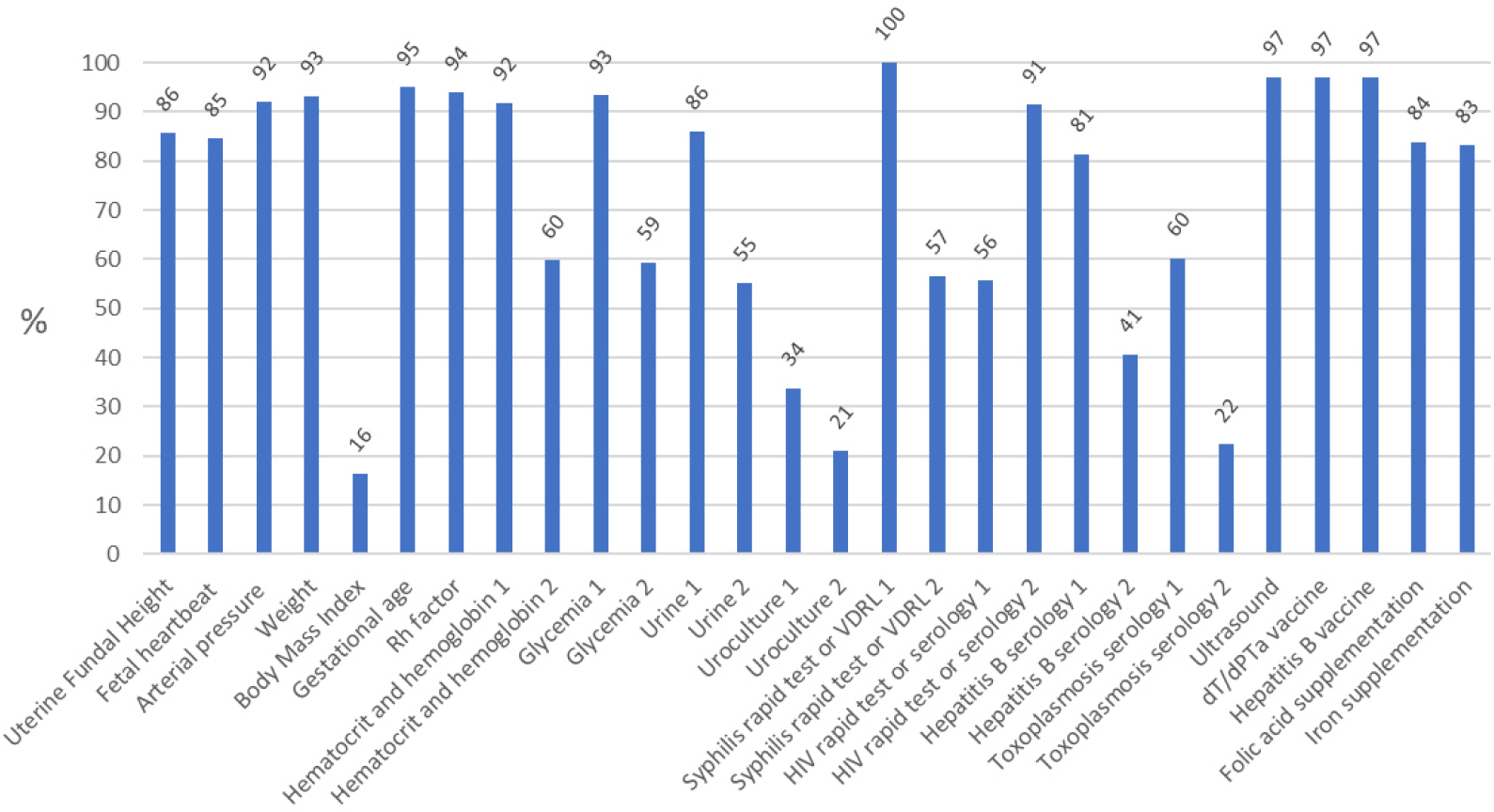
With regard to the registration of information in the pregnant woman’s handbook (Figure 1), only in 84.5% of these was there a description of the BCF in all consultations, from the 12th week of gestation, and only in 16.34% was there information on BMI. It is noteworthy that, among the examinations performed, those referring to the second routine (recommended in the third trimester of pregnancy) were all less frequently registered, with the exception of rapid HIV testing/serology. With regard to iron supplementation, only in 83.2% was there at least one record of its use.
Percentage of registration of exams, procedures, vaccines and supplementation in the pregnant women’s handbook. Caruaru (PE), 2017–2018.
Regarding the guidelines received during prenatal care, 64.44% of the pregnant women reported having been informed about childbirth, 65.09% about the reference maternity for childbirth, 68.35% regarding the right to a companion, and 72.43% regarding breastfeeding.
With regard to childbirth care, most of these (85.81%) occurred in the indicated maternity (M1), with the majority of women (93.64%) in the gestational period considered at term, that is, between 37 and 41 weeks and six days. Despite the high frequency of informed pregnancy complications, only 7% of women mentioned negative outcomes, such as preterm neonates or congenital infections.
When analyzing the adequacy of prenatal care, higher frequencies were observed the number of consultations performed (87.13%) and early initiation (65.91%), followed by adequacy regarding maternal guidelines (45.51%), procedures performed (12.56%) and exams performed (2.94%). The general adequacy index was 0.6%. We chose not to assess the factors associated with the general adequacy index of prenatal care, due to the very low frequency of this outcome, which is a limiting factor to demonstrate probable associations.
In simple logistic regression, in each adequacy block, the variables that had a p<0.20 were then subjected to non-hierarchical multiple logistic regression (Table 2). At the final model, women aged <18 years were less likely to start early prenatal care (p=0.026; OR 0.55; 95%CI 0.32–0.93), while belonging to the economic class B-C (p=0.044; OR 1.45; 95%CI 1.01–2.09), having a partner (p=0.021; OR 1.68; 95%CI 1.08–2.61) and having 1–2 children (p=0.012; OR 1.70; 95%CI 1.12–2.57) increased the chance of adequacy regarding the early start of prenatal care. The latter was also shown to be associated with adequacy regarding the number of consultations (p=0.031; OR 1.83; 95%CI 1.06–3.16).
Simple logistic regression of prenatal adequacy according to sociodemographic, obstetric and use characteristics of public health services for puerperal women. Caruaru (PE), 2017–2018.
Performing prenatal care in a traditional BHU increased the chance of adequacy regarding the procedures received (p=0.002; OR 2.20; 95%CI 1.33–3.65), while having paid work (p=0.009; OR 1.55; 95%CI 1,11–2.16) increased the chances of adequacy regarding receiving maternal guidance (Table 3).
Multiple logistic regression of prenatal adequacy according to sociodemographic, obstetric and use characteristics of public health services for puerperal women. Caruaru (PE), 2017–2018.
DISCUSSION
It was found that the puerperal women who participated in this study had a sociodemographic profile similar to that observed in other investigations, with a predominance of young women, with a medium schooling level17,18, that have a partner, and have no paid work18.
The association between inadequate prenatal care and sociodemographic factors3,10 was also verified in this investigation. These social determinants of health (SDH) affect access to health services and the ways women obtain, understand, and evaluate health information for decision-making.
The results showed a higher prevalence of women who underwent prenatal care at Family Health Units, which can be explained by the expansion of these units in the municipality. Studies indicate that the prenatal care offered by Family Health professionals is more in line with the Humanization of Prenatal and Birth project compared to traditional BHUs19. However, even in the Family Health Units with the best levels of adequacy of prenatal care, these are still considered low17,20,21. It is noteworthy that prenatal care in a traditional BHU has more than doubled the chance of women receiving all recommended procedures, which may suggest under-registration of the procedures (weight check, body mass index, blood pressure, gestational age, uterine fundal height, fetal heart rate ) by the professional who performed them or even an absence in the Family Health Unit, even if temporary, of some of the pieces of equipment that assists in verifying these measurements, like tape measure or a sonar, for example. A high frequency was noted for weight and blood pressure records, similar to that observed in other investigations10,11.
The low percentage of BMI registration in the books is accentuated, corroborating the findings of another study22. The calculation of the pregnant woman’s BMI allows identifying possible nutritional deviations (underweight, overweight and obesity) which, if promptly treated or prevented, can reduce the burden of harm on maternal and child health in developing countries23.
One of the objectives of prenatal assistance is to identify early complications in pregnancy so that interventions are performed promptly, and adverse maternal and neonatal conditions are avoided. Urinary tract infection and hypertensive disorders were referred to by the women in this study as the most frequently complications. These two conditions were also among the most prevalent in another investigation24. Prematurity and congenital infections were the main repercussions for the neonate. These conditions are known to increase the chances of complications and neonatal death25. Especially in relation to congenital infections, although it was not the objective of this study to specify the type of infection, in Brazil, congenital syphilis has stood out with high incidence, showing failures in prenatal care26.
It is noteworthy that the examination performed for syphilis screening during pregnancy showed a percentage drop of more than 40 points between the first and second rounds. The trend of decrease in these records in the prenatal books persisted in the other exams, a situation similar to that reported in different studies18,19. In the municipality, data collection laboratory tests are conducted in the BHUs (traditional and Family Health) to facilitate exams. Failure to register may indicate a delay in requesting exams or in receiving results.
Part of the women who were referred to the high-risk prenatal care reported not having access to the specialized service, which may denote, among other causes, difficulties such as geographical barriers and failures in flows and counter flows in the health care network27. In May 2019, aiming to meet the growing demand of women for specialized care in the municipality, Specialized Medical Care for Women’s Health was inaugurated, which expanded the existing services, including high-risk prenatal care, with Primary Care coordinating the attention.
Regardless of whether prenatal care is considered high- or habitual-risk, it is understood that educational actions must be carried out during the monitoring period to foster understanding of the gestational process, active listening, knowledge exchange, and the link between health professionals and women. Studies show that lack of guidance can impair the quality of prenatal care and increase the maternal morbidity and mortality index5,28.
In this investigation, it was seen that information about breastfeeding was the most provided, similar to that found in a study with national data5. In contrast, only about ⅔ of the women investigated reported receiving guidance on childbirth, consistent with a study conducted in southern Brazil, which found that only half of postpartum women reported receiving such instruction28.
The pregnant woman’s previous connection to the maternity hospital where delivery will take place and be attended in case of complications is ensured by law29. In this study, approximately ⅔ of the women received counseling on motherhood, and most deliveries took place at the municipal reference site. These actions provide empowerment to pregnant women with regard to their rights, contribute to the humanization of care and to decrease women’s pilgrimage for admission at the time of delivery12,17. In this study, adequacy regarding access to these guidelines was associated with paid work. Although schooling was not maintained in the final model, waged productive activity provides women with greater autonomy and self-esteem, making it safer to question the professional who provides prenatal care regarding health information and the rights of pregnant women. Indirectly, this may have favored the guidance received by this group of women.
Despite the higher frequency of adjustments observed regarding the early start of prenatal care, these are not sufficient indicators of care quality. When analyzing the general adequacy index, it proved to be significantly lower than those found in other studies that also used expanded criteria12,29,30.
The results of this study should be viewed with caution, as the information collected through interviews may have been influenced by memory bias. In addition, failure to record information does not always indicate that the procedure and/or exam was not performed. Another limitation is that this study did not analyze structural issues and result indicators. Despite the limitations, this cross-sectional study was a preliminary assessment of prenatal care in the municipality. It may contribute to the management of evaluation and the reorientation of the health care model for pregnant women. New research is necessary to understand, from the perspective of health professionals and women, how these practices take place and the reasons for such performance.
CONCLUSION
Non-conformities were identified in the city’s prenatal care. Underage women, those belonging to the lower economic classes, not having a partner, and having a greater number of children, who did not have a job, and were assisted in Family Health Units had a greater chance of prenatal inadequacy.
It is recommended to expand interventions to promote women’s health in the pre-gestational, gestational, and puerperal periods, guided by health education. For municipal managers, the aim is to optimize the access of pregnant women to routine exams and to ensure timely results, and to invest in intersectoral actions and in the permanent education of Basic Health professionals.
DATA AVAILABILITY STATEMENT
The datasets generated and/or analyzed during the study are available from the corresponding author upon request.
REFERENCES
-
1. Heaman MI, Martens PJ, Brownell MD, Chartier MJ, Derksen SA, Helewa ME. The Association of Inadequate and Intensive Prenatal Care With Maternal, Fetal, and Infant Outcomes: a population-based study in Manitoba, Canada. J Obstet Gynaecol Can. 2019;41(7):947-59. https://doi.org/10.1016/j.jogc.2018.09.006
» https://doi.org/10.1016/j.jogc.2018.09.006 -
2. Linard M, Blondel B, Estellat C, Deneux-Tharaux C, Luton D, Oury JF, et al. Association between inadequate antenatal care utilisation and severe perinatal and maternal morbidity: an analysis in the PreCARE cohort. BJOG. 2018;125(5):587-95. https://doi.org/10.1111/1471-0528.14794
» https://doi.org/10.1111/1471-0528.14794 -
3. Mallmann MB, Boing AF, Tomasi YT, Anjos JC, Boing AC. Evolução das desigualdades socioeconômicas na realização de consultas de pré-natal entre parturientes brasileiras: análise do período 2000-2015. Epidemiol. Serv. Saúde. 2018;27(4):e2018022. https://doi.org/10.5123/s1679-49742018000400014
» https://doi.org/10.5123/s1679-49742018000400014 -
4. Leal MC, Gama SGN, Pereira APE, Pacheco VE, Carmo CN, Santos RV. A cor da dor: iniquidades raciais na atenção pré-natal e ao parto no Brasil. Cad Saúde Pública. 2017;33(Suppl 1):e00078816. https://doi.org/10.1590/0102-311x00078816
» https://doi.org/10.1590/0102-311x00078816 -
5. Marques BL, Tomasi YT, Saraiva SS, Boing AF, Geremia DS. Orientações às gestantes no pré-natal: a importância do cuidado compartilhado na atenção primária em saúde. Esc Anna Nery. 2021;25(1):e20200098. https://doi.org/10.1590/2177-9465-EAN-2020-0098
» https://doi.org/10.1590/2177-9465-EAN-2020-0098 -
6. Leal MC, Szwarcwald CL, Almeida PVB, Aquino EML, Barreto ML, Barros F, et al. Saúde reprodutiva, materna, neonatal e infantil nos 30 anos do Sistema Único de Saúde (SUS). Ciênc Saúde Coletiva. 2018;23(6):1915-28. https://doi.org/10.1590/1413-81232018236.03942018
» https://doi.org/10.1590/1413-81232018236.03942018 -
7. Kotelchuck M. An evaluation of the Kessner Adequacy of Prenatal Care Index and a proposed Adequacy of Prenatal Care Utilization Index. Am J Public Health. 1994;84(9):1414-20. https://doi.org/10.2105/ajph.84.9.1414
» https://doi.org/10.2105/ajph.84.9.1414 - 8. Brasil. Ministério da Saúde. Programa de humanização de pré-natal e nascimento. Brasília: Ministério da Saúde; 2000.
- 9. Brasil. Ministério da Saúde. Gabinete do Ministro. Portaria no 1.459, 24 de junho de 2011. Institui, no âmbito do Sistema Único de Saúde (SUS), a Rede Cegonha. Brasília: Diário Oficial da União; 2011.
-
10. Mario DN, Rigo L, Boclin KLS, Malvestio LMM, Anziliero D, Horta BL, et al. Qualidade do Pré-Natal no Brasil: Pesquisa Nacional de Saúde 2013. Ciênc Saúde Coletiva. 2019;24(3):1223-32. https://doi.org/10.1590/1413-81232018243.13122017
» https://doi.org/10.1590/1413-81232018243.13122017 -
11. Tomasi E, Fernandes PAA, Fischer T, Siqueira FCV, Silveira DS, et al. Qualidade da atenção pré-natal na rede básica de saúde do Brasil: indicadores e desigualdades sociais. Cad Saúde Pública. 2017;33(3):e00195815. https://doi.org/10.1590/0102-311x00195815
» https://doi.org/10.1590/0102-311x00195815 - 12. Domingues RMSM, Viellas EF, Dias MAB, Torres JA, Theme-Filha MM, Gama SGN, et al. Adequação da assistência pré-natal segundo as características maternas no Brasil. Rev Panam Salud Pública. 2015;37(3):140-7.
-
13. Aragão AAV, Oliveira SRA, Gurgel Júnior GD. O uso do Método Delphi ajustado para avaliar a Rede Cegonha: da imagem-objetivo à realidade. Esc Anna Nery. 2019;23(2):e20180318. https://doi.org/10.1590/2177-9465-ean-2018-0318
» https://doi.org/10.1590/2177-9465-ean-2018-0318 -
14. Caruaru (Cidade). Lei no 5.951, de 02 de outubro de 2017. Dispõe sobre a humanização da assistência à mulher e ao neonato durante o ciclo gravídico-puerperal na rede de saúde do município de Caruaru e dá outras providências [Internet]. Caruaru: Diário Oficial de Caruaru; 2017 [cited 2020 Jan 18]. Available from: https://caruaru.pe.gov.br/lei-no-5-951-de-02-de-outubro-de-2017/
» https://caruaru.pe.gov.br/lei-no-5-951-de-02-de-outubro-de-2017/ -
15. Instituto Brasileiro de Geografia e Estatística. Brasil. Pernambuco. Caruaru. Panorama. População [Internet] 2022 [cited 2020 Jan 18]. Available from: https://cidades.ibge.gov.br/brasil/pe/caruaru/panorama
» https://cidades.ibge.gov.br/brasil/pe/caruaru/panorama -
[16] 16. Brasil. Ministério da Saúde. Protocolos da atenção básica: saúde das mulheres [Internet]. Brasília: Ministério da Saúde; 2016 [cited 2017 July 12]. Available from: http://bvsms.saude.gov.br/bvs/publicacoes/protocolos_atencao_basica_saude_mulheres.pdf
» http://bvsms.saude.gov.br/bvs/publicacoes/protocolos_atencao_basica_saude_mulheres.pdf -
17. Dantas DS, Mendes RB, Santos JMJ, Valença TS, Mahl C, Barreiro MSC. Qualidade da assistência pré-natal no sistema único de saúde. Rev Enferm UFPE on line. 2018;12(5):1365-71. https://doi.org/10.5205/1981-8963-v12i5a230531p1365-1371-2018
» https://doi.org/10.5205/1981-8963-v12i5a230531p1365-1371-2018 -
18. Leal MC, Esteves-Pereira AP, Viellas EF, Domingues RMSM, Gama SGN. Assistência pré-natal na rede pública do Brasil. Rev Saúde Pública. 2020;54:8. https://doi.org/10.11606/s1518-8787.2020054001458
» https://doi.org/10.11606/s1518-8787.2020054001458 -
19. Corrêa MD, Tsunechiro MA, Lima MOP, Bonadio IC. Evaluation of prenatal care in unit with family health strategy. Rev Esc Enferm USP. 2014;48(spe):23-31. https://doi.org/10.1590/S0080-623420140000600004
» https://doi.org/10.1590/S0080-623420140000600004 -
20. Guimarães TA, Pinheiro AKB, Silva AA, Castro LRG, Silva MB, Fonseca LMB. Qualidade dos registros da assistência pré-natal na caderneta da gestante. Rev Baiana Enferm. 2020;34:e35099. https://doi.org/10.18471/rbe.v34.35099
» https://doi.org/10.18471/rbe.v34.35099 -
21. Esposti CDD, Oliveira AE, Santos Neto ET, Travassos C. Representações sociais sobre o acesso e o cuidado pré-natal no Sistema Único de Saúde da Região Metropolitana da Grande Vitória, Espírito Santo. Saude Soc. 2015;24(3):765-79. https://doi.org/10.1590/S0104-12902015127606
» https://doi.org/10.1590/S0104-12902015127606 -
22. Tsunechiro MA, Lima MOP, Bonadio IC, Corrêa MD, Silva AVA, Donato SCT. Prenatal care assessment according to the prenatal and birth humanization program. Rev Bras Saude Mater Infant. 2018;18(4):771-80. https://doi.org/10.1590/1806-93042018000400006
» https://doi.org/10.1590/1806-93042018000400006 -
23. Rahman MM, Abe SK, Kanda M, Narita S, Rahman MS, Bilano V, et al. Maternal body mass index and risk of birth and maternal health outcomes in low-and middle-income countries: a systematic review and meta-analysis. Obes Rev. 2015;16(9):758-70. https://doi.org/10.1111/obr.12293
» https://doi.org/10.1111/obr.12293 -
24. Varela PLR, Oliveira RR, Melo EC, Mathias TAF. Pregnancy complications in Brazilian puerperal women treated in the public and private health systems. Rev Latino-Am Enfermagem. 2017;25:e2949. https://doi.org/10.1590/1518-8345.2156.2949
» https://doi.org/10.1590/1518-8345.2156.2949 -
25. Lansky S, Friche AAL, Silva AAM, Campos D, Bittencourt SDA, Carvalho ML, et al. Pesquisa Nascer no Brasil: perfil da mortalidade neonatal e avaliação da assistência à gestante e ao recém-nascido. Cad Saúde Pública. 2014;30(Suppl 1):S192-S207. https://doi.org/10.1590/0102-311X00133213
» https://doi.org/10.1590/0102-311X00133213 -
26. Domingues RMSM, Leal MC. Incidência de sífilis congênita e fatores associados à transmissão vertical da sífilis: dados do estudo Nascer no Brasil. Cad Saúde Pública. 2016;32(6):e00082415. https://doi.org/10.1590/0102-311X00082415
» https://doi.org/10.1590/0102-311X00082415 -
27. Vitória TO, Moreira RCR. Acessibilidade de gestantes ao pré-natal de alto risco. Rev Saúde Col UEFS. 2017;7(3):45-51. https://doi.org/10.13102/rscdauefs.v0i0.1273
» https://doi.org/10.13102/rscdauefs.v0i0.1273 -
28. Gonçalves MF, Teixeira EMB, Silva MAS, Corsi NM, Ferrari RAP, Pelloso SM, et al. Pré-natal: preparo para o parto na atenção primária à saúde no sul do Brasil. Rev Gaúcha Enferm. 2017;38(3):e0063. https://doi.org/10.1590/1983-1447.2017.03.2016-0063
» https://doi.org/10.1590/1983-1447.2017.03.2016-0063 - 29. Brasil. Presidência da República. Casa Civil. Subchefia para Assuntos Jurídicos. Lei no 11.634, de 27 de dezembro de 2007. Dispõe sobre o direito da gestante ao conhecimento e a vinculação à maternidade onde receberá assistência no âmbito do Sistema Único de Saúde. Brasília: Diário Oficial da União; 2007.
-
30. Martinelli KG, Santos Neto ET, Gama SGN, Oliveira AE. Adequação do processo da assistência pré-natal segundo os critérios do Programa de Humanização do Pré-natal e Nascimento e Rede Cegonha. Rev Bras Ginecol Obstet. 2014;36(2):56-64. https://doi.org/10.1590/S0100-72032014000200003
» https://doi.org/10.1590/S0100-72032014000200003
Edited by
-
Editor:
Guilherme L. Werneck https://orcid.org/0000-0003-1169-1436.