 Clonal propagation of avocado rootstocks in Colombia: An in vitro approach
ABSTRACT
Genetic variability in rootstocks used in commercial avocado plantations negatively impacts traits such as stress adaptation and productivity, especially when plant material is not suited to local conditions. Clonal propagation of desirable rootstocks, including the widely cultivated “Criollo” avocado genotypes in Colombia, has had limited success due to the lack of efficient in vitro propagation protocols. The aim of this study was to develop an in vitro propagation protocol, including ex vitro acclimation and field planting phases, for five “Criollo” avocado genotypes from Colombia. The response of etiolated buds from six-month-old mother plants to the in vitro introduction, multiplication, rooting, and ex vitro hardening stages was evaluated. For bud establishment, WPM and MS media were tested. For multiplication, the ratio of 6-Benzylaminopurine to Gibberellic Acid and the use of LED lighting were assessed. Indole-3-butyric acid (IBA) and naphthaleneacetic acid (NAA) were applied during the rooting phase. Three substrates with different growth promoters (mycorrhizae, Serratia marcescens, and Trichoderma harzianum) were evaluated during acclimation. The results revealed multiplication rates between 0.7 and 1.9 depending on the genotype. Rooting percentages above 50% were obtained using the combination of 1 mg L-¹ IBA and 0.5 mg L-¹ NAA, and ex vitro survival rates reached 74.1% in the control. The use of LED lighting, a strategy not previously explored in this crop, promoted faster shoot and leaf development in the Duke7 genotype. Although genotype-dependent, the protocol enabled propagation of Criollo genotypes, representing a step toward avocado productivity and sustainability, with applications to regional materials.
Index terms:
“Criollo” avocado; shoot proliferation; recalcitrant; In vitro propagation
RESUMO
A variabilidade genética em porta-enxertos utilizados em plantações comerciais de abacate impacta negativamente características como adaptação ao estresse e produtividade, especialmente quando o material vegetal não está adaptado às condições locais. A propagação clonal de porta-enxertos desejáveis, incluindo os genótipos de abacate “Criollo” amplamente cultivados na Colômbia, foi limitada pela falta de protocolos eficientes de propagação in vitro. O objetivo deste estudo foi desenvolver um protocolo de propagação in vitro, incluindo aclimatação ex vitro e plantio em campo, para cinco genótipos “Criollo”. Avaliou-se a resposta de gemas etioladas de plantas-mãe de seis meses nas etapas de introdução, multiplicação, enraizamento e aclimatação. Para o estabelecimento, testaram-se os meios WPM e MS. Para multiplicação, avaliaram-se proporções de 6-benzilaminopurina e ácido giberélico, além do uso de iluminação LED. No enraizamento, aplicaram-se ácido indol-3-butírico (AIB) e ácido naftalenoacético (ANA). Três substratos com promotores de crescimento (micorrizas, Serratia marcescens e Trichoderma harzianum) foram testados na aclimatação. Os resultados revelaram taxas de multiplicação entre 0,7 e 1,9, dependendo do genótipo. Enraizamento acima de 50% foi obtido com 1 mg L-¹ de AIB e 0,5 mg L-¹ de ANA, e a sobrevivência ex vitro alcançou 74,1% no controle. O uso de LED acelerou o desenvolvimento de brotos e folhas no genótipo Duke7. Embora dependente do genótipo, o protocolo permitiu a propagação dos Criollo, contribuindo para a produtividade e sustentabilidade do abacate.
Termos para indexação:
Abacate “Criollo”; proliferação de brotos; recalcitrante; propagação in vitro
Introduction
Commercial production of avocado (Persea americana Mill.) reached an estimated global market value of approximately 13.97 billion USD in 2021. This value is expected to grow to over 26 billion USD by 2030, representing an approximate growth rate of 86.11% (Statista, 2024). Moreover, the commercial production of this crop in Colombia has experienced significant growth in recent years. The compound annual growth rate (CAGR) reached 29% in the country, in contrast to the 4.5% recorded in Mexico, the world’s largest producer (FAOSTAT, 2024). The increase in production is attributed to a 168% rise in harvested area and a 33% increase in yield per hectare. The expansion of Colombian avocado distribution in international markets has shown notable annual growth, with variations between 15% and 50% during the period of 2015-2022 (Asociación nacional de comercio exterior - ANALDEX, 2022).
Colombia has significant potential as a producer and exporter of avocado. However, the long-term success of avocado cultivation relies on several strategic factors, among which the genetic quality and stability of plant material play a critical role. Currently, a wide diversity of criollo genotypes is commonly used as the basis for propagation in the country (Lopez et al., 2022).
In particular, when establishing new plantations of the “Hass” avocado variety, which is the main traditionally cultivated variety, “criollo” rootstocks derived from seeds are typically used. However, these rootstocks lack traceability and genetic uniformity due to their sexual origin, leading to high variability in agronomic traits, such as fruit weight, as well as uncertainty about the behavior of plant material regarding its adaptability to local edaphoclimatic conditions and tolerance to root diseases. The success or failure after establishing the crop largely depends on the attributes of the material used as rootstock in the initial plant production (Bernal et al., 2020).
Currently, as a result of research findings, there are lists of “criollos” cultivars with outstanding attributes for selection as rootstocks in plant production (Cañas et al., 2022). Bedoya et al. (2023), found that the origin of the cultivars significantly influenced their physiological and morphological behavior, which allowed early detection of attributes for selecting materials as potential rootstocks. Additionally, “criollos” rootstocks from the eastern region of this department have been widely studied, showing that they can transfer up to 35% of genetic gain for relevant yield traits, such as total fruit number (Cañas et al., 2022).
Cloning methods for rootstocks have been developed to achieve the required genetic uniformity for plant propagation, basic studies, and to obtain conclusive results on the outstanding characteristics of different elite avocado genotypes. The method of rooting etiolated shoots is the most commonly used (Alberti et al., 2018). However, these procedures are laborious and time-consuming, and their main limitation is the induction of adventitious root formation in these shoots (Bandaralage, Hayward & Mitter, 2017; 2022).
A strategy to overcome this problem is the in vitro clonal propagation, which not only provides genetic stability but also ensures homogeneity in plantations and plant health (Barceló & Pliego, 2003; Suarez et al., 2006; Mosqueira et al., 2023). Several authors have described this process in avocado through somatic embryogenesis from immature zygotic embryos, achieving the formation of somatic embryos and improving their conversion into plants. Cotyledons or the nucellus from fruits at early developmental stages have also been used (Márquez et al., 2012). Although somatic embryogenesis has achieved some success, ex vitro plant regeneration and adaptation remain a bottleneck in most woody angiosperms like avocado (Suarez et al., 2006; Márquez et al., 2012).
In parallel with somatic embryogenesis, the morphogenetic approach represents a viable alternative for clonal propagation by stimulating meristems or preexisting buds from apical and nodal segments of young stems (Ibarra et al., 2017). Additionally, the success of micropropagation of woody species through this pathway is linked to the use of juvenile material or revitalized adult material (Pliego et al., 2013). This condition poses a challenge for the clonal propagation of avocado, as most of the rootstocks characterized by compatibility, tolerance, or good productive traits are available in the form of mature field trees, often over 40 years old (Cañas et al., 2022; Cano-Gallego et al., 2023). To overcome this limitation, grafting has been used to rejuvenate adult plants, achieving vigorous growth, better elongation, and rooting of new shoots in vitro cultures. The revitalization of material through severe pruning or micrografting, followed by incubation in liquid media enriched with auxin, has proven to be an effective strategy to achieve rooting percentages (80-90%) similar to those of juvenile material (Pliego et al., 1999).
Shoot culture is highly useful as an alternative method for the vegetative propagation of elite materials, particularly in new selections of rootstocks. Similar to somatic embryogenesis, in vitro morphogenesis depends on factors such as the physiological state of the explant, the type, combination, and concentration of growth regulators, the origin of the explant, its position on the mother plant, its age, and genotype (Zulfiqar et al., 2009; Pliego et al., 2013). Successful experiences have been reported using this method, such as the one described by Restrepo et al. (2018) for the “Hass” variety, where an average multiplication rate of three new shoots per explant was achieved by the third subculture, along with survival rates of 82%, successfully achieving micropropagation and ex vitro adaptation of this variety. Likewise, the feasibility of in vitro culture has been demonstrated in the propagation of clonal rootstocks such as ‘Duke-7’ and ‘Velvick,’ with multiplication rates of 1.63 and 1.25 shoots per explant, respectively (Bandaralage, Hayward & Mitter, 2017). However, ex vitro and in vitro clonal propagation protocols for avocado are scarce, and the few successful results are restricted to a limited number of commercially used genotypes worldwide.
Given the potential of selected “criollo” avocado rootstock genotypes for agronomic traits of interest-such as adaptability to specific edaphoclimatic conditions and tolerance to root diseases-this study aimed to evaluate clonal propagation strategies via in vitro morphogenesis, including the ex vitro acclimation phase, in five avocado genotypes to establish a baseline propagation protocol. Additionally, the established protocol was assessed using the ‘Duke’ rootstock, incorporating innovative approaches such as LED lighting for shoot development and the evaluation of microbial bioinoculants during the hardening phase, aspects that have been scarcely explored in avocado micropropagation.
Material and Methods
Clonal propagation via in vitro morphogenesis
Plant material
Avocado rootstock plants (locally known as “Criollo”) were obtained from “Arangro”, a commercial nursery registered with the Colombian Agricultural Institute (ICA), located in Rionegro, Antioquia, Colombia (6°06’49.3”N, 75°23’18.6”W; 2,175 masl). The plant material was sold by the nurseryman under a proprietary coding system (ArLV01, ArLR02, ArLF03, ArLA04, AgS05). These trees were selected empirically based on their adaptation to local agroecological conditions and lacked prior molecular or morphological characterization. For experimental purposes, these identifiers were retained. Molecular characterization following the methodology of Cañas et al. (2022) confirmed their classification within a group adapted to the local agroecological environment (data not shown). Six-month-old plants were subsequently maintained under shade house conditions at the Corporation for Biological Research (CIB), Medellín, Colombia, under an average temperature of 25 ± 2 °C, relative humidity of 52%, and 30% shading.
Etiolation and pre-disinfection treatment
For these processes, the methodology described by Restrepo et al. (2018). Briefly, selected plants of each genotype were subjected to etiolation in a purpose-designed darkroom, ensuring over 90% darkness, a temperature of 25 ± 2 °C, and supplementing the soil with a carbon source for at least 7 weeks. The pre-disinfection surface treatment involved spraying the entire plant, including buds and new shoots, with Benomyl 50 WP (Agricense Ltda, Soacha, Cundinamarca, Colombia) at 2 g L-1 every two days for two weeks. After this time, branches with new buds were cut and taken to the laboratory to continue the process.
Disinfection and in vitro establishment
A base protocol was proposed according to the group’s experience as follows: etiolated buds approximately 5-8 cm in size were disinfected through a series of steps, including immersion in 7% iodinated soap (Quirucidal®, Quirumedicas Ltda, Bogotá, CO) solution for 30 minutes, fungicide solution (Bélico® 500 SC, Invesa S.A., Medellín, CO) at 2 ml L-1 for 1 hour, 70% ethanol (Protokimica, Medellín, CO) for 1 minute, 1.5% sodium hypochlorite (Protokimica, Medellín, CO) for 10 minutes, and a combined solution of Vancomycin (Sigma-Aldrich, St. Louis, MO) at 50 mg L-1 and Cefotaxime (Sigma-Aldrich, St. Louis, MO) at 250 mg L-1 for 1 hour. After each step, rinses with sterile distilled water were performed. Finally, the buds were dried with sterile paper towels and cut to approximately 4 cm in size. The sowing was carried out on MS (PhytoTechnology Laboratories®, Shawnee, Kansas, USA) (Murashige & Skoog, 1962) or WPM-Woody Plant Medium basal media (PhytoTechnology Laboratories®, Shawnee, Kansas, USA) (Lloyd & McCown, 1981). The cultures were incubated under a photoperiod of 16 hours of light/8 hours of darkness, with a light intensity of μmol m-2 s-1 (Phillips TL5 14W/840, Eindhoven, NL) and a temperature of 22 °C ± 2 °C.
In this stage, the efficiency of the disinfection process was evaluated, considering the percentage of contamination by fungi and bacteria. Additionally, the percentage of phenolization and necrosis was assessed. The viability of the explants was recorded after 60 days, and the main response indicators were the number of shoots developed, height, and number of leaves for the different genotypes, and the two basal culture media evaluated for establishment, MS and WPM.
Multiplication
Based on the results obtained during the establishment stage, new shoots developed from each genotype were separated from the mother explant once they reached a length of 4 cm or more to ensure continuous development, and they were subcultured in WPM basal medium (PhytoTechnology Laboratories®, Shawnee, Kansas, USA) with hormonal supplements in mg L-1: 1 6-Benzylaminopurine (BAP); 0.5 Gibberellic Acid (GA3); 30000 sucrose; 2600 Phytagel™; and 1000 activated charcoal. The subculturing process occurred in three periods of six weeks each, with transfers to the fresh culture medium of the same composition between each period. The response variables recorded were shoot height, number of new shoots, and number of leaves formed in each subculture.
Rooting
After three subcultures, the buds developed in the different genotypes evaluated, with a minimum length of 4 cm, were transferred to a WPM culture medium supplemented with mg L-1: 1 indole-3-butyric acid (IBA) and 0.5 naphthaleneacetic acid (NAA) or 0.5 NAA alone; 30000 sucrose; 2.6 Phytagel™; and 800 activated charcoal. The response indicators were the number of new shoots, height of new leaves, root development, number and length of roots, and the time required for root formation.
Acclimation
In the ex vitro hardening stage, in vitro plants with a height greater than three centimeters and the presence of roots were removed from the culture container, and their roots were washed thoroughly with water to remove any remaining gelling agents. The plants were then transplanted into 9 x 18 cm seedling bags. Three types of substrates were evaluated: coconut fiber mixture of coconut fiber and sand (2:1 w/w)(Salazar & Urrea, 2025), and a mixture of coconut fiber and chicken manure (Sobiotech® S.A.S, Medellín, CO) (1:0005 w/w). The coconut fiber (Palomino roots, Medellín, CO) and sand were sterilized at 120 °C at 15 lb pressure for 45 minutes.
Additionally, to improve the averages of hardened plants and adaptation in the nursery stage and later in the field, the effect of three microorganisms selected for their beneficial properties in plant growth and development was evaluated: MYCORFOS® 10g Kg-1 (mycorrhizal spores: at least 500 g and phosphorus solubilizers and other minerals: 104 UFC g-1; Biofertilizar S.A.S., Medellín, CO), bacterium code 5.1 (Serratia marcescens) (1x10⁴ UFC mL-1), and Trichoderma harzianum (1x10⁴ spores mL-1), obtained from the MicroCIB #223 microorganism collection. For the mycorrhizae, 10 g per bag was added, and for the application of the last two microorganisms, the drench method (10 mL 5 kg-1 of substrate) was used.
After transplanting to the different treatments, the plants were covered with a transparent plastic cup to maintain a relative humidity above 80%. The adaptation process took place during the first two months under laboratory conditions (20 ± 2 °C, 60% HR) and in the third month under shade house conditions with an average humidity of 52%, an average temperature of 25 ± 2 °C, and 30% shade. The variables recorded after 90 days were: plant height, number of leaves, number and length of roots.
Response of Duke 7 variety buds to LED light conditions (Light-Emitting Diodes)
Based on the protocol established for the previously described “criollo” genotypes and using plant material from the Duke 7 variety-a reference rootstock resistant to Phytophthora cinnamomi, obtained from AGROSAVIA’s germplasm bank (6°07’49.9”N, 75°24’53.4”W; 2,175 masl)-several exploratory trials were conducted to evaluate this genotype’s response to in vitro propagation. These trials aimed to support basic research, early selection, micrografting, and compatibility assessments. The stages of etiolation, disinfection, and in vitro establishment of etiolated internodes were followed as previously described.
In the multiplication stage and the development of new buds, we initially evaluated the previously established WPM medium supplemented with mg L-1 compounds: 1 BAP; 0.5 GA3; 30000 sucrose; 2600 Phytagel™; and 1000 activated charcoal 1000 under white light conditions at 32.43 μmol m-2 s-1 (Phillips TL5 14W/840). However, given the slow response of this genotype, we proceeded to evaluate two light conditions using an AONI® LED lamp (Amazon, USA) with a combination of blue-red light (blue LED/red LED 80:20, with an average of 92 µmol m-2 s-1), commercially known as a stimulation recipe, and a control treatment with the absence of light (elongation through etiolation). For this, etiolated Duke 7 buds were established for 20 days in WPM culture medium supplemented with mg L-1: 1 BAP; 30000 sucrose; and 7000 agar and then subjected to these light conditions. Monitoring was conducted over 50 days.
Based on the results of the previous trial and with the aim of promoting further development of the buds previously activated through the use of the LED light combination, a matrix was developed using different growth regulators, their combinations, and varying concentrations in the WPM basal medium (Table 3). The buds under evaluation were maintained under the previously described light stimulus. Their responses were monitored over a period of 90 days.
A second trial was conducted, this time with etiolated buds of this variety obtained through the propagation method described by Brokaw (Alberti et al., 2018) and established in WPM medium supplemented with mg L-1: 1 BAP; 30000 sucrose; and 7000 agar 7000. Of the 20 buds to be evaluated, 10 were subjected to white, fluorescent light (Phillips TL5 14W/840) and the other 10 were maintained under a new PARALED lamp (Cebra, Las Condes Santiago, CL) with the recipe in µmol m-2 s-1: blue (10), red (20), far-red (20). The cultures were maintained at a temperature of 20 ± 3°C and 60% relative humidity. After 30 days, the development of new shoots and leaves, as well as shoot length, was recorded.
Experimental design and statistical analysis
In the disinfection, establishment, and multiplication stages, a total of 174 explants were evaluated with four replicates over time for each treatment (genotype). In the rooting stage, 10 explants per genotype were evaluated. The normality and homoscedasticity of the data were assessed using the Shapiro-Wilk and Levene tests, respectively, with a significance level of 95%. When the assumptions were met, an ANOVA followed by Tukey’s post hoc test was performed. If the assumptions were not met, the non-parametric Kruskal-Wallis test was used. Finally, Dunn’s post hoc test was applied to identify specific differences between treatments.
For the hardening experiments, a completely randomized design with two factors was conducted: substrate with three levels and microorganisms with four levels. All statistical analyses were performed using R software version 4.3.3 (R Core Team, 2014).
Results and Discussion
In Vitro Disinfection and Establishment
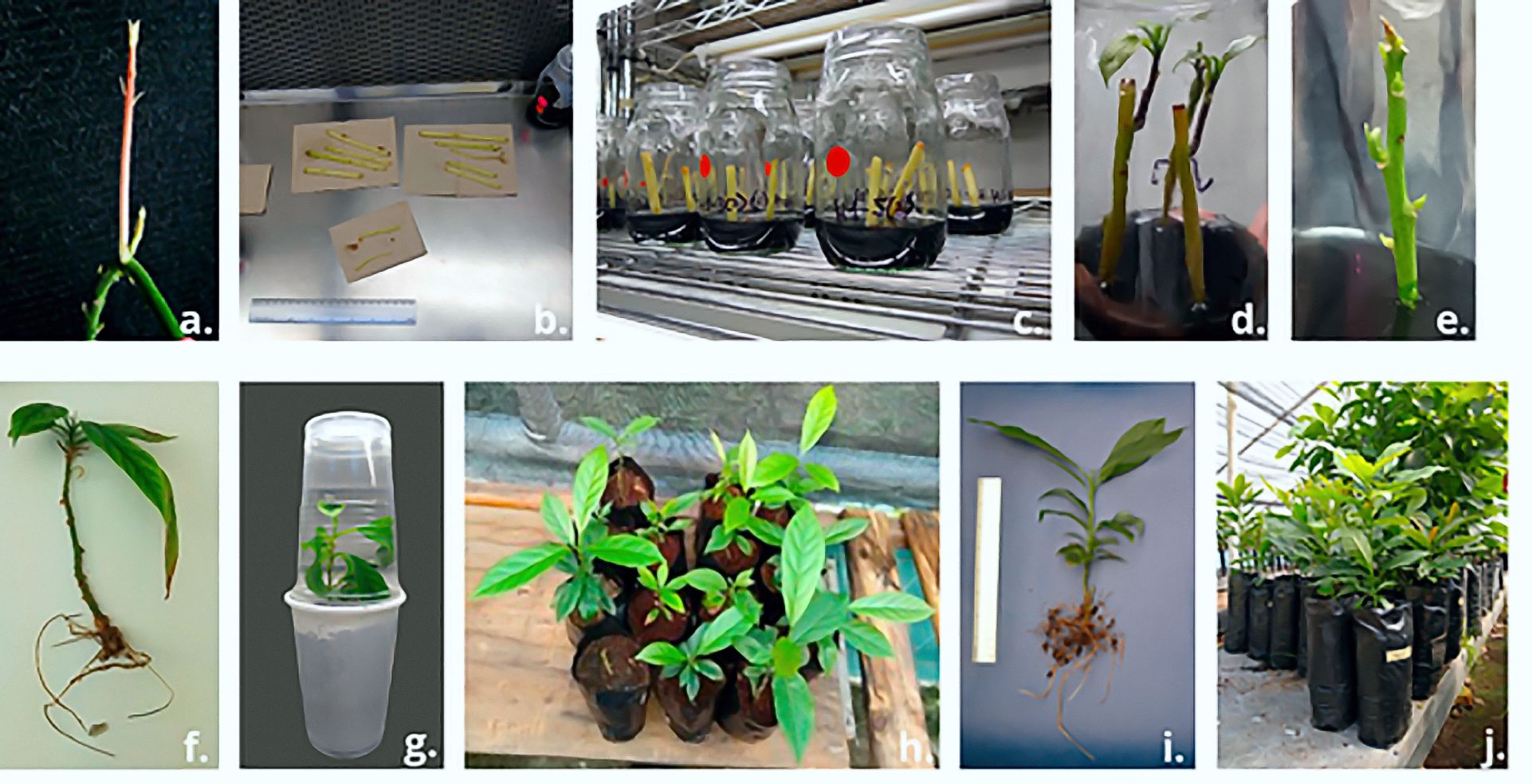
In the disinfection stage, for the five genotypes, the explant disinfection percentage was 96.8%. In MS medium, 15 days after planting, necrosis was recorded at 24.7%, and callus formation occurred at the base of the explant in 12.9%. In the WPM medium, the disinfection percentage was similar (96.3%), necrosis decreased to 13.9%, and callus formation at the base of the explant was 12%. This result allowed the development of an effective disinfection protocol adjusted for the five genotypes, maintaining a level of asepsis above 90% and a low level of oxidation, which enabled the successful establishment of nodal explants in vitro (Figure 1a y b), similar to what was described by Restrepo et al. (2018), in the Hass variety.
The establishment and viability of the explants recorded 60 days after sowing in the different culture media, showed an axillary bud survival percentage without necrosis in MS and WPM culture media of 83.3% and 76.7%, respectively, without significant differences between them regarding the evaluated variables (leaf formation, number, and height of shoots) (Figure 1c). However, differences were found between genotypes in terms of the length of new shoots, with genotype AgS05 showing the greatest length in the new shoots developed (p꞊0.0003). Although no significant differences were found in the response of buds introduced into WPM and MS media, WPM was chosen because it is a formulation adjusted for woody plants and is therefore frequently recommended for avocado cultivation (Bandaralage, Hayward & Mitter, 2017).
The low percentage of oxidation and necrosis is related to etiolation. This process that the plants underwent for seven weeks allowed the development of buds with differential characteristics compared to those of plants exposed to light: elongated internodes, absence of green pigmentation (appearing yellow to white), lack of chlorophyll and other pigments, resulting in halted photosynthesis and other slowed physiological processes. As a result, the tissues of the buds developed in darkness were less lignified, contained fewer protective metabolites such as phenols, tannins, and reactive oxygen species (ROS), and were, therefore, more responsive to the components of the culture media, including growth regulators. This significantly improved the response when cultured in vitro under light conditions. Initiation of the de-etiolation process (darkness-to-light transition) reactivated metabolism, pigment synthesis, and photosynthesis, with a large number of genes increasing their expression due to higher transcription rates. Levels of mRNA for the Rubisco enzyme, membrane proteins, the nitrate reductase enzyme, and other proteins markedly increased. This stage, or pre-treatment, is carried out before in vitro culture in various recalcitrant species, especially woody trees such as chestnut (Tomaszewicz et al., 2022).
Moreover, our study demonstrated that the use of activated charcoal (AC) at the established concentration had a beneficial effect, with no negative outcomes observed across the three evaluated subcultures. The concentration of AC in the medium significantly influences the growth and development of in vitro plantlets; at appropriate concentration, it promotes morphogenic responses by adsorbing inhibitory phenolic compounds. However, its application must be carefully adjusted according to the species and explant type, as an incorrect concentration may reduce the number of shoots, suppress their formation, and impair regeneration due to the non-selective adsorption of growth regulators, nutrients, and other essential compounds (Thomas, 2008). Although alternative antioxidant agents were not employed in this study, it is relevant to consider other strategies reported in the literature (Permadi et al., 2024).
Multiplication and rooting stage
The shoots developed from nodal explants with a minimum length of 4 cm were used in this stage. Based on the analysis of the results obtained, genotype AgS05 had the highest average multiplication rate (1.92) with significant differences compared to the other genotypes (p<0.05), where the range was between 0.71 and 1.07. The average multiplication coefficients across the three subcultures are consistent with previous research (Quintero et al., 2020; Restrepo et al., 2018), where, in general, the number of lateral buds responding to the process is very low, and growth takes a considerable amount of time to reach the size necessary for separation from the mother plant and continued growth and multiplication (Figure 1d y e).
Likewise, the length of the new shoots and leaf formation was also higher in genotype AgS05, with 3.6 cm and 48.9%, respectively. For the variable number of buds per genotype, significant differences were found (p < 0.05) (Table 1).
The height of the buds was evaluated over four subcultures. Starting from the second subculture, no new shoots developed in genotype ArLA04, while ArLV01 and ArLF03 exhibited this behavior starting from the third subculture. In contrast, genotypes ArLR02 and AgS05 generated buds in all four subcultures. The buds of ArLR02 and AgS05 reached an average length of 4.38 cm and 3.67 cm, respectively, in the fourth subculture. In the specific case of genotype AgS05, a decrease in the height of the new shoots was observed, going from 4.55 cm in the third subculture to 3.67 cm in the fourth (Table 1).
The genotype had an important effect, with ArLR02 and AgS05 showing stimulation of lateral bud sprouting and development in a shorter time, while the other genotypes had fewer and less developed lateral buds. This response persisted in the multiplication stage for genotypes ArLV01, ArLF03, and ArLA04. In this phase, the use of regulators is known to be necessary to stimulate the formation of new buds and the development of existing ones.
However, in this research, AgS05 stood out due to its rapid establishment, and greater elongation of buds introduced into a growth regulator-free culture medium, suggesting an endogenous auxin-cytokinin balance favorable for the development of these lateral buds.
Several factors influence the success of in vitro regeneration and propagation, including the plant’s ontogeny, the type of explant, its position on the mother plant, health status, metabolic condition, and genotype (Bandaralage, Hayward & Mitter, 2017).
In the rooting stage, significant differences (p<0.05) were found between the two hormonal treatments evaluated (1 mg L-1 IBA with 0.5 mg L-1 NAA or 0.5 mg L-1 NAA) for the different genotypes, based on the evaluated variables of root number and root length. The treatments where NAA was the only rooting hormone showed the lowest response percentages across the five genotypes. When the combination of the two auxins (IBA+NAA) was used, there was a higher percentage of response in all genotypes, with AgS05 standing out with significantly higher average values in the number of roots and their length (4.1±2.0 y 5.9±3.4 cm, respectively), compared to the other genotypes, where the range in root number was between 0.6 ±0.7 - 2.9±1.1, and the root length ranged from 1.8±1.93 and 5.28±4.8 (Table 2, Figure 1f).
The NAA-IBA combination of regulators has been widely reported for this stage, either alone or in combination, in avocado (Bandaralage, Hayward & Mitter, 2017), as well as in eucalyptus, olive, and guarana (Goulart, Xavier & Cardoso, 2008; Ismaili, 2016; Dos Santos Lemo et al., 2023). However, it is imperative to establish the exogenous auxin supplementation requirements -type and concentration- for each genotype.
Acclimation stage
In this stage, the survival, growth, and development of in vitro obtained plants are crucial, as their quality is validated at the end of the process. For this purpose, different substrates and plant growth-promoting microorganisms were evaluated. Overall, for all genotypes, plants in the control treatment achieved significantly higher values compared to the other treatments, with a 74.1% survival rate in the shade house (Figure 1g, h, i). The same behavior was observed for the variables of plant height, number of leaves, number, and length of roots. Regarding the biological supplements evaluated, T. harzianum had a negative effect on the survival percentage of the plants, with significant differences compared to the control in the evaluated genotypes. Mycorrhizae and S. marcescens did not show differences compared to the control when used in the substrates. Some possible causes that could explain the results obtained in this study are the amount of inoculum from the bacterial and mycorrhizal consortium or the low effectiveness of the root infection process, which can occur if the conditions for the microorganisms are not suitable (Montoya & Osorio, 2009). In the case of T. harzianum, its negative effect on survival may be due to a nutrient-poor substrate of inoculation, resulting in competition for nutrients with the plant (Ramirez, Castañeda & Morales, 2014). The evaluation time defined for the acclimation stage may also have affected the non-differential response compared to the control. Microorganisms need to first establish themselves and then colonize the plant roots, and the time required for this process can vary depending on the interaction. The benefits will become visible or measurable in later developmental stages. Plants with controlled fertilization and irrigation may not show growth responses during the exposure time to mycorrhizae, which can mask the effectiveness of mycorrhization. An inactivity effect has also been observed with mycorrhizae when soil phosphorus levels are higher than 0.02 mg L-1 (Montoya & Osorio, 2009; Prettl et al., 2024).
The root development achieved during the acclimation stage allowed the transplanting of plant material into larger bags. The acclimatized plants were transferred to a shade house, where they were maintained in bags with a sterile substrate composed of a coconut fiber mixture. Weekly irrigation and fertilization with Hoagland solution were applied (Figure 1j).
Although differences were observed among the evaluated “Criollo” genotypes, all stages of the micropropagation process were successfully completed up to the ex vitro adaptation phase. These stages include: etiolation (a), disinfection (b), establishment (c), multiplication (d and e), in vitro rooting (f), transplanting to substrate and hardening in the laboratory (g), adaptation in the shade house after three months (h), shoot and root development after three months (i), and five-month-old plants (j) (Figure 1). Plants obtained from the different genotypes were subsequently planted under field conditions in agronomic performance and stress tolerance trials (evaluation in progress/data not shown).
Response of Duke variety buds to LED light conditions (Light-Emitting Diodes)
In the first trial, after 50 days, a necrosis rate of 40% was observed in the buds kept in darkness, with no response recorded in the remaining buds. In contrast, under LED light treatment, 80% of the pre-existing buds were activated, with 40% exhibiting expanded leaves and visible signs of vigorous development. However, these buds did not elongate beyond 2 cm, nor did their development continue.
In the elongation assay with various growth regulators, combinations, and concentrations, although necrosis was observed in some buds, overall, the best responses (greater than 50%) were obtained in media supplemented with mg L-1 combinations: 1 BAP and 0.5 IBA, and with 0.56 BAP and 1 IBA. When meta-topolin (mT) alone was added at 0.1 mT, 0.2 in combination with 0.2 GA3, and 0.3 mT in combination with 0.3 GA3, apical meristem development and leaf formation were observed. 1 mg L-1 meta-topolin, alone or in combination with 0.1 mg L-1 GA3, did not have a positive effect on bud development (Table 3).
Response of Duke7 variety buds in the multiplication and development stage of new shoots exposed to LED lights and different hormonal treatments.
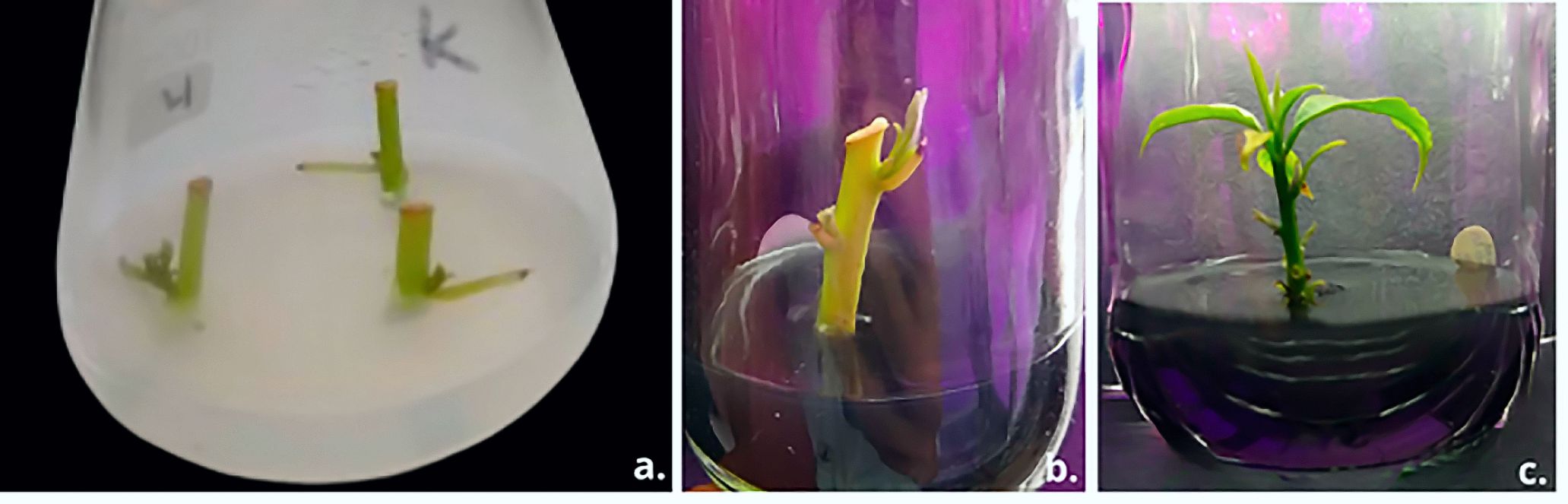
At the second trial, after 30 days of treatment, it was found that 40% of the buds incubated under the LED lamp initiated the development of pre-existing shoots, and after 90 days, leaf expansion was observed in most shoots, with elongation of approximately 0.5 cm (Figure 2a). Conversely, the buds incubated under white-fluorescent light conditions did not activate shoot development, nor was any tissue necrosis observed
Development of Duke 7 buds under white fluorescent (a) and LED lighting conditions during stimulation (b) and development (c) phases.
The buds developed after activation under this stimulation recipe were transferred to a space with lamps with the combination in µmol m-2 s-1: blue (4), red (10), and far-red (3), designed to improve leaf development and expansion. A positive response in the development and expansion of new leaves was observed, but no additional elongation of the subcultured buds was recorded within 45 days (Figure 2b).
Traditionally, in vitro cultures for research or commercial production have been illuminated with fluorescent lamps (FL). However, in recent years, LEDs as lighting systems have gained considerable interest due to their comparative advantages: lower heat emission, monochromatic spectrum, longer lifespan, and low energy consumption (Nowakowska et al., 2023). These systems for greenhouse or in vitro cultivation allow control and delivery of light in the spectral range used in photosynthesis, positively impacting photomorphogenic responses in plants (Morrow, 2008; Bello et al., 2017). In this context, Cavallaro et al. (2023) related various studies highlighting the positive effects of LED light spectral quality on in vitro seedling proliferation. Although most studies have focused on blue and red light (Li et al., 2017), some have revealed that different LED lighting combinations improved growth characteristics, pigment content, antioxidant enzyme activity (Naznin et al., 2019), biomass increase (Idrees et al., 2018), greater fresh and dry shoot biomass, better PSII functionality, higher Chl a/b, Chl b and carotenoides, and carotenoid content, as well as reduced number of stressed explants (Sarropoulou et al., 2023) and ex vitro survival rates (Dutta & Sahoo, 2015). These findings align with our research results, as only under the combination in µmol m-2 s-1: blue (10), red (20), and far-red (20), was axillary bud development stimulated. However, contrasting results have also been reported when compared to white fluorescent lamps (Cavallaro et al., 2023).
The variability in responses regarding the effects of light on in vitro research can be attributed to differences in sensitivity among genera and species regarding their interaction with varying light conditions intensities, growth regulators in the culture medium, and the specific life cycle stage of the plant under LED lighting. In the specific case of woody and fruit species like avocado, where achieving high multiplication rates via in vitro morphogenesis is more challenging, it is essential to consider that shoot multiplication includes two processes: induction and phytomer formation, which involves forming lateral meristems (axillary buds) from the apical meristem (apex), followed by the growth of axillary buds into new shoots (Stefano & Rosario, 2003). Artificial light plays a crucial role in the success of in vitro plant production. Considering all of the above and aiming for more successful in vitro propagation, Cavallaro et al. (2023) recommended conducting detailed studies for each species to investigate the interaction between LEDs, their promoting or inhibiting effects, and the stability of plant proliferation, using a protocol involving at least three growth cycles and a very low cytokinin concentration in the substrate. With the propagation protocol already established and promising results from preliminary LED lighting trials, it will be possible to improve the multiplication coefficient obtained in the different genotypes.
In the search for clonal rootstocks of interest, various strategies have been standardized. The most well-known and widely used so far is double grafting (Alberti et al., 2018) which takes between 16 and 20 months to obtain a complete scion-rootstock plant, with estimated survival rates of 60-70% (Bernal et al., 2020). Since this process requires special infrastructure conditions and strict monitoring, few nurseries carry it out or are certified to produce through this method, resulting in a continued shortage of important clonal materials such as rootstocks. With the protocol developed in the present research, hardened plants can be obtained in an average of 15 months. However, this time could be reduced if the development of shoots in different subcultures is improved, for instance, by using LED lighting.
Conclusions
In vitro propagation via morphogenesis was effectively standardized for five “criollo” genotypes, establishing a complete protocol from mother plant etiolation to ex vitro acclimation. Although genotype-dependent responses were confirmed, particularly during multiplication, the method proved efficient and reproducible. Additionally, based on first trials with LED lights, their use is suggested to enhance bud development and leaf expansion in less time than observed with white light. This protocol is a valuable tool for propagating rootstocks adapted to stress and edaphoclimatic conditions, contributing to improved crop productivity.
Acknowledgments
This work was financially supported by MinCiencias under grant number 2213-745-58976 and the project titled “Establecimiento en campo de plantas de aguacate (Persea americana mill.) propagadas in vitro con tolerancia a las principales pudriciones radiculares”. We extend our gratitude to the members of the Plant Health and Biological Control group at the Corporación para Investigaciones Biológicas (CIB) for their valuable contributions. This research was made possible through the collaborative efforts of the Universidad de Antioquia, Arangro’s Nursery, Cartama Company, and Don Emilio Estrada.
Data Availability Statement
Data available upon request to authors.
References
- Alberti, M. F. et al. (2018) Avances en la propagación del aguacate. Revista Brasileira de Fruticultura, 40(6):e-782.
-
Asociación nacional de comercio exterior - ANALDEX. (2022) Informe exportaciones de aguacate Hass septiembre 2022 Asociación nacional de comercio exterior (ANALDEX). Available in: https://www.analdex.org/2022/12/13/informe-exportaciones-de-aguacate-hass-septiembre-2022/
» https://www.analdex.org/2022/12/13/informe-exportaciones-de-aguacate-hass-septiembre-2022/ - Bandaralage, J., Hayward, A., & Mitter, N. (2017). Micropropagation of avocado (Persea americana Mill.). American Journal of Plant Sciences, 8(11):2898-2921.
- Bandaralage, J., Hayward, A., & Mitter, N. (2022). Structural disparity of Avocado rootstocks in vitro for rooting and acclimation success.International Journal of Plant Biology,13(4):426-442.
- Barceló, A., & Pliego, F. (2003) Micropropagation of Avocado (Persea americana Mill.). In S. M. Jain., & K. Ishii. Micropropagation of woody trees and fruits Springer, Berlin, (pp.519-542).
- Bedoya, S. I. et al. (2023) Physiological and morphological characterization of avocado creole (Persea americana Mill.) accessions for elite rootstocks. Revista Colombiana de Ciencias Hortícolas, 17(2):e15830.
- Bello, J. J. et al. (2017). Light-emitting diodes: Progress in plant micropropagation.InTech, 6:93-103.
- Bernal, J. A. et al. (2020). Actualización tecnológica y buenas prácticas agrícolas (BPA) en el cultivo de aguacate (2ª ed.). Editorial AGROSAVIA. Bogotá, Colombia. 777p.
- Cañas, G. et al. (2022). Inheritance of yield components and morphological traits in avocado cv. hass from “Criollo” “Elite Trees” via half-sib seedling rootstocks. Frontiers in Plant Science, 13:843099.
- Cano-Gallego, L. E. (2023). Graft compatibility effects on cv. Hass avocado fruit growth. Ciência e Agrotecnologia, 47:e014022.
- Cavallaro, V. et al. (2023). Effects of spectral quality and light quantity of LEDs on in vitro shoot development and proliferation of Ananas comosus L. Merr. Agronomy, 13:1072.
- Dos Santos Lemos, M. S. et al. (2023). Rooting solutions IBA, 2, 4-D and NAA on guarana cuttings from 16 genotypes. Revista de Ciências Agrárias - Amazonian Journal of Agricultural and Environmental Sciences, 66:1-19.
- Dutta, S., & Sahoo, T. K. (2015). Light emitting diode (LED)-induced alteration of oxidative events during in vitro shoot organogenesis of Curculigo orchioides Gaertn. Acta Physiologiae Plantarum, 37:233.
-
Food and Agriculture Organization of the United Nations - FAOSTAT. (2024). Cultivos y productos de ganadería Organización de las naciones unidas para la alimentación y la agricultura (FAO). Available in: <https://www.fao.org/faostat/es/#data/QCL>.
» https://www.fao.org/faostat/es/#data/QCL - Goulart, P. B., Xavier, A., & Cardoso, N. Z. (2008). Efeito dos reguladores de crescimento AIB e ANA no enraizamento de miniestacas de clones de Eucalyptus grandis X Eucalyptus urophylla Revista Árvore, 32(6):1051-1058.
- Ibarra, A. et al. (2017). Inducción in vitro de brotes de dos cultivares de aguacate raza Mexicana Persea americana var. drymifolia Schltdl. & Cham. Revista Mexicana de Ciências Agrícolas, 7(2):337-347.
- Idrees, M. et al. (2018). Spectral lights trigger biomass accumulation and production of antioxidant secondary metabolites in adventitious root cultures of Stevia rebaudiana (Bert.).Comptes Rendus Biologies,341(6):334-342.
- Ismaili, H. (2016). Study of some forms of IBA in the rooting process of the olive. International Journal of Current Microbiology and Applied Sciences, 5(3):239-246.
- Li, Y. et al. (2017). Carbohydrate accumulation and sucrose metabolism responses in tomato seedling leaves when subjected to different light qualities. Scientia Horticulturae, 225:490-497.
- Lloyd, G., & McCown, B. (1981). Commercially-feasible micropropagation of mountain laurel, Kalmia latifolia, by use of shoot-tip culture. Proceedings of the International Plant Propagator’s Society, 30:421-427.
- Lopez, Y. et al. (2022). Morphological characterization of seed-donor Creole avocado trees from three areas in Colombia. Revista Chapingo. Serie Horticultura, 28(2):94-108.
- Marquez, B. et al. (2012). Somatic embryogenesis and plant regeneration in avocado (Persea americana Mill.): Influence of embryogenic culture type. Journal of Plant Biochemistry and Biotechnology, 21:180-188.
- Montoya, B., & Osorio, N. W. (2009). Mycorrhizal dependency of avocado at different levels of soil solution phosphorus. Suelos Ecuatoriales, 39(2):143-147.
- Morrow, R. C. (2008). LED lighting in horticulture. HortScience, 43:1947-1950.
- Mosqueira, J. G. A. et al. (2023). Isolation, molecular identification, and in vitro control of Campomanesia rufa (O. Berg) Nied. endogenous bactéria. Ciência e Agrotecnologia, 47:e004023.
- Murashige, T., & Skoog, F. (1962). A revised medium for rapid growth and bioassays with tobacco tissue cultures. Physiologia Plantarum, 15(3):473-497.
- Naznin, M. T. et al. (2019). Blue light added with red LEDs enhance growth characteristics, pigments content, and antioxidant capacity in lettuce, spinach, kale, basil, and sweet pepper in a controlled environment. Plants, 8(4):93.
- Nowakowska, K. et al. (2023). Energy efficiency of LEDs during micropropagation of helleborus ‘Molly’s White’. Agriculture, 13(6):1265.
- Permadi, N. et al. (2024). Traditional and next-generation methods for browning control in plant tissue culture: Current insights and future directions. Current Plant Biology, 38:100339.
- Pliego, F. et al. (1999). La micropropagación en la mejora de patrones de aguacate (Persea americana Mill.): Problemas y limitaciones. Revista Chapingo Serie Horticultura, 5:239-244.
- Pliego, F. et al. (2013). Biotechnology. In B. Schaffer., B. N. Wolstenholme., & A. W. Whiley (Eds). The avocado: Botany, production and uses CABI, (pp. 268-300).
- Prettl, N. et al. (2024). Limited effect of mycorrhizal inoculation depending on soil type and fertilization level in a central European field trial. Plant Growth Regulation, 104(3):1669-1681.
- Quintero, A. et al. (2020). Embriogénesis y organogénesis de aguacate criollo mexicano. Revista Mexicana de Ciencias Agrícolas, 11:1525-1536.
-
R Core Team. (2020). R: A language and environment for statistical computing R Foundation for Statistical Computing, Vienna, Austria. Available in: <https://www.R-project.org/>.
» https://www.R-project.org/ - Ramirez, J. G., Castañeda, D. A., & Morales, J. G. (2014) Alternativas microbiológicas para el manejo de Phytophthora cinnamomi Rands., en Persea americana Mill. bajo condiciones de casa-malla. Cultivos Tropicales, 35(4):19-27.
- Restrepo, C. et al. (2018). In vitro propagation of avocado (Persea americana Mill. cv. Hass) through morphogenesis. Acta Agronómica, 67(1):160-167.
- Salazar, R., & Urrea, A.I. (2025). In vitro propagation of Espeletia occidentalis: A strategy for the conservation and reintroduction of a near-threatened Andean species.Plant Cell, Tissue and Organ Culture,161:67.
- Sarropoulou, V. et al. (2023). The use of different LEDs wavelength and light intensities for in vitro proliferation of cherry rootstock: Influence on photosynthesis and photomorphogenesis. Plant Cell, Tissue and Organ Culture, 152:317-330.
- Stefano, M., & Rosario, M. (2003). Effects of light quality on micropropagation of woody species. In S. M. Jain., & K, Ishii. (eds). Micropropagation of woody trees and fruits. Forestry Sciences, vol 75. Springer, Dordrecht. (pp. 3-35).
- Suarez, I. E. et al. (2006). Recovery and indexing of avocado plants (Persea Americana) from embryogenic nucellar cultures of an avocado sunblotch viroid-infected tree. Plant Cell, Tissue and Organ Culture, 84:27-37.
-
Statista. (2024). Valor de la industria de aguacate a nivel mundial de 2021 a 2030 Available in: <https://es.statista.com/estadisticas/1263584/aguacates-valor-del-mercado-a-nivel-mundial/>.
» https://es.statista.com/estadisticas/1263584/aguacates-valor-del-mercado-a-nivel-mundial/ - Thomas, T. D. (2008). The role of activated charcoal in plant tissue culture. Biotechnology Advances, 26(6):618-631.
- Tomaszewicz, W. et al. (2022). Enhancing in vitro production of the tree fern Cyathea delgadii and modifying secondary metabolite profiles by LED Lighting.Cells,11(3):486.
- Zulfiqar, B. et al. (2009). Effect of explant sources and different concentrations of plant growth regulators on in vitro shoot proliferation and rooting of avocado (Persea americana Mill.) cv. “Fuerte”. Pakistan Journal of Botany, 41(5):2333-2346.
-
Editor de seção:
Renato Paiva