 Genotypic performance of intervarietal hybrids of Conilon and Robusta in Amazonian environments
Abstract
Amazonas, Brazil, has only one released Coffea canephora cultivar, the multiclonal BRS Ouro Preto, which limits cultivar recommendation for an expanding region. We assessed genotype-by-environment interaction (GEI) for 15 C. canephora genotypes using processed coffee yield in three Amazonas municipalities over three harvests. Mean yields ranged from 37.9 to 111.5 bags ha⁻¹ among genotype × environment combinations and from 54.8 to 77.8 bags ha⁻¹ among environments. GEI was significant (P < 0.01) and predominantly complex, forming two to three performance groups per environment. The modified Lin and Binns method and centroid-based PCA confirmed the superior performance of BRS 1216 (86.3 bags ha⁻¹) and Clone 15 (83.4 bags ha⁻¹) under favorable edaphoclimatic or technological conditions. BRS 2299, BRS 2357, and Clone 09 (68.2-72.5 bags ha⁻¹) showed broad adaptation, whereas BRS 3213 and BRS 2336 performed best in unfavorable environments. These results provide the first multi-environment validation of intervarietal hybrids for Amazonas.
Keywords:
Coffea canephora; 'Amazonian Robusta'; adaptability and stability; yield; Amazonas
INTRODUCTION
Over the past decade, coffee cultivation in the state of Amazonas has been revitalized through the clonal cultivation of Coffea canephora Pierre ex A. Froehner, with plant material originating from the state of Rondônia (Ferreira et al. 2024a). The adoption of recommended agricultural practices for harvest (Espindula et al. 2022) and post-harvest processing, combined with the introduction of high-yielding genetic materials, has led to consecutive increases in state coffee production (CONAB 2025) as well as improved beverage quality (Ferreira et al. 2024b).
In this context, coffee cultivation in Amazonas has become a sustainable agricultural alternative, especially in agroforestry systems and in areas previously used for low-income activities. The cultivation of C. canephora under such conditions promotes rational and intensive soil use, allowing the expansion of production without the need for new deforestation. The proximity of plantations to forest fragments contributes to the maintenance of native pollinators, enhancing fruit set and reinforcing associated ecosystem services. In addition to its environmental benefits, coffee production plays a significant role in supporting rural livelihoods and diversifying income sources for family farms. In municipalities such as Silves and Apuí, recent experiences with Amazonian Robusta cultivation have demonstrated the technical and economic feasibility of the crop, reinforcing its potential as a driver of sustainable rural development in the region (Moraes-Neto et al. 2025).
The predominant climate in Amazonas is tropical rainforest (Af, Köppen), with an annual mean temperature above 26 °C and little seasonal thermal variation (Alvares et al. 2013). In the extreme southern region, the tropical monsoon climate (Am) has a more distinct dry season and greater variation between minimum and maximum temperatures (Silva et al. 2018a). Although Amazonas belongs to the same biome as other coffee-growing areas of the Western Amazon, a fundamental requirement for the introduction of new genetic resources is the prior evaluation of individual genotypic performance (Cruz et al. 2021).
Genotypic performance refers to the production capacity or agronomic behavior of a genotype and its fluctuations when grown under different environmental conditions (Moraes et al. 2020). The genotype-by-environment interaction manifests in various traits such as coffee beverage quality (Morais et al. 2021), plant architecture (Akpertey et al. 2023), yield components (Lourenço et al. 2022, Sousa et al. 2025), and overall yield (Morais et al. 2021). Moreover, C. canephora exhibits high phenotypic plasticity (Ferrão et al. 2024) but is sensitive to high temperatures (Rodrigues et al. 2024) and water deficits (Fernandes et al. 2021, Solimões et al. 2023).
In coffee breeding, the main strategy adopted by public genetic improvement programs in Brazil is the identification of more stable genotypes, ensuring greater uniformity across regions and facilitating crop management (Adunola et al. 2024, Ferrão et al. 2024). In the Western Amazon, the coffee breeding program of the Brazilian Agricultural Research Corporation (Embrapa) has focused on developing monoclonal cultivars (BRS series), derived from intervarietal hybridizations between the two botanical varieties - Conilon and Robusta - or from plants resulting from natural crosses (Oliveira et al. 2018, Ferrão et al. 2020).
This study, initiated in 2019, represents the second phase of C. canephora genotype introduction in Amazonas. The performance trials conducted in different municipalities (Sousa et al. 2025) aimed to validate the yield potential of intervarietal hybrids, including both non-commercial clones and BRS 'Amazonian Robusta' cultivars (Moraes-Neto et al. 2025), originally recommended for the states of Acre and Rondônia (Teixeira et al. 2020).
The work carried out in this research has played a pivotal role in advancing coffee cultivation in Amazonas. It provides insight into how Coffea canephora genotypes adapt and perform under specific Amazon conditions. Therefore, the objective was to quantify genotype-by-environment interaction, decompose adaptability and stability, and characterize the performance of thirteen clones to confirm their agronomic behavior under Amazon conditions.
MATERIAL AND METHODS
Experimental characterization
Three experiments were established in the state of Amazonas. In January 2019, one trial was implemented in the municipality of Humaitá, at the Mangabeiras Experimental Field of the Institute of Education, Agriculture and Environment, Federal University of Amazonas (UFAM), located at km 3 of the federal highway BR-230, in the direction of Humaitá (Amazonas) - Porto Velho (Rondônia). The soil was classified as a Plintossolo (Plinthosol) (EMBRAPA 2013), sandy clay in texture, and the area had previously been covered by secondary vegetation, with no history of prior cropping. During the 2021/2022 season, soil analysis in the 0-20 cm layer revealed a pH of 4.46; 3.00 mg dm⁻³ of P; 0.33 of K; 2.51 of Ca; 0.72 of Mg; 4.14 of H+Al; 1.98 of Al (cmolc dm⁻³); and 1.96 of organic matter (g dm⁻³). Complete soil chemical analysis (0-20 and 20-40 cm layers) for all three localities is presented in the Supplementary Table S1. The predominant climate is tropical monsoon (Am, Köppen classification), with a short dry season from June to August (Alvares et al. 2013). Between 2019 and 2023, the mean air temperature was 26.8 °C, with an annual mean precipitation of 1807 mm. September was the warmest month (28.8 °C), May the coolest (25.9 °C), and July the driest (INMET 2025).
In the municipality of Itacoatiara, the experiment was conducted in March 2019 on the rural property Sítio Jota Pê, located at km 7 of the state highway AM-010, towards Manaus. The soil was classified as Latossolo Amarelo (Ferralsol) (EMBRAPA 2013), clay loam in texture, and the experimental area had previously been used for papaya cultivation. The prevailing climate is humid tropical (Af, Köppen), with a dry winter and rainy summer (Alvares et al. 2013). During the experimental period, the mean air temperature was 27.5 °C, with an annual precipitation of 2647 mm. September was both the hottest (29.3 °C) and driest month (INMET 2025). Irrigation was applied during the driest months of 2020 and 2021, particularly between August and September.
In Manaus, the rainfed experiment was also established in January 2019 at the experimental farm of the Faculty of Agricultural Sciences, UFAM, located at km 38 of the federal highway BR-174, towards Presidente Figueiredo (Amazonas) - Boa Vista (Roraima). The soil was classified as a very clayey Latossolo Amarelo (Ferralsol) (EMBRAPA 2013), and the area had been under fallow before planting. The climate is also Af type, with an average temperature of 27.7 °C and mean annual rainfall of 2435 mm during the experimental years. The lowest precipitation and highest mean temperature (29.3 °C) were recorded in August and September (INMET 2025).
All climatic data were obtained from automatic meteorological stations located in each municipality, managed by the National Institute of Meteorology (INMET 2025).
Annual climatic summaries for each environment and harvest year are presented in Supplementary Table S2. Monthly accumulated precipitation and mean air temperature for the three localities during 2021-2023 are illustrated in Figure S1.
Seedlings were supplied by Embrapa Rondônia, and management followed regional recommendations for C. canephora plantations in the Western Amazon, considering the species' yield potential (Marcolan and Espindula 2015). Plants were pruned and trained to maintain three orthotropic stems (Espindula et al. 2021). The experiment followed a randomized complete block design with four replications, organized in a factorial arrangement to assess genotype-by-environment interaction (GEI). Each plot consisted of six plants spaced at 3 m × 1 m (usable plot area = 18 m²). In each environment, the experiment occupied 1080 m², corresponding to a density of 3,333 plants ha⁻¹ and approximately 10,000 orthotropic stems ha⁻¹ (Espindula et al. 2021).
Evaluated genotypes and yield measurement
Thirteen clones (Table S3) were evaluated across the three environments over three consecutive crop years (2021, 2022, and 2023). Ten clones corresponded to the Amazonian Robusta cultivars, identified by the prefix BRS (1216, 2299, 2314, 2336, 2357, 3137, 3193, 3210, 3213, and 3220). These are grouped into three gametophytic compatibility categories according to the first digit (1, 2, or 3) and have different maturation cycles defined by the second digit: 1 for early, 2 for intermediate, and 3 for late maturation (Moraes et al. 2018, Teixeira et al. 2020). Three additional clones (09, 12, and 15), not yet commercially released but also from the Embrapa Rondônia breeding program, were included. As control, clones RO C-125 and RO C-160-belonging to the multiclonal cultivar Conilon BRS Ouro Preto, recommended for cultivation in Amazonas and classified as intermediate-maturing-were used (Espindula et al. 2022).
Fruit harvesting was carried out manually on tarps, and yield per plot was recorded according to each genotype's maturation cycle, accounting for the natural uneven ripening observed among genotypes (Sousa et al. 2025). Yield was expressed as 60 kg bags of processed coffee per hectare (bags ha⁻¹). Samples of 1 kg of ripe fruits were used to estimate the yield index (Espindula et al. 2024), which served to calculate yield (Moraes et al. 2020).
Genotypic performance analysis
After confirming the homogeneity of residual variances in individual analyses of variance (maximum-to-minimum MS ratio = 1.70, within the ≤ 7:1 criterion; Cruz et al. 2012), a combined analysis of variance with a split-plot error structure was performed to test the effects of environment and genotype and to detect the presence of GE interaction, according to Model 1:
where is the observation of the ith genotype in the kth block within the jth environment; is the overall mean; is the effect of the ith genotype; is the effect of the kth block within the jth environment; is the effect of the jth environment; is the genotype × environment interaction effect; and is the experimental error. Genotype and environment effects were considered fixed and random, respectively. Data from the three harvest years were used to calculate mean block values for each environment. Genetic parameters were estimated based on environmental variance components and genotypic quadratic components. Phenotypic plasticity for each genotype was obtained from the mean square of environments within each genotype (Cruz et al. 2012).
Two distinct error terms were used in the combined analysis: (Blocks within environments; MS = 322.59, df = 9) served as the F-test denominator for the Environment effect; the Genotype effect was tested against the Genotype × Environment mean square (MS = 944.43, df = 28); and the Genotype × Environment interaction was tested against the residual (MS = 155.52, df = 126). Environment was treated as a random effect because the three localities represent a sample of the edaphoclimatic conditions under which C. canephora may be cultivated in Amazonas, allowing generalization of the GE variance components to the target region (Piepho et al. 2008).
The conventional fixed-model combined ANOVA was preferred over mixed models (REML/BLUP) because the dataset is fully balanced (15 genotypes × 3 environments × 4 blocks), residual variance homogeneity among environments was confirmed (maximum-to-minimum MS ratio = 1.70, within the ≤ 7:1 criterion; Cruz et al. 2012), and the adaptability/stability methods employed (Lin and Binns modified; centroid PCA) operate on arithmetic treatment means. All analyses were conducted using the Genes software platform (Cruz 2016). A REML/BLUP re-analysis to refine genotypic predictions is recommended for future work with larger multi-environment datasets.
Phenotypic plasticity quantifies the degree to which a genotype adjusts its phenotypic expression in response to environmental variation (Bradshaw 1965). It was estimated as the mean square of environments within each genotype (MSEj/Gi), obtained from the decomposition of the combined ANOVA; higher MSEj/Gi values indicate greater variation in that genotype's performance across environments and thus greater phenotypic plasticity (Li et al. 2025).
Phenotypic plasticity is conceptually distinct from phenotypic stability: plasticity measures the magnitude of performance change across environments, while stability reflects the predictability or consistency of genotypic performance relative to the mean environmental response (Li et al. 2025).
Favorable environments were characterized by optimal edaphic, climatic, or technological conditions for coffee cultivation, whereas unfavorable environments presented limiting conditions. The overall environment comprised all sites evaluated. To analyze adaptability and stability and rank genotypes by yield performance, experiments in Itacoatiara and Manaus were classified as favorable environments and experiments in Humaitá, as unfavorable, based on the environmental index (Finlay and Wilkinson 1963). The modified nonparametric method of Lin and Binns (1988) (Cruz et al. 2012) was then applied, in which the estimator Pi measures the mean Euclidean distance between genotypes and the ideotype of superior performance across environments (overall) and within each environmental group. Additionally, the modified centroid method based on principal component analysis was used as a graphical approach, considering vector data of minimum, mean, and maximum performance of each clone in each environment, allowing the creation of reference ideotypes for environmental groups and the classification of genotypes according to seven centroids (Rocha et al. 2005, Rocha et al. 2015).
For comparing yield performance, the Scott-Knott (1974) clustering test was applied at a 5% probability level. The Scott-Knott procedure was chosen because it partitions genotype means into mutually exclusive, non-overlapping groups by maximizing the between-cluster sum of squares, thereby avoiding the ambiguity of simultaneous group membership inherent in pairwise tests and facilitating unequivocal genotype recommendation (Rocha et al. 2015). All analyses were performed using Genes genetic-biometric software (Cruz 2016).
RESULTS AND DISCUSSION
Considering the genotype-by-environment interaction (GEI), plant breeding can be directed either toward reducing phenotypic plasticity and focusing on stabilizing the overall performance of genotypes across multiple environments, thereby selecting materials less sensitive to environmental fluctuations, or toward increasing plasticity to identify genotypes better adapted to specific environments (Ferrão et al. 2024).
The combined analysis of variance (Table 1) confirmed a highly significant Environment effect (MS = 9,873.38, P < 0.01), reflecting mean yields of 53.2, 78.6, and 69.0 bags ha⁻¹ in Humaitá, Itacoatiara, and Manaus, respectively (Table 2). The Genotype main effect was not significant (P > 0.05), consistent with the broad overlap observed in individual analyses. The Genotype × Environment interaction was highly significant (MS = 944.76, P < 0.01) (Table 1), confirming non-parallel genotypic responses across localities and justifying the subsequent adaptability and stability analyses. The GE variance component () exceeded the residual variance ( = 155.52), indicating that GEI accounted for a substantial proportion of total phenotypic variation.
Significant differences (P < 0.05) were detected among all genotypes and between the groups of tested and control clones for each evaluated environment, except among controls in the Humaitá and Itacoatiara trials (Table 2). The genotypic variance component was at least twice as large as the environmental variance in all locations, with the highest genetic variability observed in Manaus, as reflected by the genotypic coefficient of variation (CVg) (Table 2). The experimental coefficients of variation (CVe) indicated adequate experimental precision when compared with other yield studies in C. canephora (Rocha et al. 2015, Silva et al. 2018b, Moraes et al. 2020). However, in Humaitá, limitations related to crop management during the juvenile phase of the coffee plants resulted in lower experimental precision (CVe = 23.79%), a smaller genotypic determination coefficient (), and a lower CVg/CVe ratio compared to other trials. The and CVg/CVe values in favorable environments revealed a greater likelihood of success in selecting productive genotypes (Silva et al. 2018b, Moraes et al. 2020), even under rainfed conditions in Manaus.
According to the F-test from individual analyses of variance (Table 2), in Itacoatiara and Humaitá, the yield of the tested clones did not surpass that of the control group. In Manaus, the control group outperformed the tested clones. No significant differences were observed between mean yields of genotypes or groups (tested clones versus controls) when considering all environments jointly (Table 1). Nevertheless, some descriptive comparisons were useful for associating yield performance with adaptability and stability measures. Given the existence of GEI, presumably of a complex nature (Morais et al. 2021), cultivars BRS 1216, BRS 2299, BRS 2336, and Clone 15 showed mean yield estimates exceeding 72 bags ha⁻¹, thus outperforming the controls (Table 3).
Across environments, two to three yield performance groups were identified. In Humaitá, cultivars BRS 3213, BRS 2336, BRS 2314, and Clone 15 stood out with estimated yields ≥ 65 bags ha⁻¹, although not statistically different (P > 0.05) from BRS 1216, BRS 3220, and Clone 09 (Table 3). In Itacoatiara, the best-performing clones (Clone 15, BRS 3193, BRS 1216, BRS 3213, BRS 3210, BRS 2299, BRS 2336, BRS 2357, and BRS 3137) yielded above 75 bags ha⁻¹, comparable to the controls. In Manaus, under rainfed conditions across all harvests, BRS 1216 was the only cultivar that outperformed the controls, with an estimated yield exceeding 110 bags ha⁻¹. Clone 15 and BRS 1216 consistently exhibited superior performance in all environments. BRS 1216 is a tall clone with large, heavy beans (Ferreira et al. 2024a) and excellent potential for specialty coffee (Teixeira et al. 2020).
In performance trials conducted in Rondônia and Acre, cultivars BRS 1216, BRS 2336, BRS 3210, and BRS 3213 exhibited higher yield potential than others, reaching a maximum yield of 120 bags ha⁻¹ during the best crop season (Teixeira et al. 2020). Among the tested clones, BRS 1216, BRS 2357, and BRS 3193 showed the highest environmental variance values (MSEj/Gi)(Table 4). This indicates greater phenotypic plasticity, i.e., a higher degree of physiological or morphological adjustment across contrasting environments, which is distinct from phenotypic stability, the latter referring to the predictability or consistency of genotypic performance relative to the mean environmental response (Li et al. 2025). Conversely, cultivars BRS 2336, BRS 2314, and BRS 3220 showed lower plasticity, being more invariant across environments (Table 4), generally associated with lower yield (Cruz et al. 2012). A significant moderate positive correlation (r = 0.56, data not shown) was found between MSEj/Gi and Pᵢ values in unfavorable environments, suggesting that clones with lower plasticity did not respond to favorable environmental stimuli (Table 4).
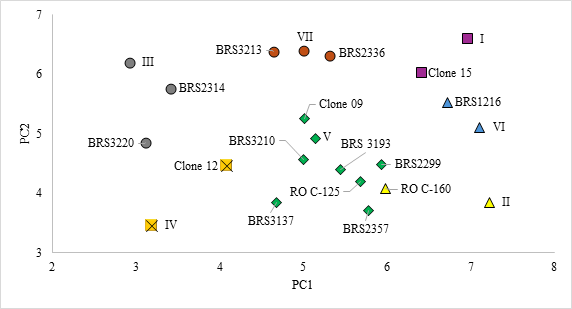
The adapted Pᵢ criterion of Lin and Binns (Cruz et al. 2012) effectively represents the concept of genotypic performance, as it simultaneously accounts for yield, adaptability (general or specific), and stability (predictability) across environments, with lower Pᵢ values indicating superior genotypic performance. When combined with the principal component analysis based on ideotypes (Figure 1), it enhances the understanding of each genotype's adaptability and the reliability of such classifications (Rocha et al. 2015, Moraes et al. 2020), showing strong interpretative correlation between both methods regarding general adaptability (Sousa et al. 2025).
of 15 Coffea canephora clones in adaptability classes based on the centroid method (Rocha et al. 2005, Nascimento et al. 2009), evaluated across three environments in Amazonas, Brazil (2021-2023). The numbered points represent the ideotypes: I, maximum general adaptability; II, maximum specific adaptability to favorable environments; III, maximum specific adaptability to unfavorable environments; IV, minimum adaptability; V, average general adaptability; VI, average specific adaptability to favorable environments; VII, average specific adaptability to unfavorable environments. PC1 (x-axis) explains 60% of the variation in general adaptability, and PC2 (y-axis) explains 25% of the specific variation (variances estimated via principal component analysis).
In C. canephora, lower Pᵢ values have been associated with higher behavioral predictability and suitability for recommendation across contrasting environments (Rocha et al. 2015, Moraes et al. 2020, Sousa et al. 2025). Genotypes BRS 1216 and Clone 15 once again stood out, as they combined high yield with wide general adaptability and responsiveness under favorable environments (Table 4, Figure 1), while showing minimal sensitivity to unfavorable environments, thus classified as ideal-performance genotypes. Subsequently, cultivars BRS 2299, BRS 2357, and Clone 09 exhibited moderate general adaptability (Figure 1) and specific adaptability to favorable environments (Table 4). Cultivars BRS 2336, BRS 3213, BRS 2314, and BRS 3220 were better adapted to unfavorable environments, though the latter two had the lowest mean yields (Table 4). Clones BRS 2314 and BRS 3220 have strong potential for fine or specialty coffee, though their beans are small, resulting in lower yield (Teixeira et al. 2020). Cultivars BRS 3137, BRS 3193, and BRS 3210 showed moderate general adaptability and low mean yield. Clone 12, with minimal adaptation and performance, should not be validated for Amazon environments (Table 4, Figure 1).
The decomposition of the GEI into simple and complex parts (Robertson 1959, Cruz and Castoldi 1991), presented in Supplementary Table S4, confirmed the predominantly complex nature of the interaction: between the Humaitá-Itacoatiara and Humaitá-Manaus environment pairs, more than 79% of the interaction was of complex type, indicating that genotypic rankings changed substantially across environments and reinforcing the need for environment-specific recommendations.
Given the gametophytic incompatibility mechanism that ensures allogamy in C. canephora, a minimum of five clones is recommended for plantation establishment. These results emphasize the importance of evaluating C. canephora clones individually prior to their introduction and validation in Western Amazon environments. This approach is essential for consolidating the sustainability of robusta coffee cultivation in the Amazon, particularly under the diverse climatic, edaphic, and technological conditions characteristic of the state of Amazonas (Teixeira et al. 2020).
Future multi-environment studies evaluating C. canephora genotypes under Amazon conditions should incorporate beverage quality attributes (e.g., sensory scores, chemical composition) and physiological indicators of tolerance to abiotic stresses, such as heat stress and water deficit responses (Fernandes et al. 2021, Rodrigues et al. 2024), to enable a more comprehensive, multi-trait genotype recommendation aligned with market demands and climate change scenarios.
CONCLUSION
A significant and predominantly complex genotype-by-environment interaction (GEI) (P < 0.01) was confirmed among the 15 Coffea canephora genotypes evaluated across the three environments in the state of Amazonas, Brazil, based on the combined analysis with a split-plot error structure. Clones BRS 1216 (86.3 bags ha⁻¹) and Clone 15 (83.4 bags ha⁻¹) exhibited the best genotypic performances for cultivation in the state of Amazonas-standing out for their superior performance under favorable edaphoclimatic or technological conditions. Cultivars BRS 2299, BRS 2357, and Clone 09 showed yields in the range of 68.2-72.5 bags ha⁻¹ across heterogeneous environments, while cultivars BRS 3213 and BRS 2336 showed better adaptation to conditions of greater environmental stress or adversity.
ACKNOWLEDGEMENTS
The authors thank the Fundação de Amparo à Pesquisa do Estado do Amazonas (FAPEAM) for financial support to the research project, the Coordenação de Aperfeiçoamento de Pessoal de Nível Superior - Brazil (CAPES) - Finance Code 001, for support through the graduate program, and the Universidade Federal do Amazonas (UFAM) for institutional support, logistics, infrastructure, and human resources. The authors also thank the Instituto Federal do Amazonas (IFAM) for institutional support and Embrapa Rondônia for providing the plant material used in the experiments.
Data Availability Statement
The datasets generated and/or analyzed during the current research are available from the corresponding author upon reasonable request.
REFERENCES
- Adunola P, Tavares Flores E, Riva-Souza EM, Ferrão MAG, Senra JFB, Comério M, Espindula MC, Verdin Filho AC, Volpi PS, Fonseca AFA, Ferrão RG, Munoz PR, Ferrão LFV2024 A comparison of genomic and phenomic selection methods for yield prediction in Coffea canephoraThe Plant Phenome Journal 7:e20109
- Akpertey A, Anim-Kwapong E, Adu-Gyamfi P, Dadzie A, Nyadanu D, Ofori A2023 Exploring genotype × environment interaction in Robusta coffee for growth and yield stability under tropical environmentsJournal of Crop Science and Biotechnology 26:179-197
- Alvares CA, Stape JL, Sentelhas PC, Gonçalves JLM, Sparovek G2013 Köppen's climate classification map for BrazilMeteorologische Zeitschrift 22:711-728
- Bradshaw AD1965 Evolutionary significance of phenotypic plasticity in plantsAdvances in Genetics 13:115-155
-
CONAB - Companhia Nacional de Abastecimento2025 Acompanhamento da safra brasileira de café. Available at <Available at https://www.conab.gov.br/info-agro/safras/cafe >. Accessed on January 15, 2025.
» https://www.conab.gov.br/info-agro/safras/cafe - Cruz CD2016 Genes software - extended and integrated with the R, Matlab and Selegen. Acta ScientiarumAgronomy 38:547-552
- Cruz CD, Castoldi F1991 Decomposição da interação genótipo x ambientes em partes simples e complexaRevista Ceres 38:422-430
- Cruz CD, Carneiro PCS, Bhering LL2021 Biometry in plant breedingCrop Breeding and Applied Biotechnology 21:e380621
- Cruz CD, Regazzi AJ, Carneiro PCS2012 Modelos biométricos aplicados ao melhoramento genético. Editora UFV, Viçosa, 668p.
-
EMBRAPA - Empresa Brasileira de Pesquisa Agropecuária2013 Sistema brasileiro de classificação de solos. Available at <Available at https://www.embrapa.br/solos/sibcs/atributos-do-solo/atributos-diagnosticos >. Accessed on November 20, 2024.
» https://www.embrapa.br/solos/sibcs/atributos-do-solo/atributos-diagnosticos - Espindula MC, Pinheiro JOC, Cararo DC, Silva EB, Diocleciano JM, Rosa Neto C, Rocha RB, Ramalho AR, Botelho FJE, França RM2022 Desempenho agronômico e análise econômica do cultivo de cafeeiros clonais no estado do Amazonas. Embrapa Rondônia, Porto Velho, 21p. (Boletim Informativo, 153).
- Espindula MC, Rocha RB, Teixeira AL, Partelli FL, Diocleciano JM2024 Formas de expressar o rendimento do café, relação entre frutos in natura e grãos beneficiados, em cafeeiros Coffea canephora no Brasil. Embrapa Rondônia, Porto Velho , 7p. (Boletim Informativo, 154).
- Espindula MC, Tavella LB, Schmidt R, Rocha RB, Dias JRM, Bravin MP, Partelli FL2021 Yield of robusta coffee in different spatial arrangementsPesquisa Agropecuária Brasileira 56:e02516
- Fernandes I, Marques I, Paulo O, Batista D, Partelli F, Lidon F, Damatta F, Ramalho J, Ribeiro-Barros A2021 Understanding the impact of drought in Coffea genotypes: transcriptomic analysis supports a common high resilience to moderate water deficit but a genotype dependent sensitivity to severe water deficitAgronomy 11:2255
- Ferrão M, Riva-Souza E, Azevedo C, Volpi P, Fonseca A, Ferrão R, Montagnon C, Ferrão L2024 Robust and smart: inference on phenotypic plasticity of Coffea canephora reveals adaptation to alternative environmentsCrop Science 64:2709-2724
- Ferrão MAG, Fonseca AFA, Ferrão RG, Verdin Filho AC2020 Cultivares de cafés Conilon e Robusta. Incaper, Vitória, 122p.
- Ferreira FM, Ramos MR, Sousa ALB, Tadeu HC, Nunes JP, Silva RC, Marques FA, Lopes MTG2024a Caracterização da granulometria dos grãos de cafeeiros Coffea canephora cultivados no AmazonasEnciclopédia Biosfera 21:34
- Ferreira FM, Silva RC, Sousa ALB2024b Formação inicial de cafeeiros clonais 'Conilon' sob efeito da indução de brotaçõesEnciclopédia Biosfera 21:93
- Finlay KW, Wilkinson GN1963 The analysis of adaptation in a plant-breeding programmeAustralian Journal of Agricultural Research 14:742-754
-
INMET - Instituto Nacional de Meteorologia2025 Balanço hídrico sequencial - SISDAGRO. Available at <Available at https://sisdagro.inmet.gov.br/sisdagro/app/monitoramento/bhs >. Accessed on October 15, 2025.
» https://sisdagro.inmet.gov.br/sisdagro/app/monitoramento/bhs - Li P, An Z, Xu N, Li J, Li Q, He C2025 Phenotypic plasticity and stability in plants: genetic mechanisms, environmental adaptation, evolutionary implications, and future directionsPlant, Cell & Environment 48:5847-5860
- Lin CS, Binns MR1988 A method of analyzing cultivar x location x year experiments: a new stability parameterTheoretical and applied genetics 76:425-430
- Lourenço JLR, Rocha RB, Espindula MC, Alves EA, Teixeira AL, Ferreira FM2022 Genotype × environment interaction in the coffee outturn index of Amazonian Robusta cultivarsAgronomy 12:2874
- Marcolan AL, Espindula MC2015 Café na Amazônia. Embrapa, Brasília, 474p.
- Moraes M, Rocha R, Teixeira A, Espindula MC, Silva C, Lunz A2020 Adaptability and stability of Coffea canephora Pierre ex Froehner genotypes in the Western AmazonCiência Rural 50:e20190087
- Moraes MS, Teixeira AL, Ramalho AR, Espindula MC, Ferrão MAG, Rocha RB2018 Characterization of gametophytic self-incompatibility of superior clones of Coffea canephoraGenetics and Molecular Research 17:1-11
- Moraes-Neto VF, Baqueta MR, Carames ETS, Rocha RB, Pallone JAL2025 Authentication of 'Robusta Amazônico' geographical indication for green coffee: UV-vis and NIR spectroscopy-based approaches combined with chemometricsFood Chemistry 493:145612
- Morais J, Rocha R, Alves E, Espindula M, Teixeira A, Souza C2021 Beverage quality of Coffea canephora genotypes in the Western Amazon, BrazilActa Scientiarum Agronomy 43:e52095
- Nascimento M, Cruz CD, Campana ACM, Tomaz RS, Salgado CC, Ferreira RDP2009 Alteração no método centroide de avaliação da adaptabilidade genotípicaPesquisa Agropecuária Brasileira 44:263-269
- Oliveira LNL, Rocha RB, Ferreira FM, Spinelli VM, Ramalho AR, Teixeira AL2018 Selection of Coffea canephora parents from the botanical varieties Conilon and Robusta for the production of intervarietal hybridsCiência Rural 48:e20170444
- Piepho HP, Möhring J, Melchinger AE, Büchse A2008 BLUP for phenotypic selection in plant breeding and variety testingEuphytica 161:209-228
- Robertson A1959 Experimental design on the measurement of heritabilities and genetic correlations: biometrical geneticsBiometrics 15:219-226
- Rocha RB, Muro-Abad JI, Araújo EF, Cruz CD2005 Avaliação do método centróide para estudo de adaptabilidade ao ambiente de clones de Eucalyptus grandisCiência Florestal 15:255-266
- Rocha RB, Ramalho AR, Teixeira AL, Souza FDF, Cruz CD2015 Adaptabilidade e estabilidade da produção de café beneficiado em Coffea canephoraCiência Rural 45:1531-1537
- Rodrigues AP, Pais IP, Leitão AE, Dubberstein D, Lidon FC, Marques I, Semedo JN, Rakočević M, Scotti-Campos P, Campostrini E, Rodrigues WP, Simões-Costa MC, Reboredo FH, Partelli FL, Damatta FM, Ribeiro-Barros AI, Ramalho JC2024 Uncovering the wide protective responses in Coffea spp. leaves to single and superimposed exposure of warming and severe water deficitFrontiers in Plant Science 14:1320552
- Scott AJ, Knott M1974 A cluster analysis method for grouping means in the analysis of varianceBiometrics 30:507-512
- Silva DO, Ferreira FM, Rocha RB, Espindula MC, Spinelli VM2018b Genetic progress with selection of Coffea canephora clones of superior processed coffee yieldCiência Rural 48:e20170443
- Silva PE, Santos e Silva CM, Spyrides MHC, Andrade LDMB2018a Precipitation and air temperature extremes in the Amazon and northeast BrazilInternational Journal of Climatology 39:579-595
- Solimões FCR, Espindula MC, Teixeira Filho AJ, Sousa ALB, Ferreira FM2023 Seasonal vegetative growth of Coffea canephora associated with two water managements in the South-Western AmazonSemina: Ciências Agrárias 44:1265-1286
- Sousa ALB, Rocha RB, Tadeu HC, Lopes MTG, Espindula MC, Silva RC, Ferreira FM2025 Maturation cycle and fruit-to-bean conversion ratios in Amazon Robusta coffee cultivarsRevista Caatinga 38:e12571
- Teixeira AL, Rocha RB, Espindula MC, Ramalho AR, Vieira Júnior JR, Alves EA, Lunz AMP, Souza FF, Costa JNM, Fernandes CF2020 Amazonian Robustas - new Coffea canephora coffee cultivars for the Western Brazilian AmazonCrop Breeding and Applied Biotechnology 20:e323420318