 REML/BLUP-based dissection of combining ability and maternal influence on soybean grain protein
Abstract
This study aimed to analyze the additive and non-additive genetic effects governing protein content in soybean grains and to identify superior parents and maternal contributions in advanced generations. A total of 170 F8 soybean lines and 95 commercial cultivars were evaluated during the 2024/2025 growing season. The total protein content in the grains (%) was determined. Deviance analysis confirmed significant effects of general combining ability (GCA) and specific combining ability (SCA). Narrow-sense heritability was low (2%), while broad-sense heritability reached 52%, demonstrating total genetic variability, attributable to dominance and epistatic effects. The average overall crude protein content was 36.15%. The parents NS5958RR, Maradona, and DM5.8BmxApoloRR showed the highest positive GCA estimates, indicating the presence of favorable additive alleles. The most promising specific combination was L77, with a 1.16% increase in protein, followed by L87. Maternal contributions were evident, particularly when NS5958RR and Maradona were used as female parents.
Keywords:
Maternal effects; circulating diallel; heritability
INTRODUCTION
Soybean (Glycine max (L.) Merr.) is one of the world’s leading crops, essential for food security due to its vegetable oil production and high-quality protein for human and animal consumption, contributing to global market competitiveness and socioeconomic development (Singh et al. 2008, Vasconcelos et al. 2020). Thus, breeding programs prioritize the development of high-protein cultivars with strong agronomic performance under biotic and abiotic stresses (Anderson et al. 2019, Liu et al. 2023). In this context, multi-trait selection in multi-environment trials has become a key strategy to manage environmental heterogeneity and genotype × environment interaction, enabling the identification of stable, high-performing genotypes (Kehl et al. 2022).
The genetic control of protein content in soybean is quantitative in nature, characterized by the action of multiple genes, strong environmental influence and management (Bosaz et al. 2019), which poses challenges to direct selection, especially in early breeding stages, thus requiring improved techniques for identifying these quantitative loci (Van and McHale 2017). In this context, biometric tools that enable the identification of superior parents and promising hybrid combinations are fundamental for increasing the efficiency of breeding programs (Borém et al. 2021).
Combining ability, widely used in quantitative genetics studies, is a robust method for evaluating the genetic potential of lines, parents, and combinations in crosses. By estimating the genetic effects of general combining ability (GCA) and specific combining ability (SCA), it is possible to infer the predominance of additive and non-additive effects in controlling the variable of interest. GCA corresponds to additive gene action and reflects the mean performance of a parent across different crosses, while SCA is associated with dominance and epistatic interactions (Cruz et al. 2012, Carvalho et al. 2017).
Studies of combining analysis have been widely applied in grain legumes to dissect the genetic architecture of yield and nutritional traits. In pea, dominance gene effects were reported to be predominant for yield components (Ceyhan et al. 2008, Ceyhan and Kahraman 2013, Ceyhan et al. 2014a, Şimsek and Ceyhan 2017). In common bean, significant GCA and SCA effects were identified for protein and mineral accumulation, demonstrating the relevance of additive gene action for nutritional improvement (Ceyhan et al. 2014b, Ceyhan et al. 2025). Similarly, diallel analyses in cowpea revealed substantial genetic variability and heritability for protein and mineral composition (Jou-Nteufa and Ceyhan 2024, Dalgıç et al. 2025). These findings emphasize that protein-related traits in legumes are governed by both additive and non-additive genetic effects, depending on species and population structure. However, such analyses remain limited in soybean advanced-generation lines, particularly regarding maternal influence and residual heterozygosity effects in F8 materials.
Studies of combining ability have been widely used for agronomic traits of soybean, such as grain yield, plant height, and cycle (Bagatelli et al. 2020, Sangiovo et al. 2025). However, there are still few analyses focused on grain protein content, especially those involving lines in advanced generations that exhibit greater homozygosity and genetic stability. Evaluating combining ability in these lines allows the identification of parents with a higher frequency of alleles favorable to protein production, as well as crosses capable of generating superior progeny, contributing to the development of more efficient cultivars from a nutritional and industrial perspective (Meena et al. 2024).
Given this scenario, studying the combining ability of soybean as a function of grain protein content is essential to understanding the genetic basis of this trait and to guiding precise selection strategies, without confounding from heterozygous genes. This study aimed to evaluate the general and specific combining ability of elite soybean lines (F8 generation: 0.78% heterozygous genes), seeking to identify promising parents and their maternal effects on increasing soybean grain protein.
MATERIAL AND METHODS
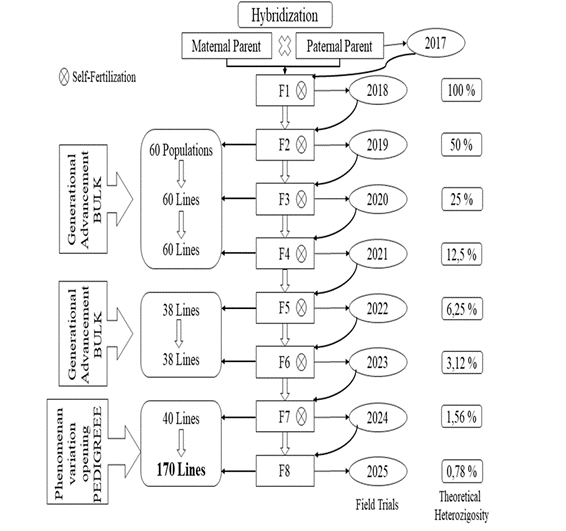
The experiment was conducted at the Experimental Farm School of the Regional University of Northwest Rio Grande do Sul (UNIJUÍ), located in the municipality of Augusto Pestana, Rio Grande do Sul, during the 2024/2025 growing season. The experimental design was conducted using an augmented block design with interspersed controls. The regular treatments consisted of 170 soybean lines from the F8 generation, originating from crosses in a circulating diallel (Figure 1 and Table 1), and 95 soybean cultivars, included as interspersed controls, all arranged in four blocks. The experimental units consisted of a sowing row fifteen meters long, spaced 0.5 meters apart. For all genotypes, a sowing density of 16 seeds per linear meter was used, with a base fertilization of 300 kg ha-1 of 04-30-20 (N-P-K).
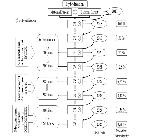
Chronological diagram of the genetic improvement process through hybridizations up to the F8 stage, to obtain the 170 inbred lines.
The control cultivars were: M6410IPRO, DM5958IPRO, 95Y52RR, FPS1859RR, TMGManacáXTD, C2570RR, FPSJúpiterRR, BMXTorqueI2x, FPS2565IPRO, TMG6123IPRO, SoyTech570I2x, GH2361IPRO, DM59IX61I2x, IPRBasalto, M6210IPRO, FPSSolimõesRR, SoyTech580I2x, IPRPé-Vermelho, NEO531I2x, 95R40IPRO, BRS525, NEO590I2x, NEO510IPRO, BMXLótusIPRO, C2560CE, NEO620IPRO, BMXCromoTFIPRO, SYN1059RR, M6130I2x, NS6601IPRO, NS4823RR, TMG7363RR, BRS511, TMG7061RR, DM64I63IPRO, NS6446I2x, BR2606IPRO, GH2459I2x, NS5252I2x, 95Y02IPRO, DM54IX57I2x, BRS5804RR, NS5922IPRO, M5939I2x, M5947IPRO, SoyTech541I2x, IPRPetrovita, BMXNexusI2x, BMXTitaniumI2x, DM60I64I2x, BMXTrovãoI2x, BRS546, BMXRaçaE, 95R51IPRO, AS3590IPRO, M5705IPRO, BMXVênusCE, SoyTech616I2x, BMXImuneTFI2x, TMGGuanandiI2x, BRS6013, NEO600I2x, C2550E, NS6006IPRO, FPSParanapanemaRR, NEO581E, BMXCompactaIPRO, 95Y95IPRO, URNRS23, BRS10001IPRO, M5917IPRO, GH5933IPRO, NEO610IPRO, NEO560IPRO, BRS537, DM65IX67I2x, BMXLançaIPRO, TMG7362IPRO, BMXFibraIPRO, M5710I2x, NS5959IPRO, DM56I59IPRO, NS5624I2x, M5834XTD, BRS539, DM57I52IPRO, BMXZeusIPRO, NA5909RGRR, TMG7262RR, SoyTech535I2x, M5838IPRO, BMXFúriaCE, and BMXRaioIPRO.
After maturation, 50 representative plants per experimental unit were harvested, from which the grains were grouped, homogenized, dried until they reached 13% moisture, and formed a 100 g sample from each experimental unit. For each sample, the percentage of total crude protein (%) was determined by the acid-catalytic digestion method, followed by distillation and titration using the Kjeldahl method, employing a conversion factor of 6.25, indicated for soybean cultivation (Kjeldahl 1883).
The grain protein data obtained from the control lines and cultivars were subjected to analysis of model assumptions, including normality, homogeneity of residual variances, additivity, and independence of errors. The Restricted Maximum Likelihood (REML) method was applied to estimate variance components and genetic parameters, based on the linear mixed model y = Xβ + Za + Wf + e , where is the vector of individual phenotypic observations; is the incidence matrix relating observations to fixed effects; is the vector of fixed effects in the model; is the incidence matrix relating observations to additive genetic effects; is the vector of random additive genetic effects of individuals, with , where is the additive relationship matrix and represents the additive genetic variance (Va); is the incidence matrix relating observations to family effects; is the vector of random family effects, with , where is the identity matrix and represents the variance among families (Vfam); and is the vector of residual random errors, with , where represents the residual variance (Ve).
Significance determined by a Deviance analysis at a 5% significance level using the Chi-square test (χ2). The significant model allowed the estimation of the following parameters: additive variance (Va); family variance (Vfam); residual variance (Ve); phenotypic variance (Vf); narrow-sense heritability based on additive effects (h2a); broad-sense heritability (h2g); and mean family heritability (h2fam). From these parameters, the Best Linear Unbiased Predictor (BLUP) was extracted to estimate the genetic deviations from the general combining ability of the parents and the specific combining ability, using the metan package (Olivoto and Lúcio 2020). The analyses were performed using the R software (R Core Team 2026) with the plant breeding, lmDiallel, and sommer packages.
RESULTS AND DISCUSSION
Deviance analysis revealed the significance of the general and specific combining abilities of the genotypes for the soybean grain protein content at a 5% probability level using the chi-square test (χ2), validating the estimation of variance components and genetic parameters (Table 2). The significance of both GCA and SCA components indicates that soybean grain protein is controlled by a mixed genetic model involving both additive and non-additive gene effects. The relative contribution of these components suggests that although additive variance is limited, dominance and possible epistatic interactions substantially influence phenotypic expression (Ceyhan et al. 2008, Ceyhan et al. 2014a). The parameters related to the heritability of genotypes for grain protein reveal that the narrow-sense heritability (h2a) is only 2%, which is low but essential for selection strategies. The narrow-sense heritability (2%) observed in this study is considerably lower than values reported in cowpea (0.64-0.99 for protein; Dalgıç et al. 2025) and common bean populations (Ceyhan et al. 2014b). This discrepancy may be attributed to the advanced generation (F8), environmental variance, and potential genotype × environment interactions affecting protein accumulation in soybean. Low additive variance suggests that direct phenotypic selection may be inefficient, and parent-based selection strategies should be emphasized.
In contrast, considering overall variability through broad-sense heritability (h2g) shows 52% genetic variance, allowing the selection of promising lines for this attribute. The moderate broad-sense heritability indicates that total genetic variance, including dominance and epistatic components, remains substantial. This reinforces the importance of exploiting non-additive gene action through strategic crossing schemes rather than relying exclusively on within-line selection (Tekin and Ceyhan 2023, Tamüksek and Ceyhan 2024, Jou-Nteufa and Ceyhan 2024). The overall family heritability (h2fam) indicates that selection based on this parameter accounts for 24% of the genetic variation. The overall mean for crude protein was 36.15%, considering 95 control cultivars, 30 parent cultivars, and 170 elite lines. When considering these genetic gains via heritability for increasing grain protein, breeding programs need adequate, readily available analytical approaches, that primarily accounts for additive effects.
Diallel analysis for recombinant soybean genotypes in early generations provides an estimate of general combining ability (GCA), revealing additive genetic effects on the mean parental performance relative to the overall mean, and specific combining ability (SCA), indicating the deviation of the cross from parental performance, based on dominance and epistasis effects (Cruz et al. 2012, Oliveira et al. 2014). However, in F8 generation lines considered elite in the breeding program, which exhibit high homozygosity, this approach helps identify the superior parents, position future crosses, and assess contributions, inheritances, and maternal effects responsible for cytoplasmic, mitochondrial, metabolic, and photosynthetic traits (Singh and Hadley 1972). In advanced generations such as F8, reduced segregating variance and increased allele fixation may limit detectable additive variance relative to early-generation diallel studies. Therefore, the interpretation of combining ability parameters in highly homozygous populations must consider the genetic background stabilization inherent to elite breeding materials. The great potential of these estimates in future generations lies in minimizing errors caused by heterozygote bias.
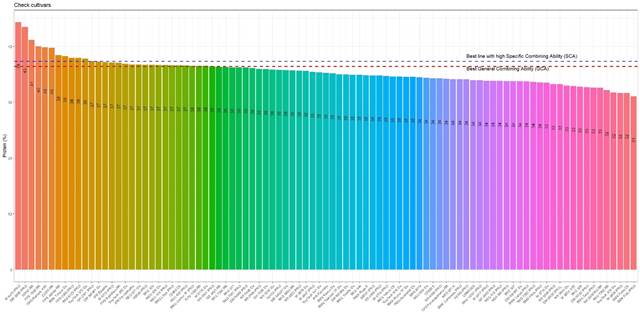
Estimates of the means (BLUP) for general combining ability were made for the 30 parent cultivars and for specific combining ability for 170 lines. To increase protein content in new soybean genotypes, the performance of control cultivars for grain protein content was evaluated (Figure 2), and these results can be incorporated into genetic improvement programs to obtain progenies with high protein content. The cultivars that presented protein contents higher than the mean specific combining ability (SCA) of 37% were M6410IPRO (44%), DM5958IPRO (43%), 95Y52RR (41%), FPS1859RR (40%), TMGManacáXTD (40%), C2570RR (40%), FPSJúpiterRR (38%), BMXTorqueI2x (38%), FPS2565IPRO (38%), TMG6123IPRO (38%) and SoyTech570I2x (38%). For general combining ability (GCA), the controls that exceeded 36% crude protein were GH2361IPRO, DM59IX61I2x, IPRBasalto, M6210IPRO, FPSSolimõesRR, SoyTech580I2x, IPRPé-Vermelho, NEO531I2x, 95R40IPRO, BRS525, NEO590I2x, NEO510IPRO, BMXLótusIPRO, C2560CE, and NEO620IPRO.
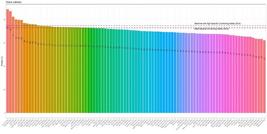
Ranked performance of 95 control cultivars for grain protein (%), and rows of mean performances of general (GCA) and specific (SCA) combining abilities.
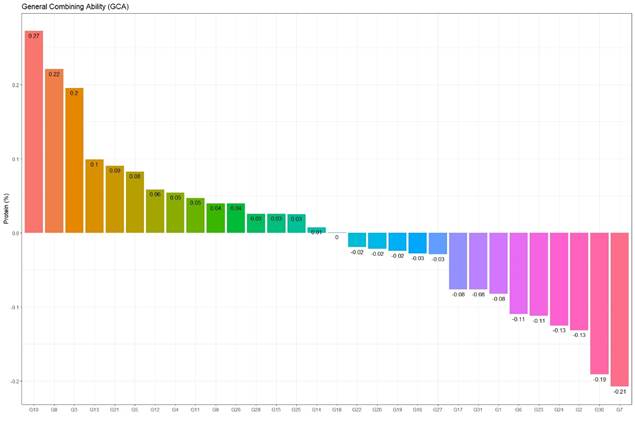
The selection of superior parents for a given trait can be aided by analyzing general combining ability, in which the highest estimates (positive for an increase or negative for a decrease in the trait) indicate which parents are superior or inferior to the overall mean of the combinations (Miranda et al. 1996). From the classification (Table 3) and the graph (Figure 3), it can be observed that the parents NS5958RR, Maradona, and DM5.8BmxApoloRR showed the highest estimates and increases in grain protein, at 0.27%, 0.22%, and 0.20%, respectively. Despite low narrow-sense heritability, significant GCA effects for NS5958RR, Maradona, and DM5.8BmxApoloRR indicate the presence of favorable additive alleles. Similar findings were reported in common bean, where cultivars with positive GCA values significantly contributed to protein enhancement in hybrid populations (Ceyhan et al. 2025). This confirms that combining ability analysis remains a powerful tool for selecting superior parents, even under conditions of limited additive variance. Furthermore, the parents TMG7166RR, MonascarRR, FPSNetunoRR, NS5909RR, BmxPotênciaRR, BmxForçaRR, 4823RR, Rota54, TMG2757, M5710, 5601IPRO, DM6563IPRO, and 15B70IPRO showed positive genetic deviations for increased protein, but less than 0.1%.
Ranking of estimates of the genetic deviation of the general combining ability (GCA) of the parents for grain protein (%)
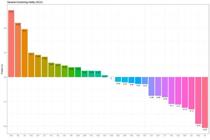
Estimates of genetic deviation from ordered general combining ability (GCA) of parents for grain protein.
GCA demonstrated estimates of reduced grain protein content for the parents FPSParanapanemaRR, Fundacep66RR, HOJacuiIPRO, FPSJúpiterRR, DM5.9BmxAlvoRR, HOPuricaIPRO, HOAmaboyIPRO, DM7.0BmxMagnaRR, TMG7062IPRO, FPSUranoRR, BmxAtivaRR, RoosCaminoRR, with DM6160IPRO and 6700RR standing out with genetic deviations of -0.19% and -0.20%, respectively. Through general combining ability, it was observed that some parents carry alleles that favor increases or decreases in protein content, which be fixed in the transgressive progenies of the program (Pimentel et al. 2013).
Significant estimates of general combining ability were also obtained for grain weight per plant in a partial diallel with three parents (Zorzetto et al. 2008), and in the selection of soybean parents to enhance grain yield in the Brazilian Cerrado (Daronch et al. 2014). In the study by Teodoro et al. (2019), the general combining ability analysis using 11 parent cultivars and 28 hybrid combinations revealed strong additive effects for net photosynthesis, stomatal conductance, internal CO₂ concentration, and transpiration, with high estimates for TMG7062IPRO. Greater additive effects were reported in estimates of general combining ability by Bagatelli et al. (2020), Santos et al. (2025), and Sangiovo et al. (2025). These works aimed to select soybean genotypes based on main yield components and cycle reduction.
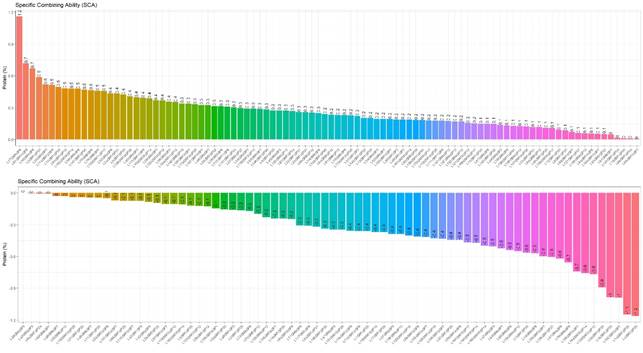
Estimates of specific combining ability (Figure 4) show that, out of 170 lines, 96 combinations presented an increase in soybean grain protein content compared to the overall mean of 37%. The best combinations for increasing protein were L77 (Maradona x Maradona) with 1.16%, followed by 0.71% through L87 (Maradona x NS5958RR) and 0.67% through L30 (Maradona x DM5.8BmxApoloRR). It is noteworthy that the genotypes NS5958RR, Maradona, and DM5.8BmxApoloRR, which showed the best combinations, also exhibited the highest general combining ability values, a desired result in diallel analyses for identifying the superior parents, indicating the relevant additive effects on protein content in soybean grains (Cruz et al. 2012).
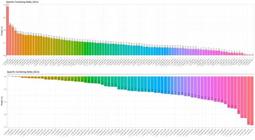
Barplot graph showing estimates of the genetic deviation from specific combining ability (SCA) of genotypes ordered for grain protein (%).
Conversely, lower estimates of specific combining ability were obtained from L14 and L4, both from the cross Fundacep66RR x DM7.0 BmxMagnaRR, with a reduction of -1.16% and -1.15% in grain protein, as well as from L102 (6700RR x NS5958RR), which reduced -0.99%. It is noteworthy that these parents 6700RR, Fundacep66RR, and DM7.0BmxMagnaRR showed low general combining ability, indicating the effectiveness of diallel analysis. Low additive effects for the oil and soybean grain protein content are attributed to SCA and higher GCA in generations of high heterozygosity (Meena et al. 2024). In this scenario, it becomes evident that the choice of parents based on this approach for grain quality attributes should be prioritized in later breeding generations, in line with the premises presented in this work.
Specific combining ability (SCA) in advanced generations (F8) of soybean consolidates the results due to the additive effects fixed in each line, complementarity of alleles and genes, as well as the correct positioning of the pollen-receiving and pollen-donating parents, due to the large maternal contribution to the genetic potential of the line (Pimentel et al. 2013, Carvalho et al. 2017). Relating the superior parent expressed by general combining ability, NS5958RR (0.27%), with the best combination via specific combining ability, this maternal parent was L87 (Maradona x NS5958RR), contributing 0.44% to the protein magnitude. The superiority of certain parent lines suggests potential effects of maternal inheritance. Maternal contributions have also been highlighted in reciprocal diallel analyses in pea and cowpea (Ceyhan and Kahraman 2013, Jou-Nteufa and Ceyhan 2024). Such effects may arise from interactions between the cytoplasmic genome or from maternal regulation of seed storage protein synthesis. In soybean, major seed storage proteins such as glycinin and β-conglycinin are synthesized under large maternal tissue influence during seed development, which may partially explain the maternal contribution detected in advanced-generation lines. Therefore, cytoplasmic-nuclear interactions should be considered in protein-oriented breeding strategies. The Maradona parent revealed better specific combining ability and maternal effect for the trait in question.
Studies by Singh and Hadley (1972) showed that maternal and cytoplasmic effects are crucial for the protein composition in soybean grains during early breeding generations. Similar trends were reported by Pucinelli (1992), who postulated that the soybean grain protein results from the successful combination of favorable genes with large additive effects. Maternal genetic effects in the F1, F2, and F3 generations of soybean are confirmed for isoflavone content (Liang et al. 2007), fatty acids (Gilsinger et al. 2010), and tolerance to Asian soybean rust (Cruz et al. 2011). The results suggest that improving soybean grain protein in advanced generations should prioritize parental selection based on GCA estimates, complemented by evaluating superior SCA combinations and maternal contributions. Integrating combining ability analysis with high-throughput protein phenotyping platforms may accelerate genetic gain in soybean breeding programs.
CONCLUSION
Soybean grain protein in advanced generation (F8) material is governed by a mixed genetic architecture, involving additive and non-additive gene effects. Although narrow-sense heritability was low (2%), indicating limited exploitable additive variance at this stage, moderate broad-sense heritability (52%) confirmed the presence of substantial total genetic variability.
General combining ability (GCA) analysis identified parents such as NS5958RR, Maradona, and DM5.8BmxApoloRR as superior for increasing grain protein. Superior specific combining ability (SCA), such as Maradona × NS5958RR, showed significant protein gains, demonstrating that strategic crossing schemes remains essential to maximize genetic progress. Maternal effects were evident in several superior combinations, suggesting the influence of cytoplasmic-nuclear interactions and maternal regulation of seed storage protein synthesis.
ACKNOWLEDGMENTS
Authors are thankful to the Conselho Nacional de Desenvolvimento Científico e Tecnológico (CNPq), Nº: 306334/2024-0, and the Coordenação de Aperfeiçoamento de Pessoal de Nível Superior (CAPES) for the financial support.
Data Availability Statement
The datasets generated and/or analyzed during the current research are available from the corresponding author upon reasonable request.
REFERENCES
- Anderson EJ, Ali ML, Beavis WD, Chen P, Clemente TE, Diers BW, Tilmon KJ2019 Soybean [Glycine max (L.) Merr.] breeding: history, improvement, production and future opportunities. In Al-Khayri JM, Jain SM and Johnson DV (eds) Advances in plant breeding strategies: legumes. Springer International Publishing, Cham, p. 431-516
- Bagatelli JR, Bahry CA, Silva RNO, Carvalho IR, Conte GG, Villela FA, Meneghello GE2020 Estimates of heterosis and combining ability of soybean diallel crossingsPlant Omics 13:7-14
- Borém A, Miranda GV, Fritsche-Neto R2021 Melhoramento de plantas. Editora UFV, Viçosa, 626p.
- Bosaz LB, Gerde JA, Borrás L, Cipriotti PA, Ascheri L, Campos M, Rotundo JL2019 Management and environmental factors explaining soybean seed protein variability in central ArgentinaField Crops Research 240:34-43
- Carvalho IR, Nardino M, Souza VD2017 Melhoramento e cultivo da soja. Cidadela, Porto Alegre, 366p.
- Ceyhan E, Kahraman Kahraman2013 Genetic analysis of yield and some characters in peasLegume Research 36:273-279
- Ceyhan E, Avci MA, Karadaş S2008 Line x tester analysis in pea (Pisum sativum L.): Identification of superior parents for seed yield and its componentsAfrican Journal of Biotechnology 7:2810-2817
- Ceyhan E, Harmankaya M, Kahraman A2014b Combining ability and heterosis for concentration of mineral elements and protein in common bean (Phaseolus vulgaris L.)Turkish Journal of Agriculture and Forestry 38:581-590
- Ceyhan E, Kahraman A, Avcı MA, Dalgıç H2014a Combining ability of bean genotypes estimated by line × tester analysis under highly-calcareous soilsThe Journal of Animal and Plant Sciences 24:579-584
- Ceyhan E, Korkmaz A, Ali A, Karadaş S, Harmankaya M, Şimşek D, Karaköy T2025 Exploring genetic diversity: The inheritance of protein and mineral contents in dwarf common beansTurkish Journal of Agriculture and Forestry 49:24-36
- Cruz CD, Regazzi AJ, Carneiro PC2012 Métodos biométricos aplicados ao melhoramento genético. Editora UFV, Viçosa , 512p.
- Cruz MFAD, Souza GAD, Rodrigues FÁ, Sediyama CS, Barros EGD2011 Reaction of soybean cultivars to natural infection by Asian rustPesquisa Agropecuária Brasileira 46:215-218
- Dalgıç H, Ali A, Karadaş S, Korkmaz A, Ayran Çolak İ, Harmankaya M, Karaköy T, Ceyhan E, Türkoğlu A2025 Diallel analysis of cowpea (Vigna unguiculata L. Walp) for protein and mineral composition: Genetic variability and heritabilityEuphytica 221:168
- Daronch DJ, Peluzio JM, Afférri FS, Nascimento MOD2014 Capacidade combinatória de cultivares de soja em F2, sob condições de cerrado tocantinenseBioscience Journal 30:688-695
- Gilsinger JJ, Burton JW, Carter Junior TE2010 Maternal effects on fatty acid composition of soybean seed oilCrop science 50:1874-1881
- Jou-Nteufa C, Ceyhan E2024 Genetic analysis of seed yield and some traits in cowpea using diallel analysisTurkish Journal of Agriculture and Forestry 48:278-293
- Kehl K, Carvalho IR, Sacon D, Rizzardi MA, Langaro NC, Loro MV, Lautenchleger F2022 Strategic positioning of soybean based on the agronomic ideotype and on fixed and mixed multivariate modelsPesquisa Agropecuária Brasileira 57:e02702
- Kjeldahl J1883 Neue methode zur bestimmung des stickstoffs in organischen Körpern. Fresenius, Zeitschrift f. analChemie 22:366-382
- Liang HZ, Zhang HY, Zhang MC2007 Genetic analysis of embryo, cytoplasm and maternal effects and their environment interactions for isoflavone content in soybean [Glycine max (L.) Merr.]Agricultural Sciences in China 6:1051-1059
- Liu S, Liu Z, Hou X, Li X2023 Genetic mapping and functional genomics of soybean seed proteinMolecular Breeding 43:29
- Meena BL, Koli NR, Sharma SC, Patidar BK, Meena RK2024 Heterosis and combining ability analysis for quality traits in soybean [Glycine max (L.) Merrill]International Journal of Advanced Biochemistry Research 8:38-42
- Miranda JEC, Costa CP, Cruz CD1996 Análise dialélica em pimentão. I. Capacidade combinatóriaRevista Brasileira de Genética 11:431-440
- Oliveira IJD, Vello NA, Vieira PDMJ, Wyminersky PT2014 Diallel among soybean genotypes with high oil content and resistance to sudden death syndromeBrazilian Archives of Biology and Technology 57:178-186
- Olivoto T, Lúcio ADC2020 metan: An R package for multi‐environment trial analysisMethods in Ecology and Evolution 11:783-789
- Pimentel AJB, Souza MAD, Carneiro PCS, Rocha JRDASDC, Machado JC, Ribeiro G2013 Análise dialélica parcial em gerações avançadas para seleção de populações segregantes de trigoPesquisa Agropecuária Brasileira 48:1555-1561
- R Core Team2026 R: A language and environment for statistical computing. R Foundation for Statistical Computing, Vienna, 2026.
- Sangiovo JP, Carvalho IR, Colet CDF, Bandeira WJA, Roza JPD, Bruinsma GMW, Lúcio ADC2025 Combining genetic potential for early maturitty and grain yield in soybeanRevista Ceres 72:e72005
- Santos MS, Hamawaki OT, Gomes BH, Gastl Filho J, Oliveira MBD, Silva ACD, Nogueira AP2025 Combining ability of soybean in F1 and F2 generations for earliness and grain yieldRevista Caatinga 38:e12487
- Şimşek D and Ceyhan E2017 Inheritance of some agronomic characters in peaJournal of Agricultural Sciences 23:34-41
- Singh L, Hadley HH1972 Maternal and cytoplasmic effects on seed protein content in soybeans, Glycine max (L.) Merrill 1Crop Science 12:583-585
- Singh P, Kumar R, Sabapathy SN, Bawa AS2008 Functional and edible uses of soy protein productsComprehensive Reviews in Food Science and Food Safety 7:14-28
- Tamüksek Ş and Ceyhan E2024 Genetic analysis of grain yield and its components in green bean for soils with high lime contentBrazilian Archives of Biology and Technology 67:e24231090
- Tekin NB, Ceyhan E2023 Diallel analysis of dry bean varieties for seed yield and important traits for calcareous soilsBrazilian Archives of Biology and Technology 66:e23230170
- Teodoro LPR, Bhering LL, Gomes BEL, Campos CNS, Baio FHR, Gava R, Teodoro PE2019 Understanding the combining ability for physiological traits in soybeanPLoS ONE 14:e0226523
- Van K, McHale LK2017 Meta-analyses of QTLs associated with protein and oil contents and compositions in soybean [Glycine max (L.) Merr.] seedInternational Journal of Molecular Sciences 18:1180
- Vasconcelos MW, Grusak MA, Pinto E, Gomes A, Ferreira H, Balázs B, Iannetta P2020 The biology of legumes and their agronomic, economic, and social impact. In Hasanuzzaman M, Araújo S and Gill SS (eds) The plant family Fabaceae: biology and physiological responses to environmental stresses. Springer, Singapore, p. 3-25
- Zorzetto MM, Costa Motta F, Morais LK, Kiihl TAM, Silva RM2008 Análise dialélica da capacidade combinatória em sojaRevista Biociências 14:45-51
Edited by
-
SCIENTIFIC EDITOR:
Luiz Antônio dos Santos Dias