 New and efficient AS-PCR molecular marker for selection of coffee resistant to coffee leaf rust
Abstract
Coffee leaf rust, caused by Hemileia vastatrix, is the most important disease affecting Coffea arabica. The use of molecular markers through marker-assisted selection (MAS) is an effective approach to develop cultivars with multiple and durable resistance, which is economically and environmentally beneficial for this disease control. In this work, a new molecular marker based on allele-specific polymerase chain reaction (AS-PCR) associated with the quantitative trait locus (QTL) of the linkage group 5 (LG5), which confers resistance to races I, II and pathotype 001 of H. vastatrix, was developed. The CaRHv10-AS marker was validated in a segregating genetic mapping population of 247 F2 genotypes and demonstrated selection efficiency greater than 97% for genotypes with resistance to three races. Thus, this work provides a fast, robust, and affordable molecular marker for use in MAS, facilitating the development of coffee plants with multiple resistance and ensuring sustainable coffee production.
Keywords:
Coffee breeding; sustainable coffee; marker-assisted selection (MAS); QTL; Hemileia vastatrix
Keywords:
Coffee breeding; sustainable coffee; marker-assisted selection (MAS); QTL; Hemileia vastatrix
Keywords:
Coffee breeding; sustainable coffee; marker-assisted selection (MAS); QTL; Hemileia vastatrix
INTRODUCTION
Coffee production faces significant challenges due to high yield losses caused by pests and diseases (Zambolim and Caixeta 2021). Coffee leaf rust (CLR), caused by the biotrophic fungus Hemileia vastatrix, is globally recognized as the most devastating coffee disease (Talhinhas et al. 2017, Koutouleas et al. 2023). CLR reduces plantation productivity and affects grain quality, leading to annual global production losses exceeding US$1 billion (Kahn 2019). This situation is expected to worsen due to climate change (Van der Vossen et al. 2015).
The primary control strategy employed by coffee farmers is the application of fungicides (Zambolim 2016). However, this approach increases production costs, and has adverse effects on the environment and human health (Koutouleas et al. 2023). Breeding for long-lasting resistance is considered the best long-term solution for CLR management, from both economic and sustainability perspective (Van der Vossen et al. 2015).
Resistance to CLR is conferred by at least 11 characterized genes, SH1, SH2, SH3, SH4, SH5, SH6, SH7, SH8, SH9, SH10, and SH11 (Bettencourt et al. 1988, Barka et al. 2020, Almeida et al. 2021b). The SH1, SH2, SH4, and SH5 genes were identified in Coffea arabica, but have been overcome by fungal races present in Brazil. Combinations of the SH6-SH11 genes, in addition to others that have not yet been characterized, are presented in naturals hybrids such as ‘Híbrido de Timor’ (HdT) (Setotaw et al. 2020). HdT is derived from natural crosses between C. arabica and C. canephora and has been utilized to introgress resistance genes in coffee plants to develop rust-resistant arabica cultivars.
Molecular markers have significantly improved the efficiency and accuracy of plant breeding through marker-assisted selection (MAS) (Hasan et al. 2021). Marker-assisted selection (MAS) allows the selection of resistant genotypes and the development of cultivars with multiple sources of resistance, through the integration of several alleles into a single host, a process known as gene pyramiding (Almeida et al. 2021a, Koutouleas et al. 2023). This strategy can be employed to accumulate resistance alleles against different races of H. vastatrix and other diseases that affect coffee, thus enabling a broad-spectrum and durable resistance (Saavedra et al. 2023).
Several methods are available for obtaining molecular markers (Yang et al. 2015, Choudhury et al. 2022). Cleaved amplified polymorphic sequence (CAPS) markers are based on variations in restriction enzyme digestion patterns of polymerase chain reaction (PCR) amplicons resulting from a nucleotide change in the DNA sequence of the samples (Matuszczak et al. 2020). However, the requirement for restriction endonucleases increases the cost and time of analysis, potentially limiting their large-scale applicability required by plant breeding programs (Thiel 2004). Allele-specific polymerase chain reaction (AS-PCR) is a variation of PCR that allows for the selective amplification of a specific allele of a target (Ugozzoli and Wallace 1991). AS-PCR is a sensitive, rapid, and relatively simple technique (Ariyoshi et al. 2022).
In this work, a new marker based on the AS-PCR methodology was developed from a sequence characterized amplified region (SCAR) converted into CAPS-type marker, previously identified as associated with the resistance Quantitative Trait Locus (QTL) of C. arabica against races I, II, and the 001 pathotype of H. vastatrix by Almeida et al. (2021a). The new marker, named CaRHv10-AS, was validated in a population of 247 F2 genotypes from a segregating genetic mapping population.
MATERIAL AND METHODS
Plant material and DNA extraction
The HdT accession, rust-resistant, was used as the male parent in a controlled cross with the rust-susceptible cultivar Catuaí Amarelo IAC 64 (UFV 2148-57). A plant from the F1 generation, H511-1, was self-pollinated to obtain the segregating F2 generation. DNA extraction followed the protocol described by Diniz et al. (2005). For this, young, soft, fully expanded leaves were collected, cleaned, and immediately stored at 80 °C. The material was then freeze-dried and macerated. The extracted DNA was qualitatively evaluated on a 0.8% agarose gel and quantitatively measured using a NanoDrop 2000 spectrophotometer (Thermo Fisher Scientific, USA). The samples were standardized to a concentration of 25 ng µL−1 and stored at -20 °C.
Molecular marker development
The molecular marker based on AS-PCR was developed from a monomorphic SCAR marker (CaRHv10), previously converted into CAPS marker, and identified as associated with the resistance locus/QTL of C. arabica against races I, II, and the 001 pathotype of H. vastatrix. For this, DNA from the resistant (UFV 443-03) and susceptible (UFV 2148-57) coffee parents was amplified using the primer CaRHv10. The resulting fragments were sequenced, compared, and analyzed for the presence of restriction sites and single nucleotide polymorphisms (SNPs) (Almeida et al. 2021a). The CaRHv10-AS primer pair was designed using Primer-Blast software (Ye et al. 2012).
The following parameters were considered in the primer design: CG content (36% to 66%), primer size (18 to 22 bp), amplicon size (200 to 600 bp), and annealing temperature (55 °C to 65 °C) (Bui and Liu 2009) (Table 1). Secondary intramolecular structures (such as hairpins and self-dimers) and intermolecular structures (cross-dimers) were identified using the OligoAnalyzer Tool (Owczarzy et al. 2008). The regions amplified by the CaRHv10-AS marker were designed to correspond to the fragments amplified by the monomorphic marker CaRHv10 (Figure 1A), which is genetically linked to CLR resistance locus/QTL. The reverse primer was designed to match the DNA sequence of the HdT, and to mismatch in three positions, including the third nucleotide of the 3′ end, as indicated by Wangkumhang et al. (2007), with the DNA region of UFV 2148-57. The forward primer was designed to match the DNA sequence of the HdT region and to mismatch in seventh and thirteenth positions with the UFV 2148-57 (Figure 1B).

For PCR, a reaction mixture of 20 μL was prepared, containing 50 ng of DNA, 0.1 μM of each primer, 0.15 mM of each dNTP (Promega, USA), 1.5 mM of MgCl2, 1.0 U of Taq DNA polymerase (Invitrogen, USA), and 1× PCR reaction buffer. The amplification protocol included an initial denaturation step at 94 °C for 5 min, followed by 30 cycles of denaturation at 94 °C for 30 s, annealing at 63 °C for 30 s, and extension at 72 °C for 30 s. A final extension step at 72 °C for 8 min was performed. The PCR products were visualized on a 1.5% agarose gel.
Linkage map
The initial validation of the CaRHv10-AS marker was conducted by assessing its position on the linkage map previously developed based on data of 247 individuals from the F2 population obtained by Pestana et al. (2015). Marker data were encoded, combined with the data from Pestana et al. (2015) and Almeida et al. (2021a), and analyzed using GENES software. Linkage groups (LG) were formed and ordered using a minimum LOD score of 3.0 and a maximum recombination value of 30%. The estimated recombination frequencies were converted to genetic distances (centiMorgans; cM). The line graphs of linkage groups were constructed using MapChart software (Voorrips 2002). Mendelian segregation (3:1) for each marker was evaluated using a chi-square test (χ 2 ) (p= 0.05, linkage group (LG) using Bonferroni correction. Markers with segregation distortion were included in the map if they did not change the linkage order of markers without distortion.
Data from the resistance and susceptibility assessment of F2 genotypes, races I, II and pathotype 001 obtained by Pestana et al. (2015), were used for QTL mapping. The statistical analyses were conducted following the procedures described by Lander and Botstein (1989), by the GENES software (Cruz 2016). The simple interval method was employed for regression analysis. The coefficient of determination (R2) corresponded to the peak of large QTL significance at an LOD score of >3.0.
Evaluation of genotypic selection efficiency
The efficiency of genotypic selection was evaluated by comparing the presence and absence of the CaRHv10-AS marker with coffee resistance or susceptibility data to three different isolates, race I, II and pathotype 001 as obtained by Pestana et al. (2015). The selection efficiency (SE) between phenotyping and molecular evaluations was calculated for race I, II, and pathotype 001 of H. vastatrix. SE was calculated using the following formula, as proposed by Alzate-Marin et al. (2005) and modified by Almeida et al. (2021a):
The total selection efficiency (SET) was calculated considering the sum of false negatives (plants with a resistant phenotype but without amplification by CaRHv10-AS) and false positives (plants with a susceptible phenotype but without amplification by CaRHv10-AS), selection efficiency excluding false negatives (SEFN), and selection efficiency excluding false positives (SEFP).
RESULTS AND DISCUSSION
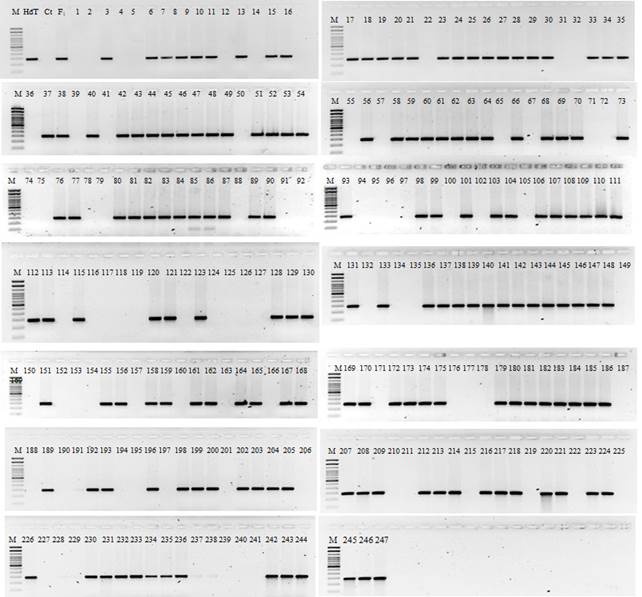
The CaRHv10-AS primer was effective for amplification of only the genitor HdT resistant parent to CLR and F1 H-511-1 heterozygous rust-resistant to CLR DNA samples. An amplification fragment of 282 bp was observed (Figure 2). Conversely, no PCR amplification product was detected in DNA samples from the susceptible parent UFV 2148-57 (Figure 2). Furthermore, Pestana et al. (2015) and Almeida et al. (2021a) identified markers associated with the locus/QTL of resistance to race I, II, and pathotype 001 of H. vastatrix belonging to the HdT UFV 443-03. A SCAR marker (CaRHv10) was developed to monitor these identified locus/QTL. However, the CaRHv10 marker showed no polymorphism between the resistant and susceptible parents when the fragments were analyzed on an agarose gel. They were also tested on a polyacrylamide gel, which offers higher resolution, but they remained monomorphic. Thus, the CaRHv10 marker was converted to a CAPS marker (CaRHv10-CAPS).
The AS-PCR technique was employed by Ariyoshi et al. (2022) to develop a marker associated with coffee resistance to bacterial halo blight (BHB), a bacterial disease caused by Pseudomonas syringae pv. garcae. In their work, the reverse primer was designed for a complementary genomic region common between resistant and susceptible genotypes, without any mismatches. In contrast, in this work, both the forward and reverse primers were designed for a complementary genomic region common between resistant and susceptible genotypes, with mismatches to enhance specificity (Figure 1). The figure illustrates that when the primer is not designed in the mismatch region, as with CaRHv10, it is not possible to identify resistant and susceptible genotypes in agarose gel analysis.
The new marker CaRHv10-AS was integrated in the genetic map at 0.8 cM from the CaRHv10-CAPS marker and was associated with the same locus/QTLs that conferred coffee plants resistance to the three H. vastatrix races, as reported in previous work by Pestana et al. (2015) and Almeida et al. (2021a) (Figure 3A). The CaRHv10-AS marker flanks the locus/QTL of the LG5 along with the CaRHv9 marker, which was previously developed by Almeida et al. (2021a). In MAS, a combination of two or more markers flanking the loci of interest can facilitate the monitoring of possible recombination events and enhance selection accuracy in populations segregating for resistance (Alkimim et al. 2017).


A. Linkage map. LG5 = Linkage Group 5 of the C. arabica genetic map, containing the markers CaRHv10-CAPS, and its derived marker CaRHv10-AS (red). The names of the molecular markers are indicated to the right of the bar, and the distances in cM are shown to the left of the bar. B. CaRHv10-AS and inoculation of three races analyses used in each population are indicated. HdT = resistant parent, Híbrido de Timor UFV 443-03 and presence of band corresponding to the CaRHv10-AS; Ct = susceptible parent, Catuaí Amarelo IAC 64 (UFV 2148-57) and absence of band corresponding to the CaRHv10-AS; resistant F1 = first generation of self-pollination and presence of band corresponding to the CaRHv10-AS; susceptible individual 01 from the F2 population and absence of band corresponding to the CaRHv10-AS; resistant individual 03 from the F2 population and presence of band corresponding to the CaRHv10-AS.
In a previous work by Pestana et al. (2015), an F2 population was inoculated with race I, II and pathotype 001 of H. vastatrix. For all the three isolates of H. vastatrix, the expected phenotypic segregation ratios were confirmed using χ 2 test (p> 0.05): 15:1 (indicating two dominant independent loci) and 61:3 (indicating two dominant loci and one recessive independent locus) for the F2 populations. This work established that none of the locus/QTL identified in the linkage map were recessive, showing that no recessive gene contributes to the resistance of HdT UFV 443-03. This result rejects the hypothesis suggesting that the inheritance resistance involves the three loci (two dominant and one recessive). By the combination of phenotypic and genotypic data, it was concluded that at least two dominant and independent loci control the resistance of HdT UFV 443-03, as confirmed by Almeida et al. (2021a), Gonzales et al. (2023) and Saavedra et al. (2023) in MAS.
Furthermore, in this work, CaRHv10-AS demonstrated high efficiency in selecting resistant plants, with a selection efficiency excluding false positives (SEFP) greater than 97% across all three isolates of H. vastatrix (Table 2). Specifically, 97% of genotypes that showed the allele amplified by CaRHv10-AS were resistant when inoculated with urediniospores of races I, II, and pathotype 001. The most common and widespread H. vastatrix race globally is race II (Talhinhas et al. 2017, Zambolim and Caixeta 2021). According to our data, the SEFP of CaRHv10-AS for race II is 99.17%, highlighting the importance of using this marker for selection and traceability of resistant coffee plants. CaRHv10-AS showed SEFP of 97.49% for race I and pathotype 001 (Table 2). Race I was first described in C. canephora in Brazil (Capucho et al. 2013) and has now spread in C. arabica fields. Pathotype 001 is known for overcoming the resistance of major cultivars planted worldwide, including those from the Catimor and Sachimor groups, initially released as rust-resistant cultivars. It also overcomes the resistance of another important coffee group, Icatu Vermelho (C. arabica×C. canephora) (Capucho et al. 2009). Therefore, employing molecular markers associated with multiple pathogen races is crucial to preventing resistance breakdown. Due to the high variability of the pathogen, new races capable of overcoming resistance have emerged (Talhinhas et al. 2017). Recently, the presence of this pathogen has been detected in coffee-growing regions previously free of the disease, such as China, Hawaii, and Saudi Arabia (Li et al. 2021, Ramírez-Camejo et al. 2022, Alhudaib and Ismail 2024). Thus, obtaining cultivars with durable resistance remains a challenge for coffee breeders.
Significant advances in genomic tools include the genome sequencing of C. arabica (NCBI-https://www.ncbi.nlm.nih.gov/) and C. canephora (COFFEE GENOME HUB-http://coffee-genome.org/), which support modern breeding techniques such as genome-wide association studies (GWAS) and genomic selection (GS) for identifying SNP markers associated with biotic stress (Nonato et al. 2021). However, the use of SNP markers in MAS has limitations due to the time-consuming and high-cost nature of genotyping methodologies. Therefore, the availability of PCR molecular markers, easy to use and accessible, is critical for the rapid advancement of coffee breeding programs.
Molecular markers can reliably distinguish between resistance genes with diverse specificities and effectively control their transfer during crossing and selection. This substantially enhances the efficiency of introgression in breeding programs targeting the most significant diseases of coffee. Previous works have established the great importance of utilizing markers associated with different loci associated with coffee resistance to other races of H. vastatrix, and to other diseases(Alkimim et al. 2017, Almeida et al. 2021a, Almeida et al. 2021b, Saavedra et al. 2023, Silva et al. 2023). This newly developed marker offers several advantages, including cost and time savings, as it eliminates the need for restriction enzymes and polyacrylamide gel, previously required by the CaRHv10-CAPS marker. Additionally, the polyacrylamide gel is time consuming and laborious, which makes it difficult to use this marker in genetic breeding programs. Moreover, this marker offers a user-friendly solution for MAS enabling the pyramiding of multiple resistance loci with diverse spectra of resistance against single or multiple pathogens within the same genetic background.
CONCLUSION
The molecular marker developed and validated in this work proved effective for selecting CLR-resistant genotypes. Incorporating this new marker, along with previously published ones, within coffee breeding programs will enhance selection accuracy and streamline the breeding process. The insights gained and the methodology established in this study are invaluable for effective breeding, introducing a novel approach for generating molecular markers targeting specific SNPs through the AS-PCR technique with adjustments. This approach facilitates the development and traceability of cultivars with multiple resistance and can be used in gene pyramiding with others resistance genes, contributing to sustainable coffee production and providing socioeconomic benefits to the global coffee market.
ACKNOWLEDGMENTS
We greatly appreciate the funding support received from the Brazilian Coffee Research and Development Consortium (Consórcio Pesquisa Café, CBP&D/Café), the Minas Gerais State Research Support Foundation (FAPEMIG), the National Council for Scientific and Technological Development (CNPq), the National Institutes of Science and Technology of Coffee (INCT/Café), Coordination for the Improvement of Higher Education Personnel (CAPES).
Data Availability
The datasets generated and/or analyzed during the current research are available from the corresponding author upon reasonable request.
REFERENCES
- Alhudaib K, Ismail AM2024 First occurrence of coffee leaf rust caused by Hemileia vastatrix on coffee in Saudi Arabia. Microbiology Research 15:164-173
- Alkimim ER, Caixeta ET, Sousa TV, Pereira AA, Oliveira ACB, Zambolim L, Sakiyama NS2017 Marker-assisted selection provides arabica coffee with genes from other Coffea species targeting on multiple resistance to rust and coffee berry disease. Molecular Breeding 37:6
- Almeida DP, Caixeta ET, Moreira KF, Oliveira ACB, Pestana KN, Pereira AA, Rosado RDS, Zambolim L, Cruz CD2021a Marker-assisted pyramiding of multiple disease resistance genes in coffee genotypes (Coffea arabica). Agronomy 11:1763
- Almeida DP, Castro ISL, Mendes TAO, Alves DR, Barka GD, Barreiros PRRM, Zambolim L, Sakiyama NS, Caixeta ET2021b Receptor-Like Kinase (RLK) as a candidate gene conferring resistance to Hemileia vastatrix in coffee. Scientia Agricola 78.
- Alzate-Marin AL, Cervigni GDL, Moreira MA, Barros EG2005 Seleção assistida por marcadores moleculares visando ao desenvolvimento de plantas resistentes a doenças, com ênfase em feijoeiro e soja. Fitopatologia Brasileira 30:333-342
- Ariyoshi C, Sera GH, Rodrigues LMR, Carvalho FG, Shigueoka LH, Mendonça AES, Pereira CTM, Destéfano SAL, Pereira LFP2022 Development and validation of an allele-specific marker for resistance to bacterial halo blight in Coffea arabica. Agronomy 12:3178
- Barka GD, Caixeta ET, Ferreira SS, Zambolim L2020 In silico guided structural and functional analysis of genes with potential involvement in resistance to coffee leaf rust: A functional marker based approach. PloS ONE 15:7
- Bettencourt AJ, Rodrigues Junior, Clarke CJ, Macrae RJR1988 Principles and practice of coffee breeding for resistance to rust and other diseases. In Clarke RJ and Macrae R (eds) Coffee agronomy. Elsevier, London and New York, p. 199-234
- Bui M, Liu Z2009 Simple allele-discriminating PCR for cost-effective and rapid genotyping and mapping. Plant Methods 5:1
- Capucho AS, Caixeta ET, Maciel-Zambolim E, Zambolim L2009 Herança da resistência do Híbrido de Timor UFV 443-03 à ferrugem-do-cafeeiro. Pesquisa Agropecuária Brasileira 44:276-282
- Capucho AS, Zambolim L, Cabral PGC, Maciel-Zambolim E, Caixeta ET2013 Climate favourability to leaf rust in conilon coffee. Australas. Plant Pathology 42:511-514
- Choudhury A, Deb S, Kharbyngar B, Rajpal VR, Rao SR2022 Dissecting the plant genome: through new generation molecular markers. Genetic Resources and Crop Evolution 69:2661-2698
- Cruz CD2016 Genes software - extended and integrated with the R, Matlab and Selegen. Acta Scientiarum Agronomy 38:547-552
- Diniz LEC, Sakiyama NS, Lashermes P, Caixeta ET, Oliveira ACB, Zambolim EM, Loureiro ME, Pereira AA, Zambolim L2005 Analysis of AFLP markers associated to the Mex-1 resistance locus in Icatu progenies. Crop Breeding and Applied Biotechnology 5:387-393
- Gonzales RV, Zambolim L, Almeida DP, Caixeta ET, Rosado RD, Verdin-Filho AC2023 Prospects for achieving multiple disease resistance with Coffea canephora clones. Australasian Plant Pathology 52:451-462
- Hasan N, Choudhary S, Naaz N, Sharma N, Laskar RA2021 Recent advancements in molecular marker-assisted selection and applications in plant breeding programmes. Journal of Genetic Engineering and Biotechnology 19:128
- Kahn LH2019 Quantitative framework for coffee leaf rust (Hemileia vastatrix), production and futures. Journal of Agricultural Extension 7:77-87
- Koutouleas A, Collinge DB, Ræbild A2023 Alternative plant protection strategies for tomorrow’s coffee. Plant Pathology 72:409-429
- Lander ES, Botstein D1989 Mapping mendelian factors underlying quantitative traits using RFLP linkage maps. Genetics 121:185-199
- Li L, Várzea VMP, Xia Q, Xiang W, Tang T, Zhu M, He C, Pereira AP, Silva MCML, Wu W, Yi K2021 First report of Hemileia vastatrix (Coffee leaf rust) physiological races emergent in coffee germplasm collections in the coffee-cropping regions of China. Plant Disease 105:4162
- Matuszczak M, Spasibionek S, Gacek K, Bartkowiak-Broda I2020 Cleaved amplified polymorphic sequences (CAPS) marker for identification of two mutant alleles of the rapeseed BnaA.FAD2 gene. Molecular Biology Reports 47:7607-7621
- Nonato JVA, Carvalho HF, Borges KLR, Padilha L, Maluf MP, Fritsche-Neto R, Guerreiro Filho O2021 Association mapping reveals genomic regions associated with bienniality and resistance to biotic stresses in arabica coffee. Euphytica 217:190
- Owczarzy R, Tataurov AV, Wu Y, Manthey JA, McQuisten KA, Almabrazi HG, Pedersen KF, Lin Y, Garretson J, McEntaggart NO, Sailor CA, Dawson RB, Peek AS2008 IDT SciTools: a suite for analysis and design of nucleic acid oligomers. Nucleic Acids Research 36:163-169
- Pestana KN, Capucho AS, Caixeta ET, Almeida DP, Zambolim EM, Cruz CD, Zambolim L, Pereira AA, Oliveira ACB, Sakiyama NS2015 Inheritance study and linkage mapping of resistance loci to Hemileia vastatrix in Híbrido de Timor UFV 443-03. Tree Genetic Genomes 11:72
- Ramírez-Camejo LA, Keith LM, Matsumoto T, Sugiyama L, Fukada M, Brann M, Moffitt A, Liu J, Aime MC2022 Coffee leaf rust (Hemileia vastatrix) from the recent invasion into Hawaii shares a genotypic relationship with Latin American populations. Journal of Fungi 8:189
- Saavedra LM, Caixeta ET, Barka GD, Borém A, Zambolim L, Nascimento M, Cruz CD, Oliveira ACB, Pereira AA2023 Marker-assisted recurrent selection for pyramiding leaf rust and coffee berry disease resistance alleles in Coffea arabica L. Genes (Basel) 14:189
- Setotaw TA, Caixeta ET, Zambolim EM, Sousa TV, Pereira AA, Oliveira ACB, Cruz CD, Zambolim L, Sakiyama NS2020 Genome introgression of híbrido de Timor and its potential to develop high cup quality C. arabica cultivars. The Journal of Agricultural Science 12:64
- Silva AG, Ariyoshi C, Shigueoka LH, Pereira Pereira, LFP LFP, Sera GH2023 Assisted selection using molecular markers linked to rust resistance SH3 gene in Coffea arabica. Crop Breeding and Applied Biotechnology 23:e445323413
- Talhinhas P, Batista D, Diniz I, Vieira A, Silva DN, Loureiro A, Tavares S, Pereira AP, Azinheira HG, Guerra‐Guimarães L, Várzea V, Silva MC2017 The coffee leaf rust pathogen Hemileia vastatrix: one and a half centuries around the tropics. Molecular Plant Pathology 18:1039-1051
- Thiel T2004 SNP2CAPS: a SNP and INDEL analysis tool for CAPS marker development. Nucleic Acids Research 32:5
- Ugozzoli L, Wallace R1991 Allele-specific polymerase chain reaction. Methods 2:42-48
- Van der Vossen H, Bertrand B, Charrier A2015 Next generation variety development for sustainable production of arabica coffee (Coffea arabica L.): a review. Euphytica 204:243-256
- Voorrips RE2002 MapChart: software for the graphical presentation of linkage maps and QTLs. Journal of Heredity 93:77-78
- Wangkumhang P, Chaichoompu K, Ngamphiw C, Ruangrit U, Chanprasert J, Assawamakin A, Tongsima S2007 WASP: a web-based allele-specific PCR assay designing tool for detecting SNPs and mutations. BMC Genomics 8:275
- Yang HB, Kang WH, Nahm SH, Kang BC2015 Methods for developing molecular markers. In Koh HJ, Kwon SY and Thomson M (eds) Current technologies in plant molecular breeding. Springer, Dordrecht, p. 15-50
- Ye J, Coulouris G, Zaretskaya I, Cutcutache I, Rozen S, Madden TL2012 Primer-BLAST: A tool to design target-specific primers for polymerase chain reaction. BMC Bioinformatics 13:134
- Zambolim L2016 Current status and management of coffee leaf rust in Brazil. Tropical Plant Pathology 41:1-8
- Zambolim L, Caixeta ET2021 An overview of physiological specialization of coffee leaf rust: new designation of pathotypes. International Journal of Current Research 13:15564-15575