 UENF Red: Agronomic potential and advantages of the new guava cultivar
Abstract
The UENF Red guava cultivar was developed for the climate of northern Rio de Janeiro. Selected from 17 full-sib families, it showed superior yield and fruit quality compared to Paluma. Distinct morphological traits highlight its potential as a productive, high-quality alternative for regional guava cultivation.
Keywords:
Productivity; yield; regional agriculture
INTRODUCTION
Guava (Psidium guajava L.) is a tropical fruit tree native to the Americas and widely cultivated in tropical and subtropical regions. In Brazil, it has great economic importance, being consumed fresh or processed into various products. The country is one of the world’s main producers, with major cultivation in São Paulo, Pernambuco, and Bahia (IBGE 2019).
Currently, 14 cultivars are registered in Brazil (MAPA 2024), such as ‘Paluma’, ‘Pedro Sato’, and ‘Cortibel’, which differ in fruit quality, pulp color, and disease resistance. Breeding programs focus on improving yield, fruit quality, and tolerance to biotic and abiotic stresses, combining traditional methods with molecular tools (Pommer et al. 2013).
Despite the cultivars already available on the market, none of them are suitable for the northern region of Rio de Janeiro, which has a strong culture of producing guava, which is sold mainly in the form of guava jam. The development of cultivars adapted to the region is crucial for the sustainable and competitive production of guava. This study focuses on the northern and northwestern regions of Rio de Janeiro, aiming to support local genetic improvement efforts and benefit producers.
CULTIVAR DEVELOPMENT
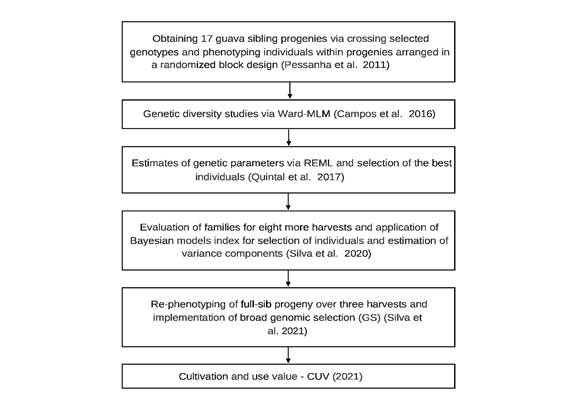
The guava breeding program at the State University of Northern Rio de Janeiro (UENF) began in 2008 to meet the needs of local producers and take advantage of the region’s agricultural potential. In the initial phase, Pessanha et al. (2011) evaluated 20 Psidium guajava accessions from open-pollinated orchards in São João da Barra and Bom Jesus do Itabapoana, RJ. Using cytogenetic and RAPD analyses, superior genotypes were identified for hybridization, leading to crosses among nine selected individuals (Table 1), which generated 17 full-sib families. These families were evaluated from 2011 to 2016 in Campos dos Goytacazes (lat 21° 43' 15.5" S, long 41° 20' 38.3" W), in northwestern Rio de Janeiro (Oliveira et al. 2014, Paiva et al. 2016, Campos et al. 2016, Quintal et al. 2017, Silva et al. 2020, Silva et al. 2021). Figure 1 shows a schematic of the UENF guava breeding program.
Characteristics of the selected guava accessions for crosses carried out at Sítio Providência, Bom Jesus do Itabapoana, RJ, Brazil
The UENF Red cultivar, derived from this program, also served as a base for developing new guava lines with nematode resistance genes and other desirable traits (Ribeiro et al. 2019, Maitan et al. 2023, Souza et al. 2020, Santos et al. 2020, Krause et al. 2021, Ambrósio et al. 2021, Almeida et al. 2023).
The experiments followed a randomized block design with two replicates and 24 individuals per family (12 per block), totaling 408 plants. Standard management practices were applied for weed, pest, and disease control, and drip irrigation was used during dry periods.
Selection of superior individuals was based on fruit traits using the Best Linear Unbiased Prediction (BLUP) method, focusing mainly on the number of fruits and yield. The nine best genotypes were cloned and evaluated in the Value for Cultivation and Use (VCU) test in Campos dos Goytacazes, using ‘Paluma’ as a control cultivar.
VCU
The experiment was conducted in the experimental area of the Guava Genetic Improvement Program at UENF, located at the Antônio Sarlo Technical and Agricultural School, in Campos dos Goytacazes, Rio de Janeiro, Brazil (coordinates: lat 21° 44' S, long 41° 33' W, alt 11.2 m asl). The experimental design used was randomized blocks. The treatments consisted of seven individuals selected in the second selection cycle of the program, plus the commercial cultivar 'Paluma' as a control. The experiment had seven replications and three plants per plot, totaling 168 plants. The spacing adopted was 2 x 4 meters.
Orchard management followed the recommended practices for the crop: irrigation was carried out by drip irrigation and fertilization was carried out according to the nutritional needs of the plants. Phenotypic evaluations began two years after planting, covering the 2021, 2022, and 2023 growing seasons, with data collected at the individual plant level.
Cultivar traits
The UENF Red cultivar was evaluated according to the agronomic and morphological descriptors proposed by the National Plant Variety Protection Service (SNPC/MAPA). The characterization included plant architecture, leaf and branch morphology, flower and fruit structure, and seed and maturation traits.
Fruit traits such as size, shape, peel and pulp color, juiciness, sweetness, acidity, and number of seeds were also measured. For each trait, data were obtained from the average of five fruits per plant (Table 2).
These descriptors are essential for identifying and differentiating cultivars, providing a detailed profile of UENF Red. This information supports proper management, facilitates cultivar registration, and contributes to the development of new varieties with desirable agronomic characteristics.
Performance
The UENF Red cultivar outperformed the Paluma cultivar in the three main traits (Table 3). In the first harvest, UENF Red produced an average of 14 fruits per plant, compared to 11 by the Paluma cultivar. This increase was directly reflected in the production per plant, where UENF Red achieved an average production of 3,777.78 g per plant, in contrast to 2,127.32 g per plant for ‘Paluma’. The average weight of the fruits was also slightly higher in UENF Red, equal to 300.04 g, compared to 292.02 g for ‘Paluma’ (Table 4).
Mean values of number of fruits, production per plant (g) and fruit weight (g) of the UENF Red cultivar and a commercial control, in the first two harvests in the state of Rio de Janeiro, Brazil
In the second harvest, both cultivars showed a significant increase in the number of fruits, with UENF Red maintaining its superiority. This indicates that UENF Red has superior agronomic performance compared to the commercial cultivar Paluma in terms of the number of fruits, production per plant, and fruit weight. This consistent performance across two harvests suggests that UENF Red is a promising option for producers in the Rio de Janeiro state region, offering greater productivity and yield potential.
Other traits
The following table presents the morphological descriptors of flowers and fruits of the UENF Red cultivar, offering a comprehensive overview of the important phenotypic traits specific to this cultivar (Table 5).
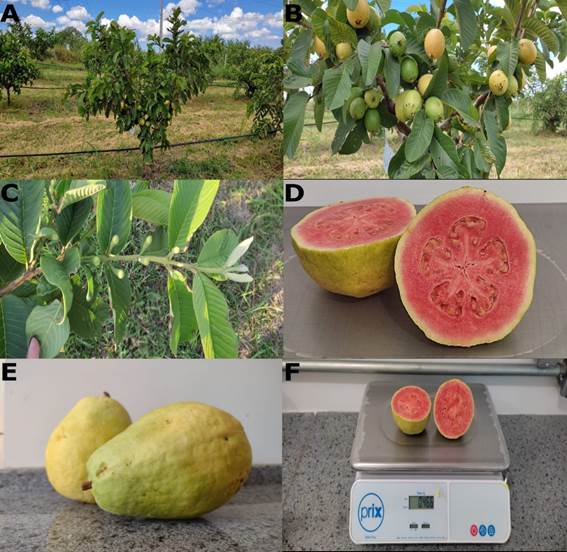
Figure 2 displays various characteristics of the cultivar, as the distinctive morphological traits, and illustrate the seasonal variations. This photo board is essential for understanding the diversity and adaptations of the species in their natural habitat.
Different characteristics of the cultivar as a plant, fruit, and flowering. A - Vegetative structure; B - Fruit formation; C - Flower bud; D - Fruit pulp color; E - Fruit shape; F - Fruit weight.
The morphological descriptors listed for the flowers and fruits of the UENF Red cultivar reveal characteristics that are advantageous for cultivation and commercial sale. The combination of high juiciness, balanced acidity and sweetness, along with pulp that maintains a stable color, makes this cultivar an appealing option for producers.
ACKNOWLEDGEMENTS
To FAPERJ (Carlos Chagas Filho Foundation for Research Support of the State of Rio de Janeiro) and CAPES (Coordination for the Improvement of Higher Education Personnel) for the financial support that made this study possible.
Data Availability Statement
The datasets generated and/or analyzed during the current research are available from the corresponding author upon reasonable request.
REFERENCES
- Almeida OF, Viana AP, Gomes VM, Souza RM, Santos PR, Amaral AT, Rodrigues DL2023 Cross preferences and genetic diversity of Psidium interspecific hybrids through morphoagronomic traits and resistance to Meloidogyne enterolobiiAnais da Academia Brasileira de Ciências 95:1-12
- Ambrósio M, Viana AP, Ribeiro RM, Preisigke SC, Cavalcante NR, Silva FA, Torres GX, Sousa CMB2021 Genotypic superiority of Psidium Guajava S1 families using mixed modeling for truncated and simultaneous selectionScientia Agricola 78:1-8
- Campos BM, Viana AP, Quintal SSR, Barbosa CD, Daher RF2016 Heterotic group formation in Psidium guajava L. by artificial neural network and discriminant analysisRevista Brasileira de Fruticultura 38:151-157
-
IBGE - Instituto Brasileiro de Geografia e Estatística2019 Tabela 5457 - Área plantada ou destinada à colheita, área colhida, quantidade produzida, rendimento médio e valor da produção das lavouras temporárias e permanentes. Available at <Available at https://sidra.ibge.gov.br/tabela/5457#resultado >. Accessed on July 30, 2024.
» https://sidra.ibge.gov.br/tabela/5457#resultado - Krause W, Ramos CN, Viana AP, Ambrósio M, Azevedo SE, Duarte VH2021 Genetic variability in inbred guava families mediated by agronomic traitsFunctional Plant Breeding Journal 3:61-71
- Maitan MQ, Viana AP, Vieira HD, Santos EA, Silva FWA2023 Selection and genetic dissimilarity in S2 families of guava through seed attributesRevista Ceres 70:73-81
-
MAPA - Ministério da Agricultura Pecuária e Abastecimento2024 CultivarWeb. Available at <Available at https://sistemas.agricultura.gov.br/snpc/cultivarweb/cultivares_registradas.php >. Accessed on July 30, 2024.
» https://sistemas.agricultura.gov.br/snpc/cultivarweb/cultivares_registradas.php - Oliveira NNS, Viana AP, Quintal SSR, Paiva CL, Marinho CS2014 Análise de distância genética entre acessos do gênero Psidium via marcadores ISSRRevista Brasileira de Fruticultura 36:917-923
- Paiva CL, Viana AP, Santos EA, Freitas JCO, Amaral Júnior AT2016 Genetic gain estimated by different selection criteria in guava progeniesBragantia 75:418-427
- Pessanha PGDO, Viana AP, Amaral Júnior, AT AT, Souza RM, Teixeira MC, Pereira MG2011 Avaliação da diversidade genética em acessos de Psidium spp. via marcadores RAPDRevista Brasileira de Fruticultura 33:129-136
- Pommer CV, Oliveira OF, Santos CAF2013 Goiaba: recursos genéticos e melhoramento. Edufersa, Mossoró, 126p.
- Quintal SSR, Viana AP, Campos BM, Vivas M, Amaral Júnior AT2017 Selection via mixed models in segregating guava families based on yield and quality traitsRevista Brasileira de Fruticultura 39:1-8
- Ribeiro RM, Martins GV, Viana PA, Souza RM, Santos PR2019 Selection of interspecific Psidium spp. hybrids resistant to Meloidogyne enterolobiiActa Scientiarum-Agronomy 41:e42702
- Santos RM, Viana AP, Santos EA, Souza RM, Almeida OF, Gomes VM, Rodrigues DL, Santos PR2020 Genetic structuring of segregating populations of Psidium spp. resistant to the southern root-knot nematode by Bayesian approach as basis for the guava breeding programAnais da Academia Brasileira de Ciências (Online) 92:1-18
- Silva FA, Viana AP, Corrêa CCG, Carvalho BM, Sousa CMB, Amaral BD, Ambrósio M, Glória LS2020 Impact of bayesian inference on the selection of Psidium guajavaScientific Reports 10:1999-2008
- Silva FA, Viana AP, Correa CCG, Santos EA, Oliveira JAVS, Andrade JDG, Ribeiro RM, Glória LS2021 Bayesian ridge regression shows the best fit for SSR markers in Psidium guajava among Bayesian modelsScientific Reports 11:13639-13650
- Souza CMB, Ribeiro RM, Viana AP, Cavalcante NR, Silva FA, Ambrósio M, Amaral Jr. AT2020 Guava breeding via full-sib family selection: conducting selection cycle and divergence between parents and familiesCrop Breeding and Applied Biotechnology 20:1-9
Edited by
-
SCIENTIFIC EDITOR:
Luiz Antônio dos Santos Dias