Optimal nutritional support is key to liberation from mechanical ventilation
ABSTRACT
Liberation from mechanical ventilation is a physiologically demanding phase of critical illness that requires coordinated recovery of respiratory muscle function, metabolic stability, and systemic resilience. Nutritional therapy plays a central role in supporting this transition. However, early aggressive caloric and protein delivery has not improved outcomes and may be detrimental. Current evidence supports a phase-adapted, individualized approach: permissive underfeeding during acute inflammation, moderate protein provision, monitoring of metabolic tolerance, and targeted correction of micronutrient deficiencies. Future research should incorporate time to successful weaning as a clinically meaningful endpoint when evaluating nutritional interventions in the intensive care unit.
Keywords:
Respiration, artificial; Ventilator weaning; Critical illness; Respiratory muscles; Nutrients; Metabolic tolerance; Diaphragm dysfunction; Nutritional support; Energy metabolism; Vitamin D
INTRODUCTION
Liberation from mechanical ventilation is not simply a respiratory decision but also a metabolic test. It represents a complex metabolic and functional turning point in critical illness. Transitioning from controlled ventilation to spontaneous breathing increases diaphragm workload, oxygen consumption, and systemic energy demand, while patients frequently exhibit muscle wasting, insulin resistance, and persistent inflammation.(1) Despite decades of research in intensive care unit (ICU) nutrition, the optimal strategy during weaning remains incompletely defined.(2) Importantly, the effectiveness of medical nutrition therapy is profoundly influenced by the underlying inflammatory and infectious burden. Ongoing systemic inflammation drives catabolism, accelerates muscle protein breakdown, and may blunt anabolic responses to nutrient delivery.(1) In this setting, nutritional support must be aligned with the evolving metabolic phase rather than guided by fixed targets.
Energy delivery: respecting the metabolic phase
During the acute phase of critical illness, endogenous glucose production persists despite exogenous feeding, and anabolic resistance predominates. Large randomized trials have shown that early full caloric feeding does not improve outcomes and may prolong ICU stay or mechanical ventilation. Permissive underfeeding (approximately 12 - 25kcal/kg/day) during this phase appears safe and appropriate.(2–4)
As inflammation decreases and metabolic stability improves, energy requirements increase. During recovery and weaning, caloric provision should progressively approach resting energy expenditure (REE). Indirect calorimetry remains the most accurate method for estimating REE, particularly in patients with prolonged ICU stays or difficult weaning. However, targeting full measured REE too early has not shortened ventilation duration.(5,6)
A gradual, phase-adapted escalation of energy delivery appears more consistent with current evidence than rapid achievement of calculated targets.(5)
Protein provision: moderation over enthusiasm
Skeletal and respiratory muscle wasting begins early in critical illness. Although increasing protein intake seems intuitively protective, recent high-quality trials (EFFORT-Protein, PRECISe, EAT-ICU) have not demonstrated benefit from high protein delivery (≥ 2.0 - 2.2g/kg/day), and possible harm has been reported in selected subgroups.(7–9) A recent meta-analysis suggested a potential association between higher protein intake and increased mortality.(10) These data support a moderate strategy:
-
–
Acute phase: 0.8 - 1.2g/kg/day
-
–
Recovery/weaning phase: cautious increase based on tolerance and clinical evolution
Muscle preservation alone does not guarantee successful weaning. Diaphragm function, neuromuscular coordination, sedation exposure, and early mobilization are equally relevant determinants. Protein should therefore be integrated into a broader recovery framework rather than considered a single therapeutic lever (Table 1).
Metabolic tolerance and the risk of overfeeding
Metabolic tolerance is central during the weaning phase. In acute illness, insulin resistance is common, and endogenous glucose production is incompletely suppressed. Excess caloric intake, particularly carbohydrates, may increase carbon dioxide production, potentially adding ventilatory burden in patients with limited respiratory reserve, particularly in conditions such as chronic obstructive pulmonary disease (COPD).(1)
Insulin requirements provide a pragmatic surrogate marker of metabolic tolerance. Persistently elevated insulin needs may indicate that nutrient delivery exceeds metabolic capacity and should prompt reassessment of caloric targets.
Circulating visceral proteins such as albumin, prealbumin, transferrin, and retinol-binding protein are strongly influenced by inflammation, capillary leakage, and hepatic reprioritization during the acute-phase response.(1) Their concentrations correlate poorly with protein intake or short-term anabolic response and should not be used to titrate nutritional therapy during weaning. Even nitrogen balance calculations and insulin-like growth factor (IGF-1) levels provide limited insight in the presence of ongoing catabolism and systemic inflammation.
High-fat, low-carbohydrate regimens have been proposed to reduce carbon dioxide (CO2) production, but randomized studies have shown limited impact on clinically meaningful weaning outcomes.(1) Nutritional prescriptions should therefore remain dynamic and responsive to metabolic signals rather than anchored to fixed formulas.(1)
Respiratory muscle function and nutritional integration
Diaphragm dysfunction is a major contributor to weaning failure. Mechanical ventilation, systemic inflammation, corticosteroid exposure, and malnutrition accelerate respiratory muscle atrophy.(11) Bedside diaphragm ultrasound enables assessment of diaphragm thickness and thickening fraction, with thresholds around 30 - 35% associated with higher likelihood of successful weaning.(12) In addition to ultrasound assessment, maximal inspiratory pressure (MIP) can be used as a bedside measure of inspiratory muscle strength and may be particularly useful to monitor changes over time, especially when inspiratory muscle training is implemented.(11) Although not sufficient as a standalone predictor, serial assessment may identify progressive dysfunction and guide integration of nutritional reassessment with rehabilitation strategies.
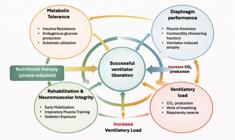
Nutritional therapy alone cannot reverse diaphragm dysfunction. However, inadequate intake may exacerbate muscle wasting, whereas appropriately timed and individualized support, combined with early mobilization and inspiratory muscle training, may contribute to functional recovery. The interaction between metabolic tolerance, diaphragm performance, ventilatory load, and rehabilitation intensity is summarized in figure 1.
Vitamin D and micronutrients
Vitamin D deficiency is highly prevalent in critically ill patients and associated with muscle weakness and immune dysregulation.(13) Nevertheless, large randomized trials such as VITdAL-ICU and VIOLET did not demonstrate a mortality benefit from high-dose supplementation.(14,15) A balanced approach is warranted: assess vitamin D status, correct confirmed deficiency, and avoid indiscriminate high-dose administration. Other supplements, including creatine, branched-chain amino acids, and β-hydroxy-β-methylbutyrate, remain investigational and cannot currently be recommended in routine practice. Correction of electrolyte disturbances is also essential during weaning, particularly hypophosphatemia, which may impair diaphragmatic contractility and reduce respiratory muscle performance.(1)
Integration with rehabilitation and future perspectives
Liberation from mechanical ventilation is fundamentally a functional milestone. Nutritional therapy should therefore be integrated with early mobilization, inspiratory muscle training, and structured rehabilitation.(2) Future approaches should move beyond fixed caloric and protein targets and incorporate metabolic phenotyping, including inflammatory burden, insulin resistance, and anabolic responsiveness. Despite the recognized importance of nutrition, no randomized trial has specifically evaluated nutritional strategies with time to successful weaning as a primary endpoint. Such trials are needed to clarify the true clinical impact of nutritional therapy during this critical transition. The potential role of anabolic or anti-catabolic agents (e.g., selective androgen receptor modulators, β-hydroxy-β-methylbutyrate, or other pharmacologic strategies targeting muscle preservation) remains an area of active investigation. However, current evidence is insufficient to support their routine use in critically ill patients undergoing ventilator weaning.
CONCLUSION
Optimal nutritional support is an essential component of liberation from mechanical ventilation. Current evidence favors a conservative, individualized strategy: permissive underfeeding during acute inflammation, moderate protein provision, close monitoring of metabolic tolerance, and correction of confirmed micronutrient deficiencies.
Nutritional therapy should not be viewed as an adjunctive afterthought, but as a physiologically integrated element of the weaning strategy. When aligned with the metabolic phase and combined with rehabilitation, it may become a decisive factor in successful liberation from mechanical ventilation.
Nutrition does not replace resolution of the underlying disease, but it may determine whether recovery is physiologically sustainable.
-
This article is part of a series of viewpoints/reviews of the 45th International Symposium on Intensive Care and Emergency Medicine (ISICEM). Brussels, Belgium on March 17-20, 2026.
-
Take-home message
Nutrition during ventilator weaning should be individualized and guided by metabolic phase, not fixed caloric or protein targets. Appropriately timed nutritional support may contribute to sustainable physiological recovery and successful liberation from mechanical ventilation.
-
Publisher's note
AVAILABILITY OF DATA AND MATERIALS
Data cannot be made publicly available. This article is a mini-review and does not contain original research data, datasets, or software codes.
REFERENCES
- 1 Singer P, Blaser AR, Berger MM, Calder PC, Casaer M, Hiesmayr M, et al. ESPEN practical and partially revised guideline: clinical nutrition in the intensive care unit. Clin Nutr. 2023;42(9):1671-89.
- 2 De Rosa S, Rauseo M, Umbrello M, Lassola S, Battaglini D. Potential benefits of medical nutrition therapy for timely ventilator weaning in the critically ill. Anesthesiology 2025;143(3):737-49.
- 3 Reignier J, Plantefeve G, Mira JP, Argaud L, Asfar P, Aissaoui N, et al.; NUTRIREA-3 Trial Investigators; Clinical Research in Intensive Care; Sepsis (CRICS-TRIGGERSEP)Group. Low versus standard calorie and protein feeding in ventilated adults with shock: a randomised, controlled, multicentre, open-label, parallel-group trial (NUTRIREA-3). Lancet Respir Med. 2023;11(7):602-12.
- 4 The National Heart, Lung, and Blood Institute Acute Respiratory Distress Syndrome (ARDS) Clinical Trials Network, Rice TW, Wheeler AP, Thompson BT, Steingrub J, Hite RD, Moss M, et al. Initial trophic vs full enteral feeding in patients with acute lung injury: the EDEN randomized trial. JAMA. 2012;307(8):795–803.
- 5 Casaer MP, Wilmer A, Hermans G, Wouters PJ, Mesotten D, Van den Berghe G. Role of disease and macronutrient dose in the randomized controlled EPaNIC trial: a post hoc analysis. Am J Respir Crit Care Med. 2013;187(3):247-55.
- 6 Watanabe S, Izumino H, Takatani Y, Tsutsumi R, Suzuki T, Tatsumi H, et al. Effects of energy delivery guided by indirect calorimetry in critically ill patients: a systematic review and meta-analysis. Nutrients. 2024;16(10):1452.
- 7 Heyland DK, Patel J, Compher C, Rice TW, Bear DE, Lee ZY, et al.; EFFORT Protein Trial team. The effect of higher protein dosing in critically ill patients with high nutritional risk (EFFORT Protein): an international, multicentre, pragmatic, registry-based randomised trial. Lancet. 2023;401(10376):568-76.
- 8 Bels JL, Ali Abdelhamid Y, van de Poll MC. Protein supplementation in critical illness: why, when and how? Curr Opin Clin Nutr Metab Care. 2023;26(2):146-53.
- 9 Allingstrup MJ, Kondrup J, Wiis J, Claudius C, Pedersen UG, Hein-Rasmussen R, et al. Early goal-directed nutrition in ICU patients (EAT-ICU): protocol for a randomised trial. Dan Med J. 2016;63(9):A5271.
- 10 Heuts S, Lee ZY, Lew CC, Bels JL, Gabrio A, Kawczynski MJ, et al. Higher versus lower protein delivery in critically ill patients: a systematic review and Bayesian meta-analysis. Crit Care Med. 2025;53(3):e645-55.
- 11 Goligher EC, Ferguson ND, Brochard LJ. Clinical challenges in mechanical ventilation. Lancet. 2016;387(10030):1856-66.
- 12 Parada-Gereda HM, Tibaduiza AL, Rico-Mendoza A, Molano-Franco D, Nieto VH, Arias-Ortiz WA, et al. Effectiveness of diaphragmatic ultrasound as a predictor of successful weaning from mechanical ventilation: a systematic review and meta-analysis. Crit Care. 2023;27(1):174.
- 13 Langlois PL, D’Aragon F, Manzanares W. Vitamin D in the ICU: more sun for critically ill adult patients? Nutrition. 2019;61:173-8.
- 14 Amrein K, Schnedl C, Holl A, Riedl R, Christopher KB, Pachler C, et al. Effect of high-dose vitamin D3 on hospital length of stay in critically ill patients with vitamin D deficiency: the VITdAL-ICU randomized clinical trial. JAMA. 2014;312(15):1520-30.
- 15 The National Heart, Lung, and Blood Institute PETAL Clinical Trials Network. Early high-dose vitamin D3 for critically ill, vitamin D–deficient patients. N Engl J Med. 2019;381(26):2529-40.
Edited by
-
Responsible editor:
Bruno Valle Pinheiro https://orcid.org/0000-0002-5288-3533