Sedative defined daily dose: suggestion for a new monitoring tool
Light sedation is considered good practice in the intensive care unit (ICU), as demonstrated across multiple clinical situations.(1) Accordingly, the use of the lowest effective dose of sedatives to maintain patient comfort while ensuring ease of arousal is recommended.(1,2) However, there is no specific recommendation for a single drug or drug class associated with superior clinical outcomes.(1,3) Consequently, comparing sedative consumption among patients across different units or within the same unit over time becomes challenging when preferences for specific sedative agents vary. The defined daily dose (DDD) methodology has appealing characteristics for this task, but it is widely used only in the context of antimicrobial stewardship and rarely for other drugs in the ICU.(4) For intravenous sedatives, only midazolam and dexmedetomidine have World Health Organization (WHO)-assigned DDD values, and these differ substantially from doses commonly used for continuous sedation in the ICU.(5) Accordingly, this potentially useful methodology is not applied as a widespread monitoring tool in sedation practice.
This study aimed to present a novel method to compare the overall use of sedatives across different ICUs, regardless of the individual drug choices.
Between January 1st and December 31, 2022, in a group of 40 ICUs from a private healthcare network comprising ten hospitals, we applied the DDD concept for sedatives in the ICU environment, based on the established definition of DDD and aligned with Society of Critical Care Medicine (SCCM) recommendations. In this way, we created an "adapted DDD" of sedatives in the ICU.
Briefly, the calculation of the number of adapted sedative DDDs is as follows (example in Table 1S - Supplementary Material).
Number of adapted sedative DDDs/1,000 mechanical ventilation (MV)-days = ((daily dose sedative 1/adapted DDD for sedative 1) + (daily dose sedative 2/adapted DDD for sedative 2) + … + (daily dose sedative n/adapted DDD for sedative n)/number of MV-days)) × 1,000.
To calculate the adapted DDD for each drug (Table 1), we used the midpoint of the range, i.e., the arithmetic mean between the lowest and highest values recommended for each drug in the scientific recommendation. We assumed an average weight of the patients based on a hypothetical patient's weight of 80kg.
Throughout the year 2022, using electronic dashboards, we monitored, along with the average Richmond Agitation-Sedation Scale (RASS) score per unit, the value of sedative DDD/1,000 MV-days. We promoted and encouraged best practices for rational sedative use and light sedation, notably: standardized drug dilution, RASS assessment every 4 hours, and discussion of individual sedation goals during multidisciplinary rounds. A target was established for each unit: "< 700 adapted sedative DDD/1,000 MV-days"
A total of 4,791 MV patients were included in the analysis, out of 31,940 ICU admissions. The MV rate was 15%, accounting for 25,041 MV-days. RASS scores and adapted sedative DDD/1,000 MV-days are presented in figure 1.
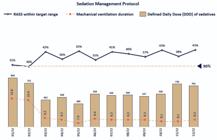
Number of adapted defined daily doses of sedatives per 1,000 mechanical ventilation-days and percentage of Richmond Agitation-Sedation Scale within the target range (Richmond Agitation-Sedation Scale zero to -2) over the 12 months of 2022 in a group of 40 intensive care units.
The tool has inherent limitations, especially the sensitivity to the chosen reference dose values (DDD). We used the midpoint of the range stated in the most important recommendation of the area, for external validity, but different methodologies could be discussed. Additionally, using a fixed patient weight limits its applicability to ICUs serving populations with markedly different average weights. This limitation can be easily addressed by keeping weight as a modifiable variable. Finally, the accuracy and reliability of this method should be further explored before its widespread adoption.
In conclusion, the adapted sedative DDD tool proved helpful in promoting communication and comparability among ICUs that preferentially use multiple and/or different sedative agents, including different regimens (intermittent or continuous infusion).
AVAILABILITY OF DATA AND MATERIALS
Data is available on demand from referees.
REFERENCES
- 1 Devlin JW, Skrobik Y, Gélinas C, Needham DM, Slooter AJ, Pandharipande PP, et al. Clinical practice guidelines for the prevention and management of pain, agitation/sedation, delirium, immobility, and sleep disruption in adult patients in the ICU. Crit Care Med. 2018;46(9):e825-73.
- 2 Barr J, Fraser GL, Puntillo K, Ely EW, Gélinas C, Dasta JF, et al; American College of Critical Care Medicine. Clinical practice guidelines for the management of pain, agitation, and delirium in adult patients in the intensive care unit. Crit Care Med. 2013;41(1):263-306.
- 3 Pun BT, Balas MC, Barnes-Daly MA, Thompson JL, Aldrich JM, Barr J, et al. Caring for critically ill patients with the ABCDEF bundle: results of the ICU Liberation Collaborative in over 15,000 adults. Crit Care Med. 2019;47(1):3-14.
- 4 Mittal N, Verma M, Siwach S, Bansal P, Singhal SK. Drug utilization research and predictors of outcomes in the intensive care unit of a tertiary care hospital: a prospective observational study. Cureus. 2023;15(12):e50653.
-
5 Norwegian Institute of Public Health (NIPH). WHO Collaborating Centre for Drug Statistics Methodology. ATC/DDD Index 2025. Oslo: Norwegian Institute of Public Health; 2024 [cited 2025 Jul 17]. Available from: https://atcddd.fhi.no/atc_ddd_index/
» https://atcddd.fhi.no/atc_ddd_index/
Edited by
-
Responsible editor:
Viviane Cordeiro Veiga https://orcid.org/0000-0002-0287-3601