Mineralogical and Technological Characterization of Clays from the Pre-Amazon Region in Maranhão for Use in Ceramic Products
Abstract
Red ceramic production in the Pindaré Valley (Brazil) is affected by raw material variability linked to the geological transition between the Itapecuru and Barreiras formations. This study characterizes representative horizons of “fat” (high-plasticity) and “lean” (sandy) clays to support the shift from empirical practice to rational processing. Mineralogical analysis (XRD and FTIR) identified kaolinite as the predominant mineral, alongside illite, montmorillonite, and accessory phases, which dictate plasticity, sintering, and mechanical strength. Chemical and physical properties were evaluated via XRF, particle size analysis, Atterberg limits, TGA, and SEM. Technological tests on specimens fired at 950 and 1050ºC assessed water absorption, porosity, shrinkage, and flexural strength. Results revealed marked heterogeneity, with plasticity indices ranging from 13.25% to 39.24%. “Fat” clays exhibited higher strength (up to 29.79 MPa) and lower absorption, while “lean” clays provided superior dimensional stability. All samples met the requirements for bricks and roof tiles. The findings indicate that optimized blending of fat and lean fractions is key to enhancing industrial performance and overcoming the limitations of current empirical mixing methods.
Keywords:
clays; characterization; red ceramics; technological properties
INTRODUCTION
Clays are widely employed as raw materials in the red ceramics industry due to their plasticity, abundance, and satisfactory performance during shaping and firing. The technological behavior of ceramic bodies, however, is strongly influenced by mineralogical composition, particle size distribution, and the nature and proportion of accessory phases such as quartz, feldspars, and iron-bearing minerals, which directly affect plasticity, sintering mechanisms, porosity evolution, and mechanical strength after firing1.
In the state of Maranhão, ceramic production relies on extensive sedimentary deposits of the Parnaíba Basin. Several deposits, particularly those in São Luís, Caxias, Timon, and Imperatriz, have been characterized to correlate material properties with ceramic performance2), (3), (4. In contrast, the Pindaré Valley remains poorly documented, despite its widespread use by local manufacturers. This gap is critical because, unlike the semi-arid areas previously studied, the Pindaré Valley lies within a Pre-Amazon transition zone. The humid tropical regime and intense chemical weathering in this region may generate distinct mineralogical assemblages and thermal behaviors compared to other parts of the state.
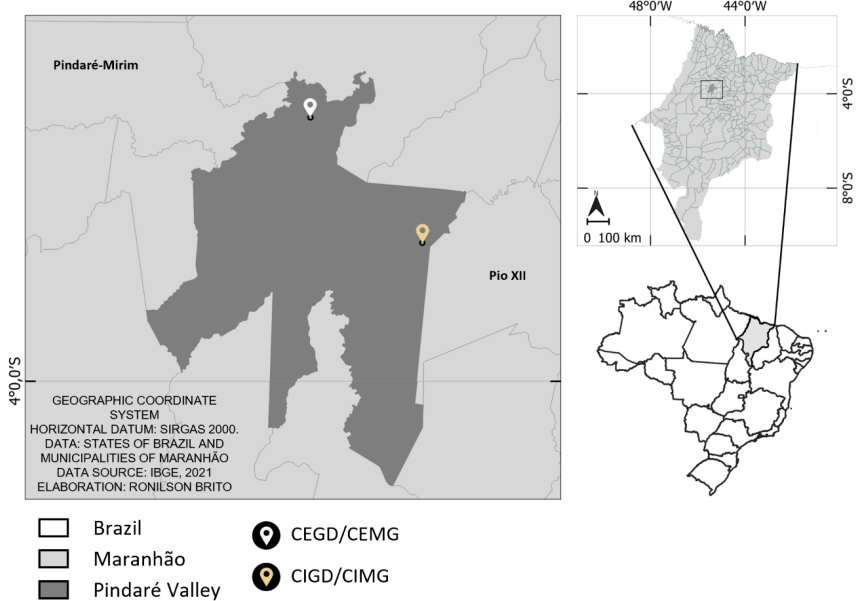
Geologically, Pindaré Valley (Fig. 1) is defined by lithologies of the Itapecuru Formation, frequently overlain by sediments of the Barreiras Formation5. This fluvio-lacustrine depositional framework produces a heterogeneous soil profile marked by alternating clay-rich horizons and sandy layers. Variations in depositional energy govern this stratification, favoring the formation of kaolinite-rich, plastic horizons distinct from quartz-rich, non-plastic layers.
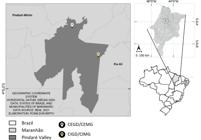
Location of clay deposits of this study (Maranhão, Brazil) (QGIS Geographic Information System) (CIGD/CIMG: S3.80, W45.21, and CEGD/CEMG: S3.62, W45.36).
In local practice, these materials are empirically classified as “fat” clays (gray, high plasticity) and “lean” clays (reddish or sandy, low plasticity), and blended based on visual estimation. Yet this empirical approach lacks systematic correlation with mineralogical features. “Fat” clays are typically dominated by kaolinite, illite, and montmorillonite, which impart high plasticity but also induce significant drying shrinkage. Conversely, “lean” clays serve as a structural skeleton due to their high free-quartz content. Without determining the precise balance of these phases, production remains unpredictable. In local manufacturing, the proportions of these clays are often adjusted empirically, with typical volumetric mixtures of 50/50 for bricks and 60/40 for roof tiles.
Moreover, previous studies in the region rarely combined bulk chemical analysis with detailed oriented-fraction X-ray diffraction, a technique essential for identifying expandable phyllosilicates such as montmorillonite and clarifying their role in sintering mechanisms. Therefore, the main objective of this work is to conduct an integrated characterization of stratified deposits in Pindaré-Mirim and Pio XII. By correlating chemical composition, mineralogical profiles, and thermal behavior, the study seeks to provide a scientific basis for the rational formulation of “fat” and “lean” clays, moving from empirical practice toward optimized technical parameters.
EXPERIMENTAL PROCEDURES
Collection and preparation of samples: Four clay samples were sourced from the Pindaré Valley (Maranhão, Brazil), specifically in the localities of Pindaré-Mirim and Pio XII. The materials were collected from two local ceramic manufacturers: Cemil and Cigana. The samples were identified as CEGD, CEMG, CIGD, and CIMG, where CE/CI refer to the manufacturers and GD (fat clay)/MG (lean clay) indicate the plasticity of the materials. To ensure representativeness, samples were collected from multiple points across fresh stockpiles and homogenized, reflecting in situ properties while minimizing seasonal interference. Initially, the samples were dried at room temperature until reaching a constant moisture content. They were then quartered and crushed using a rubber-tipped pestle. Aliquots were set aside for granulometric testing, while the remaining material was wet-milled in a ball mill (Marconi, MA-500) for 2 h at 71 rpm. The milling chamber was loaded with alumina balls (±4 cm in diameter) and filled to 30% of its total volume. Finally, the clays were oven-dried at 100ºC for 24 h and sieved to 75 µm (200 mesh) to ensure suitability for physical, chemical, mineralogical, and technological characterization. No carbonate removal was performed to prevent acid-induced mineralogical alterations.
Physical tests: The Atterberg limits (Liquidity Limit, Plastic Limit, and Plasticity Index) were determined according to the procedures established by the Brazilian Association of Technical Standards (ABNT), specifically NBR 6459 and NBR 71806), (7. The average particle diameter and texture were determined by sieve and sedimentation analysis8. Clay grain density was evaluated by pycnometry, according to the Brazilian standard ABNT 65089. Thermogravimetric analysis (TGA) was performed on the powder samples using a Shimadzu TGA-51H instrument. The test was conducted under a nitrogen atmosphere (50 mL min-1 flux) to isolate clay dihydroxylation reactions at a heating rate of 10ºC min-1 up to 1000ºC.
Chemical tests: The chemical composition was determined by X-ray fluorescence spectrometry (XRF) using a PANalytical Epsilon 3 XL spectrometer. The powdered clay minerals were analyzed using a Shimadzu XRD-6100 diffractometer with Cu Kα radiation (l=1.5406 Å) operating at 30 kV and 30 mA. Measurements were taken over a scan range of 3-70º (2θ) with a step size of 0.02ºand a time per step of 2 s. Phase semi-quantification was performed using the rational mineralogical analysis method, assuming idealized mineral stoichiometries10. The clay fraction was separated following the USGS OFR 01-041 protocol11, which involved dispersion in a 0.5% sodium hexametaphosphate solution, decantation (Stokes’ law), and the oriented slide technique to isolate it from the silt fraction. XRD analysis of oriented slides was performed with a step size of 0.01º and a time per step of 0.6 s, over a 3-40º (2θ) range. Additional treatments included thermal annealing at 400ºC and 500ºC for 1 hour, as well as ethylene glycol saturation. Mineralogical identification was performed using X’Pert HighScore software. For structural characterization, Fourier transform infrared spectroscopy (FTIR) was employed. The powder samples were uniaxially pressed into KBr pellets at a 1: 99 (clay: KBr) ratio and analyzed in the 400-4000 cm-1 range using a Shimadzu IRAffinity-1 spectrometer. Spectra were processed in Shimadzu’s LabSolutions software using Savitzky-Golay smoothing (10 points)12. The micrographs were recorded on a FEI Quanta FEG 250 SEM operating at 1-30 kV, coupled to an EDS detector (Bruker XFlash 5010). Analyses were performed using the clay fraction (<2 µm) obtained after sedimentation to provide a detailed overview of the mineral morphology.
Technological characterization: For this procedure, the clays were adjusted to the required moisture content (5 wt% for CEMG/CIMG; 10 wt% for CEGD/CIGD), sieved (<100 mesh), molded into rectangular specimens (80 x 20 x 6 mm), and uniaxially dry-pressed at 20 MPa. After compaction, the samples were oven-dried at 110ºC for 24 hours and then fired in a muffle furnace. The firing process included a 1-hour hold at 500ºC, followed by heating to final temperatures of 950 and 1050ºC for 3 hours (heating rate of 5ºC·min-¹). After firing, five specimens of each clay were tested to determine their water absorption and apparent porosity, following the boiling water method as recommended by ASTM C20-0013. Additionally, linear shrinkage and three-point flexural strength were also evaluated. Flexural strength (Modulus of Rupture, MOR) was calculated according to ASTM C67414 tests were performed using an INSTRON Emic DL30000N universal testing machine equipped with a 20 kN load cell, a 60 mm support, and a displacement rate of 0.5 mm·min-1. All results are reported as mean ± standard deviation.
RESULTS AND DISCUSSION
The chemical composition and loss on ignition (LOI) of the clay samples (Table I) define two distinct groups, with notable similarities within each pair. XRF analysis revealed a high combined SiO2 and Al2O3 content in all samples (71.37 to 84.65 wt%), indicating an overall chemical composition commonly associated with aluminosilicate-rich clay materials. The “lean” samples exhibited high SiO2/Al2O3 ratios, with CEMG showing the highest value (3.51), reflecting a significant contribution from free silica as quartz (SiO2), a finding supported by XRD analysis.
The K2O contents are higher than those of Na2O (not detected) and MgO, reaching 4.49 wt% in CEMG and 3.29 wt% in CIMG, while lower values are observed in CEGD (1.97 wt%) and CIGD (1.50 wt%). In these compositions, K2O may act in combination with Fe2O3 (3.89-12.53 wt%) and MgO (0.70-1.56 wt%) as fluxes, reducing the sintering temperature and promoting the formation of a more homogeneous glassy phase15), (16. This balance between fluxing and intermediate oxides indicates a low to moderate vitrification potential, particularly for CIGD, which presents a significantly higher total flux content (15.02 wt%) primarily due to its elevated Fe2O3 concentration.
Iron oxide influenced the post-firing coloration depending on the clay type. In lean, quartz-rich clays, even at low Fe2O3 contents, such as in CEMG (<5 wt%), iron tends to crystallize as finely dispersed hematite, acting as the main red pigment17. In contrast, in fat clays, the intense red coloration typically expected at Fe contents of 3-7 wt% may not develop when iron is incorporated into phases such as mulita, metakaolinite, or pyroxenes, resulting in beige tones, as observed for CEGD18), (19. TiO2 occurred in low concentrations (1.14-1.48%), exerting a secondary influence on aesthetic and physical properties20. Minor oxides such as P2O5, MnO, ZrO2, SnO2, and V2O5 are present in trace amounts. The presence of CaO (0.488 wt%) solely in sample CIGD is ascribed to an impurity of calcium carbonate (calcite)21), (22.
The clays exhibited loss on ignition (LOI) values ranging from 3.51% to 11.21%. The higher LOI values in CEGD and CIGD are due to a richer clay mineral composition, which undergoes dehydroxylation, decomposition of organic matter, and loss of greater amounts of adsorbed water. Elevated LOI values are directly associated with increased apparent porosity in sintered ceramics23
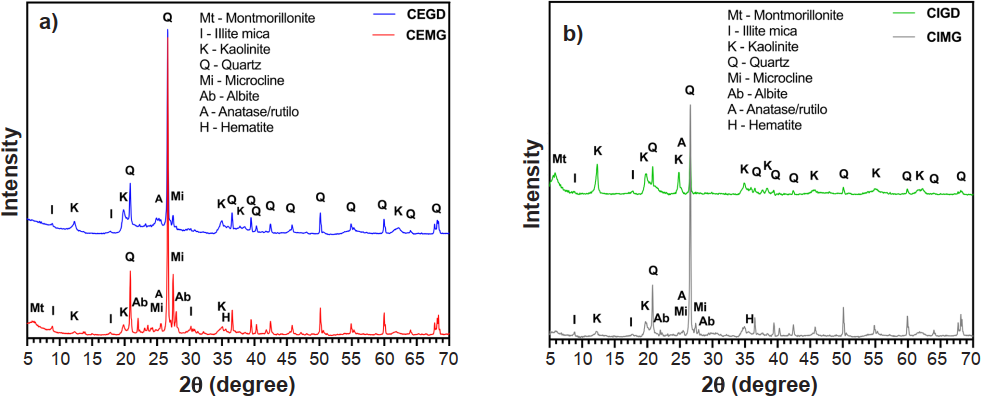
The XRD results for the clay fractions (<75 μm) are presented in Fig. 2. The analyses identified illite (ICSD 90144), kaolinite (ICSD 63192), quartz (ICSD 200721), montmorillonite (ICSD 161171), microcline (ICSD 16597), and albite (ICSD 9829) as the dominant crystalline phases in the studied samples.
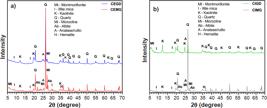
Rational analysis combining XRF data and XRD-identified phases (Fig. 2) was used to estimate phase content. The results, presented in Table II, should be regarded as semi-quantitative. Distinct mineralogical profiles were observed among the samples. CEGD and CIGD are dominated by kaolinite (50.1% and 40.3%, respectively), with quartz (28.9% and 22.8%) and illite (5.4% and 7.5%) as accessory phases. Montmorillonite was not detected in CEGD, as confirmed by oriented XRD analysis, whereas CIGD contains montmorillonite (14.6%), which may contribute to the increase in plasticity.
Semi-quantitative mineralogical compositions (%) of the coarse clays fraction (<75 μm) estimated via rational analysis.
CEMG exhibited the highest quartz concentration (42.2%) and the lowest kaolinite proportion (15.8%). The predominance of quartz acts as a rigid skeletal framework, enhancing dimensional stability during firing25), (27. Despite its lean character, the presence of montmorillonite (12.6%) ensures sufficient plasticity for shaping. Illite contents (5.4-12.5%) in all samples may act as a secondary flux, promoting liquid-phase formation, and potentially limiting mullite and cristobalite crystallization28.
In CIMG, quartz is the dominant phase (41.2%), followed by kaolinite and illite (35.2% combined), microcline (15.3%), and minor albite (1.1%). The high combined contents of quartz and feldspars observed in CEMG and CIMG samples (>60%) indicate low mineralogical maturity and a direct detrital contribution from the parent rock24.
Geologically, the high SiO2 content and the persistence of K2O (associated with feldspar) suggest a proximal depositional environment and a moderate stage of chemical weathering, in which the hydrolysis of primary minerals was incomplete, contrasting with the observation in the aluminous samples CEGD and CIGD. This mineralogical preservation is a distinct regional feature; while typical Amazonian soils, such as the widely distributed Yellow Latosols, undergo intense lateritic leaching that leads to almost total kaolinization and removal of alkalis25, the Pindaré Valley deposits retain primary minerals likely sourced from the felsic and metamorphic rocks of the São Luís Craton26), (27. The presence of microcline and albite provides a natural fluxing reservoir that is not commonly found in more mature tropical clay deposits.
From a technological perspective, kaolinite-rich compositions show higher potential for mullite (3Al2O3×2SiO2) formation during firing28. In this process, metakaolinite decomposes at elevated temperature (>950ºC), leading to mullite crystallization, which reinforces the ceramic matrix and enhances flexural strength and thermal stability15 . Minor amounts of Ti-bearing phases, more likely associated with anatase and hematite, were also detected, in agreement with XRF results.
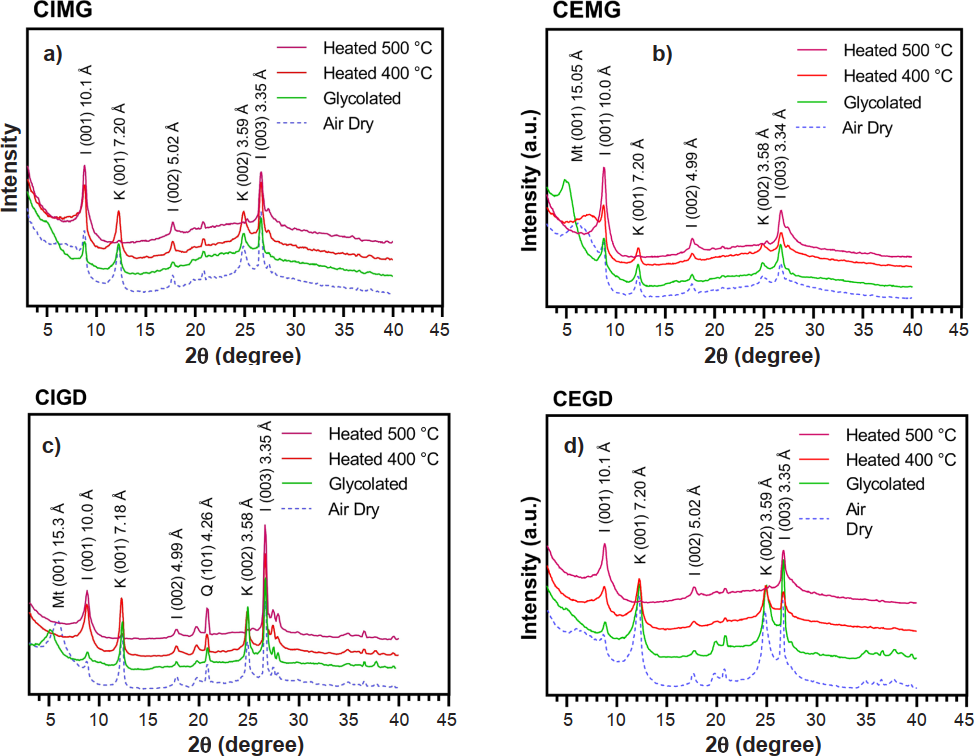
Complementary X-ray diffraction results of oriented clay fraction (<2 μm) under natural, glycolated, and heat-treated (400/500ºC) conditions are presented in Fig. 3. These samples went through sedimentation, as required by USGS OFR 01-041 protocol. CEGD and CIGD samples consist predominantly of well-crystallized kaolinite, evidenced by sharp, intense reflections at 12.4º and 24.8º 2θ (d=7.20 and 3.58 Å, respectively). Kaolinite maintained its structure after glycolation and 400ºC/1h treatment; as expected, these reflections disappeared completely at 500ºC/1h, confirming its transformation to metakaolinite through thermal dihydroxylation29), (30.
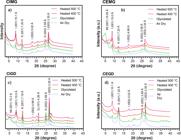
X-ray diffraction patterns of the samples, clay fraction under oriented conditions (air dry), glycolated and heated at 400 and 500ºC (M - Montmorillonite, I - Illite, K - Kaolinite).
CEMG and CIGD displayed a characteristic ~15 Å reflection, indicative of expansive montmorillonite group clay minerals (montmorillonite). This identification was confirmed by the shift of the ~15 Å reflection to ~17.6 Å following glycolation. In CEMG, thermal treatment at 400ºC induced a shift of the ~15 Å reflection to approximately 11 Å, attributed to the loss of interlayer water. Complete structural collapse of the montmorillonite occurred after treatment at 500ºC, as evidenced by the total disappearance of the ~15 Å reflection. The presence of montmorillonite-type clays in ceramic bodies requires careful drying and firing protocols, as trapped water combined with rapid temperature increases may cause cracking or bloating31), (32.
Weak reflections between 6-7º (2θ) in CEMG and CIMG suggest poorly crystalline montmorillonite components. Illite (ICSD 90144) was identified by stable reflections at 10.0 Å, 5.0 Å, and 3.3 Å, which remained unchanged after glycolation and thermal treatment22), (33.
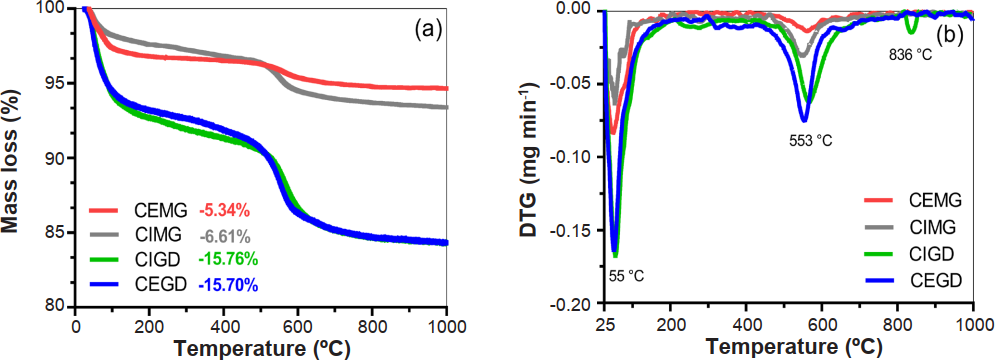
The DTG curves (Fig. 4b) show that all samples experienced an initial mass loss between 25-200ºC, attributed to the evaporation of surface-adsorbed and interlayer water. This effect was more pronounced in CEGD and CIGD, with losses of about 7.4% and 8.1%, respectively, whereas CEMG and CIMG exhibited low values, around 2.7% and 3.3%, respectively.
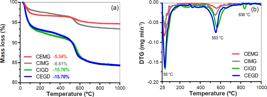
The second thermal event, occurring between 450 and 650ºC, corresponds to the release of structural water through the dehydroxylation of clay minerals. Within this interval, kaolinite undergoes transformation into metakaolinite as its crystalline structure becomes disorganized (~400-650ºC)34), (35. Illite also dehydroxylates between 525ºC and 575ºC, while montmorillonite contributes similarly within this range36), (37), (38. The associated mass losses were comparable to the previous stage, totaling 1.84%, 3.19%, 6.58%, and 6.63% for CEMG, CIMG, CIGD, and CEGD, respectively. The DTA curve showed variations in the intensity and width of the endothermic peak (550-560ºC), characteristic of kaolinite dihydroxylation. CEGD exhibited a more intense and narrower peak, suggesting a higher content of kaolinite with high crystallinity29), (39. CIGD displayed a less intense and broader peak, indicating a lower degree of crystallinity due to higher iron content, which undergoes isomorphic substitution of Al atoms by Fe atoms40), (41. Meanwhile, CEMG and CIMG showed less intense and broader peaks in comparison, consistent with intermediate degrees of crystallinity.
Mass losses occurring between 200ºC and 450ºC reflect pyrolysis of organic matter and release of volatiles, while losses above 650ºC are mainly due to decomposition of accessory phases42. The mass loss values obtained here are comparable to those of ball clay-type clays43, which shows minimal mass loss starting at 800ºC.
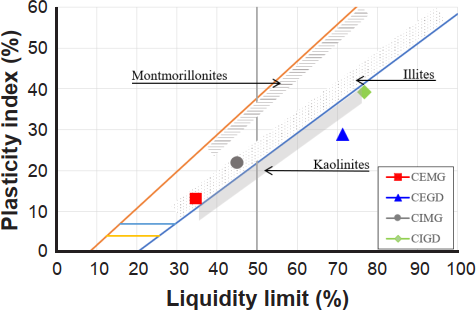
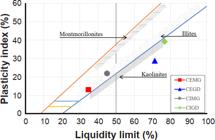
Table III lists the liquid limit (LL), plastic limit (PL), plasticity index (PI), and grain density of the raw clays. The CEGD and CIGD clays exhibited higher liquid limits (71.32% and 76.71%, respectively) and plasticity index (28.85% and 39.24%). These values are explained in the literature as resulting from the combined effects of mineralogical composition (kaolinite, montmorillonite, and Fe-Al bearing minerals), combined with a high proportion of fine particles (<2mm) and the presence of organic matter, which is commonly found in natural clays44), (45), (46), (47. Notably, CIGD differs by containing montmorillonite (14.6%), which accounts for its higher PI (39,24%) due to the high-water absorption capacity of this mineral48), (49.
In contrast, CEMG showed the lowest liquid limit (34.65%) and plasticity index (13.25%), a behavior attributed to its high quartz content (42.2%), which reduces water retention, together with the relatedly low clay fraction, resulting in low plasticity50. CIMG presented intermediate values (LL=44.85%; PI=21.84%), consistent with its balanced mineralogical composition, dominated by quartz (41.2%), illite (12.5%), and feldspars, minerals that limit water adsorption and result in moderate plasticity20), (51. The plasticity indices obtained are in line with the values reported in the literature for clays used in the ceramic industry20), (52, confirming the material’s suitability for shaping processes.
The position of the clays on the Casagrande diagram (Fig. 5) reveals distinct mineralogical and technological affinities. The lean clays (CEMG, CIMG) fall within the low to medium plasticity region, plotting in the illite domain. In contrast, CEGD and CIGD plot in the high plasticity domain, consistent with the kaolinite region but exhibiting a high liquid limit (>50%). Although this high plasticity is characteristic of the ‘roofing tiles ‘category, being favored for the superior moldability53, it poses a significant risk of shrinkage, warping, or structural collapse if the material is used pure54. Consequently, CEGD and CIGD are unsuitable for monolithic use, requiring rational formulation. Specifically, they must be blended with leaner raw materials, typical of the ‘hollow block’ category, to balance dimensional stability53. This approach leverages the skeletal function of silt and sand to reduce the active clay fraction, yielding mixtures with a moderate Plasticity Index that combine optimal workability with controlled drying behavior51.
The grain density of the samples studied here ranged from 2.57 to 2.65 g·cm-³, which is consistent with values reported for common clay minerals such as montmorillonite (2.22-2.75 g·cm-³), illite (2.64-3.00 g·cm-³), and kaolinite (2.60-2.68 g·cm-³)55), (56, and falls within the expected range for red clays15. Soils richer in clay minerals, such as CEGD and CIGD, with higher contents of TiO2, Al2O3, Fe2O3, K2O, and LOI, are characterized by a decrease in particle density. In contrast, quartz and feldspar contribute positively to an increase in density, as observed in CEMG and CIMG50.
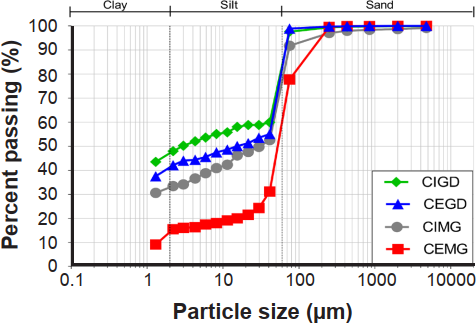
Fig. 6 illustrates the cumulative particle size distribution (PSD) curves obtained through sieving and sedimentation with sodium hexametaphosphate as a dispersant. The samples exhibited similar overall profiles, characterized by a predominance of fine-grained particles (<63 µm).
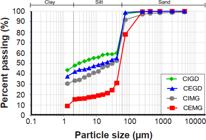
The CIGD sample showed the highest clay content (49.36%), followed by the CEGD sample (42.90%), both of which had low sand fractions (<14%), resulting in predominantly clayey to silt-clay textures. CIMG presented an intermediate composition, with 33.88% clay and 18.99% sand, while silt was the dominant fraction (47.13%). In contrast, CEMG displayed the lowest clay content (16.29%) and the highest sand proportion (33.18%), indicating a markedly coarser texture.
The elevated fine fraction (>85%) in CEGD and CIGD may favor faster sintering kinetics due to the increased surface area, which enhances the diffusion process20), (58. Moreover, the balanced silt-to-clay ratio in CEGD promotes optimized initial particle packing. However, the smaller median particle size (D50) of CIGD (3.1 µm compared to 15.4 µm for CEGD) facilitates pore closure, suggesting a slightly superior densification performance after sintering59), (60.
The coarser texture of CEMG, due to its reduced clay fraction and higher average particle size, hinders sintering kinetics. This imbalance can impair densification, promote residual porosity, and result in a heterogeneous microstructure in the fired product. In contrast, although CIMG presents a higher clay content than CEMG, its behavior is dominated by the silt fraction. Since silt is less reactive than clay minerals, it acts as a refractory skeleton that attenuates phase transformations, making the material’s thermal evolution dependent on the presence and effectiveness of fluing agents61), (62.
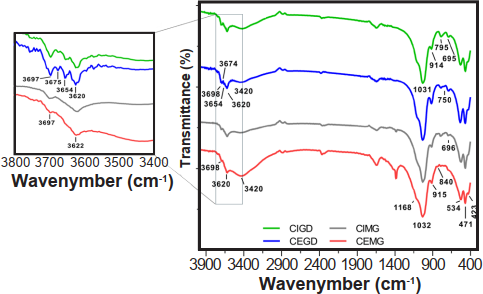
Fig. 7 shows the FTIR spectra of the samples. The spectral analysis concentrated on the hydroxyl group vibration region (3700-3600 cm-¹) and the silicate framework vibration region (1200-400 cm-¹). The CEGD spectrum displayed four well-resolved bands in the OH stretching region (3700-3600 cm-¹), consistent with kaolinite and only minimally influenced by the illite present63), (64), (65. In contrast, the CIGD spectrum exhibited a similar pattern, but with partially overlapped bands due to contributions from 2:1 phyllosilicate.
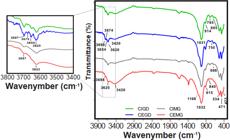
Three bands between 3698-3654 cm-¹ are commonly associated with outer-surface hydroxyl groups forming hydrogen bonds with Si-O-Si groups of neighboring tetrahedral sheets, whereas the band at 3620 cm-¹ is typically attributed to the stretching of inner hydroxyls located between octahedral and tetrahedral layers65. Bands related to adsorbed water were observed at approximately 3420 and 1635 cm-¹ in all samples63), (66.
CEMG spectrum displayed broadened and partially overlapping OH stretching bands at 3695 and 3622 cm-¹, along with more intense absorptions related to adsorbed water (3420 and 1647 cm-¹), features compatible with the presence of 2: 1 minerals (illite and smectite)30), (65), (66. In this sample, a weak band at 840 cm-¹, often associated with AlMg-OH bending, suggests the presence of smectite67), (68. This band was less evident in CIGD due to their lower Mg²+ content, as indicated by XRF.
In the silicate framework region (1200-400 cm-¹), all samples exhibited bands commonly reported for the identified minerals. Vibrations at 1108 and 1032 cm-¹ (in-plane Si-O stretching), 915 cm-¹ (inner-surface OH deformation), 697 cm-¹ (Si-O stretching), and 534/425 cm-¹ (Al-O-Si and Si-O bending) are typical of kaolinite, illite, and montmorillonite30), (69, consistent with the XRD results. Quartz was indicated by bands at 795 cm-¹ (symmetric Si-O bending) and 471 cm-¹ (Si-O-Si bending)66), (70. A band at 750 cm-¹, particularly evident in CEGD, is commonly associated with illite.
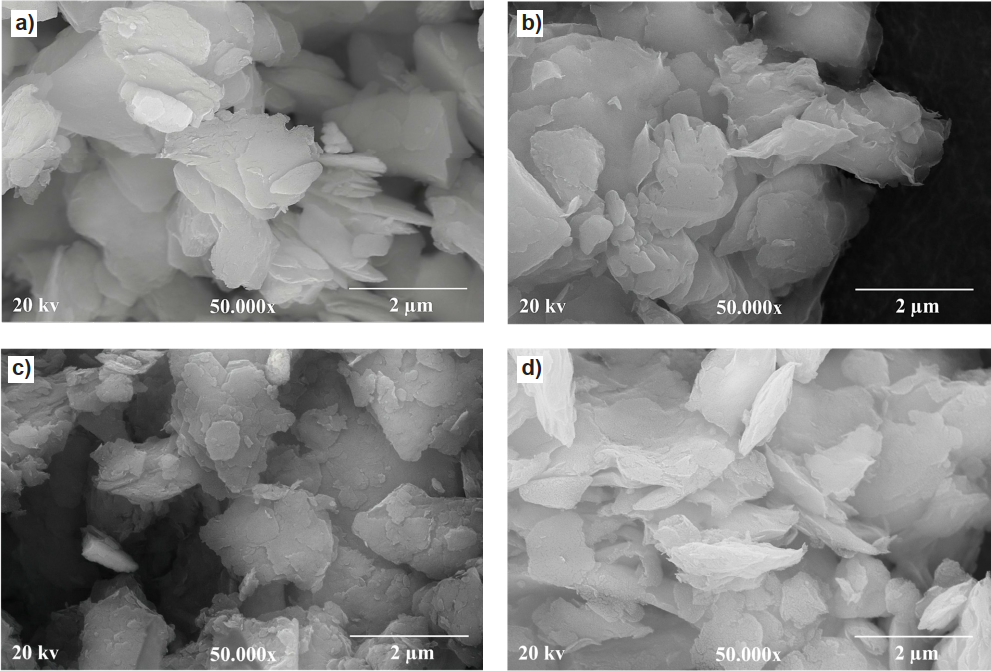
The SEM micrograph of the CEGD sample (Fig. 8a) reveals that the clay minerals consist of fine particles with varying sizes, arranged in stacked plate-like units that form aggregates with irregular edges, typical of kaolinite. The CEMG sample (Fig. 8b) exhibits smooth, sheet-like lamellar structures arranged in curved, petal-like aggregates. This type of morphology, lamellar, is commonly observed in 2: 1 phyllosilicates and can be reasonably associated with illite/smectite, as suggested by the mineralogical composition obtained in XRD.
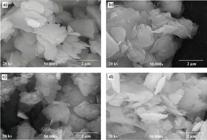
The CIGD sample (Fig. 8c) displayed poorly developed hexagonal to pseudohexagonal plates with rounded or irregularly ragged outlines (~1 µm), characteristic of kaolinite15), (71, which is one of the most abundant phases in the sample, according to the XRD data. The SEM micrograph of CIMG (Fig. 8d) shows regions containing thin, relatively smooth lamellae with greater lateral extension, as well as areas where overlapping plates form small lamellar stacks, consistent with clay minerals, such as kaolinite and illite.
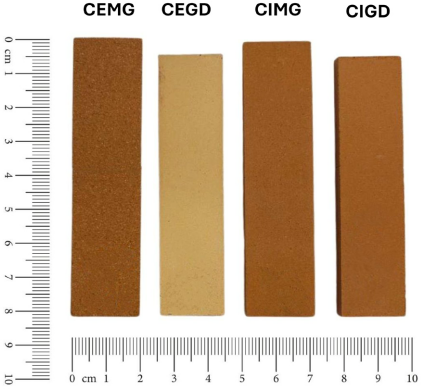
Figure 9 shows images of the test specimens after firing at 950ºC for 3 h. The more plastic clays exhibited distinct color variations due to iron oxidation: CEGD (7.18 wt% Fe2O3) developed a cream color, while CIGD (12.53 wt% Fe2O3) turned orange42.
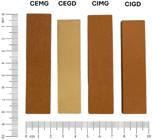
Specimens after firing at 950 ºC, showing color and surface variations among the clay samples.
Fig. 10a illustrates the linear shrinkage of clay compacts fired at 950ºC and 1050ºC. The linear shrinkage of both CEMG and CIMG showed no statistically significant variation with increasing firing temperature, demonstrating high dimensional stability with values ranging from 0.51% to 1.10% for CEMG and from 0.22% to 0.59% for CIMG. This stability is attributed to the high quartz content (42.2% and 41.2%), which acts as a refractory phase and limits liquid-phase formation even in the presence of alkali fluxes. Equivalent results have been reported, where higher quartz contents led to increased porosity and reduced shrinkage72.
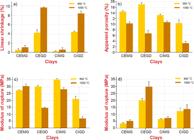
Linear shrinkage (a), water absorption (b), apparent porosity (c), and modulus of rupture (d) as a function of the firing temperature of the clays under study
In contrast, CEGD and CIGD samples exhibited higher values of linear shrinkage, ranging from 4.25% to 4.45% at 950ºC, and increasing to 8.43% and 9.71% at 1050ºC, respectively. This behavior can be attributed to the higher content of clay minerals (kaolinite and montmorillonite), which undergo structural collapse during firing, and to the presence of feldspathic phases, hematite, and other fluxing oxides (Fe2O3, K2O), which promote early vitrification and densification34), (73. Although the slow heating rate (5ºC×min-1) used in this study prevented visible deformation during the controlled laboratory firing, linear shrinkage values close to 10% for CEGD and CIGD are considered high for red ceramic and may easily lead to warping74), (75. Under industrial firing conditions, non-uniform heat distribution and higher heating rates may intensify these effects76. Mixing these clays with others that exhibit lower shrinkage, or with more inert materials, is a commonly adopted strategy to improve dimensional control and reduce deformation of the final product77.
Overall, most clays demonstrated the expected decline in water absorption (Fig. 10b) and apparent porosity (Fig. 10c) with increasing temperature. However, the CEMG sample was an exception, maintaining a high porosity level due to the likely formation of heterogeneous pores. CEGD and CIGD clays exhibited the most significant decreases in water absorption with increasing firing temperature. CEGD decreased from 17.02% to 6.74% and CIGD from 10.37% to 3.26%. The water absorption values obtained for the investigated samples were suitable for the manufacture of bricks (<25%), roofing tiles (<20%), and porous wall coatings (10-20%)34), (49.
Fig. 10d demonstrates the temperature-dependent enhancement of flexural tensile strength in the clay samples. While the CEMG sample’s strength increased from 3.37 MPa (950ºC) to 5.26 MPa (1050ºC), the CEGD sample achieved a significantly higher strength, rising from 20.02 MPa to 29.79 MPa over the same temperature range. The higher MOR of CEGD is consistent with its low SiO2/Al2O3 ratio, which indicates an alumina-rich matrix capable of strong structural reorganization and intense densification during firing75), (78. This behavior is further supported by the presence of K2O minerals such as illite and K-feldspar, whose thermal decomposition and partial melting promote the formation of glassy phases at 1050ºC, improving particle bonding and consolidating the microstructure79.
CIMG and CIGD samples demonstrated a similar trend, albeit with slightly lower values. For reference, the minimum recommended flexural tensile strength of red ceramic clays is 2.0 MPa for solid bricks, 5.5 MPa for hollow blocks, and 6.5 MPa for roof tiles3), (42.
Based on the correlation between mineralogical composition and technological performance, a decision matrix was developed to guide the rational formulation of ceramic bodies (Table IV). The results indicate that a firing temperature of 950ºC provides a sufficient balance between strength and energy efficiency. While fat clays (CEGD and CIGD) contribute to workability and high mechanical strength, they require blending with lean clays (CEMG and CIMG) to control linear shrinkage, which can reach values near 10% at higher temperatures. The proposed 50: 50 and 60: 40 ratios align with local empirical practices but are now technically justified by the compensatory effects of the quartz-rich and kaolinite-rich fractions.
CONCLUSIONS
The Pindaré Valley deposits exhibit complementary mineral and technological properties relevant to red ceramic manufacturing. Kaolinite-rich fractions (“fat” clays) enhance workability and mechanical strength, while quartz-rich layers (“lean” clays) reduce shrinkage and improve dimensional stability. Their combination can produce superior formulations, enabling production guided by mineralogical criteria rather than empirical practice.
A firing temperature of 950 ºC is adequate for Pindaré Valley clays, ensuring mechanical strength, controlled shrinkage, and acceptable water absorption with lower energy demand. Industrially, blends around 50: 50 are best suited for bricks and hollow blocks, whereas slightly fat-rich mixtures (~60: 40) perform better in roof tiles. These proportions balance the plasticity and strength of kaolinite-rich fractions with the dimensional stability provided by quartz-rich layers.
Beyond technological gains, the rational use of local clay blends with moderate firing temperatures can yield environmental and economic benefits, including reduced raw material losses, fewer defects, and lower energy consumption. This study, however, has limitations: the number of sampling sites was restricted, which may not fully capture basin variability, and the firing temperature range investigated was relatively narrow (950-1000 ºC). In addition, no systematic approach was adopted to control shrinkage through optimized blending ratios or processing parameters.
DATA AVAILABILITY
The data that support the findings of this study are available from the corresponding author, upon reasonable request.
ACKNOWLEDGMENTS
The authors gratefully acknowledge Brazil’s Federal Agency for the Support and Improvement of Higher Education (CAPES) and the National Council for Scientific and Technological Development (CNPq) for their financial support of this work. For the funding granted through public call nº. 118/2022 - call for the selection of dissertation and thesis projects of students regularly enrolled in Stricto Sensu Graduate Programs at IFMA. We also thank the Laboratory of Metal Oxide Synthesis and Catalytic Applications (LACAT) of the Federal Institute of Education, Science and Technology of Maranhão (IFMA) for conducting the XRD/FTIR analyses, the Federal Institute of Piauí (IFPI) for the XRF/TG analyses, and the companies CEMIL Ceramic Mirim and Ceramic Cigana for providing the raw materials.
REFERENCES
-
1 Bergaya F, Lagaly G. General Introduction: Clays, Clay Minerals, and Clay Science. Dev Clay Sci, vol. 1, 2006, p. 1-18. https://doi.org/10.1016/S1572-4352(05)01001-9
» https://doi.org/10.1016/S1572-4352(05)01001-9 -
2 Mercury JMR, Correia GS, Vasconcelos NSLS, Cabral Jr. AA, Angélica RS. Ceramic raw materials from the State of Maranhão, Brazil. Part 1: chemical and mineralogical characterization and technological properties of clays from São Luis, Rosário, Pinheiro, and Mirinzal. Rem: Revista Escola de Minas 2012; 65: 513-21. https://doi.org/10.1590/S0370-44672012000400012
» https://doi.org/10.1590/S0370-44672012000400012 -
3 Magalhães R da S, Almeida KS de, Gomes ÉR. Caracterização físico-química, mineralógica e tecnológica de argilas de Caxias/MA. The Journal of Engineering and Exact Sciences 2022; 8: 01-10. https://doi.org/10.18540/jcecvl8iss2pp13974-01e
» https://doi.org/10.18540/jcecvl8iss2pp13974-01e -
4 Magalhães R da S, Dos Santos RM, Da Silva AAM, Marques FP, Gomes ÉR. Propriedades e aplicações industriais de argilas do estado do Maranhão/Properties and industrial applications of clays from Maranhão/Brazil. Brazilian Journal of Development 2021; 7: 82090-108. https://doi.org/10.34117/bjdv7n8-425
» https://doi.org/10.34117/bjdv7n8-425 -
5 Medeiros RB, dos Santos LCA, Bezerra JFR, Marques AR, dos Santos GIFA. Landscape Cartography in the Maranhense Amazon: The Case of the Lower Course of the Pindaré River Basin. GEOGRAPHY, ENVIRONMENT, SUSTAINABILITY 2024; 16: 39-51. https://doi.org/10.24057/2071-9388-2023-2706
» https://doi.org/10.24057/2071-9388-2023-2706 - 6 Associação Brasileira de Normas Técnicas. NBR 6459, Solo - Determinação do limite de liquidez: Método de ensaio. Rio de Janeiro, RJ: 2016.
- 7 Associação Brasileira de Normas Técnicas. NBR 7180, Solo - Determinação do limite de plasticidade: Método de ensaio. Rio de Janeiro, RJ: 2016.
- 8 Associação Brasileira de Normas Técnicas. NBR 7181 - Solo - Análise granulométrica. Rio de Janeiro, RJ: 2016.
- 9 Associação Brasileira de Normas Técnicas. NBR 6508, Grãos de solos que passam na peneira de 4, 8 mm - Determinação da massa específica. Rio de Janeiro, RJ: 1984.
-
10 Coelho C, Roqueiro N, Hotza D. Rational mineralogical analysis of ceramics. Mater Lett 2002; 52: 394-8. https://doi.org/10.1016/S0167-577X(01)00429-3
» https://doi.org/10.1016/S0167-577X(01)00429-3 -
11 POPPE Lawrence J, Paskevich VF, Hathaway JC, Blackwood DS. A laboratory manual for X-ray powder diffraction. 2001. https://doi.org/10.3133/ofr0141
» https://doi.org/10.3133/ofr0141 - 12 Savitzky A, E MJ. Smoothing and Differentiation of Data by Simplified Least Squares Procedures. Z Physiol Chem 1951; 40: 1832.
-
13 ASTM C20-00. Test Methods for Apparent Porosity, Water Absorption, Apparent Specific Gravity, and Bulk Density of Burned Refractory Brick and Shapes by Boiling Water 2022. https://doi.org/10.1520/C0020-00R22
» https://doi.org/10.1520/C0020-00R22 -
14 ASTM C674-13. Test Methods for Flexural Properties of Ceramic Whiteware Materials 2018. https://doi.org/10.1520/C0674-13R18
» https://doi.org/10.1520/C0674-13R18 -
15 Gu X, Ling Y. Characterization and properties of Chinese red clay for use as ceramic and construction materials. Sci Prog 2024; 107. https://doi.org/10.1177/00368504241232534
» https://doi.org/10.1177/00368504241232534 -
16 Santos CP, Oliveira HA, Oliveira RMPB, Macedo ZS. Caracterização de argilas calcárias utilizadas na produção de revestimentos cerâmicos no Estado de Sergipe - Brasil. Cerâmica 2016; 62: 147-56. https://doi.org/10.1590/0366-69132016623621983
» https://doi.org/10.1590/0366-69132016623621983 -
17 Gu X, Ling Y. Characterization and properties of Chinese red clay for use as ceramic and construction materials. Sci Prog 2024; 107: 1-17. https://doi.org/10.1177/00368504241232534
» https://doi.org/10.1177/00368504241232534 -
18 Kreimeyer R. Some notes on the firing colour of clay bricks. Appl Clay Sci 1987; 2: 175-83. https://doi.org/10.1016/0169-1317(87)90007-X
» https://doi.org/10.1016/0169-1317(87)90007-X -
19 Bouzidi N, Siham A, Concha-Lozano N, Gaudon P, Janin G, Mahtout L, et al. Effect of chemico-mineralogical composition on color of natural and calcined kaolins. Color Res Appl 2014; 39: 499-505. https://doi.org/10.1002/COL.21813
» https://doi.org/10.1002/COL.21813 -
20 Candeias C, Santos I, Rocha F. Characterization and Suitability for Ceramics Production of Clays from Bustos, Portugal. Minerals 2025; 15: 503. https://doi.org/10.3390/min15050503
» https://doi.org/10.3390/min15050503 -
21 Rat E, Martínez-Martínez S, Sánchez-Garrido JA, Pérez-Villarejo L, Garzón E, Sánchez-Soto PJ. Characterization, thermal, and ceramic properties of clays from Alhabia (Almería, Spain). Ceram Int 2023; 49: 14814-25. https://doi.org/10.1016/j.ceramint.2022.05.328
» https://doi.org/10.1016/j.ceramint.2022.05.328 -
22 Assunção ARS, Correia GS, Vasconcelos N do SLS, Cabral AA, Angélica RS, da Costa FP, et al. New Clayey Deposit and Their Potential as Raw Material for Red or Structured Ceramics: Technological Characterization. Materials 2021; 14: 7672. https://doi.org/10.3390/ma14247672
» https://doi.org/10.3390/ma14247672 -
23 Achik M, Benmoussa H, Oulmekki A, Ijjaali M, El Moudden N, Touache A, et al. Evaluation of technological properties of fired clay bricks containing pyrrhotite ash. Constr Build Mater 2021; 269: 121312. https://doi.org/10.1016/J.CONBUILDMAT.2020.121312
» https://doi.org/10.1016/J.CONBUILDMAT.2020.121312 -
24 Kieufack G, Bomeni IY, Ngapgue F, Tchamba AB, Mbog MB, Kouonang ST, et al. Potential use of alluvial clays from Monoun in ceramics by adding feldspar from Batie (West-Cameroon) as a fluxing agent. SN Appl Sci 2021; 3: 856. https://doi.org/10.1007/S42452-021-04837-5/FIGURES/6
» https://doi.org/10.1007/S42452-021-04837-5/FIGURES/6 - 25 Sombroek W. Amazon soils: a reconnaissance of the soils of the Brazilian Amazon region 1966.
-
26 Mendes AC, Truckenbrodt W. Proveniência de arenitos albianos (Grupo Itapecuru), borda leste da bacia de São Luís-Grajaú, Maranhão, usando análise de minerais pesados e química mineral. Boletim Do Museu Paraense Emílio Goeldi - Ciências Naturais 2009; 4: 57-74. https://doi.org/10.46357/bcnaturais.v4i1.671
» https://doi.org/10.46357/bcnaturais.v4i1.671 -
27 de Oliveira Cunha JA, do Carmo Sousa D, Córdoba VC. Evolução estratigráfica dos depósitos cretáceos da porção norte da Bacia de São Luís-Grajaú (NE do Brasil). Geologia USP Série Científica 2019; 19: 151-70. https://doi.org/10.11606/ISSN.2316-9095.V19-152654
» https://doi.org/10.11606/ISSN.2316-9095.V19-152654 -
28 Sánchez-Soto PJ, Eliche-Quesada D, Martínez-Martínez S, Pérez-Villarejo L, Garzón E. Study of a Waste Kaolin as Raw Material for Mullite Ceramics and Mullite Refractories by Reaction Sintering. Materials 2022; 15: 583. https://doi.org/10.3390/MA15020583/S1
» https://doi.org/10.3390/MA15020583/S1 -
29 Mbey JA, Ngally Sabouang CJ, Makon TB, Coulibaly SL, Kong S. The thermal dehydroxylation of kaolinite using thermogravimetric analysis and Controlled rate thermal analysis. Journal of the Cameroon Academy of Sciences 2021; 16: 235-45. https://doi.org/10.4314/jcas.v16i3.4
» https://doi.org/10.4314/jcas.v16i3.4 -
30 Adeniyi FI, Ogundiran MB, Hemalatha T, Hanumantrai BB. Characterization of raw and thermally treated Nigerian kaolinite-containing clays using instrumental techniques. SN Appl Sci 2020; 2: 821. https://doi.org/10.1007/s42452-020-2610-x
» https://doi.org/10.1007/s42452-020-2610-x -
31 Vasić MV, Pezo L, Zdravković JD, Bačkalić Z, Radojević Z. The study of thermal behavior of montmorillonite and hydromica brick clays in predicting tunnel kiln firing curve. Constr Build Mater 2017; 150: 872-9. https://doi.org/10.1016/j.conbuildmat.2017.06.068
» https://doi.org/10.1016/j.conbuildmat.2017.06.068 -
32 Jaha S, Carvalheiras J, Mahmoudi S, Labrincha J. Production of lightweight expanded aggregates from smectite clay, palygorskite-rich sediment and phosphate sludge. Clay Miner 2024; 59: 85-99. https://doi.org/10.1180/clm.2024.10
» https://doi.org/10.1180/clm.2024.10 -
33 Barbosa VHR, Marques MES, Guimarães ACR. Caracterização mineralógica de um solo do Acre visando à produção de agregados artificiais de argila calcinada para uso em pavimentos. Matéria (Rio de Janeiro) 2018; 23: e12181. https://doi.org/10.1590/s1517-707620180003.0515
» https://doi.org/10.1590/s1517-707620180003.0515 -
34 Correia GS, Vaz THS, da Costa FP, da Silva MFP, da Silva WM, Paiva AEM, et al. Evaluation of Clayey Raw Materials and Ceramic Masses from Ceramic Building Material Companies Located in Northeastern Brazil. Minerals 2024; 14. https://doi.org/10.3390/min14111062
» https://doi.org/10.3390/min14111062 -
35 Garcia E, Cabral Junior M, Quarcioni VA, Chotoli FF. Avaliação da atividade pozolânica dos resíduos de cerâmica vermelha produzidos nos principais polos ceramistas do Estado de S. Paulo. Cerâmica 2015; 61: 251-8. https://doi.org/10.1590/0366-69132015613581847
» https://doi.org/10.1590/0366-69132015613581847 -
36 Wang S, Gainey L, Mackinnon IDR, Allen C, Gu Y, Xi Y. Thermal behaviors of clay minerals as key components and additives for fired brick properties: A review. Journal of Building Engineering 2023; 66: 105802. https://doi.org/10.1016/j.jobe.2022.105802
» https://doi.org/10.1016/j.jobe.2022.105802 -
37 Elkhalifah Ali EI, Murugesan T, Bustam MA. Characterization of different cationic forms of montmorillonite by FTIR, XRD, and TGA techniques. 2011 National Postgraduate Conference, IEEE; 2011, p. 1-6. https://doi.org/10.1109/NatPC.2011.6136275
» https://doi.org/10.1109/NatPC.2011.6136275 -
38 Boukili G El, Lechheb M, Ouakarrouch M, Dekayir A, Kifani-Sahban F, Khaldoun A. Mineralogical, physico-chemical and technological characterization of clay from Bensmim (Morocco): Suitability for building application. Constr Build Mater 2021; 280: 122300. https://doi.org/10.1016/j.conbuildmat.2021.122300
» https://doi.org/10.1016/j.conbuildmat.2021.122300 -
39 Melo VF, Singh B, Schaefer CEGR, Novais RF, Fontes MPF. Chemical and Mineralogical Properties of Kaolinite-Rich Brazilian Soils. Soil Science Society of America Journal 2001; 65: 1324-33. https://doi.org/10.2136/sssaj2001.6541324x
» https://doi.org/10.2136/sssaj2001.6541324x -
40 Liang Y, Chen H, Xu J, Wang M, Tan W. Review of the structural properties and interfacial reactions of Al-substituted goethite, hematite, and ferrihydrite. Pedosphere 2025; 35: 42-52. https://doi.org/10.1016/j.pedsph.2024.06.006
» https://doi.org/10.1016/j.pedsph.2024.06.006 -
41 Herbillon AJ, Mestdagh MM, Vielvoye L, Derouane EG. Iron in kaolinite with special reference to kaolinite from tropical soils. Clay Miner 1976; 11: 201-20. https://doi.org/10.1180/claymin.1976.011.3.03
» https://doi.org/10.1180/claymin.1976.011.3.03 -
42 Silva AL, Luna CBB, Chaves AC, Neves GA. Avaliação de novos depósitos de argilas provenientes da região sul do Amapá visando aplicação na indústria cerâmica. Cerâmica 2018; 64: 69-78. https://doi.org/10.1590/0366-69132018643692275
» https://doi.org/10.1590/0366-69132018643692275 -
43 Laursen A, Santana LNL, Menezes RR. Characterization of Brazilian Northeastern plastic clays. Cerâmica 2019; 65: 578-84. https://doi.org/10.1590/0366-69132019653762579
» https://doi.org/10.1590/0366-69132019653762579 -
44 Won J, Park J, Kim J, Jang J. Impact of Particle Sizes, Mineralogy and Pore Fluid Chemistry on the Plasticity of Clayey Soils. Sustainability 2021, Vol 13, Page 11741 2021; 13: 11741. https://doi.org/10.3390/SU132111741
» https://doi.org/10.3390/SU132111741 -
45 Chen L, Wang X, Deng Q, Wang H, Luo B, Tang T. Study on microscopic pores and physico-mechanical properties of red clay modified by calcium carbonate. Scientific Reports 2024; 14: 23852. https://doi.org/10.1038/s41598-024-73723-y
» https://doi.org/10.1038/s41598-024-73723-y -
46 Feng X, Teng J, Wang H. Influence Mechanism of Water Content and Compaction Degree on Shear Strength of Red Clay with High Liquid Limit. Materials 2023; 17: 162. https://doi.org/10.3390/MA17010162
» https://doi.org/10.3390/MA17010162 -
47 Zeng LL, Hong ZS, Wang C, Yang ZZ. Experimental study on physical properties of clays with organic matter soluble and insoluble in water. Appl Clay Sci 2016; 132-133: 660-7. https://doi.org/10.1016/J.CLAY.2016.08.018
» https://doi.org/10.1016/J.CLAY.2016.08.018 -
48 Salah MM, Hammad MS, Fayed AL, Ebid AM. The influence of Bentonite content on the properties of its mixture with Kaolinite. Scientific Reports 2025; 15: 1-13. https://doi.org/10.1038/s41598-025-89001-4
» https://doi.org/10.1038/s41598-025-89001-4 -
49 Cipriano PB, Ferraz AV. Characterization and utilization of the wastes of clay and argillite from the extraction of gypsum in the municipality of Araripina-Brazil as raw materials for red ceramics. Cerâmica 2019; 65: 611-9. https://doi.org/10.1590/0366-69132019653762652
» https://doi.org/10.1590/0366-69132019653762652 -
50 Hammami F, May M El. Mineralogical, geochemical, geotechnical, and technological characterization of Tunisian Oued Zarga Clays: industrial application in the ceramic industry. Arabian Journal of Geosciences 2023; 16: 76. https://doi.org/10.1007/s12517-022-11101-6
» https://doi.org/10.1007/s12517-022-11101-6 -
51 Bhavya K, Nagaraj HB. Influence of soil structure and clay mineralogy on Atterberg limits. Sci Rep 2025; 15: 15459. https://doi.org/10.1038/s41598-025-98729-y
» https://doi.org/10.1038/s41598-025-98729-y -
52 Guimarães TC de F, Dos Santos AV, Thedoldi A da C, de Lima DC. Estudo das propriedades físicas e mecânicas com a composição química de argilas vermelhas do Estado da Bahia. Matéria (Rio de Janeiro) 2021; 26: e13110. https://doi.org/10.1590/S1517-707620210004.1310
» https://doi.org/10.1590/S1517-707620210004.1310 -
53 Vieira CMF, Sánchez R, Monteiro SN. Characteristics of clays and properties of building ceramics in the state of Rio de Janeiro, Brazil. Constr Build Mater 2008; 22: 781-7. https://doi.org/10.1016/J.CONBUILDMAT.2007.01.006
» https://doi.org/10.1016/J.CONBUILDMAT.2007.01.006 -
54 Danish A, Totiç E, Bayram M, Sütçü M, Gencel O, Erdoğmuş E, et al. Assessment of Mineralogical Characteristics of Clays and the Effect of Waste Materials on Their Index Properties for the Production of Bricks. Materials 2022; 15: 8908. https://doi.org/10.3390/ma15248908
» https://doi.org/10.3390/ma15248908 -
55 Amoozegar A, Heitman JL, Kranz CN. Comparison of soil particle density determined by a gas pycnometer using helium, nitrogen, and air. Soil Science Society of America Journal 2023; 87: 1-12. https://doi.org/10.1002/saj2.20476
» https://doi.org/10.1002/saj2.20476 -
56 Totten MW, Hanan MA, Knight D, Borges J. Characteristics of mixed-layer smectite/illite density separates during burial diagenesis. American Mineralogist 2002; 87: 1571-9. https://doi.org/10.2138/AM-2002-11-1207
» https://doi.org/10.2138/AM-2002-11-1207 - 57 Holtz RD, Kovacs WD. An introduction to geotechnical engineering. Introductory Geotechnical Engineering 1981: 1-746.
-
58 Figueiredo JMR, Fernandes IMM, Silva VJ, Neves GA, Ferreira HC, Santana LNL. Influência da composição e das variáveis de processamento de formulações à base de argilas - uso em materiais refratários. Cerâmica 2018; 64: 10-9. https://doi.org/10.1590/0366-69132018643692169
» https://doi.org/10.1590/0366-69132018643692169 -
59 Wiśniewska K, Pichór W, Kłosek-Wawrzyn E. Influence of Firing Temperature on Phase Composition and Color Properties of Ceramic Tile Bodies. Materials 2021, Vol 14, Page 6380. https://doi.org/10.3390/MA14216380
» https://doi.org/10.3390/MA14216380 -
60 Chappell JS, Ring TA, Birchall JD. Particle size distribution effects on sintering rates. J Appl Phys 1986; 60: 383-91. https://doi.org/10.1063/1.337659
» https://doi.org/10.1063/1.337659 -
61 Vasić MV, Velasco PM, Mijatović N, Radormirović M, Radojević Z. Sustainable approach to raw clays for ceramic and refractory applications: insights from updated traditional ternary diagrams. Clay Miner 2024; 59: 202-12. https://doi.org/10.1180/CLM.2024.20
» https://doi.org/10.1180/CLM.2024.20 -
62 de Azevedo ARG, Alexandre J, Barnabé Zanelato E, Picanço Oliveira R, de Souza RC, de Castro Xavier G, et al. Characterization of a Clay Body Used for Red Ceramics in São Sebastião, District of Campos dos Goytacazes, State of Rio de Janeiro, Brazil. Materials Science Forum 2015; 820: 8-12. https://doi.org/10.4028/www.scientific.net/MSF.820.8
» https://doi.org/10.4028/www.scientific.net/MSF.820.8 -
63 Kgabi DP, Ambushe AA. Characterization of South African Bentonite and Kaolin Clays. Sustainability 2023, Vol 15, Page 12679 2023; 15: 12679. https://doi.org/10.3390/SU151712679
» https://doi.org/10.3390/SU151712679 -
64 Khang VC, Korovkin M V., Ananyeva LG. Identification of clay minerals in reservoir rocks by FTIR spectroscopy. IOP Conf Ser Earth Environ Sci 2016; 43: 012004. https://doi.org/10.1088/1755-1315/43/1/012004
» https://doi.org/10.1088/1755-1315/43/1/012004 -
65 Anil A, Mohan Misra N, Misra SN. Characterization of Some Red Clays from Morbi-Wankaner Region (Gujarat, India). Transactions of the Indian Ceramic Society 2018; 77: 73-83. https://doi.org/10.1080/0371750X.2018.1463870
» https://doi.org/10.1080/0371750X.2018.1463870 -
66 Manoharan C, Sutharsan P, Dhanapandian S, Venkatachalapathy R. Spectroscopic and thermal analysis of red clay for industrial applications from Tamilnadu, India. J Mol Struct 2012; 1027: 103. https://doi.org/10.1016/j.molsruc.2012.05.079
» https://doi.org/10.1016/j.molsruc.2012.05.079 -
67 Djomgoue P, Njopwouo D, Djomgoue P, Njopwouo D. FT-IR Spectroscopy Applied for Surface Clays Characterization. J Surf Eng Mater Adv Technol 2013; 3: 275-82. https://doi.org/10.4236/JSEMAT.2013.34037
» https://doi.org/10.4236/JSEMAT.2013.34037 -
68 Russell JD, Fraser AR. Infrared methods. Clay Mineralogy: Spectroscopic and Chemical Determinative Methods 1994: 11-67. https://doi.org/10.1007/978-94-011-0727-3_2
» https://doi.org/10.1007/978-94-011-0727-3_2 -
69 Ritz M, Vaculíková L, Plevová E. Identification of clay minerals by infrared spectroscopy and discriminant analysis. Appl Spectrosc 2010; 64: 1379-87. https://doi.org/10.1366/000370210793561592
» https://doi.org/10.1366/000370210793561592 -
70 Murthuza K, Surumbarkuzhali N, Thirukumaran V. The use of spectroscopy techniques to determine the mineral content of soils in the Tiruvannamalai District of Tamil Nadu, India. J Rad Nucl Appl 2023: 17-22. https://doi.org/10.18576/jrna/080103
» https://doi.org/10.18576/jrna/080103 -
71 Hong H, Churchman GJ, Gu Y, Yin K, Wang C. Kaolinite-smectite mixed-layer clays in the Jiujiang red soils and their climate significance. Geoderma 2012; 173-174: 75-83. https://doi.org/10.1016/j.geoderma.2011.12.006
» https://doi.org/10.1016/j.geoderma.2011.12.006 -
72 Comin AB, Zaccaron A, Nandi V de S, Inocente JM, Muller TG, Peterson M. Characterization and use of clays from the Rio Bonito Formation/Paraná Basin for ceramic industry application. Int J Appl Ceram Technol 2021; 18: 1814-24. https://doi.org/10.1111/IJAC.13749
» https://doi.org/10.1111/IJAC.13749 -
73 Moctar IB, Yannick TL, Albertine AS-T, Mache JR, Mominou N. Physico-chemical, mineralogical characterization, and ceramic properties of clay materials from South Mindif (Far North, Cameroon). JMST Advances 2023 5: 1 2023; 5: 13-26. https://doi.org/10.1007/S42791-023-00047-9
» https://doi.org/10.1007/S42791-023-00047-9 -
74 Gurgel JFS, Xavier SCR, Amaral IBC, Araújo AD, Reis AB dos. Coprocessamento de rejeito do Garimpo Areinha (Diamantina/MG) para produção de cerâmica vermelha. Matéria (Rio de Janeiro) 2020; 25. https://doi.org/10.1590/s1517-707620200003.1114
» https://doi.org/10.1590/s1517-707620200003.1114 -
75 Pinto LA, de Souza TD, Silva DB, Peixoto LP, Rodrigues MIB. Study of clay used in the production of red ceramic pottery on semi-arid Cearense, Brazil. Matéria (Rio de Janeiro) 2021; 26: e13019. https://doi.org/10.1590/S1517-707620210003.13019
» https://doi.org/10.1590/S1517-707620210003.13019 -
76 Candeias C, Novo S, Rocha F. Clay Schists from Barrancos (Portugal): An Approach Toward Sustainable Ceramic Raw Material Use. Minerals 2025, Vol 15, Page 852 2025; 15: 852. https://doi.org/10.3390/MIN15080852
» https://doi.org/10.3390/MIN15080852 - 77 Aguiar MC de, Gadioli MCB, Sant’anna MAK, Almeida KM de, Giori AJN. Processos de fabricação de cerâmica vermelha 2022.
-
78 Garzón E, Pérez-Villarejo L, Eliche-Quesada D, Martínez-Martínez S, Sánchez-Soto PJ. Vitrification rate and estimation of the optimum firing conditions of ceramic materials from raw clays: A review. Ceram Int 2022; 48: 15889-98. https://doi.org/10.1016/J.CERAMINT.2022.02.129
» https://doi.org/10.1016/J.CERAMINT.2022.02.129 -
79 Harech MA, Labbilta T, Abouliatim Y, Elhafiane Y, Benhammou A, Abourriche A, et al. Influence of Thermal Treatment of Moroccan Red Clay on its Physicochemical and Mechanical Behavior. Clays Clay Miner 2022; 70: 601-15. https://doi.org/10.1007/S42860-022-00208-2
» https://doi.org/10.1007/S42860-022-00208-2