Effect of surfactant admixture on alkali-activated pastes
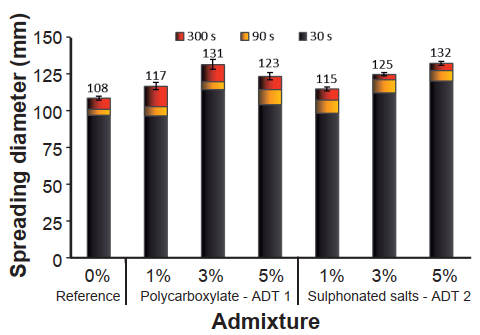
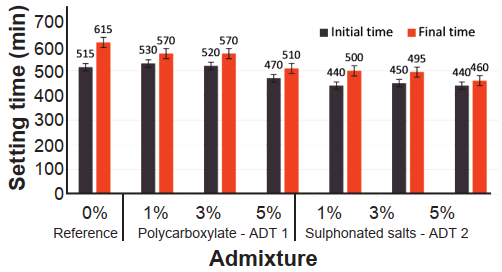
Alkali-activated binders represent a promising alternative for reducing the high carbon dioxide emissions associated with the cement industry. However, the influence of chemical admixtures on the workability of these materials remains insufficiently explored. This study aimed to evaluate the effect of surfactant admixtures on alkali-activated pastes composed of fly ash, basic oxygen furnace (BOF) steel slag, sodium hydroxide, and sodium silicate. Workability was assessed using the Kantro mini-slump test, alongside measurements of setting time and compressive strength. The polycarboxylate-based admixture (ADT1) and the sulfonated salt-based admixture (ADT2) improved the consistency of the material, with optimal dosages of 3% for ADT1 and 5% for ADT2, resulting in increases in mini-slump spread of 18% and 25%, respectively. The initial setting time was reduced by up to 50 minutes with the use of 5% ADT2, acting as an accelerator, while 3% of ADT1 presented a lower impact on setting time. However, compressive strength decreased by 33% with ADT1 and 27% with ADT2. Overall, ADT2 yielded better performance across all evaluated properties compared to ADT1.
Keywords:
Alkali-activated pastes; Surfactant admixtures; Mini-slump test; Yield stress; Compressive strength
 Thumbnail
 Thumbnail
 Thumbnail
 Thumbnail
 Thumbnail