 Development of an educational booklet using cordel literature for cardiopulmonary resuscitation assistance
ABSTRACT
Objective: To develop an educational booklet for school adolescents on assistance to victims of cardiopulmonary arrest, using cordel literature as a linguistic resource.
Method: A methodological study conducted in five stages: analysis and planning; modeling; implementation; validity; and distribution. Expert selection followed non-probabilistic snowball sampling, using subject searches on the Lattes Platform of the Brazilian National Council for Scientific and Technological Development. Convenience-based non-probabilistic sampling was used to define the adolescent sample. Data analysis was conducted using the Content Validity Index.
Results: The educational booklet “A Quase Morte do Vaqueiro” (“The Cowboy’s Near Death”) was validated by experts and the target audience, presenting total Content Validity Indexes of 0.97 and 0.94, respectively.
Conclusion: Experts highlighted content relevance and the use of cordel literature for teaching adolescents about first aid procedures in cases of cardiopulmonary arrest, and the material was also considered accessible by students.
DESCRIPTORS:
Educational Technology; Health Education; First Aid; Heart Arrest; Literature.
HIGHLIGHTS
1. Development of an educational booklet on cardiopulmonary resuscitation.
2. Application of cordel literature as an accessible linguistic resource.
3. Content and appearance validity of the developed educational booklet.
4. Assessment with adolescents as disseminators of knowledge within the community.
RESUMO
Objetivo: Desenvolver uma cartilha educacional para escolares sobre assistência à vítima em parada cardiorrespiratória utilizando como recurso linguístico a literatura de cordel.
Método: Estudo metodológico, realizado em cinco etapas: análise e planejamento; modelagem; implementação; validação; e distribuição. A seleção dos especialistas seguiu a amostragem não probabilística por snowball, utilizando busca por assunto na Plataforma Lattes do Conselho de Desenvolvimento Científico e Tecnológico. Para delimitação da amostra de adolescentes, foi utilizada a técnica não probabilística por conveniência. A análise de dados foi conduzida pelo Índice de Validade de Conteúdo.
Resultados: A cartilha educacional “A Quase Morte do Vaqueiro” foi validada por especialistas e pelo público, apresentando Índices de Validade de Conteúdo total de 0,97 e 0,94, respectivamente.
Conclusão: Os especialistas destacaram a relevância do conteúdo e da literatura de cordel para o ensino de adolescentes sobre condutas em primeiros socorros nos casos de parada cardiorrespiratória, sendo considerada acessível também pelos escolares.
DESCRITORES:
Tecnologia Educacional; Educação em Saúde; Primeiros Socorros; Parada Cardíaca; Literatura
HIGHLIGHTS
1. Desenvolvimento de cartilha educacional sobre parada cardiorrespiratória.
2. Aplicação da literatura de cordel como recurso linguístico acessível.
3. Validação de conteúdo e aparência da cartilha educacional construída.
4. Avaliação com adolescentes disseminadores de saberes na comunidade.
RESUMEN
Objetivo: Desarrollar una cartilla educativa para adolescentes escolares sobre la asistencia a víctimas de paro cardiorrespiratorio, utilizando la literatura de cordel como recurso lingüístico.
Método: Estudio metodológico realizado en cinco etapas: análisis y planificación; modelado; implementación; validación; y distribución. La selección de especialistas siguió un muestreo no probabilístico por snowball, utilizando la búsqueda por tema en la Plataforma Lattes del Consejo Nacional de Desarrollo Científico y Tecnológico. Para definir la muestra de adolescentes, se utilizó un muestreo no probabilístico por conveniencia. El análisis de los datos se realizó mediante el Índice de Validez de Contenido.
Resultados: La cartilla educativa “A Quase Morte do Vaqueiro” (“La Casi Muerte del Vaquero”) fue validada por especialistas y por el público objetivo, presentando Índices de Validez de Contenido totales de 0,97 y 0,94, respectivamente.
Conclusión: Los especialistas destacaron la relevancia del contenido y de la literatura de cordel para la enseñanza de adolescentes sobre conductas de primeros auxilios en casos de paro cardiorrespiratorio, siendo considerada también accesible por los escolares.
DESCRIPTORES:
Tecnología Educacional; Educación en Salud; Primeros Auxilios; Paro Cardíaco; Literatura.
HIGHLIGHTS
1. Desarrollo de una cartilla educativa sobre paro cardiorrespiratorio.
2. Aplicación de la literatura de cordel como recurso lingüístico accesible.
3. Validación del contenido y de la apariencia de la cartilla educativa desarrollada.
4. Evaluación con adolescentes como difusores de conocimientos en la comunidad.
INTRODUCTION
Initial care provided to victims of health emergencies is decisive in reducing the risk of morbidity and mortality, and cases of cardiopulmonary arrest (CPA) are recurrent situations. In CPA, there is interruption of cardiovascular dynamics and respiratory activity, accompanied by absence of neurological response. Therefore, high-quality cardiopulmonary resuscitation (CPR), including the performance of effective chest compressions, is essential1.
During prehospital care, an initial assessment is conducted to identify events involving life-threatening risk. Subsequently, priority actions are defined, emphasizing reduced waiting time for care and appropriate victim management2. The appreciation of strategies aimed at promoting health literacy in assistance to these events constitutes a significant tool for developing safe and responsible attitudes toward community-based care3-4.
The construction and validity of educational technologies (ETs) enable teaching mediated by playful strategies that are sensitive to valuing the target audience as disseminators of scientific and cultural knowledge3-4. Therefore, it is essential that healthcare professionals, especially nurses working in school health, develop creative technologies focused on health education. These tools should promote students’ active participation, encourage collaboration, and support the construction of meaningful knowledge, always respecting the sociocultural specificities of each context5.
In this regard, ETs consist of the development of a product based on a specific methodological strategy. They are grounded in the implementation of a set of knowledge capable of generating positive repercussions in an individual’s educational process6. Educational booklets are part of this group and are developed based on technical-scientific criteria, including theme, target audience, language, and appearance7-8. In terms of language, cordel literature (a popular and traditional Brazilian folk poetry) has been increasingly incorporated into different health education contexts9-10.
Teaching mediated by this linguistic resource promotes the association of playfulness with the scientific nature of the discussed content9-11, supporting the proposal of an educational booklet focused on constructing scientific knowledge about CPR. Additionally, the emphasis on Paulo Freire’s problem-posing pedagogy represents a relevant strategy for strengthening autonomy, critical citizenship, and social transformation12-13.
Accordingly, the present study aimed to develop an educational booklet for school adolescents on assistance to victims of CPA using cordel literature as a linguistic resource.
METHOD
This methodological study focused on the development and validity of an educational booklet in cordel literature format for school adolescents on assistance to victims of CPA. The research was conducted between January and June 2023 through the integration of five stages: analysis and planning; modeling; implementation; validity; and distribution14.
To support the analysis and planning phase14 of the educational booklet in cordel literature format, as for the contents to be addressed, adolescents’ prior knowledge and expectations about CPA were investigated. This process was mediated through a focus group involving 20 adolescents. To delimit and provide greater precision in concluding the data collection process, the theoretical saturation criterion was adopted15.
The focus group lasted approximately 30 minutes and was guided by the following questions: “What do you know about CPA?” and “What would you like to know about CPA?” The meeting took place in person at the school setting, was audio-recorded, and later transcribed to support the construction of a Discourse of the Collective Subject (DCS). The DCS qualitative analysis strategy makes it possible to identify meanings and social representations shared within a collective16.
During the educational material modeling phase, three domains were defined: conceptual, for content organization; navigation, referring to access pathways; and interface, focused on visual structure aligned with the proposed theme14,17.
Information collected during the focus group, combined with references obtained from the ScienceDirect, PubMed, LILACS, and Google Scholar databases, guided the development of the educational booklet. The following Health Sciences Descriptors were selected to guide the search: “First Aid”, “Cardiopulmonary Resuscitation”, “Educational Technology”, “ADOLEC”, and “Literature”. These descriptors were combined using the Boolean operators AND and OR to ensure technical rigor and scientific foundation for the material.
The design was developed by the researchers using Canva - an intuitive online graphic design tool. The illustrations were produced with the assistance of OpenAI and Gemini generative artificial intelligence tools. The use of these tools was conducted transparently and responsibly by the authors, in accordance with Committee on Publication Ethics recommendations18.
This process was mediated through a generalist prompt for generating images in a woodcut visual style. The base prompt was “Woodcut-style illustration inspired by cordel literature”. Subsequently, descriptions of specific educational actions corresponding to the verses were added to the prompt, without including any copyrighted or sensitive data.
Some visual elements originated from graphic drawings previously available in Canva, and enhancement processes were performed using generative AI tools. For this purpose, simple commands aimed at improving visual quality were used, such as adjustments in sharpness, contrast, and consistency with the aesthetic coherence of the material.
During the implementation stage, the educational product configuration, as well as the coherence and authenticity of the explored content, were verified14.
For the educational booklet validity process, a form was applied to characterize the experts’ socioeconomic and demographic profile. Subsequently, the educational booklet was assessed using an instrument composed of 27 objective questions considering aspects related to appearance, content, relevance, and verbal language. Open-ended fields were also provided, allowing suggestions for inclusion, exclusion, or modification19.
The objective questions required assigning values to the tool characteristics through a Likert scale. In this instrument, the assessed items were classified as “Totally adequate” (4), “Adequate” (3), “Partially adequate” (2), and “Inadequate” (1)19.
The initial selection of experts was performed through searches on the Lattes Platform using nursing and ET in cordel literature with adolescents as identification criteria for potential participants. Subsequently, non-probabilistic snowball sampling was conducted, in which selected experts who agreed to participate indicated other experts. The sample consisted of 15 participants, according to a previously described method20, ensuring a minimum approval rate of 80% and a 20% margin of error.
Additionally, expert eligibility was verified through the adaptation of previously described methodological criteria21. In this strategy, a score is calculated for each expert, with a minimum score of five required for eligibility in technology assessment.
Experts were invited via invitation letters sent by email. After confirmation of interest in participating in the validity process and signing the Informed Consent Form (ICF), the digital version of the educational booklet and the data collection instruments were sent. Initially, an eight-day period was established for material analysis and completion of the data collection instrument. If the expert considered the period insufficient, it was extended for an additional seven days to ensure participation.
The adolescent sample was defined by convenience and consisted of students from the 6th to the 9th grades of elementary school from a municipal school in Recife, Pernambuco. The considered age group ranged from 12 to 15 years, regardless of gender. Students with cognitive limitations, according to medical diagnoses presented to the pedagogical coordination that could restrict participation, were not included.
School adolescents were invited to participate in the study within the in-person school setting, where the Assent Form and the ICF for parents or guardians were provided. Initially, adolescents answered a form for socioeconomic and demographic characterization. Subsequently, the educational booklet was assessed using an instrument addressing the same aspects assessed by experts, although adapted into accessible language for adolescents19. Data collection occurred individually in a reserved room and lasted approximately 15 minutes.
For analysis and interpretation of assessments conducted by experts and adolescents, data were organized in a database through double-entry in an electronic spreadsheet. Subsequently, the Content Validity Index (CVI) was calculated, adopting 0.80 as the minimum acceptable agreement value between the expert committee and adolescents22. The content validity of individual items (Item-Content Validity Index - I-CVI) was also calculated through the sum of “Totally adequate” and “Adequate” assessments, constituting the Concordance Index (CI), divided by the number of participants19.
The present study was previously approved by the Research Ethics Committee of the Health Sciences Center of Universidade Federal de Pernambuco, in accordance with Resolution 466/12, under Opinion 5,896,192.
RESULTS
During the focus group, corresponding to the analysis and planning stage of the educational booklet in cordel literature format, adolescents’ prior knowledge and learning needs regarding CPA were investigated. Participants associated CPA with cessation of breathing and/or absence of pulse, demonstrating appreciation of vital signs in recognizing the event. In addition, they cited death as a consequence. When asked what they would like to learn, they highlighted interest in first aid actions. It was identified that, although familiar with the topic, adolescents did not know how to proceed in cases of CPA.
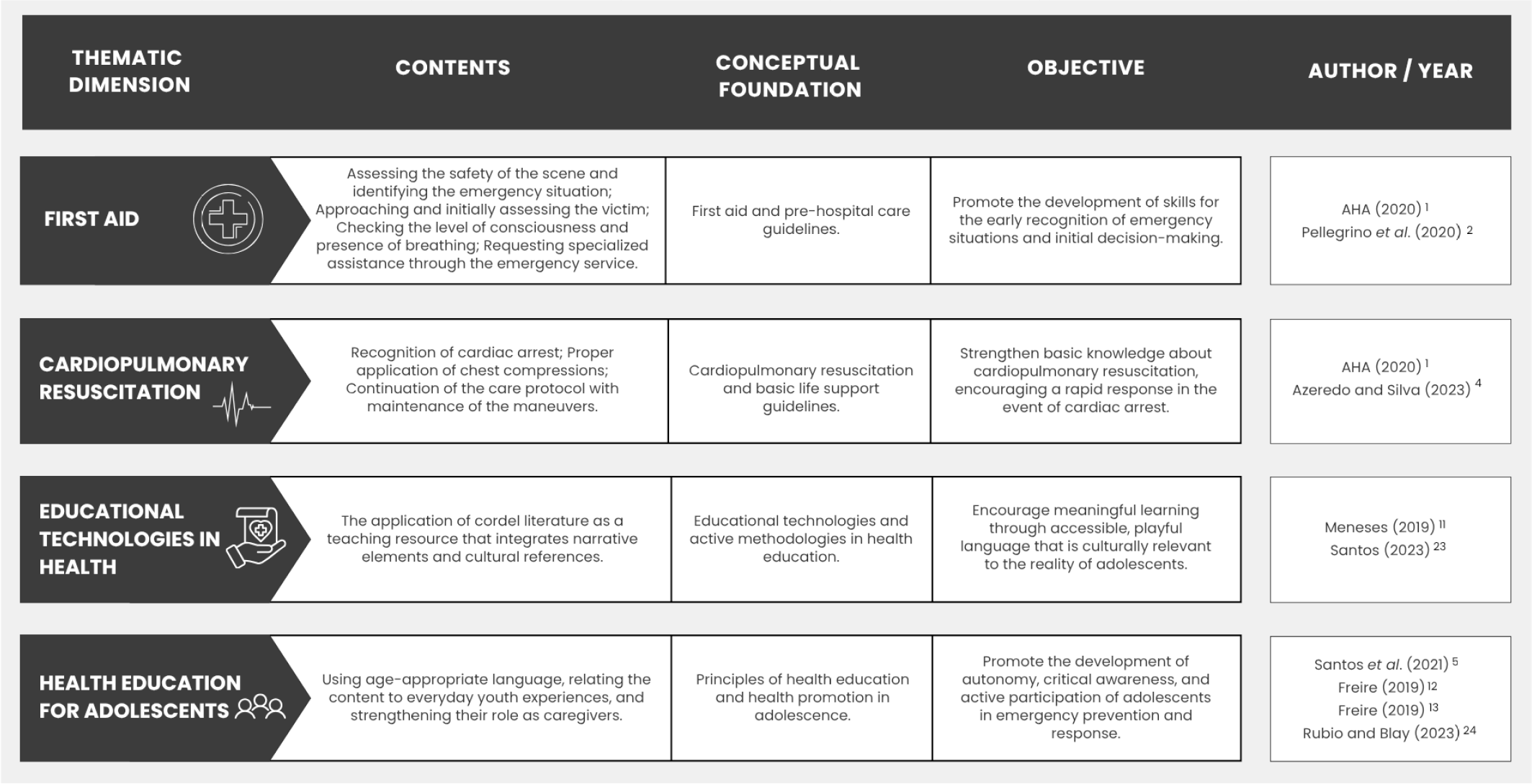
Within the conceptual domain, the educational material modeling was based on information obtained from the focus group and scientific evidence identified in the literature. This process enabled the definition of the contents addressed in the booklet, including aspects related to first aid, CPR, and health education for adolescents, grounded in ETs (Figure 1).
Conceptual structure of the educational cordel booklet on assistance in cardiopulmonary arrest. Recife, Pernambuco, Brazil, 2023 Source: The authors (2023).
In terms of navigation, the content was organized sequentially throughout the cordel narrative, allowing a logical progression of information about CPA recognition and first aid procedures.
In terms of interface, the use of a cordel literary style favored the presentation of content in accessible language, incorporating cultural elements. The work was structured in 29 sextets, meaning each stanza has six verses, and regarding rhyme, only the second, fourth, and sixth verses rhyme with each other. As for meter, each verse has seven poetic syllables. With 13 pages, the primer incorporated language representative of northeastern Brazilian culture through illustrations based on woodcuts, highlighting Brazilian cultural roots.
During the implementation stage, adolescents required approximately five to ten minutes to read the material at a comfortable pace. After reading the booklet, the presence of a mediator contributed to encouraging critical reflection about both the content and the cordel language.
Fifteen experts participated in the content and appearance validity process. Most participants were female (86.7%), with a mean age of 32.6 years (SD = 5.35), ranging from 26 to 42 years. In terms of teaching experience, ten experts (66.7%) currently taught or had previously taught subjects related to first aid; seven (46.7%) had experience developing, supervising, or assessing ETs; and three (20%) were experts in cordel literature. As the technology included a cultural approach, all experts were from northeastern Brazil, including the states of Ceará, Maranhão, Paraíba, and Pernambuco.
Different aspects of the booklet were assessed during the validity process. In the appearance assessment, CI was 14.28 and I-CVI was 0.95. In the content assessment, CI was 13.50 and I-CVI was 0.97. As for relevance, CI was 13.66 and I-CVI was 0.91. In verbal language assessment, CI was 14.5 and I-CVI was 0.96, demonstrating high concordance among experts regarding the adequacy of the assessed items, with a total I-CVI of 0.95.
The booklet was revised according to experts’ suggestions. As for appearance, the pages were standardized in black and white, following the traditional format of cordel booklets. None of the experts considered the included content unnecessary, and suggestions involving the inclusion of additional relevant topics were incorporated. To improve relevance, specific terms were replaced and the illustrations demonstrating the maneuvers were refined. Regarding verbal language, experts highlighted the importance of the material and its potential applications among adolescents, as described in Chart 1.
Experts’ suggestions for improving the educational booklet. Recife, Pernambuco, Brazil, 2023
Among the 20 participating adolescents, 11 (55%) were male, with a mean age of 12.5 years (SD = 0.96), ranging from 12 to 14 years. Regarding skin color, eight (40%) self-identified as white, seven (35%) as mixed-race, and five (25%) as black. Concerning school grade, eight students (40%) were in the 8th grade, five (25%) in the 6th grade, four (20%) in the 7th grade, and three (15%) in the 9th grade. In addition, 16 participants (80%) had never repeated a school year.
Different aspects of the booklet were also assessed by the adolescents. In the appearance assessment, CI was 18.37 and I-CVI was 0.92. In the content assessment, CI was 19.22 and I-CVI was 0.95. Regarding relevance, CI was 19.0 and I-CVI was 0.95. In the language assessment, CI was 19.25 and I-CVI was 0.96, indicating high concordance among adolescents regarding the adequacy of the assessed items, with a total I-CVI of 0.94.
The booklet was revised to improve its appearance based on adolescents’ suggestions, especially by increasing the font size throughout the material. Some adolescents found the black-and-white color pattern unusual; however, most approved the choice because it resembled the traditional woodcut illustrations commonly found in cordel booklets.
As for semantic assessment, most adolescents approved the contextualization of the topic, storyline, and cordel verses within the school setting. In relation to verbal language, participants approved the use of cordel literature, expressed greater interest in reading the material, and highlighted the importance of incorporating cultural approaches into health education in schools. Adolescents’ suggestions were considered to improve the adequacy of the booklet for the target audience. The main suggestions are presented in Chart 2.
Adolescents’ suggestions for improving the educational booklet. Recife, Pernambuco, Brazil, 2023
During the distribution stage, the school setting was defined as the priority setting for application of the educational booklet. However, the material also has potential for use in other relevant settings, such as Family Health Units and neighborhood associations, and may be distributed in printed or digital formats.
The final version of the cordel booklet entitled “A Quase Morte do Vaqueiro” (“The Cowboy’s Near Death”) is available on YouTube®25.
DISCUSSION
The educational booklet entitled “A Quase Morte do Vaqueiro” (“The Cowboy’s Near Death”) proved to be an important tool for health education, as it achieved high levels of concordance among both experts and adolescents in all assessed domains, demonstrating the relevance and adequacy of the developed ET. Another important aspect was the refinement of the booklet based on the suggestions obtained during the validity process.
Scientific evidence suggests that health education initiatives become more effective when culturally sensitive pedagogical approaches are adopted. The dissemination of health-related knowledge, when aligned with the linguistic and sociocultural realities of individuals, contributes to strengthening positive practices. Such strategies encourage community engagement and promote the active participation of school adolescents, who may act as disseminators of health knowledge26.
In this context, the development of ETs, such as the booklet proposed in this study, may contribute to raising adolescents’ awareness and empowering them to positively intervene within their communities through access to knowledge5. These tools also encourage citizenship practices and social protagonism by preparing adolescents to provide first aid in CPA situations3-4.
CPR is a first aid intervention technique used in victims of CPA, especially in situations where immediate medical assistance is unavailable. Disseminating theoretical and practical CPR knowledge among adolescents may increase their motivation to recognize emergency situations and intervene appropriately during cardiovascular emergencies27.
ETs also play an important role in promoting health literacy, which is related to individuals’ ability to make informed decisions focused on their well-being. These tools favor the critical and dialogical construction of knowledge by encouraging interaction and reflection among individuals, making information more accessible, understandable, and meaningful24.
The cordel booklet developed in this study was predominantly structured using seven-syllable verses, following the traditional style of northeastern Brazilian cordel literature23. This literary genre is characterized by accessible language and sensitivity to the population’s cultural characteristics, which supports its use as a health communication strategy. In this regard, the development of educational cordel booklets to support healthcare institutions has become increasingly common. In one such experience, researchers used cordel literature to deliver welcoming messages focused on the mental health of mothers with newborns hospitalized in neonatal units, while also providing guidance regarding measures adopted during the COVID-19 pandemic28.
Freire’s theoretical framework characterizes education as a dialogical, critical, and emancipatory process that opposes passive learning by valuing interaction, reflection on social reality, and the development of autonomy among individuals capable of transforming their reality. Within this perspective, cordel literature represents an important cultural resource for developing critical awareness because it integrates culture and tradition into its narrative structure. The connection between cordel narratives and everyday experiences favors meaningful learning processes12-13.
Based on the validity process conducted with experts and the assessment performed by adolescents, the booklet in cordel literature format fulfilled its proposed objectives and proved to be a relevant ET for teaching first aid procedures in cases of CPA. The material demonstrated satisfactory appearance, relevant content, and accessible language for the target audience, reinforcing its educational and cultural potential.
The limitations of this study include its development within a single educational institution and the small convenience sample of adolescents. These factors may have introduced selection bias and limited the generalizability of the findings, since the results may reflect characteristics specific to the investigated context. The absence of an additional assessment round may also represent a limitation in the validity process. Furthermore, expert selection through snowball sampling may have contributed to a geographically homogeneous sample, limiting the diversity of perspectives. However, this characteristic may also be related to the regional nature of the cultural expression explored in the study.
Future studies should investigate the use of this ET in other educational settings using larger and more diverse samples. This may allow assessment of the applicability and effectiveness of the booklet in different scenarios, including healthcare services and community spaces. From a practical perspective, dissemination strategies for the developed technology include providing the material in digital format for teachers and Primary Health Care professionals, facilitating its incorporation into health education activities.
CONCLUSION
This study described the development and validity of an educational booklet for school adolescents on assistance to victims of CPA using cordel literature as a linguistic strategy. The assessment results, together with experts’ suggestions for improvement, demonstrated the relevance of the developed technology. In addition, the target audience’s assessment reinforced the potential of this tool to facilitate the teaching-learning process.
Since the material may be used in both printed and digital formats, it can be considered a no-cost or low-cost resource for reproduction. The use of popular, playful, and attractive language through traditional cordel verses makes the content more understandable for the target audience. However, further studies are needed to assess the effectiveness of the developed ET in different educational contexts, including extracurricular settings. It is concluded that teaching technical-scientific content through cordel language adds a playful dimension to learning and contributes to valuing Brazilian intangible cultural heritage in dialogue with Freire’s principles of Popular Health Education.
This study was supported by the Brazilian National Council for Scientific and Technological Development under Protocol 3191253640965853.
-
HOW TO REFERENCE THIS ARTICLE:
de Oliveira SRDE, de Araújo LES, Compagnon MC, Santos KRM, Barbosa KPM, de Vasconcelos EMR, et al. Development of an educational booklet using cordel literature for cardiopulmonary resuscitation assistance. Cogitare Enferm [Internet]. 2026 [cited “insert year, month and day”];31:e101758en. Available from: https://doi.org/10.1590/ce.v31i0.101758en
Data availability:
The authors declare that all data are fully available within the article.
References
-
1 American Heart Association. Highlights of the 2020 American Heart Association guidelines for cardiopulmonary resuscitation and emergency cardiovascular care (CPR & ECC) [Internet]. Dallas (TX): American Heart Association; 2020 [cited 2023 oct 20]. Available from: https://cpr.heart.org/-/media/cpr-files/cpr-guidelines-files/highlights/hghlghts_2020_ecc_guidelines_english.pdf
» https://cpr.heart.org/-/media/cpr-files/cpr-guidelines-files/highlights/hghlghts_2020_ecc_guidelines_english.pdf -
2 Pellegrino JL, Charlton NP, Carlson JN, Flores GE, Goolsby CA, Hoover AV, et al. American Heart Association and American Red Cross focused update for first aid. Circulation [Internet]. 2020 [cited 2023 Oct 16];142(17):e287-303. Available from: https://doi.org/10.1161/CIR.0000000000000900
» https://doi.org/10.1161/CIR.0000000000000900 -
3 da Silva MSGO, Ferreira MMSV, Rodrigues AM, de Sousa CNS. Knowledge of secondary school students about basic life support. Cogitare Enferm [Internet]. 2024 [cited 2025 Jul 21];29:e94687. Available from: https://doi.org/10.1590/ce.v29i0.96830
» https://doi.org/10.1590/ce.v29i0.96830 -
4 Azeredo GO, da Silva RFA, Nunciaroni AT, Ferreira CSX, Corrêa VAF. Telesimulation as a remote teaching method for cardiopulmonary resuscitation: experience report. Cogitare Enferm [Internet]. 2023 [cited 2025 Mar 16];28:e89437. Available from: https://doi.org/10.1590/ce.v28i0.89437
» https://doi.org/10.1590/ce.v28i0.89437 -
5 Santos TA, de Araújo BFP, Brandão Neto W, de Araújo EC, de Vasconcelos EMR, Monteiro EMLM. Leading role of adolescents in the creation of a storyboard for a digital game on leprosy. Cogitare Enferm [Internet]. 2021 [cited 2025 Mar 16];26:e71478. Available from: https://doi.org/10.5380/ce.v26i0.71478
» https://doi.org/10.5380/ce.v26i0.71478 -
6 Araújo KC, de Souza AC, da Silva AD, Weis AH. Educational technologies for health approaches to adolescents: an integrative review. Acta Paul Enferm [Internet]. 2022 [cited 2025 Mai 25];35:eAPE003682. Available from: http://dx.doi.org/10.37689/acta-ape/2022AR03683
» http://dx.doi.org/10.37689/acta-ape/2022AR03683 -
7 Borges AVSS, de Matos MA, Souza JHB, Freire KRFS, Sousa FRD, Florentino VDJ. Construction and validation of educational technology for hiv/aids prevention in women deprived of freedom. Cogitare Enferm [Internet]. 2023 [cited 2025 Mai 25];28:e89509. Available from: https://doi.org/10.1590/ce.v28i0.89509
» https://doi.org/10.1590/ce.v28i0.89509 -
8 Cunha MBS, da Frota KC, Ponte KMA, Felix TA. Construction and validation of an educational booklet to provide care for snakebite victims. Rev Gaúcha Enferm [Internet]. 2020 [cited 2025 Aug 8];41:e20190467. Available from: https://doi.org/10.1590/1983-1447.2020.20190467
» https://doi.org/10.1590/1983-1447.2020.20190467 -
9 Belém JM, Vieira CMS, Ferreira Junior AR, Machado SP, da Silva MRF. Public Health and Collective Health discussed in cordel literature: possibilities for the teaching-learning process, Interface (Botucatu) [Internet]. 2025 [cited 2025 Nov 17];29:e250149. Available from: https://www.scielosp.org/article/icse/2025.v29/e240574/
» https://www.scielosp.org/article/icse/2025.v29/e240574/ -
10 de Melo DV, de Góz PMV, Campos LAA, de Lima KEC. Sequência didática e o uso de literatura de cordel como recurso pedagógico no ensino da prevenção de Doenças Transmitidas por Alimentos (DTA). Ciência & Educação (Bauru) [Internet]. 2025 [cited 2025 Nov 17];31:e25024. Available from: https://doi.org/10.1590/1516-731320250024
» https://doi.org/10.1590/1516-731320250024 -
11 de Meneses UTB. A literatura de cordel como patrimônio cultural. Rev Inst Estud Bras [Internet]. 2019 [cited 2023 Oct 16];(72):225-44. Available from: https://doi.org/10.11606/issn.2316-901X.v0i72p225-244
» https://doi.org/10.11606/issn.2316-901X.v0i72p225-244 - 12 Freire P. Pedagogia do oprimido. 95th ed. Rio de Janeiro: Paz e Terra; 2019. 256 p.
- 13 Freire P. Pedagogia da autonomia: saberes necessários à prática educativa. 74th ed. Rio de Janeiro: Paz e Terra; 2019. 144p.
-
14 Falkembach GAM. Concepção e desenvolvimento de material educativo digital. Renote [Internet]. 2005 [cited 2023 Jun 12];3(1). Available from: https://doi.org/10.22456/1679-1916.13742
» https://doi.org/10.22456/1679-1916.13742 -
15 Rahimi S, Khatooni M. Saturation in qualitative research: an evolutionary concept analysis. Int J Nurs Stud Adv. [Internet]. 2024 [cited 2025 Dec 14];6:100174. Available from: https://doi.org/10.1016/j.ijnsa.2024.100174
» https://doi.org/10.1016/j.ijnsa.2024.100174 - 16 Lefèvre F, Lefèvre AMC. O discurso do sujeito coletivo: um novo enfoque em pesquisa qualitativa (desdobramentos). 1th ed. Porto Alegre: Educs; 2003. 256p.
-
17 Dias VC, Rodrigues IAN. Assessment practices in times of emergency educational experiences: difficulties when planning. Rev Bras Aprendiz Aberta Distância [Internet]. 2021 [cited 2023 Sept 2];1:e388. Available from: https://doi.org/10.17143/rbaad.v20i1.489
» https://doi.org/10.17143/rbaad.v20i1.489 -
18 COPE Council. COPE position - Authorship and AI - English [Internet]. Committee on Publication Ethics; 2024 [cited 2025 Dec 16]. Available from: https://doi.org/10.24318/cCVRZBms
» https://doi.org/10.24318/cCVRZBms -
19 de Medeiros EGMS. Construção e validação do jogo da memória para a promoção do autocuidado de idosos ao HIV/Aids à luz da Teoria de Dorotheia Orem [dissertation on the Internet]. Recife: Universidade Federal de Pernambuco; 2020 [cited 2023 Mar 20]. 88 p. Available from: https://repositorio.ufpe.br/handle/123456789/38654
» https://repositorio.ufpe.br/handle/123456789/38654 -
20 Lopes MVO, da Silva VM, de Araújo TL. Methods for establishing the accuracy of clinical indicators in predicting nursing diagnoses. Int J Nurs Knowl [Internet]. 2012 [cited 2023 Mar 20];23(3):134-9. Available from: https://doi.org/10.1111/j.2047-3095.2012.01213.x
» https://doi.org/10.1111/j.2047-3095.2012.01213.x - 21 Fehring RJ. The Fehring model. In: Carrol-Johnson RM, Paquete M. Classification of nursing diagnoses: proceedings of the tenth conference. philadelphia: J.B. Lippincott; 1994. p. 55-62.
- 22 Flanagan JM, Beck CT. Polit & Beck’s nursing research: generating and assessing evidence for nursing practice. 12th ed. Philadelphia: Wolters Kluwer; 2024. 814 p.
-
23 Santos VM. Cordel: oralidade e escrita em fluxo. Jangada [Internet]. 2023 [cited 2025 Apr 12];10(2):214-27. Available from: https://doi.org/10.35921/jangada.v1i20.470
» https://doi.org/10.35921/jangada.v1i20.470 -
24 Rubio MDN, Blay C. Health literacy in children and adolescents: a review of the state of the art. Med Res Arch [Internet]. 2023 [cited 2025 Dec 14];11(6):1-9 Available from: https://doi.org/10.18103/mra.v11i6.3882
» https://doi.org/10.18103/mra.v11i6.3882 -
25 Cartilha Educativa. A quase morte do vaqueiro. Cordel [Internet]. YouTube;2025 [cited 2025 Oct 21]. Vídeo: 5:59 min. Available from: https://www.youtube.com/watch?v=mTbGr50_fCU
» https://www.youtube.com/watch?v=mTbGr50_fCU -
26 Wiedermann CJ, Rina P, Barbieri V, Piccoliori G, Engl A. Integrating a strategic framework to improve health education in schools in south tyrol, Italy. Epidemiologia [Internet]. 2024 [cited 2025 Dec 12];5(3):371-384. Available from: https://doi.org/10.3390/epidemiologia5030027
» https://doi.org/10.3390/epidemiologia5030027 -
27 Hamednia M, Yaghoobzadeh A, Moradzadeh R, Sayahi S. Evaluation of the effectiveness of basic cardiopulmonary resuscitation training on willingness to perform CPR among high school students. BMC Cardiovasc Disord [Internet]. 2025 [cited 2025 Dec 12];25:341. Available from: https://doi.org/10.1186/s12872-025-04783-9
» https://doi.org/10.1186/s12872-025-04783-9 -
28 Chaves AFL, da Cunha ALA, Santos BKO, do Nascimento BM, dos Santos LL, Frota NM, et al. String literature to support mothers with children admitted to a neonatal unit during the COVID-19 pandemic. Cogitare Enferm [Internet]. 2021 [cited 2024 Apr 15];26:e76209. Available from: https://doi.org/10.5380/ce.v26i0.76209
» https://doi.org/10.5380/ce.v26i0.76209
-
Associate editor:
Dr. Gilberto Tadeu Reis da Silva