
 Floristics and phytosociology of models ecological restoration intercropped with Eucalyptus in the Brazilian Atlantic Forest
ABSTRACT
This work aimed to evaluate the effectiveness of forest restoration combined or not with eucalyptus in the floristic and in the phytosociological recovery and in the species diversity. Three of them were managed with the following forest restorations: natural regeneration after clear cutting of eucalyptus plantations (RPA), planting of native species after clear cutting of eucalyptus plantations (RMA) and planting of native species after cutting 50% of eucalyptus plantations. eucalyptus (RAR), and a fourth stand consisting of a secondary forest (REF). The floristic and phytosociological data were collected in ten plots of 25 × 25 m in each stand. The active restoration with native forest species (RAM) was better than the restorations with eucalyptus (RAR and RPA), when analyzed using diversity, evenness and floristic composition indices, but they were not similar to the Secondary Forest area (REF). In areas undergoing forest restoration, even after ten years of implementation, the structural attributes similar to those in the Secondary Forest area were not verified. The use of restorations with native forest species in consortium with eucalyptus were not able to promote a recovery of the species diversity and structure. Restoration with the planting of native species without the presence of eucalyptus can recover species diversity and establish ecological succession in the Atlantic Forest. However, it was unable to restore the structure similar to a secondary forest.
Keywords:
Recovery of degraded areas; Species diversity; Ecological succession
RESUMO
Este trabalho teve como objetivo avaliar a eficácia da restauração florestal consorciada ou não com eucalipto no restabelecimento da florística e estrutura de espécies florestais. Três sítios foram manejados com as seguintes restaurações florestais: regeneração natural após corte raso de plantio de eucalipto (RPA), plantio de espécies nativas após corte raso de plantio de eucalipto (RAM) e plantio de espécies nativas após corte de 50% do eucalipto plantado (RAR), e uma quarta área de floresta secundária (REF). Dados florísticos e da estrutura foram coletados em dez parcelas de 25 × 25 m em cada sítio. A RAM foi melhor que RAR e RPA quando analisada com o emprego dos índices de diversidade, equabilidade e composição florística, porém não foi similar à REF. Nas áreas de restaurações florestais, mesmo após dez anos de implantação, não foram verificados atributos da estrutura semelhantes aos da área de REF. O uso de restaurações com espécies florestais nativas consorciadas com eucaliptos não foi capaz de promover uma recuperação da diversidade de espécies e estrutura. A restauração com plantio de espécies nativas sem a presença de eucalipto pode recuperar a diversidade de espécies e estabelecer a sucessão ecológica na Mata Atlântica, porém não foi capaz de restaurar a estrutura similar a uma floresta secundária.
Palavras-chave:
Recuperação de áreas degradadas; Diversidade de espécies; Sucessão ecológica
1 INTRODUCTION
In forest restoration, passive or active models can be used. Although the methods predict the closest possible return to the conditions observed in the original ecosystem, the restoration projects being carried out in the Atlantic Forest face several problems due to the lack of diagnoses that consider the management of the areas and due to the lack of monitoring (Rodrigues et al., 2009). In the active restoration model, where native seedlings are introduced, it is desirable that silvicultural treatments are carried out, in addition to monitoring in order to guarantee greater biodiversity (Rodrigues et al., 2009). On the other hand, in the passive model, it is based exclusively on natural regeneration, only requiring fencing and forest protection in some cases (Zahawi; Reid; Holl, 2014).
In the case of studies with active or passive restorations in the Atlantic Forest, there is a consensus among researchers that passive models, despite being slower and generally accumulating less carbon in aerial biomass and using a lower diversity of forest species, are more advantageous in terms of low restoration costs (Brancalion et al., 2016; Zahawi; Reid; Holl, 2014). In active and passive restoration models, the consortium species with timber potential, native or exotic, such as eucalyptus can also be used (Brancalion et al., 2021). These essences can, in addition to contributing to the supply of wood, promote carbon storage and the recovery of the soil's chemical and physical properties. However, within this context, the influence of Eucalyptus on species diversity in the forest ecosystem is discussed on how it can help or harm ecological succession in areas subject to forest restoration (Brancalion et al., 2021).
In Brazil, there has long been a debate about incentive strategies for the restoration of the Atlantic Forest, guaranteeing the maintenance of its biodiversity. Forest restoration programs, such as the National Plan for the Recovery of Native Vegetation - PLANAVEG, try to encourage the planting of native and exotic plants so that goals in the country are achieved (Bustamante et al., 2019). Government initiatives are considered modest compared to the goals assumed, in addition to facing the problem of lack of resources, since the restoration of degraded areas is costly and for each situation a method is recommended (Bustamante et al., 2019).
In areas of mixed plantations of Eucalyptus grandis and Eucalyptus urophylla with a high diversity of native forest species in the Atlantic Forest, Amazonas; Forrester et al. (2018) observed that there was competition for resources such as water, light and nutrients with Eucalyptus, slowing the growth of native species. However, this was not enough to affect their survival or outperform native trees. According to the aforementioned authors, forest restorations with a high diversity of native forest species in the consortium with Eucalyptus can be used to restore Permanent Preservation Areas (APP), where Eucalyptus can be managed to generate income.
It should be noted that many of the negative effects attributed to the presence of Eucalyptus in areas of growth and natural regeneration of native trees depend on the characteristics of the production system, the structure of the landscape, the soil and the climate in which they are cultivated, and not the effects promoted by Eucalyptus itself. In the Atlantic Forest of Northern Espírito Santo and Bahia, in Semideciduous Seasonal Forest, Eucalyptus can become important allies in the restoration of tropical forests, and their use and investment opportunities should be considered within the portfolio of options supported by financing public and private policies (Brancalion et al., 2021).
Most changes in soil chemical and physical properties in response to degradation and restoration depend on the reestablishment and the development of the plant community and the ecological succession (Guareschi et al., 2014; Castelli et al., 2015). According to the level of degradation and the distance from propagule sources, degraded and/or disturbed areas may respond in different ways, depending on the type of the forest restoration and the management. Thus, in forest restorations, the floristic and phytosociological composition can be different from natural ecosystems (Dodonov; Silva; Rosatti, 2014). In this context, this work aimed to evaluate the effectiveness of forest restoration combined or not with eucalyptus in reestablishing floristics and vegetation structure.
2 MATERIALS AND METHODS
2.1 Description of the study area
The study areas are located at Fazenda Rio Fundo (Rio Fundo farm) (11º06'30” South latitude and 37º19'60” West longitude) in the municipality of Itaporanga d´Ajuda and on the Rural Campus of the Federal University of Sergipe state (UFS) (10° 55' South latitude and 37°11' West longitude) in the municipality of São Cristóvão, both in the state of Sergipe. The climate in the four study areas is tropical with a dry summer season (As) with six or more dry months and an average temperature above 18°C throughout the year (Alvares et al., 2013).
The relief is mainly made up of gentle hills. The original vegetation is the Atlantic Forest Semideciduous Seasonal Forest (IBGE, 2012). The vegetation that occurs in the study region is a forest typology that includes semi-deciduous and deciduous species such as: ingá (Inga uruguensis), amescla (Protium heptaphyllum), embiruçu (Pseudobombax grandiflorum), embaúba (Cecropia pachystachya) and murici (Byrsonima crassifolia) (Fontes, 2010). The soil in the four study areas was classified as Red Yellow Argisol, A moderate with sandy loam texture (EMBRAPA, 2013).
2.2 Description of successional forest restoration models
Rio Fundo farm has 1,563.44 ha and belongs to an industrial pulp and paper company in the municipality of Itaporanga d’Ajuda, SE state. The main activity at Rio Fundo farm is the planting of Eucalyptus urophyla for firewood production.
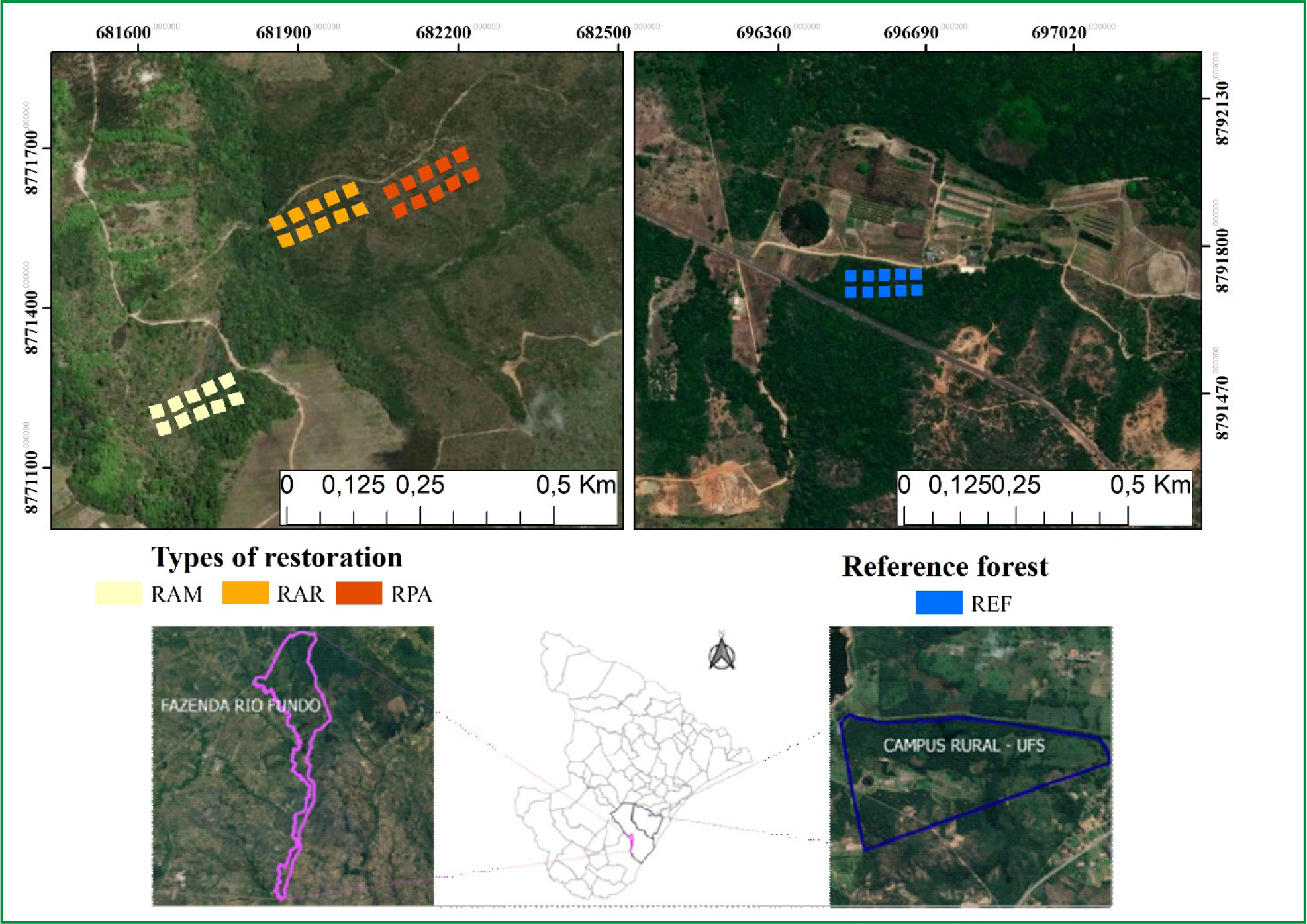
In 2012, Rio Fundo farm had an environmental liability, requiring restoration to comply with current environmental legislation due to the deforestation of APP areas. In 2013, the farm managers implemented 38.63 ha of forest restoration (Figure 1). In this way, a set of active and passive forest restorations were carried out. Three forest restoration areas were implemented in 2013 when the eucalyptus plantations were 7 years old. These eucalyptus plantations did not undergo any cutting or rotation until 2013. A secondary forest located on the UFS Rural Campus in the municipality of São Cristóvão, SE state, 8 km away from the forest restorations, was also used as a reference ecosystem.
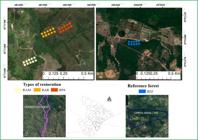
Location map of plots allocated at Rio Fundo farm, Itaporanga d’Ajuda and at the Rural Campus of the Federal University of Sergipe, São Cristóvão, Sergipe state, Brazil
In the first forest restoration area, all eucalyptus trees were cut with a chainsaw and the logs were removed manually, leaving the area completely deforested. In the same month, 32 native tree species were planted, spaced 4 x 4 m apart. This treatment was called Active Restoration (RAM) and consists of planting native species after clear-cutting eucalyptus plantations.
The following species were planted: Anadenanthera colubrina, Centrolorobium robustum, Eritroxyllum deciduum, Swartizia apetala, Himatanthus bracteatus, Strypnodendron pulcherrinum, Eschweilera ovata, Cupania vernalis, Cupania oblongfolia, Cecropia pachystachya, Eriotheca pubencens, Inga laurina, Inga marginata, Inga vera, Miconia cinnamomifollia, Guapira opposita, Didymopanax morototonii, Erythrina velutina, Byrsonima sericea, Myrcia selloi, Guazuma ulmifolia, Tapirira guianensis, Vismia brasiliensis, Himatanthus bracteatus, Apeiba tibourbou, Tibouchina granulosa, Mimosa caesalpinifolia, Sapindus saponária, Curatella americana, Samanea tubulosa, Pterodum emarginatus and Aegiphila klotzchiana.
In the second forest restoration area, 50% of the eucalyptus individuals were thinned using a chainsaw and the logs were removed manually. Subsequently, at the removed eucalyptus sites, 32 native tree species were planted (4 x 4 m spacing), the same species being planted in RAM. This area received the acronym “RAR” because it is characterized by the planting of native species after cutting down 50% of the eucalyptus individuals.
In the third forest restoration area, the eucalyptus was cleared with a chainsaw and the logs were removed manually. However, there was no planting of native trees and the area was fenced to encourage natural regeneration. Due to the technique used, this area was classified as Passive Restoration (RPA).
It should be noted that all activities (eucalyptus cutting and planting of native species, fencing) linked to RAM, RPA and RAR restorations were carried out between March and June 2013.
We considered a fourth area, which has the same forest typology (Semideciduous Seasonal Forest), soil type and topography as the ecological restoration areas mentioned in this study, which is located on the UFS Rural Campus, 8 km away from the other areas. It consists of a fragment of secondary forest in the initial stage of succession. This area was called secondary forest (REF) and was used as a reference ecosystem. It is noteworthy that data collection was carried out in the four areas described.
2.3 Collection of floristic and phytosociological data
In 2022, ten square plots (25 × 25 m) were demarcated, 50 m equidistant from each other in each treatment, using systematic sampling with plots of fixed area (Figure 1). In each plot, the circumference at breast height (CAP) of all trees was measured at 1.30 m from the ground and subsequently transformed into diameter at breast height (DBH).
CAP was measured with a tape measure. In the plots, all individuals above 5 cm CAP were measured. The total height (H) values of the trees were collected with a 10 m graduated (telescopic) pole. Trees larger than 10 m were measured with a digital clinometer.
To identify the species, botanical collections were made, which were later identified through botanical literature, in addition to the assistance of a parabotanist. Species not identified in the field were collected and identified by comparison in the herbarium of the Federal University of Sergipe state. The botanical nomenclature was based on APG IV (APG IV, 2016).
The Shannon diversity index (H´) was calculated for each area, using Equation (1) (Souza; Soares, 2013):
Where: H´ is the Shannon index and pi is the proportion of individuals belonging to species i.
Pielou's equability (J) was calculated using Equation (2) (Souza; Soares, 2013):
The tree species inventoried were classified according to ecological groups, namely: pioneer and initial secondary (very fast growth rates, demanding on light, colonizers of gaps, seed bank and short useful life); late secondary (medium growth rates, shade tolerant, seedling bank and medium shelf life) and climax (slow growth rates, shade tolerant, seedling bank, large seeds and long shelf life) (Budowski, 1965).
2.4 Statistical analysis
To verify normality and homoscedasticity for the diversity and structure parameters, the Shapiro-Wilk and Barlett tests were applied. Subsequently, the data were subjected to analysis of variance (ANOVA), adopting a significance level of 5%. A Tukey test was performed at 5% significance for the diversity and structure parameters. The experimental design used was completely randomized. The data obtained in each plot within an area was considered a replication. There are 10 plots (replications) in each study area.
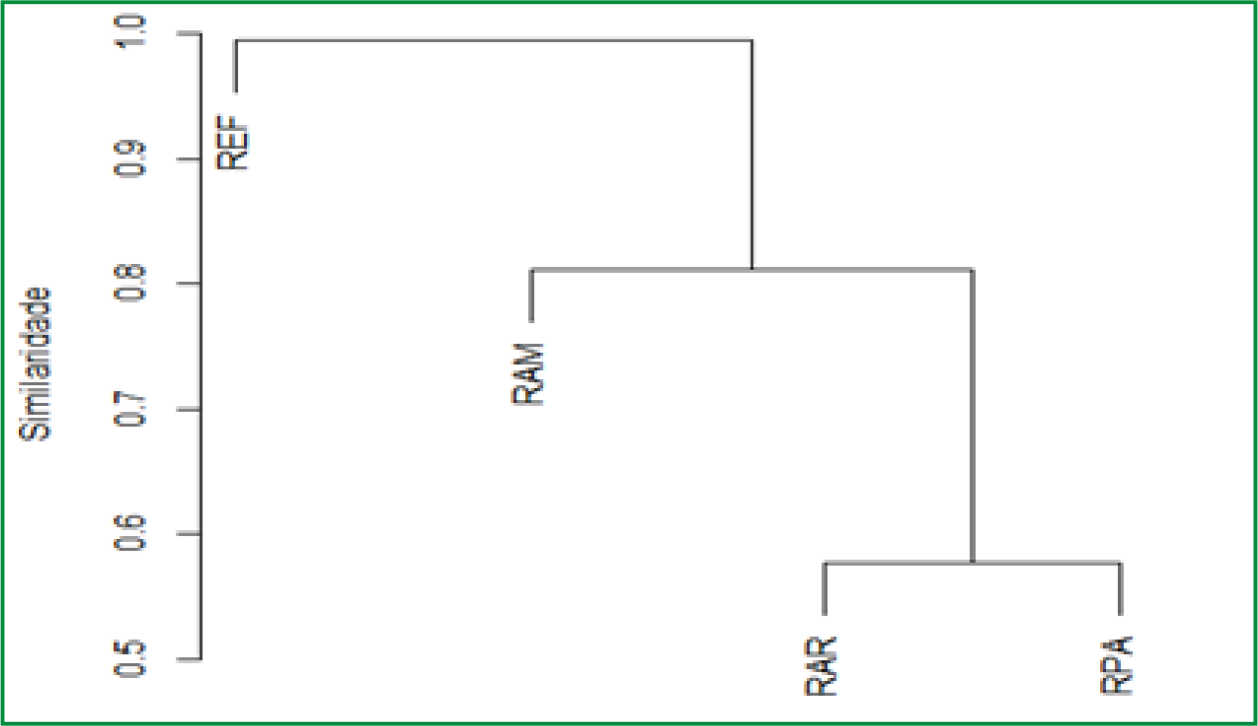
The floristic similarity between the fragments was determined, through cluster analysis, based on the basic presence/absence matrix of the sampled tree species. Euclidean distance was used as a measure of floristic similarity between the studied areas and a measure of simple connection (Ludwig; Reynolds, 1988).
3 RESULTS
One thousand, seven hundred and ninety-seven (1,797) tree individuals were inventoried, distributed in 59 species, and 26 families, being recorded in the 40 sampled plots, in a total sampled area of 25,000 m2 (2.5 ha). In REF, the largest number of trees was quantified, much higher than forest restorations (Tables 1, 2, 3 and 4). It appears that Curatella americana occurs in all areas under restoration with a high number of individuals. In REF, only two individuals were quantified. In the RAM area this species presented the highest IVI (Table 1). However, in the RAR and RPA areas, eucalyptus trees (Eucalyptus urophylla) have a greater number of individuals and IVI (Tables 2 and 3).
Floristic composition and phytosociological parameters active restoration area (RAM) in the municipality of Itaporanga d’Ajuda, Sergipe state, Brazil, 2022
Floristic composition and phytosociological parameters in an active restoration area (RAR) in the municipality of Itaporanga D’ajuda, Sergipe state, Brazil, 2022
Floristic composition and phytosociological parameters of the species sampled in a passive restoration area (RPA) in the municipality of Itaporanga D’Ajuda, Sergipe, Brazil, 2022
Floristic composition and phytosociological parameters in an area of initial secondary forest (REF) in the municipality of São Cristóvão, Sergipe state, Brazil, 2022
In RAM, 35 species were inventoried, in RAR, 22 species and in RPA, 11 species. The REF presents 29 species, with RAM being the only restoration that reached a number of species similar to the REF (Tables 1, 2, 3 and 4). It should be noted that RAM has the species Psidium guajava and Bambusa vulgaris, which are exotic species.
In the RAM area, 59% of pioneer species were observed, and 18% of late secondary and climatic species (Table 1). The highest percentage of late secondary and climatic species was found in the RAR area (Table 2). The largest number of initial and pioneer secondary species with 91% of its composition was quantified in the RPA area (Table 4). The RAM area presents superiority in the composition of climax and late secondary species with 15% and 26% respectively, which together correspond to 41% (Table 2).
It is observed that the REF presents characteristics of a secondary forest in the initial stage of succession, due to the greater dominance of initial secondary species, such as Cordia trichotoma, presenting DoR = 13.696 and IVI = 10%, and the presence of secondary and climax, to a lesser extent, such as Cupania vernalis with IVI=4.61, Byrsonima sericea with IVI=7.85, Duguetia lanceolata with IVI=3.73 and Pterodon emarginatus with IVI=5.16 (Table 4).
The studied areas were compared with a Tukey test at the level of 5% among themselves for each phytosociological parameter (Table 5). Among the restoration areas, in the RAM area, once it only has native species, after ten years of implementation, it was expected to find a structure similar to the REF area. The comparison between the studied areas of the phytosociological parameters, only RAM was similar to the REF in relation to the phytosociological parameter NE by the Tukey test at 5% significance. The RAR and RPA restorations did not present any phytosociological parameter statistically equal to the REF (Table 5).
RAM and REF were the ones with the highest Shannon diversity (SH) and significantly greater species uniformity (PI) compared to the RAR and RPA restoration areas (Table 5). In the RAM and REF areas, a more diverse and better distributed floristic composition was observed compared to the other restorations.
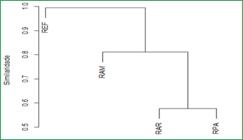
The RAR and RPA areas have a floristic similarity of 55% (Figure 3). It is observed that, among the 11 species found in RPA (Table 3), only three were not observed in the RAR area (Table 2): Eritroxyllum deciduum, Eriotheca pubencens and Samanea tubulosa. The RAM area showed greater similarity in relation to the REF, with 18% floristic similarity, while RAM with RAR and RPA was 22% (Figure 2).
4 DISCUSSIONS
From the analysis of floristic data from each area, it is observed that in the RAR and RPA areas, even after ten years, there is a predominance of eucalyptus, making it necessary to manage this species so that the forest restoration process used in the areas can favor ecological succession. The presence of the species Curatella americana stands out with a large number of individuals in forest restoration areas. Due to its performance and adaptive potential, it can be considered a colonizing or even nucleating species for the recovery of degraded areas. This finding demonstrates that the species has the capacity to adapt to adverse environmental conditions (Calgaro et al., 2015), and can be used in restoration projects in degraded areas.
In RAR and RPA areas, lower Shannon diversity and Pielou evenness values were determined due to the high number of eucalyptus individuals present, even after ten years of intervention. These two areas were more similar floristically, although the highest percentage of late secondary and climax species was observed in RAR. In RPA, the percentage was lower, due to the lower diversity of species, with a predominance of eucalyptus.
In RAM, the fact of not having any eucalyptus individuals favored greater diversity, evenness, a more diverse floristic composition and greater floristic similarity among the restoration areas compared to the REF area. In this way, it can be stated that in the RAM area a better process of ecological succession was observed, in floristic terms, among forest restorations once it presents greater species richness.
However, RAM did not reach a structure similar to REF. It is observed that species richness in RAM recovers before the structure. These results are in line with Londe et al. (2020), who observed that from 13 years onwards, ecological restorations in semi-deciduous seasonal forests in the Atlantic Forest reach height and basal area values similar to a secondary forest. While species richness is achieved in ecological restorations from the first years, compared to secondary forests.
Other studies have shown that eucalyptus does not impede the ecological succession. In a study on a 20-year-old Eucalyptus sp plot, without management, Correia et al. (2022) observed pioneer species in the upper extract and non-pioneer species of natural regeneration. In this same study, eucalyptus was observed only in the upper extract, demonstrating that it did not act as an invasive species and the area is undergoing a process of ecological succession.
Seubert et al. (2017), studying three areas under natural regeneration, characterized by different ages after removal of Eucalyptus grandis stands, observed that the pioneers suffered a decrease in the number of species, both in the arboreal and regenerative strata, while that the shade-tolerant climax species showed inflows with the advancing age of abandonment of the areas.
The eucalyptus in RAR allowed higher values of NI, H and AB, since 50% of the remaining eucalyptus individuals were not cut. In the RAM area, despite the higher NE value, high NI and AB values were not observed.
In the ecological restoration of ecosystems, the increased diversity is always associated with increased productivity (and consequent carbon and biomass stock), which is among the most important functions of the ecosystem (Rosa; Marques, 2022). Throughout the ecological succession, there is an increase in biomass in tropical forests due to the increase in the diversity of species from more advanced successional stages, which have greater volume and a long life cycle, consequently contributing to a greater stock of biomass and carbon (Chazdon, 2019).
The ecological paradigm of this association is that ecosystem biodiversity is positively related to both ecosystem functions and services (Rosa; Marques, 2022). However, the relationships between biodiversity, ecosystem functions and services vary spatially and temporally, which makes understanding these relationships relevant and important for practical restoration actions (Rosa; Marques, 2022). Therefore, there is a need for evaluations over a longer period of the phytosociological parameters of restorations (RAM, RAR and RPA) to confirm that a greater diversity of species will result in better floristic and structural attributes.
The Shannon diversity observed in this study can be considered high in RAM and REF compared to Rabelo et al. (2015), who obtained a Shannon index of 2.88 for a Dense Ombrophylous Forest in the Atlantic Forest, municipality of Igarassu, state of Pernambuco. The observed patterns demonstrate that in areas of passive restoration with eucalyptus, the regrowth must be suppressed, given that more than 50% of the individuals in RPA are from eucalyptus, which favors a lower Shannon diversity.
Eucalyptus in RAR and RPA may be competing for light, water and nutrients with forest species in the tree extract, inhibiting the advancement of ecological succession, given that 10 years after restoration, these two areas have a high percentage of eucalyptus individuals.
5 CONCLUSIONS
The use of restorations with native forest species in consortium with eucalyptus was not able to promote a recovery in the species diversity and in the vegetation structure.
The restoration with the planting of native species without the presence of eucalyptus can recover species diversity and establish the ecological succession in the Atlantic Forest. However, during the period evaluated, it was not able to restore the structure similar to that one of a secondary forest.
REFERENCES
-
ALVARES, C. A.; STAPE, J.; SENTELHAS, P. C.; GONÇALVES, J. L. M.; SPAROVEK, G. Köppen’s climate classification map for Brazil. Meteorologische Zeitschrift, v. 22, n. 6, pp. 711-728, 2013. Available from: https://www.schweizerbart.de/papers/metz/detail/22/82078/Koppen_s_climate_classification_map_for_Brazil
» https://www.schweizerbart.de/papers/metz/detail/22/82078/Koppen_s_climate_classification_map_for_Brazil -
AMAZONAS, N.T.; FORRESTER, D.I.; SILVA, C.C.; ALMEIDA, D.R.A.; RODRIGUES, R.R.; BRANCALION, P.H.S. High diversity mixed plantations of Eucalyptus and native trees: An interface between production and restoration for the tropics. Forest Ecology and Management, v. 417, p. 247-256, 2018. Available from: https://www.sciencedirect.com/science/article/pii/S037811271732042X Accessed in: 5 Out. 2023.
» https://www.sciencedirect.com/science/article/pii/S037811271732042X -
ANGIOSPERM PHYLOGENY GROUP. An update of the Angiosperm Phylogeny Group classification for the orders and families of flowering plants: APG IV, Botanical Journal of the Linnean Society, v. 181, n. 1, p. 1-20, 2016. Available from: https://academic.oup.com/botlinnean/article/181/1/1/2416499
» https://academic.oup.com/botlinnean/article/181/1/1/2416499 -
BRANCALION, P.H.S.; SCHWEIZER, U.G.; MANGUEIRA, J.R.; LAMONATO, F.; FARAH, F.T.; NAVE, A.G.; RODRIGUES, R.R. Brinde economic costs and ecological outcomes of passive and active restoration in agricultural landscapes: the case of Brazil. Biotropica, v. 48, n. 6, p.856-867, 2016. Available from: https://onlinelibrary.wiley.com/doi/10.1111/btp.12383 Accessed in: 5 Out. 2023.
» https://onlinelibrary.wiley.com/doi/10.1111/btp.12383 -
BRANCALION, P.H.S.; GUILLEMOT, J.; CÉSAR, R.G.; ANDRADE, H.S.; MENDES, A.; SORRINI, T.B.; PICCOLO, M.D.C.; PELUCI, M.C.; MORENO, V.D.S.; COLLETTA, G.; BRANCALION, P.H.S.; AMAZONAS, N.T.; CHAZDON, R.L.; MELLIS, J.V.; RODRIGUES, R.R.; SILVA, C.C.; SORRINI, T.B.; HOLL, K.D. Exotic eucalypts: From demonized trees to allies of tropical forest restoration? Journal of Applied Ecology, v. 57, n. 1, p. 55-66, 2021. Available from: https://besjournals.onlinelibrary.wiley.com/doi/full/10.1111/1365-2664.13513 Accessed in: 5 Out. 2023.
» https://besjournals.onlinelibrary.wiley.com/doi/full/10.1111/1365-2664.13513 -
BUDOWSKI, G. N. Distribution of tropical American rainforest species in the light of sucessión processes. Turrialba, Costa Rica, v. 15, n. 2, p. 40-52, 1965. Available from: https://search.worldcat.org/pt/title/distribution-of-tropical-american-rain-forest-species-in-the-light-of-successional-processes/oclc/708884645
» https://search.worldcat.org/pt/title/distribution-of-tropical-american-rain-forest-species-in-the-light-of-successional-processes/oclc/708884645 -
BUSTAMANTE, M.M.C.; SILVA, J.S.; SCARIOT, A.; SAMPAIO, A.B.; MASCIA, D.L.; GARCIA, E.; SANO, E.; FERNANDES, G.W.; DURIGAN, G.; ROITMAN, I.; FIGUEIREDO, I.; RODRIGUES, R.R.; PILLAR, V.D.; OLIVEIRA, A.O.; MALHADO, A.C.; ALENCAR, A.; VENDRAMINI, A.; PADOVEZI, A.; CARRASCOSA, H.; FREITAS, J.; SIQUEIRA, J.A.; SHIMBO, J.R.; GENEROSO, L.G.; TABARELLI, M.; BIDERMAN, R.; PAIVA SALOMÃO, R.; VALLE, R.; JUNIOR, B.; NOBRE, C. Ecological restoration as a strategy for mitigating and adapting to climate change: lessons and challenges from Brazil. Mitigation and Adaptation Strategies for Global Change, v. 24, n. 7, p.1249-1270, 2019. Available from: https://doi.org/10.1007/s11027-018-9837-5 Accessed in: 5 Out. 2023.
» https://doi.org/10.1007/s11027-018-9837-5 -
CALGARO, H.F.; BUZETTI, S.; SILVA, L.R.; STEFANINI, L.; MIRANDA, L.P.M.; MORAES, M.A.; MORAES, M.L.T. Distribuição natural de espécies arbóreas em áreas com diferentes níveis de antropização e relação com os atributos químicos do solo. Revista Árvore, v. 39, p. 233-243, 2015. Available from: https://www.scielo.br/j/rarv/a/QvRg35SKCfVCsxNL4TK4X7n/abstract/?lang=pt Accessed in: 5 Out. 2023.
» https://www.scielo.br/j/rarv/a/QvRg35SKCfVCsxNL4TK4X7n/abstract/?lang=pt -
CASTELLI, K.R.; BARRETO, M.G.; FRANCESCONI, W.; VALLE, L.D.; MONDELLI, G.; ABILIO, F.M.; SILVA, A.M. da. Analysis of effectiveness of three forest interventionist techniques and proposal of a new and integrated model of forest restoration. Environmental Technology, v. 36, n. 21, p. 1-33, 2015. Available from: https://pubmed.ncbi.nlm.nih.gov/25970012/ Accessed in: 5 Out. 2023.
» https://pubmed.ncbi.nlm.nih.gov/25970012/ -
CHAZDON, R.L. The cost of restoring carbon stocks in Brazil's Atlantic Forest. Land Degradation Development v.32, p.830- 841, 2019. Available from: https://onlinelibrary.wiley.com/doi/abs/10.1002/ldr.3764 Accessed in: 5 Out. 2023.
» https://onlinelibrary.wiley.com/doi/abs/10.1002/ldr.3764 - CORREIA, L. F.; ALVES, M. L.; CARVALHO, S. Z; PRADO, T. R.; SCABBIA, R. J. A. Restauração natural em talhão de Eucalyptus sp sem manejo: um estudo de caso. RESEARCH, SOCIETY AND DEVELOPMENT, v. 11, p.24-33, 2022.
-
DODONOV, P.; SILVA, D.M.; ROSATTI, N.B. Understorey vegetation gradient in a Eucalyptus grandis plantation between a savanna and a semideciduous forest. New Zealand Journal of Forestry Science, v.44, p.1-10, 2014. Available from: https://nzjforestryscience.springeropen.com/articles/10.1186/s40490-014-0010-y Accessed in: 05 Out 2023.
» https://nzjforestryscience.springeropen.com/articles/10.1186/s40490-014-0010-y -
EMBRAPA. Sistema brasileiro de classificação de solos Brasília, 3 ed. rev. ampl. - Brasília, DF: Embrapa, 2013. 353p. Available from: https://www.embrapa.br/solos/sibcs#:~:text=O%20SiBCS%20%C3%A9%20um%20sistema,%2C%20Subgrupo%2C%20Fam%C3%ADlia%20e%20S%C3%A9rie
» https://www.embrapa.br/solos/sibcs#:~:text=O%20SiBCS%20%C3%A9%20um%20sistema,%2C%20Subgrupo%2C%20Fam%C3%ADlia%20e%20S%C3%A9rie -
FONTES, J.A.C. Caracterização geoambiental da sub-bacia do rio Fundo São Cristovão: Universidade Federal de Sergipe, 2010. 120p. Dissertação mestrado. Available from: https://ri.ufs.br/handle/riufs/5623 Accessed in: 5 Out. 2023.
» https://ri.ufs.br/handle/riufs/5623 -
GUARESCHI, R.F.; PEREIRA, M.G.; ANJOS, L.H.C.; MENEZES, C.E.G.; CORREIA, M.E.F. Atributos químicos e físicos do solo sob pastagem e estádios sucessionais de floresta estacional. Revista de la Facultad de Agronomía (La Plata), v.113, p.47-56, 2014. Available from: https://core.ac.uk/reader/76479810 Accessed in: 5 Out. 2023.
» https://core.ac.uk/reader/76479810 - IBGE - Instituto Brasileiro de Geografia e Estatística. Manual técnico da vegetação brasileira Série manuais técnicos em Geociências 1. 2ª ed. Instituto Brasileiro de Geografia e Estatística, Rio de Janeiro, 2012. 275p.
-
LONDE, V.; TURINI, F. F.; RIBEIRO, R. R.; ROBERTO, M. F. Reference and comparison values for ecological indicators in assessing restoration areas in the Atlantic Forest. Ecological Indicators, v. 110, p. 1-9, 2020. Available from: https://www.sciencedirect.com/science/article/pii/S1470160X19309239?via%3Dihub#f0010
» https://www.sciencedirect.com/science/article/pii/S1470160X19309239?via%3Dihub#f0010 - LUDWIG, J. A; REYNOLDS, J. F. Statistical ecology: a primer on methods and computing New York: John Wiley & Sons, 1988. 337p.
-
RABELO, F. R. C.; RODAL, M. J. N.; SILVA, A. C. B. L.; PINTO, A. V. F. Dinâmica da vegetação em um fragmento de mata atlântica no nordeste do Brasil. Ciência Florestal, v. 25, p. 23-36, 2015. Available from: https://www.scielo.br/j/cflo/a/BXWn8Ywz7jGB6F5NCNJZ4Xb/?lang=pt
» https://www.scielo.br/j/cflo/a/BXWn8Ywz7jGB6F5NCNJZ4Xb/?lang=pt -
RODRIGUES, R.R.; LIMA, R.A.F.; GANDOLFI, S.; NAVE, A.G. On the restoration of high diversity forests: 30 years of experience in the Brazilian Atlantic Forest. Biological conservation, v. 142, n. 6, p.1242-1251, 2009. Available from: https://www.sciencedirect.com/science/article/pii/S0006320708004771 Accessed in: 5 Out 2023.
» https://www.sciencedirect.com/science/article/pii/S0006320708004771 -
ROSA, C.M.; MARQUES, M.C.M. How are biodiversity and carbon stock recovered during tropical forest restoration? Supporting the ecological paradigms and political context involved. Journal for nature conservation, v. 65, 2022. Available from: https://www.sciencedirect.com/science/article/pii/S161713812100162X Accessed in: 5 Out 2023.
» https://www.sciencedirect.com/science/article/pii/S161713812100162X -
SEUBERT, R.C.; MAÇANEIRO, J.P.; SCHORN, L.A.; SEBOLD, D.C. Regeneração natural em diferentes períodos de abandono de áreas após extração de Eucalyptus grandis hill ex maiden, em Argissolo Vermelho-amarelo Álico, em Brusque, Santa Catarina. Ciência Florestal, v. 27, p. 1-19, 2017. Available from: https://periodicos.ufsm.br/cienciaflorestal/article/view/26443 Accessed in: 3 Out 2023.
» https://periodicos.ufsm.br/cienciaflorestal/article/view/26443 - SOUZA, A. L.; SOARES, C.P.B. Florestas Nativas: Estrutura, Dinâmica e Manejo. Viçosa - MG: Editora UFV, 2013.
-
ZAHAWI, R.A.; REID, J.L.; HOLL, K.D. Hidden costs of passive restoration. Restoration Ecology, v.22, n.3, p. 284-287, 2014. Available from: https://onlinelibrary.wiley.com/doi/10.1111/rec.12098 Accessed in: 5 Out. 2023.
» https://onlinelibrary.wiley.com/doi/10.1111/rec.12098

 Source: Authors (2023)In where: RAM = Active restoration; RAR = Active Restoration combined with eucalyptus; RPA = Passive restoration, REF = Secondary forest.
 Source: Authors (2023)