
 An approach to optimize the emergence and production of Cordia trichotoma seedlings
ABSTRACT
The present study aimed to evaluate the emergence and development of seedlings from 18 Cordia trichotoma (Vell.) Arráb. ex Steud, a species of great economic importance owing to its superior wood quality and versatility. Two experiments were conducted: the first evaluated seed processing and subsequently analyzed the seedling emergence percentage; the second assessed seedling production using seeds from different parent trees. For the emergence test, two processing methods were applied to the seeds collected from 18 parent trees, with four replicates of 100 seeds per plot. In the seedling production experiment, 120 cm3 tubes were used for growing seedlings from the 18 progenies in a randomized block design with four replicates and linear plots of nine plants. Emergence was evaluated 30 days after sowing, whereas seedlings were assessed seven months after transplantation by measuring the height and stem diameter. Operationally, C. trichotoma seeds display recalcitrant behavior, complicating their storage for subsequent sowing. Immediate sowing and processing without drying improved seedling emergence because of the recalcitrant nature of seed lots. Genetic variation among progenies also influenced seedling emergence and growth, thereby affecting the seedling production.
Keywords
Louro-pardo; Progeny test; Orthodox seed; Seed processing
RESUMO
O presente estudo teve como objetivo avaliar a emergência de plântulas e o desenvolvimento de mudas de 18 progênies de Cordia trichotoma (Vell.) Arráb. ex Steud, uma espécie de grande relevância econômica devido à qualidade superior e versatilidade de sua madeira. Foram realizados dois experimentos, sendo o primeiro uma avaliação do processo de beneficiamento e posterior análise do percentual de emergência de plântulas e outro, avaliando o processo de produção de mudas em função das diferentes matrizes fornecedoras de sementes. Para o teste de emergência, foram testados dois métodos de beneficiamento para sementes coletadas em 18 matrizes, em quatro repetições de 100 sementes por parcela. No caso do experimento de produção de mudas, foram utilizados tubetes de 120 cm3 para a produção de mudas das 18 progênies, em delineamento de blocos casualizados, com quatro repetições e parcelas lineares de nove plantas. A emergência foi avaliada aos 30 dias após a semeadura, enquanto as mudas foram avaliadas aos sete meses após a repicagem, a partir da medição da altura e do diâmetro na altura do coleto. Observou-se que, operacionalmente, as sementes de C. trichotoma apresentam comportamento recalcitrante, dificultando o armazenamento para semeaduras posteriores. O beneficiamento sem secagem e a semeadura imediata de sementes de Cordia trichotoma resultaram em maior emergência de plântulas, devido ao comportamento recalcitrante dos lotes de sementes. Além disso, a variação genética entre as progênies influencia, tanto a emergência, quanto o crescimento das mudas, impactando a produção de mudas.
Palavras-chave
Louro-pardo; Teste de progênies; Semente ortodoxa; Beneficiamento de sementes
1 INTRODUCTION
Cordia trichotoma (Vell.) Arráb. ex Steud is a forest species from the Boraginaceae family, known for the high value of its wood, which is primarily used for manufacturing luxury furniture (Berghetti, Araujo, Tonetto, Aimi, Navroski, Turchetto, Zavistanovicz, 2016). The silvicultural potential of this species lies in its moderate to fast growth rate (Machado, Pastorini, Souza, Barbeiro, Santos, 2015) and its broad geographic distribution, present in Argentina, Bolivia, Paraguay, Uruguay, and Brazil, from the South to the Northeast and in the Center-West (Kulmann, Schwalbert, Berghetti, Araujo, Piccin, Gatiboni, Tiecher, Ferreira, Brunetto, 2021).
These growth characteristics and broad geographic range have increased the use of this species in pure commercial plantations (Santos, Curto, Roters, Trazzi, 2017) and agroforestry systems (Antonelli, Brun, Santos, Sartor Brun, 2015). Recent advances in the species' silviculture, such as studies on nutrition (Cunha, Almeida, Diniz, Campos, Gonzaga, Melo, 2021), Planting (Berghetti, Araujo, Tabaldi, Turchetto, Aimi, Rorato, Marchezan, Griebeler, Barbosa, Brunetto, 2021), and pruning (Torres, Almeida, Assunção, Souza, Santos, Melo, 2022), combined with early breeding programs (Santos, Souza, Zulian, Alves, Gomes, Moraes, Sousa, Aguiar, 2022), aim to provide greater technical security and increase the productivity of the species' commercial plantations.
One of the major challenges in C. trichotoma seedling production is the low seedling emergence percentage. Germination rates have varied from 0 to 83% under different substrates, photoperiods, temperatures, and storage times (Felippi, Maffra, Cantarelli, Araújo, Longhi, 2012; Machado, Pastorini, Souza, Barbeiro Santos, 2015; Maffra, 2019). This variation suggests that climatic, edaphic, genetic, and physiological conditions can interfere with its germination efficiency (Felippi, Maffra, Cantarelli, Araújo, Longhi, 2012; Machado, Pastorini, Souza, Barbeiro Santos, 2015). Moreover, according to Maffra (2019), this species still has a high moisture content in its seeds, making them sensitive to desiccation and, therefore, losing vigor when stored for long periods. However, Vaz, Rodrigues-Junior, Tonetti, Davide and José (2015) have demonstrated that it is a species with orthodox seeds, as they were stored with 8% moisture at 5°C for four years without any observable viability loss. However, conflicting reports regarding the germination and seed storage of this species continue to exist.
Regarding seed processing, diaspores (pericarp and seed) collected later have lower moisture content and exhibit higher germination (Vaz, Rodrigues-Junior, Tonetti, Davide, José, 2015). However, there may be an accelerated loss of seed viability when exposed to ambient temperatures and shaded conditions (Maffra, 2019). Thus, uncertainty remains regarding the appropriate procedures for collecting and processing C. trichotoma seeds to make the seedling production process more efficient.
In this context, the objective of this study was to evaluate the processing method and genetic influence on seedling emergence and seedling development of C. trichotoma, with the primary hypothesis that drying and processing would preserve seedling emergence, as the collection of drier diaspores results in increased germination. The secondary hypothesis was that there are differences in seedling emergence and seedling growth among C. trichotoma progenies, as multiple genes control these factors.
2 MATERIALS AND METHODS
The experiment was conducted in the Forest Nursery of the Federal University of Lavras (UFLA). The region has a Cwa climate according to Köppen's classification, with an average annual temperature of 19.3°C, an average temperature of 22.1°C in the hottest month, and 15.8°C in the coldest month. Annual precipitation averages 1,530 mm, with a moderate water deficit from June to August, characterized by dry winters and rainy summers (Melo Neto, Mello, Mello, Guimarães, 2019).
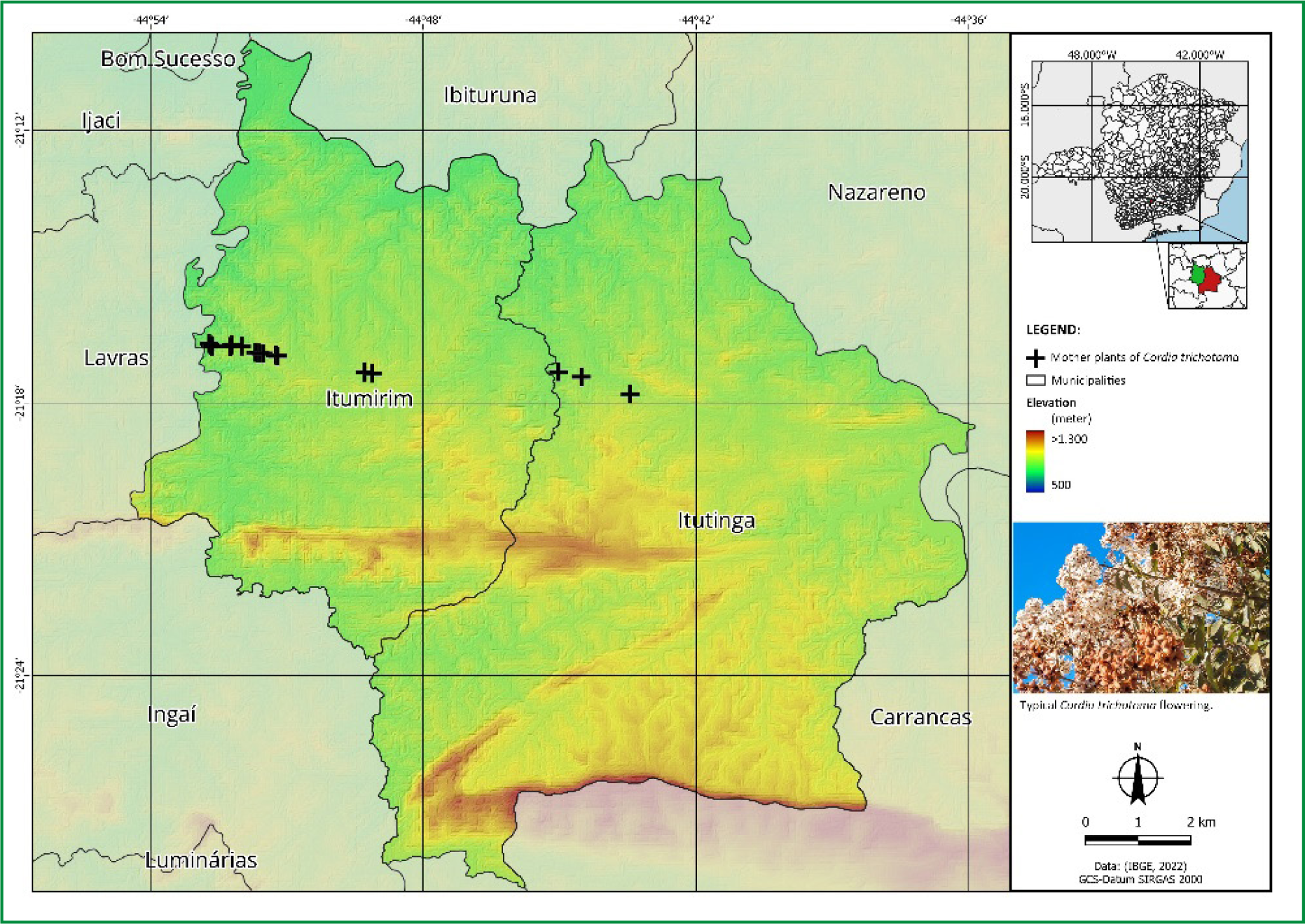
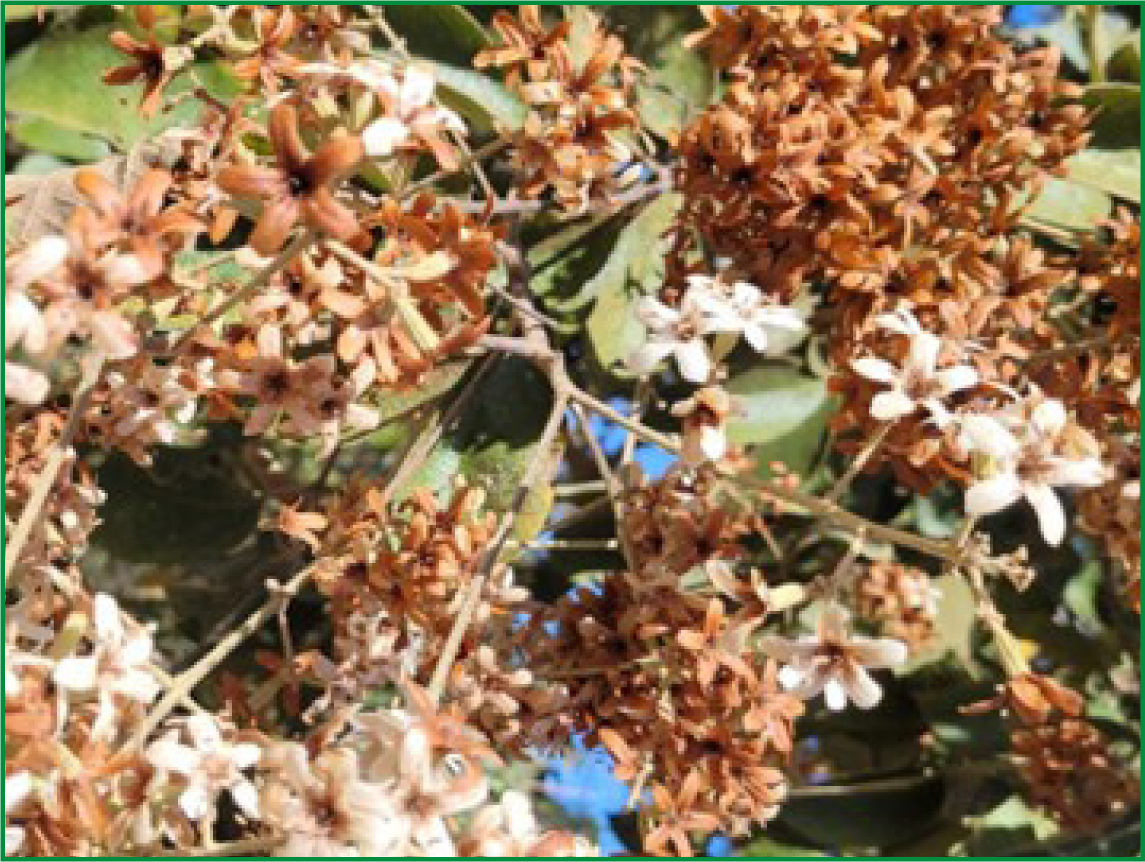
C. trichotoma seeds were collected in August 2021 from 18 phenotypically selected and georeferenced parent trees in Itumirim and Itutinga southern Minas Gerais (Figure 1). The selected parent trees exhibited straight trunks, apparently healthy phytosanitary conditions, and were spaced at least 150 m apart. At the time of collection, differences in the seed maturation stages within the same parent tree were observed based on the coloration of the fruit clusters (Figure 2).
Locations of Cordia trichotoma seed collection in Itumirim and Itutinga, southern Minas Gerais
Cordia trichotoma fruit cluster at the time of collection, showing different degrees of physiological maturity
Two seed-processing methods were evaluated for C. trichotoma. In the first method, seeds were dried in a dry, shaded, and well-ventilated location for 15 d after collection. This was followed by manualremoval of the corolla from the fruit structure, by rubbing it over sieves, within 24 h of collection.
After processing, the seeds were sown in seedbeds containing washed sand. Using 100% washed sand as a substrate in forest seedbeds offers several advantages, particularly its excellent drainage and aeration, which help prevent waterlogging and the proliferation of root diseases. Furthermore, sand texture facilitates seedling transplantation, allowing easier removal and transplantation with minimal root damage, which is crucial for plant survival and initial development (Caldeira et al., 2023).
The seeds were arranged in a completely randomized design in a 2 × 18 factorial scheme comprising two processing methods (with and without drying) and 18 parent trees. Four replicates were conducted in plots containing 100 seeds each. The seedling emergence percentage was recorded 30 d after sowing.
Thirty days after sowing, the seedlings were transplanted into tubes with a volumetric capacity of 120 cm. For seedling production, a substrate mixture consisting of 40% commercial substrate, 30% carbonized rice husk, and 30% aged and sieved bovine manure was used; NPK 06-30-06 fertilizer was added at 4 kg per cubic meter of substrate. After transplantation, the seedlings were kept under 50% shade provided by black synthetic fabric for 45 days (Almeida, Carvalho, Cunha, Diniz, Gonzaga, Melo, 2023), which is necessary for seedlings to establish and initiate vegetative growth following transplantation, a silvicultural practice that induces water stress.
After 45 d under shade, the seedlings were moved to an area with full-sunlight, where they remained for 140 d, completing their vegetative growth phase and undergoing the hardening process, concluding their production cycle at 210 d after sowing.
The progeny seedlings were arranged in a randomized block design with 18 treatments (progenies), four replicates, and linear plots of nine plants each. Evaluations were conducted 210 d after sowing by measuring height (H) using a graduated ruler; height measurements were taken from the stem base to the apical bud. The stem diameter at the base (Dc) was measured using a digital caliper.
The data were validated using an analysis of variance (ANOVA) at a 5% error probability. When significant differences were detected by ANOVA, they were compared using the Scott-Knott test at a 5% error probability, performed using the SISVAR software (Ferreira, 2019).
3 RESULTS AND DISCUSSIONS
The overall seedling emergence rate for C. trichotoma was 46.27%, and analysis of variance indicated a significant interaction (p<0.05) between the different processing methods and parent trees (Table 1). The coefficient of variation for emergence was 7.03%, highlighting the high experimental precision and reliability of the data obtained. These results demonstrate the robustness of the experiment, ensuring that the observed variations are attributable to the applied treatments and not to external or random factors.
Seedling emergence percentage of Cordia trichotoma as a function of different parent trees and seed processing methods
The interaction analysis (Table 1) revealed that C. trichotoma seeds exhibited a significantly higher emergence rate when the drying step was omitted during processing, with an average emergence rate of 85.68%. In contrast, the average emergence of seeds subjected to drying was drastically reduced, reaching only 6.86%, although there was some variation, as progeny LP16 showed 33.50% emergence even after drying.
This drastic reduction in seedling emergence suggests that the drying process may negatively affect seed viability, possibly due to excessive dehydration or changes in the internal structure of the seeds, which impair their ability to germinate. These results corroborate the findings of Vaz et al. (2015), who reported a 50% loss in seed viability when moisture content dropped from 8% to 5%, and Maffra (2019), who stored dried seeds at ambient conditions (+/- 25°C) for 120 days, reaching 11.86% moisture and an average emergence of 1.56% from the six analyzed matrices.
Although C. trichotoma seeds are classified as orthodox by Vaz, Rodrigues-Junior, Tonetti, Davide, José (2015), they exhibit behavior similar to recalcitrant seeds when collected directly from the tree. Owing to the heterogeneity of developmental stages during collection (Figure 2), these seeds must be sown immediately after collection to avoid reducing their germinative power.
C. trichotoma seeds have high moisture content at collection, ranging from 43.19–51.16% (Maffra, 2019; Felippi, Maffra, Cantarelli, Araújo, Longhi, 2012). According to Castro and Hilhorst (2004), the high moisture content suggests that C. trichotoma does not dry naturally at the end of maturation. However, the seeds were at different developmental stages at the time of collection, indicating that many had not yet acquired desiccation tolerance. Species with these characteristics typically lose viability when subjected to desiccation at moisture levels below 50%, reaching values as low as 25% (Bonner, 2001). This phenomenon can be explained by the acceleration of seed respiratory rate under ambient drying conditions, which results in the consumption of essential carbohydrates for germination, thereby reducing seed viability (Maffra, 2019).
One premise of physiological seed classification is that it should be performed using seeds at physiological maturity. However, segregating the physiological maturity point in C. trichotoma seeds is extremely challenging due to the presence of seeds at different developmental stages on the branch and the lack of morphological differentiation (Vaz, Rodrigues-Junior, Tonetti, Davide, José, 2015).
The advanced level of physiological maturity could explain the increased germination of seeds collected late (September), as well as the maintenance of seed germination even at moisture levels close to 8%, as found by Vaz, Rodrigues-Junior, Tonetti, Davide, and José (2015). The early maturity level of the seed lot could also explain the inability to maintain seedling emergence viability during the drying process in shaded environments, as reported by Maffra (2019), even when moisture levels reached approximately 11%, corroborating the low emergence observed in Table 1.
Thus, considering that the seeds were collected before reaching physiological maturity, environmental drying conditions may have accelerated the seeds’ respiratory rates, consuming essential carbohydrates for germination. On the other hand, maintaining the seeds at a low temperature would slow down the seed metabolism, conserving its carbohydrates, which justifies the promising results found by Lima et al. (2008) in the cold storage of C. trichotoma seeds (-20°C and -196°C).
As shown in Table 1, genetic components may be associated with the emergence of C. trichotoma seeds. Evaluating the emergence of seeds that did not undergo the drying process, it is observed that the parent trees were grouped into five distinct categories, which is related to genetic factors but may also be influenced by external factors such as predation, as pointed out by Vaz, Rodrigues-Junior, Tonetti, Davide, José (2015).
It is worth highlighting the behavior of certain parent trees, such as the high emergence rates of the LP16 and LP39(N) progenies. These progenies exhibited greater resistance to desiccation and maintained the highest emergence rates after the drying process. For these progenies, , most of the seeds had already reached physiological maturity, which is essential for desiccation tolerance.
The opposite behavior was observed in the LP30 and LP40(N) progenies, which exhibited low emergence in both processing methods. Some progenies showed low desiccation tolerance, such as LP7 and LP12, which had the highest emergence rates when sown immediately, but exhibited the lowest emergence rates after drying during processing.
Genotypic variability was also observed by Almeida, Assis, Melo, Silva, Resende, Luz and Resende (2021), which reinforces the statement by Felippi, Maffra, Cantarelli, Araújo and Longhi (2012) that the genetic component influences seed lot quality. Therefore, the evaluation and selection of parent trees with good seedling emergence rates are essential to meet the demand for forest seedlings of this species.
Some parent trees of this species performed better than others, reflecting interactions between genetic and environmental factors. The analysis indicated that genetic variability among C. trichotoma progenies influenced seedling emergence and growth. External factors such as predation and environmental conditions during seed collection and processing can also affect the performance of different progenies.
Parent trees that demonstrated greater resistance to desiccation and maintained high emergence rates after the drying process, such as LP16 and LP39(N), likely had seeds that reached physiological maturity, which is an essential factor for desiccation tolerance. In contrast, progenies such as LP30 and LP40(N) exhibited low emergence rates under both processing methods, suggesting lower desiccation tolerance or genetic or environmental limitations.
Significant differences (p<0.05) were observed among the parent trees (progenies) in terms of seedling growth, height, and stem diameter. After 210 d, the seedlings had an average height and stem diameter of 25.51 cm and 3.81 mm, respectively. The coefficients of variation for the height and stem diameter at the base were 8.61% and 7.10%, respectively, confirming the experimental reliability of the observations.
Three progenies (LP04, LP06, and LP30) outperformed the others in terms of the two analyzed growth variables (Table 2). LP14 and LP15 also performed well in terms of height, whereas LP27 showed the best performance in terms of stem diameter growth. LP08 and LP13 progenies had the lowest values for height and stem diameter. No correlation was observed between seedling emergence performance and subsequent growth.
Average height (H) and stem diameter (Dc) of Cordia trichotoma seedlings, measured 210 days after transplantation
The lack of correlation between seedling emergence performance and subsequent growth can be attributed to the influence of genetic and environmental factors, which act differently at each developmental stage. Seedling emergence is primarily affected by the viability and initial vigor of the seeds, whereas growth in height and stem diameter reflect both the genetic quality of the progeny and their ability to adapt to environmental and management conditions throughout seedling production. Therefore, the progeny may exhibit a high emergence rate without necessarily excelling in subsequent growth stages, suggesting the involvement of different physiological mechanisms and resource allocation during these developmental phases. Progenies such as LP04, LP06, and LP30, which showed superior growth performance, may exhibit greater resource-use efficiency or better adaptation to environmental conditions, whereas progenies with rapid emergence may have compromised their long-term performance. These results emphasize the importance of considering emergence and continuous growth when selecting progeny to optimize seedling performance under field conditions.
According to Davide and Botelho (2015), a 210-day period is considered the most suitable for seedling production. This ensures that seedlings reach the ideal height and diameter for field planting. Appropriate silvicultural techniques can promote homogeneous seedling growth after planting, even with different production processes (Malavasi and Malavasi, 2006).
The average growth behavior of C. trichotoma seedlings is similar to that reported by Machado, Pastorini, Souza, Barbeiro and Santos (2015). The differences in growth rates observed among the progeny suggest the viability of early selection in the nursery. This approach is advantageous because rapidly growing seedlings reach quality parameters such as seedling height, stem diameter, vigor, and health in a shorter period, reducing production costs.
4 CONCLUSIONS
Seed processing without drying and immediate sowing of C. trichotoma seeds resulted in the highest seedling emergence. Despite being orthodox, their seeds exhibited recalcitrant behavior owing to the heterogeneity of developmental stages within the collected seed lots. Genetic variation exists in seedling emergence capacity and seedling growth, which can and should be managed to make the seedling production process more efficient.
ACKNOWLEDGEMENTS
To the National Council for Scientific and Technological Development (CNPq) and Agreement No. 213/2018 between UFLA and the Foundation for Scientific and Cultural Support (FCA), established through the Decentralized Execution Term between the Brazilian Forest Service and UFLA, for funding part of this research.
REFERENCES
- ALMEIDA, R. S.; ASSIS, G. S.; MELO, L. A.; SILVA, G. C. A.; RESENDE, E. W. A.; LUZ, M. S.; RESENDE, J. C. R. GROWTH AND GENETIC PARAMETERS OF PROGENIES OF Cordia trichotoma IN THE JUVENILE PHASE. Scientia Agraria Paranaensis, Marechal Cândido Rondon, v. 20, n. 1, p. 69-74, 2021.
- ALMEIDA, R. S.; CARVALHO, C. A.; CUNHA, F. L.; DINIZ, P. C.; GONZAGA, M. D.; MELO, L. A. Período de sombreamento na produção de mudas de espécies florestais. Ciência Agrícola, Rio Largo, v. 2, p. e13260, 2023.
- ANTONELLI, P. V.; BRUN, E. J.; SANTOS, M. D.; SARTOR, L. R.; BRUN, F. Desenvolvimento de Cordia trichotoma em função da adubação, em sistema silvipastoril no Sudoeste do Paraná-Brasil. Ecologia e Nutrição Florestal, v. 3, n. 3 p. 59-70, 2015.
- BERGHETTI, A. L. P.; ARAUJO, M. M.; TONETTO, T. S.; AIMI, S. C.; NAVROSKI, M. C.; TURCHETTO, F.; ZAVISTANOVICZ, T. C. Growth of Cordia trichotoma seedlings in different sizes of recipients and doses of fertilizer. African Journal of Agricultural Research, v. 11 n. 28, p. 2450-2455, 2016.
- BERGHETTI, A. L. P.; ARAUJO, M. M.; TABALDI, L. A.; TURCHETTO, F.; AIMI, S. C.; RORATO, D. G.; MARCHEZAN, C.; GRIEBELER, A. M.; BARBOSA, F. M.; BRUNETTO, G. Morphological, physiological and biochemical traits of Cordia trichotoma under phosphorus application and water-retaining polymer. Journal of Forestry Research, v. 32, p. 855-865, 2021.
- BONNER, F. T. Seed Biology. In: Woody-Plant Seed Manual (s.l.): USDA Forest Service’s/Reforestation, Nurseries, & Genetics Resources, 2001.
- CASTRO, R. D.; HILHORST, H. W. M. Embebição e reativação do metabolismo. Pp.149-162. In: FERREIRA, A. G.; Borghetti, F. (eds.). Germinação: do básico ao aplicado Porto Alegre, Artmed, 2004.
- CALDEIRA, Daniela Soares Alves et al PRODUÇÃO DE MUDAS DE IPÊ AMARELO EM TELADO TERMO REFLETOR USANDO MISTURAS DE SUBSTRATO. REVISTA FOCO, v. 16, n. 6, p. e2124-e2124, 2023.
- CUNHA, F. L.; ALMEIDA, R. S.; DINIZ, P. C.; CAMPOS, V. A.; GONZAGA, M. D.; MELO, L. A. Application of increasing doses of phosphor in Cordia trichotoma seedlings. Amazon Journal of Agricultural and Environmental Sciences, Belém, v. 64, p. 1-5, 2021.
- DAVIDE, A. C.; BOTELHO, S. A. Fundamentos e Métodos de Restauração de Ecossistemas Florestais 1. ed. Lavras – MG: Editora UFLA, 2015. 636 p.
- FERREIRA, D. F. SISVAR: A computer analysis system to fixed effects split plot type designs: Sisvar. Brazilian Journal of Biometrics, v. 37, n. 4, p.529-535, 2019.
- FELIPPI, M.; MAFFRA, C. R. B.; CANTARELLI, E. B.; ARAÚJO, M. M.; LONGHI, S. J. Fenologia, morfologia e análise de sementes de Cordia trichotoma (Vell.) Arráb. ex Steud. Ciência Florestal, Santa Maria, v. 22, n.3 , p. 631-641, 2012.
- KULMANN, M. S. S.; STEFANELLO, L. O. S.; SCHWALBERT, R. A.; BERGHETTI, A. L. P.; ARAUJO, M. M.; PICCIN, R.; GATIBONI, L. C.; TIECHER, T.; FERREIRA, P. A. A.; BRUNETTO, G. Effects of phosphorus fertilizer application on phosphorus fractions in different organs of Cordia trichotoma Journal of Forestry Research, v. 32, p. 725-732, 2021.
- LIMA, V. V. F.; VIEIRA, D. L. M.; SEVILHA A. C.; SALOMÃO, A. N. Germination of tropical dry forest tree species of Paranã river basin, Goiás state, after three types of storage and up to 15 months. Biota Neotropica, v.8, p. 89-97, 2008.
- MAFFRA, C. R. B. Características físicas e de emergência de sementes de Cordia trichotoma (VELL.) Arrab. ex Steud) armazenadas em condição ambiente. Revista Brasileira de Engenharia de Biossistemas, v. 13, n. 2, p. 124-131, 2019.
- MALAVASI, U. C.; MALAVASI, M. M. Efeito do tubete no crescimento inicial de Cordia trichotoma (Vell.) Arrab. ex steud e Jacaranda micranta Cham. Ciência Florestal, Santa Maria, v. 16, n. 1, p. 11-16, 2006.
- MACHADO, G. M.; PASTORINI, L. H.; SOUZA, L. A.; BARBEIRO, C.; SANTOS, L. S. Germinação de diásporos e crescimento inicial de Cordia trichotoma (Vell.) Arrab. Ex Steud (Boraginaceae). Iheringia, Porto Alegre, v. 70, n. 2, p. 279-286, 2015.
- MELO NETO, J. O.; MELLO, C. R.; MELLO, J. M.; GUIMARÃES D. V. Comportamento físico da precipitação interna em um povoamento de Eucalyptus. Ciência Florestal, Santa Maria, v. 29, n. 3, p.1215-1226, 2019.
- TORRES, A. Q. A.; ALMEIDA, R. S.; ASSUNÇÃO, R. R.; SOUZA, A. F.; SANTOS, L. V.; MELO, L. A. Silvicultural performance of four native forest species as a function os pruning intensity. Floresta e Ambiente, Seropédica, v. 29, n. 2, p. e20210100, 2022.
- SANTOS, W.; SOUZA, B. M.; ZULIAN, D. F.; ALVES, G. T. R.; GOMES, J. B. V.; MORAES, M. L. T.; SOUZA, V. A.; AGUIAR, A. V. Genotype-environment interaction in Cordia trichotoma (Vell.) Arráb. Ex Steud. progenies in two different soil conditions. Journal of Forestry Research, v. 33, p. 309-319, 2022.
- SANTOS, J.; CURTO, R.; ROTERS, D. F.; TRAZZI, P. A. Potencial de crescimento de Cordia trichotoma e Grevillea robusta em plantio puro e consorciado. Enciclopédia Biosfera, v. 14, n. 26, 2017.
- VAZ, T.A.A.; RODRIGUES-JUNIOR, A.G.; TONETTI, O.A.O; DAVIDE, A.C.; JOSÉ, A.C.The implications of the morphophysiology of Cordia trichotoma seeds to their collection and propagation. Seed Science and Technology, Zurich, v. 43, n. 3, p. 390-398, dec. 2015.

 Source: Authors (2024)
 Source: Authors (2024)