
 Tertiary spaces. Urban restructuring trends in the deindustrialization context?
Abstract
This paper aims to understand and characterize the emergence of tertiary spaces in the post-industrial city, focusing on the spatial and production transformations they promote. We understand tertiary spaces as novel urban forms targeted at the spatial and production repurposing of consolidated areas that stimulate the growth of the tertiary sector, commercial vitality, and urban dynamism. The study focuses on the Metropolitan Region of Buenos Aires. The methodological strategy is qualitative, and data were produced through a morpho-typological survey and interviews with municipal authorities and entrepreneurs in the sector. The results show the role played by those forms in the urban and production repurposing of previously industrial areas.
economic geography; production restructuring; urban renewal; metropolitan areas; socio-territorial transformations
Resumen
Este artículo se propone comprender y caracterizar el surgimiento de espacios del terciario en la ciudad posindustrial, poniendo particular atención a las transformaciones productivas y espaciales que promueven. Entendemos a los espacios del terciario como figuras urbanas novedosas orientadas a la reconversión productiva y espacial de áreas consolidadas, estimulando el crecimiento del sector terciario, la vitalidad comercial y la dinamización urbana. La investigación está focalizada en la Región Metropolitana de Buenos Aires. La estrategia metodológica es cualitativa y los datos fueron producidos mediante un relevamiento morfo-tipológico y la realización de entrevistas a funcionarios municipales y empresarios del sector. Los resultados evidencian el papel que juegan estas figuras en la reconversión productiva y urbana de áreas previamente industriales.
geografía económica; reestructuración productiva; renovación urbana; áreas metropolitanas; transformaciones socio-territoriales
Introduction
As a consequence of an industrialization period based on the substitution of late and intensive import in the light industry of goods of internal consumption, in the middle 70s, Argentina began to undergo a process of dismantling of the manufacturing structure and entered into a process of improvement of tertiarization. Measures adopted in 1976 during the last military dictatorship, together with the neoliberal policies of economic, commercial and financial opening, the deregulation of working frameworks and the lack of public investment on productive infrastructure, strongly affected our national industry. Later, the official exchange rate during the 80s and 90s invigorated import entries. No matter how strong the economic crisis and devaluation of 2001 were, a process of recovery on the sector started, but the local productive framework did not recoup.
These changes occurred mainly in the Metropolitan Region of Buenos Aires (RMBA), significantly impacting on the premises according to the principles of population localization, its uses and soil density, and urban hierarchies. On the one hand, it implied the impairment of consolidated urban and densely populated areas, especially in the south of the Autonomous City of Buenos Aires (CABA) and surrounding Municipalities of the first ring.1 Those territories had become the favourite localization for the industry, which together with the plot of lands and the development of the railway favoured population settlement (Torres, 2001; Blanco, 2005 and Bozzano, 2007). In turn, during the 90s, in the context of economic opening – global and regional –, a process of geographic reconcentration of the national industry in the RMBA began, following patterns of localization even more scattered and grouped in industrial parks and areas of the peri-urban space in line with the expansion of Metropolitan highways and the increase in the use of private transportation (Blanco, 2005; Briano et al., 2003). Therefore, while old industrial areas, which were urbanely consolidated in the south of CABA and surrounding Municipalities, turned into "industrial cemeteries” (Bozzano, 2007), in the second and third ring, the railway began to create industrial areas for exclusive purposes. There are two phases of a process of change in the production that nowadays posit challenges to guarantee the vitality and dynamics of the city built over the obsolescence of some sectors.
In this context, it is important to recognize the establishment of new urban agents in RMBA, which are called “areas of the tertiary sector”. They make up one of the ways in which local policies pretend to foster the economic development in the consolidated areas, promoting a growth of the tertiary sector, commercial vitality and urban dynamics. Those initiatives are encouraged in CABA as Economic Districts and traditional places of the Buenos Aires Conurbation, such as food businesses or special districts. Most of them are located in consolidated places, which had formerly been industrial places, but had undergone impairment and practical obsolescence processes in the neoliberal context.
The establishment of those services leaves the door open for questions about the spatial arrangement that the tertiary sector adopts and the possibility of recognizing examples of territorial rearrangement promoted by tendencies of tertiarization of the local economy. Some questions that arise are: Which is the economic nature that the tertiary sector assumes in the local context and how is it territorialized? What happens with the new arrangement of the post-industrial city? Which characteristics do the geographic places where services are developed have? We argue in the working hypothesis that certain pathways of the territory – its local scale and its regional and global reach – determine the special way in which the tertiary sector develops. Following this reasoning, the areas of the tertiary sector of RMBA exhibit their own characteristics: a) dependent inclusion of the local economy in the global context, late and relative pathways of industrialization; b) structural inequality as a feature of the social base; and c) the shifting macroeconomic conditions that set up a climate of political instability and financial uncertainty. Not only those aspects, but also others define the nature of the services, which grow in number and density in our latitudes, as well as how the services adapt to the socio-territorial changes.
The organization of this research takes into account a characterization of tertiary areas based on previous research done on many cases in the Autonomous City of Buenos Aires (CABA) and in Municipalities of the Buenos Aires Conurbation These are the Arts, Design and Technological districts in the south of CABA and Palaá Bouvelard in Avellaneda Municipality, Tigre Sur district in Tigre and Paseo Dorrego in Esteban Echeverría (Figure 1).
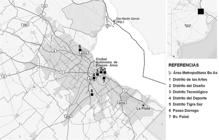
In each case, key actors of the local public administration, businesspeople and members of the community were interviewed; a morpho-typological (González Redondo et al., 2022) survey of the land and its changes, newspaper articles and official documents were studied and local rules were analysed.2 Besides, each tertiary premise was considered, answers to the questions were found, reflecting on a conceptual way about the nature of those promoted tertiary economic activities, which urban agents foster as well as the spatial scope of those changes.
The organization of this article is based on those elements of analysis. Therefore, case studies are presented to get deeper into the specific characteristics that have turned those urban agents into new objects of study so as to understand the role of the services in the current socio-territorial changes in RMBA. It is worth noticing that each section articulates the revision of relevant bibliographic documents and theoretical-conceptual contributions oriented to understanding the characteristics of tertiary areas. Finally, conclusions are discussed.
Presentation of case studies
As it was mentioned before, the areas of the tertiary sector in RMBA are the result of measures promoted or taken by the public sector that emphasized the economy as the engine to foster a process of changes in the city, focusing on hegemonic speeches and models of economic geography (like clusters or districts) applied to the tertiary sector. Nevertheless, in each case, a special political-institutional arrangement is adopted in line with the agents, interests and specific geographic conditions that no matter the common aspect that share, have different territorial paths.
In CABA, since 2008, the local government has nurtured the creation of “economic districts” with the aim of fostering an urban makeover. At the beginning, most of the districts were located in the south. The urban impairment and functional obsolescence of the area stood out in the analysis of some areas where new economic activities were compatible with residential areas. Consequently, there are certain similarities (even a deeper understanding) regarding previous urban makeover measures, like the interventions over public space, the beauty and recovery of the south-east part of the city (Herzer, 2008) and Major Urban Projects that changed the Abasto area (Kozak, 2011; Soccoloff, 2015; Carman, 2006), Puerto Madero (Cuenya and Corral, 2011) and Comuna 8 (Arqueros Mejica, 2017).
In each district, the establishment of businesses and companies of the same economic sector is promoted by offering tax and fiscal benefits, leading to a new way of territorial arrangement which divides the city into topics – and concentrates investments – standing out certain productive features or characteristics (whether inherent to the area). First, the Technological district (2008) was set up on a polygon that occupies most of Parque Patricios neighbourhood, part of Nueva Pompeya and some square metres of Boedo. There, companies of the Information and Communication Technology (ICT) sector are encouraged to set up. Moreover, it is the sector that shows more dynamism in relation to socio-territorial changes. Later, the Arts district was created in 2012. Conditions favoured entrepreneurships related to the visual and performing arts, literature and music in La Boca neighbourhood and the south part of San Telmo. A year later, in 2013, the Design district was created in Barracas neighbourhood. New businesses related to design (industrial, fabric, graphic, multimedia, advertising, shoes, furniture, among others) were set up taking into account the activities near Centro Metropolitano del Diseño. Recently, the government has moved forward some consolidated traditional areas in line with initiatives of tactical urbanism of post-pandemic, especially in Youth District along north riverside (2020) and the Wine District in Devoto (2021).
Likewise, the local government has brought about improvements on urban infrastructure and accessibility to the area. Consequently, apart from the establishment of some activities, the appearance of new districts involved a dynamism of the real estate market and the construction sector as well as the commercial area. Nevertheless, those trends did not happen in the same way in all the cases, standing out different territorial arrangements based on the heterogeneity of intra and inter-district relations (Arqueros Mejica et al.,2020; Goicoechea and Arqueros Mejica, 2021) (Figure 2).
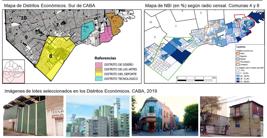
– Limits and Characteristics of Economic Districs in the South of Buenos Aires (Communes 4 and 8)
The “success” of the district policies in Buenos Aires caused interest between the Municipalities of the Greater Buenos Aires that, with some changes, started to promote urban and economic transformations in their main areas, leading to new geographic arrangements. In this context, the Tigre Sur district (DTS) was created in 2014, following some of the criteria for the economic activities measures that the Buenos Aires districts set up. Boosters aim to consider districts as the reference area for the artistic creation, design and scientific-technological production in the Metropolitan Region. DTS covers a polygon of the historical centre near the main area and it is introduced as part of the Programme of Urban Makeover which highlights the coexistence of architectonic buildings with a heritage value and the non-working industrial equipment in this area (Goicoechea et al, 2023) (Figure 3).
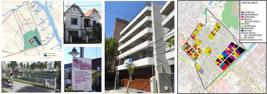
– Limits and characteristics of Tigre Sur district:map of the localization, pictures of the urban surroundings and map of the most relevant plots purposes. Tigre 2023
Paseo Dorrego and the Palaá Boulevard have dissimilar dynamics. Both places have always run food businesses, so the Municipality intervened at some point of the process to make commerce strong and improve the urban scenery. Changes in the residential area have been introduced as a result of rising of the commercial sector.
Avellaneda is a Municipality which is famous for its industrial and port activities. Its main area is functionally integrated into the historical part of San Telmo in CABA and with the main businesses in Quilmes and Lanus. The gastronomic area of Palaá Boulevard began to develop in 2015 by private means, leading to the opening of bars and restaurants in old houses or former industrial premises after a renovation into a modern façade. Neither franchises nor chains of national scope took part in it. Measures taken by the Municipality have stimulated the process to make the public area attractive and have fostered a symbolic idea of the area under the motto #Quedate (#Stay) in Avellaneda (Arqueros Mejica et al., 2023) (Figure 4).
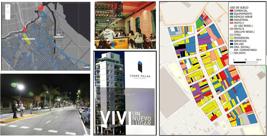
– Limits and characteristics of Palaá Boulevard: map of the localization, pictures of the urban surroundings and map of the most relevant plots purposes. Avellaneda, 2023
On the other hand, Paseo Dorrego is adjacent to the main traditional area of the city of Monte Grande, district of Esteban Echeverria (Figure 5). The makeover process started due to the establishment of food businesses and stores that sell “fashionable” products that were investments of private initiatives. Since 2018, the local government supported those initiatives through measures oriented to the attractiveness of public premises, the promotion of cultural activities and advertising. In this context, the Municipality inaugurated Paseo Dorrego to make the place stand out and organized monthly special events to encourage consumption.
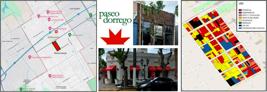
– Limits and characteristics of Paseo Dorrego: map of the localization, pictures of the urban surroundings and map of the most relevant plots purposes. Monte Grande, 2023
These experiences work as common ground with the settings of traditional sub-centralities at the beginning of the decade (Ciccolella, et al., 2015; Vecslir and Elimbaun, 2016; Vecslir et al., 2017), yet include new elements that must be analysed, particularly the economic incentive for the tertiary sector.
Areas of the tertiary sector in RMBA
The analysed cases depict a special interaction that has taken place between the historical background of the land and new changes, giving rise to makeover processes or different “alternatives” (Goicoechea et al., 2021; Arqueros Mejica et al., 2020). Our research encompasses many case studies from CABA to the Metropolitan city, recognizing a shift in the type of activities that were fostered in those areas. It is then observed that the production or innovation sphere, noticeably present in the districts of Buenos Aires, little by little was also taking place in the Buenos Aires Conurbation, where restaurants and entertainment services are offered. However, leaving the urban processes aside, it is possible to recognize some common aspects that lead us to acknowledge them as a unit of the “tertiary sector”. Some of these elements are introduced, paying close attention to the economic dimension of the territorial changes and the way in which the assumptions of a transition from the local production to a tertiary advancement are made.
The nature of the promoted activities
Delving into this aspect implies reflecting on the tertiary sector, the economic activities that covers and how the local context develops. The great internal heterogeneity is one the main characteristics of the sector.
The notion of “tertiary sector” has appeared in the mid-19th century when the neoclassicals Fisher (1939) and Clark (1940) proposed to think about a three-sector model: primary, secondary and tertiary, including specific activities in each sector and encompassing a wide range of activities that offer services within the tertiary sector. Later, Foote and Hatt (1953) grouped services differently: 1) tertiary sector, including restaurants, hairdresser’s, laundries, household equipment workshops and other jobs; 2) quaternary sector that orders, coordinates and manage activities of the primary, secondary and tertiary sector, including transport, commerce, communication, finance and administration; 3) the quinary sector, including health, education and training and leisure activities (Cuadrado Roura and Del Rio, 1990).
Therefore, the tertiary sector involves a variety of activities with different levels of complexity and requirements targeted to the immediate or long-lasting consumption, to commerce of different socio-economic nature, to technical repairments or entertainment, to the production, making inputs in the industrial processes (Garza, 2006). Besides, some specialized services stand out from the industrial services – which constitute technological and innovation contributions to the productive processes – regarding services that are part of the circuit, for example, transport, logistics, and storage. In this way, there are significant differences regarding their ability to generate surplus value because, following a Marxist perspective, even though services oriented to consumption could be carried out within the commercial sphere without adding capital gains, services oriented to the production sphere effectively increase the capital value. The latter type of services will be developed in the following sections.
Heterogeneity becomes the starting point to understand the influence of the economic background in the process of productive changes and the process of accumulation models based on the manufacturing production of those activities based on services. The development of productive forces does not imply a dematerialization of employment, but involve a greater overlapping between tangible and intangible work that continues to be subordinated to the logic of the production of goods and capital. The contemporary world evidences connection between the textile and services activities, between practical working activities and abstract activities that take part in the context of the productive redistribution of capital (Antunes, 2007, pp. 35-37). Therefore, the development of new activities associated to the advanced tertiary sector (or quaternary) inevitably requires the interaction with a consolidated tangible productive base. In this context, it is noted that while modern economies of the main countries perceive the growth of services as an indicator of wellbeing improvement, consolidation of the productive development and increase of wealth3 (Clark, 1940; Fourastié, 1949), in the Latin American economies, services have historically constituted a solution to the problem of local workforce.4
Nun et al. (1968) argued that the dependent inclusion of the Latin American region in the world economic circuit has defined the economic and geographic background of our land in a way of Fordism. Industrialization in the region started 150 years ago after the industrial revolution when European countries reached a relatively high level of development of their productive forces, monopolist concentration and centralization, and international penetration, resulting from industrial, commercial and transnational bank companies (Pradilla, 2013). It was an industry oriented to the local consumption, of low organic capital stock and limited capacity of absorption of the workforce in cities (Prebisch, 2012; Jaramillo and Cuervo, 1987). The relative character of industrialization led to a process of apparent tertiarization, making the region unique (Márquez López and Pradilla, 2008).
We can observe that the growth of the tertiary sector in Latin American economies could give be the response to the growth of relative overpopulation in cities whose activities are mainly part of the tertiary sector that is composed of trivial services rather than to the complexity of the tangible production system (that requires working profiles for tasks R+D due to the technological advancement and communication). Also, the characteristics of the industrial development influenced the integration of services to the productive economic base. Manufacturing activities did not have high levels of technological development and withdrew, at a great level, from the incorporation of services that add value to the subsidiary activity. These steps – partly – explain the rising of the tertiary sector based mainly on services oriented to individual consumption with a low level of task complexity and knowledge involved. It developed as an economic unit with a low organic capital stock. They are considered trivial services, including services, such as street selling, retail sales, food services, professional services, blue-collar work, entertainment, etc.
These characteristics of the tertiary sector in the local context are evidenced in our case studies because apart from their features and economic activities (ICT, design, innovation, leisure), they exhibit a predominance of trivial services as the base of the economic dynamic.
In Chart 1, there is a presentation of the results of the survey about purposes according to land plots on each of the case studies. Data suggests that the residential area tends to stand out in all the cases, reaching around 50% with lower exceptions in Paseo Dorrego and Arts district, two areas highly affected by the central dynamics. On the other hand, industrial activities, except for Esteban Echeverría, exist in all the analysed areas with lower value reaching 5% average.
We draw our attention to the tertiary sector that shows different levels of prevalence. Therefore, it is noticeable that most activities are located in Esteban Echeverría (58,5%), Arts district (48,6%) and Design district (45,1%) in CABA. Mixed activities (including residential purposes) are located right next to the owners’ house or in commercial ground floors of buildings. They are oriented to individual consumption and to the satisfaction of population needs. When studying them closely, it can be pointed out that, as an example, in Esteban Echeverría, 28% of the activities belong to restaurants, bars, ice-cream shops, cafés, etc. There are also markets, many retail businesses (paint stores, hardware store, grow stores and bicycle stores), event venues, theatres, among others.
Economic agents and their function
Tertiary activities do not fit the dynamic node of the globalized economy not only because of the nature of the economic activities that prevail – minor services – but also because of the characteristics of the economic agents that have developed them.
Considering this, we can argue that the dependent pathway of the local economy also conditioned from the beginning a special structural heterogeneity: capital agents that coexisted with non-capitalist production ways, working people with great revenue gaps and different working conditions, freelancers with non-traditional jobs or with self-employed jobs and entrepreneurs. During the last military dictatorship (1976-1983), deindustrialization processes, inflationary contexts, decrease of real salaries in a repressive context and harassment to workers and institutions steered changes from the formal dependent job post to a non-regulated market (freelancers, small businesses) (Dieguez and Gerchunoff, 1984), underlining the differences in working and productive characteristics of the region. Later, in 1990, neoliberal policies were adopted and consolidated the segmented job market polarized by sectors and difficulties of the workforce salaries, which is still happening in the present (Neffa et al, 1999). Finally, currently, there are macroeconomic conditions that do not encourage businesses which would operate under capitalist logic and specifically of those who produce goods (which require more organic capital stock, guarantees for permanent storage of goods and raw material and more stable commercial links). Therefore, as it was mentioned before, within the heterogeneity of services, minor services are the ones that create job posts because of the amount of capital stock and structure.5 According to Jaramillo (2016), in many personal services or blue-collar jobs, Simple Commodity Agents have more chances of surviving due to the fact that relative productivity of capitalist agents is not enough to tear down simple commodity production.
Taking into account these aspects, our case studies evidence a development of the tertiary activities with a low level of complexity and sophistication as they are carried out under simple capitalist and commodity ways that, without making up subsistence strategies, are articulated and complemented with more dynamic sectors of the economy (such as the real state). In the arrangement of the territory, a special disposition is established, following the type of activities, measures adopted by many agents and pathways of each territory.
There are some large-scale businesses and, to a greater extent, small investors with capital stock oriented to the production of food, entertainment and personal services that offer services of notable distinction. Small-scale investments are capable of creating low sophisticated jobs, but significantly contribute to the scenery and practicality of the areas where they are erected. Different from the encouraged trends under the framework of global processes, we are not talking about investments promoted by concentrated sectors pursuant to the creation of a corporate city, but to the creation of small and medium-scale business atmosphere that they have adopted under the framework of a capitalist market. Results of our interviews reveal that there are agents who feel strongly identified with the territory, and have been triggered by their desire to improve and “modernize” the consumption patterns in those areas to catch new consumers. In Paseo Dorrego in Esteban Echeverría, officials who were interviewed pointed out that many of the lifepaths of those new food entrepreneurs were sons of traditional food business owners who wanted to open small bars, burger restaurants, breweries, among others.
About their economic function
The role or economic function that the tertiary sector plays in the local economy, especially in RMBA, leads us to deliberate on how services contribute to the productivity and creation of value.
National statistics show that the growth of services does not necessarily trigger a growth in GDP, nor local revenues, nor an improvement in exchange terms. The productivity of services is less than in the manufacturing industry because in this context, the national economy greatly depends on the industrial activity. In fact, the predominance of more dynamic and specialized services – those which complement the production and contribute to added value – is dependent and part of the manufacturing industry (Pradilla, 2013).
When considering their chance to create value, the tertiary sector has been the focus of many debates throughout the history of economic ideas. Delving into them exceeds the limits of this study, as notions began in the Mercantilism (where commerce was the main source of wealth), through Physiocrats (who founded the theory of value-work in which work is the source of all value), up to Adam Smith (who pointed out that the unproductive nature of services does not produce tangible benefits and cannot be stored, then they do not contribute to the creation of wealth). A systematic and detailed explanation can be found in Garza (2006) and Cuadrado Roura and Del Río (1990).
It is of our interest to consider Marxism which paid closed attention to the differentiation between productive and unproductive labour (Marx, 1980[1956]) and contributed elements to understand services from his value theory. We adhere to this position.
In the Marxist theory, it is possible to accept a wide notion of productive labour within which services can be included, when stating that “the category of productive workers, of course, are those who contribute in one way or another to the production of the commodity, from the actual operative to the manager or engineer (as distinct from the capitalist)” (Marx, 1974:136 cited in Machado, 2017). This idea is complemented by the notion that “[the distinction between productive and unproductive labour] has nothing to do with the determinate content of that labour – its special utility or the particular use-value in which it manifests itself- but of the social relations embodied in the labour” (Marx, 1974:138 cited in Machado, 2017). Therefore, following Marx, it can be argued that services are not productive or unproductive in nature and within the heterogeneity of the services and their social relations embodied in the production, it is feasible to identify different instances in which surplus value could be created.
First, when services are offered just to be exchanged for money as money, they might be considered under the sphere of simple merchant exchange (C-M-C) without producing surplus value. Marx, nevertheless, differentiates the producer that directly sells their commodities in the market from those that offer a service which does not produce anything and that as a result of the exchange would obtain value. In the first case, a production of surplus vale (not capital) occurs because it is exchanged, but in the second case, only rent consumption is observed (Ernest Mandel, 1979 in Bach, 2005).
Secondly, a different situation occurs when the service seeks to assign value to the commodity (that is to say, a good that will be exchanged). That case effectively corresponds to the M-C-M cycle because it is part of a capitalist relation of production that implies capital and work exploitation (taken from Rubin’s perspective (1974) on Essays on Marx’s Theory of Value).
Thirdly, selling does not produce value because value or surplus value is not the result of selling (in the sphere of exchange) but the result of production (productive capital) even though it constitutes a necessary way to guarantee the cycle of capitalist storage. “…Commercial work is necessary work, in general, so that capital works like commercial capital… It is work that deals with values, but does not create them” (Marx, 1974:381, cited in Machado, 2017).
Thirdly, the commercial activity of selling unfolds other implicit activities that add value, like transport -to take goods from one place to another where they could be done in the market- “The productive capital invested in it [transport industry] adds value to the transported goods, partly because of the value of transportation and partly because of the added value that transport workers add” (Marx, 1977, Volume 2, p.151, cited in Astarita, 2011).
Having analysed different standpoints, we can understand the economic impact of services in RMBA and the role they have adopted in these parts of the tertiary sector in the Metropolitan area. The economic activities analysed in this article belong to commerce, food and entertainment businesses which are inscribed into the sphere of simple commodity exchange and are oriented to the reproducing consumption of individuals in the society. They do not create surplus value nor involve capitalist relations of production. They are just activities that carry values and guarantee the cycle of capitalist storage (from sales, for example) but are maintained in the consumption of rent without creating value. Therefore, it can be noticed that in urban areas where these types of activities abound, there is a change from productive uses to consumption and reproduction. These territories, which are linked to industrial and manufacturing uses – where productive units take place (workshops, factories, hangars, warehouses) are merged with urban elements that guarantee general conditions of production (ways, neighbourhood stores and schools) – become affected by individual consumption, losing its economic role within the Metropolitan productive frame.
In this territorial arrangement, there is a tendency towards a specific way of economic tertiarization. It would be incorrect to express it in restrictive terms because, in each case, different uneven ways of production coexist, like small economic units, medium-size businesses (pymes) and big capitalist businesses, like multinational companies oriented to technology with high levels of innovation. In the same way, there are divergences between case studies. For example, the Technological district is home to 360 technological companies, such as start-ups, big technological offices, including Tata Consultancy and IBM. On the other hand, in Dorrego and Palaá Bouvelard, there are food businesses owned by entrepreneurs or local businesspeople with their own brand or franchise.
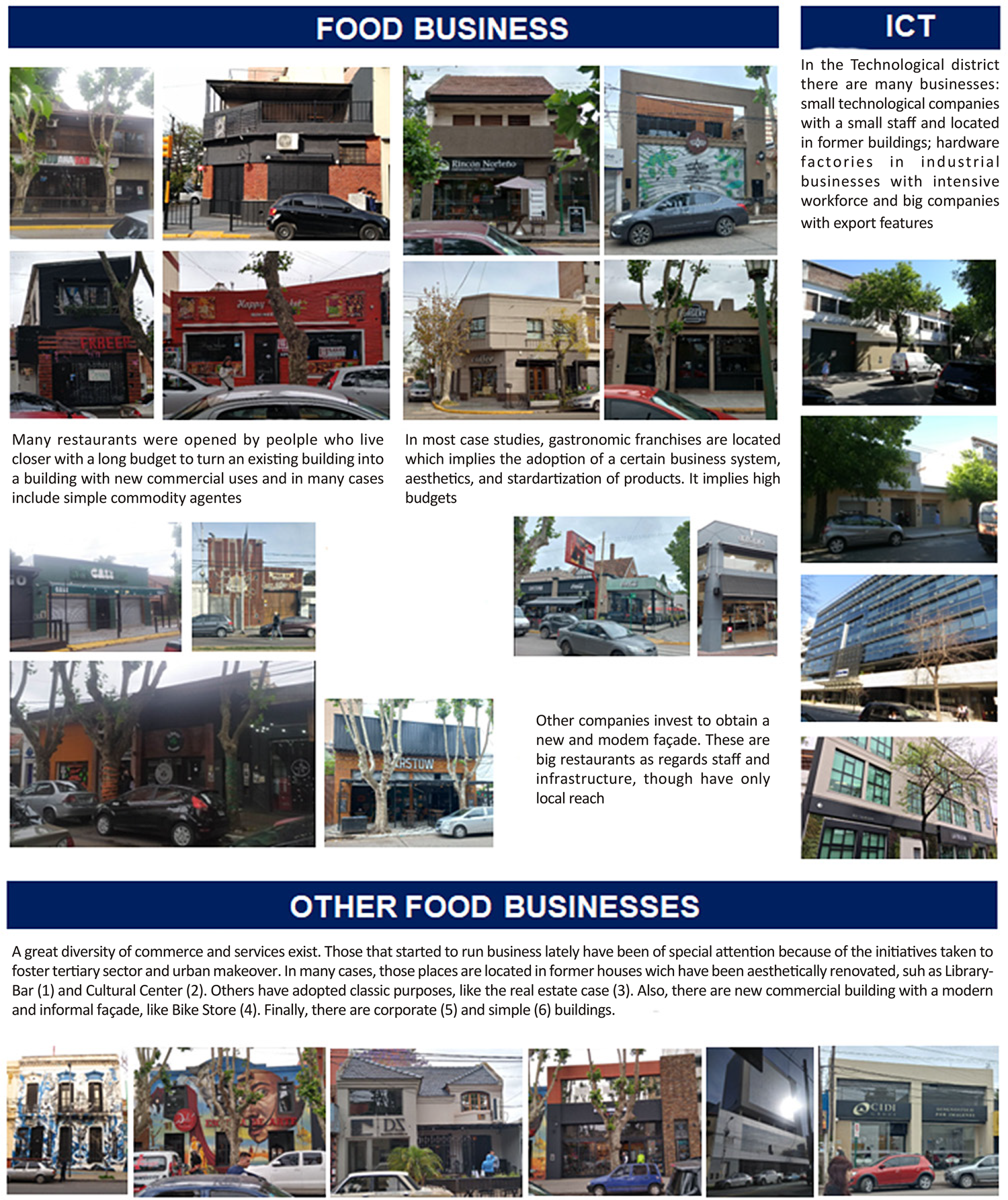
Figure 6 illustrates how diverse existing companies are and allows us to measure commercial activities that thrive. However, our attention is focused on the type of minor services because they make up the main strategy that local governments encourage for the urban makeover as an economic boost for obsolete or deteriorated areas. Speeches and models, such as “Getting to the city in 15 minutes” or the “Urbanization in Human Scale” fulfil different purposes (residential and productive purposes) and a life scale of proximity that fosters the intensive consumption in the urban space.

– Infographics about different economic units analysed in the presmises of the tertiary sector
Another aspect to highlight is the progressive relevance of the real estate and construction markets, which constitute the economic activity that adds capital value through the creation of buildings and urban rent. Different from industrial uses, new uses do not create conditions for a city conceived as a business place that promotes general conditions for the capitalist storage based on the production of surplus value. On the other hand, the development of those economic activities (of low added value and low productivity) implies a dynamic of urban production oriented to a privileged way of consumption of urban rent.
As it has been stated throughout this article, our case studies illustrate adaptative logic of local capitalist storage and depart from the idea of “the city as a business” where the economy takes place in areas triggered by financial capital and applied to the construction of business buildings for new services (Fani Alessandri, 2008). Nevertheless, it is important to consider it within the strategies of current capitalist storage and cover the importance that the real state market plays in the economic development of the consolidated city. In this context, it can be argued that changes in space give an answer to the force of real state businesses and its logic to occupy spaces rather than to the requirements and needs that the new environments create for the development of tertiary activities.
About the socio-territorial changes
The last aspect to consider is the characteristics that the geographic places exhibit so that the tertiary sector develops, that is to say, which socio-territorial changes exist and how the localization patterns of the service influence.
Garza (2006) postulates a differentiation between the rules for the localization of services, whether they are aimed at consumption or production. Within services for consumption, there are services which are immediately consumed due to their non-tangible nature (inability to be stored or moved) and are located near potential consumers, requiring demographic concentration. Also, there are services that offer long-lasting consumption which are located in some specialized areas in big cities. On the other hand, services oriented to the production tend to be located in some metropolis with sophisticated and varied urban infrastructure thanks to public investments (economies of urbanization) which are home to a vast list of economic activities and great white-collar job positions.
This short explanation leads us to reflect on the establishment of tertiary business in relation to the territory where they are. Our case studies in RMBA throw light on the relation between industrial uses and services oriented to consumption. Even though the industry and services do not share the same rules of establishment (Garza, 2006), they share the need to be grouped and their dependence on the density and amount of population. This is why minor tertiary services are located in deteriorated industrial areas, resulting from the first industrialization wave (concentrated in the city, near pedestrian precinct) instead of the industrialization wave of the 90s, in industrial parks of the Metropolitan area. Therefore, given the conditions of the local economy of tertiary sectors, it is possible to go back to urban centres and consolidated city.
Regarding their impacts on the urban arrangement, services encourage grouping and concentration tendencies because of the proximity to be sold and also fosters different territorial effects, such as attracting more clients. It is not coincidence that many of those initiatives are launched in neighbourhoods in CABA and main traditional areas of Buenos Aires Conurbation. In the same way, measures taken by the local government were intended to promote tax and fiscal benefits, but also led to an improvement in the façade and urban spaces. The economic reactivation is those places called, to a less or great extent, the investors’ attention to construct new buildings, people’s attention to live and a desire to turn old industrial places into bars or restaurants.
When conducting our survey, we could observe that the makeover processes reveal different developments, though they share low impact requalification. According to Vecslir and Kozak (2013) there are two types of changes. Firstly, requalification refers to improvements in buildings like better façade, recycling, additions or changes in material. Secondly, processes of changes in building typologies, referring to new higher constructions which evidence changes in the surrounding area. Our results indicate that in all cases requalification processes have had a major impact, reaching around 20% of plot lands in comparison to 6% average corresponding to changes in building typologies (Chart 2). In this group, there is a significant number of improvements in former constructions (paint and façade), but, to a less extent, in recycling and addition works. Therefore, those improvements were made by people who dwell (work, live or use) those buildings, requalifying their environment. An important datum is that 73% in Paseo Dorrego and 30% in Palaá Boulevard of requalifications occurred in plot lands that have business or services-use (Arqueros Mejica et al., 2023).
Processes of changes in building typology paved the way for new buildings. In Paseo Dorrego and Tigre those processes derive from big real estate operations (6 and 5 buildings, respectively). Both impact on the urban environment of the studied areas which are characterized by low-rise buildings and scarcely populated, as well as by non-working industrial buildings.
New developments imply changes in buildings alignments, verticalization and density processes, in particular, portrayed as modern designs in comparison to traditional buildings in the areas. Their effects are material and symbolic because they include morphological and aesthetic changes that influence on the urban landscape to attract certain dwellers (Arqueros Mejica et al.,2023). The impact of these changes on each place is relatively low.
We observe that our case studies are not those “tertiary areas” that the literature has recognized as new market around modern economies and business ecosystems based on R+D, as a way of global exchange6 (Ciccolella and Vecslir, 2010). These viewpoints coincide with the impacts on globalization and new economic flows at a global scale, driven by the development of information and communication technologies, adapting cities from the growth of quaternary stages of the tertiary sector, whose activities add value to the tangible production (De Mattos, 2010). We suggest nuancing our case studies with insights on urban reproduction in big Latin American metropolis in charge of real estate-financial, national-multinational capital, targeted to the investment in new architectonic artifacts and answering to soil value and rent strategies (Márquez and Pradilla, 2015). In this sense, our case studies’ characteristics are not similar to the tertiary sector that has restructured urban hierarchies in the Metropolitan Area of Valle de México (Pradilla, 2013).
Conclusions
The analysed tertiary sectors represent a tendency within the process of economic restructuring oriented to the tertiarization. It is not the only one, though. In RMBA, productive units associated to strategic and dynamic services of the economy emerge (corporate spaces, technological innovation businesses, among others), that impact on the urban makeover and real state value, leave footpaths on the Metropolitan restructuring and match with the type of tertiary services linked to the neoliberal globalization. Nevertheless, we can consider that our case studies contribute to the recognition of the local, special and specific dynamics that the tertiarization process has adopted in Latin America.
Cases that belong to the tertiary sector which were analysed belong to trivial services (food business, commerce, cultural business, mainly oriented to the immediate consumption). They constitute activities of low level of complexity and sophistication, carried out under low capitalist ways and simple commodities. There are mainly small and medium-scale businesses that provide answers to the adaptative logic of the capitalist storage framework, clearly differentiated from other concentrated sectors which foster a corporate city. The establishment and development of this type of agents as well as the type of productive change that promote is directly linked to the dependent character of the local economy and its pathway in the industrialization process.
The emergence of tertiary services allows to understand some of the tendencies that influence the urban scenery of main neighbourhoods and traditional areas of RMBA in the post-industrial context. Therefore, some changes stood out in the context built from the development of trivial services with grouping and concentration trends. Also, the progressive relevance that the real estate and construction market adopts as well as the role of the dynamization of territory and rent. In this way, the establishment of tertiary services implied that the areas where they have been erected became affected to the individual consumption, emphasizing the losing of economic role in the local productive sphere that went through industrial stages. Besides, these changes have occurred gradually and present structural heterogeneity of the productive system.
Finally, some questions have emerged. Our research focuses on changes of the post-industrial city as of the establishment and development of the tertiary sector oriented to trivial activities in main areas. In this context, we seek to understand some tendencies that have been less studied in the literature and complement themselves with other that have been more relevant, for example those linked to the city as a business sphere where corporate agents take part in. The connection between those relations is a unit of inquiry. Furthermore, the current inflationary and recessive context that Argentina is going through leaves the door open for tertiary services under the dimensions analysed. Finally, we consider that it is crucial to pay close attention to the social effects that these changes bring about, especially when creating and reproducing inequalities. In the future, we look forward to studying those units of inquiry.
References
- ALESSANDRI CARLOS, A. F. (2008). De la geografía de la acumulación a la geografía de la reproducción: un diálogo con Harvey. In: X COLOQUIO INTERNACIONAL DE GEOCRÍTICA. Universidad de Barcelona, Barcelona.
- ANTUNES, R. (2009). "Diez tesis sobre el trabajo del presente (y el futuro del trabajo)". In: NEFFA, J. C.; DE LA GARZA TOLEDO, E.; MUÑIZ TERRA, L. (comps.). Trabajo, empleo, calificaciones profesionales, relaciones de trabajo e identidades laborales. Buenos Aires, CLACSO.
-
ARQUEROS MEJICA, M. S. (2017). La política de desarrollo de la Comuna 8 de la ciudad de Buenos Aires (1996-2015). Disertación de doctorado. Buenos Aires, Universidad de Buenos Aires. Disponible en: http://repositorio.sociales.uba.ar/files/show/2127
» http://repositorio.sociales.uba.ar/files/show/2127 - ARQUEROS MEJICA, M. S.; GOICOECHEA, M. E.; GONZÁLEZ REDONDO, C.; VÁZQUEZ, D.; FASSINA, R. (2020). Distritos económicos y renovación urbana. Una mirada comparada a los impactos urbanísticos en el sur de la Ciudad de Buenos Aires (CABA). In: COLOQUIO DE CONFLICTOS URBANOS. Sevilla-Cadiz, España.
- ARQUEROS MEJICA, M. S.; GOICOECHEA, M. E.; VÁZQUEZ, D. E.; RETA, C. G.; GRAUBERGER, J.; ALCALDE, M.; GONZÁLEZ REDONDO, C.; TOSCANI, M. P; GALGANO, M. (2023). Transformaciones territoriales en el Área Metropolitana de Buenos Aires. In: II JORNADAS DE ESTUDIOS SOCIO ANTROPOLÓGICOS LEOPOLDO JOSÉ BARTOLOMÉ. Posadas, Misiones, Argentina.
-
ASTARITA, R. (2011). Respuesta a una crítica a la teoría del valor de Marx. Disponible en: https://rolandoastarita.blog/2011/11/15/respuesta-a-una-critica-a-la-teoria-del-valor-de-marx/
» https://rolandoastarita.blog/2011/11/15/respuesta-a-una-critica-a-la-teoria-del-valor-de-marx/ -
BACH, P. (2005). El sector servicios y la circulación del capital: una hipótesis. Disponible en: http://www.economia.unam.mx/lecturas/inae3/bachp.pdf Acceso en: 25 mar 2024.
» http://www.economia.unam.mx/lecturas/inae3/bachp.pdf - BLANCO, J. (2005). Localización industrial y movilidad asociada en la Región Metropolitana de Buenos Aires. In: X ENCONTRO DE GEÓGRAFOS DA AMÉRICA LATINA. Anais São Paulo, Universidade de São Paulo.
- BOZZANO, H. (2007). "Buenos Aires desde sus orígenes. Transformaciones territoriales y mutaciones productivas". In: BORELLO, J. A. (comp). Aproximaciones al mundo productivo de la Región Metropolitana de Buenos Aires. Los Polvorines, Univ. Nacional de General Sarmiento.
- BRIANO, L. E.; FRITZSCHE, F.; VIO, M. (2003). El lugar de la industria. Los parques industriales en la reestructuración productiva y territorial de la Región Metropolitana de Buenos Aires. Revista Latinoamericana de Estudios Urbano Regionales, v. XXIX, n. 86, pp. 109-135.
- CARMAN, M. (2006). Las trampas de la cultura: los "intrusos" y los nuevos usos del barrio de Gardel. Buenos Aires, Paidós.
- CICCOLELLA, P.; VECSLIR, L.; BAER, L. (2015). Revitalización de subcentros metropolitanos. Buenos Aires entre la ciudad dispersa y la ciudad compacta. Revista de la Facultad de Arquitectura de la Universidad Autónoma de Nuevo León, v. 9, n. 11, pp. 11-27
- CICCOLELLA, P.; VECSLIR, L. (2010). Nuevos espacios del terciario y transformación metropolitana en Buenos Aires. In: XI SEMINARIO INTERNACIONAL DE LA RED DE INVESTIGADORES EN GLOBALIZACIÓN Y TERRITORIO. Universidad Nacional de Cuyo, Mendoza, Argentina.
- CLARK, C. (1940). The conditions of economic progress London, MacMillan.
- CUADRADO ROURA, J. R.; DEL RIO, C. (1990). Los economistas y los servicios. Papeles de Economía Española, n. 42, pp. 2-18.
- CUENYA, B.; CORRAL, M. (2011). Empresarialismo, economía del suelo y grandes proyectos urbanos: el modelo de Puerto Madero en Buenos Aires. EURE, v. 37, n. 111, pp. 25-45.
- DE MATTOS, C. (2010). “Globalización y metamorfosis metropolitana en América Latina. Hacia una nueva forma urbana”. In: De MATTOS, C. (ed.) Globalización y metamorfosis urbana en América Latina. Olachi, Quito.
- DIEGUEZ, L.; GERCHUNOFF, P. (1984). La dinámica del mercado laboral urbano en la Argentina, 1976-1981. Desarrollo Económico, v. 24, n. 93, pp. 3-40.
- FISHER, A. (1935). The class of progress and security. London, MacMillan.
- FOURASTIÉ, J. (1949). Le grand spoir du XX siecle. París, PUF.
- GARZA, G. (2006). "La dimensión espacial de la Revolución Terciaria". In: GARZA, G. (coord.). La organización espacial del sector servicios en México México DF, El colegio de México.
- GOICOECHEA, M. E.; ARQUEROS MEJICA, M. S.; RETA, C. G.; ALCALDE, M. (2023). "La movilidad de las políticas de renovación urbana en el Área Metropolitana de Buenos Aires. Actores, arreglos e inversiones en la producción de nuevos espacios del terciario". In: VIDAL-KOPPMANN, S.; LIBERALI, A. M. (comp.). Movilidad urbana y vulnerabilidad socio-territorial. Aportes para el análisis de las regiones metropolitanas en Latinoamérica. Buenos Aires, IMHICIHU.
- GOICOECHEA, M. E.; ARQUEROS MEJICA, M. S. (2021). Nuevas configuraciones socioterritoriales en áreas centrales metropolitanas. La políticas de Distritos Económicos en el sur de la ciudad de Buenos Aires, Argentina. Área. Agenda de Reflexión en Arquitectura, Diseño y Urbanismo, v. 27, n. 2.
- GONZÁLEZ REDONDO, C.; GOICOECHEA, M. E.; ARQUEROS MEJICA, S. (2022). Estrategia metodológica para el estudio de la renovación urbana. Una propuesta centrada en las transformaciones territoriales del sur de la Ciudad de Buenos Aires, Argentina. Relmis, v. 24, n. 12, pp. 74-99.
- HERZER, H. (org.) (2008). Con el corazón mirando al sur Buenos Aires, Espacio Editorial.
- JARAMILLO, S. (2016). Heterogeneidad estructural en el capitalismo. Una mirada desde la Teoría del Valor Trabajo Abstracto. Territorios, n. 34, pp. 59-85.
- JARAMILLO, S.; CUERVO, L. (1987). Urbanización Latinoamericana, nuevas perspectivas. Bogotá, Escala.
- KOZAK, D. (2011). Construcción y transformaciones del Abasto, 1889-1998. Instituto de Arte Americano e Investigaciones Estéticas. Anais. Fadu-UBA, v. 41, n. 2, pp. 213-230.
-
MACHADO, G. (2017). El lugar de los "servicios" en El Capital de Marx. Teoria & Revolução. Recuperado de http://teoriaerevolucao.pstu.org.br/o-lugar-dos-servicos-em-o-capital-de-marx/ Acceso en: 25 mar 2024.
» http://teoriaerevolucao.pstu.org.br/o-lugar-dos-servicos-em-o-capital-de-marx/ - MÁRQUEZ LÓPEZ, L.; PRADILLA COBOS, E. (2015). Los territorios latinoamericanos en la mundialización del capital. In: II SEMINARIO INTERNACIONAL DE LA RED LATINOAMERICANA DE INVESTIGADORES SOBRE TEORÍA URBANA. Escuela de Planeación Urbano-Regional, Facultad de Arquitectura, Universidad Nacional de Colombia, Medellín.
- MARX, K. (1980). Teorías sobre la plusvalía: Tomo IV de "El Capital." México, Fondo de Cultura Econo´mica.
- NEFFA, J. C. (1999), "Crisis y emergencia de Nuevos Modelos Productivos". In: DE LA GARZA, E. (comp.). Los retos teóricos de los estudios del trabajo hacia el siglo XXI Buenos Aires, CLACSO.
- NUN, J.; MURMIS, M.; MARÍN, J. C. (1968). La Marginalidad en América Latina-Informe Preliminar". In: Documento de Trabajo, n. 53. Buenos Aires, ITDT.
- PRADILLA COBOS, E. (2013). "La economía y las formas urbanas en América Latina". In: RAMÍREZ VELÁSQUEZ, B. R.; PRADILLA COBOS, E. (comps.). Teorías sobre la ciudad en América Latina, tomo I. México DF, Universidad Autónoma Metropolitana.
- PREBISCH, R. (2012). El desarrollo económico de la América Latina y algunos de sus principales problemas. Santiago de Chile, Cepal. (Publicación original de 1986).
- RUBIN, I. I. (1974). Ensayos sobre la teoría marxista del valor. Córdoba, Cuadernos del Pasado y Presente.
- SOCOLOFF, I. (2015). Capital inmobiliario-financiero y articulaciones público-privadas: consideraciones a partir del centro comercial Abasto de Buenos Aires. Ciudades, v. 27, n. 106, pp. 10-19.
- TORRES, H. A. (2001). Cambios socioterritoriales en Buenos Aires durante la década de 1990. EURE, v. 27, n. 80, pp. 33-57.
- VECSLIR, L.; BLANCO, J.; NEROME, M.; SCIUTTO, F.; MAESTROJUAN, P.; RODRÍGUEZ, L. (2017). Reestructuración de la centralidad y movilidad cotidiana en el sur de la Región Metropolitana de Buenos Aires. Revista Transporte y Territorio, n. 17, pp. 267-287
- VECSLIR, L.; ELIMBAUM, P. (2016). "Centro y centralidades en la Región Metropolitana de Buenos Aires". In: JANCHES, F; ROBERTO, A.; JAIMES, C.; CORTES, M. (comps.). Del conocimiento al desarrollo: nuevos desafíos de la universidad en la gestión del desarrollo urbano contemporáno. Buenos Aires, Eudeba.
- VECSLIR, L.; KOZAK, D. (2013). Transformaciones urbanas en la manzana tradicional. Desarrollos fragmentarios y microtransformaciones en el tejido del barrio de Palermo, Buenos Aires. Cuaderno Urbano. Espacio, Cultura y Sociedad, v. 14, n. 14, pp. 146-172.
Notes
-
1
General San Martín, Vicente López, Tres de Febrero, La Matanza, Lanús and Avellaneda were greatly affected.
-
2
These tasks were part of the research that we have been developed as “Urban Renovation and Territorial Changes in AMBA” (RUTA, in Spanish) through the projects: UNDAVCyT 2021 “Premises of the tertiary sector. Initiatives for an urban renovation in the main areas of the Great Buenos Aires”, PICT 2021-0664 “Urban changes in contexts of renovation: Economic Districts in the Metropolitan area of Buenos Aires”, and PIT-CONUSUR “Rearrangement of the main areas after the pandemic. New tertiary areas in the Great Buenos Aires”.
-
3
These ideas, which are predominant in economic thinking, emerged after World War II in some countries of advanced capitalism. They comprised the growth of services within the framework of progressive complexity of the economy, as the technological development fosters new productive processes, activities and job posts. The prevalent approach was an evolutive understanding, noting that the tertiary sector represents a step further in the economic development. (Rostow, 1961; Bell, 1973).
-
4
To illustrate it, the tertiary sector in Argentina has always been important, making up for more than 60% of the GDP since 1900 according to (Institute of Economic Research of the Stock Market of Córdoba)), and the job distribution has even favoured those services.
-
5
Data is illustrative of those trends. Between 2005 and 2009, gastronomic businesses in Argentina were almost doubled, from 34.828 to 66.310. In the gastronomic-hotel sector, job posts increased to 77% while the national economy reached a growth of 44% (INVCQ, 2020 based on the data provided by the Ministry of Labour).
-
6
Departing from the Direct Foreign Investments targeted to the rearrangement of the way of consumption and residence, with the emergence of shopping centres and new central places as well as the emergence of new Central Business Districts in the city, which were considered to be “globalization artifacts” linked to more dynamic and international economic circuits.

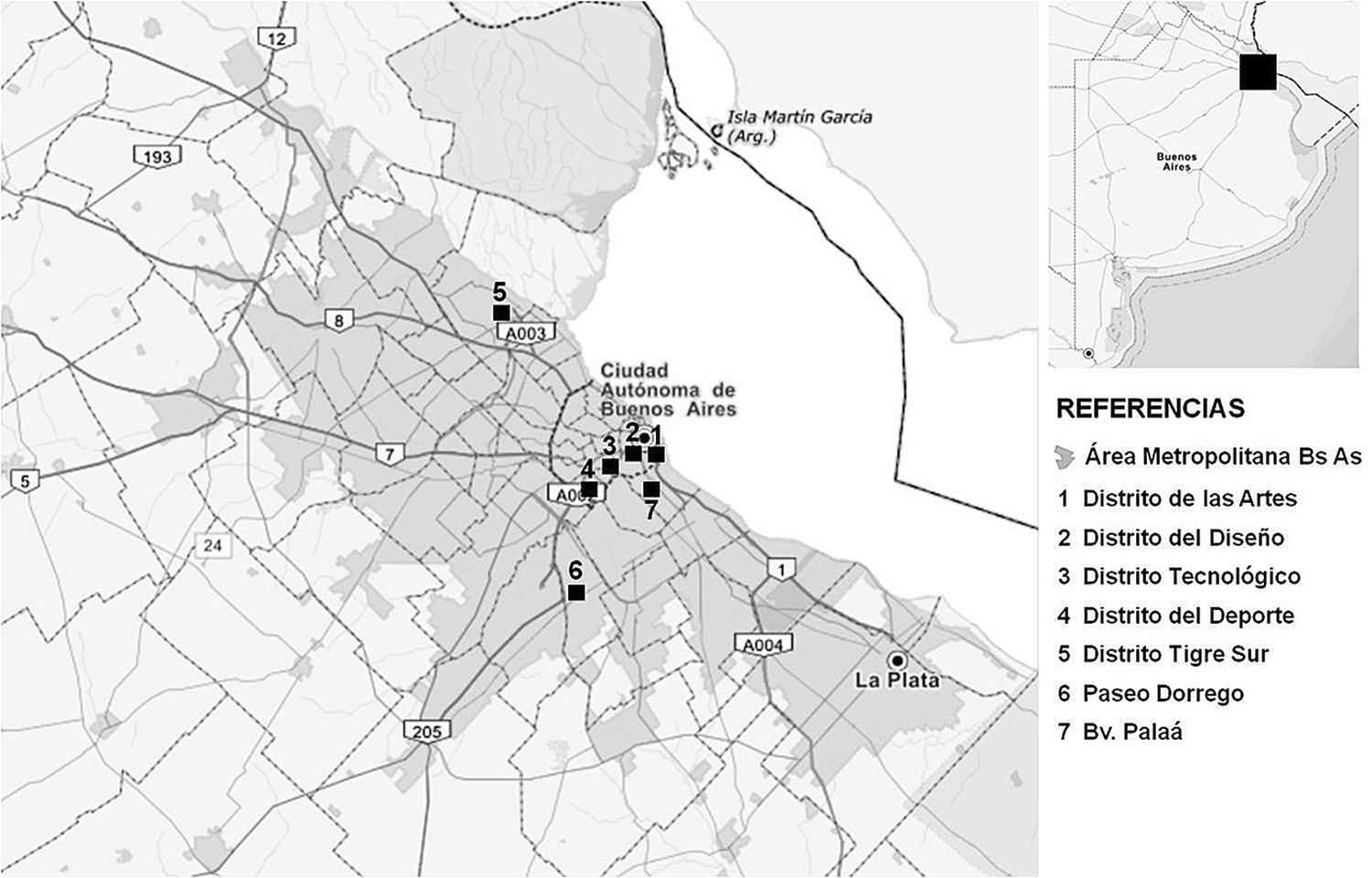 Source: developed by the authors.
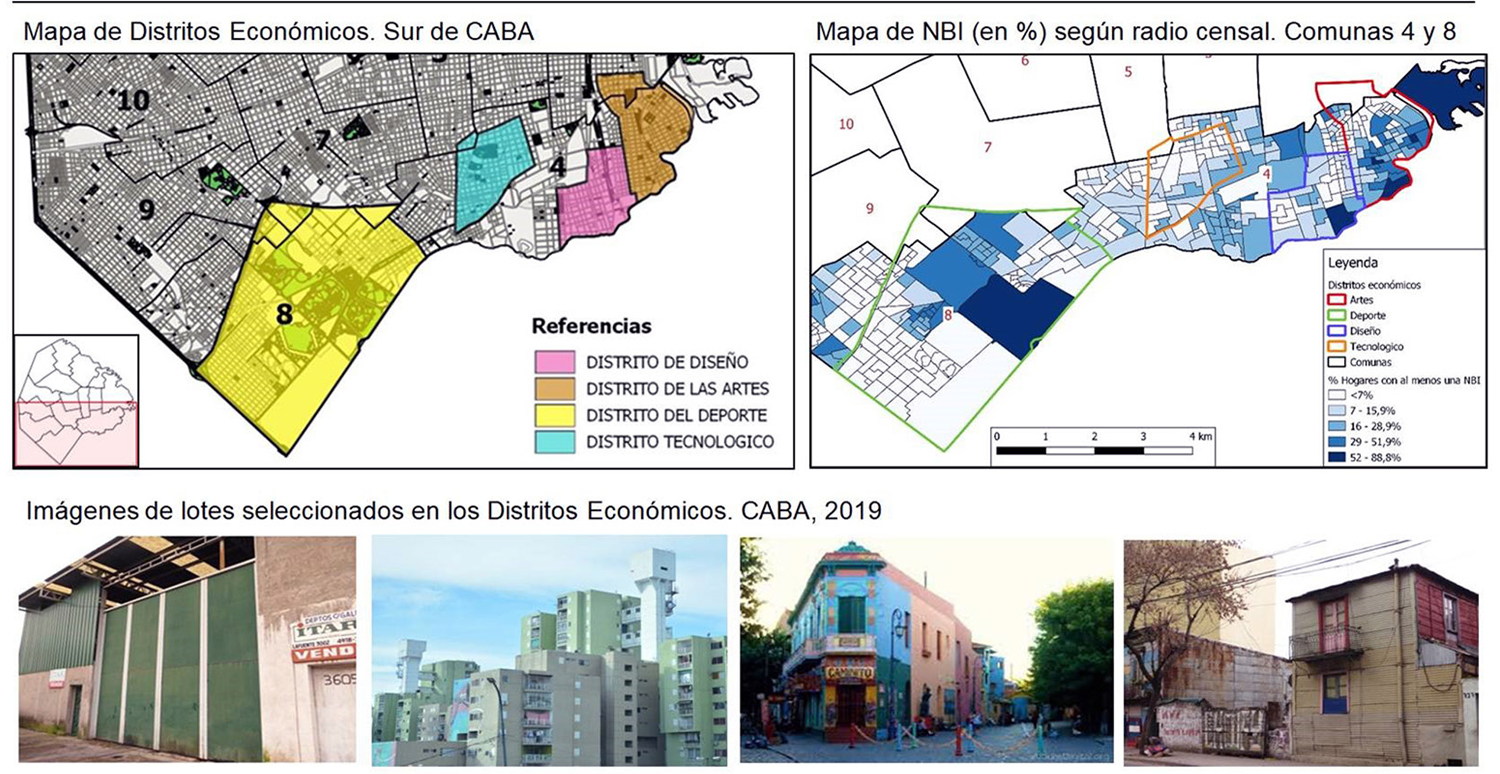 Source: developed by the authors.Comments: We depart from recognizing the heterogeneities that exist between intra and inter-districts, acknowledging that the south of Buenos Aires is home to many places with different purposes, types of buildings and social levels. We identify these characteristics as well as the type of activity promoted in each district as key features to understand how makeover initiatives impact.
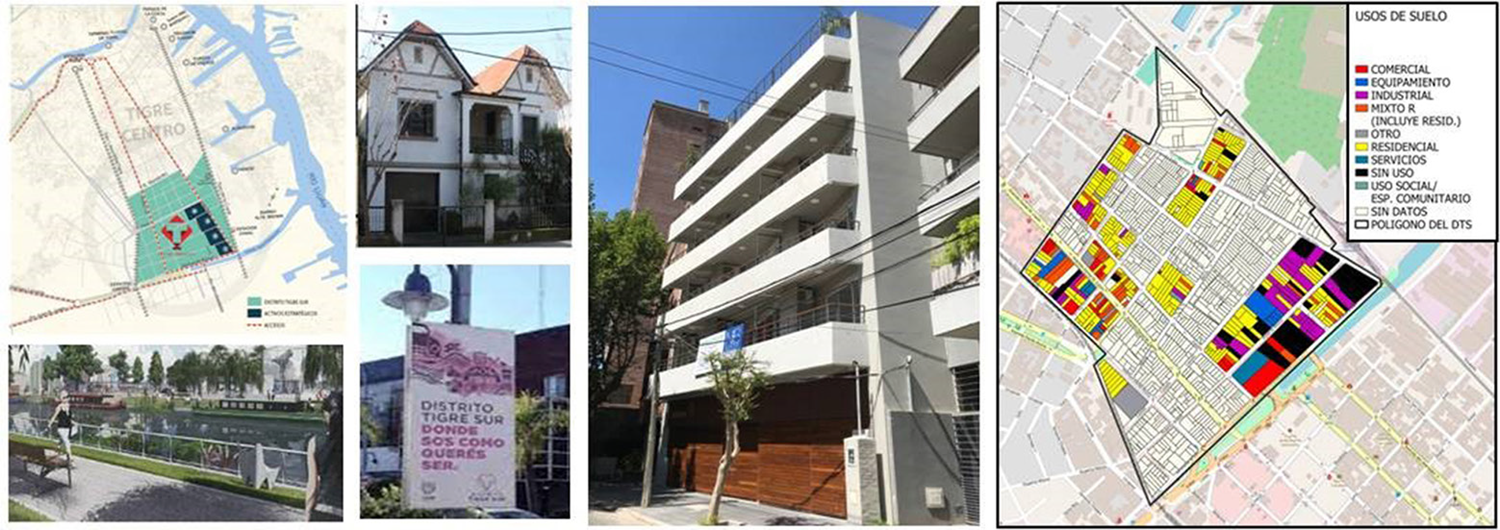 Source: developed by the authors.Comments: Tigre has historically been a privileged area characterized by countries, private neighbourhoods, gated communities and linked to tourism, mostly the Delta area and Puerto de Frutos, which is one the most well-known places for local and international tourists. 381 plots were analyzed. 63,68% fulfil residential purposes whereas 18,5% exhibit commercial or services purposes.
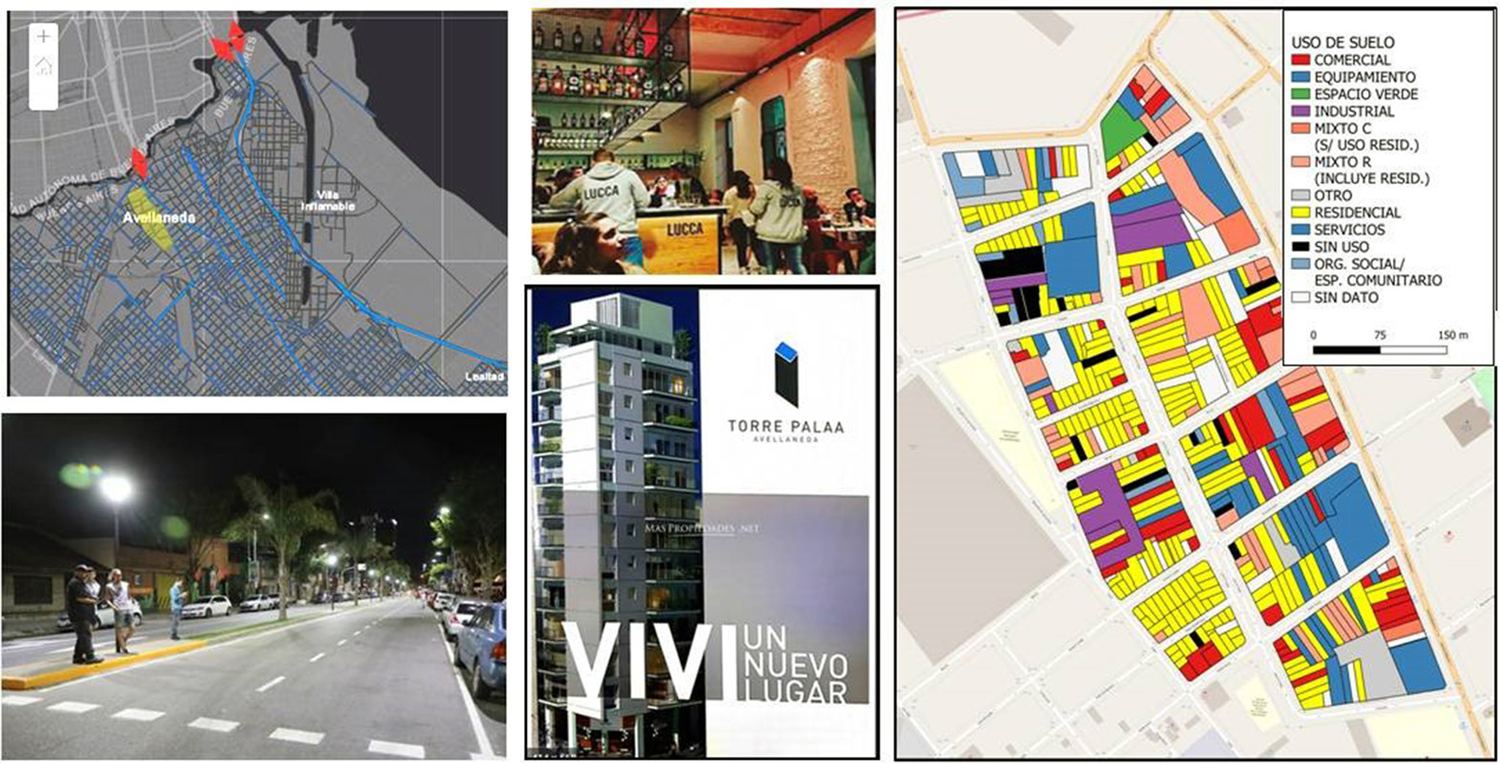 Source: developed by the authors.Comments: Avenalleda is a traditionally industrial and port Municipality, connected to CABA and other main commercial areas in Quilmes and Lanus. 418 plot lands along Palaá Boulevard were studied. 38,6% fulfil residential purposes and 23,95% exhibit commercial or services purposes.
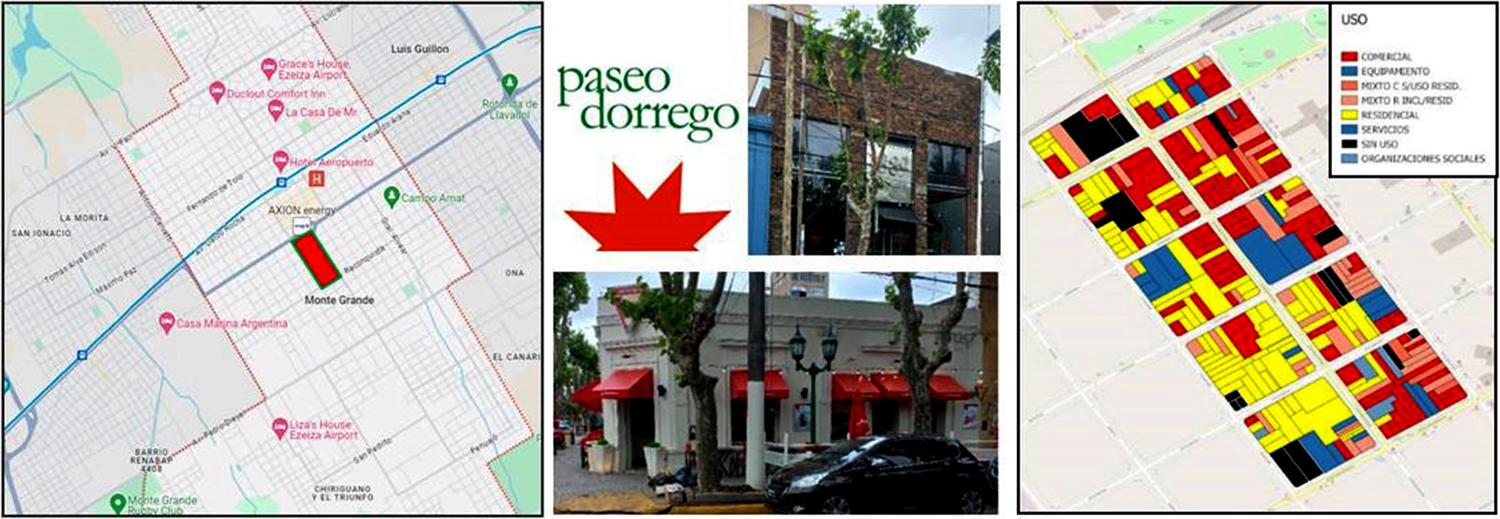 Source: Developed by the authorsComments: Paseo Dorrego develops as a new food business place adjacent to the main traditional area of Monte Grande, Municipaity of Esteban Echeverría. 277 plot lands were analysed. 35% fulfil residential purposes and 55,2% exhibit commercial or services purposes. Among the latter, 10% are food businesses. Within the polygon made up of 10 squares in Paseo Dorrego, there are 4 night clubs and 1 theatre.
 Source: developed by the authors.