
 City, participation, and political culture: games and other forms of representation and engagement
Abstract
This article discusses the relationship between participation, democracy, representation, and city. Based on a debate about the representation crisis, I discuss the role of architects in participatory processes. Reflecting on the concepts of quality of democracy, trust, and political culture, I argue in favor of using playful elements to shape urban culture. Then, I present two games developed in Brazil that aim to contribute to urban consciousness: the game Estatuto da Cidade (City Statute) (2001) and the game Agentes urbanos e a cidade participativa (Urban agents and the participatory city) (2015). Finally, I address how games can contribute to the autonomy of participants and to what extent they can promote the imagination of other forms of political mobilization.
city; participation; democracy; political culture; games
Resumo
Este artigo aborda a relação entre participação, democracia, representação e cidade. A partir do debate sobre a crise da representação, discuto sobre qual é o papel de arquitetos e arquitetas em processos participativos. Refletindo sobre os conceitos de qualidade da democracia, confiança e cultura política, argumento em favor do uso de elementos lúdicos como formadores de cultura urbana. Apresento, então, dois jogos desenvolvidos no Brasil que têm como objetivo a contribuição para a formação da consciência urbana: o jogo Estatuto da Cidade (2001) e o jogo Agentes urbanos e a cidade participativa (2015). Por fim, questiono como os jogos podem contribuir para a autonomia dos participantes e até que ponto podem promover a imaginação de outras formas de mobilização política.
cidade; participação; democracia; cultura política; jogos
Participation, representation and the social role of architects
The theme of participation gained momentum in architecture after the Second World War, in a period marked by major changes in the political, economic and social landscape in several countries. This was a time of boiling social movements in various parts of the world, with the Prague Spring, the May 68 Revolution in France and countless achievements by the black and feminist movements in the USA. In this context, the provocations raised by the Team X1 group during the International Congresses of Modern Architecture (CIAM) initiated a crisis in architecture by questioning modern premises and criticizing the authoritarian bias of the social role of architects in modernism.
Since the second half of the 20th century, therefore, we have experienced processes in the field of architecture and urbanism that seek to involve their users in different stages of the project: in the collection of demands, with cartographies and affective mapping; in the project design, through technical assistance and support and social movements; during construction, through joint efforts and vernacular techniques; or in the form, by allowing transformations and future appropriations. The variety of intensity of participation in this history of practices makes it impossible to give a single reading of these processes. As the American communicator Sherry Arnstein (1969) points out, a participatory process can range from manipulation of the participants – in which the population is used as a justification for pre-established interests by external agents – to total popular control, with no intermediaries between the population and the source of resources.
Arnstein, in formulating a “ladder of citizen participation”, argues that different degrees of participation require different times and relationships between agents. From the point of view of the role of architects throughout these processes, the experiences are disparate. For some architects, such as the Englishman John Turner and the Brazilian Carlos Nelson Ferreira dos Santos, for example, there is a lot to be learned from self-building and mutual aid in scenarios where public policies are lacking. In projects such as Álvaro Siza’s Bairro da Bouça (1973-1976 and 2001-2006, Portugal), Giancarlo de Carlo’s Villaggio Matteotti (1970-1975, Italy) and many of the projects carried out by Usina CTAH’s technical assistance (mostly developed in the 1990s in Brazil), it is possible to recognize an authorial imprint of the architects.
Disagreements over the sovereignty of architects’ or users’ authority remain in question today: while some experiences seek to give end users maximum decision-making power, others face the dilemmas of representation via advocacy or social leadership. As such, the question of authorship is directly related to the question of representation, and guides communication and the dynamics of the relationship between the agents involved in participatory processes.
At the end of the 1960s, the word “participation” was in the spotlight of Western political debate. There was a wave of demands for more openness to popular participation in governmental spheres, stemming from the post-war and re-democratization processes in many countries. The mass use of the word broadened the concept, giving rise to various understandings and interpretations. “Participation” came to denote a series of situations that could even contradict each other. After the Second World War, democracy was presented as the only possible regime to guarantee the acceptance of the governed, according to Brazilian social scientist Miguel (2014). For a long time now, societies have been too numerous to propose direct democracy, and representation has been necessary. Likewise, politics has become more complex, requiring more specialized knowledge and a time commitment that is unfeasible for most citizens. In the past, governors were also governed and there was a turnover; today, this role has become a class. The distance between representatives and those they represent is much greater nowadays and comes up against the difference in the interests of each of these actors. Representation is therefore unavoidable, as Miguel argues, but it doesn’t have to be the only solution for collective decisions on a smaller scale.
When analyzing the situation of representation in politics, we can relate it to representation within the participatory processes of architecture and urbanism. When Luis Felipe Miguel discusses the concept of advocacy (people, institutions or non-governmental organizations that act on behalf of a cause or group, either through their influence among agents or expertise), this parallel becomes even more evident. According to him, valuing technique as the most effective method of guaranteeing the interests of those represented leads to a probable elitization of advocates, since there are unequal opportunities for specialization. Advocacy can then accentuate the asymmetry of power between representatives and the represented, as well as compromising judgment on the part of the represented due to a lack of political training, and finally, representation via advocacy can take away the autonomy of the represented in building their political preferences. In other words, for him, this model, despite its claims of effectiveness, is always crossed by the problems of social inequality between the two groups. In a less favored position of dialogue, organization and judgment, the represented tend to embrace the preferences of their advocates. Representation through advocacy evokes the profusion of intermediaries between the state and society. In participatory processes of any kind, we can find representatives who have not received authorization via elections or other mechanisms, such as community leaders, NGOs and companies. Architects, when acting as representatives of the population, can take advantage of these shortcomings to “advocate” for personal interests through popular participation.
Representation via advocacy therefore reproduces many of the problems encountered in traditional political representation, as well as creating new issues related to authorization. The author argues that these new modes of representation should not replace the interests of the represented groups. Demands should arise autonomously and it should be the role of advocates to encourage this autonomy. Autonomy is important not only in the construction of interests, but also in the ability to renegotiate group identities. Miguel (2014) stresses that autonomy is both individual and collective, it is the ability to criticize the group to which we belong. Individual autonomy strengthens the collective by making commitments and pacts clearer. In this sense, is it possible to think of forms of participation and representation that promote the autonomy of those represented? What is the role of the technician, architect or specialist in qualifying participation as a political mechanism?
Quality of democracy, trust and political culture
The consolidation of a large number of democracies in the West after the end of the Second World War has changed the research agenda in political theory, which today focuses on the search for new qualitative evaluation parameters – in addition to economic and institutional ones – especially the influence of culture on politics. Concepts such as civic culture, trust and social capital have become fundamental to contemporary political debate. By studying how interpersonal trust and trust in institutions relate to the quality of democracy, much current research in the field of political theory seeks to measure the degrees of trust and their consequences for contemporary democracies.
The book The civic culture: political attitudes and democracy in five nations, published in 1963 in the USA by political scientists Almond and Verba (1989), is one of the first works to address the issue of political culture, analyzing democracy in five countries. The authors draw attention to the fact that there was a great increase in popular participation after the Enlightenment, when ordinary citizens became politically relevant. Participation, however, is not synonymous with democracy. They identify two types of participation: democratic and authoritarian. For them, institutions such as universal suffrage, political parties and the legislature are not enough to guarantee a model of democratic participation, after all, they are also present in totalitarian regimes. Almond and Verba then argue that a democratic form of participation also requires a political culture.
Based on this central argument, the authors analyze the degree to which citizens know about the political system and its structure, the inputs and outputs2 of the process and their individual role as part of this system, defining three categories of political culture: parochial, subject and participant.
A parochial political culture is one in which citizens have none of this knowledge. In these societies, there is no specialization required of political leaders, and there is no prospect of change through politics. In the subject culture, citizens recognize the existence of a political structure and its outputs, but the relationship is passive: there is no individual political exercise. In the participant political culture, however, there is knowledge of all the factors and citizens play an active role.
According to Almond and Verba (ibid.), these different types of culture are not progressive or exclusive; they can complement each other and coexist within the same society. The authors also point out that this categorization does not seek to be homogeneous or uniform, as there will always be parochial and subject orientations even in the most developed and stabilized societies as participatory and democratic. With this, they refute the idea that the quality of democracy depends only on economic factors and emphasize the importance of the existence of a political culture. For the authors, the concept of “civic culture” is therefore more than the history and social context of a given group: it is what connects macro-politics with micro-politics, because it involves political as well as psychological orientations.
In their work, Almond and Verba seek to analyze how individual orientations relate to and impact the political structure. Understanding that the role of the participatory citizen adds to that of the parishioner and the subject, the authors point to research that reiterates this point by verifying that citizens are more concerned with family and personal matters than with politics:
[...] if the ordinary man is interested in political matters, he is more likely to be interested in the output than in the input process. He is concerned about who wins the election, not about how it is carried on; he cares about who is benefited by legislation, not about how legislation is passed. (Ibid., p. 117)
According to them, passive behavior, typical of the subject, is more common than that of the active citizen. Active behavior would demand much more from the citizen, requiring some degree of empowerment. By ignoring the instruments of political change, the individual shirks the responsibility of fighting for them, just accepting what is decided and obeying the laws. Ideally, in a democracy, decision-making power is divided among ordinary citizens, who are active and empowered participants; however, what is found in practice is passivity and indifference.
This discussion around specialization and empowerment led the authors to research how ordinary citizens (those who are not specialists, authorized representatives or community leaders) want to participate. The citizen who participates is still the citizen who obeys the law and has personal interests. These two roles overlap and are in constant conflict. Almond and Verba conclude that for there to be a democratic government in which ordinary citizens participate, there needs to be a political culture consisting of a series of values, attitudes and norms. These factors are affected by the structure of the local community, but institutional changes alone are not enough to guarantee effective participation.
The mismatch between institutions and the political culture of societies presented by Almond and Verba in the 1960s became even more evident in several countries in the decades that followed. Released in 1993, the book Making democracy work by american political scientist Putnam (1997) was one of the first studies on the influence of civic culture on politics. Presenting his research on Italy, the book shows how the same configuration of public institutions in the country generated disparate experiences and results according to the different Italian provinces.
To analyze the different contexts in the northern and southern regions of Italy, Putnam refers to the “authoritarian vicious circle” and the “democratic virtuous circle”. The authoritarian approach uses fear and repression to the detriment of trust. The democratic one starts from the principle that there are rules that must be complied with by everyone, based on compromise and the exchange of part of one’s freedom for future compensation. In the democratic circle there is an understanding that breaking them will result in a loss for everyone, while the authoritarian circle is the result of vertical power.
To exemplify his theory, Putnam makes an analogy between these two aspects and the “prisoner’s dilemma”.3 When citizens are inserted in an environment of cooperation and horizontality, it is understood that individual behavior can be replicated by the other players, inhibiting individual action in search of favors. In the same way, an environment in which the rules of the game seem fragile or unstable generates a desire in the players to abandon or boycott the game before being harmed by a sudden change in the rules. Thus, the democratic circle is more unstable than the authoritarian one because it depends on cooperation and, consequently, trust.
According to Putnam, what would explain the very different performance of the same Italian institutions would be “social capital” or the “civic community” measured by certain indices (participation in referendums, reading newspapers, associations, etc.).
Social capital influences institutional performance through interpersonal trust: “social capital refers to characteristics of social organization, such as trust, norms and systems, which contribute to increasing the efficiency of society by facilitating coordinated actions” (ibid.). According to him, a society in which there is no interpersonal trust is wasting its potential – which leads to a greater need for physical capital.
Brazil is a good example of how participatory institutional apparatuses alone do not guarantee the quality of democracy. The reflection of the lack of political engagement can be seen in our fragile democracy – with a history of coups, dictatorships and instability of power, rights and freedoms – and, consequently, in our cities. Often, Brazilian cities are affected by public policies that do not respect our history – erasing the memory of native people, black people and the most vulnerable groups – and that accentuate social inequalities, aiming for profit and the interests of the few. From the hygienist urban reforms of the early 20th century to mega-events (such as the 2014 World Cup and the 2016 Olympic and Paralympic Games in Brazil), decisions seem to be taken without the participation of the population. But if implementing participatory tools isn’t enough, how can we encourage citizens to play their political role?
Our most recent democratization process, which began at the end of the 1980s after the long period of civil-military dictatorship in 1964, brought many hopes by creating a progressive constitution that defined real instruments for participation beyond elections. More than 30 years after the Constituent Assembly, however, there is a clear need for a critical review of these mechanisms, based on an analysis of their mistakes and successes.
The main direct participation tool introduced by the Constitution of the Federative Republic of Brazil was the community council: a social participation mechanism established in the 1988 Constitution to promote dialog with the population through consultative or deliberative channels between the government and members of civil society in the areas of Security, Health and Social Assistance. Since then, various researchers have dedicated themselves to the subject, seeking to assess its potential and its weaknesses.
Brazilian economist Abramovay (2001), in a text focused on the study of rural development management councils, raises important points about the shortcomings of this experience. Abramovay recognizes the potential for political transformation that the councils represent, but argues that there is, in general, a submission to dominant local powers. Looking specifically at the rural development councils (created in 1997 to approve rural development plans and receive funds from the National Program to Strengthen Family Farming), he acknowledges that there is an innovation in the fact that the funds are mediated by members of civil society, but warns: “[...] for this achievement to mark a strengthening of civil society, it must be translated into a real increase in income generation capacity and in society’s confidence in its development possibilities (ibid., p.122).
Abramovay (ibid.) shows that, in practice, councils don’t always work as instruments for empowering citizens. This is due to two main factors. The first problem is explained by the author when he presents data showing that the majority of councils came into existence after the legal provision for their existence in order to obtain public funds. They were therefore created out of economic interest, rather than out of a political culture of participation. And values, behaviors and interpersonal trust were not generated automatically with the creation of councils. According to the author, this scenario is directly related to the second factor, which is the lack of broad participation by society in the councils, which are generally made up mostly of specialists, with particularly low participation by young people and women.
Abramovay points out the cost of participation to individuals due to the large number of meetings and the accumulation of functions on the same individuals. Once again, the issue of specialization appears as the main challenge of participatory processes, since, as there is a lack of technical training to participate effectively in debates, the public is restricted to a small number of specialized people. According to Abramovay, these factors lead to participation fatigue, causing social capital to be wasted and, in many cases, even generating resistance on the part of the population.
Disbelief in participatory institutions seems to be a repetition of distrust in public institutions, according to Brazilian political scientist Moisés (2008). Moisés associates Brazilians’ current disbelief in public institutions and the political system with legacies from the dictatorial period. According to Moisés, our institutions and “coalition presidentialism” – a term coined by Sergio Abranches in 1988 and which refers to Brazil’s proportional multiparty system, which requires the president to make alliances with other parties in order to achieve a majority in Congress and pass his measures – bear traces of authoritarianism that lead to distrust and dissatisfaction with democracy on the part of the population:
Dissatisfaction with democracy and distrust of its institutions indicate that they do not feel that their rights to participation and representation – on which political equality and its corollaries, such as social and economic equality, depend – are effective channels for tackling problems such as corruption or economic hardship. (Ibid., p. 36)
In fact, Abramovay (2001) and Moisés’ (2008) arguments corroborate the idea that Brazil has advanced in legal terms faster than its political culture. The political consequences of this scenario are perhaps only becoming evident decades after the 1988 Constitution, in the face of the crisis of representativeness that exploded in demonstrations across the country in 2013.4 However, surveys such as the World Values Survey – WVS (Inglehart et al., 2014)5 have already indicated that Brazil historically has a very low rate of interpersonal trust.
In his article Trust, well-being and democracy, american political scientist Inglehart, director of the WVS, presents some indicators of the level of interpersonal trust related to the economic development of various countries. His thesis is that wealthier societies have a higher level of trust, since this is a prerequisite for social development. Inglehart also states that it is more likely to trust other people when you have a basic level of economic development: in situations of extreme poverty, a breach of trust can have fatal consequences.
Recognizing that the relationship between trust and socio-economic development is not simple and straightforward, Inglehart adds other factors that feed into this equation, such as education, religion and the country’s political history. For him, economic development encourages a political culture that helps stabilize democracies. The author identifies that these factors have been little studied in empirical analyses – which led the WVS to test these remises. Comparing Freedom House’s6 indicators of civil liberty and political rights with the level of interpersonal trust, WVS produced graphs analyzing countries with different degrees of democratic stability. From 1972 to 1997, the graphs confirm the hypothesis that more democratic governments also have higher levels of trust: “[...] its [democracy’] long-term survival is linked with relatively high levels of subjective well-being and interpersonal trust. These factors, in turn, seem to reflect both the economic development and the cultural heritage of given societies” (ibid., p. 119).
In this survey, which covers more than 50 countries, Brazil appears with the lowest confidence index,7 signaling the fragility of our democracy. This data supports the arguments of Abramovay and Moisés by demonstrating that the country lacks a political culture, despite efforts to create a “participatory” state. Inglehart’s final statement highlights the importance of ordinary citizens in the effectiveness of democracy: “its [democracy’] survival also depends on what ordinary people think and feel” (ibid., p. 119).
It is precisely this mismatch between institutions and the population that the English architect Miessen (2010) warns about in his book The nightmare of participation. In line with Abramovay (2001), Miessen believes that there are more and more mechanisms for participation and fewer and fewer people taking part. In his work, he warns of the danger of a possible “violence of participation”, when it becomes an obligation rather than a desire. For him, the concept of participation has become generalized and is almost always understood, in a romantic and naive way, as something that is necessarily positive.
The author goes so far as to say that, sometimes, fully inclusive democracies should be avoided, since people don’t always have good intentions and the will of the majority isn’t always positive or beneficial. In this sense, his view is close to the studies of Almond and Verba (1989), as well as Putnam (1997), in assuming that participation is not necessarily synonymous with democracy. For these authors, the will of the majority is not always democratic, just as a civic culture is not always a participatory civic culture. The exercise and construction of democratic participation involves the formation of culture. Miessen (2010) goes so far as to say that “the more central difficulty with the romanticized notion of the participatory project is that it assumes that everyone should sit around the table to make decisions. Yet this might not necessarily be in everyone’s interes.” (ibid., p. 245).
For Miessen (2010), understanding participation as something linked to the ideas of consensus and inclusion represents an opportunistic and manipulative vision that doesn’t set out to add something to the architectural debate, but rather to accomplish something predetermined: “Participation is war. [...] Any form of participation is already a form of conflict. [...] In order to participate in any environment or given situation, one needs to understand the forces of conflict that act upon that environment” (ibid., p. 53). Thus, referendums and plebiscites, for example, are seen as a mechanism used by politicians to avoid their responsibilities, diluting the democratic model. The author therefore urges a practice of conflict that contributes to critical thinking. The search for consensus – as well as being impossible – is, for him, paralyzing, as it prevents critical engagement. It is necessary to assume the risks and responsibilities of a process in which failure and conflict are part of it.
To this end, Miessen (ibid.) advocates an autonomous and independent practice, in which architects can act as external activists who raise questions and debates in a provocative and productive way. For him, the conformism of architects in only interfering where they are called or following orders from clients is related to the crisis in the profession and contributes to the loss of space and appreciation of architectural practice.
So, as a way out of the crisis – of participation, of politics and of architecture – it is necessary to review praxis, to rethink modes of action. In this way, perhaps participation can be understood not as a “war”, but as a “game”, in the sense of dispute, recognition of forces, negotiation, necessary conflict and victory that is not always achieved.
Putnam’s (1997) association of the structures of the authoritarian vicious circle and the democratic virtuous circle with the structure of games seems instrumental to his thinking, as an analogical tool to develop his ideas more clearly. Even so, this approach also highlights the playful nature of the democratic game. Because it is a power structure, with different characters and rules, democracy follows a structure that is somewhat analogous to that of games. Putnam emphasizes how repetition, the variation of agents and the number of players influence the game. And it is this analogy, coupled with the idea that games are shapers of culture, that has guided initiatives linked to the development of games as tools for popular participation.
I see in the possibility of the game as a tool for participation a strong relationship with the question about the lack of political culture in Brazil. Although there have been legal advances in terms of participation tools, as Abramovay (2001) points out, there seems to be a lack of willingness to participate. The abyss of specialization, the lack of basic education and the serious levels of social inequality keep a large part of the population away from the instruments of participation, perpetuating what Almond and Verba (1989) define as a parochial and subject political orientation (those in which citizens are unaware of or passive to the political system). While the debate on democracy in certain countries is being updated, going beyond the definition of the initial concept and moving on to study the evaluation of its quality, in Brazil, the years of authoritarian regimes, our colonial background and the enormous internal inequalities make for a fragile democracy. Even so, we must not shy away from debating the quality of our democracy. Despite the fragility of our institutions and the uncertain political scenario, we can take an optimistic view of developing our democracy through effective participation in political education. In this way, we could avoid a mismatch between the evolution of democratic institutions and the country’s political culture.
The role of games in shaping urban culture
The idea that games form culture was the central thesis defended in the book Homo Ludens, published in 1938 by the Dutch historian Huizinga (1971). In it, play is presented as a component of culture. It is characterized as a sphere of exception from everyday life and a necessarily voluntary activity, capable of simulating reality and going beyond the real world. Thus, according to the author, games are able to access the collective imagination and reveal information, feelings and desires.
In his conception, play is something beyond physical or biological activity, as it has a significant action. Its symbolic factor means that play goes beyond the limits of reality, establishing an autonomous reality. Thus, play is not part of everyday, ordinary life, it is an activity with its own time and space, a sphere of exception.
With its own limited duration, the game establishes a break in ordinary life – which adds to it the sense of fun and unpretentiousness shared by a group. Necessarily a voluntary activity, the game presupposes that you play until a certain end, and you can start again as many times as you wish. According to Huizinga, the bond established between the player and what was shared during the game doesn’t end when the game is over. There is something that emerges from the game and brings the players closer together:
Player communities generally tend to become permanent, even after the game is over. [...] the sensation of being “separately together”, in an exceptional situation, of sharing something important, moving away from the rest of the world and refusing the usual norms, retains its magic beyond the duration of each game. (Ibid., p. 15)
In this sense, based on the formation of “communities”, it is possible to think about the importance of games in the formation of civilizations. Huizinga relates them to rituals, cults, myth, language, theater and other “archetypal activities” of societies. He defines two functions for play: the struggle for something and the representation of something. The author also points out that: “these two functions can also sometimes be confused, so that the game comes to ‘represent’ a struggle, or else becomes a struggle for a better representation of something” (ibid., p. 16). In other words, “more than a false reality, its [the game’s] representation is the realization of an appearance: it is ‘imagination’, in the original sense of the term” (ibid., p. 17).
Following in Huizinga’s footsteps, it is therefore possible to identify games as a tool for social construction through representation. The world of play makes it possible to deal with real-world issues without a seriousness that could be compromising. Through fun, memories are reached, social bonds are created and, through imagination and complicity, a new understanding of the real world can emerge.
How, then, can games be used today to engage the public in debate about cities in a more attractive way than assemblies, meetings, questionnaires and other methods normally used in participatory processes?
Throughout human history, games of various kinds have been found. Archaeological discoveries indicate the presence of games in ancient civilizations more than 5,000 years ago. The importance of games in the formation of societies is evident, with the leading example being competitive games such as the Olympics and the World Cup – among other millenary and centenary events that mobilize many nations socio-politically and economically. It is therefore possible to identify different approaches and functions linked to games: entertainment, propaganda, isolation, manipulation, criticism, etc. However, my focus is on the role of ludic elements in participatory processes. Here, I seek to understand how imagination and fiction are part of the construction of cities and how games function as a tool for participation in this construction. Therefore, I am necessarily referring to collective and face-to-face games.
In this sense, it’s important to remember that playful experiences in the field of architecture and art have been developed at least since the 1960s, when groups explored the participation of the spectator or user in their works, thus questioning authorship, the rigidity and predictability of works and projects, as well as seeking a more playful vision of urban experience (such as the Surrealists, the Situationist International, Hélio Oiticica, Lygia Clark, Team X, among others). Within the universe of face-to-face and collective games, I would like to highlight two examples of contemporary play experiences chosen because they deal with urban themes and seek, in some way, to promote urban awareness. I have selected two Brazilian games to illustrate the experiences that have emerged in this sense in the country with the process of re-democratization in the 1990s and since the landmark City Statute in 2001.
City Statute Game
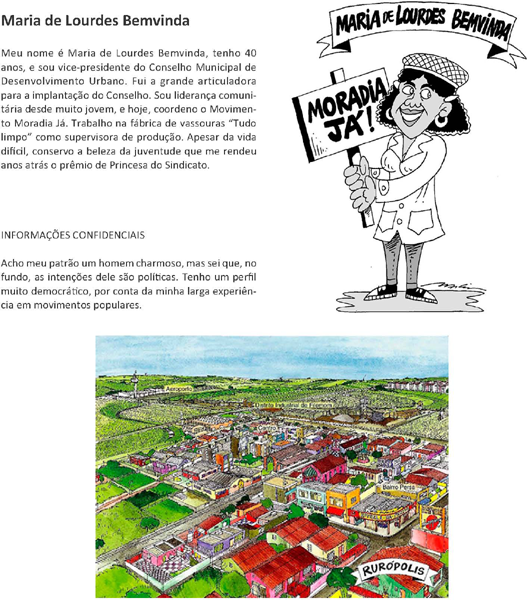
The City Statute Game was created in 2002 by the NGO Instituto Polis, and was developed by Renato Cymbalista, Raquel Rolnik, Paula Santoro and Uirá Kayano Nóbrega. Its intention is to present the City Statute and make its players familiar with its instruments through a role-playing game. The game features three fictional cities and urban situations similar to those found in many cities across the country, such as housing shortages, lack of urban mobility, real estate speculation, etc. The players decide which of the cities they want to play with and listen to the mediator explain the characteristics of that city.
The cards in the game are the instruments of the City Statute (real estate consortium, transfer of the right to build, consortium urban operations, public hearings, etc.) and the cards with the characters of the city (mayor, councillor, farmer, president of the residents’ association, journalist, housing secretary). Each player chooses or draws a character, reads their description to everyone and keeps the secrets of the character described on the card to themselves. The mediator reads out the municipality’s “problem situation” and the players begin to discuss and suggest solutions using the instrument cards. Each player must use at least one instrument card. The game ends when a proposed solution is found or when the mediator determines.
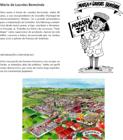
There is no competition in this game. The players must work together to solve the problems presented. There also seems to be a need for prior knowledge of both the City Statute and the roles of each player. The instrument cards in the City Statute game contain lengthy descriptions of complex urban planning devices. The need for a mediator in this game also points to problems in the dynamics of the game and emphasizes the need for someone with a certain degree of expertise to coordinate the game – which seems contradictory to the game’s proposal.
Urban agents and the participatory city Game
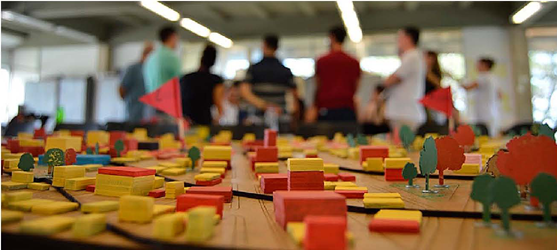
Another similar experience has been developed within the academic field. Since 2015, the university project Cartilha da Cidade has also been working on the theme of urban awareness through games at the University of São Paulo in São Carlos. Coordinated by Professor Miguel Buzzar and with a team made up of Desirée Figueiredo Carneiro, Gabriele de Campos Trombeta, Matheus Motta Vaz and Mayara Vivian dos Prazeres Cruz, the game Urban agents and the participatory city involves undergraduate and graduate students from the university, as well as primary and secondary school students from the public school system. The aim of the game is to bring urban themes and debates closer to young people’s daily lives, as well as to promote civic education and a critical sense of the city.
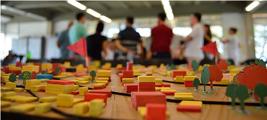
The game consists of a model of a fictional city and three cards with the city’s problems. The players are divided into the roles of the agents: city hall, city council, secretariats, the public prosecutor’s office, the residents’ association, social movements, NGOs and the real estate developer. The aim of the game is to solve the city’s problems by consensus, and there is no winner. The game ends when the time allotted for the match has elapsed or when the players manage to come up with a solution to the problems.
This game follows the same structure as the City Statute game. The role-playing by the players aims to familiarize them with the levels of political representation and introduce them to the instruments of representative democracy. In this way, these experiences have great merit in using playful language to promote urban debate in a more accessible way. The fact that the games are cooperative – they don’t have a single winner – also contributes to the idea of the city as a collective construction.
From the point of view of graphic representation, these experiments seek to get away from the technical representation common to architecture. Playful representation has the ability to communicate to a wider, non-specialized audience, unlike technical drawings that require an advanced degree of abstraction. Thinking about other forms of graphic representation that can democratize debate is one way of contributing to the construction of a participatory political culture.
However, both games set out to present political actors and the mechanisms of the political representation system, without considering other forms of mobilization. By limiting themselves to institutional and representative tools, these games fail to take advantage of the imagination triggered by symbolism to discuss and think about other forms of political organization and action in the city. By prioritizing problem-solving and consensus, they also overlook the potential of conflicts as urban activators. How, then, do these tools address the growing disbelief in traditional political representations? Why think of participation only in terms of consensus if we are heading towards a crisis of representative democracy?
Conflict, dissent and other forms of political organization
In fact, the 1960s were a time when the debate around the concept of participation became more effervescent – whether in architectural projects, in the field of fine arts or in public policies. Nevertheless, it is clear that this period sparked questions about other forms of representation and mobilization that remain active and are being updated. The Belgian philosopher Stengers (2015), in her book In Catastrophic Times: Resisting the Coming Barbarism, analyzes how the 2008 economic crisis alerted us to the need for a change in our relationship with the political-economic system and with the planet. For Stengers, the questions posed at that time would be repeated in other moments of crisis, as the system was unlikely to change. The author speaks of a feeling of paralysis at the impossibility of change through the usual channels of political representation and the need to “reinvent modes of production and cooperation that escape the evidence of growth and competition” (ibid., p. 15). She characterizes the current mechanisms of participation as “domesticated” because they restrict it to “constructive” opinions, which in reality only validate that everything remains the same. In this way, she argues that it is no longer possible to expect any change from the state, it is urgent to think of other modes of resistance and that “we need to be aware of the contemporary emergence of ‘other narratives’” (ibid., p. 71). In criticizing specialization and the distancing of science from popular everyday life, Stengers emphasizes the importance of autonomy and the “saturation of consensual narratives”.
This search for other forms of political organization can be seen especially since the 2010s, when a new wave of demonstrations around the world indicated the dissatisfaction of those represented with their representatives and criticism of current democracy.
In Brazil, the June 2013 demonstrations in several capitals showed a high degree of popular indignation. The initial agenda was to defend free, quality transportation, but the protests were also against mega-events and culminated in calls for the impeachment of the president. Brazil’s political fragmentation became evident when part of the protesters began to deny representation by parties and politicians, in sometimes anarchic, sometimes reactionary arguments. Despite the dispersion of demands and fronts, the agenda of urban mobility and major events was central, especially in the state of Rio de Janeiro.
On the global political scene, we can highlight moments such as the Arab Spring in 2010, which inspired the Occupy movement, which began on Wall Street in New York (2011) and spread to other capitals around the world. In Brazil, the June 2013 protests continued until 2016, exposing corruption schemes in the construction work for the 2014 World Cup and the 2016 Olympic and Paralympic Games and demanding investments of the same magnitude in health and education. A highlight of this series of mobilizations was the school occupation movement by high school students in some of the country’s capitals in 2015 and 2016, protesting against measures to cut spending on education through a system of self-management of schools with cultural activities.
Also since 2013, a new insurgency has been brewing in the black movement in the US, motivated by a series of murders of black people during violent police attacks. The Black Lives Matter movement has spread to several cities and countries in a non-centralized way through demonstrations over the last few years. However, during the Covid-19 pandemic in 2020, new murders caused the wave of protests to resume in several American cities, despite the imposition of social isolation. The urgency of the issue and the historical lack of responses from governments meant that, despite the global quarantine, people occupied six city blocks in Seattle, creating a community-managed police-free zone called Chaz (for Capitol Hill Autonomous Zone) or Chop (for Capitol Hill Organized Protest).
The context of the global health emergency is, in some cases, a call to self-organization. The economic impact generated by the need for social isolation has affected many families, especially those who were already in conditions of social vulnerability. For the favelas, social isolation is almost unfeasible due to their urban fabric. Faced with the lack of public policies in Brazil aimed at this population, many favelas have organized themselves to provide basic food and other donations through collective action, without support from the government or political parties. Perhaps the most impressive case is that of Paraisópolis, in São Paulo, where the favela, through donations and partnerships with companies, managed to hire 3 ambulances, train 240 first responders, set up 60 service bases, transform 2 schools into shelters and define 652 “street presidents” (volunteer residents who are responsible for checking on the needs of families and calling ambulances). In the first week of the pandemic’s arrival in Brazil, Paraisópolis helped organize the G10 Favelas, a mutual aid group between the country’s 10 largest favelas.
Even with different agendas, these mobilizations have in common a critique of the hegemonic political-economic system, the demand for recognition of insurgent forces and the defense of a more direct and radical democracy. These experiences also point to a different form of political organization: articulation took place via the internet and, for the most part, was detached from political parties and traditional political representations.
The speed and efficiency of the creation of mobilization and solidarity networks based on urgent issues demonstrates the strength of the population’s autonomy in organizing, as well as revealing the total abandonment by the state. However, just as these non-traditional forms of mobilization point to a radical democracy, they can also indicate liberal responses and populist tendencies to the democratic crisis. In this way, we need to be aware of the possibility of authoritarian participation, as defined by Almond and Verba (1989). How is it possible to think of alternative representations that seek citizen autonomy and not welfarism, without neglecting the role of the state?
In this sense, the question remains as to what role architects play in shaping a democratic political culture. The language of play seems to make a great contribution to formulating other communication mechanisms between agents in participatory processes. However, is it possible to think, within the universe of cooperative games, of practices that stimulate the autonomy of the players? To what extent are the games presented here not just reproducing traditional and existing political relations? Games that value the formation of conflicts could encourage the invention of other possibilities for political organization that are independent of the state and geared towards the particular demands of each context. Could games encourage the articulation of self-managed responses to conflicts in their territories, thus valuing common knowledge and micro-politics?
Notes
-
1
In 1953, at the International Congress of Modern Architecture IX, the issue of post-war housing was a matter of concern. At this congress, a group of younger members began to show disagreements with the position of the organization’s founders. The main objective of the meeting was to formulate a supplementary document to the Athens Charter, the Habitat Charter; however, the younger architects and the old guard of the institution disagreed on the paths to be taken and the impasse became clear. CIAM X, in 1956, followed the same theme, but this time it was organized by the younger members, who gave rise to Team X.
-
2
Input means what the system demands and output means what the system supplies to society.
-
3
This term is used in Game Theory, a field of mathematical thought that studies models of strategy based on the actions of players in order to apply these studies of behavior to various areas of knowledge.
-
4
In June 2013, several demonstrations took over the country’s main capitals. Initially focused on defending the free bus pass after a rise in ticket prices, other issues were added to the discontent, such as political corruption, the hosting of the World Cup in the country and the call for the impeachment of then-president Dilma Roussef. One of the slogans of the July Journeys was the phrase “you don’t represent me”, directed at the political class.
-
5
Database and research group created in 1981 that brings together professionals from different countries who study the social and political impact of changes in cultural values and beliefs.
-
6
An independent organization in defense of political rights and civil liberties created in 1941 to promote the expansion of freedom and democracy in the world.
-
7
The survey carried out by WVS assesses interpersonal trust by asking respondents whether or not they can trust most people. Based on this fairly general and simple question, the indices indicate that more than 90% of Brazilians choose not to trust people.
References
- ABRAMOVAY, R. (2001). Conselhos além dos limites. Estudos Avançados. São Paulo, v. 15, n. 43, pp. 121-140.
- ALMOND, G.; VERBA, S. (1989). The civic culture: political attitudes and democracy in five nations. Princeton, Princeton University Press. Edição original de 1963.
- ARNSTEIN, S. (1969). The Ladder of Citizen Participation. Journal of the American Planning Association, v. 35, n. 4, pp. 216-224.
-
ARQUITEC IAU-USP – Arquitetura, Inovação e Tecnologia (2024). Cartilha da cidade. Disponível em: https://arquitec.iau.usp.br/projetos/cartilha-da-cidade Acesso em: 15 ago 2024.
» https://arquitec.iau.usp.br/projetos/cartilha-da-cidade - BRASIL (2001). Lei n. 10.257, de 10 de julho. Regulamenta os arts. 182 e 183 da Constituição Federal, estabelece diretrizes gerais da política urbana e dá outras providências. Diário Oficial da União: seção 1, p. 1., 11 jul.
- HUIZINGA, J. (1971). Homo ludens: o jogo como elemento da cultura. São Paulo, Perspectiva.
- INGLEHART, R. (1999). “Trust, well-being and democracy”. In: WARREN, M. Democracy and trust. Cambridge, Cambridge University Press.
-
INGLEHART, R. et al. (ed.) (2014). World Values Survey: All Rounds – Country-Pooled Datafile Version: https://www.worldvaluessurvey.org/WVSDocumentationWVL.jsp Madrid, JD Systems Institute.
» https://www.worldvaluessurvey.org/WVSDocumentationWVL.jsp - ISER, W. (1996). O fictício e o imaginário: perspectivas de uma antropologia literária. Rio de Janeiro, EdUERJ.
- LEFEBVRE, H. (1969). O direito à cidade. São Paulo, Documentos.
- MIESSEN, M. (2010). The nightmare of Participation: Crossbench Praxis as a mode of criticality. Londres, Sternberg Press.
- MIGUEL, L. F. (2014). Democracia e representação: territórios em disputa. São Paulo, Unesp.
- MOISÉS, J. A. (2008) Cultura política, instituições e democracia: lições da experiência brasileira. Revista Brasileira de Ciências Sociais. São Paulo, v. 23, n. 66, pp. 11-43.
- PUTNAM, R. (1997). Comunidade e democracia: a experiência da Itália moderna. Rio de Janeiro, FGV. Edição original de 1993.
- STENGERS, I. (2015). No tempo das catástrofes. São Paulo, Cosac Naify.

 Source: Instituto Pólis. Available at:
  Source: