
 Cities and aging: propositions for an age-sensitive smart city
Abstract
Population aging poses major challenges to the development of age-sensitive smart cities. This article critically analyzes the conditions and constraints affecting the older population in São Paulo, in the context of rapid demographic aging and the increasing digitalization of urban services. Methodologically, it adopts an exploratory, theory--driven empirical approach based on literature review, document analysis, and secondary data (2022 Census, Municipal Urban Reports). The analysis is structured around five criteria: inadequate urban infrastructure, digital divide, territorial inequality, low representativeness of older people in urban data, and insufficient public transportation. The study proposes guidelines for integrated, age-sensitive urban policies, concluding that building a smart city requires technological innovation and public policies centered on equity, as well as active civic participation of older people in urban planning processes.
Keywords:
smart cities; population aging; urban mobility; territorial justice
Resumo
O envelhecimento populacional impõe desafios à construção de cidades inteligentes sensíveis à idade. O artigo analisa criticamente as condições e limites da população idosa em São Paulo, diante do acelerado envelhecimento demográfico e à crescente digitalização dos serviços urbanos. Metodologicamente, adota-se abordagem teórico-empírica, exploratória, baseada em revisão bibliográfica, análise documental e dados secundários (Censo 2022, Informes Urbanos Municipais). A análise organizou-se em cinco critérios: infraestrutura urbana inadequada, exclusão digital, desigualdade territorial, baixa representatividade nos dados urbanos e transporte público insuficiente, propondo diretrizes para políticas urbanas integradas e sensíveis à idade. Concluiu-se que a construção de uma cidade inteligente exige inovação tecnológica e políticas públicas centradas na equidade e participação cidadã ativa das pessoas idosas nos processos de planejamento urbano.
Palavras-chave:
cidades inteligentes; envelhecimento populacional; mobilidade urbana; justiça territorial
Introduction
The rapid pace of population aging constitutes one of the most significant demographic phenomena of the 21st century, producing structural transformations in urban dynamics. In Brazil, the aging index, the ratio between the elderly population (60 years or older) and the population of children and adolescents (0 to 14 years), increased from 28.9 in 2000 to 44.8 in 2010 and 57.4 in 2022, indicating a transition of great magnitude (IBGE, 2025).
In the city of São Paulo, this transition takes on even more acute contours. The proportion of older people in the total population increased from 9.3% in 2000 to 17.7% in 2022 (IBGE, 2025; São Paulo, 2024), with projections close to 29.8% in 2050. The reconfiguration of the age pyramid substantially alters the demands for infrastructure, services, and urban governance, especially with regard to mobility, access to public services, and the effective exercise of the right to the city by older people.
In this context, two central paradigms have been consolidated to guide urban policies aimed at aging: the concept of "age-friendly city," developed by the World Health Organization (WHO) from 2007 onwards, and the "smart cities" model (Ahad et al., 2020; WHO, 2007). The first emphasizes adapting the built environment, services, and social relations to the needs of older people, promoting autonomy and active aging; The second prioritizes the integration of information and communication technologies (ICTs) to optimize urban management, service provision, and infrastructure use.
Recent experience demonstrates, however, that these paradigms do not automatically converge. Technocratic approaches to smart cities tend to ignore socio-spatial inequalities and age-specific characteristics, while “age-sensitive” initiatives often remain sectoral and poorly articulated with digital transformation. In response, the concept of “age-friendly smart cities” has emerged, which seeks to articulate age-friendly principles and digital technologies, including the Internet of Things and urban data systems (Van Leeuwen et al. 2022; Xu et al., 2025), through co-created solutions with the active participation of older people (Aranguren et al., 2024).
The digital exclusion of older people manifests itself multidimensionally: unequal access to devices and connectivity, low digital literacy, usability barriers, and scarce technical support (Miranda, Mendes and Silva, 2016). Urban technologies operate "blind to age," without incorporating the specific needs of this group, reproducing inequalities and amplifying the invisibility of vulnerable populations (Kitchin, 2014; Van Leeuwen et al., 2022).
São Paulo is a privileged laboratory for analyzing tensions and synergies between these paradigms. The metropolis concentrates the largest absolute contingent of elderly people in the country – more than two million in 2022 – presenting marked territorial inequalities in income, infrastructure, transportation, and health, while implementing initiatives such as the São Paulo Amigo do Idoso program (São Paulo, 2020, 2024), revealing the potential and limitations of digital strategies in a context of aging and strong urban inequality.
Aging in Brazil requires analyses that articulate critical urban theories and contemporary demographic specificities, highlighting the need to critically examine the opportunities and risks of urban technologies for active aging and age-sensitive public policies.
The overall objective is to critically analyze the conditions, limitations, and potential of urban mobility for the elderly population in São Paulo, considering the convergence between smart cities and age-friendly cities, under dimensions of territorial inequality and digital exclusion. Specifically: (a) articulate the theoretical foundations of the age-friendly and smart city paradigms, identifying convergences, tensions, and the emergence of age-friendly smart cities; (b) characterize demographic aging in São Paulo through statistical analysis of historical series and population projections; (c) identify and systematize the limitations, challenges, and potential of age-sensitive urban mobility based on five criteria: inadequate infrastructure, digital exclusion, territorial inequality, representativeness in urban data, and insufficient public transportation.
Methodologically, an exploratory theoretical-empirical approach is adopted, based on the triangulation between bibliographic review, document analysis, and secondary data. The review integrates national and international literature on smart cities, age--friendly cities, and age-friendly smart cities, in addition to contributions on territorial justice, digital exclusion, and data governance. On the empirical level, data from the 2022 Census (IBGE, 2025), Urban Reports, and the Metro Origin- -Destination Survey (São Paulo, 2020, 2024) are used, subjected to descriptive statistical analysis and document analysis. This process organized the discussion into the five criteria that guide the interpretation of the limits and potential of age-sensitive urban mobility.
This article is organized into five sections. The second presents the theoretical framework, articulating debates on age-friendly paradigms and smart cities. The third explains the methodology. The fourth develops the diagnosis of aging and mobility in São Paulo. The fifth examines, based on the five proposed criteria, the limits and potential of age-sensitive urban mobility. The conclusion synthesizes the findings and indicates paths for urban policies aimed at building age-sensitive smart cities.
Theoretical framework
The age-friendly paradigm: genesis and foundations
The concept of "age-friendly city" developed by the WHO constitutes a fundamental milestone in the convergence between aging policies, the promotion of public health, and urban planning (WHO, 2007). Launched internationally in 2007, the Global Age-Friendly City Guide established eight structuring domains to evaluate and guide urban policies aimed at longevity: open spaces and buildings; transportation; housing; social participation; respect and social inclusion; civic participation and employment; communication and information; community support and health services (ibid.).
The notion of an age-friendly city is linked to the paradigm of active aging, understood as the “[...] process of optimizing opportunities for health, participation and security, with a view to improving the quality of life of people as they age” (WHO, 2007; Torres et al., 2020)
Although there are conceptual advances, the implementation of the age-friendly paradigm encounters important asymmetries and limitations, especially in contexts marked by social and territorial inequalities, as is the case in Brazil. National and international studies show that the materialization of active aging depends on material, symbolic and territorial conditions, overcoming the logic of “terminal decline” to recognize the potential for full and productive participation of the elderly in urban life (Abdala et al., 2014; Ivan, Beu and Van Hoof, 2020; Klimczuk and Tomczyk, 2016).
Smart cities and the age-friendly paradigm
The discussion about smart cities has intensified in recent decades due to the convergence of accelerated urbanization, digital transformation, and the need for innovative responses to urban challenges (Ahad et al., 2020; Albino, Berardi and Dangelico, 2015; Angelidou, 2014). This concept involves not only the adoption of ICTs, but a systemic perspective of integration between data, urban infrastructure, services, and governance, aiming at efficiency, sustainability, and quality of life (Bukhari, Alshibani and Ali, 2024; Harrison et al., 2010).
The concept of age-friendly cities emerges as a response to the technocratic limitations of smart cities. Based on the WHO initiative in 2007, the paradigm proposes a focus on active, healthy, and safe aging, recognizing the plurality of experiences and needs of older people in cities (WHO, 2007; WHO, 2021). According to the WHO (2007), an age-sensitive city promotes, in its processes, services, spaces and infrastructure, respect, social participation, access to information, accessible mobility, adequate housing and community support, allowing autonomy and belonging to urban life.
While smart cities prioritize operational efficiency, technological innovation, connectivity, and data-driven management (Albino, Berardi, and Dangelico, 2015; Silva, Benini, and Godoy, 2024), the age-friendly approach emphasizes equity, inclusion, accessibility, and social justice. The challenge is to prevent technological advancement from exacerbating inequalities and making vulnerable groups invisible, as urban technologies tend to be "age-blind," reinforcing ageism and digital exclusion (Li and Woolrych, 2021; Tupasela et al., 2023).
The convergence between both paradigms resulted in the concept of age-friendly smart cities, which seeks to integrate age-friendly principles with the potential of digital technologies, artificial intelligence, the Internet of Things, and participatory platforms (Abril-Jiménez et al., 2020; Klimczuk and Tomczyk, 2016; Li and Woolrych, 2021; Wright, Weber, and Walton, 2023; Xu et al., 2025). This approach highlights the importance of integrating technological innovation, universal design, and inclusive urban policies, considering the diversity of capabilities of older adults through the creation of digital solutions with the active participation of older adults and public managers so that technologies expand – and do not limit – inclusion, autonomy, and safety (Aranguren et al., 2024; Tupasela et al., 2023; Van Leeuwen et al., 2022; Silva and Godoy, 2025b).
However, the adoption of technological devices does not guarantee the inclusion of older adults, as many innovations are inadequate for the diversity of cognitive, physical, and cultural capacities of this group. There is a risk of exacerbating urban inequalities if policies for digital inclusion, universal design, and accessibility are not centralized in smart city strategies (Plouffe and Kalache, 2010; Tupasela et al., 2023; Warburton, Ng, and Shardlow, 2013). The importance of digital accessibility, continuing education, data privacy, and the creation of intergenerational networks for the digital inclusion of older adults is highlighted (Li and Woolrych, 2021; Podgórniak-Krzykacz, Przywojska, and Wiktorowicz, 2020).
The age-friendly paradigm points to a new normative horizon for digital urbanism: smart cities not only “for,” but “with” and “by” older people. This involves a shift from the efficient city to the just and age-sensitive city, where technology, inclusion, equity, and participation intertwine to address the challenges of demographic aging in complex urban contexts.
The age-friendly smart city paradigm: potential and challenges
Starting in the 2010s, the international agenda moved towards the concept of age-friendly smart cities, which proposes the integration of age-friendly principles with the potential of digital technologies, artificial intelligence, the Internet of Things (IoT), and participatory platforms (Van Leeuwen et al., 2022; Xu et al., 2025). This integration demands that the design of urban technologies, platforms, and services be guided by universal usability, co-created with the active participation of older adults and vulnerable populations, preventing innovation from reinforcing pre-existing inequalities (Aranguren et al., 2024; Tupasela et al., 2023).
Unlike the technocratic approach of smart cities, the age-friendly paradigm emphasizes values such as equity, inclusion, accessibility, and social justice, and highlights the need for co-created digital platforms, applications, and urban mobility solutions, guaranteeing accessibility, data protection, and effective participation of older adults in urban planning (Tupasela et al., 2023; Van Leeuwen et al., 2022; WHO, 2021).
Recent literature emphasizes that digital solutions should be implemented across the eight domains of the WHO paradigm, overcoming risks of segmentation or reinforcement of privileges for groups already integrated into digital culture (Li and Woolrych, 2021; Podgórniak-Krzykacz, Przywojska and Wiktorowicz, 2020). Furthermore, the importance of digital accessibility, continuing education, data protection, and the creation of intergenerational networks for the digital inclusion of older adults and continuous monitoring of the social impacts of technological solutions are highlighted as central principles to avoid widening inequalities through urban digitization (Wong and Neo, 2025).
In short, the age-friendly smart city paradigm demands a new normative horizon for digital urbanism: smart cities not only for, but with and by older people, in a shift from the logic of efficiency to the centrality of justice, inclusion, and citizen participation in the context of population aging.
Critiques of the technological solutionism of smart cities
The intensification of debates about smart cities stems from the convergence between accelerated urbanization, digital transformation, and the demand for innovative responses to urban challenges (Silva, Benini, and Godoy, 2024; Wong and Neo, 2025; Wright, Weber, and Walton, 2023). The concept involves not only ICTs but also systemic integration between data, infrastructure, services, and governance, aiming at efficiency, sustainability, and quality of life (Harrison et al., 2010; Sajhau, 2017; Silva and Godoy, 2025a).
However, a warning is issued against technological solutionism, that is, the belief in technology as an isolated solution to complex urban problems, ignoring the vulnerabilities of specific groups and historical inequalities. Smart cities require new relationships between technology and society, and simply making digital devices available is insufficient without guaranteeing real conditions for access, engagement, and social appropriation (Söderström, Paasche, and Klauser, 2014). Programs must consider limitations in digital literacy and the different perceptual capacities of older adults, otherwise they risk reinforcing exclusions and increasing vulnerabilities, especially in peripheral regions (Podgórniak- -Krzykacz, Przywojska, and Wiktorowicz, 2020).
The articulation between age-friendly and smart city agendas reveals fundamental epistemic tensions. While age-friendly cities emphasize participation, inclusion, and environmental adaptation to their needs, the smart city paradigm prioritizes efficiency, rationalization, and technological centrality (Li and Woolrych, 2021; Woolrych and Li, 2024). The development of integrated urban public policies should be geared towards empowering older adults, territorial justice, and promoting urban environments that inextricably link inclusion, innovation, and equity.
Overcoming these tensions requires an epistemic reorientation that transcends reductionist dichotomies between efficiency and equity, or between innovation and inclusion. Bria and Morozov (2020) warn that the smart city paradigm, often captured by corporate interests and surveillance capitalism, operates under the false narrative of technical neutrality, when in reality it instrumentalizes technologies for data extraction, behavior modeling, and deepening neoliberal logics of commodification of urban space.
In this sense, the paradigm of age- -friendly smart cities emerges as a synthesis proposal that articulates the potential of digital technologies with the normative principles of active aging, autonomy, and social participation, rejecting both technological solutionism and entrepreneurial and financialized urbanism. This integrated approach recognizes that urban technologies constitute social mediations capable of both reproducing and transforming structures of territorial inequality, requiring intersectoral public policies anchored in strong articulation with social movements and guided by the defense of the public sphere and collective rights (ibid.).
It is about reorienting urban intelligence not only towards the optimization of flows and services, but fundamentally towards guaranteeing the right to the city and to dignified aging through municipal technological sovereignty, algorithmic transparency, and democratic governance of digital infrastructures in contexts of accelerated demographic transformation (Aranguren et al., 2024; Van Leeuwen et al., 2022; Xu et al., 2025).
Synergy between the concepts of smart cities and age-sensitive cities
The combination of smart cities and age-friendly cities represents the most promising horizon for addressing the challenges of population aging in Brazilian urban centers, articulating advanced technological capabilities and a normative framework centered on rights, equity, and age sensitivity. While the smart city paradigm emphasizes the integration of information technologies, urban sensors, digital platforms, and massive data systems to optimize flows and services (Albino, Berardi, and Dangelico, 2015; Silva and Godoy, 2025a), the age-friendly paradigm prioritizes the experience of older adults in the territory, valuing accessibility, safe mobility, social participation, and active aging (WHO, 2007; WHO, 2021). In rapidly aging societies, such as Brazil, no single agenda robustly addresses the multiple dimensions of urban aging: either there is a risk of a technologism blind to age, or of well-intentioned policies that are disconnected from the digital infrastructures that structure daily life.
The age-friendly framework functions as a normative and ethical filter for smart solutions, guiding them towards caring for the functional, cognitive, and socioeconomic diversity of older adults and providing governance, monitoring, and coordination tools on a metropolitan scale.
Operationally, this means using georeferenced data, digital participation platforms, and decision support systems to identify territories where aging, low income, and precarious infrastructure generate greater vulnerability, prioritizing these spaces for accessible policies, adapted transportation, and local health services (Li and Woolrych, 2021; Van Leeuwen et al., 2022). Simultaneously, it means designing these technologies based on universal usability and co-creation with older adults, preventing complex interfaces, exclusionary languages, or inaccessible connectivity requirements from deepening digital exclusion (Miranda, Mendes, and Silva, 2016; Tupasela et al., 2023).
In Brazilian urban contexts, where aging is advancing alongside the persistence of socio--spatial inequalities, fragile mobility policies, and the accelerated digitalization of public services, this combination presents additional advantages. Age-sensitive smart cities allow for the construction of information systems capable of making the presence and needs of older adults visible in urban databases, combating the statistical and algorithmic erasure that renders them invisible (Kitchin, 2014; Wong and Neo, 2025) and anchoring the use of this information in an agenda of territorial justice and the rights of older adults, as per the Statute of the Elderly. It is less about digitizing the city and more about reorienting urban intelligence to reduce age and territorial inequalities.
Finally, integration is promising because it recognizes aging not as a problem to be managed, but as a structuring dimension of contemporary urban planning. By articulating technological innovation, universal design, intergenerational participation, and age--sensitive data governance, this model significantly expands the capacity of Brazilian municipalities to formulate policies on mobility, housing, health, and the use of public space that are compatible with an aging society. Instead of choosing between an "efficient" city and an "age-friendly" city, the proposal for age-sensitive smart cities points to a synthesis: cities where digital intelligence is mobilized to guarantee, in a territorially situated manner, the right to age autonomously, safely, and in a socially integrated way.
Methodology
This study adopts a theoretical-empirical approach, based on the triangulation of methods and sources, with the aim of critically analyzing the conditions, limitations, and potential of urban mobility for the elderly population in the municipality of São Paulo, in light of the age- -sensitive smart city paradigm. The choice of the territorial scope is justified by the demographic relevance and socio-spatial complexity of the metropolis, which concentrates one of the largest contingents of elderly people in the country amidst strong inequalities in income, race/ethnicity, access to urban infrastructure, public services, and mobility opportunities.
Literature review and document analysis
The theoretical framework was organized into two articulated axes: (1) national and international literature on smart cities, age- -friendly cities, and the proposed convergence in terms of age-friendly smart cities; (2) legal, normative, and programmatic frameworks related to urban mobility, accessibility, active aging, and the rights of older persons.
The literature review was conducted systematically in national and international databases, covering the period from 2007 to 2025, using descriptors in Portuguese and English related to smart cities, age-friendly cities, urban mobility, population aging, digital exclusion, and territorial justice, prioritizing peer-reviewed articles, technical reports, and normative documents with thematic adherence and minimal explanation of method, and excluding strictly opinion-based texts or those without empirical support.
Analytical procedures
The empirical analysis was divided into three stages:
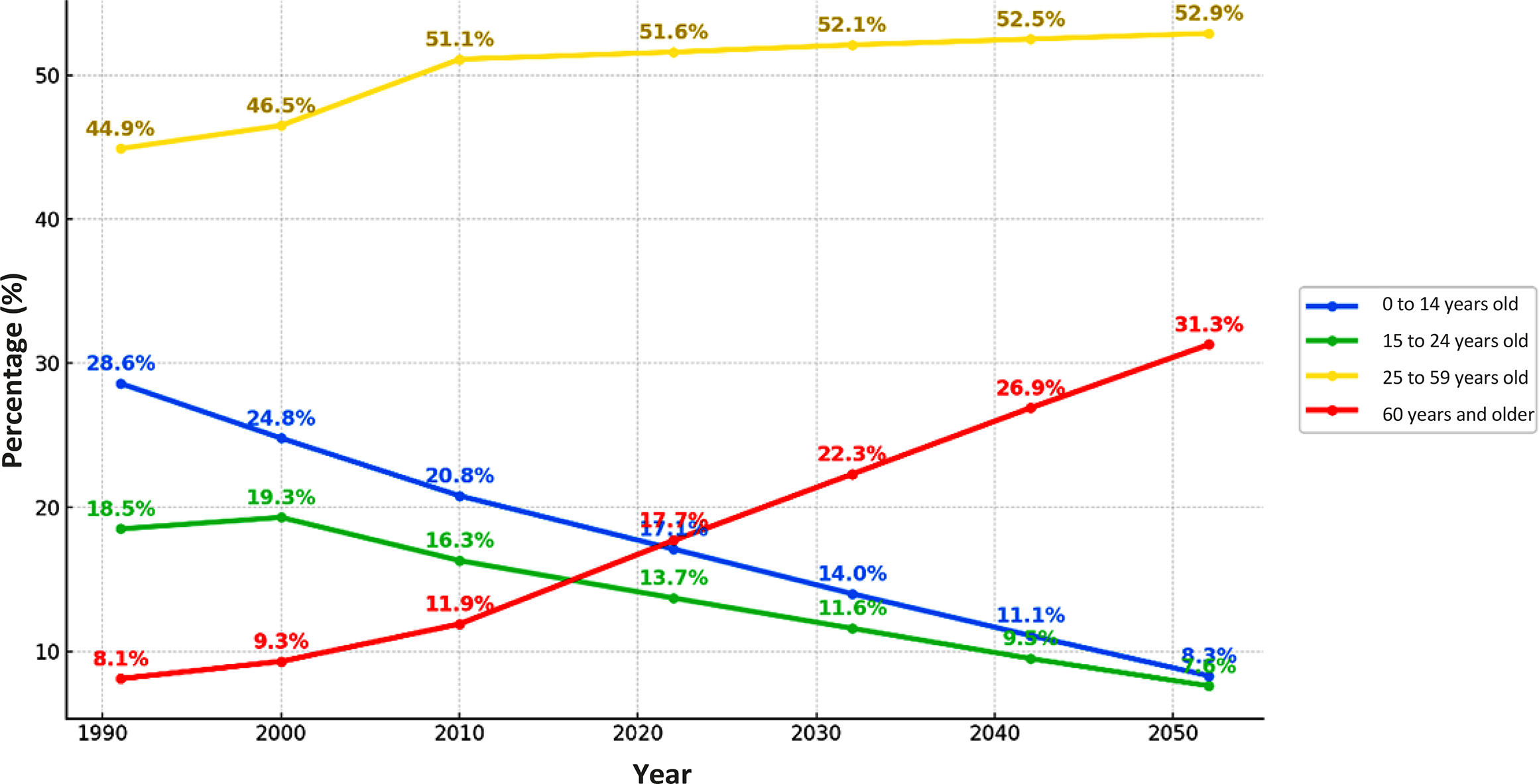
1) Descriptive statistical analysis: historical series and linear projections of the age structure of São Paulo (1991-2052) were constructed from IBGE (2025) and São Paulo (2024), represented in graphs and age pyramids, in order to explain the pace of aging and the change in the age composition of the municipality;
2) Documentary and normative analysis: documentary and normative analysis: legal documents and government programs were examined in light of the concepts of age--friendly and smart city (Albino, Berardi and Dangelico, 2015; WHO, 2007; Silva and Godoy, 2025b), identifying convergences and gaps. Sections on physical accessibility, public transport, digital inclusion, data governance and participation of older people in decision- -making processes were coded;
3) Critical-interpretative integration with the literature: the statistical and documentary results were integrated with the literature on age-sensitive smart cities and technological justice (Kitchin, 2014; Li and Woolrych, 2021; Tupasela et al., 2023; Van Leeuwen et al., 2022; Wong and Neo, 2025). From this integration, five analytical criteria were systematized – inadequate urban infrastructure, digital exclusion, territorial inequality, representativeness in urban data, and insufficient public transport – organized in Table 1, which synthesizes the limits, challenges, and potential of urban mobility for older people in São Paulo.
It should also be noted that the main limitations associated with the use of secondary data relate to: (a) the heterogeneity of collection and aggregation criteria; (b) insufficient disaggregation by intersectionalities (gender, race/color, disability); (c) the absence of indicators that express subjective dimensions of mobility (perception of safety, comfort, fear of falls, barriers in digital interfaces). These limitations reinforce the need for future research that incorporates participatory methodologies and qualitative approaches, in order to value the protagonism of older people in the production of diagnoses and solutions for smart cities.
Analysis of aging In São Paulo
The aging process of São Paulo's population is manifesting itself in an accelerated and unequal way, configuring structural challenges for the promotion of age-sensitive smart cities and for the advancement of public policies of territorial justice. Data extracted from the Urban Report No. 63 (São Paulo, 2024), based on information from the 2022 Demographic Census (São Paulo, 2025), indicate that the municipality of São Paulo has more than two million elderly people, corresponding to 17.7% of its total population. Projections indicate that this contingent should reach 22.33% by 2032, anticipating a scenario of surpassing the proportion of children and adolescents in many regions of the city.
The pace of aging in São Paulo reveals unprecedented intensity: while between 2000 and 2010 the growth in the representation of elderly people was 2.6 percentage points, between 2010 and 2022 this increase reached 5.8 percentage points, more than double the previous period. In absolute numbers, São Paulo reached more than two million elderly people in 2022 – a contingent equivalent to the total population of the city of Manaus and almost three times greater than that recorded in 1991 (São Paulo, 2024). The demographic projections developed in this work indicate that this population segment will reach 2,596,780 people (22.3%) in 2032 and 3,744,220 (31.3%) in 2052, configuring a demographic transformation of historical magnitude.
The graph illustrates the historical evolution and population projections of the municipality of São Paulo by age groups from 1991 to 2022 (IBGE, 2025), with projections up to 2052, based on data behavior (Figure 1). This is a linear projection, without considering any inflections in birth rates, mortality rates, migration, and interventions of structuring public policies.
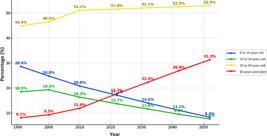
– Percentage composition by age group based on the IBGE Census conducted in 2022, with projections up to 2052
A continuous decline in the populations of the 0 to 14 and 15 to 24 age groups is observed, which reaffirms the consolidation of population aging as a structural process. The population aged 60 or over shows a significant upward trajectory, indicating not only increased longevity but also the intensification of the demographic transition in the municipality. The intermediate age group, from 25 to 59 years, shows relative stability, with a slight upward trend, followed by a possible inflection in the following decades, according to the projected data (São Paulo, 2024).
A comparative analysis of the age structure of the municipality of São Paulo between the years 2022 and the projection for 2052 reveals an accelerated process of population aging and an exhaustion of the classic pyramidal pattern, characteristic of societies in advanced demographic transition. In 2022, a still relatively balanced distribution is observed, with a predominance of adult groups (20 to 59 years) and significant participation of children, adolescents and young people, reflecting the recent past of higher fertility. However, the growth of the elderly segment is already noteworthy, exceeding 15% of the total population and anticipating the trend observed in developed countries. The base of the age pyramid, formed by the 0 to 9 and 10 to 19 age groups, shows a consistent retraction, evidencing the decrease in birth rates and the redefinition of family projects in the urban context of São Paulo.
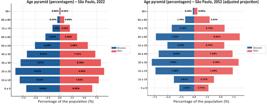
– Age pyramid of the population of São Paulo in 2022, compared with the projected age pyramid of the population of São Paulo in 2052
By 2052, adjusted projections indicate a scenario of absolute predominance of groups aged 60 and over, who should represent approximately one-third of the total population, while groups aged 0 to 19 tend to account for less than 15%. This scenario presents challenges of great proportions for public planning and social sustainability: there will be a drastic increase in the demand for health services and long-term care, growing pressure on social security, and a need to adapt the labor market and urban infrastructure to the demands of an aging society. The dependency relationship between the active and elderly populations will be profoundly altered, requiring innovative and integrated policies to guarantee inclusion, quality of life, and intergenerational equity in the country's largest urban center.
This scenario points to profound social and economic transformations, which require the redesign of public policies on several fronts – health, social security, housing, urban mobility, and citizen participation – based on intersectoral and inclusive approaches.
In summary, the diagnostic analysis of aging in São Paulo reveals the coexistence of two dynamics: on the one hand, the expansion of the elderly population; on the other, the intensification of the aging process. This situation reinforces the urgency of intersectoral strategies to address inequality among the elderly in São Paulo and to guide public policies for inclusive smart cities.
Limits, challenges, and potential for the elderly population in São Paulo
Smart cities, defined by the integration of digital technologies, data governance, and efficient urban infrastructure, offer significant potential to address the challenges of population aging in large metropolises (Angelidou, 2014; Silva and Godoy, 2025a; Van Leeuwen et al., 2022). However, in the municipality of São Paulo, the practical application of this paradigm encounters specific limits and challenges, especially in promoting safe and inclusive mobility for the elderly population. This article addresses these aspects considering five central criteria: inadequate urban infrastructure, digital exclusion, territorial inequality, representativeness in urban data, and insufficient public transportation.
The urban mobility of the elderly population in São Paulo faces a series of structural challenges, considering the context of smart cities. These challenges stem mainly from deficiencies in urban infrastructure, persistent digital exclusion, intense territorial inequalities, insufficient representativeness in urban data, and limitations in public transportation services. In this scenario, it is essential to recognize and analyze these aspects to understand the real mobility conditions of the elderly and, thus, guide more effective and inclusive public policies.
Chart 1 summarizes the limitations, challenges, and potential related to each of these five criteria, aiming to provide a systematized overview of the main factors impacting the mobility of the elderly population in São Paulo. For each criterion, existing barriers, specific challenges that need to be addressed, and potential contributions that the smart city paradigm can offer are highlighted, based on specialized literature and practical models already tested or implemented in similar urban contexts.
Inadequate urban infrastructure
The urban infrastructure of São Paulo, especially in the outskirts, limits the safe mobility of the elderly population. Irregular sidewalks, with holes and uneven surfaces, increase the risk of falls for the elderly and people with reduced mobility who use canes, walkers, or wheelchairs (São Paulo, 2020).
The main challenge is to universalize accessibility interventions, which are currently concentrated in central areas. Municipal public policies need to invest on a large scale in the requalification of sidewalks, installation of ramps, and adaptation of public lighting in the outskirts.
Smart cities offer promising solutions adaptable to São Paulo. Applications such as the SP156 Portal allow for real-time monitoring and reporting of urban conditions, facilitating rapid interventions (WHO, 2021; Wong and Neo, 2025). Smart urban sensors, used in the European Urbanage program, detect irregularities and obstacles on roads, preventing accidents and optimizing corrective actions. Smart intersections with sensors and timers adjustable to the pace of the elderly increase safety at crossings, reducing run-overs and falls (Abril-Jiménez et al., 2020; Tupasela et al., 2023).
Thus, smart technological solutions combined with inclusive and territorially equitable urban policies represent viable ways to improve São Paulo's urban infrastructure, promoting mobility and quality of life for the elderly.
Digital exclusion
Digital exclusion represents a significant challenge for the urban mobility of the elderly population in São Paulo, limiting access to the technological solutions of smart cities. A large part of the elderly population of São Paulo faces difficulties in using digital technologies due to low digital literacy, the absence or insufficiency of adequate devices (smartphones, tablets and computers) and limited connectivity coverage in peripheral regions (Colnar, Dimovski and Bogataj, 2021; Li and Woolrych, 2021). These factors are critical for low-income and less educated elderly people, accentuating inequalities and creating barriers to access to essential services, such as public transport, remote medical care and information on urban mobility (Van Leeuwen et al., 2022; Xu et al., 2025).
This limitation is evident in the use of public transport applications in the city of São Paulo such as SPTrans and TOP, developed to facilitate mobility and provide information on schedules and routes. Although effective for users familiar with the digital environment, they prove inaccessible to the elderly due to the unintuitive design and complexity of the interfaces. Furthermore, many elderly people do not have smartphones or data plans for frequent use of these tools, especially in the outskirts of cities where digital exclusion is more intense (São Paulo, 2020).
The main challenge lies in developing broad public policies for digital inclusion and literacy aimed at the elderly, equitably reaching the peripheral regions where exclusion is more severe. Initiatives that combine in-person and virtual training, continuous technological skills development, and the provision of low-cost devices can mitigate these barriers (Marè, Gogliano Sobrinho and Malatesta, 2024; Pereira et al., 2015). A relevant action is the expansion of municipal Telecenters, with specific actions for the elderly already implemented in neighborhoods such as São Miguel Paulista and Capão Redondo, which could be expanded to other vulnerable regions.
Smart cities offer important potential to overcome digital exclusion. Projects from the European Urbanage program demonstrate that simplified interfaces, applications with accessible language, and tools co-created with the participation of the elderly improve usability and acceptance. Adopting universal design, considering the specific cognitive and perceptual needs of older adults from the outset, allows for the development of more accessible and effective digital solutions (Tupasela et al., 2023; Van Leeuwen et al., 2022).
Effectively tackling digital exclusion in São Paulo, aligned with smart cities and age-friendly paradigms, requires an integrated effort between inclusive public policies, continuous technological training, and the participatory development of accessible digital technologies, ensuring that all older adults can enjoy the opportunities offered by smart cities.
Territorial inequality
Territorial inequality in São Paulo significantly affects the mobility and quality of life of the elderly population, exacerbating disparities in access to the benefits of smart cities. The city presents large contrasts between central and peripheral areas, with differences in the availability and quality of urban infrastructure, public transport, access to digital services, and technological coverage. Peripheral regions, such as Cidade Tiradentes, Brasilândia, and Parelheiros, face structural and socioeconomic precariousness, resulting in severe restrictions on the safe and autonomous mobility of the elderly, compared to central regions, such as Pinheiros, Sé, or Vila Mariana (Marè, Gogliano Sobrinho and Malatesta, 2024; Pereira et al., 2015).
This inequality manifests itself in the contrast between Avenida Paulista, with ample connectivity, accessibility, and a diverse range of smart services, and regions like Parelheiros, where internet coverage is limited, public transport is insufficient, and infrastructure is inadequate. This scenario highlights the challenge of ensuring that technological innovations in smart cities benefit all older adults, regardless of geographic location or socioeconomic status (Bushatsky et al., 2018; Marè, Gogliano Sobrinho and Malatesta, 2024).
The main municipal challenge is to develop integrated and equitable public policies that effectively reduce regional disparities, prioritizing investments in digital and physical infrastructure in peripheral areas and strengthening local capacities for the effective use of smart urban technologies. The expansion of the São Paulo Amigo do Idoso program to peripheral districts represents a promising approach. Investments in accessible sidewalks, ramps, adapted transportation, and digital inclusion centers can reduce territorial inequalities and promote active and healthy aging in the peripheries (São Paulo, 2020).
The smart city paradigm presents relevant potential for addressing territorial inequalities in São Paulo. Solutions such as digital urban monitoring and management platforms based on georeferencing and spatial analysis allow public administration to identify critical areas and specific demands of the elderly in each region with greater precision and speed (Ivan, Beu and Van Hoof, 2020).
Territorial inequality in São Paulo not only limits the mobility of the elderly population, but is actively reproduced and amplified by the technocratic and financialized model of smart city implementation. Bria and Morozov (2020) warn that the concentration of advanced digital infrastructures, high-speed connectivity and smart services in central regions responds to the logic of entrepreneurial urbanism that prioritizes territories with greater potential for real estate appreciation and financial return for private investors, relegating peripheries such as Cidade Tiradentes, Brasilândia and Parelheiros to the condition of technologically marginalized zones.
This pattern of selective investment embodies what the authors call technological gentrification, a process in which digital solutions operate as vectors of socio-spatial segregation, transforming urban innovations into territorially restricted privileges instead of universally accessible rights (Bria and Morozov, 2020; Marè, Gogliano and Sobrinho; Malatesta, 2024). The asymmetry between Avenida Paulista, endowed with ample connectivity, urban accessibility, and a diversified offer of smart services, and peripheral regions with limited internet coverage, insufficient public transport, and inadequate infrastructure demonstrates how urban technologies, when mediated exclusively by market rationality, deepen historical inequalities instead of overcoming them (Bushatsky et al., 2018; Pereira et al., 2015).
Representativeness in urban data
The insufficient representation of the elderly population in urban data for planning and management is a critical limitation faced by São Paulo in the development of mobility policies in the context of smart cities. The elderly are frequently underrepresented or neglected in the databases that underpin decisions on urban investments, transport planning, and the implementation of smart technologies. This algorithmic exclusion results in public policies that are ineffective and poorly adapted to the real needs of the elderly, especially those residing in peripheral areas or in socioeconomic vulnerability, deepening existing inequalities (Pereira et al., 2015; Wong and Neo, 2025).
This limitation is evident in the databases that guide the planning of São Paulo's public transport. Detailed information on travel patterns and specific needs of the elderly is scarce or fragmented, making it difficult to implement solutions that meet their demands for accessibility, safety, and comfort. This gap prevents policies such as expanding adapted lines or improving bus stations and stops from being prioritized in regions with more vulnerable and socially isolated elderly people (São Paulo, 2020). The main challenge for São Paulo is to actively and representatively integrate older adults into urban databases, requiring strategies ranging from the systematic collection of detailed quantitative data to the incorporation of qualitative data that capture older adults' perceptions and experiences regarding mobility and the urban environment. Another challenge is to ensure that the use of this data is ethical, transparent, and participatory, allowing older adults to actively participate in planning and decision-making on urban issues that affect their lives (Woolrych and Li, 2024; Godoy, 2025).
The smart city paradigm offers significant potential for improving the representation of older adults in urban data. Projects like Urbanage demonstrate how participatory digital platforms allow for the direct and continuous collection of information from older adults, involving them in generating data on needs, challenges, and preferences related to urban mobility. Mobile applications, interactive websites, and simple digital surveys can allow older adults to report experiences in real time, providing valuable qualitative data for inclusive urban planning. These initiatives can be adapted in São Paulo, strengthening the representation and voice of older adults in smart cities (Tupasela et al., 2023).
Building a robust and representative urban database of older adults in São Paulo is essential for effective, inclusive public mobility policies adapted to the specific reality of the older population, ensuring autonomy and full participation in a smart and age-friendly urban environment.
Insufficient and inadequate public transportation for the most vulnerable populations.
Public transportation is an essential dimension for urban mobility for the elderly in São Paulo, but it faces critical limitations regarding adequacy and availability in the face of population aging, especially for the most vulnerable populations. Elderly residents of São Paulo report difficulties related to the insufficient number of adapted vehicles, overcrowding, low frequency of lines, and inadequate physical conditions of stations, terminals, and bus stops.
These deficiencies are particularly severe in the peripheries, where the supply of adapted transportation for reduced mobility is even more restricted, disproportionately affecting low- -income elderly people and those in situations of social vulnerability, compromising their autonomy and quality of life (Marè, Gogliano Sobrinho and Malatesta, 2024; Pereira et al., 2015).
These limitations are observed in the municipal service Atende+, created to serve elderly people and people with severe reduced mobility. Although it represents a positive initiative, its reach is restricted due to the limited fleet and high demand, resulting in long waiting times and the inability to meet the real needs of the most vulnerable elderly. On regular bus and metro lines, adapted vehicles remain insufficient, especially in areas far from the city center, such as Parelheiros, São Mateus, or Jaraguá, territories marked by socioeconomic vulnerability, where the elderly face the greatest difficulties in accessing public transportation comfortably and safely (São Paulo, 2020).
The municipal challenges require integrated and urgent actions with a priority focus on vulnerable populations: expanding the availability of adapted vehicles in the peripheries, ensuring greater frequency and regularity on lines serving low-income territories, investing in the improvement of the physical infrastructure of terminals and bus stops in peripheral regions, providing safe and comfortable conditions for vulnerable elderly people. In addition, digital applications for planning and monitoring public transportation should be adjusted to better serve the elderly with low digital literacy, visual difficulties, and less access to technological resources, characteristics prevalent among vulnerable populations (Marè, Gogliano Sobrinho and Malatesta, 2024; São Paulo, 2020).
Smart cities offer innovative technological solutions capable of improving public transportation in São Paulo, primarily benefiting vulnerable elderly people. Successful models include intelligent systems for managing and scheduling specialized transportation in peripheral areas, applications with real-time information on schedules and adapted routes accessible to populations with low digital literacy, and sensors that optimize routes, reduce waiting times, and ensure greater safety during trips, especially in vulnerable areas (Pereira et al., 2015). Projects with these characteristics demonstrate that technologies such as georeferencing, intelligent sensors, and adapted applications can substantially improve public transportation conditions for vulnerable elderly people, allowing for greater autonomy, safety, and quality in urban travel (Tupasela et al., 2023; Xu et al., 2025).
Integrating these technologies into São Paulo's public transportation system, prioritizing investments in vulnerable areas, represents a concrete opportunity to address current limitations and ensure more dignified, safe, and autonomous mobility for the elderly population throughout São Paulo, especially in the peripheries where seniors in situations of socioeconomic vulnerability face the most intense and urgent demands, thus promoting territorial justice and reducing urban inequalities.
Conclusion
This study highlighted epistemic and political tensions inherent in the convergence between the paradigms of smart cities and age- -friendly cities in the São Paulo metropolis. The critical analysis, based on the triangulation between international theoretical frameworks, territorialized demographic data, and evaluation of public policies, revealed that the materialization of age-friendly smart cities demands overcoming reductionist dichotomies between technological efficiency and social justice, innovation and inclusion, algorithmic rationalization and citizen participation.
The systematization of the five critical criteria for the mobility of the elderly population of São Paulo revealed that the limits to the implementation of age-friendly smart cities transcend technical or financial resource issues. These limitations stem from the persistence of urban planning conceptions that prioritize operational efficiency over territorial equity, technological rationalization over social participation, and standardization of solutions over the diversity of demands from different age groups.
The digital exclusion of older adults constitutes a mechanism for reproducing and amplifying pre-existing urban inequalities when mobility solutions are mediated by digital platforms, applications, and intelligent systems. The low representation of older adults in the databases that guide municipal planning results in policies that are inadequate to their needs, reinforcing the algorithmic invisibility of vulnerable groups and perpetuating "age- -blind" cities.
The research identified significant potential: urban technologies co-created with the active participation of older adults, guided by universal design and based on transparency, accessibility, and data protection, can expand autonomy, social participation, and the exercise of the right to the city by aging populations. Participatory monitoring applications, sensors adapted to accessibility needs, integrated public transport, and territorial management platforms can improve urban mobility for older adults, provided they are implemented in intersectoral strategies for territorial justice.
Expanding these policies to the peripheries, creating effective mechanisms for the participation of older adults in urban decision-making processes, and implementing systems for continuous monitoring of the social impacts of technological innovations are indispensable conditions for the realization of age-sensitive smart cities.
The age-friendly smart city paradigm demands a new normative horizon for digital urbanism: smart cities not only for, but with and by older adults. This involves a fundamental epistemic shift, from the efficient city to the just and age-sensitive city, which recognizes urban technologies as social mediations capable of reproducing or transforming power relations and structures of territorial inequality.
The methodological limitations inherent in the use of secondary data and the heterogeneity of indicators reinforce the need for future research that incorporates participatory methodologies, qualitative approaches, and intersectional perspectives capable of capturing multiple dimensions of the urban experience of older adults. Longitudinal studies on the subjective impacts of mobility policies, comparative analyses between metropolitan territories, and evaluations of international experiences of age-friendly smart cities can deepen theoretical debates and improve inclusive urban planning practices.
The construction of age-sensitive smart cities is an unavoidable ethical, political, and technical imperative for metropolises like São Paulo, where accelerated population aging coexists with intense territorial inequalities and increasing digitalization of urban services. This challenge demands convergence between technological innovation and territorial justice, operational efficiency and citizen participation, algorithmic rationalization and sensitivity to the age, cultural, and socioeconomic diversities of contemporary urban societies.
References
- ABDALA, L. N. et al. (2014). Como as cidades inteligentes contribuem para o desenvolvimento de cidades sustentáveis? Uma revisão sistemática de literatura. I nternational Journal of Knowledge Engineering and Management, v. 3, n. 5, p. 98.
- ABRIL-JIMÉNEZ, P. et al. (2020). Ageing-friendly cities for assessing older adults' decline: IoT-based system for continuous monitoring of frailty risks using smart city infrastructure. A ging Clinical and Experimental Research, v. 32, n. 4, pp. 663-671.
- AHAD, M. A. et al. (2020). Enabling technologies and sustainable smart cities. Sustainable Cities and Society, v. 61, p. 102301.
- ALAN TURING INSTITUTE (2021). Advancing Data Justice Research and Practice. In: Interim Report for the 2021 GPAI Paris Summit. Paris, GPAI.
- ALBINO, V.; BERARDI, U.; DANGELICO, R. M. (2015). Smart Cities: definitions, dimensions, performance, and initiatives. Journal of Urban Technology, v. 22, n. 1, pp. 3-21.
- ANGELIDOU, M. (2014). Smart city policies: a spatial approach. Cities, v. 41, pp. S3-S11.
- ARANGUREN, A. et al. (2024). "Age-friendly route planner: calculating comfortable routes for senior citizens". In: ROCHA, A. et al. (org.). Information Systems and Technologies. Lecture Notes in Networks and Systems, v. 802. Cham, Springer Nature Switzerland, pp. 192-202.
- BRIA, F.; MOROZOV, E. (2020). A cidade inteligente: tecnologias urbanas e democracia São Paulo, Ubu Editora.
- BUKHARI, A.; ALSHIBANI, S. M.; ALI, M. A. (2024). Smart city as an ecosystem to foster entrepreneurship and well-being: current state and future directions. Sustainability, v. 16, n. 24, p. 11209.
- BUSHATSKY, A. et al. (2018). Fatores associados às alterações de equilíbrio em idosos residentes no município de São Paulo em 2006: evidências do Estudo Saúde, Bem-Estar e Envelhecimento (SABE). Revista Brasileira de Epidemiologia, v. 21, n. supl. 2, p. e180016.
- COLNAR, S.; DIMOVSKI, V.; BOGATAJ, D. (2021). Review of telecare in smart age-friendly cities. IFAC-PapersOnLine, v. 54, n. 13, pp 744-749.
- GODOY, J. A. R.; BENINI, S. M.; PALMISANO, A. (2025). Dicotomias na participação democrática: conformação e desilusão no planejamento urbano brasileiro. Cadernos Metrópole. São Paulo, v. 27, n. 63.
- HARRISON, C. et al. (2010). Foundations for Smarter Cities. IBM Journal of Research and Development, v. 54, n. 4, pp 1-16.
-
IBGE - Instituto Brasileiro de Geografia e Estatística (2025). Censo demográfico 2022: resultados preliminares. Rio de Janeiro, IBGE. Disponível em: https://censo2022.ibge.gov.br/panorama/ Acesso em: 6 maio 2025.
» https://censo2022.ibge.gov.br/panorama/ - IVAN, L.; BEU, D.; VAN HOOF, J. (2020). Smart and age-friendly cities in Romania: an overview of public policy and practice. International Journal of Environmental Research and Public Health, v. 17, n. 14, p. 5202.
- KITCHIN, R. (2014). Big Data, new epistemologies and paradigm shifts. Big Data & Society, v. 1, n. 1, p. 2053951714528481.
- KLIMCZUK, A.; TOMCZYK, L. (2016). "Smart, age-friendly cities and communities: the emergence of socio-technological solutions in the Central and Eastern Europe". In: FLOREZ-REVUELTA, F.; CHAARAOUI, A. A. Active and assisted living: technologies and applications. Londres, IET, pp. 335-359.
- LI, M.; WOOLRYCH, R. (2021). Experiences of older people and social inclusion in relation to smart "age-friendly" cities: a case study of Chongqing, China. Frontiers in Public Health, v. 9, p. 779913.
- MARÈ, R.; GOGLIANO SOBRINHO, O.; MALATESTA, M. E. B. (2024). Efetividade do transporte público gratuito para inclusão de pessoas idosas (São Paulo). Cadernos Metrópole. São Paulo, v. 26, n. 60, pp. 707-726.
- MIRANDA, G. M. D.; MENDES, A. D. C. G.; SILVA, A. L. A. (2016). Population aging in Brazil: current and future social challenges and consequences. Revista Brasileira de Geriatria e Gerontologia, v. 19, n. 3, pp. 507-519.
-
OMS - Organização Mundial de Saúde. (2007). Guia global das cidades amigas das pessoas idosas. Envelhecimento e ciclo de vida, saúde na família e na comunidade. Disponível em: https://apps.who.int/iris/bitstream/handle/10665/43755/9789899556867_por.pdf?sequence=3 Acesso em: 30 jun 2025.
» https://apps.who.int/iris/bitstream/handle/10665/43755/9789899556867_por.pdf?sequence=3 - PEREIRA, R. H. M. et al. (2015). Envelhecimento populacional, gratuidades no transporte público e seus efeitos sobre as tarifas na Região Metropolitana de São Paulo. Revista Brasileira de Estudos de População, v. 32, n. 1, pp. 101-120.
- PLOUFFE, L.; KALACHE, A. (2010). Towards global age-friendly cities: determining urban features that promote active aging. Journal of Urban Health, v. 87, n. 5, pp. 733-739.
- PODGÓRNIAK-KRZYKACZ, A.; PRZYWOJSKA, J.; WIKTOROWICZ, J. (2020). Smart and age-friendly communities in Poland. An analysis of institutional and individual conditions for a new concept of smart development of ageing communities. Energies, v. 13, n. 9, p. 2268.
- SAJHAU, P. (2017). IBM - Building sustainable cities through partnerships and integrated approaches. Field Actions Science Reports, v. special issue 16, pp. 52-57.
-
SÃO PAULO (2020). Mobilidade dos idosos na cidade de São Paulo: resultados da Pesquisa Origem e Destino 2017. Informes Urbanos, fev. Disponível em: https://www.prefeitura.sp.gov.br/cidade/secretarias/upload/Informes_Urbanos/43_IU_IDOSO_2020_3p.pdf Acesso em: 30 jun 2025.
» https://www.prefeitura.sp.gov.br/cidade/secretarias/upload/Informes_Urbanos/43_IU_IDOSO_2020_3p.pdf -
SÃO PAULO (2024). São Paulo supera a marca de 2 milhões de idosos. Disponível em: https://www.prefeitura.sp.gov.br/cidade/secretarias/upload/licenciamento/63_IU_CENSO_MUNICIPIO_IDADE.pdf Acesso em: 30 jun 2025.
» https://www.prefeitura.sp.gov.br/cidade/secretarias/upload/licenciamento/63_IU_CENSO_MUNICIPIO_IDADE.pdf - SILVA, A. L. C.; BENINI, S. M.; GODOY, J. A. R. (2024). Smart cities and sustainable cities: contradictions and synergy for construction of an integrated model. Boletim de Conjuntura (BOCA), v. 20, n. 58, pp. 350-382.
- SILVA, A. L. C.; GODOY, J. A. R. (2025a). Strategic urban planning for smart and sustainable cities in Brazil: an approach based on SWOT analysis. Boletim de Conjuntura (BOCA), v. 22, n. 66, pp. 77-102.
- SILVA, A. L. C.; GODOY, J. A. R. (2025b). Conceito multidimensional para o planejamento urbano de cidades inteligentes: da inovação tecnológica à integração humana e institucional. Periódico Eletrônico Fórum Ambiental da Alta Paulista, v. 21, n. 1.
- SÖDERSTRÖM, O.; PAASCHE, T.; KLAUSER, F. (2014). Smart cities as corporate storytelling. City, v. 18, n. 3, pp. 307-320.
- STOPARO, T. R. (2021). Smart cities, mobilidade urbana e envelhecimento humano em tempos de pandemia: exclusão e isolamento. Boletim de Conjuntura (BOCA), v.5, n. 14, pp. 102-109.
- TORRES, K. R. B. et al. (2020). Evolução das políticas públicas para a saúde do idoso no contexto do Sistema Único de Saúde. Physis: Revista de Saúde Coletiva, v. 30, n. 1, p. e300113.
- TUPASELA, A. et al. (2023). Older people and the smart city - Developing inclusive practices to protect and serve a vulnerable population. Internet Policy Review, v. 12, n. 1, 31 mar.
- VAN LEEUWEN, C. et al. (2022). Invisible in the smart city: Using participatory design methods for age-friendly solutions. Frontiers in Sustainable Cities, v. 4, p. 956787, 4 ago.
- VÉRAS, M. P. B.; FELIX, J. (2016). Questão urbana e envelhecimento populacional: breves conexões entre o direito à cidade e o idoso no mercado de trabalho. Cadernos Metrópole, v. 18, n. 36, pp. 441-459, dez.
- WARBURTON, J.; NG, S. H.; SHARDLOW, S. M. (2013). Social inclusion in an ageing world: introduction to the special issue. Ageing and Society, v. 33, n. 1, pp. 1-15, jan.
-
WHO - World Health Organization (2005). Envelhecimento ativo: uma política de saúde Disponível em: https://www.who.int/ageing/publications/active_ageing/en/ Acesso em: 7 jun 2025.
» https://www.who.int/ageing/publications/active_ageing/en/ -
WHO - World Health Organization (2021). Decade of healthy ageing: baseline report. 1 ed. [S.l.], WHO, v. 1. Disponível em: https://www.who.int/publications/i/item/decade-of-healthy-ageing-baseline-report Acesso em: 7 jun 2025.
» https://www.who.int/publications/i/item/decade-of-healthy-ageing-baseline-report - WILES, J. L. et al. (2012). The meaning of "Aging in Place" to older people. The Gerontologist, v. 52, n. 3, pp. 357-366.
- WONG, Y.; NEO, X. S. (2025). Smart cities for aging populations: future trends in age-friendly public health policies. Journal of Foresight and Health Governance, v. 2, n. 1.
- WOOLRYCH, R.; LI, M. (2024). Exploring the role of smart cities in supporting ageing-in-place in Chongqing, China. Australasian Journal on Ageing, v. 43, n. 2, pp. 264-270.
- WRIGHT, J.; WEBER, V.; WALTON, G. F. (2023). Identifying potential emerging human rights implications in Chinese smart cities via machine-learning aided patent analysis. Internet Policy Review, v. 12, n. 3.
- XU, W. et al. (2025). Creating age-friendly environments in a smart society in China: a policy review. Journal of Aging & Social Policy, v. 37, n. 2, pp. 216-235.
-
Data availability statement:
All the data supporting the results of this study were published in the article itself.
Edited by
-
Editors:
Lucia Bógus and Luiz César de Queiroz Ribeiro
-
Organizers of this issue:
Ana Marcela Ardila Pinto, Carlos Fernando Ferreira Lobo, Natália Villamizar Duarte
All the data supporting the results of this study were published in the article itself.

 Source: adapted from
  Source: adapted from