| Degan and Puppin-Rontani, 2005(9) |
Children with anterior open bite with pacifier sucking habit |
To study the effects of the association of OMT and the removal of sucking habits in the rehabilitation of swallowing and tongue rest |
20 |
Pacifier and baby bottle removal group: n: 10 |
| Brazil |
| OMT group: n: 10 |
| Age: 4 years to 4 years and 8 months both groups |
| Sex: - |
| Guimarães et al., 2009(10) |
Adults with moderate OSAHS |
To determine the impact of oropharyngeal exercises in patients with moderate OSAHS |
31 |
Placebo group: n: 15 | Age: 25-65 years (mean 47.7 SD: 9.8) |
| Brazil |
| Sex: 11 (73%) male, 4 (27%) female |
| Exercise group: n: 16 | Age: 25-65 years (mean 51.5 SD: 6.8) |
| Sex: 10 (63%) male, 6 (37%) female |
| Carnaby-Mann et al., 2012(11) |
Adults with head and neck cancer |
To evaluate the benefits of a set of exercises on the composition and function of swallowing muscles for patients with head and neck cancer who are undergoing radiation and chemotherapy |
58 |
Usual care group: n: 20 | Age: - (average 54 SD: 11.3) |
| United States |
| Sex: 15 (75%) male, 5 (25%) female |
| Placebo group: n: 18 | Age: - (mean 60 SD: 12.2) |
| Sex: 11 (61.11%) male, 7 (38.89%) female |
| High intensity group: n: 20 | Age: - (mean 59 SD: 10.4) |
| Sex: 18 (90%) male 2 (10%) female |
| Kothari et al., 2011(12) |
Healthy adult |
To test the possible influence on tongue-training performance and motor learning of the natural ability to roll the tongue and modulations of tongue-training parameters by alteration of tongue-task timing. |
44 |
Study 1: n: 29 | Aged 21–29 years |
| Denmark |
| Group with the natural ability to roll their tongue: n: 15 |
| Sex: 4 men, 11 women |
| Group without the natural ability to roll their tongue: n: 14 |
| Sex: 3 men, 11 women |
| Study 2: n: 15 | Age: 20–60 years |
| Sex: 7 men, 8 women |
| Clark., 2012(13) |
Healthy adults without history of speech or swallowing deficits |
The objectives of Phase I (specific tongue training) include identifying the presence of a therapeutic effect and estimating its size |
25 |
Age: 20-57 years (average 29.8 years) |
| United States |
| Sex: 3 male, 22 female |
| Lazarus et al., 2014(14) |
Adults with head and neck cancer |
To study the effects of tongue strengthening training associated with traditional exercises versus only traditional exercises |
23 |
Study group: n: 12 | Age: - (mean 62.3 SD: 8.06) |
| Turkey |
| Control group: n: 11 | Age: - (average 61.7 SD: 7.27) |
| Sex: 22 (96%) male, 1 (4%) female |
| Mackenzie et al., 2014(15) |
People with chronic post-stroke dysarthria |
To examine operational feasibility of the programme; participants’ views and speech intelligibility, communication effectiveness and tongue and lip movement at four points |
39 |
Group A (intervention without NSOMExs): n: 20 | Age: - (mean 67.95 SD: 12.10) |
| UK |
| Sex: 14 (70%) male, 6 (30%) female |
| Group B (intervention with NSOMExs): n: 19 | | Age: - (mean 62.80 SD: 12.52) |
| Sex: 12 (63%) male, 7 (37%) female |
| Nuffelen et al., 2015(16) |
Adults: head and neck cancer, dysphagia and chemotherapy |
To investigate the effects of resistance levels on tongue muscle strength and swallowing function |
51 |
Study in progress |
| Belgium |
| Diaféria et al., 2017(17) |
Adults, men with OSAHS |
To assess the effect of myofunctional therapy on adherence to CPAP |
100 |
Placebo: n: 24 | OMT: n: 27 | CPAP: n: 27 | Combined: n: 22 |
| Brazil |
| Sex: 100% male | Age: 25-65 years (mean 48.1 SD: 11.2) |
| Van Dyck et al., 2016(18) |
Children undergoing treatment with myofunctional therapy |
To investigate the effects of OMT on the tongue behavior of children with anterior open bite |
22 |
No expansion (OMT): n: 6 | Age: 7.1-10.6 years (average 8.3 SD: 0.8) |
| Belgium |
| No expansion (Non-OMT): n: 4 | Age: 7.1-10.6 years (average 9.1 SD: 1.2) |
| With expansion (OMT): n: 6 | Age: 7.1-10.6 years (average 8.4 SD: 0.3) |
| With expansion (Non-OMT): No: 6 | Age: 7.1-10.6 years (average 8.7 SD: 0.9) |
| Sex: - |
| Prado et al., 2018(19) |
Adults, orthognathic surgery |
To determine the effect of OMT in individuals with dentofacial deformity undergoing orthognathic surgery |
48 |
Treatment: n: 13 | Age: 18-45 years (mean 29.31 SD: 8.87) |
| Brazil |
| Non-treatment: n: 10 | Age: 18-45 years (mean 28.10 SD: 5.30) |
| Sex: - |
| Huang et al., 2019(20) |
Children and adolescents with OSAHS |
To conduct a prospective study in randomized, age-matched children undergoing myofunctional therapy or a functional device used during sleep |
110 |
OMT: n: 54 | Age: 4-16 years (average 7.02 SD: 2.44) |
| United States |
| Sex: 27 (50%) man, 27 (50%) women |
| Night device: n: 56 | Age: 4-16 years (average 7.97 SD: 3.08) |
| Sex: 36 (64%) male, 20 (36%) female |
| Van den Steen et al., 2018(21) |
Healthy elderly |
To investigate the effect of anterior and posterior tongue strengthening exercises on tongue strength and measure possible detraining effects |
16 |
Group anterior exercise: n: 9 | Age: 75-95 years (average 84 years) |
| Belgium |
| Group posterior exercise: n: 7 | Age: 75-95 years (average 84 years) |
| Sex: 8 male and 8 female |
| Byeon, 2018(22) |
Patients who were diagnosed with flaccid dysarthria due to stroke |
To identify the effects of the tongue-pressure exercise protocol and the traditional orofacial exercise on the articulation muscle and percentage of correct consonants of the patients with dysarthria |
21 |
Control group: n: 11 | Age: - (average 67.03 SD 7.6) |
| South Korea |
| Sex: 10 male and 5 female |
| Treatment group: n: 10 | Age: - (average 65.85 SD 9.23) |
| Sex: 11 male and 6 female |
| Baudelet et al., 2020(23) |
Adults undergoing chemotherapy and the presence of dysphagia |
To investigate the effect of specific adherence measures on patients’ actual compliance, wellbeing, muscle strength, swallowing function and quality of life during and following (chemo)radiotherapy |
- |
Registration of the study protocol |
| Belgium |
| O'Connor-Reina et al., 2020(24) |
Patients with severe obstructive sleep apnea-hypopnea syndrome |
To evaluate the effects of the new mobile health (mHealth) app in patients with severe obstructive sleep apnea-hypopnea syndrome |
28 |
Control group: n: 10 | Age: - (median 63.9) |
| Sex: 2 (20%) female |
| AirwayGym group: n: 18 | Age: - (median 59.17) |
| Spain |
Sex: 4 (22%) female |
| Poncin et al., 2022(25) |
Adults diagnosed with moderate obstructive sleep apnoea |
To assess the effects of a 6 weeks tongue elevation training programme in patients with obstructive sleep apnoea |
|
Control group: n: 13 | Age: - (Median 56.0) |
| Belgium |
| Sex: 6 (46%) males |
| Therapy group: n: 12 | Age: - (Median 48.0) |
| Sex: 8 (66%) males |
| Baudelet et al., 2023(26) |
Adults undergoing chemotherapy and the presence of dysphagia |
To investigate the effect of 3 different service-delivery modes on actual patients’ adherence. |
148 |
Paper group: n: 49 | Age: Average: 63 SD: 9.5 |
| Belgium |
| Sex: 14 (29%) female and 35 (71%) male |
| App group: n: 49 | Age: Average: 63 SD: 7.9 |
| Sex: 11 (22%) female and 38 (78%) male |
| Therapist supported: n: 50 | Age: 63 Average: 63 SD: 8.2 |
| Sex: 10 (20%) female and 40 (80%) male |

 Therapeutic strategies for tongue musculature: a systematic literature review
 Thumbnail
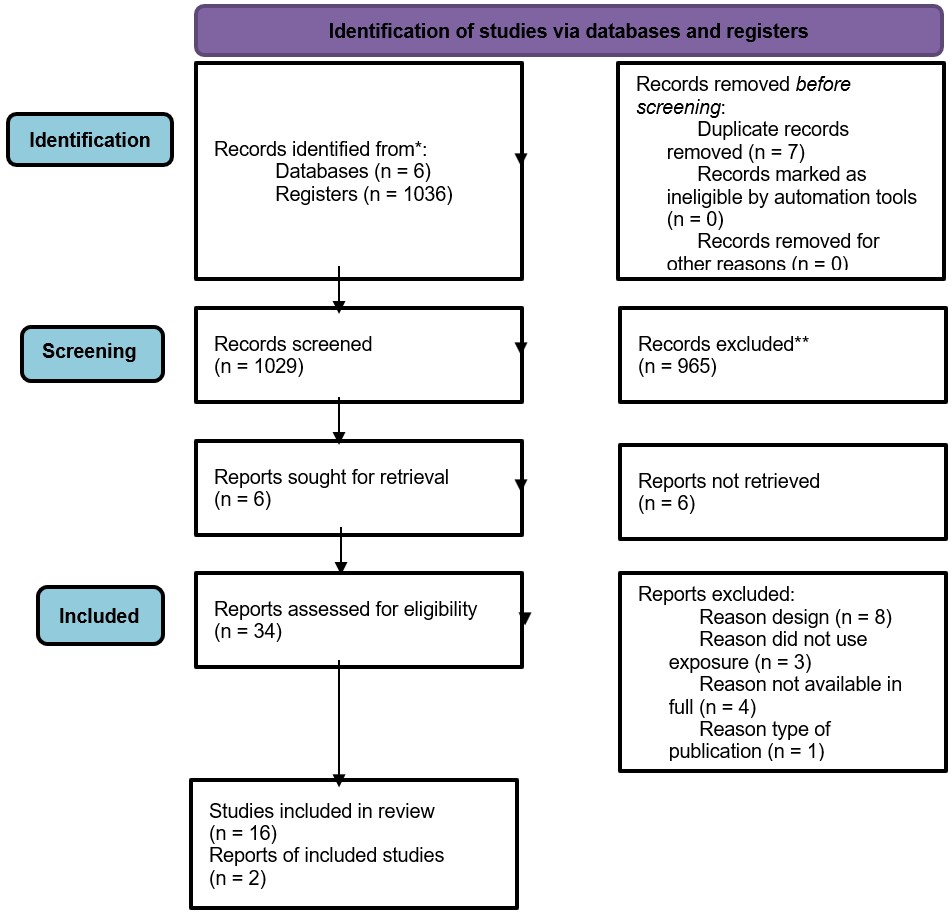 *Consider, if feasible to do so, reporting the number of records identified from each database or register searched (rather than the total number across all databases/registers)**If automation tools were used, indicate how many records were excluded by a human and how many were excluded by automation toolsFrom: Page et al.(