 PRIMARY MANAGEMENT EVALUATION OF SPINAL CASES BY PHYSICIANS IN SãO PAULO HEALTH NETWORKS
ABSTRACT
Objectives: To evaluate the clinical management of spinal pathologies by non-specialist medical professionals in the healthcare networks of the state of São Paulo.
Methods: This descriptive cross-sectional observational study was conducted through self-administered online questionnaires.
Results: Forty-five responses were obtained, 82% being family and community physicians and 52% having less than five years of graduation. Of the respondents, 91.5% felt capable of initially managing spine cases, and 62.2% reported occasionally referring cases. Only 52.2% worked in institutions that had a referral protocol for specialized care. There was no difference between the analyzed groups regarding the time of training.
Conclusion: Healthcare professionals still lack sufficient resources to assist decision-making, and excessive referrals to specialized care still occur. To mitigate these problems, it is essential for healthcare professionals to have access to updated clinical guidelines and appropriate screening tools to assist in referral decision-making. Level of Evidence III; Retrospective Comparative Study.
Keywords:
Primary Health Care; Spine; Diagnostic Reference Levels
RESUMO
Objetivos: Avaliar o manejo clínico de patologias da coluna vertebral por profissionais médicos não especialistas da área nas redes de saúde do estado de São Paulo.
Métodos: Trata-se de estudo descritivo observacional transversal realizado por meio de questionários autoaplicáveis online.
Resultados: Foram obtidas 45 respostas, sendo 82% médicos de família e comunidade, 52% com menos de cinco anos de graduação. Dos respondentes, 91,5% sentiram-se aptos à condução inicial de casos de coluna e 62,2% relataram encaminhar os casos ocasionalmente. Apenas 52,2% trabalhavam em instituições que dispunham de protocolo de encaminhamento à atenção especializada. Não houve diferença entre os grupos analisados quanto ao tempo de formação.
Conclusão: Os profissionais de saúde ainda não dispõem de recursos suficientes para auxílio à tomada de decisão e ainda ocorrem encaminhamentos em excesso para a atenção especializada. Para mitigar esses problemas, é essencial que os profissionais, não especialistas em coluna, tenham acesso a diretrizes clínicas atualizadas e ferramentas de triagem adequadas para ajudar na tomada de decisões antes do referenciamento à atenção especializada ou ao cuidado terciário. Nível de Evidência III; Estudo Retrospectivo Comparativo.
Descritores:
Atenção Primária à; Saúde; Coluna Vertebral; Níveis de Referência de Diagnóstico
RESUMEN
Objetivos: Evaluar el manejo clínico de patologías de la columna vertebral por parte de profesionales médicos no especialistas en el área en las redes de salud del estado de São Paulo.
Métodos: Se trata de un estudio descriptivo observacional transversal realizado mediante cuestionarios auto aplicables en línea.
Resultados: Se obtuvieron 45 respuestas, siendo el 82% médicos de familia y comunidad, y el 52% con menos de cinco años de graduación. De los encuestados, el 91,5% se sintió capaz de llevar a cabo inicialmente casos de columna, y el 62,2% informó que ocasionalmente remitía casos. Solo el 52,2% trabajaba en instituciones que contaban con un protocolo de remisión a la atención especializada. No hubo diferencia entre los grupos analizados en cuanto al tiempo de formación.
Conclusión: Los profesionales de la salud aún no disponen de recursos suficientes para ayudar en la toma de decisiones y aún se producen referencias excesivas a la atención especializada. Para mitigar estos problemas, es esencial que los profesionales de la salud tengan acceso a pautas clínicas actualizadas y herramientas de cribado adecuadas para ayudar en la toma de decisiones sobre remisiones. Nivel de Evidencia III; Estudio Retrospectivo Comparativo.
Descriptores:
Atención Primaria de Salud; Columna Vertebral; Niveles de Referencia para Diagnóstico
INTRODUCTION
Spinal pathologies affect a significant portion of the population every year, resulting in intense pain or neurological deficits, which can develop rapidly or progress over time, leading to disability and permanent changes in functionality.1-4 The impact of these conditions on quality of life is significant, affecting people of all ages and genders.
Before referral to a specialist, an appropriate approach by the teams at health units who act as the gateway and access to the care network is essential to identify these pathologies early on, provide efficient management, and correctly refer patients to a specialist to ensure a more favorable clinical evolution and better use of available resources.4-5 Health professionals, especially family and community doctors and general practitioners, play a crucial role in this context and must adopt a comprehensive and multidisciplinary approach to deal with the complexity of these conditions. This implies recognizing the biopsychosocial factors that can influence patients’ clinical condition and prognosis and being aware of warning signs that require priority referral.6
Most spinal disorders involve mechanical causes with no warning signs, which non-specialists can treat with appropriate procedures and care. Referral to a specialist is only recommended in cases of suspicion or confirmed diagnosis of pathologies that require a possible need for a surgical approach or specific management with follow-up due to the significant possibility of progression and complications, such as neoplasms, infections, severe deformities, surgical fractures or when there is no satisfactory response to conservative treatment after six weeks.7
Indiscriminate referral to specialists without proper assessment and treatment has significant negative consequences for the health system. This leads to an unnecessary increase in queues, overloading the schedules of health professionals and damaging the capacity to provide care. In addition, financial resources are wasted since specialized consultations and exams require additional costs.
Thus, the aim of this study is to survey the routine of health professionals in health networks regarding spinal pathologies, both in terms of clinical management and treatment and the frequency of referrals to specialists.
METHODS
This cross-sectional observational study uses an online questionnaire designed to assess the initial management of complaints related to spinal pathologies and the routine referral to specialists. The form was applied to general practitioners, specialists, and residents from various areas who have contact with this complaint profile.
Data collection
The questionnaire was developed, tested, and validated by specialists from the Spine Group at the Federal University of São Paulo (UNIFESP). The form consisted of 20 questions, 19 of which were multiple-choice and one open-ended question with free text (Supplementary Material 1). The questionnaire consisted of three parts: (1) personal data, (2) professional training data, and (3) column pathology care profile. It was realized and hosted through the online platform RedCap,8 available at https://redcap.link/colunaEPM.
Recruitment and selection of participants
The participants were selected based on a survey of institutional links using information on the official public domain websites of basic health units in cities in São Paulo. Key professionals were selected and invited to recruit the other participants.
Inclusion and exclusion criteria
The inclusion criteria were professionals working in primary, secondary, and tertiary health networks, public or private, in the state of São Paulo. Participants should have had contact with spinal pathologies during their professional careers. The exclusion criteria were non-acceptance of the ICF, professionals not working in health networks in the state of São Paulo, and duplicates or incomplete questionnaires.
Ethical aspects
All participants read and accepted the Informed Consent Form (ICF). Personal data was kept confidential under the General Data Protection Act (LGPD) and only accessed by the researcher responsible for checking the completed questionnaires, controlling duplicates, and returning the results to participants who wished to do so. The Research Ethics Committee (CAAE) submitted and approved the research project: 75808823.1.0000.5505.
Statistical analysis
The analysis was carried out using the statistical program R Project for Statistical Computing (version 4.3.3). The variables were categorical and presented as relative and absolute frequencies.
The analysis was carried out by categorizing the sample into two groups: (1) more than five years since graduation and (2) less than five years since graduation to evaluate associations between length of training and the answers obtained. Associations between categorical variables were assessed using the chi-square test with Yates’ correction or Fisher’s exact test, as appropriate. A statistically significant difference was established based on α < 5% (p< 0.05).
RESULTS
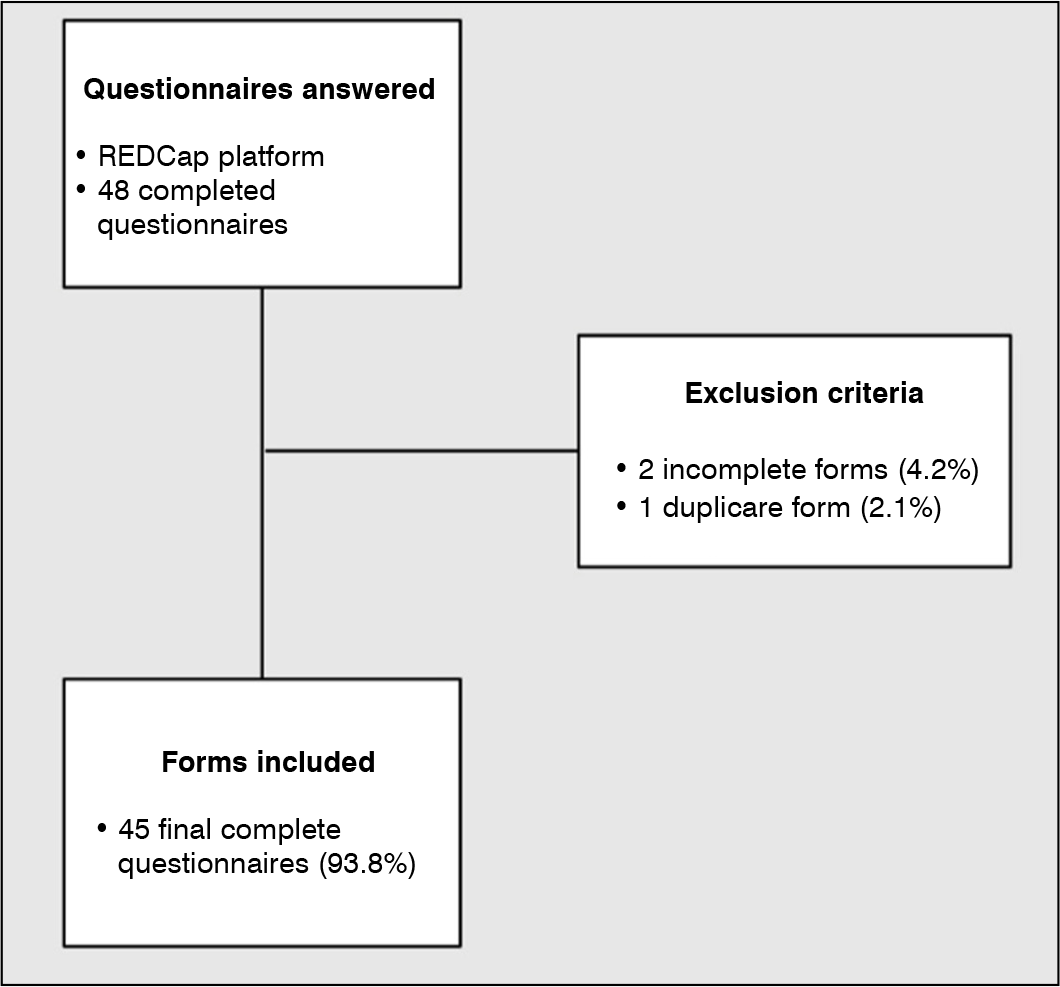
A total of 48 responses to the form were obtained, of which 45 were considered valid after applying the inclusion and exclusion criteria. (Figure 1)
Table 1 describes the sample’s demographic characteristics regarding professional training. In the general sample, 62.2% of respondents graduated from private institutions, and 53.3% graduated less than five years ago. As for residency and specialization, 64.4% took place in a public institution, and the most common area of practice was Family and Community Medicine (82.2%). As for their professional activity, 60% work in the capital, and the majority work only in the public sector (64.4%).
Regarding the profile of back care (Table 2), both groups said that they frequently or always attend cases, and 93.3% of the participants said that they felt able to deal with the cases they attended. When a referral to a specialist is necessary, the most frequently referred pathologies are fractures (88.9%), tumors (86.7%), or deformities (80.0%). There was no statistically significant difference between the groups categorized in the analysis.
Regarding the tests requested before referral to a specialist, in both groups, the most frequent test was a simple X-ray of the spine (88.9%), followed by a CT scan (62.2%). There was a tendency to request more tests, such as plain radiography, in the group formed less than five years ago (95.8% vs. 81.0% in the group formed more than five years ago), but there was no statistical difference.
In both groups, participants said that they occasionally needed to refer cases to a specialist. More than half of the sample said that the service where they worked had a protocol for referral to a specialist.
Table 3 deals with self-perception of the ability to manage spinal cases and professionals’ knowledge of the warning signs of spinal pathologies. In both groups, acute lumbar pain (95.6%), chronic pain (88.9%), and hernias (80.0%) were the main cases in which professionals felt comfortable conducting initial management.
When it came to identifying warning signs, 13.3% of participants were unable to name three warning signs. Most respondents cited neurological deficits (60%) and constitutional symptoms (48.9%). In addition, 37.3% identified at least one alarm signal incorrectly.
DISCUSSION
This study carried out a survey of the management profile and referral to specialists of spinal cases treated in the state of São Paulo health networks. As there is little data on this type of care in the Brazilian literature, the data presented here provides an overview of the current situation and helps to diagnose and resolve the problems presented.
Low back pain and neck pain are among the most frequent reasons for clinical consultation or physiotherapy in primary care, with low back pain being the largest single musculoskeletal cause of years lived with disability.2 Most cases of low back pain, whether acute or chronic, can be effectively treated in primary care. However, the data obtained shows that almost half of the cases of chronic low back pain and a third of the cases of acute low back pain are usually referred to a specialist by the professionals who treat these cases in the various health networks in the state of São Paulo. In addition, most of the sample reported referring cases frequently. Data shows that there is an over-referral to specialists. Brazil’s Primary Health Care (PHC) resolvability rate is around 70%, below the 90% expected in countries with a consolidated PHC system.9-10 This fact reflects that indiscriminate referrals to specialists persist without proper evaluation and treatment in the health networks that act as a gateway. This leads to an unnecessary increase in queues, overloading the schedules of health professionals and damaging the capacity to provide care.
In analyzing the initial imaging propaedeutics before referral to the specialist, most of the sample requested a plain X-ray, and computed tomography was the second most requested test. In addition, magnetic resonance imaging, the most accurate test for diagnosing various bone and structural lesions in the spine, was requested in less than 20% of cases before referral.7,11 This may be due to the high cost of the test or the unavailability of the test in health networks, especially in public primary care. Professionals should be trained to request imaging exams to avoid unnecessary requests for exams, which are detrimental to the patient and the health system.12 Also, they should be aware of the exams and techniques required for each type of pathology that will be referred.
Most of the professionals interviewed said they had the skills and confidence to deal initially with the most common cases encountered in health networks, such as acute and chronic low back pain and hernias. However, even in the case of complex cases, professionals should have protocols and teleconsultations or easy access to specialists for initial handling of cases, as well as help with referral and prioritization of cases according to their severity.12 Despite this, only around half of the respondents said that their work institution has a protocol for referring spinal cases. The presence of a protocol and other triage tools directs care, helping to standardize the conduct of the various professionals and aiding decision-making. Access to such tools reduces overload and unnecessary referrals.12
Another important aspect was the participants’ knowledge of the warning signs related to spinal pathologies. It is known that patients who show alarm signs should be referred with priority and agility, and initial propaedeutics should be carried out promptly. The main signs pointed out by the professionals were neurological deficits, followed by constitutional symptoms (such as fever and weight loss). However, it is important to note that 30% of the sample incorrectly identified alarm signals, with severe pain or pain unresponsive to simple analgesia being mistakenly cited as an alarm signal. In addition, factors that are warning signs, such as age and duration of pain, were cited by less than 20% of respondents. Incorrect identification of warning signs also contributes to inappropriate referrals, overloading access to specialists, and delaying the diagnosis of patients who do show warning signs.13,14 It is interesting to note that, although there was no statistical significance, incorrect identification was more common in the group trained for more than five years, reinforcing the need for training and continuing education for health professionals.
This study provided data on the initial management and referral to specialists of spinal cases in various health networks in the state of São Paulo. It was also observed that there are too many referrals to specialized care and that health professionals still don’t have enough resources to help them make decisions. To mitigate these problems, it is essential that healthcare professionals have access to up-to-date clinical guidelines and appropriate screening tools to help make decisions about referrals. In addition, continuing education programs and collaborative communication between general practitioners and specialists can contribute to a more judicious approach to referrals, ensuring that patients receive the necessary care in a timely and efficient manner while reducing the negative impact on the health system as a whole.3,15
However, this study has limitations. First, it is a self-administered questionnaire, which can lead to underestimation or overestimation of responses, resulting in response bias. Second, the sample size limits the generalizability of the findings and underestimates the association between the groups analyzed. To this end, it is necessary to repeat the study to analyze the repeatability of the findings in a more robust sample.
CONCLUSION
Health professionals still lack enough resources to help them make decisions, and there are still too many referrals to specialized care. To mitigate these problems, it is essential that healthcare professionals have access to up-to-date clinical guidelines and appropriate screening tools to help them make referral decisions.
-
Study conducted by the Federal University of São Paulo, São Paulo, SP, Brazil.
REFERENCES
-
1 Ravindra VM, Senglaub SS, Rattani A, Dewan MC, Härtl R, Bisson E, et al. Degenerative Lumbar Spine Disease: Estimating Global Incidence and Worldwide Volume. Global Spine J. 2018;8(8):784-94. doi: 10.1177/2192568218770769.
» https://doi.org/10.1177/2192568218770769. -
2 GBD 2019 Diseases and Injuries Collaborators. Global burden of 369 diseases and injuries in 204 countries and territories, 1990-2019: a systematic analysis for the Global Burden of Disease Study 2019. Lancet. 2020;396(10258):1204-22. doi: 10.1016/S0140-6736(20)30925-9. Erratum in: Lancet. 2020;396(10262):1562.
» https://doi.org/10.1016/S0140-6736(20)30925-9. -
3 Buchbinder R, van Tulder M, Öberg B, Costa LM, Woolf A, Schoene M, et al. Low back pain: a call for action. Lancet (London, England). 2018;391(10137):2384-8. doi: 10.1016/S0140-6736(18)30488-4.
» https://doi.org/10.1016/S0140-6736(18)30488-4. -
4 Babu JM, Patel SA, Palumbo MA, Daniels AH. Spinal Emergencies in Primary Care Practice. Am J Med. 2019;132(3):300-6. doi: 10.1016/j.amjmed.2018.09.022.
» https://doi.org/10.1016/j.amjmed.2018.09.022. -
5 Bussières AE, Taylor JA, Peterson C. Diagnostic imaging practice guidelines for musculoskeletal complaints in adults-an evidence-based approachpart 3: spinal disorders. J Manipulative Physiol Ther. 2008;31(1):33-88. doi: 10.1016/j.jmpt.2007.11.003.
» https://doi.org/10.1016/j.jmpt.2007.11.003. -
6 Henschke N, Maher CG, Refshauge KM, Herbert RD, Cumming RG, Bleasel, J, et al. Prevalence of and screening for serious spinal pathology in patients presenting to primary care settings with acute low back pain. Arthritis Rheum. 2009;60(10):3072-80. doi: 10.1002/art.24853.
» https://doi.org/10.1002/art.24853. -
7 Koes BW, van Tulder M, Lin CW, Macedo LG, McAuley J, Maher C. An updated overview of clinical guidelines for the management of non-specific low back pain in primary care. Eur Spine J. 2010;19(12):2075-94. doi: 10.1007/s00586-010-1502-y.
» https://doi.org/10.1007/s00586-010-1502-y. -
8 Harris PA, Taylor R, Thielke R, Payne J, Gonzalez N, Conde JG. Research electronic data capture (REDCap)--a metadata-driven methodology and workflow process for providing translational research informatics support. J Biomed Inform. 2009;42(2):377-81. doi: 10.1016/j.jbi.2008.08.010.
» https://doi.org/10.1016/j.jbi.2008.08.010. - 9 Mendes EV. O cuidado das condições crônicas na atenção primária à saúde: o imperativo da consolidação da estratégia da saúde da família. Brasília: Organização Pan-Americana da Saúde; 2012.
- 10 Gérvas J, Fernández MP. Como construir uma atenção primária forte no Brasil: É possível transformar o círculo vicioso de má qualidade em um círculo virtuoso de boa qualidade, no trabalho clínico e comunitário na atenção primária no Brasil. Sociedade Brasileira de Medicina de Família e Comunidade. Rio de Janeiro; 2011.
- 11 Guevara-Lopez U, Covarrubias-Gomez A, Elias-Dib J, Reyes-Sanchez A, Rodriguez-Reyna TS. Consensus group of practice parameters to manage low back P. Practice guidelines for the management of low back pain. Consensus group of practice parameters to manage low back pain. Cir Cir. 2011;79(3):264-79.
-
12 Oliveira CB, Maher CG, Pinto RZ, Traeger AC, Lin CC, Chenot JF, et al. Clinical practice guidelines for the management of non-specific low back pain in primary care: an updated overview. Eur Spine J. 2018;27(11):2791-803. doi: 10.1007/s00586-018-5673-2.
» https://doi.org/10.1007/s00586-018-5673-2. -
13 Corp N, Mansell G, Stynes S, Wynne-Jones G, Morsø L, Hill JC, et al. Evidence-based treatment recommendations for neck and low back pain across Europe: A systematic review of guidelines. Eur J Pain. 2021;25(2):275-95. doi:10.1002/ejp.1679.
» https://doi.org/10.1002/ejp.1679. -
14 Fritz JM, Lane E, McFadden M, Brennan G, Magel JS, Thackeray A, et al. Physical Therapy Referral from Primary Care for Acute Back Pain with Sciatica: A Randomized Controlled Trial. Ann Intern Med. 2021;174(1):8-17. doi: 10.7326/M20-4187.
» https://doi.org/10.7326/M20-4187. -
15 Goertz CM, Weeks WB, Justice B, Haldeman S. A proposal to improve health-care value in spine care delivery: the primary spine practitioner. Spine J. 2017;17(10):1570-4. doi: 10.1016/j.spinee.2017.06.013.
» https://doi.org/10.1016/j.spinee.2017.06.013.
Edited by
-
Reviewed by:
Alexandre Fogaça Cristante