 INTRAOPERATIVE RADIOTHERAPY COMBINED WITH KYPHOPLASTY (KYPHO-IORT) FOR VERTEBRAL METASTASES: A LITERATURE REVIEW
ABSTRACT
Objective: To review the current literature on intraoperative radiotherapy combined with kyphoplasty (Kypho-IORT) in spinal metastases, highlighting its advantages, limitations, and future perspectives.
Methods: A structured narrative review was conducted with a PubMed search using predefined descriptors and inclusion criteria. After screening, 11 relevant studies were selected describing the technique and its applicability, as well as its outcomes in patients with spinal metastases.
Results: The reviewed studies varied, including descriptions and feasibility of the surgical technique, procedural learning curve studies, and retrospective and prospective cohort studies presenting the technique’s results. The technical feasibility of the technique was observed to be feasible and reproducible, and it is capable of producing satisfactory results in pain control and local disease control. Doses of radiotherapy considered safe are also described.
Conclusions: Kypho-IORT is a technique that has proven effective in providing pain relief and local control of the disease in the spine and becomes a viable alternative in the treatment of metastatic vertebral diseases. However, conventional radiotherapy still remains the gold standard in the evolution of treatment. Level of Evidence V; Non-Systematic Structured Narrative Review.
Keywords:
Kyphoplasty; Radiotherapy; Intraoperative; Brachytherapy; Spine; Spinal Neoplasms; Vertebral Fractures
RESUMO
Objetivo: Revisar a literatura atual acerca do sobre radioterapia intra operatória associada com cifoplastia (Kypho-IORT) em metástases vertebrais, destacando suas vantagens, limitações e perspectivas futuras.
Métodos: Realizou-se uma revisão narrativa estruturada com busca na base PubMed, utilizando descritores e critérios de inclusão predefinidos. Após triagem, selecionaram-se 11 estudos relevantes sobre a descrição da técnica e sua aplicabilidade além dos desfechos em pacientes com metástase vertebral.
Resultados: Os estudos revisados foram variados entre descrição e viabilidade da técnica cirúrgica, estudo de curva de aprendizado do procedimento e estudos de coorte retrospectiva e prospectiva apresentando os resultados da técnica. Observou-se a viabilidade técnica da técnica é factível e reprodutível e é capaz de trazer resultados satisfatórios no controle de dor e controle local da doença. Também são descritas as doses consideradas seguras de radioterapia.
Conclusões: O Kypho-IORT é uma técnica que se mostrou eficaz em trazer alivio da dor e controle local da doença na vertebra e se torna uma alternativa viável no tratamento das doenças vertebrais metastáticas, porém a radioterapia convencional ainda continua sendo o padrão ouro na evolução do tratamento. Nível de Evidência V; Revisão Narrativa Estruturada não sistemática.
Descritores:
Cifoplastia; Radioterapia; Intraoperatória; Braquiterapia; Coluna Vertebral; Neoplasias da Coluna Vertebral; Fraturas Vertebrais
RESUMEN
Objetivo: Revisar la literatura actual sobre radioterapia intraoperatoria combinada con cifoplastia (Kypho-IORT) para metástasis espinales, destacando sus ventajas, limitaciones y perspectivas futuras.
Métodos: Se realizó una revisión narrativa estructurada mediante una búsqueda en PubMed utilizando descriptores predefinidos y criterios de inclusión. Tras la selección, se seleccionaron 11 estudios relevantes que describen la técnica y su aplicabilidad, así como sus resultados en pacientes con metástasis espinales.
Resultados: Los estudios revisados fueron diversos, incluyendo descripciones y viabilidad de la técnica quirúrgica, estudios de la curva de aprendizaje del procedimiento y estudios de cohorte retrospectivos y prospectivos que presentan los resultados de la técnica. Se observó que la técnica es factible y reproducible, y capaz de producir resultados satisfactorios en el control del dolor y la enfermedad local. También son descriptas las dosis de radioterapia consideradas seguras.
Conclusiones: La Kypho-IORT es una técnica que ha demostrado su eficacia en el alivio del dolor y el control local de la enfermedad espinal y se convierte en una alternativa viable en el tratamiento de las enfermedades vertebrales metastásicas. Sin embargo, la radioterapia convencional sigue siendo el estándar de oro en la evolución del tratamiento. Nivel de Evidencia V; Revisión narrativa estructurada no sistemática.
Descriptores:
Cifoplastia, Radioterapia; Intraoperatoria; Braquiterapia; Columna Vertebral; Neoplasias de la Columna Vertebral; Fracturas Vertebrales
INTRODUCTION
The spine is the most common site of bone metastasis in systemic tumors. Among patients with bone metastases, 40% will develop vertebral fractures, and 90% of them will present with severe pain.1-5
Approximately 50% of all bone metastases occur in the spine; 60% to 80% of these are located in the thoracic spine, followed by 15% to 30% in the lumbar spine, and less than 10% in the cervical spine. The main complications of spinal metastases include pain and neurological dysfunction, potential hypercalcemia, reduced mobility, and bone fractures, ultimately leading to decreased quality of life.6-9
Although the median overall survival of patients with bone metastases is only 7 to 9 months, half of them live longer and will require some form of palliative treatment for their symptoms.10-12
Among the available treatments for vertebral metastases confined to the vertebral body are radiotherapy and minimally invasive cement augmentation techniques, which are commonly employed to preserve neurological function, stabilize the spine, and provide pain relief.13
Percutaneous kyphoplasty and vertebroplasty are widely used minimally invasive techniques for treating patients with osteoporotic fractures and painful spinal metastases.12,13
Vertebroplasty was introduced by Galibert and Deramond14 in 1984 in France for the treatment of hemangiomas at C2. Balloon kyphoplasty was first performed in 1998 and consists of a minimally invasive surgical technique aimed at correcting kyphosis secondary to vertebral body collapse through the use of an intrasomatic balloon, followed by injection of bone cement into the cavity created.14,15
As a well-established first-line treatment with consolidated results in the literature, external beam radiotherapy (EBRT) is widely used in vertebral metastases, with variations in dose and number of fractions. This method offers acceptable rates of local control; however, pain relief typically occurs gradually and may take weeks or even months after treatment initiation, even when combined with bisphosphonates.16–19
In parallel, spinal stereotactic body radiotherapy (SBRT/SRS) – which includes both Stereotactic Body Radiotherapy (SBRT) and Spinal Stereotactic Radiosurgery (SRS) – delivers higher doses, often in a single or a few fractions, with high precision, resulting in excellent local control and, in some cases, comparable or superior pain response to conventional EBRT.19–23 This technique has evolved with advances in imaging, guidance systems, and intensity or volumetric modulation, allowing better dose targeting and a theoretical reduction in adverse effects. Nevertheless, ablative doses can lead to vertebral compression fractures in up to 40% of patients in the long term, and randomized studies have not yet consistently demonstrated superiority over conventional radiotherapy in achieving the primary outcome of pain response at three months.22–26
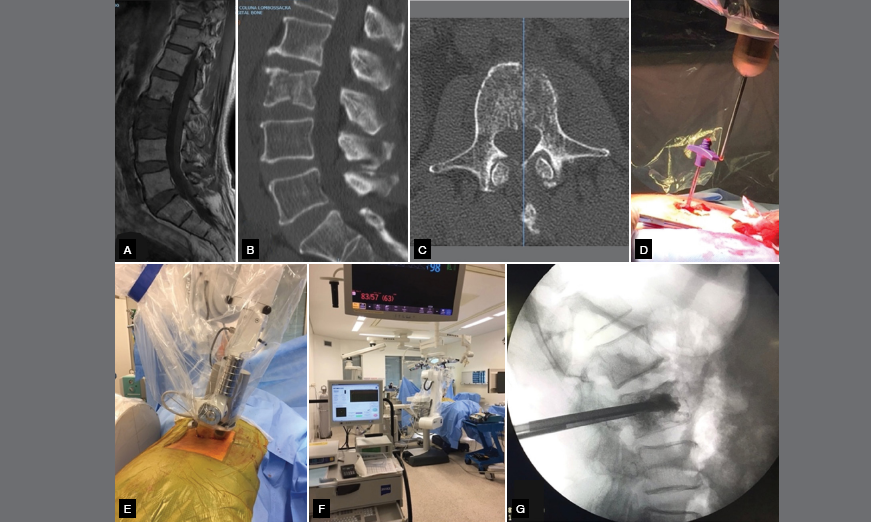
Despite the effectiveness of radiotherapy techniques, these modalities require multiple sessions and may delay clinical response. Thus, in 2010, Wenz and Schneider developed a technique combining intraoperative radiotherapy with kyphoplasty (Kypho-IORT – Intraoperative Radiotherapy Kyphoplasty). In this approach, through a transpedicular surgical access using working cannulas for balloon kyphoplasty stabilization, an intraoperative radiotherapy device (Intrabeam® – Carl Zeiss Surgical, Oberkochen, Germany) is coupled. This allows the simultaneous delivery of a high, localized, single dose of radiotherapy along with the surgical stabilization provided by balloon kyphoplasty.27 (Figure 1)

Steps of the Kypho-IORT procedure in a patient with vertebral metastasis in L3: a – Magnetic resonance imaging; b, c – Computed tomography; d, e, f – Applicator and moment of application; g – Kyphoplasty.
Given this scenario, the objective of this study is to review the current literature on Kypho-IORT in light of the latest evidence, with a focus on its clinical applicability, advantages, limitations, and future perspectives.
Methodology
A structured narrative review was conducted with the aim of evaluating the current literature on the topic of Kypho-IORT, in light of the most recent knowledge regarding its clinical applicability, advantages, limitations, and future perspectives.
Search Strategy
The literature search was performed exclusively in the PubMed/MEDLINE database, without restrictions on date or language.
Free-text terms and MeSH (Medical Subject Headings) descriptors were used, combined with Boolean operators, covering topics related to Kypho-IORT.
The search strategy employed was: “Kypho-IORT” AND “intraoperative radiotherapy” AND “vertebral metastases” AND/OR “kyphoplasty”.
The data were organized and discussed qualitatively, according to their clinical and scientific relevance.
Inclusion and Exclusion Criteria
Original articles, systematic reviews, narrative reviews, experimental studies, guidelines, and expert consensus documents addressing the topic of Kypho-IORT were included. Incomplete texts and animal studies were excluded.
Study Selection and Data Extraction
The selection process was conducted in two stages: screening of titles and abstracts, followed by full-text reading of potentially eligible articles. For each included study, the following information was extracted: authors, year of publication, type of study, population analyzed, main objectives, and key conclusions. The data were organized in a standardized spreadsheet for narrative synthesis.
Data Analysis
The selected studies were analyzed descriptively, focusing on the identification of the advantages and limitations of Kypho-IORT.
Results
The search yielded 24 results, of which 13 were excluded due to the unavailability of full-text articles. After reviewing titles, abstracts, and full texts, a total of 11 publications met the inclusion criteria.
The studies are listed in Table 1.
The published experience on Kypho-IORT includes different types of clinical and technical studies. The first case report27 described a patient with painful vertebral metastasis treated in under 90 minutes, with immediate pain relief and no complications. A methodological study involving the analysis of 53 CT scans and application in a cadaver36 estimated eligibility in 23% to 34% of patients with unstable metastases, with an average additional procedure time of 15 minutes and a maximum spinal cord dose of 3.8 Gy. A pilot clinical study29 included 17 patients (20 vertebrae), with technical success in 90% of cases and no major complications.
The first clinical outcomes study30 included 18 patients (21 vertebrae), showing a success rate of 86%, a reduction in pain from a VAS score of 5 to 2.5 on the first day and to 0 at six weeks, along with 93% local control. Learning curve studies31 evaluated 53 procedures in 43 patients, reporting no technical failures after the 25th procedure and a mean time of 42.6–61.2 minutes per vertebra. A cumulative experience analysis32 reported 81 patients (102 vertebrae), with over 100 successful procedures, no technical issues beyond the 23rd case, and an average duration of 65 minutes per patient.
A technological advancement in image-guided planning33 was described in a case report, with a planning time of 5.3 minutes and a 40% increase in the minimum dose delivered to the target. Another case report34 documented the treatment of an aggressive hemangioma, with no complications and immediate neurological recovery. A phase I/II clinical trial13 included 61 patients (76 vertebrae), reporting no dose-limiting toxicities, pain reduction of ≥3 points in 69.8% of patients on the first day, and 93.8% local control at 12 months. A randomized phase III trial protocol35 projected enrollment of 54 patients to evaluate immediate pain relief, local control, and quality of life. The largest published cohort٣٦ included 104 patients (143 vertebrae), with local control rates of 97.1%, 95.9%, and 94.2% at 6, 12, and 24 months, respectively, overall survival rates of 74.6%, 61.7%, and 50.3% at the same intervals, and only one serious adverse event reported.
Discussion
The literature on Kypho-IORT has evolved from initial technical reports to more methodologically robust clinical trials. The first case report by Wenz27 in 2010 demonstrated the technical feasibility of the procedure, with surgical time under 90 minutes and immediate pain relief, without relevant adverse events, reinforcing the minimally invasive nature of the approach.27
Subsequently, a methodological study on cadavers and a retrospective analysis of CT scans33 estimated that 23% to 34% of patients with unstable vertebral metastases could be eligible for the procedure, documenting low spinal cord radiation dose and minimal additional time required for intraoperative radiotherapy.33
The first pilot clinical study included 17 patients (20 vertebrae), confirming the clinical feasibility and safety of the procedure, although in 10% of cases radiotherapy could not be applied due to technical difficulties.29
Following this, accumulated clinical experience involving 18 patients demonstrated a technical success rate of 86%, immediate pain reduction (VAS score from 5 to 2.5 on day 1 and 0 at six weeks), and short-term local control of 93%.30
Learning curve studies and cumulative experience analyses in 81 patients showed that the technique is teachable, with a low complication rate and progressive improvement in procedural precision.31-32
Technological advances – such as image-guided planning and tissue heterogeneity correction – have enhanced dosimetric precision, reflecting growing concern for spinal cord safety.33 The first reported benign indication (aggressive hemangioma) demonstrated safety and efficacy beyond oncological applications.33
The first formal phase I/II clinical trial13 with 61 patients (76 vertebrae) confirmed the absence of dose-limiting toxicities (DLTs), sustained pain relief (≥3-point reduction in 69.8% of patients on day 1), and excellent local control (93.8% at 12 months).13 A randomized phase III trial was planned to compare the technique with external beam radiotherapy (EBRT), aiming to generate level 1 evidence and evaluate clinical, oncological, and quality of life outcomes.35
Finally, the largest cohort published to date, comprising 104 patients and 143 treated vertebrae, reported 94.2% local control at 24 months and a very low rate of serious adverse events, reinforcing both the durability of the response and the method’s safety.36
The evolution of Kypho-IORT literature reflects a typical trajectory for emerging technologies – moving from proof of concept to clinical consolidation based on patient prognosis. Initially, case reports and feasibility studies in cadavers and small clinical series demonstrated the procedure’s safety and feasibility, essential in patients with limited prognosis and refractory pain.27-29
Subsequent pilot studies and learning curve analyses confirmed the reproducibility and teachability of the technique, supporting its adoption in centers experienced with minimally invasive spinal surgery.31-32
The inclusion of oligometastatic patients or those with sufficient life expectancy to justify a more aggressive local approach enabled the demonstration of not only immediate pain relief but also sustained local control and low complication rates – outcomes aligned with the prognostic goals of these patients.13,30,36
Finally, the execution of a randomized clinical trial comparing the technique to conventional EBRT aims to provide level 1 evidence, assessing whether the one-stop strategy can offer superior clinical benefits in individuals whose oncological course allows prioritization of quality of life and early local control.35
Despite the promising results demonstrated by studies on Kypho-IORT since its initial description by Wenz27 and Schneider,28 external beam radiotherapy (EBRT) remains the gold standard for the treatment of vertebral metastases – often in combination with stabilization procedures such as vertebroplasty or kyphoplasty.
Additionally, stereotactic radiotherapy (SBRT/SRS) has gained traction as an advanced option for patients with better prognosis and localized disease, allowing the delivery of ablative doses with high precision and excellent local control rates – even in radioresistant tumors.
Kypho-IORT, on the other hand, remains an emerging technique, with a growing scientific foundation but without robust, consolidated evidence of clinical superiority over standard therapies. Nevertheless, its ability to provide immediate pain relief, spinal stabilization, and early local control in a single procedure makes it a potentially valuable alternative for selected patients – especially those with painful lesions, mechanical instability, and a life expectancy compatible with a more aggressive local approach.
Thus, although it does not replace conventional approaches or stereotactic radiotherapy, Kypho-IORT represents a developing field with potential for integration into the therapeutic arsenal of centers with appropriate technical expertise and careful patient selection.
CONCLUSION
Kypho-IORT is a minimally invasive approach that combines vertebral stabilization and localized radiotherapy delivery in a single procedure for selected cases. Early studies have demonstrated its technical feasibility, safety, and effectiveness in providing immediate pain relief and local disease control in patients with vertebral metastases. However, larger-scale clinical studies are still needed to validate its effectiveness. Thus, Kypho-IORT may be considered a promising option, particularly in specialized centers and carefully selected patients.
-
Study conducted by the Hospital Alemão Oswaldo Cruz.
REFERENCES
- 1 Bohm P, Huber J. The surgical treatment of bony metastases of the spine and limbs. J Bone Joint Surg Br. 2002;84(4):521–9.
- 2 Perrin RG, Laxton AW. Metastatic spine disease: epidemiology, pathophysiology, and evaluation of patients. Neurosurg Clin N Am. 2004; 15(4):365–73.
- 3 Ryken TC, Eichholz KM, Gerszten PC, Welch WC, Gokaslan ZL, Resnick DK. Evidence-based review of the surgical management of vertebral column metastatic disease. Neurosurg Focus. 2003;15(5):E11.
- 4 Pratali RR, Risso Neto MI, Zuiani GR, Cavali PTM, Pasqualini W, Veiga IG, et al. Reproducibility analysis of the stability and treatment of vertebral metastatic lesions. Coluna/Columna. 2014;13(3):294-7
- 5 Silva HJSS, Risso Neto MI, Pratali RR, Zuiani GR, Cavali PTM, Veiga IG, et al. Avaliação da reprodutibilidade interobservadores de uma nova escala para orientação da conduta terapêutica nas metástases vertebrais - escore SINS (spine instability neoplastic score). Coluna/Columna. 2012;11(4):287-9.
- 6 Bartels RH, van der Linden YM, van der Graaf WT. Spinal extradural metastasis: Review of current treatment options. CA Cancer J Clin 2008; 58(4):245–59
- 7 Mercadante S. Malignant bone pain: Pathophysiology and treatment. Pain 1997;69) 1-2):1–18.
- 8 Sheehan JP, Jagannathan J. Review of spinal radiosurgery: A minimally invasive approach for the treatment of spinal and paraspinal metastases. Neurosurg Focus. 2008;25(2):E18.
- 9 Jagas M, Patrzyk R, Zwolinski J, Kołodziejczyk A, Sakowski J, Pudełko M, et al. Vertebroplasty with methacrylate bone cement and radiotherapy in the treatment of spinal metastases with epidural spinal cord compression. Preliminary report. Ortop Traumatol Rehabil. 2005; 7(5):491–8.
- 10 Steenland E, Leer JW, van Houwelingen H, Post WJ, van den Hout WB, Kievit J, et al. The effect of a single fraction compared to multiple fractions on painful bone metastases: a global analysis of the Dutch Bone Metastasis Study. Radiother Oncol. 1999;52(2): 101-9.
- 11 Yarnold YR. 8 Gy single fraction radiotherapy for the treatment of metastatic skeletal pain: randomised comparison with a multifraction schedule over 12 months of patient follow-up. Bone pain trail working party. Radiother Oncol. 1999;5(2)2:111-21.
- 12 Ratanatharathorn V, Powers WE, Moss WT, Perez CA. Bone metastases: review and critical analysis of random allocation trials of local field treatment. Int J Radiat Oncol Biol Phys.1999;44(1):1-18.
- 13 Bludau F, Welzel G, Reis T, Schneider F, Sperk E, Neumaier C, et al. Phase I/II trial of combined kyphoplasty and intraoperative radiotherapy in spinal metastases. Spine J. 2018;18(5):776-81
- 14 Galibert P, Deramond H, Rosat P, Le Gars D. Preliminary note on the treatment of vertebral angioma by percutaneous acrylic vertebroplasty. NeuroChirurgie. 1987;33(2):166–8.
- 15 Wang B, Zhao CP, Song LX, Zhu L. Balloon kyphoplasty versus percutaneous vertebroplasty for osteoporotic vertebral compression fracture: a meta-analysis and systematic review. J Orthop Surg Res. 2018;13(1):264
- 16 Gerszten PC, Mendel E, Yamada Y. Radiotherapy and Radiosurgery for metastatic spine disease: what are the options, indications, and outcomes? Spine. 2009;34(22 Suppl): S78-92.
- 17 van der Linden YM, Steenland E, van Houwelingen HC, Post WJ, Oei B, Dutch Bone Metastasis Study Group; et al. Patients with a favourable prognosis are equally palliated with single and multiple fraction radiotherapy: results on survival in the Dutch Bone Metastasis Study. Radiother Oncol. 2006;78(3):245-53.
- 18 Rades D, Veninga T, Stalpers LJ, Basic H, Rudat V, Karstens JH, et al. Outcome after radiotherapy alone for metastatic spinal cord compression in patients with oligometastases. J Clin Oncol.2007;25(1):50-6.
- 19 Souchon R, Wenz F, Sedlmayer F, e Budach W, Dunst J, Feyer P, et al. DEGRO practice guidelines for palliative radiotherapy of metastatic breast cancer: bone metastases and metastatic spinal cord compression (MSCC). Strahlenther Onkol. 2009;185(7):417–24.
- 20 Sahgal A, Larson DA, Chang EL. Stereotactic body radiosurgery for spinal metastases: a critical review. Int J Radiat Oncol Biol Phys. 2008;71(3):652–65.
- 21 Moulding HD, Elder JB, Lis E, Lovelock DM, Zhang Z, Yamada Y, et al. Local disease control after decompressive surgery and adjuvant high-dose single-fraction radiosurgery for spine metastases. J Neurosurg Spine. 2010; 13(1):87–93.
- 22 Sahgal A, Bilsky M, Chang EL, Ma L, Yamada Y, Rhines LD, et al. Stereotactic body radiotherapy for spinal metastases: current status, with a focus on its application in the postoperative patient. J Neurosurg Spine. 2011; 14(2):151–66.
- 23 Sheehan JP, Shaffrey CI, Schlesinger D, Williams BJ, Arlet V, Larner J. Radiosurgery in the treatment of spinal metastases: tumor control, survival, and quality of life after helical tomotherapy. Neurosurgery 2009;65(6):1052–61 discussion 61-2.
- 24 Rose PS, Laufer I, Boland PJ, Hanover A, Bilsky MH, Yamada J, et al. Risk of fracture after single fraction image-guided intensity-modulated radiation therapy to spinal metastases. J Clin Oncol. 2009;27(30):5075–9.
- 25 Ryu S, Deshmukh S, Timmerman RD, Movsas B, Gerszten P, Yin FF, et al. Stereotactic Radiosurgery vs Conventional Radiotherapy for Localized Vertebral Metastases of the Spine: Phase 3 Results of NRG Oncology/RTOG 0631 Randomized Clinical Trial. JAMA Oncol. 2023;9(6):800-7.
- 26 Adida S, Taori S, Donohue JK, Rajan A, Sefcik RK, Burton SA, et al. Stereotactic radiosurgery for patients with spinal metastases from prostate cancer. J Neurooncol. 2024;170(3):631-9.
- 27 Wenz F, Schneider F, Neumaier C, Kraus-Tiefenbacher U, Reis T, Schmidt R, et al. Kypho-IORT – A novel approach of intraoperative radiotherapy during kyphoplasty for vertebral metastases. Radiat Oncol.2010;5:11.
- 28 Schneider F, Greineck F, Clausen S, Mai S, Obertacke U, Reis T, et al. Development of a novel method for intraoperative radiotherapy during kyphoplasty for spinal metastases (Kypho-IORT). Int J Radiat Oncol Biol Phys. 2011;81(4):1114-9.
- 29 Schmidt R, Wenz F, Reis T, Janik K, Bludau F, Obertacke U. Kyphoplasty and intra-operative radiotheray, combination of kyphoplasty and intra-operative radiation for spinal metastases: technical feasibility of a novel approach. Int Orthop. 2012;36(6):1255-60.
- 30 Reis T, Schneider F, Welzel G, Schmidt R, Bludau F, Obertacke U, et al. Intraoperative radiotherapy during kyphoplasty for vertebral metastases (Kypho-IORT): first clinical results. Tumori. 2012;98(4):434-40.
- 31 Bludau F, Schmidt R, Schneider F, Reis T, Wenz F, Obertacke U, et al. Learning and teaching abilities of a newly inaugurated operation technique. Analysis of learning curves and transferability exemplified by Kypho-IORT. Orthopade. 2013;42(9):7712-9.
- 32 Bludau F, Reis T, Schneider F, Clausen S, Wenz F, Obertacke U. Kyphoplasty combined with intraoperative radiotherapy (Kypho-IORT). Alternative therapy for patients with oligometastatic spinal metastases. Radiologe. 2015;55(10):859-67.
- 33 Schneider F, Bludau F, Clausen S, Fleckenstein J, Obertacke U, Wenz F. Precision IORT - Image guided intraoperative radiation therapy (igIORT) using online treatment planning including tissue heterogeneity correction. Phys Med. 2017; 37:82-87.
- 34 Pinar Sedeño B, Rodríguez Ibarria N, Mhaidli Hamdani H, Fernández Varela T, San Miguel Arregui I, Macías Verde D, et al. First reported treatment of aggressive hemangioma with intraoperative radiation therapy and kyphoplasty (Kypho-IORT). Clin Transl Radiat Oncol. 2017;2:19-22.
- 35 Bludau F, Welzel G, Reis T, Abo-Madyan Y, Sperk E, Schneider F, et al. Combined kyphoplasty and intraoperative radiotherapy (Kypho-IORT) versus external beam radiotherapy (EBRT) for painful vertebral metastases - a randomized phase III study. BMC Cancer. 2019;19(1):430.
- 36 Bludau F, Winter L, Welzel G, Obertacke U, Schneider F, Wenz F, et al. Long-term outcome after combined kyphoplasty and intraoperative radiotherapy (Kypho-IORT) for vertebral tumors. Radiat Oncol. 2020;15(1):263.